
❌

Normal view

Exploring 'very low Earth orbit': The world's 1st air-breathing satellite thruster could soon get a test run

9 August 2026 at 15:00

A new way to move around Earth's outer atmosphere could soon get a field test.

The Spanish company Kreios Space plans to launch into orbit the world's first satellite that uses scooped-up air to push it forward, the company announced on Tuesday (Aug. 4).

The technology Kreios Space has been developing is called air-breathing electric propulsion (ABEP). It relies on air sourced from Earth's atmosphere, which is then heated up, ionized and expelled to generate thrust.

Diagram showing the different types of orbit around Earth.

Diagram showing the different types of orbit around Earth. (Image credit: ESA)

This method will allow satellites in very low Earth orbit (VLEO) β€” the region from roughly 60 miles to 250 miles (100 to 400 kilometers) above our planet β€” to counteract atmospheric drag without the aid of liquid fuel.

"Kreios is building the satellites that make sustained operations in very low Earth orbit possible," Kreios Space CEO AdriΓ‘n Senar said in the Aug. 4 announcement.

"By enabling satellites to fly lower, longer and more efficiently, we are enabling higher-resolution Earth observation, much better satellite communications, more responsive and accurate missions and a more sustainable orbital infrastructure," he continued.

Kreios Space chose Lithuanian-based Kongsberg NanoAvionics to provide the satellite bus that will carry the ABEP system into orbit for the test run.

"Kreios is tackling one of the most demanding operating environments in space, and this mission joins a very short list of European VLEO initiatives," Kongsberg NanoAvionics CEO Atle WΓΈllo said in the same statement.

"Our engineering team has worked closely with Kreios to configure the MP42 satellite bus to the mission's specific requirements and support the integration of Kreios' technology," he added.

Kreios Space did not give a target launch date for the mission in Tuesday's statement, saying that the company will launch it "at a time when interest in and development of VLEO technologies has accelerated." But the company's website identifies 2027 as a notional target for its first space mission.

A new, very low frontier

Satellites in low Earth orbit (LEO) β€” altitudes of roughly 100 miles to 1,200 miles (160 to 2,000 km) β€” generally don't need constant propulsion. Usually, a small boost from traditional thrusters here and there is enough to keep a LEO satellite on the right track. To power the thrusters, these satellites usually have some form of fuel built in.

VLEO works differently. It's low enough that there's still some atmosphere present, which generates drag on spacecraft. If you want a satellite to move around VLEO, it'll need to employ propulsion most or all of the time to counteract that drag. Any fuel that the satellite brings with it therefore won't last long.

So, if satellites are going to operate in VLEO, it would be very helpful to have a method of propulsion that doesn't require traditional fuel β€” a method like ABEP.

Satellites in VLEO have a few advantages over those operating in LEO, like sharper imagery thanks to the closer vantage point. One of the biggest advantages is that VLEO is much less crowded. There are thousands of satellites in LEO β€” most of them SpaceX's Starlink broadband spacecraft β€” and the number is growing all the time. But VLEO has plenty of room.

If ABEP technology works and companies start outfitting satellites with this new propulsion method, then we might start seeing satellites operate quite close to Earth, zooming through the atmosphere and using the air around it to stay on course.

On this day in space! Aug. 9, 1976: Soviet Luna 24 sample return probe launches to the moon

9 August 2026 at 15:00

On Aug. 9, 1976, the Soviet space program launched its last moon mission.

Luna 24 was a robotic sample return mission and the third of its kind. It lifted off on a Proton-K rocket from the Baikonur Cosmodrome in Kazakhstan and safely landed on the lunar surface nine days later.

The probe landed in a dark plain of the moon known as Mare Crisium, or the "Sea of Crises" and collected 6 ounces (170.1 grams) of soil samples, which it brought back to Earth on Aug. 22, 1976. Scientists then found that the samples from Luna 24 contained tiny traces of water β€” about 0.1% by mass.

a black-and-white photo taken from the moon's orbit showing the location of where a robotic probe landed near a crater (with a superimposed white arrow pointing to the site).

This photo, taken by NASA's Lunar Reconnaissance Orbiter, shows the location of the Soviet Luna 24 moon lander on Mare Crisium near a crater. (Image credit: NASA/GSFC/Arizona State University)

Why it mattered

The Soviet Union lost the Space Race to land the first humans on the moon, but its Luna program of robotic probes was prolific. The country's Luna 2 was the first spacecraft ever to land on the moon (it slammed into the lunar surface in 1959), with the more advanced Luna 9 making the first-ever soft-landing on the moon in February 1966, beating NASA's Surveyor 1 by about 4 months.

By 1976, 12 NASA astronauts had walked on the moon, the last two on Apollo 17 in 1973 and the Space Race was over. But the Soviet moon program was not, with Luna probes and Lunakhod rovers.

A Roscosmos illustration of the Luna 24 lunar sample return capsule launching from its lander to return pieces of the moon to Earth in August 1976.

A Roscosmos illustration of the Luna 24 lunar sample return capsule launching from its lander to return pieces of the moon to Earth in August 1976. (Image credit: Roscosmos)

The Luna sample return missions consisted of a lander equipped with a descent stage, ascent stage and Earth return capsule. The probes could collect samples of the moon, place them in the return capsule on the ascent stage, then rocket it from the moon for the trip back to Earth. NASA's Lunar Reconnaissance Orbiter has captured photos of the descent stages of Luna 16, Luna 20 and Luna 24 still on the moon.

The Luna 23 spacecraft remained on the moon entirely, as it was damaged during landing and wasn't able to return a sample. NASA's LRO images later revealed Luna 23 likely fell on its side. But Luna 24, the last of the series, worked as planned, landing on Mare Crisium on Aug. 16, 1976, collecting a sample of the lunar regolith and launching back into space less than 24 hours later.

While Luna 24 was the last Soviet moon sample return mission, it was not the last for Russia.

In August 2023, Russia's Roscosmos space agency launched the Luna 25 mission, its first in 47 years, toward the lunar south pole.

Luna 25 was planned to be the first in a new fleet of moon probes, but ultimately crashed into the moon after an orbital maneuver went wrong.

Want more space history? Check out our full On This Day In Space Story archive and watch our On This Day In Space videos on YouTube.

The asteroid that may be three worlds

9 August 2026 at 11:40
What shape is an asteroid? For (44) Nysa, the honest answer until now has been that nobody knew. It is one of the brightest and largest E-type asteroids in the main belt, a class with a surface rich in enstatite, and its oddness has made it a favorite target for well over a hundred years. Successive observations hinted that it was elongated, perhaps even two lumps stuck together, but the picture stayed frustratingly blurred.

SpaceX launches 24 Starlink satellites to orbit from California (video)

8 August 2026 at 20:19

SpaceX launched another batch of its Starlink broadband satellites to orbit today (Aug. 8) from California's scenic central coast.

A Falcon 9 rocket lifted off from Vandenberg Space Force Base today at 12:35 p.m. EDT (1635 GMT; 9:35 a.m. local time), carrying 24 of the internet-beaming spacecraft to low Earth orbit (LEO).

The rocket's first stage returned to Earth as planned about 8.5 minutes later, landing in the Pacific Ocean atop the SpaceX droneship "Of Course I Still Love You." It was the 16th flight for this particular booster, which is designated B1093.

a black-and-white spacex falcon 9 rocket launches into a blue sky.

A SpaceX Falcon 9 rocket launches 24 Starlink internet satellites from California's Vandenberg Space Force Base on Aug. 8, 2026. (Image credit: SpaceX)

B1093's most recent flight before today was on July 14, when it launched 27 Starlink satellites to LEO from Vandenberg.

Meanwhile, the Falcon 9's upper stage continued carrying the 24 Starlink satellites toward LEO today, deploying them about 61 minutes after liftoff as planned.

Previous Booster B1093 launches

SDA-T1TL-B | SDA-T1TL-C | Transporter-16 | 12 Starlink missions

Today's launch was the 92nd Falcon 9 liftoff of 2026, and the 71st of the year devoted to building out the Starlink megaconstellation.

Starlink, by far the largest orbiting network ever assembled, currently consists of more than 10,900 active satellites β€” and it's growing all the time.

On this day in space! Aug. 8, 1977: Soviet Union's Salyut 5 reconnaissance space station burns up in Earth's atmosphere

8 August 2026 at 15:00

On Aug. 8, 1977, the Salyut 5 space station fell out of space and burned up in Earth's atmosphere.

Salyut 5 was a Soviet space station and part of the highly-secretive Almaz military space station program. It launched in 1976 and housed two crew of cosmonauts as they conducted military experiments and other scientific research in orbit. Originally, four crewed missions were supposed to go to Salyut 5. However, the third crew was unable to dock their spacecraft and had to return home.

The fourth mission had to be canceled because Salyut 5 was starting to run low on propellant for its main engines and attitude control system. Salyut 5 couldn't be refuelled, so it was deorbited and left to burn up in Earth's atmosphere.

A diagram of a Soviet Almaz space station, such as Salyut 3 and Salyut 5.

A diagram of a Soviet Almaz military space station, such as Salyut 3 and Salyut 5. Salyut 5 was the last of the secretive space station series. (Image credit: NASA)

Why it mattered

When it comes to space stations, Salyut 5 was the last of its kind. While it was the Soviet Union's fifth Salyut station, Salyut 5 was actually the third and final space station dedicated primarily to Earth reconnaissance from space, and was part of the Almaz military space station program, the Soviet Union's counterpart to the U.S. Manned Orbiting Laboratory spy station.

Salyut 5 launched in June 1976 and was expected to host at least four cosmonaut crews during its time in orbit, but only three missions were ultimately launched.

The first mission, Soyuz 21, arrived at Salyut 5 a month after its launch, but returned to Earth early due to a noxious smell (possibly due to a fuel leak) on the station. A second mission, Soyuz 23, failed to dock at the station in October 1976 when their rendezvous system experienced a malfunction. After using too much propellant, they abandoned the docking attempt and returned to Earth, only to splash down in a frozen lake, making it the only Soyuz ever to land in water, according to RussianSpaceWeb.com.

The third and final Salyut 5 crew , Salyut 24, visited the station in February 1977, venting its air to avoid any lingering contamination before spending about 18 days in space. After the cosmonauts' departure, a small reentry capsule carrying the film from their reconnaissance photography separated from Salyut 5 and returned to Earth, RussianSpaceWeb reported.

By mid-1977, Salyut 5 was running low on propellant and couldn't be refueled. A fourth crewed mission was canceled and it was ultimately deorbited. Two more Salyut stations, Salyut 6 and 7, would eventually fly as science stations.

Want more space history? Check out our full On This Day In Space Story archive and watch our On This Day In Space videos on YouTube.

Reduced gravity pushes people toward simpler movement patterns, experiments suggest

8 August 2026 at 14:20
From reaching for a cup of coffee to tying your shoelaces, gravity shapes nearly all human movement. So how do our bodies react when that familiar force begins to change? Texas A&M University researchers are exploring the answer through a multiphase project supported by NASA.

'Not looking good right now': Starship likely to be lost at sea 2 weeks after epic 13th test flight, Elon Musk says

7 August 2026 at 21:44

It looks like Starship's two-week-long ocean adventure won't have a happy ending.

The SpaceX megarocket conducted its 13th test flight on July 24, lifting off from the company's Starbase site in South Texas. Things went pretty well on Flight 13, especially for Starship's 171-foot-tall (52 meters) upper stage, known as Ship, which splashed down as planned in the Indian Ocean off the coast of Western Australia.

In an unexpected first, Ship survived that homecoming, staying in one piece even after toppling over and hitting the waves. It remains intact still, and SpaceX is towing it toward shore in Western Australia to get a better look. But the ambitious effort is unlikely to succeed, SpaceX founder and CEO Elon Musk told us today (Aug. 7).

SpaceX works to get the upper stage from Starship's 13th test flight to shore from its Indian Ocean splashdown site. This is a screenshot from a video the company posted on X on Aug. 7.

SpaceX works to get the upper stage from Starship's 13th test flight to shore from its Indian Ocean splashdown site. This is a screenshot from a video the company posted on X on Aug. 7. (Image credit: SpaceX)

"Unfortunately, ship recovery is not looking good right now. Nonetheless, we were able to obtain close-up photos of critical regions of the heat shield and engines for future upgrades," Musk wrote this afternoon via X, the social media site he owns.

He was responding to a SpaceX post from an hour or so earlier, which provided an update about the recovery effort and shared two photos and a video of the activities.

The recovery team has "been overcoming challenging conditions and increasingly rough seas as they attempt to guide the 52m long spacecraft to port," SpaceX wrote in the post.

The SpaceX Recovery team is still working to recover Flight 13’s Starship from the Indian Ocean. They’ve been overcoming challenging conditions and increasingly rough seas as they attempt to guide the 52m long spacecraft to port pic.twitter.com/ECT5FyCvr7August 7, 2026

Starship is the biggest and most powerful rocket ever built, standing about 408 feet (124 meters) tall when stacked. Both of its stages β€” Ship and the Super Heavy booster β€” are designed to be fully and rapidly reusable, a breakthrough that SpaceX thinks will revolutionize spaceflight.

A key enabler of rapid reuse is Ship's heat shield, which protects the vehicle during its downward trips through Earth's atmosphere. Musk has described heat shield development as perhaps the biggest challenge on Starship's road to operational flight β€” but that challenge may now be in the rearview mirror.

"I don't want to jinx it or anything, but I think I'd consider the heat shield problem solved at this point," Musk said on Tuesday (Aug. 4), during SpaceX's first-ever quarterly earnings call.

It's no surprise that Starship and Flight 13 came up in that call. The megarocket is key to SpaceX's ambitious future plans, which include assembling and operating a million-satellite AI constellation in Earth orbit.

Flight 13 was similar to previous Starship test missions; it was a suborbital jaunt that ended with Super Heavy coming down in the Gulf of Mexico and Ship landing in the Indian Ocean.

There was a big milestone, however, in addition to Ship's unexpected transition to seagoing vessel: During its time in space, the upper stage deployed 20 functional Starlink V3 satellites, the bigger, next-gen variant of SpaceX's broadband spacecraft.

These satellites quickly came back down to Earth on July 24, but Flight 13 was a vision of the future nonetheless. SpaceX wants to operate a constellation of 100,000 or so Starlink V3s, and this network will be lofted by Starship.

NASA figured out how to keep its 48-year-old Voyager 2 probe running for yet another year

7 August 2026 at 20:00

NASA just made an interstellar tweak to the Voyager 2 spacecraft, known as the "Big Bang", to keep its remaining 50-year-old science instruments running a little longer.

Voyager 2 and its twin launched in 1977, called Voyager 1, rely on a form of nuclear battery known as a radioisotope thermoelectric generator that uses the heat produced by the decay of plutonium. But the supply of plutonium on each probe drops at about four watts a year on each spacecraft.

To keep the probe running on this dwindling power supply, engineers recently reduced Voyager 2's power requirements by turning off a few non-science devices and using "lower-power alternatives" that are still effective enough to keep the spacecraft warm while it's so far from the sun, NASA officials said in a statement. "The spacecraft power margins have grown razor thin, requiring the team to conserve energy by shutting off non-essential devices and systems," NASA officials wrote of the mission, which is managed by the agency's Jet Propulsion Laboratory.

The drop in power is having a measurable science impact on both spacecraft β€” each has turned off two of their science instruments since 2024 alone. While some of these instruments were shut off after the spacecraft finished their historic planetary flybys decades ago, others were turned off due to power requirements.

Each spacecraft initially launched with 10 instruments, and Voyager 2 is now down to only three instruments. At first it looked as though Voyager 2 would have to shut down another of these instruments later this year, but luckily, the new power shifts will allow all three to operate "for at least another year," NASA said.

Voyager 1 will be tasked to do the same "Big Bang" power change "in the coming months." A signal to each spacecraft takes nearly 24 hours (or one light-day) to make a one-way journey, and officials noted Voyager 1 is further from Earth than its twin. (Voyager 2 is at about 142 astronomical units or sun-Earth distances, while Voyager 1 is nearing 171 AU.)

The two spacecraft initially launched to take advantage of a rare alignment between the outer solar system gas giant planets, which in order of distance from the sun are Jupiter, Saturn, Uranus and Neptune. Each Voyager spacecraft first flew past Jupiter and Saturn, taking unprecedented imagery of the planets and their moons.

darkness obscures half of a grey orb crisscrossed with deep lines and cracks

NASA's Voyager 2 probe captured this image of Europa, the smallest of Jupiter's four Galilean moons, on July 9, 1979. (Image credit: NASA/JPL)

Next, Voyager 1 was directed to fly above the plane of the solar system (also known as the ecliptic) while Voyager 2 continued flying past Uranus and Neptune, becoming the first spacecraft to see these worlds and their moons. Voyager 2's last planetary flyby was in 1989.

The two spacecraft continue to send scientific data from interstellar space; Voyager 1 passed into that region in 2012, while Voyager 2 did so in 2018. Voyager 1 is Earth's most distant spacecraft, currently around 15.9 billion miles (25.5 billion kilometers) away from us, according to NASA.

Engineers race to save stricken LINK rescue spacecraft before it's too late

7 August 2026 at 17:00

A private rescue spacecraft is having troubles of its own in Earth orbit.

LINK, a satellite built and operated by the Arizona company Katalyst Space Technologies, launched July 3 on a daring and unprecedented mission: Rendezvous with NASA's Swift space telescope and boost the observatory to a higher orbit before it falls out of the sky.

About three weeks after launch, however, LINK started spinning at an unexpected rate, a problem that caused a temporary communications dropout and a reset of its satellite platform. And two of LINK's three orientation-controlling reaction wheels stopped working.

Spacecraft operators always work hard to fix such problems when they crop up, but there's a special urgency where LINK is concerned. It needs to reach Swift soon, or atmospheric drag will pull the observatory β€” which possesses no thrusters of its own β€” down past a point of no return. NASA thinks this boundary lies at around 186 miles (300 kilometers) above Earth, an altitude that Swift is expected to reach by October.

So the original plan called for LINK to meet up with Swift in early August, just a month after launch β€” pretty much as soon as commissioning work on the rescue craft wrapped up. That's not going to happen at this point, but mission teams haven't given up on the rescue attempt. Indeed, they're making progress on getting LINK back up to speed, as a new update relates.

"LINK originally was in a multi-axis spin rotating at about 9 degrees per second, which resulted in sporadic communications and impeded LINK’s progress toward Swift," NASA officials wrote in the update, which the agency posted on Thursday (Aug. 6).

"Using a series of burns from one of LINK’s electric propulsion thrusters, the Katalyst team now has slowed that spin to about 1.47 degrees per second," they added. "Katalyst plans to keep LINK at that spin rate as it proceeds with next steps for the mission."

Those next steps include uploading flight software updates "with new attitude controllers designed to maintain LINK’s stability in its current configuration," NASA officials wrote. "These updates would allow LINK to begin maneuvering to align with Swift’s orbit."

The updates are expected to be beamed up to LINK "in the coming days," according to the update.

a three-panel illustration showing two spacecraft meeting up above earth

Artist's illustration of Katalyst Space Technologies' Link servicing spacecraft approaching and capturing NASA's Swift space observatory on an orbit-boosting mission. (Image credit: Katalyst Space Technologies)

Swift β€” officially known as the Neil Gehrels Swift Observatory, launched in 2004 to study gamma-ray bursts, the most energetic events in the universe.

The $250 million telescope's initial altitude was about 375 miles (600 km). But it has fallen considerably since then, and the descent is accelerating: The lower Swift goes, the more atmosphere it encounters and the greater the force of frictional drag becomes.

Swift is still working just fine, which explains why NASA wants to save it. Last September, the agency awarded Katalyst $30 million to build LINK β€” a refrigerator-sized spacecraft with three robotic arms β€” and fly its rescue mission.

That's a very tight timeline, but Katalyst hit it, getting LINK ready by its launch date and checking off a number of commissioning milestones before running into trouble. The company has experience delivering under pressure, so maybe it can pull off the rescue craft's rescue before it's too late.

Chinese company Landspace targets Aug. 10 for historic rocket launch and landing attempt

The Chinese commercial launch company Landspace is set for a second attempt at catching an orbital booster.

The startup launched its first Zhuque-3 rocket in December 2025, in what was a milestone for Chinese rocket reusability efforts. While the Zhuque-3 second stage successfully reached orbit, the first stage exploded in a dramatic fireball during its final powered descent toward the landing pad.

Now, Landspace is poised for a second attempt at liftoff and landing, with airspace closure notices indicating that launch is scheduled from the Dongfeng commercial space innovation pilot zone at Jiuquan spaceport, in northwest China, at around 7:45 p.m. EDT on Aug. 10 (23:45 GMT, or 7:45 a.m. Beijing time, Aug. 11).

UPDATE | ZhuQue-3 Y2 Reusable Launch Vehicle Completed Static Fire TestOn June 29, 2026, LandSpace's ZhuQue-3 Y2 reusable launch vehicle successfully completed a static fire test at the Dongfeng Commercial Space Innovation Pilot Zone.The test comprehensively verified the… pic.twitter.com/G9EzZbnyqBJune 29, 2026

The company conducted a successful static fire test on June 29 in preparation for the launch.

"All systems operated normally, and test data and results met expectations, validating the correctness and coordination of system operations and laying a solid foundation for upcoming flight missions," Landspace stated in a post that day on the social media platform X.

Zhuque-3 is a 216-foot (66-meter) stainless steel rocket powered by methane-liquid oxygen engines. It's similar in capabilities to SpaceX's Falcon 9, and is capable of sending 40,350 pounds (18,300 kilograms) of payload to low Earth orbit (LEO).

The Aug. 10 launch will be China's fourth orbital booster recovery attempt. The first was the Zhuque-3 launch in December 2025; the second was the debut, just days later, of the Long March 12A, which also reached orbit but with a first-stage recovery attempt ending in flames. The third try, using the Long March 10B, took place on July 10. That one was successful: China made history, becoming just the second country to land an orbital booster, in this case using a vessel equipped with a net-capture system.

Landspace, when it makes its expected second attempt next week, will use a powered descent and landing legs, similar to the Falcon 9.

On this day in space! Aug. 7, 1980: NASA's Viking 1 Mars orbiter shuts down 4 years into a 90-day mission

7 August 2026 at 15:14

On Aug. 7, 1980, NASA's Viking 1 spacecraft ended its epic and historic mission on the Red Planet.

Viking 1 was the first spacecraft to successfully land on Mars. It was one of two Viking missions NASA launched in 1975 to go look for evidence of life on Mars. Each of the Viking missions were composed of an orbiter and a lander. Viking 1's orbiter took photos of the Martian surface that helped NASA decide where to drop the lander.

After four years of orbiting Mars, the orbiter ran out of attitude-control propellant, so NASA had to shut it down. The lander continued its scientific observations for another three years before it lost contact with NASA in 1983.

A photo of NASA's Viking 1 Mars orbiter with its Mars lander attached in a landing capsule.
A photo of NASA's Viking 1 Mars orbiter with its Mars lander attached in a landing capsule.NASA
This NASA graphic shows the different parts of the Viking 1 Mars Orbiter.
This NASA graphic shows the different parts of the Viking 1 Mars Orbiter.NASA

Why it mattered

NASA's Viking 1 mission is most well-known for making the first truly successful landing on Mars, but the mission was more than just a huge lander. Viking 1 actually consisted of two spacecraft, the Viking 1 Lander and the Viking 1 Orbiter. The two spacecraft rode to Mars together, with the lander separating from the orbiter ahead of its landing on the Red Planet.

In fact, NASA sent FOUR Viking spacecraft to Mars in total. The Viking 2 mission also carried both a Lander and Orbiter. But the Viking 1 probes were the first of that wave. The two orbiters were based on NASA's general Mariner 9 spacecraft bus, but more sophisticated. They carried three primary instrument suites: A two-camera imaging system; infrared spectrometer for water vapor mapping; and an infrared radiometer for thermal mapping.

The Viking missions were only planned to last 90 days, but both the lander and orbiter lasted years beyond their design lifetime. The Viking 1 Orbiter studied Mars for four years, orbiting the planet 1,488 times before shutting down on orbit 1,489 on Aug. 7, 1980.

The Viking 1 and Viking 2 Orbiters captured a combined 52,663 high-resolution photos of Mars, mapping about 97% of its surface with a resolution of about 984 feet (300 meters). They also snapped photos of Mars' two moons, Phobos and Deimos, in great detail, far surpassing what NASA achieved with the Mariner 9 Mars orbiter in 1971.

Want more space history? Check out our full On This Day In Space Story archive and watch our On This Day In Space videos on YouTube.

NASA grants Voyager 2 probe another year of power with risky 'Big Bang' maneuver. Now, will it work for Voyager 1?

7 August 2026 at 11:00

Scientists are preparing for an interstellar rescue of humanity's most distant spacecraft, Voyager 1, after fixing up its twin from billions of miles away.

According to a NASA statement released Aug. 4, a clever power-saving maneuver known as the "Big Bang" helped the agency avoid having to shut off another one of the Voyager 2 probe's three remaining science instruments later this year. The Big Bang procedure involves selectively shutting off some high-power instruments on the Voyager probes while switching on lower-power alternatives, all while keeping the spacecraft warm enough to operate in the frigid environment of interstellar space.

"The idea is to swap out a group of powered devices all at once β€” hence the nickname β€” turning some things off, and replacing them with lower-power alternatives, to keep the spacecraft warm enough to continue gathering science data," representatives from NASA's Jet Propulsion Laboratory, which manages the mission, wrote in an April blog post.

NASA carefully ran tests on Voyager 2 before implementing the procedure in May and June. Now, sharing the results of those tests in the Aug. 4 statement, NASA reports a successful power transfer that should keep Voyager 2 running a while longer.

"The savings should provide power to keep its three instruments operating for at least an extra year," NASA wrote of the Big Bang.

But power is dwindling on both nuclear-powered spacecraft, and Voyager 1 is in worse shape than its twin. Mission scientists were forced to turn off one of Voyager 1's last remaining science instruments in April.

Voyager 1's turn for a life-extending Big Bang will happen within a few months, to keep science operating there as long as possible, agency officials added.

Going out with a bang

Scientists decided to do the "Big Bang" on Voyager 2 first because it is in better health, and closer to Earth, than Voyager 1. Voyager 1 is nearly 171 astronomical units (AU, where 1 AU is the average distance between Earth and the sun) from our planet, while Voyager 2 is about 143 AU away. Both spacecraft are crucial for revealing clues about the region outside the heliopause β€ͺ—‬ the sphere of influence the sun exerts upon our solar system β€ͺ—‬ as they are the only working spacecraft at such a distance.

That distance is no small factor. In November, Voyager 1 will reach a milestone "light day" from Earth β€” when it takes 24 hours for a radio signal to travel one way from our planet to the spacecraft. Both spacecraft will also turn 50 years old in 2027, assuming they keep working.

Both Voyager probes launched in 1977, with Voyager 2 getting an opportunity for a "grand tour" of our solar system. An alignment of the outer planets β€” Jupiter, Saturn, Uranus and Neptune β€” that occurs only once every 176 years allowed both Voyager probes to maneuver from one planet to the next with minimal fuel usage.

Voyager 2 flew by all four planets, finishing its Neptune encounter in 1989, while Voyager 1 was tasked with flying above the plane, or "ecliptic," of our solar system after its closest approach to Saturn in 1981. As each spacecraft finished its close-up imaging of these planets, some instruments were shut off to extend their mission for as long as possible. But as the two spacecraft aged, more instruments needed to go quiet.

Plutonium, which the spacecraft rely on for power, has a natural decay rate, with the spacecraft now losing roughly 4 watts of power a year, according to NASA. In recent years, power supplies have turned critically low on both spacecraft. Voyager 2 would have needed to shut off one of its remaining three science instruments later this year if measures were not taken, and Voyager 1 was in slightly worse shape after an unexpected power drop in February occurred following a planned maneuver in deep space. Only two of Voyager 1's 10 science instruments remain powered after the latest was shut down in April.

'One more step': NASA astronauts conduct 6.5-hour spacewalk to prep ISS for solar array upgrade

Two NASA astronauts installed the seventh and final set of mounting hardware for new sets of solar arrays during a successful 6.5-hour spacewalk outside of the International Space Station.

Jessica Meir and Anil Menon on Thursday (Aug. 6), assembled the modification kit for one of the space station's eight power channels, which will allow for the future addition of a new ISS Rolll-Out Solar Array (iROSA). Since 2021, astronauts on prior spacewalks have deployed six of the iROSA assemblies, leaving now just two awaiting delivery to the station later this year.

Like building a giant erector set, Meir and Menon worked to assemble and bolt together the triangular brackets on the 3B power channel, located on the far right, or starboard (S6) segment of the station's backbone truss. Menon was positioned on an articulating portable foot restraint (APFR) atop a worksite interface (WIFEX), providing a stable angle to work from the truss.

Diagram showing a space station and install locations for advanced solar arrays.

NASA graphic showing the augmentation plan for the ISS Roll-Out Solar Arrays (iROSAs), including where work has been completed and where work is still needed prior to a spacewalk that installed the mounting hardware on power channel 3B on Thursday, Aug. 6, 2026. (Image credit: NASA)

Once the modification kit structure was built and secured to the 3B mast canister, the two spacewalkers routed cabling that will carry the electricity from the future iROSA into the 3B power channel and then covered the struts with multi-layer insulation to protect them from micrometeoroid strikes.

The iROSA wings sit forward of the legacy solar arrays, augmenting their electricity generation rather than replacing it. The station's eight original arrays began showing degraded power output as they exceeded their 15-year design life. When used in tandem with the new iROSA wings, the upgraded system will increase the station's electricity supply by 20% to 30%.

The other power channel currently without an iROSA deployed is 2A on the left, or port side, of the station.

Two astronauts in bulky white spacesuits work outside a large space station, backdropped by the blackness of space.

NASA astronauts Jessica Meir (at left) and Anil Menon (with feet to camera) installed solar array mounting hardware during a spacewalk outside of the International Space Station on Thursday, Aug. 6, 2026. (Image credit: NASA)

"Anil, you can see the moon to the β€” well, I am not sure what way you're facing, but…," said Meir, taking a short break during the spacewalk to notice NASA's next destination for astronauts under its Artemis program.

"To my right. Yeah, I see it β€” thanks for the heads-up," said Menon. "I can see a future moon base there."

"I can see it, too!" Meir said.

Meir later turned her attention to Mars with her closing words of the day.

"On this day in 2012, NASA's robotic rover Curiosity successfully landed on the surface of Mars with the goal of understanding if the planet could have fostered life. Curiosity achieved that goal within a year," she said. "One day, humans will visit Curiosity, propelled by the groundbreaking science, technology demonstrations and operations conducted here on the International Space Station for almost 26 years now."

"Today, we made one more step toward expanding the ISS power system, further sustaining our human presence in low Earth orbit, as we prepare to take those next steps," said Meir.

A view from an astronaut's helmet-mounted camera shows the worksite for a spacewalk and a fellow spacesuited astronaut nearby.

A camera mounted on NASA astronaut Anil Menon's spacesuit helmet captured this view of NASA astronaut Jessica Meir (at left) and the worksite where they assembled and installed mounting hardware for a new solar array outside of the International Space Station on Thursday, Aug. 6, 2026. (Image credit: NASA)

Thursday's spacewalk began at 8:33 a.m. EDT (1233 GMT) when Meir and Menon switched their spacesuits to internal battery power. After collecting their tools and reentering the Quest airlock, the spacewalk, or extravehicular activity (EVA), concluded at 3:00 p.m. EDT (1900 GMT), 6 hours and 27 minutes after it began.

This was the 96th U.S. EVA and 281st spacewalk overall in support of the International Space Station's assembly, maintenance and enhancement. It was the first career spacewalk for Menon and the sixth for Meir, bringing her total time on EVA to 42 hours and 33 minutes.

This was the first spacewalk for the space station's Expedition 75 crew. There are two more U.S. outings scheduled for this month: EVA 97 will work to replace a space-to-ground antenna on Aug. 13, and EVA 98 will connect power channel cables and data relay systems as part of ongoing maintenance, including preparations for the station's future deorbit, as well as replace a navigational aid used for spacecraft docking on Aug. 25.

Rocket Lab launches Japanese Earth-observing satellite after 5-week delay (video, photos)

6 August 2026 at 19:34

A Japanese Earth-observing satellite got to orbit early this morning (Aug. 6), five weeks later than originally planned.

The spacecraft β€” a radar satellite that will be operated by the Tokyo-based company iQPS β€” lifted off atop a Rocket Lab Electron vehicle from New Zealand today at 5:18 a.m. EDT (0918 GMT; 9:18 p.m. local time).

It was a deferred round two for the mission: Rocket Lab originally tried to launch it on June 30 but aborted that attempt at the last second. The company has not yet revealed what caused that abort.

a black-and-white rocket launches into a night sky

A Rocket Lab Electron rocket launches "The Grain Goddess Provides" mission for the Japanese company iQPS from New Zealand on Aug. 6, 2026. (Image credit: Rocket Lab)

Everything went well on this morning's flight, which Rocket Lab called "The Grain Goddess Provides." The Electron deployed the iQPS satellite into its target orbit about 357 miles (575 kilometers) above Earth, Rocket Lab announced via X this morning.

The spacecraft β€” known as QPS-SAR-13 or MIKURA-I, after a Japanese goddess associated with abundance and prosperity β€” will study our planet using high-resolution synthetic aperture radar (SAR), which can peer through clouds and collect imagery both day and night.

iQPS is building a constellation of 36 such SAR satellites in low Earth orbit. Electron is the primary launcher for this network; "The Grain Goddess Provides" was the eighth of a total of 15 launches that Rocket Lab will conduct to help assemble the constellation.

closeup of a the fiery plume produced by a black and white rocket during its nighttime liftoff

A closeup of the Electron's nine first-stage Rutherford engines in action on Aug. 6, 2026. (Image credit: Rocket Lab)

Today's mission was the 92nd overall for Rocket Lab and the company's 13th of 2026. Most of these flights have involved the 59-foot-tall (18 meters) Electron, the company's workhorse small-satellite launcher. But a growing number these days are performed by HASTE, a suborbital variant of Electron that allows customers to test technologies in a hypersonic flight environment.

And we could soon see an increase in the cadence of HASTE liftoffs. Rocket Lab recently signed a $266 million contract with the U.S. Space Force to fly up to 18 suborbital missile-defense missions, most of them from Alaska, a new launch locale for the company.

First photos of SpaceX lunar rocket crash show blackened hole torn into the moon's surface

6 August 2026 at 18:22

In the dead of night on Wednesday (Aug. 5), part of a defunct SpaceX rocket slammed into the moon at more than 5,000 mph (8,000 km/h) β€” and a Korean lunar satellite has just shared the first images of the aftermath.

A series of photos snapped by South Korea's Danuri lunar orbiter on Wednesday reveal a small, blackened crater at the alleged site where a used Falcon 9 upper stage crashed into the lunar surface around 2:35 a.m. ET. The crash occurred near Einstein crater, on the northwestern limb of the moon, close to the terminator zone where lunar day and night meet. The photos were shared by the Korea AeroSpace Administration on social media on Thursday (Aug. 6).

Because this region was on the sunlit side of the moon at the time, the initial flare from the crash was not visible from Earth; however, scientists at the European Southern Observatory's Very Large Telescope in Chile reported seeing evidence of a debris plume lifting off of the lunar surface shortly after the collision, according to the CBC. (At this time, no photos of the debris plume have been released).

A preprint study shared earlier this week predicted that the crash would create a new crater on the moon measuring roughly 90 feet (27 meters) wide and up to 16 feet (5 m) deep β€” a dent too small to be seen from Earth, even with a good telescope. No measurements of the newfound crater have been shared yet, but they are likely to arrive in the coming days as other lunar orbiters, such as NASA’s Lunar Reconnaissance Orbiter, and Earth-based observatories get a chance to examine the crash site.

What caused the crash?

Images from Korea’s Danuri orbiter showing the before and after views of the lunar crash site.

Images from Korea’s Danuri orbiter showing the before and after views of the lunar crash site. (Image credit: KASA)

The pesky piece of space junk that hit the moon on Wednesday is the second (or upper) stage of one of SpaceX's Falcon 9 rockets that launched into space on Jan. 15, 2025. It was carrying a pair of lunar landers: the Blue Ghost lander developed by private company Firefly Aerospace, which successfully touched down on the moon in March 2025; and the Hakuto-R lander developed by Japanese company ispace, which lost contact with Earth and crash-landed on the moon in June 2025.

Unlike Falcon 9's first (or lower) stages, which can return to Earth for reuse, the rocket's second stages are discarded in orbit. This rocket piece spent nearly a year drifting in an elliptical orbit around our planet before a combination of solar radiation and the moon's gravitational pull nudged it away from us, according to Live Science's sister site Space.com. In May this year, independent astronomer Bill Gray first predicted the crash and when and where the collision would occur, before other experts confirmed his calculations.

The 4.4-ton (4 metric tons) rocket part is estimated to have struck the moon at roughly 5,400 mph (8,700 km/h). While many times faster than the speed of sound, that’s still much slower than the average meteoroid strike on the moon, making the crash that much harder to see.

More to come

This is not the first time that human-made objects have impacted the moon, nor will it be the last. Studying these crashes can lead to important insights about the moon’s composition.

For example, the 2009 crash of a Centaur rocket's upper stage near the moon's south pole was analyzed by NASA's Lunar Crater Observation and Sensing Satellite mission, which revealed subsurface ice in the area. As a result, the lunar south pole is now the most coveted location for missions that aim to establish a permanent human presence on the moon.

Studying human-made impacts like these will also be essential for managing the potential risks to future astronauts and missions, like the permanent moon base NASA hopes to build.

"Now that we're in an era where we're going to have more and more astronauts going back to the moon, perhaps permanently, we also want to understand how much of a risk these artificial impacts pose," Benjamin Fernando, a postdoctoral researcher at Los Alamos National Laboratory and co-author of a recent study on the impact, told CBC.

"It presents a different set of hazards than say the Apollo astronauts faced on the lunar surface from the average background meteoroids that are striking the moon every day. And what we want to try and do with this event is understand both the direct [and indirect] hazards."

Blue Origin traces origin of huge New Glenn rocket explosion to oxygen valve, CEO says

6 August 2026 at 16:00

Blue Origin is close to figuring out why its New Glenn rocket went boom a few months ago.

The explosion β€” which destroyed the rocket and some key pieces of pad infrastructure β€” occurred on May 28 during a routine engine test at Florida's Cape Canaveral Space Force Station. Blue Origin has been working hard ever since to determine the cause of the anomaly, and it has made considerable progress, according to a new update.

"The anomaly originated at the main oxygen valve on one of the BE-4 engines, which was later confirmed by hardware recovery and inspections," Blue Origin CEO Dave Limp said via X on Wednesday afternoon (Aug. 5). "Extensive component-level and engine hotfire tests have been conducted to understand the failure mode better and inform mitigations."

Like SpaceX's workhorse Falcon 9 rocket, the 320-foot-tall (98-meter) New Glenn features a reusable first stage, which is powered by seven BE-4s and designed to launch at least 25 times. The heavy lifter is a big part of Blue Origin's ambitious plans, which include helping humanity establish a foothold in the final frontier.

"The rocket is engineered with the safety and redundancy required to fly humans, and will enable our vision of building a road to space for the benefit of Earth," Blue Origin's website states.

The company, and NASA, are counting on the rocket to get important hardware to the moon. New Glenn will be the ride for Blue Origin's Blue Moon, one of two crewed landers that NASA picked to get astronauts to and from the lunar surface for its Artemis program. (The other is SpaceX's Starship.)

And there's an important Blue Moon mission coming up: the first test flight of the prototype Mark 1 lander, which is scheduled to make an uncrewed lunar touchdown by the end of this year, if possible. That mission will help prove out the vehicle's capabilities ahead of crewed flights.

Wanted to give an update on the hotfire anomaly investigation. Progress continues. The anomaly originated at the main oxygen valve on one of the BE-4 engines, which was later confirmed by hardware recovery and inspections. Extensive component-level and engine hotfire tests have…August 5, 2026

New Glenn debuted in January 2025 and has flown two more times since, in November 2025 and April 19 of this year. There was an issue on that most recent launch, which carried up AST SpaceMobile's BlueBird 7 communications satellite: New Glenn failed to deploy the payload into the proper orbit, and it was lost.

Despite that issue, and the May 28 explosion, Limp expressed confidence that Blue Origin will soon get New Glenn up and running again.

"The path forward is clear," he added in Wednesday's X post. "We're making small modifications to the valve that can be quickly retrofitted to existing engines. We’re manufacturing the updated hardware, which will be ready by the end of this month. In parallel, we're working through the remaining fault tree analysis."

On this day in space! Aug. 6, 2012: NASA lands huge Curiosity rover on Mars with a rocket-powered sky crane

6 August 2026 at 15:00

On Aug. 6, 2012, NASA's Curiosity rover successfully touched down on the Martian surface.

At the time, the Curiosity rover was the biggest and most ambitious Mars rover that NASA ever launched. Its landing involved a new kind of maneuver that had never been tried before using something called a "sky crane." Like previous rovers that have landed on Mars, Curiosity used a parachute and rocket engines to slow down as it descended through the Red Planet's atmosphere.

But while other rovers used airbags to cushion the last part of the fall, Curiosity's rocket-propelled sky crane hovered over the ground and gently lowered it with cables. Touchdown was confirmed at 1:31 a.m. EDT (0531 GMT), though it was 10:31 p.m. PDT on Aug. 5 at Curiosity's JPL control room.

artist's impression of curiosity rover landing on the Mars surface.
How Curiosity landed on Mars.NASA/JPL-Caltech
NASA's Curiosity rover on Mars
NASA's Curiosity rover on MarsNASA, JPL-Caltech and MSSS

Why it mattered

The Curiosity Mars rover was built by engineers and scientists at NASA's Jet Propulsion Laboratory in Pasadena, California. The space center's motto is ambitious: "Dare Mighty Things." With Curiosity, JPL may have dared more mightily than it ever had before.

First, there's the rover's immense size. It weighs nearly 1 ton on Earth and is the size of a small car. It's powered by a nuclear battery and was the first of a new family of massive rovers to land on Mars. The sky crane landing approach was a big departure from the direct touchdowns of the Viking landers, as well as the bouncy airbag landings of the Mars Pathfinder, Spirit and Opportunity missions.

It all had to go right autonomously during a time NASA called the "7 minutes of terror" β€” the time it took for the landing, which would happen faster than the rover could get instructions from flight controllers on Earth due to the signal travel time to reach Mars. And it all worked spectacularly.

Curiosity not only aced its landing at Gale Crater on Mars, but it changed Mars landings forever. NASA repeated the feat nine years later with the successful landing of the Perseverance rover at Jezero Crater on Mars in February 2021. Curiosity and Perseverance are the largest rovers ever to explore Mars and set a new benchmark for what is possible on other planets.

As of this writing, Curiosity has spent 14 years exploring Mars, drilling into rocks and finding new clues about water on Mars and the planet's potential habitability in the ancient past. It's still going strong, even if it got a rock stuck on its drill for a few days earlier this year.

Want more space history? Check out our full On This Day In Space Story archive and watch our On This Day In Space videos on YouTube.

Mars rover watches Earth disappear behind Phobos | Space photo of the day for Aug. 6, 2025

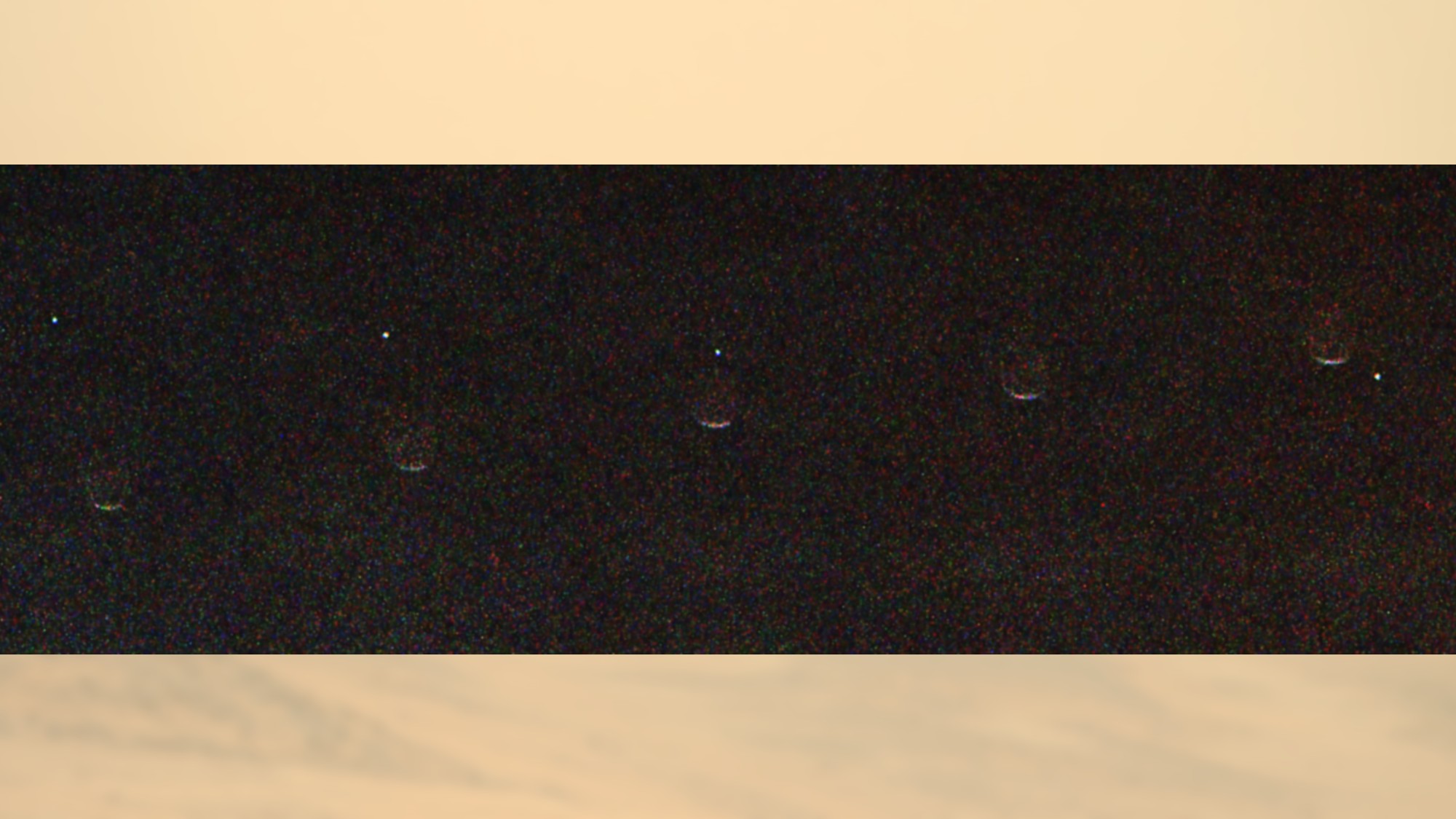
a dot of light disappears behind a crescent of light on a grey background

A composite image captured by NASA's Perseverance rover on July 2, 2026 showing Earth (the bright dot) passing behind Mars' moon Phobos in the Red Planet sky. (Image credit: NASA/JPL-Caltech/ASU/MSSS/SSI)

NASA's Perseverance rover witnessed a rare event recently, when Earth briefly disappeared behind Mars' moon Phobos in the Red Planet sky.

What is it?

These new composite images were released by NASA's Jet Propulsion Laboratory (JPL) and taken on July 2, 2026, the 1,907th Martian day of Perseverance's mission. They consist of nine different images taken by the rover's Mastcam-Z instrument as it pointed up into the hazy Martian sky, watching our planet, seen here as a pale dot, cross behind the Mars moon Phobos.

This type of event is known as an occultation, from the Latin word occultare, meaning "to hide." On Earth, the most common type of occultation occurs when our moon passes in front of background stars or when planets pass behind the moon.

Mars has two moons, Phobos and Deimos. Phobos is the larger and innermost moon. Both are lumpy and irregularly shaped, and astronomers aren't sure whether they came from the asteroid belt or were formed from an ancient impact near or on the Red Planet.

a dot of light disappears behind a crescent of light on a grey background

A composite of nine different images captured by NASA's Perseverance rover on July 2, 2026 showing Earth (the bright dot) passing behind Mars' moon Phobos in the Martian sky. (Image credit: NASA/JPL-Caltech/ASU/MSSS/SSI)

Why is it incredible?

The image took careful preparation and required Perseverance to be in the right place at the right time.

"Phobos crosses the Martian sky three times a day, and Earth is visible for months at a stretch, but catching one directly behind the other takes planning and a little luck," said Mark Lemmon, a Mastcam-Z co-investigator at the Space Science Institute.

Aside from catching Earth passing behind Phobos, Perseverance has also witnessed Phobos passing in front of the sun, in what JPL calls a "Martian solar eclipse."

❌