Approximately 40% of insect species worldwide are thought to be in decline and under threat of extinction. Among the key causes are habitat loss, pollution and climate change. Another threat is artificial light from sources like streetlights and security lamps. In new research published in the journal Biological Conservation, scientists say a simple change in artificial lighting could help reduce this particular threat.
Scientists created an AI system that uses facial recognition and real-time touchscreen testing to automate cognitive studies of capuchin monkeys in the wild. The American Journal of Primatology published a proof-of-concept for the novel method—dubbed CapuchinAI—developed by researchers at Emory University and Georgia Institute of Technology.
We also have an update of our own: Live Science has launched Live Science Pro, a paid membership that gives you access to our exclusive features, analyses, interviews, book excerpts and opinion pieces, all without ads And to celebrate, we're offering an introductory price of only $3 for the first three months! You can subscribe here.
While the Northern Hemisphere battled heat waves and wildfires, Antarctica just experienced the lowest temperature recorded on Earth in over a decade. High-altitude research station Concordia, located in the icy continent's interior, logged a low of minus 119.4 degrees Fahrenheit (minus 84.1 degrees Celsius) on July 18, just shy of the coldest temperature ever recorded at the station.
"Even here, where extreme cold is expected, temperatures below minus 84 C are remarkable and highlight how variable Antarctic weather can still be," Gabriele Carugati, the station leader at Concordia for Italy's National Antarctic Research Program, told Live Science from the station.
Cats are known for having whiskers on their faces. But if you look closely, you'll see they also have them on their legs. So what are these leg whiskers for? And how do they differ from the ones on their face?
A significant portion of the Amazon rainforest remains unexplored, and even from above, it's almost impossible to see through the trees' thick canopies to find out what lies beneath. However, thanks to modern laser scanning technology, scientists have peered through this wall of leaves — and what they've found may offer new insight into lost human civilizations.
We're increasingly learning about the role of chronic inflammation in a range of diseases, from autoimmune conditions like rheumatoid arthritis to neurodegenerative diseases like Alzheimer's. However, scientists may have now added a new surprising side effect to this immune response: "out-of-body" experiences.
If you're looking for things to keep you busy over the weekend, here's a selection from our best interviews, explainers, skywatching guides and crosswords that we published this week.
It's like something from a movie: Seconds after China's Long March 3B rocket launched on July 23, the spacecraft was struck by lightning. Hundreds of spectators watched in shock as at least 100 million volts of electricity hit the craft and surged around its fuselage and through its exhaust plume, before shooting down to Earth.
Despite the strike, the uncrewed rocket safely reached space and successfully deployed its payload into orbit.
Cats are known for the whiskers on their faces. However, if you look closely, you can see that they also have whiskers on their legs. So why do cats have leg whiskers?
To answer why they're useful, it's important to understand what whiskers are. Technically known as vibrissae, whiskers are specialized hairs that are stiffer and several times thicker than other hairs. Although whiskers themselves do not contain nerves, their bases are rooted in specialized receptacles loaded with nerve endings, making whiskers very sensitive.
"Facial whiskers are as sensitive as human fingertips," Robyn Grant, a sensory biologist at Manchester Metropolitan University in the U.K., told Live Science.
A cat's whiskers around the nose, which are also known as the mystacial vibrissae, are the longest whiskers they have, according to the veterinary reference book "The Feline Patient" (Wiley, 2025). Although there is variation among cats, on average there are 12 mystacial whiskers set in four rows on each side of the muzzle.
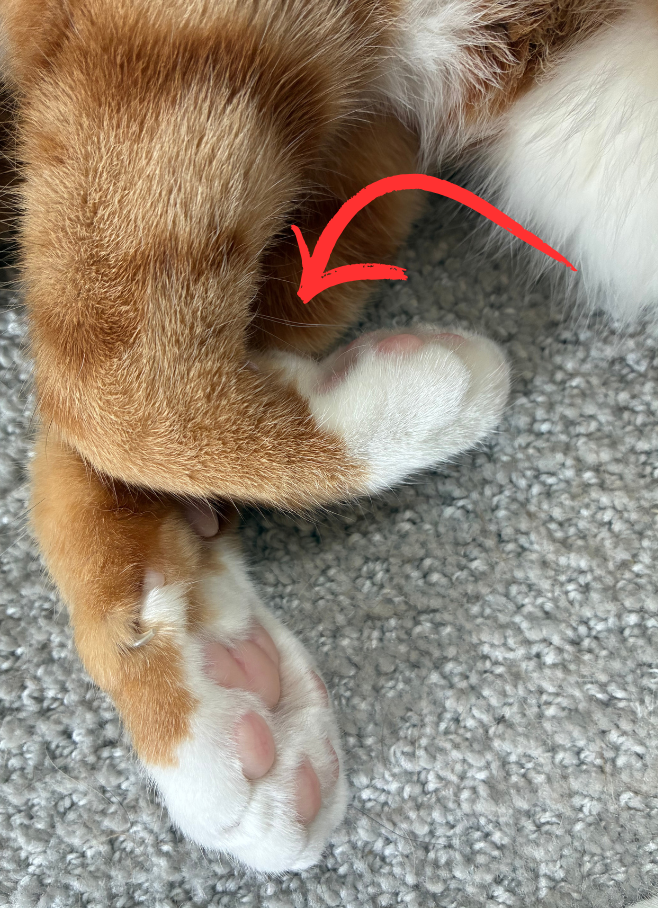
Cat leg whiskers, scientifically known as carpal vibrissae, are attached to their forelegs. (Image credit: Future)
Facial whiskers help cats hunt when light is limited or when their vision is poor. Although cats are good at seeing distant objects, "cats can't really focus on anything less than 10 inches (25 centimeters) from their eyes, so they use their whiskers to figure out where things are," Jonathan Losos, an evolutionary biologist at Washington University in St. Louis and author of "The Cat's Meow: How Cats Evolved from the Savanna to Your Sofa" (Viking, 2023), told Live Science.
In addition, cats have a tuft of whiskers known as superciliary vibrissae above each eye. These whiskers help protect the cat's vision by triggering a blink when stimulated by anything that might fly into their eye, according to The Feline Patient.
Cats also have chin whiskers (mandibular vibrissae) and whiskers on each side of the head, between the ear and chin (genal vibrissae). These also help cats stay aware of the space around them.
Leg whiskers
Cats also possess a tuft of four to six whiskers on the back of each front leg, each about 0.8 to 1.2 inches (2 to 3 centimeters) long. These are known as carpal vibrissae.
"Carpal refers to the bones that, in humans, are in our wrists," Losos said. "Carpal whiskers are attached to cat forelegs near the carpal bones." However, in cats, the carpal bones are not located in the same place as the human wrist. Rather, they "are further up the leg, because cats essentially walk on their toes and not their palms," he explained.
Cats are not the only animals with carpal whiskers. "Most carnivores have them, and many rodents do, as do lemurs and armadillos," Losos said. "Dogs don't have them, but other canine species do. Rabbits don't have them either, nor do ungulates — that is, hooved animals, such as horses and cattle."
The species that have carpal whiskers "tend to be the ones that either grasp things with their forelimbs or climb up trees," Losos said. "The idea is that if it's hard for the animals to see what they're grasping, carpal whiskers can help supplement their vision. Perhaps cats have them and dogs don't because cats can move their forearms laterally from side to side and put their palms together to grab things, whereas dogs can't."
It remains uncertain what role carpal whiskers play in cats, but they likely "guide locomotion — that is, safe forepaw placement — especially during complex locomotion, such as climbing," Grant said. "They might guide prey handling too."
How much of a cat fan are you? Find out by taking our cat quiz!
Emergency crews say situation remains ‘dynamic’ as more than 100 firefighters battle Dunwich Heath blaze
A wildfire near Britain’s biggest nuclear power station has caused “total devastation” to one of the UK’s most important landscapes, as fire crews said the situation remained “dynamic”.
More than 100 firefighters have been battling the blaze on Dunwich Heath, near Leiston, on the Suffolk coast since Wednesday evening. The fire service said on Friday afternoon the situation was stabilising but remained a “major incident” that was “dynamic and potentially changeable”.
Surfer, spear-fisher and free-diver Riley Elliott and marine biologist, shark diver and underwater photographer Kori Burkhardt put themselves in harm's way in don't-try-this-at-home "Shark Week" 2026 special "Secrets of the Great White Kill", and Live Science is here with all the TV and streaming details.
How to watch "Secrets of the Great White Kill" — Quick Guide
It doesn't always go to plan, as this seal uprising and vengeful turtle demonstrate, but great white sharks (Carcharodon carcharias) are known for attacking prey from below with such frightening speed and power it can propel their enormous bodies clear out of the water and stun or even kill their prey upon impact.
However, closer inspection has revealed that they can be a little more subtle when the need arises
In "Secrets of the Great White Kill," Eliott and Burkhardt aim to capture and unpack the full range of great white hunting techniques, including one or two surprising methods, the nuances of which have never been fully appreciated before.
How to watch "Secrets of the Great White Kill" in the U.S.
"Secrets of the Great White Kill" airs on Discovery at 8 p.m. ET/PT on Friday, July 31.
If you don't have the Discovery channel on cable, it's available on a streaming basis from several cable alternatives. Best of all, many of the services offer a free trial to new customers.
YouTube TV usually costs $82.99 per month but comes with a free trial and $15 off each of your first five months.
The DirecTV MyEntertainment genre pack costs $42.99 per month after a 5-day free trial, and Hulu + Live TV costs $89.99 per month after a 3-day free trial.
Alternatively, the HBO Max streaming service starts at $10.99 per month.
Can you watch "Secrets of the Great White Kill" in the U.K.?
"Shark Week" programming typically airs on Discovery+ in the U.K. at a later date.
At the time of publication, plans for "Secrets of the Great White Kill" and the other 2026 specials are still firmly under wraps.
If you're currently in the U.K. for work or on vacation from the U.S., you can still catch "Secrets of the Great White Kill" by using a VPN, such as Surfshark.
Watch "Secrets of the Great White Kill" from anywhere
If you're travelling abroad you can access your usual streaming services from anywhere with a good VPN.
A VPN, or virtual private network, is a piece of internet security software that can alter your device's digital location, unlocking the geo-restrictions on most streaming platforms.
Our expert colleagues at TechRadar rate Surfshark as one of the best VPNs. Not only is it great for unblocking streaming services, it has top-level security features, a reasonable price tag and, right now, a big discount.
Live Science x Surfshark Exclusive "Shark Week" Deal
Whether you're tuning into Discovery's Shark Week or diving deep into the web, privacy matters. Surfshark keeps your connection encrypted and your data out of sight – no matter what waters you're navigating.
Protect unlimited devices for just $2.39/mo + 4 Extra Months. Save 85%! Shark Week Special runs from July 26 to August 1, 2026.
🥇 From $2.39 per month ✅ Block ads, trackers, scams, and malware 🤝 30-day money-back guarantee 🏆 4 Extra monthsView Deal
We test and review VPN services in the context of legal recreational uses. For example: 1. Accessing a service from another country (subject to the terms and conditions of that service). 2. Protecting your online security and strengthening your online privacy when abroad. We do not support or condone the illegal or malicious use of VPN services. Consuming pirated content that is paid-for is neither endorsed nor approved by Future Publishing.
Whale sharks may be the biggest fish in the ocean, but their feeding habits have remained mysterious. Now, new camera footage from the backs of these gentle giants has captured them doing something scientists rarely get to see: hunting for food far below the surface.
The footage reveals that whale sharks (Rhincodon typus) spend far more time feeding underwater than scientists realized and that they use a surprising variety of foraging techniques that had never been documented before.
The videos show whale sharks filtering food while cruising through open water, gliding downward as they feed during dives, climbing back toward the surface with their mouths still open, and cruising just above the seafloor to feed. Slow, steady underwater feeding turned out to be one of the sharks' most common activities.
Philip Motta, a professor emeritus of biology at the University of South Florida who was not involved in the study, said the videos provide "very valuable" new information on the variability of whale shark feeding behaviors, which have been poorly documented to date.
Cameras reveal whale shark feeding
Before this study, whale sharks had been studied from boats, from planes and by divers swimming alongside them. But those methods shared a blind spot: They could only follow the sharks when they were near the surface.
Earlier research had hinted that whale sharks spend a lot of time feeding out of view, at varying depths. In a 2020 study, researchers estimated that whale sharks may forage at these depths for up to 20% of the day and feed at the surface for less than 1% of their time.
In the new study, scientists strapped cameras directly onto the whale sharks, offering a rare shark's-eye view beneath the waves.
They deployed camera tags on 10 whale sharks at Ningaloo Reef in Western Australia and gathered more than 22 hours of footage from the sharks' own perspective. They combined that footage with a review of 106 previously published studies to build the most comprehensive catalog of whale shark behavior to date. Ultimately, they cataloged 36 distinct behaviors — 12 were related to feeding, and of those, six had never been recorded before. The findings were published July 21 in the journal Marine Biology.
Whale sharks can grow to 60 feet (18 meters) in length. And yet, this enormous fish survives on tiny prey — like krill, fish eggs and plankton — in tropical waters that are notoriously poor in nutrients. The ability to switch between so many feeding techniques may help to explain the long-standing puzzle of how such a large species can survive in these nutrient-poor waters.
However, even with a shark's-eye view, the cameras captured only part of the story. Whale sharks are known to dive hundreds of feet below the surface, where sunlight disappears and conventional cameras can no longer record.
"The most important new discoveries could be what these gentle giants are doing when they perform really deep dives," Motta said.
What it means: Coprolites are fossilized poop. Scientists have found coprolites from animals as diverse as fish, dinosaurs and saber-toothed cats. Teeth in the saber-toothed cat poop indicated that it had been eating baby sloths, which frankly feels a bit unfair from a creature with 11-inch-long (28 centimeters) teeth.
These fossils form when poop gets rapidly buried and mineralized instead of rotting away. Coprolites can be hard to match to the animal that produced them, but undigested bones and teeth in the fossilized poop can often provide clues to the kinds of animals that other animals eat.
How to use it in a sentence: If you're ever in a science museum and a volunteer, with a twinkle in their eye, asks you what you think a chunky, rock-looking thing is, the answer is always coprolite.
Can you crack our science word of the day puzzle, Chain Word?
Monkeys use some of the same basic mental strategies as people do to perceive abstract relationships between shapes, a new study suggests.
The findings challenge the idea that humans crossed a sharp evolutionary divide when they learned to recognize geometric properties like symmetry, parallel lines and right angles, the researchers say.
"While humans do come up with geometric descriptions that are more abstract than what nonhumans can do, there's still some overlap, some similarity in the kinds of geometric intuitions you see in humans and those of non-primates," study co-author Jessica Cantlon, a professor of developmental neuroscience and psychology at Carnegie Mellon University, told Live Science. "So there's a thread of continuity that runs through geometric reasoning between humans and nonhumans."
The research, published July 20 in the journal PNAS, adds to a long-standing scientific debate over whether humans possess entirely unique forms of abstract thought or unusually sophisticated versions of abilities found elsewhere in the animal kingdom.
"For decades, cognitive scientists have searched for the 'special ingredient' that distinguishes human intelligence from that of other animals," Elizabeth Brannon, a professor of psychology at the University of Pennsylvania who was not involved in the research, told Live Science in an email. "This study provides compelling evidence that, at least for geometric reasoning, the difference between humans and other primates is more quantitative than qualitative."
In other words, the study suggested that baboons and macaques don't lack the ability to reason about geometry. Instead, they just aren't as proficient at it as humans, meaning that humans didn't evolve a new unique skill in understanding geometry.
A geometric matching game
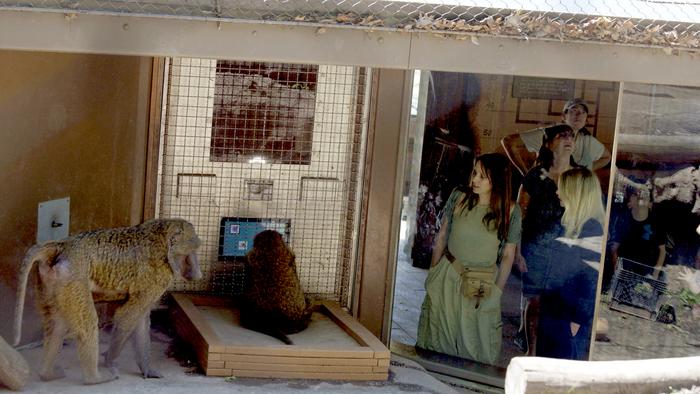
The researchers tested eight adult monkeys: four rhesus macaques (Macaca mulatta) and four olive baboons (Papio anubis). The olive baboons participated through the Primate Portal, a touch-screen system installed at Seneca Park Zoo in Rochester, New York. One baboon, Kalamata, was especially enthusiastic.
"Every day he came to the touch screen," Jialin Li, a doctoral student at Carnegie Mellon University and first author of the study, told Live Science. "He just sat there and worked for two hours, three hours straight, completing thousands of trials. That's just amazing."
The macaques participated separately at Carnegie Mellon University, having prior experience with matching tests in other experiments.
The researchers then compared the animals' performance with that of 58 U.S. preschoolers ages 3 to 6, and 79 adults from the Tsimané, an Indigenous farmer-forager society in Bolivia whose members received little formal education. A separate experiment in the larger project involving rotating shapes also included 21 U.S. adults.
In all of the study's cohorts, the participants played a game known as a match-to-sample task.
"[The participants] see a sample shape first," Li said. "For example, it's a square. Then they need to tap the square to make sure that they are looking at it. When they tap it, there will be two shape choices that come up: one on the left and one on the right. They need to choose which shape matches with the sample shape."
The researchers made the choice shapes half the area of the sample shape, thus preventing the participants from solving the task by simply matching overall size or pixel count. In another version of the test, they rotated the choice shapes, thereby forcing the participants to identify the underlying form despite its changed orientation.
Two olive baboons participated in the Primate Portal experiments at the Seneca Park Zoo in Rochester, New York. (Image credit: Rochester Institute of Technology)
Correct answers earned the monkeys fruit-flavored cereal pellets, preschoolers collected stickers that could later be exchanged for prizes, and adults received verbal feedback. Incorrect answers triggered a "bonk" sound and a short timeout from the game.
Despite their limited formal education, the adult group had little trouble with the game, but the monkeys and the children had to put considerable thought into their choices.
"We often think that this matching task will be super easy for humans," Li said. "But actually, young kids were struggling in completing the task in telling the shapes apart, which makes them more similar to monkeys."
Ultimately, the children and monkeys could find the matches, Cantlon said, but only after taking a long time to think about the problem.
The researchers then used computer models to investigate which visual properties best predicted participants' decisions. One model represented simple details, such as edges and lines. Another represented more complex information about a shape's overall form. A third encoded discrete geometric properties, such as equal sides, equal angles, symmetry and parallelism — an approach the researchers described as "symbolic."
According to Cantlon and Li, the term "symbolic" does not mean the monkeys were mentally applying rules such as "a square has four equal sides." Much of the apparent symbolic effect could be explained by the ability to recognize a shape regardless of its orientation, known as rotation invariance.
If abstract geometry depended on a uniquely human symbolic system, only the human participants would have shown evidence of using that thought process. Instead, both monkeys and humans appeared to rely on a mixture of complex visual information and symbolic-like features. Adult humans generally performed the best, followed by preschoolers and monkeys, but their results overlapped. This finding suggests that the differences were quantitative, meaning humans are simply better at the same underlying kind of geometric reasoning rather than possessing an entirely unique ability., Monkeys relied roughly three times more strongly on the symbolic model when the shapes were rotated than when they remained upright.
Brandon said one of the study's most intriguing findings is that what looks like uniquely human symbolic reasoning for understanding geometry may actually grow out of flexible, abstract ways of representing information that are shared by humans and other primates.
Ancient roots of geometry
The results do not mean that monkeys understand formal mathematics, Brannon cautioned. "Human mathematical reasoning extends far beyond recognizing geometric regularities — it includes language, formal proof, recursive reasoning and cultural transmission."
Rather, this study provides evidence that some of the building blocks of mathematical thought have deeper evolutionary roots than previously recognized, she said.
Giorgio Vallortigara, a professor of neuroscience at the University of Trento in Italy who was not involved in the study, agrees with Brannon and her colleagues' conclusions.
Vallortigara explained in an email to Live Science that previous studies have often focused on how animals understand the geometry of their surroundings, such as navigating spaces. What makes these findings different is that they show animals can also reason about the geometric properties of individual objects.
Comparing species can help scientists trace the origins of geometry before language or arbitrary symbols became involved, Vallortigara said. It may also reveal whether similar abilities depend on mechanisms inherited from a common ancestor or evolved independently in animals with different nervous systems.
Li and Cantlon are now breaking down shapes into components such as angles, side lengths and numbers of sides to identify which properties are the hardest for monkeys and humans to understand. Cantlon described the follow-up as "a deconstructed geometry task."
The research could also help educators understand the geometric intuitions children bring into the classroom, Cantlon said, allowing lessons to build upon those abilities rather than treating geometry as something learned entirely from scratch.
"Evolution rarely invents entirely new mechanisms from scratch," Brannon said. "More often, it refines, recombines and extends existing ones."
What do you know about chimpanzees and great apes? Test your smarts with our primate quiz!
"Expedition X: Atomic Sharks" – a "Shark Week" 2026 special – sees biologist Phil Torres and "Expedition X" host Heather Amaro explore the islands' waters, including Troy's Coral Head, to establish if nuclear fallout could be behind reports of sharks displaying unusual and highly aggressive behaviors.
How to watch "Expedition X: Atomic Sharks" — Quick Guide
The U.S. military detonated 67 nuclear bombs at Bikini Atoll and Enewetak Atoll over 12 years from 1946 to 1958, which inflicted catastrophic and irreversible harm on the local populace and environment. Cancer rates among residents increased significantly, and local produce was rendered unfit for consumption.
Half a century later, however, the Marshall Islands became the site of the world's largest shark sanctuary.
How to watch "Expedition X: Atomic Sharks" in the U.S.
"Expedition X: Atomic Sharks" airs on Discovery at 8 p.m. ET/PT on Wednesday, July 29.
If you don't have the Discovery channel on cable, it's available on a streaming basis from several cable alternatives. Best of all, many of the services offer a free trial to new customers.
YouTube TV usually costs $82.99 per month but comes with a free trial and $15 off each of your first five months.
The DirecTV MyEntertainment genre pack costs $42.99 per month after a 5-day free trial, and Hulu + Live TV costs $89.99 per month after a 3-day free trial.
Alternatively, the HBO Max streaming service starts at $10.99 per month.
Can you watch "Expedition X: Atomic Sharks" in the U.K.?
"Shark Week" programming typically airs on Discovery+ in the U.K. at a later date.
At the time of publication, plans for "Expedition X: Atomic Sharks" and the other 2026 specials are still firmly under wraps.
If you're currently in the U.K. for work or on vacation from the U.S., you can still catch "Expedition X: Atomic Sharks" by using a VPN, such as Surfshark.
Watch "Expedition X: Atomic Sharks" from anywhere
If you're traveling abroad you can access your usual streaming services from anywhere with a good VPN.
A VPN, or virtual private network, is a piece of internet security software that can alter your device's digital location, unlocking the geo-restrictions on most streaming platforms.
Our expert colleagues at TechRadar rate Surfshark as one of the best VPNs. Not only is it great for unblocking streaming services, it has top-level security features, a reasonable price tag and, right now, a big discount.
Live Science x Surfshark Exclusive "Shark Week" Deal
Whether you're tuning into Discovery's Shark Week or diving deep into the web, privacy matters. Surfshark keeps your connection encrypted and your data out of sight – no matter what waters you're navigating.
Protect unlimited devices for just $2.39/mo + 4 Extra Months. Save 85%! Shark Week Special runs from July 26 to August 1, 2026.
🥇 From $2.39 per month ✅ Block ads, trackers, scams, and malware 🤝 30-day money-back guarantee 🏆 4 Extra monthsView Deal
We test and review VPN services in the context of legal recreational uses. For example: 1. Accessing a service from another country (subject to the terms and conditions of that service). 2. Protecting your online security and strengthening your online privacy when abroad. We do not support or condone the illegal or malicious use of VPN services. Consuming pirated content that is paid-for is neither endorsed nor approved by Future Publishing.
"Demon cavefish" have been discovered lurking in caverns beneath a contaminated U.S. Army base in Alabama, a new study has found.
Biologists have named the pale, eyeless creatures Demogorgonichthys arcanus, after the monstrous Demogorgons from Netflix's "Stranger Things" and the underworld demon of Greek mythology from which the Demogorgon name derives. They are likely among the rarest fishes in the world.
The find came as a shock to scientists because the cavefish's home, Bobcat Cave, has been extensively studied in recent decades. The subterranean system is part of U.S. Army site Redstone Arsenal, which was historically a center for chemical weapons production. Bobcat Cave is regularly subject to water quality monitoring and part of efforts to save endangered Alabama Cave Shrimp (Palaemonias alabamae), which also call the cave home.
In a new study, published July 6 in the journal Scientific Reports, researchers described the cavefish find as a "discovery in plain sight." Study lead author Matthew Niemiller, who directs the cave biology lab at The University of Alabama in Huntsville, encountered the cavefish by chance during a routine survey of Bobcat Cave's largest chamber, known as the Shrimp Room, in early 2025.
"I slipped in the mud at the back of the Shrimp Room and fell into a deeper pool," Niemiller told Live Science in an email. "During my graceful plummet, I disturbed a cavefish and crayfish underneath a rock ledge."
Niemiller quickly snapped photos of the animals using an underwater camera before silt clouded his view of them. It wasn't until several days later, when he checked the photos, that he noticed the cavefish looked different from southern cavefish (Typhlichthys subterraneus), a known species within the cave.
"The new cavefish had a pronounced hump behind the head, a longer, flatter snout, and unbranched fin rays," Niemiller said. "We returned a few days later, before a storm system forecasted to dump several inches of rain moved into the area. On the next trip, we confirmed that nearly half of the cavefish we observed were this new species."
Niemiller studied the cavefish with colleagues at Auburn University, The University of Alabama and Mississippi State University, with students performing much of the lab work. Genetic analysis revealed that demon cavefish didn't fit within any known cavefish group. Notably, demon cavefish carry unique disabling mutations for rhodopsin, a light-sensitive protein that would otherwise support dim light vision. Niemiller noted that this mattered for two reasons.
"First, it's a great example of 'use it or lose it' at the molecular level," he said. "In total darkness, vision is useless, so natural selection stops maintaining the gene, and mutations simply accumulate. Second, and more importantly, the specific way this fish's rhodopsin is broken is different from how it's broken in the related cavefish it lives alongside. That's strong evidence they lost their vision independently."
Demon cavefish and southern cavefish seemingly losing the ability to see independently is an example of how evolution can lead different species to converge on the same physical characteristics when they're suitable for an environment.
Demon cavefish have a combination of physical traits that set them apart from other cavefish, including a long and flat snout. (Image credit: Matthew L. Niemiller, Niemiller Nature LLC.)
The conditions in Bobcat Cave have likely been influenced by the history of the military base above it. Redstone Arsenal made various chemical weapons during World War II. At the end of the war, vast quantities of chemical munitions were buried at the site, along with chemical weapons from overseas, like British mustard gas and nerve agents and other toxic weapons recovered from Nazi Germany. The site is the subject of ongoing investigations, clean-ups and storage.
Researchers have found that the cave contains elevated levels of trace metals compared to what would normally be found in such a habitat. However, Niemiller noted that the restricted-access status of the military installation does limit disturbance in the cave.
A bigger concern for the demon cavefish is that surface water connects to the cave's groundwater, so the life in the cave is also exposed to runoff, sediment and contaminants linked to the nearby city of Huntsville. As demon cavefish are, as far as we know, restricted to a single cave, they are very vulnerable to extinction.
The researchers concluded that demon cavefish would meet the criteria for becoming a "critically endangered" species, under the International Union for Conservation of Nature (IUCN) Red List — a framework for determining a species' conservation status. It's unknown how many demon cavefish live within the cave, and it's likely that many of them will be in places that are inaccessible to researchers.
"Like other cavefish, these animals probably spend much of their lives down in the water-filled aquifer below the cave, beyond where we can observe them, so any single survey is a snapshot, not a census," Niemiller said. "What we can say with some confidence is that it's known from just one cave system, it's rarely encountered, and by every measure we use, it qualifies as critically imperiled."
Fortunately for the cavefish, Bobcat Cave is already known for being a home for endangered Alabama Cave Shrimp. Since 1990, the cave has been a focus for water quality monitoring, shrimp surveys, and other biological investigations that should also help the newfound species.
"What protects the shrimp's water protects the fish's water too," Niemiller said.
In the sea, soft-bodied sea slugs crawl around without shells to protect them. Instead, they sport dazzling colors and flashy patterns to warn would-be predators that they’re toxic. Now, researchers have learned that many of these vibrant hues come from structures under the slugs’ skin.
These slugs, called nudibranchs (NU-dih-branks), are sometimes dubbed the “butterflies of the sea.” Their colors are “exceptionally bright,” says materials scientist and physicist Samuel Humphrey. He works at the Max Planck Institute of Colloids and Interfaces in Potsdam, Germany. Nudibranchs’ range of colors and patterns exceeds those of other ocean dwellers and is only like that of butterflies and birds, he says.
Not much was known about nudibranch colors, Humphrey says. But in nature, some of these colors — such as white, blue and purple — are hard to get from pigments. (Those are molecules that provide color.) That made Humphrey’s team suspect the slugs’ colors instead arise from light waves bouncing off structures on their bodies. Such structural color can create hues as intense as those seen on the sea slugs.
Two sea slugs — a Barbie-pink Hypselodoris bullockii (left) and a golden-speckled Hypselodoris tryoni (right) — use the same technique to wear wildly different hues.Left: Reinhard Dirscherl/Getty Images; Right: ifish/iStock/Getty Images Plus
Humphrey collected one species of nudibranchs off the coast of France. Others, he and his colleagues bought from aquarium shops. The researchers looked at the creatures under the microscope and saw tiny dots of colors that combined to create a shade. For instance, a nudibranch might look purple, but zoom in, and you may find specks of red and blue. “It’s a bit like mixing paints until you get the color you want,” Humphrey says.
Actually, he adds, “it’s better than that.” Sea slugs’ hues arise from specific wavelengths, or colors, of light bouncing off them and reaching our eyes. And the team found that, for a given color, nudibranchs reflect up to 80 percent of light that hits them. That makes their hues more vivid than those produced by pigments, which create colors by absorbing light. Losing light means losing brightness, Humphrey explains.
The researchers shared their results in the March issue of the Proceedings of the National Academy of Sciences.
With a powerful microscope, the team saw stacks of tiny plates under nudibranchs’ skin. The plates were crystals made of guanine. The thickness of the plates and the distance between them in a stack determined the colors that they reflected. That allows sea slugs to wear a rainbow of colors made of just one material.
The many tiny dots of color on sea slugs’ skin creates an effect akin to how TVs make images with many spots of only a few colors. This is called pixelation. “It feels like a thing that humans have invented,” Humphrey says. “But actually, evolution had invented it millions of years ago.”
Sea slugs’ style is spot on
Humphrey et al/PNAS 2026 (CC BY 4.0)
Microscope images revealed close-ups of nudibranchs’ skin (Figures A–F). These images show the many dots of different hues that make up a single area of color on the animals. Researchers also measured how these areas interact with light (Figures I–N). The graph in Figure I goes with the image in Figure A, Figure J goes with Figure B and so on. The graphs show the reflectance, or how much light reflects off differently colored spots to reach our eyes. Most colors have a specific wavelength at which the most light is reflected. For example, Figure C shows the pink region of Hypselodoris bullockii, which has some violet colored dots (Figure C). These dots reflect the most light at a wavelength of around 400 nanometers (Figure K).
Data Dive:
How many types of colored light make up the violet hue of Hypselodoris tryoni (Figure A)?
How many types of colored light make up the beige or white region of the same slug (Figure B)? Which color of light has the highest reflectance? What is that color’s peak wavelength?
Which sea slug here has the color with the highest reflectance? (Hint: Not all the y-axes are exactly the same.) What is that color and what is the peak wavelength?
How many different colors of light are in the region of Chromodoris annae (Figures E and M)? Based on those colors, how do you think this area of the slug looks to the eye?
A pod of killer whales has sunk another yacht off northwestern Spain, reinforcing a bizarre pattern of vessel encounters that has stretched on for more than six years along the Iberian coast.
In the incident, reported Friday (July 24), the whales destroyed the rudder of a 46-foot-long (14 meters) Swedish-flagged yacht off Galicia in northwestern Spain, forcing the two people aboard to send a mayday call. A Spanish coastguard vessel towed them to safety, Spain-based news outlet Sur in English reported.
The incident came after several other encounters in the same waters earlier that week, including one in which a pleasure craft called the Idem sank near Estaca de Bares, the northernmost point of the Iberian Peninsula. The ship sank after the killer whales, also known as orcas (Orcinus orca), destroyed its rudder. Both occupants were rescued.
That makes the Idem at least the eighth boat lost to these encounters since they began, according to groups that track the incidents. More than 700 interactions between orcas and vessels have been logged since 2020, ranging from a brief nudge to a multihour rudder-ramming session, according to the Atlantic Orca Working Group, the Spanish-Portuguese research collective that has coordinated data collection on the phenomenon from the start.
Researchers have identified roughly 15 individual killer whales involved in these incidents, out of an Iberian subpopulation of fewer than 50. The group is so small that the International Union for Conservation of Nature lists it as critically endangered, as it is dependent mainly on Atlantic bluefin tuna for its food.
The family-like cluster is thought to be led by a female known as White Gladis. That name comes from an early theory researchers themselves once floated: that White Gladis suffered some kind of traumatic run-in with a boat and that the encounter flipped a behavioral switch, with her being the first in the group to start ramming rudders.
Alfredo López Fernandez, a biologist with the Atlantic Orca Working Group, told Live Science in 2023 that this kind of defensive, trauma-driven origin was gaining traction among researchers at the time. But "defensive" isn't "vengeful" — and the idea has since curdled online into a punchier revenge story most scientists studying the population don't endorse.
So why do orcas go after the boats? Nobody knows for certain, but the leading explanation is simple: Orcas are some of the most social animals on the planet, and social animals pick up habits from one another the way trends spread through a friend group. Researchers describe the behavior as socially learned — young orcas appear to watch adults ram a rudder and then try it themselves, and the habit has spread through the group over time.
A 2022 study in the journal Marine Mammal Science found that the killer whales usually targeted sailing boats and often lost interest after striking the rudder and causing the boat to stop.
None of that makes the encounters any less disruptive for the people living through them. The standard guidance from authorities like the Maritime Safety and Rescue Society and the Atlantic Orca Working Group, refined over repeated encounters, is to cut the engine, drop the sails if possible, disengage the autopilot, and let go of the wheel entirely, giving the orcas nothing to push against. Boats that follow this protocol tend to sustain less damage than those that don’t.
Sailors are asked to report every encounter. Each one adds to the data scientists are using to try to solve a years-long mystery.
We've all heard of the fearsome megalodon, the largest known shark to have ever lived, but how about its predecessors, contemporaries and successors? Shark Week premiere "Jurassic Sharks" uses CGI to flesh out the fossils of ancient cartilaginous fish, and Live Science is here with all the TV and streaming details.
Using fossil records and "cutting-edge" visual effects, "Jurassic Sharks" will attempt to trace the ancestry of modern-day species back through millions of years, and build a picture of the prehistoric ocean, complete with superpredators that are both weird and awe-inspiring.
It's a must-watch for budding palaeontologists and animal fans alike.
How to watch "Jurassic Sharks" in the U.S.
"Jurassic Sharks" airs on Discovery at 8 p.m. ET/PT on Tuesday, July 28.
If you don't have the Discovery channel on cable, it's available on a streaming basis from several cable alternatives. Best of all, many of the services offer a free trial to new customers.
YouTube TV usually costs $82.99 per month but comes with a free trial and $15 off each of your first five months.
The DirecTV MyEntertainment genre pack costs $42.99 per month after a 5-day free trial, and Hulu + Live TV costs $89.99 per month after a 3-day free trial.
Alternatively, the HBO Max streaming service starts at $10.99 per month.
Can you watch "Jurassic Sharks" in the U.K.?
"Shark Week" programming typically airs on Discovery+ in the U.K. at a later date.
At the time of publication, plans for "Jurassic Sharks" and the other 2026 "Shark Week" specials are still firmly under wraps.
If you're currently in the U.K. for work or on vacation from the U.S., you can still catch "Jurassic Sharks" by using a VPN, such as Surfshark.
Watch "Jurassic Sharks" from anywhere
If you're traveling abroad you can access your usual streaming services from anywhere with a good VPN.
A VPN, or virtual private network, is a piece of internet security software that can alter your device's digital location, unlocking the geo-restrictions on most streaming platforms.
Our expert colleagues at TechRadar rate Surfshark as one of the best VPNs. Not only is it great for unblocking streaming services, it has top-level security features, a reasonable price tag and, right now, a big discount.
Live Science x Surfshark Exclusive Shark Week Deal
Whether you're tuning into Discovery's Shark Week or diving deep into the web, privacy matters. Surfshark keeps your connection encrypted and your data out of sight – no matter what waters you're navigating.
Protect unlimited devices for just $2.39/mo + 4 Extra Months. Save 85%! Shark Week Special runs from July 26 to August 1, 2026.
🥇 From $2.39 per month ✅ Block ads, trackers, scams, and malware 🤝 30-day money-back guarantee 🏆 4 Extra monthsView Deal
We test and review VPN services in the context of legal recreational uses. For example: 1. Accessing a service from another country (subject to the terms and conditions of that service). 2. Protecting your online security and strengthening your online privacy when abroad. We do not support or condone the illegal or malicious use of VPN services. Consuming pirated content that is paid-for is neither endorsed nor approved by Future Publishing.
Great white sharks can launch themselves clear out of the ocean, but why they breach so dramatically remains one of marine biology's biggest mysteries. "Air Jaws: Red, White and Breach", premiering during "Shark Week" 2026, follows a team of filmmakers and scientists as they investigate the shark's behavior.
How to watch "Air Jaws: Red, White and Breach" — Quick Guide
"Shark Week" is now in its 25th year, and to mark this milestone, Jeff Kurr and marine biologist Alison Towner head to the Californian coast, which has seen an unexpected surge of great whites (Carcharodon carcharias) breaching the surface.
With cinematographer Andy Casagrande in tow, "Air Jaws: Red, White and Breach" aims to capture this behavior in full glory, and to establish why breaching great whites have entered American waters.
How to watch "Air Jaws: Red, White and Breach" in the U.S.
"Air Jaws: Red, White and Breach" airs on Discovery at 9 p.m. ET/PT on Sunday, July 26.
If you don't have the Discovery channel on cable, it's available on a streaming basis from several cable alternatives. Best of all, many of the services offer a free trial to new customers.
YouTube TV usually costs $82.99 per month but comes with a free trial and $15 off each of your first five months.
The DirecTV MyEntertainment genre pack costs $42.99 per month after a 5-day free trial, and Hulu + Live TV costs $89.99 per month after a 3-day free trial.
Alternatively, the HBO Max streaming service starts at $10.99 per month.
Can you watch "Air Jaws: Red, White and Breach" in the U.K.?
"Shark Week" programming typically airs on Discovery+ in the U.K. at a later date.
At the time of publication, plans for "Air Jaws: Red, White and Breach" and the other 2026 specials are still firmly under wraps.
If you're currently in the U.K. for work or on vacation from the U.S., you can still catch "Air Jaws: Red, White and Breach" by using a VPN, such as Surfshark.
Watch "Air Jaws: Red, White and Breach" from anywhere
If you're traveling abroad you can access your usual streaming services from anywhere with a good VPN.
A VPN, or virtual private network, is a piece of internet security software that can alter your device's digital location, unlocking the geo-restrictions on most streaming platforms.
Our expert colleagues at TechRadar rate Surfshark as one of the best VPNs. Not only is it great for unblocking streaming services, it has top-level security features, a reasonable price tag and, right now, a big discount.
Live Science x Surfshark Exclusive "Shark Week" Deal
Whether you're tuning into Discovery's Shark Week or diving deep into the web, privacy matters. Surfshark keeps your connection encrypted and your data out of sight – no matter what waters you're navigating.
Protect unlimited devices for just $2.39/mo + 4 Extra Months. Save 85%! Shark Week Special runs from July 26 to August 1, 2026.
🥇 From $2.39 per month ✅ Block ads, trackers, scams, and malware 🤝 30-day money-back guarantee 🏆 4 Extra monthsView Deal
We test and review VPN services in the context of legal recreational uses. For example: 1. Accessing a service from another country (subject to the terms and conditions of that service). 2. Protecting your online security and strengthening your online privacy when abroad. We do not support or condone the illegal or malicious use of VPN services. Consuming pirated content that is paid-for is neither endorsed nor approved by Future Publishing.

 Login