Normal view
New Supernova Study Confirms Universeβs Expansion is Still Accelerating
A fresh analysis of Type Ia supernovae overturns a controversial 2025 claim that cosmic expansion is slowing.
The post New Supernova Study Confirms Universeβs Expansion is Still Accelerating appeared first on Sci.News: Breaking Science News.
Astronomers Confirm Dark Energy After Shock Challenge Rocked Cosmology
- The Debrief
- Black Holes Arenβt Real? Astronomers Propose Elusive Formation Mechanism for βGravastarβ Alternative That is βEasier to Acceptβ
Black Holes Arenβt Real? Astronomers Propose Elusive Formation Mechanism for βGravastarβ Alternative That is βEasier to Acceptβ
Scientists from Goethe University, Frankfurt, studying alternatives to black holes have suggested a mathematically viable formation mechanism for one proposed alternative called a βGravastar.β
Although the team behind the newly proposed gravastar formation mechanism conceded that black holes still represent the simplest and most natural solution to gravitational collapse, they also suggest that the physics behind the alternative, which doesnβt require a single point where spacetime curves infinitely, called a βsingularity,β can make them βeasier to acceptβ than black holes.
If correct, and some or all black holes are, in fact, gravastars that mimic their expected properties, the work would establish a valid formation mechanism that could rewrite decades of accepted science and open a new field of research dedicated to understanding this previously misunderstood phenomenon.
Meet Gravastar: The Black Hole Mimicker without a Singularity
According to standard cosmology theories, black holes form when extremely massive stars stop generating energy, allowing the force of gravity to take over and collapse the remaining matter into a single point, or singularity. Unfortunately, the research team behind the new study notes that βthe laws of physics break downβ within the singularity, making the formation of the resulting black hole a difficult phenomenon to predict.
βHow can spacetime be curved infinitely at that point, the singularity?β asks the teamβs statement announcing the new approach. They also note that no information escapes a black hole, including light, making studying its inner workings effectively impossible, and opening up the possibility that βblack holes are in fact entirely different objects.β
Some options have been proposed, including βhorizonlessβ black hole mimickers. The team notes that these proposed options are βmathematically consistent alternativesβ that also address the physics challenges posed by traditional black holes.Β
Still, how these alternative objects form has remained largely unclear. The research team said this lack of a formation mechanism constitutes βa significant open problemβ since understanding how they form is the βfirst stepβ to determining if they truly exist.
New Model Creates a βBig Bangβ Inside a βMini-Universeβ
In the new formation model, theoretical physicists Daniel Jampolski and Theoretical Astrophysics Professor Luciano Rezzolla from Goethe University showed that the collapse of a dying star may not go far enough that it reaches the point of no return, where βthe collapse to a black hole is inevitable.β
Instead, the collapse slows down near a point scientists call the Schwarzschild radius, then stops. The result is what the team termed a βminiature universeβ within the collapsing matter, which they compared to the dynamics of the Big Bang, which most theorists agree formed the entire universe.
Since the universeβs expansion was driven by dark energy, the new model proposes that the dark energy within the mini-universe establishes an βequilibriumβ with the counteracting force of gravity, therefore halting the collapse of the star βbefore a black hole can form.β
βThe Big Bang of the emerging universe can unfold once the star has already collapsed almost to the point of becoming a black hole,β explained Jampolski, who discovered the black hole alternative gravastar solution in his masterβs thesis while under the supervision of Professor Rezzolla.
Maintaining an Unbiased Approach Toward βWhat We Do Not Knowβ
When discussing the impact of their proposed black hole alternative formation model, Jampolski said that from a mathematical and physics standpoint, it is βeasier to imagine that the Big Bang occurs only at a very late stage, when matter has already been compressed to an extreme degree, thereby giving rise to new effects.β The team also notes that the unresolved behavior of matter in this environment βleaves room for new physics.β
Although the teamβs model offers a mathematically sound formation for an alternative to black holes, Rezzolla notes that the search for gravastars or other alternatives βshould not suggest a skepticism towards black holes,β which, he adds, βstill represent the most natural and simplest solution to the fate of gravitational collapse.β
Instead, the Goethe professor explained, his general role as a scientist and his specific discipline as a theoretical physicist make it essential that he and his colleagues βmaintain an unbiased approach towards what we do not know and hence explore both the accepted wisdom and the more exotic interpretations.β
βHistory teaches us that it is not unusual for the latter to become the former,β the professor added.
The paper βFormation of gravastarsβ was published in the journal Physical Review D.
Christopher Plain is a Science Fiction and Fantasy novelist and Head Science Writer at The Debrief. Follow and connect with him on X, learn about his books at plainfiction.com, or email him directly at christopher@thedebrief.org.

- The Debrief
- New Analysis Confirms the Universe is Still Expanding, Refuting Controversial 2025 Claims and Prompting Immediate Response
New Analysis Confirms the Universe is Still Expanding, Refuting Controversial 2025 Claims and Prompting Immediate Response
A new study has taken a fresh look at a late 2025 Yonsei University study claiming the universeβs expansion is stalling out and instead has found that the universe is still expanding as previously believed.
Led by researchers from the University of Southampton, the team behind the new analysis acknowledged the scientific value of the 2025 teamβs work, noting that their calculations were not wrong but lacked the additional data needed to confirm the universeβs expansion rather than refute it.
The lead author of the 2025 study, Dr. Chul Chung, told The DebriefΒ that he and his colleagues βhave already submitted our response to Wiseman, Riess et al. 2026 on May 14,β adding that the paper, βStill accelerating: age bias correction in supernova cosmology is robust to host-progenitor age mapping,β has also been posted on arXiv.
βThe abstract summarizes the two main issues we identify in Wiseman et al., so I think it provides a concise overview of our position,β Chung told The Debrief.
Challenging Universal Expansion
According to a statement announcing the findings, scientists first confirmed the universeβs expansion was accelerating in 2011, a discovery that won astrophysicists Professor Adam Riess and Professor Brian Schmidt the Nobel Prize in Physics. Since that discovery, cosmological models have incorporated this accelerating expansion, with experiments on dark matter and dark energy attempting to explain it.
Then last year, a separate team of astronomers announced that a new analysis of stellar phenomena indicated that the universe was no longer expanding. Adding to the controversy was the teamβs claim that dark energy may not exist, citing the lack of concrete evidence for a universe undergoing accelerating expansion.
According to the Southampton-led team behind the new study, the 2025 study suggested that previous methods used to measure the universeβs expansion, such as measuring supernovae, βwere fundamentally flawed.β
βThis points to a time-varying dark energy and a universe that is no longer accelerating, representing a potential paradigm shift in cosmology if confirmed,β explained Professor Chul Chung, co-lead author on the study, in a 2025 email to The Debrief.
The claims sent shockwaves through the scientific community, a result that the researchers note could have dismantled the Nobel Prize-winning teamβs historic findings, and βnearly three decades of astronomical progress.β
When discussing the 2025 teamβs work, the lead author of the new study, Dr Phil Wiseman, said the teamβs findings and the resulting debate were not necessarily incorrect. Instead, the Southampton researcher said it was primarily a result of a scientific understanding.
βThe previous and well-accepted measurements were, in fact, fine and our current understanding of the fate of the universe remains robust.β
Recalculating Galaxy Masses and White Dwarf Star Ages Reestablishes Expansion
In their reanalysis, the Southampton-led team recalibrated the original data to account for variables not in the original study. According to Wiseman, these included βdifferent host environments and populations.β
For example, the research team looked at Type 1a supernovae, which are violet, extremely bright explosions of white dwarf stars. The authors of the 2025 study claimed that this class of supernova had βdifferent maximum brightness,β which had tricked astronomers into thinking the cosmos was accelerating, when their analysis said it was actually slowing down.
When they took a fresh look at the data, the Southampton team found that they had incorrectly estimated the age of these stars. The new study also says the 2025 team didnβt account for the mass of the galaxies hosting these cosmological phenomena, which they described as βa standard correction used in modern cosmology to prove accuracy.β
When his team factored those data points in, Wiseman said the evidence for a stalling expansion was not supported. Instead, the researcher observed that βthe evidence for cosmic acceleration remains remarkably consistent.β
In their reply on ArXiv, the Yonsei University team said the new research failed to factor in two variables of their own, adding that βwhen these two effects are consistently combined in computing the redshift-dependent magnitude correction, the final correction, and hence the resulting cosmological impact, remain largely unchanged,β from the original 2025 calculations.
βExtraordinary Claims Require Especially Careful Testingβ
When discussing the new studyβs findings, Southampton Professor Mark Sullivan highlighted the benefits of scientific review, noting that βthis is how progress is made.β
βAlthough this idea did not turn out correct, it has opened up new ways of thinking about how supernovae explode and how we can measure dark energy more accurately,β the researcher added.
Paper co-author, Dr Brodie Popovic agreed, noting that the 2025 study provided astronomers a good opportunity to βgo back over all of our assumptions,β adding that βit turns out, yes, we do understand this stuff, and weβre accounting for it in our cosmology measurement.β
In a salute to the Sagan Standard established by astronomer Carl Sagan, which says βextraordinary claims require extraordinary evidence,β Reiss seemed to celebrate the new findings that reestablish his original work by quipping that βextraordinary claims require especially careful testing.β
With the accelerating expansion of the universe seemingly reestablished, at least for now, Dr Wiseman said: βwe can get back to trying to understand what dark energy actually is, rather than wondering if it exists at all.β
βThankfully we have averted this crisis, but the mystery about why the universe is still accelerating in size remains,β he added.Β
The study βStill Accelerating: Type Ia supernova cosmology is robust to host galaxy age evolutionβ was published in Monthly Notices of the Royal Astronomical Society.
Christopher Plain is a Science Fiction and Fantasy novelist and Head Science Writer at The Debrief. Follow and connect with him on X, learn about his books at plainfiction.com, or email him directly at christopher@thedebrief.org.
A Universe Without Dark Energy? Mathematicians Challenge Standard Cosmology
Getting a Peek of Kitt Peak National Observatory
![]()
After AAS 247 in Phoenix, Arizona, AAS Nova Editor Kerry Hensley and I had the chance to travel about 150 miles south for a tour of Kitt Peak National Observatory.
A Window into Kitt Peak
Located 60 miles southwest of Tucson, Kitt Peak National Observatory (KPNO) resides on a mountain top within the Tohono Oβodham Nation reservation. Founded in 1958, Kitt Peak is home to nearly two dozen active telescopes ranging in wavelength coverage and scientific objectives. Ronald Proctor, Lori Allen, and Jacelle Ramon-Sauberan, all serving in crucial roles for the observatory, led our tour around the mountain.
The Windows On the Universe Centerβs lobby exhibit displaying the Tohono Oβodham language with words describing the land and astronomy. Jacelle Ramon-Sauberan, the Tohono Oβodham Nation Education Liaison, is seen to the left. [KPNO/NOIRLab/NSF/AURA/R. Proctor; CC BY 4.0]
The centerβs lobby introduced visitors to the beautiful land KPNO calls home. Working with Tohono Oβodham linguists, Jacelle, the observatoryβs Tohono Oβodham Nation Education Liaison, curated the lobby exhibit that features the native language and the Nationβs connection to astronomy and the observatory. The science center serves as an educational resource and place of cultural exchange, expanding the relationship between the observatory and the Tohono Oβodham Nation.Β
Apollo astronauts in the control room of the McMath-Pierce Solar Telescope in 1964. [United States Geological Survey; CC BY 4.0]
At the end of the Windows Center is a Science On a Sphere Theater β a spherical display system that allows visitors to see planets, stars, moons, and even large-scale structures of the universe in 3D. Featuring multiple programs, the theater takes visitors through the universe and displays data collected right there on the mountain!
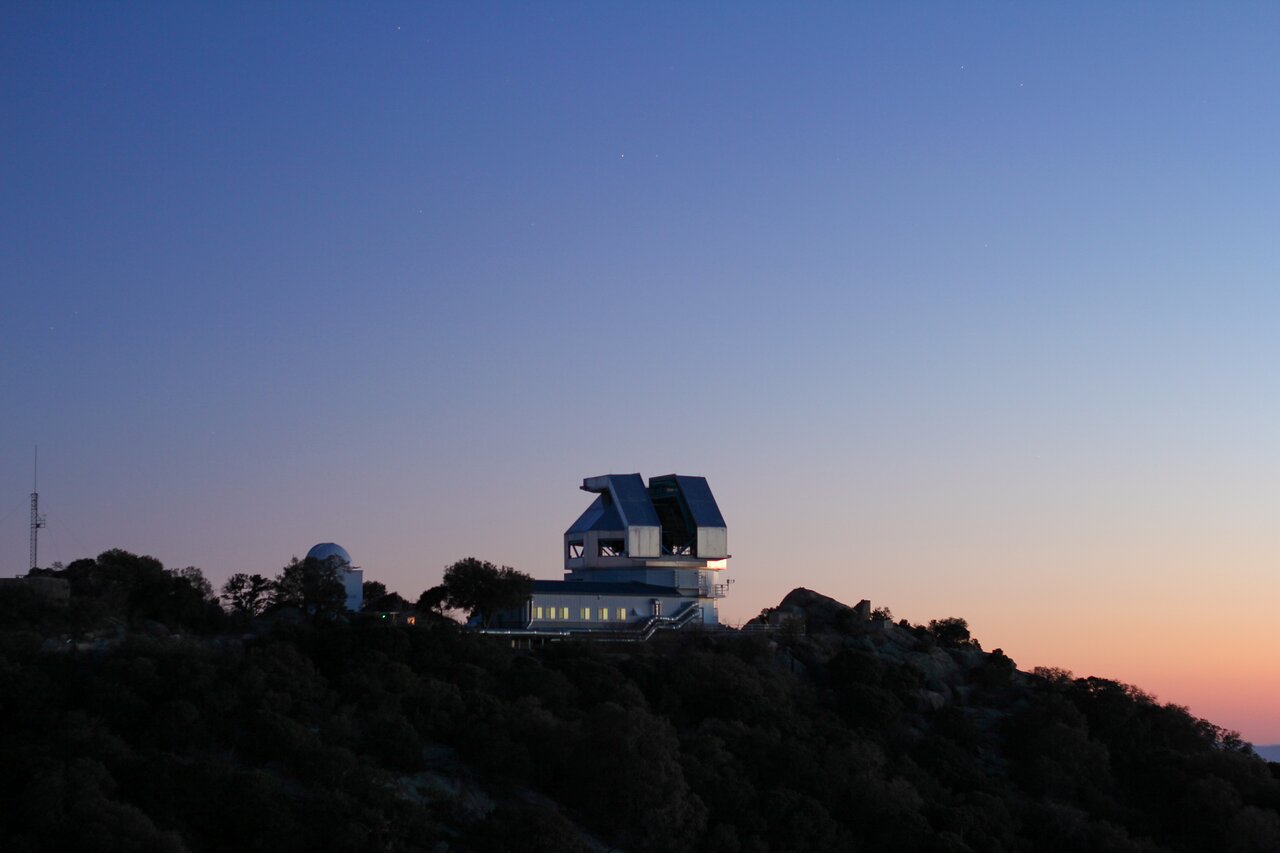
The WIYN 3.5-meter telescope at sunset. [KPNO/NOIRLab/NSF/AURA/P. Marenfeld; CC BY 4.0]
A WIYN for Exoplanetary Science
Though not typically open to the public for tours, our next stop took us to the WIYN 3.5-meter telescope. This telescope is operated and owned by the WIYN Consortium, a partnership between the University of Wisconsin, Indiana University, NSFβs NOIRLab (National Optical-Infrared Astronomy Research Laboratory; formerly NOAO), Pennsylvania State University, and Princeton University. Operating since 1994 with a strong collection of instruments, WIYN has observed galaxies near and far, stars across their lifetimes, and exoplanets tugging on their host stars.
Me, Lexi Gault (AAS Media Fellow), in front of the WIYN 3.5-meter telescope. I have used WIYNβs SparsePak spectrograph to collect data for my dissertation research! [AAS Nova/Kerry Hensley]
The partnership between public and private universities and a government institution was the first of its kind. Through this consortium, hundreds of undergraduate and graduate students have conducted research with WIYN, and the telescopeβs suite of instruments have enabled early career astronomers to explore the universe both near and far.
Mysteries of Dark Energy at Mayall
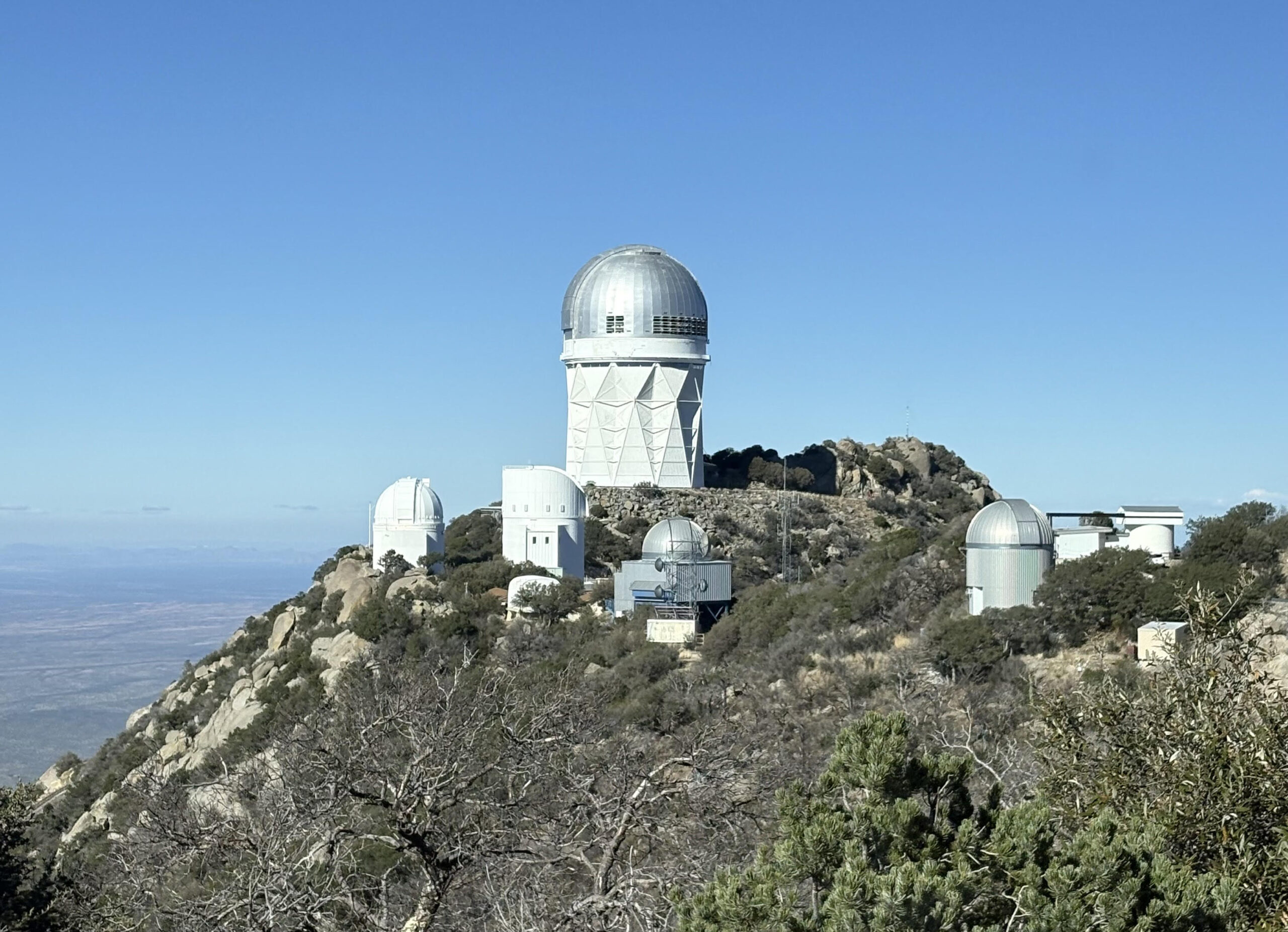
We concluded our tour at the Mayall 4-meter Telescope, the tallest telescope dome on the mountain at a staggering 18 stories high. This iconic telescope saw first light in 1973, and at the time, was the second-largest (in diameter) telescope in the world. Originally built for wide-field optical and infrared studies of the universe, the Mayall has enabled decades of critical scientific research.
Mayall is now home to the Dark Energy Spectroscopic Instrument (DESI), the most powerful multi-object survey spectrograph in the world. The DESI survey measures the impact of dark energy on the expansion of the universe through creating the largest ever 3D map of the universe. Mapping the distances to hundreds of millions of galaxies, DESI has revolutionized cosmology and enabled groundbreaking research into the origins of the universe.ΒFrom the telescopeβs massive dome, to the busy DESI control room, to the gallery floor with a nearly 360 degree view of the surrounding desert, the Mayall offers visitors a unique glimpse into Kitt Peakβs history and its future. While WIYN is a hidden gem, the Mayall 4-meter Telescope is open to the public for tours daily, so you can experience the exciting era of research and discovery at KPNO.Β
Visit Kitt Peak
Interested in getting a peek yourself? KPNO is open to the public daily with multiple tour types to choose from, including both daytime and nighttime visits! Plan your visit to Kitt Peak here.
The post Getting a Peek of Kitt Peak National Observatory appeared first on AAS Nova.
Why Evolution is Still Foolish

Standing For Truth Against the Big Bang


Black Hole Superradiance Search for Dark Photons


Dark Photons and the Illusion of Dark Matter


Should Biblical Creationists Believe in Dark Matter and Dark Energy?


Is the Big Bang Pure Fiction?


Dark Energy May Not Exist | New Insight on the Cosmic Web?


- Sci.News
- Is Dark Energy Unnecessary? Mathematicians Challenge Standard Cosmological Model of Universe
Is Dark Energy Unnecessary? Mathematicians Challenge Standard Cosmological Model of Universe
Mathematicians from University College London and the University of California, Davis, have published a mathematical proof that the Universeβs accelerating expansion can be explained without dark energy, dealing a serious blow to the Lambda-cold dark matter model.
The post Is Dark Energy Unnecessary? Mathematicians Challenge Standard Cosmological Model of Universe appeared first on Sci.News: Breaking Science News.