❌

Normal view

NASA’s Hubble Shows Star Formation in Andromeda Galaxy Winding Down

27 July 2026 at 15:00
6 Min Read

NASA’s Hubble Shows Star Formation in Andromeda Galaxy Winding Down

The left half of the disk of the Andromeda galaxy, with a jagged outer edge at the top and bottom on a black background. At right, the galaxy’s center is a horizontal yellow oval extending across about a third of the image. Two crescent shaped clumpy, dark dust lanes with abundant stars throughout extend out from the center. The galaxy becomes bluer as you move outward. At top middle, the satellite galaxy M32 appears as a small, fuzzy yellow oval. Within the disk of Andromeda, two regions at upper right and lower middle are outlined in small white boxes labeled 1 and 2, respectively. At the left side of the image, those two regions are enlarged in pullouts. Both contain a dense, grainy-appearing field of thousands of stars. Region 1 is noticeably bluer than region 2 and contains blue star-forming clumps.
NASA Hubble’s view of part of the Andromeda galaxy.
Credits:
Image: NASA, ESA, Benjamin Williams (UWashington), Zhuo Chen (UWashington), L. Clifton Johnson (Northwestern); Image Processing: Joseph DePasquale (STScI)

A new study using data from NASA’s Hubble Space Telescope finds that star formation in the nearby Andromeda galaxy has undergone a 500-million-year decline, with an even steeper drop in the last 40 million years. Andromeda, a spiral galaxy comparable in size to our Milky Way, is close enough to be seen with the unaided eye from areas with dark skies. Located about 2.5 million light-years from Earth, practically our cosmic backyard, Andromeda offers an opportunity for astronomers to examine its stellar populations in detail, leading to better understanding of the past of galaxies like our own.

The results published Monday in The Astrophysical Journal.

To reach this conclusion, the researchers combined data from two Hubble surveys: the Panchromatic Hubble Andromeda Treasury and the Panchromatic Hubble Andromeda Southern Treasury. Together, these two surveys mapped two-thirds of the disk of Andromeda in ultra-sharp detail. In total, the team measured about 200 million individual stars across the galaxy, giving them a detailed picture of Andromeda’s past activity.

“We need to measure the individual stars because they are the fossil record of the galaxy’s formation. Hubble is the only telescope that can give you high enough spatial resolution over a large enough area to be able to do that in Andromeda,” said Ben Williams, astronomer at the University of Washington and a co-author on the study.

Massive stars are bluer and short-lived, while less massive stars are redder and longer-lived. As a result, areas that have experienced recent star formation tend to have a larger fraction of blue stars, while areas with less recent star formation typically have a redder population. The team divided the Andromeda images into thousands of squares, spanning 300 light-years on each side of the square, and determined the history of star formation within each parcel to gain a comprehensive view of the galaxy’s past.

NASA’s Hubble Space Telescope has provided a detailed view of millions of stars in the Andromeda galaxy. Regions that have experienced recent star formation (1) appear significantly bluer than regions with less recent star formation (2).
NASA, ESA, Benjamin Williams (UWashington), Zhuo Chen (UWashington), L. Clifton Johnson (Northwestern); Image Processing: Joseph DePasquale (STScI)

Steady decline

Previous research showed the Andromeda galaxy experienced a dramatic burst of star formation about 2 billion years ago, likely due to a past interaction or merger with another galaxy. Since that time, star formation has been steadily declining.

Astronomers measure the rate of star formation in terms of the mass, or amount of gas and dust, converted into stars per year. The researchers calculated that, 500 million years ago, Andromeda formed stars at a rate of about one solar mass per year. However, the formation rate dropped to about half that by 40 million years ago. The current rate has plummeted even farther, to about one-fifth the mass of our Sun per year.

The team also examined whether that decline was consistent across the galaxy or concentrated in certain areas. They found that much of the recent star formation has occurred in a star-forming ring located about 32,000 light-years from the galaxy’s center. As a result, much of the decline they measure is driven by decreasing activity within that ring.

Rather than being the result of reduced material from which new stars can form, the decline is more likely to be a natural winding down from its previous, more active state.

“It’s just like after running a marathon, sometimes you’ve got to take a bit of a breather,” said Tobin Wainer, lead author, University of Washington.

Likely suspect

The team also investigated whether there was any connection between the decrease of activity in Andromeda and its proximity to satellite galaxy M32 (Messier 32). The M32 galaxy is separated from Andromeda by about 16,000 light-years in the plane of the sky; however, its 3D location in space is uncertain. As a result, astronomers are unsure if or when it might have interacted with Andromeda in the past.

“One of the major motivations for this program was to probe potential interactions between M32 and Andromeda’s disk,” said Zhuo Chen, co-author, University of Washington.

Survey data from the Panchromatic Hubble Andromeda Southern Treasury allowed the team to study the history of star formation in Andromeda near M32. They found that this area showed signs of decreased star formation compared with other regions. The timing of this decrease, which this study finds began roughly 60 million years ago, could help constrain when the M32 galaxy interacted with Andromeda’s disk.

“We can’t explicitly say that we are seeing a decrease in star formation because of M32. But it’s right there, and it’s definitely the most likely suspect,” said Wainer.

This movie, created from an analysis of data from NASA’s Hubble Space Telescope, demonstrates how the rate of star formation in the Andromeda galaxy has declined over the past 500 million years. Brighter colors indicate where star formation was highest during a given time.
Visualization: Tobin Wainer (UWashington); Image Processing: Joseph DePasquale (STScI); Video: NASA, ESA, STScI, Gregory Bacon (STScI)

The team plans to continue analyzing the Hubble data and combine it with data from ground-based observatories to gain additional insights into the history of Andromeda.

“There’s a strong scientific value to this archival data. Andromeda is important because it’s a neighbor that is close enough that we can see it in great detail while also getting a global perspective,” said Raja GuhaThakurta, co-author, University of California Santa Cruz.

An even greater global perspective is likely to come from NASA’s Nancy Grace Roman Space Telescope after it launches as early as Sunday, Aug. 30. Roman’s gigantic field of view can cover at least 100 times as much area as Hubble at near-infrared wavelengths in a single observation. A newly approved Roman observing program will image the entirety of Andromeda’s disk and areas of its surrounding halo, allowing astronomers to measure hundreds of millions of stars and enabling groundbreaking new science.

The Hubble Space Telescope has been operating for more than three decades and continues to make ground-breaking discoveries that shape our fundamental understanding of the universe. Hubble is a project of international cooperation between NASA and ESA (European Space Agency). NASA’s Goddard Space Flight Center in Greenbelt, Maryland, manages the telescope and mission operations. Lockheed Martin Space also supports mission operations at Goddard. The Space Telescope Science Institute in Baltimore, which is operated by the Association of Universities for Research in Astronomy, conducts Hubble science operations for NASA.


Related Images & Videos

The left half of the disk of the Andromeda galaxy, with a jagged outer edge at the top and bottom on a black background. At right, the galaxyu2019s center is a horizontal yellow oval extending across about a third of the image. Two crescent shaped clumpy, dark dust lanes with abundant stars throughout extend out from the center. The galaxy becomes bluer as you move outward. At top middle, the satellite galaxy M32 appears as a small, fuzzy yellow oval. Within the disk of Andromeda, two regions at upper right and lower middle are outlined in small white boxes labeled 1 and 2, respectively. At the left side of the image, those two regions are enlarged in pullouts. Both contain a dense, grainy-appearing field of thousands of stars. Region 1 is noticeably bluer than region 2 and contains blue star-forming clumps.

Andromeda Galaxy

NASA’s Hubble Space Telescope has provided a detailed view of millions of stars in the Andromeda galaxy.

On a black background, a pixelated, partial ring of bright pink and purple extends from 8 ou2019clock clockwise to 3 ou2019clock. There is a black gap at the bottom of the ring as well as in the middle. Below the ring, a timeline labeled millions of years ago lists the numbers 500, 200, 100, 50, 25, 0. The numbers 500 and 200 are yellow with a yellow line between them, indicating that the image shows the rate of star formation that was occurring in that timeframe.

Star Formation Rate in Andromeda Over Time

This movie, created from an analysis of data from NASA’s Hubble Space Telescope, demonstrates how the rate of star formation in the Andromeda galaxy has declined over the past 500 million years.


Share

Details

Last Updated
Jul 27, 2026
Editor
Andrea Gianopoulos
Contact
Media

Claire Andreoli
NASA’s Goddard Space Flight Center
Greenbelt, Maryland
claire.andreoli@nasa.gov

Christine Pulliam
Space Telescope Science Institute
Baltimore, Maryland

NeoCam é um app que deixa suas fotos com a cara de jogos em pixel art

27 July 2026 at 19:07

Já pensou em dar às suas fotos o visual característico de jogos em pixel art? Até existem alguns aplicativos com essa proposta na App Store, mas o NeoCam é uma nova solução do tipo que funciona em tempo real, permitindo ajustes instantâneos.

Ele oferece algumas opções principais de filtro: GamePal (visual de tela de Game Boy antigo), Mermaid (paleta de cores com tons de azul) e Hope (filtro em vermelho e azul). Em cada um deles, você pode ajustar a exposição, o nível de pixelização e a intensidade do dither (efeito de pontilhado).

Além disso, é possível criar seus próprios filtros com paletas de cores personalizadas e compartilhá-los com outros usuários, bem como obter criações de outras pessoas.

🚀👾🚀 NeoCam is officially LIVE on the App Store!

Turn your iPhone into a powerful 8-bit camera. Pixelate. Dither. Shoot. It's Game Boy Camera for the modern age.

Search "NeoCam" or… pic.twitter.com/NlP6cfV84h

— Chad Etzel (@jazzychad) July 23, 2026

Mas não para por aí pois o NeoCam também serve para gravar vídeos. Você pode, ainda, importar fotos existentes para editá-las como preferir.

O NeoCam está disponível gratuitamente na App Store para iPhone e iPad. A versão gratuita permite usar uma seleção de filtros; contudo, para gravar vídeos, ajustar o dither em fotos da sua biblioteca, capturar fotos em diferentes proporções de tela e remover a marca d’água, é necessário adquirir o NeoCam Plus — disponível por uma compra única de R$40.

via 9to5Mac

Europe’s next-generation submarines are getting a lithium-ion battery upgrade

25 July 2026 at 16:58

European defense contractor Saft is set to supply lithium-ion battery systems for the next generation of naval submarines, replacing decades-old lead-acid technology with EV-style packs that promise higher energy density, faster charging, and superior underwater endurance.

EC warns TikTok over child protection breaches

24 July 2026 at 15:19

Regulatory pressure over TikTok’s child safety measures continued to mount as the European Commission (EC) warned a preliminary look at the company’s protections found it wanting in various aspects.

The initial results of a formal probe into potential breaches of the Digital Services Act (DSA) show TikTok is falling short of the required standards. The EC explained a public-access setting means child accounts can still be viewed by all kinds of people whether they use the social media platform or not.

Another risk involves the content of 16- and 17-year-olds, which the EC found can be featured in recommendations to other users, presenting the risk of “unwanted contact” or cyberbullying.

It is inviting TikTok to view and respond to the preliminary findings and emphasised there is no prejudice to any final decisions in the investigation.

If TikTok is ultimately judged to be in breach of the DSA, the EC “may issue a non-compliance decision, which can trigger a fine”.

Other areas of concern the EC highlighted include an ability to view the profile pictures of children even when accounts are set to private mode, with discovery available if they are contacts of other users or by non-users of TikTok.

The EC explained the DSA requires platforms which children can use to “ensure a high level of privacy, safety and security”, a standard it considers TikTok may not be meeting.

UK regulator Ofcom is conducting its own probe into TikTok’s child protection measures.

The EC previously warned TikTok over its “potentially addictive design” as part of the same investigation.

The post EC warns TikTok over child protection breaches appeared first on Mobile World Live.

“That’s No Moon!”: Astronomers Vexed by “Super Weird” Moon-Like Object Without a Planet

24 July 2026 at 13:26

Scientists working at the European Southern Observatory’s Very Large Telescope (ESO’s VLT) in Chile have detected evidence for an unusual, ‘moon-like object’ in the CD-35 2722 system that doesn’t appear to orbit a planet.

The research team behind the discovery said the unusual object, which orbits a brown dwarf that orbits a large, Sun-like star, doesn’t fit normal astronomical categories, leaving them unsure what to name it.

If confirmed, the unusual space object would be the first moon without a host planet ever discovered. Such a confirmation would also make the newly termed “exosatellite” the first exomoon of any type discovered outside our Solar System.

Moon-Like Object Part of ‘Super Weird’ System

According to a statement announcing the moon-like object, ESO student Kevin Hoy had been monitoring the CD-35 2722 star system for months. The measurements that spotted the new, moon-like object were taken with the observatory’s CRIRES+ instrument using the radial velocity method that spotted the first planet around a Sun-like star.

During that time, the researcher and lead author of a study detailing the find said he noticed the system was “super weird” compared to our local Solar System. While the star at the center of the system, with a mass of about half of our Sun, was not unusual, they also determined that it is orbited by a brown dwarf. Brown dwarfs are astronomical objects too small to be a star, but too massive to be a planet, making the pairing unusual. Still, it was not unheard of.

moon-like object exosatellite
The region in the sky around CD-35 2722, a star orbited by a brown dwarf, which is itself orbited by an object at least as massive as Jupiter. The ‘moon’ orbiting the brown dwarf is not visible, but it has been detected via the gravitational pull it exerts on the brown dwarf (Image Credit: ESO/Digitized Sky Survey 2).

However, according to Hoy, when the team spotted a third, smaller object in the system, they were left confused. Measurements indicated it is at least as massive as Jupiter, suggesting it may be a moon orbiting the Brown Dwarf, only without a host planet.

“The satellite we report is a giant gaseous body orbiting a highly massive companion, itself several times the mass of Jupiter,” explained Alice Zurlo, Director of the Millennium Nucleus of Young Exoplanets and their Moons (YEMS) in Chile project and collaborator on the study.

Mysterious ‘Exosatellite’ Defies Traditional Classification

The team has temporarily named the moon-like object an “exosatellite.” However, Hoy said the object’s status as a ‘third wheel’ in the system makes them want to classify it as a moon, “even if it is nothing like the small, rocky moons we have in our system.”

“This system is somewhat hard to define using Solar-System-based words like ‘planet’ and ‘moon’,” the researcher explained. “The exosatellite is clearly massive enough to be a planet, but it does not orbit a star, though it orbits an object that orbits a star.”

Director Zurlo said the differences between the observed system and our own Solar System have added to the difficulty in labeling the moon-like object.

“We have a clear delineation between the planets and the Sun in the Solar System, so defining things like moons is simple,” Zurlo explained. “In the CD-35 2722 system, where we are blurring the lines between stars, planets, and moons, the whole thing becomes more complicated to describe.”

“This System is Truly Unique and Represents a Breakthrough”

When discussing the significance of the moon-like object, Director Zurlo said detecting satellites in other systems will help researchers better understand the diversity in formation and evolution of planets, moons, and other moon-like objects. The director also noted the historical nature of the detection.

“As exotic as it is, this system is truly unique and represents a breakthrough: the first plausible detection of an exosatellite,” the researcher explained.

Moving forward, the team said the increased sensitivity of the 39-meter mirror on the ESO’s in-development Extremely Large Telescope (ELT) will allow for the detection of even smaller moons, including potentially spotting moons the size of Earth’s largest satellite. The researchers said such detections will likely force the astronomical community to reconsider how planetary objects are labeled, especially those in systems so radically different from our own.

The study “Planetary-mass exosatellite detected around the substellar companion of a star” was published in the journal Nature.

Christopher Plain is a Science Fiction and Fantasy novelist and has spent the last six years as Associate News Editor and Head Science Writer at The Debrief. Follow and connect with him on X, learn about his books at plainfiction.com, or email him at christopher@thedebrief.org.

Hubble Spies One-Sided Spiral

24 July 2026 at 12:11

3 min read

Hubble Spies One-Sided Spiral

A spiral galaxy. It has a prominent spiral arm on one side (lower left) and a wide, glowing core. Dark brown filaments of dust swirl through its disk, while blue clusters of stars are visible mostly going out to its arm. On the opposite side of the arm (upper right), gas trails off from the disk, beyond the field of view in this image. A matching spiral arm is not visible on this side. The galaxy lies on a dark background.
This NASA/ESA Hubble Space Telescope image features the spiral galaxy NGC 4654, located 72 million light-years away in the constellation Virgo (the Maiden).
NASA, ESA/Hubble, D. Thilker, J. Lee, and the PHANGS-HST Team

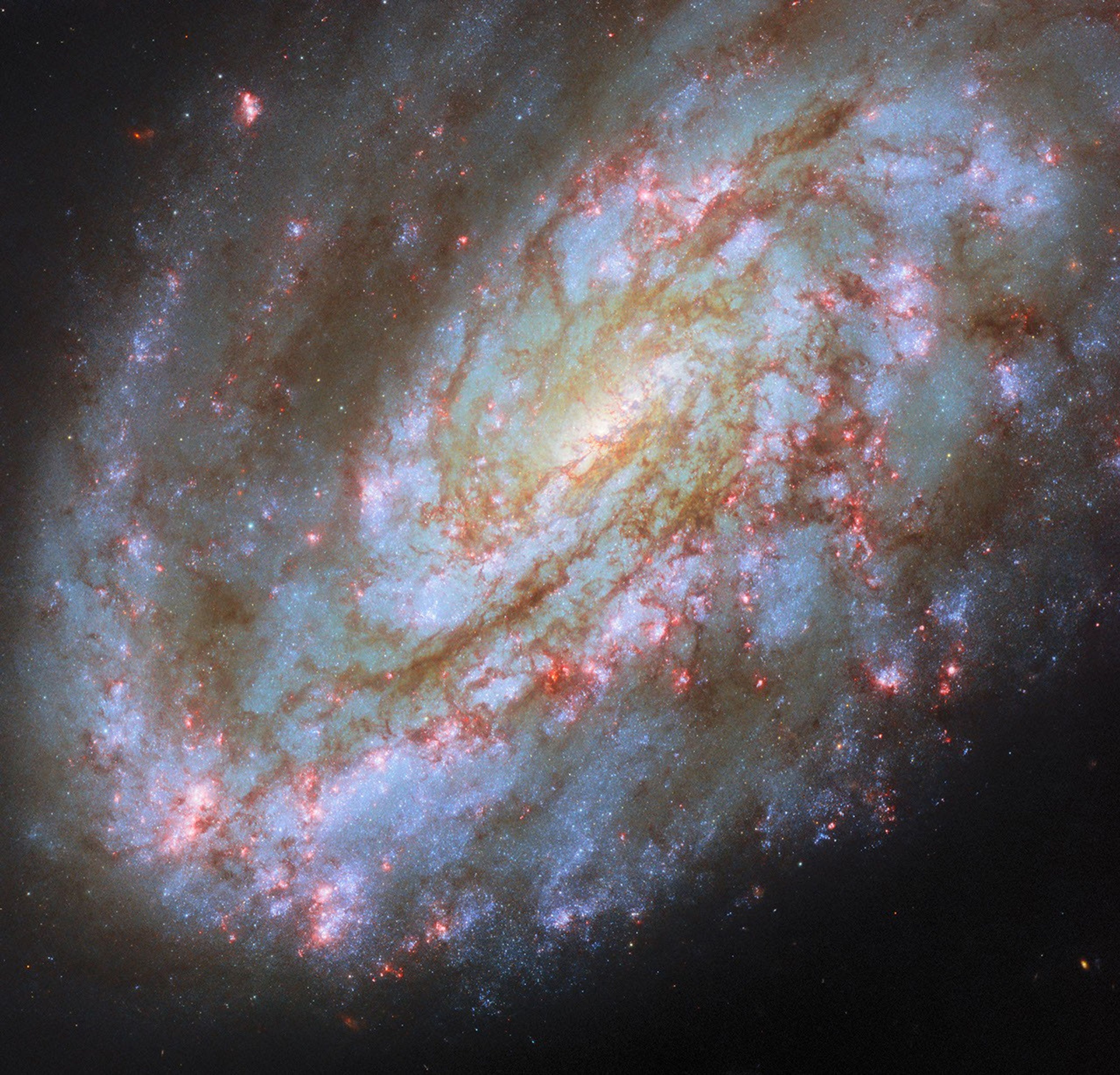
The subject of this NASA/ESA Hubble Space Telescope image is a spiral galaxy struggling against titanic forces that appear on galactic scales in space. This is NGC 4654, an intermediate spiral galaxy in the constellation Virgo (the Maiden). It is classified as an “intermediate” because its overall shape lies between spiral galaxies that have a bar across their centers and those that don’t. NGC 4654 has a weak bar structure at its center and is located 72 million light-years from Earth in the Virgo Cluster, a particularly massive and populous galaxy cluster.

NGC 4654 is particularly asymmetric, with a rounded and clearly-defined edge on one side and a long tail of gas stretching out from the opposite side — outside the field of view captured in this image. This gaseous tail is the result of ram pressure stripping, a force that galaxies can experience as they plow through space. NGC 4654 moves with such high velocity that it sweeps up and rams through the hot, rarefied gas filling the space between the Virgo Cluster’s galaxies. This intracluster medium in turn exerts a “ram pressure” on the galaxy, compressing the galaxy’s leading edge and dragging its gas behind the galaxy, creating the elongated tail.

It’s not just the galaxy’s gas that is unevenly distributed: its stars are too, and this is more unusual for a spiral galaxy. While the spiral arm on its leading edge is rich with stars and gas, the opposite arm noticeably lacks stars, influencing the galaxy’s lopsided spiral shape. Astronomers think that ram pressure alone is unlikely to cause this effect. Rather, NGC 4654 was also subjected to the gravitational force of fellow Virgo Cluster galaxy NGC 4639. While the two galaxies are far apart now, it’s thought that a fly-by interaction between them around 500 million years ago ripped away NGC 4654’s gas along one side, limiting star formation there and creating the asymmetry in its shape.

Many galaxies that undergo ram pressure stripping suffer reduced star formation rates as the cold gas that collapses to form their stars is pulled away and lost. NGC 4654, however, is still forming nearly two Suns’ worth of stars every year, a rate comparable to other galaxies of similar size. The active star formation is visible in the latest Hubble data included in this image. The data picks up on a wavelength of red light emitted by the clouds of energized gas where newborn stars lurk. The bright pink bubbles that appear across NGC 4654 — from its forward spiral arm, to around its weak bar, and out to the edge of its disk — are areas where these newborn stars shine.

The data used in this image came from two observing programs (#15654, #17502) that aim to link the gas in galaxies with star formation. By observing many prominent galaxies in the vicinity of our own, researchers hope to better understand how gas moves in galaxies, where and when it collapses to form stars and star clusters, and what effect those new stars have on the gas around them.

Text Credit: ESA/Hubble

Media Contact:

Claire Andreoli
NASA’s Goddard Space Flight Center, Greenbelt, MD
claire.andreoli@nasa.gov

James Webb Telescope Discovers Hidden Giant Planet in Famous Star System

By: NASA
24 July 2026 at 11:44
Beta Pictoris System (Artist’s Concept)Webb found a hidden giant planet by detecting its atmospheric chemistry through a bright debris disk. For years, a third giant planet remained concealed within the bright dust surrounding Beta Pictoris, one of the most closely observed planetary systems in the Milky Way. NASA’s James Webb Space Telescope has now exposed the hidden world by [...]

Hubble telescope watches unique nova explosion fire cosmic 'bullets' through the Milky Way at 20 million mph

24 July 2026 at 11:00

Using NASA's long-serving Hubble Space Telescope, astronomers have discovered that a stellar explosion in the Milky Way is blasting out cosmic bullets travelling at 20 million miles per hour.

The cosmic explosion in question is V445 Puppis, which erupted in 2000 and is the only known "helium nova" in our galaxy. Though astronomers have been studying V445 Puppis for two decades, much of the phenomena associated with it were shrouded in mystery due to a vast cloud of dusty debris that surrounded this nova.

When this debris finally cleared, a team of researchers was able to peer into V445 Puppis using Hubble, NASA's exoplanet-hunting spacecraft TESS (Transiting Exoplanet Survey Satellite), and the Earth-based Very Large Telescope (VLT), along with an array of other instruments. This allowed them to discover not only the "bullets", clumps of potentially oxygen-rich gas it is firing, but also the true nature of this system. This revealed that V445 Puppis consists of a dead star hungrily feeding on a companion star that is, by itself, a rare find. Thus, this system offers scientists a rare chance to study one of the rarest types of binary systems and one of the rarest cosmic explosions.

"The origin of these 'bullets' is a mystery. We suspect that these originated post-outburst, but 'bullets' of this kind have not been observed in any other nova," team member John Mills, a researcher at the University of Warwick in the UK, said in a statement.

What is a helium nova?

Helium novas like V445 Puppis occur when a white dwarf dead star cannibalistically strips helium-rich but hydrogen-poor matter from a star that has already lost its outer layer of hydrogen, exposing inner layers of helium; forming a rare "helium star." By contrast, "ordinary" novas are explosions triggered by the buildup of stolen stellar matter rich in hydrogen, not helium.

As the material accumulates on the surface of the white dwarf (a type of stellar remnant left behind when stars around the mass of the sun die) it creates runaway pressures and temperatures that eventually trigger a thermonuclear explosion.

When V445 Puppis went nova back in late 2000, it launched vast, twin plumes of debris that resemble butterfly wings. Stretching out for more than a trillion miles, astronomers initially spotted this bipolar outflow in infrared. The nova also spawned a thick disc of dust that completely obscured the binary star system. That cloud persisted for over two decades, preventing astronomers who were investigating the expanding debris from determining what kind of stars the blast originated from.

Once the debris cleared, this team determined that the system contained a helium star, one of only a few thousand of these stripped stellar bodies to be discovered among the billions of stars that populate the Milky Way.

"The culprits behind this galactic eruption have been an enduring mystery over the past 25 years, which is why it is very exciting to confirm that this helium nova was the result of a helium star accreting onto a white dwarf," Mills said.

The findings also revealed cosmic "bullets" that are even more remarkable, as they have never been seen around any other novas. Intriguingly, the team also found that V445 Puppis may be about to go nova again, and this could lead to an entirely different type of cosmic explosion.

Is V445 Puppis about to blow its top again?

Mills found that the white dwarf in V445 Puppis has overcome its stellar indigestion and is once again feeding on its companion helium star.

This is the process that led to the initial helium nova, and could mean that another episode of this rare type of cosmic explosion is soon to occur.

That has implications for our understanding of another type of cosmic eruption, this time a type of supernova called a Type Ia supernova. These occur when white dwarfs overfeed on companions and are completely destroyed by the resultant explosion.

Scientists have long suspected that repeated helium nova eruptions could lead to final Type Ia supernovas.

An illustration  of a white dwarf star feeding on a stellar companion prior to a type Ia supernova

An illustration of a white dwarf star feeding on a stellar companion prior to the eruption of a type Ia supernova (Image credit: Robert Lea (created with Canva))

A new Type Ia supernova would be exciting because these events are so regular in terms of their light emission that they can be used as so-called "standard candles" to measure cosmic distances and gauge the age of the universe.

This means that they can also be employed in the quest to understand how fast the universe's expansion is proceeding, and the influence of the mysterious force called dark energy on this process.

"I look forward to seeing how this result may help us uncover what powers other similar hydrogen-poor astronomical explosions, such as the famous Type Ia supernovas," Mills said.

The team's research was presented this week at the Royal Astronomical Society's National Astronomy Meeting in Birmingham, UK.

EU delays release of Copernicus imagery over Gulf of Oman 

24 July 2026 at 11:00
The Gulf of Oman, imaged in September 2018 by the Copernicus Sentinel-3A satellite. Credit: ESA; CC BY-SA 3.0 IGO

JOHANNESBURG — The European Union has ordered a 24-hour delay in the release of some Sentinel-1 and Sentinel-2 imagery following a request from the United States based on concerns that […]

The post EU delays release of Copernicus imagery over Gulf of Oman  appeared first on SpaceNews.

Réchauffement extrême : quand l’Europe a brûlé pendant des millénaires dans un gigantesque enfer de feu

24 July 2026 at 06:08
Il y a 201 millions d’années, l’Europe aurait connu une période d’incendies sans précédent. Alimentés par d’immenses tapis de fougères apparus après une extinction massive, les feux se seraient répétés pendant des dizaines de milliers d’années, créant un véritable cercle vicieux entre incendies...

Poland commits $745 million to EU’s IRIS² constellation project

23 July 2026 at 22:14

WARSAW, Poland — The Polish government has agreed to invest around $745 million in the development of the planned IRIS² multi-orbit satellite internet constellation with the European Union.  The money […]

The post Poland commits $745 million to EU’s IRIS² constellation project appeared first on SpaceNews.

Le télescope James-Webb a vu des centaines de « points rouges » : ce qu’ils pourraient réellement cacher est vertigineux

23 July 2026 at 20:03
Il existe plusieurs objets et phénomènes exotiques en astrophysique qui sont des serpents de mer, comme on dit. Des signes de leur existence apparaissent parfois et à répétition dans les observations, sans que l'on puisse aboutir vraiment à une conclusion. C'est le cas avec une nouvelle...

Google fined €890M for EU DMA breaches

23 July 2026 at 15:35

The European Commission (EC) slapped two fines on Google totalling €890 million for non-compliance with the Digital Markets Act (DMA) and demanded the tech giant make changes to its search service and app store policies.

Decisions on the two probes follow investigations started in March 2024. Of the total, €460 million is for breaches on its search service and €430 million for app distribution restrictions on Google Play.

On the search charge, the EC determined Google gave its own services preferential treatment in rankings, either by having them at the top of a results page, or using enhanced visuals or filters.

This goes against DMA rules requiring “transparent, fair and non-discriminatory conditions” in rankings, the EC argued.

Its fine related to the Google Play app store was for not allowing developers distributing apps through the platform to inform customers of alternative offers and direct them to make purchases elsewhere.

The regulator acknowledged after what it termed constructive dialogue Google had begun testing changes to its services the regulator noted could “constitute substantial progress towards compliance”.

However, the EC stated the “fines imposed today on Google take into account the gravity and duration of the non-compliance”.

As part of the judgement, the EC demands Google ends the policies deemed in breach of the DMA.

Google has 60 days to comply, with the authority threatening periodic penalty payments of up to 5% of worldwide turnover if it does not.

The company has the right to appeal.

Breaking products
Unsurprisingly Google is unhappy with the changes it is being forced to make to meet DMA obligations.

In a statement, president of global affairs at Google and its parent company Alphabet Kent Walker claimed the way the DMA is implemented “continues to break everyday products” and degraded the experience of businesses and consumers in the European Union.

“To comply, we are having to strip away real-time Search features Europeans love like instant pricing and direct availability for hotels, flights and restaurants, and dismantle safety protections on Google Play,” he added.

“This isn’t fair competition, it’s product degradation driven by a small group of self-serving complainants, with European businesses and consumers taking the hit. Regulation should improve products, not make them worse.”

The post Google fined €890M for EU DMA breaches appeared first on Mobile World Live.

High risk vendor rip out could cost EU up to €40B

23 July 2026 at 11:05

GSMA Intelligence estimated the cost of replacing equipment made by so-called high risk vendors (HRV) from telecoms networks in Europe will cost between €30 billion to €40 billion, based on data from operators representing almost half of the market.

In the study, independently commissioned and sponsored by seven operator groups, GSMA Intelligence put the cost of replacing mobile networks at €16 billion to €22 billion, equating to around €30 to €42 per mobile connection. This is driven by high exposure to HRV equipment and the cost of replacing equipment such as base stations.

Fixed network costs will hit up to €5 billion, representing the costs of fibre terminals, gateways and fixed wireless equipment. Transport networks, which includes optical switches, multiplexers and amplifiers will cost between €9 billion and €12 billion.

The figures cover only direct equipment replacement and exclude write-offs of existing assets, disruption cost, capacity constraints and broader impacts on future investment plans.

Higher prices
GSMA Intelligence further warned excluding HRV’s could reduce competitive pressure, leading to a 24% price increase in mobile network equipment, 19% in fixed network equipment and 10% in transport network equipment.

Higher prices would therefore raise operator investment costs by €8.5 billion between 2027 and 2030, with current budgets for mobile networks set at nearly €42 billion.

The European Commission outlined a proposal making it mandatory to “de-risk” European mobile telecoms networks from high-risk third party suppliers in January, as part of revisions to its Cybersecurity Act.

Over a five year period, it estimated phasing out equipment could lead to annual costs of €3.4 billion to €4.3 billion for operators, while investment in “trusted suppliers” could grow up to €2 billion per year.

Operators Deutsche Telekom, Fastweb, MEO, Orange, Telefonica, United Group and Vodafone Group took part in the GSMA Intelligence study, which was based on limited datasets provided by third parties.

The post High risk vendor rip out could cost EU up to €40B appeared first on Mobile World Live.

EU fines Google €890m for competition breaches over search and apps

Firm told to treat third-party services that appear in its results in ‘fair and non-discriminatory manner’

Google has been fined a total of €890m (£760m) by the EU for breaches of online competition laws by its search and app store services.

The European Commission, the EU’s executive arm, said Google had broken the Digital Markets Act by giving priority to its own services, such as shopping and hotel deals, in search results over those of its rivals.

Continue reading...

© Photograph: Steve Marcus/Reuters

© Photograph: Steve Marcus/Reuters

© Photograph: Steve Marcus/Reuters

The James Webb Space Telescope's disappearing 'Little Red Dots' may lead to another cosmic puzzle

23 July 2026 at 11:00

Paleontologists now know that many of the dinosaurs didn't disappear but instead evolved into modern birds, and new research suggests that "cosmic dinosaurs" observed by the James Webb Space Telescope (JWST) didn't go extinct either. Rather, they may have evolved into familiar sights in the modern universe: vast conglomerations of densely packed stars called "globular clusters."

Little Red Dots became quite the puzzle for astronomers in 2022, when the JWST began to routinely spot them in abundance around 600 million years after the Big Bang. That is because these objects seemingly disappear before the cosmos gets to around 2 billion years old.

Astronomers have proposed many different explanations for Little Red Dots, including the suggestion that they could be "black hole stars," or black holes wrapped in vast shrouds of dense gas and dust. This team theorizes that a forming globular cluster with a supermassive star, a hypothetical short-lived stellar body with between 1,000 and 10,000 times the mass of the sun, would also look a lot like a Little Red Dot at its heart.

"These may not be just a strange new JWST population with no connection to the universe around us today," team leader John Chisholm of the University of Texas Austin said in a statement. "Instead, Little Red Dots may persist past the early universe, evolving into something relatively familiar.

"Little Red Dots could be galaxies, they could involve black holes, or they could be something even more unexpected. Our work shows that forming globular clusters with supermassive stars should be part of that conversation."

An unfamiliar side to a familar sight

Globular clusters are generally seen in large galaxies and are densely packed with up to many millions of ancient stars. Our galaxy, the Milky Way, is host to at least 150 globular clusters, and though familiar, astronomers still aren't quite sure how they form.

"We usually see them [globular clusters] after billions of years of evolution, at a time when their massive stars are gone, their gas has been cleared out, and dynamical processes have changed their masses and structures," team member Danielle Berg of UT Austin said in the statement. "That makes it very hard to reconstruct the original conditions they formed in."

It is thought that the stars in globular clusters all formed at the same time in the early universe. However, at this time the cosmos should only have had hydrogen, helium and a smattering of heavier elements (which astronomers call "metals") available for star construction. Yet, many stars in globular clusters are strangely abundant in helium and metals like nitrogen, sodium and aluminum, while lacking the expected levels of carbon, oxygen and magnesium.

"This specific pattern indicates nuclear fusion at very high temperatures, much higher than in the cores of even massive normal stars," team member Mike Boylan-Kolchin of UT Austin said in the statement. "A supermassive star is precisely the kind of environment that could produce this combination."

Globular cluster NGC 6638 looks like a sparkling conglomerate of blueish stars.

Globular cluster NGC 6638, as seen by the Hubble Space Telescope. (Image credit: ESA/Hubble & NASA, R. Cohen)

Supermassive stars capable of generating this kind of heat would form in the dense environments of early globular clusters in which stellar collisions and mergers would be expected to occur over and over again. The resultant supermassive stars would be short-lived, lasting just around 1 million years (remember the sun is middle-aged at 4.6 billion years old) — but this would be sufficient time to forge the elements needed to explain the peculiar chemistry of globular clusters.

When these supermassive stars die in supernova explosions, the elements they forged would be blasted out to become the building blocks of the next generation of stars. This would provide the stars of modern globular clusters with their unusual chemical fingerprints.

"In our model, the supermassive star that helps make the object look like a Little Red Dot would live for only a short time," Chisholm continued. "Once that star dies, the object may no longer look like a Little Red Dot, even if the cluster itself survives billions of years."

Six of the

Just some of the "little red dot" galaxies discovered by the JWST. (Image credit: NASA, ESA, CSA, STScI, Dale Kocevski (Colby College))

Strange chemistry isn't the only thing linking early globular clusters with Little Red Dots, however. Not only does the team propose that the distribution of Little Red Dots in the early universe matches the distribution of modern globular clusters, but they also say models of Little Red Dot evolution show that their estimated masses could easily lead to the masses of globular clusters seen in the recent universe.

There is also the issue of timing. Little Red Dots appear around 600 million years after the Big Bang, and that is also the time that scientists estimate that globular clusters would have begun to form.

"There's no single smoking gun at this point that says Little Red Dots are globular clusters, but it would explain a lot of diverse and surprising observations," said Boylan-Kolchin.

This study is currently available to view as a pre-print on the paper repository arXiv.

Hugs May Be an Ancient Peacekeeping Tool, Ape Study Suggests

22 July 2026 at 20:01
Examples of bonobo and chimpanzee reassurance behaviors. Image credit: Z. Clay / J.S. Brooker.

In a new study of chimpanzees (Pan troglodytes) and bonobos (Pan paniscus), scientists found that embraces, touches and other reassuring gestures before competition for food were linked to more peaceful sharing, suggesting the roots of human social touch stretch back at least six million years.

The post Hugs May Be an Ancient Peacekeeping Tool, Ape Study Suggests appeared first on Sci.News: Breaking Science News.

❌