July’s full Buck Moon, the second full moon of summer in the Northern Hemisphere, will turn full on Wednesday (July 29). It will be the final full moon before a flurry of solar and lunar activity — notably, a total solar eclipse caused by the new moon on August 12, and a partial lunar eclipse during the following full moon on August 28.
Named for the new antlers that emerge from male deer during summer, July’s full moon is also known as the Thunder Moon and Hay Moon, according to Time and Date. The Anishinaabeg people call it Miin Giizis, or Berry Moon, according to the Center for Native American Studies.
The Buck Moon will be at its fullest at 10:37 a.m. EDT on Wednesday — however, it will also look bright and full on Tuesday and Thursday night. From North America, the best time to see it will be at moonrise in the southeast during dusk on Wednesday evening. The exact time of moonrise will depend on your location. A full moon looks most dramatic as it first appears above the eastern horizon shortly after sunset, with Rayleigh scattering making it loom orange — the same light-scattering phenomenon that makes the sky blue and sunsets red.
July's full moon is one of the lowest full moons of the year as seen from the Northern Hemisphere because it occurs relatively soon after the June solstice. A full moon always sits opposite the sun, so the path of July's full moon mirrors the sun's path in February.
Two weeks after theBuck Moon, the new moon will slide directly between Earth and the sun, causing a total solar eclipse. Observers along a narrow path of totality in eastern Greenland, western Iceland and northern Spain will see the moon block the sun for a few minutes, revealing the solar corona.
A deep partial solar eclipse will be visible across Europe, with a small partial solar eclipse observed over Canada and the northeastern U.S.. The largest eclipse in Canada will be 93% in northeastern Nunavut, while northeastern Maine in the U.S. will see 29% of the sun covered by the moon. Solar eclipse glasses must be worn at all times to safely view the partial phases.
The next full moon, the Sturgeon Moon, will rise on August 27 and be partially eclipsed by Earth overnight. More than 96% of the moon will pass into Earth's shadow as seen from Europe, Africa, North America and South America.
How much do you know about the moon? Test your lunar smarts with our moon quiz!
On July 3, one of NASA’s two Mars-destined ESCAPADE (Escape and Plasma Acceleration and Dynamics Explorers) spacecraft captured photos of Earth and the Moon in visible and thermal infrared light. At the time, the spacecraft was 363,250 miles (584,600 kilometers) from Earth and 115,600 miles (186,100 kilometers) from the Moon, making the Moon appear relatively large.
Taken with the Sun only partly illuminating Earth and the Moon, the visible light image shows the two bodies as crescents, with only around 8% of each face sunlit. Yet in the thermal infrared image, the shadowed hemisphere of Earth is illuminated by its own heat from both the atmosphere and surface, glowing at minus 10 to minus 44 degrees Fahrenheit (250 to 280 kelvins). Without the insulating blankets of oceans and atmospheres, the Moon’s far side remains at a much cooler minus 280 degrees Fahrenheit (100 kelvins).
visible light
thermal infrared light
Caption: In these images from NASA’s ESCAPADE mission, Earth (left) and Moon (right) can be seen. The image to the left of the slider shows visible light reflected by the Sun while the infrared image to the right shows the bodies’ emitted energy. White rings have been added in the thermal image to show the actual size of Earth and the Moon. Credit: NASA/UCB-SSL/NAU-Radiant/Lucint
NASA/UCB-SSL/NAU-Radiant/Lucint
In these images from NASA’s ESCAPADE mission, Earth (left) and Moon (right) can be seen. The image to the left of the slider shows visible light reflected by the Sun while the infrared image to the right shows the bodies’ emitted energy. White rings have been added in the thermal image to show the actual size of Earth and the Moon.
NASA/UCB-SSL/NAU-Radiant/Lucint
visible light
thermal infrared light
ESCAPADE Photos of Earth and Moon
July 3, 2026
In these images from NASA’s ESCAPADE mission, Earth (left) and Moon (right) can be seen. The image to the left of the slider shows visible light reflected by the Sun while the infrared image to the right shows the bodies’ emitted energy. White rings have been added in the thermal image to show the actual size of Earth and the Moon. Credit: NASA/UCB-SSL/NAU-Radiant/Lucint
The ESCAPADE mission used its Visible and Infrared Observation System cameras, provided by Northern Arizona University in Flagstaff, to capture the images, which are more than just road trip photo album snaps.
“We are thrilled that ESCAPADE was able to accommodate these excellent space-qualified cameras which will search for visible Martian aurora and investigate thermal properties of the Martian surface and atmosphere,” said Rob Lillis, the mission’s principal investigator at the University of California, Berkeley. “Since Earth and the Moon are well-known targets, imaging them provides an important calibration check for ESCAPADE’s cameras.”
The ESCAPADE spacecraft, which were built by Rocket Lab, are currently in a “loiter” orbit around Lagrange point 2, a location in space about a million miles from Earth. In November 2026, the spacecraft will fly by Earth to use the planet’s gravity to slingshot their way to Mars. When the spacecraft arrive in September 2027, they will study how a million-mile-per-hour stream of material flowing from the Sun, known as solar wind, interacts with the Martian environment and how that drives atmospheric loss at the Red Planet.
The ESCAPADE mission is funded by NASA’s Heliophysics Division and is part of the NASA Small Innovative Missions for Planetary Exploration program. The UC Berkeley’s Space Sciences Laboratory leads the mission with key partners Rocket Lab; NASA’s Goddard Space Flight Center in Greenbelt, Maryland; Embry-Riddle Aeronautical University; Advanced Space; and Blue Origin.
By Mara Johnson-Groh NASA’s Goddard Space Flight Center, Greenbelt, Md.
The research team behind the discovery said the unusual object, which orbits a brown dwarf that orbits a large, Sun-like star, doesn’t fit normal astronomical categories, leaving them unsure what to name it.
If confirmed, the unusual space object would be the first moon without a host planet ever discovered. Such a confirmation would also make the newly termed “exosatellite” the first exomoon of any type discovered outside our Solar System.
Moon-Like Object Part of ‘Super Weird’ System
According to a statement announcing the moon-like object, ESO student Kevin Hoy had been monitoring the CD-35 2722 star system for months. The measurements that spotted the new, moon-like object were taken with the observatory’s CRIRES+ instrument using the radial velocity method that spotted the first planet around a Sun-like star.
During that time, the researcher and lead author of a study detailing the find said he noticed the system was “super weird” compared to our local Solar System. While the star at the center of the system, with a mass of about half of our Sun, was not unusual, they also determined that it is orbited by a brown dwarf. Brown dwarfs are astronomical objects too small to be a star, but too massive to be a planet, making the pairing unusual. Still, it was not unheard of.
The region in the sky around CD-35 2722, a star orbited by a brown dwarf, which is itself orbited by an object at least as massive as Jupiter. The ‘moon’ orbiting the brown dwarf is not visible, but it has been detected via the gravitational pull it exerts on the brown dwarf (Image Credit: ESO/Digitized Sky Survey 2).
However, according to Hoy, when the team spotted a third, smaller object in the system, they were left confused. Measurements indicated it is at least as massive as Jupiter, suggesting it may be a moon orbiting the Brown Dwarf, only without a host planet.
“The satellite we report is a giant gaseous body orbiting a highly massive companion, itself several times the mass of Jupiter,” explained Alice Zurlo, Director of the Millennium Nucleus of Young Exoplanets and their Moons (YEMS) in Chile project and collaborator on the study.
Mysterious ‘Exosatellite’ Defies Traditional Classification
The team has temporarily named the moon-like object an “exosatellite.” However, Hoy said the object’s status as a ‘third wheel’ in the system makes them want to classify it as a moon, “even if it is nothing like the small, rocky moons we have in our system.”
“This system is somewhat hard to define using Solar-System-based words like ‘planet’ and ‘moon’,” the researcher explained. “The exosatellite is clearly massive enough to be a planet, but it does not orbit a star, though it orbits an object that orbits a star.”
Director Zurlo said the differences between the observed system and our own Solar System have added to the difficulty in labeling the moon-like object.
“We have a clear delineation between the planets and the Sun in the Solar System, so defining things like moons is simple,” Zurlo explained. “In the CD-35 2722 system, where we are blurring the lines between stars, planets, and moons, the whole thing becomes more complicated to describe.”
“This System is Truly Unique and Represents a Breakthrough”
When discussing the significance of the moon-like object, Director Zurlo said detecting satellites in other systems will help researchers better understand the diversity in formation and evolution of planets, moons, and other moon-like objects. The director also noted the historical nature of the detection.
“As exotic as it is, this system is truly unique and represents a breakthrough: the first plausible detection of an exosatellite,” the researcher explained.
Moving forward, the team said the increased sensitivity of the 39-meter mirror on the ESO’s in-development Extremely Large Telescope (ELT) will allow for the detection of even smaller moons, including potentially spotting moons the size of Earth’s largest satellite. The researchers said such detections will likely force the astronomical community to reconsider how planetary objects are labeled, especially those in systems so radically different from our own.
The study “Planetary-mass exosatellite detected around the substellar companion of a star” was published in the journal Nature.
Christopher Plain is a Science Fiction and Fantasy novelist and has spent the last six years as Associate News Editor and Head Science Writer at The Debrief. Follow and connect with him on X, learn about his books at plainfiction.com, or email him at christopher@thedebrief.org.
NASA is teaming up with 37 companies to develop the next generation of technologies that could make long-term exploration of the Moon and Mars possible. NASA has chosen 41 proposals from 37 U.S. companies to help develop technologies needed for a sustained human presence on the Moon and eventual crewed missions to Mars. The companies [...]
NASA is taking another major step toward a permanent Moon base with four new commercial missions that will test technology, deliver science, and help prepare for humanity’s future beyond Earth. NASA has selected three commercial space companies to carry out four new lunar missions in late 2028 through the agency’s Moon Base Program. Astrobotic, Firefly [...]
Landing spacecraft on the moon could contaminate ancient clues about how life may have originated on Earth, a new study finds.
As NASA continues on with its plan of sending astronauts back to the moon with the Artemis program, researchers are exploring what possible unintended consequences may arise from humans visiting the lunar surface. For instance, Artemis IV will land astronauts near the moon's south pole and the agency has future plans for building a longer-term moon base on the lunar surface, which would require many more trips. And indeed, a new study has found the exhaust from spacecraft involved with these landings could expel enough methane to contaminate the moon's surface — possibly destroying molecules that could help to explain how life may have originated on Earth.
"We are trying to protect science and our investment in space," senior study author Silvio Sinibaldi, the planetary protection officer at the European Space Agency, said in a statement. "Our activity can actually hinder scientific exploration."
While experts have had concerns for some time about how rocket launches on Earth pollute our planet and atmosphere, scientists have only really considered this issue with our own planet. This is especially because we haven't been to the moon's surface in over 50 years; concerns of accidental effects of a lunar landing simply haven't been top-of-mind. That's what makes this new study so important. It points to a potential issue that could mean that future moon landings might actually be detrimental to science.
An artist's concept of Blue Origin's lunar lander. Lunar landings could pose a serious issue for science on the moon if methane contaminates ancient polar ices, a new study has found. (Image credit: Blue Origin)
Life's clues on the moon?
So why do we think the signs of life could be hiding on the moon? It's actually hiding in ice. Dark craters near the moon's poles, which exist in perpetual shadow, hold ancient ice. This ice is thought to contain material from asteroids and comets that smashed into the moon billions of years ago. Trapped in lunar ice to this day, these bits of ancient collisions could include what the researchers describe as "prebiotic organic molecules," or molecules that could have preceded life on Earth.
It's thought that these molecules from asteroid and comet visitors could have sparked life on Earth, and by studying those possibly trapped on the moon, researchers could be looking at the molecules that ended up combining and creating life as we know it.
The molecular history of life on Earth is pretty much nonexistent on our own planet, as it was largely destroyed by the billions of years of changes we've experienced. But the moon has remained mostly unchanged, so these wells of ice are a uniquely-preserved sampling of pre-life molecules.
"We know we have organic molecules in the solar system — in asteroids, for example," Sinibaldi said. "But how they came to perform specific functions like they do in biological matter is a gap we need to fill."
This ice exists in a somewhat fragile ecosystem, so left alone in darkness, this ice isn't going anywhere anytime soon. But with Artemis, NASA is planning on sending crewed landers to the moon's south pole. That might pose a problem. With computer models in this new study, researchers have shown that the methane exhaust from these landers could very quickly and permanently contaminate this ancient ice, destroying the molecular evidence sealed within.
Inside the simulations
This image shows the distribution of surface ice at the moon’s south pole (left) and north pole (right). Blue represents ice locations, and the gray scale corresponds to surface temperature, with darker gray representing colder areas and lighter shades indicating warmer ones. (Image credit: NASA)
In those computer models, the researchers simulated how methane, the main organic component expelled by planned lunar landers, would spread across the moon's surface after a landing at the south pole. While the simulations included the effects of solar wind and radiation, the moon's lack of an atmosphere caused the methane to spread incredibly quickly, reaching the moon's north pole in under two lunar days.
Within one lunar week (which is roughly seven months on Earth), over half the methane was trapped at the moon's cold polar areas, with a whopping 42% of the substance trapped at the south pole compared to 12% at the north pole. This methane could collect in the same cold pockets where ice and ancient molecules have been collected for billions of years, possibly contaminating this finite, scientific evidence.
"Their trajectories are basically ballistic," lead author Francisca Paiva, a physicist at Instituto Superior Técnico in Portugal, said in the statement. "They just hop around from one point to another."
In better news, there may be a way to circumvent some of this methane disturbance. For instance, the study suggests it's possible that by choosing colder landing sites, scientists can avoid having the methane travel as quickly or as far. Additional simulations are needed to better understand how exhaust compounds travel on the moon, however, as well as the risks that this poses for scientific investigations and if there are other materials lunar trips will involve that could contaminate the environment. Above all, the new study's team emphasizes that as we push toward future lunar exploration, it is key to balance our dreams of settling the moon with preserving its priceless history.
"We have laws regulating contamination of Earth environments like Antarctica and national parks," Paiva said. "I think the moon is an environment as valuable as those."
NASA is once again sending scientific missions to the Moon. But under the new commercial framework for getting there, researchers need to invent a new method for how to pick where to land.
A New Process for Picking Sites
NASA’s Commercial Lunar Payload Services program is a bold innovation in organizing robotic missions to the Moon. Under this model, rather than keeping the mission process entirely in-house, the agency selects the scientific mission they want to support then simply buys a ride to the lunar surface from a commercial vendor. But, how do you pick a landing site before you know exactly how you’re getting there?
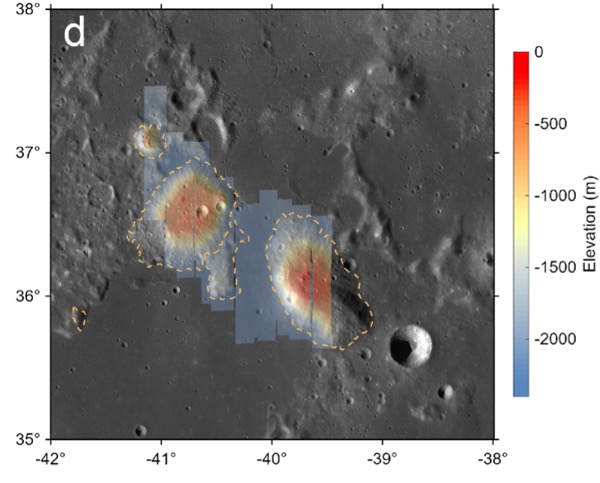
The Gruithuisen domes region, the broad area the Lunar-VISE team searched for potential landing sites. Click to enlarge. [Adapted from Williams et al. 2026]
The Lunar Vulkan Imaging and Spectroscopy Explorer (Lunar-VISE) mission, set to launch in mid-2028, was one of the first programs to go through this new landing site selection process. After being officially selected in 2022, the team had just nine months to nail down exactly where their mission should touch down. A recent article led by Jean-Pierre Williams (University of California, Los Angeles) detailed exactly how the team accomplished this task and presented some lessons they learned along the way.
No Parking Lots on the Moon
Picking a landing site is no small task: for context, selecting the landing sites for each of the most recent Mars rovers took five years and multiple community workshops. The Lunar-VISE team therefore took a streamlined and logic-driven approach. They started by explicitly laying out their science objectives: Lunar-VISE’s purpose is to investigate some strangely silicate-rich volcanic formations called the Gruithuisen domes, so they had to land either on or near those. They also had to have access to boulders that were excavated from deep within the domes during a crater formation event, so they had to pick a spot with boulders relatively nearby.
In addition to objectives, they also laid out a slew of constraints. Although they needed boulders nearby, they couldn’t have too many boulders, or any particularly large boulders, since those could pose hazards for landing. There also couldn’t be any steep slopes in the field. Most of the area had to maintain a line of sight with a supporting orbiter for communications, so they couldn’t set down near any ridges. Also, they had to consider how the terrain would cast shadows as the lunar day progressed, since they didn’t want their mission cut short by freezing temperatures and a lack of solar power. As the team quipped, “many interesting, high-science value locations on the Moon may not be in proverbial ‘parking lots.'”
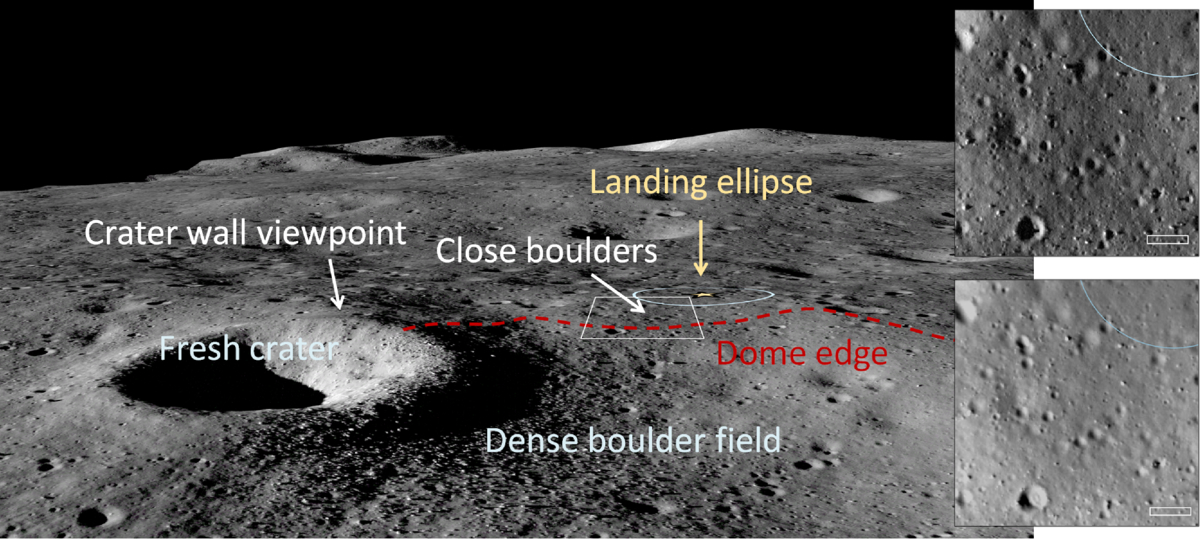
An image from the Lunar Reconnaissance Orbiter overlaid onto a terrain model of the final landing site. Click to enlarge. [Williams et al. 2026]
By combing through archival data and working with the team that operates the Lunar Reconnaissance Orbiter Camera, a key asset for making detailed maps of the Moon, the researchers found the perfect spot: alongside a 190-meter-diameter crater named Mareta. This feature is named after Mareta West, one of the first female planetary geologists at the United States Geological Survey and the scientist who selected the landing site for Apollo 11’s historic touchdown.
In addition to presenting their landing site, the researchers offered a handful of lessons to others who may someday be in the fortunate and thrilling position of needing to pick a landing spot on the Moon. For one, they urged teams to coordinate with the Lunar Reconnaissance Orbiter specialists as early as possible, since processing the imaging data for lander-quality maps is a specialized and intensive task. For another, they recommended that all of the software tools used be made publicly available so that future missions don’t need to duplicate their work.
As this article laid out, the Commercial Lunar Payload Services program and Lunar-VISE take us one step closer to making missions to the Moon routine — but we’re still figuring out exactly how to do that.
Citation
“Lunar-VISE Landing Site Selection and Characterization at Mons Gruithuisen Gamma,” Jean-Pierre Williams et al 2026 Planet. Sci. J.7 161. doi:10.3847/PSJ/ae7d2c
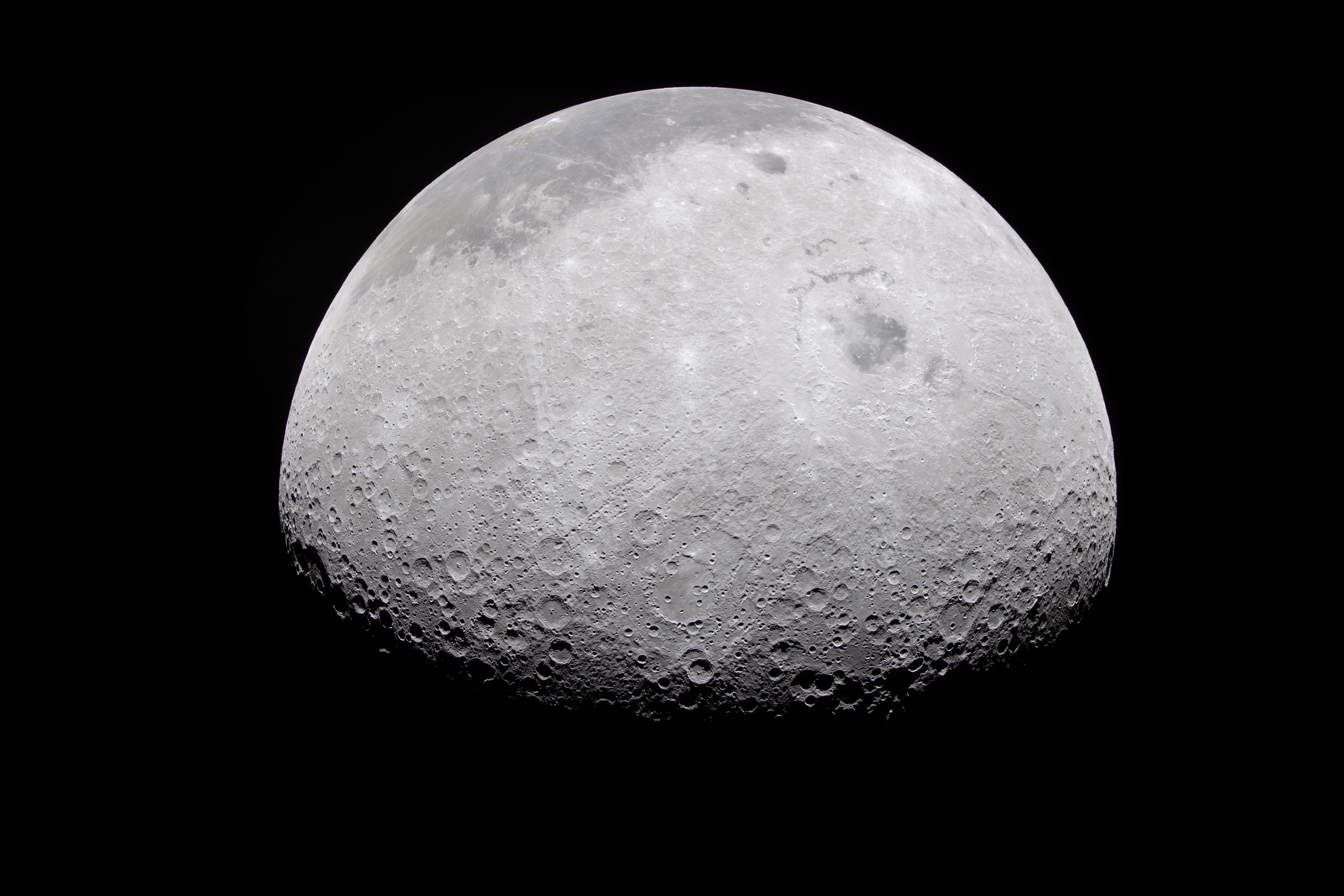
The Moon’s rocky, uneven, and otherworldly surface features are highlighted by the terminator – the difference between light and darkness.
NASA
The Moon appears half-illuminated in this photo captured by the Artemis II crew on flight day 6. The terminator – the difference between light and darkness – provides a stark contrast and even greater perspective of the Moon’s rocky, uneven, and otherworldly surface features. The near side, which is what we can see from Earth, appears in the dark gray regions at the top of this image.
GOLDEN, Colorado — The moon is in need of good and accurate artists!
As NASA's Artemis program hits its stride, and in a few years "reboots" our moon with a human presence, there's an urgent need to guard against artistic misrepresentations of the lunar landscape, experts say.
We've all seen those alluring lunar renderings of vehicles and astronauts bounding about while setting up equipment and putting in place a moon base.
What's wrong with this picture? Missing in this artwork are small craters, dust, dirty equipment and dirty astronauts. (Image credit: NASA)
Reality versus depictions
"We are telling the public the moon is easy — it is not!"
That's the matter-of-fact warning from Daniel Britt, the Pegasus Professor of Astronomy and Planetary Sciences in the Department of Physics at the University of Central Florida. He's also the director of the Center for Lunar and Asteroid Surface Science.
Britt spoke about and showcased artists' misconceptions during a "reality versus depictions of the lunar surface" talk here at a Space Resources Roundtable, held from June 2 to June 5 on the campus of the Colorado School of Mines.
"I wish I could say that engineers and managers know better, but they don't. We are training a generation of engineers to not worry about terrain. If the artists are getting it wrong, it is our fault. Let's stop fooling ourselves," Britt said.
Well versed in what the lunar surface truly offers, Britt scolded a number of arty accounts of lunar territory promulgated by both NASA and commercial space ventures. He spotlighted what's wrong with those pictures — for starters, small craters and ever-present lunar dust, along with dirty astronauts, dirty equipment and dirty habitats.
Dusting off past moonwalker experiences reveals a dusty future on the moon. (Image credit: NASA/Daniel Britt)
Facts of life
A flat, dustless moon is not the one we are sending Artemis astronauts to, said Britt. Crews will experience coarse terrain, pervasive dust, and a surface unlike anything here on Earth. These are the facts of life on the moon, he said.
The Apollo moon-landing missions learned this first hand. But those astronauts explored equatorial areas. The Artemis program is targeting the lunar south polar region, which will be tough to deal with thanks to the low angle of the sun.
"When you look into the sun, it will be blasting into your face. But at least you'll see the shadow of that crater you are about to trip into," said Britt. "But looking down-sun, you won't see diddly squat."
"There's need to stop deluding ourselves," Britt told Space.com, advocating the creation of a 1-to-10 scoring system for lunar art, with prizes for the worst and best visualizations
"What I want to do is land on the moon way safer and easier," he added, "so you need to ask yourself what's missing from these depictions. We are training the public to think this is easy."
No dust, almost no small craters, no tipping problems. (Image credit: SpaceX)
False impression
To support his concern, Britt spotlighted both Apollo moonwalker-taken imagery and the scenery as projected by artists, be it using paint brush or artificial intelligence-guided computer work.
"The sun angle washes out the rough terrain. Almost all the pictures taken from the surface give the very false impression of a flat, gentle terrain," Britt said. "The reality is that the lunar surface is heavily cratered, rough, very dusty and covered in regolith."
Most Apollo surface images were taken "down-sun" because looking "up-sun" was hard. "This leaves a very false impression of a flat moon with gentle terrain," Britt said.
Why should we care about artist's misconceptions? Because they create false impressions that lunar landings are easier than they actually are. (Image credit: Blue Origin)
Tilt problems
Apollo was pretty lucky, Britt said, observing that several of the six human moon landings experienced tilt problems. For instance, Apollo 14 experienced a 7-degree tilt on landing, and Apollo 15 had an 11-degree tilt on touchdown.
Apollo 11 had to dodge a boulder field. Apollo 12 and Apollo 16 landed on the edge of big craters. "Even small craters can be meters deep," said Britt, recalling problems encountered by astronauts on their descent to the moon.
"The dust went as far as I could see in any direction and completely obliterated craters and anything else … I couldn't tell what was underneath me," astronaut Pete Conrad said during an Apollo 12 debriefing. "I knew I was in a generally good area, and I was just going to have to bite the bullet and land, because I couldn't tell whether there was a crater down there or not."
Similarly, Apollo 16 commander John Young said: "I couldn't judge slope out the window worth a hoot, and that's the truth. Even down low. The ground looks flat, but I'm sure it would look flat if it had been a 6-8 degree slope, too. I don't see any way around that."
Landing on "flat" places on the moon is a dicey situation. This Apollo 15 image shows the 11-degree tilt experienced by that mission during touchdown. (Image credit: NASA)
Getting it wrong
A flat, crater-free, dustless moon is a staple of imagery issued by NASA, the European Space Agency, other space agencies, and even private space firms, said Britt.
"Yes, these are artists' impressions," Britt said, "but somebody is telling the artists what to draw. I love the idea of landing and operating on a moon without dust, small craters, and rough terrain. However, we see the misconception of a flat, gentle moon everywhere."
"Commercial providers are just as bad. No dust, almost no small craters, no tipping problems. Yes, these are artists' impressions, and they are getting it wrong," said Britt. "NASA knows better. All these people should know better, but don't. Let's not fool the public. We owe them better data."
Developed at NASA’s Jet Propulsion Laboratory, ERNEST (Exploration Rover for Navigating Extreme Sloped Terrain) is used in a desert field test to help refine mobility hardware and autonomy software that could be used for a potential future long-range lunar rover mission.
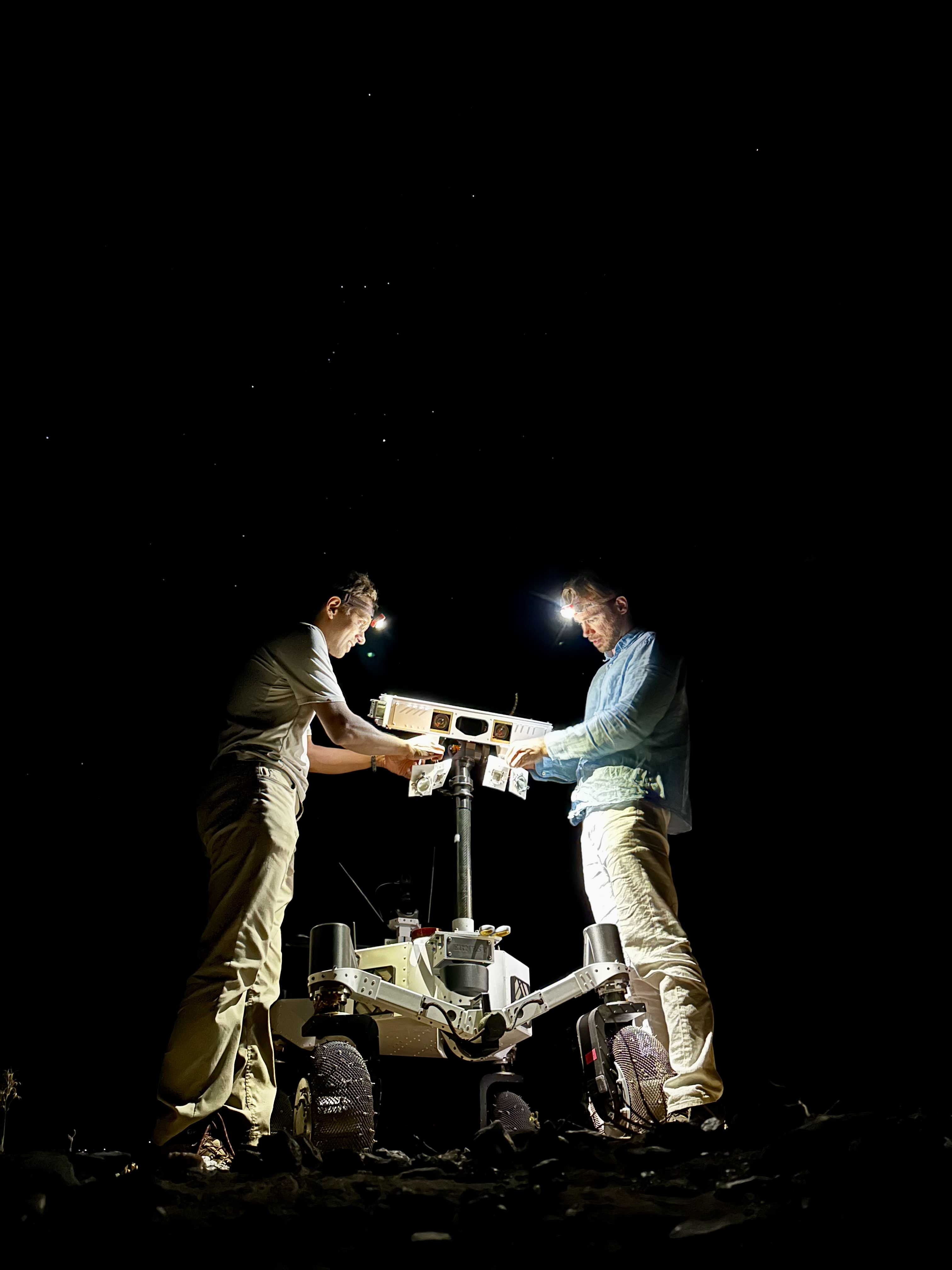
During the field test, which took place in March 2026 in the Colorado Desert of Southern California, the JPL team deployed ERNEST at all times of the day — including dusk, dawn, and nighttime, when lighting conditions create long shadows like those seen on the Moon’s polar regions.
On a bleak stretch of the Colorado Desert in Southern California, a compact four-wheeled rover recently trundled about 16 miles (26 kilometers) with minimal intervention from the team of engineers trailing it. Called ERNEST (Exploration Rover for Navigating Extreme Sloped Terrain), this prototype is being used by NASA to advance both robotic autonomy and the ability to traverse challenging landscapes.
Developed at NASA’s Jet Propulsion Laboratory in Southern California, ERNEST is 4 feet (1.2 meters) long. Not only can it lift each of its mesh wheels to get past obstacles that would stymie Curiosity and Perseverance, NASA’s six-wheeled Mars rovers, but the prototype also has enhanced independent decision-making capabilities. These mobility and autonomy advances could be infused into future missions that will venture to previously inaccessible areas of the Red Planet or the Moon.
ERNEST serves as a testbed for a potential future lunar rover mission requiring high speeds and extreme distances. In a recent field test, the prototype traveled 16 miles over the course of 37 hours, going an order of magnitude above the top speed at which NASA’s current Mars rovers can navigate. Credit: NASA/JPL-Caltech
In the field, ERNEST served as a testbed for a potential future lunar mission requiring higher speeds and much greater mileage than can be accomplished by current rovers. This technology could be used to inform future designs for exploration efforts on the Moon and beyond.
“This testing is helping us refine the mobility hardware and autonomy software to navigate extreme distances across a wide range of terrain and lighting conditions anticipated on the Moon,” said Issa Nesnas, a principal technologist at JPL who led the recent testing as head of autonomy for a NASA mission concept for a potential future long-range lunar rover.
Engineers from JPL set up illuminators after transporting ERNEST for a pre-sunrise test during a seven-day desert field campaign.
NASA/JPL-Caltech
Nesnas’ team is using ERNEST to demonstrate it is possible to build a rover that’s twice as big as the prototype and capable of a long-distance Moon mission. During the recent campaign, ERNEST traveled at speeds up to 0.6 mph (1 kph) over 37 hours of driving, across seven days of intermittent testing. That’s an order of magnitude above the top speed Perseverance and Curiosity can navigate.
“You could do a science road trip across the Moon — or Mars — with this vehicle,” said James Keane, a JPL planetary scientist working on lunar missions.
The initial goal of the team that developed ERNEST was mechanical: to design a relatively simple, low-cost rover that advances the trusted rocker-bogie suspension system featured on every Mars rover since NASA’s Sojourner. This passive system keeps relatively constant weight on all six wheels, thanks to pivot points and struts that enable each one to adapt to the changing surface.
The mobility and autonomy advances developed at JPL for the ERNEST prototype rover could be infused into future NASA missions to previously inaccessible areas of the Red Planet or the Moon. Credit: NASA/JPL-Caltech
On ERNEST, the active suspension lets the rover manage weight distribution among its wheels. Two powered joints in front articulate a gimbal that allows the rover to drive using different gaits like squirming, wheel-walking, and obstacle-climbing. With a clutch mechanism, it can switch between active and passive suspension, which is less terrain capable but more energy efficient. With four steerable wheels, it can drive in any direction, including sideways.
“We started by postulating that we could do better in designing a planetary surface robotic mobility system,” said Hari Nayar, a JPL principal technologist leading the ERNEST team. “While the rocker-bogie system has been very successful over the past 30 years, there’s been a lot of research in that time on mobility and understanding terrain interaction.”
Before arriving at today’s version of ERNEST, the team built two earlier prototypes, each about 2 feet (0.6 meters) long, to test 11 active suspension configurations. In a trailer filled with lunar regolith simulant, they ran experiments at different slope angles over several months before landing on a final design.
Then the team scaled up, including adding a rectangular head mounted on a 4.5-foot-tall (1.4-meter-tall) mast. The hardware was completed in September 2024, but the rover still needed a human operator to joystick it, sending commands to instruct the rover on how to move over obstacles.
In order to train the rover to think on its own, the ERNEST team turned to reinforcement learning, a type of artificial intelligence where the robot learns by interacting with its environment. The Dynamics and Real-Time Simulation Laboratory at JPL developed a high-fidelity virtual testing environment that replicates the rover’s behavior. The team fed the simulator data collected by engineers who documented the response of the actual rover hardware to a variety of terrain types. On a high-performance computing cluster, the team ran many simulations at once, sometimes completing thousands of hours of tests over a single weekend.
After months of virtual training, the ERNEST team was ready to see if the rover could use its new autonomous algorithms to figure out how to drive over terrain features that would halt a passive-suspension rover. They set up an obstacle course with sand ripples, rubble piles, steps, and steep slopes in JPL’s Mars Yard, an outdoor terrain proving ground. Then they watched as the rover maneuvered the terrain on its own. Since then, ERNEST has completed many such courses.
Nayar’s team is starting a new autonomy project which involves integrating the rover’s ability to determine when and how to use its active suspension with longer-range intelligent navigation. The goal is to enable ERNEST to plan an efficient path so that it can tackle surmountable obstacles and circumnavigate hazardous ones. These capabilities could contribute to potential future rover missions encountering formidable landscapes on Mars or more rugged areas of the Moon.
Work on ERNEST began in 2022 was initially supported by JPL internal research and development funds. It is currently funded by NASA’s Mars Exploration Program and the agency’s Exploration Science Strategy and Integration Office in its Science Mission Directorate at NASA Headquarters in Washington. Caltech in Pasadena, California, manages JPL for NASA.
Engineers from NASA’s Jet Propulsion Laboratory are field-testing advanced capabilities for potential future Moon and Mars rovers. In the Colorado Desert nea...
Blue Origin has started rebuilding a launch pad severely damaged in a New Glenn explosion less than three weeks ago as it works to resume launches by year’s end
Humans have always gazed up at the moon in wonder. A generation ago, NASA astronauts did the extraordinary and touched down on its surface, planting an American flag and igniting […]
A laser system, previously tested on board the International Space Station, helped to stream video directly from the Artemis 2 mission on its way around the moon.
As NASA prepares for humanity’s return to the Moon, researchers at Texas A&M University are exploring how the same material could become a key building block for the first permanent settlements beyond Earth.
The Moon’s surface is surprisingly unlike anything we would consider soil on Earth. Instead, it is covered by a fine powder of pulverized rock and jagged glass that slips into every gap, grinds through seals and gaskets, and exists in a vacuum exposed to intense radiation and extreme temperature swings capable of bending steel. Yet researchers at Texas A&M University see opportunity rather than obstacles in this harsh environment.
Scientists refer to this material as lunar regolith, and it is considered one of the greatest challenges to long-term human habitation beyond Earth.
As NASA advances plans for a permanent human presence on the Moon through its Lunar Innovation Park initiative, Texas A&M researchers are developing technologies designed to transform the lunar surface into a foundation for future settlements.
“We are moving past the era of ‘flags and footprints,’” said Dr. Patrick Suermann, professor of construction science and retired U.S. Air Force lieutenant colonel in a statement. “We have to stop thinking like explorers and start thinking like settlers.”
Money as a Hurdle
Arguably, the greatest challenge facing lunar construction may not be engineering, but cost. Transporting materials from Earth remains extraordinarily expensive, with estimates ranging from roughly $1 million to $1.3 million per kilogram delivered to the Moon. As a result, researchers are increasingly focused on utilizing resources already available on the lunar surface rather than transporting materials from Earth.
“The future depends on building infrastructure from resources already on the moon,” explained Suermann.
“The high cost of shipping to the moon is the million-dollar problem,” Suermann said. “Every time you can cut the mass of a payload, you save a fortune. That’s why the future depends on building infrastructure from resources already on the moon.”
Helping advance that vision is Dr. Robert Ambrose of the Texas A&M Space Institute, located near NASA’s Johnson Space Center in Houston. The institute has received $200 million in support from the Texas Legislature.
“One of the most exciting features of the 240-acre facility is it’s two-and-a-half acre testing areas: one replicating the surface of the moon, the other Mars,” says Suermann.
These facilities allow researchers to evaluate robotic systems, autonomous vehicles, and construction technologies under conditions similar to those expected during future lunar and Martian missions.
Meanwhile, the university’s Construction Automation, Safety and Education (CASE) Lab is exploring how humans and machines can collaborate in extreme environments. Led by Dr. Gilles Albeaino, the lab focuses on mixed-reality technologies and semi-autonomous robotic systems capable of performing construction tasks on the Moon.
“On the moon, construction operations will depend on semi-autonomous robotic systems,” Suermann said. “The CASE lab is leading research into how humans and machines can work together in environments where humans can’t safely do everything themselves.”
“Every tool matters. Every ounce of material you ship matters,” added Suermann. “So, the question becomes: how do you use the environment itself as your supply chain, and how can you augment machines to become your partner in austere environments?”
Arctic to Afghanistan
Suermann’s experience combines two worlds: military service and construction science. Before joining Texas A&M in 2017, he served in the U.S. Air Force, deploying to remote locations that included Afghanistan, Guam, and Greenland.
Those experiences operating in challenging and isolated environments continue to inform his thinking about future lunar settlements.
“My experiences in serving the U.S. Air Force were formative and transformative,” Suermann said. “It taught me a great deal about construction, and that what can go wrong will go wrong.”
It shows, to me, that lunar regolith isn’t too dissimilar from the terrain we have here on Earth,” Suermann adds. “At the end of the day, construction is construction.”
Should We Develop on the Moon?
The broader question remains whether humanity should be expanding its footprint beyond Earth at all. While plans for lunar settlements continue to advance, critics point out that many environmental, political, and social challenges remain unresolved here at home.
As governments and private companies invest billions into space infrastructure, some argue that humanity must carefully consider how development beyond Earth aligns with priorities on our own planet. Others contend that technologies developed for lunar habitation could ultimately provide benefits back on Earth, helping address challenges ranging from resource management to sustainability.

 Login