 Login
Silicon Valley Splits Over Closing the Borders to Chinese A.I.
25 July 2026 at 16:36
Anthropic and OpenAI are clashing with the rest of the tech industry over whether “open-source” models from China should be freely available or restricted.

On July 3, one of NASA’s two Mars-destined ESCAPADE (Escape and Plasma Acceleration and Dynamics Explorers) spacecraft captured photos of Earth and the Moon in visible and thermal infrared light. At the time, the spacecraft was 363,250 miles (584,600 kilometers) from Earth and 115,600 miles (186,100 kilometers) from the Moon, making the Moon appear relatively large.
Taken with the Sun only partly illuminating Earth and the Moon, the visible light image shows the two bodies as crescents, with only around 8% of each face sunlit. Yet in the thermal infrared image, the shadowed hemisphere of Earth is illuminated by its own heat from both the atmosphere and surface, glowing at minus 10 to minus 44 degrees Fahrenheit (250 to 280 kelvins). Without the insulating blankets of oceans and atmospheres, the Moon’s far side remains at a much cooler minus 280 degrees Fahrenheit (100 kelvins).

July 3, 2026
The ESCAPADE mission used its Visible and Infrared Observation System cameras, provided by Northern Arizona University in Flagstaff, to capture the images, which are more than just road trip photo album snaps.
“We are thrilled that ESCAPADE was able to accommodate these excellent space-qualified cameras which will search for visible Martian aurora and investigate thermal properties of the Martian surface and atmosphere,” said Rob Lillis, the mission’s principal investigator at the University of California, Berkeley. “Since Earth and the Moon are well-known targets, imaging them provides an important calibration check for ESCAPADE’s cameras.”
The ESCAPADE spacecraft, which were built by Rocket Lab, are currently in a “loiter” orbit around Lagrange point 2, a location in space about a million miles from Earth. In November 2026, the spacecraft will fly by Earth to use the planet’s gravity to slingshot their way to Mars. When the spacecraft arrive in September 2027, they will study how a million-mile-per-hour stream of material flowing from the Sun, known as solar wind, interacts with the Martian environment and how that drives atmospheric loss at the Red Planet.
The ESCAPADE mission is funded by NASA’s Heliophysics Division and is part of the NASA Small Innovative Missions for Planetary Exploration program. The UC Berkeley’s Space Sciences Laboratory leads the mission with key partners Rocket Lab; NASA’s Goddard Space Flight Center in Greenbelt, Maryland; Embry-Riddle Aeronautical University; Advanced Space; and Blue Origin.
By Mara Johnson-Groh
NASA’s Goddard Space Flight Center, Greenbelt, Md.
The post NASA’s ESCAPADE Snaps Family Portrait of Earth, Moon appeared first on NASA Science.
On July 3, one of NASA’s two Mars-destined ESCAPADE (Escape and Plasma Acceleration and Dynamics Explorers) spacecraft captured photos of Earth and the Moon in visible and thermal infrared light. At the time, the spacecraft was 363,250 miles (584,600 kilometers) from Earth and 115,600 miles (186,100 kilometers) from the Moon, making the Moon appear relatively large.
Taken with the Sun only partly illuminating Earth and the Moon, the visible light image shows the two bodies as crescents, with only around 8% of each face sunlit. Yet in the thermal infrared image, the shadowed hemisphere of Earth is illuminated by its own heat from both the atmosphere and surface, glowing at minus 10 to minus 44 degrees Fahrenheit (250 to 280 kelvins). Without the insulating blankets of oceans and atmospheres, the Moon’s far side remains at a much cooler minus 280 degrees Fahrenheit (100 kelvins).
July 3, 2026
The ESCAPADE mission used its Visible and Infrared Observation System cameras, provided by Northern Arizona University in Flagstaff, to capture the images, which are more than just road trip photo album snaps.
“We are thrilled that ESCAPADE was able to accommodate these excellent space-qualified cameras which will search for visible Martian aurora and investigate thermal properties of the Martian surface and atmosphere,” said Rob Lillis, the mission’s principal investigator at the University of California, Berkeley. “Since Earth and the Moon are well-known targets, imaging them provides an important calibration check for ESCAPADE’s cameras.”
The ESCAPADE spacecraft, which were built by Rocket Lab, are currently in a “loiter” orbit around Lagrange point 2, a location in space about a million miles from Earth. In November 2026, the spacecraft will fly by Earth to use the planet’s gravity to slingshot their way to Mars. When the spacecraft arrive in September 2027, they will study how a million-mile-per-hour stream of material flowing from the Sun, known as solar wind, interacts with the Martian environment and how that drives atmospheric loss at the Red Planet.
The ESCAPADE mission is funded by NASA’s Heliophysics Division and is part of the NASA Small Innovative Missions for Planetary Exploration program. The UC Berkeley’s Space Sciences Laboratory leads the mission with key partners Rocket Lab; NASA’s Goddard Space Flight Center in Greenbelt, Maryland; Embry-Riddle Aeronautical University; Advanced Space; and Blue Origin.
By Mara Johnson-Groh
NASA’s Goddard Space Flight Center, Greenbelt, Md.
For several years now, astronomers who study the sun have faced a little mystery — our star seemed to hold too little silver. Whenever scientists examined the sun's outer layers, they've seen significantly less silver than they've expected to find.
Where, then, did the missing silver go?
As it turns out, this mystery may finally be solved. Newly published research suggests that the sun's missing silver may have been hiding in plain sight all along.
At first, the real mystery might seem to be why you'd seek silver in the sun at all. After all, 98.5% of the sun's mass is made from lightweight hydrogen and helium. Silver is just a tiny fraction of the remaining 1.5%, which also includes traces of other heavy elements like iron and copper.
These trace elements can illuminate the history of the cosmos. Silver is thought to form when dying stars violently explode in supernovas. When astronomers find silver in the sun and other stars, they can retrace the silver's origins and how stars have evolved over the eons.
"By studying the light of stars of different types and ages, we hope to understand where silver is formed in the universe, and how it has been distributed throughout the Milky Way over time," says Sema Caliskan, the lead author of the research and now a postdoc at the University of Liège in Belgium, in a statement.
Silver is particularly interesting because it's also found in utterly ancient meteorites called CI chondrites. These meteorites formed from the same primordial matter that created the sun, 4.6 billion years ago. As a result, when scientists break into CI chondrites that have fallen to Earth, they expect to find silver levels that match those they see in the sun.
Astronomers can measure the latter from afar by looking at sunlight's spectral lines. As light streams out from the sun's heart, it crashes into the atoms of our star's outer layers, which absorb the light at certain wavelengths. Look at a spectrum of sunlight, and you'll see dark lines where light has been absorbed. Atoms of different elements absorb different wavelengths, so each element leaves a distinct fingerprint.
Scientists can pore over these spectral fingerprints to reconstruct what elements created them and in what quantities. Therein lies the mystery: The sun seemed to contain much less silver than CI chondrites would indicate. This missing silver is a source for confusion in the sun's history.
Caliskan and her colleagues wondered if astronomers were missing something. They could not visit the sun in person, but they could still find where the silver might be hidden by simulating the sun's atoms on a computer. If they could create a high-silver model that still spawned the low-silver spectral lines, that model could be a good guess for the silver's whereabouts.
Other scientists had tried this before to limited success, but their simulations had been relatively simple. As light strikes an atom, the light has all sorts of intricate effects on the atom's innards. These effects can alter how the atom absorbs the light and, therefore, change how astronomers see that light.
Past models hadn't accounted for many of these tricky "non-equilibrium effects", because simulating them is far easier said than done. They're messy and complex and they vary a great deal from atom to atom.
In fact, no known scientists had ever tried to simulate a silver atom with non-equilibrium effects before Caliskan and her fellow investigators took on the challenge. They tried with their best guesses and the power of the Tetralith supercomputer in Linköping, Sweden.
Indeed, these non-equilibrium effects seem to explain the silver mystery. Based on their model, Caliskan and colleagues calculated that the sun holds 55% more silver than astronomers have measured.
This isn't a perfect match for the CI chondrites, but it's close enough that investigators can rule out any extraordinary cause. Instead, the missing silver may have been right there, in the sun all along, simply occluded from astronomers' view by tricks of physics. Next, Caliskan and colleagues plan to use this method to simulate other types of stars.
They published their work in the journal Astronomy & Astrophysics in July 2026.
Around 4.6 billion years ago, an immense cloud of gas and dust in space collapsed in on itself. As it collapsed, gravity pulled most of the material toward several small points, one of which would eventually become our Sun. The other points formed other stars in what scientists call an open cluster.
During this early stage of the Sun’s life, it was surrounded by a swirling disk of leftover material aligned with its equator, known as a protoplanetary disk. Eventually, this disk condensed to form the planets that make up our solar system. This process normally results in a system with a star at its center, and the planets orbiting the plane of the star’s equator.
However, scientists have found that this scenario doesn’t quite hold for our solar system. The planets in our solar system orbit the Sun in a single plane offset from the Sun’s equator by approximately 6°. The fact that the planets are in the same orbital plane suggests that the protoplanetary disk model of solar system formation is correct, since the odds of the Sun capturing 8 rogue planets in this arrangement are astronomically low. So, what threw the planets in our solar system off-kilter?
The plane in which the solar system’s planets orbit the Sun is offset from the Sun’s equator by approximately 6°. Li simulated how the solar system tilted based on its 4 largest planets, from left to right: Neptune, Saturn, Jupiter, and Uranus. Illustration by Andrew Bizal.
To determine what caused the solar system to tilt, Daohai Li at Queen Mary University of London recently used the computer program NBODY6++ to model different versions of the open cluster from which the Sun came. In these simulations, he varied the number of stars in the cluster, from 500 to 2,000 to 8,000. He also varied the radius of the cluster, from 0.25 to 1 to 4 parsecs (8 to 30 to 100 trillion kilometers or 5 to 20 to 70 trillion miles). Finally, he varied the percentage of stars with a binary companion from 10% to 50% to 90%. Li assigned each star a randomly generated initial mass, starting position, and velocity, and simulated their interactions for 400 million years.
First, Li examined the simulations to identify stars with masses approximately equal to the Sun’s. From this group of solar-massed stars, Li found ones that left the cluster after 400 million years as a single star, after either forming alone or having lost a former companion star. He proposed that these stars were the most similar to the Sun and could thus host a simulated solar system.
Li then simulated the planets and their orbits as they would have formed on these potential host stars. To simplify this process, Li only simulated the 4 giant planets, Jupiter, Saturn, Uranus, and Neptune, which dominate planetary behavior in our solar system. He modeled these solar systems independently for 200 million years to ensure they would remain intact and used those that did for statistical analysis of the solar system’s past.
Overall, Li discovered 2 scenarios that could explain the solar system’s tilt. In the first, the primordial solar system was jostled by many distant neighboring stars in its cluster. This jostling tilts the planets’ orbits, but it does so randomly. Therefore, this scenario would make it unlikely for the planets to remain in the same orbital plane. It would also cause them to orbit the Sun faster and more chaotically than in our solar system.
In the second scenario, the Sun had a temporary companion star that it either formed with or briefly encountered before separating. When this occurred, the simulated planets’ orbits all tilted together. Stars that formed with a binary companion had a 10% chance of tilting their planets’ orbits by 6° or more, while stars that formed alone had a less than 0.1% chance.
Li concluded that the solar system could have tilted as a result of interactions between the Sun and a temporary companion star within its parent cluster. However, he acknowledged that the model strongly depends on how closely a star passes by the Sun, since the closer a star passes, the more it disturbs the solar system. Despite this uncertainty, it’s possible that somewhere in space is the Sun’s twin or former neighbor that we haven’t seen in eons, and that’s what made our solar system crooked!
The post The Sun’s twin star may have tilted the planets’ orbits appeared first on Sciworthy.
Planetary researchers have found the first evidence that bursts of energetic particles from the Sun could warm the lower atmosphere of Mars during massive dust storms, hinting at an unexpected link between space weather and Martian climate.
The post Space Weather May Warp Martian Weather during Dust Storms, Planetary Scientists Suggest appeared first on Sci.News: Breaking Science News.
Major League Baseball fans and retro enthusiasts are sure to get a kick out of this one; you can watch live MLB games rendered pitch by pitch and play-by-play in 8-bit style, right in your browser, with a cool webapp called Ribbie. With Ribbie, you’re able to watch of any live baseball game rendered in ... Read More
The post Watch Live MLB Baseball Games in 8-Bit Style with Ribbie appeared first on OS X Daily.

O Apple TV divulgou o trailer de “A Dinastia — UConn Huskies” (“The Dynasty: UConn Huskies”), sua nova série documental que narra a trajetória de 40 anos do renomado programa de basquete feminino da Universidade de Connecticut (UConn) sob o comando do técnico Geno Auriemma, membro do Hall da Fama.
A produção, dividida em três partes, estreará mundialmente no dia 21 de agosto (uma sexta-feira).
Twelve championships don't happen by accident. Go inside one of college basketball's most prestigious programs.
— Apple TV (@AppleTV) July 17, 2026
The Dynasty: #UConnHuskies — August 21 on Apple TV pic.twitter.com/noP5RuttEl
“The Dynasty: UConn Huskies” narra a ascensão do programa mais dominante na história do basquete universitário nos Estados Unidos. Com entrevistas exclusivas com a equipe campeã nacional de 2025 e participações de figuras do basquete da UConn, a série explora a busca pela excelência, as expectativas que acompanham o sucesso duradouro e as pessoas que mantiveram esse padrão ao longo das gerações.
A série reflete sobre o legado que construiu o programa e oferece um olhar raro de bastidores sobre as jogadoras que dão continuidade a essa história, por meio de conversas aprofundadas com técnicos, atletas, ex-jogadoras, rivais e jornalistas de várias gerações do basquete da UConn, incluindo KK Arnold, Auriemma, Sue Bird, Paige Bueckers, Jim Calhoun, Swin Cash, Chris Dailey, Mickie DeMoss, Jana El Alfy, Jamelle Elliott, Azzi Fudd, Jeff Goldberg, Sally Jenkins, Steve Kerr, Rebecca Lobo, Jackie MacMullan, Maya Moore, Alexa Philippou, Shea Ralph, Semeka Randall, Jennifer Rizzotti, Breanna Stewart, Sarah Strong, Diana Taurasi e Tamika Williams-Jeter.
Com direção e produção executiva de Matthew Hamachek (vencedor do Emmy) e Erica Sashin (indicada ao Emmy), “The Dynasty: UConn Huskies” também conta com Jesse Sisgold, Jason T. Reed, Jon Weinbach, Lauren Gaffney, Lindsay Kagawa Colas, Grant Jones, Jon Liebman e Zoe Rogovin como produtores executivos.
O Apple TV está disponível no aplicativo Apple TV em mais de 100 países e regiões, seja em iPhones, iPads, Apple TVs, Macs, dispositivos Android, smart TVs ou online — além de também estar em aparelhos como Roku, Amazon Fire TV, Chromecast com Google TV, consoles PlayStation e Xbox. O serviço custa R$29,90 por mês, com um período de teste gratuito de 7 dias. Por tempo limitado, quem comprar e ativar um novo iPhone, iPad, Apple TV ou Mac ganha 3 meses do Apple TV. Ele também faz parte do pacote de assinaturas da empresa, o Apple One.
NOTA DE TRANSPARÊNCIA: O MacMagazine recebe uma pequena comissão sobre vendas concluídas por meio de links deste post, mas você, como consumidor, não paga nada mais pelos produtos/serviços usando os nossos links de afiliado.
The most powerful solar storms to strike Earth may pack a bigger punch than scientists realized, according to a new study that suggests the impacts of extreme space weather have been underestimated.
Researchers found evidence that the apparent upper limit on Earth's response to the strongest solar storms may be an artifact of how solar wind has been measured rather than a true physical ceiling. If confirmed, the findings suggest that rare "once-in-a-thousand-year" geomagnetic storms could have a greater impact on modern technology than current estimates indicate, according to a statement.
"Our planet's magnetic field does a really great job of protecting us against many space weather effects and so they often just show up as glitches or beautiful aurora," Maria Walach, co-author of the study from Lancaster University, said in the statement. "There are however extreme cases."
Solar storms occur when eruptions from the sun, such as coronal mass ejections and solar flares, send clouds of charged particles hurtling toward Earth. While they can produce spectacular auroras, they can also disrupt satellites, GPS, radio communications and power grids.
History has shown the damage even less extreme storms can cause. The 1859 Carrington Event, the strongest geomagnetic storm on record, disrupted telegraph systems around the world and pushed auroras from their usual high-latitude skies near the Arctic and Antarctic to locations as far south as the tropics. Another powerful storm in 1989 collapsed Quebec's power grid, leaving millions without electricity, while the 2003 "Halloween storms" disrupted satellites, GPS and radio communications.
While the study doesn't suggest that an unprecedented solar storm is imminent, it argues that scientists may need to rethink how they estimate the severity of the rarest events — an increasingly important challenge as modern society grows more dependent on satellites and other vulnerable technologies.
The researchers traced the apparent upper limit to where most solar wind measurements are collected. Many observations of extreme events come from spacecraft near the Sun-Earth Lagrange Point 1 (L1), about 1 million miles (1.5 million kilometers) upstream of Earth. Because the strongest solar wind tends to weaken somewhat before reaching Earth, comparing L1 measurements with conditions at our planet can make it appear that Earth's upper atmosphere stops responding to increasingly intense solar wind, even when it does not.
To test that idea, the team analyzed more than one million solar wind measurements collected by NASA spacecraft orbiting much closer to Earth, where the solar wind directly interacts with our planet's magnetic field. Those observations showed that electrical currents flowing through Earth's upper atmosphere continued to increase alongside stronger solar wind, with no sign of the previously assumed upper limit. The results suggest that exceptionally powerful solar storms could generate stronger geomagnetic disturbances — and greater impacts on satellites, communications systems and power grids — than earlier estimates predicted.
"Fortunately, these very extreme cases are rare, but this also means we have limited data to work with and only time will tell what happens at the very extreme one-in-a-thousand-year kind of event," Walach said in the statement.
The study comes as the sun remains near the peak of its roughly 11-year solar cycle, known as solar maximum, when sunspots, solar flares and coronal mass ejections become more frequent. During the current cycle, strong geomagnetic storms have repeatedly sent auroras far beyond their usual polar skies.
In May 2024, the strongest geomagnetic storm in more than two decades illuminated skies across much of the United States and Europe while causing intermittent disruptions to high-frequency radio communications, GPS-guided equipment and some satellite operations. Although significant, that event was far less powerful than the Carrington Event — or the even rarer storms the new study suggests may be possible.
The findings were published July 15 in the journal Nature.
A Maya astronomer’s identity has been revealed for the first time, discovered in an inscription at the Xultun site in Guatemala, finally revealing a name behind their storied knowledge.
Despite the Maya’s renowned knowledge of math and astronomy, no individual had ever been directly associated with those accomplishments, unlike figures such as the Greek scholars Ptolemy or Archimedes.
Now, in a recent paper published in Antiquity, an international team of archaeologists has identified a name linked to the Maya’s sophisticated mathematical knowledge: Sak Tahn Waax.
From around 2000 BCE until the Spanish conquest in the 16th century, the Maya flourished across the Yucatán Peninsula, building a civilization renowned not only for its political and economic power, but also for its remarkable scientific and mathematical achievements. Although relatively few Maya texts survived the Spanish conquest, those that remain—along with archaeological evidence—show that the Maya precisely calculated the length of the solar year and carefully tracked the movements of the Moon and Venus across the sky.
The art, architecture, and glyphic texts of the Classic Maya likewise reflect a sophisticated understanding of the natural world, interwoven with Indigenous cosmological traditions.
That expertise shaped nearly every aspect of Maya society. Their intricate calendars guided agriculture, informed religious observances, and influenced political life. Yet despite the importance of this knowledge, the individuals responsible for developing it have largely remained anonymous.
Meaning “white-chested fox,” the name Sak Tahn Waax appears on a wall engraved with mathematical formulas, which archaeologists dated to the eighth century CE using inscribed dates and radiocarbon analysis. Researchers believe the room likely served as either a classroom or a workshop for producing books.
The inscription was first documented shortly after excavations began at Xultun in 2011. Although the team initially focused on other priorities at the site, deciphering the text remained an enduring objective.
Reading the inscription required years of laboratory work using color scans and multispectral imaging. After reconstructing the wall’s faded engravings, the researchers determined that the text contained instructions for synchronizing the planetary cycles of Mars and Venus with the Maya calendar, concluding with the signature, “so says Sak Tahn Waax.”
“It’s really elegant, complex math,” said co-author Heather Hurst, an archaeologist at Skidmore College. “That’s why he’s signing it.”
The strangest thing about the discovery may be how common signatures are in other elements of Maya life. Artists and scribes often signed ceramics, while important political and military figures’ names often adorn stelae and buildings. Despite this propensity to name individual Maya on things, those responsible for their legendary knowledge of math and science largely remain unknown.
The archaeologists behind this new study now suggest that those names may be available after all; it is only that researchers have not known where to look.
“There’s good evidence for codex book production,” said lead author Franco Rossi, an archaeologist at the Massachusetts Institute of Technology. “So if there’s going to be a name … this would be the most logical place.”
The researchers hope the discovery will inspire a deeper appreciation for Maya history and for the scholars whose work shaped the civilization.
“I would have loved to see Sak Tahn Waax and Ptolemy hanging out,” Hurst concluded. “They would have had a great discussion.”
The paper, “The Identification and Work of an Eighth-Century Maya Mathematician,” appeared in Antiquity on July 14, 2026.
Ryan Whalen covers science and technology for The Debrief. He holds an MA in History and a Master of Library and Information Science with a certificate in Data Science. He can be contacted at ryan@thedebrief.org, and follow him on Twitter @mdntwvlf.
Many observations of solar flares suffer from saturation and blooming, causing crucial information to be lost. Researchers recently validated a technique for retrieving information from saturated flare images, unlocking a treasure trove of powerful solar flares for examination.
Since 2010, the Atmospheric Imaging Assembly (AIA) on the Solar Dynamics Observatory (SDO) has been capturing nearly continuous extreme-ultraviolet images of the Sun’s disk, revealing our star’s dramatic high-energy behavior. Though SDO/AIA’s observations have transformed our understanding of the Sun’s activity, they have limitations: powerful solar flares can saturate the detector, spilling charge into nearby pixels.
This saturation and overflow compromises our ability to study the most energetic solar flares — but the “lost” information may actually be recoverable. When light from an intense flare enters SDO’s instruments, not all of it pools in the saturated region of the detector: some of the light is diffracted by the optics, and by mathematically inverting this pattern of diffracted light, researchers can attempt to extract the encoded information about the saturated region. Researchers have used this technique for more than a decade, but options for validating the results were limited until now.
Launched almost 10 years to the day after SDO, the Solar Orbiter spacecraft provides an excellent opportunity to test inversion techniques for recovering information from saturated solar images. Solar Orbiter’s Extreme Ultraviolet Imager snaps brief photos of the Sun at a rapid cadence, and its images remain unsaturated even when faced with energetic solar flares.
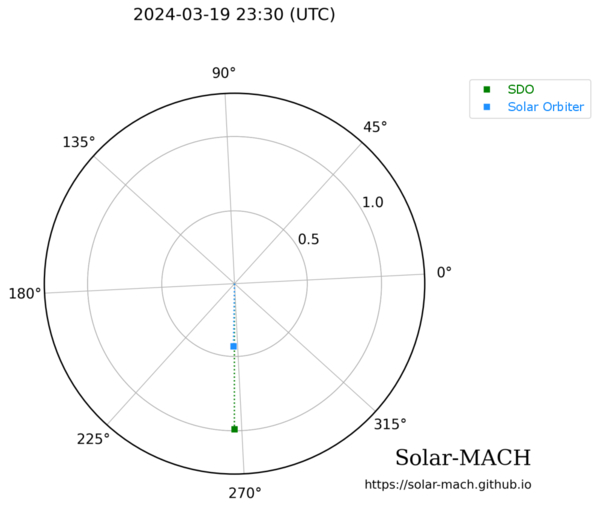
Positions of SDO (green) and Solar Orbiter (blue) during a solar flare on 19 March 2024. Click to enlarge. [Guastavino et al. 2026]
Guastavino’s team aligned and reprojected the data, accounting for the slightly different viewing angles of the two spacecraft, then applied an algorithm called Adaptive SE-DESAT to reconstruct the flux within the saturated portion of the SDO image. The team compared the desaturated SDO images to the unsaturated Solar Orbiter images over the course of the flare, finding the same flare morphology and similar time evolution between the two data sets.
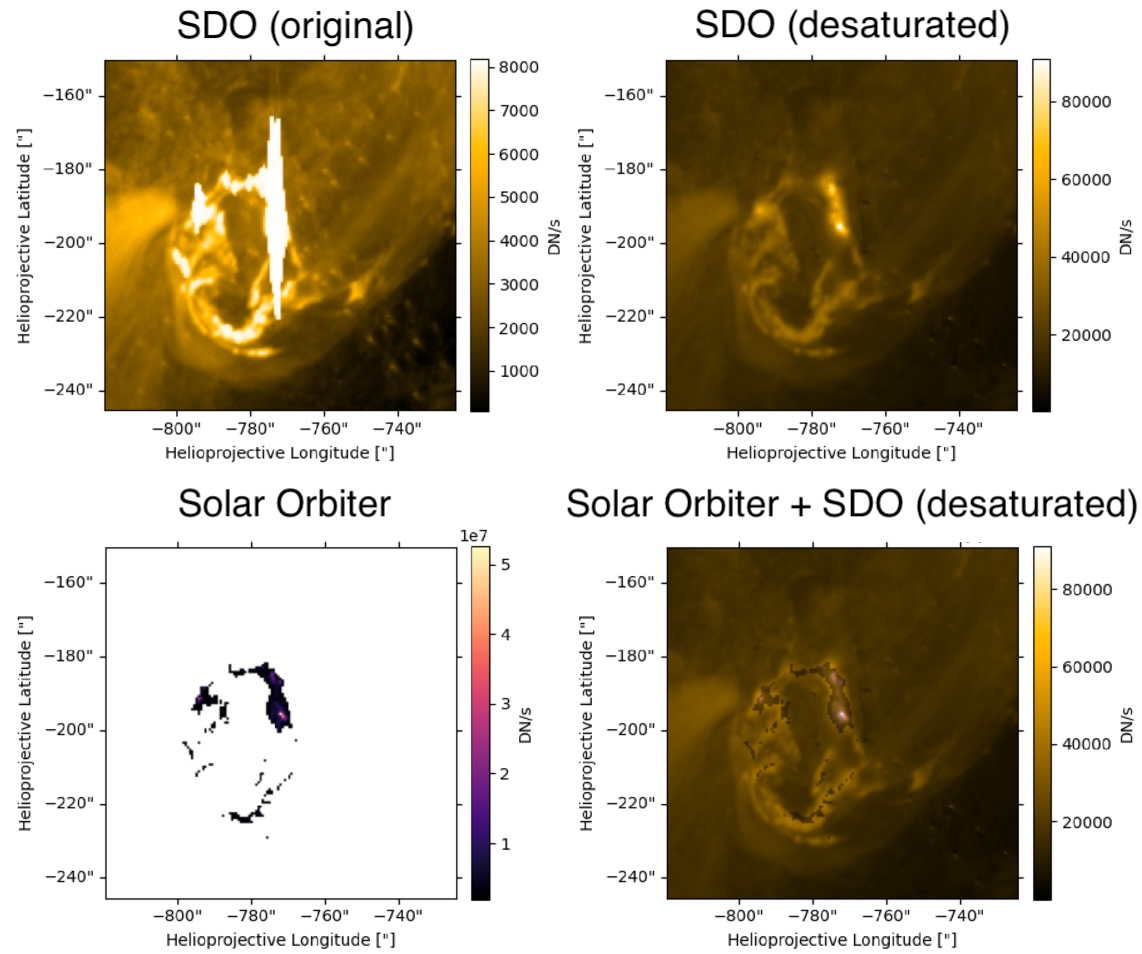
Example of unprocessed SDO data (top left), desaturated SDO data (top right), Solar Orbiter data (bottom left), and a combination of the two data sources (bottom right). Note that the Solar Orbiter observations have been clipped so that only the highest flare intensities were recorded. Click to enlarge. [Adapted from Guastavino et al. 2026]
Overall, these results demonstrate the effectiveness of the inversion technique, though Guastavino and coauthors noted that improvements could be made during the impulsive phase of the flare, when the emission is increasing. The team identified several reasons why the results may not match during this phase, including rapid evolution of the flare during individual exposures.
Despite these areas that require further attention, the validation of this technique unlocks 16 years of solar flare observations from SDO. This especially enhances our sample of powerful solar flares, increasing the available records of the most energetic solar flares by orders of magnitude.
“Validation of an Extreme-Ultraviolet Desaturation Technique for the Atmospheric Imaging Assembly on Board the Solar Dynamics Observatory Using Observations from the Extreme Ultraviolet Imager on Board Solar Orbiter,” Sabrina Guastavino et al 2026 ApJL 1005 L50. doi:10.3847/2041-8213/ae7d2e
The post When the Spacecraft Align: Rescuing Saturated Images of Solar Flares appeared first on AAS Nova.
Fourth of July celebrations across the United States this weekend could be accompanied by light shows in the night skies, as a string of powerful solar eruptions appear set to strike Earth.
The sun has been especially hyperactive over the past few days — firing off 10 M-class solar flares over 24 hours that have been accompanied by multiple coronal mass ejections (CMEs), which are set to slam into Earth on July 3 and July 5.
CMEs are large, fast-moving clouds of magnetized plasma and solar radiation that occasionally get flung into space with solar flares when kinks in the sun's magnetic field snap. If CMEs smash into Earth, they cause disturbances in Earth's magnetic field, called geomagnetic storms, that can trigger partial radio blackouts and produce vibrant aurora displays farther away from Earth's magnetic poles than usual.
"Machine-Gun Sun! More than 5 storms on their way to Earth and 3 of them offer good chances for aurora views," Tamitha Skov, a space weather physicist at Millersville University of Pennsylvania, wrote in a July 2 post on the social platform X. "NOAA and NASA model predictions do not show all the storms yet (it's hard to keep up with the rapid-fire storm launches!) but the first should hit before noon July 3 UTC."
The CMEs are expected to give a glancing blow to our planet, creating conditions for a moderate (G2) geomagnetic storm, according to the National Oceanic and Atmospheric Administration's (NOAA) Space Weather Prediction Center. It's also possible that these storms will strengthen to become strong (G3), depending on how they interact with Earth's magnetic field.
Auroras resulting from G3-class geomagnetic storms are often visible in northern parts of Washington, Idaho, Montana, Wyoming, North Dakota, South Dakota, Minnesota, Wisconsin, Michigan, New York and Maine, according to NOAA. Skywatchers farther south in Oregon, Nebraska, Iowa, Illinois, Indiana, Ohio, Pennsylvania, Massachusetts, Connecticut, Rhode Island, Vermont and New Hampshire will also have a chance of catching the light show. In any case, skywatchers interested in seeing or photographing the auroras will need to get as far from artificial light sources as possible.
The weekend storms might not be the last activity we see from the sun in the coming days, as two gigantic sunspots currently pimpling its face are displaying "beta-gamma-delta" magnetic fields — the most tangled and unstable type. This means these sunspots harbor the potential to launch powerful X-class flares, according to spaceweather.com.
The last few years have seen a record number of powerful X-class flares explode from the sun's surface, hitting Earth with several major solar storms, including 2024's Mother's Day storm. This record comes partly from improvements to scientists' solar monitoring technologies, but also due to the sun reaching its 11-year peak in sunspot production, or solar maximum, in 2024.
Following this peak, the sun has now entered a period known as the "battle zone," a relatively understudied solar phase where instabilities across our star's newly flipped magnetic field ramp up the production of solar holes, gigantic, highly-tangled sunspots and subsequent geomagnetic storms.
The worst-case scenario for a solar storm is a superstorm like the 1859 Carrington Event, which released roughly the same energy as 10 billion 1-megaton atomic bombs. After slamming into Earth, the powerful stream of solar particles set telegraph systems around the world on fire and caused auroras brighter than the light of the full moon to appear as far south as the Caribbean.
The Carrington Event unleashed a roughly X45 magnitude solar flare that remains a record, yet it's likely far from the worst the sun can muster — with ancient tree rings harboring evidence of even more powerful blasts that occurred long before humans existed.
One of Taika Waititi's greatest strengths as a director is his unique voice; he's able to bring a light touch to tragedy (Jojo Rabbit) and a gentle sadness to offbeat comedy (Our Flag Means Death). That makes him an excellent choice to direct Klara and the Sun, based on the novel by Kazuo Ishiguro. Sony Pictures just released the first trailer, and it's giving strong Hunt for the Wilderpeople vibes—a good thing, from my perspective, since that's my favorite Waititi film.
Per the official premise:
Based on the bestselling novel from Nobel Prize winner Kazuo Ishiguro and written and directed by Academy Award winner Taika Waititi, Klara and the Sun introduces audiences to Klara (Jenna Ortega), an Artificial Friend who wants nothing more than to find the perfect home. When Klara meets Josie (Mia Tharia), each immediately senses a kindred spirit in the other. Josie has a fraught relationship with her mother (Amy Adams), and they’ve suffered great loss, but Klara’s innocent wonder and unwavering loyalty begin to heal the family and bring light to Josie’s complicated world.
The cast also includes Natasha Lyonne as an artificial friend (AF) store manager; Rachel House as the housekeeper, Melania; Aran Murphy (son of Cillian Murphy) as Josie's best friend, Rick; and Sophia Bryant-Taukiri as Josie's older sister, Sal. Steve Buscemi and Harry Greenwood also appear in as-yet-undisclosed roles.
© Sony Pictures
For our weary eyeballs, strained and tired from long periods locked onto screens, rest and relaxation can do wonders. But a man in Scotland came up with an eye-popping plan to try to pamper his pooped peepers.
Ophthalmologists discovered it when the man, who was in his 20s, appeared at an eye treatment center in Edinburgh. He told them he had noticed increasing floaters and flashing lights in his right eye over the previous six days. According to a BMJ Case Report, the man said he hadn't had any eye or head injuries before the vision problems began, and that his family didn't have a history of eye disorders that might explain them. Besides having mild near-sightedness and needing glasses, he usually didn't have any problems with his eyes, he said.
When the doctors—Niamh O’Connell and Ashraf Khan—took a close look, they were surprised to find that both of his eyes were in terrible shape. In his right eye, he had multiple retinal tears, widespread retinal bruising, and a condition called retinal dialysis—a retinal break at a junction in the front of the eye—that is usually seen after a significant eye injury. In his left eye, he had more widespread bruising and six full-thickness rips in his retina.
NASA’s Parker Solar Probe completed its 28th close approach to the Sun on June 8, again matching its record distance of 3.8 million miles from the solar surface. The flyby allowed the spacecraft to continue its measurements of the solar wind and solar activity at their source, while adding to our understanding of how the Sun’s atmosphere changes throughout the solar cycle.
The spacecraft checked in with flight controllers at the Johns Hopkins Applied Physics Laboratory (APL) in Laurel, Maryland — where Parker Solar Probe was designed and built — on Thursday, transmitting a beacon tone that indicated its systems were operating normally. Zooming around the Sun on a trajectory that limited communications with Earth, Parker had been out of contact and operating autonomously for nine days around its closest approach, as planned.
During this solar encounter, which started June 3 and ends Saturday, June 13, Parker’s four scientific instrument packages gathered data from inside the Sun’s atmosphere, or corona. Parker will begin returning detailed spacecraft telemetry on June 14, with science data transmission set to run from Wednesday, June 17 to Tuesday, June 30.
Parker’s observations of the solar wind and solar events, such as coronal mass ejections and the aftermaths of flares, are critical to advancing humanity’s understanding of the Sun and the phenomena that drive high-energy space weather events that pose risks to astronauts, satellites, air travel, and even power grids on Earth. Understanding the fundamental physics of space weather enables more reliable prediction of astronaut safety during future deep-space missions to the Moon and Mars.
Parker also equaled its record-setting speed of 430,000 mph — a mark that, like Parker’s distance to the Sun, was set during a close approach on Dec. 24, 2024, and matched during five flybys since, most recently on March 11. Parker will continue matching these speed and distance records during future flybys.
Through all six close approaches, mission leads say, the spacecraft has remained in excellent condition. While Parker doesn’t have a temperature sensor on the front of its heat shield — known as the Thermal Protection System, or TPS — the team can estimate through models that the heat shield reaches temperatures of about 1,700 degrees Fahrenheit at closest approach.
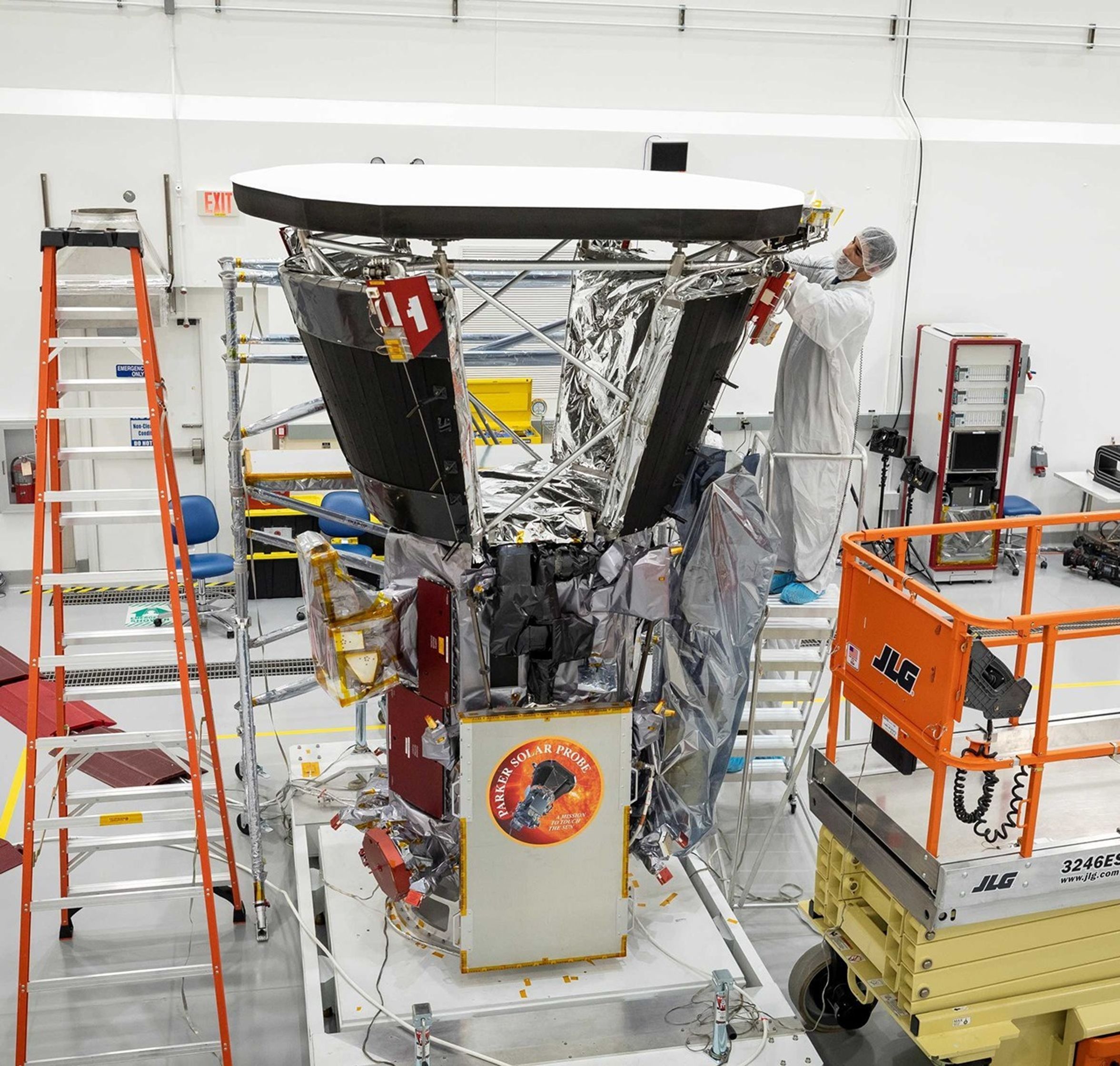
“The heat shield material is incredibly light and fragile, but the thermal design, as well as the software that keeps the spacecraft pointing the TPS toward the Sun, have been outstanding,” said John Wirzburger, Parker Solar Probe mission systems engineer at APL. “It’s a real tribute to the team that designed, built, and operates Parker Solar Probe.”
Meanwhile, the team can measure the temperature of the barrier blanketing below the heat shield, and the actual spacecraft temperature has remained consistent on each pass.
“That temperature consistency is a major indicator of spacecraft health,” said Wirzburger. “It tells us the heat shield isn’t degrading. If it were cracking or weakening, we’d see temperatures drift upward as more heat leaked through.”
Parker launched in August 2018. At the time, the Sun was near the minimum of its 11-year activity cycle. In 2024, representatives from NASA, the National Oceanic and Atmospheric Administration (NOAA), and the international Solar Cycle Prediction Panel announced that the Sun had reached its solar maximum period. Parker’s 28 encounters with the Sun reflect this change over time, sampling the Sun’s atmosphere from quiet to very active periods. Parker Solar Probe will remain in this orbit around the Sun and continue making observations into the declining phase of solar activity.
The next steps for the mission in late 2026 and beyond are under NASA review.
Parker Solar Probe was developed as a part of NASA’s Living With a Star (LWS) program to explore aspects of the Sun-Earth system that directly affect life and society. The LWS program is managed by the agency’s Goddard Space Flight Center in Greenbelt, Maryland, for NASA’s Science Mission Directorate in Washington. Johns Hopkins APL manages Parker Solar Probe for NASA and designed, built, and now operates the mission.
Mike Buckley, Johns Hopkins Applied Physics Laboratory
The post Parker Solar Probe Makes 28th Close Pass of Sun appeared first on NASA Science.
