A U.S.-Russian crew will return to Earth from the International Space Station early Sunday morning (July 26), and you can watch their homecoming live.
A Soyuz spacecraft carrying NASA astronaut Chris Williams and Sergey Kud-Sverchkov and Sergei Mikaev of the Russian space agency Roscosmos is scheduled to undock from the orbiting lab on Sunday at 3:02 a.m. EDT (0702 GMT).
The Soyuz, known as MS-28, will land on the steppe of Kazakhstan about 3.5 hours later, at 6:26 a.m. EDT (1026 GMT). You can watch these milestones here at Space.com, courtesy of NASA.
Russia's Soyuz MS-28 spacecraft is seen docked to the International Space Station shortly after its arrival on Nov. 27, 2026. (Image credit: NASA)
The coverage starts today (July 25) at 9:40 a.m. EDT (1340 GMT) ahead of a change-of-command ceremony aboard the International Space Station (ISS). Kud‑Sverchkov will hand over the reins of the orbiting lab to NASA astronaut Jessica Meir, part of the transition from ISS Expedition 74 to Expedition 75 (which officially begins when Soyuz MS‑28 undocks). You can watch that live via NASA.
NASA will resume its webcast tonight at 11:10 p.m. EDT (0310 GMT on July 26) to cover crew farewells and the closing of the hatches between the ISS and Soyuz MS-28, which is expected at 11:30 p.m. EDT (0330 GMT).
Undocking coverage begins Sunday at 2:30 a.m. EDT (0630 GMT). The stream will pick up again at 5:15 a.m. EDT (0915 GMT) for deorbit and landing activities. Touchdown will occur southeast of the Kazakh city of Dzhezkazgan, according to NASA.
The Soyuz MS-28 crew pose on Nov. 26, 2025, a day before their launch. From left: Chris Williams of NASA and Roscosmos cosmonauts Sergey Kud-Sverchkov and Sergei Mikaev. (Image credit: NASA/Bill Ingalls)
Soyuz MS-28 launched to the ISS on Nov. 27, which was Thanksgiving Day. That liftoff kicked off the first space mission for Williams and Mikaev and the second for Kud‑Sverchkov.
When it's all said and done, the trio will have spent 241 days in space on their current flight. They will have orbited Earth 3,856 times and traveled a total of more than 102 million miles (164 million kilometers).
After touchdown, the three spaceflyers "will fly by helicopter to Karaganda, Kazakhstan, where recovery teams are based," NASA officials wrote in a media advisory. "Williams then will return to NASA's Johnson Space Center in Houston, while Kud‑Sverchkov and Mikaev head back to their training base in Star City, Russia."
SpaceX launched the world's most powerful rocket on a critical 13th test flight late Friday, but there was no triskaidekaphobia on this mission.
The July 24 test launch, Space's Starship Flight 13 mission, sent a towering rocket the size of a 40-story skyscraper into space from South Texas, returned its massive Booster to Earth, and then — in a feat perhaps none saw coming — gently landed its Starship upper stage in the Indian Ocean, where it tipped over to float belly up on the sea.
"Starship is intact, floating in the ocean and transmitting telemetry!" SpaceX CEO Elon Musk wrote on X.
SpaceX's Starship Flight 13 test flight lifts off from Starbase, Texas on July 24, 2026.SpaceXSpaceX's Starship Flight 13 test flight lifts off from Starbase, Texas on July 24, 2026.SpaceXSpaceX's Starship Flight 13 test flight lifts off from Starbase, Texas on July 24, 2026.SpaceX
Even if you can't see SpaceX's Starship in person, you can score a model of your own. Standing at 13.77 inches (35 cm), this is a 1:375 ratio of SpaceX's Starship as a desktop model. The materials here are alloy steel and it weighs just 225g.View Deal
"That is a first," SpaceX spokesperson Dan Huot added in live commentary as a drone beamed stunning views of Starship bobbing in the waves. "That is the softest splashdown we have ever had with Starship in the Indian Ocean."
The splashdown capped what appeared to be a mostly successful test flight of SpaceX's biggest Starship ever. With a mighty roar, Starship Flight 13 lifted off from SpaceX's Starbase, Texas launch site at 6:51 p.m. EDT (2251 GMT) on a test flight that lasted just over one hour.
It was only the second flight of the company's new Starship Version 3 design, or V3, and SpaceX was hoping for a better outing than its first attempt in May. During that previous test, the Starship Flight 12 mission, the massive Super Heavy first-stage Booster suffered engine problems after stage separation and failed to make a water landing in the Gulf of Mexico. It crashed instead.
Lucky Flight 13
Friday's Starship Flight 13 mission fared a bit better.
SpaceX initially tried to launch Flight 13 on July 16, but the rocket aborted the try at the last second due to engine issues. SpaceX replaced some first-stage Raptor engines in time for a July 23 launch attempt, but waved off due to weather, setting the stage for Friday's successful liftoff.
Minutes into the flight, the Super Heavy Booster successfully separated from its Ship upper stage, aced a flip maneuver and returned to Earth. There was a problem during the landing burn. Only five engines appeared to fire when 13 were required to slow the Booster to landing speed. It hit the Gulf waters harder than planned, its camera views cutting out.
"It didn't look like we lit all 13 engines that we were planning for that initial landing burn," Huot said. "We were targeting a softer splashdown and, as you saw, it came in with quite a bit of velocity."
SpaceX's Starship Flight 13 Booster hits the Gulf of Mexico waters hard, with only 5 of 13 planned engines firing during a landing burn, on July 24, 2026. (Image credit: SpaceX)
Starlink V3 makes a debut
Starship is intact, floating in the ocean...'
- Elon Musk, SpaceX CEO
Despite the Booster's rough landing, there were clear successes on Starship Flight 13.
While sailing on its suborbital trajectory, Flight 13's Ship upper stage deployed 20 next-generation Starlink Version 3 internet satellites — large, flat satellites equipped with laser communications links and expansive solar arrays that will replace SpaceX's current Starlink internet megaconstellation.
Starship is designed to launch 60 Starlink V3 satellites at a time, spitting them out through a slit-like payload bay door like a giant PEZ candy dispenser. All 20 Starlink V3 satellites deployed smoothly, with the last two switching on flashlights and looking back at their Ship carrier before floating off into orbital darkness. The satellites did not stay in space. They fell to Earth and burned up (by design) due to their suborbital flight path.
The Ship upper stage (which SpaceX also refers to as Starship) then reignited one of its six Raptor engines to test a critical engine relight capability that will allow future Starships to enter and leave orbit. The burn went off without a hitch — a milestone since SpaceX had not always performed the burn if a test didn't go smoothly.
Then it was time for reentry, with cameras beaming back stunning views of Starship wrapped in super-hot plasma as it fell back to Earth. The spacecraft executed a three-engine burn to flip over into a vertical landing position, but did shift down to two engines, then one before it toppled over to rest on the waves.
The sight of a floating Starship triggered a cacophony of cheers from SpaceX teams at Starbase and its Hawthorne, California rocket factory in the company's livestream. After all, Starships usually explode after they tip over.
"This is just the first time we've put a Starship into the water," SpaceX's Dan Huot said during live commentary. He called it SpaceX's "softest splashdown" ever. "This is a dream scenario for this team that's trying to get this heat shield data."
A view of SpaceX's Starship Flight 13 Ship vehicle wrapped in plasma during reentry on July 24, 2026. (Image credit: SpaceX)
The heat shield isn't the only thing SpaceX's recovery team will be looking at.
Live views from Starship showed its six engines intact along with its flaps and other systems. Teams will be poring over what they can retrieve from the sea to help improve future Starship upgrades.
SpaceX is developing Starship to be a fully reusable launch system, a 407-foot-tall (124 meters) megarocket capable of taking Starlink fleets to orbit as easily as it lands NASA astronauts on the moon. That part is key.
NASA has tapped SpaceX's Starship to land its Artemis IV astronauts on the moon in 2028, but SpaceX has yet to ever complete an entire Earth orbit with Starship after 13 test flights and three years of launches. It's been a decade since Elon Musk first unveiled what SpaceX now calls Starship during a 2016 speech.
SpaceX's Starship Flight 13 Ship vehicle floats in the Indian Ocean just after splashdown on July 24, 2026.SpaceXSpaceX's Starship Flight 13 Ship vehicle floats in the Indian Ocean just after splashdown on July 24, 2026. Some flames are visible at the nose. SpaceXSpaceX's Starship Flight 13 Ship vehicle floats in the Indian Ocean just after splashdown on July 24, 2026. The flames near the nose are now gone.SpaceXA view of SpaceX's Starship Flight 13 Ship during its final landing and splashdown in the Indian Ocean on July 24, 2026.SpaceX
Over the next two years, SpaceX must not only send a Starship into orbit. The company also aims to return a Ship to Earth to catch it in the "chopsticks" of its Mechazilla launch pad at Starbase. (The company has already done so with its Super Heavy Booster stages.)
SpaceX also must successfully demonstrate in-space Starship refueling, complete an orbital tanker version of Starship, and finish a crewed lander version complete with a life support system that can keep astronauts alive on the moon. That's a lot on the Starship to-do list and NASA is watching.
"Congrats on getting Flight 13 underway," NASA Administrator Jared Isaacman wrote on X after the launch. "Excited for what will be learned from this mission. When Starship comes online, its capabilities will be game-changing, not least of which will be ensuring we never give up the Moon again!" In a lunar coincidence, Friday's launch coincided with the 57th anniversary of theApollo 11astronauts' return to Earth after their historic moon landing flight.
But for now, SpaceX is clearly celebrating.
"I'm a little over the moon right now," Huot said. "Wow. Lucky number 13. Hell of a great day for Starship."
Even if you can't see SpaceX's Starship in person, you can score a model of your own. Standing at 13.77 inches (35 cm), this is a 1:375 ratio of SpaceX's Starship as a desktop model. The materials here are alloy steel and it weighs just 225g.View Deal
ESA's Plato spacecraft completes critical testing ahead of its spaceflight. (Image credit: ESA - R. Moorkens O'Reilly)
A planet-hunting spacecraft named Plato just passed a series of critical tests as it prepares for the challenges of outer space.
What is it?
Gleaming in the light of a laboratory, this box of electronics is actually the European Space Agency's Platospacecraft sitting inside a special test chamber where it underwent critical tests ahead of its planned spaceflight.
The Plato (PLAnetary Transits and Oscillations of stars) probe is designed to study terrestrial exoplanets, or rocky planets outside of our solar system that are Earth-sized or smaller.
This chamber, called the Maxwell Test Chamber (which is located at the European Space Research and Technology Centre in the Netherlands), is an enclosure made of conductive metal that blocks electromagnetic fields. On top of the conductive metal are foam spikes. Combined, they block out and/or absorb all electrical signals and sounds to mimic some aspects of the environment of the vacuum of space.
In this enclosure, the team turned on Plato's electronics to make sure that signals from some of the probe's instruments don't interfere with other systems or electronics on the craft. With all other signals blocked out, scientists had a clear look into how it might perform in space.
Why is it incredible?
This test is critical as Plato will need to be able to collect data and run its instruments without interference from electronics or signals from elsewhere on the spacecraft. But it's pretty impossible to ensure that things would work as planned amidst the "noise" on planet Earth.
To get any spacecraft ready to operate in the void of space, researchers conduct all sorts of tests to make absolutely sure that they're up to the challenge. In addition to tests like this, spacecraft can be placed in extremely hot or cold temperature chambers or even shaken around to make sure that they can handle the violent conditions of a rocket launch. It's amazing how we can recreate different aspects of outer space here on Earth to prepare for these missions.
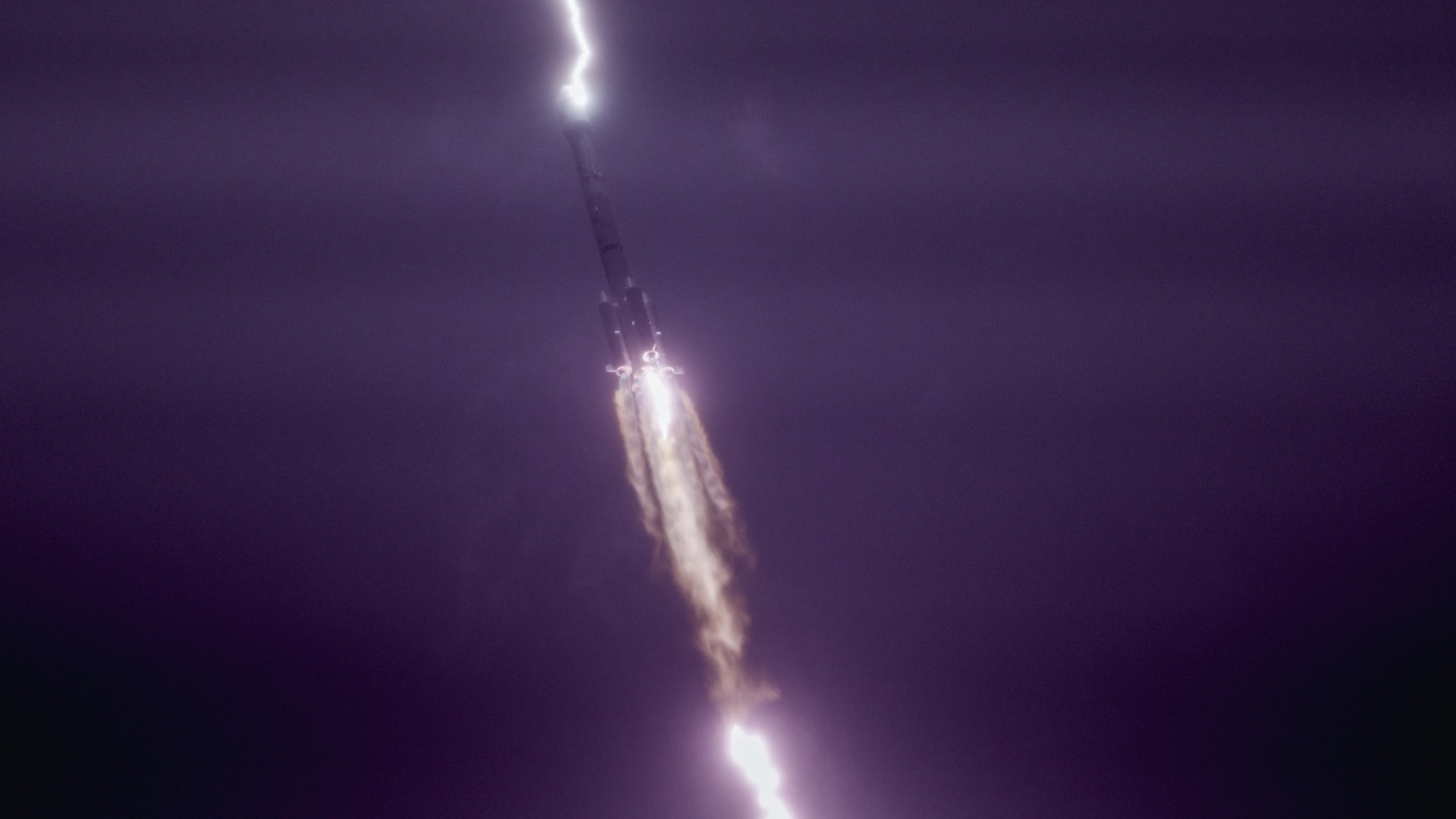
A Long March-3B carrier rocket carrying the Tianlian II-06 satellite blasts off from the Xichang Satellite Launch Center on July 23, 2026 in Xichang, Sichuan Province of China. (Image credit: Zhou Quan/VCG via Getty Images)
Lightning struck a Chinese rocket shortly after liftoff this week, as seen in incredible video and photographs.
A Long March-3B rocket lifted off from China's Xichang Satellite Launch Center on Thursday (July 23) carrying a communications relay satellite destined for geostationary orbit. Some 30 seconds into flight, lightning struck the rocket, leading to awestruck cries from crowds gathered nearby to watch the launch.
Despite the strike, the rocket delivered the satellite to its intended orbit as planned, according to the China Aerospace Science and Technology Corporation (CASC). The satellite will help relay communications to the nation's Tiangong Space Station and other crewed missions.
This isn't the first time lightning has struck a rocket shortly after liftoff. A lightning bolt famously struck the Saturn V rocket carrying NASA's Apollo 12 mission, the second to ever land astronauts on the moon. In fact, the rocket was struck twice.
According to a report NASA issued after the mission, some non-essential instruments and sensors experienced "permanent effects" from the strikes. Nevertheless, the mission put astronauts Charles "Pete" Conrad, Alan Bean and Richard "Dick" Gordon on the moon as planned.
More recently, lightning struck a Russian Soyuz rocket in 2019 shortly after it launched. Like in this most recent example, the vehicle was able to place its Glasnost communications satellite in orbit despite the strike.
Une fusée Longue Marche 3B vient de se prendre la foudre peu après son décollage de Xichang.Ce n'est pas la première fusée à subir ça, la Saturn V et la Soyouz-2 ont été aussi foudroyées par exemple. Aucun échec n'est lié à la foudre... pour l'instant.pic.twitter.com/vrAqaGAnnCJuly 23, 2026
But not all rockets struck by lightning fare so well. In 1987, a bolt struck the United Launch Alliance Atlas/Centaur-67 rocket, leading to a malfunction in one of the computers that guided the vehicle and "ultimately causing the breakup of the vehicle," NASA wrote in a report of the incident.
The incident led to NASA developing strict Lightning Launch Commit Criteria (LLCC) to lower the risk of strikes by further defining weather conditions that would delay launches. "Since Atlas/Centaur-67 and the rigorous implementation of the LLCC, no other launch vehicles have intercepted or triggered lightning on launch in the United States," NASA wrote in a technical paper outlining the criteria.
NASA is shaking things up for its next mission to research the sun.
The six satellites of NASA's Sun Radio Interferometer Space Experiment (SunRISE) mission are poised to launch to Earth orbit soon, to serve as an early warning system for incoming solar storms. They were originally slated to lift off on a United Launch Alliance (ULA) Vulcan Centaur rocket but have now been assigned a SpaceX Falcon Heavy, according to a NASA mission update.
SunRISE will fly to space as part of a rideshare mission sponsored by the U.S. Space Force's (USSF's) Space Systems Command (SSC). Though it's not stated specifically in the NASA release, that may be a hint as to why the mission's rocket was changed. On its most recent launch, USSF-87, Vulcan experienced an anomaly in one of its solid rocket boosters — the second such incident to occur during the rocket's four launches to date.
Vulcan succeeded in delivering the USSF-87 payload to its designated orbit on that launch, but the recurrence of the booster issue during ascent prompted the Space Force to pause national security launches on Vulcan until it could be addressed. Which mission SunRISE will be manifested on has not yet been released, but SSC has already shifted other launches between Vulcan and SpaceX's Falcon 9, so NASA's change in rockets for SunRISE could indicate either that the mission has been remanifested on a different SSC rideshare, or that another SSC mission has been shifted from Vulcan entirely.
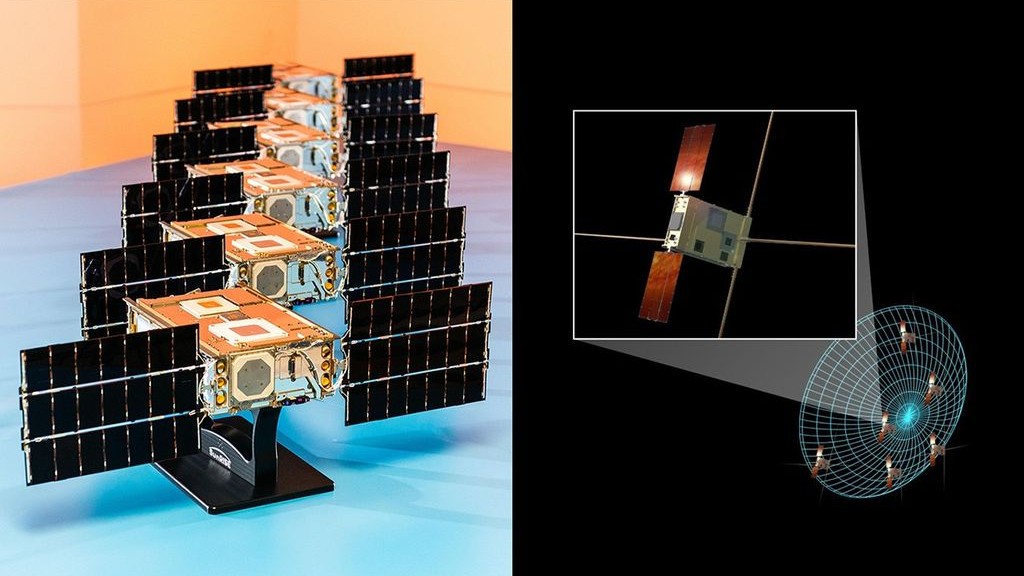
SunRISE is a heliophysics study under the NASA Science Mission Directorate's "missions of opportunity" umbrella and is part of the Explorers Program run by Goddard Space Flight Center in Greenbelt, Maryland. It consists of six small satellites, each about the size of a mailbox. The mini-constellation's mission is led by scientists at the University of Michigan and will be managed out of NASA's Jet Propulsion Laboratory in Southern California.
The half-dozen smallsats will be delivered to an orbit about 22,000 miles (35,000 kilometers) above Earth — just above a geostationary parking altitude — and fly in a giant 10-mile (16-km) "X" formation, each extending its roughly 10-foot (2.5-meter) antenna booms to act as a single large radio telescope to track solar radio bursts. These kinds of bursts travel faster than the energetic particles from a solar storm, and precede their arrival when shot towards Earth.
The SunRISE satellites, seen at left, will fly in formation, illustrated on the right, working as one large radio telescope in Earth orbit. (Image credit: NASA/JPL-Caltech)
SunRISE will help researchers better understand the behavior of incoming solar radio bursts, but the mission won't serve as an alert system by itself. Instead, scientists will use data collected by the spacecraft to improve prediction models for impending space weather, which in turn could lead to mitigation plans to better thwart the effects of such solar events on orbital infrastructure.
Falcon Heavy is SpaceX's heavy-lift launch vehicle, capable of launching up to 58,860 pounds (26,700 kg) to geostationary transfer orbit. It's a triple-booster rocket that consists of three modified Falcon 9 first stages, and has launched 12 times since it debuted in 2018. Four of those have delivered national security payloads to orbit, with the most recent of those, USSF-52, launching in December 2023. Falcon Heavy's most recent flight overall occurred this past April, when it sent the Viasat-3 F3 telecom satellite to orbit.
Falcon Heavy's next mission will lift off with NASA's Nancy Roman Space Telescope, currently set for no earlier than Aug. 30. SunRISE is scheduled to launch later this year, but a more specific launch window has not yet been announced.
New data from NASA’s Juno spacecraft show temperatures spike more than 20 degrees Celsius just a few meters under Io’s surface, providing the first look at what’s happening below the crust of the Solar System’s most volcanic world.
LOS ANGELES — Standing in the shadow of the space shuttle Endeavour, a group of retired NASA astronauts announced their plan to travel the country visiting colleges to try to inspire younger generations to get out and vote. This campaign comes as we lead up to the November midterm election.
This past year, a group of retired NASA astronauts teamed up for a single cause: to defend the U.S. constitution. They banded together as part of a non-profit, non-partisan activist organization called Astronauts for America. So far, they have been speaking out, using their astronaut expertise, platforms, cultural relevance and role model status to speak out in support of "science, evidence-based decision-making, public service and the rule of law," their website reads. Now, as the group announced at an event at the California Science Center's new air and space center — home to the shuttle Endeavour — they're hitting the road on a campaign tour of colleges called "Vote for Freedom."
"We have to do what we can to ensure that the country makes it through the challenges that we're dealing with here, and that is the message that we're going to be taking to colleges and universities," Apollo 9 astronaut Rusty Schweickart told Space.com. "And the agency that we have, the immediate agency, is to vote."
This tour will send astronauts from the group on a four-month jaunt across the country. Astronauts from the group's more than 100 members will visit state and community colleges, county fairs and even town halls, aiming to reach first-time voters and young people who might be new to voting.
"I'm really excited to look a bunch of younger Americans in the eye and make sure that they know that someone that they can trust said: ;Listen, you matter, because our country matters, and our country needs you,'" former NASA astronaut Cady Coleman told Space.com.
"It's with a uniquely American kind of freedom that we were able to go to the moon, and that same freedom launched the spaceship behind us 25 times into space. Now we see those freedoms under heavy threat," former NASA astronaut Steve Smith said during the event. "We're seeing chaos instead of community, violence instead of votes, lies instead of laws, and fear instead of fate. That's how democracy and freedom die."
"The mission is all that matters. Now, our country is the mission, and our message is simple: going to the polls is one small step for you, and one giant leap for our country," Smith added.
Former NASA astronaut Steve Smith speaks alongside other former astronauts in front of the space shuttle Endeavor at the California Science Center on July 20, 2026. (Image credit: Space.com/Chelsea Gohd)
This campaign leads up to the U.S. midterm elections this November. Midterm elections happen halfway through every four-year presidency. This election allows voters to decide what Congress looks like, and which political party controls Congress. This can ultimately have a major impact on what laws and decisions are passed moving forward, and whether Congress will reject or change actions by the president moving forward. And this group of astronauts is serious about the importance of getting people out to exercise their right to vote.
"I'm a child of the segregated South; I grew up in Columbia, South Carolina," former astronaut and NASA Administrator Charlie Bolden, who also serves as a steering committee member for Astronauts for America, said at the event. "I graduated in 1964. Anybody know what happened in 1964? The Voting Rights Act. So, as a person growing up in my hometown, it wasn't a guarantee that my mom and dad were going to be able to go out and vote. I look at what's going on today about people trying to restrict the ability of people to cast their ballot. That's not who we are. That's not America."
The group of astronauts recently spoke out about voting access after the U.S. Supreme Court ruled in favor of protecting the right to absentee voting, in response to attempts by the Trump administration to place restrictions on the current voting process. Especially leading up to the November midterms, each vote carries significant weight. And while this nonpartisan group isn't telling you who to vote for, they do think that everyone who can should vote.
"As astronauts, we signed an oath to our nation, and we are mission-oriented people. And our nation is now the mission," Coleman added. "We need to recognize that everyone's voice is important, and one of the voices that we don't hear very much is the young people. And we want them to understand that, even though sometimes change can seem daunting, their perspective is really important, and, you know, their voice is important."
The moon's south pole has long been the target of NASA's Artemis lunar landing missions, but one Artemis astronaut is questioning if that's still the best plan.
NASA's Victor Glover, who piloted the Artemis II mission around the moon this past April, proposed a different approach while speaking at the NASA Exploration Science Forum at the agency's Ames Research Center in California on July 21, according to a report published on Space News. "I think we need to be realistic and work our way to the south pole, and maybe not try to go there first," Glover said.
Instead, Glover suggested aiming closer to the moon's equator, where missions can land in areas not at risk of falling out of daylight, and in regions reachable by orbits that allow for quick transfers back to Earth in case of an emergency, according to Space News. That argument aligns with other recent Artemis program changes that NASA has introduced to gradually expand successive mission goals, but whether space agency officials will take his advice depends on what the top priority for Artemis moon landings is deemed to be.
NASA astronaut Victor Glover, the pilot of the Artemis II moon mission. (Image credit: NASA)
NASA has long targeted the lunar south pole due to its abundance of water ice. Permanently shadowed areas inside craters in this region are believed to harbor large ice deposits, which scientists believe can be used as a resource in the production of several space-travel essentials, like potable water, radiation shielding and rocket fuel. That goes a long way toward achieving the Artemis program's ultimate goal of creating a sustainable, long-term base on the surface of the moon, and using the lessons learned in building that outpost to enable the eventual occupation of Mars.
There is, however, a secondary motivation behind NASA's ramped-up urgency to see its Artemis missions succeed in a timely manner. China has also set its sights on the lunar surface, stoking fears in some U.S. officials about the implications of Chinese astronauts staking some sort of claim at the moon's south pole before American astronauts are able to get there.
During a Senate Commerce Committee hearing last year, several space industry experts, including former NASA Administrator Jim Bridenstine, urged lawmakers not to let that happen. Mike Gold, president of civil and international space at Redwire, told senators that China beating the U.S. back to the moon would mean "a global realignment that will impact our economy, our tax base, our ability to innovate and our national security."
If not just getting back to the moon first, but being the first with boots on the ground at the south pole, is the priority, Glover's suggested approach may not get NASA there in time. China is making fast progress with its lunar program; it has already demonstrated robotic landings and sample returns on both the moon's near and far side and begun developing hardware for a crewed landing by 2030.
NASA's next Artemis mission, Artemis III, is scheduled for next year. It will launch four astronauts aboard the Orion space capsule for rendezvous and docking tests with the program's two commercial lunar lander vehicles, SpaceX's Starship and Blue Origin's Blue Moon. If all goes according to plan on that mission, NASA is targeting late 2028 for the program's first moon landing on Artemis IV. To pull that off, one of the two landers has to be up to the task, and both have faced significant delays that have raised questions about their readiness on NASA's timeline.
To facilitate south pole landings, NASA previously laid out a lunar near-rectilinear halo orbit (NRHO) — a high-altitude, elliptical polar orbit — where Orion would dock with the lunar Gateway space station, and then crews would transfer to and undock aboard one of the Artemis landers to descend to the surface. Gateway is no longer part of the picture, however; the agency has sidelined that outpost to push ahead with a surface base.
But NRHO on its own also introduces some complications that SpaceX and Blue Origin have raised while developing their lunar landers, as well as safety concerns for astronauts facing a potential emergency situation on the moon's surface. Because of its highly elliptical shape and long orbital period, opportunities to launch from the moon's south pole to rendezvous with Orion in NRHO open up just once a week.
To highlight the potential risks imposed by relying on an NRHO, Glover brought up a hypothetical situation — an astronaut health issue that requires a medical evacuation just after landing at a lunar south pole moon base.
"You’re stuck for a week," Glover said. "That’s a big deal to me, and I don’t like that plan … The equator gives me opportunity to save that person."
If the point of Artemis' returning astronauts to the moon as soon as possible is landing there at all, then there's no need for the first of those missions to aim for the south pole, Glover argued. "If you want to go fast, go familiar … If we want to land soon, familiar, daylight, equator."
"I think we need to be realistic and work our way to the south pole, and maybe not try to go there first," he added.
SpaceX is also eyeing an equatorial orbit when Starship flies on the Artemis IV mission, and NASA may already be quietly shifting the mission's landing site to a higher latitude. During a June 9 event that revealed the Artemis III, SpaceX Customer Operations and Integration Vice President Jessica Jensen outlined an Artemis IV mission plan with Starship that didn't involve NRHO.
"We have an updated plan with NASA that includes docking Starship with Orion in Earth orbit instead of NRHO, and then we use Starship to actually do the translunar injection with Orion attached," Jensen said, stressing the same benefits that Glover expressed during the July 21 forum.
"The crew can also abort off the lunar surface nearly any time, versus waiting up to days from NRHO," she said. "In addition to improving crew safety, these new Artemis IV orbits also significantly lower the amount of propellant Starship needs to aggregate in space, since we now just have a more direct route to the moon, and this lower schedule risk overall."
There's nothing more disorienting than falling asleep in transit only to wake up and find you've somehow drifted billions of miles beyond the orbit of Pluto.
Fortunately for NASA's New Horizon spacecraft, which scientists just awakened from a nearly yearlong hibernation at the solar system's edge, all systems are in "good health," according to a NASA statement. Now, with the probe recovered from its 321-day sleep and beginning to transmit science data again, New Horizons appears ready to continue its mission of studying the mysterious boundary where the sun's realm ends and interstellar space begins.
"Every status report through this hibernation period was 'green,' meaning all was well aboard New Horizons each and every week," Alice Bowman, the New Horizons mission operations manager at the Johns Hopkins Applied Physics Laboratory in Maryland, said in the statement.
New Horizons launched in 2006, breaking the record for fastest-ever space launch at roughly 36,400 mph (58,500 km/h). On its way to the edge of the solar system, the spacecraft picked up speed during a flyby of Jupiter in 2007 and then again while passing Pluto in 2015. Today, New Horizons is about 5.9 billion miles (9.5 billion kilometers) from Earth, or roughly 64 times the distance from Earth to the sun (64 astronomical units, or AU).
With the exception of the twin Voyager probes that launched in 1977, New Horizons is the farthest working spacecraft in the universe. (Two other probes, Pioneer 10 and 11, have traveled farther, but each stopped working several decades ago.)
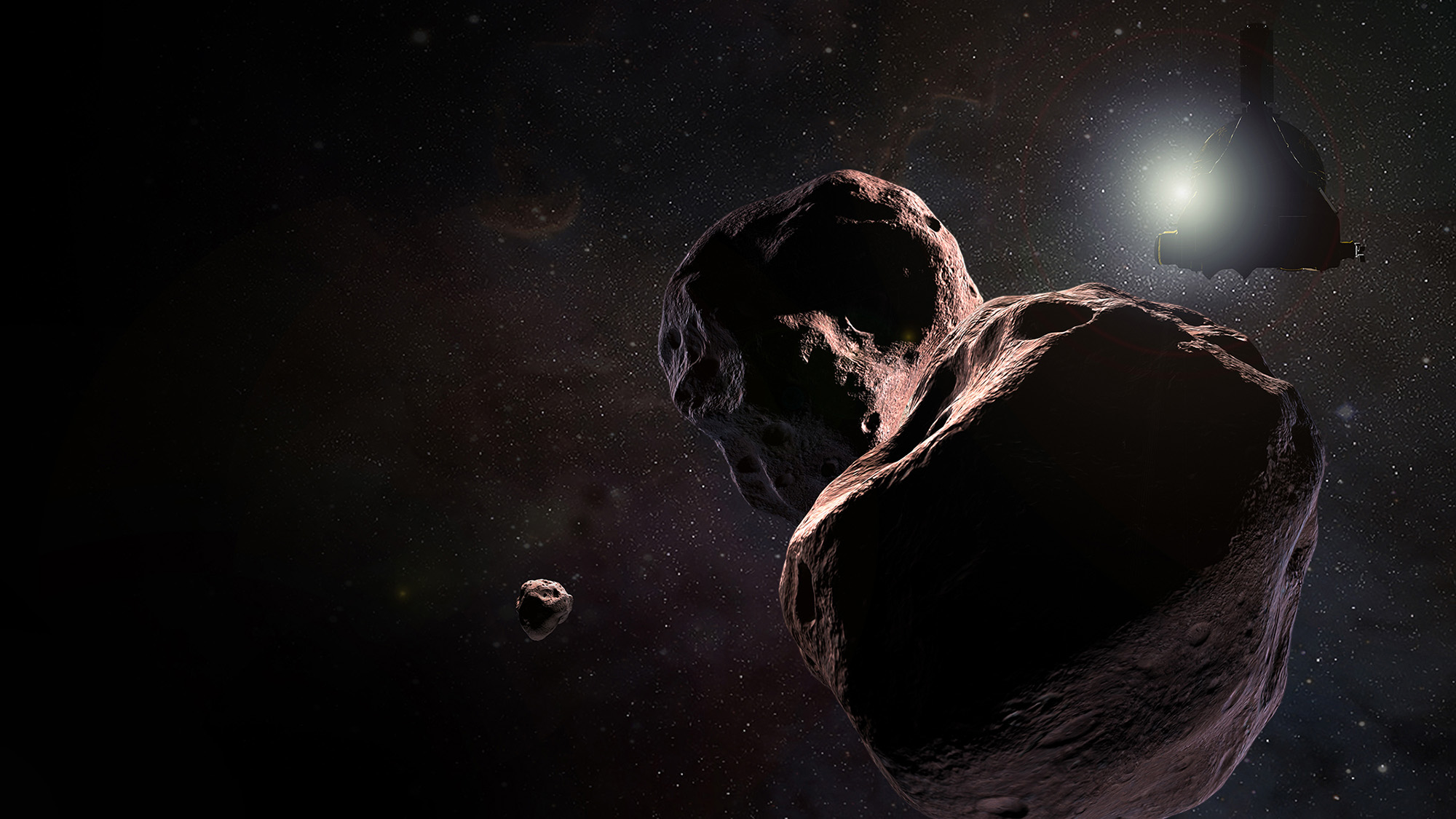
An illustration of the Kuiper Belt object Arrokoth, the farthest-ever solar system object to receive a close flyby. New Horizons whizzed past it in 2019. (Image credit: NASA/Johns Hopkins University Applied Physics Laboratory/Southwest Research Institute/Steve Gribben)
Like the Voyager twins, New Horizons is on a trajectory toward the heliopause — the extreme outer edge of the sun's influence, where solar wind collides with the interstellar medium.
The Voyager probes proved that this dividing line is a measurable, physical boundary in space, marked by a hot, thick plasma barrier. However, New Horizons will eventually pass this boundary with far more sensitive instruments than the Voyagers held, enabling it to collect the most detailed data about this region ever.
But there's still a long way to go. The heliopause is estimated to begin about 120 AU from the sun — nearly twice as far as New Horizons has traveled so far. In the meantime, a long and lonely journey through the Kuiper Belt awaits. In the coming weeks, the spacecraft will begin conducting a study of hydrogen in the outer reaches of the heliosphere as it sends back the hoarded trove of data from its year in hibernation.
According to NASA, each transmission between New Horizons and Earth takes about 8 hours and 52 minutes, with that delay growing all the time.
In the Kuiper Belt, New Horizons may also have the chance to study peculiar, icy objects similar to the peanut-shaped space rock Arrokoth, which the probe flew by in 2019. This was the furthest object in the solar system ever to receive a close spacecraft flyby; whether New Horizons will break its own record again in the coming years is an open question.
Planetary researchers have found the first evidence that bursts of energetic particles from the Sun could warm the lower atmosphere of Mars during massive dust storms, hinting at an unexpected link between space weather and Martian climate.
The world's most powerful solid-fuel rocket just aced its third-ever mission.
Gravity-1, a distinctively squat and stubby rocket, launched Tuesday night (July 21) from the deck of a ship stationed off the coast of Shanghai.
Liftoff occurred at 10:54 p.m. EDT (0254 GMT and 10:54 a.m. Beijing time on July 22), according to the state-run Chinese outlet Xinhua, which further reported that all nine satellites reached "their designated orbits." Details about those satellites were not provided.
Orienspace's Gravity-1 rocket launches nine satellites to orbit from a ship at sea on July 21, 2026. (Image credit: CCTV)
Gravity-1 is operated by Orienspace, a company based in the eastern Chinese province of Shandong. The rocket stands about 100 feet (30 meters) tall — less than half the height of SpaceX's workhorse Falcon 9 vehicle.
Gravity-1 consists of three core stages and four strap-on boosters, all of which feature solid rocket motors. The launcher can haul up to 14,300 pounds (6,500 kilograms) of payload to low Earth orbit (LEO), making it the most powerful solid rocket in the world. (For comparison: The liquid-fueled Falcon 9 can deliver a maximum of 50,265 pounds, or 22,800 kg, to LEO.)
The Chinese vehicle now has three flights under its belt, all of which launched from ships at sea and achieved full mission success. Gravity-1's first two flights occurred in January 2024 and October 2025.
There won't be such a long gap before Gravity-1 flies again, if all goes to plan. The rocket is expected to launch a batch of Chinese internet satellites in the next few months, according to the state-run outlet CGTN.
And Orienspace's ambitions don't end with Gravity-1. The company is also developing Gravity-2 and Gravity-3, larger, more powerful rockets that will feature liquid-fueled core stages and solid rocket boosters.
Gravity-2 could be ready to fly by the end of the year, CGTN reported. And that vehicle will likely lift off from an ocean-based pad as well.
"Sea launch of solid-propellant rockets paves the way for future launch of liquid rockets at sea," said Gravity-1 chief designer Xu Guoguang, according to CGTN. "We are also considering other methods, such as launching from drilling platforms."
The outgoing head of the U.S. Space Force has some stark words for his international partners.
Speaking at the 2026 Global Air and Space Chiefs Conference on July 15, in what was his last public speech as Chief of Space Operations (CSO), Gen. Chance Saltzman told attendees that if an armed conflict ever reaches space, as military leaders have for years been predicting and planning for, no military or nation in the world will be spared.
"If a conflict extends into space, none of us will be able to avoid the war zone. Unlike a combat zone in the air, land or sea, we will not be able to steer clear," Saltzman said in his remarks at the conference, published by the Space Force. "Whether we want to be in the combat zone or not, orbital mechanics will put all of our space capabilities into the space war zone."
Saltzman's warning touches upon the fact that there isn't an unlimited amount of space in Earth orbit; in fact there are some crowded orbital inclinations that contain thousands of spacecraft. When a satellite or other spacecraft breaks up in one of these orbits, it can create hazards for many other spacecraft — even crewed ones.
When Russia destroyed a satellite with a missile in a 2022 test, it left a dangerous debris field in orbit that persists today. The ISS has had to dodge it multiple times.
If a conflict broke out or extended to space, and that conflict involved the destruction of even just one satellite, it could potentially create a runaway effect that leaves parts of Earth's orbit unusable.
But despite the grave nature of his warning, Saltzman stressed that ultimately the shared nature of space means that all spacefaring nations should aim toward cooperation.
"We will share the consequences; therefore, we should share the responsibility for a safe, secure and stable space domain," Saltzman said, adding later in the speech that "these widespread consequences of conflict in space should make deterrence a goal for all of us."
Saltzman has stressed the need for international cooperation in prior speeches. The outgoing CSO called defending the peaceful use of space "the ultimate team sport" when introducing Space Force's International Partnership Strategy in 2025. "The domain is too big, too complex, too dynamic, for a single nation to secure alone," Saltzman said.
While head of the U.S. military's newest branch, Saltzman has seen the Space Force evolve into a fully "combat-credible" force, to use the outgoing CSO's own words.
Saltzman touted the Space Force's contributions to recent U.S. military operations earlier this year at the Space Foundation's 41st Space Symposium in Colorado Springs. "We aren't just talking about theories or plans anymore. We're talking about real operational combat, space effects and the Guardians who deliver them," Saltzman told attendees.
Saltzman is set to retire in August 2026 after serving as the Space Force's second Chief of Space Operations since 2022. President Donald Trump has nominated a replacement, Lt. Gen. Douglas A. Schiess, to serve as Saltzman's successor. Schiess has served as Deputy Chief of Space Operations for Operations since November 2025.
During a recent confirmation hearing, Schiess defended the Space Force's $71 billion budget request, stating the funds are needed to deter China's development of military space capabilities. "The 71.1 billion dollars that the president has asked for is exactly what we need," Schiess said, according to Space News.
The fight continues against SpaceX's controversial South Texas land swap.
That deal, which the company made with the U.S. Fish and Wildlife Service (USFWS), gives SpaceX 727 acres (294 hectares) of public land that's currently part of the Lower Rio Grande Valley National Wildlife Refuge. In exchange, the company hands over 683 acres (276 hectares) of its territory in the area, not all of it contiguous, to the USFWS.
Last month, a coalition of conservation and tribal groups sued the USFWS over the swap, saying it degrades the refuge and violates multiple laws, including the National Wildlife Refuge System Improvement Act of 1997. And yesterday (July 20), those groups filed an emergency injunction, asking a federal judge to stop the exchange until the courts can rule on the ongoing case.
"Federal officials are racing to fork over America's public lands to one of wealthiest corporations on Earth before the courts can even weigh in," Laiken Jordahl, national public lands advocate at the Center for Biological Diversity, said in a statement yesterday (July 20).
"This refuge is one of the last places left for the public to enjoy nature in the Rio Grande Valley," Jordahl added. "Why should Texans be forced to surrender even more of their public lands to a trillion-dollar corporation? The court has to intervene now, because once these refuge lands are transferred to SpaceX, they’re gone forever."
The land set to be transferred to SpaceX is near Starbase, the manufacturing and launch hub for the company's Starship megarocket. SpaceX sees Starship as transformational; it's the biggest and most powerful launcher ever built, and it's designed to be fully and rapidly reusable.
SpaceX's Starbase site sits amid wetlands with high biodiversity in South Texas. (Image credit: SpaceX)
Starship remains in the development-and-testing phase. It has flown 12 suborbital test flights to date, all of them from Starbase, and is gearing up for Flight 13 this Thursday (July 23).
These launches pose a threat to the wildlife that the 90,000-acre (36,420 hectares) refuge was established to protect, according to the Center for Biological Diversity, a conservation nonprofit based in Tucson, Arizona.
"A 2024 study found that, after one launch, every single monitored shorebird nest near the launch site suffered egg damage or loss," the organization said in yesterday's statement. "Instead of taking any enforcement actions or working with SpaceX to reduce or eliminate its harm to the refuge, the Service [USFWS] is now citing the resulting degradation as justification for handing the public land to SpaceX."
Some of the land being transferred to SpaceX is part of the Palmito Ranch Battlefield National Historic Landmark, where the final battle of the Civil War was fought. This means the swap also violates the National Historic Preservation Act, according to the Center or Biological Diversity.
The Center or Biological Diversity and its partners also take issue with how the land deal was made.
"The proposed land exchange was first made public in March, but records obtained under the Freedom of Information Act show internal agency planning began as early as April 2025," yesterday's statement reads. "In those discussions with the regional director of the Service, the agency developed 'the most expedited schedule possible' for completing a land transfer and recommended hiring additional staff to meet what they described as an 'optimum timeframe.'"
The plaintiffs in the lawsuit against the USFWS are the Center for Biological Diversity, Save RGV, the Carrizo/Comecrudo Nation of Texas, Inc., and the South Texas Environmental Justice Network.
Once again, the "Land Down Under" is on the apparent uptick for falling space debris.
In early July, the Australian Space Agency reported that objects recovered, dubbed "space balls," are likely pressure vessels from a space launch vehicle. Six spherical pieces of space junk were found in the small seaside community of Forrest Beach, near Ingham. Australian Queensland Fire Department crews swung into action to assist partner agencies following the discovery of the potentially hazardous objects. Scientific teams safely secured a number of the items, establishing a 165 feet (50-meter) "exclusion zone" around them to assure public safety. The nature and origin of the debris are still being investigated.
This latest incident is part of an unwanted legacy of being the "fall guy" for space remains, from the U.S. Skylab space station debris that fell into Western Australia in 1979; a chunk of a SpaceX Dragon trunk found in New South Wales in 2022; a pressure vessel that washed up in Perth from an Indian booster in 2023; along with a section of Chinese Jielong-3 rocket in October 2025.
In fact, these incidents are becoming so common that the Australian Space Agency has put together a trio of steps to take if suspected space debris is discovered:
Step 1: Do not handle the debris. Space objects are built from a range of materials that may be hazardous. They should only be handled by appropriately trained and equipped professionals.
Step 2: Contact the local authorities if (a) the situation is potentially urgent (e.g. there is a life-threatening situation) or (b) otherwise contact the 24/7 Police Assistance Line for further advice.
Step 3: Notify the Australian Space Agency, who may support authorities with technical expertise, liaise with foreign counterparts and operators, and advise on the country's treaty obligations. The ASA can advise local authorities on the appropriate response to a confirmed space debris event.
Indeed, if an item is definitely found to be space debris, the Australian Government has worldwide obligations to notify the launching authority of its discovery, and upon request, may be required to return the space junk.
A metallic sphere found in Australia in July 2026 is believed to be space debris. (Image credit: Queensland Fire Department)
"Even if they heat up, they don't care."
For Marlon Sorge, executive director of the Aerospace Corporation's Center for Orbital and Reentry Debris Studies (CORDS), it's no surprise that the recent so-called space balls endured their plunge from space.
"Very often they will be made of something like titanium which is really good at surviving," Sorge told Space.com. "In spite of them being metal, they tend to decelerate more than, say, a solid hunk of metal. They can 'float down' a little bit more gently than some other things," he said.
Sorge said that this class of space debris decelerates quicker, and also once on the surface the pieces are also more recognizable than broken up chunks of metal. Furthermore, if made of titanium, "even if they heat up, they don't care." In other words, they tend to survive reentry intact.
There's more awareness in the space debris study community that materials like titanium are potentially an issue, said Sorge. If you go to something like Composite Overwrapped Pressure Vessels (COPV), also commonly used in manufactured space hardware, that too is an issue you have to deal with, he said.
Bigger picture
But ultimately, many of these debris concerns could be mitigated with more responsible behaviors from space agencies and launch providers, Sorge said.
"In the bigger picture with [rocket] upper stages," Sorge added, "just don't let them randomly reenter. Bring them down via controlled reentry and then if they are survivable it doesn't matter because you dump them somewhere where there aren't any people."
As for the Australian-found space leftovers, these tanks are clearly coming from non-controlled reentry events, said Sorge, dropping out of the sky and washing up onshore.
Over the years, the Aerospace Corporation has studied recovered pressure vessels like those from the Australian affair. The welcome mat is open for contributions from countries that are on the receiving end of space objects, Sorge advised.
Some information can be gleaned from such appraisals, like what shape the recovered debris is in, what degree of temperatures they were exposed to. Also, such a hands and eyes-on look can point out what they didn't experience, which is also useful data, Sorge said.
If observers could track and observe incoming debris on its way down, it could be extremely helpful in identifying points of origin. That's currently a challenge, Sorge said. "If we get an impact location and a time of reentry that really helps us figure out what's going on," he said.
On the whole, there's a lot more attention being paid to the implications stemming from reentering, human-made, space leftovers.
"The real challenge is that this is still an area that we don't completely understand. We get surprises now and again," Sorge concluded, "because we know only so much. There's certainly a lot more awareness now than earlier years to be proactive in thinking about this."
A metallic sphere found in Australia in July 2026 believed to be space debris. (Image credit: Queensland Fire Department)
Atmospheric drag wins
"It may seem surprising that pieces of the same rocket can show up in Australia, Canada or on a farm in Africa, but that's actually what we'd expect," said Michelle Hanlon, executive director of the Center for Air and Space Law at the University of Mississippi School of Law.
"Objects in low Earth orbit pass over much of the planet as the Earth rotates underneath them. If a reentry isn't controlled, the exact point where it finally comes down can shift by thousands of kilometers depending on when atmospheric drag finally wins," Hanlon told Space.com.
Since most of the Earth is ocean, that's where most debris ends up, Hanlon said. "Every now and then, though, a tough piece survives and lands somewhere people can find it — or lands in the ocean and gets swept swiftly to shore."
Country of origin?
Hanlon said that the pressure vessels like those found in Australia are a good example.
"They're built to withstand enormous pressures, so they are also among the pieces most likely to survive reentry. That's why they seem to turn up so often," said Hanlon.
Why are recovered space debris so hard to identify, their country-of-origin?
"I'm not sure stamping everything with a country-of-origin is the answer," said Hanlon. "Many of these objects can already be identified by their design, serial numbers or by matching them to launch and registration records. And there's no guarantee a label would even survive reentry."
For Hanlon, the bigger issue is traceability. "Can authorities quickly figure out what the object is, whether it poses any danger and which state should be contacted? Better information-sharing and better tracking would be far more useful than a 'Made in' stamp," Hanlon said.
"One thing I'd also point out is that we're seeing more of these simply because we're launching a lot more things into space. That's actually a sign of how active the space sector has become, not necessarily that it's becoming less safe," said Hanlon.
Even if reentries go exactly as planned 99.9 percent of the time, more launches mean more reentries, which means more chances that a particularly durable piece survives and lands somewhere unexpected.
All-in-all, the Australian incident of space balls is another sobering reminder that space activities don't end when a mission does, Hanlon concluded. "End-of-life disposal is now just as much a part of responsible space operations as launch."
This recent debris incident has a bit of a cosmic coincidence to it, too, Hanon added. "It's funny that we're having this conversation just as 'Spaceballs: The New One' is gearing up."
A rocky planet orbiting in the habitable zone of a sun-like star may look like a perfect place for life to thrive — but not if it's too small to hold onto its atmosphere.
So, we may wonder: How much smaller Earth could be and still have its delightfully breathable atmosphere? How small could an exoplanet be to sustain life as we know it?
With these questions in mind, University of California Riverside planetary scientist Michelle Hill and her colleagues recently simulated what happens to the atmospheres of different sizes of rocky worlds. The worlds tested were similar to Earth and orbited in the habitable zones around sun-like stars. It turns out for a world to maintain an atmosphere long enough for life to gain a foothold (a few billion years at minimum), it needs to be at least as big as Mars.
Narrowing down the search for life
The habitable zone — the area around a star where temperatures are right for liquid water to exist on a planet's surface — is prime real estate in the hunt for alien life. It's also a tough neighborhood for exoplanet atmospheres, because the closer a planet is to a star, the more ways in which radiation and stellar wind will try to strip away an atmosphere.
This is why Hill and her colleagues recently simulated how long it would take rocky, Earth-like planets of various sizes, in the habitable zone of a star like our sun, to lose their atmospheres. In other words, how much smaller could Earth, or a similar planet, be and still keep an atmosphere?
The answer turns out to be that an atmosphere-sustaining planet needs to be about 80% as wide as Earth, but could technically be as small as 60%. This offers astrobiologists a clue about which planets to focus on in the search for habitable worlds and signs of alien life.
"The plethora of exoplanets creates an interesting challenge in the search for potentially habitable planets," wrote Hill and her colleagues. "Of the many targets in the habitable zones of their star, which are the best candidates for follow-up observations with the aim of detecting biosignatures?" In other words, astrobiologists now have almost too many planets to choose from and not enough telescope time to search them all. So, it's time to narrow the search.
One way to do that is to figure out which planets are most likely to be habitable — and for life as we know it, that habitability means having an atmosphere.
New exoplanets, like those orbiting TRAPPIST-1, are being discovered with staggering frequency. (Image credit: NASA's Goddard Space Flight Center)
Modeling atmospheres — and volcanoes
Hill and her colleagues' "Smaller Than Earth Habitability Model" simulates the fate of atmospheres around digital versions of Earth. Some of the simulated worlds are exactly like ours but smaller, with the same chemical makeup and the same proportions of core, mantle and crust. Others have slightly different amounts of carbon, larger or smaller cores, or different starting temperatures. The model traces what happens to these worlds over a few billion years, based on two things: how quickly stellar wind and radiation strip away gas from the planet's atmosphere and how quickly volcanoes pump out gas (mostly carbon dioxide) to replace it.
The model is how the team realized a scaled-down version of Earth needs to be at least 80% as wide as true Earth (0.8 Earth radii) to maintain an atmosphere in the long run. Smaller planets tend to lose gas faster than volcanic eruptions can replace it.
That's because smaller planets have less gravity and weaker magnetic fields with which to hold onto their thin envelopes of gas. They also don't usually release enough gas from within to make up for the loss. Their mantles — the churning layer of magma beneath the crust — tend to release less volcanic gas over time, and their upper layers cool and harden much faster. The latter process cuts off volcanic eruptions much earlier in a planet's lifespan.
Smaller planets clinging onto atmospheres
By changing some of Earth's parameters, the team managed to get planets as small as 0.6 Earth radii to maintain a stable atmosphere. Carbon was the key: planets with more carbon in their mantles tend to release more carbon dioxide gas in eruptions, and that turns out to be the biggest factor (other than size) in whether a planet keeps its atmosphere.
"Carbon dioxide is a heavy molecule," Hill and her colleagues wrote, "which can make it a difficult molecule to lose. We focus on a pure carbon dioxide atmosphere as a best-case scenario for atmospheric retention." Of course, that's only a best-case scenario for some relatively simple forms of life, so your astrobiological mileage may vary.
It took tons more carbon than Earth contains to make a significant difference to the fate of a planet's atmosphere — but because it's theoretically possible for a planet to form with that much carbon in its makeup, that's useful knowledge. Planets with relatively smaller cores, and therefore relatively thicker mantles, also had better luck on the atmospheric retention front. Starting with a larger supply of radioactive elements, which decay and release heat into the surrounding rock, helped keep the mantle molten and the volcanic gases churning skyward.
Space volcanoes are widespread. For instance, Jupiter's moon Io has a pizza-like surface covered in volcanoes. (Image credit: NASA)
Starting with a cooler mantle also helps — which sounds surprising. You'd think a hotter mantle would be more likely to spew volcanic gases into the atmosphere. Yet, a cooler mantle takes longer to start erupting in earnest, which means the planet gets to hold onto its reservoir of gases until its star is older and more settled.
Newborn stars are prone to violent bursts of radiation and plasma, which would sweep away the volcanic gas as fast as it erupted. With a cooler mantle and later eruptions, the planet gets to keep more of the erupted gas.
A second chance for airless worlds
There's still hope of life for smaller worlds.
Even planets that lose their initial atmospheres entirely — instead of gradually replacing them with things like carbon dioxide and methane — might have a second chance to build a new atmosphere.
Hill and her colleagues suggest that one way for a planet to regain its lost atmosphere could be comet and asteroid impacts, which might deliver volatile elements like hydrogen, oxygen and carbon. These elements can combine to form all sorts of atmospheric gases.
Such impacts could be especially helpful if they happen later in the star system's life, like after the star is past its youthful phase of intense flares.
"While smaller planets face greater challenges in retaining atmospheres, our model suggests that they can develop atmospheres under the right conditions," wrote Hill and her colleagues, so, "even those that initially lose their atmospheres should not be immediately discounted as potentially habitable worlds."
What's next?
Future simulations using the Smaller Than Earth Habitability Model could study worlds around smaller, cooler stars called red dwarfs — stars like TRAPPIST-1, which is home to at least seven rocky planets, with three of them in the habitable zone. These stars make up about 75% of the stars in our galaxy, and their relatively dim light makes it easier for telescopes like the James Webb Space Telescope (JWST) to capture images of starlight filtering through the atmospheres of planets that pass between Earth and their host stars.
Hill and her colleagues also hope to explore what happens to atmospheres around tidally-locked planets, or planets where tidal forces keep the interior hot and seismically active, similar to Jupiter's moon Io.
The U.S. Space Force is adding three dozen spacecraft to its growing constellation designed to detect and track incoming missiles from orbit. The Space Development Agency (SDA) announced the agreements, worth a combined $1.75 billion, on July 14, naming L3Harris Technologies and Sierra Space as the recipients.
Each company will provide 18 Accelerated Missile Defense Tranche 3 (AMDT3) spacecraft, for a total of 36 satellites that will grow the SDA Proliferated Warfighter Space Architecture's Tranche 3 Tracking Layer constellation, part of the Trump Administration's Golden Dome initiative. All 36 are expected to be ready for launch by the end of 2028, according to an SDA statement.
SDA's contracts with each company differ slightly. One calls for "18 missile warning and missile tracking variant space vehicles" from Sierra Space, while the other requests "18 missile defense variant space vehicles" from L3Harris, all equipped with infrared sensors to add to the constellation's global network.
L3Harris will receive up to $955 million for its 18 satellites, which the Space Force describes as "Hypersonic and Ballistic Tracking Space Sensor-like" (HBTSS) spacecraft. Sierra Space's agreement has the potential to reach $798 million for its 18-satellite contribution. Altogether, the 36 spacecraft will be distributed across four orbital planes as part of a hybrid missile-defense architecture designed to provide "global stereo coverage" of next-generation missile threats.
The Tracking Layer uses infrared imaging in low Earth orbit to detect and track missiles, and it transfers that data in real time through a low-latency communications network to military forces on the ground. According to the agency, the new satellites will increase the constellation's coverage and integrate into the spacecraft of SDA's first three Tranches.
“AMDT3 expands upon SDA’s previous and current Tracking Layer generations — Tranches 1, 2 and 3," said SDA Director G.P. Sandhoo, "marking another milestone in delivering a resilient, global missile warning, missile tracking, and missile defense capability.”
Sierra Space will base its satellites on the Horizon vehicle, from the company's Eclipse satellite series, which it also used in the design of the spacecraft it provided for the Tranche 2 Tracking Layer program, according to a Sierra Space release.
Stack of Satellites from Sierra Space. (Image credit: Sierra Space)
L3Harris plans to build on the success of the HBTSS satellites the company developed for the Military Defense Agency, according to an L3Harris release. The company "has more than 70 missile tracking and defense satellites on order, including five on orbit, between MDA’s HBTSS program and SDA’s Tracking Layer across Tranche 0, 1, 2 and 3," the company said.
The 36 satellites from L3Harris and Sierra Space are in addition to the 72 Tranche 3 Tracking Layer spacecraft SDA ordered in December 2025, via contracts worth $3.5 billion. L3Harris was included in those agreements as well, along with Lockheed Martin, Rocket Lab and Northrop Grumman. In total, the two rounds of awards bring the Tranche 3 constellation to a planned 108 satellites, worth about $5.25 billion. If all goes to plan, all of them will be available to launch by the end of 2029.
The newly contracted satellites from L3Harris and Sierra Space could begin heading to space sooner than that, however. SDA describes the new contracts as "accelerated," though a launch timeline has not been established to the overall group. Once in orbit, the Space Force will assume responsibility for the satellites' operation and integration "in support of joint force operations and delivering warfighting capabilities," the SDA statement said.
Twenty-four Starlink satellites reached low Earth orbit on Tuesday (July 21), a day later than originally scheduled due to a last-second rocket engine abort.
SpaceX at first tried to launch the broadband internet relay units on a Falcon 9 rocket on Monday morning (July 20), but an unexpected engine cutoff at the point of ignition scrubbed the day's attempt. The company did not provide a reason for the abort.
By Tuesday, whatever the problem was had been addressed and the Falcon 9 was ready to fly. It liftoff off at 10:49 a.m. EDT (1449 GMT; 7:49 a.m. PDT local time) from Space Launch Complex 4 East at Vandenberg Space Force Base in California. About an hour later, after a normal ascent, the new Starlink batch (Group 17-39) were deployed into their intended orbit.
The Falcon 9 rocket's first stage, Booster 1082, completed its 23rd mission by touching down atop the droneship "Of Course I Still Love You" positioned in the Pacific Ocean.
The Starlink network provides worldwide access to the internet, especially to areas where other means of connection are not possible. The megaconstellation also enables in-flight wifi and direct-to-cell services for select providers.
Tuesday's Starlink launch was SpaceX's 85th Falcon 9 launch of the year. SpaceX experienced a similar but unrelated last-second abort on its first attempt at launching its 13th test flight of its Starship megarocket on Thursday (July 16). That flight has now been rescheduled for Thursday (July 23).
Orion is getting an upgrade on Artemis III, and the astronauts aboard are getting WiFi (sort of).
NASA is partnering with SpaceX to equip the Orion spacecraft for Artemis III with a pair of Starlink mini laser terminals, designed to operate on SpaceX's existing Starlink network. The two panels will be installed on Orion's exterior, and will augment the spacecraft's existing communications systems.
The added capability is expected to provide a greater data capacity from Orion to NASA's mission control in Houston, which may include high-definition live video from orbit. The mission is currently scheduled for the second half of 2027, and will also include another sizable contribution from SpaceX: a Starship rocket.
SpaceX currently operates more than 10,000 Starlink spacecraft in LEO, which provide satellite internet coverage across nearly the entire globe to commercially-available wireless terminals about the size of a laptop. Combined, those more than 10,000 and counting satellites are equipped with over 25,000 lasers currently in operation in LEO to maintain the network's interconnectedness, according to a NASA update.
The company previously demonstrated the Starlink constellation's use as a communication relay network during the privately funded Fram2 mission that launched the first human into a polar orbit around Earth in 2025. SpaceX frequently utilizes its high-data capabilities to stream high-definition live views of its Falcon 9 and Starship rocket launches from orbit.
Artemis III is the third in a program of NASA missions with the goal of returning astronauts to the moon and establishing a permanent base on its surface. Artemis III is designed as a practice run for NASA's Orion capsule to rendezvous and dock with the program's commercial lunar lander vehicles, Starship, and Blue Origin's Blue Moon spacecraft, in low Earth orbit (LEO). That's a lot closer to home compared to the Artemis II mission that NASA launched in April of this year.
Artemis II was Orion's first flight with astronauts onboard, and flew a 10-day mission around the far side of the moon. NASA used laser communications during Artemis II as well, using terminals on Orion and ground stations at NASA's Jet Propulsion Lab in California and White Sands Complex in New Mexico to transmit data loads too big for the agency's Near Space and Deep Space radio networks. With flight sticking to LEO during Artemis III, communication limitations become a lot easier to surmount.
If all goes according to plan during Artemis III, NASA has scheduled the first Artemis moon landing on the following mission, Artemis IV. NASA is targeting 2028 to launch Artemis IV, and has selected Starship as the lunar lander that will return astronauts to the lunar surface.
SpaceX called today's launch MRV-MEV, because it's sending up a Mission Robotic Vehicle and three Mission Extension Pods (MEPs). These spacecraft will be operated by SpaceLogistics, a subsidiary of Virginia-based aerospace giant Northrop Grumman.
Northrop Grumman integrated the robotics payload, developed by the Naval Research Laboratory (NRL), onto its Mission Robotics Vehicle at the company’s Dulles, Virginia facility. (Image credit: Northrop Grumman)
MRV-MEV is headed to geostationary orbit (GEO), 22,236 miles (35,786 kilometers) above Earth. At this altitude, orbital speed matches the velocity of our planet's rotation, allowing spacecraft to "hover" over the same patch of ground continuously. For this reason, GEO is a popular destination for spy, communications and weather satellites.
The new mission will work to extend the lives of such satellites. The MRV is equipped with two 10-foot-long (3 meters) robotic arms, a system developed by the U.S. Defense Advanced Research Projects Agency (DARPA) with the help of the Naval Research Laboratory. The spacecraft will use those arms to attach the MEPs — the first three ever to launch — to three separate satellites in GEO.
"Once installed, the MEP uses electric propulsion to provide orbit control and momentum unloading for a client satellite," Northrop Grumman wrote in an MEP fact sheet. "The MEP is controlled by the customer via a self-contained C- or Ku-band telemetry and command system, and [is] capable of providing up to eight years of life extension for a typical 2,000 kg satellite in GEO."
The Australian satellite operator Optus booked one of the MEPs, and Intelsat hired out the other two, according to Tech Times.
The MRV and MEPs will reach GEO separately. When it's rendezvous time, the robotic-armed spacecraft will grab an MEP and ferry it over to its client satellite, Tech Times reported. The MRV will then remain in GEO after it has installed the third MEP, waiting for other such "satellite jetpacks" to reach orbit.
In addition to installing MEPs, the MRV "can relocate, inspect, repair and upgrade spacecraft while in orbit," Northrop Grumman's website states.
"MRV includes a Northrop Grumman-developed Passive Refueling Module (PRM), the first refueling interface standard approved by the U.S. Space Force, which enables MRV to be refueled in orbit," it adds. "With advanced robotics technology and Northrop Grumman's proven experience in satellite servicing, the mission delivers an unprecedented capability and new class of system that can continuously evolve to support novel or increasingly advanced missions for our nation, making assets in space more resilient."
That "proven experience in satellite servicing" consists of two previous Northrop Grumman projects. Mission Extension Vehicle-1 (MEV-1) — the first-ever commercial satellite-servicing spacecraft — launched in October 2019 and successfully rendezvoused with its target in GEO (the communications satellite Intelsat 901) four months later. MEV-2 launched in August 2020 and docked with Intelsat 10-02 the following April.
Neither MEV-1 nor MEV-2 used Mission Extension Pods, however. Each of those previous efforts employed a single servicing craft, which made its way to the target satellite, docked and performed life-extension duties on its own.
All went according to plan during the launch: The Falcon 9's upper stage deployed the MRV 35.5 minutes after liftoff and the three MEPs at 10-minute intervals after that, according to SpaceX.
In a departure from most Falcon 9 missions, there was not a first-stage landing today.
"Due to the additional performance needed to launch these payloads to geosynchronous transfer orbit, this will be the 32nd and final flight for the Falcon 9 first stage booster supporting this mission, which previously launched CRS-24, Eutelsat HOTBIRD 13F, OneWeb 1, SES-18 and SES-19, and 27 Starlink missions," SpaceX's MRV-MEP mission description reads.
SpaceX's rocket-reuse record is 36 flights, set earlier this month during a Falcon 9 launch of the company's Starlink internet satellites.
MEV-MEP was SpaceX's second launch of the day. The company also sent 24 Starlink craft to orbit atop a Falcon 9 from California this morning.
Editor's note: This story was updated at 5:23 p.m. ET with news of successful liftoff. It was then updated again at 11:05 a.m. ET on July 22 with news of successful payload deployment, and to note DARPA's key role in this mission.

 Login