❌

Normal view

Promoções na App Store: ClipCourt, FAR: Lone Sails, Wait Menu e mais!

24 July 2026 at 04:10

Para esta madrugada de quinta para sexta-feira, aproveite a nossa seleção de promoções na App Store!

O nosso destaque do dia é ClipCourt. Desenvolvido por Kostas Papadopoulos, ele é um editor de vídeos voltado para criadores que buscam rapidez e simplicidade.

O app oferece ferramentas essenciais como corte, divisão, ajuste de velocidade e adição de música, além de filtros e efeitos que ajudam a dar um acabamento mais profissional aos seus vídeos. A interface é limpa e direta, permitindo que usuários iniciantes editem sem dificuldade e que os mais experientes façam ajustes rápidos, seja em um iPhone, iPad ou Mac.

Um dos pontos fortes do aplicativo é a fluidez do processo de edição: importar, ajustar e exportar vídeos acontece de forma intuitiva, sem menus complexos ou excesso de opções.

Um aplicativo útil para quem produz conteúdo para redes sociais ou que precisa editar vídeos curtos com agilidade. Aproveite a oferta! 📹


Abaixo outros jogos/apps que, juntos, somam mais de R$60 em descontos:

Jogos

Jogo de aventura.

Jogo de ação.

Puzzles.

Aplicativos

Contagem regressiva para eventos.

Utilitário para texto.


Aproveite as ofertas e até amanhã! Vale lembrar que as ofertas são sempre por tempo limitado, então é bom correr. 🚂

Geekbench 7 chega com benchmark de GPU e testes multi-core reformulados

23 July 2026 at 20:47

A Primate Labs anunciou hoje o Geekbench 7, a geração mais recente de sua popular ferramenta de benchmark, que traz conjuntos de dados maiores e mais exigentes para o processamento de GPUs 1Graphics processing units, ou unidade de processamento gráfico., testes multi-core reformulados, entre outras novidades.

A Primate Labs afirma que o benchmark de GPU reformulado concentra-se em aprendizado de máquina e criação de conteúdo para refletir a forma como as GPUs são utilizadas atualmente. Ele inclui agora testes que rastreiam rostos e aplicam efeitos de filtro em tempo real a vídeos, realizam upscaling de imagens com aprendizado de máquina e desfocam fundos em transmissões de videoconferência.

Já os benchmarks multi-core foram projetados para refletir melhor o comportamento real dos softwares, visto que as novas cargas de trabalho só utilizam múltiplas threads quando as tarefas simuladas exigem.

Geekbench 7
Divulgação/Primate Labs

A Primate Labs adicionou ainda um teste expandido de edição de fotos, com um conjunto mais abrangente de edições. Ademais, a carga de trabalho de biblioteca de fotos oferece suporte à importação e ao processamento de formatos de imagem como JPEG XL e DNG. Além disso, os novos testes de áudio e vídeo agora incluem suporte a AV1 e Opus, além de simular cargas de trabalho de streaming e consumo de conteúdo.

No mais, ele tem a mesma aparência do Geekbench 6 — e a licença Pro continua custando US$100 (com desconto para US$80 até 6 de agosto). A versão Pro permite realizar benchmarks offline — sem envio de dados para o Geekbench Browser — e abrange todas as plataformas desktop compatíveis (macOS, Windows e Linux).

É possível baixar gratuitamente o Geekbench 7 para macOS e outros sistemas operacionais nessa página. A versão para iOS/iPadOS ainda não foi atualizada na App Store.

Notas de rodapé

  • 1
    Graphics processing units, ou unidade de processamento gráfico.

Apple TV anuncia “The Last Person on Earth”, docussérie com Esther Perel

23 July 2026 at 16:20

O Apple TV anunciou há pouco sua mais nova série documental: “The Last Person on Earth”, feita em parceria com a autora bestseller e renomada terapeuta de casais Esther Perel.

Na produção, veremos Perel e uma equipe de especialistas reunir casais que parecem opostos, antes de embarcarem em uma aventura “em um dos destinos mais românticos e remotos do mundo”.

Opposites are matched and sent on an adventure of a lifetime in search of love.

Esther Perel leads a new social experiment and dating series where people are paired with someone who appears to be the last person they would normally date. Could an unexpected match lead to a… pic.twitter.com/6fjUFq4PJY

— Apple TV (@AppleTV) July 23, 2026
Os opostos são colocados juntos e enviados para uma aventura inesquecível em busca do amor.

Esther Perel apresenta um novo experimento social e uma série de encontros onde as pessoas são reunidas com alguém que parece ser a última pessoa com quem elas normalmente namorariam. Será que um encontro inesperado pode levar a um relacionamento que mudará suas vidas?

#TheLastPersonOnEarth — Em breve no Apple TV.

A ideia da docussérie, segundo o serviço de streaming, é levantar a seguinte questão: “Será que a última pessoa na Terra com quem você imaginaria namorar pode acabar sendo justamente aquela sem a qual você não consegue viver?” Um experimento interessante em um mundo onde “há mais pessoas solteiras do que nunca e níveis crescentes de polarização e isolamento social”.

Perel comentou o anúncio:

Ao longo da minha carreira como terapeuta de casais, uma verdade tornou-se inegável: o amor pode ansiar pela proximidade, mas o desejo é alimentado pela alteridade. “The Last Person on Earth” é uma exploração ousada dos relacionamentos que desafia tudo o que presumimos sobre compatibilidade, convidando as pessoas a deixarem de lado a lista de requisitos e a encararem o namoro como uma aventura rumo ao desconhecido. Quando escolhemos sair dos limites restritos daquilo que nos parece familiar ou seguro, histórias de amor apaixonadas podem florescer.

Criada pela Boldprint Studios, “The Last Person on Earth” conta com a produção executiva de Dan Gray, Lou Hutchinson e Phil Harris. Josh Jacobs e Olly Lambert, por sua vez, são diretores.

O Apple TV ainda não divulgou uma data de estreia para “The Last Person on Earth”. Também ainda não se sabe quantos episódios a docussérie terá.

O Apple TV está disponível no aplicativo Apple TV em mais de 100 países e regiões, seja em iPhones, iPads, Apple TVs, Macs, dispositivos Android, smart TVs ou online — além de também estar em aparelhos como Roku, Amazon Fire TV, Chromecast com Google TV, consoles PlayStation e Xbox. O serviço custa R$29,90 por mês, com um período de teste gratuito de 7 dias. Por tempo limitado, quem comprar e ativar um novo iPhone, iPad, Apple TV ou Mac ganha 3 meses do Apple TV. Ele também faz parte do pacote de assinaturas da empresa, o Apple One.

NOTA DE TRANSPARÊNCIA: O MacMagazine recebe uma pequena comissão sobre vendas concluídas por meio de links deste post, mas você, como consumidor, não paga nada mais pelos produtos/serviços usando os nossos links de afiliado.

SmartGym é atualizado com nova tela de registro, teclado proprietário e mais

23 July 2026 at 14:00

O popular aplicativo de exercícios SmartGym recebeu hoje mais uma grande atualização, que foca tanto no lançamento de novos recursos quanto em melhorias na experiência dos muitos recursos que já existem em seu aplicativo para iOS.

Uma das novidades é o lançamento de uma nova experiência de registro de exercícios que já está presente no Apple Watch desde o watchOS 10. Basicamente, ela permite alterar os dados de cada série sem sair da tela principal do treino.

Na interface tradicional, o usuário visualiza todas as séries do exercício e, caso queira alterar peso, repetições ou outros valores, precisa entrar no modo de edição antes de registrar a série — um processo que exige mais etapas.

O novo modo, por sua vez, exibe uma série por vez, permitindo fazer alterações e registrá-las em um fluxo contínuo. Após concluir uma série, a próxima é exibida automaticamente e o cronômetro de descanso é iniciado.

Cabe destacar que essa interface de edição tradicional não está sendo substituída por completo, já que os usuários podem escolher a qualquer momento entre a interface clássica e o registro “inline” — o que fizer mais sentido para cada um.

A interface de edição das séries agora também passa a mostrar um indicador de qual era o plano original — o que ajuda o usuário a saber se ele está acima ou abaixo de sua meta e a acompanhar sua progressão ao longo dos meses.

Outra novidade bem interessante é o lançamento de um teclado proprietário que substitui o padrão do iOS. Além dos números tradicionais, ele conta com botões que facilitam edições feitas no app (como + e -).

Por fim, o Smart Action Button ficou ainda mais inteligente e agora reconhece melhor situações (como o fim de uma série, mudanças de exercícios e retornos após pausas) para tentar prever o próximo passo do usuário com mais precisão.

Inclusive, donos de iPhones com o botão de Ação (Action Button) agora podem configurá-lo para usar o Smart Action Button — o que significa que ele ativará a ação principal recomendada pelo app por meio do recurso.


Trazendo outras pequenas melhorias e uma série de novos exercícios, a nova versão do SmartGym já está disponível na App Store.

Embora ele possa ser baixado gratuitamente, é necessário realizar uma assinatura para a liberação de certos recursos. O SmartGym Premium+ sai por R$25 mensais ou R$150 anuais.

Como editar um Memoji pelo iPhone, iPad ou Apple Watch

23 July 2026 at 12:00

Há alguns anos, a Apple oferece a possibilidade de criar Memojis, uma representação visual do seu rosto que pode ser enviada por mensagem, no FaceTime ou até mesmo como um mostrador do Apple Watch.

Caso você tenha criado um e queira adicionar ou remover algum item ou alguma característica facial, você pode editar os Memojis posteriormente nos seus dispositivos da Maçã. Veja como é simples! 😉

Como editar um Memoji pelo iPhone/iPad

  1. Abra o app Mensagens (Messages) e selecione uma conversa ou inicie uma do zero.
  2. Toque no “+”.
  3. Escolha “Memoji”.
  4. Deslize o dedo até encontrar o Memoji que deseja editar.
  1. Vá até os três pontinhos (no canto inferior esquerdo) e toque em “Editar” para alterar as características.
  2. Depois, basta salvar as alterações.

Como editar um Memoji pelo Apple Watch

  1. Abra o app Memoji no seu relógio.
  2. Gire a Digital Crown até encontrar o Memoji desejado.
  3. Toque nele e vá até uma categoria (como pele, penteado, sobrancelhas, etc.) para alterá-lo.
  1. Quando estiver satisfeito, toque no ícone localizado no canto superior direito.

Como ocultar os dados de exercícios enquanto o iPhone estiver bloqueado

23 July 2026 at 11:30

Para evitar que as suas informações acabem sendo visualizadas por outras pessoas, a Apple permite escolher o que pode ou não ser mostrado no seu iPhone enquanto ele estiver bloqueado.

Dentre as opções, é possível ocultar os dados de saúde de exercícios físicos iniciados usando o seu iPhone ou Apple Watch. Assim, somente após você ter feito a autenticação via Face ID, Touch ID ou código, eles serão mostrados.

Veja como limitar isso! 🏃‍♂️

  1. No seu iPhone, abra os Ajustes (Settings) e toque em “Face ID e Código” ou “Touch ID e Código”, dependendo do seu aparelho.
  2. Autentique-se digitando a senha usada para desbloquear o iPhone.
  1. Na seção “Permitir Acesso Quando Bloqueado”, desmarque a opção “Dados de Saúde do Exercício”.

Promoções na App Store: Space Menace, Dungeon Merge!, Química Tabela Periódica 2026 e mais!

22 July 2026 at 23:24

Nesta quarta-feira, economize com a nossa seleção de promoções na App Store!

Space Menace, desenvolvido por Md Umar, é um jogo de estratégia direto e surpreendentemente divertido, escolhido como nosso destaque do dia.

Como jogador, você controla uma pequena nave, coletando sucata, desenvolvendo seus módulos e construindo gradualmente uma frota capaz de enfrentar facções hostis em batalhas táticas. Cada melhoria realmente muda o seu desempenho em combate.

De acordo com o seu avanço na campanha, o jogo revela tanto seus méritos quanto suas limitações. A dificuldade é crescente e passa a exigir cada vez mais decisões estratégicas reais e complexas, evitando que o jogador se torne indestrutível. Mas nem tudo são flores — algumas facções inimigas retomam territórios rápido demais, o balanceamento favorece excessivamente os mísseis no início e o sistema de energia pode parecer irregular mesmo com evoluções conquistadas.

Confira um vídeo:

Divertido. Aproveite a oferta e baixe agora! 🛸


Abaixo outros jogos/apps que, juntos, somam cerca de R$110 em descontos:

Jogos

Jogo de estratégia.

Jogo de ação.

Puzzles.

Aplicativos

Tabela periódica.

Sons de teclado.


Aproveite as ofertas e até amanhã! Vale lembrar que as ofertas são sempre por tempo limitado, então é bom correr. 🏎️

Whisper and SpeechAnalyzer

22 July 2026 at 21:34

Om Malik (2023):

One of the key advantages of MacWhisper, as it utilizes the Whisper technology, is its superior accuracy in transcriptions compared to other services I have used. I was an early adopter of Rev.com and eventually switched to Otter.ai, for which I paid approximately $100/year. However, I have since canceled my subscription.

[…]

After comparing the audio transcripts from MacWhisper and Otter, I found that while Otter’s formatting is superior, there is hardly any difference in the transcriptions. I started with the free model, which was sufficient for my needs, and eventually upgraded to the large models. Nowadays, I primarily use MacWhisper to transcribe my voice memos, which I then import into Lex.Page.

Bon Adamson:

Whisper, which is made by OpenAI, has the distinct advantage of allowing you to transcribe audio in almost any language you may ever need to. For the time being, Otter can only transcribe English. The benefits of better accuracy and accurate punctuation that the service already holds over Siri hold up across other languages as well. If you’re looking to transcribe non-English audio accurately, Whisper is definitely the best option available on Mac.

Dan Moren:

By taking advantage of OpenAI’s Whisper framework, Audio Hijack can now take any audio it’s recording and generate a text transcript. While this process was possible before—see Jason’s lengthy post about his workflow—it required a lot of fiddling and several different tools to accomplish; it’s certainly a lot easier to simply drop Audio Hijack’s block into your existing session. If you record multiple sources, it can even appropriately label each one—though if you record multiple people via one input, say the other end of a Zoom call, it can’t distinguish between the various participants.

Inscribe (2026, Hacker News):

Apple’s new SpeechAnalyzer is the most accurate on-device speech engine we tested. It beat every Whisper model we ship, including Whisper Small, on both the clean and the noisy half of LibriSpeech, while running roughly three times faster than Small. And the API it replaces, SFSpeechRecognizer, came last on clean speech: behind even Whisper Tiny, a 40MB model.

[…]

The new API cuts word error rate by 3.5 to 4x on the same audio: from 9.02% to 2.12% on clean speech, and from 16.25% to 4.56% on noisy speech. There is no accuracy trade-off to weigh; the new API wins everywhere we measured, and it produces punctuated, cased text where the legacy engine’s output is rougher.

[…]

All five engines ran comfortably faster than real time: between roughly 12x and 40x on the M2 Pro, meaning an hour of audio transcribes in about 1.5 to 5 minutes on-device. SpeechAnalyzer was about 3x faster than Whisper Small per second of audio while beating it on accuracy.

Yuki:

SpeechAnalyzer’s ReportingOption.fastResults reads like a knob you’d reach for when you want to trade power for latency. That framing is what cost me the afternoon.

[…]

If a recording matters — and in a notes app, a lost meeting is the worst thing that can happen to a user — then the container you write while recording has to be PCM in CAF. Not m4a, and not AAC-in-CAF either.

[…]

AVAudioEngine’s inputNode silently ignores your device selection

[…]

I wanted summarization to run on-device. Everything else in Nib’s transcription path does, the audio never leaves the machine, and it would have been a much cleaner story to tell.

But 4,096 tokens for the Foundation Models isn’t enough.

Previously:

The EnshAIttification of Day One

21 July 2026 at 21:28

Aleem Shaun:

I’ve used Day One for more than a decade. It was an excellent journalling app. Private, minimal, easy to use, with excellent features such as geolocation, weather, ‘On this Day’, and book printing. Features that got out of the way and either worked quietly in the background or appeared only when you summoned them. That’s changed.

Now there are new subscription tiers. Previously, the tiers were Free and Premium. Simple. Premium included sync and a few other things that I can’t remember, but it was compelling enough that I’ve been a Premium subscriber from the beginning. Now, without consultation, I’m Silver (not Premium), and there’s a new, more expensive AI-driven tier, Gold. I don’t object solely on that basis. You would think I could just choose to remain on ‘Silver’ and all would be well. But no. Even with these features turned off in settings, I’m visually prompted in the app to upgrade to Gold and use the Daily Chat (with AI), which I’ve turned off and can only use if I upgrade. And yet, there it is, taunting me.

Via Eric Schwarz:

Even Apple is guilty of doing this in the Settings app and the former iWork apps.

Previously:

Apple Financial Statements: Products vs. Services

21 July 2026 at 21:27

John Gruber (Mastodon, 2):

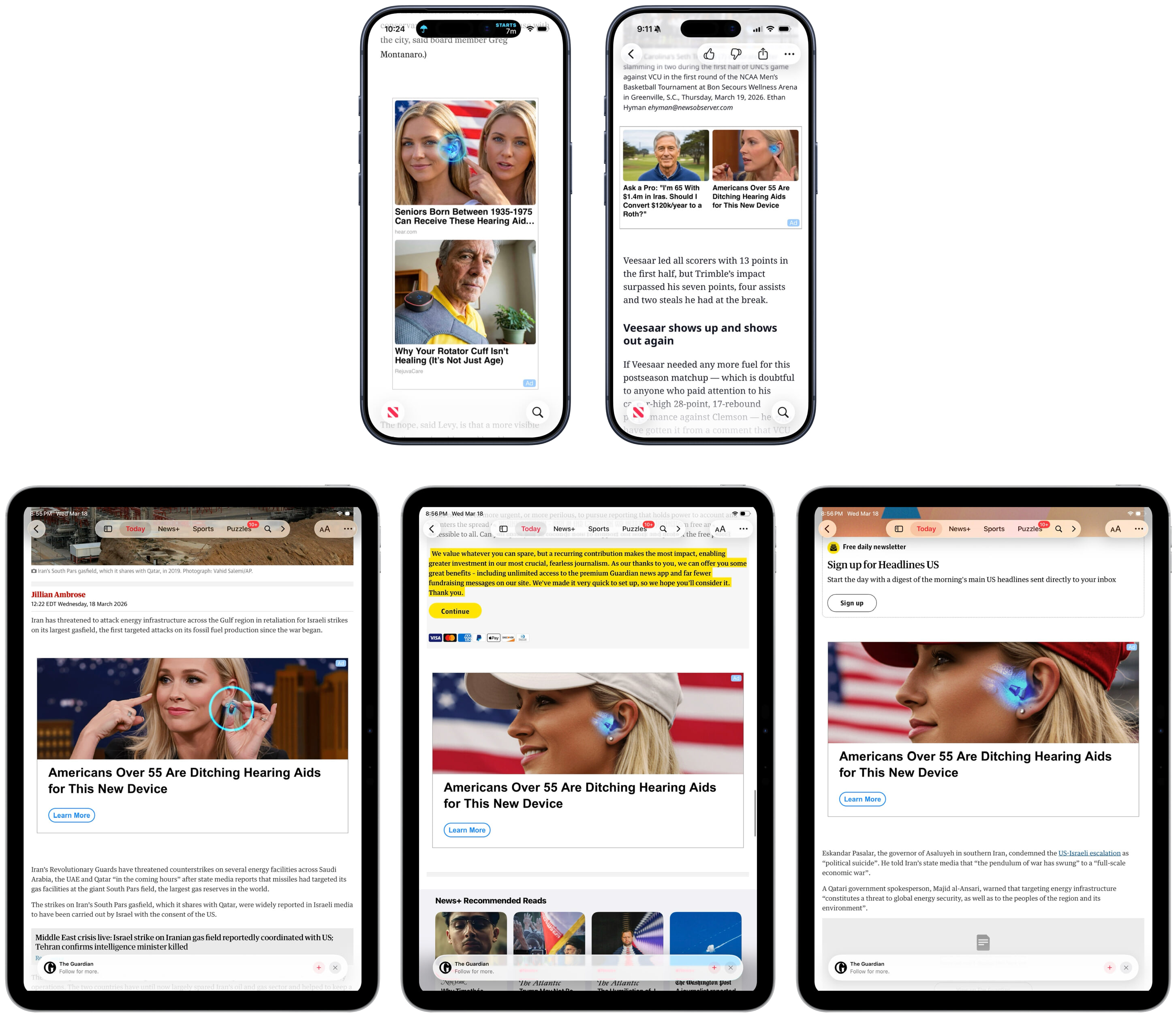
Some of [Cook’s letter] remains true, but has lost some truthiness — and truthiness matters. But some of it is no longer true, period. It’s no longer just “one small part” of Apple’s business that serves advertisers. Here in 2026, search results in the App Store not only show paid ads — frequently for casinos — but the search results are visually dominated by paid ads now that Apple has added a second ad to results. Apple News+ is a paid subscription that offers a genuinely great value for the number of paywalled publishers whose content it includes, but articles on the News app tend to include the weirdest AI-generated ads on the Internet. (How many young blond women am I supposed to believe need hearing aids?) And — at this writing, still “coming soon” — Apple is launching ads on Apple Maps. Apple Maps remains free of charge to use, so according to Tim Cook, we’re not the customer. We’re the product. Or, if you prefer, our frustration is the product.

[…]

The ratio of ads to organic results in App Store search — especially when measured in screen area — is clearly not aligned with Cook’s 2014 statement that “Our software and services are designed to make our devices better. Plain and simple.” Obviously not. App Store search today is designed primarily to generate more revenue for Apple. That’s not criminal, but it’s a change.

[…]

What gave Tim Cook’s privacy letter heft in 2014 wasn’t just the clarity of its plain language, but the fact that you didn’t have to take his word for it that the ads Apple showed you respected your privacy, because Apple didn’t show you ads in 2014. Apple today can’t say that.

[…]

John Ternus should return Apple’s privacy policy to its 2014 clarity. The trust Apple would earn from such a move would far out-value whatever revenue these ads pad to their already hefty and ever-increasing quarterly Services numbers.

I wish that were the case, but I fear this is kind of a Hotelling’s Law situation, where Apple can get most of the benefit by being just slightly better on this axis. Where else do its customers have to go?

Jeff Johnson (Mastodon):

In the second fiscal quarter of 2018, services generated $9 billion in revenue (net sales), whereas in Q2 2026, that amount had grown to $31 billion! In this blog post, I want to focus on understanding the relative financial importance of products and services for Apple.

[…]

In 2025, services were 42% of Apple gross margin. How does 26% of net sales become 42% of gross margin? The explanation is that services have a much lower cost of sales. The products gross margin was 37% of products net sales, while the services gross margin was an astonishing 75% of services net sales. In other words, Apple services are almost pure profit!

Does this 75% account for TV and movie production costs?

With persistent general inflation, consumers do not have unlimited money to spend on Apple products. At least in the near future, it’s reasonable to question how much further room is available for growth in profits from Apple products. To satisfy the demands of investors, Apple executives including CEO-elect John Ternus may be forced to rely even more than before on growth in services, which do not face as much pressure on cost of sales as hardware products.

Previously:

Siri AI Beta

20 July 2026 at 16:27

Federico Viticci (Mastodon):

The AI frontier from the two big labs (and – we have to be honest with the numbers here – probably SpaceXAI and Meta now, too) is in a completely different league at the moment. I spent my first couple of weeks with Siri AI trying to convince myself that I could replace Codex with Siri AI, and that was the wrong approach. There is a potential future in which Siri AI can become a more proactive and capable agent, but that’s not what Apple is shipping this year.

[…]

Siri AI is a dramatically better Siri for typical Siri stuff. The new Siri understands your commands and nuanced requests better because of the LLMs behind it; it can often perform multiple requests in one go (such as setting multiple timers with one command); the new expressive (and customizable!) voices sound great, and they’re terrific at reading and summarizing notifications. Apple’s first advantage compared to other chatbots is right here: only Siri can integrate with the iPhone and iPad to this extent, so even if the Foundation models aren’t as smart as the competition, Siri can do a lot more for most people on their devices because neither OpenAI nor Anthropic have OSes they can control.

[…]

The biggest issue I’ve encountered is the inconsistency of it all. Very often, the new Siri AI still replies with a generic “Uh oh, something went wrong“ error that doesn’t explain what the error was or why it happened. Sometimes, I ask a question via voice, and it errors out, but then a few seconds later, I type the same question in the app, and it’s fine.

[…]

My problem is that, right now with Apple’s own apps, both the index and Siri’s ability to perform actions are very inconsistent. The assistant hallucinates abilities it doesn’t have, and it frequently just doesn’t work.

Dan Moren:

The good news is that Siri AI is capable: impressively so, at times. In the lowest of low bars, it certainly beats the pants off the previous incarnation of Siri, but its access to your own personal data and all of the app on your phone also unlocks a host of new possibilities.

But it’s also not without the pitfalls that underlie all LLM-powered chatbots: errors in understanding, hallucinations, and so on.

[…]

The app itself is pretty barebones, letting you view those conversations in List or Grid layouts, select multiple conversations to delete them, and pin or rename any single conversation. In Settings : Siri, you can choose to either open to the overview or to a new conversation and decide whether old conversations are kept for 30 days, 1 year, or forever. It’s a little strange that one-off queries (“What’s the average height of the Norwegian World Cup team?”) are stored alongside more involved conversations (“Can you help me build a specific RSS feed for this site?”); I also ended up with a few orphan blank “New conversations” which I deleted, but it’d be nice if you could filter to find those. Conversations are fully searchable and sync between devices via iCloud.

John Voorhees:

Despite the current limitations, if you use chatbots as a replacement for Google Search, you’ll probably have a good experience with the new Siri app. That’s because even in these early betas, if you ask Siri something like, “Give me a day trip itinerary for a trip to Chicago this Saturday,” you’re likely to get good but pretty middle-of-the-road recommendations. From there, though, you can drill down with follow-up queries to get something more in line with your tastes. The results include source links you can follow, too. Given the ad-strewn mess that web search has become, using Siri for this sort of thing is a meaningfully better experience.

The one caveat on Siri’s world knowledge is that it’s roughly 2-3 weeks stale in some places.

[…]

A good example is Music. You can prompt Siri to play a song, but most of the rich metadata in the app isn’t exposed to Siri, which is a shame because it is exposed elsewhere, for example to AppleScript.

Previously:

Update (2026-08-04): Benjamin Mayo:

Thanks to the top-to-bottom revamp that is Siri AI, Siri is reliably intelligent. Finally. We are still in the midst of beta season, and Apple is yet to confirm whether Siri AI will formally launch with iOS 27 in September or sometime later in the year, but the feature is up to scratch. There are bugs and glitches and edge-case quirks, but on the whole, it wipes the floor with old Siri and is competent enough to supplant my everyday usage of other chatbots too.

[…]

Siri AI can get a snapshot of what’s on screen, but it cannot control the UI for you autonomously. As such, if you ask it to do something outside of its library of available app actions, it will say it can’t do that. Often, it can quote the relevant steps for you to do it yourself, but obviously that falls short of the ideal experience. This feels a bit lacklustre to people already embracing AI agents en masse. Claude and Codex on Mac do not hit these walls; they are all too keen to move your mouse for you and run terminal commands until the job is done.

Previously:

San Francisco Demands Removal of Nudify Apps

17 July 2026 at 22:16

Matt Burgess (MacRumors, ArsTechnica):

On Thursday, San Francisco city attorney David Chiu sent legal notices to Apple and Google demanding that they remove from their app stores 13 face-swapping apps, which allow users to create AI-generated nonconsensual nude images. The letters say the Silicon Valley giants should stop “aiding and abetting” the sale of explicit deepfake images and “sever” business relationships with the app developers.

[…]

Researchers have repeatedly found and reported apps in Apple’s App Store and Google’s Play Store that allow people to generate sexual images using AI—including some apps being rated as suitable for use by children. While new laws and bans aim to tackle the scourge of explicit deepfakes online, technology and social media companies consistently direct millions of people toward the harmful tech.

Both Apple and Google have developer policies that prohibit pornography, abuse, and harassment on their platforms.

Burgess gives the impression, which is my base assumption, that these 13 apps were clear about what they do, so App Review has no excuse for missing them. But I’m sure it’s keeping us all safe in other regards.

Meanwhile, in a preprint research paper published in May, researchers from Cornell University and Georgetown University identified 420 apps offering general face-swapping capabilities on Google’s and Apple’s app stores. They tested 155 to see if they could be used to create face swaps with nude images; in 70 percent of cases, it was possible, with the apps not including safety measures to prevent this.

Previously:

Update (2026-07-21): Danny Bradbury:

Chiu isn’t arguing that hosting an app automatically makes a platform liable for what it does. Platform operators already won that battle with Section 230 of the Communications Decency Act. That 30-year-old law says websites generally aren’t responsible for content posted by users, allowing platforms to host user-generated content without getting sued every time someone defames someone in a comment thread.

Courts have often extended those protections to cover app stores too. Apple and Google are treated as distributors of whatever a third-party developer uploads, rather than publishers.

Chiu is attempting to sidestep that argument by focusing on the companies’ payment systems, noting that Apple and Google collect a cut of every in-app purchase. According to the Tech Transparency Project (TTP), that means they profit from apps that generate revenue by creating non-consensual intimate imagery.

Apple Intelligence to Launch in China

17 July 2026 at 22:16

Hartley Charlton:

Reuters reports that China’s Cyberspace Administration registered Apple’s on-device generative AI service this week, putting it on a list of newly cleared providers that also includes homegrown systems from Chinese phone makers.

An unnamed source told the outlet that Apple’s AI features in the country will draw on models from both Baidu and Alibaba.

William Gallagher:

China has complex requirements for regulatory approval, and sufficiently so that US firms typically need to involve a local partner.

John Gruber:

This isn’t about Siri AI, announced last month at WWDC for iOS 27 — this is the initial approval for Apple Intelligence, which was announced two years ago and rolled out in iOS 18.

Previously:

Flickr 5.0

15 July 2026 at 19:52

Phil Gyford:

Flickr recently updated their iOS/iPadOS app to version 5 (App Store link) and, while it’s not radically new, for a service whose changes have been incremental over recent years it contains a lot of differences. However I’ve yet to find any official changelog or update information.

[…]

When displaying multiple grouped photos from a person you’re following, it is no longer possible to view all the subsequent ones, other than the three or four initially displayed.

In the list of your Followers’ photos, their name now appears under their photos, so you must scroll down beyond the photos to see who took them.

[…]

When zooming into a photo the app no longer loads a higher resolution version, so now the zoomed-in version will be very pixellated.

He has a long list of missing features that may or may not be coming back. And there’s what seems like a major change: tags can no longer use capital letters.

The main changes I noticed were:

  • In the Home/Discover view, when there’s a large group of new photos, you can only go into the group and view them individually, swiping to see each one. There’s no longer a way to see the whole group at once and scroll through it. (And tapping on the group icon or number of photos doesn’t do anything.)

  • Double-tapping to favorite doesn’t work in some situations.

  • The interface is more busy, showing more interaction chrome like other social media sites, rather than focusing on the photos.

  • Swiping/navigation seems more clear than before, though without the old app side-by-side I can’t be exactly sure what’s changed.

Update (2026-07-16): Wesley Moore:

The Android version has been updated too:

“Flickr is back and better than ever — rebuilt from the ground up with a fresh new look and feel.”

I would guess it’s been built with cross-platform technology as it looks the same and came out the same time as iOS. The performance is terrible on Android. Scrolling my Photostream is juddery on my Pixel 9a (120 Hz display). It’s worse on my Android tablet.

Scrolling between photos swipes the whole UI (not just the photo), there’s also a flash of white loading the new photo. Needs some serious iteration.

See also: Reddit.

Update (2026-07-27): A. Lee Bennett Jr.:

Hooray! #Flickr restored a thumbnail view of all items from a specific post.

It turns out that Flickr 5.0.3 reverts back to the 4.x codebase.

Flickr (Reddit):

We know the new app hasn’t met the bar you expect from Flickr. Since launch, we’ve heard your feedback about bugs, missing features, and rough edges, and we want to acknowledge that directly. Here is where we currently stand:

iOS: We’re in the process of rolling back the iOS app to the previous version while we address these issues. You should see this reflected in the App Store shortly.

Android: The Android app will remain on the updated version. Due to technical limitations and the risks involved in reverting, a rollback isn’t possible on this platform. Instead, expect frequent updates as we fix bugs and restore preexisting features.

Across both platforms, this app refresh represents a significant, long-term investment in the Flickr app. The app was long overdue for an update and getting it right matters to us. Thank you for your patience, and for continuing to share what’s missing and not working. It’s shaping exactly what we address next.

iOS 27 Public Beta

14 July 2026 at 19:27

Juli Clover:

Apple released the iOS 27 public beta today, and if you’ve been curious about the new software, now’s the time to try it out. iOS 27 brings Siri AI, performance improvements, and lots of new Apple Intelligence features.

[…]

Everything feels snappier than it did in iOS 26. Animations are quicker, apps launch faster, and AirDrop transfers complete faster. You’ll see improvements when taking photos, opening the keyboard, using the App Library, and swapping Home Screen pages. Your iMessages between devices sync more accurately, messages won’t fail to send and will be automatically retried, and your iPhone can transition more smoothly between Wi-Fi and cellular.

Dan Moren:

In general, the iOS 27 incarnation of Liquid Glass is far easier on the eyes, dialing down the transparency in favor of legibility. Apple’s also imposed some distinction between user interface elements and content. For example, in list views like in Messages and Mail there are now much clearer “toolbar” areas at the top when you start scrolling, even if they still have some degree of translucency. App icons have also gotten a face lift; they’re sharper, and feel more vibrant.

[…]

That’s because one of the odd things about looking at iOS 27 is that there’s just a ton of small stuff—those “quality of life” improvements that chip away at little frustrations and annoyances.

Previously:

Apple Sues OpenAI Over Trade Secrets

13 July 2026 at 20:02

Sarah Perez (PDF, Hacker News, MacRumors):

The iPhone maker alleges that this misconduct, which it says reveals a pattern of theft from OpenAI employees who previously worked at Apple, was directed by OpenAI’s senior leadership, including Chief Hardware Officer Tang Tan.

The lawsuit, which was filed in the U.S. District Court for the Northern District of California, accuses Tan of using Apple’s confidential project code names during OpenAI’s recruiting process, asking job candidates to bring in Apple hardware components to their interviews, coaching departing Apple employees on how to evade the company’s security procedures, and asking for details about the company’s unannounced products.

Apple’s allegations are detailed and shocking, and it sounds like they have a lot of evidence.

Chance Miller:

The lawsuit names Chang Liu and Tang Tan as two of the defendants. Tang Tan served as VP of product design at Apple, leading iPhone and Apple Watch product design. He departed the company in February 2024 to work with Jony Ive. Chang Liu, meanwhile, worked at Apple for eight years and was a senior system electrical engineer before departing to join OpenAI in January 2026.

Apple’s lawsuit also names OpenAI and io Products as defendants.

OpenAI’s hardware efforts are being led by Jony Ive, Apple’s former chief design officer.

[…]

Ive, Hankey, and Cannon are not personally mentioned anywhere in Apple’s initial filing today.

Emma Roth:

Here are the most surprising claims in Apple’s 41-page filing.

Marcus Mendes (MacRumors):

OpenAI’s Director of Strategic Communications, Drew Pusateri, took to X to comment on the company’s behalf.

In his post, he claims OpenAI has “no interest in other companies’ trade secrets,” adding that OpenAI remains “focused on building innovative technology that empowers people everywhere.”

This seems like a weak response, given that Apple says it reported its findings to OpenAI in February and never heard back. Presumably, they’ve already investigated but see the situation as serious enough that they need to say as little as possible.

It’s not clear to me the extent to which Apple believes the behavior was limited to the named defendants. It’s hard to believe that the rest of OpenAI’s leadership—including Altman and Ive—were unaware, given the scale of their recruiting from Apple. It’s equally hard to believe that they were aware and thought they could get away with it. I guess little from Altman would surprise me at this point. I’d like to believe that Ive wasn’t part of it, but then are we to believe that his former coworkers all kept him in the dark?

Nick Heer:

What is immediately notable about this whole thing is the myriad conflicts of interest. Apple, of course, has a current partnership with OpenAI to power Apple Intelligence features, something repeatedly mentioned on the previous version of its marketing webpage, and conspicuously absent on the current one.

But the history runs far deeper. Among the defendants in the suit is io Products — do not blame me for that capitalization choice — founded by Jony Ive and acquired by OpenAI last May. Total mentions of “Ive” in the body of this lawsuit? Zero. Also, one of the investors in Ive’s company was Emerson Collective, founded by Laurene Powell Jobs, and which now has equity in OpenAI. Neither Emerson nor Powell Jobs are defendants.

M.G. Siegler:

It all reads a bit as if Apple has been building up evidence of these allegations for some time and recently got their smoking gun. It’s not just nebulous “trade secrets” either, there are specific mentions down to “metal finishing techniques” that Apple apparently invented and protected.

It also comes a little less than a month after OpenAI was rumored to be threatening Apple with a lawsuit over the perceived failure of their deal to bake ChatGPT into the iPhone. As I wrote at the time, even just that threat was clearly not going to go over well in Cupertino.

John Gruber (Mastodon):

Footnote 13 on p. 15 states:

Apple and OpenAI have a commercial relationship involving the integration of OpenAI’s ChatGPT into Apple Intelligence. The companies have entered into a written agreement governing that integration. That agreement is not at issue here. OpenAI’s acts of trade secret misappropriation alleged herein do not arise from and have no connection to that agreement.

Be that as it may legally speaking, in practical terms it seems untenable for that Apple Intelligence partnership to continue after this.

Jason Snell:

All that bubbling-under-the-surface tension between Apple and OpenAI is now out in the open!

M.G. Siegler:

Namely, while Apple frames OpenAI – or at least its fledgling hardware division – as “rotten to its core” (interesting terminology!), they really only have a case against two and maybe three individuals. But they also clearly believe that if this case goes to trial, they will have a case against a lot more.

[…]

The parallels to the Anthony Levandowski situation after he left Google for Uber have been drawn.

[…]

It is interesting that Apple is not suing Yu-Ting “Alyssa” Peng, who is named in the suit as a co-conspirator with Liu while she was still employed at Apple, before she also subsequently went to work at OpenAI. Is it possible she’s cooperating or has cooperated with Apple in this investigation?

[…]

Even if these allegations are found to be untrue or embellished, can he reasonably stay at OpenAI now? And perhaps that’s the real outcome Apple is looking for here, as they clearly frame him as the ringleader of the 400-plus people who have come over to OpenAI from Apple.

Hartley Charlton:

OpenAI’s ambitions to build a hardware rival to the iPhone are already running into trouble because of Apple’s trade secret lawsuit, according to Bloomberg’s Mark Gurman, who argues the damage is showing up well before any court ruling.

[…]

The scale of the talent drain is a major part of why this matters to Apple. More than 400 former Apple employees now work at OpenAI, including former Apple design chief Jony Ive, and Gurman says the company poached so heavily from Apple’s iPhone product design group specifically that Apple had to rebuild parts of the team. Apple has responded with bigger retention bonuses and executives personally working to keep engineers from leaving.

Jeff Johnson:

OpenAI stole stuff? I can’t believe it! I thought they were done with stealing after they stole literally everything on the internet.

Colin Cornaby:

I’m sure there’s no problem with sending this company all your source code they pinky swear not to train on.

Steve Troughton-Smith:

I can’t believe this awful company solicited confidential information and stolen trade secrets, hiring from this other company while pretending to partner with them. ‘Rotten to the core’ indeed

😛

He’s referencing Apple doing this to Masimo. And, of course, Steve Jobs himself directed Apple to engage in illegal hiring practices.

Previously:

Update (2026-07-17): See also: Dithering.

Tim Hardwick (FT, Hacker News):

Apple has reportedly sent legal letters to dozens of former Apple employees now working at OpenAI, telling them to preserve potentially relevant documents and communications as it continues to pursue its trade secret lawsuit against the AI company.

Update (2026-08-06): Hartley Charlton (PDF):

OpenAI has asked a federal judge to dismiss Apple’s lawsuit accusing the AI company of stealing trade secrets, calling the allegations “meritless.”

Previously:

Apple Still Designated a Gatekeeper

9 July 2026 at 19:38

Tim Hardwick:

Apple’s challenge against the EU’s designation of its App Stores and iOS platform as “gatekeepers” was dismissed by Europe’s top court on Wednesday, reports Reuters.

[…]

The company also disputed the classification of iMessage as a number-independent interpersonal communications service, or NIICS, which would subject the app to EU telecoms rules. But the General Court said Apple’s actions regarding the iMessage service are inadmissible.

William Gallagher:

Back in 2023, Apple acknowledged that it qualified under the then-new definition of being what the EU called a gatekeeper service. But key to that is the size of the operation, and since 2024, Apple has been claiming it runs five smaller App Stores rather than one large one.

[…]

“Irrespective of the devices in question,” ruled the judges, “those stores have the same purpose, namely to connect app developers with end users in order to facilitate the distribution of software applications.”

Steve Dent:

Apple disagreed with the decision but didn’t say yet if it would appeal. “We firmly believe the DMA’s mandate goes beyond what is lawful and proportionate, threatening to erode decades of privacy and security protections we’ve built and leaving our users vulnerable to new risks,” an Apple spokesperson said in a statement to multiple outlets. “We will continue advocating for the innovation and privacy our European customers deserve.”

Apple still has two cases pending with EU courts. The first is a challenge to the EU Commission’s decision last year forcing Apple to open iOS to third-party developers, and the second is an appeal against the €500 million fine imposed in April last year for anti-steering violations.

Previously:

Weathergraph 1.0.358

9 July 2026 at 19:38

Tomas Kafka:

Pressure is now much easier to read. A new Pro trend strip under the chart shows whether pressure is holding steady, rising, or falling. Fast changes stand out with stronger marks and colour, so you can spot a front moving in sooner - useful for hiking, sailing, flying, fishing, or weather-sensitive heads and joints.

You can now also design the chart more freely with the new theme editor. Mix palette, style, sky detail, and accent colour, or start from a preset, to make Weathergraph fit your style.

This is an example of what it looks like:

Weathergraph: Pressure

Previously:

Castro’s Customer Support Lessons

6 July 2026 at 19:45

Dustin Bluck (archive link, Hacker News):

I had an idea when I bought Castro that human support based around actual user experience was an easy differentiator. I’ve rarely gotten useful answers from support from services I use. I thought if I used my own product every day, read every email and answered it thoughtfully, people would appreciate this, and it would build some degree of loyalty and appreciation.

[…]

However, what I found is this whole thing didn’t work as I thought it would. Sure sometimes we were able to wow customers, particularly when we responded right away with an exact fix for them. But the vast majority of our honest, thoughtful answers were deeply unsatisfactory to users, and it often annoyed them more than anything else.

[…]

Customers email us with confusion about how podcasts work, how the App Store works, how their Mac works, and any number of tangential issues. What tends to happen is the same users do this over and over, and once they find out we answer, the requests get more frequent and more burdensome.

[…]

To the user, any response aside from “Okay, we’re going to build that right now” is meh-to-negative. Various honest responses, such as “I thought about this or tried it in the past and it unfortunately didn’t work very well” are not going to knock their socks off. These just don’t do much in terms of loyalty and rapport.

[…]

Avoiding explanations and specifics tends to get a neutral response and doesn’t suck anyone in or waste too much time. In other words, the best approach for us is what most companies do. Because building loyalty or rapport at the moment something isn’t working and the user is frustrated hasn’t worked. The real positive experience comes when you actually improve the product, so that’s where we’re spending our time.

I have definitely seen all these categories of customer interactions, but I don’t agree with the conclusion. Yes, in the end you want to be improving the product, but I don’t think that’s fully separable from interacting with customers as humans. I’ve found spending time on customer support incredibly valuable for making my products better. Even a lone report of an issue can often lead to a fix and learning something important that has wider implications. It’s also enjoyable and motivational to hear about real people making use of what I’ve built or to turn around someone who started with a negative view. And it seems to help with marketing, too.

I also see a correlation with the apps that I use—the better ones tend to also have good support. That said, I use a podcast app that famously doesn’t offer support. There are different situations, and there’s more than one way to a good product and a successful business.

I do think there’s an art to all this. Not everything can be measured, and there’s more to it than just committing to answering e-mails thoughtfully. You need to set boundaries and steer the interactions to make them productive, efficient, and satisfying for both sides. I’m still learning.

Previously:

Update (2026-07-07): Jeff Johnson:

This is what you get from the free with IAP business model: most of your support emails are from freeloaders!

My apps are upfront paid, thus most of my support emails are from customers. I don’t get overloaded with emails, and paid customers are more incentivized to solve issues with you, because they’ve invested money into the app.

Vitor:

I find myself agreeing with you that customer support is valuable and we should do it. But over the years I have also realised that, in a way, being good at support is punishing. I’ll explain[…]

UK CMA Proposals for External Payments and NFC

3 July 2026 at 19:23

Ben Lovejoy:

The EU required Apple to permit third-party app stores, while a US court ruled that developers have the right to direct iPhone users to third-party payment platforms for app purchases and subscriptions. Britain’s Competition and Markets Authority (CMA) is now proposing to apply this latter rule in the UK.

Tim Hardwick (John Gruber):

The U.K.’s competition regulator has proposed letting app developers direct users to payment options outside Apple’s App Store and Google’s Play Store, in a move aimed at increasing competition and reducing the fees charged by the two companies.

[…]

The regulator said any fees Apple and Google charge developers for enabling such “steering” must be fair and reasonable, remain below existing App Store and Play Store commissions, and allow developers to either pass savings on to consumers or reinvest them in innovation.

John Gruber (Mastodon):

Requiring Apple to allow apps to steer users to the web to make payments is, I’ve long argued, sensible regulation. I’ve also long argued that Apple has been obstinate in disallowing it. If in-app payments — through Apple’s system — can’t compete with out-of-app payments on the web, something is wrong with IAP. But it’s wrong to assume that payments outside IAP will result in lower prices and better policies for users.

Nick Heer:

They may increase prices when costs grow but that does not mean they do the opposite. But who cares? Lower costs permit more flexibility on pricing and, even if that money ends up in the pockets of developers instead of Apple, is that supposed to be a bad thing? Is there a reason why someone should be upset that they might pay the same amount but an indie developer gets to keep more of it?

The proposed policies are pretty straightforward from what I can see. Among other obligations, Apple is not allowed to use or require scare tactics when users are routed to an external payment mechanism and, while it is allowed to charge a steering fee, it is not allowed to count services not used by developers offering third-payments nor double-count for services already accounted for by other developer fees. Also, the CMA calls bullshit on Apple’s claim that third-party payments are particularly risky[…]

Previously:

Update (2026-07-30): Juli Clover:

Apple said new UK App Store rules would give regulators a “highly intrusive” role dictating how it runs its business, reports Reuters. Apple submitted feedback to the UK’s Competition and Markets Authority as it considers forcing Apple to change its App Store rules around steering.

[…]

UK regulators said Apple can charge developers a fee, but it must be fair and reasonable, and below existing App Store commissions, so developers can pass savings to customers or reinvest them in innovation.

According to Apple, the CMA’s proposed rules would undermine innovation and investment, and would amount to price regulation because of the restriction on fees.

❌