❌

Normal view

Apple Services Price Hikes 2026

21 July 2026 at 21:27

Chance Miller:

Here are the new monthly prices for Apple Music and Apple One as of today:

Apple Music

Apple One

The price increases for Apple Music come after Spotify announced its own round of price hikes earlier this year, which Apple poked fun at on social media. Even with today’s price hikes, though, Apple Music remains cheaper than Spotify.

Lee Peterson:

Apple Music no longer makes sense when I’m already paying for YouTube Premium. Apple Music goes up to £11.99, YouTube Premium is £12.99 and on top of a good music service you get no ads on YouTube.

Mike Rockwell:

Distilling my longtime argument down to its simplest bit, I’d ask “do you want to pay $10 a month for music for the rest of your life?”

But truly, it was never going to just be $10 per month. The price was going to go up over time. It was going to get more expensive to have access to the same music.

If you purchase your music, though, I think most people would reach a point in their life where they stop buying new music entirely or they’re only buying a few albums per year. The cost of music would go down for you over time.

That was my thinking, too, but then I found that music I’ve purchased from Apple won’t work on my HomePod. I refuse to condone that behavior, so now I have two solid reasons not to subscribe to Apple Music.

Joe Rossignol:

While the monthly and annual prices of AppleCare+ plans for Macs and iPads received a slight increase this week, AppleCare One continues to start at $19.99 per month in the U.S., making the multi-device plan even more valuable.

Previously:

Apple Financial Statements: Products vs. Services

21 July 2026 at 21:27

John Gruber (Mastodon, 2):

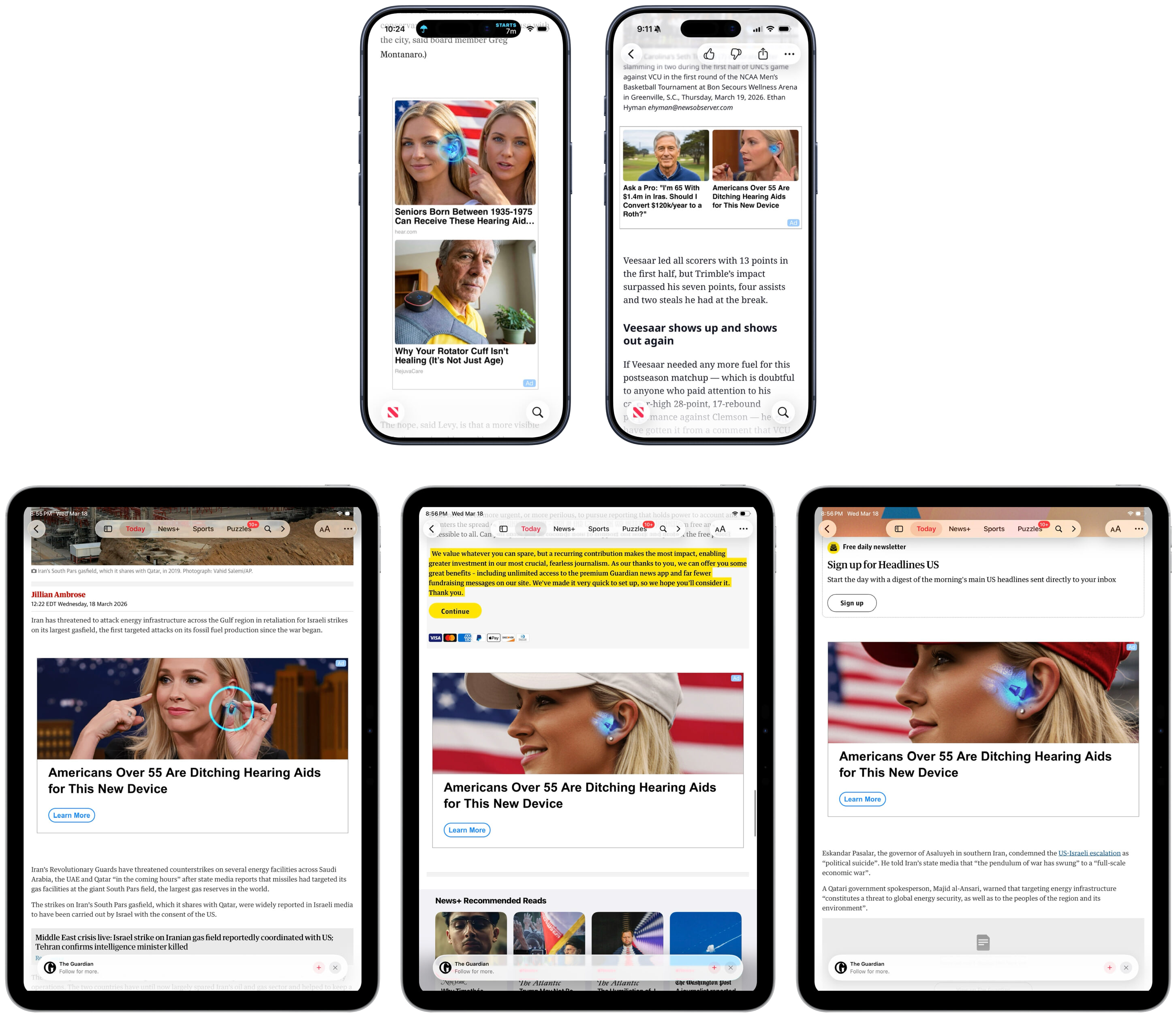
Some of [Cook’s letter] remains true, but has lost some truthiness — and truthiness matters. But some of it is no longer true, period. It’s no longer just “one small part” of Apple’s business that serves advertisers. Here in 2026, search results in the App Store not only show paid ads — frequently for casinos — but the search results are visually dominated by paid ads now that Apple has added a second ad to results. Apple News+ is a paid subscription that offers a genuinely great value for the number of paywalled publishers whose content it includes, but articles on the News app tend to include the weirdest AI-generated ads on the Internet. (How many young blond women am I supposed to believe need hearing aids?) And — at this writing, still “coming soon” — Apple is launching ads on Apple Maps. Apple Maps remains free of charge to use, so according to Tim Cook, we’re not the customer. We’re the product. Or, if you prefer, our frustration is the product.

[…]

The ratio of ads to organic results in App Store search — especially when measured in screen area — is clearly not aligned with Cook’s 2014 statement that “Our software and services are designed to make our devices better. Plain and simple.” Obviously not. App Store search today is designed primarily to generate more revenue for Apple. That’s not criminal, but it’s a change.

[…]

What gave Tim Cook’s privacy letter heft in 2014 wasn’t just the clarity of its plain language, but the fact that you didn’t have to take his word for it that the ads Apple showed you respected your privacy, because Apple didn’t show you ads in 2014. Apple today can’t say that.

[…]

John Ternus should return Apple’s privacy policy to its 2014 clarity. The trust Apple would earn from such a move would far out-value whatever revenue these ads pad to their already hefty and ever-increasing quarterly Services numbers.

I wish that were the case, but I fear this is kind of a Hotelling’s Law situation, where Apple can get most of the benefit by being just slightly better on this axis. Where else do its customers have to go?

Jeff Johnson (Mastodon):

In the second fiscal quarter of 2018, services generated $9 billion in revenue (net sales), whereas in Q2 2026, that amount had grown to $31 billion! In this blog post, I want to focus on understanding the relative financial importance of products and services for Apple.

[…]

In 2025, services were 42% of Apple gross margin. How does 26% of net sales become 42% of gross margin? The explanation is that services have a much lower cost of sales. The products gross margin was 37% of products net sales, while the services gross margin was an astonishing 75% of services net sales. In other words, Apple services are almost pure profit!

Does this 75% account for TV and movie production costs?

With persistent general inflation, consumers do not have unlimited money to spend on Apple products. At least in the near future, it’s reasonable to question how much further room is available for growth in profits from Apple products. To satisfy the demands of investors, Apple executives including CEO-elect John Ternus may be forced to rely even more than before on growth in services, which do not face as much pressure on cost of sales as hardware products.

Previously:

Licensing a Mac App With RevenueCat

20 July 2026 at 16:28

Jared Sorge:

I know there are options out there like Paddle, FastSpring, and Lemon Squeezy that have worked for many apps like mine over the years. But I also wanted something simple for my users. Not to mention Apple Pay was a must-have.

I believe all the services he mentions do support Apple Pay.

  • RevenueCat serves as the source of truth for whether or not a customer is licensed.

  • I create RevenueCat customer IDs from local iCloud identifiers (more specifically, calling userRecordID() on my CKContainer in CloudKit).

  • When the user makes a purchase, they earn an entitlement that I look for in Arborist to grant them a license.

He doesn’t need to run his own server, and the purchases are automatically tied to the user’s iCloud account, so there are no e-mails or serial numbers to deal with. On the other hand, well, it’s all dependent on the Apple Account.

The app, which helps manage Git worktrees, is shipping now.

Previously:

Apple Sues OpenAI Over Trade Secrets

13 July 2026 at 20:02

Sarah Perez (PDF, Hacker News, MacRumors):

The iPhone maker alleges that this misconduct, which it says reveals a pattern of theft from OpenAI employees who previously worked at Apple, was directed by OpenAI’s senior leadership, including Chief Hardware Officer Tang Tan.

The lawsuit, which was filed in the U.S. District Court for the Northern District of California, accuses Tan of using Apple’s confidential project code names during OpenAI’s recruiting process, asking job candidates to bring in Apple hardware components to their interviews, coaching departing Apple employees on how to evade the company’s security procedures, and asking for details about the company’s unannounced products.

Apple’s allegations are detailed and shocking, and it sounds like they have a lot of evidence.

Chance Miller:

The lawsuit names Chang Liu and Tang Tan as two of the defendants. Tang Tan served as VP of product design at Apple, leading iPhone and Apple Watch product design. He departed the company in February 2024 to work with Jony Ive. Chang Liu, meanwhile, worked at Apple for eight years and was a senior system electrical engineer before departing to join OpenAI in January 2026.

Apple’s lawsuit also names OpenAI and io Products as defendants.

OpenAI’s hardware efforts are being led by Jony Ive, Apple’s former chief design officer.

[…]

Ive, Hankey, and Cannon are not personally mentioned anywhere in Apple’s initial filing today.

Emma Roth:

Here are the most surprising claims in Apple’s 41-page filing.

Marcus Mendes (MacRumors):

OpenAI’s Director of Strategic Communications, Drew Pusateri, took to X to comment on the company’s behalf.

In his post, he claims OpenAI has “no interest in other companies’ trade secrets,” adding that OpenAI remains “focused on building innovative technology that empowers people everywhere.”

This seems like a weak response, given that Apple says it reported its findings to OpenAI in February and never heard back. Presumably, they’ve already investigated but see the situation as serious enough that they need to say as little as possible.

It’s not clear to me the extent to which Apple believes the behavior was limited to the named defendants. It’s hard to believe that the rest of OpenAI’s leadership—including Altman and Ive—were unaware, given the scale of their recruiting from Apple. It’s equally hard to believe that they were aware and thought they could get away with it. I guess little from Altman would surprise me at this point. I’d like to believe that Ive wasn’t part of it, but then are we to believe that his former coworkers all kept him in the dark?

Nick Heer:

What is immediately notable about this whole thing is the myriad conflicts of interest. Apple, of course, has a current partnership with OpenAI to power Apple Intelligence features, something repeatedly mentioned on the previous version of its marketing webpage, and conspicuously absent on the current one.

But the history runs far deeper. Among the defendants in the suit is io Products — do not blame me for that capitalization choice — founded by Jony Ive and acquired by OpenAI last May. Total mentions of “Ive” in the body of this lawsuit? Zero. Also, one of the investors in Ive’s company was Emerson Collective, founded by Laurene Powell Jobs, and which now has equity in OpenAI. Neither Emerson nor Powell Jobs are defendants.

M.G. Siegler:

It all reads a bit as if Apple has been building up evidence of these allegations for some time and recently got their smoking gun. It’s not just nebulous “trade secrets” either, there are specific mentions down to “metal finishing techniques” that Apple apparently invented and protected.

It also comes a little less than a month after OpenAI was rumored to be threatening Apple with a lawsuit over the perceived failure of their deal to bake ChatGPT into the iPhone. As I wrote at the time, even just that threat was clearly not going to go over well in Cupertino.

John Gruber (Mastodon):

Footnote 13 on p. 15 states:

Apple and OpenAI have a commercial relationship involving the integration of OpenAI’s ChatGPT into Apple Intelligence. The companies have entered into a written agreement governing that integration. That agreement is not at issue here. OpenAI’s acts of trade secret misappropriation alleged herein do not arise from and have no connection to that agreement.

Be that as it may legally speaking, in practical terms it seems untenable for that Apple Intelligence partnership to continue after this.

Jason Snell:

All that bubbling-under-the-surface tension between Apple and OpenAI is now out in the open!

M.G. Siegler:

Namely, while Apple frames OpenAI – or at least its fledgling hardware division – as “rotten to its core” (interesting terminology!), they really only have a case against two and maybe three individuals. But they also clearly believe that if this case goes to trial, they will have a case against a lot more.

[…]

The parallels to the Anthony Levandowski situation after he left Google for Uber have been drawn.

[…]

It is interesting that Apple is not suing Yu-Ting “Alyssa” Peng, who is named in the suit as a co-conspirator with Liu while she was still employed at Apple, before she also subsequently went to work at OpenAI. Is it possible she’s cooperating or has cooperated with Apple in this investigation?

[…]

Even if these allegations are found to be untrue or embellished, can he reasonably stay at OpenAI now? And perhaps that’s the real outcome Apple is looking for here, as they clearly frame him as the ringleader of the 400-plus people who have come over to OpenAI from Apple.

Hartley Charlton:

OpenAI’s ambitions to build a hardware rival to the iPhone are already running into trouble because of Apple’s trade secret lawsuit, according to Bloomberg’s Mark Gurman, who argues the damage is showing up well before any court ruling.

[…]

The scale of the talent drain is a major part of why this matters to Apple. More than 400 former Apple employees now work at OpenAI, including former Apple design chief Jony Ive, and Gurman says the company poached so heavily from Apple’s iPhone product design group specifically that Apple had to rebuild parts of the team. Apple has responded with bigger retention bonuses and executives personally working to keep engineers from leaving.

Jeff Johnson:

OpenAI stole stuff? I can’t believe it! I thought they were done with stealing after they stole literally everything on the internet.

Colin Cornaby:

I’m sure there’s no problem with sending this company all your source code they pinky swear not to train on.

Steve Troughton-Smith:

I can’t believe this awful company solicited confidential information and stolen trade secrets, hiring from this other company while pretending to partner with them. ‘Rotten to the core’ indeed

😛

He’s referencing Apple doing this to Masimo. And, of course, Steve Jobs himself directed Apple to engage in illegal hiring practices.

Previously:

Update (2026-07-17): See also: Dithering.

Tim Hardwick (FT, Hacker News):

Apple has reportedly sent legal letters to dozens of former Apple employees now working at OpenAI, telling them to preserve potentially relevant documents and communications as it continues to pursue its trade secret lawsuit against the AI company.

Update (2026-08-06): Hartley Charlton (PDF):

OpenAI has asked a federal judge to dismiss Apple’s lawsuit accusing the AI company of stealing trade secrets, calling the allegations “meritless.”

Previously:

Castro’s Customer Support Lessons

6 July 2026 at 19:45

Dustin Bluck (archive link, Hacker News):

I had an idea when I bought Castro that human support based around actual user experience was an easy differentiator. I’ve rarely gotten useful answers from support from services I use. I thought if I used my own product every day, read every email and answered it thoughtfully, people would appreciate this, and it would build some degree of loyalty and appreciation.

[…]

However, what I found is this whole thing didn’t work as I thought it would. Sure sometimes we were able to wow customers, particularly when we responded right away with an exact fix for them. But the vast majority of our honest, thoughtful answers were deeply unsatisfactory to users, and it often annoyed them more than anything else.

[…]

Customers email us with confusion about how podcasts work, how the App Store works, how their Mac works, and any number of tangential issues. What tends to happen is the same users do this over and over, and once they find out we answer, the requests get more frequent and more burdensome.

[…]

To the user, any response aside from “Okay, we’re going to build that right now” is meh-to-negative. Various honest responses, such as “I thought about this or tried it in the past and it unfortunately didn’t work very well” are not going to knock their socks off. These just don’t do much in terms of loyalty and rapport.

[…]

Avoiding explanations and specifics tends to get a neutral response and doesn’t suck anyone in or waste too much time. In other words, the best approach for us is what most companies do. Because building loyalty or rapport at the moment something isn’t working and the user is frustrated hasn’t worked. The real positive experience comes when you actually improve the product, so that’s where we’re spending our time.

I have definitely seen all these categories of customer interactions, but I don’t agree with the conclusion. Yes, in the end you want to be improving the product, but I don’t think that’s fully separable from interacting with customers as humans. I’ve found spending time on customer support incredibly valuable for making my products better. Even a lone report of an issue can often lead to a fix and learning something important that has wider implications. It’s also enjoyable and motivational to hear about real people making use of what I’ve built or to turn around someone who started with a negative view. And it seems to help with marketing, too.

I also see a correlation with the apps that I use—the better ones tend to also have good support. That said, I use a podcast app that famously doesn’t offer support. There are different situations, and there’s more than one way to a good product and a successful business.

I do think there’s an art to all this. Not everything can be measured, and there’s more to it than just committing to answering e-mails thoughtfully. You need to set boundaries and steer the interactions to make them productive, efficient, and satisfying for both sides. I’m still learning.

Previously:

Update (2026-07-07): Jeff Johnson:

This is what you get from the free with IAP business model: most of your support emails are from freeloaders!

My apps are upfront paid, thus most of my support emails are from customers. I don’t get overloaded with emails, and paid customers are more incentivized to solve issues with you, because they’ve invested money into the app.

Vitor:

I find myself agreeing with you that customer support is valuable and we should do it. But over the years I have also realised that, in a way, being good at support is punishing. I’ll explain[…]

App Store Complaint From Chinese Developers

30 June 2026 at 20:48

Hartley Charlton:

A group of 48 China-based iOS developers have filed an antitrust complaint against Apple with the country’s market regulator over the App Store’s commission rates, the South China Morning Post reports.

The developers sent an open letter to China’s State Administration for Market Regulation (SAMR), alleging that Apple failed to deliver on a promise to offer the lowest commission rate to the Chinese market. The group asked the SAMR to investigate and penalize Apple for allegedly abusing its market dominance to impose “unfair and excessively high” costs on local developers.

Apple lowered the fees in March but not as much as it did in Brazil and Japan.

Previously:

Boom Mobile Restructuring

26 June 2026 at 18:23

Our phones stopped working this morning, or perhaps last night, but everything looked fine on Boom’s Web site. I contacted their support, and as always they got back right away, but this time with bad news:

I’m deeply sorry to share that after careful consideration, we’ve made the very difficult decision to restructure through Chapter 11 bankruptcy. If this isn’t successful, then we will discontinue Boom! Mobile service. I know this is upsetting, and I want to personally thank you for trusting us. We’re committed to making your transition to another provider if you choose to do so.

So now I’m looking for another Verizon MVNO. The options and pricing seem to have changed a lot since the last time I was picking a plan. Some possibilities: US Mobile, Visible, RedPocket, Tello, Boost Mobile, and Total Wireless.

See also: Reddit.

Update (2026-06-29): I ended up going with US Mobile. I like that they offer smaller plans without unlimited data and that you can add extra lines sharing the same bucket of data for only $8. So far, so good. It was an easy switch—even for Visual Voicemail, which has given me trouble in the past. Their Web site works much better than Boom’s, which used to be good but had gotten unreliable in recent years.

Update (2026-07-17): Mike Rockwell switched to US Mobile, too.

Qualcomm Acquiring Modular

26 June 2026 at 18:21

Chris Lattner:

I’m excited to share that Qualcomm is acquiring Modular: this will accelerate our path to unifying accelerated compute with an open platform. This will also mark a new era in open software development for Qualcomm.

[…]

This will accelerate our progress and path, and their vision is expansive: [spanning] edge to cloud, CPU, GPU, NPU, and custom ASICs and perhaps more.

Modular (Hacker News):

As AI scales, efficiency, not capability, becomes a constraint. Performance-per-watt drives the cost of inference, and cost determines what scales. Meeting this demand requires more than hardware. Developers need software that connects system-level optimization with heterogeneous, disaggregated compute, turning silicon performance into reliable and efficient AI services across accelerators, environments, and use cases.

Previously:

Apple Hardware Price Hikes

25 June 2026 at 18:27

Osmond Chia (Hacker News, 9To5Mac, Engadget):

Apple plans to raise the prices of its products as the cost of the memory chips it uses has surged, the technology giant’s boss has said.

Tim Cook, Apple’s outgoing chief executive, told the Wall Street Journal (WSJ) that price increases were “unavoidable” as the situation around memory chips had become “unsustainable”.

Nick Heer:

During its holiday quarter, Apple’s profit margin on hardware was 40.7%; in its most recent quarter, that dropped to 38.7% — a remarkable figure for physical products. It is these high margins that led to analysts like Ming-Chi Kuo to claim Apple would keep prices more-or-less stable and offset the additional costs through its even higher-margin — 76.7% — services business.

Adam Engst:

Winkler suggests in his summary that Apple has absorbed the cost increases so far because it has always treated memory and storage upgrades as profit centers. That’s no surprise to the Apple community, which has long chafed at Apple’s premium prices for memory and storage. But now, for instance, the price of standalone internal flash storage is closer to and sometimes even higher than Apple’s upgrade prices.

[…]

Obviously, Apple could absorb such costs and more if it were to accept dramatically lower gross margins. But as high-minded and customer-focused as Apple is, the company is still in business to maximize profit.

I was recently looking to add another SSD and a few hard drives to my setup. Normally, prices go down over time, but currently it SSDs are about double the price I paid last year, and large hard drives are almost triple.

John Gruber (Hacker News):

Apple, to my recollection, has never before issued a warning about price increases. Keep in mind that Apple deals with prices in a very different way from its competitors. For Apple, prices are part of a product’s brand, so they don’t fluctuate with component costs.

Chance Miller (Hacker News, MacRumors, Mac Power Users):

Apple has raised prices across the board for many of its products today. MacBook Neo now starts at $699 (up from $599), while MacBook Air now starts at $1299 (up from $1099). Other impacted products include MacBook Pro, iPad, iPad Air, and many more. iPhone, Apple Watch, and AirPods pricing is unchanged.

Ben Lovejoy:

Earlier this week, I outlined three reasons for agreeing with Mark Gurman that the Apple price increases could be imminent, and that indeed proved to be the case.

iPhones have escaped the increases, but they are otherwise both broad-reaching and pretty dramatic. But perhaps the most surprising thing is that the MacBook Neo has been included …

Tim Hardwick:

Apple today increased the starting price of the Mac mini with M4 Pro chip by $200, taking the higher-tier model up to $1,599 on its online store.

[…]

Apple had already raised the Mac mini’s effective starting price in May by discontinuing the $599 configuration with 16GB of RAM and a 256GB SSD, leaving the $799 model with a 512GB SSD as the new entry-level option. Interestingly, the 16GB RAM / 256GB storage option has now been reinstated, but the $799 starting price remains.

Stephen Hackett has a table of the old and new prices.

Nick Heer:

Pre-announce it with a small delay, thus giving you a temporary sales boost as people scramble to get their orders in at current prices, and to soften the blow when the increases hit.

Matt Birchler:

I also can’t help but see that “we need to begin raising prices on a number of products, including today’s increases for iPad and Mac,” statement as implying more increases are coming. The iPhone price increase seems inevitable, and my money is on it starting with the new models in September.

Simon Sharwood:

Micron CEO, president and chairman Sanjay Mehrotra explained the SCAs in prepared remarks delivered during the company’s Q3 earnings call. He explained that Micron has signed 16 SCAs, most of them covering 2026 to 2030, and that they involve a commitment to buy a certain quantity of product and pay for it in a pricing band that has a floor and a ceiling price. The floor price covers the historically high gross margins mentioned above, and the ceiling price means those who commit to an SCA are insulated if memory prices go even higher.

Previously:

Update (2026-06-26): Hartley Charlton:

Micron’s chief business officer has hinted, without calling it out by name, that Apple’s tough supplier negotiations contributed to the conditions behind the global memory shortage.

M.G. Siegler:

For years, Apple has been able to dominate and dictate to their suppliers thanks to their scale. But the Asian operations which Tim Cook so famously set up, have been upended, like most everything else, by AI. From TSMC on down, Apple is no longer the customer dictating terms for the entire industry, it’s now the company which has taken over the mantle as the most valuable one in the world: NVIDIA.

Joe Rossignol:

Apple’s stock price dropped 6% on the day — its largest single-day loss since April 2025.

John Gruber:

Here’s a table with most of the base models whose prices increased[…]

[…]

iPad prices mostly went up 20–25%, but the hardest hit was the no-adjective base model, which rose almost 30%, from $350 to $450. That’s a big increase for a product meant to appeal to buyers for whom price is obviously their biggest concern.

John Gruber:

Anyone who purchased a MacBook Neo for $600 (or $500 with education discount) between March and this morning purchased the lowest-price MacBook Apple has ever sold — and perhaps the lowest-price MacBook they ever will sell.

Joe Rossignol:

Apple’s full statement:

The consumer electronics industry is facing an unprecedented challenge. The rapid expansion of AI data centers has created an extraordinary surge in demand for memory and storage. We have never seen a component price increase this much, this quickly. We have shielded our customers from these increases so far, but we have now reached a point where we need to begin raising prices on a number of products, including today’s increases for iPad and Mac. We know this is not welcome news, and we are working tirelessly to find solutions.

[…]

Apple indicating that it needs to “begin” raising prices suggests that additional price increases might occur later.

Jason Martin:

“and we are working tirelessly to find solutions.”

I find this to be the most confusing part. Do we believe this to be a genuine effort? Even if so, how would a “solution” actually work? Would they actually lower prices if a solution were to be found?

They also just said they “will continue working” on bringing Siri AI to the EU right before saying in a different venue that they’d stopped working on it.

Jeff Johnson:

In a statement about the price increases, Apple said, “We can no longer shield customers from our 39% gross margin.”

Christina Warren:

Like, truly laughable. $200 for a 64GB Apple TV 4K that is almost 4 years old?

John Gruber (Mastodon):

But even setting aside the prices of competing devices, it just feels wrong to hike prices this much for four-year-old hardware running five-year-old pre-AI silicon. The higher-end model’s price went up 67 percent!

The only way this makes sense is if these prices are really meant for the upcoming new hardware, and those new models are more ambitious home hubs that warrant $200–250 prices.

Previously:

Update (2026-06-29): Zac Hall:

The Financial Times reports that Apple is seeking clearance from the Trump administration to purchase memory chips from a blacklisted Chinese company. The move would help it meet demand for product manufacturing during the ongoing global memory supply shortage.

Perhaps this is the “working tirelessly” that Apple was referring to.

Ben Lovejoy:

Apple previously sought permission from the Biden administration to do the same thing back in 2022, and that did not go well – despite promising to use the chips only for iPhones sold in China …

John Gruber:

Something happens — outside the company’s control — that causes those essential components to rise in price significantly.

[…]

What you cannot do is hold a philosophically consistent logically coherent view where your answer to how a company should respond in such a scenario is contingent on what the “something happens” is that caused component prices to rise.

Maybe—but that’s only relevant if you accept the premise that it was out of Apple’s control. I don’t know the details of the deals, but there’s an argument that the rising costs to Apple are to some extent Apple’s “fault.” If Tim Cook gets credit for helping suppliers expand capacity and locking in contracts for memory at low prices over the past two decades, doesn’t the same logic apply in reverse? The AI-driven shortages were foreseeable—and publicly discussed years ago. If you believe Micron that Apple chose to prioritize its own past numbers rather than securing its future supply, doesn’t that make today’s situation different from, say, a tsunami that unexpectedly wiped out a bunch of factories? I don’t know exactly how the increased costs should be apportioned, but I think the reasons for the costs are relevant, and I don’t think they’re fully exogenous.

sid:

If Apple has the balls to raise the prices of their products, they should also have the balls to increase trade-in values for older devices.

Update (2026-06-30): Kif Leswing:

But while tech giants like Apple and Microsoft, which both announced price hikes this week, have a hefty cash cushion, supply chain leverage and customers numbering in the millions or billions, a much wider swath of businesses face potentially dire straits. Most consumer electronics companies have little margin to spare and can’t confidently raise prices in an economy already grappling with inflationary pressures.

GoPro, the struggling maker of action cameras, warned this month that it might go out of business after memory costs shot up between 80% and 115% at the end of the first quarter. And shares of speaker maker Sonos are down 23% this year as memory prices pressure margins.

Update (2026-07-06): Basic Apple Guy:

Below you’ll find a bunch of charts chronicling the current state of RAMmaggedon, the global memory-chip crisis we currently find ourselves in.

Update (2026-07-22): Tim Hardwick:

Apple’s principal chipmaker TSMC plans to raise prices by as much as 10 percent starting in 2027, according to a new report from Nikkei Asia.

SpaceX Acquires xAI, Goes Public, Acquires Cursor

16 June 2026 at 20:37

Elon Musk (February, Hacker News):

SpaceX has acquired xAI to form the most ambitious, vertically-integrated innovation engine on (and off) Earth, with AI, rockets, space-based internet, direct-to-mobile device communications and the world’s foremost real-time information and free speech platform.

[…]

Current advances in AI are dependent on large terrestrial data centers, which require immense amounts of power and cooling. Global electricity demand for AI simply cannot be met with terrestrial solutions, even in the near term, without imposing hardship on communities and the environment.

In the long term, space-based AI is obviously the only way to scale.

There are potential environmental and energy benefits to putting data centers in space, and Blue Origin’s Bezos also thinks this makes sense, but many are convinced that the numbers just don’t work (Reddit).

Kirsten Korosec and Russell Brandom:

But in its 24-year history, nothing quite compared to its initial public offering. Everyone seemed interested — perhaps because of the sheer size of the IPO. The company priced its 555.6 million shares at $135 each to raise $75 billion, making it the largest IPO in history and turning Musk into the world’s first trillionaire. That total raised figure would end up ballooning to $85.7 billion raised.

[…]

SpaceX shares opened June 12 at $150 on the Nasdaq public exchange, an 11% pop for the most anticipated debut in history. And it has continued to rise. The shares kept rising too. In midday trading, SpaceX shares soared 30%. SpaceX shares closed at $160.95, up 19%.

Sean O’Kane:

SpaceX passed Amazon to become the fifth-most valuable company in the world, after its stock price climbed 20% on Monday and more than 8% in early trading Tuesday, pushing its valuation past $2.7 trillion.

Reuters (Hacker News):

SpaceX is buying the startup behind the popular AI coding agent Cursor, Anysphere, for $60 billion in an all-stock deal to boost its presence in the lucrative enterprise AI tools market.

Previously:

Bank of England to stop accepting bonds linked to coal for key loans

Campaigners hope move will force commercial banks to rethink holding assets linked to the fossil fuel

Climate campaigners have declared a victory after the Bank of England said it would no longer accept bonds linked to one of the most polluting industries on the planet for key loan arrangements.

The ban, which comes into force in October, marks a fresh crackdown on thermal coal, which is burned in power plants to create electricity, and has long been a target of green policy activists.

Continue reading...

© Photograph: Bloomberg/Getty Images

© Photograph: Bloomberg/Getty Images

© Photograph: Bloomberg/Getty Images

Burnham risks Labour backlash if he reverses ban on new oil and gas drilling

18 July 2026 at 17:26

Party manifesto pledged to honour existing North Sea exploration licences but not issue new ones

Andy Burnham risks his first confrontation with Labour MPs if he announces new oil and gas drilling licences when he becomes prime minister, insiders have warned.

Speculation is rife that Burnham will unveil fresh plans for drilling in the North Sea after he is installed in Downing Street.

Continue reading...

© Photograph: Jack Taylor/Reuters

© Photograph: Jack Taylor/Reuters

© Photograph: Jack Taylor/Reuters

Goooool v goal: English speakers flock to Telemundo for lively World Cup coverage

The Spanish-language broadcaster has won over millions of US viewers with its energetic commentary during games

Soccer fans looking to watch the 2026 World Cup on US television have been presented with two very different options this tournament.

The first is Fox Sports, a cousin of Fox News owned by the same parent company and the sole network airing matches in English in the US. Audiences tuning in to Fox, which acquired the exclusive English broadcast rights in 2015, are met with coverage that reflects the network’s “America first” aesthetic, with promos for pro-Donald Trump talkshows, advertising breaks during games and the frequent, grating presence of host Alexi Lalas.

Continue reading...

© Photograph: Sarah Yenesel/EPA

© Photograph: Sarah Yenesel/EPA

© Photograph: Sarah Yenesel/EPA

Apple dethrones Nvidia to regain title of world’s most valuable company

17 July 2026 at 16:01

Shift in pecking order illustrates that investors are reassessing outlook for artificial intelligence

Apple overtook Nvidia on Friday to become the world’s most valuable company, reshuffling the top ranks of tech heavyweights as investors reassess the outlook for artificial intelligence.

Apple was last valued at $4.88tn as ⁠its shares held steady, while Nvidia ⁠was roughly at $4.86tn, ​after a 3.5% decline.

Continue reading...

© Photograph: Michael M Santiago/Getty Images

© Photograph: Michael M Santiago/Getty Images

© Photograph: Michael M Santiago/Getty Images

❌