❌

Normal view

VOOPOO Vinci S vs Vinci E80 Pod Vape Review: Which Vinci Pod Kit Is Better?

22 July 2026 at 12:56

VOOPOO continues to expand its popular Vinci series with two impressive devices: the VOOPOO Vinci S and VOOPOO Vinci E80. Both models focus on portability, flavor performance, and easy operation, but they target different types of vapers.

The Vinci S is designed as a simple, lightweight 40W pod device with long battery life and beginner-friendly operation, while the Vinci E80 is a more powerful pod mod featuring an 80W output, larger battery, display screen, and broader vaping flexibility.

In this detailed comparison, we will look at their design, battery performance, pods, flavor, airflow, power output, and overall vaping experience to help you choose the right Vinci device.

VOOPOO Vinci S vs Vinci E80 Specifications

Feature VOOPOO Vinci S VOOPOO Vinci E80
Device Type Pod System Pod Mod
Maximum Output 40W 80W
Battery Capacity 2000mAh Built-in 3000mAh Built-in
Chipset GENE TT 2.0 GENE TT 2.0
Display LED Indicator 1.47-inch TFT Color Screen
Pod Capacity 4.5ml / 2ml TPD 5ml / 2ml TPD
Cartridge Type Vinci S Cartridge Vinci E Cartridge / PnP X Compatible
Filling Method Top Fill Top Fill
Airflow Adjustable Adjustable
Charging USB Type-C USB Type-C 5V/2A
Best For MTL & RDL Users MTL, RDL & DTL Users

Specifications are based on VOOPOO’s official product information.


Design and Build Quality

VOOPOO Vinci S Design

The Vinci S adopts a minimalist and stylish design. It uses an aluminum alloy + PC construction, making it lightweight and comfortable for daily carrying. The device weighs around 69g and has a slim body that fits easily into pockets.

Its biggest design highlight is the Luminous Palette finish, giving the device a premium appearance while maintaining a simple operation style. There are no complicated buttons or menus, making it ideal for beginners.

The Vinci S focuses on:

  • Compact size
  • Easy operation
  • Lightweight portability
  • Everyday vaping convenience

VOOPOO Vinci E80 Design

The Vinci E80 takes a more advanced pod mod approach. Although it remains compact, it provides a larger body to accommodate the bigger battery and screen.

The device weighs about 88.8g and features an aluminum alloy + PC body. It includes a 1.47-inch TFT color display, allowing users to view battery level, wattage, resistance, and vaping information clearly.

Compared with Vinci S, the E80 feels more like a traditional box-style pod mod.

Vinci E80 Advantages:

Larger screen
More adjustable settings
More powerful output
Better for experienced users

Winner: Vinci E80 for advanced design
Winner: Vinci S for portability


Battery Performance Comparison

Vinci S: 2000mAh Battery

The Vinci S comes with a built-in 2000mAh battery, which is impressive for a compact pod device. Its maximum output is 40W, providing enough power for daily MTL and RDL vaping.

For moderate users, the battery can easily last a full day or longer.

Best suited for:

  • Nicotine salt users
  • Moderate vaping habits
  • Pocket-friendly daily use

Vinci E80: 3000mAh Battery

The Vinci E80 features a larger 3000mAh battery combined with an 80W maximum output. This gives it significantly more power and endurance compared with Vinci S.

The larger battery is especially useful when using lower resistance coils at higher wattages.

Best suited for:

  • Heavy users
  • Cloud-focused vaping
  • Long outdoor sessions

Battery Winner: VOOPOO Vinci E80


Power Output and Performance

Vinci S Performance

The Vinci S offers adjustable output from 5W to 40W. It uses the GENE TT 2.0 chipset, which automatically detects coil resistance and adjusts power settings for stable performance.

The device supports:

  • 0.6Ξ© Vinci S cartridge
  • 0.8Ξ© Vinci S cartridge
  • Selected PnP X cartridges

It delivers a smooth and flavorful vape, especially for:

  • Tight MTL
  • Loose MTL
  • Light RDL

Vinci E80 Performance

The Vinci E80 is designed for users who want more control. With up to 80W output, it can produce warmer vapor, larger clouds, and stronger flavor intensity.

It supports:

  • Vinci E cartridges
  • PnP X platform cartridges
  • Multiple resistance options

The included 0.3Ξ© and 0.6Ξ© cartridges allow users to switch between stronger vapor production and smoother restricted airflow vaping.

Performance Winner: VOOPOO Vinci E80


Flavor Quality and Pod Comparison

Vinci S Cartridge System

The Vinci S uses integrated Vinci S cartridges with iCOSM CODE 2.0 technology, designed to improve leak resistance and maintain consistent flavor.

The 0.8Ξ© cartridge is excellent for:

  • Nicotine salts
  • Cigarette-style draws
  • Smooth throat hits

The 0.6Ξ© option provides:

  • More vapor
  • Warmer flavor
  • Looser airflow

Vinci E80 Cartridge System

The Vinci E80 uses Vinci E cartridges and supports the PnP X platform, giving users more flexibility.

Advantages include:

  • More coil choices
  • Wider wattage range
  • Better customization

For flavor enthusiasts who enjoy experimenting with different vaping styles, the E80 offers more possibilities.

Flavor Winner: VOOPOO Vinci E80


Ease of Use

Vinci S

The Vinci S is almost plug-and-play:

  1. Fill the pod
  2. Insert cartridge
  3. Start vaping

It has automatic operation and simplified controls, making it suitable for beginners.

Recommended users:

  • First-time pod users
  • Smokers switching to vaping
  • Users who dislike complicated settings

Vinci E80

The Vinci E80 is still beginner-friendly but offers more advanced features:

  • Adjustable wattage
  • Display screen
  • More cartridge options
  • More airflow adjustment

It gives experienced users more control without becoming complicated.

Ease of Use Winner: Vinci S


Pros and Cons

VOOPOO Vinci S

Pros:

Lightweight and portable
Excellent 2000mAh battery
Simple operation
Great MTL flavor
Leak-resistant cartridge design


VOOPOO Vinci E80

Pros:

Powerful 80W output
Large 3000mAh battery
TFT color display
Supports PnP X platform
Better for different vaping styles


Which One Should You Buy?

Choose VOOPOO Vinci S If:

  • You want a simple pod vape
  • You prefer MTL vaping
  • You need a lightweight device
  • You mainly use nicotine salts
  • You want long battery life without complicated settings

The Vinci S is an excellent everyday pod system.


Choose VOOPOO Vinci E80 If:

  • You want stronger vapor production
  • You enjoy RDL or DTL vaping
  • You want adjustable wattage
  • You prefer a screen and advanced controls
  • You want more cartridge choices

The Vinci E80 is better for experienced vapers who want more performance.

Final Verdict: Vinci S vs Vinci E80

Both devices represent the strengths of the VOOPOO Vinci family, but they serve different audiences.

VOOPOO Vinci S is the better choice for beginners and MTL users who want simplicity, portability, and reliable flavor.

VOOPOO Vinci E80 wins for power, customization, and versatility with its 80W output, 3000mAh battery, and PnP X compatibility.

Overall Winner: VOOPOO Vinci E80

For users who want a future-proof pod device with more vaping options, the Vinci E80 offers a more complete experience. However, the Vinci S remains one of the best choices for anyone looking for a lightweight, easy-to-use daily pod vape.

The post VOOPOO Vinci S vs Vinci E80 Pod Vape Review: Which Vinci Pod Kit Is Better? appeared first on IGeeKphone China Phone, Tablet PC, VR, RC Drone News, Reviews.

JNR Shisha Hookah 70K Puffs Vape Review: A High-Capacity E-Hookah Experience with Modern Features

22 July 2026 at 12:02

The demand for high-capacity disposable vapes continues to grow, with manufacturers introducing products that combine extended lifespan, premium performance, and interactive features. The JNR Shisha Hookah 70K Puffs Vape is one of the latest additions to JNR’s popular Shisha lineup, offering an impressive up to 70,000 puffs, rechargeable convenience, advanced mesh coil technology, and a design inspired by the social experience of traditional hookah.

Positioned between a disposable vape and an electronic hookah device, the JNR Shisha Hookah 70K aims to deliver long-lasting performance while maintaining rich flavor and dense vapor production.

Inspired by Traditional Hookah

Unlike standard disposable vapes, the JNR Shisha Hookah series takes inspiration from traditional hookah culture, offering a direct-to-lung (DTL) vaping experience designed to produce larger clouds and fuller flavor.

The ergonomic body and premium exterior give the device a more sophisticated appearance while remaining portable enough for everyday use.

Its design philosophy focuses on combining the atmosphere of hookah with the convenience of a rechargeable disposable vape.

Up to 70,000 Puffs

The standout specification is its up to 70,000-puff capacity, placing it among the newest generation of ultra-high-capacity vaping devices.

While actual puff count varies depending on individual inhalation style, airflow settings, and usage habits, the large capacity significantly reduces the need for frequent device replacement, making it suitable for adult users seeking extended usage.

Advanced Mesh Coil Technology

Flavor consistency is enhanced through an advanced mesh coil atomization system.

Compared with traditional wire coils, mesh technology offers several benefits:

  • Faster heating
  • More even vaporization
  • Richer flavor reproduction
  • Denser vapor production
  • Improved coil longevity

The result is a smoother vaping experience with consistent performance throughout the device’s lifespan.

Rechargeable Battery with USB Type-C

Supporting the high puff count is a rechargeable high-capacity battery that can be conveniently recharged using a USB Type-C connection.

Type-C charging offers:

  • Faster charging speeds
  • Stable power delivery
  • Greater convenience
  • Longer overall device usability

Rechargeability ensures users can continue using the device until the e-liquid is fully consumed.

Adjustable Airflow

The JNR Shisha Hookah 70K features adjustable airflow, allowing users to customize their draw according to personal preference.

Whether you prefer:

  • A tighter draw for stronger flavor concentration
  • A looser airflow for increased vapor production

the adjustable airflow system provides greater flexibility than fixed-airflow disposable devices.

Smart Display and Interactive Features

Following the trend toward intelligent vaping devices, the JNR Shisha Hookah 70K incorporates a smart display that provides important operating information at a glance.

Depending on the version and market, the display may show:

  • Battery level
  • E-liquid status
  • Charging progress
  • Operating mode

Some JNR Shisha devices also integrate decorative lighting effects and interactive visual elements, further enhancing the overall user experience. Similar features have appeared across JNR’s latest Shisha product family, emphasizing both functionality and aesthetics.

Rich Flavor Selection

JNR is known for offering a wide range of flavor options across its Shisha series.

Depending on regional availability, users may find flavors such as:

  • Double Apple
  • Blueberry Ice
  • Watermelon Ice
  • Grape Ice
  • Strawberry Kiwi
  • Mango Peach
  • Mixed Berry
  • Mint
  • Lemon Lime
  • Tropical Fruit

Flavor availability varies according to local regulations and distributor offerings.

Key Features

  • 60ml Rechargeable Shisha Vape

    ⦁ Up to 70K Puffs

    ⦁ Curved Hookah-Inspired Body

    ⦁ Gradient Finish with Liquid Sand Decoration

    ⦁ Battery & E-liquid Display

    ⦁ Adjustable Airflow Control

    ⦁ 0.38Ω Single Mesh Coil

    ⦁ 1000mAh Battery with Type-C Charging Port

    ⦁ 6mg/ml Nicotine Strength

    ⦁ 20+ Flavors

Pros

  • Extremely long-lasting puff capacity
  • Rich flavor and dense vapor production
  • Rechargeable design extends usability
  • Adjustable airflow allows personalized vaping
  • Smart display improves user convenience
  • Modern premium appearance
  • USB Type-C charging offers fast recharging

Who Should Consider the JNR Shisha Hookah 70K?

This device is well suited for:

  • Adult vapers looking for an ultra-high-capacity disposable vape
  • Users who enjoy direct-to-lung vaping
  • Fans of hookah-inspired flavor and vapor production
  • Those seeking fewer device replacements
  • Users who appreciate interactive features such as smart displays and adjustable airflow

Final Verdict

JNR Shisha Hookah 70K Puffs Vape continues JNR’s expansion of its premium Shisha lineup by combining ultra-high puff capacity, advanced mesh coil technology, USB Type-C rechargeable power, and customizable airflow in a stylish, hookah-inspired design.

As manufacturers increasingly compete on user experience rather than puff count alone, devices like the JNR Shisha Hookah 70K demonstrate how high-capacity disposable vapes are evolving into feature-rich platforms that deliver greater convenience, enhanced performance, and longer service life. For adult vapers seeking a modern e-hookah experience with extended longevity, the JNR Shisha Hookah 70K stands out as an attractive option in the growing ultra-capacity vape category.

The post JNR Shisha Hookah 70K Puffs Vape Review: A High-Capacity E-Hookah Experience with Modern Features appeared first on IGeeKphone China Phone, Tablet PC, VR, RC Drone News, Reviews.
Maskking Ucee Max 60K Refillable Disposable Vape Review: A High-Capacity Vape with Smart Features and Refillable Convenience

22 July 2026 at 10:19

The disposable vape market continues to evolve, with manufacturers introducing larger puff counts, smarter displays, and refillable designs that bridge the gap between traditional disposables and reusable pod systems. The Maskking Ucee Max 60K Refillable Disposable Vape is one of the latest examples of this trend, offering up to 60,000 puffs, a refillable e-liquid system, a rechargeable battery, and a dual mesh coil for consistent performance.

Designed for vapers who want extended usage without sacrificing convenience, the Ucee Max 60K combines premium features with a user-friendly design, making it a compelling choice in the ultra-high-capacity vape segment.

Modern Refillable Design

Unlike conventional disposable vapes that are discarded once the e-liquid is depleted, the Maskking Ucee Max 60K features a refillable e-liquid system that allows users to top up the device when needed.

This refillable design helps maximize the lifespan of the device while reducing unnecessary waste compared to fully disposable products. The transparent e-liquid reservoir also allows users to monitor the remaining e-liquid level, making refills more convenient and helping prevent dry hits.

The ergonomic construction ensures a comfortable grip, while the sleek body maintains the portability expected from a disposable-style vape.

Up to 60,000 Puffs

One of the headline features of the Ucee Max is its impressive 60,000-puff capacity.

While actual puff count varies depending on individual vaping habits, airflow settings, and usage style, the large-capacity design is intended to provide significantly longer use than traditional disposable devices, reducing the need for frequent replacements.

For heavy users, this extended lifespan offers greater convenience and value over time.

Dual Mesh Coil Technology

The Ucee Max 60K is equipped with a dual mesh coil, designed to improve vapor production and flavor consistency.

Compared with traditional single-coil systems, dual mesh technology offers several advantages:

  • Faster and more even heating
  • Enhanced flavor reproduction
  • Denser vapor production
  • Improved coil longevity
  • More consistent performance throughout the life of the device

This advanced atomization system helps maintain a satisfying vaping experience from the first refill to the last.

Rechargeable Battery for Extended Use

Powering the device is a high-capacity rechargeable battery, allowing users to recharge the vape multiple times instead of discarding it once the battery is depleted.

USB Type-C charging provides:

  • Faster charging speeds
  • Improved charging efficiency
  • Greater convenience for everyday use

The rechargeable battery complements the refillable design, ensuring users can continue using the device until the coil reaches the end of its service life.

Adjustable Airflow

The Maskking Ucee Max 60K includes an adjustable airflow control system, allowing users to customize their vaping experience.

Users can choose between:

  • A tighter mouth-to-lung (MTL) draw for a cigarette-like experience
  • A looser restricted direct-lung (RDL) draw with increased vapor production

This flexibility allows the device to accommodate a wider range of vaping preferences.

Smart Display for Real-Time Information

To improve usability, the Ucee Max features a smart display that provides real-time device information.

Depending on the version, the display can show:

  • Battery level
  • E-liquid status
  • Charging status
  • Device operating information

Having this information readily available helps users better manage charging and refilling, minimizing interruptions during daily use.

Wide Flavor Selection

Maskking offers the Ucee Max 60K in a variety of flavor options designed to appeal to different taste preferences.

Popular flavor categories include:

  • Fresh mint
  • Mixed berries
  • Tropical fruit blends
  • Watermelon varieties
  • Grape flavors
  • Citrus combinations
  • Beverage-inspired flavors
  • Dessert profiles

Flavor availability may vary depending on regional markets and local regulations.

Key Features

β€’ Up to 60000 Puffs

β€’ 10ml Capacity Refillable Pod

β€’ 650mAh Rechargeable Battery

β€’ 0.6ohm Dual Mesh Coil for Rich Flavor

β€’ Dual Power Modes: NORMAL / BOOST

β€’ Patented Rotating Seal Design for Leak Resistance

β€’ Visible Pod Design

β€’ At Least 3 Refills with Up to 30mL E-Liquid Usage

β€’ Child Safety Lock for Enhanced Protection

β€’ Ergonomic Design with Vivid Color Options

β€’ USB Type-C Charging

Pros

  • Extremely high puff capacity
  • Refillable design extends product lifespan
  • Dual mesh coil delivers rich flavor and dense vapor
  • Rechargeable battery supports long-term use
  • Adjustable airflow accommodates different vaping styles
  • Smart display enhances user convenience
  • Transparent tank simplifies e-liquid monitoring
  • Portable and comfortable to use

Who Is It For?

The Maskking Ucee Max 60K is well suited for:

  • Experienced vapers seeking extended device longevity
  • Users who prefer refillable convenience over fully disposable products
  • Those looking for a high-capacity backup device
  • Vapers who enjoy adjustable airflow and customizable performance
  • Users who want to reduce the frequency of device replacement

Final Verdict

The Maskking Ucee Max 60K Refillable Disposable Vape represents the latest evolution of high-capacity vaping devices. By combining up to 60,000 puffs, a refillable e-liquid system, dual mesh coil technology, USB-C rechargeable battery, adjustable airflow, and a smart display, it offers a feature-rich experience that goes well beyond traditional disposable vapes.

As the vaping industry continues to shift toward longer-lasting and more sustainable device designs, products like the Ucee Max 60K demonstrate how refillable, rechargeable, and high-capacity technologies can coexist in a convenient all-in-one format. For adult vapers seeking durability, customization, and extended performance, the Maskking Ucee Max 60K is a strong contender in the growing ultra-capacity vape category.

The post Maskking Ucee Max 60K Refillable Disposable Vape Review: A High-Capacity Vape with Smart Features and Refillable Convenience appeared first on IGeeKphone China Phone, Tablet PC, VR, RC Drone News, Reviews.
Topological Jackiw-Rebbi States in Photonic Van der Waals Heterostructures

19 July 2026 at 04:08

A new study is turning an elegant quantum idea into a practical platform for light. In research published in Light: Science & Applications, physicists report β€œtopological Jackiw–Rebbi” states engineered inside photonic van der Waals heterostructuresβ€”systems built by stacking atomically thin materials with precisely tailored interfaces. The result is a photonic phenomenon that echoes how particles can be trapped at boundaries where the rules of their governing equations change.

The work builds on the classic Jackiw–Rebbi mechanism, originally proposed for relativistic particles. In those models, a localized mode appears when a mass term flips sign, effectively creating a domain wall. The authors translate this concept into optics by designing photonic structures where an effective β€œmass” characterizing light propagation changes across an interface.

What makes the platform especially compelling is the van der Waals architecture. Unlike conventional fabrication routes that can introduce disorder, the layered nature of these materials enables sharp, controllable boundaries and tunable photonic band structures. By adjusting the stacking and interlayer optical responses, the researchers create conditions in which topological modes become robust against typical imperfections.

The study emphasizes that these states are not merely conventional guided resonances. Instead, they are tied to topology: the light modes are associated with an invariant property of the band structure. As a consequence, the Jackiw–Rebbi-like photonic states are expected to persist even when the system’s details vary, so long as the relevant symmetry and band configuration remain intact.

Topological protection is more than a slogan. In photonics, it can translate into reduced sensitivity to fabrication tolerances and a pathway toward devices that rely on stable boundary transport. The paper therefore positions these localized states as building blocks for future optical components that route signals along designed interfaces.

The authors demonstrate the concept theoretically and connect it to experimental observables by focusing on how the interface should host modes localized near the domain wall region. Such localization is a hallmark of the Jackiw–Rebbi scenario, now realized in a controllable, designer photonic environment.

Beyond fundamental interest, the approach could influence the design of reconfigurable photonic circuits. Because van der Waals stacks can be combined and adjusted, the same topology-driven logic may be extended to new material systems, wavelengths, and device geometries.

Overall, the report signals a broader trend: using topological field-theory ideas to engineer light–matter behavior in atomically precise platforms, potentially enabling the next generation of robust, interface-based photonic technologies.

Subject of Research: Topological photonic states (Jackiw–Rebbi) in van der Waals heterostructures.

Article Title: Topological Jackiw-Rebbi states in photonic Van der Waals heterostructures.

Article References: Randerson, S.A., Bouteyre, P., Hu, X. et al. Light Sci Appl 15, 323 (2026). https://doi.org/10.1038/s41377-026-02392-5

Image Credits: AI Generated

DOI: 10.1038/s41377-026-02392-5

Keywords:

'We were genuinely surprised': 'Superworms' can clean extremely delicate skeletons lickety-split, and that's a game changer for museums

20 July 2026 at 12:00

The skeleton of a wolf or bat you admire at the natural history museum may look pristine, but it wasn't always that way β€ͺ—‬ there's a good chance flesh-eating beetles helped prepare those bones for display. For decades, many museums have relied on colonies of dermestid beetles to strip soft tissue, like skin and muscles, from skeletons. Unlike the harsh chemicals that would otherwise be used for bone preparation, these beetles can be gentler and clean hard-to-reach areas. But these colonies are a hassle to keep up, and escaped beetles can even be dangerous for valuable museum specimens that don't need their skin removed. Now, researchers may have found an even better biological cleanup crew.

In a new study published July 1 in the journal PLOS One, scientists found that superworms (Zophobas morio) β€” large beetle larvae commonly sold as pet food β€” can clean skeletons just as effectively while offering practical advantages. The larvae removed soft tissue from animals ranging from tiny bats to a 9-pound (4.2 kilograms) wolf without damaging even the most delicate bones.

Two of the paper's authors, Niloofar Alaei Kakhki, a postdoctoral researcher at the State Museum of Natural History Stuttgart in Germany, and Morteza Monfared, a researcher at the Ferdowsi University of Mashhad in Iran, answered our questions via email about what makes superworms unique and how they could be used in laboratories and museums.

Kenna Hughes-Castleberry: Why are these critters called "superworms?" What makes them different from other beetle larvae?

Niloofar Alaei Kakhki and Morteza Monfared: Compared with the larvae of many other beetles, Zophobas morio larvae are much larger, which is one of the reasons they are so effective at removing soft tissue from bones.

What makes them truly unique, however, is their life cycle. Most beetle larvae pupate automatically once they reach the appropriate size. In contrast, superworms require an additional trigger: They must be isolated individually before they will pupate and develop into adult beetles. As long as they remain together in crowded conditions, they stay in the larval stage for several months.

This characteristic provides a major advantage for skeleton preparation. Because the larvae remain larvae for an extended period, they can be used repeatedly for cleaning specimens without rapidly developing into adult beetles. After each cleaning cycle, they can simply be fed a vegetable-based diet, allowed to recover, and then used again.

This also makes them safer than beetles commonly used for skeleton preparation, such as Dermestes. Adult dermestid beetles can reproduce, and females may lay eggs on β€ͺ—‬ or even inside β€ͺ—‬ skeletal specimens. If eggs or larvae are accidentally introduced into museum collections, they can become a serious pest and damage valuable specimens. Since superworms do not develop into adults unless they are intentionally isolated, this risk is greatly reduced, making the method safer for museum collections.

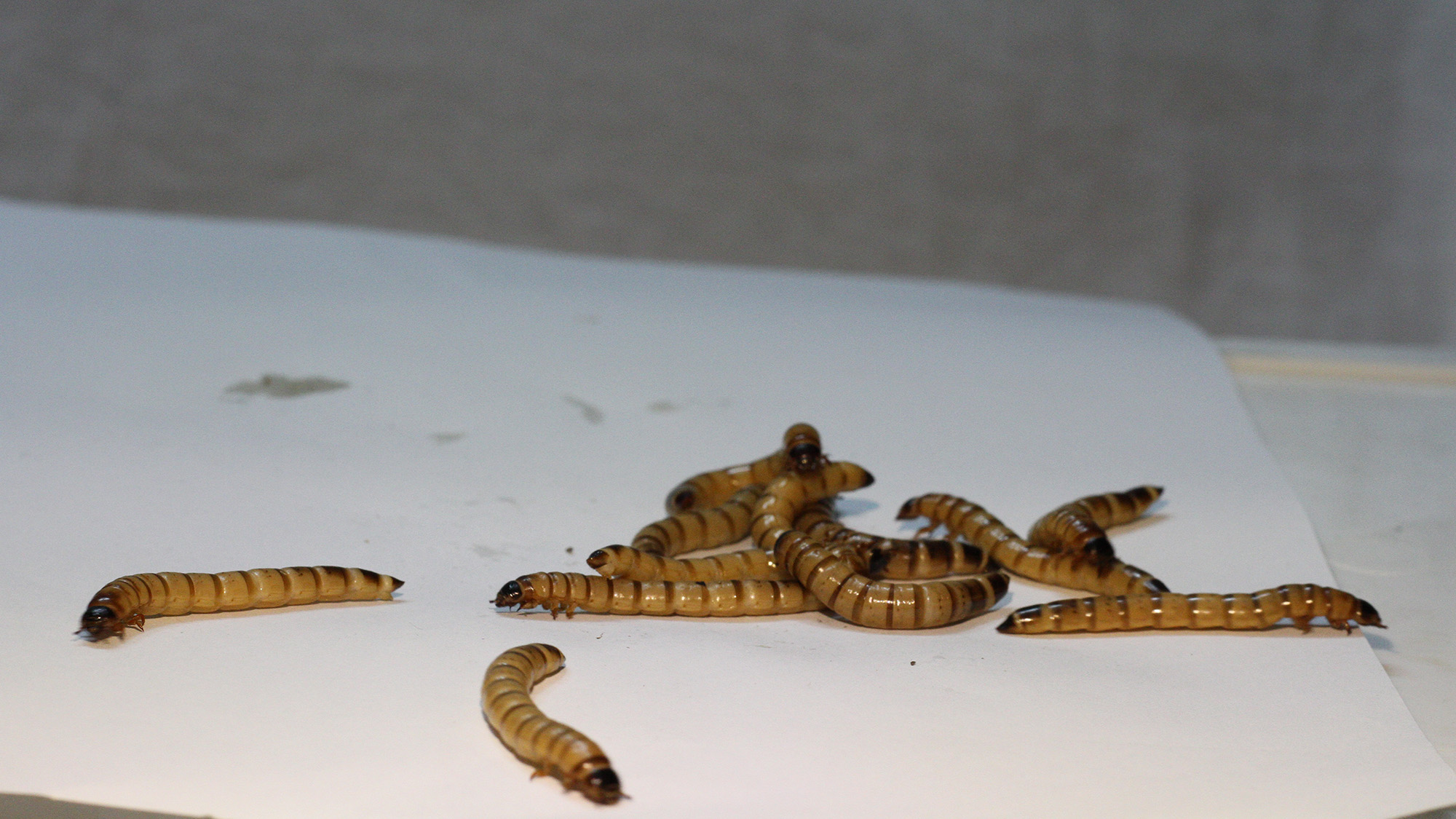
A close up of a series of brown worms on a white piece of paper.

A group of superworms in their larval stage. (Image credit: Niloofar Alaei Kakhki and Morteza Monfared)

KHC: How did you figure out that the worms could clean the skeletons? Was that surprising?

NAK and MM: Several years ago, we started keeping a colony of Zophobas morio larvae (superworm) as live food for birds. As bird-watchers, we were often asked to help care for injured wild birds, so maintaining our own colony was more practical than purchasing larvae repeatedly. We fed the larvae mainly with vegetable scraps, such as cucumber, potato and banana peels.

One day, we ran out of vegetable waste. After lunch, we placed a leftover chicken bone with a small amount of meat still attached into the colony. To our surprise, the larvae gathered around it almost immediately and removed the remaining tissue with remarkable speed. Watching hundreds of larvae work together so efficiently was fascinating, and it immediately made us wonder whether they could be useful for something beyond animal feed.

At the same time, we were volunteering at the Zoology Museum of Ferdowsi University (ZMFUM), where preparing skeletal specimens was one of our regular responsibilities. We had experience with conventional preparation methods, including manual cleaning, boiling and burial. Although effective, these methods were often time-consuming and carried the risk of damaging delicate bones or losing small skeletal elements.

After observing how efficiently the larvae cleaned the chicken bone, we decided to test whether they could also prepare skeletal specimens. The first trials were remarkably successful. Within only a few hours, the larvae removed the soft tissues while leaving even delicate bones intact. Seeing the quality of the cleaned specimens was genuinely surprising and convinced us that this approach had real potential.

From that point on, whenever suitable animal specimens became available, we continued testing the method under different conditions, gradually refining it and optimizing the protocol. Over the following years, these observations evolved into the standardized, efficient and safe skeleton preparation method presented in our study. Yes, we were genuinely surprised. We already knew that superworms could consume a wide variety of organic materials, but we did not expect them to clean skeletons so quickly, so thoroughly, and with so little damage to even the most delicate bones.

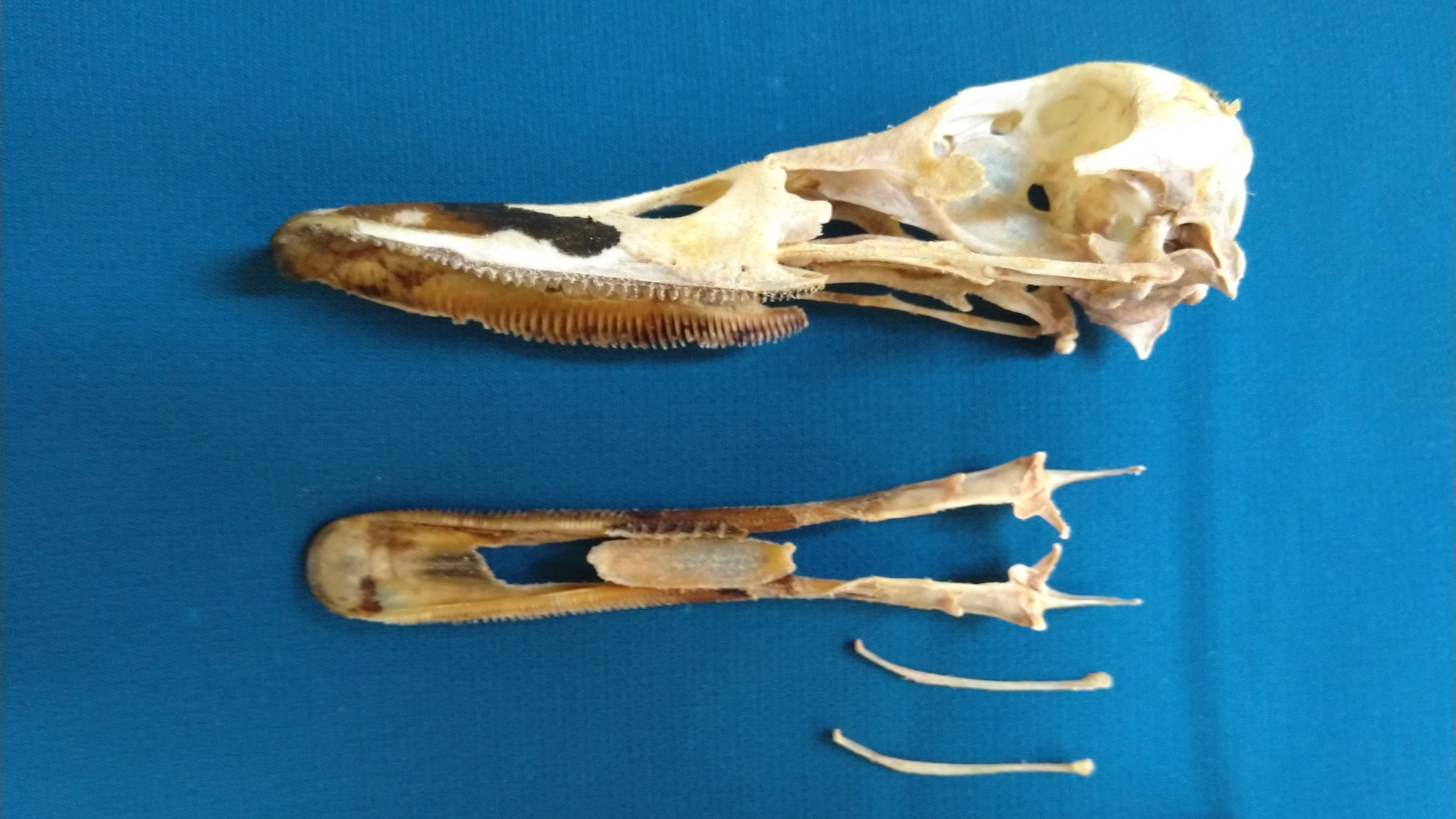
A close up of two halves of a bird skull with delicate white bones next to it against a blue background

A delicate bird skull after being cleaned by superworms. (Image credit: Niloofar Alaei Kakhki and Morteza Monfared)

KHC: How do these superworms compare to other skeleton-cleaning products, like chemical cleaners? Are the worms better or worse at this task?

NAK and MM: Based on our experience, superworms offer several important advantages over existing skeleton preparation methods.

Compared with dermestid beetles, one of the biggest advantages is colony management. Because superworms only pupate when they are isolated individually, their life cycle can be controlled much more easily. As long as they are kept together, they remain as larvae and continue cleaning specimens. This greatly reduces the risk of accidentally introducing adult beetles or their eggs into museum collections, which is a major concern when working with dermestid beetles.

Compared with traditional methods such as boiling, manual cleaning or burial, the larvae also save a great deal of time and effort. Manual cleaning, especially for delicate specimens, can take many hours and always carries the risk of breaking or losing small bones. In contrast, the larvae can remove soft tissues efficiently while preserving even fragile skeletal elements.

Every preparation method has its own strengths and limitations, and the best choice depends on the type of specimen and the goals of the researcher. However, based on our experience using a wide range of preparation techniques, we believe that superworms provide an efficient, safe and practical alternative for many museum and research applications.

Rather than replacing every existing method, we see this technique as a valuable new tool that museums, universities and research laboratories can adopt and adapt according to their own needs.

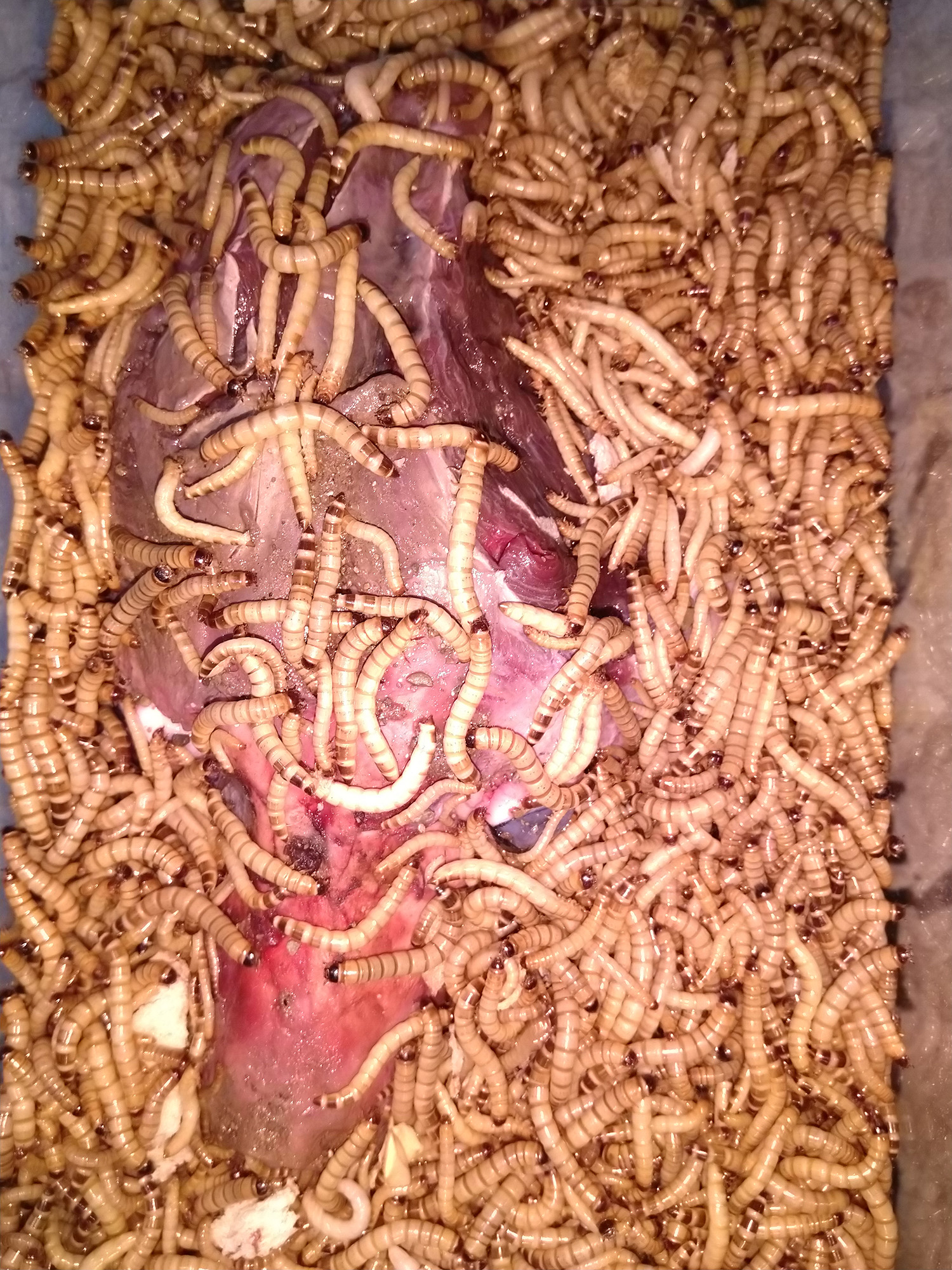
A red skull is half covered by brown worms.

A wolf skull being "cleaned" by superworms. (Image credit: Niloofar Alaei Kakhki and Morteza Monfared)

KHC: On average, how much does it cost to use the worms?

NAK and MM: It is difficult to estimate an average cost because prices vary considerably between countries and suppliers. Rather than the initial purchase price, the long-term maintenance cost is what makes this method attractive.

A colony can be established from a relatively small number of superworms. Once the larvae reach the appropriate stage, a portion of them can be isolated to pupate and develop into adult beetles. These adults reproduce and generate new larvae, allowing the colony to become self-sustaining over time.

The equipment required is also quite simple. The colony can be maintained in plastic or glass containers with wheat bran as the bedding, at approximately 25 degrees Celsius [77 degrees Fahrenheit]. Between skeleton preparation cycles, the larvae can be fed inexpensive vegetable scraps, allowing them to recover before being used again. Larvae can remain in the larval stage for several months, meaning the same colony can be used repeatedly.

Another advantage is that the colony size can easily be adjusted to meet the needs of different users. A museum or laboratory processing a large number of specimens can maintain a larger colony, while smaller collections can operate with far fewer larvae.

Overall, we find the method is relatively inexpensive to establish and maintain, especially when compared with the time, labor and specialized facilities often required for traditional skeleton preparation methods.

KHC: Do you envision museums and laboratories implementing these superworm cleaners in the future? Why or why not? Is the cost worth it?

NAK and MM: We believe this method has the potential to be adopted by many museums, universities and research laboratories, particularly those that regularly prepare skeletal specimens.

One of its greatest advantages is that it combines efficiency, safety and relatively low operating costs. Compared with some traditional approaches, it requires only basic equipment and does not rely on expensive chemicals or specialized enzymatic treatments. This makes it especially attractive for smaller museums and institutions with limited resources.

We also see advantages in terms of colony management. Because the life cycle of superworms can be controlled, the risk of introducing damaging museum pests is much lower than with some other biological cleaning methods. At the same time, the larvae can be reused repeatedly over several months, making the system practical for long-term use.

Ultimately, whether this method is worthwhile depends on the needs of each institution. However, based on our experience, we believe it offers an excellent balance between cost, efficiency, safety and specimen quality. Perhaps one of the most rewarding aspects of this approach is that it works with a natural biological process rather than against it. Instead of relying on harsh treatments, the soft tissues become a food source that supports the growth of another organism, creating a sustainable cycle while producing clean skeletal specimens. We believe this is one of the most appealing aspects of the method.

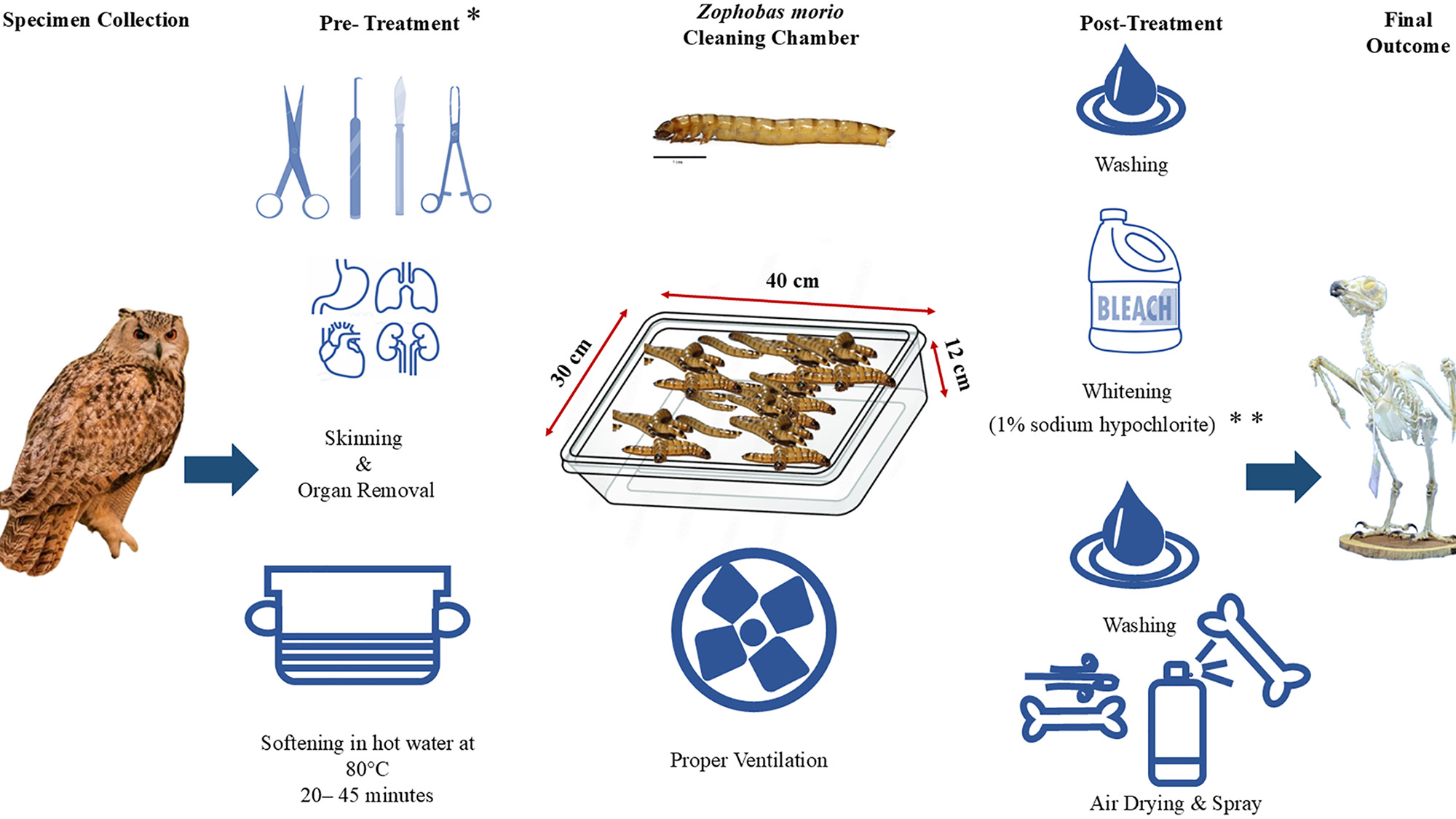
A diagram showing several steps for cleaning an owl skeleton.

A diagram showing how the worms could be implemented in skeleton preparations. (Image credit: Rastekar et al., 2026, PLOS One, CC-BY 4.0)

KHC: Are there any fun stories from your research you can share?

NAK and MM: We have collected quite a few memorable stories over the years!

One of the funniest happened while we were experimenting with burial as a skeleton preparation method. We buried the head of a Persian onager (Equus hemionus) on the university campus. Unfortunately, the specimen had already begun to decompose and had a very strong smell. Even after it was buried, we knew exactly where it was because that part of the campus still smelled terrible. We avoided walking past it whenever possible, but anyone who happened to pass by immediately noticed the odor. At one point, campus security even came over to ask what we were doing, probably wondering why we were digging a hole and burying something on university grounds!

Another memorable story involved our superworms colony itself. In the early days, we kept the larvae in our office at the Zoology Museum (ZMFUM). Almost everyone who entered the room was startled by the sight of thousands of large larvae constantly moving around in their containers. Many people kept their distance at first. But over time, as we explained their biology and demonstrated how useful they were for our research, people's reactions changed. Some visitors even became genuinely interested in the colony, and a few who were initially afraid eventually asked to hold the larvae themselves.

Those moments reminded us that science is not only about experiments and data; it can also change the way people think about animals that are often misunderstood.

KHC: If there's one thing you want our readers to take away from your work, what would it be?

NAK and MM: If there is one message we hope readers take away from our work, it is that nature often has far more to offer than we initially realize.

Many organisms are known for a single, well-established application. Zophobas morio, for example, is widely recognized as animal feed and, more recently, for its ability to consume certain plastics. Our work shows that the same species can also provide an entirely different and unexpected solution to a practical problem in museum science.

This reminds us that the first known application of an organism is not necessarily its most valuable one. Sometimes, its second or even third application can have an even greater impact. Discovering those possibilities begins with curiosity, careful observation and a willingness to ask new questions.

This interview has been edited for length and clarity.

Orange-Lipped Monkey Photo Helps Scientists Identify New Species

20 July 2026 at 11:19
The medium-sized monkey with an orange-colored patch around its nose and mouth, known locally as Likweli, joins a very short list of newly identified African monkey species.

Molten salt and human sweat: the weird batteries that could store renewable energy

19 July 2026 at 12:00

From Nevada to Manchester, developers are trialling innovative solutions to clean energy’s biggest challenge

In the deserts of the United Arab Emirates a sprawling clean energy project, stretching across an area roughly the size of 12,600 football fields, will play host to a breakthrough allowing solar energy to power the equivalent of half a million homes through the night.

The Gulf state has been steadily combining 5.2GW of solar power capacity with 19GWh of battery storage to create the largest battery scheme in the world.

Continue reading...

Β© Photograph: UCG/Universal Images Group/Getty Images

Β© Photograph: UCG/Universal Images Group/Getty Images

Β© Photograph: UCG/Universal Images Group/Getty Images

What is the roundest animal?

18 July 2026 at 10:00

Animals come in a wide range of shapes and sizes, from spindly stick insects to blubbery whales. Round animals are harder to come by, but they're more common in the ocean than on land. So what is the roundest animal, and why are round animals uncommon?

At a glance, round animals might not seem that out of place on land. After all, small mammals like rabbits and pikas often look a bit spherical when their fur is puffed out and they're sitting. But Chris Law, an evolutionary biologist at the University of Washington in Seattle, said this shape is mostly an illusion.

"They're physically not as round as they appear to be," he told Live Science.

A sphere has the lowest surface-area-to-volume ratio of any shape, which is ideal for heat conservation. Law said the ability to curl or scrunch into a sphere can be essential to the survival of small animals, which lose heat more quickly than larger animals do.

Three images side by side showing round furry rodent-like animals.

Some small and furry mammals like the cotton-tail rabbit, Ezo flying squirrel and northern pika make look spherical when they're scrunched up and sitting down, but in reality they're not as physically round as they appear to be. (Image credit: Chris Rogers/Satoru S/feathercollector via Getty Images)

Rolling into a circle can also offer protection. To safeguard their vital organs, animals like armadillos and hedgehogs roll into balls when threatened, leaving only their armor or spikes exposed to predators. But when you look at the skeletons of these supposedly round critters and their shape when they're not scrunched up, they aren't round at all, Law said.

Sign up for our newsletter

Life's Little Mysteries logo with a question mark in a magnifying glass

(Image credit: Marilyn Perkins / Future)

Sign up for our weekly Life's Little Mysteries newsletter to get the latest mysteries before they appear online.

In fact, there are several reasons why round creatures are rarely found on land. Being perfectly round all the time would make it difficult to fit into small spaces, which is a key survival technique for avoiding predators, he added, and with the effects of gravity, having a lot of unsupported round mass puts strain on an animal's body. Overly round mammals, like obese cats and dogs, often suffer joint issues and other health problems.

"As a round animal, you're probably going to lose mobility, and you're going to be picked off by predators pretty easily," Law told Live Science.

There are exceptions, however. For example, beetles are small enough not to be affected as much by gravity and can fit into nooks and crannies without much wiggling. Their round shape coupled with their hard carapace makes them more difficult for predators to eat. And rain frogs puff up into a round shape to keep predators from removing them from their hiding spots.

If we're counting animals that are only round sometimes, then pill bugs (also known as rolly pollies) might take first place for the roundest land animal. But if not, rain frogs, and beetles like ladybugs, are the top contenders for the roundest land animal. But even these animals aren't perfectly round; ladybugs have flat bottoms to make it easier to move around, and rain frogs are less spherical when not puffed up.

Round sea animals

Being round at sea is a little more feasible than it is on land. In fact, sometimes, it's critical to survival.

Karly E. Cohen, a biomechanist at Friday Harbor Labs in Washington, studies lumpsuckers, a type of fish she describes as "quite round." These bulbous fish have suction cups made of enamel on their stomachs, which they use to latch on to surfaces at the bottom of the ocean. Lumpsuckers have armor, also made of enamel, covering their round shape. According to Cohen, lumpsuckers' roundness plays a huge part in keeping them attached to the seafloor or other surface. The curve of their bodies, coupled with the tooth armor, modifies the drag around the animal, creating a force that pushes them down rather than shooting them into the water column.

A close up of a small round fish on a rock.

A lumpsucker sits on a rock. These animals use their enamel armor and their round shape to stay anchored to the ocean floor. (Image credit: MWCPhoto via Getty Images)

Although gravity still works underwater, buoyancy helps push objects up, meaning the effects of gravity do not feel as strong at sea as they do on land. According to Cohen, lumpsuckers can get around just fine, if a bit more slowly than their more streamlined neighbors. And like pufferfish and porcupine fish, lumpsuckers' round shape and uninviting exterior make them tough to swallow β€ͺ—‬ literally.

"There's no real good way to eat an apple whole; you have to take a bite," Cohen told Live Science. "And then this thing is armored, so it's very hard to take a bite."

All about symmetry

Despite their spherical shape, lumpsuckers don't quite win the award for the roundest animal. Lumpsuckers, like most animals, have bilateral symmetry, which means they are divided into two symmetrical sides across one plane of symmetry. But there are animals that have radial symmetry, which means they are symmetrically arranged in a circle around a central point with multiple planes of symmetry.

Echinoderms β€ͺ—‬ which include sea stars, sea urchins and sand dollars β€ͺ—‬ have pentaradial symmetry, which means they have five planes of symmetry arranged around a central point. According to Laurent Formery, a developmental biologist at the Oceanological Observatory of Banyuls-sur-Mer in France who studies echinoderms, scientists aren't entirely sure of the benefits of pentaradial symmetry or why echinoderms are the only modern animals that have it.

However, Formery thinks being divided into five sections instead of two may give echinoderms better sensory perception than bilaterally symmetrical animals. Echinoderms have decentralized nervous systems, meaning that instead of a brain, they have a series of neurons distributed evenly across their body, and photoreceptors all over their skin.

"They are kind of like a big crawling eye and brain, so they are receiving information from everywhere," he told Live Science. "They have a completely different way, that is difficult for us to imagine, of interacting with their environment."

A close up of a spiny sea urchin on the sandy sea floor.

An urchin in the genus Histocidaris. Underneath their spines, sea urchins are almost perfectly spherical. (Image credit: Volgi archive via Alamy)

Because of this unique organization, radially symmetrical animals can sense predators from any direction. They can also easily switch which segment of their body is in the lead, making it easier for them to change directions to capture prey.

Discounting their spikes, certain species of sea urchin are almost perfectly spherical. Like lumpsuckers, sea urchins' spherical shape, coupled with their spines, makes them difficult meals for predators, Formery said. Sponges lack any symmetry, so they can develop all sorts of body shapes. One species, called the death ball sponge, looks like a Sputnik lamp, with many hook-covered spheres attached to its spindly "arms."'

Under the sea, urchins in the genus Histocidaris, like Histocidaris purpurata and Histocidaris formosa, are the closest to perfect spheres, making them the top candidate for roundest animal.

Although roundness might be uncommon in the animal kingdom, Cohen said it's fascinating to study these animals and the reasons for their adaptations.

"As somebody that's interested in the tools and ways organisms work in their environments," she said, "they're a real treasure trove of evolution."

What do you know about the animal kingdom? Test your knowledge with our animal quiz!

Deals: AirPods Pro 3 for $199, AirPods 4 for $99, Apple Watch 11 for $299

12 July 2026 at 23:45

Amazon is offering some good deals on AirPods, the popular wireless headphones from Apple. AirPods Pro 3 are packed with advanced features like hearing aid functionality and more and available at $199, while AirPods 4 are just $99 if you don’t need the fancier features of the Pro models. AirPods Pro 3 for $199 (down ... Read More

The post Deals: AirPods Pro 3 for $199, AirPods 4 for $99, Apple Watch 11 for $299 appeared first on OS X Daily.

Deals: AirPods 4 for $99

7 July 2026 at 22:24

Amazon is offering the popular AirPods for at just $99: AirPods 4 for $99 (down from $129) And if you’re in the market for a MacBook Pro or MacBook Air, Amazon is taking $150 off the price of the Air, and $350 off the MacBook Pro, in select configurations and color options. Discounts are extra ... Read More

The post Deals: AirPods 4 for $99 appeared first on OS X Daily.

The different types of SSDs in your computer

8 February 2026 at 21:29

Whether you’re dropping an OWC Mercury Accelsior AHCI into an old Mac Pro, are replacing a 2.5β€³ SATA HDD with an SSD, or deal with mostly any Mac made after 2012, Solid State Drives have become the predominant choice as the primary boot drive in nearly every modern computer. Flash storage has been used for […]

The post The different types of SSDs in your computer appeared first on Low End Mac.

How to save all photos from shared albums to your iPhone

15 July 2026 at 17:30

iCloud shared albums on iPhone

Find out how to save one, a few, or all photos and videos from a shared iCloud album to your iPhone, iPad, and Mac in just a few quick steps.

How to enter recovery restore screen on iPhone in iOS 27

13 July 2026 at 17:30

Recovery restore screen on iPhone in iOS 27

Find out how to enter the recovery screen on iPhone or iPad running iOS 27 or iPadOS 27 to fix issues or erase your device and start fresh.
❌