NASA has selected eight new companies and will acquire new data products from six existing Commercial Satellite Data Acquisition contract holders to expand the range of commercial satellite data available to researchers, civil agencies, and decision-makers. Such measurements supplement NASA’s Earth satellites by contributing high-resolution and frequent observations to enhance the agency’s set of data.
Leveraging commercial data demonstrates NASA’s commitment to strong public-private partnerships, allowing the agency to expand scientific insight while reducing costs and accelerating the delivery of data to researchers and decision-makers.
Collectively, NASA and commercial Earth observations provide insight into our home planet – benefitting Americans, providing environmental intelligence, strengthening disaster response, and improving public safety.
The Commercial Satellite Data Acquisition Program On-Ramp 2 Multiple Award contract is a firm-fixed-price, indefinite-delivery/indefinite-quantity multiple-award contract. The original maximum contract value was $476 million, with a performance period that began in 2023 and continues through Nov. 15, 2028.
Contract awardees are:
Airbus DS Geo Inc.
GHGSat Inc.
Hydrosat Inc.
ICEYE US Inc.
ImageSat International
Kuva US Inc.
Muon Space Inc.
Orbital Sidekick Inc.
OroraTech USA Inc.
Planet Labs Federal Inc.
Space Sciences and Engineering LLC, doing business as PlanetiQ
SATLANTIS US
Tomorrow Companies Inc., doing business as Tomorrow.io
Wyvern Inc.
The agency’s Commercial Satellite Data Acquisition mission works to execute a cost-effective way to augment and complement the suite of Earth observations captured by NASA and its partners by identifying, evaluating, and acquiring commercial satellite data.
For more information about NASA’s Commercial Satellite Acquisition program, visit:
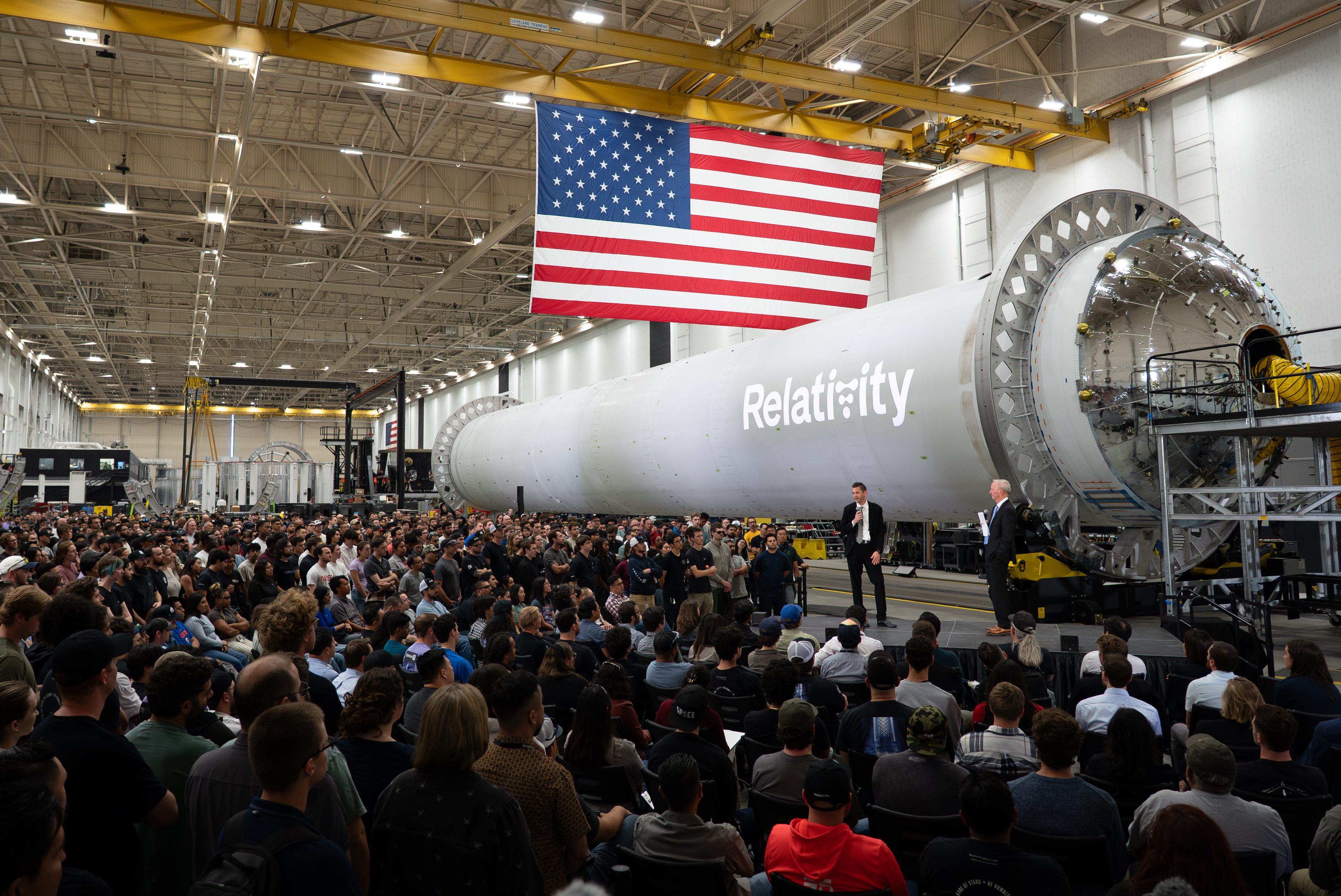
NASA Administrator Jared Isaacman announces a public-private partnership to advance Mars science during an event at Relativity Space on June 17, 2026.
Credit: Relativity Space
NASA Wednesday announced a new public‑private partnership to advance Mars science by combining the agency’s scientific leadership with commercial innovation. Under this model, NASA will provide the Aeolus atmospheric‑science instrument payload suite, while Relativity Space supplies the spacecraft, rocket, and cruise operations necessary to deliver the instruments to Mars.
This partnership reflects NASA’s growing commitment to approaches that accelerate discovery, expand mission cadence, and strengthen the foundation for future human exploration. By leveraging commercial investment and development capacity, NASA can focus resources on high‑value science while enabling more frequent opportunities to gather critical data about Mars, data essential to safely navigating the Martian atmosphere and ultimately landing humans on the surface.
“Public-private partnerships like this are a force multiplier for science,” said NASA Administrator Jared Isaacman. “By pairing NASA’s world‑class instruments with commercial innovation and investment, we can deliver more science, more often, and reduce the time it takes to get essential data into the hands of researchers preparing for future human missions to Mars.”
Aeolus, scheduled to launch in 2028, is a NASA‑developed suite of four complementary instruments designed to provide the first integrated, daily, global view of Martian winds, temperatures, dust, and clouds. By improving models for dust, winds, temperature, and seasonal atmospheric behavior, Aeolus will generate the detailed environmental knowledge required to reduce risk for future crewed and uncrewed landings. These measurements will directly inform entry, descent, and landing systems and support safer, more predictable mission planning for astronauts.
Aeolus builds on more than two decades of NASA missions that have studied the Martian atmosphere, including orbiters such as MAVEN (Mars Atmosphere and Volatile Evolution), the Mars Reconnaissance Orbiter, and Mars Odyssey, while taking the foundation laid by earlier missions even further, continuing NASA’s tradition of expanding the frontiers of Mars science. Researchers at NASA’s Ames Research Center in California’s Silicon Valley will design, build, and integrate the payload, while Relativity Space will manage spacecraft development and mission operations.
“As NASA’s Innovation Center of Excellence, Ames is committed to delivering the technologies, capabilities, and creative partnerships that enable the agency’s boldest missions,” said Dr. Eugene Tu, center director, NASA Ames. “Aeolus reflects how innovative collaboration accelerates science and strengthens the foundation needed for one day landing humans on Mars.”
The Aeolus payload suite includes four NASA‑built instruments:
Doppler Wind and Temperature Sounder (DWTS‑Ozone): Measures wind and temperature profiles from the surface up to approximately 37 miles (60 km). A collaboration with GATS.
Thermal Limb Sounder (TLS): Provides vertical temperature profiles and observations of dust and water‑ice clouds. A collaboration with Xiomas Technologies.
Surface Radiometric Sensor Package (SuRSeP): Measures surface energy balance, dust, and cloud properties.
Wide‑Field Context Camera (WFCC): Captures daily global images of atmospheric activity.
NASA will support operations of science instruments for at least one Martian year, while Relativity Space maintains the spacecraft. As part of the agreement, NASA will develop the data‑processing pipeline needed to transform raw measurements into high‑quality, ready‑to‑use data products for broad scientific use.
This effort is supported under NASA’s first six‑year reimbursable Space Act Agreement, providing a stable framework for sustained collaboration, predictable development, and mission continuity.
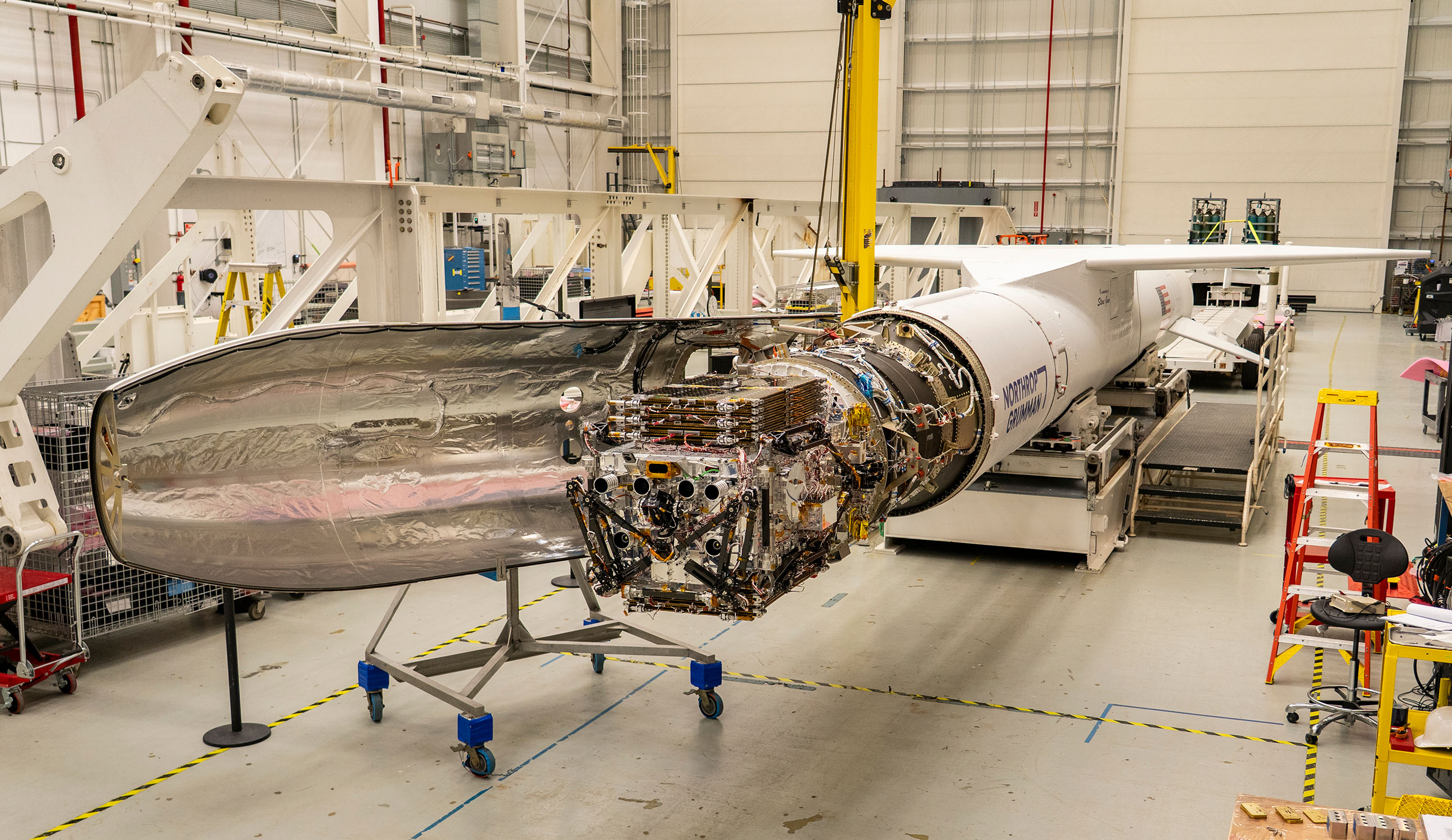
Katalyst Space’s LINK robotic servicing satellite awaits encapsulation inside a Northrop Grumman Pegasus XL on June 8, 2026, at NASA’s Wallops Flight Facility in Virginia. The rocket will carry LINK to space for an attempted orbital boost of NASA’s Neil Gehrels Swift Observatory.
Credit: NASA/Ron Beard
NASA will host an audio-only media teleconference at 11 a.m. EDT, Wednesday, June 17, to preview the Katalyst Space mission to boost the orbit of NASA’s Neil Gehrels Swift Observatory.
Katalyst’s robotic servicing spacecraft, called LINK, will attempt to rendezvous with Swift and raise its altitude, extending its science mission lifespan and advancing a key capability for the future of space exploration. The LINK spacecraft will launch on Northrop Grumman’s Pegasus XL rocket later this month from Kwajalein Atoll in the Marshall Islands.
Media interested in participating by phone must RSVP no later than two hours before the start of the call to Amy Barra at: amy.l.barra@nasa.gov. NASA’s media accreditation policy is available online.
Audio of the media teleconference will stream on the agency’s website at:
The Swift mission, which launched in 2004, leads NASA’s fleet of telescopes in studying changes in the high-energy universe, like gamma-ray bursts, which are the most powerful explosions in the cosmos. When a rapid, sudden event takes place in the sky, Swift serves as a “dispatcher,” providing critical information that allows other “first responder” missions to follow up to learn more about how the universe works.
After 21 years, Swift’s low Earth orbit has begun to rapidly decay because of increased solar activity. Rather than allowing the observatory to re-enter Earth’s atmosphere, as many missions do at the end of their lifetimes, NASA is using this opportunity to advance U.S. spacecraft servicing technology. In September 2025, NASA awarded a contract to Katalyst to mount a robotic servicing mission for Swift in less than a year. The mission will use LINK to rendezvous with Swift and boost it to a higher altitude, demonstrating a key capability for the future of space exploration. The mission is targeted for launch in June from Kwajalein Atoll, Marshall Islands.
Learn more about the mission to boost Swift’s orbit at:
NASA has selected multiple small businesses for the Western Regional Multiple Award Construction Contract, which supports a broad range of facility enhancement, modernization, and sustainment work at NASA’s Armstrong Flight Research Center in Edwards, California, NASA’s Ames Research Center in California’s Silicon Valley, and other federal agencies in the region.
The contract provides general construction, modification, maintenance and repair, and demolition services, as well as new construction of buildings and facilities that incorporate Leadership in Energy and Environmental Design practices and building information modeling to support efficient and sustainable project execution.
The indefinite-delivery/indefinite-quantity, firm-fixed-price contract is a follow-on to the agency’s previous regional construction contract and has a potential value of $450 million over a five‑year period.
Contract awardees are:
Abide International Inc.
Able Heating and Air Conditioning
Anderson Burton Construction Inc.
Anna Lisa Luna Construction
Barkley Andross Corporation
Bibro Construction Company Inc.
CM Construction Services
CMS Construction Inc.
FASONE
G‑1 Lead Builders JV LLC
Gideon USA
Good‑men Roofing & Construction Inc.
Groundlevel Construction Inc.
IPI Construction Inc.
Innovative Project Solutions Inc.
Ironwood Commercial Builders Inc.
J.I. Garcia Construction Inc.
JG Contracting
Lead Builders Inc.
Martinez Construction Services
MX Construction Inc.
OCS Construction Services Inc.
Patricia I. Romero Inc., doing business as Pacific West Builders
Gustav Keoni, doing business as Precision Construction
Prime MIK JV LLC
Spectrum Builders and Renovations Inc.
Sea Pac Engineering Inc.
Sergent Construction
Souza Construction Inc.
TLI Construction Inc.
For more information about NASA and agency programs, visit:

 Login