 Login
Lululemon backs nylon-recycling startup Syntetica in $30M Series A
16 July 2026 at 05:00
Syntetica, a French startup that has developed a novel approach to recycling nylon, has already obtained big-name partners and investors.



Editor’s Note: Astrobites is a graduate-student-run organization that digests astrophysical literature for undergraduate students. As part of the partnership between the AAS and astrobites, we occasionally repost astrobites content here at AAS Nova. We hope you enjoy this post from astrobites; the original can be viewed at astrobites.org.
Title: Carbon Cycle Imbalances on Arid Terrestrial Planets with Implications for Venus
Authors: Haskelle T. White-Gianella and Joshua Krissansen-Totton
Authors’ Institution: University of Washington
Status: Published in PSJ
When discussing the habitability of planets, we usually focus on the habitable zone, the region around a star where a planet can host a temperature suitable for supporting liquid water on its surface. Yet, being in the right place doesn’t necessarily guarantee that a planet will be habitable.
A planet also needs the right atmospheric composition to sustain the necessary temperatures for hosting liquid water. A key mechanism found on Earth for maintaining this composition is the geologic carbon cycle, which acts as a built-in climate control system. This cycle begins with volcanic eruptions releasing carbon dioxide (CO2), which then dissolves in rainwater and forms a weak acid that weathers rocks on continents. The weathering products wash into oceans, where they form carbonate rocks, locking carbon away. Eventually, plate tectonics recycles some of that carbon back to volcanoes. The weathering process works faster when the planet is warmer, thus regulating the amount of CO2 and stabilizing the climate over long periods of time (but it should be noted that it can take up to a few hundred thousand years to rebalance this slow carbon cycle through the weathering process).
An important caveat is that the weathering process requires sufficient liquid water on the planet’s surface, so what happens in the case for planets with shallower oceans? Low-mass M dwarfs, the most common type of star found in the galaxy, are expected to host less-massive disks and therefore lower water inventories for forming planets. If more “dry” planets are indeed a more likely outcome of planet formation, we’d want to know how their arid conditions influence their long-term evolution and habitability.
The authors built a model that tracks how water and CO2 move between a planet’s interior, oceans, and atmosphere over 4.5 billion years. The model notably includes the following:
The model tests for four initial surface water inventories (0.1%, 1%, 10%, and 100% of Earth’s oceans) and then simulates how the surface water, atmosphere, and climate evolve over time.
The models reveal that planets require at least 20–50% of Earth’s ocean mass to maintain a balanced carbon cycle. Below this threshold, the carbon cycle becomes unbalanced, leading to devastating consequences for habitability (Figure 1).
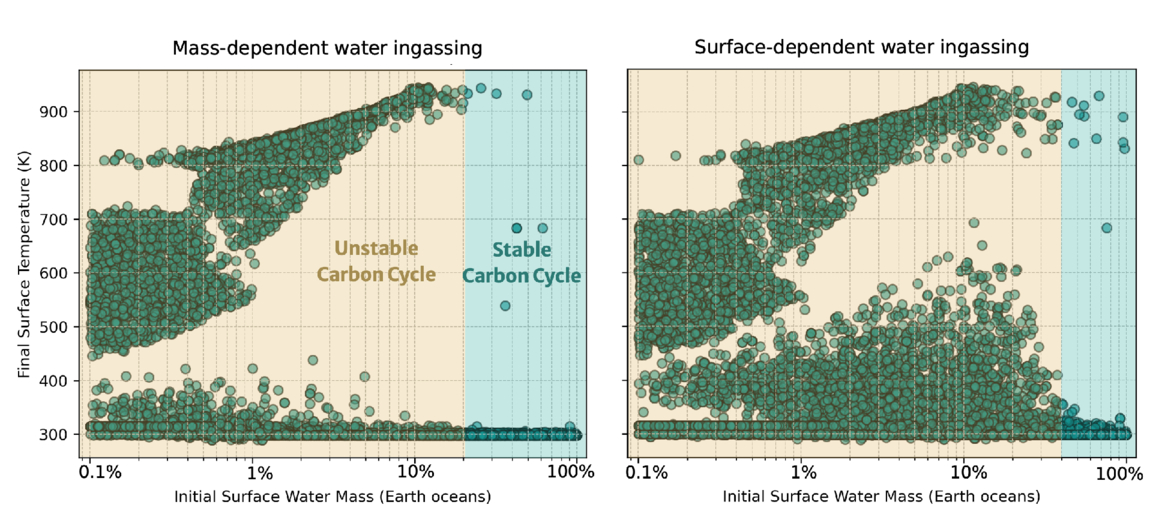
Figure 1: Final surface temperature after simulating 4.5 billion years of evolution as a function of initial water inventory for Earth-like planets. Each dot represents a model run with different assumptions (total carbon inventory, temperature dependence of weathering, soil age, etc.). The yellow region shows where most simulations result in uninhabitable surface temperatures from an unbalanced carbon cycle, and the cyan region shows where most simulations result in habitable surface temperatures and a balanced carbon cycle. The left and right plots show the results for two different parameterizations of the deep water cycle implemented in the model. [White-Gianella & Krissansen-Totton 2026]
Looking within the solar system, the results offer an explanation for how a potentially habitable Venus could have transitioned into its current inhospitable state. If Venus had formed with an initial water inventory below this critical threshold of 20–50% of Earth’s ocean mass, then its carbon cycle would have become unbalanced, creating the CO2 inferno seen on Venus today.
In future exoplanet studies, telescopes like the Habitable Worlds Observatory might detect ocean glint (specular reflection from liquid water) or measure land fraction from light curves. Finding a planet in the habitable zone but with limited ocean coverage would likely be bad news, as the planet could be quietly losing its grip on habitability. Astronomers may want to be more careful when looking at seemingly promising planets within their habitable zones.
Original astrobite edited by Natalie Price.
About the author, Jared Bull:
I am a 2nd-year PhD student at Johns Hopkins University. I study brown-dwarf variability and am interested in using time-series observations to uncover dynamic processes within their atmospheres. In my free time I like to read, cook, and do astrophotography.
The post Can Arid Planets Keep Their Cool? appeared first on AAS Nova.
Thousands of metres below the ocean’s surface, there are tiny waves moving through the water. Much like breaking waves at the beach, these small waves within the ocean must eventually break. When they do, they create turbulence and mixing, similar to what you feel from a big wave breaking on the beach. This might seem […]
In a groundbreaking study challenging prevailing assumptions about climate policy, German politicians appear to underestimate public support for climate action, suggesting a disconnect that could shape future legislative efforts. This research, recently published in Communications Earth & Environment, involved a comprehensive survey of over 6,000 German political figures combined with two robust population samples, shedding new light on the perceptions of climate-related public opinion within political domains.
The study’s core methodology involved contacting 6,074 German politicians via official email addresses between September and November 2024. These emails invited recipients to participate in a concise, five-minute online survey on “Trends in German Society,” deliberately omitting any direct reference to climate change in an effort to reduce bias. Despite the considerable size of the outreach, the overall final completion rate after stringent data cleaning—including a threshold where respondents completing less than half of the survey were excluded—yielded 1,599 high-quality responses. This cohort formed the backbone of the political sample for in-depth analysis.
Respondents were first provided a clear, scientific definition of global warming to ensure a consistent understanding across participants. This standardization was essential for eliciting valid attitudes relating to perceived problem awareness, policy acceptance, and willingness to engage in financial contributions toward climate mitigation efforts. The survey asked about politicians’ perceptions of how problematic the average German citizen finds climate-damaging behaviors and the corresponding desire for government intervention to reduce such actions. This dual focus aimed to assess both the perceived societal concern and the appetite for political support in addressing climate issues.
One of the critical findings centers on the perceived public acceptance of climate policies. Politicians were queried about communication and informational initiatives, the imposition of taxes on environmentally harmful products and behaviors, as well as stricter laws and regulations. Results indicated that politicians systematically underestimated the level of public support for each type of intervention, revealing a sizable perception gap that may influence hesitancy or delay in implementing ambitious policies.
Additional layers of the survey explored perceived willingness among citizens to contribute financially to climate action. Two specific metrics were used: the number of people believed to be willing to donate 1% of their household income monthly toward climate causes, and the expected amount of microdonations from a hypothetical €1 earned by survey participation. The politicians’ conservative estimates in these financial willingness measures contrasted with actual data derived from representative surveys of the German population, underscoring a potential underappreciation of public commitment.
Complementing the political survey, two population samples were simultaneously analyzed. The first was a nationally representative online cohort of 1,034 German residents aged 16 and older, recruited through the professional survey company Kantar. This sample’s data helped benchmark real public attitudes toward climate problem awareness, governmental support desires, and acceptance of policy measures. The second incorporated 1,000 participants from the global Gallup World Poll, representing a broad cross-section of the German populace, further reinforcing the validity of the findings.
The population samples consistently demonstrated higher levels of problem recognition and stronger endorsement for governmental action on climate change than the political respondents presumed. Notably, willingness to financially support climate initiatives was markedly higher among the general public than politicians estimated. This disparity points toward a systemic underestimation within the political elite regarding their constituents’ readiness for meaningful climate policies.
Such findings hold significant implications for political decision-making. By misjudging the public’s attitudes, legislators and party leaders may refrain from advancing or supporting robust climate legislation for fear of voter backlash or electoral risk. This dynamic could partly explain the sluggish pace of climate policy adoption in Germany despite mounting scientific urgency and popular concern.
The study also incorporates demographic variables from the political cohort—party membership, mandate level, government versus opposition status—but the perception gap in climate support appears pervasive across these strata. The researchers carefully mitigated selection biases by anonymizing survey topics and limiting survey length to encourage participation, thus strengthening the generalizability of their conclusions.
Moreover, the research underscores a broader phenomenon in democratic governance: the critical importance of accurate awareness of public opinion among policymakers. Misperceptions can skew policy priorities and stall necessary systemic transformation, especially in deeply divisive or complex issues such as climate change. This study contributes empirical evidence to the discourse, advocating for enhanced communication channels and feedback mechanisms between citizens and their elected representatives.
The implications extend beyond Germany, serving as a cautionary tale for democracies worldwide. As climate crises accelerate, aligning political perceptions with grassroots realities is paramount to fostering effective, timely policy responses. Future research might explore interventions that improve politicians’ insight into public sentiment or measure the impacts of corrected perceptions on policy enactment.
Researchers also highlight the need for continuous, high-resolution public opinion tracking using varied methodologies, including direct surveys with policymakers and general population samples. This multi-angle approach ensures robust cross-validation and prevents siloed misunderstandings from dampening political momentum on urgent environmental challenges.
By revealing that German politicians substantially undervalue public backing for climate action, this study challenges political assumptions and calls for strategic reforms in policymaker engagement with constituents. Increased awareness of genuine public support could embolden policymakers to champion ambitious climate initiatives, potentially reshaping Germany’s environmental trajectory.
The convergence of rigorous survey methods, large sample sizes, and thorough demographic controls lends significant credibility to these revelations. Ultimately, bridging the gap between political perception and public reality represents a critical step to unlocking proactive climate governance capable of meeting the demands of planetary stewardship.
As Germany positions itself as a leader in climate policy, this study’s insights serve as a powerful reminder that public opinion is not only a metric but a dynamic resource to be understood and harnessed. Greater transparency and dialogue between politicians and citizens might unlock untapped political will, enhancing collective climate action efficacy.
In conclusion, the evidence points to a pervasive issue: political misjudgment of climate support that risks impeding crucial policy advancements. Addressing this perceptual shortfall may catalyze transformative environmental legislation, aligning political action with the robust enthusiasm evident among the German populace.
Subject of Research: Public perceptions of climate action support among German politicians compared to the general population
Article Title: Public support for climate action is underestimated in the German political domain
Article References:
Sevincer, A.T., Hostlowsky, L., Styhler, F. et al. Public support for climate action is underestimated in the German political domain. Commun Earth Environ 7, 543 (2026). https://doi.org/10.1038/s43247-026-03721-7
Image Credits: AI Generated
It’s not the shell. It’s the hen — and the climate.In a groundbreaking new study published in Nature Communications, researchers Ampuero, Stríkis, Meckler, and colleagues have unveiled compelling evidence of rapid warming in South America during the last deglaciation, a period roughly spanning from 20,000 to 10,000 years ago. This revelation not only reshapes our understanding of ancient climate dynamics in the Southern Hemisphere but also provides critical insights relevant to modern climate change scenarios. The study harnesses a suite of advanced geochemical proxies and high-resolution sediment analyses to reconstruct past temperature variations with unprecedented precision, shedding light on the complex interplay of atmospheric and oceanic processes that drove rapid temperature shifts during this critical juncture in Earth’s climate history.
The last deglaciation marks the transition from the Last Glacial Maximum (LGM), characterized by extensive ice sheets and colder global temperatures, to the relatively warmer Holocene epoch. While the general timeline of global warming during this period has been well documented, the rate and regional variability of temperature changes in South America remained less clear. This research addresses that gap by focusing on paleoclimatic archives from the Andes and adjacent lowlands, areas particularly sensitive to past climate fluctuations due to their unique topography and atmospheric circulation patterns. The team’s integration of isotopic measurements, sediment core analyses, and climate modeling has allowed them to track rapid temperature increases occurring in discrete pulses rather than gradual trends.
One of the study’s central findings is that the warming episodes in South America during the deglaciation were not synchronous with the Northern Hemisphere, suggesting a nuanced asynchronous behavior in global climate systems. This asynchrony challenges prevailing assumptions derived from mid-latitude and polar records predominantly from the Northern Hemisphere. The evidence points to a scenario where atmospheric teleconnections, influenced by shifts in the Intertropical Convergence Zone (ITCZ), played a vital role in redistributing heat between hemispheres. Changes in the ITCZ’s position and intensity appear to have triggered alterations in monsoonal patterns and precipitation regimes across tropical and subtropical South America, thereby accelerating warming trends.
Delving deeper into the proxies used, the research team employed oxygen isotope ratios (δ18O) from speleothems and lacustrine carbonate deposits, alongside organic biomarkers preserved in lake sediments. These proxies are invaluable for reconstructing past temperature and hydrological conditions. Their fine temporal resolution enabled the team to detect rapid warming events occurring over mere decades to centuries, contrasting starkly with previously assumed millennial-scale trends. This high-resolution data challenges the paradigm that post-glacial warming was a slow and steady process, underscoring the climate system’s capacity for abrupt state shifts driven by complex feedback mechanisms.
The study posits that these rapid warming events are linked to deglacial reductions in ice volume combined with rising greenhouse gas concentrations, which collectively enhanced atmospheric temperatures. However, the mechanisms responsible for regional heterogeneity in warming intensity remain a frontier of research. The authors hypothesize that the interplay between the South Atlantic Ocean’s temperature gradients and the Andes’ orographic effects created microclimates that either amplified or moderated warming signals locally. These insights highlight the intricacies of Earth’s cryosphere-atmosphere interactions, emphasizing that regional response to global forcings can diverge dramatically.
Crucially, the study carries significant implications for understanding future climate trajectories. The past rapid warming episodes provide analogs for the rate and spatial distribution of modern anthropogenic warming, especially in mountainous and tropical regions. Given that South America supports critical biodiversity hotspots and large human populations dependent on glacial-fed water resources, these findings raise concerns about the vulnerability of such systems to contemporary climate disruptions. They also stress the importance of refining climate models to incorporate regional heterogeneities and abrupt transitions observed in past climates to improve future predictions.
The methodologies applied in this study exemplify advancements in paleoclimatology. High-precision radiometric dating techniques, including uranium-thorium series and radiocarbon calibrations, ensured robust chronological frameworks. Simultaneously, the use of compound-specific isotope analyses allowed disentanglement of temperature signals from confounding hydrological changes. By merging empirical data with state-of-the-art climate model simulations, the research provides a comprehensive narrative that integrates proxy evidence with theoretical climate dynamics, fostering an interdisciplinary understanding crucial for reconstructing past climates.
This investigation also revisits the role of Southern Hemisphere westerly winds during glacial terminations. These winds, known to influence oceanic upwelling and atmospheric moisture transport, appear to have shifted latitudinally and intensified during warming intervals, enhancing the carbon cycle feedback through increased ocean-atmosphere exchange. Such shifts would have profound implications for regional precipitation and temperature patterns, echoing the complex feedback loops that amplify climate variability. The interplay between atmospheric circulation changes and deglacial warming elucidated in this work refines our grasp of the mechanisms driving rapid climate shifts in South America.
The detailed record of warming patterns obtained from Andean ice cores and sediment cores also reveals that local climate responses were amplified by feedback mechanisms related to vegetation changes and soil moisture dynamics. As temperatures rose, altered precipitation regimes induced shifts in ecosystem composition and land surface properties, which in turn influenced regional albedo and evapotranspiration rates. These biophysical feedbacks likely intensified warming pulses, creating nonlinear climate responses that challenge the linear projections often found in simplified models. The study’s recognition of these processes underscores the need to consider feedback loops when analyzing both past and future climate events.
Furthermore, the research highlights the influence of meltwater pulses originating from retreating glaciers on ocean circulation patterns in the South Atlantic, which may have contributed to abrupt changes in the Atlantic Meridional Overturning Circulation (AMOC). These oceanic perturbations would have cascaded into atmospheric circulation anomalies, further modulating temperature regimes. The integration of paleohydrological and oceanographic data thus provides a multidimensional perspective on how coupled ocean-atmosphere-cryosphere systems orchestrated climate variability during the last deglaciation.
The findings provoke new questions about thresholds and tipping points in paleoclimatic systems. The demonstrated rapid warming episodes suggest that even small incremental increases in external forcings can trigger disproportionately large climate responses once feedbacks are engaged. Such insights are vital for modern climate science, particularly in understanding the potential for abrupt, nonlinear climate transitions under ongoing anthropogenic pressures. By decoding the clues encoded in South America’s geological record, the study enhances our ability to forecast and mitigate the risks associated with rapid climatic changes.
Notably, this work emphasizes the importance of cross-continental and hemispheric comparisons in paleoclimatic studies. By juxtaposing South American data with Northern Hemisphere and Antarctic records, the researchers have contextualized regional warming events within the broader global climate narrative. This comparative approach reveals asynchronous yet interconnected patterns of deglacial warming, challenging simplistic notions of uniform climate shifts and advocating for more intricate, region-specific assessments of past climate dynamics.
In conclusion, the study by Ampuero et al. represents a significant stride in reconstructing past climate change with regional fidelity and temporal precision. Their identification of rapid warming intervals during the last deglaciation in South America not only enriches the scientific understanding of glacial-interglacial transitions but also provides vital lessons for the present and future. The intricate linkages among atmospheric circulation, oceanic processes, and terrestrial feedbacks revealed by this study underscore the intricacy of Earth’s climate system and the urgency of addressing rapid environmental changes from a holistic perspective. Future research inspired by this work will undoubtedly deepen insights into the mechanisms of abrupt climate change and help refine predictive climate models essential for safeguarding vulnerable ecosystems and societies.
—
Subject of Research: Paleoclimatic reconstruction of rapid warming events in South America during the last deglaciation.
Article Title: Rapid warming in South America during the last deglaciation.
Article References:
Ampuero, A., Stríkis, N.M., Meckler, A.N. et al. Rapid warming in South America during the last deglaciation. Nat Commun (2026). https://doi.org/10.1038/s41467-026-74093-x
Image Credits: AI Generated
As Earth’s climate system evolves with unprecedented rapidity, forests — vital guardians of global ecological balance — are undergoing complex transformations that extend far beyond the mere sequestration of carbon. Emerging research has begun to unravel the subtle yet profound ways in which climate change reshapes the biophysical interactions between forested landscapes and their surrounding environments, particularly regarding land surface temperature dynamics. A recent groundbreaking study delves deep into these dynamics, revealing starkly contrasting trends that underscore the dualistic nature of forests as climate regulators amidst rising atmospheric dryness. This nuanced revelation challenges long-held assumptions about the uniform benefits of forest cooling and opens new frontiers for understanding ecosystem-climate feedbacks in the Anthropocene.
Forests have long been recognized as crucial climate buffers, primarily through their capacity for carbon storage and evapotranspiration-driven cooling effects. The new research pivots attention to a complementary biophysical mechanism: the difference in growing-season land surface temperature (LST) between forested areas and adjacent open lands, designated as ∆LSTgs. By systematically quantifying ∆LSTgs globally across a span of more than two decades (2001–2023), the researchers uncovered contrasting temporal patterns that vary profoundly with geography and changing atmospheric conditions. Notably, these patterns defy a simplistic narrative of consistent forest cooling, instead revealing a dynamic response heavily modulated by atmospheric humidity levels.
Central to these divergent forest temperature dynamics is the rising vapor pressure deficit (VPD), a measure of atmospheric dryness that quantifies the difference between the amount of moisture in the air and its saturation point. The study identifies VPD as the predominant driver behind the observed variations in ∆LSTgs, exerting a stronger influence than other conventional climatic factors such as temperature, precipitation, or solar radiation. This finding shines light on the critical role that atmospheric moisture stress plays in forest surface energy exchanges, fundamentally altering the cooling potential traditionally attributed to forests under wetter conditions.
However, the forest response to this intensifying atmospheric dryness is far from uniform across global biomes. The research highlights a pivotal interaction between VPD fluctuations and plant hydraulic traits, particularly stomatal regulation strategies embodied by anisohydricity, a measure of plants’ ability to regulate water loss through stomata under drought stress. Forests exhibiting high anisohydricity maintain more open stomata even under dry conditions, enabling continued transpiration and evaporative cooling but at increased risk of hydraulic failure. In contrast, isohydric forests tightly conserve water by closing stomata earlier, reducing cooling at the leaf surface.
Intriguingly, this stomatal regulatory behavior correlates with latitude, delineating distinct forest cooling trajectories. Tropical forests near the equator tend to display more isohydric characteristics. Here, rising VPD often surpasses the hydraulic safety threshold of these ecosystems, leading to stomatal closure and a consequent weakening of forest cooling effects. This trend portends a diminished capacity of tropical forests to mitigate local heating as atmospheric dryness intensifies, potentially accelerating heat stress on these already vulnerable ecosystems.
Conversely, high-latitude forests manifest a more anisohydric strategy, maintaining open stomata under increasing VPD levels that nonetheless remain within their hydraulic safety margins. As a result, these boreal and temperate forests continue to sustain transpiration-driven cooling, which paradoxically intensifies with rising VPD. This phenomenon enhances the biophysical benefits of northern forests, amplifying their role as regional climate coolants and underscoring the heterogeneous nature of forest climate feedbacks across latitudes.
This nuanced physiological interplay yields profound implications regarding future forest-climate interactions under global warming. It underscores that elevated atmospheric dryness will not only influence ecosystem carbon dynamics but also significantly alter the biophysical feedback mechanisms by which forests regulate surface temperatures. As VPD continues to climb worldwide, the traditional ecological services of forests, particularly their cooling benefits, may become compromised in many parts of the globe, particularly within tropical zones critical for biodiversity and global climate regulation.
Moreover, the study’s integrative approach—which combines satellite observations of surface temperature with detailed climatological measurements and physiological trait data—provides a comprehensive framework to understand how climatic stressors mediate forest cooling effects. By leveraging large-scale data spanning two decades, the researchers offer robust evidence that forest cooling is not static but dynamically contingent on complex interactions among atmospheric moisture, plant hydraulics, and geographic distribution, emphasizing the need for ecosystem-specific climate mitigation strategies.
The findings challenge the prevailing optimism about forests’ capacity to offset warming through biophysical means alone. In vulnerable tropical regions, the erosion of cooling benefits linked to stomatal closure under heightened VPD may exacerbate heat stress, increase fire risk, and undermine forest resilience. This could trigger feedback loops accelerating tropical forest degradation and amplifying global warming, raising alarm over the future of these essential carbon sinks.
Conversely, the sustained or even enhanced cooling in high-latitude forests might partially offset regional warming trends, but the balance of such compensatory effects at the global scale remains uncertain. These complexities highlight an urgent need to integrate physiological and biophysical forest attributes into predictive climate models, allowing for more accurate assessments of forest contributions to local and global temperature regulation.
Crucially, the research points to the hydraulic safety margin as a vital threshold parameter dictating the tipping points at which forests transition from cooling to warming agents. This insight offers potential pathways for management interventions aimed at bolstering forest hydraulic resilience, such as selective species planting or conservation strategies tailored to optimize ecosystem-level responses to rising VPD.
In a broader context, the study underscores that atmospheric dryness—often overshadowed by temperature-centric perspectives on climate change—constitutes a formidable and multifaceted challenge for forest ecosystems worldwide. Rising VPD alters not only physiological processes at the leaf level but also cascades through landscape-scale energy budgets, with cascading impacts on regional climate patterns, hydrology, and ecosystem services.
As the global community contemplates reforestation and afforestation policies as climate mitigation tools, these findings call for a recalibrated understanding that accounts for the limits imposed by plant hydraulic behavior and atmospheric moisture constraints. The simplistic paradigm of “more trees equal cooler climate” must evolve into a sophisticated appreciation of when, where, and how forest ecosystems can be expected to maintain their biophysical cooling contributions in a drying and warming world.
Ultimately, this pioneering research adds a critical dimension to our grasp of climate-vegetation feedbacks, illuminating the complex, sometimes counterintuitive outcomes of drying atmospheres on forested landscapes. By highlighting the paramount role of VPD and stomatal regulation across global latitudinal gradients, it informs the scientific community, policymakers, and conservationists alike about the nuanced realities shaping the future of Earth’s green lungs and their vital climate services.
Understanding these relationships better will be indispensable to crafting adaptable and resilient conservation strategies capable of sustaining the biophysical cooling functions of forests. The study’s revelations lay groundwork for future research probing genetic, species-specific, and ecosystem-level hydraulic traits, as well as remote sensing advancements to monitor forest physiological stress and energy exchanges in real time under changing climates.
As atmospheric dryness intensifies in the coming decades, the fate of forests as biophysical climate modulators will hinge on the delicate balance between environmental stressors and intrinsic plant water regulation mechanisms. This research presents an urgent clarion call to incorporate these intricate biophysical and physiological insights into forest management and climate policy frameworks, lest the cooling benefits of the planet’s forests risk becoming relics of a less-dry past.
Subject of Research:
Forest biophysical effects on land surface temperature under changing atmospheric dryness and climate conditions.
Article Title:
Globally constrained forest biophysical cooling benefits under rising atmospheric dryness.
Article References:
Zhang, C., Su, Y., Liao, Z. et al. Globally constrained forest biophysical cooling benefits under rising atmospheric dryness. Nat. Clim. Chang. (2026). https://doi.org/10.1038/s41558-026-02677-y
Image Credits: AI Generated
