❌

Normal view

Atlantic Ocean Slowdown Could Supercharge California Storms

Atmospheric River Forming Over the Pacific NorthwestA new study shows how changes in ocean circulation could reshape global rainfall patterns. A storm reaching California can begin with changes thousands of miles away in the Atlantic Ocean. Climate modeling suggests that as one of the planet’s major ocean circulation systems weakens, more moisture could be directed toward the West Coast while snowfall [...]

Lawyers to investigate claims of GB power grid cover-up over blackout risk

Operator brings in independent legal firm to look into whistleblower allegations relating to June heatwave

Great Britain’s grid operator has brought in independent investigators to look into accusations that its staff were involved in a cover-up over the power system being at a greater risk of blackouts during the heatwave.

The government-owned energy system operator will face the scrutiny of an external legal firm after a whistleblower claimed that control room staff were warned against leaving a paper trail relating to efforts to stabilise the power system during record high temperatures in late June.

Continue reading...

© Photograph: Gareth Fuller/PA

© Photograph: Gareth Fuller/PA

© Photograph: Gareth Fuller/PA

The Weather Channel increases streaming subscription prices by up to $20

7 July 2026 at 19:29

People who pay for a subscription to livestream The Weather Channel via its dedicated smart TV app are seeing a 66.7 percent price hike.

The TV app, available via Android TV, Fire TV, Roku, and Samsung TVs, used to cost $3 per month, or $30 per year. According to the Internet Archive’s Wayback Machine, those prices were valid as recently as April 2026. Now, a subscription to the streaming app is $5 per month, or $50 per year, as first reported today by Cord Cutters News.

In addition to livestreaming The Weather Channel’s broadcast network, The Weather Channel TV app also offers on-demand shows, local forecasts, maps, radars, and news. The app launched in May 2022, allowing people to access The Weather Channel’s reporting without a cable or satellite TV subscription.

Read full article

Comments

© Getty

“We Call It Weather Jiu-Jitsu”: Scientists Want to Fight Extreme Weather With Precision ‘Nudges’ Instead of Force

25 June 2026 at 18:04

Scientists from Arizona State University have performed computer simulations suggesting viable methods for controlling the weather by ‘nudging” systems in their development stages with proven technologies to mitigate or even completely avoid the damage from extreme weather events.

Although the new approach, which the team termed “Weather Jiu-Jitsu,” hasn’t been tested in real-world conditions, the researchers behind the new perspective paper outlining the process said it could help humans better prepare for severe weather systems by finding ways to live with nature rather than reacting to it.

Controlling the Weather Could Mitigate Property Damage and Loss of Life

When detailing their approach, ASU researcher Qin Huang and colleagues highlight the historical damage caused by extreme weather events, including floods, heat waves, droughts, and ‘freezes.’ In addition to the loss of life, estimates suggest that climate extremes caused $417 billion in damage in 2024 alone.

The paper’s authors also note that such extreme weather events “are increasing in frequency and intensity,” a trend research suggests is strongly driven by rising global temperatures. Although there have been some efforts to mitigate the effects of extreme weather, the paper’s authors write that increasing populations and continued climate change “heighten exposure to risks that conventional infrastructure cannot fully address.”

“The growing impact of weather extremes on society highlights that traditional approaches such as dams, levees, and insurance alone may not be sufficient to address the widespread consequences of these hazards,” the authors write.

To explore alternatives, the team wondered if small adjustments to burgeoning weather systems could redirect their paths or lessen their severity. In some ways, it’s like redirecting an incoming meteor to miss the Earth or hit it at a more oblique angle to lessen the impact.

“Imagine harnessing the power of nature to help steer hurricanes away from land, redirect atmospheric rivers to spread their rain safely and evenly, or defuse extreme weather patterns like heatwaves, freezes, or prolonged droughts before they take hold,” Huang and colleagues write. “It’s a vision where we partner with Earth’s own forces to create resilience, rather than reacting to disasters. We call it Weather Jiu-Jitsu.”

‘Nudging’ Weather System Trajectories with Weather Jiu-Jitsu

When detailing how the process would work, the team explained that Weather Jiu-Jitsu takes advantage of the “chaotic sensitivity of mid-latitude atmospheric dynamics to redirect destructive weather trajectories through small, precisely timed perturbations,” using forecasting models that project system paths and intensities.

“Our thesis is that Weather Jiu-Jitsu, i.e., adaptive chaos control applied to mid-latitude atmospheric dynamics, may provide a 21st century approach to managing a range of extreme weather events by nudging the system trajectories,” they explain.

Due to the challenges and risks of testing weather-control methods in real-world conditions, the researchers developed proof-of-concept computer simulations. Critically, their approach used established models of atmospheric circulation and a large-scale artificial intelligence “deep-learning Earth system” model, Aurora, designed to predict weather at high resolution.

According to the team’s research, carefully timed seeding of clouds could have major impacts on a storm’s path and intensity, noting that “nudges applied days before peak impact can shift a hurricane track to avoid landfall on a major city, weaken the peak intensity of a blocking-driven cold extreme, and reduce atmospheric river moisture transport under favorable upstream conditions.”

When testing their weather control approach on historically extreme climate events, the results were significant. For example, the team found that small, carefully timed cloud seeding operations applied in the critical days before the peak of an extreme weather event “could have shifted the track of the 2012 Hurricane Sandy by about 300 miles to miss New York City.”

The model also indicated that a similar approach could have raised the lowest temperature extremes experienced during the 2021 Texas freeze “by about 18 degrees Fahrenheit.” Similarly, the model revealed that the approach could have reduced the damaging precipitation levels associated with the 2022 atmospheric river that caused flooding in California by about 5%.

“By leveraging the atmosphere’s inherent sensitivity, Weather Jiu-Jitsu seeks not to overpower nature, but to collaborate with it: nudging storm tracks, influencing jet stream meanders, and possibly mitigating compound extremes before they fully develop,” the authors explain.

Revolutionizing the Risk from Extreme Climate Events

When discussing the potential impacts of controlling the weather before serious damage can occur, the study authors noted that it would be “transformative” for the planet. They also noted that controlling the weather could offer an outsized benefit to the most vulnerable people “who do not have recourse to other protections from weather extremes.”

Still, they add that demonstrating the real-world benefits of their approach to controlling the weather while accounting for “natural variability” will require evidence of tangible outcomes. The suggestion is that these metrics would include “reductions in peak precipitation intensity, flood inundation extent, and insured economic losses.”

To achieve this goal, Huang and colleagues recommended a three-stage approach. In the near term, they suggested starting with “controlled deep-learning perturbation experiments” for historical extreme events like floods and droughts, and air them with an “observational system design.” In the medium term, Huang and colleagues suggested implementing “scaled regional pilot studies” and developing a “governance framework development with WMO and UNEP.” The final proposed phase involved limited operational pilot experiments in select locations “under formal international oversight with systematic outcome monitoring.”

“We outline an argument that control over catastrophic weather extremes is imperative to reduce exposure to catastrophic events that are not mitigated by traditional physical, financial, or social infrastructure, and explore conditions under which this may be feasible,” the authors conclude. “If such an approach were successful, it could revolutionize hydroclimatic risk mitigation.”

The study “Weather Jiu-Jitsu: Prospects for atmospheric nudging to defuse the impact of catastrophic weather extremes” was published in PLOS Water.

Christopher Plain is a Science Fiction and Fantasy novelist and Head Science Writer at The Debrief. Follow and connect with him on X, learn about his books at plainfiction.com, or email him directly at christopher@thedebrief.org.

Fuel on the fire: why oil companies are profiting as the world gets dangerously hot

7 July 2026 at 07:00

The scientific consensus is that burning fossil fuels drives the climate crisis, yet the world’s biggest oil companies are planning to increase production

As the world swelters in ever more dangerous heat, why are oil companies being allowed to turn up the gas instead of paying for the consequences of their greed?

That ought to be the question on everyone’s minds amid baking heat domes over much of the northern hemisphere, temperature records being smashed day after day, children dying in locked cars, hospitals filling with heatstroke victims and emergency services tackling wildfires.

Continue reading...

© Photograph: Christian Hartmann/Reuters

© Photograph: Christian Hartmann/Reuters

© Photograph: Christian Hartmann/Reuters

Climate Change Fueling Europe’s Ferocious Heat Wave, Scientists Find

26 June 2026 at 05:01
A scientific analysis concluded that such high temperatures, across so much of the continent, would “not have been possible” without global warming.

© Christophe Archambault/Agence France-Presse — Getty Images

A shady passageway on Tuesday in Bordeaux, France, where temperatures reached 108 degrees Fahrenheit, or roughly 42 Celsius.

How space weather could bust the AI boom

24 June 2026 at 14:00
A coronal mass ejection from August, 2012. Credit: NASA/GSFC/SDO

America’s electric grid is entering a period of unprecedented strain. Utilities across the country are scrambling to keep up as power-hungry AI data centers expand at a staggering pace, often […]

The post How space weather could bust the AI boom appeared first on SpaceNews.

NASA Mission to Study Space Weather Impacts of Earth’s Atmosphere

18 June 2026 at 22:33
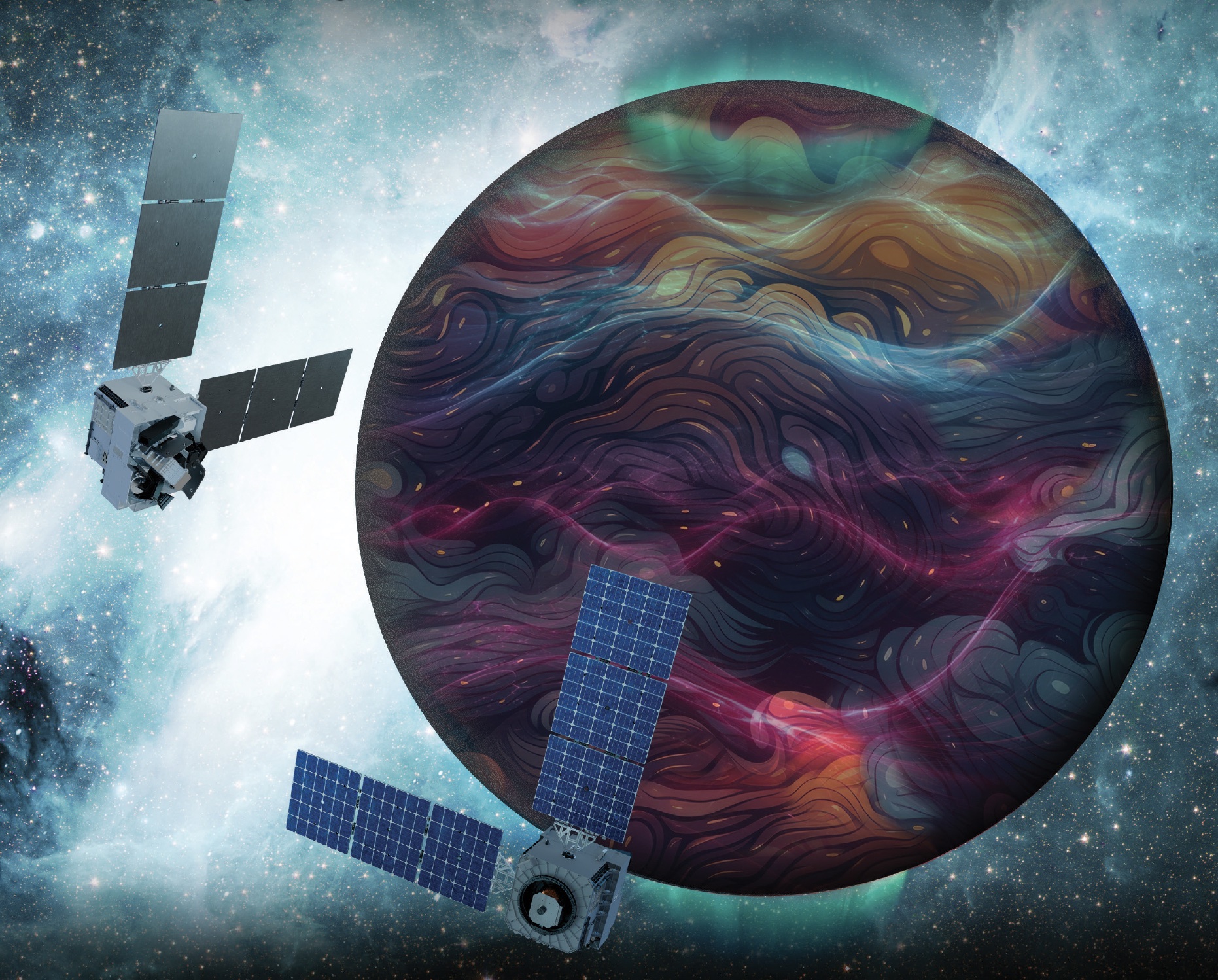
Artist’s rendition of the DAPHNE (Dynamic Atmosphere-Ionosphere Explorer) mission concept.
Artist’s rendition of the DAPHNE (Dynamic Atmosphere-Ionosphere Explorer) mission concept. The coloring represents auroras and atmospheric waves in Earth’s atmosphere.
Credit: Laboratory for Atmospheric and Space Physics/Mary Tostanoski

NASA selected a mission concept to research how space weather and dynamics within Earth’s atmosphere influence the space environment and help improve prediction capabilities for impacts on crucial technology, such as GPS and low Earth orbit satellites, as well as astronauts in space.

The DAPHNE (Dynamic Atmosphere-Ionosphere Explorer) mission will enter Phase B of development, which includes planning and design for flight and mission operations. It will use identical twin satellites to study how changes in Earth’s lower atmosphere influence our planet’s upper atmosphere, where space weather is manifested.

“NASA is advancing the United States’ leadership as a space weather-ready nation, and by providing new insights into Earth’s atmosphere we can better predict and prepare for impacts in our daily lives on Earth and in space,” said Nicky Fox, associate administrator, Science Mission Directorate, NASA Headquarters in Washington. “As NASA sends astronauts beyond Earth’s magnetic protection to the Moon, Mars, and beyond, DAPHNE will join the NASA science fleet strategically located across the solar system to provide data that will help mission planners predict and mitigate the effects of space weather for the benefit of all.”

The DAPHNE mission’s low-risk high-return concept will provide coordinated, multi-point measurements of neutral winds, temperature, and composition in the thermosphere. The ionosphere and thermosphere regions are where Earth’s neutral atmosphere transitions into the ionized plasma of space. In this thin shell that surrounds the planet, the atmosphere is in constant motion, shaped by the influence of solar activity and changes in the lower atmosphere and in near-Earth space.

Fundamental observations and physical insights from the DAPHNE mission will incorporate lower-atmospheric energy data to advance space weather predictive capabilities. The mission is led by Aimee Merkel from the Laboratory for Atmospheric and Space Physics at the University of Colorado, Boulder.

The mission will be subject to a confirmation review in 2027, which will assess the progress of the mission and the availability of funds. If confirmed, the total estimated cost of the mission, excluding launch, will not exceed $250 million in fiscal year 2023 dollars, with a mission launch date of no earlier than 2029.

The DAPHNE mission was proposed as a concept study in response to the DYNAMIC (Dynamical Neutral Atmosphere-Ionosphere Coupling) mission announcement of opportunity. Funding and management oversight for this mission is provided by the Solar Terrestrial Probes program at NASA’s Goddard Space Flight Center in Greenbelt, Maryland.

For more information on NASA’s heliophysics missions, visit:

https://science.nasa.gov/heliophysics

-end-

Abbey Interrante / Karen Fox
Headquarters, Washington
202-358-1600
abbey.a.interrante@nasa.gov / karen.c.fox@nasa.gov

Share

Details

Last Updated
Jun 18, 2026

The post NASA Mission to Study Space Weather Impacts of Earth’s Atmosphere appeared first on NASA Science.

NASA Mission to Study Space Weather Impacts of Earth’s Atmosphere

18 June 2026 at 22:33
Artist’s rendition of the DAPHNE (Dynamic Atmosphere-Ionosphere Explorer) mission concept.
Artist’s rendition of the DAPHNE (Dynamic Atmosphere-Ionosphere Explorer) mission concept. The coloring represents auroras and atmospheric waves in Earth’s atmosphere.
Credit: Laboratory for Atmospheric and Space Physics/Mary Tostanoski

NASA selected a mission concept to research how space weather and dynamics within Earth’s atmosphere influence the space environment and help improve prediction capabilities for impacts on crucial technology, such as GPS and low Earth orbit satellites, as well as astronauts in space.

The DAPHNE (Dynamic Atmosphere-Ionosphere Explorer) mission will enter Phase B of development, which includes planning and design for flight and mission operations. It will use identical twin satellites to study how changes in Earth’s lower atmosphere influence our planet’s upper atmosphere, where space weather is manifested.

“NASA is advancing the United States’ leadership as a space weather-ready nation, and by providing new insights into Earth’s atmosphere we can better predict and prepare for impacts in our daily lives on Earth and in space,” said Nicky Fox, associate administrator, Science Mission Directorate, NASA Headquarters in Washington. “As NASA sends astronauts beyond Earth’s magnetic protection to the Moon, Mars, and beyond, DAPHNE will join the NASA science fleet strategically located across the solar system to provide data that will help mission planners predict and mitigate the effects of space weather for the benefit of all.”

The DAPHNE mission’s low-risk high-return concept will provide coordinated, multi-point measurements of neutral winds, temperature, and composition in the thermosphere. The ionosphere and thermosphere regions are where Earth’s neutral atmosphere transitions into the ionized plasma of space. In this thin shell that surrounds the planet, the atmosphere is in constant motion, shaped by the influence of solar activity and changes in the lower atmosphere and in near-Earth space.

Fundamental observations and physical insights from the DAPHNE mission will incorporate lower-atmospheric energy data to advance space weather predictive capabilities. The mission is led by Aimee Merkel from the Laboratory for Atmospheric and Space Physics at the University of Colorado, Boulder.

The mission will be subject to a confirmation review in 2027, which will assess the progress of the mission and the availability of funds. If confirmed, the total estimated cost of the mission, excluding launch, will not exceed $250 million in fiscal year 2023 dollars, with a mission launch date of no earlier than 2029.

The DAPHNE mission was proposed as a concept study in response to the DYNAMIC (Dynamical Neutral Atmosphere-Ionosphere Coupling) mission announcement of opportunity. Funding and management oversight for this mission is provided by the Solar Terrestrial Probes program at NASA’s Goddard Space Flight Center in Greenbelt, Maryland.

For more information on NASA’s heliophysics missions, visit:

https://science.nasa.gov/heliophysics

-end-

Abbey Interrante / Karen Fox
Headquarters, Washington
202-358-1600
abbey.a.interrante@nasa.gov / karen.c.fox@nasa.gov

Share

Details

Last Updated
Jun 18, 2026

Net Zero Can Never Be Worth it

17 June 2026 at 09:00

With CO2 greening the planet, any possible harms are outweighed by the benefits of more trees and crops. And that's even before you subtract the monumental cost of Net Zero, says Matt Ridley.

The post Net Zero Can Never Be Worth it appeared first on The Daily Sceptic.

NASA Spots Giant Ocean Swell Signaling a Potential El Niño Comeback

Earth Experiencing Extreme High TemperaturesSentinel-6 satellite data shows strengthening warm-water waves in the Pacific, pointing to the likely arrival of El Niño and its global weather impacts later in 2026. Several months before an El Niño develops, large waves of warmer, elevated water travel eastward across the Pacific Ocean. Satellite observations in 2026 have detected several of these waves. [...]

AcuRite admits new app falls short, delays old app’s May shutdown to fix problems

11 June 2026 at 20:08

Smart weather-monitoring device vendor AcuRite has delayed plans to force users onto a new companion app. The transition from My AcuRite to AcuRite NOW, which AcuRite previously set for May 30, “has raised serious questions and concerns among many long-time users,” AcuRite’s VP of product development, Jeff Bovee, told Ars Technica.

AcuRite, whose devices include weather stations, rain gauges, and indoor thermometers, told customers that it would shut down My AcuRite at the end of May. Devices owners would have to use AcuRite NOW, an iOS and Android app launched in June 2025, to control their gadgets instead.

Some long-time users lamented being forced to new software when the current software worked fine, if not better, than the new app. When Ars first reported on AcuRite in May, AcuRite NOW lacked some features of My AcuRite, including the ability to rename multiple temperature sensors, report temperatures in non-integers, as well as an online dashboard option. Users have also highlighted problems uploading data to weather sites and a poor layout with wasted space.

Read full article

Comments

© AcuRite

❌