❌

Normal view

ARK Augmented Reality Could Build Apple’s Knowledge Layer

17 July 2026 at 19:33

ARK augmented reality describes a form of spatial interaction in which artificial intelligence does more than place digital objects in the physical world. It uses knowledge from foundation models to understand unfamiliar scenes, generate useful information and adapt its response to the person, task and environment.

The concept comes from a 2023 research paper titled “ArK: Augmented Reality with Knowledge Interactive Emergent Ability.” Its authors proposed a system that transfers knowledge from large foundation models into new physical and virtual environments. Instead of training an AI agent separately for every room, object or activity, ArK uses existing knowledge memory to interpret what it sees and generate appropriate 2D or 3D content.

Traditional augmented reality places information over reality. ARK augmented reality tries to understand reality before deciding what should appear.

That distinction creates a compelling direction for Apple. Vision Pro already blends digital content with physical space. Apple Intelligence adds language, image understanding and personal context. Visual Intelligence lets users look at objects, text and scenes before asking for information. Siri AI adds a conversational layer. ARKit, RealityKit and visionOS provide the spatial foundation.

Apple now has many of the components required to build a knowledge layer over the physical world.

ARK Augmented Reality Goes Beyond Digital Overlays

Most familiar augmented reality experiences are relatively fixed. A furniture app places a digital sofa in a room. A navigation app displays arrows over a street. A museum app identifies an artwork. A repair app shows where a component belongs.

These experiences can be useful, but they usually depend on predefined content and rules. The system recognizes a known object or location, then presents prepared information.

ARK augmented reality proposes something more adaptive. A knowledge-enabled system could enter an unfamiliar environment, interpret what is present and generate assistance based on a broader understanding of objects, relationships and possible actions.

A user looking at a complicated electrical panel would not only see labels. The system could identify the panel type, explain the purpose of each section, compare the arrangement with standard configurations and warn the user not to touch dangerous components.

A student examining a machine could ask how it works and receive a spatial explanation attached to its real parts. A surgeon could review anatomical information positioned around a medical model. A technician could receive repair guidance even when the exact equipment had not been included in a previous training dataset.

The display becomes less like a floating screen and more like an informed interpretation of the environment.

A cozy living room with a digital interface on Apple Vision Pro displaying a 3D wireframe chair design, superimposed in front of a fireplace and surrounded by modern furniture and warm lighting.
Image Credit: Apple Inc.

Why Apple Is Positioned to Build It

Apple’s advantage would not come from inventing every part of ARK augmented reality. It would come from combining hardware, software, artificial intelligence and personal context into one controlled ecosystem.

Vision Pro already understands rooms, surfaces, hands, eyes and objects well enough to place digital content convincingly in physical space. Its cameras and sensors continuously map the environment while visionOS manages windows, volumes and immersive experiences.

Apple Intelligence provides another layer. Foundation models can interpret language, summarize information, generate content and connect requests with app actions. Visual Intelligence can identify text, images and real-world objects. Siri AI can act as the conversational interface.

The Apple ecosystem also provides personal context that a generic AR platform may not have. Calendar knows the user’s schedule. Maps understands location. Photos contains visual history. Notes and Mail hold project information. Health contains personal trends. Home understands rooms, accessories and automations.

An Apple-built knowledge layer could combine the environment in front of the user with the information already available across trusted devices and apps.

A person preparing for a meeting could look at a conference room and see the agenda, participant names and relevant documents arranged around the table. A traveler could look across a train station and receive directions connected to the correct platform, departure time and digital ticket. A homeowner could examine a room and see live information from temperature, air-quality and energy sensors.

The physical environment becomes the interface.

Vision Pro Is the Laboratory

Vision Pro is the obvious development platform for this idea because it already offers the cameras, displays, sensors and processing required for advanced spatial understanding. Its size and price limit broad adoption, but those same characteristics allow Apple and developers to test experiences that would be harder to build first on lightweight glasses.

ARK augmented reality on Vision Pro could become especially useful in enterprise environments. Apple already promotes the headset for employee training, product design, field service, collaboration and specialized visualization.

A worker could enter an unfamiliar facility and receive contextual instructions attached to real equipment. An engineer could inspect a physical prototype while design changes, performance data and maintenance history appear around it. A new employee could learn a workflow through spatial guidance generated from company manuals and operational knowledge.

The system would not need to display every available fact. It would need to understand which information fits the current task.

That is where AI knowledge becomes more valuable than a traditional AR overlay. Too much information can be as disruptive as too little. A strong system should filter, prioritize and explain rather than cover the room with floating labels.

ARK augmented reality - A modern living room with visionOS virtual reality overlays displays an online store page for a red stool, alongside a 3D modeling preview of the stool positioned on the floor near a fireplace and sleek, modern chair.

The iPhone Could Bring ARK to More People

Vision Pro may be the development environment, but iPhone could provide the scale. The iPhone already combines cameras, LiDAR on Pro models, location, motion sensing, Visual Intelligence and Apple Intelligence.

An iPhone-based ARK experience would be less continuous because users would need to hold up the device. It could still deliver useful knowledge interaction without requiring a headset.

A user could point the camera at a plant and receive care guidance based on its species, visible condition, local weather and placement in the room. Someone assembling furniture could receive generated guidance positioned over the actual parts. A shopper could compare products by looking at them rather than manually searching for each model.

The difference from ordinary visual search would be interaction. The user could ask follow-up questions, change the goal and let the system update the visual guidance.

Future glasses could eventually make the experience persistent. The iPhone would help Apple develop the intelligence, privacy controls and app ecosystem before lightweight eyewear becomes ready.

A World That Explains Itself

The most ambitious version of ARK augmented reality is a world in which information is attached to objects, places and situations only when requested or needed.

A city could become understandable without searching through maps, review sites and separate transit apps. Buildings could reveal history. Streets could explain temporary closures. Restaurants could surface reservations, dietary options and accessibility details. Public transport could show the correct entrance and platform.

Inside a home, Apple’s knowledge layer could explain energy use, identify maintenance problems and guide repairs. In a classroom, physical models could become interactive lessons. In healthcare, patients could receive visual instructions for approved home procedures or medication devices.

The experience would depend on context rather than menus. The user looks, asks and receives information positioned where it belongs.

This is the transition from augmented reality as decoration to augmented reality as understanding.

Privacy Will Decide Whether It Works

A knowledge layer capable of understanding the physical world also creates serious privacy questions. The system may see homes, workplaces, documents, faces, screens and private conversations. The more context it receives, the more useful it becomes. The same access can also make it invasive.

Apple’s privacy architecture could become one of its strongest advantages. On-device processing would allow some scene understanding without sending continuous camera feeds to external servers. Private Cloud Compute could handle more complex requests while preserving stricter controls than an ordinary cloud AI service.

Apple would also need visible controls over what is analyzed, remembered and shared. A user should know when the system is interpreting the environment and whether information is temporary or retained. Workplaces and public spaces would need rules for recording, identification and sensitive data.

ARK augmented reality cannot become socially acceptable if people feel that nearby devices are constantly cataloging them.

The successful version would behave less like surveillance and more like intentional assistance. The user asks for understanding. The system processes only what is needed. The knowledge disappears when the task ends unless the user chooses to save it.

A sleek, black, futuristic virtual reality headset with a smooth, curved design and reflective surface—perfect for exploring the latest Betas—viewed from the front against a white background.
Image Credit: Apple Inc.

Developers Could Build Knowledge Worlds

Apple would not need to create every knowledge experience itself. visionOS, ARKit, RealityKit and App Intents could let developers connect specialized knowledge with physical environments.

A medical company could build guidance for approved equipment. A manufacturer could create spatial maintenance systems. A university could attach interactive explanations to laboratories and museums. A retailer could create product comparisons based on inventory and customer preferences.

Apple could provide the shared intelligence layer: scene understanding, object recognition, language interaction, privacy permissions and spatial presentation. Developers would provide the trusted domain knowledge.

This division would be essential. General AI can explain many things, but professional environments require verified information. A generated answer about a historical building has different consequences from an answer about industrial machinery or medical treatment.

Apple’s platform could distinguish between general knowledge and certified domain sources, allowing users to see where information comes from before acting.

From Spatial Computing to Contextual Computing

Apple describes Vision Pro as a spatial computer because digital content can occupy physical space. ARK augmented reality suggests the next progression: contextual computing.

A spatial computer knows where digital content is placed. A contextual computer understands why the content is useful in that location, what the user is trying to accomplish and which knowledge should appear.

That would connect several Apple strategies that currently look separate. Vision Pro supplies spatial awareness. Apple Intelligence supplies reasoning and generation. Siri AI supplies conversation. Visual Intelligence supplies real-world understanding. The ecosystem supplies personal context.

Together, they could create a system that does not wait for users to open the correct app and search through the correct menu. The environment itself becomes the starting point.

Apple’s opportunity is to make that interaction restrained rather than overwhelming. The company does not need to cover reality with digital noise. It can use design, privacy and contextual intelligence to make information appear only when it improves the moment.

ARK augmented reality offers a useful description of that future. Reality remains visible. Knowledge becomes interactive. The computer begins to understand the world in front of the user instead of asking the user to translate everything into a search box.

The post ARK Augmented Reality Could Build Apple’s Knowledge Layer appeared first on AppleMagazine.

visionOS 27: The MacStories Beta Preview

13 July 2026 at 22:45

Summer beta season is in full swing, with a new wave of testers coming aboard via the just-released public OS 27 betas. While visionOS hasn’t ever been included in the public beta program, now is as good a time as any to check in on visionOS 27. What’s it like living with the features Apple highlighted at WWDC, and if you’re jumping on the public betas with your other devices, is it a good time to give the visionOS 27 developer beta a try, too? Let’s dig in and find out.

Siri AI

Given the massive overhaul Siri is receiving this year and the fact that the Vision Pro has always been a little behind when it comes to Apple Intelligence features, I didn’t expect visionOS to get the full Siri AI treatment this year. Thankfully, I was wrong. Not only is Siri AI fully present in visionOS 27, but the experience of interacting with the assistant has even been adapted to fit a spatial context.

For starters, Siri is much more capable in visionOS 27 than ever before. It’s not just for opening apps anymore. With access to your personal context, Siri can handle tasks I would have never imagined prompting it for until now. Questions like, “When was the last time I ate at this restaurant?” or, “How many years in a row have I attended this local event?” used to lead me down time-intensive rabbit holes of scavenging emails, texts, calendar events, photos, and more. Now, Siri can pull all of that information for me and answer the question in just a few seconds.

That “in a few seconds” bit is important. At least this point in the beta cycle, every request I give the assistant takes some time. Even tasks like checking my calendar and opening apps have a bit of lag to them on my M2 Vision Pro. This seems to be a side effect of Siri’s new architecture: it can do more, but parsing input, coordinating resources, and performing tasks takes a little longer than you might expect.

Of course, Siri has access to world knowledge now, too. We’ve all run into the classic, “Here are some web results for you,” response when asking Siri a question it considers too complex to answer itself, but those canned responses are no more. Now, Siri can dive into its (scraped) trove of knowledge to answer questions about pretty much any topic: history, science, pop culture, and more. Siri is the all-knowing bot we’ve always wanted it to be; just be sure to double-check its answers because, as Siri will remind you, AI can get things wrong.

Interacting with Siri in visionOS 27 is a whole new experience. The purple, blue, and green sphere evocative of Siri’s previous era (before all of Apple’s other platforms switched to the rainbow outline UI that never came to visionOS) has been replaced with a semi-translucent glowing white orb matching the Siri aesthetic on iOS, iPadOS, and macOS. The circular “thinking” animation mimics what you see when you interact with Siri on other devices, too, making for a much more cohesive cross-device experience.

When you invoke Siri via voice, the orb appears with a window above it displaying the text of your conversation. You can grab the window and place it anywhere in your environment. To continue the conversation, you simply look at the Siri UI and start speaking again. It all feels very natural, and I appreciate the way you can converse with Siri while interacting with other windows in objects in visionOS, a task that doesn’t translate as well to Apple’s other platforms. For those on the M5 Vision Pro, Siri has a new, more natural voice with customizable speed and expressivity as well, though my M2 model isn’t capable of running the local model necessary to power these changes and the improved dictation system.

visionOS 27 also includes a gesture for activating Siri that’s a little nostalgic. If you hold your palm open and upward then look at it, you’re present with a Home button as before. But if you pinch and hold the Home button, a tiny Siri UI will appear above it, just like in the old days when iPhones had physical Home buttons. You have to hold your fingers together the whole time you’re speaking to Siri, which seems a bit strange to me, but once you’ve made your initial request, the standard Siri UI appears, and you can carry on as usual.

The new version of Siri also brings Visual Intelligence to the Vision Pro for the first time. You can ask Siri about the content of a virtual window or objects in your real-world environment. When Visual Intelligence is activated, the system displays a very cool animation of your environment being scanned, and then, Siri can use what it sees to answer your questions. I’ve used this to ask Siri about webpages, documents I’m working on, and items I see around me, and it’s very cool to have an always-available digital assistant who can see what I see. It did a great job identifying my water bottle and then pulling up the receipt from my email to let me know how old it was, which I found to be a great combination of Visual Intelligence with my personal context.

There’s also a new Siri app that contains a history of all your conversations with the assistant, including those synced from other devices. On visionOS, the Siri app is a horizontally-scrolling list of glassy cards that reminds me a lot of the Spatial Gallery app. It’s a handy way to pick back up on conversations started elsewhere, search for a previous answer, or simply interact with Siri via keyboard rather than voice.

At WWDC, Apple showed off a Siri mode where the orb persists in your environment, waiting for you to look at it and start a conversation. I have not been able to get that method to work yet. Once I start a conversation with Siri, I can keep the conversation window open and place it anywhere, but that’s not the same as having a small Siri UI sitting on my desk out of the way until I need it. I’ll keep my eyes peeled for it in future beta releases.

Siri AI is marked for release “later this year” (as opposed to the OS 27 updates listed as coming “this fall”), so there are still some rough edges to work out. Sometimes, conversations simply stop, with Siri telling me an error occurred. The Siri conversation UI will sporadically disappear, and I have to force quit the Siri app to get it to show up again. And Visual Intelligence sometimes struggles to understand what I’m trying to get it to look at, focusing on the wrong window or even the keyboard. But that’s beta life for you; it’s what I signed up for, and I’m trusting it will all be worked out before the public release.

Beta UI bugs aside, Siri AI is a huge upgrade for Apple’s digital assistant, and I’m happy to see visionOS getting the first-class treatment here. It isn’t simply ported over from iOS. It’s been carefully adapted for a spatial UI, and it makes for a powerful overall experience.

There is one other major way Siri differs on visionOS from other platforms: it hasn’t been integrated with Spotlight Search. For now, at least, the search feature on visionOS is dedicated to finding apps, app content, and web results, without even an ‘Ask Siri’ button in sight. With so many other ways to interact with Siri on the platform, it might make sense to keep it separate from search, but it’s certainly an oddity given the way the two features have been merged on every other platform. I’m still trying to figure out if I find this a helpful separation or a missed opportunity for cross-device cohesion.

Panoramas and Environments

There’s a lot more to visionOS 27 than just AI. Big changes are coming to panoramas, including the ability to act as persistent Environments. And, of course, Apple has to throw in a new Environment of its own, too.

Over the past couple of years, Apple has continually pushed the capabilities of its spatial photo conversion technology. Last year, that came in the form of spatial scenes across all of the company’s platforms, and this year, it’s coming to panoramas. In visionOS 27, you can convert panoramas into spatial scenes, adding layers of depth and perspective to the already stunning experience of viewing panoramas on the Vision Pro.

Being immersed in panoramic photos in visionOS was already breathtaking. This takes it to a whole new level. Experiencing memories in deeper ways than I ever thought possible is one of my favorite uses for the Vision Pro, and now, I can use it to revisit places I’ve been and feel like I’m standing there once again.

The system takes this experience one step further by allowing you to set panoramic spatial scenes as custom Environments. In the Environments view, there’s a new folder called My Environments where you can add up to 34 panoramas from your photo library and use them as immersive backgrounds for your content. You can even adjust the immersion level to make the photo wrap around you.

I love that we now have the option to use our own photos as Environments, but it does come with some tradeoffs. Panoramic photos are static, so they don’t have the subtle motion elements that make Environments feel alive. They also don’t expand as far vertically as Environments do, which means you’re likely to see your real-world surroundings if you look up or down. Still, this is the first time visionOS users have been able to set their own custom Environments using their own photos or images purchased online, so it’s a win. It’s definitely inspired me to start taking more panoramas than I did before.

The new built-in Thórsmörk Environment is gorgeous. Apple always knows how to pick the perfect spot. Between the snow, the slow-moving river, and the aurora borealis in the sky at night, it offers a beautiful, peaceful place to relax, watch a movie, or trick your mind into cooling off on a hot summer’s day.

Safari

Spatial browsing is continuing to mature in visionOS 27, this time with the help of curved windows. Safari is one of the few built-in apps – Freeform and TV being the others – that are receiving special curved window modes this year, similar to what we’ve seen in the past with Mac Virtual Display. When a window is expanded beyond a comfortable width for side-to-side viewing, it automatically starts to curve, wrapping around the user’s head to make it easier to take in the window’s contents.

To be honest, I’m not sure how useful curved windows will be for browsing normal websites. While some, such as Apple’s OS Overview page are optimized to display content like image galleries at such wide aspect ratios, most sites don’t expand beyond a certain point, displaying blank space on either side of a centered column of content. Perhaps that will change with time, but for now, I don’t foresee these ultra-wide windows catching on for single-tab browsing.

Where the curved Safari window does shine, though, is in the browser’s new multi-tab view. A new button on the right side of the tab bar activates the view, which displays all open tabs side by side in a horizontally-scrolling curved window. These aren’t previews, either. Each tab can be scrolled, navigated, interacted with, and even closed as it if it were an independent browser window.

I’ve already found numerous use cases for this view in my own workflows: editing article previews, comparing product pages, and reviewing multiple research sources at once, just to name a few. Displaying multiple tabs at once in a large, ergonomic window view makes for a fantastic interaction method that I think could apply far beyond Safari webpages and sports multiviews in TV. I imagine this feature will be used far more than last year’s spatial browsing.

Apple Intelligence can sort your bookmarks and Reading List entries based on topic if you like, though the automatic tab sorting feature present on other platforms is curiously missing. Personally, I like managing my own tabs anyway, but add that feature to the long list of strange feature parity omissions on visionOS along with Focus filters, photo editing, and – as of the current beta – Describe a Shortcut.

Platform Improvements

There’s no doubt that this is a refinement year for Apple’s platforms beyond AI. The company is taking the opportunity to revisit and optimize OS features that have long been considered mature, and that’s the case even for visionOS, a relative newcomer.

The time it takes the Vision Pro to connect to Wi-Fi upon power-up has been reduced significantly. Given the device’s short battery life and tendency to go into deep sleep when not in use, this is a quality-of-life change that you’re going to feel. When I turn my M2 Vision Pro on, I can’t log in quickly enough to open Safari or the TV before it’s connected to the Internet. That definitely was not the case before visionOS 27, and I appreciate it.

I’ve long been on the record as a critic of the notification system on visionOS, but it’s taking a big leap forward this year with expanding notifications. When an app icon appears at the top of your view to alert you to a notification, you expand it with your gaze and actually see what you’re being notified about. You can even long-press a Messages notification to reply directly without the need to open the full app, which is so convenient. And with any app, just seeing notifications in full without losing the context of what I’m doing is a major improvement.

Unlike notifications, I was a fan of the redesigned Control Center in visionOS 26. Alas, Control Center has been redesigned again, now featuring a three-column layout instead of a single window. I’m still getting used to the new look, but it does make sense conceptually to split different types of controls into separate columns, so I’m hoping this will make the feature more intuitive once I’ve adapted to it. Regardless of any other efficiency wins, though, this redesign gets my approval simply because it finally brings the AirPlay menu to the top level of Control Center, saving me an extra tap every time I want to switch sound output to my AirPods.

Sharing screenshots and videos from visionOS is going to be much easier thanks to high-quality screen recordings, which can be enabled in the Settings app. Now, the Vision Pro can take unfoveated videos of its screen for up to three minutes, as well as full-quality screenshots. In the past, on-device screen recordings were fuzzy outside of the viewer’s focus, resulting in a poor representation of the visionOS experience and requiring a Developer Strap and Xcode on a Mac as a workaround. This change alone is going to make my review process much simpler, and it’ll make it easier for all Vision Pro users to show others what using the device is like.

visionOS 27 now supports extra-small widgets, which are basically Lock Screen widgets brought to life in the user’s space. Like any other spatial widget, they can be placed on a wall or a horizontal surface such as a desk, and they are entirely customizable. Apple is introducing its own extra-small Mac Virtual Display widget for starting up a virtual connection with a Mac even if it’s asleep. Extra-small widgets take up much less space on a desk than even small ones, and there are already a bunch of them available from iPad apps running on the Vision Pro, so I think they’re going to be very useful.

Finally, there are some other Mac Virtual Display improvements included in visionOS 27. Virtual Display sessions can optionally persist even when you take your Vision Pro off, and macOS can stream spatial previews of 3D objects directly to visionOS with instant updates and two-way editing. I don’t have a Mac running Golden Gate yet, so I haven’t been able to try these features myself, but I plan to soon. If you work with 3D objects on your Mac and Vision Pro, I imagine this will speed up your workflow significantly.


And that’s visionOS 27 – so far, at least. There’s a still a lot more summer left: bugs to be squashed, refinements to be made, and third-party apps to be updated and introduced. My experience with the new version up to this point has been very positive, and I think it’ll make for a great update.

If you want to try out some of these features early, you can enroll in the Developer Beta anytime in the Software Update section of the Settings app. Whether you upgrade now or hold off for the public release, Apple’s got some great things in store with visionOS 27, and I look forward to continuing my testing over the summer in preparation for a full review this fall.

Qué pasa con los niños superdotados al crecer

16 July 2026 at 12:49
Durante décadas se asumió que el genio infantil acababa en aislamiento o crisis. Un seguimiento de cuatro décadas y un metaanálisis de neuroimagen cuentan una historia distinta.

Cómo afecta el calor al desarrollo cerebral del bebé

14 July 2026 at 20:22
Un reciente estudio de cohorte prospectiva asocia la exposición al calor durante el embarazo y la infancia con un desarrollo más lento del tálamo, una estructura clave para la conducta adolescente.

La recuperación tras un infarto mejora cuando la pareja se involucra

18 December 2025 at 11:00
Pareja de ancianos caminando juntos al aire libre, apoyándose mutuamente y mostrando cercanía y bienestar emocional.

Una relación de pareja sólida y de apoyo no solo mejora el bienestar emocional, sino que puede influir de forma directa en la recuperación del corazón tras un infarto u otra patología cardiovascular, según un amplio análisis científico reciente.

Cuando una persona sufre un infarto de miocardio o es diagnosticada con una enfermedad cardíaca, el impacto va mucho más allá del daño físico inmediato. El miedo, la incertidumbre y los cambios bruscos en la vida cotidiana afectan tanto al paciente como a quien comparte su día a día. Durante décadas, la cardiología ha puesto el foco casi exclusivamente en el tratamiento médico individual, pero una nueva revisión científica plantea que este enfoque deja fuera un elemento clave del proceso de recuperación: la relación de pareja.

La evidencia, publicada en Canadian Journal of Cardiology, una revista médica internacional de referencia en el ámbito de la cardiología, sugiere que el vínculo emocional y el apoyo mutuo dentro de una relación estable pueden convertirse en un auténtico factor protector del corazón. No se trata solo de sentirse acompañado, sino de un efecto medible sobre los hábitos de vida, la salud mental y, en última instancia, los resultados cardiovasculares.

Una mirada más amplia a la rehabilitación cardíaca

Las enfermedades cardiovasculares siguen siendo la principal causa de muerte a nivel mundial. A pesar de los avances en fármacos, técnicas quirúrgicas y programas de rehabilitación, las tasas de recaídas y las dificultades para mantener cambios de estilo de vida saludables continúan siendo un desafío. En este contexto, un grupo de investigadores canadienses decidió analizar de forma sistemática qué ocurre cuando la pareja del paciente se involucra activamente en el proceso de recuperación.

El equipo revisó decenas de estudios centrados en las llamadas intervenciones de pareja, programas diseñados para incluir tanto al paciente como a su compañero o compañera sentimental en la rehabilitación cardíaca. Los resultados fueron consistentes: en el 77 % de los estudios analizados se observaron mejoras claras en comportamientos clave como la alimentación saludable, la actividad física regular y la adherencia correcta a la medicación prescrita.

Además de estos cambios conductuales, los investigadores encontraron beneficios tanto en la salud cardiovascular como en el bienestar psicológico de los participantes. La calidad de la relación, la comunicación y el apoyo emocional emergieron como factores estrechamente ligados a un mejor pronóstico.

Heather E. Tulloch, psicóloga de la salud del University of Ottawa Heart Institute y una de las autoras del análisis, subraya la relevancia de estos hallazgos. “Desde hace tiempo sabemos que la calidad de una relación influye en la salud del corazón”, explica. “Lo que resulta sorprendente es lo poco que los programas de rehabilitación se han centrado realmente en la pareja como parte activa del tratamiento”.

Cuando la enfermedad afecta a dos personas

Un evento cardíaco agudo no es una experiencia aislada que afecte solo a quien lo sufre físicamente. La pareja suele vivir el episodio con una intensidad emocional similar, marcada por el miedo a la pérdida, la ansiedad ante el futuro y la necesidad de asumir nuevos roles. En muchos casos, quien acompaña al paciente se convierte de repente en cuidador, apoyo emocional y gestor de la vida cotidiana.

Según Tulloch, esta transformación puede tener efectos ambivalentes. “A veces, una crisis cardíaca fortalece el vínculo”, señala. “Pero con frecuencia introduce tensiones importantes: cambios en la dinámica de la pareja, preocupaciones económicas, estrés constante y una sensación de vulnerabilidad que no siempre se sabe cómo manejar”.

Estos factores emocionales no son secundarios. El estrés crónico, la ansiedad y la depresión están bien documentados como elementos que pueden interferir en la recuperación cardiovascular. Ignorarlos supone dejar sin atender una parte esencial del proceso de sanación.

Las cifras ayudan a dimensionar la magnitud del problema. En Canadá, uno de cada doce adultos mayores de veinte años vive con una enfermedad cardíaca, lo que equivale a unos 2,6 millones de personas. En la Unión Europea, las patologías cardiovasculares son responsables de aproximadamente un tercio de todas las muertes y constituyen la causa de uno de cada cinco fallecimientos antes de los 65 años. Detrás de cada uno de estos casos suele haber una pareja o una familia que también carga con el impacto de la enfermedad.

El papel activo de la pareja en la salud del corazón

Las intervenciones centradas en la pareja parten de una idea sencilla pero poderosa: el entorno más cercano del paciente influye de forma decisiva en su comportamiento diario. La persona con la que se comparte el hogar suele participar en la compra de alimentos, la preparación de las comidas, la organización del tiempo libre y la gestión de las rutinas médicas. Integrar a la pareja en la rehabilitación permite alinear objetivos y crear un entorno coherente con las recomendaciones médicas.

En la práctica, estos programas fomentan que ambos miembros adopten hábitos más saludables. Cocinar de forma equilibrada deja de ser una obligación individual y se convierte en una decisión compartida. Salir a caminar o realizar ejercicio moderado pasa a ser una actividad conjunta, no una carga solitaria. Incluso la toma regular de la medicación se ve reforzada cuando existe un apoyo cercano y constante.

Los estudios analizados muestran que este enfoque no solo mejora la adherencia a largo plazo, sino que reduce la sensación de aislamiento del paciente. Al mismo tiempo, la pareja se siente parte del proceso, con un rol definido y reconocido por los profesionales de la salud.

No menos importante es el beneficio para quien acompaña. Diversas investigaciones indican que las parejas de pacientes cardíacos suelen compartir factores de riesgo similares, como sedentarismo, dieta poco saludable o niveles elevados de estrés. Al participar activamente en la rehabilitación, también reducen su propio riesgo cardiovascular.

Más allá de los hábitos físicos

A pesar de los resultados alentadores, los autores del análisis advierten que todavía existen lagunas importantes en el conocimiento. La mayoría de los programas se han centrado en los cambios de comportamiento físico, mientras que los aspectos emocionales y relacionales han recibido menos atención sistemática.

La calidad de la comunicación, la gestión de los miedos compartidos y el impacto de la enfermedad en la intimidad son elementos que influyen tanto en la relación como en la recuperación. Sin embargo, estos factores no siempre se evalúan de forma rigurosa en los estudios clínicos.

“Sabemos que las emociones y la relación importan, pero aún no medimos lo suficiente cómo cambian ni cómo influyen a largo plazo”, señala Tulloch. Para los investigadores, incorporar evaluaciones psicológicas y relacionales más completas permitiría diseñar intervenciones más eficaces y adaptadas a las necesidades reales de cada pareja.

Este enfoque encaja con una tendencia más amplia en la medicina contemporánea, que busca avanzar hacia modelos de atención centrados no solo en el paciente, sino también en su entorno familiar y social. En el caso de las enfermedades crónicas, esta perspectiva resulta especialmente relevante.

Hacia un modelo de atención escalonada

Uno de los principales aportes del trabajo es la propuesta de un modelo de atención escalonada dentro de la rehabilitación cardíaca. Este planteamiento sugiere que las parejas sean evaluadas de forma sistemática para detectar niveles elevados de estrés, síntomas de ansiedad o dificultades en la relación.

En función de los resultados, se podría ofrecer desde información básica y apoyo educativo hasta intervenciones psicológicas más especializadas. De este modo, los recursos se ajustarían a las necesidades concretas de cada caso, evitando tanto la sobrecarga del sistema como la falta de apoyo en situaciones de mayor vulnerabilidad.

El equipo investigador insiste en la importancia de que futuros estudios incluyan a poblaciones diversas y tengan en cuenta variables como la edad, el contexto socioeconómico y el tipo de relación. También subrayan la necesidad de medir de forma conjunta los resultados en ambos miembros de la pareja, y no solo en el paciente.

“Tenemos que dejar de tratar el corazón como un órgano aislado”, afirma Tulloch. “Cuidar la relación puede generar nuevos hábitos saludables, fortalecer la resiliencia mental y ofrecer un impulso adicional a la recuperación cardíaca. Al final, se trata de mejorar la salud de dos personas y del vínculo que las une”.

La evidencia acumulada apunta en una dirección clara: el amor y el apoyo mutuo no sustituyen a los tratamientos médicos, pero pueden convertirse en un complemento poderoso. Integrar la dimensión relacional en la cardiología moderna no solo humaniza la atención, sino que abre una vía prometedora para mejorar los resultados de una de las enfermedades más extendidas y letales del planeta.

“Shadow Blaster” Galaxy Might Have Sent High-Energy Neutrino to Earth

18 June 2026 at 13:00

A star-forming galaxy in the early universe might have sent a ghostly particle known as a neutrino crashing into the ice at Earth’s South Pole, after an 11 billion-year journey through space.

The post “Shadow Blaster” Galaxy Might Have Sent High-Energy Neutrino to Earth appeared first on Sky & Telescope.

Experts Warn of Potential Covert Misuse of Fusion Reactors—Antineutrino Detectors Could Offer a Safeguard, New Research Reveals

16 June 2026 at 14:45

While nuclear fusion holds promise for revolutionizing energy systems of the future, many scientists are also concerned about its potential misuse for secretive weapons development.

Fortunately, a team of physicists at Virginia Tech has a plan for preventing that before it happens, which utilizes an existing variety of particle detection to spot and track down such illicit nuclear development before it becomes a major concern.

The team, led by Virginia Tech researcher Patrick Huber, says that antineutrino detectors could hold the key to preventing misuse of nuclear fusion, as described in new research published in Physical Review Applied.

Antineutrino Detection

Fusion reactors generate large quantities of energy by fusing hydrogen nuclei, which results in powerful neutron emissions. This makes such systems ideal for energy production, since they aren’t reliant on the same kinds of materials used in weapons production.

Still, there are potential concerns, since the neutrons produced by fusion reactors could potentially be used to convert uranium-238—the most common isotope of uranium found in nature—into plutonium-239. The latter isotope is the primary fissile component used in the production of nuclear weapons (along with another variety of uranium isotope: uranium-235).

Given the abundance of uranium-238, scientists warn of the potential for seemingly innocuous fusion reactors being used for the generation of plutonium-239. The only way to prevent this from happening is the use of monitoring systems that could detect such activity.

Fortunately, such detection systems already exist.

The Hunt for Illicit Plutonium Production

According to Huber and his team, antineutrino detectors could hold the key to overcoming this problem.

As one of the byproducts of nuclear reactions, antineutrinos—the very low-mass, chargeless neutrino variants (essentially the antimatter counterparts of neutrinos) can neither be blocked using shielding, nor can they be produced by any known non-nuclear processes.

Because of this, they offer a perfect source for detecting nuclear power generation, including those being operated covertly by any potential bad actors.

The Footprints of Antineutrinos

Given the antineutrino “footprint” produced by the fusion process, Huber and his colleagues used simulations to determine if the signal produced by uranium-238’s absorption of neutrons, which releases antineutrinos as they become split into smaller nuclei, compared with normal nuclear reactor operation. They also used their simulations to make comparisons to another known source of antineutrinos: emanations coming from space.

“We find that even a relatively small detector should be able to confirm production rates of a few kilograms of plutonium over 30 days, despite the cosmogenic background and the antineutrino emissions associated with neutron activation of reactor components,” Huber and the team write in their new paper.

Any such detector could also be operated at a considerable distance from the source reactor, which would make such detection systems practical for use at various facilities.

Fundamentally, the team believes the method their work describes could greatly promote efforts to curb the proliferation of illicit nuclear systems for use in making weapons.

The findings were reported in the recent paper, “Detectability of covert fissile material production in nuclear fusion reactors via antineutrino emissions,” by Patrick Huber and co-authors Alexander Glaser and Robert J. Goldston, which appeared in Physical Review Applied on June 2, 2026.

Micah Hanks is the Editor-in-Chief and Co-Founder of The Debrief. A longtime reporter on science, defense, and technology with a focus on space and astronomy, he can be reached at micah@thedebrief.org. Follow him on X @MicahHanks, and at micahhanks.com.

JUNO’s First Results Bring the Neutrino Mass Mystery Into Focus

16 June 2026 at 12:58
Particle Collision Neutrino ConceptJUNO’s first results have launched a new era of precision neutrino physics and brought scientists closer to solving the neutrino mass mystery. The Jiangmen Underground Neutrino Observatory (JUNO) has achieved its first major scientific milestone. On June 10, its debut physics result was featured as a cover article in Nature. Using 59 days of high-quality [...]

Tráfico humano, exploração digital e crime organizado: Como funcionam as “fábricas” de burlas online?

11 June 2026 at 18:59

Ao TEK Notícias, Montse Ferrer, co-diretora regional do Gabinete do Leste e Sudeste Asiático e do Pacífico da Amnistia Internacional, explica como funcionam as “fábricas” de burlas online no Camboja, onde vítimas são “recrutadas” sob falsas promessas de emprego e forçadas a participar em esquemas de fraude.

The post Tráfico humano, exploração digital e crime organizado: Como funcionam as “fábricas” de burlas online? appeared first on Tek Notícias.

Monthly Roundup: Investigating Active Galactic Nuclei

30 March 2026 at 17:00

composite image of the active galaxy Centaurus A

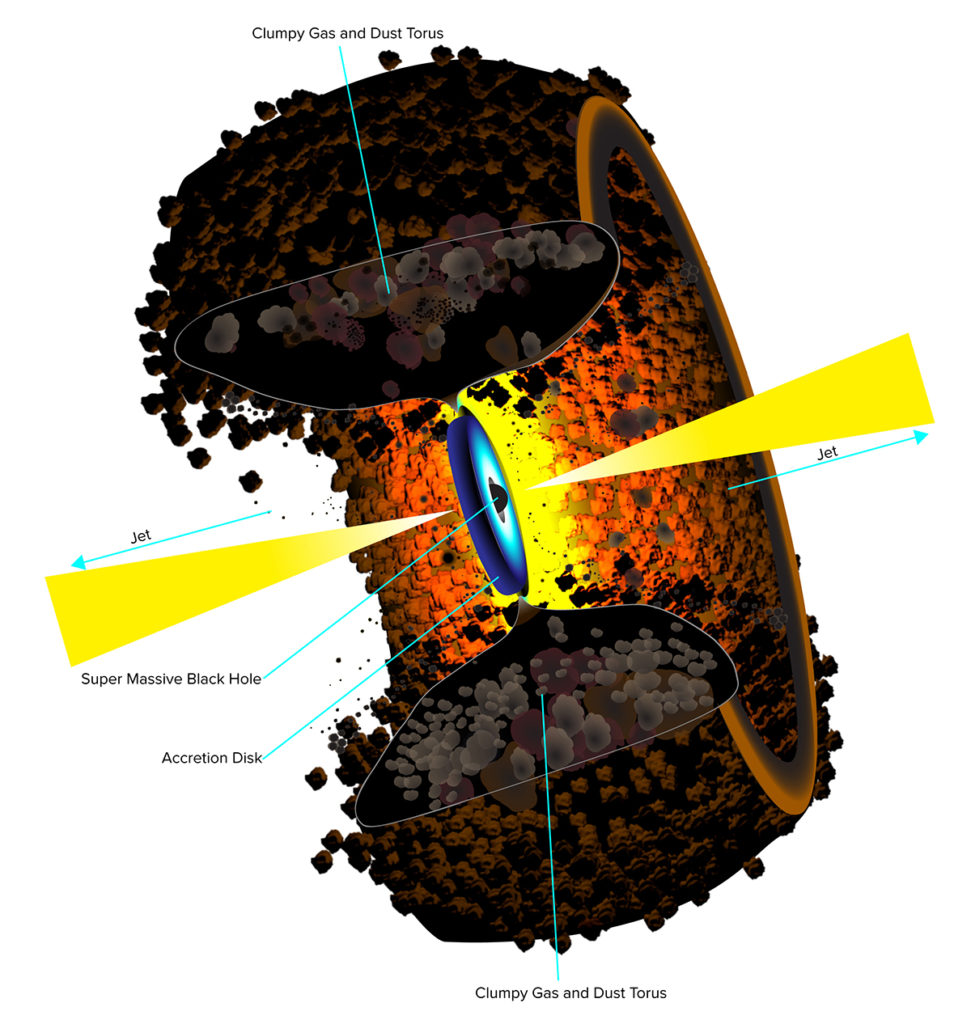
Many galaxies, including our own, have a central supermassive black hole. In certain galaxies, gas becomes ensnared in the black hole’s gravitational pull and collects in a disk that feeds the black hole, forming an active galactic nucleus (AGN). An AGN can feast on this disk of gas and dust for millions to billions of years — glowing across the electromagnetic spectrum, brandishing relativistic jets, and creating a brilliant, variable light show visible from billions of light-years away.

Today’s Monthly Roundup investigates the connection between AGNs and neutrinos, considers the question of AGN variability, and explores modeling techniques for relativistic environments.

A Search for Neutrinos from X-Ray-Bright AGNs

Where do neutrinos — neutral, nearly massless elementary particles — come from? AGNs have emerged as one likely source; in 2022, the IceCube collaboration reported evidence for neutrinos from the nearby galaxy Messier 77, which hosts an X-ray-bright AGN, and earlier observations potentially linked a neutrino to the blazar TXS 0506+056.

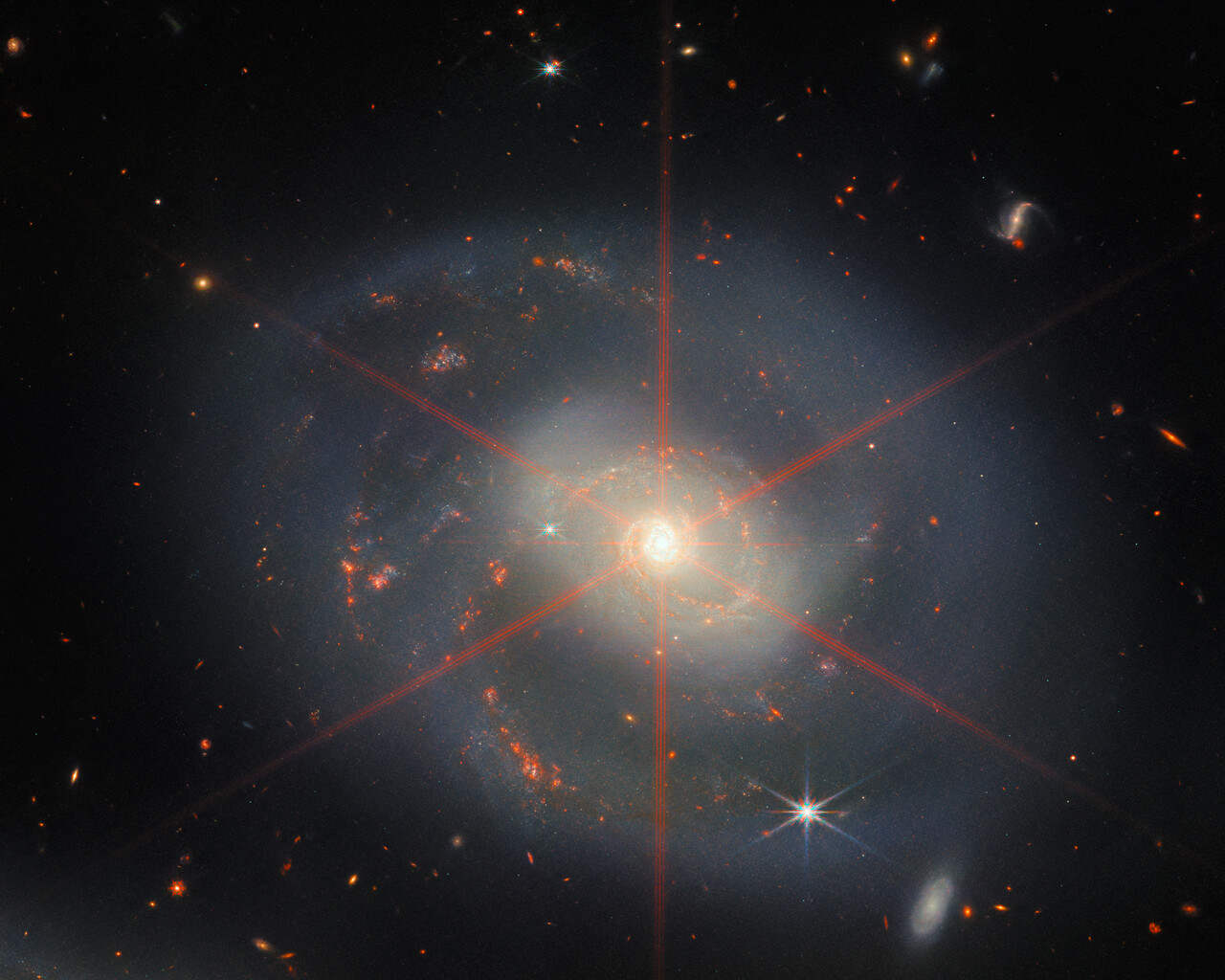
NGC 7469

The spiral galaxy NGC 7469, shown here in this JWST image, contains an AGN that may be a source of neutrinos. [ESA/Webb, NASA & CSA, L. Armus, A. S. Evans; CC BY 4.0]

To investigate the possible connection between neutrinos and X-ray-bright AGNs, the IceCube collaboration performed a dedicated search for neutrinos toward a collection of X-ray-bright AGNs in the northern sky. The team’s initial analysis confirmed that Messier 77 is the strongest source of neutrinos in that area. Focusing specifically on X-ray-bright AGNs with hard X-ray fluxes at least 20% of Messier 77’s flux — 47 AGNs in total — the team found evidence for a possible neutrino excess toward 11 of the galaxies, with NGC 7469 being the strongest candidate.

This result suggests that X-ray-bright AGNs are indeed a plausible source of neutrinos. As for the specific physical origin of these AGN-generated neutrinos, the data provide a few clues. The X-ray emission of an AGN is thought to arise from a billion-degree cloud of plasma called the corona. The interaction of coronal X-rays with high-energy protons is thought to produce neutrinos in the energy range of 1–10 teraelectronvolts — roughly the energies of the neutrinos associated with Messier 77 in this study. However, NGC 7469 was associated with neutrinos more energetic than this range, suggesting that not all AGN-produced neutrinos have a coronal origin. Thus, though the body of evidence suggesting that X-ray-bright AGN are a source of neutrinos, the precise mechanism through which these neutrinos are produced remains unknown.

diagram of the unified model of active galactic nuclei

A diagram of the unified model of active galactic nuclei, showing an accretion disk, dusty torus, and jets. Click to enlarge. [B. Saxton NRAO/AUI/NSF; CC BY 4.0]

Disk or Jet: Which Varies More?

If there’s one constant when it comes to AGNs, it’s change; observations show that the emission from active galaxies varies on timescales from minutes to decades. Though both the accretion disk and the jet contribute to the overall multiwavelength behavior of an AGN, it’s not yet clear which of these structures is a greater contributor to an AGN’s variability.

Vineet Ojha (Peking University) and coauthors considered AGN variability at optical and mid-infrared wavelengths. Ojha’s team collected a sample of AGN that lie at similar redshifts and fall into one of three categories: narrow-line Seyfert 1 galaxies detected in gamma rays, narrow-line Seyfert 1 galaxies not detected in gamma rays, and broad-line Seyfert 1 galaxies detected in gamma rays. These three classes are distinguished by the presence or absence of relativistic jets as well as their accretion rate; gamma-ray-detected Seyfert 1s likely host jets, and narrow-line Seyfert 1s likely have higher accretion rates than broad-line Seyfert 1s.

Using optical data from the Zwicky Transient Facility and mid-infrared data from the Wide-field Infrared Survey Explorer, the team separated statistical wiggles from true variability and determined which sample of AGNs was most variable. They found that broad-line AGNs detected in gamma rays are the most variable, suggesting that jets are major contributors to AGN variability. Narrow-line AGNs detected in gamma rays are next in line, likely because these AGNs have jets but also have a strong thermal emission component from their accretion disks due to their high rate of accretion. Narrow-line AGNs not detected in gamma rays are the least variable, lacking a jet and dominated by thermal emission. Taken together, these results suggest that AGN variability is mostly jet driven, with some contribution from accretion disk instabilities.

More on AGN Jets: The Slow-Light Effect

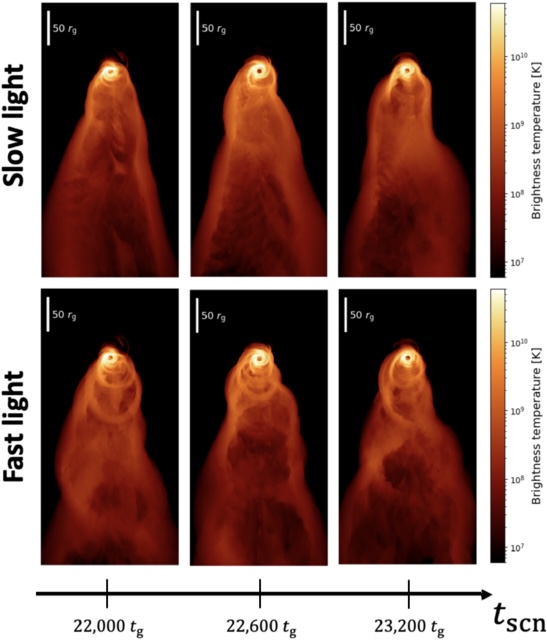
The galaxy Messier 87 (M87) hosts one of the most studied AGN jets. M87’s jet is visibly structured, and it exhibits superluminal motion, in which the relativistic plasma appears to move faster than the speed of light. Because the plasma accelerated by an AGN moves so quickly, researchers attempting to model this plasma may opt to use the slow-light approach, in which the evolution of the ambient plasma is modeled simultaneously with the propagation of light through the medium. Though more computationally intensive than the fast-light approach, in which photons zip through a static medium, slow-light techniques are needed in regions of relativistic flows or strong acceleration.

comparison of slow light and fast light results for M87's jet

Comparison of the jet morphology from the slow-light (top row) and fast-light (bottom row) methods. [Adapted from Tsunetoe et al. 2026]

Yuh Tsunetoe (Chinese Academy of Sciences; University of Tsukuba) and collaborators demonstrated their use of the slow-light approach in models of M87’s jet-launching region, where plasma is accelerated to relativistic velocities. The team performed general relativistic magnetohydrodynamics simulations of the accretion disk and jet from M87’s supermassive black hole and compared the results from slow-light and fast-light methods.

The team found that slow-light images tended to be smoother, lacking the looping, helical structures within the jet seen in fast-light images. Slow-light images show more evidence for the superluminal motion that is observed in relativistic jets like M87’s, as well as greater limb brightening and less wobbling motion. The team also investigated the effects of changing the black hole spin, finding greater wobbling in the jet for slow black hole spins and a straighter, wider jet for rapid black hole spins. Overall, Tsunetoe and coauthors found that the slow-light approach generated images that are more consistent with the properties of M87’s jet, demonstrating that the slow-light approach is necessary to capture the behavior of relativistic jets.

Citation

“Evidence for Neutrino Emission from X-Ray-Bright Active Galactic Nuclei with IceCube,” R. Abbasi et al 2026 ApJL 1000 L26. doi:10.3847/2041-8213/ae4aad

“The Relative Contributions of Accretion Disk Versus Jet to the Optical and Mid-Infrared Variability of Seyfert Galaxies,” Vineet Ojha et al 2025 ApJ 994 84. doi:10.3847/1538-4357/ae0a38

“Slow-Light Effect in the Jet-Launching Region of M87,” Yuh Tsunetoe et al 2026 ApJ 1000 29. doi:10.3847/1538-4357/ae43e7

The post Monthly Roundup: Investigating Active Galactic Nuclei appeared first on AAS Nova.

Do Black Hole Flares Generate Neutrinos?

25 February 2026 at 17:00

illustration of a tidal disruption event

Where do the mysterious cosmic messengers called neutrinos come from? Researchers search for a connection between neutrinos and accretion flares from black holes.

Seeking Connections

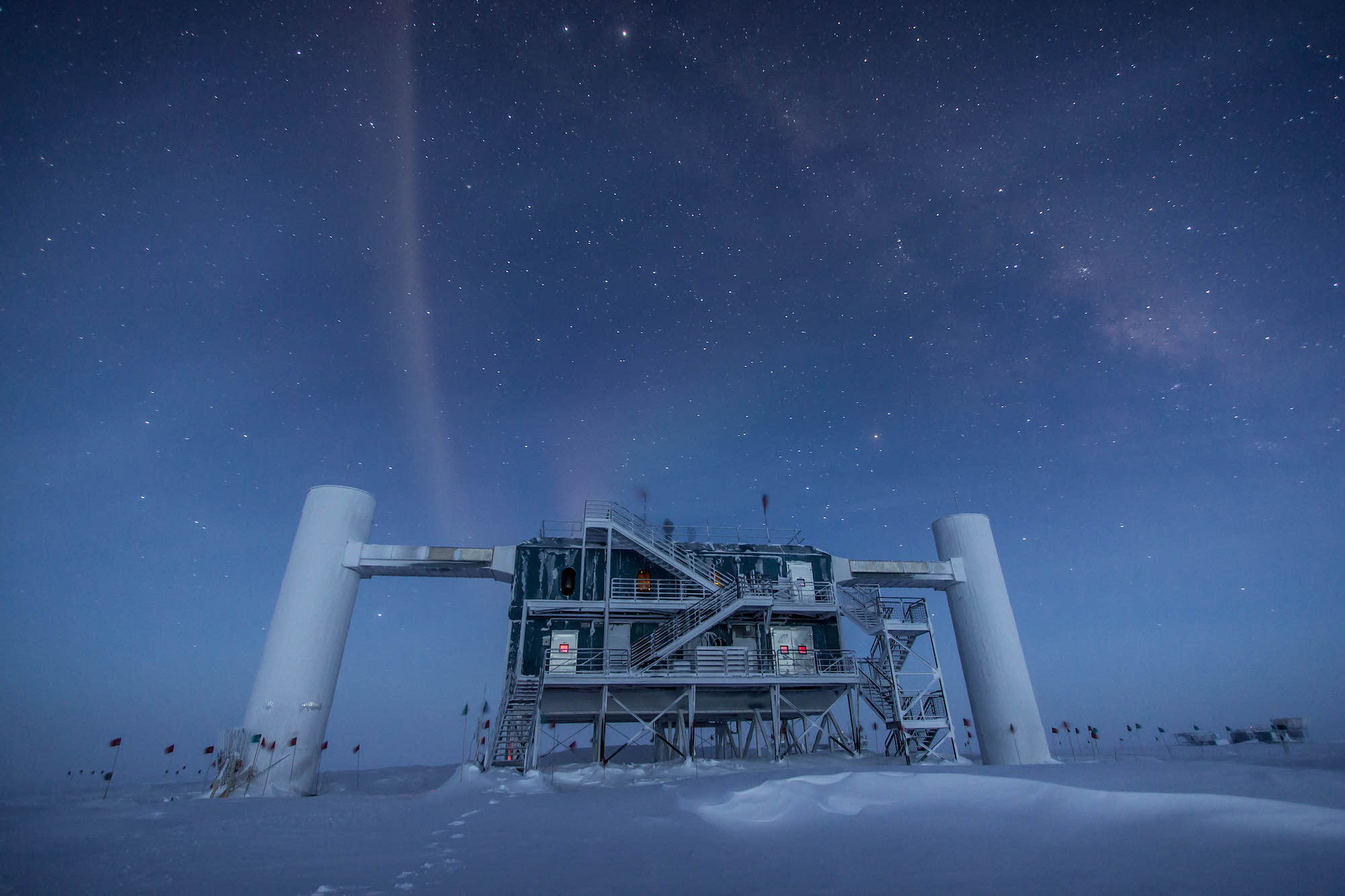
A photograph of the IceCube Neutrino Observatory

The IceCube Laboratory at the Amundsen-Scott South Pole Station in Antarctica. [Felipe Pedreros, IceCube/NSF]

Neutrinos — neutral, nearly massless elementary particles — are generated by natural particle accelerators across the universe. Facilities like the IceCube Neutrino Observatory, which employs detectors buried a mile deep in Antarctic ice, spot neutrinos from distant astrophysical sources, but matching these neutrinos to their sources is no easy task.

Thus far, researchers have discovered a compelling connection between neutrinos and distant active galactic nuclei, which are powered by the accretion of gas onto supermassive black holes. The active galactic nucleus phase of a black hole tends to be long lived, with activity lasting hundreds of thousands of years or more, making these nuclei lasting sources of neutrinos.

Sampling Flares

Recently, researchers have found tentative evidence for coincident neutrinos from short-lived accretion events like tidal disruption events, in which a star is torn apart and accreted by a black hole. These studies have uncovered a potential connection between neutrinos and tidal disruption events with mid-infrared echoes, signaling the presence of obscuring dust.

map of sampled black hole flares and neutrinos

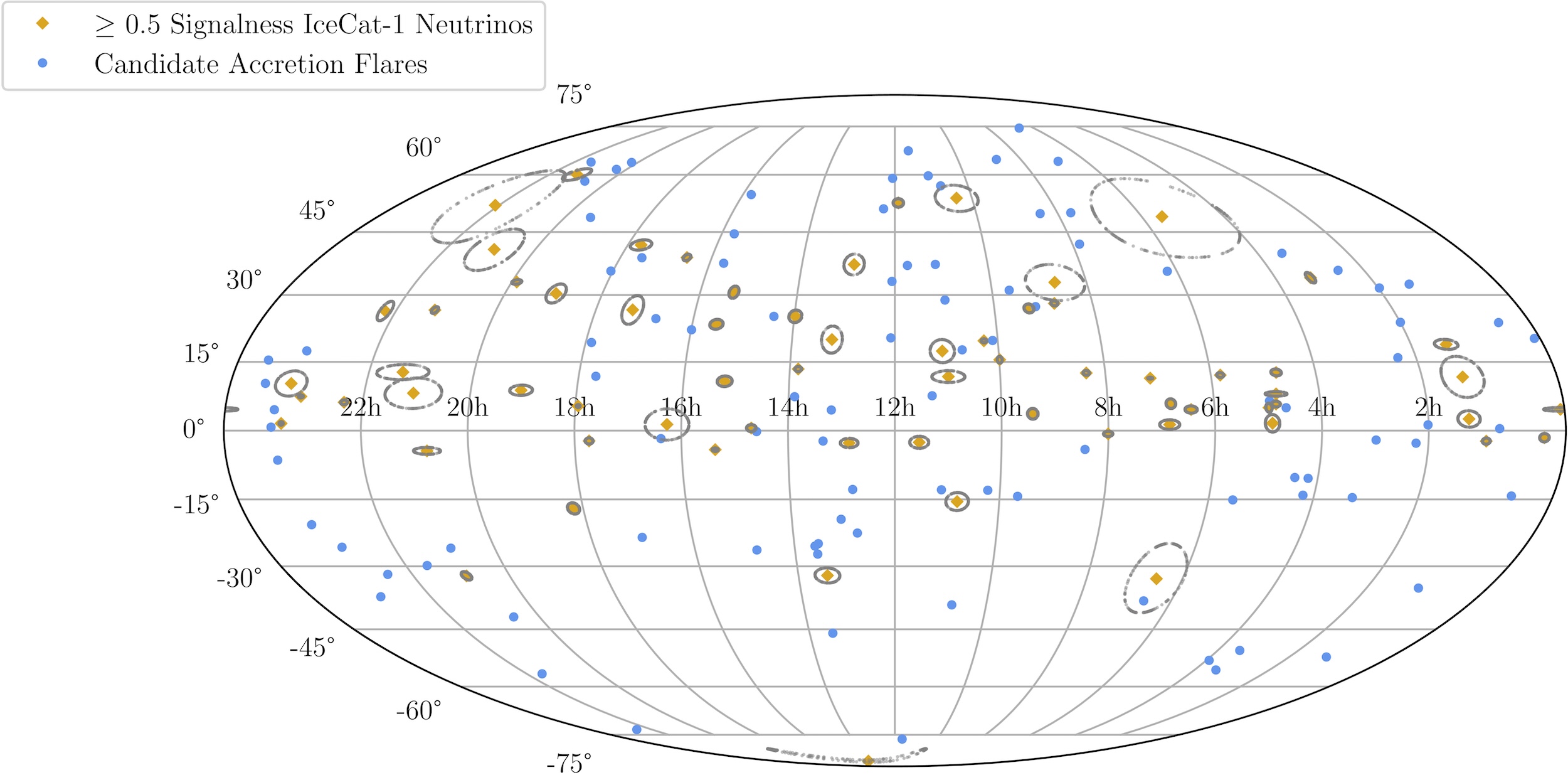
A map of the locations of the neutrinos (yellow diamonds) and black hole flares (blue circles) on the sky. Click to enlarge. [Wang et al. 2026]

To investigate whether there is any connection between neutrinos and short-lived accretion events, Megan Wang (Massachusetts Institute of Technology) and collaborators first compiled a sample of 99 black hole flares observed by NEOWISE. These flares were selected for their strong mid-infrared emission, location in the nuclei of galaxies, and a fast rise and slow decline. The team applied additional selection criteria to remove other bright transients, such as supernovae, and retain only tidal disruption events and active galactic nucleus accretion flares.

For the neutrino side of the equation, Wang’s team turned to IceCube’s most recent catalog of neutrino events from astrophysical sources. In total, they compiled a sample of 68 events for which the odds of the source being astrophysical was greater than 50%, and for which the directional uncertainty was below 50.

No Coincidences

For a flare and a neutrino to be considered spatially and temporally coincident, the neutrino must arrive within one year of the flare, and the flare must fall within the 90% certainty contours of the neutrino. Ultimately, Wang’s team found no neutrinos that fulfilled both criteria and only one that was spatially but not temporally coincident with a black hole flare.

This result appears to be at odds with previous studies that found several neutrinos that were coincident with tidal disruption events. Wang and collaborators noted that while this work finds no association between neutrinos and black hole flares, it’s possible that the team is studying a different population of accretion events.

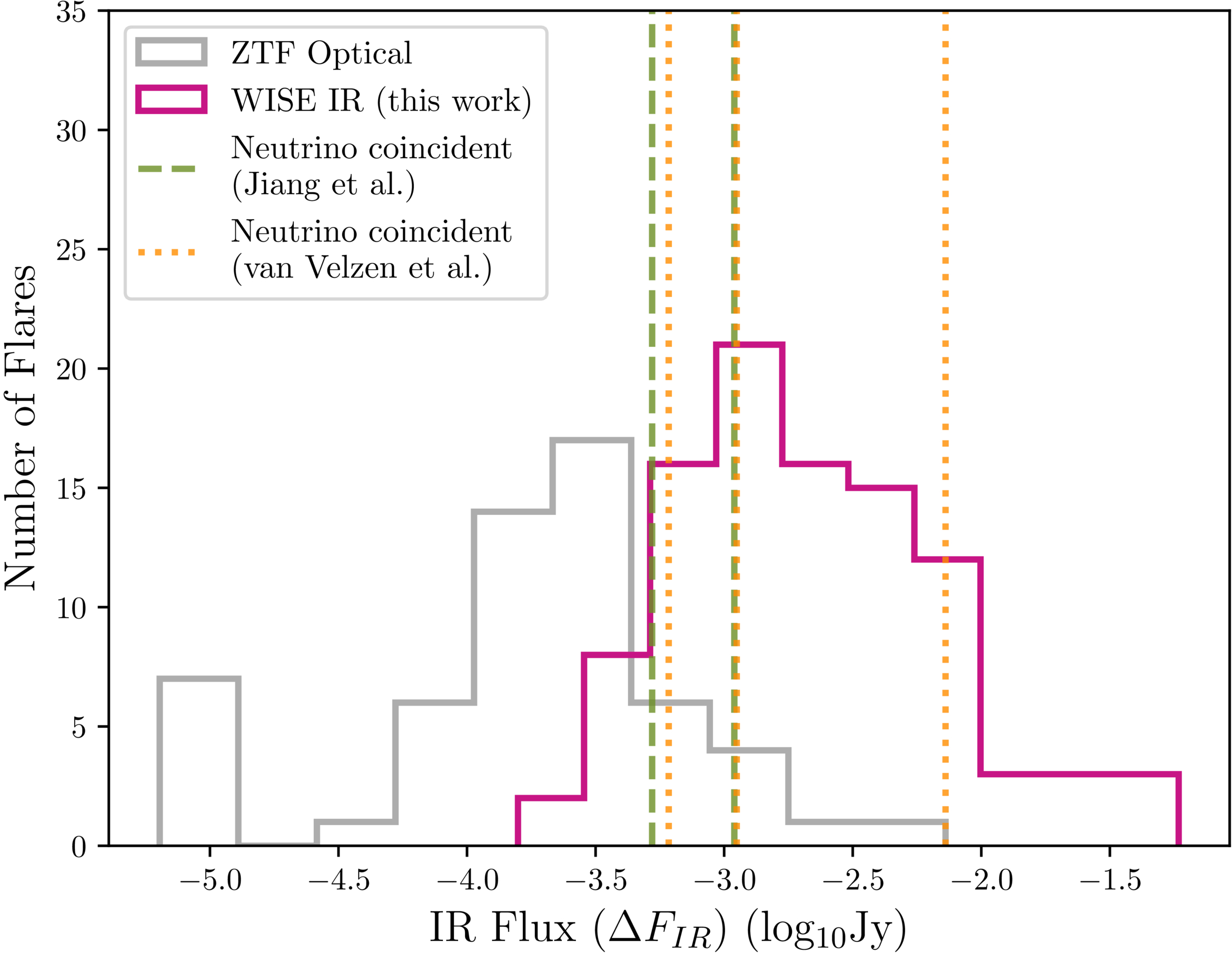
infrared fluxes of black hole flares

Infrared fluxes of the flares sampled in this study (magenta), optically identified flares (gray), and the tidal disruption events thought to have coincided with neutrino detections (green and gold dashed lines). [Wang et al. 2026]

For example, while the previous neutrino-associated flares were flagged for having strong mid-infrared emission, they differ from the current sample in that they were detected at optical wavelengths. The flares sampled in this work were detected in the mid-infrared and have little to no optical emission, potentially highlighting intrinsic differences compared to previous samples.

Future work, including studies that leverage upcoming datasets from the Vera C. Rubin Observatory, the Roman Space Telescope, and the NEO Surveyor, can address this question further and search for connections with specific populations of black hole flares.

Citation

“Testing the Association of Supermassive Black Hole Infrared Flares and High-Energy Neutrinos,” Megan Wang et al 2026 ApJL 998 L29. doi:10.3847/2041-8213/ae3f90

The post Do Black Hole Flares Generate Neutrinos? appeared first on AAS Nova.

Ultra-High-Energy Neutrino Emission on the Extragalactic Express: A Mystery

13 August 2025 at 17:00

galaxy Phaedra

Editor’s Note: Astrobites is a graduate-student-run organization that digests astrophysical literature for undergraduate students. As part of the partnership between the AAS and astrobites, we occasionally repost astrobites content here at AAS Nova. We hope you enjoy this post from astrobites; the original can be viewed at astrobites.org.

Title: ASKAP and VLASS Search for a Radio-Continuum Counterpart of Ultra-High-Energy Neutrino Event KM3–230213A
Authors: M. D. Filipović et al.
First Author’s Institution: Western Sydney University
Status: Published in ApJL

The Scene of the Crime

On Galentine’s Day this year, an ultra-high-energy neutrino attempted to sneak through the Mediterranean Sea, likely expecting she wouldn’t be caught. The odds were in her favor; neutrinos, ghostly particles with no electric charge and infinitesimal mass, only very rarely interact with matter. However, what she failed to account for was the awaiting undersea neutrino detector, KM3NeT, and the clever lepton within who would finally notice her. She slammed into the lepton, spewing charged particles everywhere at speeds greater than the speed of light in the water. While no particle can outrun a photon in a vacuum, water slows light down, giving us the familiar effect of refraction; similar to supersonic jets creating a boom when they break the sound barrier, these charged particles produced a distinctive blue light, known as Cherenkov light, exposing the neutrino’s position to astronomers and physicists everywhere. Busted.

The Investigation Begins

However, the neutrino was only the messenger; of even more interest is the astrophysical object that produced her. It’s not easy to generate such a high-energy particle, and no one can create a neutrino from thermal emission alone, indicating that wherever she originated, something extreme was going on. To date, only three astrophysical sources have been caught emitting neutrinos at all, and none of them are extragalactic: the Sun, although this is old news (in the 1960s, detections of solar neutrinos showed definitively that the Sun is powered by nuclear fusion, resolving the issue of how the Sun has burned long enough for life to evolve on Earth); the nearest core-collapse supernova to our galaxy in modern times, SN 1987A; and the galactic plane.

Theoretical models predict a much wider variety of objects, including extragalactic sources, to produce neutrinos, usually via cosmic-ray production: supernova remnants, star-forming galaxies, gamma-ray bursts, supermassive black holes (which are found at the centers of most galaxies), active galactic nuclei (a particularly fussy subset of supermassive black holes that are eating their host galaxies), and blazars (an extreme subset of active galactic nuclei that emit jets of radio light directly at Earth). The reason we have not detected their predicted neutrino emission is that neutrino astronomy is a new field, extragalactic sources are super far away, and neutrinos are both difficult to detect and difficult to trace back to their origin.

Rounding Up Suspects

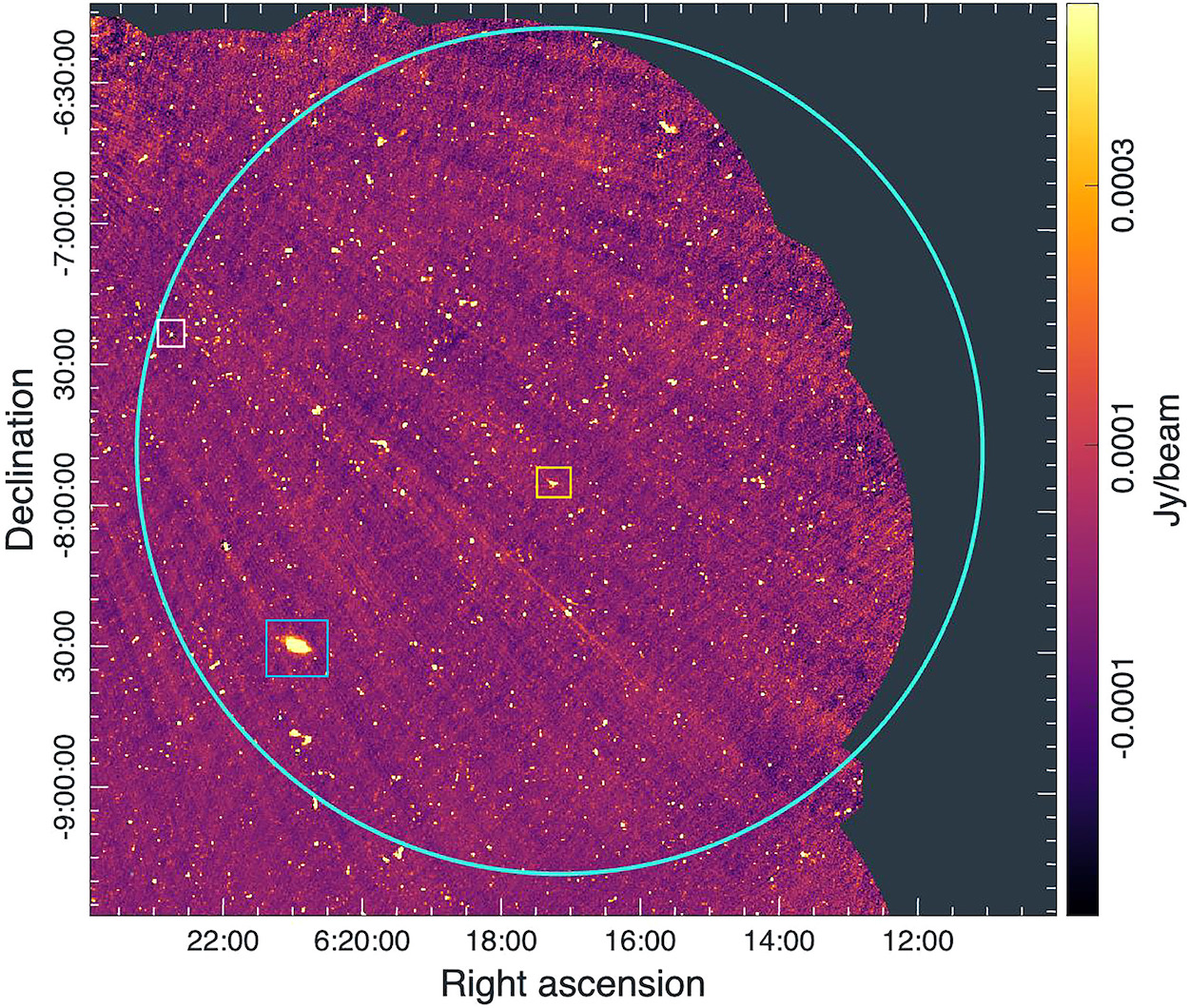
With this in mind, today’s authors embark on a quest to catch the culprit, starting in the radio band. Radio emission, like neutrino emission, is usually an indicator of non-thermal radiative processes, and one such process, synchrotron radiation (emitted by relativistic electrons getting spun around in powerful magnetic fields), can be distinguished from other types of radiation based on its radio characteristics. Conveniently, the region our neutrino hails from is spanned by multiple radio surveys conducted with the Very Large Array (VLA) and the Australian Sub-Kilometer Compact Array Pathfinder (ASKAP), and so our authors use these surveys to round up all the radio riffraff. Unfortunately, the long wavelengths of radio photons and the scarcity of neutrinos result in reduced resolution for both compared to traditional optical telescopes, and our authors find over a thousand radio emitters in the region. Of course, no one can question that many sources, so our authors limit their investigation to objects with at least two radio brightness measurements, which can be used to calculate the brightness as a function of radio wavelength (the spectral energy distribution, which tells us about what type of radiation we see) and/or as a function of time (a light curve, which tells us if our source is variable). Our authors settle on a lineup of 10 likely blazars, any of whom could have emitted our ultra-high-energy neutrino, as well as a shortlist of prime suspects warranting further investigation: Phaedra, a spiral galaxy; Hebe, a radio galaxy; and Narcissus, an unusual compact radio emitter (see Figure 1).

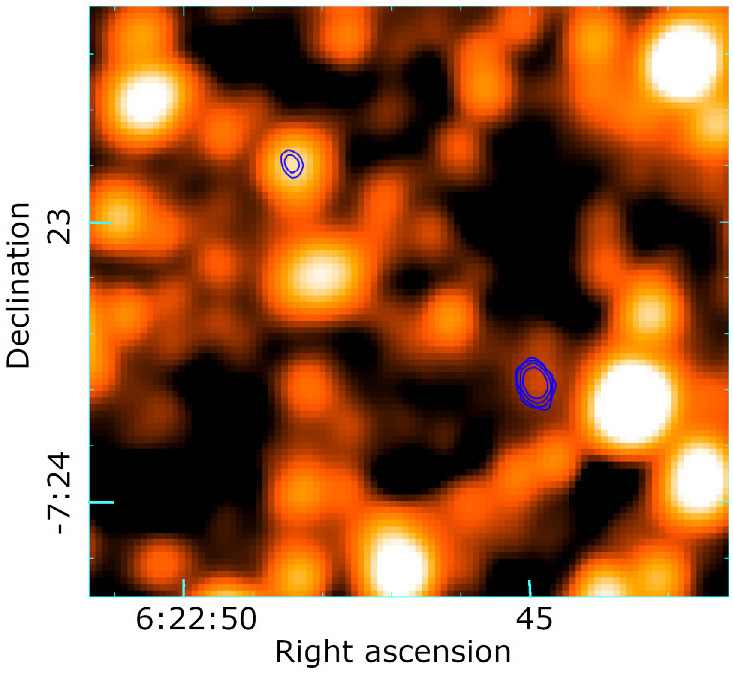
radio emission from the region of sky from which the neutrino originated

Figure 1: Radio emission detected by ASKAP in the region of the sky in which the neutrino originated. Every yellow dot should be considered suspect, but the three colored squares identify the primary guilty parties: Phaedra (in blue), Hebe (in yellow), and Narcissus (in pink). [Filipović et al. 2025]

Phaedra: A Spiral Galaxy with a Secret?

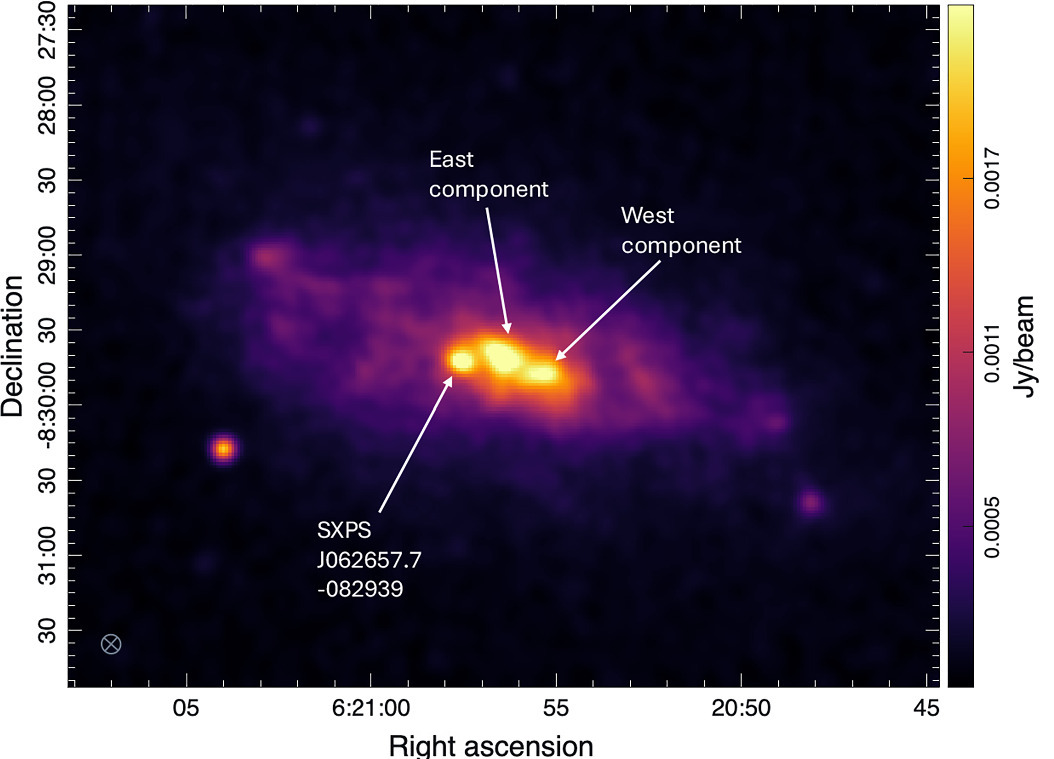
Phaedra (Figure 2), the most radio-luminous in the area, exhibits plenty of behavior typical of a galaxy guilty of neutrino emission. For starters, she has two regions of highly concentrated radio emission, and these regions are offset from her center, making them look suspiciously like active galactic nucleus jets, which are excellent particle accelerators. Furthermore, infrared observations suggest she is a starburst galaxy, churning out stars faster than a bestselling author with a team of ghostwriters churns out books. This intense star formation could have easily been triggered by jet activity. Even more suspiciously, she is closely associated with an X-ray binary, and where there are high-energy photons, there are likely to be other high-energy particles like neutrinos and cosmic rays. Phaedra’s prospects of beating the neutrino emission allegations are not looking good; these high-energy phenomena produce buckets of high-energy particles, and even if they produce only cosmic rays, the cosmic rays are bound to crash into the surrounding dense gas and photons, creating neutrinos anyway.

radio image of Phaedra

Figure 2: Radio image of Phaedra, one of our suspects. The east and west components are the likely radio jets, and the third bright blob is the radio counterpart to the X-ray binary, SXPS J062657.7-082939. [Adapted from Filipović et al. 2025]

Hebe: A Simple Radio Galaxy, or Something More?

Hebe (Figure 3), the nearest extended radio source, isn’t exactly innocent-looking either. She is one of a triplet of galaxies sharing a common envelope, like peas in an extragalactic pod. Galaxies, unlike peas, however, are so massive that they can’t help but interact dynamically in such close quarters, causing a commotion that could totally produce ultra-high-energy neutrinos. She likely also has an active galactic nucleus jet, giving her the same neutrino-wielding powers as Phaedra.

infrared image of Hebe

Figure 3: An infrared image of Hebe that clearly shows the common envelope surrounding the triplets. The white contour lines denote levels of polarized intensity, which indicate the presence of a magnetic field. [Adapted from Filipović et al. 2025]

Narcissus: Double Active Galactic Nucleus?

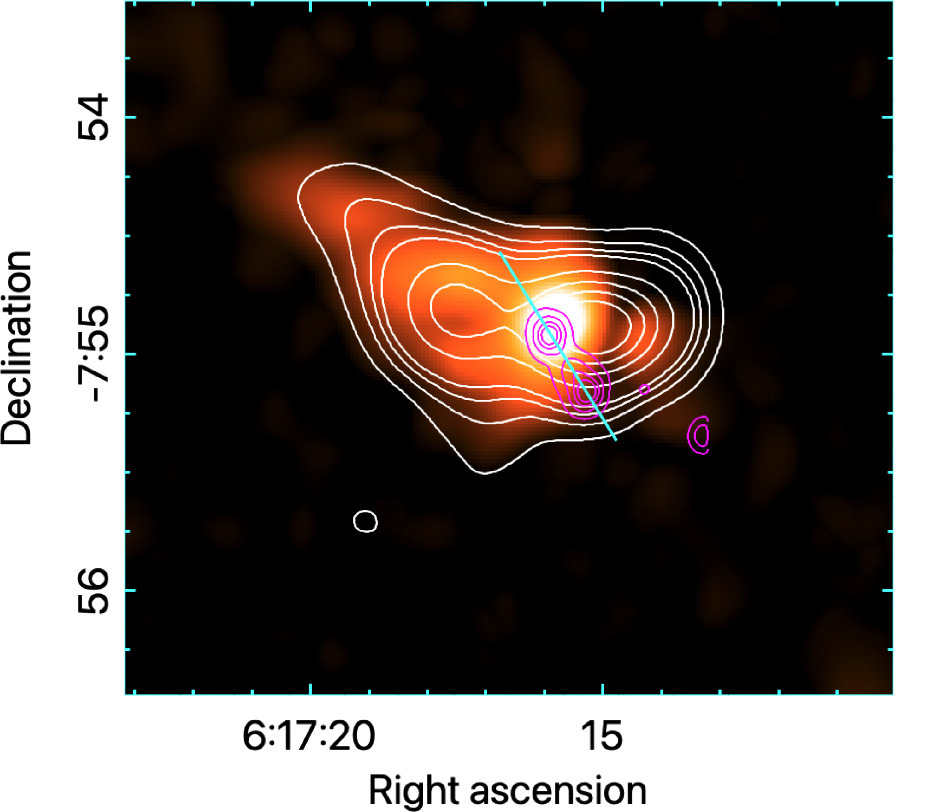
Our final suspect, Narcissus (Figure 4), consists of not one, but two active galactic nuclei. One appears to exhibit the classic synchrotron spectral energy distribution, and the other is likely a blazar, based on his notable radio variability and infrared observations.

infrared image of Narcissus

Figure 4: Infrared image of Narcissus, with the purple contours outlining the two radio sources that are likely active galactic nuclei. [Adapted from Filipović et al. 2025]

Solving the Mystery

So, who really emitted the ultra-high-energy neutrino? For now, our authors can’t jump to any firm conclusions — they’d never risk condemning an innocent galaxy — but they will continue to closely monitor the suspects and gather more evidence. In the meantime, Phaedra, Hebe, and Narcissus should find themselves a good defense attorney experienced in neutrino emission cases.

Original astrobite edited by Sandy Chiu.

About the author, Chloe Klare:

I’m a PhD student in astronomy and astrophysics at Penn State (with a physics minor, so I get to use my semester spent in QFT for something!). I study active galactic nuclei (in the radio!), and I’m currently looking for baby synchrotron jets in active galactic nuclei.

The post Ultra-High-Energy Neutrino Emission on the Extragalactic Express: A Mystery appeared first on AAS Nova.

The P5 Report & The Future of Particle Physics (Part 1)

3 January 2024 at 20:21

Particle physics is the epitome of ‘big science’. To answer our most fundamental questions out about physics requires world class experiments that push the limits of whats technologically possible. Such incredible sophisticated experiments, like those at the LHC, require big facilities to make them possible,  big collaborations to run them, big project planning to make dreams of new facilities a reality, and committees with big acronyms to decide what to build.

Enter the Particle Physics Project Prioritization Panel (aka P5) which is tasked with assessing the landscape of future projects and laying out a roadmap for the future of the field in the US. And because these large projects are inevitably an international endeavor, the report they released last week has a large impact on the global direction of the field. The report lays out a vision for the next decade of neutrino physics, cosmology, dark matter searches and future colliders. 

P5 follows the community-wide brainstorming effort known as the Snowmass Process in which researchers from all areas of particle physics laid out a vision for the future. The Snowmass process led to a particle physics ‘wish list’, consisting of all the projects and research particle physicists would be excited to work on. The P5 process is the hard part, when this incredibly exciting and diverse research program has to be made to fit within realistic budget scenarios. Advocates for different projects and research areas had to make a case of what science their project could achieve and a detailed estimate of the costs. The panel then takes in all this input and makes a set of recommendations of how the budget should be allocated, what should projects be realized and what hopes are dashed. Though the panel only produces a set of recommendations, they are used quite extensively by the Department of Energy which actually allocates funding. If your favorite project is not endorsed by the report, its very unlikely to be funded. 

An computer generate graphic showing two sprays of particles being injected from a single center point
The P5 report also created an awesome graphic that contains symbolism for the different aspects of the plan. The left  side depicts oscillating neutrinos and the shape of the Higgs potential. The right side depicts dark matter and the large scale structure of the universe. The central ball of light is supposed to represent discoveries of the unknown. Source

Particle physics is an incredibly diverse field, covering sub-atomic to cosmic scales, so recommendations are divided up into several different areas. In this post I’ll cover the panel’s recommendations for neutrino physics and the cosmic frontier. Future colliders, perhaps the spiciest topic, will be covered in a follow up post.

The Future of Neutrino Physics

For those in the neutrino physics community all eyes were on the panels recommendations regarding the Deep Underground Neutrino Experiment (DUNE). DUNE is the US’s flagship particle physics experiment for the coming decade and aims to be the definitive worldwide neutrino experiment in the years to come. A high powered beam of neutrinos will be produced at Fermilab and sent 800 miles through the earth’s crust towards several large detectors placed in a mine in South Dakota. Its a much bigger project than previous neutrino experiments, unifying essentially the entire US community into a single collaboration.

DUNE is setup to produce world leading measurements of neutrino oscillations, the property by which neutrinos produced in one ‘flavor state’, (eg an electron-neutrino) gradually changes its state with sinusoidal probability (eg into a muon neutrino) as it propagates through space. This oscillation is made possible by a simple quantum mechanical weirdness: neutrino’s flavor state, whether it couples to electrons muons or taus, is not the same as its mass state. Neutrinos of a definite mass are therefore a mixture of the different flavors and visa versa.

Detailed measurements of this oscillation are the best way we know to determine several key neutrino properties. DUNE aims to finally pin down two crucial neutrino properties: their ‘mass ordering’, which will solidify how the different neutrino flavors and measured mass differences all fit together, and their ‘CP-violation’ which specifies whether neutrinos and their anti-matter counterparts behave the same or not. DUNE’s main competitor is the Hyper-Kamiokande experiment in Japan, another next-generation neutrino experiment with similar goals.

A depiction of the DUNE experiment. A high intensity proton beam at Fermilab is used to create a concentrated beam of neutrinos which are then sent through 800 miles of the Earth’s crust towards detectors placed deep underground South Dakota. Source

Construction of the DUNE experiment has been ongoing for several years and unfortunately has not been going quite as well as hoped. It has faced significant schedule delays and cost overruns. DUNE is now not expected to start taking data until 2031, significantly behind Hyper-Kamiokande’s projected 2027 start. These delays may lead to Hyper-K making these definitive neutrino measurements years before DUNE, which would be a significant blow to the experiment’s impact. This left many DUNE collaborators worried about its broad support from the community.

It came as a relief then when P5 report re-affirmed the strong science case for DUNE, calling it the “ultimate long baseline” neutrino experiment. The report strongly endorsed the completion of the first phase of DUNE. However, it recommended a pared-down version of its upgrade, advocating for an earlier beam upgrade in lieu of additional detectors. This re-imagined upgrade will still achieve the core physics goals of the original proposal with a significant cost savings. With this report, and news that the beleaguered underground cavern construction in South Dakota is now 90% complete, was certainly welcome holiday news to the neutrino community. This is also sets up a decade-long race between DUNE and Hyper-K to be the first to measure these key neutrino properties.

Cosmic Implications

While we normally think of particle physics as focused on the behavior of sub-atomic particles, its really about the study of fundamental forces and laws, no matter the method. This means that telescopes to study the oldest light in the universe, the Cosmic Microwave Background (CMB), fall into the same budget category as giant accelerators studying sub-atomic particles. Though the experiments in these two areas look very different, the questions they seek to answer are cross-cutting. Understanding how particles interact at very high energies helps us understand the earliest moments of the universe, when such particles were all interacting in a hot dense plasma. Likewise, by studying the these early moments of the universe and its large-scale evolution can tell us about what kinds of particles and forces are influencing its dynamics. When asking fundamental questions about the universe, one needs both the sharpest microscopes and the grandest panoramas possible.

The most prominent example of this blending of the smallest and largest scales in particle physics is dark matter. Some of our best evidence for dark matter comes analyzing the cosmic microwave background to determine how the primordial plasma behaved. These studies showed that some type of ‘cold’, matter that doesn’t interact with light, aka dark matter, was necessary to form the first clumps that eventually seeded the formation of galaxies. Without it, the universe would be much more soup-y and structureless than what we see to today.

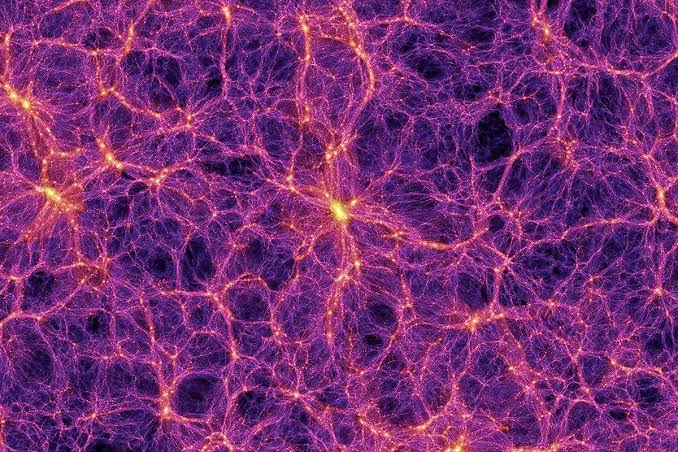
The “cosmic web” galaxy clusters from the Millenium simulation. Measuring and understanding this web can tell us a lot about the fundamental constituents of the universe. Source

To determine what dark matter is then requires an attack from two fronts: design experiments here on earth attempting directly detect it, and further study its cosmic implications to look for more clues as to its properties.

The panel recommended next generation telescopes to study the CMB as a top priority. The so called ‘Stage 4’ CMB experiment would deploy telescopes in both the south pole and Chile’s Atacama desert to better characterize sources of atmospheric noise. The CMB has been studied extensively before, but the increased precision of CMS-S4 could shed light on mysteries like dark energy, dark matter, inflation, and the recent Hubble Tension. Given the past fruitfulness of these efforts, I think few doubted the science case for such a next generation experiment.

A mockup of one of the CMS-S4 telescopes which will be based in the Chilean desert. Note the person for scale on the right (source)

The P5 report recommended a suite of new dark matter experiments in the next decade, including the ‘ultimate’ liquid Xenon based dark matter search. Such an experiment would follow in the footsteps of massive noble gas experiments like LZ and XENONnT which have been hunting for a favored type of dark matter called WIMP’s for the last few decades. These experiments essentially build giant vats of liquid Xenon, carefully shield from any sources of external radiation, and look for signs of dark matter particles bumping into any of the Xenon atoms. The larger the vat of Xenon, the higher chance a dark matter particle will bump into something. Current generation experiments have ~7 tons of Xenon, and the next generation experiment would be even larger. The next generation aims to reach the so called ‘neutrino floor’, the point as which the experiments would be sensitive enough to observe astrophysical neutrinos bumping into the Xenon. Such neutrino interactions would look extremely similar to those of dark matter, and thus represent an unavoidable background which would signal the ultimate sensitivity of this type of experiment. WIMP’s could still be hiding in a basement below this neutrino floor, but finding them would be exceedingly difficult.

A photo of the current XENONnT experiment. This pristine cavity is then filled with liquid Xenon and closely monitored for signs of dark matter particles bumping into one of the Xenon atoms. Credit: XENON Collaboration

WIMP’s are not the only dark matter candidates in town, and recent years have also seen an explosion of interest in the broad range of dark matter possibilities, with axions being a prominent example. Other kinds of dark matter could have very different properties than WIMPs and have had much fewer dedicated experiments to search for them. There is ‘low hanging fruit’ to pluck in the way of relatively cheap experiments which can achieve world-leading sensitivity. Previously, these ‘table top’ sized experiments had a notoriously difficult time obtaining funding, as they were often crowded out of the budgets by the massive flagship projects. However, small experiments can be crucial to ensuring our best chance of dark matter discovery, as they fill in the blinds pots missed by the big projects.

The panel therefore recommended creating a new pool of funding set aside for these smaller scale projects. Allowing these smaller scale projects to flourish is important for the vibrancy and scientific diversity of the field, as the centralization of ‘big science’ projects can sometimes lead to unhealthy side effects. This specific recommendation also mirrors a broader trend of the report: to attempt to rebalance the budget portfolio to be spread more evenly and less dominated by the large projects.

A pie chart comparing the budget porfolio in 2023 (left) versus the projected budget in 2033 (right). Currently most of the budget is being taken up by the accelerator upgrades and cavern construction of DUNE, with some amount for the LHC upgrades. But by 2033 the panel recommends a much more equitable balance between different research area.

What Didn’t Make It

Any report like this comes with some tough choices. Budget realities mean not all projects can be funded. Besides the pairing down of some of DUNE’s upgrades, one of the biggest areas that was recommended against were ‘accessory experiments at the LHC’. In particular, MATHUSULA and the Forward Physics Facility were two experiments that proposed to build additional detectors near already existing LHC collision points to look for particles that may be missed by the current experiments. By building new detectors hundreds of meters away from the collision point, shielded by concrete and the earth, they can obtained unique sensitivity to ‘long lived’ particles capable of traversing such distances. These experiments would follow in the footsteps of the current FASER experiment, which is already producing impressive results.

While FASER found success as a relatively ‘cheap’ experiment, reusing detector components from and situating itself in a beam tunnel, these new proposals were asking for quite a bit more. The scale of these detectors would have required new caverns to be built, significantly increasing the cost. Given the cost and specialized purpose of these detectors, the panel recommended against their construction. These collaborations may now try to find ways to pare down their proposal so they can apply to the new small project portfolio.

Another major decision by the panel was to recommend against hosting a new Higgs factor collider in the US. But that will discussed more in a future post.

Conclusions

The P5 panel was faced with a difficult task, the total cost of all projects they were presented with was three times the budget. But they were able to craft a plan that continues the work of the previous decade, addresses current shortcomings and lays out an inspiring vision for the future. So far the community seems to be strongly rallying behind it. At time of writing, over 2700 community members from undergraduates to senior researchers have signed a petition endorsing the panels recommendations. This strong show of support will be key for turning these recommendations into actual funding, and hopefully lobbying congress to even increase funding so that more of this vision can be realized.

For those interested the full report as well as executive summaries of different areas can be found on the P5 website. Members of the US particle physics community are also encouraged to sign the petition endorsing the recommendations here.

And stayed tuned for part 2 of our coverage which will discuss the implications of the report on future colliders!

Moriond 2023 Recap

17 April 2023 at 16:16

Every year since 1966,  particle physicists have gathered in the Alps to unveil and discuss their most important results of the year (and to ski). This year I had the privilege to attend the Moriond QCD session so I thought I would post a recap here. It was a packed agenda spanning 6 days of talks, and featured a lot of great results over many different areas of particle physics, so I’ll have to stick to the highlights here.

FASER Observes First Collider Neutrinos

Perhaps the most exciting result of Moriond came from the FASER experiment, a small detector recently installed in the LHC tunnel downstream from the ATLAS collision point. They announced the first ever observation of neutrinos produced in a collider. Neutrinos are produced all the time in LHC collisions, but because they very rarely interact, and current experiments were not designed to look for them, no one had ever actually observed them in a detector until now. Based on data collected during collisions from last year, FASER observed 153 candidate neutrino events, with a negligible amount of predicted backgrounds; an unmistakable observation.

Black image showing colorful tracks left by particles produced in a neutrino interaction
A neutrino candidate in the FASER emulsion detector. Source

This first observation opens the door for studying the copious high energy neutrinos produced in colliders, which sit in an energy range currently unprobed by other neutrino experiments. The FASER experiment is still very new, so expect more exciting results from them as they continue to analyze their data. A first search for dark photons was also released which should continue to improve with more luminosity. On the neutrino side, they have yet to release full results based on data from their emulsion detector which will allow them to study electron and tau neutrinos in addition to the muon neutrinos this first result is based on.

New ATLAS and CMS Results

The biggest result from the general purpose LHC experiments was ATLAS and CMS both announcing that they have observed the simultaneous production of 4 top quarks. This is one of the rarest Standard Model processes ever observed, occurring a thousand times less frequently than a Higgs being produced. Now that it has been observed the two experiments will use Run-3 data to study the process in more detail in order to look for signs of new physics.

Event displays from ATLAS and CMS showing the signature of 4 top events in their respective detectors
Candidate 4 top events from ATLAS (left) and CMS (right).

ATLAS also unveiled an updated measurement of the mass of the W boson. Since CDF announced its measurement last year, and found a value in tension with the Standard Model at ~7-sigma, further W mass measurements have become very important. This ATLAS result was actually a reanalysis of their previous measurement, with improved PDF’s and statistical methods. Though still not as precise as the CDF measurement, these improvements shrunk their errors slightly (from 19 to 16 MeV).  The ATLAS measurement reports a value of the W mass in very good agreement with the Standard Model, and approximately 4-sigma in tension with the CDF value. These measurements are very complex, and work is going to be needed to clarify the situation.

CMS had an intriguing excess (2.8-sigma global) in a search for a Higgs-like particle decaying into an electron and muon. This kind of ‘flavor violating’ decay would be a clear indication of physics beyond the Standard Model. Unfortunately it does not seem like ATLAS has any similar excess in their data.

Status of Flavor Anomalies

At the end of 2022, LHCb announced that the golden channel of the flavor anomalies, the R(K) anomaly, had gone away upon further analysis. Many of the flavor physics talks at Moriond seemed to be dealing with this aftermath.

Of the remaining flavor anomalies, R(D), a ratio describing the decay rates of B mesons in final states with D mesons and taus versus D mesons plus muons or electrons, has still been attracting interest. LHCb unveiled a new measurement that focused on hadronically taus and found a value that agreed with the Standard Model prediction. However this new measurement had larger error bars than others so it only brought down the world average slightly. The deviation currently sits at around 3-sigma.

A summary plot showing all the measurements of R(D) and R(D*). The newest LHCb measurement is shown in the red band / error bar on the left. The world average still shows a 3-sigma deviation to the SM prediction

An interesting theory talk pointed out that essentially any new physics which would produce a deviation in R(D) should also produce a deviation in another lepton flavor ratio, R(Λc), because it features the same b->clv transition. However LHCb’s recent measurement of R(Λc) actually found a small deviation in the opposite direction as R(D). The two results are only incompatible at the ~1.5-sigma level for now, but it’s something to continue to keep an eye on if you are following the flavor anomaly saga.

It was nice to see that the newish Belle II experiment is now producing some very nice physics results. The highlight of which was a world-best measurement of the mass of the tau lepton. Look out for more nice Belle II results as they ramp up their luminosity, and hopefully they can weigh in on the R(D) anomaly soon.

A fit to the invariant mass the visible decay products of the tau lepton, used to determine its intrinsic mass. An impressive show of precision from Belle II

Theory Pushes for Precision

The focus of much of the theory talks was about trying to advance our precision in predictions of standard model physics. This ‘bread and butter’ physics is sometimes overlooked in scientific press, but is an absolutely crucial part of the particle physics ecosystem. As experiments reach better and better precision, improved theory calculations are required to accurately model backgrounds, predict signals, and have precise standard model predictions to compare to so that deviations can be spotted. Nice results in this area included evidence for an intrinsic amount of charm quarks inside the proton from the NNPDF collaboration, very precise extraction of CKM matrix elements by using lattice QCD, and two different proposals for dealing with tricky aspects regarding the ‘flavor’ of QCD jets.

Final Thoughts

Those were all the results that stuck out to me. But this is of course a very biased sampling! I am not qualified enough to point out the highlights of the heavy ion sessions or much of the theory presentations. For a more comprehensive overview, I recommend checking out the slides for the excellent experimental and theoretical summary talks. Additionally there was the Moriond Electroweak conference that happened the week before the QCD one, which covers many of the same topics but includes neutrino physics results and dark matter direct detection. Overall it was a very enjoyable conference and really showcased the vibrancy of the field!

❌