Normal view
Never-before-seen shark that 'walks' on land discovered off Papua New Guinea
Researchers have identified a new species of "walking shark," a rare group of small carpet sharks that use their fins to "walk" along shallow reefs.
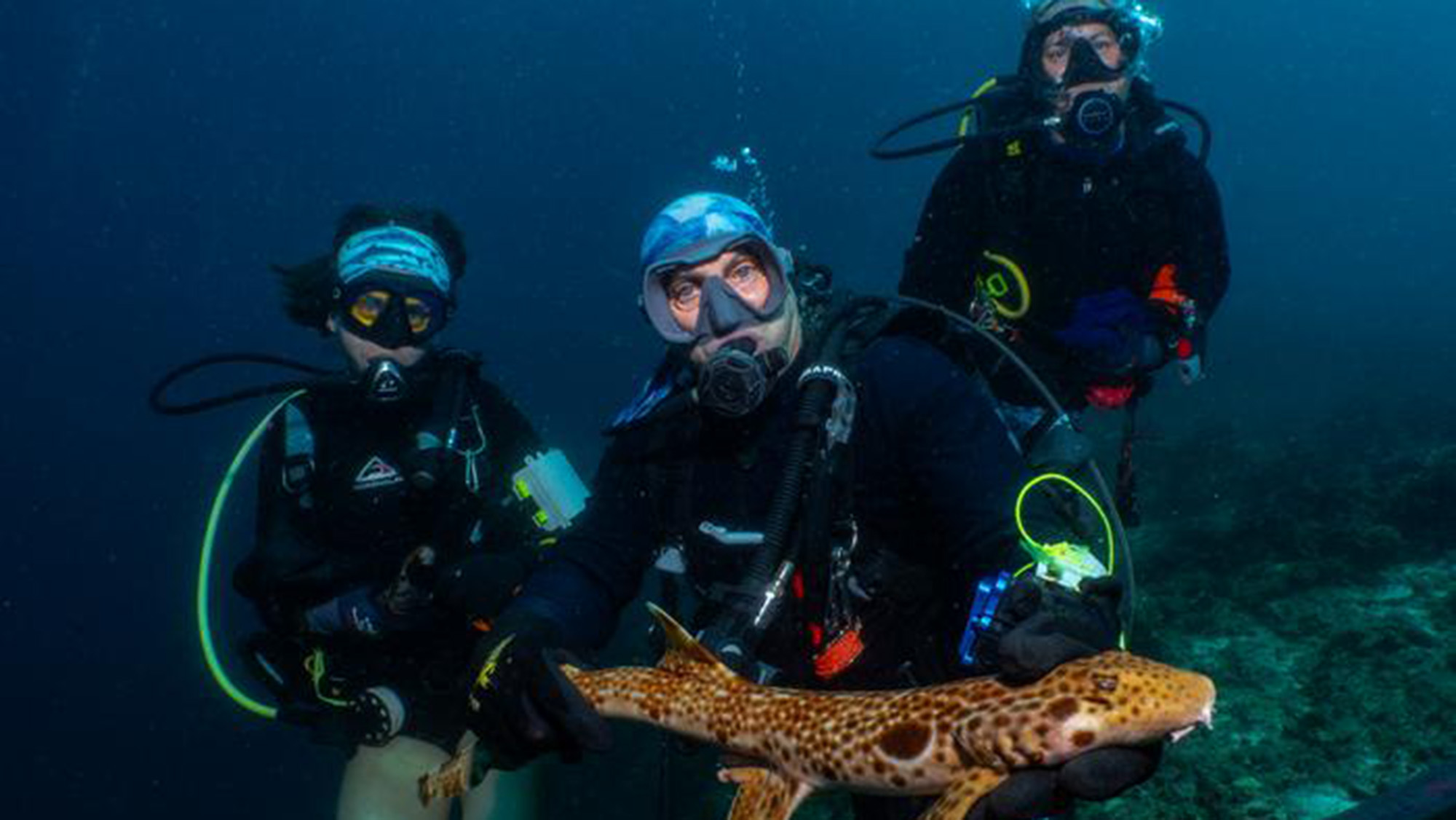
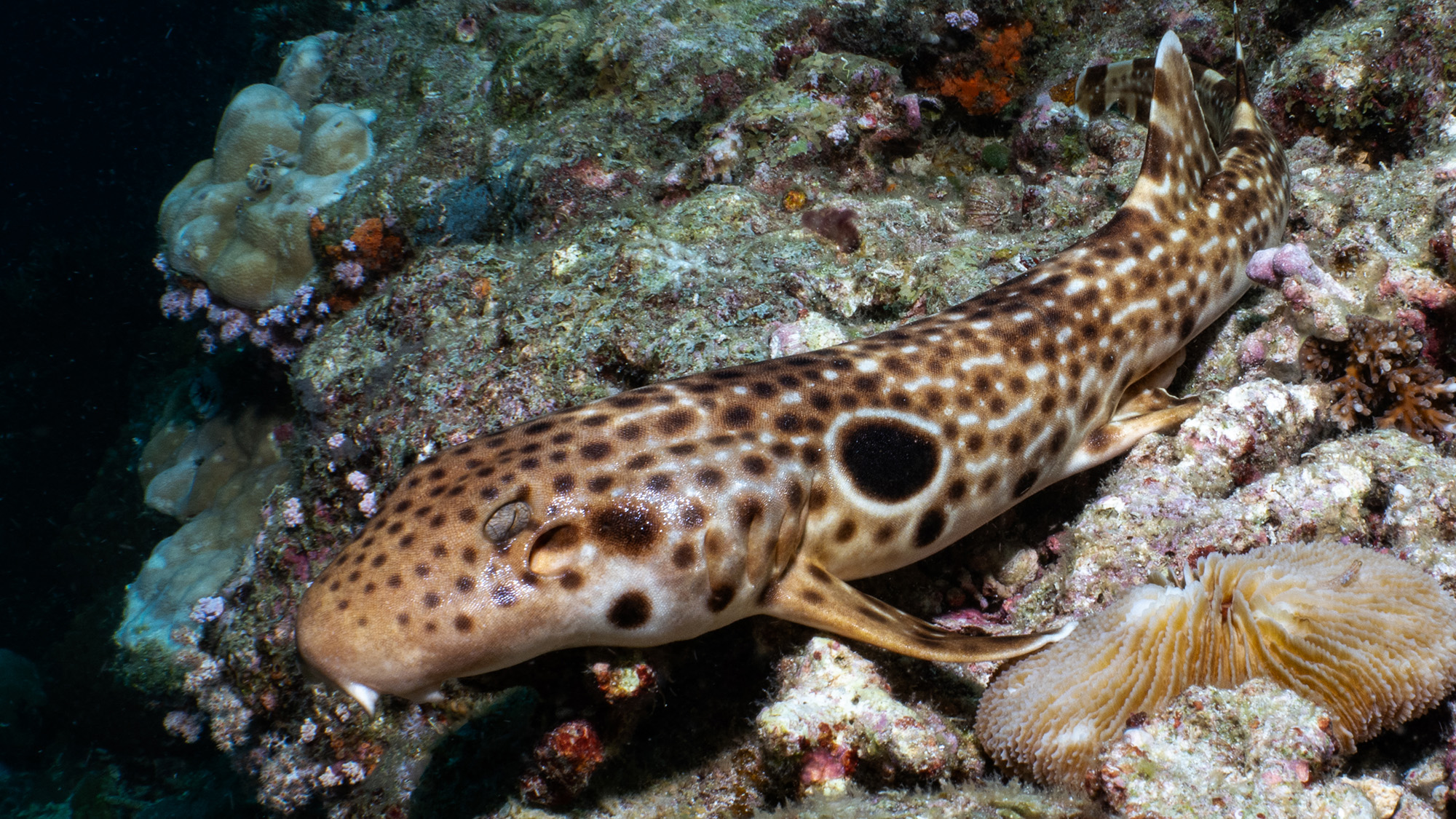
A team of divers spotted the newfound shark, which they named Hemiscyllium dudgeonae, in the dark waters around the reefs of southeastern Papua New Guinea. Gliding along the rocks was a small, brown-spotted shark that they didn't recognize.
"I was so excited. … I didn't look very closely at the pattern and quickly caught it and took it back to the boat," Christine Dudgeon, a senior research fellow at the University of the Sunshine Coast in Australia, told Live Science in an email.
Dudgeon handed the shark to Jess Blakeway, a doctoral student and first author of a new study describing the shark. Blakeway "noticed that the shark had a different pattern to the one that we were looking for and called out to me: 'Chris, it's different.'"
The new shark is named the Dudgeon's walking shark after Dudgeon, in recognition of her 20 years of researching the Hemiscyllium genus.
The new find, described June 15 in the Journal of the Ocean Science Foundation, brings the number of known walking shark species to 10, each with their own unique body pattern.
"This discovery is exciting because a lot of new fishes, and in particular, new shark and ray species, tend to be deep sea, so finding something in very shallow [less than 3 feet, or 1 meter] of water is unusual and highlights that there is potentially a lot of biodiversity that we really don't know about," Dudgeon said.
Encountering a new species
The team had been searching for another walking shark species, called Michael's walking shark (Hemiscyllium michaeli), when they encountered the unusual shark.
"Michael's walking shark has leopard prints and Dudgeon's walking shark has small white dashes and brown dots all over its body," Dudgeon said. "But with only one specimen we were not sure if this was an anomaly or a true difference."
The researchers continued surveying nearby reefs, and within two days, they had located 11 additional Dudgeon's walking sharks across three sites. These included males and females, both juveniles and adults, with all displaying the distinctive body pattern. That consistency convinced the team that they were likely looking at an undescribed species.
Dudgeon and Blakeway used genetic data to test this hypothesis at their laboratory in Australia. By comparing DNA from the newly discovered sharks with genetic samples from the other nine walking shark species, they confirmed that the population represented a new species.
Walking on land
Walking sharks are notable for their unusual biology. Unlike larger, open-ocean shark species, walking sharks spend their lives near coral reefs. Their ability to "walk" across the seafloor using their pectoral and pelvic fins is particularly useful during low tide, when parts of the reef become isolated from deeper waters. "Walking" helps the animals remain active when oxygen levels drop so that they can continue hunting prey across reef flats.
Scientists think this ability evolved as a response to the challenging environment of tropical reef flats, where oxygen levels can shift dramatically as the tides rise and fall.
Studies indicate that some walking sharks can survive in low oxygen environments for hours, though more research is needed to understand how the sharks are able to do this, Dudgeon said.
So far, Dudgeon's walking shark has been documented at only three locations in Papua New Guinea. If future research confirms that the species has a highly restricted range, H. dudgeonae could be vulnerable to habitat degradation, climate change or overfishing.
Many walking shark species appear to stay close to the reefs where they were born, which limits their ability to recolonize damaged habitats. Species with small geographic ranges are often more susceptible to population declines because local disturbances can affect a larger portion of the total local population.
The discovery also shows how new shark species are still being found in regions that have received relatively little scientific attention. Dudgeon and her team plan to continue doing surveys in Papua New Guinea to study the new species in its home environment.
"I think many people are not aware of the wonderful diversity of sharks and their relatives, the rays, skates and chimeras," Dudgeon said. "Very few species are dangerous to humans and they are a wonderfully broad and eclectic group of animals. They continue to surprise and fascinate us."
How much of a shark fan are you? Find out with our shark quiz!
- Live Science
- 'I never thought we'd see one alive': Elusive goblin shark captured on camera for the first time
'I never thought we'd see one alive': Elusive goblin shark captured on camera for the first time
- The Debrief
- This Deep-Sea Predator Can Live for Centuries—Now Geneticists Are Close to Hacking the Secrets of Its Longevity
This Deep-Sea Predator Can Live for Centuries—Now Geneticists Are Close to Hacking the Secrets of Its Longevity
The mystery of the Greenland shark’s incredible longevity may finally be unraveling, as a team of international researchers has completed the first comprehensive genome map of the creature.
Native to the cold waters between Greenland, Iceland, and Canada, Greenland sharks boast one of the longest vertebrate lifespans on Earth, approaching 400 years. In a recent paper published in the Proceedings of the National Academy of Sciences, researchers led by Shigeharu Kinoshita of the University of Tokyo have identified some of the genetic basis of that extraordinary lifespan, which they say future researchers may exploit to treat cancer and age-related illnesses.
Greenland Sharks Longevity
As genetic sequencing technology has improved and costs have fallen, there has been a major increase in the number of sequences from long-lived species for comparative analysis. Discoveries have included identifying increases in genes related to the immune system and growth hormone receptors in rockfish and bat species noted for their longevity.
With an entire lifecycle in slow motion, Greenland sharks’ longevity can be traced to their prolonged development: they take 150 years to reach sexual maturity, growing only 1 centimeter per year. Despite being one of the slowest swimmers in the ocean, the species undertakes large-scale migrations spanning over 1,000 kilometers.
Genome Mapping
Large genome sizes, like those of the Greenland shark, pose enormous mapping challenges, full of many repetitive sequences. Despite their importance for management and conservation, few whale and shark species have been sequenced due to the difficulty involved. To fill data gaps in the genetic causes of longevity, aquatic species evolution, and the risks of biodiversity loss, the team chose the Greenland shark as their subject.
The University of Tokyo-led team mapped roughly 5.9 billion DNA base pairs, accounting for 96.7% of the shark’s genome. Among the discoveries were the identification of specific genetic features likely related to the Greenland shark’s longevity.
In their paper, they wrote of discovering “genetic traits associated with cancer, immune response function, genome stability, and cardiac function, deep-sea adaptations, and population size dynamics,” in the new research.
Longevity Results
One of the most crucial of these traits is how the shark appears to mitigate the genetic strain that contributes to aging by stabilizing the building blocks of chromosomes. Chromatin is a structure consisting of DNA, RNA, and proteins, which makes up chromosomes.
In the Greenland shark, the histone H1.0 protein, which binds DNA in chromatin, undergoes an amino acid substitution that may enhance stability and reduce the effects of aging.
Another genetic tool aiding the shark’s longevity is the presence of 59 copies of the FTH1b gene, which researchers discovered on pseudochromosome 33, far above the number seen in other shark or fish species. This helps regulate ferroptosis, a form of programmed cell death, thereby mitigating cell damage. Since the gene controls iron storage and ferroptosis is iron-dependent, the researchers say this multiplication of FTH1b could prevent oxidative cell damage.
Beyond those specific expressions, researchers also found expansion of entire gene families associated with DNA repair, immune functions, and cancer resistance.
Although limited to a single species, the research does advance general understanding of the genetic factors involved in extended lifespans. However, it will be up to future researchers to identify how this new information can be applied to human concerns.
The paper, “The Greenland Shark Genome: Insights into Lifespan Extremes and Population Dynamics,” appeared in Earth and Planetary Science Letters on May 19, 2026.
Ryan Whalen covers science and technology for The Debrief. He holds an MA in History and a Master of Library and Information Science with a certificate in Data Science. He can be contacted at ryan@thedebrief.org, and follow him on Twitter @mdntwvlf.

Offshore wind power cables can affect sensory system of sharks and rays: studies

- Live Science
- First whole-genome sequence of a Greenland shark holds clues to their extreme longevity
First whole-genome sequence of a Greenland shark holds clues to their extreme longevity
China’s shark finning could lead to US seafood sanctions
For migrant workers trapped onboard Chinese distant water fishing fleets, cutting the fins off sharks as they writhe violently on rusted decks in the Indian Ocean isn’t accidental. It’s an intentional and lucrative act that marks the start of a bloody half-a-billion-dollar offshore supply chain, tacitly supported by Beijing yet covertly concealed from port inspectors globally.
The Center for Biological Diversity, a nonprofit focused on the protection of endangered species, filed a formal petition this month requesting the U.S. government potentially sanction China for failing to meet American shark conservation standards. Shark populations have declined by more than 70 percent since 1970, with more than one-third of all shark and ray species now threatened with extinction. Yet each year, Chinese-flagged vessels catch, brutally fin, and discard thousands.
Should the National Marine Fisheries Service identify China as having violated the US Moratorium Protection Act, then President Trump could be expected to ban the import of all $1.5 billion of Chinese seafood.


© Robertus Pudyanto/Getty Images