Login
The Haystack 37m Telescope: A new era of astrophysical research
30 June 2026 at 22:09
The post The Haystack 37m Telescope: A new era of astrophysical research appeared first on MIT School of Science.

The post Two from MIT named 2026 Knight-Hennessy Scholars appeared first on MIT School of Science.

The Large Hadron Collider (LHC), the world's largest and most powerful atom smasher, has entered a planned four-year shutdown that will upgrade it to its most capable form yet.
The particle accelerator was switched off Monday (June 29) and is scheduled to come back online in 2030 as the High-Luminosity Large Hadron Collider (HiLumi LHC), with improvements that will allow it to smash together roughly 10 times more particles than its original design. That data could help spark new discoveries in fundamental physics and shed light on the nature of dark matter, antimatter and the early universe.
"This is a very important moment," HiLumi LHC project chief Markus Zerlauth told Agence France-Presse. "From Monday, we will be entering a new phase."
Since its first successful proton collision in 2009, the LHC has allowed physicists to test theories about particle physics and the Standard Model of the subatomic world. It was essential to the discovery of the Higgs boson in 2012, which helped explain how tiny fundamental particles acquire mass. The collider covers a 17-mile (27 kilometers) loop at the border between France and Switzerland near Geneva.
The current shutdown is the third long-term, planned pause in the collider's operations. The first, a two-year shutdown beginning in 2013, consolidated connections between superconducting magnets and boosted the energy of the colliding proton beams. A second pause, from 2018 to 2022, involved a series of upgrades, replacements and preventive maintenance.
In the current period of dormancy, dubbed Long Shutdown 3 (LS3), specialists will install upgrades to boost the collider's luminosity by a factor of 10. That will increase the number of particle collisions, roughly tripling the number of times particles will smack into each other compared with the existing setup. Once the final version of the particle accelerator is online, it will run until the end of its operational lifespan in the 2040s and will be earmarked for replacement by a new, higher-energy particle accelerator in the years that follow.
"It really is an opportunity to explore the universe in a way we haven't done before," Mark Thomson, director general of CERN (the European Organization for Nuclear Research), where the LHC is housed, told New Scientist.
That jump means that experiments will produce much more data, which will allow scientists to study known phenomena, such as the Higgs boson, in more detail and increase the odds of observing rare events. For example, the HiLumi LHC is expected to produce about 380 million Higgs bosons over its lifetime of a decade or so, compared with the 55 million it's made to date. The data could help scientists solve problems with the Standard Model, which currently doesn't incorporate dark matter or dark energy, the primary forms of mass and energy in the universe.
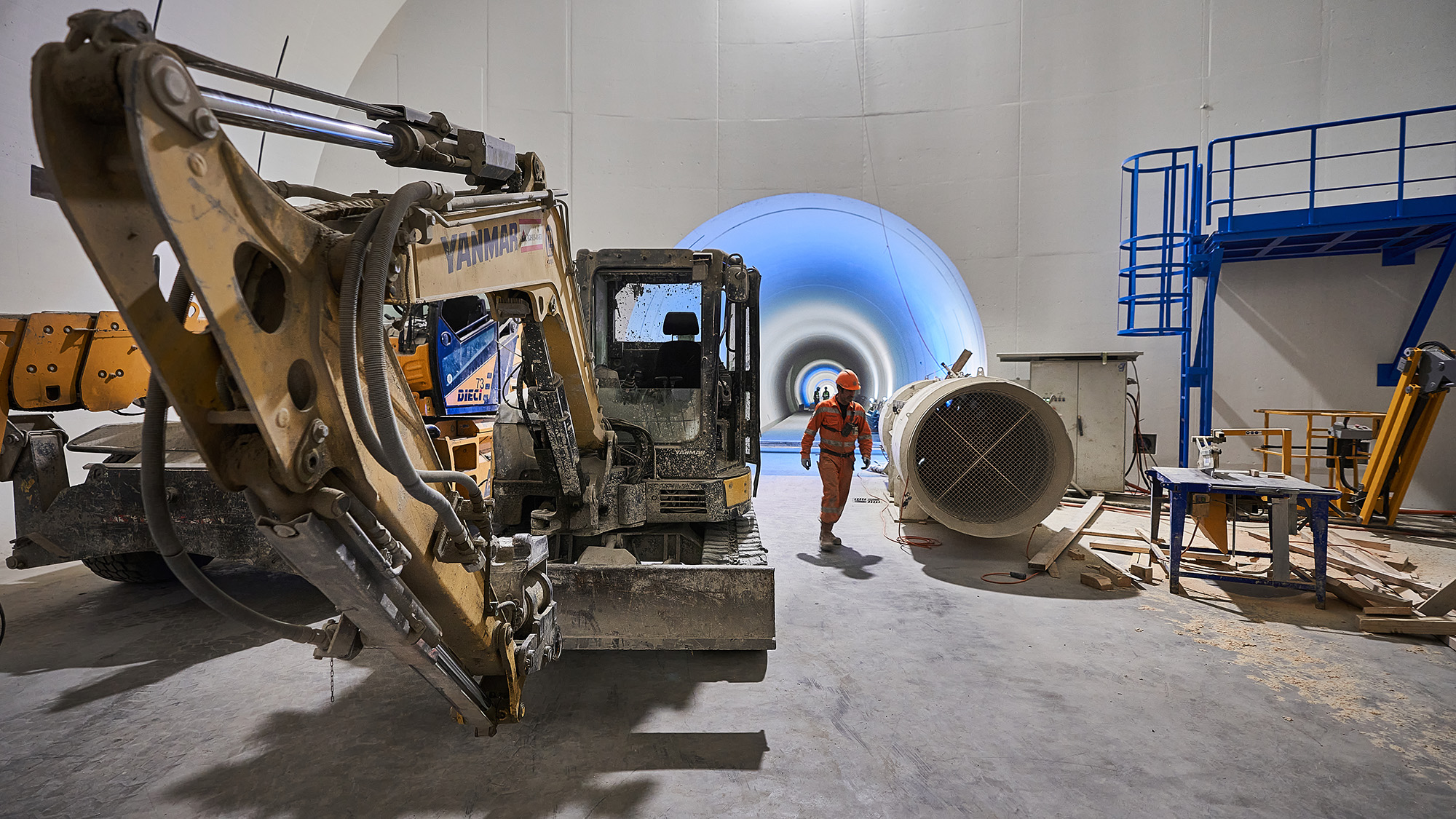
"The LS3 represents a huge and complex logistical and engineering undertaking," Jean-Philippe Tock, head of the LS3 coordination team, said in a statement. "In the LHC alone, 1.2 km [0.75 miles] of magnets and components will be removed and replaced with new equipment, and across the whole complex, dozens of projects are planned, involving thousands of engineers, physicists, technicians and support personnel."
While the LHC won't be smashing any particles together during the shutdown period, researchers will continue to analyze data already collected during experiments during the prior operational window.
Though the LHC's primary purpose is fundamental physics research, technologies used to upgrade the collider could find their way into everyday life. For example, some instruments and techniques originally developed at CERN are now being used in medical imaging, sensors and art restoration.

In a groundbreaking advancement poised to revolutionize semiconductor analysis, a team of researchers from the Institute of Science Tokyo has pioneered a tandem neural network (TNN) architecture that dramatically accelerates the inference of vital material parameters from transistor measurements. This novel machine learning framework addresses one of the most vexing challenges in semiconductor physics—the multivalued inverse problem—achieving unprecedented speed and accuracy that eclipses traditional computational methods.
Semiconductor devices underpin nearly every aspect of modern electronics, from smartphones to sophisticated computing systems. The performance and reliability of these devices hinge on intricate material properties such as defect densities, trap states, and charge carrier mobilities. While engineers can rapidly measure transistor behavior through current-voltage characteristics, deciphering the precise material attributes driving this behavior remains an elusive inverse problem. Conventional approaches rely heavily on iterative simulations and optimization techniques, often consuming hours or even days to converge on plausible solutions.
At the heart of the difficulty lies the phenomenon of multivaluedness: distinct combinations of semiconductor material parameters can yield virtually indistinguishable transistor responses. This ambiguity complicates the task of tracing device performance back to its physical origins. The research team recognized that conventional simulation frameworks are ill-equipped to navigate this degeneracy efficiently. Their insight was to harness the power of tandem neural networks, an innovative deep learning configuration capable of simultaenously enforcing physical consistency and mathematical plausibility in parameter estimation.
The tandem neural network developed by the team couples two interconnected models operating in series. The initial inverse model proposes candidate sets of material parameters based on observed transistor behavior. This output then feeds into a forward model pre-trained to reconstruct transistor characteristics from material parameters. By integrating the forward model’s reconstructions into the training loss function of the inverse network, the system effectively teaches itself to generate solutions that not only fit the measurement data but also align with the physical laws governing transistor operation.
Training this sophisticated architecture required an extensive dataset of over 1,000 simulated transistor measurements, specifically focusing on amorphous indium-gallium-zinc oxide (a-IGZO) transistors—a material of significant interest for flexible and transparent electronics. The dataset spanned a parameter space roughly 1,000 times broader than previous studies, encompassing six key variables: defect density, electron trap states, and carrier mobility among them. Astonishingly, the TNN inferred all six parameters from a single transistor current-voltage curve in less than one millisecond, achieving near-perfect accuracy across the range.
Beyond simulations, real-world validation was paramount. The researchers fabricated a series of a-IGZO transistors under five distinct processing conditions in their laboratories. When subjected to the TNN analysis, the model reproduced the measured device characteristics with exceptional fidelity, requiring no parameter tuning or iterative refinement. This immediate, high-precision performance marks a quantum leap compared to traditional simulation-dependent approaches that demand repetitive calculations, often spanning hours or days.
Assistant Professor Keisuke Ide, one of the principal investigators, highlighted the transformative implications of this speedup: “Our tandem neural network achieves a computational acceleration exceeding six orders of magnitude relative to conventional device simulation methods. This means what once took days can now be done almost instantaneously, radically changing the landscape of semiconductor diagnostics and research.”
The implications of this advancement extend well beyond academic curiosity. In industrial manufacturing, instantaneous and ultra-accurate assessment of transistor material properties can serve as an integral part of quality control, allowing defects and performance variants to be detected and addressed on the production line in real-time. This rapid feedback loop could markedly reduce waste and improve yield in semiconductor fabrication facilities.
Moreover, the TNN framework paves the way for autonomous laboratories where artificial intelligence designs, executes, and interprets experiments with minimal human oversight. By swiftly and reliably unraveling complex material-property relationships, AI-driven research tools can accelerate innovation cycles, optimizing device designs and material formulations in ways previously unattainable due to computational bottlenecks.
Interestingly, the tandem neural network architecture is not conceptually limited to semiconductors alone. The researchers underscore its potential applicability across a broad spectrum of inverse problems characterized by multivaluedness, spanning materials science, chemistry, optics, and possibly even biological systems where multiple underlying parameter sets may produce indistinguishable observational data.
The Institute of Science Tokyo, newly established in 2024 through the merger of Tokyo Medical and Dental University and Tokyo Institute of Technology, serves as a nexus for such cutting-edge interdisciplinary research. This project exemplifies the institute’s mission to advance scientific understanding and technology in ways that create tangible value for society.
As the demands for faster, smaller, and more efficient semiconductor components intensify, novel computational tools that can disentangle the complex interplay of material parameters swiftly and accurately become indispensable. The tandem neural network approach represents a critical milestone on this journey, ushering in a new era where machine learning not only supplements but fundamentally transforms physical sciences research.
This rise of AI-powered physics inference is poised to fuel accelerated material discovery, optimized manufacturing, and ultimately, enhanced electronic devices that power tomorrow’s technological landscape. With this tandem neural network, researchers have cracked open the door to solving multivalued inverse problems at blistering speeds, a feat that was once considered beyond reach.
Subject of Research: Semiconductor material characterization using machine learning
Article Title: Tandem Neural Network Rapidly Solves Multivalued Inverse Problems: Application to Oxide-Semiconductor Characterization
News Publication Date: 27-May-2026
Web References: https://doi.org/10.1002/aisy.70437
Image Credits: Institute of Science Tokyo
Artificial intelligence, machine learning, semiconductor analysis, inverse problems, multivaluedness, twin neural networks, material characterization, oxide semiconductors, transistor diagnostics, amorphous indium-gallium-zinc oxide, computational speedup, autonomous laboratories
And how lugworms tweak the rules by pooping upside down
The post The Physics Behind the Poo Emoji’s Shape appeared first on Nautilus.
It's not physics, it's biology.
Webb found the same unexplained infrared fingerprint on two frozen worlds.
A NASA astronaut Meir captured a stunning video of aurora australis
The post See the Southern Lights from Space in New ISS Video appeared first on Nautilus.
The first direct measurements of exoplanet magnetic fields reveal that ultra-hot Jupiters possess strong magnetism that shapes their atmospheres and may provide new insights into planetary habitability. Astronomers have achieved a major advance in the study of worlds beyond our Solar System by estimating the strength of the magnetic fields surrounding seven ultra-hot Jupiters. The [...]Researchers have identified the most distant dormant black hole known, dating back to the universe’s early history. Astronomers have long relied on brilliant quasars, supermassive black holes actively feeding on surrounding matter, to study the early universe. Yet these luminous objects reveal only part of the story. Now, researchers have detected the most distant dormant [...]Researchers investigate how quantum time flow can be stretched, blurred, or even reversed. What if the direction of time isn’t as fixed as it seems? While our everyday experience tells us that time moves relentlessly forward, the microscopic laws governing quantum systems are far less restrictive. In fact, many of the equations of quantum mechanics [...]For those who see the world as a dark place, the universe seems to offer little solace. According to current estimates, approximately 70% of the stuff that makes up the cosmos consists of dark energy, an unknown force that pushes space to expand. And another 25% consists of dark matter, a mysterious material that holds galaxies together. But semantically speaking, dark energy and dark matter are…
Scientists have developed a new particle detector that can measure incredibly short bursts of electrons lasting just one trillionth of a second, or one picosecond. The breakthrough could help next-generation particle accelerators reveal how materials, chemicals and biological systems behave at the atomic level. The new detector was created by the Advanced Accelerator Diagnostics Collaboration, […]
The post Scientists develop diamond detector that captures electron bursts lasting just one picosecond appeared first on Knowridge Science Report.
Could the Universe hold minds built from radically different stuff?
Millions of years ago, a massive star exploded somewhere far away in our galaxy. During this violent event, called a supernova, the dying star blasted huge amounts of matter into space. These materials included carbon, nitrogen and oxygen—the essential ingredients for life—as well as many other elements, some as heavy as iron. The explosion itself […]
The post Mysterious cosmic rays are challenging what scientists thought they knew about the universe appeared first on Knowridge Science Report.