The scientific consensus is that burning fossil fuels drives the climate crisis, yet the world’s biggest oil companies are planning to increase production
As the world swelters in ever more dangerous heat, why are oil companies being allowed to turn up the gas instead of paying for the consequences of their greed?
That ought to be the question on everyone’s minds amid baking heat domes over much of the northern hemisphere, temperature records being smashed day after day, children dying in locked cars, hospitals filling with heatstroke victims and emergency services tackling wildfires.
America’s electric grid is entering a period of unprecedented strain. Utilities across the country are scrambling to keep up as power-hungry AI data centers expand at a staggering pace, often […]
As a new, potentially record-breaking El Niño begins, researchers are vigorously debating whether climate change is driving the phenomenon’s intensity.
As a new, potentially record-breaking El Niño begins, researchers are vigorously debating whether climate change is driving the phenomenon’s intensity.
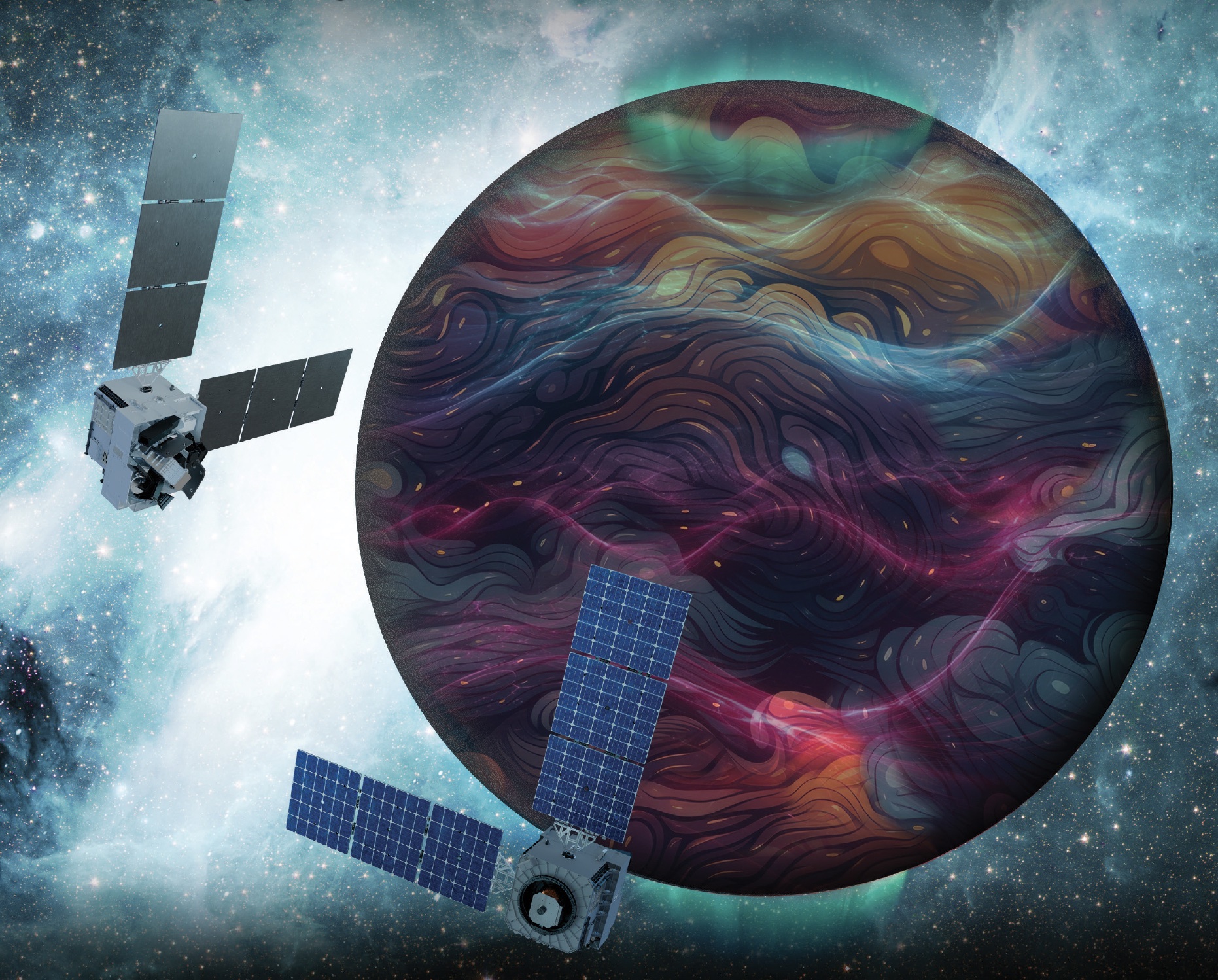
Artist’s rendition of the DAPHNE (Dynamic Atmosphere-Ionosphere Explorer) mission concept. The coloring represents auroras and atmospheric waves in Earth’s atmosphere.
Credit: Laboratory for Atmospheric and Space Physics/Mary Tostanoski
NASA selected a mission concept to research how space weather and dynamics within Earth’s atmosphere influence the space environment and help improve prediction capabilities for impacts on crucial technology, such as GPS and low Earth orbit satellites, as well as astronauts in space.
The DAPHNE (Dynamic Atmosphere-Ionosphere Explorer) mission will enter Phase B of development, which includes planning and design for flight and mission operations. It will use identical twin satellites to study how changes in Earth’s lower atmosphere influence our planet’s upper atmosphere, where space weather is manifested.
“NASA is advancing the United States’ leadership as a space weather-ready nation, and by providing new insights into Earth’s atmosphere we can better predict and prepare for impacts in our daily lives on Earth and in space,” said Nicky Fox, associate administrator, Science Mission Directorate, NASA Headquarters in Washington. “As NASA sends astronauts beyond Earth’s magnetic protection to the Moon, Mars, and beyond, DAPHNE will join the NASA science fleet strategically located across the solar system to provide data that will help mission planners predict and mitigate the effects of space weather for the benefit of all.”
The DAPHNE mission’s low-risk high-return concept will provide coordinated, multi-point measurements of neutral winds, temperature, and composition in the thermosphere. The ionosphere and thermosphere regions are where Earth’s neutral atmosphere transitions into the ionized plasma of space. In this thin shell that surrounds the planet, the atmosphere is in constant motion, shaped by the influence of solar activity and changes in the lower atmosphere and in near-Earth space.
Fundamental observations and physical insights from the DAPHNE mission will incorporate lower-atmospheric energy data to advance space weather predictive capabilities. The mission is led by Aimee Merkel from the Laboratory for Atmospheric and Space Physics at the University of Colorado, Boulder.
The mission will be subject to a confirmation review in 2027, which will assess the progress of the mission and the availability of funds. If confirmed, the total estimated cost of the mission, excluding launch, will not exceed $250 million in fiscal year 2023 dollars, with a mission launch date of no earlier than 2029.
The DAPHNE mission was proposed as a concept study in response to the DYNAMIC (Dynamical Neutral Atmosphere-Ionosphere Coupling) mission announcement of opportunity. Funding and management oversight for this mission is provided by the Solar Terrestrial Probes program at NASA’s Goddard Space Flight Center in Greenbelt, Maryland.
For more information on NASA’s heliophysics missions, visit:
With CO2 greening the planet, any possible harms are outweighed by the benefits of more trees and crops. And that's even before you subtract the monumental cost of Net Zero, says Matt Ridley.
Sentinel-6 satellite data shows strengthening warm-water waves in the Pacific, pointing to the likely arrival of El Niño and its global weather impacts later in 2026. Several months before an El Niño develops, large waves of warmer, elevated water travel eastward across the Pacific Ocean. Satellite observations in 2026 have detected several of these waves. [...]
Smart weather-monitoring device vendor AcuRite has delayed plans to force users onto a new companion app. The transition from My AcuRite to AcuRite NOW, which AcuRite previously set for May 30, “has raised serious questions and concerns among many long-time users,” AcuRite’s VP of product development, Jeff Bovee, told Ars Technica.
AcuRite, whose devices include weather stations, rain gauges, and indoor thermometers, told customers that it would shut down My AcuRite at the end of May. Devices owners would have to use AcuRite NOW, an iOS and Android app launched in June 2025, to control their gadgets instead.
Some long-time users lamented being forced to new software when the current software worked fine, if not better, than the new app. When Ars first reported on AcuRite in May, AcuRite NOW lacked some features of My AcuRite, including the ability to rename multiple temperature sensors, report temperatures in non-integers, as well as an online dashboard option. Users have also highlighted problems uploading data to weather sites and a poor layout with wasted space.
The National Oceanic and Atmospheric Administration gives the climate event a 63% chance to "rank among the largest El Niño events in the historical record going back to 1950."
Unusually tall red auroras over Japan may be revealing that some solar storms are stronger than scientists realize. A study published in the Journal of Space Weather and Space Climate reports that red auroras observed over Japan extended to altitudes of roughly 500-800 kilometers above Earth. The discovery was made by researchers from Hokkaido University [...]
Typhoon Jangmi dazzled from space with a giant swirling eye while drenching parts of Japan with heavy rain. From late May into early June 2026, Typhoon Jangmi slowly tracked north-northwest across the Philippine Sea on a path toward southern Japan. Although the storm moved at a relatively slow pace, it spread intense rainfall across a [...]
A rapidly intensifying super typhoon sent giant atmospheric ripples skyward, revealing a hidden connection between extreme weather and near-space. In April 2026, Super Typhoon Sinlaku swept across the North Pacific, bringing torrential rain and flooding to parts of the Mariana Islands. The storm intensified into a “violent typhoon,” the highest category used by the Japan [...]

 Login