❌

Normal view

Alien life on nearby 'super Earth' much likelier than we thought, study claims

4 July 2026 at 12:00

A hefty "super Earth" lurking in one of the closest star systems to our planet may be much better suited to supporting extraterrestrial life than scientists initially thought, a new study suggests. The alien world's relative proximity to Earth, and the nature of its home star, make it a prime candidate for follow-up observations, researchers say.

The exoplanet, dubbed GJ 3378b, was discovered in 2024 and orbits a red dwarf star around 25 light-years from our planet. The alien world circles its star every 21.5 days at a distance around 10 times closer than Earth orbits the sun, which would make it completely inhospitable in our solar system. But because the red dwarf emits around 90% less radiation than the sun does, GJ 3378b is slap bang in the middle of this star system’s "habitable zone," where liquid water could exist on the exoplanet's surface.

Researchers initially thought that GJ 3378b was around five times more massive than Earth. If the planet is rocky like ours, it would qualify as a "super Earth" — often considered the best candidates for sustaining extraterrestrial life. However, it was hard to tell if this world had a solid surface or was actually a mini gas giant. And even if it was rocky, its immense size would probably mean that its atmospheric pressure would be crushing, making it less likely to harbor life.

But in a new study, published June 30 in The Astrophysical Journal, researchers recalculated the exoplanet's size, using the Habitable-zone Planet Finder instrument attached to the Hobby-Eberly Telescope at the McDonald Observatory in Texas. This device measures subtle wobbles in the host star, caused by the gravitational tug of orbiting planets, and can be used to calculate the planet’s mass and trajectory.

This revealed that GJ 3378b is actually only 2.3 times more massive than Earth, which almost guarantees it is a rocky world and means it could have an atmosphere with a similar pressure to our own, raising the chances that extraterrestrial lifeforms could thrive there.

An artist's illustration of an exoplanet in space

The newly constrained size of GJ 3378b makes it much more likely that the exoplanet has an atmosphere similar to Earth's. But more research is needed to confirm if it even has an atmosphere. (Image credit: NASA/Eyes on Exoplanets viewer)

While researchers have found several other exoplanets that could harbor life, the fact that GJ 3378b is so close to us makes it particularly intriguing, as it will be easier to confirm whether it is truly habitable.

"This one’s exciting," study first author Paul Robertson, an astronomer at the University of California, Irvine, said in a statement. "25 light-years sounds like a long way, but the Milky Way is about 100,000 light-years across, so in that respect it’s our next-door neighbor."

Before we get too carried away, there is still no evidence that GJ 3378b has an atmosphere or liquid water. Its proximity to its home star may mean that any atmosphere it once had was stripped away by stellar winds, similar to how solar radiation likely stripped Mars of its atmosphere and ancient oceans.

Therefore, more observations are needed. But if an atmosphere is detected, GJ 3378b would likely jump to near the front of the queue of exoplanets that researchers want to study further.

"If a planet in the habitable zone has a proper atmosphere, we can justify further research looking for biosignatures, liquid water or other signs of life," study co-author Gogod James, an undergraduate student at UC Irvine, said in the statement.

The fact that GJ 3378b orbits a red dwarf also makes it more appealing for future study because this is the most common star type in the Milky Way, so experts are keen to learn more about these stars' planetary systems and potential to nurture life.

"About 70% of stars in our galaxy are red dwarfs, so they represent the standard," study co-author Michael Endl, an astronomer at the McDonald Observatory and the University of Texas at Austin, said in another statement. "It’s really important that we understand the planet population around these stars."

Cotton-Candy Exoplanets: Two for the Price of One!

2 July 2026 at 13:00

NASA’s Transiting Exoplanet Survey Satellite has found two “super-puff” planets in the same system, each one as light as cotton candy.

The post Cotton-Candy Exoplanets: Two for the Price of One! appeared first on Sky & Telescope.

This 'improbable' exoplanet system is so wonky because of a weird object within

23 June 2026 at 11:00

Using NASA's exoplanet-hunting spacecraft TESS (Transiting Exoplanet Survey Satellite), scientists have discovered a planetary system that scientists are calling "improbable." It could change how we think about the mechanisms behind planet formation.

The reason for the unusual arrangement of this planetary system is a failed star or brown dwarf designated TOI-201 c. Objects like this get the slightly unfair nickname of "failed stars" because, despite forming from a collapsing cloud of gas and dust like other stars, they fail to gather enough mass to trigger nuclear fusion of hydrogen to helium in their cores. Brown dwarfs have masses between 13 and 80 times that of Jupiter, or 0.013 to 0.08 the mass of the sun. That puts them right between the most massive planets and the smallest stars.

TOI-201 c is on a highly elliptical orbit, taking 2,881 days to orbit its star, which has resulted in planets including a super-Earth named TOI-201 d and a warm Jupiter named TOI-201 b, forming in a narrow zone within its orbit, something that isn't just new to astronomers; it is completely unexpected based on planetary formation models.

The 5.8-day orbit of TOI-201 d and the 53-day orbit of TOI-201 b are both perfectly aligned with the orbit of the brown dwarf. The brown dwarf creates gravitational instability at distances equivalent to the distance between Mars and the sun, but this didn't prevent planets from forming in the system.

"This discovery provides a crucial insight into how planets form even around massive, eccentric objects," team member and INAF researcher Aldo Bonomo said in an emailed statement.

The system challenges the idea that gas giant planets form at distances equivalent to 2 to 3 times the distance between Earth and the sun in the disks of gas and dust that surround stars during their infancy.

"The presence of the brown dwarf on such an elliptical orbit forced the planets to form and survive by occupying the innermost and hottest edges of the primordial disk," team member Luca Naponiello of the National Institute for Astrophysics (INAF) said in the statement. "Furthermore, the data show that during the close approach of the brown dwarf, the warm Jupiter undergoes strong and sudden variations in its transit timing, bearing witness to an intense and vigorous dynamic interaction currently underway between the two giants."

The system was discovered by TESS using a rare mono-transit event, which describes a planetary body making one crossing of the face of its star, causing a dip in starlight. This was followed by an observing campaign conducted from the ground.

It is extremely rare to discover objects like TOI-201 c with such long and eccentric orbital periods using transits they make of their parent star. This brown dwarf is the first one of these objects to have its mass confirmed, making it an important step forward in astronomy.

"It [TOI-201c] is the transiting object with the longest orbital period for which the mass is known," Naponiello said.

The team's results were published on Wednesday (June 17) in the journal Nature.

James Webb Space Telescope finds a salty surprise on famous 'Pink Planet'

18 June 2026 at 21:00

Using the James Webb Space Telescope, astronomers have discovered that the well-known "Pink Planet" harbors a salty surprise and an exotic atmospheric chemistry. The discovery marks an advancement in the study of cold objects beyond the solar system.

Initially discovered in 2013, GJ504b orbits a sun-like star located around 57 light-years from Earth. With a mass around 25 times that of Jupiter, this Pink Planet may not be a planet at all despite its moniker. It may instead be a brown dwarf, a failed star that formed like a star but was unable to gather enough mass to achieve the nuclear fusion of hydrogen to helium in its core. Thus, astronomers refer to it as a "planetary-mass companion," which means a planet-size object orbiting a parent star.

GJ504b remains one of the coldest planetary-mass companions discovered using ground-based telescopes, with a temperature of around 550 degrees Fahrenheit (290 degrees Celsius). Although, that still makes it hot enough to bake bread. Now, James Webb Space Telescope (JWST) data reveals it has a key ingredient for bread making too: salt located in its atmospheric clouds, unlike anything astronomers have seen before.

"The Pink Planet is the coldest companion ever discovered using ground-based instruments," team leader Aneesh Baburaj of Northwestern University said in a statement. "Many teams all around the world performed follow-up observations to study its light, but it was too faint for ground-based instruments. That made it a perfect target for JWST.

"When we finally obtained its spectrum, it immediately looked interesting. But once we started digging deeper into the data, we realized it was not like anything we have analyzed before."

The Pink Planet is cold and old

The team studied this planetary companion by measuring its faint electromagnetic radiation emissions and filtering out the bright glare of its parent star.

They found the relative coolness of the Pink Planet is a result of the planet's age. Both gas giant planets and brown dwarfs are born blisteringly hot but cool off as they get older. This new research estimated that GJ504b is between 2.5 billion and 4 billion years old.

Breaking down light from the Pink Planet into individual wavelengths, the team was also able to determine its chemical composition. This is possible because elements absorb and emit light at characteristic wavelengths, meaning they leave "fingerprints" on light passing through their atmospheres.

"In the past, other astronomers observed the companion for an entire night with some of the biggest telescopes in the world to obtain a spectrum," Baburaj said. "And they could not see the object. With JWST, our entire observation took around two hours, and we were successful."

The JWST data revealed a rich cocktail of chemicals in the atmosphere of the Pink Planet that included water, carbon dioxide, methane, and ammonia. However, these observations didn't match modeling of the planetary companion's atmosphere until the team factored in something completely unexpected: clouds of salt deep in the atmosphere.

A depiction of a yellow-hexagon mirror attached to a long silver shield-shape object. This is the JWST. In the background, lots of stars across space. Toward the right in the background, glare from one star that is likely the sun.

An illustration of the JWST which has become a vital tool in the investigation of exoplanets and brown dwarfs. (Image credit: ESA)

"We ran simulations with clouds, and the results aligned with what we know about cold planets," Baburaj said. "We tried three different types of clouds, and salt clouds fit best. When we accounted for salt clouds, it subdued the signature of molecules hidden deeper in the companion’s atmosphere. Then, the results became physically possible.

"This is the first time we've found that salt clouds are critical to explaining the spectrum of an object. It's a good reminder to account for clouds in our models."

Though this mystery may be solved, there are still questions surrounding GJ504b that will only be solved with further investigation. The Pink Planet seems to be unusually rich in elements heavier than hydrogen and helium, which astronomers call metals. This means the team still can't pin down the origin of the Pink Planet; did it form like a planet, or like a star?

That means they aren't quite ready to determine if GJ504b is a gas giant planet or a brown dwarf... or should that be Pink Dwarf?

The team's research was published on Thursday (June 18) in The Astronomical Journal.

June 17, 2 BCE: A conjunction between Venus and Jupiter

17 June 2026 at 14:00

On June 17, in the year 2 B.C.E, a significant planetary conjunction occurred involving Venus and Jupiter. From Earth’s perspective, these two bright planets appeared to draw so close that they would have seemed to merge into nearly a single, brilliant object in the sky. This type of celestial alignment occurs because planets move inContinue reading "June 17, 2 BCE: A conjunction between Venus and Jupiter"

The post June 17, 2 BCE: A conjunction between Venus and Jupiter appeared first on Astronomy Magazine.

Unusual Exoplanet Redefines the Concept of a Hot Jupiter

17 June 2026 at 01:04

For nearly a decade, the hot Jupiter CoRoT-2 b has presented a profound mystery to astronomers: its atmospheric hot spot is inexplicably located opposite the position observed on all other exoplanets of its kind. This peculiar phenomenon challenges conventional wisdom about the nature of hot Jupiters and their atmospheric dynamics. Recent research led by Aurora Kesseli, a staff scientist at the NASA Exoplanet Science Institute (NExScI) housed within Caltech’s IPAC center, has shed new light on this enigma by leveraging advanced spectroscopic data obtained from the Very Large Telescope (VLT) at the European Southern Observatory. This breakthrough offers compelling evidence that CoRoT-2 b defies a fundamental assumption about hot Jupiters: it is not tidally locked to its host star.

Hot Jupiters are a fascinating class of exoplanets typified by their colossal size—often comparable to or exceeding that of Jupiter—and their blisteringly close orbits around host stars, sometimes completing a single revolution in mere days. Because of these properties, hot Jupiters serve as prime candidates for detailed atmospheric studies. Their proximity to the parent star means they receive intense irradiation, significantly influencing their atmospheric dynamics, radiative properties, and chemical compositions. This environment makes them critical laboratories for testing and refining planetary formation, evolution, and climate models.

The accepted paradigm for hot Jupiter atmospheres is predicated on tidal locking, whereby the planet’s rotation period synchronizes with its orbit, causing one hemisphere to perpetually face the star, exposed to relentless stellar radiation, while the opposite side remains cloaked in darkness. This lock is thought to occur rapidly due to strong gravitational interactions between the planet and its star. The perpetual dayside is expected to feature a dominant hot spot slightly offset towards the direction of planetary rotation and orbital motion, driven by atmospheric super-rotation. This consistent pattern is observed across many studied hot Jupiters, reinforcing tidal locking as a foundational concept within exoplanetary atmospheric science.

However, CoRoT-2 b stands out starkly against this backdrop. Discovered in 2007 and studied extensively since, this hot Jupiter’s hottest atmospheric region is displaced not ahead of but behind the substellar point—the point on the planet directly facing its star—opposite to the behavior seen in counterparts. Initial hypotheses proposed to explain this anomaly included obscuring cloud layers, magnetic field-driven atmospheric dynamics complicating wind patterns, or a rotation period differing from the orbital period. Previous work by Lisa Dang, a collaborator and professor at the University of Waterloo, outlined these potential explanations based on early observational data.

Aurora Kesseli and her team recently applied phase-resolved emission spectroscopy using the CRIRES+ instrument on the VLT, capturing the planet’s atmosphere in unprecedented detail across different orbital phases. This method enables tracing variations in emitted light corresponding to temperature and wind structures dynamically as the planet orbits. The data conclusively pointed toward the third hypothesis: CoRoT-2 b exhibits a rotation rate slower than its orbital period, meaning it is not synchronized tidally. Specifically, one full rotation of CoRoT-2 b lasts approximately three Earth days, while its orbital period is about 1.5 days. This differential implies that by the time the planet completes a single axial spin, it has circumnavigated its host star twice.

This non-synchronous rotation leads to a decoupling of the traditional tidally locked pattern of day-night heating contrasts, fundamentally altering how atmospheric circulation redistributes energy. Without tidal locking, the expected eastward-shifted hot spot is replaced by a distinct thermal signature resulting from slower planetary spin interacting with intense stellar irradiation. The discovery challenges standard assumptions embedded in many exoplanet climate models that universally prescribe tidal locking for hot Jupiters, suggesting a more nuanced picture with rotational diversity.

Understanding the rotational state of exoplanets like CoRoT-2 b carries broader implications, especially in the context of habitability studies. Many terrestrial exoplanets orbit M dwarfs, cool stars constituting roughly 70% of the stellar population in the Milky Way. These stars have habitable zones—regions where liquid water can persist on planetary surfaces—so close that tidal locking is highly probable within relatively short stellar lifetimes. Since rotation influences temperature gradients, weather systems, and atmospheric retention, a tidally locked terrestrial exoplanet’s climate could differ drastically from one with asynchronous rotation. Hence, unraveling CoRoT-2 b’s rotation contributes to refining the models employed for predicting environments on potentially habitable worlds in tight orbits.

While the revelation of CoRoT-2 b’s slow rotation solves a significant piece of the puzzle, it simultaneously opens further questions. The mechanisms driving this atypical rotational state in a planet where tidal forces should dominate remain elusive. Possible contributors might include magnetic torques, differential interior structures, or recent dynamical interactions within its planetary system that disturbed its spin. Future observations, especially with upcoming flagship observatories like the James Webb Space Telescope, the Habitable Worlds Observatory, and the ground-based Extremely Large Telescope, promise to provide deeper insight into these processes by offering higher precision data across broader wavelength ranges.

Hot Jupiters continue to act as vanguards in exoplanetary science. They are currently the best-understood and most accessible class of exoplanets for atmospheric characterization, enabling astronomers to test and recalibrate models of atmospheric physics, chemistry, and dynamics. The case of CoRoT-2 b exemplifies how nature’s variability often defies simplified expectations, compelling constant refinement of theories and models. These advances do not merely enhance comprehension of gas giants but ripple outward to shape understanding of all planetary atmospheres, including those bearing life.

Kesseli underscores the excitement of probing “weird” exceptions within the exoplanet census, emphasizing that such outliers drive scientific progress. As instrumentation improves and more extensive surveys unfold, the taxonomy of exoplanetary rotation states, atmospheric dynamics, and climate regimes will grow richer. This improved framework will essentialize our broader quest to understand planet formation, stellar influences, and potential biosignatures on distant worlds. CoRoT-2 b’s defiance of tidal locking invites the scientific community to remain alert to unexpected phenomena lurking in exoplanet atmospheres.

In summation, the unraveling of CoRoT-2 b’s anomalous atmospheric hot spot through rigorous spectroscopic measurements marks a milestone in exoplanet research. It dispels the notion of universal tidal locking among hot Jupiters and reveals a more intricate rotational behavior impacting atmospheric properties. The ongoing inquiry into the cause of this slowed rotation will propel future efforts to decipher planetary spins, magnetic interactions, and orbital dynamics across a diverse planetary population. These insights will deepen our grasp of planetary physics and help guide the search for habitable environments beyond our solar system.

Subject of Research: Atmospheric dynamics and rotational state of the hot Jupiter CoRoT-2 b
Article Title: Unraveling the Mystery of the Peculiar and Young Hot Jupiter CoRoT-2b II: Phase Resolved Emission Spectroscopy with VLT/CRIRES+ and Gemini-S/IGRINS
News Publication Date: June 16, 2026
Web References: IPAC News, NExScI at Caltech, University of Waterloo Newsroom
References: Kesseli et al., submitted to The Astronomical Journal
Image Credits: Keith Miller (Caltech/IPAC – SELab)

Keywords: hot Jupiter, CoRoT-2 b, tidal locking, exoplanet atmospheres, phase-resolved spectroscopy, planetary rotation, atmospheric dynamics, VLT/CRIRES+, exoplanet climate models, M dwarf habitability, rotational decoupling, spectroscopic observations

NASA’s Webb Catches Exoplanet Getting Roasted

16 June 2026 at 22:15
 
4 Min Read

NASA’s Webb Catches Exoplanet Getting Roasted

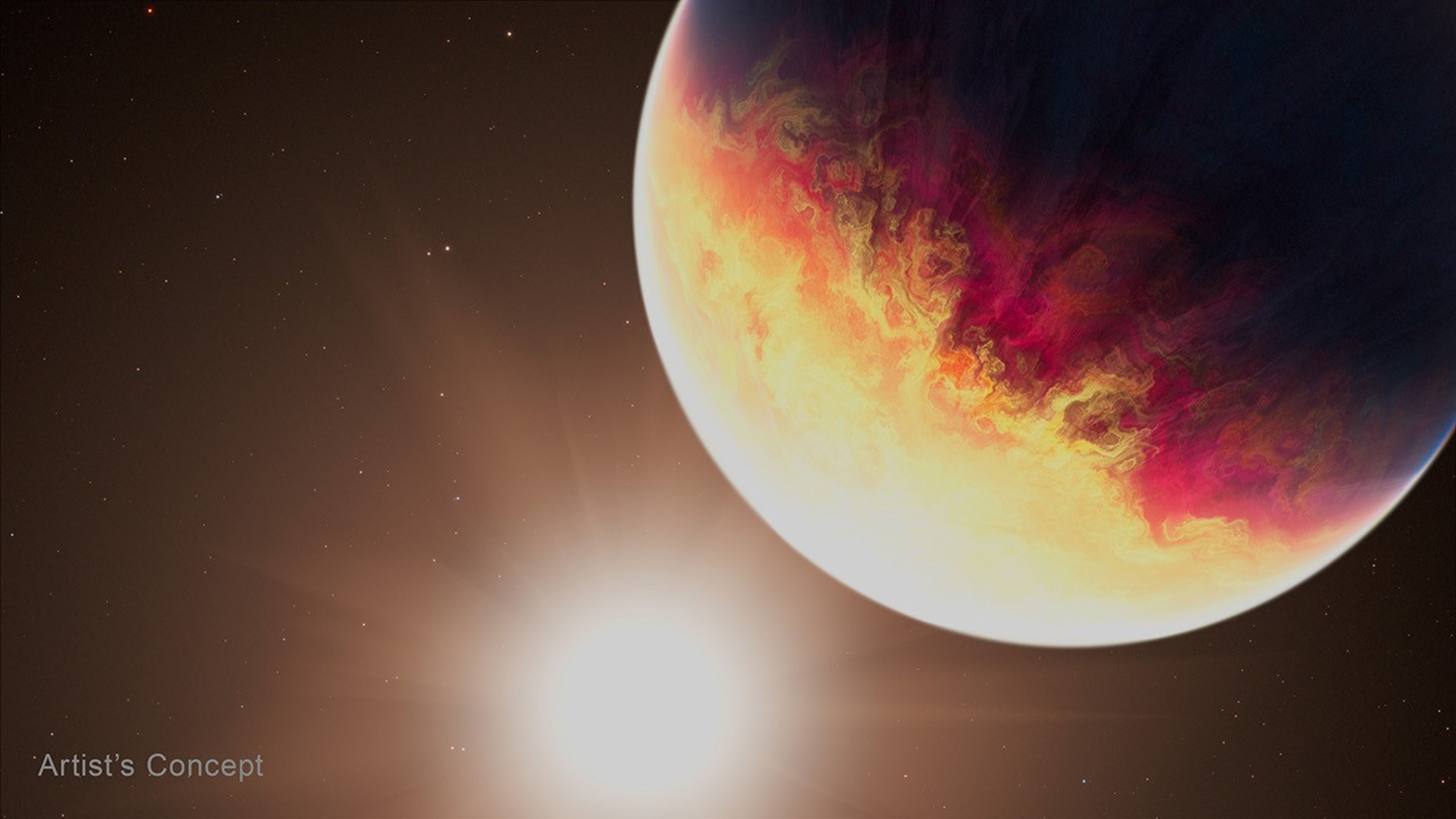
Illustration of a planet and a star, labeled artist’s concept at the bottom left. The planet fills more than a quarter of the image to the upper right, with the bright star to its lower left. The planet is white hot on the star side, fading to yellow that mixes with swirls of bright red across its middle, and eventually fading to black on the side most distant from the star. Distant stars dot the background of space, which is black near the edges of the frame.
This artist’s concept shows exoplanet HD 80606 b being “roasted” as its orbit approaches periastron, the point at which it is closest to its host star, which is similar to our Sun.
Credits:
Artwork: NASA, ESA, CSA, Joseph Olmsted (STScI)

4 min read

NASA’s Webb Catches Exoplanet Getting Roasted

One well-done gas giant, coming right up! That’s the latest from researchers analyzing NASA’s James Webb Space Telescope’s observations of HD 80606 b, an exoplanet four times the mass of Jupiter with an extremely elliptical orbit that sweeps close by its Sun-like star. The research team is presenting their study and preliminary findings Tuesday at the 248th meeting of the American Astronomical Society in Pasadena, California.

“Hot Jupiters are already considered some of the most extreme exoplanets we know of, but even among that population, HD 80606 b is one of the most extreme,” said Tiffany Kataria, the study’s principal investigator at NASA’s Jet Propulsion Laboratory in Southern California. “We typically think of hot Jupiters as hot gas giants sitting right next to their stars, but this planet’s highly eccentric orbit creates a completely different beast.”

As the planet plunges close to its star, Webb shows its temperature skyrockets by 1,100 degrees Fahrenheit. Previous studies have shown that radical temperature swings can cause an exoplanet’s chemistry and clouds to change in real time. According to the research team, the dynamic conditions of HD 80606 b make the planet an ideal target to observe these changes with Webb’s powerful instruments.

Image: Artist’s concept exoplanet HD 80606 b

Illustration of a planet and a star, labeled artistu2019s concept at the bottom left. The planet fills more than a quarter of the image to the upper right, with the bright star to its lower left. The planet is white hot on the star side, fading to yellow that mixes with swirls of bright red across its middle, and eventually fading to black on the side most distant from the star. Distant stars dot the background of space, which is black near the edges of the frame.
This artist’s concept shows exoplanet HD 80606 b being “roasted” as its orbit approaches periastron, the point at which it is closest to its host star, which is similar to our Sun.
Artwork: NASA, ESA, CSA, Joseph Olmsted (STScI)

“Observing a planet like HD 80606 b is actually very efficient because its unusual orbit, with the corresponding swings in temperature and chemical composition, allow us to gather data under varying conditions in just hours and apply those findings to other hot Jupiters or more conventional exoplanets,” said Laura C. Mayorga, co-investigator on the study and an exoplanet astronomer at the Johns Hopkins Applied Physics Laboratory in Laurel, Maryland.

Measurements of temperature and chemical composition were done with spectroscopy, a technique scientists use to break light into its component colors to reveal information about the composition, temperature, motion, and physical properties of objects in space. The team used Webb’s MIRI (Mid-Infrared Instrument) for an extended observation of HD 80606 b before, during, and after its periastron, or closest pass by its star. During periastron, the planet also passed behind the star from Webb’s perspective in what’s known as a secondary eclipse. The observation was years in the planning, as scheduling the time to catch the planet at this point was complex given its extremely elliptical 111-day orbit, and Webb’s own restrictions on where it can look during specific times of the year, based on Earth’s position in orbit around the Sun.

Researchers say they have only begun to peel back the layers of an incredibly rich dataset, but they can clearly see a dramatic shift in the exoplanet’s temperature. “Webb has shown that the planet’s increase in temperature was even more extreme than we anticipated based on Spitzer data,” said Kataria.

In fact, the planet had already been dubbed the “roasted exoplanet” and even got its own poster in NASA’s popular series. NASA’s now-retired Spitzer Space Telescope laid the groundwork of infrared observations of HD 80606 b, showing that more detailed spectroscopic data from Webb would be especially compelling.

“Spitzer did amazing work on this exoplanet, and now Webb is building on that legacy by enabling us to drill down to distinguish specific chemical signatures like methane and carbon dioxide, which is just amazing progress,” said Ryan Challener, co-author and research associate at the Cornell Center for Astrophysics and Planetary Science. “There’s so much to learn from this one dataset here — we really are just getting started deciphering what Webb has to tell us.”

The James Webb Space Telescope is the world’s premier space science observatory. Webb is solving mysteries in our solar system, looking beyond to distant worlds around other stars, and probing the mysterious structures and origins of our universe and our place in it. Webb is an international program led by NASA with its partners, ESA (European Space Agency) and CSA (Canadian Space Agency).

For more information on Webb, visit:

science.nasa.gov/webb

Downloads & Related Information

The following sections contain links to download this article’s images and videos in all available resolutions followed by related information links, media contacts, and if available, research paper and Spanish translation links.

Related Images & Videos

Illustration of a planet and a star, labeled artistu2019s concept at the bottom left. The planet fills more than a quarter of the image to the upper right, with the bright star to its lower left. The planet is white hot on the star side, fading to yellow that mixes with swirls of bright red across its middle, and eventually fading to black on the side most distant from the star. Distant stars dot the background of space, which is black near the edges of the frame.

HD 80606 b (Artist’s Concept)

This artist’s concept shows exoplanet HD 80606 b being “roasted” as its orbit approaches periastron, the point at which it is closest to its host star, which is similar to our Sun.

Related Links

Este Artículo en Español – “Telescopio Webb de la NASA Detecta un Exoplaneto Asandose”

Read:  Webb’s Impact on Exoplanet Research

Watch:  How to Study Exoplanets: Webb and Challenges

Explore:  Eyes on Exoplanets

Print: The Roasted Exoplanet Poster

More Webb: News | Images | Science | Home Page


Share

Details

Last Updated
Jun 17, 2026
Contact
Media

Laura Betz
NASA’s Goddard Space Flight Center
Greenbelt, Maryland
laura.e.betz@nasa.gov

Leah Ramsay
Space Telescope Science Institute
Baltimore, Maryland

Hannah Braun
Space Telescope Science Institute
Baltimore, Maryland

NASA’s Webb Catches Exoplanet Getting Roasted

16 June 2026 at 22:15
 
4 Min Read

NASA’s Webb Catches Exoplanet Getting Roasted

Illustration of a planet and a star, labeled artist’s concept at the bottom left. The planet fills more than a quarter of the image to the upper right, with the bright star to its lower left. The planet is white hot on the star side, fading to yellow that mixes with swirls of bright red across its middle, and eventually fading to black on the side most distant from the star. Distant stars dot the background of space, which is black near the edges of the frame.
This artist’s concept shows exoplanet HD 80606 b being “roasted” as its orbit approaches periastron, the point at which it is closest to its host star, which is similar to our Sun.
Credits: Artwork: NASA, ESA, CSA, Joseph Olmsted (STScI)

4 min read

NASA’s Webb Catches Exoplanet Getting Roasted

One well-done gas giant, coming right up! That’s the latest from researchers analyzing NASA’s James Webb Space Telescope’s observations of HD 80606 b, an exoplanet four times the mass of Jupiter with an extremely elliptical orbit that sweeps close by its Sun-like star. The research team is presenting their study and preliminary findings Tuesday at the 248th meeting of the American Astronomical Society in Pasadena, California.

“Hot Jupiters are already considered some of the most extreme exoplanets we know of, but even among that population, HD 80606 b is one of the most extreme,” said Tiffany Kataria, the study’s principal investigator at NASA’s Jet Propulsion Laboratory in Southern California. “We typically think of hot Jupiters as hot gas giants sitting right next to their stars, but this planet’s highly eccentric orbit creates a completely different beast.”

As the planet plunges close to its star, Webb shows its temperature skyrockets by 1,100 degrees Fahrenheit. Previous studies have shown that radical temperature swings can cause an exoplanet’s chemistry and clouds to change in real time. According to the research team, the dynamic conditions of HD 80606 b make the planet an ideal target to observe these changes with Webb’s powerful instruments.

Image: Artist’s concept exoplanet HD 80606 b

Illustration of a planet and a star, labeled artistu2019s concept at the bottom left. The planet fills more than a quarter of the image to the upper right, with the bright star to its lower left. The planet is white hot on the star side, fading to yellow that mixes with swirls of bright red across its middle, and eventually fading to black on the side most distant from the star. Distant stars dot the background of space, which is black near the edges of the frame.
This artist’s concept shows exoplanet HD 80606 b being “roasted” as its orbit approaches periastron, the point at which it is closest to its host star, which is similar to our Sun.
Artwork: NASA, ESA, CSA, Joseph Olmsted (STScI)

“Observing a planet like HD 80606 b is actually very efficient because its unusual orbit, with the corresponding swings in temperature and chemical composition, allow us to gather data under varying conditions in just hours and apply those findings to other hot Jupiters or more conventional exoplanets,” said Laura C. Mayorga, co-investigator on the study and an exoplanet astronomer at the Johns Hopkins Applied Physics Laboratory in Laurel, Maryland.

Measurements of temperature and chemical composition were done with spectroscopy, a technique scientists use to break light into its component colors to reveal information about the composition, temperature, motion, and physical properties of objects in space. The team used Webb’s MIRI (Mid-Infrared Instrument) for an extended observation of HD 80606 b before, during, and after its periastron, or closest pass by its star. During periastron, the planet also passed behind the star from Webb’s perspective in what’s known as a secondary eclipse. The observation was years in the planning, as scheduling the time to catch the planet at this point was complex given its extremely elliptical 111-day orbit, and Webb’s own restrictions on where it can look during specific times of the year, based on Earth’s position in orbit around the Sun.

Researchers say they have only begun to peel back the layers of an incredibly rich dataset, but they can clearly see a dramatic shift in the exoplanet’s temperature. “Webb has shown that the planet’s increase in temperature was even more extreme than we anticipated based on Spitzer data,” said Kataria.

In fact, the planet had already been dubbed the “roasted exoplanet” and even got its own poster in NASA’s popular series. NASA’s now-retired Spitzer Space Telescope laid the groundwork of infrared observations of HD 80606 b, showing that more detailed spectroscopic data from Webb would be especially compelling.

“Spitzer did amazing work on this exoplanet, and now Webb is building on that legacy by enabling us to drill down to distinguish specific chemical signatures like methane and carbon dioxide, which is just amazing progress,” said Ryan Challener, co-author and research associate at the Cornell Center for Astrophysics and Planetary Science. “There’s so much to learn from this one dataset here — we really are just getting started deciphering what Webb has to tell us.”

The James Webb Space Telescope is the world’s premier space science observatory. Webb is solving mysteries in our solar system, looking beyond to distant worlds around other stars, and probing the mysterious structures and origins of our universe and our place in it. Webb is an international program led by NASA with its partners, ESA (European Space Agency) and CSA (Canadian Space Agency).

For more information on Webb, visit:

science.nasa.gov/webb

Downloads & Related Information

The following sections contain links to download this article’s images and videos in all available resolutions followed by related information links, media contacts, and if available, research paper and Spanish translation links.

Related Images & Videos

Illustration of a planet and a star, labeled artistu2019s concept at the bottom left. The planet fills more than a quarter of the image to the upper right, with the bright star to its lower left. The planet is white hot on the star side, fading to yellow that mixes with swirls of bright red across its middle, and eventually fading to black on the side most distant from the star. Distant stars dot the background of space, which is black near the edges of the frame.

HD 80606 b (Artist’s Concept)

This artist’s concept shows exoplanet HD 80606 b being “roasted” as its orbit approaches periastron, the point at which it is closest to its host star, which is similar to our Sun.

Related Links

Este Artículo en Español – “Telescopio Webb de la NASA Detecta un Exoplaneto Asandose”

Read:  Webb’s Impact on Exoplanet Research

Watch:  How to Study Exoplanets: Webb and Challenges

Explore:  Eyes on Exoplanets

Print: The Roasted Exoplanet Poster

More Webb: News | Images | Science | Home Page

Share

Details

Last Updated
Jun 16, 2026
Contact
Media

Laura Betz
NASA’s Goddard Space Flight Center
Greenbelt, Maryland
laura.e.betz@nasa.gov

Leah Ramsay
Space Telescope Science Institute
Baltimore, Maryland

Hannah Braun
Space Telescope Science Institute
Baltimore, Maryland

The post NASA’s Webb Catches Exoplanet Getting Roasted appeared first on NASA Science.

Astronomers discover Sun-like star that likely swallowed one of its planets

16 June 2026 at 11:38

A team of astronomers has found strong evidence that a star similar to our sun may have eaten one of its own planets. The star, known as TOI-5882, is located about 1,300 light-years from Earth. Researchers discovered that it contains an unusually high amount of lithium, a chemical element that may reveal a dramatic event […]

The post Astronomers discover Sun-like star that likely swallowed one of its planets appeared first on Knowridge Science Report.

Is Planet Nine Real? New Discovery at the Edge of the Solar System Adds a Twist

Sun Solar EclipseThe hunt for Planet Nine continues as new discoveries make the Solar System’s biggest mystery even harder to solve. Is there a massive undiscovered planet on the outer reaches of the Solar System? The idea has been around since before the discovery of Pluto in the 1930s. Labeled as planet X, prominent astronomers had put [...]

Eyes on Exoplanets Tutorial

12 June 2026 at 00:20

Eyes on Exoplanets Tutorial

Video tutorial showing how to use NASA’s 3D interactive tool “Eyes on Exoplanets.”
NASA/JPL-Caltech

Welcome to NASA’s Eyes on Exoplanets! Use this tutorial to start exploring worlds beyond our own. With this 3D interactive tool, you can visit all the stars beyond the Sun where we’ve found other planets, called exoplanets. 

Choose a star or exoplanet and see an artist’s concept of what it might look like. Spin it around to see its sun and planetary system. Learn how long a trip there from Earth would take at light speed — or by jet plane, or family car!

Study the real versions of planets and stars cited in your favorite science fiction. See which planets reside in habitable zones, where liquid water could exist on their surfaces. Or, search “Where We Explore,” stars that future space telescopes will target when looking for Earth-like planets. You can also choose your location on Earth and see what’s in the sky above you right now.

Select any of the stars shown to see how many planets have already been found there. Examine how those star systems compare to the layout of our solar system, or check the sizes of individual planets — are they as small as Earth, or as big as Jupiter? 

See all the different techniques we’ve used to confirm the 6,000+ exoplanets discovered so far — among the billions we believe exist in the galaxy — and the many observatories, on Earth and in space, that have detected them. You can also browse some of our favorite weird worlds, or destinations featured in our Exoplanet Travel Bureau.

Where will you explore?

Transcript

Welcome to NASA’s Eyes on Exoplanets. With this interactive tool, you can explore all of the stars beyond the Sun where we’ve discovered planets known as exoplanets. When you enter the site, the default is this view from space. You can start your exploration here. Or if you know of a specific star or exoplanet you want to visit, enter that in the search bar at upper right. 

You can also select View from Earth. Choose your location and see what’s in the sky above you right now. Click and drag to explore different parts of the sky. In the lower right corner, you can choose different display options. You can see the constellations, view only stars that are visible to the naked eye, or see the stars that are good places for future telescopes to search for planets like Earth. 

These future target stars are shown as filled-in circles. If you click the gear symbol and switch from the star symbol to the circled number, you will see how many exoplanets have already been found around the star shown. 

When you select a star, you have three different view options. Starting in System View, you will see the star and where planets are located around it. The shaded green area marks the habitable zone, the region around a star where a planet could have liquid water on the surface, a key to the search for life beyond Earth. You can also see how this system compares to our solar system by selecting that feature in the lower right. The star view will show a hypothetical view of what the star might look like. 

Click “Learn More” to see basic information about the star, including its history and pop-culture references. You can see how it compares to our Sun and solar system and what we found so far. Under “How to Detect a Planet in the System,” you can learn about the different ways to discover an exoplanet and see how many planets have been found with each technique, as well as the prospects for discovering more. Finally, the planet view allows you to explore each planet in the system. 

For each confirmed exoplanet, you’ll see an artist’s concept of what it might look like and see how it compares to other planets. Planets also have an option to learn more, where you can see how far away it is, how long it would take to get there, how it was discovered, and which observatory found it. 

To see other discoveries made by that observatory, click “Browse Destinations” in the upper right menu. There you can also find curated lists of featured discoveries and truly weird worlds. 

As you can see, there are so many worlds to discover. Where will you explore?

The post Eyes on Exoplanets Tutorial appeared first on NASA Science.

Shining a Light on the Shadowy Movements in Saturn’s Rings

8 June 2026 at 17:00

Editor’s Note: Astrobites is a graduate-student-run organization that digests astrophysical literature for undergraduate students. As part of the partnership between the AAS and astrobites, we occasionally repost astrobites content here at AAS Nova. We hope you enjoy this post from astrobites; the original can be viewed at astrobites.org.

Title: Dynamics of Planetary Rings Under Thermal Forces
Authors: Wen-Han Zhou et al.
First Author’s Institution: The University of Tokyo
Status: Published in ApJL

If you ask anyone what their favourite planet is, the answer you’ll most likely hear is Saturn. Why? Why else than the beautiful and intricate ring system surrounding the gas giant. The other gas and ice giants in our solar system — Jupiter, Uranus, and Neptune — have ring systems themselves but none quite as striking as Saturn’s. Would it surprise you to learn that astronomers’ best models have not yet totally explained why Saturn’s rings look the way they do?

In contrast, it may not surprise you to hear that people have been trying to explain the rings for as long as we have seen them with telescopes. We now know that planetary rings are collections of relatively small particles (think micrometre up to metre sized), most likely having once been the material of a larger body that was disrupted either by collisions or tidal forces. This material, due to the gravity of its local planet, is sculpted into a flat disc where more subtle interactions then lead to substructure forming within the disc such as gaps and ringlets. Many of these substructures are explained by well-understood physics — for example gaps being carved by embedded moonlets or resonances sculpting ring edges — though there remain some outstanding problems in our understanding.

The authors of today’s article set their sights on the problematic inner edge of Saturn’s A ring (Figure 1). They describe some mechanisms — namely the collisions of micrometeoroids within the rings — by which a sharp ring edge can be maintained, but there exists a gap in the understanding of how such an edge can form in the first place. All hope is not lost, though, as today’s authors reintroduce a physical process they call the “eclipse–Yarkovsky” effect, which seems to explain these phenomena.

horizontally sliced Saturn's rings

Figure 1: A horizontally sliced image of Saturn’s rings shows the rich substructure and gaps within the various rings. Saturn, which is not shown here, would be to the left of the image. The authors of today’s article are particularly concerned with the bright and sharp inner (left side) edges of the A and B rings. Click to enlarge. [NASA/JPL/Space Science Institute]

Billions of Rocket-Powered Bumper Cars

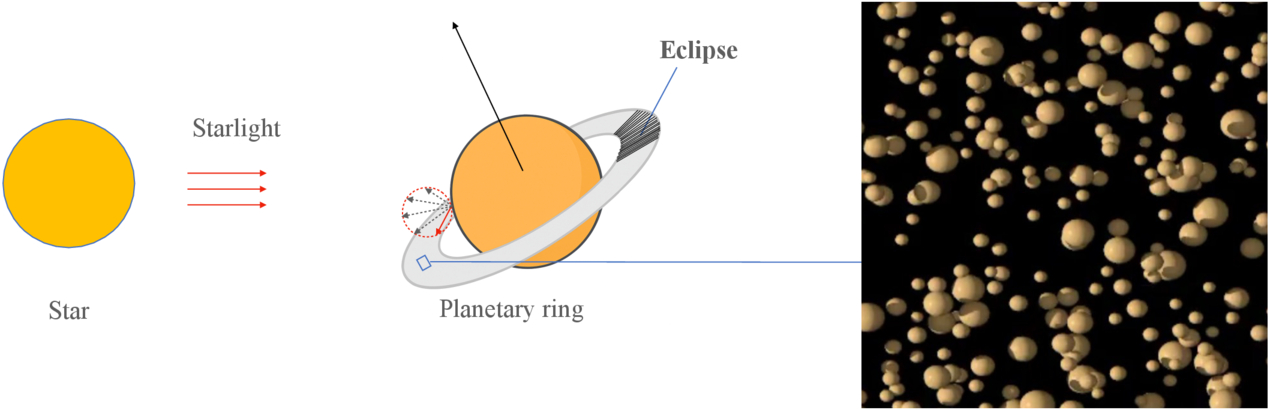
The idea behind this process revolves entirely around light. When sunlight hits a particle within a planetary ring, non-absorbed sunlight imparts a little “bump” onto a particle, ever so slightly altering its trajectory. At the same time, some of the sunlight is absorbed into the particle, which heats it up; light is soon re-emitted via thermal radiation, which, again, can slightly change the trajectory of these tiny particles. From a point on the surface of each ring particle (see rightmost side of Figure 2), the photons from this thermal radiation are all emitted in random directions; however, across the whole surface of the particle there is a net force! These tiny particles are spinning, and so the side just near “sunset” is hottest and emitting the most thermal photons. In this way, the pressure from the sunlight plus the thermal radiation of each particle imparts a net torque on the ring itself which changes the angular momentum of the ring.

diagram showing sunlight falling on Saturn and the planet casting a shadow on its rings

Figure 2: Starlight is the main source of light onto the particles that make up a planetary ring (right panel) though reflected light from the planet’s surface hits it too. This light “heats up” the ring and forms an asymmetry as the ring is eclipsed by the planet, which produces a net force. [Zhou et al. 2026]

What we described just then is essentially solar radiation pressure plus the Yarkovsky effect. It turns out that the net force from this process typically averages out to zero as the ring particles orbit around the planet. This assumes, though, that the sunlight is constantly shining on the ring. Stunning imagery of Saturn tells us that this isn’t the case, so what happens when we take into account the shadow cast on the ring from the planet? Today’s authors find that the net effect induces a positive change in angular momentum of the ring particles, which they call the eclipse–Yarkovsky effect.

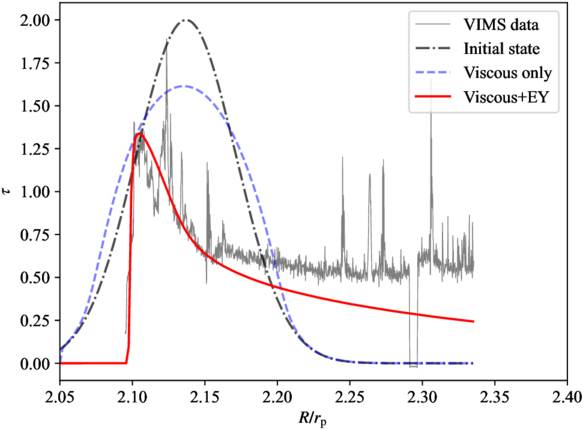
After today’s authors detailed all of the math involved in this process (and there is a lot), they put it into practice to try to help explain Saturn’s curious rings. Including the eclipse–Yarkovsky effect together with other known effects that drive ring evolution allowed them to reproduce the optical depth profile (how thick the ring looks) of Saturn’s A ring better than ever before (notably the sharp inner edge in Figure 3). On top of this, the effect provides another avenue for moonlet formation in the outer edges of ring systems as the positive torque from the effect drives material out toward and away from the Roche limit.

plot of optical thickness versus radius

Figure 3: The authors try to explain the current structure of Saturn’s A ring by initialising it with a Gaussian profile of optical thickness versus radius (black dot-dashed line) and evolving it for 81 million years under different effects. When viscous effects are included (blue dashed line), the ring spreads out, but it’s only when the eclipse–Yarkovsky (EY) effect is included (red line) that the model closely matches the observed data (grey line). [Zhou et al. 2026]

Undeniably useful for Saturn, the eclipse–Yarkovsky effect may also explain some other conundra in the solar system. Mars may have once had rings, which are thought to have eventually clumped together to form the inner moon Phobos. This idea is problematic, though, in that current models suggest there should still be some residual ring system around Mars even after Phobos formed. Enter the eclipse–Yarkovsky effect: being 100 times stronger for Mars than Saturn (due to its more intense incident sunlight), the effect may have driven out and dispersed that residual ring altogether. While the authors are currently looking into this possibility, the reintroduction of the eclipse–Yarkovsky effect has already shown great promise for our most beautiful ringed planetary neighbour.

Original astrobite edited by Wasi Naqvi.

About the author, Ryan White:

I am a first-year PhD student at Macquarie University in Australia, working mainly on binary/multiple systems with massive stars (Wolf–Rayets in particular!). Outside of study, I’m probably drinking coffee, baking, reading, or going for a run. You can also find me procrastinating on Bluesky @astroryan.bsky.social.

The post Shining a Light on the Shadowy Movements in Saturn’s Rings appeared first on AAS Nova.

June 8, 1625: The birth of Giovanni Cassini

8 June 2026 at 14:00

Giovanni Cassini was born in Perinaldo, in what is now Italy, on June 8, 1625. Early work on Jupiter and Mars’ rotational periods and the positions of Jupiter’s satellites led to an invitation to Paris and the Academie des Sciences by King Louis XIV; he became director of the Observatorie de Paris in 1671, andContinue reading "June 8, 1625: The birth of Giovanni Cassini"

The post June 8, 1625: The birth of Giovanni Cassini appeared first on Astronomy Magazine.

Now That’s Metal: How to Spot Stars That Have Swallowed Their Planets

3 June 2026 at 17:00

An illustration of an exoplanet about to be engulfed by its host star

Planets that get too close to their host stars are liable to be engulfed and consumed. New research explores how to identify stars that have had a planetary snack.

It’s Snack Time

Being a planet that closely orbits its star is dangerous, and various dynamical processes can draw a planet inward past the point of no return. When a planet vanishes beneath the surface of its host, it eventually disintegrates within the star, its atoms mixing into the blazing stellar soup.

This outcome is likely extremely common across the universe, and researchers have begun to see evidence for it: stars that appear to have absorbed angular momentum from their planets, white dwarfs with uncanny metals in their spectra, and stars with chemical abundances that don’t match those of their siblings. Now, in a recent publication led by Kaitlyn Lane (Vanderbilt University), researchers seek to find observational signatures of planetary engulfment of rocky exoplanets by main-sequence stars.

Modeling Engulfment

Lane’s team focused on main-sequence stars in the range of 0.5 to 1.4 solar masses, using one-dimensional analytical models to determine which of these stars will most readily display signs of having engulfed a planet. They simulated the stars as they consumed either an Earth-like planet or a super-Earth with the same composition as Earth but 15 times its mass.

illustration of a planet being engulfed by its star

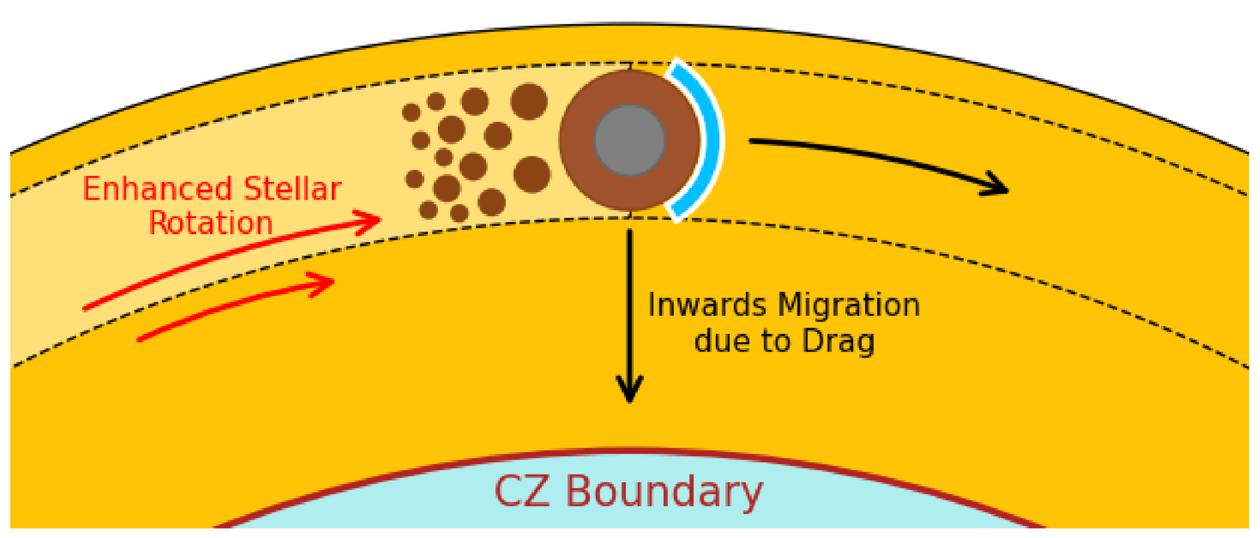
Diagram showing a planet being engulfed by its star and beginning to disintegrate before migrating inward. The boundary between the star’s outer convective zone (CZ) and inner radiative zone is shown. Click to enlarge. [Lane et al. 2026]

At the onset of the model, the engulfment is set to begin, the planet placed tangent to the star’s surface. The planets sink down and orbit just barely within their stars for 1–10 years, their solid surfaces slowly beginning to evaporate.

After that relatively lengthy phase, the process proceeds rapidly: as the planet inches deeper into its star, the drag forces grow stronger and the planet’s demise accelerates, with the planet disintegrating over the course of hours. In the last phase, the planet makes its final plunge and is destroyed in a half hour.

Signs of Planets Past

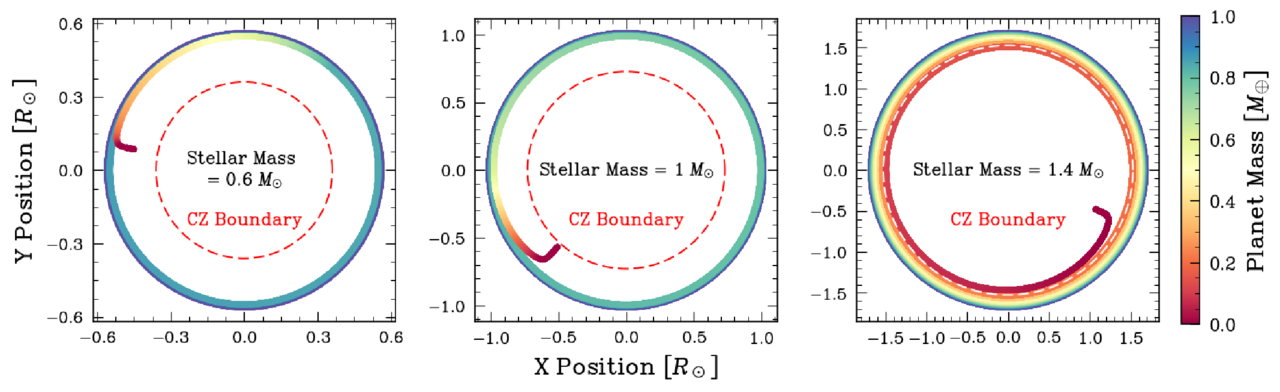
Lane’s team found that the planets tended to be destroyed fully within the outer convective layer of their stars, except in the case of the most massive stars studied here. For more massive stars, the outer convective zone is shallower than it is for the less massive stars, allowing a chunk of each planet to survive the passage through the convective zone to reach the radiative zone below.

simulation results showing planets disintegrating within their host stars

The trajectories of three example cases, showing how the planet loses mass as it spirals inward. In the 1.4-solar-mass case, part of the planet survives to reach the radiative zone, but the shallowness of the star’s convective zone means that the disintegrated planetary material is easier to observe. Click to enlarge. [Lane et al. 2026]

What this translates to, for the purposes of identifying planet-eating stars from afar, is that stars near the top of the mass range studied — from 1.0 to 1.4 solar masses — make the best targets. This is because the tell-tale planetary metals are not overly diluted within the stars’ relatively small convective zones, making these elements easier to detect. In terms of specific metals, the authors found that aluminum, calcium, and vanadium are the best signposts of planetary engulfment, with lithium also making the list.

While the authors acknowledge that there’s more work to be done — they plan to investigate the impacts of planetary engulfment on stellar structure more closely, for example — this work represents an important foray into identifying targets for future studies of stars that have eaten their planets.

Citation

“Observable Metal Pollution in Main-Sequence Stars: Simulations of Rocky Planets Engulfed by Stars in the 0.5 to 1.4 M⊙ Range,” Kaitlyn T. Lane et al 2026 ApJ 1003 67. doi:10.3847/1538-4357/ae5b9a

The post Now That’s Metal: How to Spot Stars That Have Swallowed Their Planets appeared first on AAS Nova.

❌