Large-scale datacentre projects around the world are being challenged or cancelled, as infrastructure’s energy demands ramp up
Datacentre planning proposals face all kinds of hurdles, from securing energy supply to high construction costs. But the 2,000 acre Prince William Digital Gateway site in the US state of Virginia had another problem: its proximity to a Civil War battlefield.
“If the development is allowed to proceed, the solemn nature of this historic site would become marred by sitting in the shadow of the monstrous datacentres, along with their associated electrical infrastructure,” said one legal brief against the plans.
Scottish government to consider SNP national council motion for moratorium on all new datacentres
The Scottish government is about to consider a sweeping moratorium on building new datacentres, putting a key plank of the UK’s AI strategy at risk.
Last Sunday the Scottish National party (SNP)’s national council passed a motion to freeze all new datacentres in Scotland. That motion has been sent to the Scottish government to consider.
The promise was that a Scottish community would be transformed by massive investment and empowered to chase “the jobs of the future”. Instead, local people in Lanarkshire fear they may have to sell their properties and lose green belt land because of the errors of a badly planned AI datacentre complex, even as those jobs and investments never arrive.
Late last year, representatives of Oakes Energy Services began to knock on doors in Newarthill, a village east of Glasgow. In letters reviewed by the Guardian, they invited residents to individual meetings. They told them about plans for a solar farm, say local people, and made offers: free solar panels, tree planting, or even cash for their properties.
AI use for therapy, and due to loneliness, appears not to reduce loneliness. AI provides affirmation, but at the expense of reducing the social skills needed to interact in the real world. Teachers report that students’ use of AI reduces their capacity for critical thinking.
Network latency in bitcoin mining is driving massive energy waste — the annual equivalent of the total generation capacity of Switzerland's entire hydroelectric power system, scientists say. This wasted energy results from inefficiencies in the mining process and increasing competition among bitcoin miners.
In a new study published May 26 in the journal PNAS Nexus, the researchers aimed to provide a theoretical model to measure patterns within the networks powering bitcoin's distributed ledger system.
But they also calculated that in 2025, around 16,000 megawatts was wasted by fruitless bitcoin mining attempts, where competing mining efforts exert massive computational power to obtain the same units of bitcoin. This is roughly equivalent to the total generation capacity of Switzerland's 701 hydropower plants, according to statistics from the Swiss Federal Office of Energy.
It's important to note that this figure differs from the total energy consumed by bitcoin mining activity, estimated by researchers to stand at an annual level of 138 terawatt-hours, as of June 2024. This is higher than the annual energy consumption of several developed countries including Norway and the Netherlands.
Energy-guzzling crypto
Concerns around the environmental impact of bitcoin and other proof-of-work blockchain technologies have abounded in recent years.
In 2021, for example, bitcoin mining's water usage, primarily for liquid-cooled computer equipment, equated to more than the domestic water use of 300 million people in rural sub-Saharan Africa, according to a 2023 U.N. report.
Bitcoin is underpinned by a distributed ledger system, called a blockchain, which operates on a "proof-of-work" model. For a new unit of the digital currency to be generated, computing power must be used to solve a digital puzzle. In theory, the first entity to successfully "solve" the problem adds a new "block" of transactions to the ongoing chain and is granted a set quantity of bitcoin in return.
However, due to the explosion of interest in bitcoin as a financial trading asset, the competition for who can be the first to complete a block and claim the rewards has become incredibly fierce. A solution to the puzzle is based on computational power, with specialized hardware providing a greater advantage in speed. It has driven commercial entities to invest in building specialized data centers dedicated to such mining operations.
Because the race to be the first to mine a block is so competitive, the difference between first and second place can be just tiny fractions of a second. This often results in "accidental forks" — where two competing blocks are registered at almost exactly the same time.
In this scenario, the block with the longest chain of subsequent blocks built on top of it will eventually become a verified and legitimate part of the blockchain — earning its miners the bitcoin reward — while the competing block will be seen as invalid and worth nothing.
The energy needed to solve the proof of work and generate these "orphaned blocks" in the first place — as well as any subsequent blocks built on top of them before the winner is decided — is ultimately wasted.
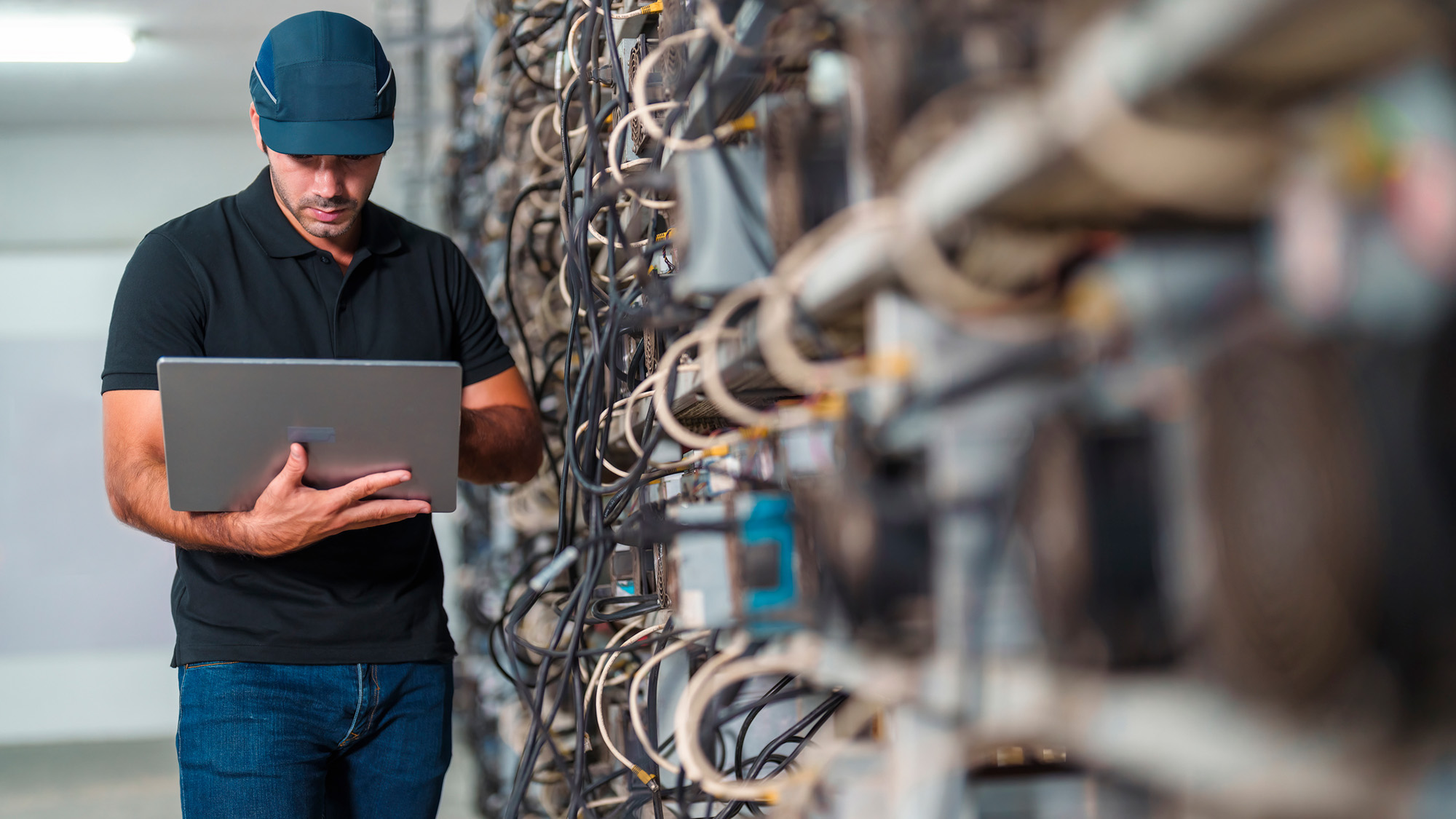
An engineer stands next to a bitcoin mine. (Image credit: PixeloneStocker via Getty Images)
"Despite their indication of a distributed network, accidental forks are an inefficiency of the Bitcoin protocol that leads to wasted computational resources (and thus energy), increasing the cost of network operations and its environmental impact to maintain a given level of security," the researchers wrote in the study.
According to the Crypto Carbon Ratings Institute (CCRI), a cryptocurrency analysis firm, bitcoin is the most dominant cryptocurrency by far, with a market capitalisation of more than $1.1 trillion — more than 80% larger than the next most popular currency, Ethereum. However, instead of proof-of-work, Ethereum uses a different form of consensus mechanism to establish block authorship, called "proof-of-stake," which is significantly less computationally intensive.
While other cryptocurrencies apart from bitcoin also use proof-of-work methods, bitcoin is around twice as large as its next nearest rival in this category, making it orders of magnitude more power-hungry.
Who rules the pool
Whereas previous models for analyzing fork rates treated all miners in the network as equal, this study considered elements such as network latency and geographic distribution, aiming to provide a "null model" — a baseline which can be used as a starting point to inform future analysis.
The model also allowed the researchers to quantify other notable trends, such as the distribution of "mining pools" — consortiums in which mining operators pool their efforts to maximize their potential success. They identified a decline in the dominance of Chinese mining pools from 2022 following the country's ban on bitcoin mining while also discovering high levels of consolidation at the upper level of the bitcoin mining industry.
The report found that just three mining pools produce over 50% of new bitcoin blocks. This is a problem because it risks a "51% attack," whereby unscrupulous miners enter fraudulent information into the blockchain by ensuring that they always produce the longest chain and, therefore, become validated.
This level of consolidation distorts the market for processing fees that bitcoin users pay to have their transactions included in the next block, the researchers added, and could thus allow miners to arbitrarily delay the inclusion of specific transactions.
A Chinese system has become the world’s most powerful supercomputer, surpassing American machines for the first time since 2021.
LineShine, installed at China’s National Supercomputing Center in Shenzhen, clinched the top spot in the 67thTOP500 ranking of the world’s most powerful supercomputers. The new system has already been used in a range of fields, giving developers another route to achieve supercomputing power.
The machine, which came online in the first half of 2026, can reach speeds of 2.198 exaFLOPS — where 1 exaFLOP is 1 quintillion (1018) floating-point operations, or mathematical calculations, per second (FLOPs) — making it the only supercomputer on the planet to exceed 2 exaFLOPS per second. It's also the first time China has hosted the world's fastest supercomputer since 2017.
A FLOP is a type of calculation used to benchmark computing performance.Exascale supercomputers can perform more than 1 quintillion of these operations every second. In comparison, home computers can perform roughly 5 trillion FLOPS.
According to TOP500, LineShine can achieve speeds about 22% faster than El Capitan, a supercomputer housed at Lawrence Livermore National Lab in California that had previously held the top spot since November 2024.
The system’s computing power is the result of "a comprehensive breakthrough in a series of core technological barriers," according to a translated statement from China's National Supercomputing Center.
Unlike many other supercomputers, LineShine uses only central processing units (CPUs) to perform calculations. Other systems rely on both CPUs and graphics processing units(GPUs), which run many jobs simultaneously by dividing tasks among smaller, specialized cores.
Since 2018, the U.S. government hasrestricted exports of semiconductor chips to China, including GPUs. However, startups such asDeepSeek have wrangled other technological advancements to train artificial intelligence (AI) models with fewer and less powerful GPUs than comparable systems such as ChatGPT.
LineShine "represents a historic leap forward for China's supercomputing field, breaking through foreign technological blockades and building an independent and controllable software and hardware system," the statement read.
The system has already been used on projects in multiple research areas, including atmospheric science, drug discovery and AI, according to the National Supercomputing Center. In general, supercomputers perform extremely complex calculations at speeds much faster than traditional computers can handle, allowing them to solve problems that would otherwise take too long or cost too much to address.
The fastest supercomputers utilize a range of different designs and processors, showing that high-performance computing doesn’t rely on any one single method.
"The list demonstrates that there is no single dominant technology path to leadership-class computing; instead, vendors are pursuing a variety of CPU, GPU, APU, and custom-accelerator approaches coupled with different interconnect and system designs," TOP500 representatives said in a statement.
Following LineShine and El Capitan, two supercomputers at U.S. national laboratories and one in Germany claimed spots three through five on theTOP500 list. Machines in Italy, Switzerland, Japan and the U.S. round out the top 10.
Can you match these ancient devices to their pictures? Find out with our computing quiz!
The refreshed lineup of Dell laptops has turned out to be even better than many of us hoped for, including the return of the XPS line — and right now, Dell's 'Days of Deals' sale is offering even better pricing than the Amazon Prime Day laptop deals I've been seeing.
Right off the top, you have the new Dell 16 Laptop for $499.99 (originally $1029.99), which is a better price for a Windows 11 Home laptop than just about any other model on Amazon that doesn't come with junk hardware inside. Instead, you get an eight-core AMD Ryzen 7 250 processor, 16GB RAM, and a 512GB SSD, far better than most sub-$500 laptops on sale for Prime Day.
There's more to explore at Dell.com, and I encourage you to check out their sale if you're in the market for new computer hardware, but I've pulled together my favorite laptop picks and configurations from the sale to help make it easier to find what you're looking for.
Today's best laptop deals at Dell.com
AMD Ryzen 7 250 | 16GB DDR5 RAM | 512GB SSD
I always think of the Dell 16 Laptop as the everyday workhorse for remote and hybrid workers. Likewise, If you or your child is off to college this September, then get ahead of the curve with this outstanding deal.View Deal
AMD Ryzen AI 5 340 | 16GB DDR5 RAM | 512GB SSD
The Dell 14 Plus is one of our favorite mid-range Windows laptops thanks to its excellent design and competitive specs. If I were looking for a decent everyday laptop for everything from work to demanding productivity applications, then I'd be very tempted by this deal.View Deal
Intel Core 5 320 | 8GB DDR5 RAM | 512GB SSD
Dell's answer to the Neo comes with a touchscreen display and a special price for students (matching Apple's $599). This is the cheapest XPS 13 yet and one with a smaller-than-A4 footprint.View Deal
Intel Core Ultra 7 258V | 32GB DDR5 RAM | 1TB SSD
Dell ships 32GB of RAM with this laptop and this is the optimal amount of memory for serious productivity/business workloads. 'Between great general computing performance for any college student or executive and long-lasting battery life, it's a solid mid-tier laptop and it's even cheaper than last year!View Deal
Dell's XPS 13 laptops are always worth keeping an eye out for during Prime Day, as we often see big price cuts for what are some of the best laptops you can currently buy. Right now, one of the biggest discounts you'll find is for this Snapdragon-equipped model, which also features an impressive 32GB of RAM. With a Snapdragon chipset, you'll get great performance and almost unbeatable battery life out of this model.View Deal
Save $350 on the Alienware Aurora 15 gaming laptop. This system strikes a sensible balance between gaming proficiency and affordability. For less than $1,000, it's a capable workhorse for both casual and professional tasks.View Deal
This Alienware Aurora 16 isn't the cheapest laptop on the market, but you're getting an Intel Core Ultra-7 240H chipset, RTX 5060 graphics card, 32GB of DDR5 RAM, and a 1TB SSD - superb specs for 1080p gaming. If you need a decent machine with a premium build, then this is a fantastic choice in the Dell Black Friday in July sale.View Deal
Firstly, VideoCardz spotted that the Economic Daily News in Taiwan published a report in which the general manager of Asus, Liao Yi-hsiang, noted that as of May 2026, the price hikes on some Asus products in that country amounted to nearly 30% (compared to Q4 of 2025).
The executive then confirmed that Asus would be raising prices further in the second half of 2026 due to the component crisis, but that the increase should only be a single-digit affair. Under 10% is quite a drop compared to knocking on the door of 30%, of course.
Liao said that price rises would be milder because the cost of memory and storage had recently decreased, and also that consumers are increasingly unlikely to buy if more large hikes are heaped onto Asus products. Especially given that there was quite a lot of buying activity early in 2026, as consumers in Taiwan acted earlier than they would have otherwise, with a view to securing purchases before heftier price increases made themselves felt.
The other nugget of positivity is that, as Trading View informs us, there have been some interesting rumblings about SK Hynix, one of the big three memory chip makers (alongside Micron and Samsung).
There are reports that "SK Hynix may slow the expansion of AI memory-chip production and increase its focus on conventional DRAM products."
This apparent shift away from making HBM (the mentioned AI memory) to conventional RAM modules (the ones in consumer electronics) unsettled investors, and led to shares in SK Hynix tumbling over 12%. (Samsung followed suit with a 12% drop, and a wider tech share slide was witnessed, particularly for companies linked to the world of AI.)
What's bad news for investors is good news for consumers though; if this report is on the money, SK Hynix reallocating assembly lines to produce more DDR5 RAM could be the beginning of the end of the memory crisis.
Analysis: is the AI bubble ready to pop? I doubt it…
(Image credit: Getty Images)
You could leap to some big conclusions here, and the rumor around SK Hynix is a potential move that could have a significant impact for consumers. With some folks talking about the end of the 'AI bubble' in recent times — which feels like hopeful chatter indeed — it could be read as another indicator in that respect, too. However, it's way too early to make that kind of call (and I don't personally think we're seeing that by any means).
What we don't know is the extent of the apparent shift away from HBM, and anyway, the move could partly be about DRAM being so pricey now that it represents a tempting enough diversification in terms of SK Hynix's overall memory strategy (a theory raised in some quarters).
We should also remember that the chairman of SK Group (the parent company of SK Hynix), Chey Tae-won, has previously predicted that the RAM shortage may not be over until 2030 (a forecast more recently echoed by Nvidia's CEO). So, as noted, temper any optimism, but this is at least a positive sign from the big chip maker, as is the price prediction from Asus.
Regarding Asus, again there's a caveat — namely that it's an analysis for the Taiwanese market only. But if price rises in H2 2026 are only (roughly) a third of what they effectively were in the first half of the year, that'll surely be reflected to some extent globally. Also, it's very true that consumers everywhere will refuse to buy if pricing goes higher too quickly, which is something I've pointed out a few times before. This isn't something unique to Taiwan.
Finally, it's also worth noting that earlier this month, we heard some more positive news on the RAM crisis from David McAfee, AMD's VP and general manager of Ryzen CPU and Radeon GPUs.
As PC Gamer reported, McAfee said: "There is an enormous amount of capacity that is being built by the memory manufacturers to bring more production online, and that more production online is going to focus on DDR, LPDDR, HBM, like the newer memory technologies."
He added: "I don't expect a lot of DDR4 production to come back into the world, but those newer memory technologies, a significant amount of capacity is coming online. I think we'll start to see by the end of next year and into 2028 that that ramp really starts to take hold, and then it's just a factor of the forces of supply and demand, and how that affects memory prices."
OK, so this is really just a reminder of what we've already been told, but it's still worth bearing in mind that the expectation for some remains a considerable easing of the crisis by 2028.
IO research shows 87% of UK cybersecurity managers doubt the credibility of speed‑focused certification programs
Rapid, automated compliance creates a false sense of security, with certifications like ISO 27001 not guaranteeing resilience
Experts stress continuous monitoring and human oversight, as automated recommendations and evidence still need validation and interpretation
Speed-focused compliance programs could help businesses get cybersecurity certifications quicker, but security professionals are skeptical if the speed comes at the expense of actual business resilience.
This is according to new research from resilience specialists IO, which claims that 87% of senior cybersecurity managers in the UK believe the speed at which certification is achieved affects its credibility.
According to the report, compliance initiatives that are either heavily automated or compressed into short timeframes are creating a false sense of security. Certifications like ISO 27001 might help companies win contracts and maintain an image, but researchers are warning that certification alone does not guarantee actual operational resilience.
Gaps in security posture
“Organizations that focus on achieving certification as quickly as possible are at risk of leaving gaps in their security posture,” says Chris Newton-Smith, CEO of IO. “Certification can open doors to new contracts and demonstrate commitment to recognised standards but treating certification as the end goal rather than the outcome of establishing and embedding effective compliance is more often than not at the expense of long-term resilience. Businesses must treat compliance not as a tick-box exercise but an evolving, iterative, and business critical project.”
Polling 251 cybersecurity managers in the UK, IO found that 31% consider continuous controls monitoring as the strongest indicator of compliance resilience. At the same time, a fifth (21%) said certifications could reflect security controls at the time of an audit, but could soon after become obsolete.
IO also stressed the importance of human expertise in these programs. Almost half (45%) of the respondents said human involvement is still essential when evaluating if automated compliance recommendations are still relevant and accurate, and another third (33%) said complex regulations still need human interpretation.
Finally, 32% stressed the importance of human in validating compliance evidence generated by automated systems.
Huntress report highlights “EvilTokens” PhaaS scaling phishing attacks 1,380% in early 2026 compared to last year
AI integration enables per‑victim personalization at scale, bypassing MFA, with subscription tiers from $600 to $1,500
Service sold openly on Telegram, showing how PhaaS now operates like a startup with cheap, powerful attack capabilities
Cybercriminals offering phishing-as-a-service (PhaaS) are increasingly operating like a tech startup, and a good one, at that. They are also using Artificial Intelligence (AI), which helped them scale significantly. This is according to a new report from cybersecurity researchers Huntress, called “EvilTokens and the Rise of AI-Powered Phishing”.
In the report, Huntress claims that this particular PhaaS operation, called EvilTokens, was used to run 1,380% more phishing attacks in early 2026 compared to the same period last year.
“We’re seeing a clear maturation of the phishing-as-a-service (PhaaS) market as threat actors increasingly integrate AI workflows into their product offerings,” the report reads. “The result is directly observable in our telemetry: a 1,380% increase in device code phishing attacks detected between July–December 2025 and January–April 2026, with over 50% of those incidents linked to two major waves of correlated incidents.”
A cheap service
“Furthermore, across hundreds of incidents associated with EvilTokens, no two phishing lures were identical. This level of per-victim personalization was previously limited to targeted, manually crafted campaigns. Now, it’s achievable at scale by any threat actor at the price of a subscription service”
So, AI is not only used to scale the operation, but it is also used for personalization at an unprecedented level. At the same time, the service is relatively cheap to use: it is being sold on Telegram for as little as $600.
If this sounds like a lot, keep in mind that a single successful phishing attack is enough to steal data worth hundreds of thousands on the black market, or even millions - in ransom negotiations.
EvilTokens’ service is tiered, too. The cheapest package costs $600, while two more expensive ones cost $1,000 and $1,500, respectively. For criminals, it is likely worth the investment, since this PhaaS is capable of bypassing multi-factor authentication, as well.
LastPass confirmed a supply chain breach via Klue, where stolen OAuth tokens let attackers access its Salesforce environment
Customer names, contact details, and CRM data were exposed, but master passwords were not; phishing risk remains high
Threat actor Icarus claimed responsibility; other firms including Recorded Future, Tanium, Jamf, Sprout Social, Gong, and Insurity also impacted
Password manager LastPass confirmed that it lost sensitive customer data in a supply chain attack that struck a third party.
As LastPass explained in a newly released incident report, unnamed threat actors first targeted Klue, a third-party market intelligence platform that integrates with its Salesforce and Gong systems. After obtaining its OAuth tokens, the attackers were able to access LastPass’ Salesforce environment and exfiltrate sensitive data stored there.
“On June 12th, LastPass was made aware of an incident that occurred at Klue (klue.com), a third-party market intelligence platform utilized by our go-to-market teams, which integrates with our Salesforce and Gong systems,” LastPass said.
Compromising names and emails
"We immediately launched an investigation and learned that, as part of this incident, an unauthorized actor was able to obtain OAuth tokens Klue held for many of its customers, including LastPass.”
“The threat actor then used these credentials to access LastPass customer data within our Salesforce environment.”
Further in the report, the password manager said the attackers most likely accessed customer names, phone numbers, email addresses, postal addresses, support case information, and sales/CRM-related data.
Passwords, including the master password, were most likely not exposed. However, criminals can use the data they obtained to launch phishing attacks, through which they might trick the victims into sharing those secrets, as well.
LastPass is now urging customers to remain vigilant and be careful with incoming messages, particularly those claiming to come from the company.
According to BleepingComputer, the Klue supply chain attack was claimed by a threat actor called Icarus, which apparently used compromised legacy credentials for an integration service to breach the intelligence platform.
Besides LastPass, a number of other organizations are affected as well, the publication further reported, including Recorded Future, Tanium, Jamf, Sprout Social, Gong, and Insurity. LastPass has now disabled employee access to Klue.
The Samsung Galaxy XR headset is now available for preorder ahead of its July 8 launch in the UK, and while you can’t pick it up at Amazon, that doesn’t mean you can't snag a Prime Day-like deal or two.
Best of all, you won’t need to be a Prime or other subscription service member; Samsung’s discounts are available to every shopper through its online store — you’ll just need to bundle a few things with your purchase, or sign up to PayPal (if you haven’t already) and check out using that as your payment method.
For that PayPal offer, you’ll get £100 off using the code PAYPALXR at Samsung's online store. That’s a serious saving off the £1,699 asking price, but you only have until July 7 to take advantage of this offer.
Plus, if you’re looking to upgrade your Samsung tech, or dive deeper into its ecosystem, it has deals that will save you 10% on Galaxy smartphones, a Galaxy Watch, and Galaxy Buds.
Today's best Samsung Galaxy XR deals
Code: PAYPALXR If you buy the Samsung Galaxy XR headset using PayPal then you can save £100 with the code PAYPALXR. You only have until July 7 to use this deal, but if you’re strongly considering getting the Samsung Galaxy XR headset then it’s a hefty saving on the device for little to no effort (especially for folks with a PayPal account already).View Deal
Save 10% on Galaxy smartphones — August 4, 2026 Save 10% on Galaxy watches and buds — September 30, 2026 If you don’t want to simply buy a Galaxy XR headset, but also upgrade your whole Samsung setup, then this combo deal is for you, as you can save 10% on Galaxy gadgets. I currently use a Galaxy Watch 8 Classic, a pair of Galaxy Buds Pro 4, and a Galaxy S26 Ultra, and they are all superb, and this kind of discount only makes the tech even better.View Deal
Save 30% on a travel case & controllers — September 30, 2026 Lastly, much like the above tech offer you can also save big on an official travel case and Samsung controllers when they’re bought with the Galaxy XR headset. The controllers will be required for some titles, though most games rely on hand tracking so I’m not convinced you need a pair straight away. A case, however, is a must-buy. Whether it’s this one or an unofficial box, any VR headset is much easier to carry around with a case, and it helps keep the headset’s lenses from getting damaged by direct sunlight. Besides a silicone facial interface (which this headset lacks), a case is the only accessory every VR headset user should own.View Deal
After spending a week with the Samsung Galaxy XR headset, Lance Ulanoff called it “an impressive multimodal AI spatial computer,” though Android XR and the overall experience didn’t hold a candle to visionOS and the Apple Vision Pro, especially the M5 version.
He also noted that, at launch, Gemini felt less deeply integrated as he had originally imagined, and the lack of precision with controls dulled the ‘wow’ factor.
At the same time, the Galaxy XR headset is half the price of the Vision Pro, so technical downgrades are to be expected, and as Google and Samsung iterate on the software, you could find the Samsung Galaxy XR headset seriously ups its game — especially as more apps get XR support.
It delivers some impressive OLED visuals despite costing less, and can integrate with the full G Suite of apps for some spatial productivity. So, if you want something that balances work and play, with great performance, at a more affordable price point, and don’t mind missing out on the Quest gaming library, you’ll struggle to find something better than Samsung’s XR machine.
I’m sure this scenario is familiar to you — you buy an external hard drive for a certain capacity, thinking that it would have more than enough space to store all your current files, and many more in the future — but then you soon realise that you’ve filled it up in no time. You’re then forced to delete some files to make enough room for new ones that you need to back up or archive. And so it goes.
I can definitely relate, having filled up a couple of hard drives ranging from 2TB to 6TB containing photo libraries, videos and Steam game backups, then later finding myself auditing those files more often than I’d like to clear up storage space.
This deal can also benefit those who work with large files regularly, like content creators, video editors, data professionals, graphic artists and more, where they can focus on their work and not constantly worry about storage.
This listing is from Amazon Germany, so you may have to wait until at least early next month for delivery to Australia, but this is so far the lowest price we’ve seen for EOFY. The Seagate Expansion Desktop has USB 3.0 file transfers, Windows and Mac support (with automatic recognition for easy setup) and access to a data recovery service for that extra peace of mind.View Deal
In our best external hard drives buying guide, our reviewer called the Seagate Expansion Desktop the best-performing HDD they'd tested thanks to the read and write speeds of 242 MB/s and 237 MB/s, respectively, and for its relatively compact size compared to others in this category.
The main downsides the tester mentioned were the hard drive’s external power requirement — which is something I would certainly live with for a capacity of this size — and the expensive RRP, which this 32% discount handily takes care of.
While you can invest in some network attached storage (NAS) devices for your growing storage needs, the Seagate Expansion Desktop is an easier plug-and-play solution that won’t require much fiddling to set up — it’s as easy as plugging the drive in and moving files to it via Windows Explorer or macOS Finder. Plus, this deal is a much cheaper alternative as the NAS devices themselves without drives cost around the same or even more in some cases.
On the other hand, this external drive can be used in a NAS device (or your PC, even) through “shucking”, or removing the external casing and installing the bare drive into a hard drive bay to add more storage for redundancy or otherwise. Do note that this will void the drive’s warranty.
In any case, a deal like this in a period of storage component shortages is hard to pass up for anyone in need of extra storage space for backups, archiving or any work that involves large file sizes.
Five years ago today we were told that Windows 11 was inbound as a free upgrade for all Windows 10 users — but there was no stampede to adopt it, that's for sure (and the hardware requirements certainly didn't help the cause).
It wasn't until July 2025 that Windows 11 overtook Windows 10 as the dominant version of Microsoft's desktop OS according to Statcounter's figures, but it now holds a comfortable majority of over 70% of that market. As it should do, considering Windows 10 ran out of support last October (and only has a few months of extended support left).
However, putting aside the sluggish pace of adoption and the various problems that have plagued Windows 11 through the years (all the bugs and some notably missing features in the main), I think there's now cause for optimism for the future of Microsoft's operating system.
So, let me share my thoughts and reflect on what has been a half-decade of Windows 11, and tell you why I'm way more positive about the OS than I was last year — and why I think that Microsoft is finally on track (with, of course, some inevitable caveats).
The great fix-athon
(Image credit: Alex Photo Stock / Shutterstock)
Most of my hopefulness about where Windows 11 is heading comes, of course, from the big campaign Microsoft kicked off in March 2026 to fix Windows 11. Since that announcement — which I would say is the biggest statement to have been made since the OS was first announced in 2021 — Microsoft has very much proven that it intends to tackle all sorts of shortcomings and pain points with the OS.
In fact, Microsoft has hit many wish-list features that I never expected would come to Windows 11, and the extent of the crowd-pleasing measures so far is heartening. These are features that are actually being delivered already, too, they're not just promises.
Furthermore, Microsoft appears to be listening to feedback and requests more closely, and generally engaging more with the community online. There's even a new initiative consisting of a research panel where Microsoft will consult testers directly on how to change aspects of Windows 11.
This genuinely feels like a fresh direction for Microsoft, and a serious commitment to change Windows 11 for the better based on what the users themselves actually want.
A more thoughtful, cautious approach
(Image credit: Shutterstock)
The other key driver for optimism with Windows 11 is the way in which Microsoft is taking more care over how the operating system is developed and coded.
Not so long ago, matters were less organized and more chaotic. Cast your mind back to the introduction of Qualcomm's Snapdragon X (Arm-based) chips in Copilot+ PCs back in 2024, alongside which Microsoft brought in a new underlying platform for Windows 11 (complete with the tinkering required to support that Arm silicon). While nothing was ever officially admitted, this is a move that I believe could have at least contributed to the mess that was the 24H2 update, which was laden with a ton of (sometimes very annoying) bugs.
Whatever the case in terms of how those glitches came to be, things have changed a lot since then. Microsoft is now being a lot more cautious with its Arm and x86 strategy — Windows 11 is split into two development paths, with the 26H1 update for Arm devices, and the 26H2 update for traditional x86 PCs — and the company has switched to use a fresh approach for these annual updates.
Instead of big annual updates — the last of which was the problematic 24H2 — Microsoft is now deploying small 'enablement packages', essentially very minor bumps to a new version of Windows 11. The actual features, the meat of Windows 11 changes, are pushed out in monthly updates as and when they're ready — in sometimes quite tightly controlled, carefully paced rollouts. This more gradual drip-feed of features is a more reliable method of deployment compared to dropping a lot of stuff all at once.
In short, Microsoft has learned its lesson from the nightmarish 24H2 release, which suffered from far too many bugs, to take on a fresh new way of operating. True, there will still need to be big updates at times, when the underlying codebase of Windows 11 has to be changed (quite possibly with 27H2). But it looks like Microsoft wants to mainly stick to compact, easily applied annual updates in the main, with features pushed out elsewhere in general.
Optimism abounds — with a notable catch
(Image credit: MAYA LAB / Shutterstock)
Between the ardent push to fix Windows 11 and the better thought-out deployment of features and updates, Microsoft has come a long way, but as I mentioned before, there are caveats here.
It's worth mentioning that while the new system of continual feature deployments, rather than weighty annual feature drops, is commendable (in my opinion), the controlled rollouts of these various features have come in for some criticism. Mainly because they are so cautious in some cases that something like the Start menu revamp (the one from last year, I should clarify, not the current work) took ages for some Windows 11 users to get, and those folks found that rather frustrating.
Part of that caution is likely down to Microsoft's paranoia around bugs, and sadly, the truth is that there are still too many bugs in Windows 11, and some of them are disappointingly weird. And by disappointing, I mean odd things that just shouldn't be happening.
I only need glance back to last weekend for one such example where there was a glitch with the Recycle Bin whereby the delete confirmation dialog (when junking a file from the bin) showed the internal file name instead of the proper name. While this only applied to the dialog box — so it was hardly an important or dangerous glitch — it was confusing some people, and more to the point, this sort of thing shouldn't be happening in the release version of an operating system.
One thing I've called for in the past is a commitment from Microsoft to confirm that it's addressing its quality assurance processes, and improving bug squashing, and this is a notably missing part of the fix Windows 11 campaign. A vital part, in fact, I'd argue, for better stability going forward which is one of the big overarching goals (alongside better performance, and those crowd-pleasing feature additions).
Still, all in all, I've got to underline that right now, I'm as optimistic about Windows 11 as I've ever been. If Microsoft can tackle the bug blot on the OS landscape, and keep on listening to users — and its new research panel of testers from the community — Windows 11 could be in great shape come next year.
Airbnb scams have surged 30x since 2023, including a sharp rise this year
Criminals hijack legitimate host accounts to to trick holidaymakers
Staying safe isn't so straightforward as threats evolve
Airbnb-related scam activity has increased 30x since the first half of 2023, according to new research from Saily and NordStellar, confirming that cybercriminals continue to go after holidaymakers seeking the best deals amid rising prices.
The report ultimately concludes that attackers are now targeting the trust built by larger platforms, saving them from having to build new identities from scratch.
And to top it all off, the nature of scams is also changing, as instead of using suspicious websites to obtain victim payments or information, criminals are now targeting legitimate Airbnb host accounts which have spent years amassing positive reviews and high ratings.
Exploiting legitimate accounts and hijacking trust
While the end goal remains high volumes of vulnerable consumers, scammers have added an extra layer of victim in their pipeline. Verified Airbnb hosts are now valuable assets for criminals because they already have identity verifications, positive reviews, booking histories, years of activity and established credibility.
Once the verified account is compromised, attackers can then go on to scam higher volumes of unsuspecting victims by posting – and charging for – fake property listings.
“Travelers are getting better at spotting obvious scams,” Saily Head of Product Matas Cenys said. “Criminals know this, so they are increasingly trying to steal trust instead of building fake trust from scratch.”
Where this type of attack differs from others, though, is that the victims never leave the platform. Rather than falling victim to phishing attacks and being redirected to malicious external sites, they interact fully with supposed legitimate hosts on the Airbnb platform.
While Airbnb attacks have seen a 30x increase in around three years and a sharp rise in the last year alone, they reflect a much broader trend of attackers compromising existing trusted accounts.
The recent ramp-up in attacks could also be tied to the summer season, with holidaymakers looking to book last-minute deals in the run-up to the summer season. Urgency and pressure to keep costs low also adds to criminals’ success.
“Everything looks normal until they arrive at their destination and discover the accommodation never existed," Cenys added.
How to protect yourself from booking scams
Saily is recommending that all communication stays within the booking platform and that customers avoid payment methods suggested outside of official channels. Unusually attractive listings in high-demand destinations could also be taken with a pinch of salt, and savvy shoppers may choose to reverse image search a property to double check its authenticity.
“As travel booking becomes increasingly digital, trust becomes one of the most valuable currencies in the travel ecosystem,” Cenys warned.
As for abusing victim trust, researchers also argue that AI has aided attacks by allowing criminals to produce better fake listings more quickly.
More generally, Airbnb revealed that two in five Americans have fallen victim for an online scam, with the average loss totalling nearly $2,000. The company has introduced measures to remind its users how to avoid scams, including introducing identity verification and reminders not to leave the platform, but account takeovers can still slip under the radar.
Airbnb also holds guest payments until 24 hours after check-in to ensure that everything is as described. Anti-fraud tech also prevented around 265,000 suspicious listings from appearing on the platform in 2025, the company boasted.
The company posted a comprehensive eight-step list of how to avoid scams on its platform online, calling out pressure tactics and unusual deals.
A new Quordle puzzle appears at midnight each day for your time zone – which means that some people are always playing 'today's game' while others are playing 'yesterday's'. If you're looking for Tuesday's puzzle instead then click here: Quordle hints and answers for Tuesday, June 22 (game #1610).
Quordle was one of the original Wordle alternatives and is still going strong now more than 1,400 games later. It offers a genuine challenge, though, so read on if you need some Quordle hints today – or scroll down further for the answers.
Enjoy playing word games? You can also check out my NYT Connections today and NYT Strands today pages for hints and answers for those puzzles, while Marc's Wordle today column covers the original viral word game.
SPOILER WARNING: Information about Quordle today is below, so don't read on if you don't want to know the answers.
Quordle today (game #1612) - hint #1 - Vowels
How many different vowels are in Quordle today?
• The number of different vowels in Quordle today is 4*.
* Note that by vowel we mean the five standard vowels (A, E, I, O, U), not Y (which is sometimes counted as a vowel too).
Quordle today (game #1612) - hint #2 - repeated letters
Do any of today's Quordle answers contain repeated letters?
• The number of Quordle answers containing a repeated letter today is 2.
Quordle today (game #1612) - hint #3 - uncommon letters
Do the letters Q, Z, X or J appear in Quordle today?
• No. None of Q, Z, X or J appear among today's Quordle answers.
What letters do today's Quordle answers start with?
• S
• E
• G
• N
Right, the answers are below, so DO NOT SCROLL ANY FURTHER IF YOU DON'T WANT TO SEE THEM.
Quordle today (game #1612) - the answers
(Image credit: Merriam-Webster)
The answers to today's Quordle, game #1612, are…
SOBER
ECLAT
GOOSE
NINNY
After a year-long win streak I’ve been having a really rough time of Quordle recently and lost again today — another case of having too many options and picking the wrong words.
I think after a successful run I might have to change my start words again. I’ll consult Claude and see what it suggests, seeing as it knows everything!
Daily Sequence today (game #1612) - the answers
(Image credit: Merriam-Webster)
The answers to today's Quordle Daily Sequence, game #1612, are…
A new NYT Strands puzzle appears at midnight each day for your time zone – which means that some people are always playing 'today's game' while others are playing 'yesterday's'. If you're looking for Tuesday's puzzle instead then click here: NYT Strands hints and answers for Tuesday, June 23 (game #842).
Strands is the NYT's latest word game after the likes of Wordle, Spelling Bee and Connections – and it's great fun. It can be difficult, though, so read on for my Strands hints.
Want more word-based fun? Then check out my NYT Connections today and Quordle today pages for hints and answers for those games, and Marc's Wordle today page for the original viral word game.
SPOILER WARNING: Information about NYT Strands today is below, so don't read on if you don't want to know the answers.
NYT Strands today (game #843) - hint #1 - today's theme
What is the theme of today's NYT Strands?
• Today's NYT Strands theme is… Just chill
NYT Strands today (game #843) - hint #2 - clue words
Play any of these words to unlock the in-game hints system.
STEEL
MOVE
ZERO
MUCH
TEAR
BARD
NYT Strands today (game #843) - hint #3 - spangram letters
How many letters are in today's spangram?
• Spangram has 15 letters
NYT Strands today (game #843) - hint #4 - spangram position
What are two sides of the board that today's spangram touches?
First side: left, 5th row
Last side: right, 5th row
Right, the answers are below, so DO NOT SCROLL ANY FURTHER IF YOU DON'T WANT TO SEE THEM.
NYT Strands today (game #843) - the answers
(Image credit: New York Times)
The answers to today's Strands, game #843, are…
BEER
SELTZER
KOMBUCHA
JUICE
WATER
SODA
SPANGRAM: BEVERAGECOOLERS
My rating: Easy
My score: Perfect
The weather is scorching hot in the UK, so my mind automatically went to words connected with staying cool.
However, I realized after spotting BEER that we were instead looking for cooling beverages — or BEVERAGECOOLERS according to the lengthy spangram.
My cooling beverage of choice — iced tea — didn’t make the cut, but as a second best I’d go with a KOMBUCHA, which is a bit of an upgrade on a regular tea drink but part of the same family, like a distant fancy auntie.
Yesterday's NYT Strands answers (Tuesday, June 23, game #842)
FOOD
BLOCK
ARMOR
BUILDING
PORTAL
STORAGE
TOOL
SPANGRAM: MINECRAFT
What is NYT Strands?
Strands is the NYT's not-so-new-any-more word game, following Wordle and Connections. It's now a fully fledged member of the NYT's games stable that has been running for a year and which can be played on the NYT Games site on desktop or mobile.
I've got a full guide to how to play NYT Strands, complete with tips for solving it, so check that out if you're struggling to beat it each day.
The White House is drastically shortening the deadline for government agencies and organizations to adopt new quantum-resistant encryption systems that will withstand attacks that use quantum computers, as the federal government seeks to protect decades’ worth of secrets belonging to militaries, banks, governments, and most individuals on Earth.
The executive order, titled Securing the Nation against Advanced Cryptographic Attacks, requires computing systems for “high-value assets” and “high-impact systems” to transition to post-quantum cryptographic key establishment schemes by December 31, 2030, and to quantum-safe digital signature schemes by December 31, 2031.
Heading off a significant threat
The new deadline, which for many organizations is about five years sooner than the previous one, comes on the heels of recent research showing that the resources and cost for building a cryptographically relevant quantum computer are far less than previous consensus estimates. In response, Google, Cloudflare, and other companies recently tightened their timelines for moving off vulnerable systems to 2029.

 Login