❌

Normal view

Observations of the Fermi Bubbles and the Galactic Center Excess with the Dark Matter Particle Explorer

18 June 2026 at 17:00
F. Alemanno et al 2026 ApJS 284 22
In the first 102 months of data from the Dark Matter Particle Explorer, researchers have independently confirmed the detection of the Fermi bubbles and identified a GeV excess toward the galactic center.

The post Observations of the Fermi Bubbles and the Galactic Center Excess with the Dark Matter Particle Explorer appeared first on AAS Nova.

Hidden in Plain Sight: Searching for Globular Clusters within JWST Observations of the PLCK G165.7+67.0 Galaxy Cluster

17 June 2026 at 17:00
Tyler R. Hinrichs et al 2026 ApJ 1001 91
By subtracting the light from gas between the galaxies of a cluster roughly 4 billion light-years away, researchers uncovered more than 900 candidate globular clusters in data from JWST.

The post Hidden in Plain Sight: Searching for Globular Clusters within JWST Observations of the PLCK G165.7+67.0 Galaxy Cluster appeared first on AAS Nova.

ALMA Band 9 CO(6–5) Reveals a Warm Ring Structure Associated with the Embedded Protostar in the Cold Dense Core MC 27/L1521F

16 June 2026 at 17:00
Kazuki Tokuda et al 2026 ApJL 1001 L1
A newly discovered distribution of dense, warm gas around a protostar, roughly in the shape of the number β€œ9,” is unlikely to be solely due to outflows and instead may be caused by magnetic flux redistribution.

The post ALMA Band 9 CO(6–5) Reveals a Warm Ring Structure Associated with the Embedded Protostar in the Cold Dense Core MC 27/L1521F appeared first on AAS Nova.

NASA’s Pandora SmallSat Mission: Simulated Modeling and Retrieval of Near-Infrared Exoplanet Transmission Spectra

15 June 2026 at 17:00
Kazuki Tokuda et al 2026 ApJL 1001 L1
During its year-long prime mission in 2026-2027, Pandora will likely constrain the abundance of water and methane to ~1.0 dex for the atmospheres of sub-Neptune and hot-Jupiter exoplanets.

The post NASA’s Pandora SmallSat Mission: Simulated Modeling and Retrieval of Near-Infrared Exoplanet Transmission Spectra appeared first on AAS Nova.

The Spatially Resolved Hot Gas Properties of NGC 1266’s Active Galactic Nucleus–Driven Outflow

12 June 2026 at 17:00
Sebastian Lopez et al 2026 ApJ 1001 69
Archival data from the Chandra X-ray Observatory and the Very Large Telescope reveal the temperature, density, and thermal energy of the wind from a low-luminosity active galactic nucleus.

The post The Spatially Resolved Hot Gas Properties of NGC 1266’s Active Galactic Nucleus–Driven Outflow appeared first on AAS Nova.

The Impact of Strong Lensing on Hubble Constant Measurements with Gravitational-Wave Dark Sirens

11 June 2026 at 17:00
Eungwang Seo et al 2026 ApJS 284 20
Combining strongly lensed gravitational wave signals with luminosity distances from their host galaxies, the Hubble constant could be measured in a way that is complementary to electromagnetic methods.

The post The Impact of Strong Lensing on Hubble Constant Measurements with Gravitational-Wave Dark Sirens appeared first on AAS Nova.

Carbon Cycle Imbalances on Arid Terrestrial Planets with Implications for Venus

10 June 2026 at 17:00
Haskelle T. White-Gianella and Joshua Krissansen-Totton 2026 Planet. Sci. J. 7 79
Modeling suggests that even planets within their stars’ habitable zones may become uninhabitable if they do not have a sufficient water inventory to balance their carbon cycle.

The post Carbon Cycle Imbalances on Arid Terrestrial Planets with Implications for Venus appeared first on AAS Nova.

Could a White Dwarf–Black Hole Pair Explain the Longest Gamma-Ray Burst Ever Seen?

9 June 2026 at 23:36

illustration of GRB 250702B

What’s the story behind the longest gamma-ray burst ever observed? Researchers explore how repeated interactions between a white dwarf and an intermediate-mass black hole could explain GRB 250702B’s unusual properties.

An Exceptional Gamma-Ray Burst

GRB 250702 host galaxy

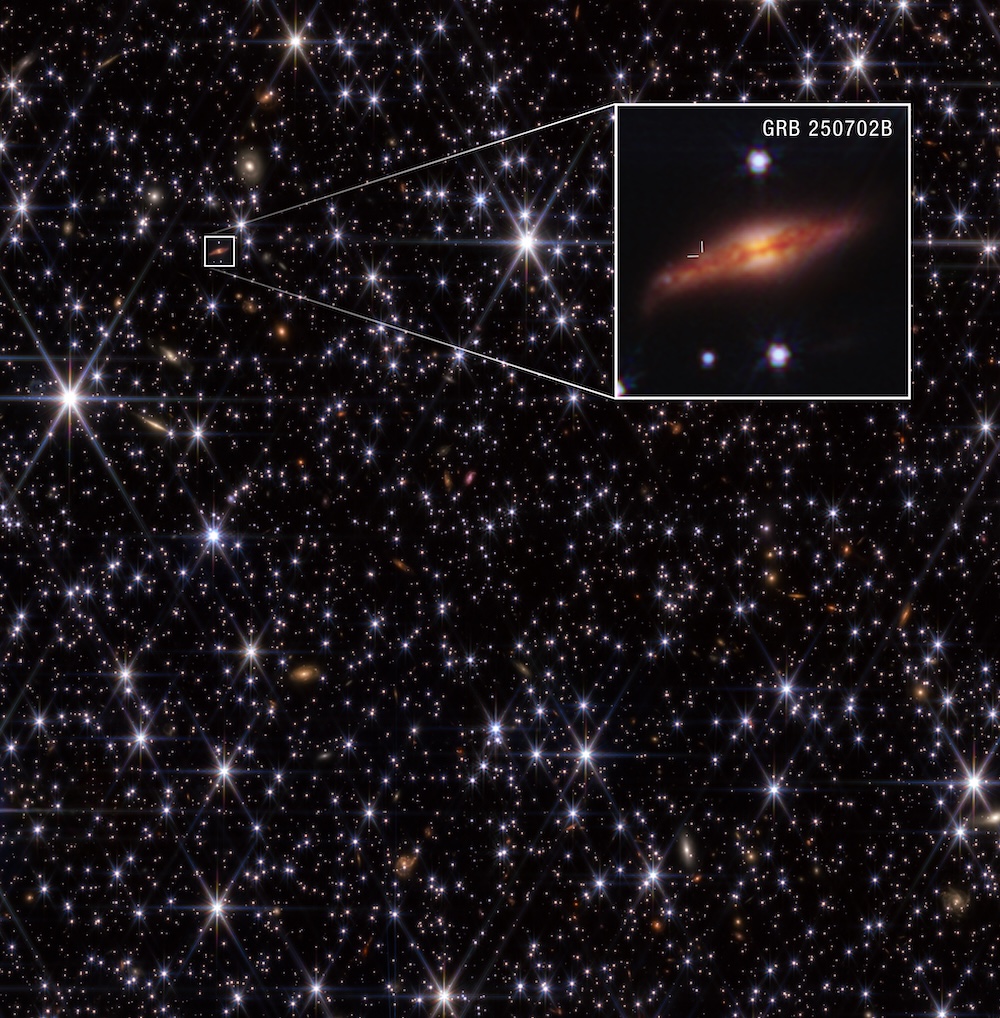
An image of GRB 250702B’s location within its host galaxy. [NASA, ESA, CSA, H. Sears (Rutgers). Image Processing: A. Pagan (STScI)]

In 2025, the Fermi Gamma-ray Space Telescope spotted an intense flash of gamma rays from a distant, dusty galaxy, and a fleet of spacefaring and earthbound telescopes soon revealed the remarkable characteristics of the event. GRB 250702B featured multiple bursts spanning several hours, individual flares lasting roughly 100 seconds, and X-ray emission in the 24 hours leading up to the gamma-ray activity β€” something never seen before in a gamma-ray burst.

These characteristics have been challenging to explain with typical models of long gamma-ray burst formation, such as collapsing massive stars, but researchers have developed numerous promising alternatives. In a new research article, astronomers have shown how GRB 250702B’s behavior might be explained by repeated close encounters between a white dwarf and an intermediate-mass black hole.

Eccentric Close Encounters

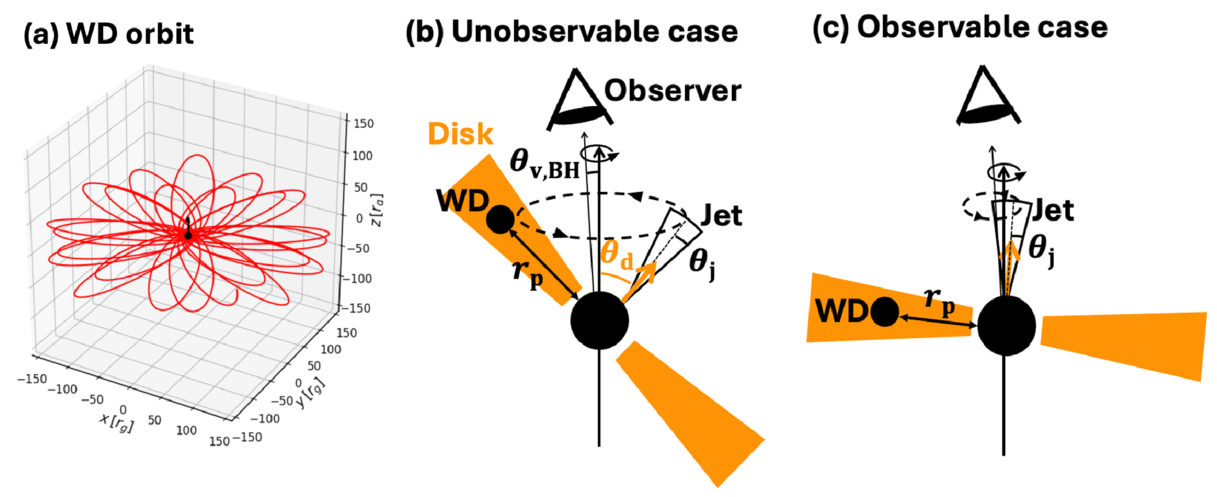
Yuri Sato (Tohoku University) and collaborators modeled the source of GRB 250702B as a white dwarf that has been captured into orbit around an intermediate-mass black hole. In their model, the white dwarf travels on an extremely eccentric orbit, drawing close to the black hole roughly once an hour. Each time the white dwarf ventures close, the black hole’s tidal forces strip away part of the star until, after about 40 such encounters, the white dwarf is completely destroyed.

geometry of the GRB 250702B system

Schematics showing the orbit of the white dwarf (WD; left) and the geometries that produce observable and unobservable jets. Click to enlarge. [Sato et al. 2026]

When the black hole peels material away from the white dwarf, some material swirls into an accretion disk, and some is cast off into space. Accretion from the disk powers a narrow relativistic jet: the source of the event’s powerful gamma-ray flares. This should mean that there is one jet produced each time the white dwarf is partially disrupted β€” 40 times β€” yet astronomers detected only a handful of flares from GRB 250702B.

Jet Precession and Model Predictions

The discrepancy can be resolved if the angle between the jet and the black hole’s spin axis precesses over time so that only some of the jets are pointed toward us. This can occur if the accretion disk is misaligned relative to the black hole’s spin. As an alternative, disk instabilities or other processes could keep all but a few of the expected jets from being launched.

radio afterglow predictions for GRB 250702B

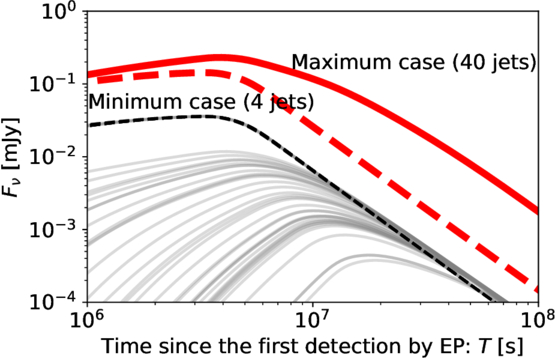
Predicted strength of the radio afterglow for the jet precession case (maximum case) and the case in which only four jets were launched due to disk instabilities or jet choking (minimum case). The x-axis shows the time since the burst was detected in X-rays by the Einstein Probe (EP). [Sato et al. 2026]

Sato and coauthors found that these two scenarios have different long-term outcomes, providing a potential way to ascertain what’s going on at the source; in the jet precession scenario, the jets that are launched away from our line of sight produce an order of magnitude more radio emission at late times.

This work by Sato and collaborators demonstrates how the repeated partial tidal disruption of a white dwarf by an intermediate-mass black hole can match the properties of one of the most remarkable recent transient sources β€” one that has pushed astronomers to consider new ways of producing gamma-ray bursts.

Citation

β€œSuccessive Partial Disruptions with Orbital Precession in a White Dwarf–Black Hole System for Repeating GRB 250702B,” Yuri Sato et al 2026 ApJL 1003 L44. doi:10.3847/2041-8213/ae6a8f

The post Could a White Dwarf–Black Hole Pair Explain the Longest Gamma-Ray Burst Ever Seen? appeared first on AAS Nova.

Evidence for a Delayed Ultraviolet Counterpart to X-Ray Quasiperiodic Eruptions in Ansky

9 June 2026 at 17:00
Hengxiao Guo et al 2026 ApJL 1000 L57
ZTF19acnskyy may be the first X-ray quasiperiodic eruption source to display correlated ultraviolet emission β€” another strange behavior that researchers must explain for this already unique source.

The post Evidence for a Delayed Ultraviolet Counterpart to X-Ray Quasiperiodic Eruptions in Ansky appeared first on AAS Nova.

The Response of Planetary Atmospheres to the Impact of Icy Comets. III. Impact Driven Atmospheric Escape

8 June 2026 at 17:00
F. Sainsbury-Martinez et al 2026 ApJ 1001 57
Simulations suggest that tidally locked planets have similar atmospheric escape rates to Earth analogs despite having cooler and drier atmospheres near their surfaces.

The post The Response of Planetary Atmospheres to the Impact of Icy Comets. III. Impact Driven Atmospheric Escape appeared first on AAS Nova.

Mass Measurements of the Double Neutron Star System PSR J0641+0448

5 June 2026 at 17:00
Z. L. Yang et al 2026 ApJL 1000 L1
Using the Five-hundred-meter Aperture Spherical radio Telescope, researchers have discovered and measured the spins and masses of a pair of neutron stars using the pulsar timing method.

The post Mass Measurements of the Double Neutron Star System PSR J0641+0448 appeared first on AAS Nova.

The First Dedicated Survey of Atmospheric Escape from Planets Orbiting F Stars

4 June 2026 at 17:00
Morgan Saidel et al 2026 AJ 171 257
A survey of six gas giants orbiting F-type stars suggests that atmospheric escape of these planets is determined by the X-ray and extreme-ultraviolet output of their host stars as well as the Roche filling factor.

The post The First Dedicated Survey of Atmospheric Escape from Planets Orbiting F Stars appeared first on AAS Nova.

Now That’s Metal: How to Spot Stars That Have Swallowed Their Planets

3 June 2026 at 17:00

An illustration of an exoplanet about to be engulfed by its host star

Planets that get too close to their host stars are liable to be engulfed and consumed. New research explores how to identify stars that have had a planetary snack.

It’s Snack Time

Being a planet that closely orbits its star is dangerous, and various dynamical processes can draw a planet inward past the point of no return. When a planet vanishes beneath the surface of its host, it eventually disintegrates within the star, its atoms mixing into the blazing stellar soup.

This outcome is likely extremely common across the universe, and researchers have begun to see evidence for it: stars that appear to have absorbed angular momentum from their planets, white dwarfs with uncanny metals in their spectra, and stars with chemical abundances that don’t match those of their siblings. Now, in a recent publication led by Kaitlyn Lane (Vanderbilt University), researchers seek to find observational signatures of planetary engulfment of rocky exoplanets by main-sequence stars.

Modeling Engulfment

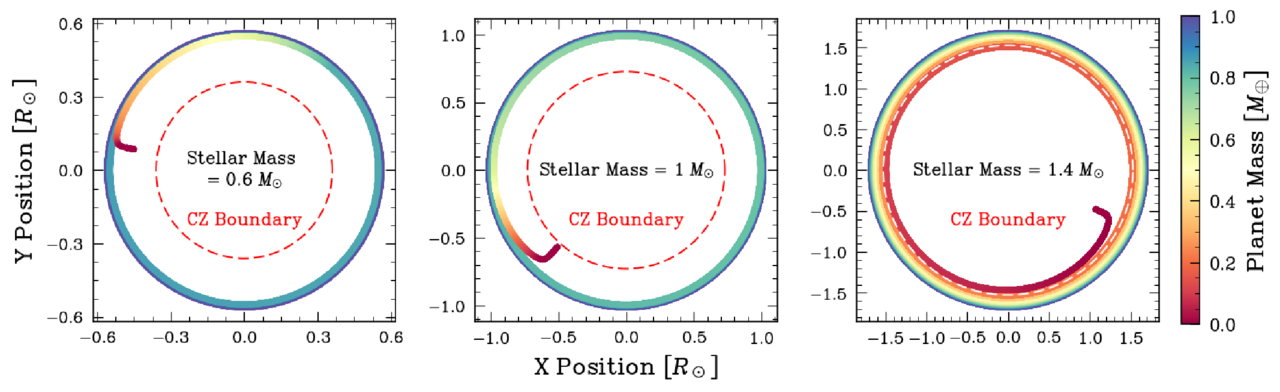
Lane’s team focused on main-sequence stars in the range of 0.5 to 1.4 solar masses, using one-dimensional analytical models to determine which of these stars will most readily display signs of having engulfed a planet. They simulated the stars as they consumed either an Earth-like planet or a super-Earth with the same composition as Earth but 15 times its mass.

illustration of a planet being engulfed by its star

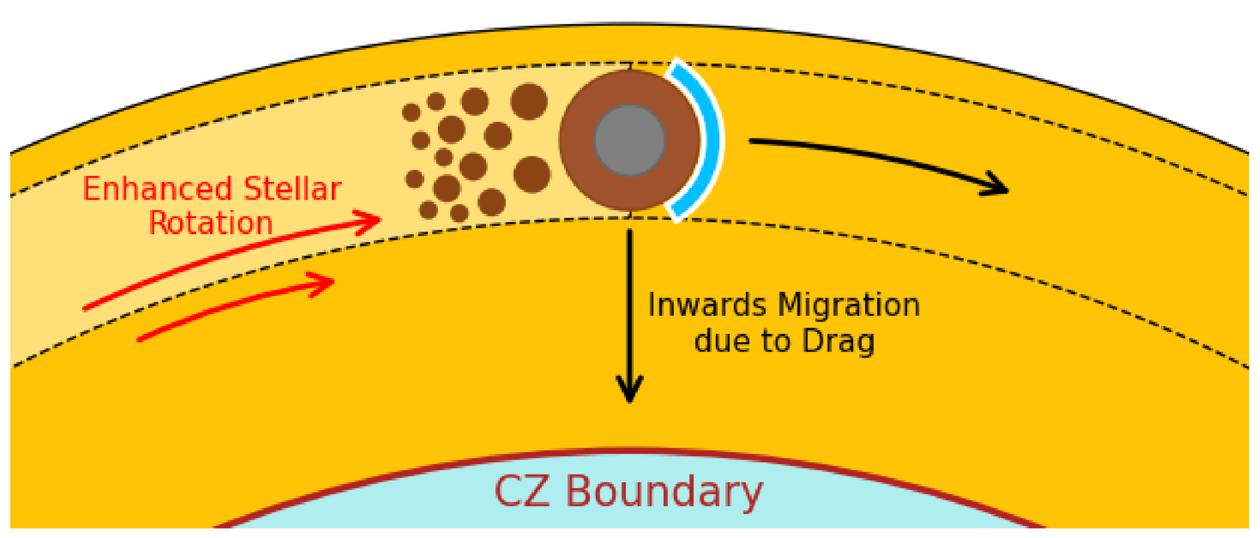
Diagram showing a planet being engulfed by its star and beginning to disintegrate before migrating inward. The boundary between the star’s outer convective zone (CZ) and inner radiative zone is shown. Click to enlarge. [Lane et al. 2026]

At the onset of the model, the engulfment is set to begin, the planet placed tangent to the star’s surface. The planets sink down and orbit just barely within their stars for 1–10 years, their solid surfaces slowly beginning to evaporate.

After that relatively lengthy phase, the process proceeds rapidly: as the planet inches deeper into its star, the drag forces grow stronger and the planet’s demise accelerates, with the planet disintegrating over the course of hours. In the last phase, the planet makes its final plunge and is destroyed in a half hour.

Signs of Planets Past

Lane’s team found that the planets tended to be destroyed fully within the outer convective layer of their stars, except in the case of the most massive stars studied here. For more massive stars, the outer convective zone is shallower than it is for the less massive stars, allowing a chunk of each planet to survive the passage through the convective zone to reach the radiative zone below.

simulation results showing planets disintegrating within their host stars

The trajectories of three example cases, showing how the planet loses mass as it spirals inward. In the 1.4-solar-mass case, part of the planet survives to reach the radiative zone, but the shallowness of the star’s convective zone means that the disintegrated planetary material is easier to observe. Click to enlarge. [Lane et al. 2026]

What this translates to, for the purposes of identifying planet-eating stars from afar, is that stars near the top of the mass range studied β€” from 1.0 to 1.4 solar masses β€” make the best targets. This is because the tell-tale planetary metals are not overly diluted within the stars’ relatively small convective zones, making these elements easier to detect. In terms of specific metals, the authors found that aluminum, calcium, and vanadium are the best signposts of planetary engulfment, with lithium also making the list.

While the authors acknowledge that there’s more work to be done β€” they plan to investigate the impacts of planetary engulfment on stellar structure more closely, for example β€” this work represents an important foray into identifying targets for future studies of stars that have eaten their planets.

Citation

β€œObservable Metal Pollution in Main-Sequence Stars: Simulations of Rocky Planets Engulfed by Stars in the 0.5 to 1.4 MβŠ™ Range,” Kaitlyn T. Lane et al 2026 ApJ 1003 67. doi:10.3847/1538-4357/ae5b9a

The post Now That’s Metal: How to Spot Stars That Have Swallowed Their Planets appeared first on AAS Nova.

Measuring the Distances to Asteroids from One Observatory in One Night with Upcoming All-Sky Telescopes

3 June 2026 at 17:00
Maryann Benny Fernandes et al 2026 Planet. Sci. J. 7 76
Using simulations of 20 asteroids from 0.05 to 2.4 au away, researchers demonstrate how the technique of topocentric parallax could be used to determine the distance to an asteroid in a single night.

The post Measuring the Distances to Asteroids from One Observatory in One Night with Upcoming All-Sky Telescopes appeared first on AAS Nova.

Predictions of Imminent Earth Impactors Discovered by LSST

2 June 2026 at 17:00
Ian Chow et al 2026 ApJ 1001 61
Simulations suggest that Rubin Observatory will discover 1–2 meter-size or larger imminent impactors each year, nearly doubling the discovery rate and providing an important set of eyes in the Southern Hemisphere.

The post Predictions of Imminent Earth Impactors Discovered by LSST appeared first on AAS Nova.

Blue Straggler in the Making: An X-Ray Active Binary in Algol Configuration

1 June 2026 at 17:00
A. H. Sheikh et al 2026 ApJL 1002 L29
Researchers have found a rare example of a blue straggler star in the process of formation, providing direct evidence for the formation of these puzzling stars through ongoing mass transfer in a binary system.

The post Blue Straggler in the Making: An X-Ray Active Binary in Algol Configuration appeared first on AAS Nova.

Featured Image: Massive Young Star Clusters, Revealed

1 June 2026 at 17:00

The Antennae galaxies are a nearby pair of interacting galaxies, shown in optical light from the Hubble Space Telescope (left) and in infrared light from JWST (right) in the image above. Between the two galaxies’ bright nuclei, there is a vast and dusty molecular cloud complex that harbors a large number of massive young star clusters β€” and in a recent article led by Rupali Chandar (University of Toledo), researchers have worked to pin down exactly how many clusters are embedded within the dusty whorls of the Antennae galaxies. The team used JWST to search for emission from star clusters too thickly blanketed with dust to be visible in previous observations by Hubble. They ultimately identified 45 sources, 40 of which were seen for the first time in this study. These star clusters mostly inhabit the overlap region between the two galaxies, are less than 2.5 million years old, and each contain roughly 104–106 solar masses. To learn more about how JWST’s infrared capabilities unveiled young star clusters in these interacting galaxies, be sure to check out the full article linked below.

Citation

β€œNowhere Left to Hide: Uncovering All of the Massive Young Embedded Star Clusters in the Antennae with JWST,” Rupali Chandar et al 2026 ApJ 1002 64. doi:10.3847/1538-4357/ae56e8

The post Featured Image: Massive Young Star Clusters, Revealed appeared first on AAS Nova.

Dual Active Galactic Nuclei on 100 kpc Scales from the Million Quasar Catalog

29 May 2026 at 17:00
Zhuojun Deng et al 2026 ApJS 283 70
In a sample of 171 new dual active galactic nuclei, four triplets, and one quadruplet drawn from a catalog of nearly a million quasars, researchers find that roughly 16% of targets exhibit tidal features.

The post Dual Active Galactic Nuclei on 100 kpc Scales from the Million Quasar Catalog appeared first on AAS Nova.

Can the Dust Eclipses in WR 104 Provide Constraints on the System’s Inclination?

28 May 2026 at 17:00
Noel D. Richardson et al 2026 ApJ 1001 34
Researchers find a system inclination of 41.8 degrees for WR 104; this result is at odds with previous interpretations of the system’s dust plume, but a new geometric model reconciles these results.

The post Can the Dust Eclipses in WR 104 Provide Constraints on the System’s Inclination? appeared first on AAS Nova.

The Cosmic-Ray Knee as a Local Signature of Nearby PeVatrons

27 May 2026 at 17:00
Ke Fang and Francis Halzen 2026 ApJL 999 L13
The observed steepening of the cosmic-ray spectrum at ~4 PeV could be a global or local feature; a local feature could be explained by sources located ~1 kpc away with ages of 0.1–1 million years.

The post The Cosmic-Ray Knee as a Local Signature of Nearby PeVatrons appeared first on AAS Nova.

❌