Login
Third of land animal habitats could face multiple extreme climate events by 2085, study warns
20 June 2026 at 02:00
Up to 36 per cent of animal habitats on land could be exposed to multiple extreme climate events


As global temperatures continue to rise at an alarming rate, the intersection of climate change and mental health has emerged as a critical area of concern, especially for vulnerable populations such as older adults. Recent research spearheaded by Liu, Zheng, Yang, and their colleagues sheds new light on the pivotal role that preventive health services utilization plays in safeguarding the mental well-being of older adults against the adverse effects of heat exposure. Their groundbreaking study, soon to be published in BMC Geriatrics, presents a comprehensive analysis that underscores the protective capacities afforded by healthcare interventions in mitigating heat-related depressive symptoms in aging populations.
The study begins by contrasting the escalating frequency and intensity of heatwaves worldwide with the growing demographic segment of older adults, who are physiologically and socially predisposed to the detrimental consequences of prolonged heat exposure. While the direct physiological impacts of heat on mortality and morbidity among the elderly have been well established, the researchers delve into a less explored yet profoundly significant domain: the influence of heat events on mental health, particularly depression. This focus addresses a critical knowledge gap in geriatric public health and climate adaptation strategies.
Employing an extensive dataset that integrates meteorological records, health service utilization patterns, and mental health assessments among older adults, the research team employs advanced statistical modeling to elucidate the complex interplay between heat exposure and mental health outcomes. Their methodological approach moves beyond correlation, venturing into causal inference by leveraging longitudinal data that tracks changes in depressive symptoms relative to heatwave durations and intensities, while accounting for confounding variables such as socioeconomic status, pre-existing health conditions, and social support networks.
One of the most striking revelations from the study is the demonstrable efficacy of preventive health services in diminishing the risk and severity of heat-induced depression. Preventive health services here include routine health check-ups, mental health screenings, access to cooling resources, and educational outreach about heat risk management. The researchers highlight that older adults who consistently engage with these services show a statistically significant reduction in the onset and exacerbation of depressive symptoms during and after heatwave periods, compared to their counterparts with limited or no engagement with preventive care.
The biological underpinnings of this protective effect are multifaceted. Heat stress has been implicated in disrupting circadian rhythms, elevating systemic inflammation, and altering neurotransmitter dynamics—all contributing factors to the pathophysiology of depression. Preventive health services facilitate early detection and management of these physiological disturbances through medication adjustments, psychosocial support, and proactive lifestyle guidance tailored to individuals’ needs during heatwaves.
Moreover, the study affirms that preventive health services extend beyond mere clinical interaction; they foster social connectedness and behavioral resilience, which act as crucial buffers against the psychological toll of environmental stressors. Regular contact with healthcare providers and community health programs enhances health literacy, empowers older adults to implement adaptive behaviors—such as hydration strategies and temperature regulation—and reduces feelings of isolation, which is a known risk factor for depression in aging populations.
In addition to individual-level benefits, the research contextualizes the broader public health implications. The integration of preventive health services into climate resilience frameworks presents a scalable, cost-effective strategy to combat the mental health impacts of extreme heat in aging societies. By embedding these services within primary care and community health infrastructures, policymakers can ensure equitable access for high-risk groups, thereby mitigating disparities exacerbated by social determinants of health and geographic vulnerabilities.
The findings also bear important implications for the design of digital health technologies and telemedicine platforms. These tools can enhance the reach and efficacy of preventive services by facilitating remote monitoring, delivering personalized health education, and enabling timely interventions during heatwave alerts. The researchers advocate for the incorporation of climate-sensitive modules into existing healthcare protocols to address the nuanced needs of older adults facing climate-related stressors.
Furthermore, the study underscores the necessity of multidisciplinary collaboration between climatologists, geriatricians, mental health specialists, and public health strategists to develop holistic interventions that encompass environmental, physiological, and psychosocial dimensions. The authors argue that traditional siloed approaches are ill-equipped to address the complex challenges posed by climate change-induced health risks and that integrated policies are paramount.
Another key contribution of this research is its emphasis on the heterogeneity within older adult populations. The analysis reveals that factors such as age stratification, comorbidities, and socio-economic status modulate the degree of vulnerability and responsiveness to preventive interventions. Tailoring preventive health services to these nuances enhances their effectiveness, highlighting the value of precision public health approaches in the era of climate change.
This study also broadens the scientific discourse by framing depression as a significant climate-sensitive health outcome that demands urgent attention from the global health community. While much focus has been placed on cardiorespiratory and heat stroke-related illnesses, mental health outcomes often remain overshadowed, despite their pervasive impact on quality of life and functional independence in older adults. Elevating mental health in the climate-health agenda is a profound step forward underscored by this work.
Additionally, Liu and colleagues offer methodological innovations by integrating environmental exposure metrics with validated geriatric depression scales and health service utilization records. Their analytical techniques—including the use of time-series analyses and mediation modeling—set new standards for rigor in environmental mental health research. Such methodological advancements facilitate the detection of subtle intervention effects that could be overlooked in conventional epidemiological studies.
The research also addresses potential barriers to the effective uptake of preventive services among older adults. Issues such as healthcare accessibility, cultural perceptions of mental health, and educational disparities are examined as critical factors influencing utilization rates. The findings suggest targeted outreach and culturally sensitive programming are essential components to optimize service delivery and engagement.
Importantly, the implications extend beyond immediate health outcomes, touching on broader societal challenges posed by an aging global population amid accelerating climate change. Mental health stability in older adults is linked to decreased healthcare costs, reduced caregiver burden, and sustained community participation—all vital components for maintaining social cohesion and economic vitality in heat-impacted regions.
The study concludes with a call for urgent action to embed preventive health services within climate adaptation policies and health systems strengthening frameworks worldwide. The authors stress that timely investment in such services not only safeguards mental health but also embodies a proactive approach to safeguarding human dignity in the face of unprecedented environmental changes.
In sum, this pioneering research by Liu et al. provides an indispensable evidence base highlighting preventive health services as a vital defense mechanism against heat-related depressive risks in older adults. Its insights pave the way for innovative, evidence-driven interventions that can transform the climate resilience landscape, ensuring the psychological well-being of our elders as they confront the relentless challenges of a warming world.
Subject of Research: The role of preventive health services utilization in protecting older adults from heat-related depressive risks.
Article Title: Uncovering the role of preventive health services utilization in protecting older adults from heat-related depressive risks.
Article References: Liu, S., Zheng, J., Yang, F. et al. Uncovering the role of preventive health services utilization in protecting older adults from heat-related depressive risks. BMC Geriatr (2026). https://doi.org/10.1186/s12877-026-07828-6
Image Credits: AI Generated
 Ultrasonic espresso’ made with cold water and high-frequency sound waves uses less energy than the traditional version – and taste tests show it’s just as good.A new gravitational-wave catalogue reports 161 additional black hole mergers, bringing the total to 390 detections. Scientists at the University of Glasgow’s Institute for Gravitational Research are celebrating the release of a major new collection of gravitational wave discoveries, a milestone that highlights the rapid growth of gravitational astronomy. The latest Gravitational Wave Transient Catalogue [...]
In 2011, miles of rock shifted deep underwater in the Japan Trench, causing an earthquake that deformed the seafloor and caused a devastating tsunami. Off the Eastern Coast of the Tōhoku region in Japan, a huge piece of the Earth’s crust carrying the Pacific Ocean, known as a tectonic plate, is forcing itself beneath Japan and into the Earth’s interior. Researchers think rock from this plate pushed against rock far beneath Japan, building pressure until it became too great. The lower plate slipped, spreading energy from the slip site and causing the earthquake.
Plate slip can cause 2 types of outcomes. The first occurs kilometers deep in the Earth’s crust, causing earthquakes too small to trigger tsunamis. The second type causes extreme slip events that begin deep in the crust, like the 2011 event that extended into the Japan Trench and warped the seafloor. The moving seafloor displaces seawater, causing a tsunami. These events are referred to as slip-to-the-trench style earthquakes.
Researchers think this phenomenon is not unique to 2011, as Japan has a long history of tsunami-causing earthquakes. Charlotte Pizer and colleagues investigated sediment from the Japan Trench to unearth the geologic history of slip-to-the-trench style earthquakes.
In between earthquakes, Japanese islands continuously shed sediment that fills the trench, forming horizontal layers. Slip-to-the-trench earthquakes bend and fold these layers. The team hypothesized that if they found these folds in the Japan Trench and dated them, they could catalogue the record of slip-to-the-trench style earthquakes in the area.
Earthquakes like these occur repeatedly, meaning that younger ones can erase folds caused by older ones. To account for this overprinting, the researchers chose a study site within the Japan Trench about 100 kilometers (60 miles) north of where the most severe earthquakes occur. This site is only mildly deformed by slip-to-the-trench earthquakes since it’s so far from their source, making it easier for the team to identify individual events.
Pizer and her group pieced together data collected from this site by previous researchers to reconstruct Japan’s earthquake history. They compiled 3 main types of data. Two of these were images of sediment layers in the trench constructed from reflections of vibrations sent into the ground, called seismic profiles.
The first seismic profile captured the full trench, over 1 kilometer deep (about 0.6 miles), at 5-meter (16-feet) resolution. Using this method, any layers smaller than 5 meters thick won’t appear in the image. The second seismic profile captured only the top 40 meters (130 feet) of sediment, but could detect layers as thin as 10 centimeters (4 inches).
The final type of data they used came from a 36-meter (120-foot) long cylinder of sediment extracted from the bottom of the trench, called a sediment core. Researchers in the past tied layers within this sediment core to historic earthquake events. They showed that it recorded 2 specific earthquakes in the area, the Kyotoku earthquake of 1454 CE, and the Jogan earthquake of 869 CE, both of which likely caused tsunamis.
Pizer’s team could observe the depth of the Kyotoku and Jogan earthquake layers taken from the sediment core in their high-resolution seismic profile of the trench. In these high-resolution data, they noticed that deformation occurred in the sediment up to the layer marking the Jogan earthquake, but not above it, meaning deformation of the trench happened during this 869 CE event.
The high-resolution data were only able to image sediments from recent earthquakes since 869 CE, but the low-resolution profile, which imaged the full trench, was able to capture the deeper, older record. When they looked deeper into the trench sediment, the researchers noticed that deformation from the 869 CE event had spread from where the tectonic plate is colliding with Japan. They saw at least 6 more similarly deformed layers, implying each was its own slip-to-the-trench event, although the dates of these events are unknown.
Pizer and colleagues concluded that slip-to-the-trench earthquakes are long-standing, common events in the Japan Trench. They hope future scientists will continue to research this site to better assess tsunami risks in Japan.
The post The history of tsunami-causing earthquakes in Japan appeared first on Sciworthy.
Where do black hole mergers happen? Recent research finds evidence that most black hole mergers occur in triple systems containing a close inner binary and a more distant third party.
Thanks to the combined efforts of the LIGO, Virgo, and KAGRA gravitational wave detectors, we’ve now collected the subtle signals from several hundred pairs of merging stellar-mass black holes. As this collection of spacetime ripples continues to grow, researchers are seeking to understand how these merging black hole pairs were assembled.
In the simplest scenario, pairs of high-mass stars independently evolve into black holes, lose momentum by emitting gravitational waves, and meld into one another. But the population of merging black holes likely contains contributions from multiple sources, including multiple-star systems, the disks surrounding accreting supermassive black holes, and black holes that have already experienced a merger. Which of these merging populations is reflected in our catalog of gravitational wave events?
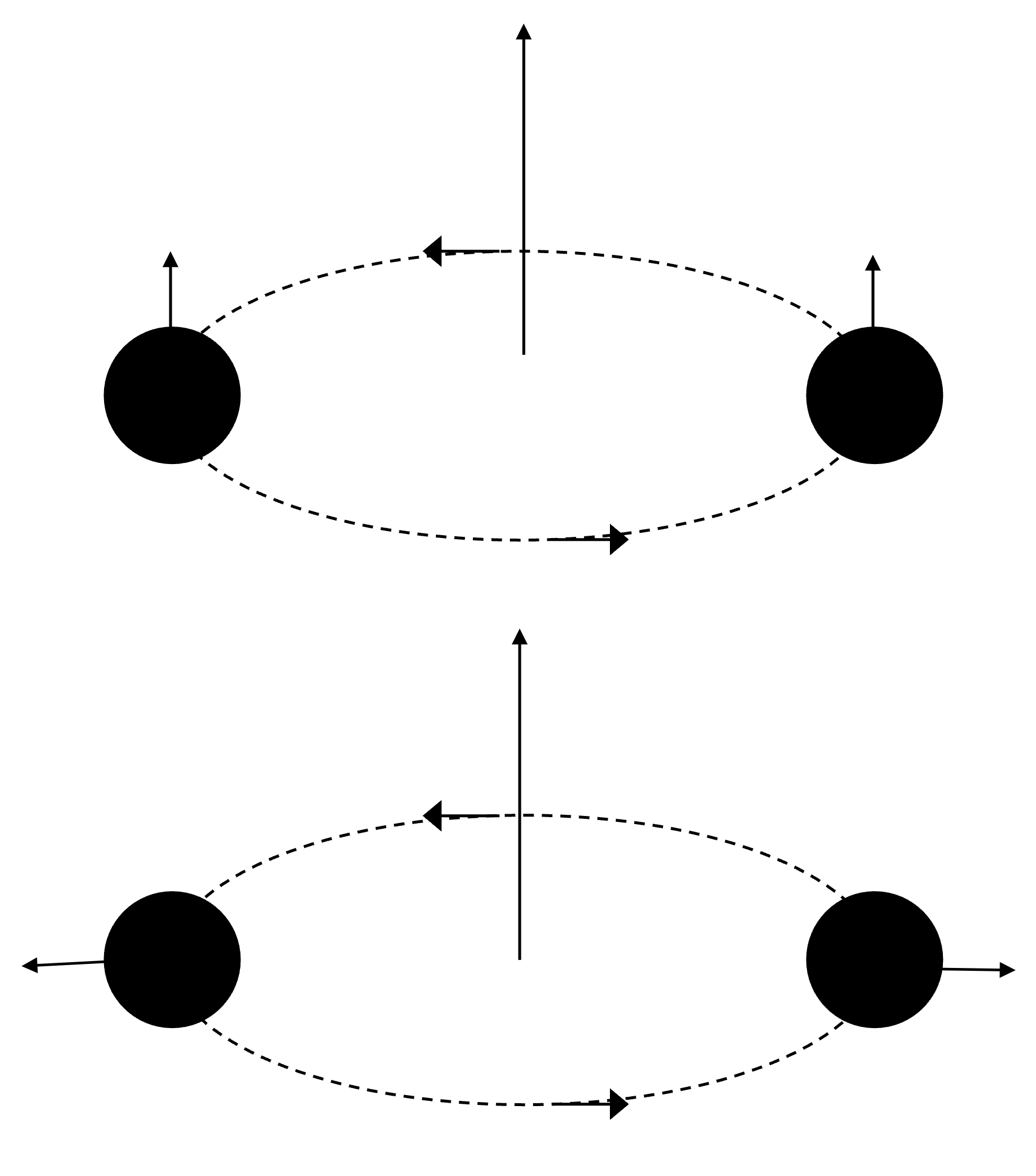
A black hole binary system with aligned spins and orbit (top) and a binary with spins tilted by 90 degrees (bottom). [AAS Nova/Kerry Hensley]
So far, the increasingly large pool of gravitational wave detections tentatively points to a feature that could illuminate the sites of black hole mergers: a peak in the spin–orbit tilt distribution around 90 degrees. This feature has been most confidently extracted from nonparametric analyses, which do not make assumptions about the population of merging black holes, but it has also been hinted at in parametric analyses, which do make population-level assumptions.
To investigate this feature further, a team led by Jakob Stegmann (Max Planck Institute for Astrophysics) performed a new, astrophysically motivated parametric analysis of the most recent catalog of gravitational wave detections from LIGO, Virgo, and KAGRA.
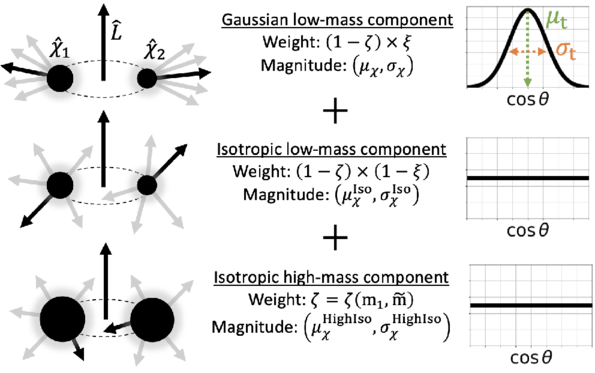
The three populations in the team’s modeling. [Stegmann et al. 2026]
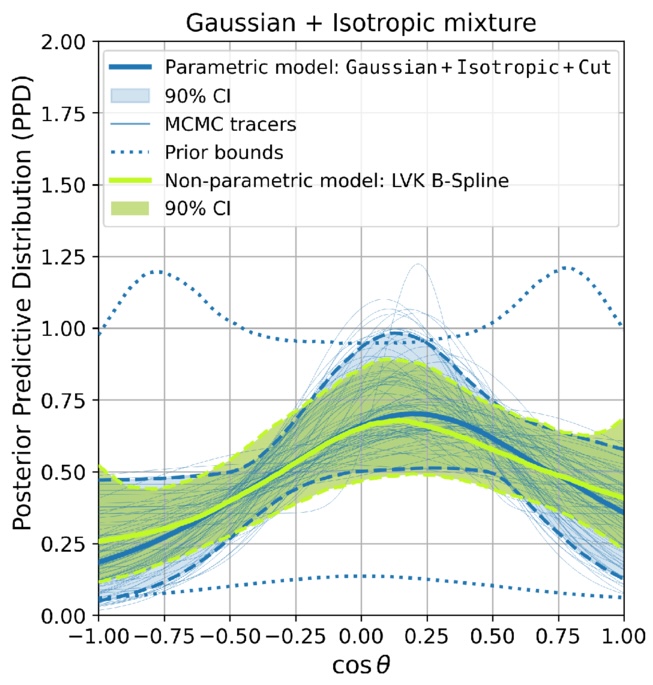
Posterior predictive distribution of black hole spin–orbit tilts. Both the authors’ modeling (solid blue line) and the nonparametric modeling performed by the LIGO–Virgo–KAGRA collaboration (solid green line) find evidence for a peak in the spin–orbit tilt distribution near cosθ = 0. [Adapted from Stegmann et al. 2026]
Stegmann and collaborators pointed out that the triple-system scenario aligns well with other properties of the observed population of black hole mergers, such as the mass and effective spin distributions. This scenario may also be necessary to explain certain merging pairs that might have had slightly eccentric orbits at the moment of merging. If future gravitational wave observations strengthen the evidence for a peak in the spin–orbit tilt distribution near 90 degrees, it will have profound implications for how and where black holes merge in our universe.
“Gravitational-Wave Observations Suggest Most Black Hole Mergers Form in Triples,” Jakob Stegmann et al 2026 ApJL 1000 L59. doi:10.3847/2041-8213/ae52ec
The post Third Star’s the Charm: Most Merging Black Holes Might Be in Triple Systems appeared first on AAS Nova.
Over many centuries of observing the night sky, astronomers have found only a single visible afterglow of a collision between neutron stars. For a few days in the summer of 2025, it seemed like observers may have found another of these treasured but elusive prizes; unfortunately, the promising candidate turned out to be a supernova in disguise.
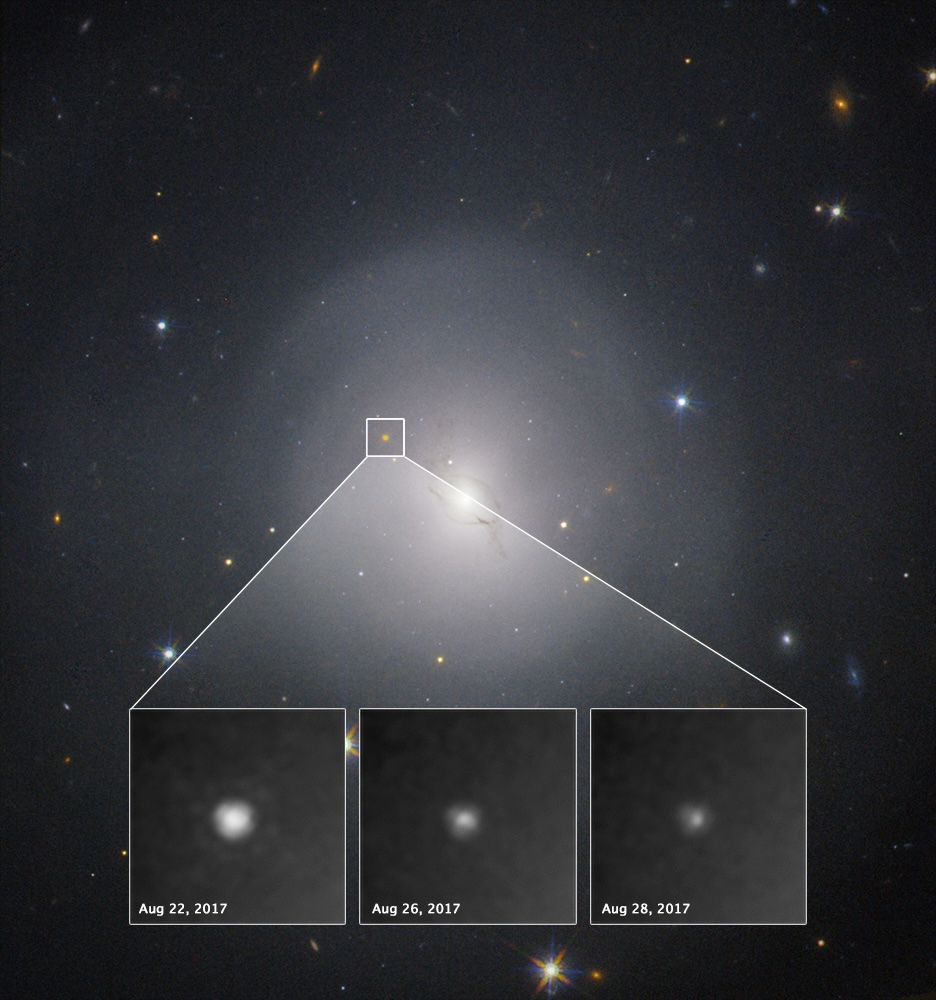
These images from the Hubble Space Telescope show the fading light of the kilonova associated with the gravitational wave event GW170817. [NASA and ESA Acknowledgment: A. Levan (U. Warwick), N. Tanvir (U. Leicester), and A. Fruchter and O. Fox (STScI)]
That one kilonova, found back in 2017, taught astronomers much about how heavy elements are formed and left the scientific community hungry for more data. Since then, each time a gravitational wave detector like LIGO reports that it may have spotted a neutron star merger, telescopes across the world scramble to look in the probable region of the sky, hoping to find the short-lived electromagnetic counterpart.
On 18 August 2025, the LIGO/Virgo/KAGRA collaboration sent out an alert that it may have detected a neutron star–neutron star merger. The odds that their signal was real weren’t great, and the researchers gave it just a 29% chance of being a genuine astrophysical signal. Still, given the potential payoff of finding the next kilonova, several telescopes quickly began searches for the optical counterpart. The gravitational wave signal suggested that the event likely came from a curved patch of sky delightfully referred to as the “northern banana,” and after trawling that region for a few nights, astronomers hauled in 47 new transients. Any one of these could have been the kilonova, and all of them received extensive follow-up observations.
A team led by James Gillanders (University of Oxford) recently summarized some of these follow-up observations carried out with the Pan-STARRS and ATLAS telescopes. In the initial exciting few days after the alert went out, one candidate transient stood out as the most promising. Named AT2025ulz, it was first spotted by the Zwicky Transient Facility and initially started fading rapidly and changing colors, just as models of kilonovae predict. For four days, it seemed like the world may have witnessed its second-ever kilonova. But then the telescopes began their fifth night of observations.

The light curve of SN2025ulz. Note that the source appeared to grow brighter again after about 5 days. Click to enlarge. [Gillanders et al. 2025]
Frustrating as this particular result may be, the effort was far from wasted. The team could use their non-detection of the true kilonova to place limits on its timing and peak magnitude, assuming it existed in the first place. And, as gravitational wave detectors grow more sensitive and alerts like this more common, hindsight will likely frame this scramble as a dress rehearsal for an ultimately successful kilonova recovery effort. Until then, astronomers will keep searching, and will keep their guard up against cosmic impostors.
“Pan-STARRS Follow-Up of the Gravitational-Wave Event S250818k and the Light Curve of SN2025ulz,” J. H. Gillanders et al 2025 ApJL 995 L27. doi:10.3847/2041-8213/ae2125
The post An Impostor Explosion appeared first on AAS Nova.
Researchers have undertaken a new search for a supermassive black hole binary, placing limits on its properties and exploring a promising technique for simultaneously analyzing electromagnetic and gravitational wave data.
In 2023, astronomers announced the discovery of compelling evidence for the gravitational wave background: the collective murmurs and rumblings of distant supermassive black hole binaries. The time may now be ripe for the natural next phase of discovery: the detection of gravitational waves from an individual supermassive black hole binary.
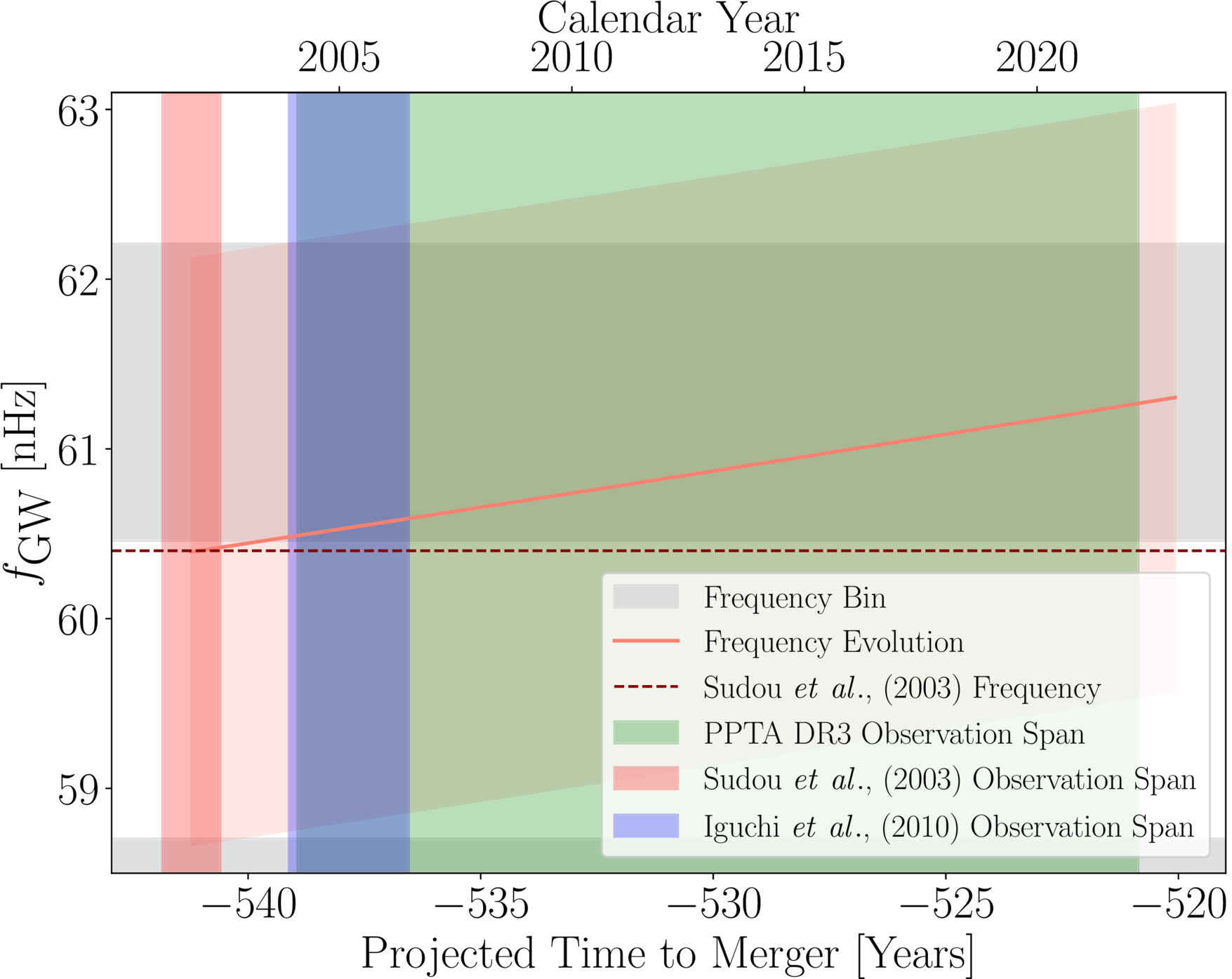
The predicted frequency evolution of gravitational waves from the black hole binary candidate in 3C 66B. Click to enlarge. [Cardinal Tremblay et al. 2026]
Jacob Cardinal Tremblay (Max Planck Institute for Gravitational Physics and Leibniz University Hannover) and collaborators conducted a search for gravitational waves from the candidate supermassive black hole binary in 3C 66B using the Parkes Pulsar Timing Array (PPTA).
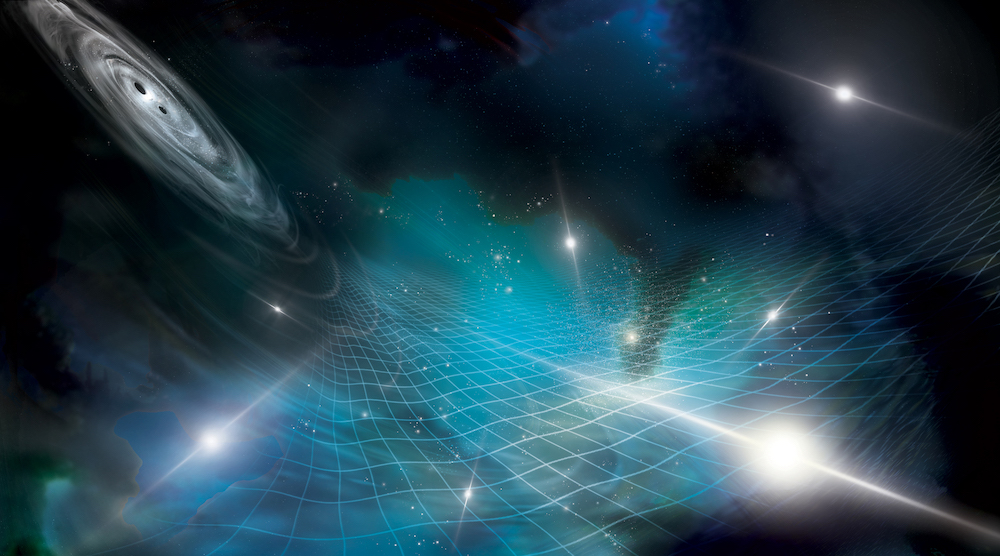
Artist’s impression of a supermassive black hole binary generating gravitational waves that sweep across an array of pulsars. [Aurore Simonnet / NANOGrav; CC BY 4.0]
Researchers have previously searched for gravitational waves from 3C 66B in data from other pulsar timing arrays, such as the North American Nanohertz Observatory for Gravitational Waves, and no black hole binary has been detected. This is the first search of the third PPTA data release, which contains measurements of 32 pulsars over 18 years, providing a long baseline to search for the slow undulations of low-frequency gravitational waves.
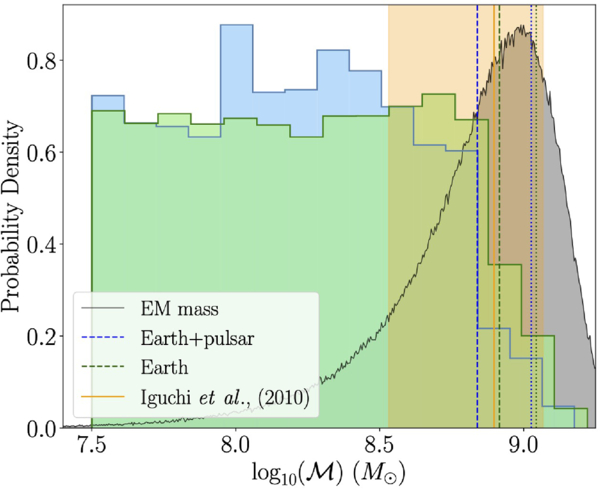
Constraints placed on the chirp mass by this work (blue and green histograms) compared to constraints from electromagnetic observations (gray and peach shaded areas). Click to enlarge. [Cardinal Tremblay et al. 2026]
While this analysis didn’t result in the first-ever detection of gravitational waves from a single supermassive black hole binary, it did allow the team to test a new method that could someday play a role in precision cosmology. This method simultaneously analyzes electromagnetic and gravitational wave data from known supermassive black hole binaries, establishing these sources as “standard sirens” that can complement standard candles like Type Ia supernovae for measurements of the expansion rate of the universe.
“A Multimessenger Search for the Supermassive Black Hole Binary in 3C 66B with the Parkes Pulsar Timing Array,” Jacob Cardinal Tremblay et al 2026 ApJL 998 L42. doi:10.3847/2041-8213/ae3c98
The post A Search for a Supermassive Black Hole Binary appeared first on AAS Nova.
Across the universe and across the electromagnetic spectrum, flares, bursts, and waves are making their mark on the sky. Today, we’re giving an update on three exceptional transients that have been discussed previously on AAS Nova: AT 2024wpp, GRB 250702B, and GW231123.
Discovered in September 2024, AT 2024wpp burst onto the scene as the most luminous example of a fast blue optical transient (FBOT) — a growing class of events that are more luminous, more rapidly evolving, and bluer than supernovae. In October 2025, astronomers published their findings on AT 2024wpp’s X-ray and radio evolution. Just last month, a research team led by Natalie LeBaron (University of California, Berkeley) described the results of a complementary investigation of the transient’s ultraviolet, optical, and near-infrared behavior.
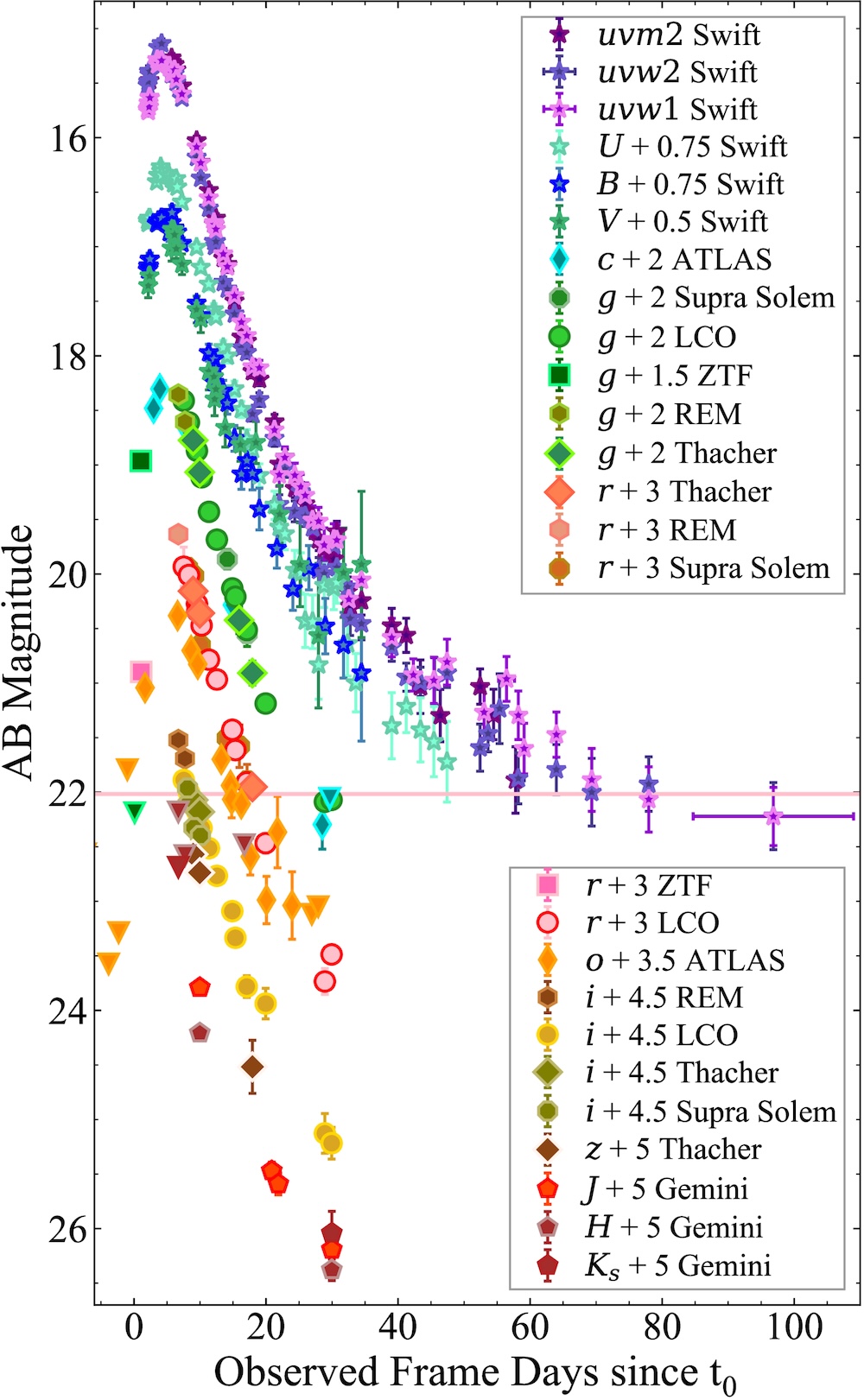
The ultraviolet through infrared light curve of AT 2024wpp. Results from different filters are offset vertically for clarity. [LeBaron et al. 2026]
The observations point to a luminous central energy source that continuously injects energy into its surroundings, powers multiple outflows, and ionizes the ejected material. These features can be explained by the rapid accretion of material by a neutron star or a black hole, in which the accreted material forms a disk and is ejected in both a fast-moving polar outflow and a slower-moving equatorial outflow.
Though the exact nature of the central object powering AT 2024wpp’s intense radiation isn’t known — the extreme luminosity of this event points to a stellar-mass black hole as the central object, but a neutron star cannot be ruled out — the overall picture of this event matches what has been found for previous FBOTs. Upcoming instruments and surveys will discover more FBOTs and spot them earlier in their evolution, transforming our understanding of these rare transients.
GRB 250702B is an exceptional gamma-ray burst: an intense flash of gamma rays lasting anywhere from a few milliseconds to several hours. GRB 250702B is unprecedented among events in this class because it features several bursts arising over the course of roughly 7 hours, plus X-ray precursor emission going back 24 hours before discovery. We’ve previously covered JWST follow-up observations of GRB 250702B, and today we’re taking a look at its high-energy evolution.

Swift (black circles) and Chandra (blue circles) observations of GRB 250702B. Click to enlarge. [Adapted from O’Connor et al. 2025]
O’Connor’s team found that GRB 250702B didn’t fit neatly into either category. While many of the event’s properties closely resembled those of ultra-long gamma-ray bursts, the hours-long gamma-ray emission and the precursor X-ray emission were outliers. Certain features are more easily reconciled with the tidal disruption of a main-sequence star by an intermediate-mass black hole, but others are similarly hard to account for. Finding the smoking gun for a tidal disruption event — an abrupt shutoff to the X-ray emission — will require long-term X-ray monitoring.
Because GRB 250702B has features that align with both ultra-long gamma-ray bursts and tidal disruption events, O’Connor and coauthors proposed scenarios that combine aspects of both possibilities: either a stellar-mass black hole tidally disrupting a star or the merger of a helium star with a stellar-mass black hole.
When compact objects like neutron stars and black holes merge, their collisions produce ripples in spacetime that are accessible to detectors on Earth. One of the most exciting events so far from the fourth gravitational wave transient catalog is GW231123, which appears to be caused by the merger of two black holes, each at least 100 times the mass of the Sun. The LIGO, Virgo, and KAGRA (LVK) collaborations reported a total mass of 238 solar masses for the event, which would make it the most massive binary black hole merger yet observed.
In a recent article, Ilya Mandel (Monash University and OzGrav) urged caution when interpreting seemingly extreme events like GW231123. Mandel’s argument is a statistical one, highlighting how certain aspects of the Bayesian techniques used to estimate GW231123’s mass could have skewed that estimate toward an artificially high value.
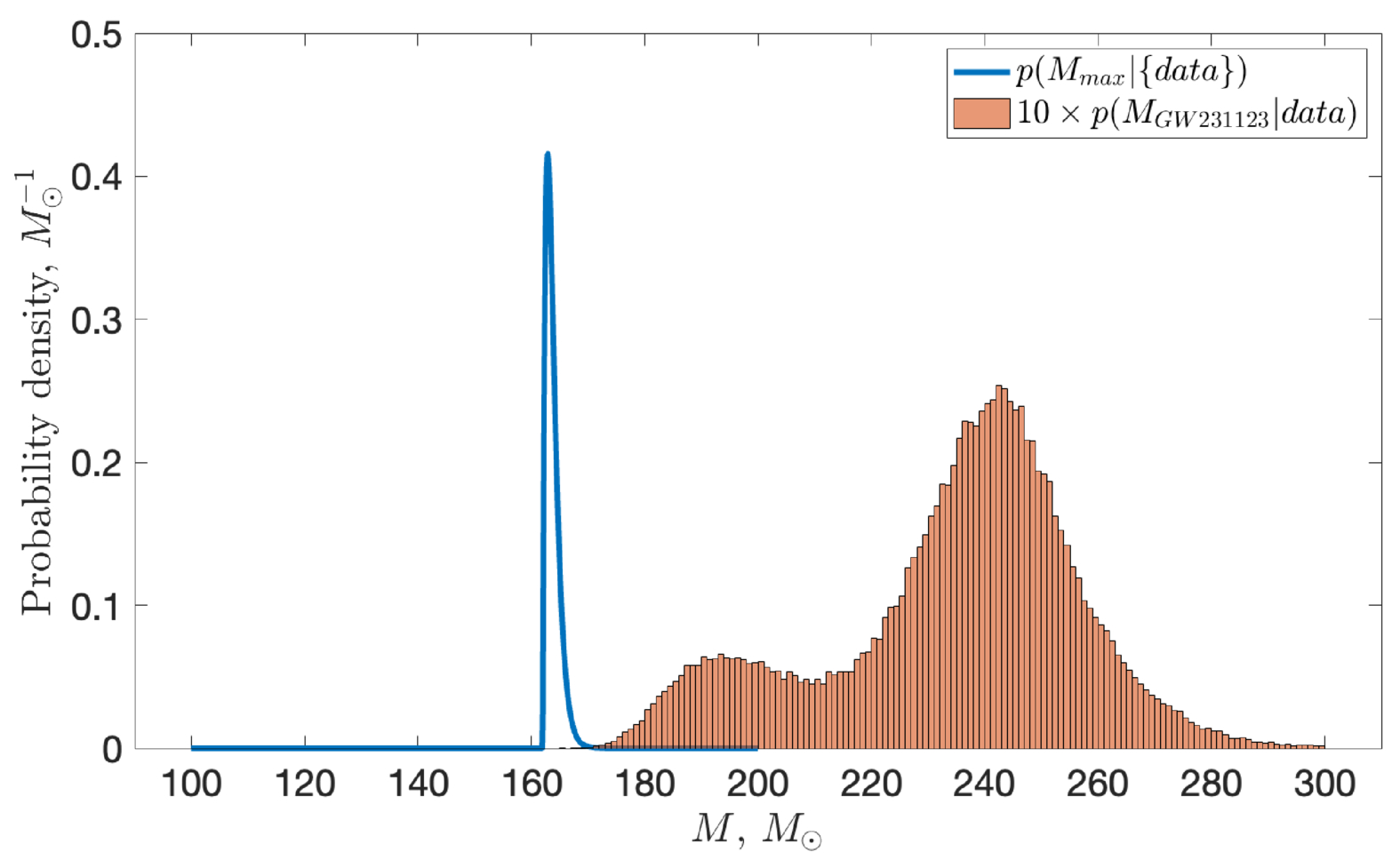
The posterior probability distribution on the maximum mass as derived from the total LVK catalog (blue), compared to the posterior for GW231123 (orange; multiplied by 10 for visibility). Click to enlarge. [Mandel 2026]
Mandel also demonstrated how considering the population of black hole mergers detected by LVK as a whole can provide a different perspective on GW231123’s likely mass. By analyzing this entire sample together, Mandel showed that the maximum mass for the population of merging black holes appears to be considerably lower than the mass estimated for GW231123, again raising the possibility that the true mass of the event is lower than the current estimate.
Ultimately, Mandel pointed out that at present it’s impossible to distinguish between three possibilities: that GW231123 is a true outlier among the population of merging black holes, representing a member of a new, unexplored population; that it’s a member of the same population as other black hole mergers seen by LVK but inhabits an extreme high-mass tail; or its high mass estimate is a statistical artifact.
“The Most Luminous Known Fast Blue Optical Transient AT 2024wpp: Unprecedented Evolution and Properties in the Ultraviolet to the Near-Infrared,” Natalie LeBaron et al 2026 ApJL 997 L10. doi:10.3847/2041-8213/ae2910
“Comprehensive X-Ray Observations of the Exceptional Ultralong X-Ray and Gamma-Ray Transient GRB 250702B with Swift, NuSTAR, and Chandra: Insights from the X-Ray Afterglow Properties,” Brendan O’Connor et al 2025 ApJL 994 L17. doi:10.3847/2041-8213/ae1741
“What Is the Most Massive Gravitational-Wave Source?” Ilya Mandel 2026 ApJL 996 L4. doi:10.3847/2041-8213/ae278d
The post Monthly Roundup: Updates on Three Notable Transients appeared first on AAS Nova.
Editor’s Note: For the remainder of 2025, we’ll be looking at a few selections that we haven’t yet discussed on AAS Nova from among the most-downloaded articles published in AAS journals this year. The usual posting schedule will resume January 2nd.
The LIGO, Virgo, and KAGRA collaborations searched for gravitational waves from the core-collapse supernova SN 2023ixf. Though no significant gravitational wave events were detected during times when two or more gravitational wave detectors were online, the non-detection of gravitational waves from this nearby supernova places constraints on the amount of energy emitted by the explosion in the form of gravitational waves, the shape of the proto-neutron star produced in the collapse, and more.
When a massive star expires in a core-collapse supernova, the collapse of the stellar core into a neutron star or black hole produces gravitational waves. These gravitational waves, along with a stream of neutrinos, should arrive at Earth before the light from the explosion does; gravitational waves and neutrinos can easily escape the dense, roiling ejecta from the explosion, but photons take some time to claw their way through the debris. Gravitational waves from a supernova have never been detected, but the nearby supernova SN 2023ixf, which occurred in a galaxy about 20 million light-years away, offered the best recent opportunity to detect these waves.
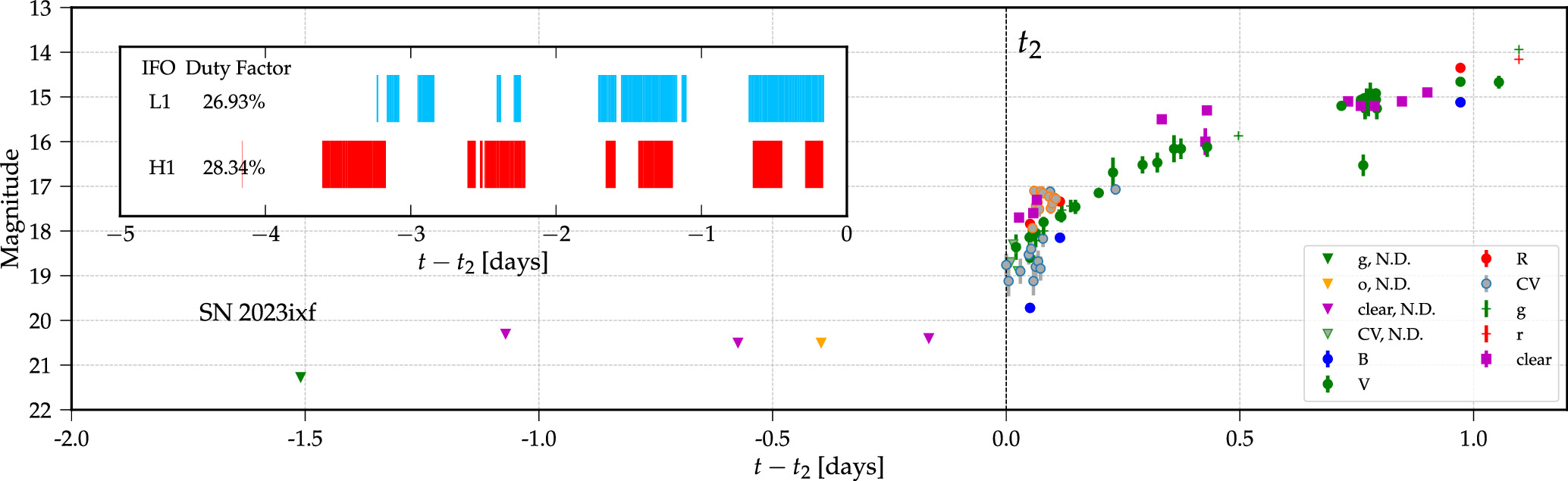
Photometric evolution of SN 2023ixf in its early days and gravitational wave coverage leading up to the supernova’s discovery (inset image). [LIGO-Virgo-KAGRA Collaborations 2025]
Using the non-detection of SN 2023ixf, researchers placed stringent constraints on the gravitational wave energy and luminosity of a supernova explosion, but an even closer supernova is still needed to begin to rule out model predictions for these quantities. To estimate the distance out to which we can expect to detect gravitational waves from collapsing stars, the collaboration members injected synthetic supernova signals into their data. The majority of non-rotating explosions can be detected out to about 22,000 light-years — meaning events on the far side of our galaxy remain inaccessible to current detectors — while rapidly rotating explosions should be detectable out to nearly 100,000 light-years, pushing the detection horizon beyond the borders of the Milky Way.
A. G. Abac et al 2025 ApJ 985 183. doi:10.3847/1538-4357/adc681
The post Selections from 2025: A Search for Gravitational Waves from SN 2023ixf appeared first on AAS Nova.
The gravitational wave background — the constant, low-frequency hum of colliding supermassive black holes across the universe — seems to have a larger amplitude than expected. Can preferential accretion explain why?
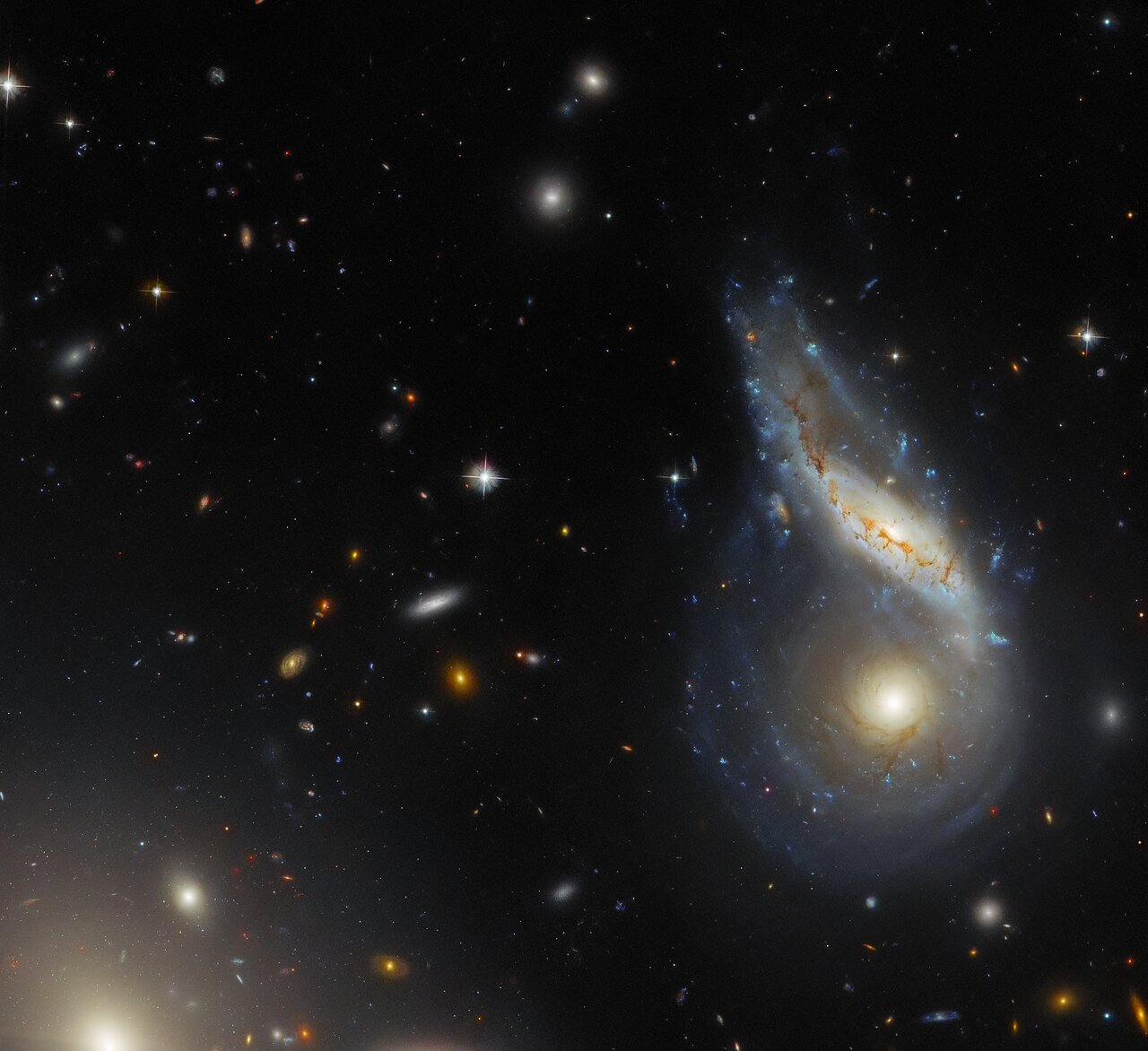
The peculiar galaxy Arp 122, shown here in a Hubble Space Telescope image, is in the process of merging. When two galaxies merge, the supermassive black holes at their centers eventually merge as well. [ESA/Hubble & NASA, J. Dalcanton, Dark Energy Survey/DOE/FNAL/DECam/CTIO/NOIRLab/NSF/AURA; Acknowledgement: L. Shatz; CC BY 4.0]
Though some researchers have invoked new physics to explain this discrepancy, all that may be required is an adjustment to our understanding of the supermassive black hole binary population in our universe. In a recent research article, Julia Comerford (University of Colorado Boulder) and Joseph Simon (University of Colorado Boulder; Oregon State University) tackled one of the underlying assumptions about the masses of merging supermassive black holes.
When supermassive black holes merge, the strength of the gravitational wave signal depends on how similar the black holes were in mass; merging equal-mass black holes produce stronger signals than mismatched black holes do. What if, Comerford and Simon proposed, the masses of merging supermassive black holes scattered across the universe are more similar than previously thought?
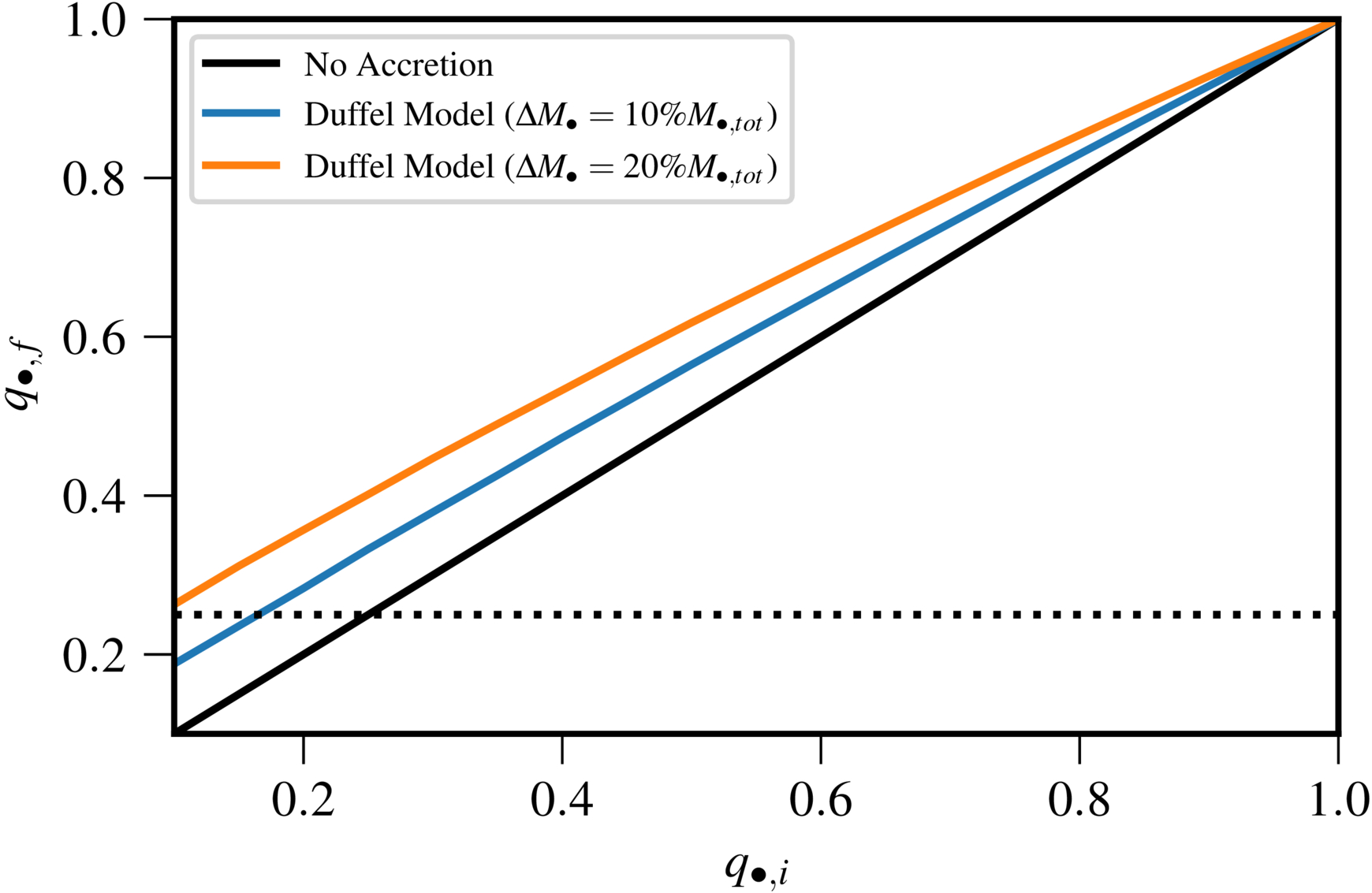
The initial and final black hole mass ratio, q. The blue and orange lines show a 10% and 20% increase in the total mass of the binary, respectively. The dotted line divides major mergers (q ≥ 0.25) and minor mergers. [Comerford & Simon 2025]
What’s more, it appears that the smaller of the two black holes tends to pack on more mass, meaning that the masses of the black holes grow more similar as they wind toward a merger. (This somewhat counterintuitive result arises because the smaller of the two black holes encounters more gas as it spirals inward.)
If accretion tends to even out the masses of the binary members, is the resulting increase in signal strength large enough to explain the observed amplitude of the gravitational wave background?
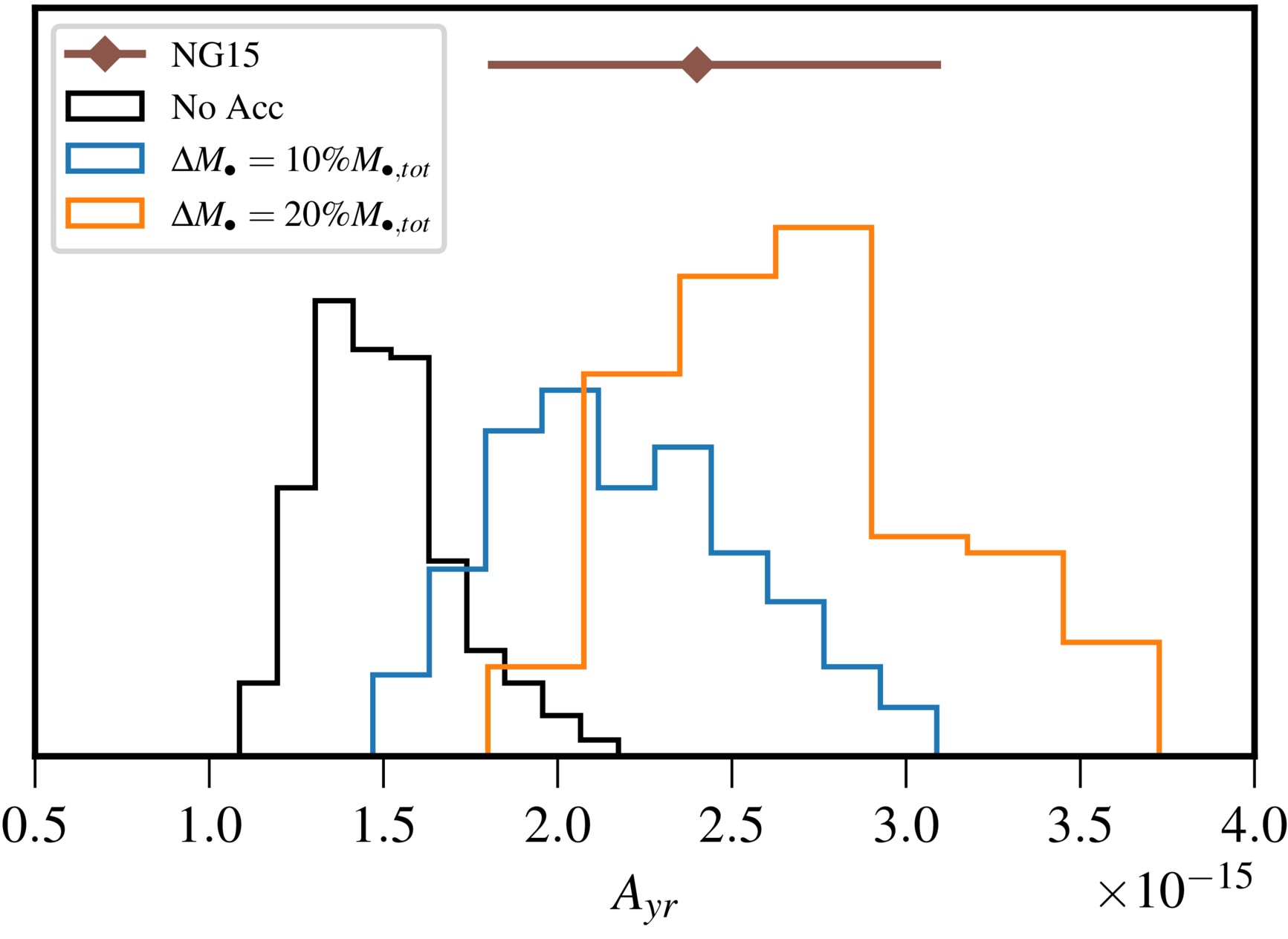
Probability distribution functions for the calculated gravitational wave background amplitude for different accretion conditions. The brown diamond shows the median amplitude from the NANOGrav data set. [Adapted from Comerford & Simon 2025]
The signal-boosting effect from preferential accretion may be especially important if the binary evolution timescale — the time it takes for black holes approaching a merger to reach a separation at which their gravitational waves become accessible to pulsar timing arrays — is longer than the estimated 1.8 billion years. At longer timescales, models without this accretion become entirely inconsistent with observations. Future research that examines the masses and accretion rates of supermassive black holes as they approach make their way toward a merger can provide further clues to the role of preferential accretion.
“Preferential Accretion onto the Secondary Black Hole Strengthens Gravitational-Wave Signals,” Julia M. Comerford and Joseph Simon 2025 ApJ 994 168. doi:10.3847/1538-4357/ae1133
The post Boosting the Gravitational Wave Background appeared first on AAS Nova.
Meet GW241011 and GW241101, two events from the fourth observing run of the LIGO, Virgo, and KAGRA (LVK) gravitational wave detectors. With rapid spins and mismatched black hole masses, both events provide strong evidence for black hole growth through hierarchical mergers.
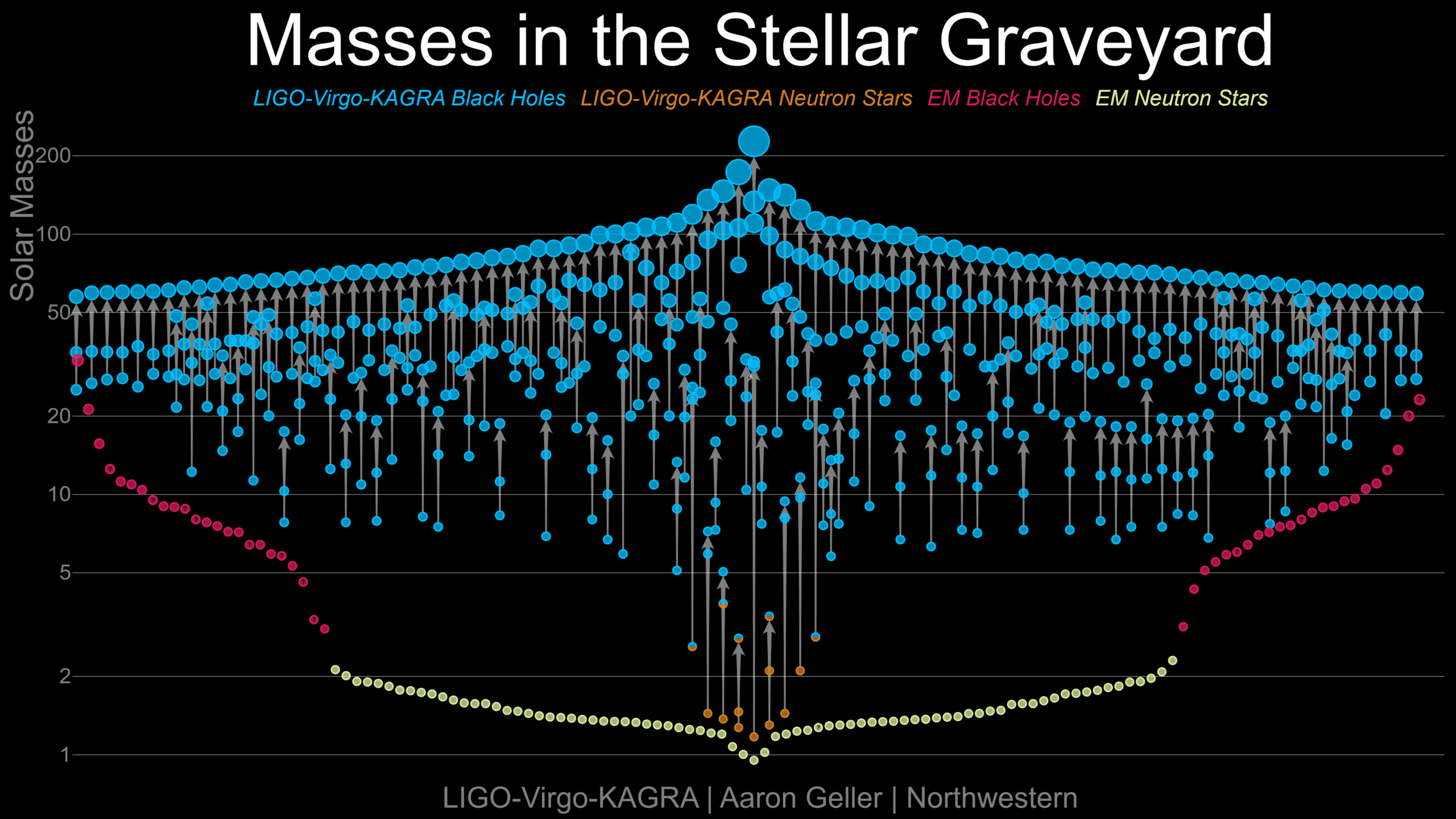
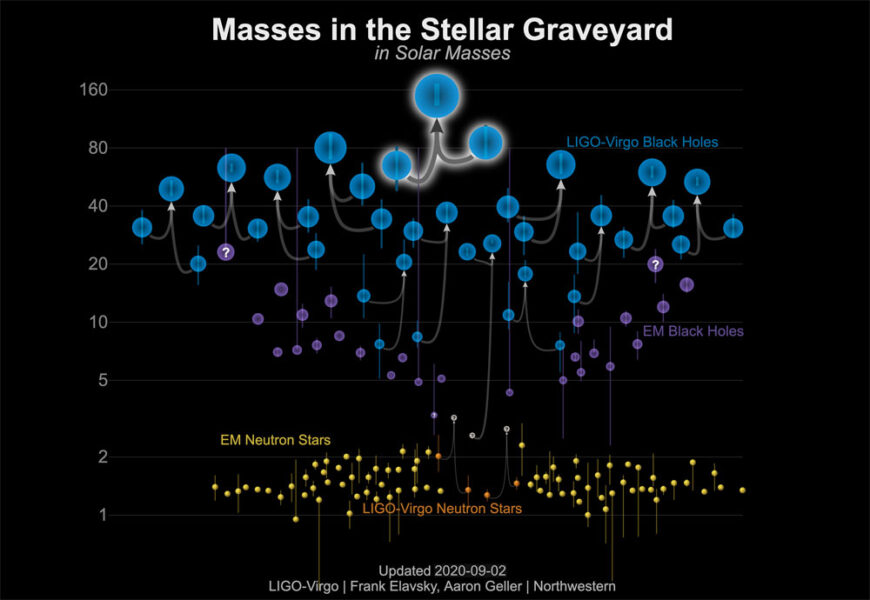
Masses of black holes and neutron stars discovered via gravitational waves (blue and orange circles). The red and yellow circles show the black holes and neutron stars detected through electromagnetic means. Click to enlarge. [LVK/A. Geller/Northwestern]
Humanity is 10 years into its study of the gravitational wave universe, and detectors across the globe are about to wrap up their fourth observing run. The recently released fourth catalog of gravitational wave transients, GWTC-4.0, more than doubles the number of recorded events.
Today, we’re taking a look at two of the fourth observing run’s gravitational wave events, both of which point to black holes born in dense environments.
GW241011 and GW241101 are gravitational wave signals that reached Earth in late 2024. Using Bayesian parameter estimation, members of the LVK collaboration determined that each of these two signals arose from the merger of a pair of black holes.
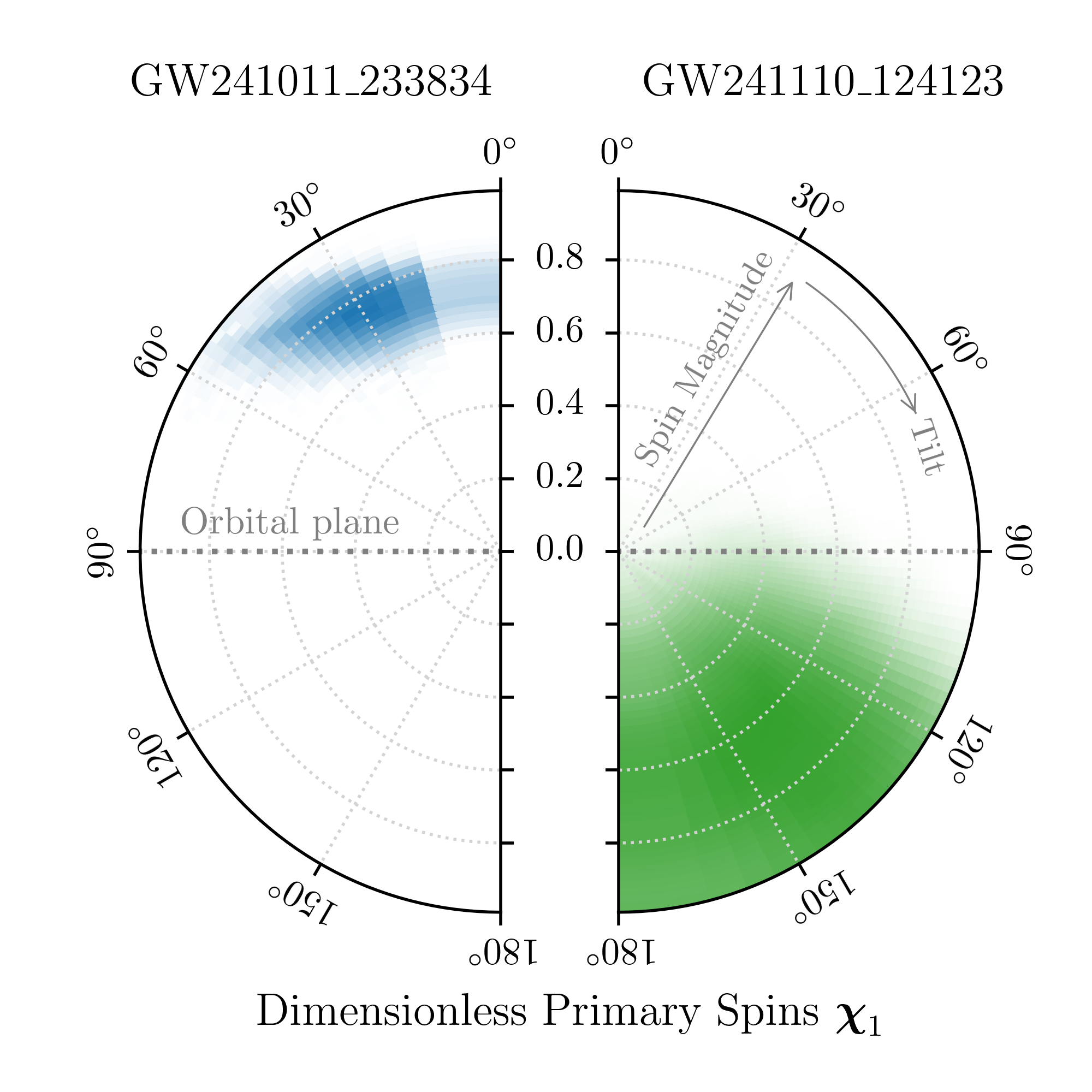
Posterior distributions for the primary black hole’s spin magnitude for GW241011 (left) and GW241101 (right). [LIGO, Virgo, and KAGRA Collaborations 2025]
GW241101 flips the script: its primary black hole also spins rapidly, but it appears to do so in a direction opposite from the direction in which the black holes orbit. Though its spin isn’t measured as precisely as that of the primary black hole in GW241011, this event still provides the best evidence so far that the spins of some merging black holes are misaligned with their orbital motion.
In addition to their standout spin parameters, these events are also remarkable for the masses involved. In both cases, the larger black hole has a mass of 15–20 solar masses, and the smaller black hole is significantly smaller — about 6 solar masses for GW241011 and 8 solar masses for GW241101.
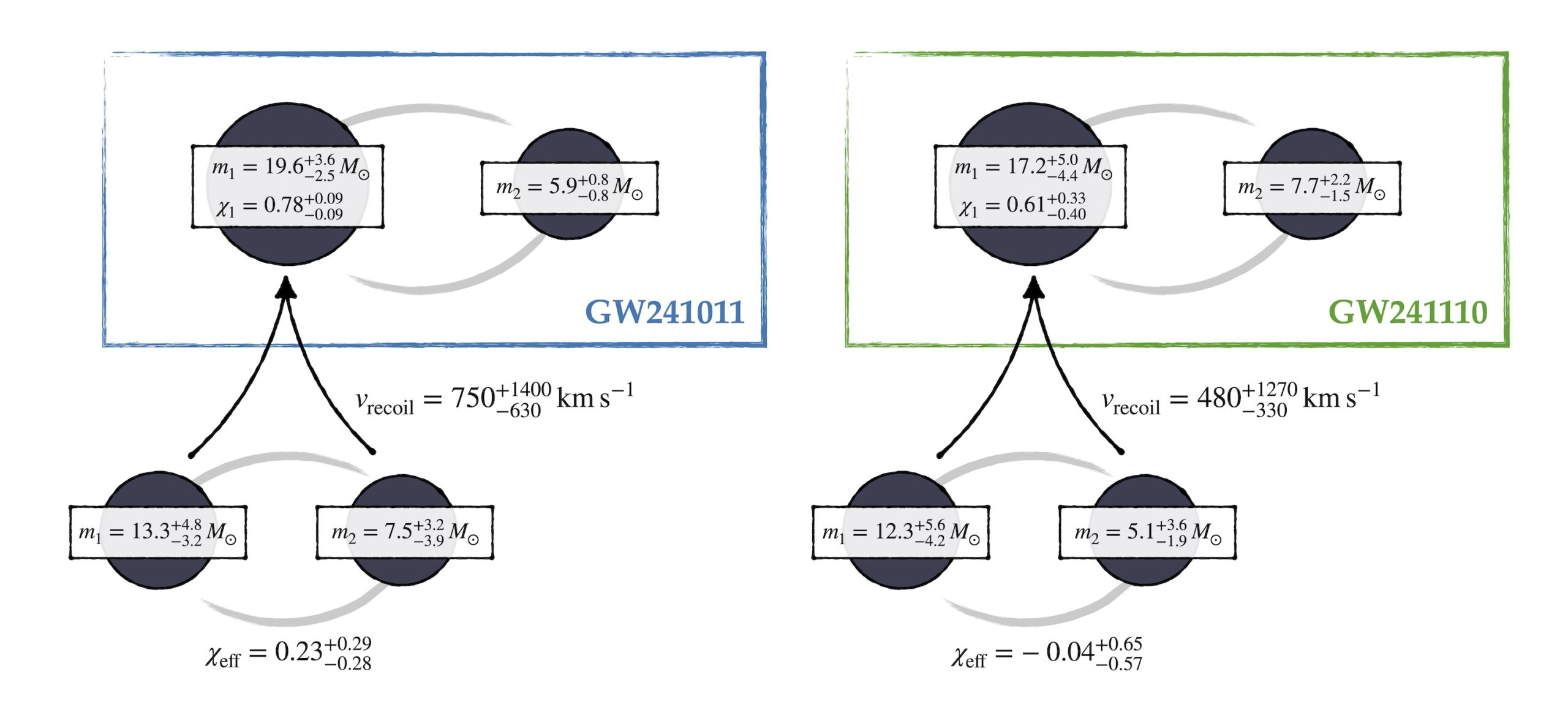
Inferred masses and spins of the ancestors of the primary black holes of GW241011 and GW241101. Click to enlarge. [LIGO, Virgo, and KAGRA Collaborations 2025]
If these signals arose from hierarchical mergers, that tells us something about the environment in which the black holes lived. When two black holes merge, the product is expected to spin rapidly and receive a “kick.” For a black hole pair in a loose grouping of stars, this kick would likely boot the merger product out of the group, preventing it from encountering other black holes and merging again.
But in dense environments like compact star clusters, even a good strong kick isn’t enough to overcome the cluster’s escape velocity and launch the resulting black hole on a lonely journey through space. Instead, these black holes are retained in the dense cluster environments of their birth, where they may dance and merge with another black hole partner. While it’s not possible to entirely rule out other origins, such as an isolated pair of massive binary stars, the data strongly support the hierarchical merger scenario.
This discovery yet again demonstrates the ability of our gravitational wave detectors to reveal the lives and histories of black holes throughout our universe. Stay tuned for even more black hole news from the current observing run!
GW241011 and GW241110: Exploring Binary Formation and Fundamental Physics with Asymmetric, High-Spin Black Hole Coalescences,” A. G. Abac et al 2025 ApJL 993 L21. doi:10.3847/2041-8213/ae0d54
The post Not Their First Rodeo: Gravitational Wave Detectors Spot Merging Black Holes That Have Merged Before appeared first on AAS Nova.
Editor’s Note: Astrobites is a graduate-student-run organization that digests astrophysical literature for undergraduate students. As part of the partnership between the AAS and astrobites, we occasionally repost astrobites content here at AAS Nova. We hope you enjoy this post from astrobites; the original can be viewed at astrobites.org.
Title: Tracing the Light: Identification for the Optical Counterpart Candidates of Binary Black Holes During O3
Authors: Lei He et al.
First Author’s Institution: University of Science and Technology of China
Status: Published in ApJ
Since the first detection of gravitational waves about a decade ago, gravitational wave science has been the gift that keeps on giving (for example, check out GW231123, announced earlier this year). It is also a field where more questions with unknown answers just keep coming. A key question at the forefront of gravitational wave science is about formation channels: how does the population of black holes seen through the LIGO–Virgo–KAGRA (LVK) detectors form? The two most popular of these formation channels are the “isolated binary” channel, wherein two stars of a binary stellar system each form black holes that then merge, and the “dynamical” formation channel, wherein two stars in a dense stellar cluster (usually a nuclear star cluster) become black holes and merge just through chance and the denseness of the environment they are in.
More recently, a third channel has been gaining popularity: the active galactic nucleus (AGN) disk channel. An AGN disk is a large disk of hot gas that surrounds a supermassive black hole in the center of a galaxy. The disk helps address two potential issues with stellar-mass binary black hole mergers that could pose a problem for the other two formation channels: delay time and mass. The delay time is the time between when the binary system forms and when the two black holes merge. By putting the system into the denser gaseous environment of an AGN disk, the orbits of the black holes decay faster, allowing the merger to happen on a quicker timescale. Regarding mass, the LVK detectors have detected mergers with masses above what would be expected from stellar-mass black holes alone, the so-called “lite” intermediate-mass black holes. One potential avenue through which these “lite” intermediate-mass black holes may form is in the gaseous disks of AGNs, where they can accrete material and gain mass before merging.
One potential astronomical benefit of a binary black hole merger happening inside the gaseous disk of an AGN is that the merger could disturb this disk and spark a flare of light. If we could spot such a flare and tie it to a gravitational wave event, we would then have both gravitational wave and electromagnetic observations of the same event. Prior research has suggested that some AGN flares detected by the Zwicky Transient Facility (ZTF) might be linked to binary black hole mergers observed during LIGO–Virgo’s third observing run. Today’s authors revisit this possibility by using additional years of data from ZTF combined with the public data through the third observing run.
The authors re-analyzed seven candidate flare–gravitational wave pairs originally flagged during the third observing run (see Figure 1). They examined each AGN’s long-term light curve from data from ZTF, looking for repeated flaring that might indicate a variable AGN rather than a one-time merger-driven flare. Using a Bayesian framework and an approach called Gaussian processes, they calculated the probability that each optical flare was physically connected to a specific gravitational wave event, considering both the spatial and temporal alignment of each of the two signals. Their framework allowed them to calculate a value they dub pflare, which is the probability that a given flare is indeed a genuine flare rather than a characteristic of the variability intrinsic to the AGN itself.
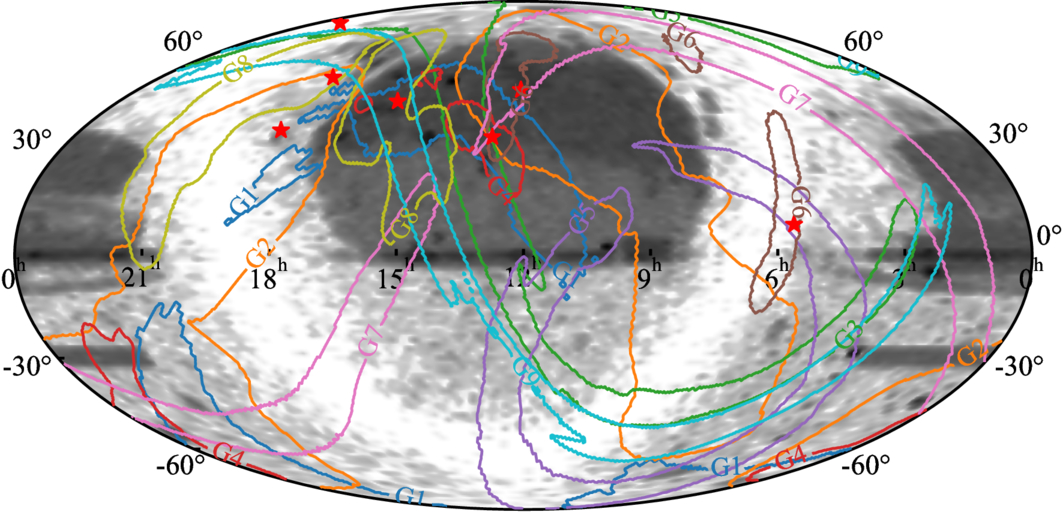
Figure 1: Sky localization of the seven AGN systems analyzed in this work. Red stars represent the locations of the AGNs with suspected flares, and colored lines represent the nine potential gravitational wave events that may be associated with each AGN flare. The white/black background represents the density of the distribution of AGNs in the Million Quasar Catalog. [He et al. 2025]
The authors take this result one step further. One primary application of combining gravitational wave and electromagnetic signals is an independent measurement of the Hubble constant. The most straightforward way to measure the Hubble constant is to measure both the recessional velocity and the distance to a single source. Multi-messenger astronomy provides a straightforward approach to this, as the redshift can be determined from electromagnetic observations and the distance from gravitational wave observations. (GW170817 is a notable example of this.)
The authors show how this could be applied to their data using flares. They use the two most promising flare–gravitational wave associations to derive a new estimate of the Hubble constant. By combining the distance inferred from the gravitational wave signal with the redshift of the AGN host galaxy, they obtained a value of the Hubble constant of about 72 kilometers per second per megaparsec (roughly the peak of the green dotted curve on the bottom of Figure 2). This result is consistent with other measurements of the Hubble constant, which are the local distance-ladder measurements from supernovae and the cosmic microwave background estimates from Planck (the two measurements that are often cited as being in tension). The uncertainty from the author’s analysis is still quite large, but it provides a proof of concept. When they included the well-known GW170817 neutron star merger, they obtained a result that is slightly more informative and slightly greater than the result from GW170817 alone.
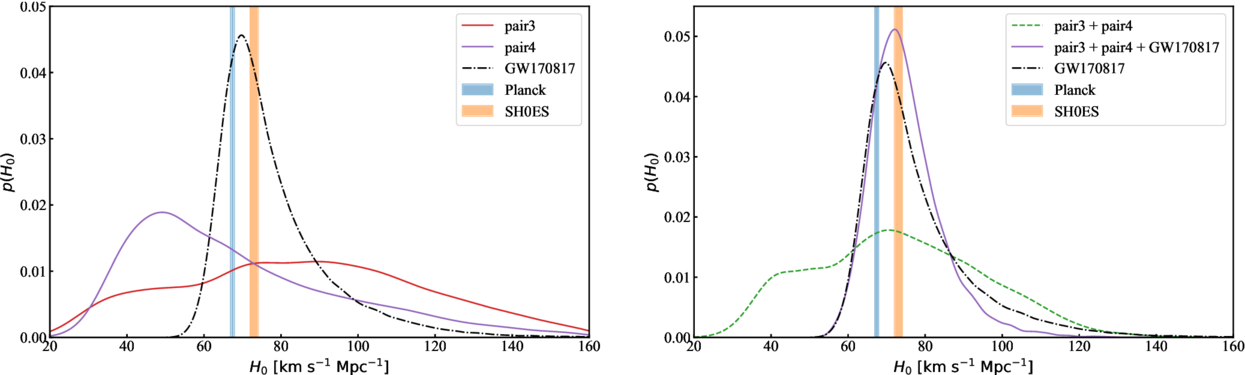
Figure 2: Constraints on the Hubble constant using multiple methods. For both figures, the x-axis represents the inferred value of the Hubble constant, and the y-axis represents the posterior probability of that value using hierarchical Bayesian analyses (for gravitational wave analyses). The vertical orange bands represent the measured value of the Hubble constant with five standard deviations of certainty using the “distance ladder” method as reported by the SH0ES collaboration. The vertical blue bands represent the measured value of the Hubble constant with five standard deviations of certainty by using measurements of the cosmic microwave background with the Planck spacecraft. The dotted black curve (both left and right) represents the posterior distribution of the Hubble constant as measured by the LVK collaboration from the first binary neutron star multi-messenger source, GW170817 (which peaks directly between the other two measurements). The purple and red curves (left) represent the posterior distributions of the two confident AGN/binary black hole pairs in this work, the green curve (right) represents the combined posterior distribution of the two confident AGN/binary black hole pairs in this work, and the solid purple curve (bottom) represents the combined posterior distribution of the two confident AGN/binary black hole pairs with GW170817. [He et al. 2025]
Original astrobite edited by Amaya Sinha.
About the author, William Smith:
Bill is a graduate student in the astrophysics program at Vanderbilt University. He studies gravitational wave populations with a focus on how these populations can help inform cosmology as part of the LIGO Scientific Collaboration. Outside of astrophysics, he also enjoys swimming semi-competitively, music and dancing, cooking, and making the academy a better place for people to live and work.
The post Following Up on Flares: Can We Spot Black Hole Mergers in Active Galactic Nucleus Disks? appeared first on AAS Nova.
Editor’s Note: Astrobites is a graduate-student-run organization that digests astrophysical literature for undergraduate students. As part of the partnership between the AAS and astrobites, we occasionally repost astrobites content here at AAS Nova. We hope you enjoy this post from astrobites; the original can be viewed at astrobites.org.
Title: Formation and Evolution of Compact Binaries Containing Intermediate-Mass Black Holes in Dense Star Clusters
Authors: Seungjae Lee et al.
First Author’s Institution: Seoul National University
Status: Published in ApJ
A delicate dance goes on in astronomy between theory and observation. Most astronomy research, by and large, fits into one of two categories. In one category, you start with a theory, model, or simulation, and attempt to figure out what observations you might expect given those initial assumptions. The other approach begins with raw data and attempts to determine what kinds of theories, models, and fundamental astrophysical assumptions might give rise to it. Accepted knowledge usually happens when these two approaches agree and reinforce each other, but a lot of the actual science occurs when one side dances ahead of the other — either we have theories and models that make predictions that cannot yet be observationally tested, or we have data that defy attempts at fitting underlying models.
Another dynamical dance goes on in globular clusters between binary black holes. Today’s article investigates intermediate-mass black holes, or IMBHs, a pristine example of an astronomical topic in which theory has danced ahead of observations. IMBHs fill the gap between stellar mass and supermassive black holes. We can observe black holes in multiple ways, usually from the electromagnetic radiation of the gas disks surrounding some black holes (either stellar or supermassive), or the gravitational waves of two orbiting or merging black holes. Unfortunately, each method requires some extra component — either gas to accrete or a companion to orbit — and IMBHs are far more challenging to observe through these methods. Hence, we have a lot of ideas about how they might form, and scarce observational evidence for their existence.
That hasn’t stopped many researchers from trying to make better models and predictions. One of the most commonly proposed mechanisms for forming IMBHs is in dense globular or nuclear star clusters (up to a million times denser than our region of the Milky Way). In these dense environments, stars and the black holes they produce might have a chance to find and run into each other often enough to reach the masses of the IMBH regime through mergers. Today’s authors use a series of N-body simulations to study these dense stellar clusters, into which they embed IMBHs. Their study investigates the detectability of gravitational waves from intermediate-mass-ratio inspirals (IMRIs). Because so many mergers occur in dense clusters, it allows for more mergers between objects with greater mass differences. The mass ratio between the two objects (usually denoted as ‘q’) is one of the most important parameters for characterizing a merger, and a high q value creates a gravitational wave signature that is different from a low q, even if the total mass of the system is the same.
To investigate the formation and detectability of IMRIs, the authors conducted a suite of direct N-body simulations of star clusters with total masses between 5×10⁴ and 105 solar masses, containing ~105 particles. They include initial conditions for how densely packed the particles should be, given how far they are from the cluster’s center (called a Plummer profile). They also include a rule for how the initial masses of the stars are distributed (called a Kroupa initial mass function). Then, they use a code called Stellar EVolution for N-body (SEVN) to follow the evolution of the stars in the system for 100 million years.
In that time, massive stars in the simulation can evolve into neutron stars and stellar-mass black holes. In addition to simulating the clusters’ stars, the authors embed an IMBH of 300–5,000 solar masses into the clusters. The key to this article is that some of the stellar-mass binary black holes will interact with the IMBH, creating an IMRI, which gives off gravitational waves. This article’s primary goal is to characterize these IMRIs and to test how well current and future gravitational wave detectors will measure them.
In the simulation, when a stellar-mass binary black hole and an IMBH come close, the authors must create a “merger criterion” — essentially, how it is decided whether the two objects merge, and what the subsequent “gravitational wave” would look like. Once they model the wave itself, they turn to five current or future detectors to see how well they will measure those waves if they were at particular astronomical distances from Earth.
One of the primary relationships the authors look at in the cluster is the half-mass radius velocity dispersion of the cluster and the number of IMRI encounters between the IMBH and stellar-mass objects. One can think of the velocity dispersion as a more complicated “average velocity” of the stars in the cluster (a high velocity dispersion means, on average, the stars are moving faster, the half-mass radius is the distance from center that separates the inner half of the stars and outer half of the stars, and we use it because it is more representative of stellar motion in the overall cluster than the packed center or the mellow edge). Figure 1 shows the relationship between the number of IMRI events (y-axis) vs. the velocity dispersion (x-axis) of the cluster where the IMBH sits. Note that the y-axis is logarithmic, so a small increase in velocity dispersion actually results in a large increase in the number of IMRIs. This tells us that the number of events is much more dependent on the properties of the larger cluster than the IMBH itself.
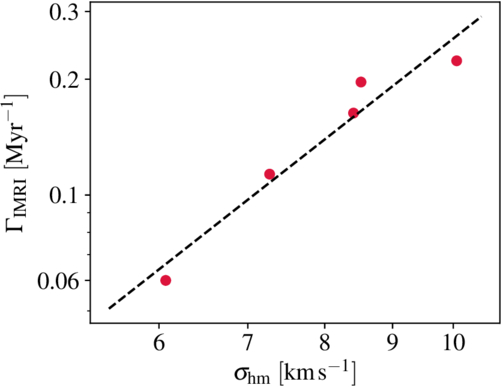
Figure 1: IMRI event rate as a function of cluster half-mass velocity dispersion (σhm) for 1,000-solar-mass IMBHs in the simulations. The IMRI merger rate is highly sensitive to the velocity dispersion of the cluster as a whole, making it a key observable of how efficiently IMRIs can form and merge in a given cluster. [Lee et al. 2025]
How do the authors translate the gravitational wave signal from the IMRI into what might be observed on Earth? First, they must pick a signal-to-noise ratio threshold, which is the ratio of the gravitational wave signal to the background noise in the detector. In this case, they chose a signal-to-noise ratio of 8, a commonly chosen threshold in the gravitational wave literature. From the signal-to-noise ratio, the authors can calculate a horizon distance. The horizon distance is the distance that a detector can measure a specific gravitational wave event with a given set of properties at or above the threshold chosen. Figure 2 shows the horizon distances (y-axis) for each detector for sets of gravitational wave sources with different properties vs. the mass of the IMBH generating the gravitational wave (x-axis). The solid and dotted lines represent two chosen masses of the IMBH’s stellar-mass companion. The figure shows that aLIGO (blue circles) can detect only low-mass IMBHs (≲ 300 solar masses) at a redshift of z ≲ 0.05. ET (red triangles) is sensitive to lower-mass IMBHs, and LISA (green diamonds) excels at detecting higher-mass IMBHs. aSORGO (purple triangles) covers a broad mass range but at lower redshifts. DECIGO (yellow Xs) offers the broadest mass range at the highest redshift.
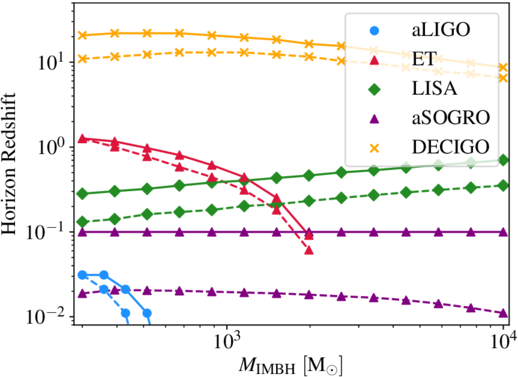
Figure 2: Horizon redshift vs. IMBH mass for several gravitational wave observatories (aLIGo represented by blue circles, ET by red triangles, LISA by green diamonds, aSOGRO by purple triangles, and DECIGO by yellow x‘s). Solid vs. dotted lines represent the mass of the stellar-mass black hole interacting with the IMBH, with the dashed line representing a 10-solar-mass companion and the solid lines representing a 60-solar-mass companion. [Lee et al. 2025]
Original astrobite edited by Kasper Zoellner.
About the author, William Smith:
Bill is a graduate student in the astrophysics program at Vanderbilt University. He studies gravitational wave populations with a focus on how these populations can help inform cosmology as part of the LIGO Scientific Collaboration. Outside of astrophysics, he also enjoys swimming semi-competitively, music and dancing, cooking, and making the academy a better place for people to live and work.
The post From Globs to Gravitational Waves: A Simulated Cosmic Choreography appeared first on AAS Nova.
Current gravitational wave detectors are primarily sensitive to powerful sources like black hole–black hole mergers — what types of events may next-generation gravitational wave detectors reveal? A recent study explores stripped subgiant stars around supermassive black holes and how their gravitational waves may be detected in next-generation missions.
The immense gravity of supermassive black holes at the centers of galaxies drives complicated dynamics that could generate so far undetected gravitational wave signals. One predicted source of gravitational waves is a rare event known as an extreme-mass-ratio inspiral (EMRI) — a prolonged inspiraling of a stellar-mass object around a supermassive black hole, driven inward by gravitational waves. EMRIs are thought to arise when a stellar-mass object is captured into a close-in nearly circular orbit around a supermassive black hole, emitting gravitational waves due to the object’s proximity to the black hole.
To date, most studies have explored EMRIs involving compact objects like black holes, but an EMRI with an inspiraling star is possible, though not yet well explored nor understood. In addition to generating gravitational waves, a stellar EMRI will also emit light as the supermassive black hole rips up siphoned material from the star. These events may explain recent observations of peculiar X-ray transients, but their gravitational wave counterparts remain undetected as EMRIs’ predicted signals fall outside the sensitivity range of current ground-based gravitational wave detectors. However, the Laser Interferometer Space Antenna (LISA), a space-based gravitational wave detector expected to launch in the mid-2030s, will be sensitive to the gravitational waves of EMRIs. In order to properly identify them, we must better understand what to expect.
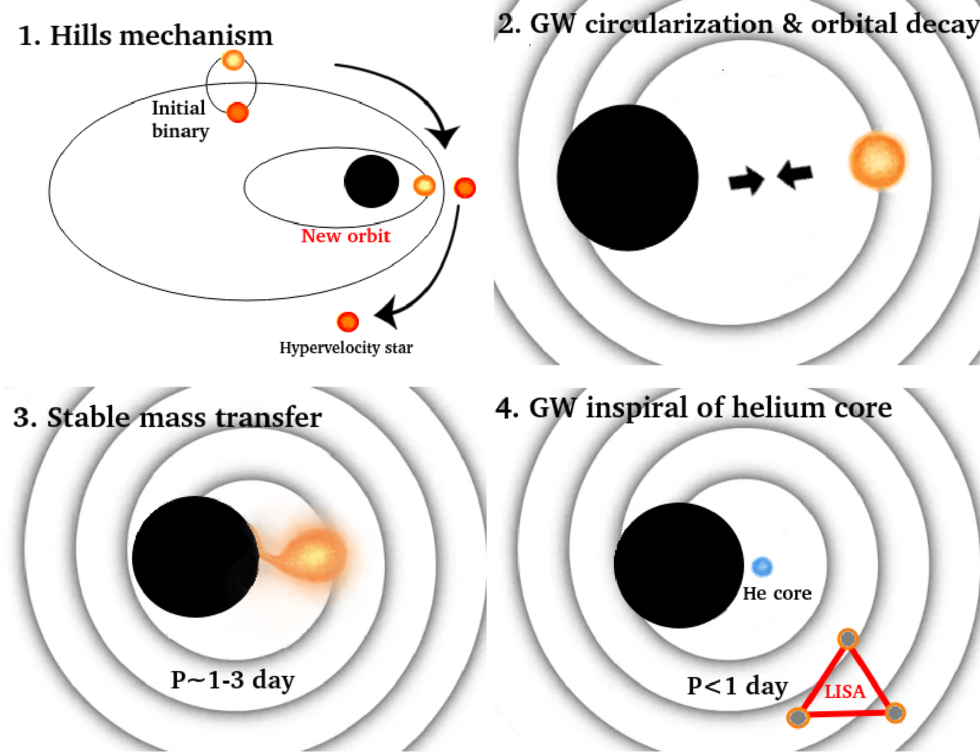
Diagram showing the evolutionary steps of a supermassive black hole capturing a subgiant star that subsequently undergoes mass transfer and gravitational wave-driven inspiral. Click to enlarge. [Olejak et al 2025]
Seeking to better predict what the gravitational waves of stellar EMRIs may look like and what LISA may detect, Aleksandra Olejak (Max Planck Institute for Astrophysics) and collaborators used stellar evolution code to simulate the evolution of a subgiant star as it transfers mass to a supermassive black hole and gravitational waves draw in its orbit. In their models, the supermassive black hole captures the star through scattering between stars or tidal interactions with a stellar binary in which the black hole catches one star and ejects the other.
Once the star is captured, its orbit becomes circularized around the black hole, pulled in closer over time until mass transfer of the star’s outer envelope begins. During this stage, the gravitational wave signal remains too weak to be detected. However, as the star is stripped down to just a helium core, it contracts and experiences an extended gravitational wave–driven orbital decay.
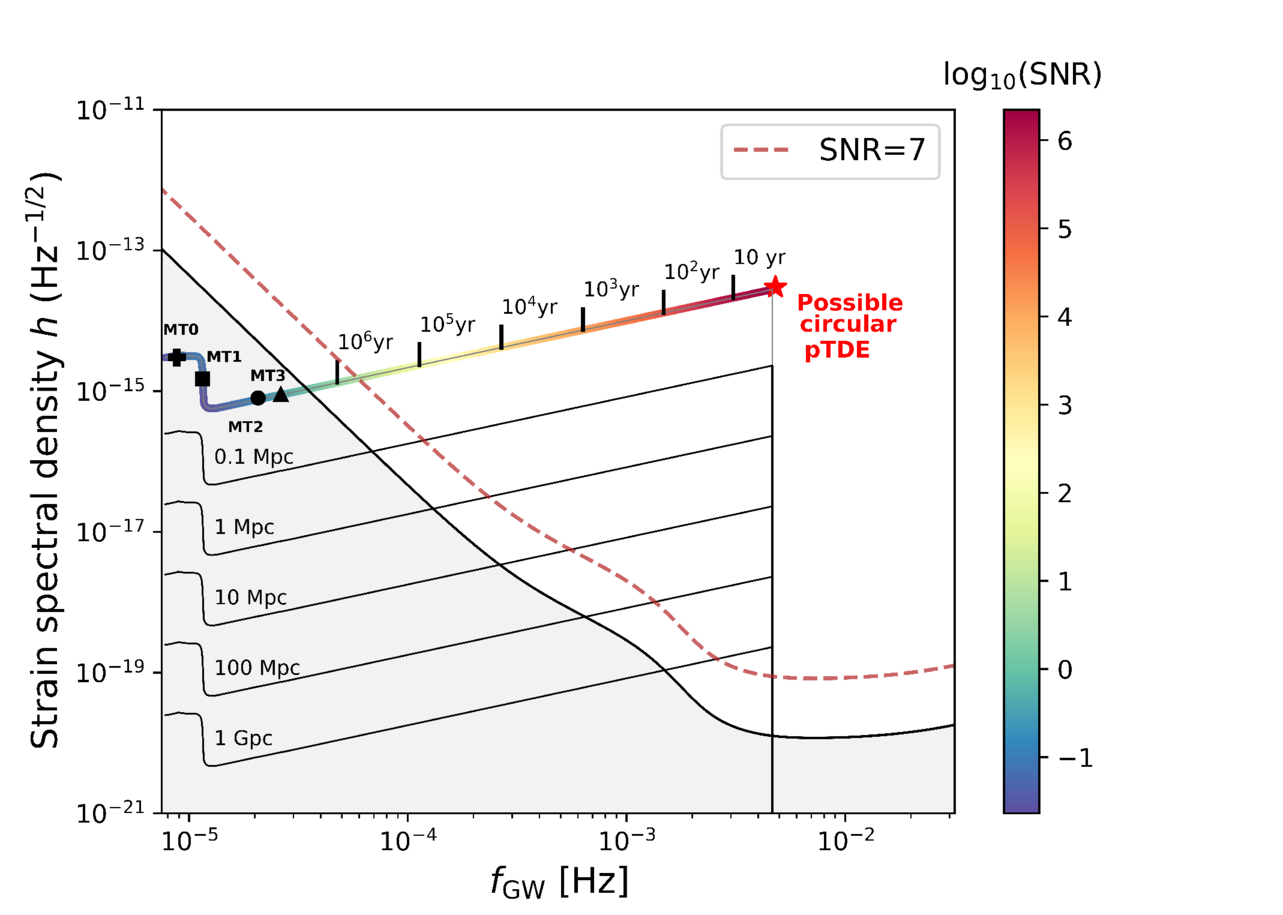
The strain spectral density as a function of the detected frequency of the gravitational wave. The colorful line indicates the signal from a stripped subgiant at the Milky Way’s center, and the gray lines are what would be observed at greater distances. LISA’s sensitivity to gravitational wave signals is shown with the black and red lines with detectable sources falling to the right of or above the line. Click to enlarge. [Olejak et al 2025]
This study provides exciting potential for what is possible with LISA, and future detections of gravitational waves will shine further light onto the complicated dynamics of galactic centers and the evolution of stars around supermassive black holes.
“Supermassive Black Holes Stripping a Subgiant Star Down to Its Helium Core: A New Type of Multimessenger Source for LISA,” Aleksandra Olejak et al 2025 ApJL 987 L11. doi:10.3847/2041-8213/ade432
The post Supermassive Black Holes and Stripped Subgiants: Significant Signals for Future Gravitational Wave Detectors appeared first on AAS Nova.
On a blazing hot day in South Africa, female southern pied babblers can’t think straight. The medium-sized black-and-white birds are trying to get at tasty mealworms behind a see-through barrier. On cooler days, the birds can quickly figure out that all they have to do is go around the small wall of plastic. But when the mercury goes up, the birds just keep stubbornly pecking at the barrier.
That experiment is part of a growing body of research showing that animals get their minds muddled during heat waves. When it’s hot outside, birds struggle to learn, dogs bite more often, goat-like chamois pick fights. This is bad news not just for those who get on Fido’s toasted nerves. If the animals can’t stay alert enough to find food or avoid predators, their chances of survival go downhill, says Amanda Ridley, a behavioral ecologist at the University of Western Australia who coauthored the pied babbler study.
With climate change making heat waves more common, such cognitive impairments across the animal kingdom could ripple through entire ecosystems, putting already fragile species at greater risk. If pollinators forget which flowers to visit, crops and wild plants may fail. If birds can’t find food as easily, their young may not survive. And on a warming planet, a sharp mind is particularly vital. “A changing climate means that your ability to behaviorally adapt is even more important,” Ridley says.
© NurPhoto / Contributor