❌

Normal view

From Paleogene to Anthropocene: Evolution of Northeast Asian Frogs

21 June 2026 at 12:20

In a groundbreaking synthesis that traverses geological epochs and ecological paradigms, recent research offers a comprehensive temporal and evolutionary framework for understanding anuran diversity in northeast Asia. This study, uniquely integrating vast phylogeographic datasets spanning over two decades, illuminates the dynamic interactions between environmental upheavals and evolutionary processes shaping frog lineages from the Paleogene through to the Anthropocene era.

Northeast Asia, a region marked by complex paleogeological histories, fluctuating climatic conditions, and increasing anthropogenic pressures, serves as a natural laboratory to unravel the intricacies of amphibian evolution. Amidst a plethora of fragmented phylogeographic studies, this synthesis stands out by harmonizing divergence timing with macroevolutionary drivers to reveal patterns hitherto obscure, offering an unprecedented panoramic view of regional anuran evolution.

Central to this ambitious undertaking is the collation and analysis of published divergence-time estimates for anuran species recorded from 1998 to the present. By aligning basal, stem, and crown age data points with temporal environmental variables, the researchers mapped a chronological narrative that directly associates lineage diversifications with major ecological and geological transformations, thereby identifying recurrent evolutionary drivers that have recurrently sculpted these amphibian assemblies.

The study delineates four principal evolutionary catalysts responsible for significant phylogenetic turnovers and demographic shifts within anuran populations. These include: the shifting paleogeological frameworks and emerging landscape barriers, oscillating climates and latitudinal gradients, cyclical glaciations paired with historical sea-level variations, and the intensified anthropogenic interventions characterizing recent epochs. Through this lens, each driver is contextualized within the temporal and spatial scales relevant to corresponding lineage divergences.

A particularly notable aspect of the analysis involves the utilization of time-calibrated genomic species trees paired with diversification modeling, an approach that successfully captures the nuanced evolutionary tempos and modes operating across major Northeast Asian frog families. This genomic architecture, juxtaposed with ecological trait datasets—specifically body size, elevational range, and latitudinal distribution—offers robust insights into the adaptive radiations and ecological breadth characterizing these amphibian clades.

Employing advanced Bayesian Analysis of Macroevolutionary Mixtures (BAMM), the research reconstructs trait evolution trajectories, revealing that Ranidae species consistently exhibit higher trait values over evolutionary timeframes. Such elevations in trait magnitude connote broader ecological amplitude and enhanced macroevolutionary expansion when compared to concurrent families such as Bufonidae and Microhylidae, signaling divergent ecological strategies underpinning their evolutionary success.

Beyond macroevolutionary analyses, the synthesis addresses contemporary conservation challenges by detecting genetic signatures indicative of human-mediated disturbances. These findings underscore the profound impact of anthropogenic activities on amphibian genetic diversity and population structure, emphasizing the urgency of integrating conservation genomics with evolutionary studies to safeguard regional biodiversity.

An intriguing discovery pertains to unresolved species boundaries within several anuran complexes, where interplays of multiple evolutionary drivers manifest as cryptic speciation events or ongoing hybridization. This complexity not only challenges traditional taxonomic classifications but also propels forward discussions on species delineation frameworks that incorporate genomic, ecological, and morphological data.

The study’s integrative approach extends to the synthesis of phenotypic, ecological, and macroevolutionary patterns utilizing openly accessible datasets. This comprehensive data amalgamation fosters a holistic understanding of how longitudinal environmental fluctuations have orchestrated lineage diversification and trait evolution, thereby grounding phylogeographic patterns within a broader evolutionary and ecological context.

Climate fluctuations, particularly linked to the pronounced latitudinal gradients in northeast Asia, emerge as pivotal factors influencing adaptive trait distributions and diversification rates. Fluctuating temperature regimes and shifting precipitation patterns have likely exerted selective pressures fostering ecological differentiation and localized adaptations, processes critical to elucidating the biogeographic mosaics observed today.

Sea-level changes accompanying glacial cycles further complicate the evolutionary landscape, intermittently disconnecting and reconnecting populations and facilitating allopatric speciation. These dynamics highlight the historical contingency embedded within contemporary phylogenies and emphasize the evolutionary significance of past climatic oscillations and paleogeographic rearrangements.

The explicit recognition of anthropogenic influences within the evolutionary framework reflects an important paradigm shift, linking human activity not only to immediate biodiversity loss but also to long-term evolutionary trajectories. Genetic imprints of habitat fragmentation, pollution, and translocation events attest to the pervasive reach of anthropogenic factors in shaping amphibian populations, potentially accelerating evolutionary processes or inducing maladaptive consequences.

By establishing a generalized framework that marries divergence timing with trait evolution and environmental drivers, this synthesis propels forward predictive modeling of biodiversity responses. Such frameworks are invaluable in projecting how ongoing environmental change may redefine evolutionary pathways, offering strategic foresight for biodiversity conservation under rapidly transforming global conditions.

Importantly, the researchers advocate for continued synthesis efforts, recommending that future investigations closely integrate genomic data with ecological and paleogeographic information. This interdisciplinary approach promises to unveil deeper evolutionary insights and refine conservation priorities, ensuring that amphibian diversity in northeast Asia remains resilient amid mounting ecological pressures.

The implications of these findings extend beyond amphibian biology, offering a blueprint for understanding how long-term environmental variability influences evolutionary processes across taxa, particularly in regions with complex historical and contemporary ecological interactions.

This synthesis not only enriches our comprehension of northeast Asian anurans but also exemplifies the profound explanatory power of integrating phylogeography, trait evolution, and macroevolutionary analytics. As biodiversity faces unprecedented threats, such integrative research embodies the critical scientific endeavor to decipher the past and guide the future of life’s intricate evolutionary tapestry.


Subject of Research: Phylogeography, trait evolution, and evolutionary drivers of northeast Asian anurans.

Article Title: From Paleogene to Anthropocene: phylogeography, geographic patterns of traits, and chronology of evolutionary drivers in northeast Asian anurans.

Article References:
Othman, S.N., Borzée, A. From Paleogene to Anthropocene: phylogeography, geographic patterns of traits, and chronology of evolutionary drivers in northeast Asian anurans. Heredity (2026). https://doi.org/10.1038/s41437-026-00856-3

Image Credits: AI Generated

DOI: 10.1038/s41437-026-00856-3

Keywords: Anuran phylogeography, evolutionary drivers, paleogeology, climate variability, glaciations, anthropogenic impacts, Bayesian macroevolutionary analysis, trait evolution, northeast Asia biodiversity, amphibian diversification

Experience the Magic of Stonehenge from Your Sofa This Solstice

21 June 2026 at 00:17

A groundbreaking digital venture has been launched, promising to revolutionize the way the world experiences prehistoric heritage. The Virtual World of Stonehenge, an innovative online platform, allows users globally to immerse themselves in the fascinating history and archaeology surrounding the iconic Stonehenge site. Developed through a collaboration between the University of Reading and the British Museum, this free-to-access digital experience offers unparalleled access to one of the most significant prehistoric collections ever assembled, transcending the limitations of physical museum visits and bringing the past vividly into the present.

Launching precisely on June 21st to coincide with the summer solstice—a date of profound importance to Stonehenge and its cultural legacy—the Virtual World of Stonehenge goes far beyond a traditional replication of the physical exhibition. While the original 2022 British Museum showcase brought together over 400 objects from 36 European institutions and attracted nearly 200,000 visitors, this online experience transcends geographical and physical boundaries. It invites users to explore prehistoric Britain interactively, offering a dynamic temporal dimension where Stonehenge is seen morphing through various epochs, shedding light on its multifaceted evolution and significance.

The project’s technological core lies in its sophisticated use of 3D laser scanning, digital animation, and immersive soundscapes, created by a multidisciplinary team of archaeologists, digital heritage experts, and computer scientists. During the exhibition’s final weeks in 2022, a highly detailed laser scan of the British Museum gallery was captured, serving as the digital blueprint for the virtual environment. These precise measurements ensured every artifact and spatial detail was faithfully rendered, enabling users to navigate authentically within the gallery or step inside reconstructed prehistoric landscapes like the Neolithic flint mines at Grimes Graves.

One of the most compelling features of the Virtual World of Stonehenge is its ability to shed light on nuanced archaeological narratives often missed by conventional displays. The platform highlights lesser-known prehistoric relics such as a 6,000-year-old elm leaf, a delicately woven cow-hair bracelet, and remnants of ancient feasts, employing animation and interactive storytelling to contextualize these objects within the daily lives and rituals of Stonehenge’s ancient communities. This approach not only enhances engagement but fosters a deeper appreciation of the complex social and cultural fabric that shaped prehistoric Britain.

Professor Duncan Garrow of the University of Reading emphasizes the transformative educational potential of the project. By uniting an extraordinary assemblage of artifacts rarely seen together, the Virtual World of Stonehenge offers an immersive learning environment where users can interrogate the intersection between archaeological evidence and lived experience. This digital format allows for multi-sensory exploration—users can observe how the monument aligned with celestial phenomena, hear recreated ambient sounds, and engage with layered historical interpretations, bringing prehistoric Britain to life in a manner previously unachievable in museum contexts.

At the same time, Dr. Neil Wilkin, curator at the British Museum, highlights the project’s forward-thinking implications for museum engagement in the twenty-first century. The initiative serves as a prototype for virtual exhibitions that can extend the reach of cultural institutions globally, fostering inclusivity by making world-class collections accessible regardless of physical or economic barriers. Moreover, the integration of cutting-edge technologies heralds a new era of digital heritage preservation and public archaeology, where virtual experiences can complement and enhance traditional curatorial practices.

Technically, the Virtual World of Stonehenge exemplifies an advanced convergence of archaeological survey methods and digital tools. The laser scanning process produced millions of data points, constructing an ultra-high-resolution 3D model of the gallery space and its constituent objects. This geospatial accuracy underpins the digital environment’s interactivity, allowing users to manipulate views, zoom in on minute details, and gain spatial insights that static images or text-based descriptions cannot offer. Additionally, the underpinning narrative content draws on extensive archaeological research funded by UK Research and Innovation and the Arts and Humanities Research Council, ensuring both scholarly rigor and public accessibility.

The virtual platform’s sound design is equally innovative, using ambient recordings and reconstructed acoustic profiles to immerse visitors in the sensory atmosphere of the prehistoric world. For example, users can experience the atmospheric sounds of the summer solstice sunrise illuminating Stonehenge, or hear the ambient clatter from the flint mines at Grimes Graves, thereby deepening emotional connection and contextual understanding. This multisensory integration reinforces the project’s ambition to be more than a virtual museum tour, positioning it as a holistic archaeological experience harmonizing visual, auditory, and intellectual engagement.

Besides its public and educational impact, the Virtual World of Stonehenge also advances archaeological methodology by providing a scalable model for digital conservation. The high-fidelity digital capture serves as a preservation tool that mitigates risks associated with physical artifact degradation, travel restrictions, or exhibition deinstallations. Institutions across the globe can look to this project as a template for safeguarding and sharing their collections, leveraging virtual reality and interactive media to future-proof cultural heritage—an urgent priority amid climate change, urban development, and other preservation challenges.

Moreover, the project opens exciting avenues for interdisciplinary research by integrating digital humanities, archaeology, and computer science domains. The collaboration between British Museum curators, university archaeologists, and heritage technology firms like ArtasMedia demonstrates an effective alliance between academia and industry. Such partnerships facilitate the application of emerging technologies to solve complex questions about human history, potentially inspiring new methodologies in archaeological visualization, data interpretation, and public outreach that can be adapted to other cultural contexts and time periods.

Crucially, the Virtual World of Stonehenge also taps into the emotive and symbolic power of the site itself. Stonehenge’s exact astronomical alignments during the solstice are reconstructed with scientific precision, allowing users to witness how the monument interacts with the rising sun on this pivotal day. This temporal accuracy does not merely serve aesthetic purposes but conveys the profound cosmological knowledge possessed by its Neolithic and Bronze Age builders, adding layers of meaning to the experience and underscoring the monument’s enduring significance across millennia.

The accessibility of this virtual exhibition across multiple devices—including desktop computers, tablets, and smartphones—ensures that a diverse global audience can engage with Stonehenge’s prehistoric narratives regardless of location or technological proficiency. Such democratization of cultural heritage promotes wider public interest in archaeology while also inspiring future generations of researchers, educators, and enthusiasts. The response to the initial trial phases and media previews has been overwhelmingly positive, pointing to an appetite for more immersive, interactive digital humanities projects that redefine museum experiences.

In conclusion, the Virtual World of Stonehenge stands at the vanguard of a digital revolution in cultural heritage. By bridging meticulous archaeological scholarship with transformative technological innovation, it offers an unprecedented opportunity to explore prehistoric Britain in an expansive, nuanced, and engaging manner. This free, globally accessible experience not only honors Stonehenge’s profound historical legacy but also envisions a future where heritage and technology converge, bringing the deep past into the digital age and captivating audiences worldwide.


Subject of Research:
Historical Archaeology and Digital Heritage Preservation

Article Title:
The Virtual World of Stonehenge: A Digital Revolution in Archaeological Experience

News Publication Date:
Sunday, 21 June

Web References:
https://research.reading.ac.uk/british-museum-partnership/world-of-stonehenge/

https://www.cloudtour.tv/the-world-of-stonehenge/

Keywords:
Stonehenge, Virtual Reality, Digital Heritage, Archaeology, British Museum, University of Reading, Laser Scanning, Neolithic, Prehistoric Britain, Cultural Preservation, Interactive Museum Exhibitions, Summer Solstice

Surface Collapse Reveals Mars Flood History at Osuga Valles

20 June 2026 at 17:23

Flood-Related Surface Collapse at Osuga Valles, Mars: Unveiling the Dynamics of Martian Geomorphology

Recent research published in Communications Earth & Environment has spotlighted a remarkable phenomenon occurring on Mars — flood-related surface collapses in the Osuga Valles region. This discovery marks a transformative step in our understanding of Martian geomorphological activity, revealing dynamic processes previously undetected on the Red Planet. The comprehensive study led by Naor et al. deploys advanced remote sensing and modeling techniques to decipher the mechanisms behind these collapses, providing a fresh perspective on Mars’s hydrological past and present.

Osuga Valles, located in the northern hemisphere of Mars, has long intrigued planetary scientists due to its complex valley networks and evidence hinting at ancient water activity. The new findings reveal that these valleys are not merely relics of a bygone era but continue to undergo morphologic changes influenced by episodic flooding events. These floods, possibly triggered by subsurface ice melting or transient atmospheric phenomena, induce sudden collapses on the surface, reshaping the landscape at scales previously underestimated.

The investigation is centered around detailed analysis of high-resolution imagery combined with digital elevation models captured by Mars orbiters. These datasets allowed the researchers to identify distinct collapse features characterized by disrupted terrain, steep scarps, and chaotic blocky deposits. The spatial distribution and morphology indicate that these collapses originated from floodwaters undermining subsurface deposits, triggering a rapid failure of overlying strata.

What makes the Osuga Valles surface collapses particularly compelling is their implication for current Martian hydrology. The collapse events are believed to be linked to relatively recent flood episodes, suggesting the presence of liquid water or brines beneath the Martian surface. This challenges the longstanding notion of Mars as an entirely arid world and paves the way for hypotheses about transient hydrological cycles persisting in specific locales and under certain environmental conditions.

Moreover, the tectonic setting of the Osuga Valles region seems to facilitate these collapses. The valley system’s structural configuration, inclusive of fractures and faults, creates zones of mechanical weakness. When these structural features interface with floodwaters infiltrating subsurface layers, they act as conduits potentiating the collapse process. Thus, the interplay between geology and hydrology emerges as a critical driver of surface dynamics on Mars.

The authors also explore analogs from terrestrial environments—places where flooding induces surface collapse, such as in karst terrains or volcanic regions with subglacial lakes—to better interpret the Martian data. These Earth analogs provide a fertile framework for understanding how subsurface voids or weakened materials collapse under hydraulic pressure, refining our conceptual models applicable to Mars.

Advanced computational fluid dynamics simulations performed in the study reveal that the hydraulic pressures generated by transient floods are sufficient to disrupt sediment cohesion and trigger mass wasting events. The models incorporate variable sediment porosities, ice content, and fracture permeability, emphasizing how subtle changes in subsurface conditions can culminate in massive geomorphic transformations. This underscores the sensitivity of Martian surface processes to inundation events, even if these are limited in time and spatial extent.

In addition, the researchers analyzed mineralogical data from spectrometers aboard orbiters, detecting possible hydrated minerals and salts that corroborate the interaction between water and subsurface sediment. This mineralogical evidence supports the hypothesis of localized aqueous alteration driven by flood events, contributing to ongoing soil and sediment evolution in Osuga Valles.

The implications of these findings extend beyond geology and planetary science to astrobiology. The presence of liquid water, even transiently, opens up potential niches for microbial life or preserves biosignatures in subsurface refuges. Flood-related collapses could expose freshly altered materials, creating accessible targets for future rover missions endeavoring to seek signs of life or past habitability.

Technological advancements in orbital imaging and data analysis have thus unlocked a new era in Martian surface exploration. This study leverages these capabilities, illustrating how multidisciplinary approaches integrating geomorphology, hydrology, geochemistry, and computational modeling can unravel complex planetary phenomena. The Osuga Valles floods and collapses exemplify the dynamic and evolving nature of Mars, still shaped by aqueous forces despite its overall cold and dry climate.

Looking forward, these discoveries necessitate a revision in mission planning and surface hazard assessments. Understanding flood-related collapses aids in predicting surface stability and potential geomorphic hazards affecting landers or rovers. Moreover, unraveling the hydrologic cycles underlying these collapses could inform in situ resource utilization strategies, potentially enabling human exploration by identifying water reservoirs.

Furthermore, this research revitalizes the debate about Mars’s climatic variability and the possibility of episodic warming events facilitating surface liquid water. Such events might arise from volcanic outgassing, orbital shifts, or impact heating, temporarily altering atmospheric and subsurface conditions to create flood-triggering scenarios. Consequently, Osuga Valles may serve as a natural laboratory to study these transient climatic phenomena.

In summary, the study by Naor et al. dramatically expands our understanding of Martian surface processes by revealing active, flood-related collapses in Osuga Valles. By decoding the intricate linkages between subsurface hydrology, geological structure, and surface dynamics, it paints a picture of Mars as a planet where water still plays a crucial role in shaping landscapes. This breakthrough invites a new generation of explorations targeted at unraveling the mysteries of Mars’s watery past and its intermittent present.

The knowledge gained from these investigations not only transforms planetary science but also enriches comparative planetology, emphasizing how terrestrial analogs can illuminate extraterrestrial environments. As we decode Mars’s dynamic surface, the paradigm shifts from a static, desiccated world to one punctuated by active, fluid-driven geomorphology. The dynamic interplay between floods and collapses in Osuga Valles is a testament to this evolving narrative—a promise for thrilling discoveries yet to come.

Subject of Research: Flood-related surface collapses and geomorphologic processes on Mars, specifically in the Osuga Valles region.

Article Title: Flood-related surface collapse at Osuga Valles, Mars.

Article References:
Naor, R., Gulick, V.C., Spurling, R. et al. Flood-related surface collapse at Osuga Valles, Mars. Communications Earth & Environment (2026). https://doi.org/10.1038/s43247-026-03683-w

Image Credits: AI Generated

DOI: https://doi.org/10.1038/s43247-026-03683-w

Keywords: Mars geomorphology, flood-related collapse, Osuga Valles, Martian hydrology, subsurface water, geomorphic dynamics, remote sensing, planetary geology

Moon Trees

18 June 2026 at 17:53

Living Tributes to Lunar Exploration

Moon Trees

Sprouted from seeds that journeyed around the Moon aboard Apollo 14 in February 1971, “Moon Trees” planted across the United States endure as living reminders of Apollo-era lunar exploration.

In 2022, a new generation of tree seeds flew around the Moon on NASA’s Artemis I mission as part of a national STEM Engagement and conservation education initiative.

The Moon Tree in front of NASA Goddard Flight Center's Visitor Center.
The “Moon Tree” in front of the Visitor Center at NASA’s Goddard Space Flight Center in Greenbelt, Md. This sycamore was planted at the visitor center on June 9, 1977, and grew from a seed carried to the Moon aboard Apollo 14.
NASA/Pat Izzo

Apollo 14 Moon Trees

Apollo 14 launched in the late afternoon of January 31, 1971 on what was to be our third trip to the lunar surface. Five days later Alan Shepard and Edgar Mitchell walked on the Moon while Stuart Roosa, a former U.S. Forest Service (USFS) smoke jumper, orbited above in the command module. Packed in small containers in Roosa’s personal kit were hundreds of tree seeds, part of a joint NASA/USFS project. Upon return to Earth, the seeds were germinated by the Forest Service. Known as the Apollo “Moon Trees”, the resulting seedlings were planted throughout the United States (often as part of the nation’s bicentennial in 1976) and the world. They stand as a tribute to astronaut Roosa and the Apollo program.

Astronaut portrait of Stuart Roosa in front of the Apollo 14 emblem
Astronaut Stuart A. Roosa was the command module pilot of the Apollo 14 lunar landing mission. In 1971 hundreds of tree seeds were packed in his personal kit as part of a joint NASA/USFS project.
NASA

The project began after Roosa was chosen for the Apollo 14 mission. Ed Cliff, Chief of the Forest Service, knew of Stuart Roosa from his days as a smokejumper and contacted him about bringing seeds into space. Stan Krugman of the Forest Service was put in charge of the project and selected the seeds for the experiment. Seeds were chosen from five different types of trees: loblolly pine, sycamore, sweetgum, redwood, and Douglas fir. The seeds were classified and sorted, and sealed in small plastic bags that were stored in a metal canister. Control seeds were kept on Earth for later comparison. Roosa carried possibly 2,000 or more seeds in the canister in his personal kit, a small canvas pouch that stayed with him as he orbited the Moon in the command module “Kitty Hawk” in February, 1971. Unfortunately, the seed bags burst open during the decontamination procedures after their return to Earth, and the seeds were scattered about the chamber and exposed to vacuum, and it was thought they might not be viable.

Stan Krugman collected the seeds and an attempt at germinating some of the seeds was made in Houston. Somewhat surprisingly, it proved successful and the seeds started growing, but they did not survive long because the facilities there were inadequate. A year later the remaining seeds were sent to the southern Forest Service station in Gulfport, Mississippi (sycamore, loblolly pine, and sweetgum) and to the western station in Placerville, California (redwood and Douglas fir) to attempt germination. Many of the seeds, and later cuttings, were successful and grew into viable seedlings. Some of these were planted with their Earth-bound counterparts as controls, (as might be expected, after over forty years there is no discernable difference) but most were given away in 1975 and 1976 to many state forestry organizations to be planted as part of the nation’s bicentennial celebration. These trees were southern and western species, so not all states received trees. A loblolly pine was planted at the White House, and trees were planted in Brazil, Switzerland, and presented to the Emperor of Japan, among others. Trees have also been planted in Washington Square in Philadelphia, at Valley Forge, in the International Forest of Friendship, and at various universities and NASA centers, reportedly in 40 different states.

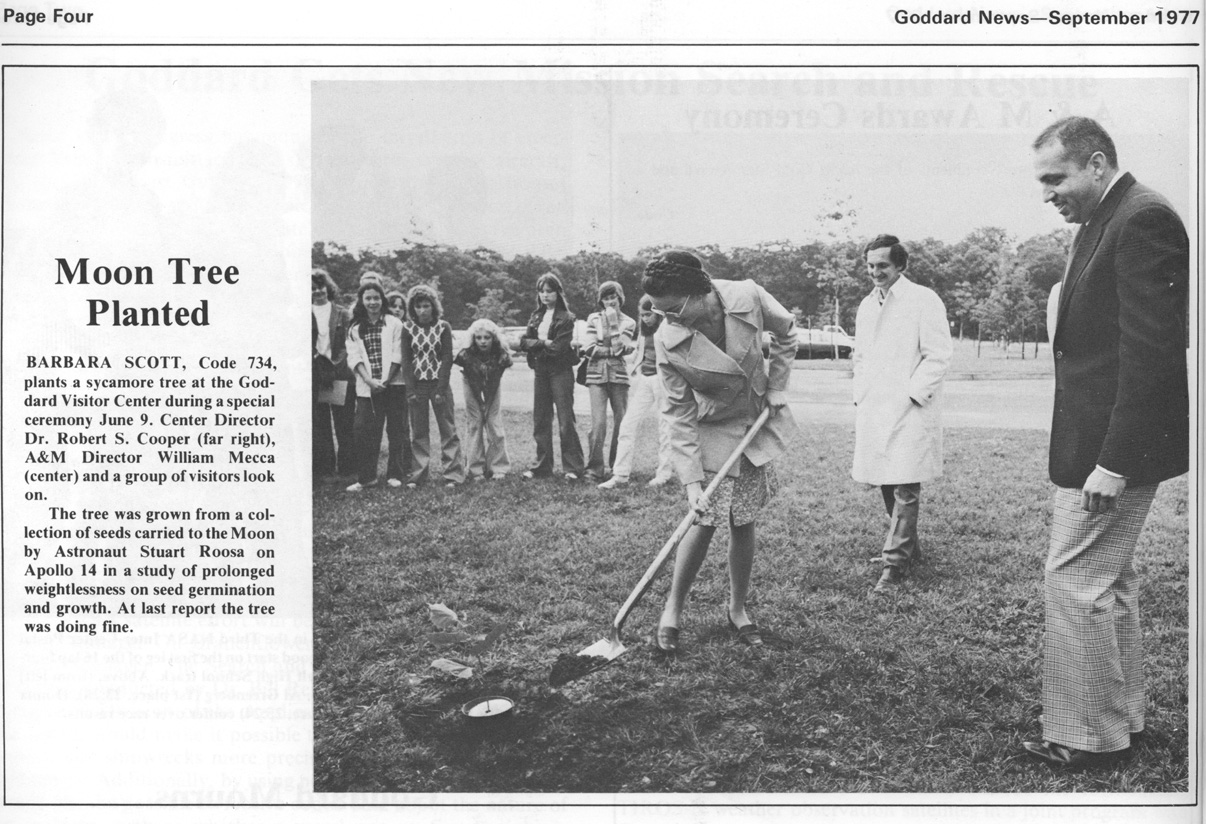
1977 clipping from Goddard News newsletter
Clipping from the September 1977 edition of Goddard Space Flight Center’s newsletter Goddard News.
NASA

Stuart Roosa was born on August 16, 1933, in Durango, Colorado. He worked for the Forest Service in the early 1950’s as a smoke jumper fighting fires and later joined the Air Force and became a test pilot. He was one of 19 people selected for the astronaut class of 1966 and was part of the astronaut support crew for Apollo 9. Following Apollo 14, Roosa was backup command module pilot for Apollo 16 and 17. He then worked on the Space Shuttle program until his retirement as a Colonel in the Air Force in 1976, the time when many of his trees were being planted. Roosa passed away in December 1994.

The Moon Trees continue to flourish, a living monument to our first visits to the Moon and a fitting memorial to Stuart Roosa. Believed locations of some of the original Moon Trees are listed below, but no list was ever kept nor any systematic tracking made of the disposition of all the trees. This list of Moon Trees was initiated by Dr. David R. Williams, retired curator at NASA’s National Space Science Data Center, after receiving a request for more information from Joan Goble, a third grade teacher in Indiana in 1996. Since then, dozens of people have contributed with information about other Moon Trees.

If you know of a Moon Tree not listed here or have a update to the status of one of those listed, please send a message to marie.j.henderson@nasa.gov.

Apollo Moon Tree Locations

City and StateLocationType of TreePlanting Date
Birmingham,
Alabama
Birmingham Botanical GardensSycamore25 February 1976
Montgomery,
Alabama
State CapitolLoblolly Pine19 April 1976
Troy,
Alabama
Pioneer Museum of AlabamaLoblolly Pine5 August 1976
Tuscumbia,
Alabama
Ivy GreenLoblolly Pine19 October 1976
Tuskegee,
Alabama
VA Medical CenterLoblolly Pine1976
Tucson
Arizona
University of ArizonaSycamore30 April 1976
Ft. Smith,
Arkansas
Sebastian County CourthouseLoblolly Pine15 March 1976
Washington,
Arkansas
Old Washington Historic State ParkLoblolly Pine15 March 1976
Arcata,
California
Humboldt State University3 Redwoods1976
Berkeley,
California
Tilden Nature Area2 Redwoods26 July 1976
Lockeford,
California
Lockeford Plant Materials CenterRedwood1979
Monterey,
California
Friendly PlazaRedwood27 July 1976
Sacramento,
California
Capitol ParkRedwoodApril 1976
San Luis Obispo,
California
Mission PlazaRedwood30 July 1976
Gainesville,
Florida
University of FloridaSycamorec. 1977
Keystone Heights,
Florida
Keystone Heights LibrarySycamore1984
Perry,
Florida
Forest Capital State ParkLoblolly Pine29 April 1978
Tallahassee,
Florida
Cascades ParkSycamore
Tallahassee,
Florida
Doyle Conner BuildingLoblolly Pine1976
Athens,
Georgia
Clarke County Planning Dept.Loblolly PineMay 1976
Macon,
Georgia
Georgia Forestry CenterLoblolly Pine22 March 1976
Waycross,
Georgia
Okefenokee RESALoblolly Pine
Boise,
Idaho
Lowell Elementary SchoolLoblolly Pine1977
Cannelton,
Indiana
Camp Koch Girl Scout CampSycamore1976
Indianapolis,
Indiana
Indiana StatehouseSycamore9 April 1976
Lincoln City,
Indiana
Lincoln State ParkSycamore1 May 1976
Atchison,
Kansas
International Forest of FriendshipSycamore24 July 1976
Elmer,
Louisiana
Palustris Experimental ForestLoblolly PineApril 1976
Bethesda,
Maryland
Society of American ForestersLoblolly Pine30 September 1975
Greenbelt,
Maryland
Goddard Space Flight CenterSycamore9 June 1977
Holliston,
Massachusetts
Holliston Police StationSycamore1982
Niles,
Michigan
Fernwood Botanical GardensSycamore23 April 1976
Biloxi,
Mississippi
Private ResidenceSycamore1974-75
Starkville,
Mississippi
Mississippi State UniversitySycamore1975
Wiggins,
Mississippi
Camp Iti KanaSycamoreApril/May 1974
DeSoto,
Missouri
Walther ParkSycamore
Santa Fe,
New Mexico
State Capitol BuildingDouglas Fir22 July 1976
Silver City,
New Mexico
Gough ParkSycamore15 August 1976
Asheville,
North Carolina
Botanical Gardens at AshevilleSycamore19 March 1976
Clyde,
North Carolina
Haywood Community CollegeSycamore1976
Pisgah National Forest,
North Carolina
Cradle of ForestrySycamore18 October 1976
Jefferson County,
Ohio
Friendship ParkSycamore29 July 1976
Corvallis
Oregon
Oregon State UniversityDouglas FirSpring, 1976
Eugene
Oregon
University of OregonDouglas Fir1976
Roseburg,
Oregon
U.S. Veteran’s HospitalDouglas Fir3 May 1976
Salem,
Oregon
State Capitol BuildingDouglas Fir30 April 1976
Salem,
Oregon
Private Residence2 Douglas Firs1973
Coudersport,
Pennsylvania
Coudersport Area Recreational ParkSycamoreLate 1970’s
Dillsburg,
Pennsylvania
Dillsburg Elementary SchoolSycamore29 April 1983
Ebensburg,
Pennsylvania
Cambria County CourthouseSycamore29 June 1976
Hollidaysburg,
Pennsylvania
Highland HallSycamore5 May 1976
King of Prussia,
Pennsylvania
Lockheed MartinSycamore30 June 1976
Newtown/Langhorne,
Pennsylvania
Core Creek ParkSycamore30 April 1976
Topton,
Pennsylvania
Topton Mini MuseumSycamore20 June 1976
Knoxville,
Tennessee
University of TennesseeLoblolly PineApril 1976
Sewanee,
Tennessee
University of the SouthSycamoreApril 1976
Westlake,
Texas
Private ResidenceSycamore1978
Draper,
Utah
Lone Peak Conservation CenterSycamore1976
Bracey,
Virginia
River Ridge CampgroundSycamoreUnknown
Doswell,
Virginia
Kings Dominion Amusement ParkSycamore1976?
Hampton,
Virginia
Patrick Elementary SchoolSycamore30 April 1976
Loudoun County,
Virginia
Scott Jenkins Memorial ParkSweetgumSeptember 1978
Olympia,
Washington
State Capitol BuildingDouglas FirApril 1976

City and CountryLocationType of TreePlanting Date
Brasilia,
Brazil
IBAMA InstituteSweetgum14 January 1980
Cambara do Sul,
Brazil
Praça Central São JoséRedwood26 September 1982
Rio Grande do Sul,
Brazil
Santa RosaRedwood18 August 1981
Chavaniac,
France
Chateau LafayetteSycamore
status unknown
1976

City and StateLocationType of TreePlanting Date
San Francisco,
California
Strybing ArboretumCoast Redwood
status unknown
22 July 1976
Savannah,
Georgia
UnknownSycamore
status unknown
Unknown
Pocatello,
Idaho
Idaho State UniversityDouglas Fir
status unknown
18 May 1976
Springfield,
Illinois
State CapitolSycamore
status unknown
29 April 1976
Des Moines,
Iowa
State CapitolSycamore ?
status unknown
30 April 1976
Baton Rouge,
Louisiana
Governor’s Mansion2 Loblolly Pines
status unknown
16 January 1976
Annapolis,
Maryland
Tawes GardenSycamore
status unknown
Unknown
Cleveland,
Mississippi
Delta State UniversityStatus Unknown1976
Hattiesburg,
Mississippi
University of Southern Mississippi?Status Unknown1976
Missoula,
Montana
University of MontanaDouglas Fir
Status Unknown
17 July 1976
Nebraska City,
Nebraska
National Arbor Day CenterStatus Unknown24 April 1976?
Monmouth County,
New Jersey
Monmouth County CourthouseSycamore
Status Unknown
Albany,
New York
Empire State PlazaSycamore
status unknown
1977?
Brooklyn,
New York
Fulton FerrySycamore
status unknown
June 1976?
Buffalo,
New York
Delaware Park LakeSycamore
status unknown
25 May 1977?
Rome,
New York
Fort StanwixSycamore
status unknown
1976?
Elkton,
Oregon
D.L. Phipps State Forest NurseryDouglas Fir
status unknown
Portland,
Oregon
Western Forestry CenterDouglas Fir
Status Unknown
25 May 1976
Emporium,
Pennsylvania
Cameron County CourthouseSycamore
Status Unknown
15 May 1976
Portersville,
Pennsylvania
Moraine State ParkSycamore
status unknown
4 August 1977

City and StateLocationType of TreePlanting Date
Auburn University,
Alabama
G.W. Andrews Forestry Sciences LabLoblolly Pine†,
Sycamore†
22 October 1976
Huntsville,
Alabama
U.S. Space and Rocket Center5 Sycamores†,
2 Pines†
29 October 1976
Flagstaff,
Arizona
Flagstaff Jr. High SchoolDouglas Fir†30 April 1976
Little Rock,
Arkansas
Forestry Commission HeadquartersLoblolly Pine†15 March 1976
Monticello,
Arkansas
University of Arkansas at MonticelloLoblolly Pine†15 March 1976
El Dorado Hills,
California
St. Stephen’s Lutheran ChurchRedwood†1976
San Dimas,
California
Technology & Development CenterGiant Sequoia?†29 March 1977
Cape Canaveral,
Florida
Kennedy Space CenterSycamore†25 June 1976
Gainesville,
Florida
University of Florida2 Loblolly Pines†c. 1977
Boise,
Idaho
State CapitolDouglas fir†7 May 1976
Moscow, IdahoUniversity of IdahoSycamore†
Tell City,
Indiana
Forest Service Office2 Sweetgums†1976
New Orleans,
Louisiana
New Orleans River WalkLoblolly Pine†June 1983
New Orleans,
Louisiana
NASA Michoud Assembly FacilityLoblolly Pine (2?)†July 1976
North Pembroke,
Massachusetts
Historical SocietySycamore†April 1976
Jackson,
Michigan
Dahlem Environmental Education CenterSycamore†22 April 1976
Lansing,
Michigan
State CapitolSycamore†22 April 1976
Wyoming,
Michigan
Wyoming Police StationSycamore†23 April 1976
Waynesboro,
Mississippi
Forestry Commission NurserySycamore†
Alamogordo,
New Mexico
International Space Hall of FameSycamore†5 October 1976
Albuquerque,
New Mexico
Civic PlazaDouglas Fir†7 April 1976
Capitan,
New Mexico
Smokey Bear State ParkSycamore†15 May 1976
Athens,
Ohio
District 4 HeadquartersSycamore†20 July 1976
Columbus,
Ohio
City NurserySycamore†1976
Illinois Valley,
Oregon
Siskiyou Smoke Jumpers BaseDouglas Fir†
Portland,
Oregon
World Forestry CenterDouglas Fir†
Philadelphia,
Pennsylvania
Washington SquareSycamore†6 May 1975
Elizabethton,
Tennessee
Sycamore Shoals State ParkSycamore†April 1976
Tullahoma,
Tennessee
Arnold Air Force BaseLoblolly Pine†April 1976
College Station,
Texas
Brazos County ArboretumSycamore†21 March 1976
Salt Lake City,
Utah
State Capitol BuildingDouglas Fir†
Doswell,
Virginia
Kings Dominion Amusement ParkSycamore†1976?
Washington,
D.C.
White HouseLoblolly Pine†19 January 1977
Princeton,
West Virginia
Forestry Sciences LabSycamore†18 October 1975

† Trees no longer alive

Featured Story

Moon Trees Stand as Living Testaments to First Voyages to Moon

The craters, mountains, and plains of the Moon stretched beneath the Apollo 14 Command and Service Module Kitty Hawk in…

Read the Story

Second-Generation Moon Trees

Second-generation trees, either grown from seeds of mature Moon Trees or from cuttings, are also growing around the world and continue to be planted today. In memory of her father, Stuart Roosa’s daughter, Rosemary Roosa, has continued the legacy of the original Apollo 14 Moon Trees through promoting planting second-generation Moon Trees around the world.

City and StateLocationType of TreePlanting Date
Enterprise, AlabamaPrivate ResidenceSycamore15 February 2002
Enterprise, AlabamaPrivate ResidenceSycamore15 March 2003
Huntsville, AlabamaMarshall Space Flight CenterSycamore22 April 1996
Lancaster, CaliforniaLancaster Performing Arts CenterSycamore23 September 2009
Blue Lake, CaliforniaUltra Powers Co.Redwood 
Lake Arrowhead, CaliforniaMSAS Astronomy VillageSycamoreMay 1999
Mountain View, CaliforniaPrivate ResidenceRedwoodJanuary, 1998
Tampa, FloridaMuseum of Science and IndustrySycamore16 November 1996
Hartwell, GeorgiaMadora Garden Club4 SycamoresSpring, 2006
Boise, IdahoNational Interagency Fire CenterSycamoreSpring, 2002
Libertyville, IllinoisAdler Park SchoolSycamore1 October 1997
Indianapolis, IndianaGreenbriar Elementary SchoolSycamore22 April 1999
Storm Lake, IowaLiving Heritage Tree MuseumSycamore 
Louisville, KentuckyLouisville ZooSycamore 
Stevensville, MarylandPrivate ResidenceSycamoreCirca 1997
Battle Creek, MichiganPrivate ResidenceSycamoreMay, 1998
Buchanan, MichiganPrivate ResidenceSycamore1996
Wyoming, MichiganWyoming Police StationSycamore†23 April 1976
Unionville, MissouriHistoric Tree MuseumSycamoreNovember, 1988
Wayne, New JerseyCyanamid CompanySycamore 
Somers, New YorkLasdon Park and ArboretumSycamore 
Greensboro, North CarolinaGuilford CollegeSycamoreSpring, 1995
Rowan County, North CarolinaSloan ParkSycamore 
Canal Winchester, OhioPrivate ResidenceSycamoreAugust, 1996
Fairfield, OhioPaper Products CompanySycamore13 July 2016
Cave Junction, OregonSiskiyou Smoke Jumpers BaseDouglas Fir6 October 2012
Hockley, TexasPrivate ResidenceSycamore15 April 2002
Arlington, VirginiaArlington National CemeterySycamore9 February 2005
Flamstead, EnglandPrivate Residence?SycamoreSummer, 2008
Tradate, ItalyTradate Astronomical ObservatoryLoblolly Pine12 October 2011
Lucern, SwitzerlandSwiss Museum of TransportSycamore8 October 2011

† Trees no longer alive

If you are seeking detailed information about the Moon trees listed here, contact marie.j.henderson@nasa.gov.

Artemis Moon Trees

A new generation of Moon Tree seeds traveled into lunar orbit aboard the Artemis I spacecraft in 2022. These Artemis Moon Tree seedlings have found homes with schools, museums, libraries, universities, and community organizations across the contiguous United States.

Employees of NASA Stennis and the NASA Shared Services Center gather outside to plant an Artemis Moon Tree

In a nod to the legacy of Apollo 14, and a celebration of the future of space exploration with NASA’s Artemis Program, a “New generation” of Moon Tree seeds traveled into lunar orbit aboard the Orion spacecraft. The seeds travelled thousands of miles beyond the Moon spending about 4 weeks in space before returning to Earth.  

NASA’s Office of STEM Engagement partnered with U.S. Department of Agriculture Forest Services to fly five species of tree seeds aboard Artemis I as part of a national STEM Engagement and conservation education initiative.

Through NASA’s Office of STEM Engagement (OSTEM) and NASA’s Artifact Module, museums, universities, federal agencies, including NASA Field Centers, and K–12 serving organizations were invited to apply for ownership of a Moon Tree seedling. Recipient distribution schedule aligned to four planting cycles: Spring 2024, Fall 2024, Spring 2025, and Fall 2025.

Artemis I Moon Tree Stewards

Artemis I Moon Tree seedlings found new homes with schools, museums, libraries, universities, and community organizations across the United States. An open call to NASA’s Artifacts Module in Fall, 2023 welcomed over 1000 organization submissions, which were reviewed and ranked by a joint USDA Forest Service and NASA panel.

View the List of Stewards
Featured Story

They Grow So Fast: Moon Tree Progress Since NASA’s Artemis I Mission

In 2022 NASA’s Orion spacecraft returned to Earth with more than 2,000 tree seedlings sourced in a partnership with USDA…

Read the Story

The post Moon Trees appeared first on NASA Science.

The first long-duration resident of the ISS, a cosmonaut, has died

18 June 2026 at 15:34

Russian cosmonaut Aleksandr Samokutyaev, who served twice as a crew member aboard the International Space Station (ISS), including during the final US space shuttle mission in 2011, has died at the age of 56.

With Samokutyaev's death on Wednesday, he becomes the first former ISS long-duration resident to die in the 26 years that the space station has been a home to 155 other cosmonauts and astronauts as expedition crew members. The cause of his death is unknown.

Portrait of cosmonaut Aleksandr Samokutyaev. Credit: Roscosmos

"The leadership and staff of the Roscosmos State Corporation extend their sincere condolences to the family and loved ones of Aleksandr Mikhailovich," officials with Russia's space agency said in a statement.

Read full article

Comments

© NASA

Towers once planned for California shuttle launches leveled for SpaceX rockets

17 June 2026 at 16:47

One of the United States' most storied space launch sites has been cleared of its decades-old support towers, making way for modern rockets to use the pad. Space Launch Complex-6 (SLC-6) at Vandenberg Space Force Station is arguably better known for what did not lift off from there than for what did.

A series of demolition charges on Tuesday (June 16) brought down the access tower, mobile service tower, and what remained of the assembly building at SLC-6—pronounced "slick-six"—in Southern California. Once the location for the US Air Force's first effort to put humans into space and later, the West Coast launch site for the space shuttle, SLC-6 will next be used by SpaceX in support of Falcon 9 and Falcon Heavy missions.

Vandenberg Space Force Base personnel watch as the assembly building at Space Launch Complex-6 (SLC-6) is toppled on June 16, 2026, to make way for SpaceX's use of the site. Credit: Space Launch Delta 30/Tech. Sgt. Draeke Layman

"Space Launch Complex-6 represents six decades of American innovation and our unwavering commitment to securing space superiority," Col. James T. Horne III, commander of Space Launch Delta 30 at Vandenberg, said in a statement. "By modernizing this historic footprint in partnership with our defense industrial base, we are building directly upon the foundation of our pioneers."

Read full article

Comments

© Space Launch Delta 30/Staff Sgt. Daekwon Stith

Post-Release Tuberculosis Risk in Lima’s Former Inmates

17 June 2026 at 17:51

In a groundbreaking study set to redefine our understanding of infectious disease risk post-incarceration, researchers have illuminated the heightened vulnerabilities faced by formerly incarcerated individuals in Lima, Peru, specifically concerning tuberculosis (TB). This investigation provides unprecedented evidence that the risk of TB remains substantially elevated even after individuals have been released from prison, posing serious public health challenges that extend beyond prison walls and timelines. The study, published in Nature Communications, draws critical attention to the intersection of social determinants, incarceration history, and tuberculosis epidemiology, offering essential insights that could pivot global TB control strategies.

Tuberculosis remains a formidable public health threat worldwide, exacerbated in settings marked by overcrowding, malnutrition, and limited access to healthcare—conditions prevalent in correctional facilities. However, the full scope of TB risk post-release has been insufficiently explored. The new findings from Lima reveal that the period following incarceration represents a window of sustained and potentially heightened TB risk, mandating urgent action in both public health policy and clinical care for this vulnerable population. By focusing on formerly incarcerated populations—a group often marginalized in health research—the study bridges a critical knowledge gap.

The investigation employed a longitudinal cohort design, tracking individuals released from prisons in Lima over several years. Advanced epidemiological modeling techniques were used to quantify the incidence of active tuberculosis following release, accounting for confounding variables such as age, gender, HIV status, socioeconomic conditions, and previous TB history. The rigor of the approach offers a robust, nuanced understanding of TB dynamics in this unique context, underscoring that incarceration and the period immediately after release must be treated as a continuum when assessing TB risk.

One of the pivotal revelations is the persistence of TB risk in the community setting following prison release, highlighting that the end of incarceration does not equate to the end of health vulnerability. This underscores how the prison environment, often characterized by high transmission rates and suboptimal health services, likely seeds infections that clinically manifest months or even years after release. Furthermore, systemic barriers such as stigma, limited healthcare access, and socioeconomic instability exacerbate disease outcomes and complicate efforts for early diagnosis and treatment.

The biological underpinnings of post-release tuberculosis susceptibility are multifactorial. Immunological stress associated with incarceration, compounded by conditions such as HIV co-infection or malnutrition, creates a permissive environment for latent Mycobacterium tuberculosis infection to reactivate. In addition, the stress of reintegration, disruption of treatment continuity, and potential exposure to TB in the community all converge to elevate risk. The study’s detailed analysis of these intertwined factors provides a clarion call for integrated interventions spanning correctional and community health services.

Perhaps most strikingly, the research highlights a critical temporal risk window—generally spanning the first two years post-release—during which TB incidence peaks. This temporal pattern suggests that interventions must be strategically timed to target this high-risk period. Enhanced screening, prophylactic therapy for latent TB infection, and improved linkage to care immediately following release could substantially reduce the disease burden for this population, thereby also curtailing community transmission chains.

The implications of this work extend well beyond Lima’s prisons. Globally, over 10 million people are estimated to be incarcerated annually, many in countries burdened with high TB prevalence. Understanding that TB risk persists and evolves post-incarceration challenges traditional paradigms that focus solely on active prison environments. Instead, comprehensive TB control must embrace a lifecycle perspective addressing social reintegration and continuity of care as integral to disease mitigation.

Health policy experts underscore the necessity of incorporating post-release care into national TB programs. This includes leveraging technologies such as mobile health platforms to monitor symptoms, ensuring continuity of TB preventive therapy, and addressing social determinants like housing instability and unemployment that underpin poor health outcomes. The Lima study’s findings provide empirical justification for allocating resources and redesigning healthcare delivery to encompass these critical components.

Moreover, the study accentuates that prisons are not isolated epidemiological entities but rather nodes interfacing with broader community health ecosystems. Tuberculosis transmitted within correctional facilities disproportionately affects communities to which incarcerated individuals return, amplifying TB transmission dynamics on a population scale. Addressing post-release TB risks, therefore, presents a compelling opportunity for broader epidemic control.

From a clinical perspective, the research advocates for routine post-release screening protocols and enhanced diagnostic vigilance among healthcare providers serving formerly incarcerated individuals. Diagnostic algorithms that incorporate risk stratification informed by incarceration history could enable earlier detection of active TB and latent infections prone to reactivation. The deployment of rapid molecular diagnostics in community settings could be particularly transformative.

This study also calls attention to necessary shifts in social policy. Eradicating stigma associated with incarceration and TB, facilitating reintegration support, and promoting equitable healthcare access are paramount. The intersectional vulnerabilities faced by formerly incarcerated populations demand an interdisciplinary approach encompassing health, social services, and criminal justice reform to break the cycle of disease and disadvantage.

Importantly, the nature of tuberculosis—a disease intricately tied to social determinants and biological factors—renders purely biomedical approaches insufficient. The Lima study’s integrative methodology, accounting for epidemiological, clinical, and social variables, sets a new standard for infectious disease research in marginalized populations. It paints a vivid portrait of how correctional and community health systems must synergize to effectively combat TB.

In conclusion, the findings emerging from Lima’s formerly incarcerated populations herald a paradigm shift in tuberculosis control. Recognition of the sustained, elevated risk post-incarceration compels a reevaluation of public health strategies to incorporate targeted post-release interventions. By bridging gaps between correctional health and community care, and acknowledging the complex socio-biological tapestry underpinning TB risk, the global health community can move closer toward the ambitious goals of TB elimination and improved health equity for vulnerable populations worldwide.

Subject of Research: Post-release tuberculosis risk among formerly incarcerated populations

Article Title: Post-release tuberculosis risk among formerly incarcerated populations in Lima Peru

Article References: Huang, CC., Brooks, M.B., Becerra, M.C. et al. Post-release tuberculosis risk among formerly incarcerated populations in Lima Peru. Nat Commun (2026). https://doi.org/10.1038/s41467-026-74436-8

Image Credits: AI Generated

Renewed Attention on Freedom House Ambulance Service Following ‘The Pitt’

17 June 2026 at 17:48

In an unprecedented exploration of how entertainment media shapes public awareness of critical yet overlooked health care history, researchers from the University of Pittsburgh School of Public Health have unveiled compelling evidence that a single episode of the hit medical drama “The Pitt” catalyzed a surge in public knowledge about the Freedom House Ambulance Service. This pioneering emergency medical service, established in 1967 in Pittsburgh’s Hill District, holds the distinction of being the first EMS system in the United States staffed entirely by African Americans. Despite its foundational contributions to prehospital care, Freedom House’s legacy has languished in obscurity—until now.

The study, published in the American Journal of Health Promotion, marks a first-of-its-kind effort to quantitatively and qualitatively assess the impact of a scripted health-related storyline on public consciousness. Utilizing a multifaceted methodology that combined Google Trends analytics with comprehensive content analysis of Reddit discussions, the research team documented a remarkable 170% spike in online searches for “Freedom House” immediately following the episode’s original broadcast on February 20, 2025. This elevated search interest persisted for approximately one week, highlighting sustained public intrigue ignited by the storyline.

The TV episode in question, “2:00 P.M.” from the inaugural season, centers on Willie Alexander, an octogenarian patient navigating a glitching pacemaker while intermittently regaling the emergency department staff with medically accurate commentary about his case. As the narrative unfolds, viewers discover Willie’s own history as a former member of Freedom House Ambulance Service, affording a rare window into the challenges and triumphs of this groundbreaking group. Founded during a turbulent era marked by systemic racial inequities, Freedom House provided not only emergency medical transport but also vital paramedic training and community employment opportunities to African Americans excluded from many healthcare roles.

Despite its transformative community impact and innovative operational model, Freedom House was ultimately shuttered eight years after its inception when Pittsburgh transitioned EMS management to city authorities, who replaced the predominantly Black cadre with a mostly white workforce. The storyline poignantly underscores how Freedom House’s pioneering efforts were largely erased from mainstream recognition—a fact that elicited profound emotional responses from both the study participants and the viewing audience.

This resurgence of interest was catalyzed in part by the University of Pittsburgh’s public health researchers hosting a special screening event that included a panel discussion featuring six surviving members of Freedom House Ambulance Service. Their firsthand testimonies and reflections resonated deeply with attendees, many of whom expressed astonishment at learning about Freedom House only through the television narrative. According to Dr. Beth L. Hoffman, assistant professor of behavioral and community health sciences at Pitt Public Health and lead author on the study, the audience’s reactions illuminated a significant gap in public knowledge and a hunger for stories that reveal hidden chapters of health equity and systemic racism.

Coauthor Dr. Sylvia Owusu-Ansah, who also acted as medical consultant for “The Pitt,” articulated the personal significance of bringing Freedom House’s story to a broader audience. As an African American physician and emergency medical services director, Dr. Owusu-Ansah highlighted the importance of representation and the pride associated with recognizing historical pioneers who paved the way for greater diversity in healthcare professions. Her expertise ensured that the storyline accurately portrayed medical details while authentically conveying the sociohistorical context of Freedom House.

The research methodology deployed by the University of Pittsburgh team leveraged the power of social media as a digital ethnographic resource. Reddit, a platform where users engage in real-time discourse, served as a vital space to observe public reactions and information dissemination catalyzed by the episode. Analyzing nearly 200 posts, the researchers found a proliferation of content explicating Freedom House’s history, alongside emotional reactions ranging from surprise and admiration to frustration over the service’s historical obscurity. Many Reddit users proactively contributed context, fielded questions, and debated the implications of Freedom House’s narrative within broader conversations about racial equity in American medical history.

This study not only exemplifies the dynamic relationship between entertainment media and public health education but also reinforces the potential of thoughtfully crafted storylines to function as catalysts for social change. Dr. Hoffman emphasized that when narratives are developed collaboratively with subject matter experts ensuring accuracy and cultural sensitivity, even brief on-screen depictions can ignite expansive public engagement with complex health topics.

From a technical standpoint, the analysis underscores the utility of integrating traditional media impact studies with digital data analytics to capture both quantitative spikes in interest and the qualitative nuances of audience interpretation. The 170% increase in Google search volume represents a statistically significant indicator of episodic influence on information-seeking behavior, while the thematic coding of Reddit discourse provides insight into the multidimensional ways stories resonate across diverse audiences.

The resurgence of Freedom House’s legacy via “The Pitt” exemplifies how the intersection of media, medicine, and social justice can advance collective memory and awareness. It invites further exploration into harnessing entertainment platforms to shed light on marginalized histories and catalyze dialogue around systemic disparities in healthcare. Going forward, this case study sets a benchmark for future research on how fictional narratives enriched by authentic lived experiences can elevate public understanding and inspire advocacy.

In conclusion, the University of Pittsburgh’s investigation into the ripple effects of a medical drama’s nod to a historically crucial EMS pioneer reveals the transformative capacity of storytelling as a public health intervention. By rekindling interest in the Freedom House Ambulance Service, the research not only honors the unsung heroes of emergency medicine but also energizes ongoing discussions about health equity, systemic racism, and the power of media to inform and engage society at large.


Subject of Research: Not applicable

Article Title: Public Awareness of Freedom House Ambulance Service After Viewing the Pitt

News Publication Date: 10-Jun-2026

Web References:

References:
Hoffman, B. L., Owusu-Ansah, S., Fawole, O., Leshniowsky, K. (2026). Public Awareness of Freedom House Ambulance Service After Viewing the Pitt. American Journal of Health Promotion. DOI: 10.1177/08901171261460703

Keywords: Social media, Medical specialties, Emergency medicine, Mass media, Television, History of medicine, Health equity, Systemic racism, Prehospital care, Public health education

Towers once planned for California shuttle launches leveled for SpaceX rockets

17 June 2026 at 16:47

One of the United States' most storied space launch sites has been cleared of its decades-old support towers, making way for modern rockets to use the pad. Space Launch Complex-6 (SLC-6) at Vandenberg Space Force Station is arguably better known for what did not lift off from there than for what did.

A series of demolition charges on Tuesday (June 16) brought down the access tower, mobile service tower, and what remained of the assembly building at SLC-6—pronounced "slick-six"—in Southern California. Once the location for the US Air Force's first effort to put humans into space and later, the West Coast launch site for the space shuttle, SLC-6 will next be used by SpaceX in support of Falcon 9 and Falcon Heavy missions.

Vandenberg Space Force Base personnel watch as the assembly building at Space Launch Complex-6 (SLC-6) is toppled on June 16, 2026, to make way for SpaceX's use of the site. Credit: Space Launch Delta 30/Tech. Sgt. Draeke Layman

"Space Launch Complex-6 represents six decades of American innovation and our unwavering commitment to securing space superiority," Col. James T. Horne III, commander of Space Launch Delta 30 at Vandenberg, said in a statement. "By modernizing this historic footprint in partnership with our defense industrial base, we are building directly upon the foundation of our pioneers."

Read full article

Comments

© Space Launch Delta 30/Staff Sgt. Daekwon Stith

Vigorous Mantle Convection Sparked Cretaceous Pacific Igneous Provinces

16 June 2026 at 13:24

In a groundbreaking study poised to reshape our understanding of Earth’s deep interior dynamics, researchers have unveiled a comprehensive model elucidating the genesis of the extensive large igneous provinces (LIPs) in the Pacific Ocean during the Early Cretaceous period. These massive volcanic events, which left a profound imprint on the planet’s geological record, had long been attributed to various causes including isolated mantle plumes, tectonic slab return flows, or complex plume–ridge interactions. This latest research integrates geophysical modeling with paleogeographic data to reveal a multifaceted interplay between mantle convection processes, subducting tectonic plates, and migrating mid-ocean ridges that collectively controlled the timing, location, and intensity of LIP formation.

The Pacific Ocean’s Early Cretaceous LIPs, encompassing some of the largest volcanic eruptions in Earth’s recent history, had puzzled researchers due to their sporadic yet intense episodes of basaltic outpourings. Historically, hypotheses have swung between attributing these vast eruptions to the arrival of deep superplumes—a concept suggesting stable, buoyant columns of hot mantle material rising from the core-mantle boundary—to mechanisms involving return flows of cold slabs being subducted beneath the Pacific basin. Adding complexity, the interaction between these mantle upwellings with tectonic spreading ridges has also been proposed as a trigger for massive melt generation. Yet, until now, a unified mechanistic explanation that could integrate these disparate phenomena remained elusive.

The pivotal insight of the new study comes from advanced mantle flow simulations constrained by precise paleogeographic reconstructions of Early Cretaceous plate configurations. By projecting plate motions and subduction geometries back in time, the researchers were able to create dynamic models of mantle convection patterns beneath the Pacific basin. These simulations revealed a stable pattern of thermally buoyant mantle upwellings, or plumes, persisting between approximately 165 million and 80 million years ago. Intriguingly, these upwellings were not isolated features but were rooted above enduring lower mantle thermal anomalies, suggesting the importance of inherited mantle structure in shaping convective behavior.

A particularly striking finding emerged around 130 to 125 million years ago, when the intensity of mantle upwelling reached its zenith. This peak activity appears fundamentally linked to an increase in slab flux beneath the Pacific realm, where enhanced subduction rates delivered cold tectonic plates deeply into the mantle, inducing a return flow that effectively strengthened the buoyant upwellings. This coupling indicates that rather than being independent processes, subduction dynamics and preexisting mantle heterogeneities synergistically elevate mantle temperatures and buoyancy, fostering conditions ripe for extensive melting and volcanic activity.

The study highlights the critical role of mantle-ridge interaction in modulating LIP genesis. Around 145 to 120 million years ago, migrating spreading ridges—regions where tectonic plates diverge, allowing mantle material to rise and solidify as new crust—passed over these vigorous upwellings. The models suggest that when spreading ridges intersected with zones of intense heat advection from the underlying mantle plumes, the accompanying thermal anomaly slowed ridge propagation. This transient deceleration enhanced the efficiency of mantle melting, channeling voluminous magma to Earth’s surface and triggering the prolific LIP eruptions witnessed in the geological record.

However, subsequent to this period of intense volcanic activity, the simulations indicate a pronounced decline in LIP eruption frequency and magnitude. This downturn corresponds to a combination of factors: a weakening of mantle upwelling intensity as slab flux diminishes, and the accelerated migration of spreading ridges away from the central Pacific mantle plumes. Such dynamic decoupling reduces the capacity for significant mantle melting beneath the ridges, thereby suppressing the generation of large-scale igneous provinces.

The revelations of this study carry profound implications for our grasp of Earth’s mantle convection and its surface expressions. The joint control of radial heat advection by slab flux and inherited lower-mantle structures innovatively bridges the gap between mantle plume theory and plate tectonic processes. It underscores the necessity of considering the deep Earth’s thermal architecture not as static but as an evolving, inherited template that interacts intricately with episodic tectonic phenomena to produce massive surface volcanism.

Moreover, the research offers a nuanced perspective on the temporal and spatial variability of LIP occurrences. The inferred stability of the central Pacific mantle upwellings over tens of millions of years challenges the traditional view that mantle plumes are transient or short-lived. Instead, the presence of deep-rooted thermal anomalies suggests longevity that serves as a backdrop for dynamic tectonic events, providing fertile mantle heat reservoirs that can be tapped repeatedly under favorable conditions.

The evidence for spreading ridges acting as crucial melting amplifiers rather than mere passive features reshapes existing paradigms around mid-ocean ridge evolution. The transient slowing of ridge migration due to underlying thermal anomalies offers a novel mechanism explaining how mantle melting can be efficiently modulated over geological timescales. This insight emphasizes the interconnectedness of deep mantle processes and plate boundary dynamics, illuminating a feedback system where surface plate motions influence, and are influenced by, mantle convection.

Such a feedback mechanism further accounts for the spatial clustering and episodic nature of LIP eruptions in the Pacific basin. As spreading ridges move relative to mantle plumes, the precise location and intensity of melting episodes shift, giving rise to spatially focused volcanic provinces at certain intervals. This dynamic explains observed geological distributions that earlier models struggled to fully capture, providing a cohesive narrative linking mantle physics, tectonic processes, and surface volcanism.

In addition to unraveling long-standing geological puzzles, this study also enhances predictive frameworks that may be vital for understanding the Earth’s future geodynamic behavior. The coupling between slab dynamics, mantle structure, and ridge migration suggests that monitoring contemporary subduction zones and spreading ridges could illuminate potential sites of enhanced mantle melting, which could, in extreme cases, relate to future volcanic hazards or crustal growth episodes.

The sophisticated modeling approaches employed further demonstrate the power of integrating multi-disciplinary datasets in geosciences. The confluence of plate reconstructions, mantle convection simulations, and thermal structure analyses exemplifies a holistic methodology transcending traditional disciplinary boundaries. This approach not only advances fundamental scientific knowledge but also opens avenues for exploration into Earth’s deep processes that underpin surface phenomena critical to the planet’s evolution.

While the findings present a compelling mechanism for Early Cretaceous LIP activity in the Pacific, the study also raises exciting questions about the potential for analogous mantle-plume and ridge interactions in other oceanic basins and geological epochs. Could similar dynamics explain volcanic provinces elsewhere, or are these processes unique to the Pacific’s mantle and tectonic configuration during that period? Future research targeted at extending these models globally and temporally promises to deepen our understanding of Earth’s geodynamic engine.

In conclusion, the fusion of mantle convection modeling with tectonic and paleogeographic data in this research provides a transformative lens on one of Earth’s most dramatic volcanic phenomena. The identification of vigorous mantle convection driven by tiered slab flux and legacy mantle structures, alongside nuanced ridge-upwelling interactions, charts a paradigm shift in interpreting large igneous province formation. These revelations not only solve longstanding enigmas of the Cretaceous Pacific LIPs but also refine the broader framework within which mantle dynamics and surface tectonics coalesce to sculpt our planet’s geological evolution.

As our planet continues to evolve, studies like this reaffirm the deep interconnectivity of processes spanning from Earth’s core to its crust, reminding us of the subtly intertwined forces shaping the planet on scales across both space and time. Through sophisticated simulations and integrative science, the tantalizing mysteries of Earth’s volcanic past inch closer to clarity, offering unprecedented glimpses into the fiery heart of our dynamic planet.


Subject of Research: Mantle convection dynamics and formation of large igneous provinces during the Early Cretaceous period in the Pacific Ocean.

Article Title: Vigorous mantle convection triggered the Cretaceous Pacific large igneous provinces.

Article References:
Deng, D., Li, S., Cao, X. et al. Vigorous mantle convection triggered the Cretaceous Pacific large igneous provinces. Nat. Geosci. (2026). https://doi.org/10.1038/s41561-026-02016-y

Image Credits: AI Generated

DOI: https://doi.org/10.1038/s41561-026-02016-y

Book of Revelation | UFOs are Angelic Beings, Both Malevolent and Benevolent

16 June 2026 at 11:08
Heaven is at war and Satan is trying to destroy the true followers of Jesus Christ. Here I explore the idea that UFOs are real manifestations of angelic forces, both malevolent and benevolent, as seen in visions in the Bible. They are the ones currently engaged in battle.

❌