❌

Normal view

NASA’s Chandra Finds Unexpected Fireworks in Aftermath of Stellar Explosions

15 June 2026 at 19:45
6 Min Read

NASA’s Chandra Finds Unexpected Fireworks in Aftermath of Stellar Explosions

A full field composite image of M83 with X-rays from Chandra (red, green, and blue) and optical light data from Hubble (red, green, and blue).
A composite image of the nearby galaxy Messier 83, and short timelapse videos of two curious supernova remnants hidden inside.
X-ray: NASA/CXC/SAO; Optical: NASA/ESA/AURA/STScI, Hubble Heritage Team, W. Blair (STScI/Johns Hopkins University) and R. O’Connell (University of Virginia); Image Processing: NASA/CXC/SAO/A. Jubett, L. Frattare and P. Edmonds

The aftermath of a supernova, a stellar explosion, is usually a slowly fading cloud of hot gas. So when astronomers pointed NASA’s Chandra X-ray Observatory at the nearby galaxy Messier 83 (M83), they did not expect to find a population of supernova remnants, or the debris from these explosions, showing dramatic changes in their brightness. The new results were presented at the American Astronomical Society meeting in Pasadena, California, and published in The Astrophysical Journal.

The galaxy M83, located about 15 million light-years from Earth, is forming stars at a high rate. Researchers analyzed 14 years of Chandra data of the galaxy, spanning 2000 to 2014.

Using this extensive set of data, the researchers caught surprising variations in the X-ray brightness of sources previously identified as supernova remnants. The researchers expected supernova remnants older than a century or so to fade gradually in X-rays, but not change dramatically in brightness.

The team found that roughly half of the 22 X-ray sources associated with supernova remnants in their sample showed changes in X-ray brightness over the 14-year span of observations — a result that was completely unexpected.

“We knew that individual X-ray sources could vary dramatically,” said Andrea Prestwich, of the Catholic University of America who led the study. “But finding that so many supernova remnants were behaving this way was a real surprise. Something unusual is going on in these objects. Pinpointing the cause remains a challenge, as M83’s distance limits the detail we can observe.”

One of the 22 variable supernova remnants has a straightforward explanation: SN 1957D, the debris from a supernova first observed nearly 70 years ago, is ramming into material surrounding the explosion site, producing the observed X-ray flares. But this cannot explain the rest of the sample. There is no evidence to suggest that all 22 remnants were formed within the last century. Something else must be driving the variability.

The most likely explanation is that the team has uncovered a population of stellar survivors stars that lived through their partner’s destruction in a supernova explosion. In this scenario, each variable X-ray source began as a pair of massive stars orbiting each other. The more massive star collapsed and exploded as a supernova, leaving behind a black hole or ultra-dense neutron star. Its companion survived.
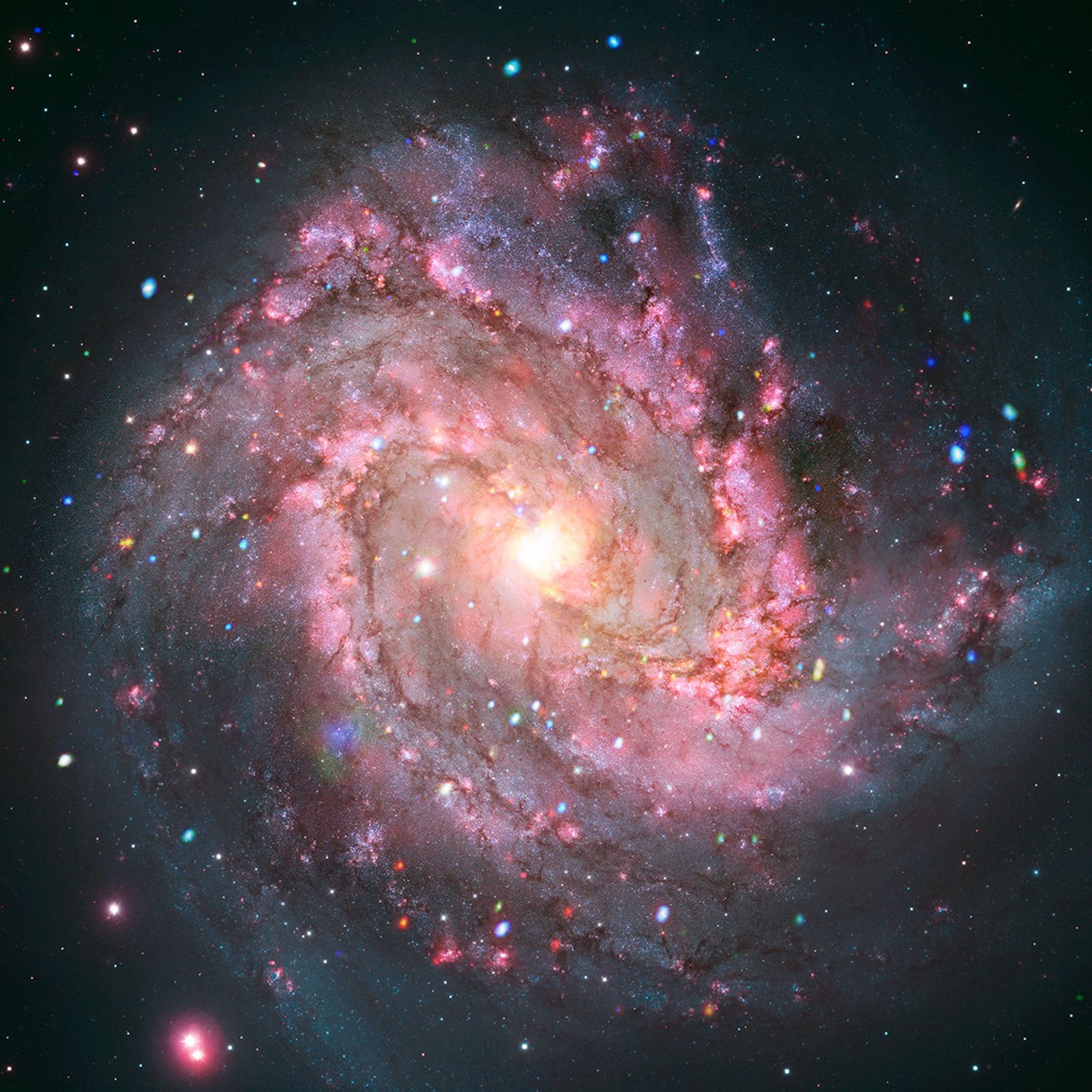
A full field composite image of M83 with X-rays from Chandra (red, green, and blue) and optical light data from Hubble (red, green, and blue).
Galaxy M83 in X-ray and Optical Light.
X-ray: NASA/CXC/SAO; Optical: NASA/ESA/AURA/STScI, Hubble Heritage Team, W. Blair (STScI/Johns Hopkins University) and R. O’Connell (University of Virginia); Image Processing: NASA/CXC/SAO/A. Jubett, L. Frattare and P. Edmonds

“It may be that this galaxy contains a collection of supernova remnants where one massive star survives the supernova and becomes locked into an orbit with a black hole or neutron star,” said co-author Michael McCollough of the Center for Astrophysics | Harvard & Smithsonian (CfA). “The neutron star or black hole can then start pulling material from the massive star’s surface.”

That infalling material is superheated by the intense gravitational pull, producing the X-rays Chandra detects. These types of systems, known as high-mass X-ray binaries (HMXBs), are among the most variable X-ray sources in the universe. Researchers say they may be the cause of the variations seen in M83’s supernova remnants.

Astronomers have known about HMXBs for decades, but the difference with this group in M83 is their connection to supernova remnants. Previously, only a handful of supernova remnants associated with HMXBs had been identified across observations of all galaxies. It is unprecedented to find more than 20 strong candidates in just one galaxy.

The authors found that the variable supernova remnants are in regions with higher concentrations of massive stars than in other parts of the galaxy, increasing the chances of a link between the remnants and HMXBs.

There is another possible explanation: Instead of pulling in material from a companion star, the black hole or neutron star may be recapturing some of the material blasted outward by the original explosion.

“This could be an example of cosmic recycling, where debris from the explosion falls back onto the very object the supernova created,” said co-author Roy Kilgard of Wesleyan University. “And it’s quite possible that both explanations are at play — different sources in our sample may have different origins.”

These results are not unique to M83. A follow-up study of the nearby star-forming galaxy M51 by Zoe Hoiland of Vassar College and Kilgard has uncovered a similar population of variable X-ray sources associated with supernova remnants, suggesting that such systems may be a feature of galaxies undergoing vigorous star formation.
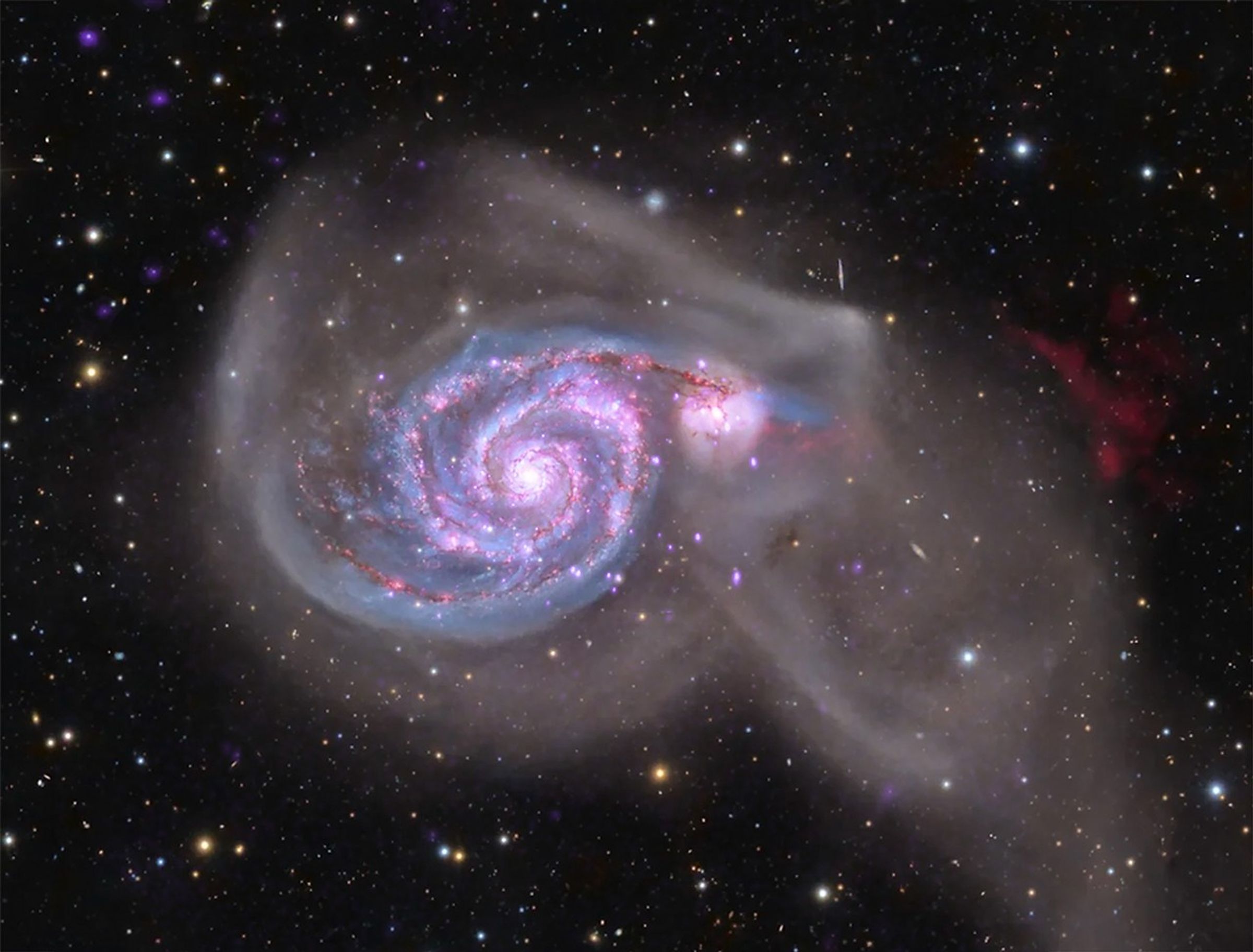
This is a composite image of the galaxy M51 combining data from NASA's Chandra X-ray Observatory (purple) with optical data (red, green and blue) taken with ground-based telescopes by a team of astrophotographers. A surprisingly high number of X-ray sources associated with supernova remnants in M51 show large changes in brightness, similar to the behavior seen in M83.
This is a composite image of the galaxy M51 combining data from NASA’s Chandra X-ray Observatory (purple) with optical data (red, green and blue) taken with ground-based telescopes by a team of astrophotographers. A surprisingly high number of X-ray sources associated with supernova remnants in M51 show large changes in brightness, similar to the behavior seen in M83.
Chandra X-ray Data: NASA/CXC/SAO; Astrobin/Optical Groundbased: C.Björk, T.Bähnck, S.Donoso, J.Gentillon, A. and D.Grelin, S.Guberski, R. Hall, T.Heuberger, J.Jacks, P.Kent, Br.Meyers, W.Ostling, N.Puig, T.Schaeffer, F.Schöfbänker, M.Vasilev

The Chandra data for M83 began with single observations in 2000 and 2001, followed by 10 observations from 2010 to 2011 and another observation in 2014.

NASA’s Marshall Space Flight Center in Huntsville, Alabama, manages the Chandra program. The Smithsonian Astrophysical Observatory’s Chandra X-ray Center controls science operations from Cambridge, Massachusetts, and flight operations from Burlington, Massachusetts.

Visual Description

This release features a composite image of the nearby galaxy Messier 83, and short timelapse videos of two curious supernova remnants hidden inside.

In the composite image, Messier 83, or M83, is shown to have a spiral structure, viewed straight on. At the center is a brilliant white and yellow pool of light. From that light, spiral arms of hot pink cloud corkscrew out in wide, sweeping arches. The galaxy is covered in a faint grey haze, and flecked with red, green, blue, white, and yellow dots.

In an annotated version of the composite image, two tiny dots to our lower right of center are highlighted by white circles. These are two of the supernova remnants being considered by researchers. Each is examined further in a separate timelapse video.

Over a 14-year period from 2000 to 2014, astronomers pointed NASA’s X-ray observatory at the M83 galaxy. They discovered that about half of the X-ray sources believed to be supernova remnants, the aftermath of stellar explosions, were exhibiting dramatic changes in brightness. This result was entirely unexpected.

Those changes in brightness are highlighted in the timelapse videos. In each video, a series of static images flashes by, focused on one of the two X-ray sources once believed to be supernova remnants. In the videos, the X-ray sources appear as bright blue blobs with glowing cores. But in each image, taken months or years apart, the shapes change, as does the intensity of the blue color, and the brightness of the core. By presenting the substantively different images of the same objects one after another in quick succession, short timelapse videos are created.

The most likely explanation for the changes in brightness is that the team has uncovered a population of stellar survivors, stars that lived through an orbiting partner’s destruction in a supernova explosion. Material is being pulled from the surviving star onto the black hole or neutron star that formed in the supernova, a process known to cause rapid changes in X-ray brightness.

Read more from NASA’s Chandra X-ray Observatory

To learn more about NASA’s Chandra mission, visit:

https://science.nasa.gov/chandra

https://chandra.si.edu

News Media Contact

Megan Watzke
Chandra X-ray Center
Cambridge, Mass.
617-496-7998
mwatzke@cfa.harvard.edu

Joel Wallace
Marshall Space Flight Center, Huntsville, Alabama
256-544-0034
joel.w.wallace@nasa.gov

About the Author

Lee Mohon

Share

Details

Last Updated
Jun 16, 2026
Editor
Lee Mohon
Contact
Joel Wallace
Location
Marshall Space Flight Center

Amendment 59: Several Updates to the ROSES-25 Summary of Solicitation

15 June 2026 at 19:55

Research Opportunities in Space and Earth Sciences (ROSES)-2025 is an ongoing “omnibus” or “umbrella” solicitation meaning that it includes many individual program elements each with its own topics and due dates. Refer to Table 3 of ROSES-25 for a list of those program elements. The ROSES-25 “Summary of Solicitation” is the front matter that sets the default backstop rules for each of the program elements in ROSES-25.

ROSES-25 Amendment 59 makes several additions, changes, and clarifications to the ROSES-25 Summary of Solicitation to conform with Agency and administration priorities, see Sections I, I(g), II(a), II(b), III(b), III(d), V(b)ii, VI(c) & VIII(b). New text is in bold.

Important and substantial revisions to 2 CFR 200, the government-wide guidance for grants and cooperative agreements are proposed to take effect October 1, 2026, see https://www.federalregister.gov/documents/2026/05/29/2026-10817/regulation-for-federal-financial-assistance#h-8. Many types of currently allowable costs, such as but not limited to publications, research or events outside the United States, and domestic conferences may be restricted, denied, or may be allowable by legal exception or special award conditions only. Public comments on the revisions to 2 CFR 200 may be submitted until July 13, 2026, at https://www.regulations.gov/commenton/OMB-2026-0034-0001

On or about June 15, 2026, this Amendment to the NASA Research Announcement “Research Opportunities in Space and Earth Sciences (ROSES) 2025” (NNH25ZDA001N) will be posted on the NASA research opportunity homepage at https://solicitation.nasaprs.com/ROSES2025 and will appear on SARA’s ROSES blog at: https://science.nasa.gov/researchers/solicitations/roses-2025/

Questions concerning this amendment to ROSES-25 may be directed to SARA@nasa.gov.

The post Amendment 59: Several Updates to the ROSES-25 Summary of Solicitation appeared first on NASA Science.

NASA’s Chandra Finds Unexpected Fireworks in Aftermath of Stellar Explosions

15 June 2026 at 19:45
6 Min Read

NASA’s Chandra Finds Unexpected Fireworks in Aftermath of Stellar Explosions

A full field composite image of M83 with X-rays from Chandra (red, green, and blue) and optical light data from Hubble (red, green, and blue).
A composite image of the nearby galaxy Messier 83, and short timelapse videos of two curious supernova remnants hidden inside.
X-ray: NASA/CXC/SAO; Optical: NASA/ESA/AURA/STScI, Hubble Heritage Team, W. Blair (STScI/Johns Hopkins University) and R. O'Connell (University of Virginia); Image Processing: NASA/CXC/SAO/A. Jubett, L. Frattare and P. Edmonds

The aftermath of a supernova, a stellar explosion, is usually a slowly fading cloud of hot gas. So when astronomers pointed NASA’s Chandra X-ray Observatory at the nearby galaxy Messier 83 (M83), they did not expect to find a population of supernova remnants, or the debris from these explosions, showing dramatic changes in their brightness. The new results were presented at the American Astronomical Society meeting in Pasadena, California, and published in The Astrophysical Journal.

The galaxy M83, located about 15 million light-years from Earth, is forming stars at a high rate. Researchers analyzed 14 years of Chandra data of the galaxy, spanning 2000 to 2014.

Using this extensive set of data, the researchers caught surprising variations in the X-ray brightness of sources previously identified as supernova remnants. The researchers expected supernova remnants older than a century or so to fade gradually in X-rays, but not change dramatically in brightness.

The team found that roughly half of the 22 X-ray sources associated with supernova remnants in their sample showed changes in X-ray brightness over the 14-year span of observations — a result that was completely unexpected.

“We knew that individual X-ray sources could vary dramatically,” said Andrea Prestwich, of the Catholic University of America who led the study. “But finding that so many supernova remnants were behaving this way was a real surprise. Something unusual is going on in these objects. Pinpointing the cause remains a challenge, as M83’s distance limits the detail we can observe.”

One of the 22 variable supernova remnants has a straightforward explanation: SN 1957D, the debris from a supernova first observed nearly 70 years ago, is ramming into material surrounding the explosion site, producing the observed X-ray flares. But this cannot explain the rest of the sample. There is no evidence to suggest that all 22 remnants were formed within the last century. Something else must be driving the variability.

The most likely explanation is that the team has uncovered a population of stellar survivors stars that lived through their partner’s destruction in a supernova explosion. In this scenario, each variable X-ray source began as a pair of massive stars orbiting each other. The more massive star collapsed and exploded as a supernova, leaving behind a black hole or ultra-dense neutron star. Its companion survived.

A full field composite image of M83 with X-rays from Chandra (red, green, and blue) and optical light data from Hubble (red, green, and blue).
Galaxy M83 in X-ray and Optical Light.
X-ray: NASA/CXC/SAO; Optical: NASA/ESA/AURA/STScI, Hubble Heritage Team, W. Blair (STScI/Johns Hopkins University) and R. O’Connell (University of Virginia); Image Processing: NASA/CXC/SAO/A. Jubett, L. Frattare and P. Edmonds

“It may be that this galaxy contains a collection of supernova remnants where one massive star survives the supernova and becomes locked into an orbit with a black hole or neutron star,” said co-author Michael McCollough of the Center for Astrophysics | Harvard & Smithsonian (CfA). “The neutron star or black hole can then start pulling material from the massive star’s surface.”

That infalling material is superheated by the intense gravitational pull, producing the X-rays Chandra detects. These types of systems, known as high-mass X-ray binaries (HMXBs), are among the most variable X-ray sources in the universe. Researchers say they may be the cause of the variations seen in M83’s supernova remnants.

Astronomers have known about HMXBs for decades, but the difference with this group in M83 is their connection to supernova remnants. Previously, only a handful of supernova remnants associated with HMXBs had been identified across observations of all galaxies. It is unprecedented to find more than 20 strong candidates in just one galaxy.

The authors found that the variable supernova remnants are in regions with higher concentrations of massive stars than in other parts of the galaxy, increasing the chances of a link between the remnants and HMXBs.

There is another possible explanation: Instead of pulling in material from a companion star, the black hole or neutron star may be recapturing some of the material blasted outward by the original explosion.

“This could be an example of cosmic recycling, where debris from the explosion falls back onto the very object the supernova created,” said co-author Roy Kilgard of Wesleyan University. “And it’s quite possible that both explanations are at play — different sources in our sample may have different origins.”

These results are not unique to M83. A follow-up study of the nearby star-forming galaxy M51 by Zoe Hoiland of Vassar College and Kilgard has uncovered a similar population of variable X-ray sources associated with supernova remnants, suggesting that such systems may be a feature of galaxies undergoing vigorous star formation.

This is a composite image of the galaxy M51 combining data from NASA's Chandra X-ray Observatory (purple) with optical data (red, green and blue) taken with ground-based telescopes by a team of astrophotographers. A surprisingly high number of X-ray sources associated with supernova remnants in M51 show large changes in brightness, similar to the behavior seen in M83.
This is a composite image of the galaxy M51 combining data from NASA’s Chandra X-ray Observatory (purple) with optical data (red, green and blue) taken with ground-based telescopes by a team of astrophotographers. A surprisingly high number of X-ray sources associated with supernova remnants in M51 show large changes in brightness, similar to the behavior seen in M83.
Chandra X-ray Data: NASA/CXC/SAO; Astrobin/Optical Groundbased: C.Björk, T.Bähnck, S.Donoso, J.Gentillon, A. and D.Grelin, S.Guberski, R. Hall, T.Heuberger, J.Jacks, P.Kent, Br.Meyers, W.Ostling, N.Puig, T.Schaeffer, F.Schöfbänker, M.Vasilev

The Chandra data for M83 began with single observations in 2000 and 2001, followed by 10 observations from 2010 to 2011 and another observation in 2014.

NASA’s Marshall Space Flight Center in Huntsville, Alabama, manages the Chandra program. The Smithsonian Astrophysical Observatory’s Chandra X-ray Center controls science operations from Cambridge, Massachusetts, and flight operations from Burlington, Massachusetts.

Visual Description

This release features a composite image of the nearby galaxy Messier 83, and short timelapse videos of two curious supernova remnants hidden inside.

In the composite image, Messier 83, or M83, is shown to have a spiral structure, viewed straight on. At the center is a brilliant white and yellow pool of light. From that light, spiral arms of hot pink cloud corkscrew out in wide, sweeping arches. The galaxy is covered in a faint grey haze, and flecked with red, green, blue, white, and yellow dots.

In an annotated version of the composite image, two tiny dots to our lower right of center are highlighted by white circles. These are two of the supernova remnants being considered by researchers. Each is examined further in a separate timelapse video.

Over a 14-year period from 2000 to 2014, astronomers pointed NASA’s X-ray observatory at the M83 galaxy. They discovered that about half of the X-ray sources believed to be supernova remnants, the aftermath of stellar explosions, were exhibiting dramatic changes in brightness. This result was entirely unexpected.

Those changes in brightness are highlighted in the timelapse videos. In each video, a series of static images flashes by, focused on one of the two X-ray sources once believed to be supernova remnants. In the videos, the X-ray sources appear as bright blue blobs with glowing cores. But in each image, taken months or years apart, the shapes change, as does the intensity of the blue color, and the brightness of the core. By presenting the substantively different images of the same objects one after another in quick succession, short timelapse videos are created.

The most likely explanation for the changes in brightness is that the team has uncovered a population of stellar survivors, stars that lived through an orbiting partner’s destruction in a supernova explosion. Material is being pulled from the surviving star onto the black hole or neutron star that formed in the supernova, a process known to cause rapid changes in X-ray brightness.

Read more from NASA’s Chandra X-ray Observatory

To learn more about NASA’s Chandra mission, visit:

https://science.nasa.gov/chandra

https://chandra.si.edu

News Media Contact

Megan Watzke
Chandra X-ray Center
Cambridge, Mass.
617-496-7998
mwatzke@cfa.harvard.edu

Joel Wallace
Marshall Space Flight Center, Huntsville, Alabama
256-544-0034
joel.w.wallace@nasa.gov

About the Author

Lee Mohon

Share

Details

Last Updated
Jun 15, 2026
Editor
Lee Mohon
Contact
Joel Wallace
Location
Marshall Space Flight Center

The post NASA’s Chandra Finds Unexpected Fireworks in Aftermath of Stellar Explosions appeared first on NASA Science.

Rocket Attached to Aircraft for Katalyst-NASA Swift Boost

15 June 2026 at 18:23

A rocket attached to the belly of a large airplane
A Northrop Grumman Pegasus XL rocket is affixed to the bottom of the company’s Stargazer, a modified L-1011 aircraft, and ready for departure, as seen on June 12, 2026, at NASA’s Wallops Flight Facility in Virginia. Inside the rocket is Katalyst Space’s LINK robotic servicing spacecraft, which will launch to boost the orbit of NASA’s Neil Gehrels Swift Observatory.
NASA/Ron Beard

Engineers attached a Northrop Grumman Pegasus XL rocket to the company’s Stargazer aircraft at NASA’s Wallops Flight Facility in Virginia on Friday, June 12.

The rocket will carry LINK, a robotic servicing spacecraft from Katalyst Space, into orbit ahead of an attempt to boost NASA’s sinking Neil Gehrels Swift Observatory.

All spacecraft in low Earth orbit experience drag caused by our planet’s atmosphere, which gradually reduces their altitudes unless they have propulsion systems to counteract the effect.

A recent bout of solar activity magnified this effect on Swift, and its orbit has lowered faster than anticipated.

Katalyst selected Northrop Grumman’s Pegasus XL rocket as the best launch option for reaching the observatory in time for LINK to perform the boost procedure, based on the mission’s orbital and programmatic needs. Northrop Grumman will deploy the rocket using Stargazer, the company’s modified L-1011 airplane.

LINK will launch from Kwajalein Atoll, part of the Republic of the Marshall Islands in the South Pacific Ocean, later this month.

Learn more about the Swift boost:

https://science.nasa.gov/mission/swift/swift-boost-mission/

By Jeanette Kazmierczak
Goddard Space Flight Center, Greenbelt, Md.

The post Rocket Attached to Aircraft for Katalyst-NASA Swift Boost appeared first on NASA Science.

A tiny lab-made universe may help solve the mystery of time

15 June 2026 at 16:28

Time seems like one of the most basic parts of everyday life. We use clocks to measure it, plan our days around it, and experience it as a steady flow from the past into the future. But according to some of the deepest theories in physics, time may not actually exist in the way we […]

The post A tiny lab-made universe may help solve the mystery of time appeared first on Knowridge Science Report.

How Many Elementary Particles Are There, Really?

15 June 2026 at 16:07

Every time I write about particle physics, I encounter a moment of uncertainty about a quantity that, at first glance, ought to be clear. How many kinds of elementary particles should I say there are? In experiments at the Large Hadron Collider, physicists smash together beams of protons, breaking them up into all possible elementary bits and pieces. Meanwhile, they have an incredibly accurate…

Source

The Amaterasu Particle May Not Be a Proton at All, New Research Suggests

15 June 2026 at 13:02


In 2021, scientists detected a cosmic ray entering Earth’s atmosphere with as much kinetic energy as a fast-moving tennis ball, all contained in a single subatomic particle. Named the “Amaterasu particle” after the Japanese sun goddess, the event left researchers questioning its origin because its arrival direction pointed to a region of space with no known source capable of producing such energy.

Researchers at Penn State now suggest that the puzzle may stem more from assumptions about the particle’s composition rather than its missing source.

A recent study in Physical Review Letters suggests that the Amaterasu particle, along with other extremely energetic cosmic rays, may actually be atomic nuclei heavier than iron. If correct, the idea could change how researchers search for the sources of cosmic rays.

A Particle of Unknown Origins

Ultrahigh-energy cosmic rays are some of the rarest and most violent phenomena in nature. These particles slam into Earth’s atmosphere with more than 100 exa-electron volts of energy, which is about 10 million times more than what the Large Hadron Collider can produce. The Amaterasu particle, found by the Telescope Array in Utah in May 2021 and reported in Science in 2023, had about 244 exa-electron volts of energy. This makes it one of the most energetic natural events ever recorded.

The mystery extended not only to the particle’s energy, but also to its origin. It came from the direction of the Local Void, which is an almost empty area of space next to the Milky Way, where there is no known source that could create such a powerful particle.

“The origins and acceleration mechanisms of ultrahigh-energy cosmic rays have been among the biggest mysteries in the field for more than 60 years, since the first example was reported,” said Kohta Murase, professor of physics and astronomy at Penn State’s Eberly College of Science and the study’s lead researcher.

The Heavy Nucleus Hypothesis

The Penn State team ran computational simulations to study how particles of different masses travel through intergalactic space. They found that atomic nuclei heavier than iron, known as ultraheavy nuclei, lose energy much more slowly than protons or lighter nuclei as they move through the radiation fields of deep space.

Most research on cosmic rays has assumed that the most extreme events involve protons, which are the simplest and lightest atomic nuclei. Ultraheavy nuclei lose energy much more slowly during their journey, allowing them to reach Earth carrying far more energy than lighter particles traveling similar distances. That makes them strong candidates for the most powerful cosmic ray events we’ve seen, including the Amaterasu particle.

“When we detect individual cosmic-ray particles such as the Amaterasu particle here on Earth, we can often use their energies, arrival directions and expected magnetic deflections to infer their possible cosmic sources,” Murase said.

New Theoretical Limits

The hypothesis that these particles are ultraheavy nuclei also changes the range of possible sources. If the particles are indeed heavier nuclei rather than protons, their production would require some of the most extreme environments in the universe. The researchers identify collapsars, which are massive stars collapsing directly into black holes, and binary neutron-star mergers as likely candidates. Both phenomena are also associated with gamma-ray bursts, which are among the most energetic explosions known to science.

The team’s calculations set new theoretical limits on how much ultraheavy nuclei may contribute to the overall population of ultrahigh-energy cosmic rays. Murase also noted that these sources could help explain a possible asymmetry in the ultrahigh-energy cosmic-ray spectrum between the northern and southern hemispheres.

“The most promising sites for producing and accelerating such ultraheavy nuclei are massive star deaths involving explosive collapse into black holes or strongly magnetized neutron stars, as well as binary neutron-star mergers known to be powerful gravitational-wave emitters,” Murase said.

Testing the Idea

The researchers stress that they are not saying all ultrahigh-energy cosmic rays are ultraheavy nuclei, but some of the most extreme ones might be. This could change what scientists look for in future studies. New observatories and upgrades, like AugerPrime in Argentina and the planned Global Cosmic Ray Observatory, could test these ideas. If ultraheavy nuclei are important, future observations should find evidence that protons alone cannot explain.

More than six decades after scientists first detected ultrahigh-energy cosmic rays, researchers may finally have a new clue about what the most extreme particles in the universe are made of.

Austin Burgess is a writer and researcher with a background in sales, marketing, and data analytics. He holds an MBA, a Bachelor of Science in Business Administration, and a data analytics certification. His work focuses on breaking scientific developments, with an emphasis on emerging biology, cognitive neuroscience, and archaeological discoveries.

This Philosopher Thinks Physics May Be Asking the Wrong Question About Space-Time

15 June 2026 at 12:57


Einstein’s equations have withstood every experimental test for more than a century. However, according to one philosopher, they have not withstood careful scrutiny of the language used to describe them.

Daryl Janzen, an astronomer and instructor at the University of Saskatchewan, recently published a philosophical challenge in The Conversation. Janzen’s critique does not question the mathematics but instead focuses on how physicists and philosophers describe the nature of space-time itself. He argues that over the past century, the language used to describe space-time has gradually merged two separate concepts into one.

Existence vs. Occurrence

The main focus of this argument is the idea of the “block universe.” In this view, also known as eternalism, space-time is a fixed, four-dimensional structure. All past, present, and future events are equally real within this block, according to this interpretation. Time does not flow, and there is no single present moment. The block contains everything that has ever occurred.

Janzen does not object to the geometry itself. His concern lies with the way the word “exists” is used in this context.

Janzen distinguishes between existence and occurrence. Objects exist because they endure through time. Events occur at a specific place and moment, and then they are over. For example, an elephant standing in a room exists. A cross-sectional snapshot of that elephant, representing a single instant removed from its timeline and frozen in place, does not exist in the same way; it only occurs.

In the block universe model, space-time holds every moment of the elephant’s existence as a four-dimensional world line. This world line shows the animal’s full path through space and time. A single cross-section, or one slice of that path, is not the elephant itself; it is only a record of what the elephant was doing at a certain moment. Janzen says the block is better understood as a representational framework rather than a physical object in the usual sense.

A Problem of When

This confusion leads to a fundamental problem. The entire block universe is said to exist, but it is unclear when it exists. A timeless structure that never unfolds cannot endure as the elephant endures from moment to moment. Meanwhile, if the whole block occurs at once, like a single flash, there is no internal experience of time that could be considered an illusion. 

To keep the sense of time passing in a block universe, the four-dimensional structure would need to endure in some sense. This would mean adding a fifth dimension, a second time axis outside the block, for the block itself to exist within; however, this extra axis is not part of Einstein’s original theory.

Janzen uses a simpler analogy. He compares the situation to describing a song that exists all at once, complete but unperformed. A song only becomes a song when it unfolds over time.

Austrian-British philosopher Ludwig Wittgenstein warned that philosophical problems arise when “language goes on holiday.” Janzen argues that physics has been in this situation for decades, reusing words such as “timeless,” “exist,” and “become” in technical senses without considering their everyday connotations.

Implications for Physics and Philosophy

One of the biggest unsolved problems in physics is how to bring together general relativity, which explains gravity and the large-scale universe, with quantum mechanics, which describes matter at the smallest scales. These two frameworks do not fit together, and every real attempt to unify them demands a clear definition of what space-time actually is.

If the language physicists use to describe space-time has been internally inconsistent for more than a century, Janzen suggests the resulting confusion may extend beyond philosophy. Clarifying what physicists mean when they talk about space-time could influence how researchers think about attempts to reconcile general relativity and quantum mechanics.

Janzen does not propose a replacement for the current framework but instead suggests that the fundamental question is not how space-time curves, but how to properly define them in the first place.

Austin Burgess is a writer and researcher with a background in sales, marketing, and data analytics. He holds an MBA, a Bachelor of Science in Business Administration, and a data analytics certification. His work focuses on breaking scientific developments, with an emphasis on emerging biology, cognitive neuroscience, and archaeological discoveries.

Scientists capture a quantum “dance” inside tiny crystals

15 June 2026 at 01:12

Scientists have observed an extraordinary quantum phenomenon inside tiny semiconductor crystals, revealing a synchronized “dance” between two different quantum particles. The discovery provides new insight into how quantum systems behave and could help pave the way for future quantum technologies. The international research team reported the findings in Nature Communications, where they described directly observing […]

The post Scientists capture a quantum “dance” inside tiny crystals appeared first on Knowridge Science Report.

AI Learned the Rules of the Universe and That Became a Problem

14 June 2026 at 20:21
Quijote SimulationsAI could accelerate the hunt for new physics, but sometimes it knows too much to see what’s right in front of it. Artificial intelligence could make it much cheaper and faster to search for new laws of physics, according to a new study published in the Journal of Cosmology and Astroparticle Physics (JCAP). But the [...]

Cosmic “galaxy-killing wind” may explain why some galaxies died so young

14 June 2026 at 14:12

Astronomers have discovered a powerful “galaxy-killing wind” in the early universe that may help solve one of the biggest mysteries in modern astronomy: why so many massive galaxies stopped forming stars much earlier than scientists expected. The discovery suggests that some young galaxies grew rapidly and then died just as quickly, not because of exotic […]

The post Cosmic “galaxy-killing wind” may explain why some galaxies died so young appeared first on Knowridge Science Report.

Scientists Develop a New Way To Measure Gravitational Waves in the Expanding Universe

14 June 2026 at 00:40
Astrophysics Gravitational Waves Spacetime VibrationsA new detector-based method clarifies how gravitational waves should be measured in an evolving universe. Imagine trying to measure a ripple on the surface of a pond while the pond itself is slowly changing shape. That is the challenge scientists face when they study gravitational waves not as isolated signals from colliding black holes, but [...]

What is Time? This Scientist Built a Miniature Universe to Find Out

13 June 2026 at 15:02


The nature of time has long puzzled scientists, and now one researcher at the University of Birmingham has constructed a mini-universe in a laboratory to get to the bottom of this and other fundamental questions about gravity and quantum mechanics.

Revealed in a recent paper published in Physical Review Research, Professor Giovanni Barontini created a universe in a sealed quantum system to answer the lingering questions of “what is time?” with a laboratory model. His work creates an intriguing new testbed for exploring the nature of our universe from beginning to end, and all the phenomena in between.

Creating a Universe

Physicists have long puzzled over how a sequence of events could be understood in a universe without an external clock. The new work demonstrates how to move purely theoretical work into a practical laboratory environment, allowing exploration of deep questions about time and quantum physics.

In the new paper, Professor Barontini describes creating a miniature universe from 24,000 atoms held at just several degrees above absolute zero. Such temperatures are essential to many quantum explorations, including quantum computing technologies.

In this quantum system, the hermetically sealed cloud of ultracold atoms acts like a miniature universe. A thin barrier divides this tiny universe in half, while two lasers set to different frequencies bombarded it to create an observed bright region and an unobserved dark region.

time miniature universe
For his research, Professor Barontini created simulations of a “miniature universe” from 24,000 atoms held at just several degrees above absolute zero (Image Credit: University of Birmingham).

Internal Time

Crucial to the experiment, Barontini did not measure time externally but instead waited for the internal relationship between the particles to generate time within this new universe. This idea comes from theoretical physics concepts such as the Wheeler-DeWitt equation, which posits that the universe exists in an ever-steady quantum state exhibiting both wave- and particle-like behavior, without an external time.

Barontini observed the bright side behaving similarly to our universe, albeit on “fast-forward,” repeating a cycle of Big Bangs and Big Crunches, continually expanding and collapsing back in on itself. Since the sequence of events could be reconstructed entirely within the quantum system without reference to a laboratory clock, this shows that time emerges from the system itself, created by the disorder of spreading atoms, rather than being an external function.

Investigating Quantum Time

Time moved forward in a single direction, with the increase or decrease in particles in the bright sector as they moved into the dark sector and back again, indicating an arrow of time. Yet, when the atomic distribution remained steady, Barontini observed a halt in time, leading him to describe what he witnessed as “entropic time.”

While this version of time corrects the order of events, it is not steady; it varies with the system’s entropy level. Notably, Schrödinger’s equation, the linchpin of quantum theory, still works in entropic time.

“In some theories of the universe, especially quantum gravity, time doesn’t appear as a built‑in feature,” Barontini said. “Yet in everyday life, time flows from past to future – why is this so, when most basic laws of physics work the same way forwards and backwards?”

“This study provides the first controlled experimental evidence that ‘time’ can be defined by changes within a system rather than as the external ‘ticking clock’ we think of as time,” Barontini concluded. “It offers new insight into the nature of time in quantum gravity that could be used to describe dynamics just as effectively as conventional time.”

Moving forward, such artificial universes could be used to probe the mysteries of our own universe, including its earliest moments, the emergence of time, and even black holes.

The paper, “Testing the Problem of Time with Cold Atoms,” appeared in Physical Review Research on June 11, 2026.

Ryan Whalen covers science and technology for The Debrief. He holds an MA in History and a Master of Library and Information Science with a certificate in Data Science. He can be contacted at ryan@thedebrief.org, and follow him on Twitter @mdntwvlf.

The Universe is Still Running Away From Us

13 June 2026 at 12:47

Here’s one of the most unsettling facts in all of science. The universe is not just expanding, it’s expanding faster and faster. Every galaxy is moving away from every other galaxy, and the further away it is, the faster it goes and worse still, that acceleration is speeding up. Whatever is driving it, and we […]

The post The Universe is Still Running Away From Us appeared first on Knowridge Science Report.

Scientists use a single flash of light to rewrite magnetic memory 1,000 times faster

13 June 2026 at 12:42

As artificial intelligence, cloud computing, and online services continue to grow, the demand for faster and more energy-efficient computer hardware is rising rapidly. Now, researchers in Japan have developed a new type of magnetic memory that can be rewritten using a single pulse of laser light instead of electric current, potentially paving the way for […]

The post Scientists use a single flash of light to rewrite magnetic memory 1,000 times faster appeared first on Knowridge Science Report.

Scientists use light echoes to hunt dark matter around giant black holes

13 June 2026 at 12:40

Dark matter remains one of the biggest mysteries in science. Scientists cannot see it directly, yet they believe it makes up most of the matter in the universe. Now, a new study suggests that dark matter may gather around supermassive black holes, forming large invisible clouds that influence their surroundings. Researchers from Virginia Tech have […]

The post Scientists use light echoes to hunt dark matter around giant black holes appeared first on Knowridge Science Report.

❌