
❌

Normal view

NASA’s James Webb Space Telescope Spots a Hidden ‘Galaxy Killer’ Lurking in the Early Universe

13 June 2026 at 16:48


The James Webb Space Telescope (JWST) has revealed a cosmic catastrophe, as winds extinguished a star-forming galaxy in the early universe, offering new insight into earlier strange observations.

Cosmic winds may destroy entire galaxies, according to new JWST research exploring the lingering mystery of why certain parts of the universe are unexpectedly devoid of growth.

The findings were published in a recent paper in the Monthly Notices of the Royal Astronomical Society, revealing galactic-scale death in a universe just one billion years old, and potentially answering questions about previous troubling JWST observations.

James Webb Space Telescope Observation

Observations made by the JWST revealed cold gas, an essential star-forming material, blowing out of the CRISTAL-2 galaxy in a massive plume, severely degrading its ability to produce new stars. According to the researchers, it would take less than 50 million years for the galaxy to be completely dead if this activity keeps up, a mere blink in the scheme of a 13.8 billion-year-old universe.

Astronomers consider galaxies to be “dead” if they are no longer capable of producing fresh stars. Traditionally, astronomers expected that it would take billions of years for an old galaxy to slowly run out of fuel and burn out. However, JWST observations have continually captured events in the early universe that were not expected to occur until much later.

One of these was finding a host of dead galaxies in the early universe shortly after it first became operational in 2022. How galaxies could die so close to the beginning of the universe, without sufficient time to burn through their cold gas supplies, has long perplexed scientists.

Explaining Galaxy Death

As researchers began considering various explanations for the phenomenon, they initially settled on dark energy, essentially explaining one unknown with another. Dark energy is a theoretical substance that scientists believe drives the expansion of the universe and was once a stronger force than it is now. While the Dark Energy Spectroscopic Instrument survey revealed last year that dark energy appears to be weakening over time, an exotic galaxy-killer is not required, according to this latest research.

Instead, researchers offer a much simpler explanation of powerful cosmic winds in the remote past. Conventional thinking has it that such powerful winds could only be generated by a supermassive black hole, yet these new observations challenge that assumption.

JWST Reveals the Culprit

CRISTAL-02 is a galaxy still in the making, composed of several smaller galaxies in the final stages of merging into a single system. Because the early universe was far denser than it is today, such collisions were much more common. During these mergers, gravitational forces funnel vast amounts of gas toward the galactic centers, triggering intense bursts of star formation.

Observations of CRISTAL-02 by the James Webb Space Telescope and the Atacama Large Millimeter/submillimeter Array (ALMA) revealed a star formation rate roughly twice that of similar galaxies. Ironically, this extraordinary burst of stellar activity is also generating a powerful cosmic wind that is stripping away the very gas needed to form new stars.

Compounding the effect, many of the newly formed stars rapidly exhaust their fuel and end their lives as supernovae, producing additional outflows that further deplete the galaxy’s star-forming material.

Together, these processes appear capable of shutting down star formation far more quickly than astronomers previously believed possible. Going forward, ongoing JWST observations are likely to continue challenging astronomers’ assumptions, as more evidence indicates that nearly half of the early universe’s massive galaxies were interacting—a finding which also suggests early “galactic deaths” like these may not be all that rare, after all.

The paper, “Multiphase Images of a Powerful Supernova-Driven Wind in the Early Universe,” appeared in Monthly Notices of the Royal Astronomical Society on June 10, 2026.

Ryan Whalen covers science and technology for The Debrief. He holds an MA in History and a Master of Library and Information Science with a certificate in Data Science. He can be contacted at ryan@thedebrief.org, and follow him on Twitter @mdntwvlf.
This James Webb Space Telescope Discovery Could Finally Solve the Mystery Behind “Little Red Dots”

12 June 2026 at 15:58


James Webb Space Telescope (JWST) observations of what astronomers call “little red dots” have intrigued researchers since their discovery in 2022.

Now, new data on the spectra of one of these dots, made possible with imagery obtained by Webb, may hold the answers researchers have long sought.

In a recent paper published in The Astrophysical Journal, a team of astronomers led by the University of Texas at Austin’s Vasily Kokorev revealed their intriguing observations of the little red dot GLIMPSE-17775 using the JWST.

Data collected by the JWST support the BH* scenario, the hypothesis that little red dots are supermassive black holes surrounded by a cloud of partially ionized gas.

JWST and the Little Red Dot

The recent JWST observation of GLIMPSE-17775 is the deepest spectral view of a little red dot ever captured, spanning 40 spectral lines and offering a powerful opportunity to compare the data with various theories about the object’s origins. Born only about 1.8 billion years after the Big Bang, or about 12 billion years ago, the object hails from the universe’s early days.

As with many of science’s most interesting discoveries, this observation was a fortunate accident, captured as the JWST was observing the Abell S1063 galaxy cluster, located in front of GLIMPSE-17775 from our point of view.

Gravitational lensing magnifies GIMPSE-17775, allowing JWST a better look at the object despite its extreme distance, and making the 30-spectrum JWST captured equivalent to hours of observations. 

“When we saw the spectrum for the first time, it was like having all the pieces of a puzzle scattered on the floor,” said Kokorev. “We picked up each piece of the puzzle, measured the lines, and started combining the different pieces into a mosaic. Maybe a few pieces looked like nothing at first, but then a couple of them came together, and we realized that there was something there.”

Explaining Little Red Dots

First appearing at around 600 million years after the Big Bang, the mysterious little red dots have puzzled scientists since they first came to light. The black hole scenario is just one of several that researchers have proposed as a possible explanation, although it is currently gaining the most support as more data comes in.

“I think part of the scientific community is converging on a singular picture — that little red dots can be explained by black hole star models. But none of the previous little red dots have all of the pieces of evidence in the same place,” Kokorev said. “With GLIMPSE-17775, we can test these models because of how deep and amazing this source’s spectrum is.”

The researchers interpret the data as showing a rapidly accreting black hole covered by a dense gas cocoon that reprocesses the black hole’s light into the spectrum observed by JWST.

Comparing the spectra to various models revealed some intriguing evidence for the BH* scenario. The helium, oxygen, and hydrogen lines don’t fit a simple rotating gas cloud model, but do correspond to an electron scattering, a broadening effect associated with a dense, layered gas cocoon.

Other lines, such as the 16 iron lines, suggest a powerful energy source, which could indicate a rapidly accreting black hole. Additionally, helium absorption and fluorescence are seen in the spectrum, signs that a powerful energy source is enveloped in a dense medium.

What JWST Didn’t See

Beyond this incredibly deep spectrum, other little red dot observations have been faint in X-rays, a form of emission that the gas cocoon, in the BH* scenario, is likely to absorb.

One strange quirk of GLIMPSE-17775 is that the spectrum was missing the portion that would indicate the little red dots’ signature dip in light emission, known as a Balmer break. However, supplementary data collected by the Hubble Space Telescope resolved this issue, identifying that interference from a giant host galaxy is the root cause.

“Everything fits, nothing is broken, and I think that makes the puzzle that is our universe even better,” Kokorev concluded. “Looking ahead, I’m eager to dive deeper and learn about what is powering the central engines of little red dots. While we think it’s a black hole, there are some other interesting theories being proposed, which is exciting. Maybe in a year or two, we’ll have the final answer to what powers these sources.”

The paper, “The Deepest GLIMPSE of a Dense Gas Cocoon Enshrouding a Little Red Dot,” appeared in The Astrophysical Journal on June 10, 2026.

Ryan Whalen covers science and technology for The Debrief. He holds an MA in History and a Master of Library and Information Science with a certificate in Data Science. He can be contacted at ryan@thedebrief.org, and follow him on Twitter @mdntwvlf.

Mistral eyes €3B funding round

12 June 2026 at 15:37

Mistral AI is reportedly in early talks to raise around €3 billion, in a move which could value the French start-up at roughly €20 billion.

Sources told Bloomberg the terms of the proposed raise may still change, and the valuation could also move higher depending on investor demand.

The rumoured round would strengthen Mistral AI’s position as Europe’s main AI challenger by providing the company with more capital as AI players face rising costs for computing power, infrastructure and talent across the globe.

It would also mark a sharp jump from the €11.7 billion valuation Mistral AI secured in September 2025 when Dutch chipmaker ASML became the largest shareholder in the start-up with an 11% stake after leading a €1.7 billion Series C funding round.

The start-up has positioned itself as a sovereign alternative to US and Chinese AI players, targeting European governments and companies with plans to build out cloud computing facilities in France and Sweden.

Mistral AI recently also moved to target industrial customers including Airbus and BMW for services covering engineering and manufacturing.

The French player acquired Austrian start-up Emmi AI last month as part of efforts to expand its services to industrial customers in Europe.

However, the company still trails larger rivals as its models and chatbot have still not matched the adoption of offerings from US players OpenAI and Anthropic, as well as Chinese competitors.

Last month, Anthropic raised $65 billion in a funding round valuing it at $965 billion, eclipsing OpenAI’s $852 billion valuation following its latest funding round in March.

The post Mistral eyes €3B funding round appeared first on Mobile World Live.

Black Eye Galaxy

12 June 2026 at 14:59
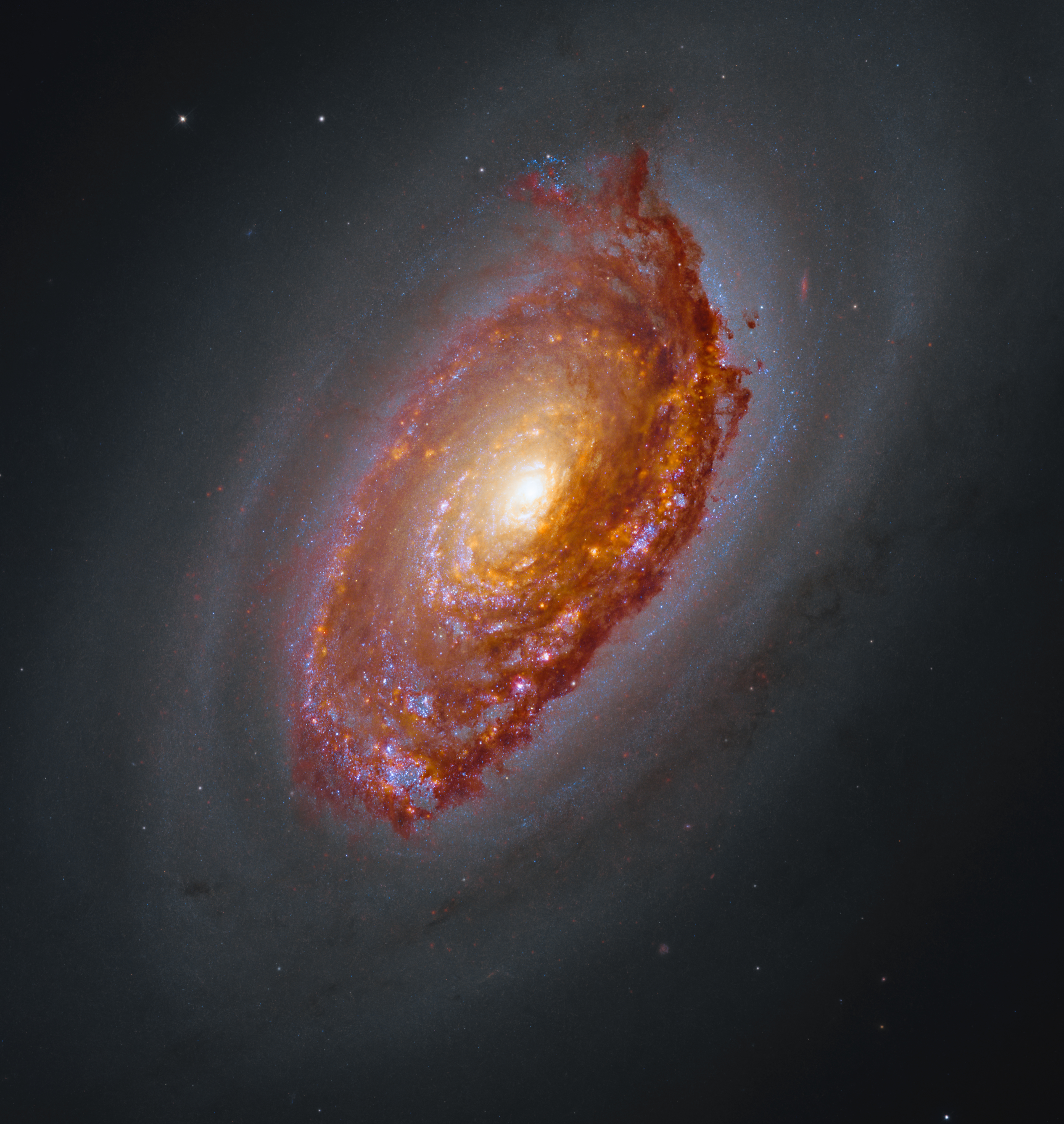
Hubble and Webb image of M64. A massive spiral galaxy glows with a yellow core, surrounded by arms full of orange-brown dust and pink and blue patches of star formation. Framed by a haze of dark dust, the galaxy shines against black space dotted with a few stars.
Easily identified by the spectacular band of dark dust that partially obscures its bright core, Messier 64, or the Black Eye Galaxy, is characterized by its bizarre internal motion.
NASA, CSA, ESA, F. Belfiore (European Southern Observatory – Germany), J. Lee (Space Telescope Science Institute), A. Leroy (The Ohio State University), and D. Thilker (The Johns Hopkins University); Processing: Gladys Kober (NASA/Catholic University of America)

This March 20, 2026, image of Messier 64, or the Black Eye Galaxy, is a composite view from NASA’s Hubble Space Telescope and James Webb Space Telescope. It shows Messier 64 captured at near- and mid-infrared wavelengths by Webb, while Hubble’s image shows the galaxy in ultraviolet, visible, and near-infrared light.

Messier 64 is characterized by its bizarre internal motion. The gas in the outer regions of this spiral galaxy is rotating in the opposite direction from the gas and stars in its inner regions. This strange behavior may be the result of a merger between M64 and a satellite galaxy over a billion years ago.

Image credit: NASA, CSA, ESA, F. Belfiore (European Southern Observatory – Germany), J. Lee (Space Telescope Science Institute), A. Leroy (The Ohio State University), and D. Thilker (The Johns Hopkins University); Processing: Gladys Kober (NASA/Catholic University of America)

The post Black Eye Galaxy appeared first on NASA Science.

Black Eye Galaxy

12 June 2026 at 14:59
Hubble and Webb image of M64. A massive spiral galaxy glows with a yellow core, surrounded by arms full of orange-brown dust and pink and blue patches of star formation. Framed by a haze of dark dust, the galaxy shines against black space dotted with a few stars.
Easily identified by the spectacular band of dark dust that partially obscures its bright core, Messier 64, or the Black Eye Galaxy, is characterized by its bizarre internal motion.
NASA, CSA, ESA, F. Belfiore (European Southern Observatory – Germany), J. Lee (Space Telescope Science Institute), A. Leroy (The Ohio State University), and D. Thilker (The Johns Hopkins University); Processing: Gladys Kober (NASA/Catholic University of America)

This March 20, 2026, image of Messier 64, or the Black Eye Galaxy, is a composite view from NASA’s Hubble Space Telescope and James Webb Space Telescope. It shows Messier 64 captured at near- and mid-infrared wavelengths by Webb, while Hubble’s image shows the galaxy in ultraviolet, visible, and near-infrared light.

Messier 64 is characterized by its bizarre internal motion. The gas in the outer regions of this spiral galaxy is rotating in the opposite direction from the gas and stars in its inner regions. This strange behavior may be the result of a merger between M64 and a satellite galaxy over a billion years ago.

Image credit: NASA, CSA, ESA, F. Belfiore (European Southern Observatory – Germany), J. Lee (Space Telescope Science Institute), A. Leroy (The Ohio State University), and D. Thilker (The Johns Hopkins University); Processing: Gladys Kober (NASA/Catholic University of America)

Hubble Sees Swarm of Galaxies

12 June 2026 at 12:34

2 min read

Hubble Sees Swarm of Galaxies

Numerous galaxies dot the scene and appear to cluster around the image center. The view includes large elliptical galaxies along with spiral and lenticular galaxies. Faint arcs of distant galaxies gravitationally lensed by the cluster appear in the upper-right quadrant of the image. A couple of foreground stars are also visible and easily distinguished by their diffraction spikes.
This NASA Hubble Space Telescope image features the galaxy cluster MACS0329-0211.
NASA, ESA, M. Postman (STScI); Image Processing: G. Kober (NASA/Catholic University of America)

Looking somewhat like a swarm of bees returning to their hive, this NASA Hubble Space Telescope image features the galaxy cluster MACS0329-0211. Galaxy clusters like MACS0329-0211 are important signposts in the story of how the structure of the universe evolved, and are the ultimate telescopic lenses, placing gravitationally lensed galaxies from the earliest stages of the universe into our view.

Zoom into this galaxy swarm and you will find large, oval-shaped elliptical galaxies, and thin spiral and lenticular galaxies viewed from the edge. We can also see the full, face-on view of spiral galaxies and their curving spiral arms. The image’s upper-right quadrant holds faint arcs of distant galaxies gravitationally lensed by the cluster’s massive gravity. The largest of these arcs appears above the bright oval shape of a giant elliptical galaxy. Closer inspection of the image’s center reveals several bright-white intersecting curves that appear as a distorted figure eight. This may be another distant galaxy whose light was magnified and distorted by this massive cluster’s gravity.

Hubble looked at MACS0329-0211 as part of an observing program of X-ray bright galaxy clusters. Researchers used Hubble’s two main cameras, the Advanced Camera for Surveys and its Wide Field Camera 3, to gather data visible and infrared light from the cluster. Hubble’s ability to see such a broad spectrum of light makes it a valuable tool in understanding the very nature of these galaxy clusters.

Media Contact:

Claire Andreoli
NASA’s Goddard Space Flight Center, Greenbelt, MD
claire.andreoli@nasa.gov

Hubble Sees Swarm of Galaxies

12 June 2026 at 12:34

2 min read

Hubble Sees Swarm of Galaxies

Numerous galaxies dot the scene and appear to cluster around the image center. The view includes large elliptical galaxies along with spiral and lenticular galaxies. Faint arcs of distant galaxies gravitationally lensed by the cluster appear in the upper-right quadrant of the image. A couple of foreground stars are also visible and easily distinguished by their diffraction spikes.
This NASA Hubble Space Telescope image features the galaxy cluster MACS0329-0211.
NASA, ESA, M. Postman (STScI); Image Processing: G. Kober (NASA/Catholic University of America)

Looking somewhat like a swarm of bees returning to their hive, this NASA Hubble Space Telescope image features the galaxy cluster MACS0329-0211. Galaxy clusters like MACS0329-0211 are important signposts in the story of how the structure of the universe evolved, and are the ultimate telescopic lenses, placing gravitationally lensed galaxies from the earliest stages of the universe into our view.

Zoom into this galaxy swarm and you will find large, oval-shaped elliptical galaxies, and thin spiral and lenticular galaxies viewed from the edge. We can also see the full, face-on view of spiral galaxies and their curving spiral arms. The image’s upper-right quadrant holds faint arcs of distant galaxies gravitationally lensed by the cluster’s massive gravity. The largest of these arcs appears above the bright oval shape of a giant elliptical galaxy. Closer inspection of the image’s center reveals several bright-white intersecting curves that appear as a distorted figure eight. This may be another distant galaxy whose light was magnified and distorted by this massive cluster’s gravity.

Hubble looked at MACS0329-0211 as part of an observing program of X-ray bright galaxy clusters. Researchers used Hubble’s two main cameras, the Advanced Camera for Surveys and its Wide Field Camera 3, to gather data visible and infrared light from the cluster. Hubble’s ability to see such a broad spectrum of light makes it a valuable tool in understanding the very nature of these galaxy clusters.

Media Contact:

Claire Andreoli
NASA’s Goddard Space Flight Center, Greenbelt, MD
claire.andreoli@nasa.gov

The post Hubble Sees Swarm of Galaxies appeared first on NASA Science.

GSMA reveals growing EU mobile GDP contribution

12 June 2026 at 11:56

The GSMA cautioned European regulations must be aligned to enable the infrastructure investments needed for the mobile industry to maintain steady growth in an already substantial contribution to GDP.

In a statement promoting the release of GSMA Intelligence’s latest regional Mobile Economy report issued ahead of the pending presidency of the European Union (EU) by the Republic of Ireland, the association reiterated concerns over network quality, 5G penetration and a gap in the funding required.

GSMA director general Vivek Badrinath noted the decisions taken during the six-month presidency and beyond “will ultimately determine how well we bolster the foundational role mobile technologies play in modern society”.

Improved mobile capabilities would also help determine “how well-equipped Europe’s digital ecosystem is to grow and compete with leading global markets”, he said.

GSMA Intelligence’s research indicates the mobile sector contributed €1.2 trillion to the EU’s GDP in 2025, up from €1 trillion in 2024.

It forecast the sum could reach €1.6 trillion in 2030, 8.2% of overall GDP compared with 6.1% in 2025.

The industry accounted for 1.3 million direct and 1.1 million indirect jobs at end-2025.

But the GSMA reiterated 5G accounted for 43% of mobile connections at end-2025 and highlighted a potential €270 billion shortfall in future funding needs.

Backing
Politicians and lobbyists said they recognise the importance of mobile connectivity to the Republic of Ireland and Europe as a whole.

The nation’s Minister for Culture, Communications and Sport Patrick O’Donovan said creating conditions which “allow Europe’s digital ecosystem to truly thrive is a high agenda item” during its EU presidency.

He highlighted the importance of getting politicians and industry players together to “ensure opportunities are not missed to drive European competitiveness and growth”.

Nicola Cooke, director of lobby group Ibec’s Telecommunications Industry Ireland, noted the sector is at “an important crossroads” due to pending digital networks and cybersecurity legislation, and vowed to step up efforts to advance investment “in this vital national infrastructure”.

The post GSMA reveals growing EU mobile GDP contribution appeared first on Mobile World Live.

Telecom Italia banks €1B refund on 1998 licence fee

12 June 2026 at 11:31

Telecom Italia (TIM) received a €1 billion payment from the Italian state, refunding a charge from the late 90s the operator has been battling through the courts for years to get back.

The operator paid just over €500 million in a licence fee in 1998 and has been contesting that payment for over 20 years. The final sum awarded to the operator comprises the original amount with inflation and interest added.

In December 2025, the country’s Court of Cassation finally ended a long-running legal row, ratifying a decision made in 2024 to award the sum.

Telecom Italia noted the payment had been flagged in its accounts last year and will “have a net positive impact on the financial position for the current financial year”.

The payment draws a line under what has been a lengthy battle for the operator to get a refund on a fee paid in the wake of the Italian telecoms market being opened-up.

In a statement made in 2024 on the issue, TIM argued courts in Europe had “intervened on this issue on several occasions” with a court in Rome eventually ruling in its favour.

The post Telecom Italia banks €1B refund on 1998 licence fee appeared first on Mobile World Live.

HyImpulse signs letter of intent with Oman’s spaceport

11 June 2026 at 17:43
The maiden flight of the HyImpulse SR75 from the Koonibba Test Range in South Australia in May 2024. Credit: HyImpulse

MILAN — Etlaq Spaceport, Oman’s commercial spaceport, and German-based small launch provider HyImpulse have signed a letter of intent to explore future launch-related activities and a potential operational presence in […]

The post HyImpulse signs letter of intent with Oman’s spaceport appeared first on SpaceNews.

ETSI issues first EU digital wallet specs

11 June 2026 at 14:47

Standards body ETSI proclaimed European digital identity infrastructure as being on the brink of a major transformation due to the release of its first specifications for a regional virtual ID set-up.

ETSI stated 450 million European Union (EU) citizens stand to benefit from the standards for the European Digital Identity Wallet programme, an initiative ultimately intended to act as identity verification and a means of securely sharing a variety of details about a person and their qualifications.

There are more than 24 specifications in ETSI’s first release for the programme and the body stated its technical groups would work on more over the next 18 months.

“Our goal is to make digital interactions across Europe as easy and trustworthy as possible,” Nick Pope, chair of ETSI’s Electronic Signatures and trust infrastructures committee said.

He explained ETSI has a “long expertise in electronic signatures, cybersecurity and trust data management”.

ETSI explained the EU is working to simplify access to online services by enabling single sign-on in place of multiple passwords. People will be able to “store and manage official digital documents, share verified information such as diplomas or licenses and sign documents with legally binding electronic signatures”.

As such, it’s initial batch of standards cover attestation profiles, policies for certification and so-called “trust list formats”.

Protocols for remote signatures, proving identity and data storage are also included.

The EU hopes the digital wallet system will simplify access to government services, healthcare, banking, travel and education.

The post ETSI issues first EU digital wallet specs appeared first on Mobile World Live.

After the launch: Why Europe’s space ambitions depend on what comes next

10 June 2026 at 12:00
An illustration of Orbit Guard satellites. Credit: Infinite Orbits

Satellites have become essential infrastructure. Financial markets rely on their timing signals. Military operations depend on their communications and surveillance. Navigation, disaster response, logistics, climate monitoring, most systems that underpin […]

The post After the launch: Why Europe’s space ambitions depend on what comes next appeared first on SpaceNews.

Vodafone explores Greek FTTH JV

10 June 2026 at 10:45

Vodafone Greece commenced early-stage talks about going Dutch on a fibre-to-the-home (FTTH) venture with utility PPC Group, a combination with the potential to pass almost 2.5 million homes.

The head of terms discussion over the 50:50 joint venture also involves the companies’ respective wholesale fibre operations. Vodafone explained any combined business would provide open access to ISPs.

PPC stated the FTTH network of the subsidiary in line for the combination currently passes 1.9 million households and Vodafone’s 550,000.

Alexandros Paterakis, vice chair of the PPC FiberGrid unit and deputy CEO for digital services at the group, said any tie-up would create a “leading digital network infrastructure in Greece”, along with advancing various of the company’s strategic goals.

For Vodafone, any agreement would “substantially accelerate the development of our fibre network” CEO Achilleas Kanaris said.

He added Greece is strategically important to Vodafone Group as a whole and explained the unit is focused on expanding its footprint, shifting from “copper to fibre” and contributing to “national digital coverage objectives”.

The companies emphasised no binding commitments had been made and they are yet to embark on due diligence processes, though indicated intentions to do so with a view to signing binding agreements.

The post Vodafone explores Greek FTTH JV appeared first on Mobile World Live.

Il telescopio spaziale James Webb sta offrendo una visione senza precedenti…

9 June 2026 at 21:33
Il telescopio spaziale James Webb sta offrendo una visione senza precedenti dell’universo primordiale grazie alla sua capacità di osservare la luce infrarossa proveniente da oggetti estremamente lontani. Tra le sue scoperte più sorprendenti figurano galassie molto luminose e apparentemente mature esistite poche centinaia di milioni di anni dopo il Big Bang. Queste osservazioni hanno acceso un intenso dibattito scientifico, poiché suggeriscono che la crescita delle prime strutture cosmiche potrebbe essere avvenuta più rapidamente del previsto. Sebbene analisi successive abbiano ridimensionato alcune delle stime iniziali, Webb continua a fornire dati che stanno portando gli astronomi a perfezionare le teorie sulla formazione delle galassie, dei buchi neri supermassicci e dell’universo delle origini.

Spanish Cave Sanctuary Reveals More Than 11,500 Years of Activity

9 June 2026 at 19:46
Sala Keimada, a chamber of Cueva Palomera in Burgos, Spain. Image credit: Ortega-Martínez et al., doi: 10.1016/j.jasrep.2026.105818.

New radiocarbon dates from Sala Keimada, a hard-to-reach chamber of Cueva Palomera in the province of Burgos, northern Spain, suggest that generations of people returned to the sacred space from the end of the Ice Age through the Iron Age, leaving behind art, structures and offerings.

The post Spanish Cave Sanctuary Reveals More Than 11,500 Years of Activity appeared first on Sci.News: Breaking Science News.

Tesla ‘FSD’ approved in Denmark, 4th European country in 2 months

9 June 2026 at 17:07

Denmark has provisionally approved Tesla’s “Full Self-Driving” (Supervised) system, making it the fourth European country to clear the software in roughly eight weeks.

The Danish Road Traffic Authority, Færdselsstyrelsen, confirmed the decision today — notably after Denmark had previously raised concerns about the technology at the EU level.

❌