Little Red Dots | Primordial Black Holes or Big Bang Failures?


![]()
Editor’s Note: Astrobites is a graduate-student-run organization that digests astrophysical literature for undergraduate students. As part of the partnership between the AAS and astrobites, we occasionally repost astrobites content here at AAS Nova. We hope you enjoy this post from astrobites; the original can be viewed at astrobites.org.
Title: The X-Ray Dot: Exotic Dust or a Late-Stage Little Red Dot?
Authors: Raphael E. Hviding et al.
First Author’s Institution: Max Planck Institute for Astronomy
Status: Published in ApJL
One of the most intriguing results produced by JWST was the serendipitous discovery of a new class of object: “little red dots” (LRDs). These objects started popping up everywhere in our early universe observations. Surprisingly, they look like compact (little) red dots in imaging data (astronomers are an incredibly creative bunch). The number of LRDs we observe drops drastically at redshifts less than about z = 4 (about 12 billion years ago), implying that LRDs are likely evolving into something else entirely. The luminous, compact nature of LRDs, paired with their disappearance from the cosmic stage, has continuously puzzled astronomers in recent years.
At least part of the LRD population has routinely been explained as a new class of active galactic nuclei (AGN). AGN are the central engines of many galaxies — luminous regions powered by actively accreting supermassive black holes. Recent evidence has increasingly pointed towards LRDs being a new class of AGN: black hole stars, or black holes surrounded by dense cocoons of gas. Naturally, this raises questions surrounding the placement of LRDs in our understanding of supermassive black hole and galaxy evolution across cosmic time.
A hallmark of typical AGNs is their X-ray brightness. X-rays are one of the most energetic types of electromagnetic radiation, and they are primarily produced by the most extreme astrophysical situations (think neutron star mergers). One of the key challenges in explaining the nature of LRDs has been their lack of X-ray emission. Their lack of emission in this regime is a piece of evidence pointing towards a black hole star scenario — dense gas can block the X-rays being produced by the black hole. However, the lack of LRDs in the present-day universe implies that they likely shed their cocoons at some point. Catching an LRD in the act of shedding its cocoon would thus provide an important piece of evidence surrounding their nature and evolution. Thankfully, today’s authors may have done exactly that! They report the discovery of what they call the “X-ray dot” (XRD): an LRD-like object that is also X-ray luminous at a redshift of approximately z = 3.28.
While archival observations of the XRD with the Hubble Space Telescope, the Canada France Hawaii Telescope, the Spitzer Space Telescope, and the Chandra X-ray Observatory existed, new spectral data from JWST were needed to study the system in depth. Spectral data have a huge advantage over photometric observations when it comes to modeling the system. With a good quality spectrum, astronomers can use sophisticated modeling tools to try and pin down the physical nature of the emission we’re observing, and thus understand its intrinsic nature.
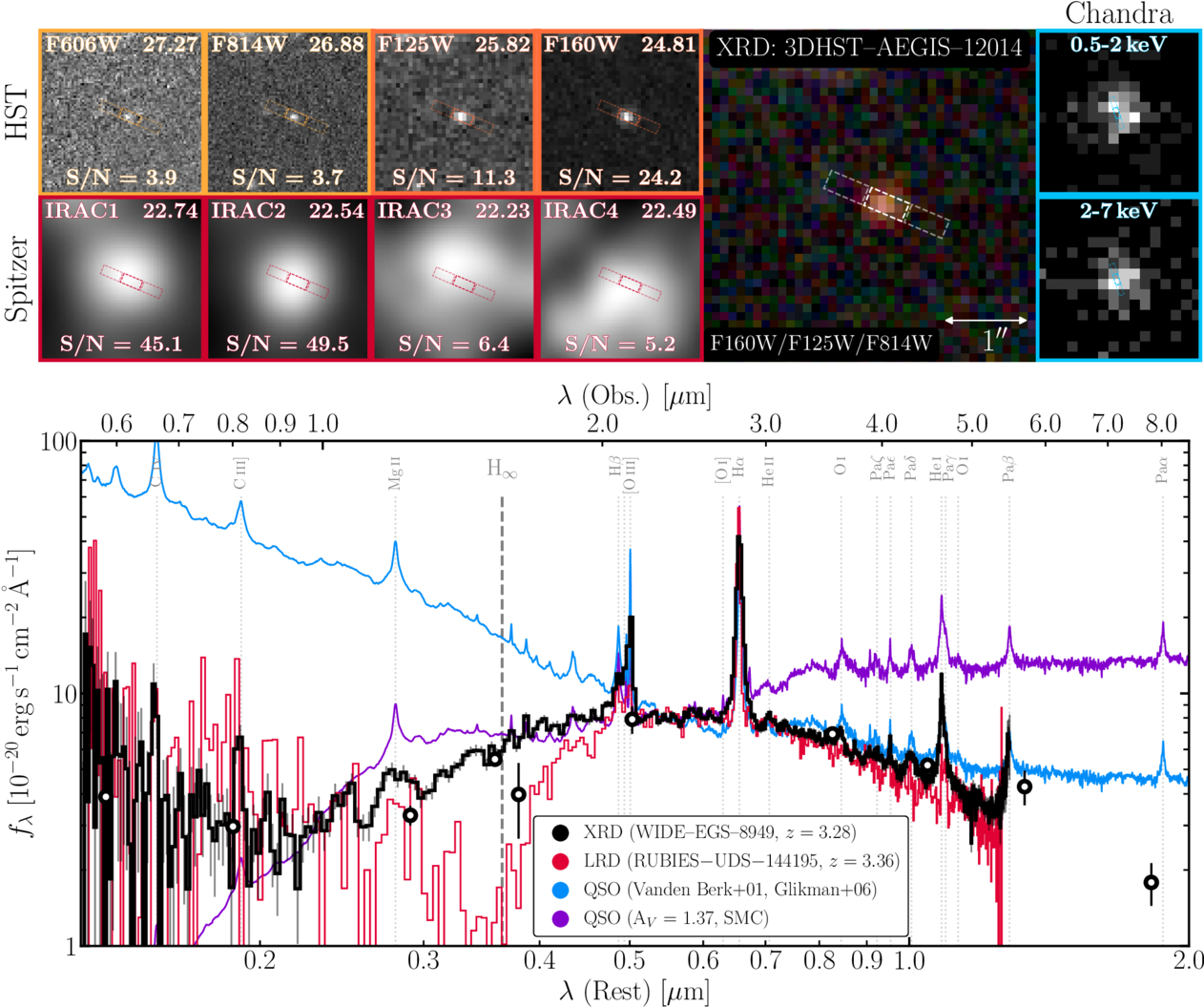
Figure 1 showcases the archival data from Hubble, Spitzer, and Chandra, along with the XRD’s spectrum from JWST (black curve, bottom panel). Photometric observations of the source indicate that it is incredibly compact (radius ≲ 250 pc, about 100 times more compact than the Milky Way) and shows similarities to LRD spectra, but with some key differences. (An example LRD spectrum is shown as the red curve in Figure 1.) The impressive X-ray luminosity of the XRD — typical of standard AGNs — is another key difference between it and standard LRDs.
Figure 1: Top: Image cutouts from various Hubble, Spitzer, and Chandra observations of the XRD. Bottom: The spectrum of the XRD (black) shown alongside a similar LRD spectrum (red) and two quasar spectra (blue and purple), one of which has been reddened due to the presence of dust (purple). [Hviding et al. 2026]
To understand the nature of the XRD, the authors fit a variety of models describing a wide range of physical systems to the available data. Surprisingly, their best-fit models indicate that if the XRD is simply a typical AGN heavily obscured by astrophysical dust, its dust properties are drastically different from those of typical galaxies and AGN. Instead, trying to explain the system as an AGN embedded in a cocoon of gas (the black hole star model) provides better results (more aligned with observed LRDs), but it still isn’t perfect.
Notably, the emission in the ultraviolet-to-optical regime of the electromagnetic spectrum differs greatly from that of LRDs. In LRDs, this emission is indicative of a single dense gas component around the supermassive black hole, while in the XRD the authors find evidence suggestive of a patchier, less uniform distribution of gas. However, in order for this explanation to match the data, physical conditions of the model must be finely tuned, suggesting that this model may need to be refined further. These factors seem to suggest that the XRD is poorly understood in the context of our current paradigm of models describing AGNs and LRDs. The potentially patchy nature of the XRD’s gas envelope could suggest that this object is an LRD in the process of shedding its outer envelope, evolving into a typical AGN.
Regardless of its true nature, the XRD opens up new doors in our understanding of AGNs and LRDs. It provides an exciting glimpse at AGN evolution in action — a transitional fossil for early universe black holes. With a new piece of the puzzle slotted into our picture of AGN evolution, it’s only a matter of time before astronomers fully contextualize the stubbornly enigmatic LRDs.
Original astrobite edited by Ansh R. Gupta.
About the author, Drew Lapeer:
Drew is a first-year PhD student at the University of Massachusetts Amherst. They are broadly interested in the evolution of galaxies, with a focus on the impact of cosmic feedback on the galactic ecosystem. In their free time, they enjoy reading, rock climbing, hiking, and baking!
The post A Potential New Piece of the “Little Red Dot” Puzzle appeared first on AAS Nova.
![]()
JWST has uncovered a peculiar population of very distant objects known as “little red dots.” The mechanisms powering these objects’ peculiar properties — high luminosities, compact radii, and “V”-shaped spectra — remain uncertain. Could little red dots be the result of supermassive stars, galaxy mergers, or, as a recent study explores, black hole stars?
Since their discovery, little red dots have been the subject of many studies, but a complete explanation for their unique combination of properties remains elusive. Multiple studies have explored the growing population of peculiar dots, with some postulating that they are the result of stars thousands of times the mass of the Sun, supermassive stars entrenched in gas from a galaxy merger, or black holes embedded in dense accretion disks.
Even more recently, studies have proposed that little red dots may be the remnants of direct-collapse black holes. In this scenario, a large cloud of gas in the early universe directly collapses into a stellar-mass black hole, and the remaining gas envelops the black hole, forming what is known as a quasi-star (or black hole star). Researchers have suggested that little red dots may be the late stage of this process when the black hole has accreted at least 10% of the total mass of the system. Direct comparisons between quasi-star evolutionary models and JWST observations of little red dots have yet to be explored but are necessary to confirm the potential of quasi-star origins.
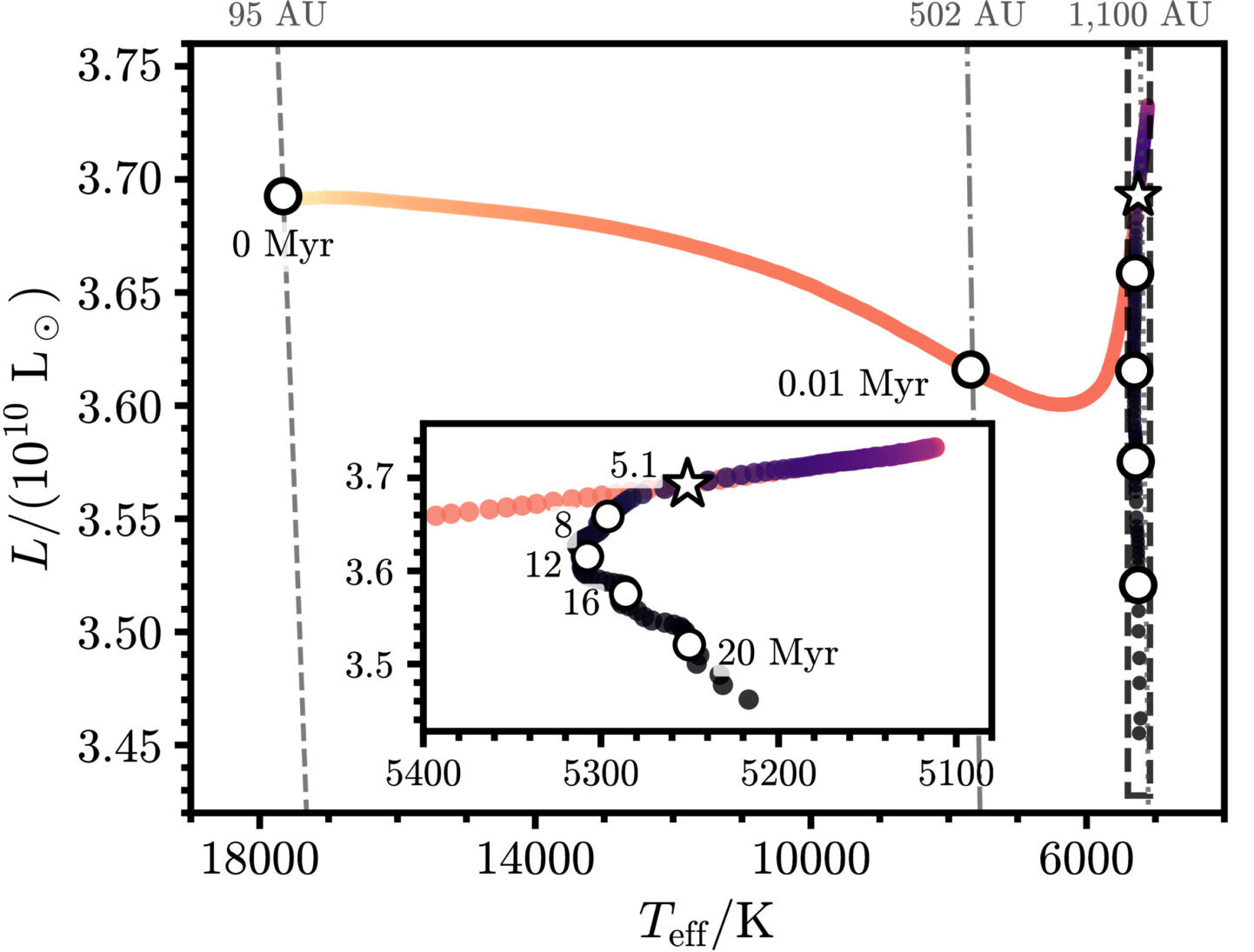
Evolution of a theoretical quasi-star model on a Hertzsprung–Russell diagram. [Modified from Santarelli et al 2026]
After a short initial phase of contraction lasting around 10,000 years, the quasi-star spends the rest of its approximately 20–40-million-year lifetime in the “late stage” as the central black hole continues to eat up the surrounding envelope. In the end, the quasi-star becomes a supermassive black hole a million times the mass of the Sun.
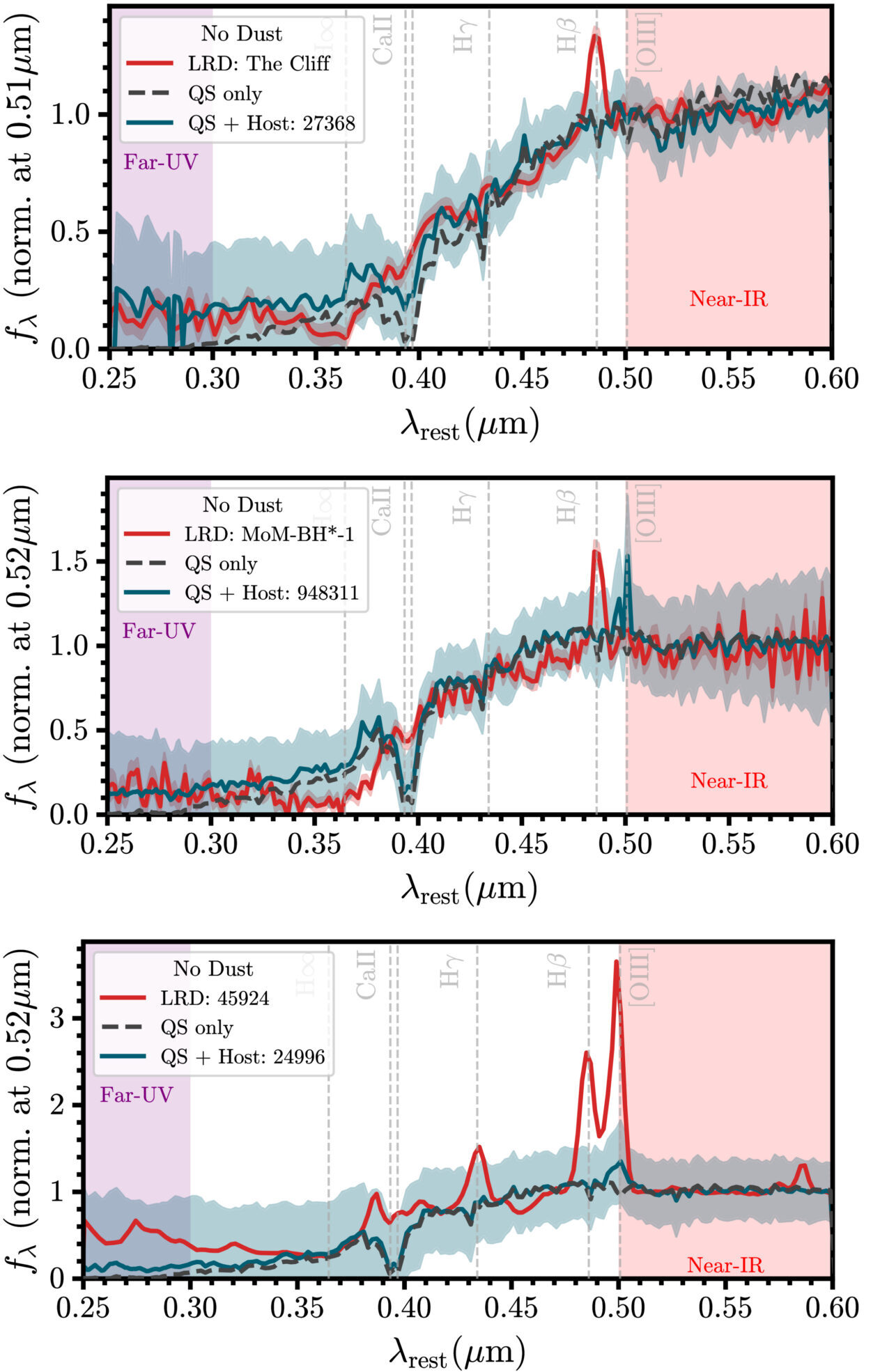
Predicted spectral energy distributions of 1 million solar mass, late-stage quasi-stars both alone (black dashed line) and embedded in a host galaxy (solid blue line). Each panel compares the quasi-star to a little red dot observed by JWST. [Modified from Santarelli 2026]
The results of this study indicate that late-stage quasi-stars can naturally produce the defining continuum features of little red dot spectra. While further modeling is required to trace specific emission line features, the initial modeling presented in this study establishes quasi-stars as plausible progenitors of not only little red dots but also the universe’s first supermassive black holes.
As the authors noted, the short lifetimes of quasi-stars shown in their models in conjunction with the observed number density of little red dots implies that a significant fraction of supermassive black holes formed through this mechanism. Continued observations of little red dots and advanced modeling of direct-collapse black holes will aid in determining if these peculiar dots are showing off the birth of supermassive black holes in the universe.
“Evolutionary Tracks and Spectral Properties of Quasi-stars and Their Correlation with Little Red Dots,” Andrew D. Santarelli et al 2026 ApJL 998 L4. doi:10.3847/2041-8213/ae3713
The post Starring in the Early Universe: Black Hole Stars and Little Red Dots appeared first on AAS Nova.
![]()
New research suggests that the mysterious “little red dots” spotted in the early universe could be supermassive black holes birthed in the collapse of dark matter halos.
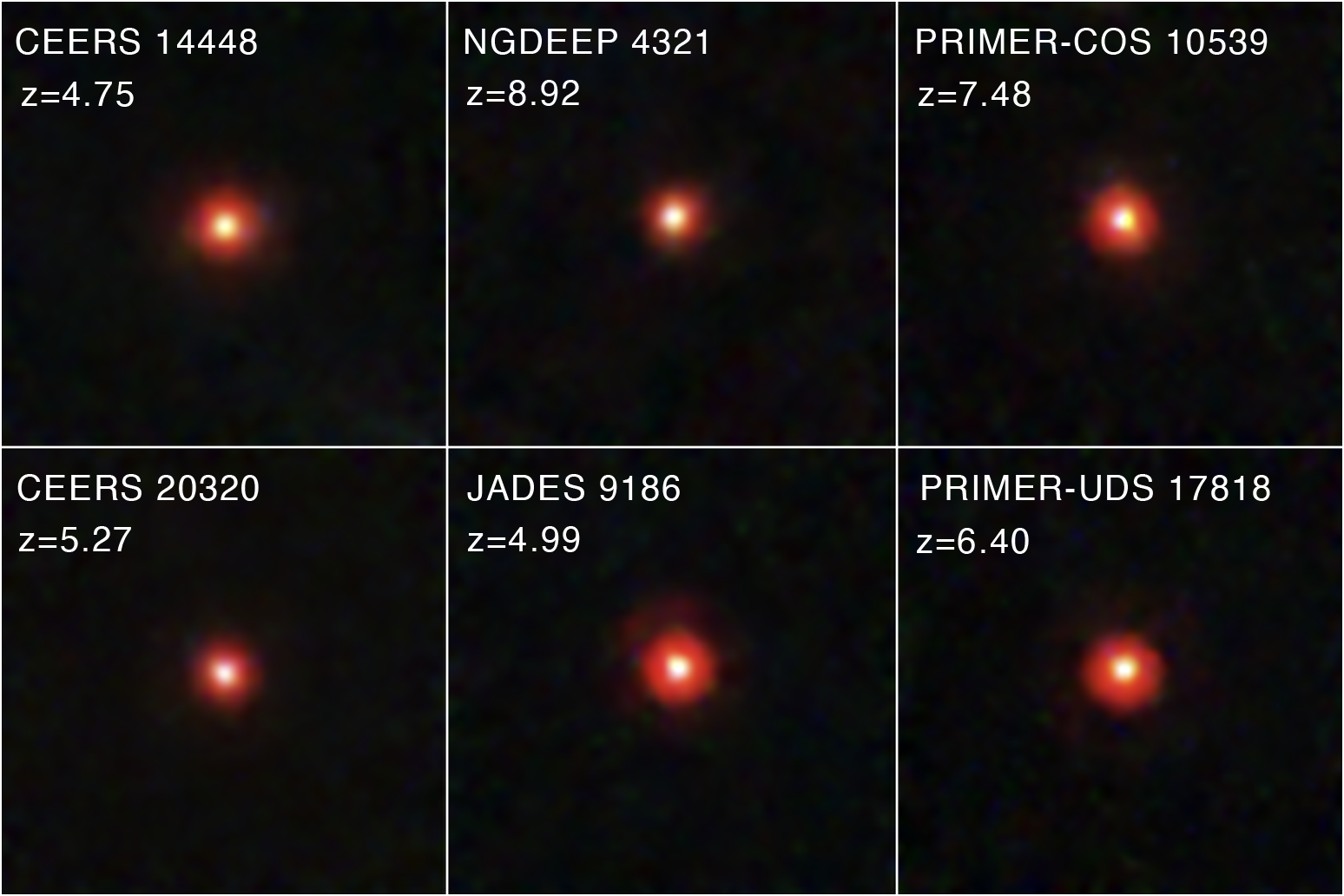
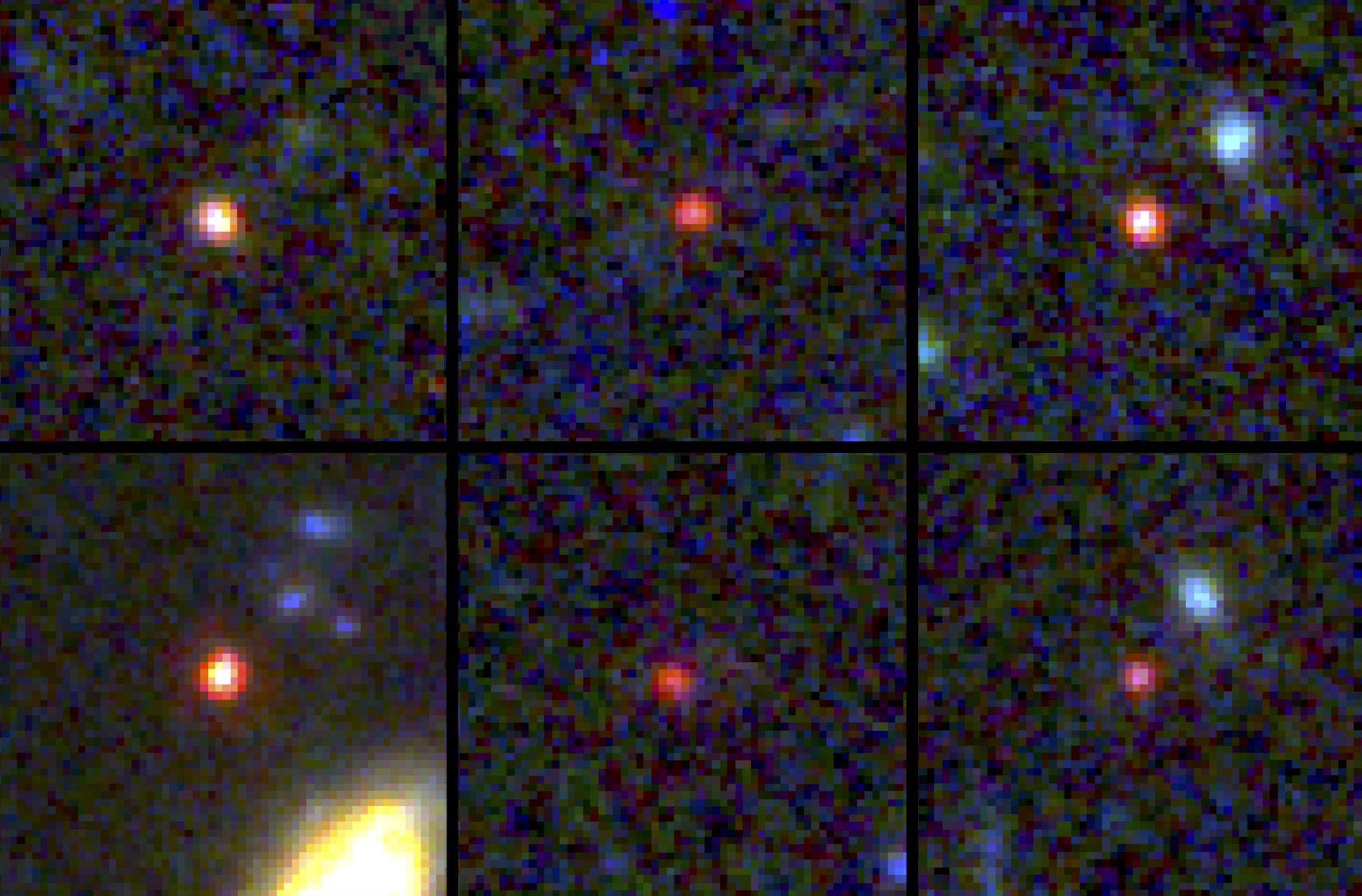
JWST images of six very distant galaxies dubbed “little red dots.” [NASA, ESA, CSA, STScI, Dale Kocevski (Colby College)]
A recent research article explores that theory, with a twist: that the black holes at the heart of little red dots were born not out of regular, baryonic matter, but out of dark matter.
In the early days of the universe, tiny fluctuations in the density of dark matter began to grow, eventually collapsing into vast spheroidal structures called dark matter halos. In the leading theory of cosmology, ΛCDM, dark matter interacts with itself and normal matter only through gravity. This leads to the creation of stable dark matter halos that act as the invisible scaffolding within which the first stars and galaxies grow.
In today’s article, Fangzhou Jiang (Peking University) and collaborators investigated the evolution of halos containing self-interacting dark matter. Particles of self-interacting dark matter, as the name suggests, can interact with one another through collisions and exchange heat. This small adjustment, sometimes invoked in alternatives to ΛCDM to explain the properties of dwarf galaxies, can lead to the collapse of dark matter halos into black holes.
Jiang and coauthors examined whether this process could explain the observed population of little red dots. First, the team examined whether the timescales are feasible: is it possible for dark matter to assemble itself into massive halos and collapse into black holes, all within the first billion years of the universe?
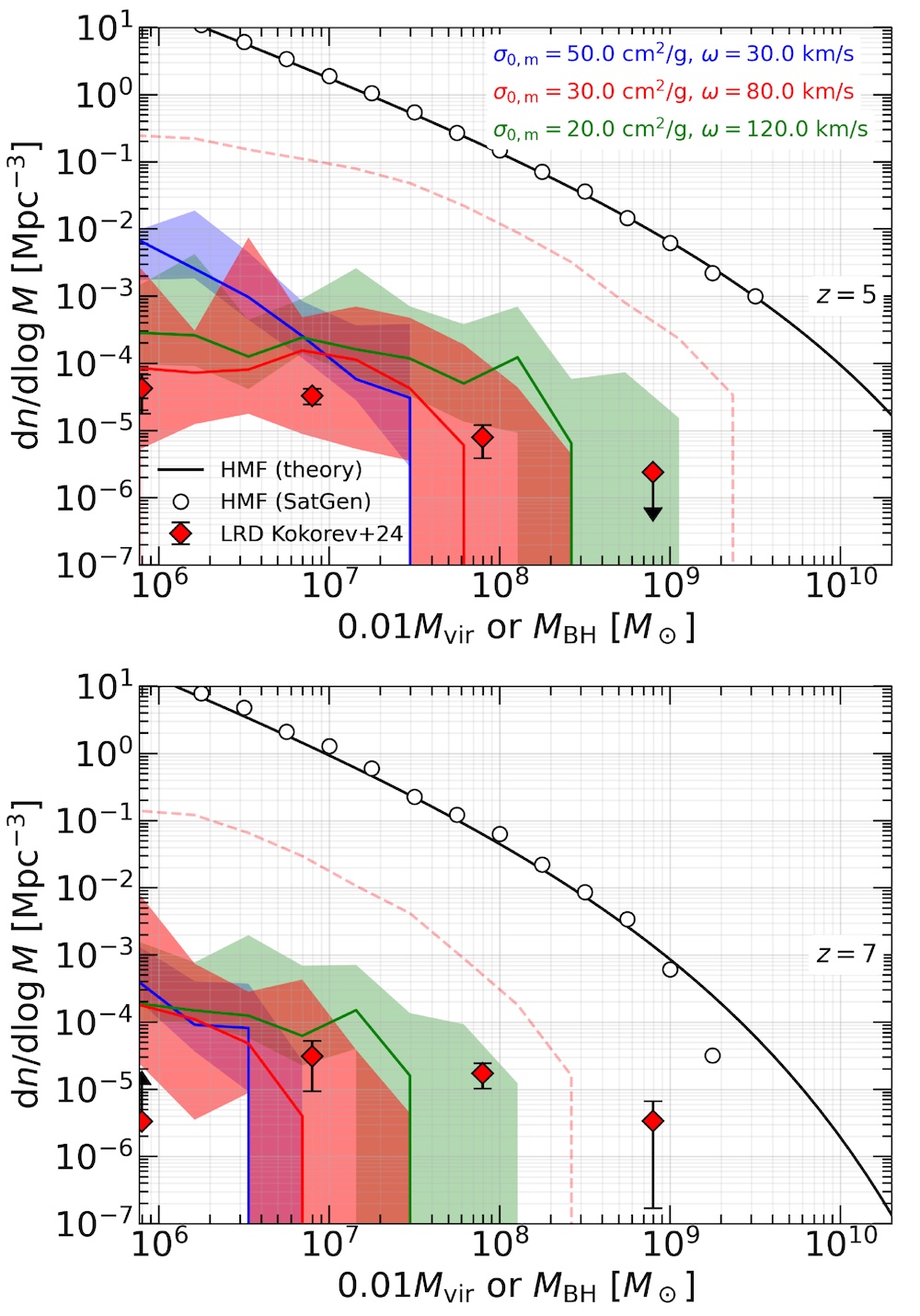
The answer appears to be yes — in this framework, dark matter halos with masses between 106.5 and 108.5 solar masses were able to form black holes between 104.5 and 106.5 solar masses by a redshift of z = 8.5, when the universe was just 600 million years old.
Comparison of the inferred black hole population in little red dots (red diamonds) to models of black holes formed in dark matter halo collapse (shaded areas) at two redshifts. The red area shows the fiducial model, while the blue and green areas show the effects of changing the dark matter self-interaction cross-section. The dashed red lines show an extreme case in which the presence of baryons accelerates halo collapse. Click to enlarge. [Jiang et al. 2026]
To close, Jiang and collaborators noted that this process is not mutually exclusive with other black hole seeding mechanisms, and as studies of self-interacting dark matter continue, its ability to create black holes in the early universe should be examined further.
“Formation of the Little Red Dots from the Core Collapse of Self-Interacting Dark Matter Halos,” Fangzhou Jiang et al 2026 ApJL 996 L19. doi:10.3847/2041-8213/ae247a
The post A Dark Matter Origin for Little Red Dots appeared first on AAS Nova.
![]()
Editor’s Note: Astrobites is a graduate-student-run organization that digests astrophysical literature for undergraduate students. As part of the partnership between the AAS and astrobites, we occasionally repost astrobites content here at AAS Nova. We hope you enjoy this post from astrobites; the original can be viewed at astrobites.org.
Title: The Discovery of Little Red Dots in the Local Universe: Signatures of Cool Gas Envelopes
Authors: Xiaojing Lin et al.
First Author’s Institution: Tsinghua University and University of Arizona
Status: Published in ApJ
Astronomers are using JWST to search the early universe for strange and captivating objects, and the results so far have exceeded all expectations. For every question we definitively answer, several deeper ones seem to emerge. The study of active galactic nuclei (AGNs), black holes that are actively consuming matter at the centers of galaxies across the universe, is no exception. Our pre-JWST understanding of AGNs has been completely shattered by the discovery of an astounding population of objects called little red dots (LRDs).
We know these objects host active black holes for several reasons. For one, they’re incredibly small despite being extremely energetic (that’s the “little” in their name). The smallest LRD we’ve seen appears to be less than 100 light-years across — for reference, the nearest star to the Sun is 4 light-years away — and yet is still as bright as a galaxy. The most plausible explanation for such brightness and compactness is a supermassive black hole that’s actively consuming matter. As further evidence for this hypothesis, we observe broad Balmer emission lines, spectral features that serve as a clear signature of AGN activity, in the vast majority of LRDs.
However, that’s where the similarities between LRDs and more typical AGNs seem to end. First off, astronomers have been unable to detect any significant X-ray emission from LRDs. This is shocking, since X-rays are a telltale signature of previously known AGNs. Another classic way to identify AGNs is by looking for changes in their brightness over time, since they can show drastic variability in their emission on the scale of years or even days. LRDs buck the trend by showing little to no fluctuation. Other classic AGN signatures that LRDs lack include radio emission and an abundance of hot dust. Explaining all of these unusual features has been incredibly challenging; nevertheless, coming up with a solution is crucial because there appear to be orders of magnitude more LRDs than any other kind of AGN in the early universe!
One leading explanation for LRDs has recently gained significant traction. The hypothesis suggests that early black holes may have been cocooned in shrouds of extremely dense gas. This scenario helps explain the absence of many typical AGN signatures in LRDs. For example, this dense gas could absorb the X-rays generated by the central black hole. The gas-enshrouded model also explains a particular feature in the spectra of many LRDs known as a Balmer break. This feature is usually interpreted as coming from old stars with relatively cool atmospheres. The cocooned AGN hypothesis implies that Balmer breaks could actually be made by a black hole embedded in a cloud of gas, which somewhat resembles an enormous star!
This model helps explain the properties of some puzzling LRDs, including the most distant one we currently know of. However, their enormous distance makes them difficult to study in detail. It would be much easier to examine LRDs if they existed in the nearby universe, since they would appear much brighter and we could probe them on small spatial scales. Unfortunately, previous studies with JWST suggest that LRDs started becoming a lot less common around 12 billion years ago (corresponding to a redshift of about z = 4).
Luckily, less common doesn’t mean extinct! The authors of today’s article leverage data from the Sloan Digital Sky Survey (SDSS), which has taken millions of spectra of objects across the night sky over the past few decades. By mining this rich and diverse dataset, they identify a handful of LRDs in the nearby universe. Although they’re still far beyond our own Local Group, they’re practically in our backyard compared to the distant LRDs we’ve seen before. The authors followed up the new sources with some of the most powerful ground-based telescopes, enabling a detailed study of their properties.
The first major result is that these local LRDs really do resemble many of the distant ones identified by JWST. They show a characteristic “V”-shaped spectrum in the ultraviolet and visible, a key feature in the definition of LRDs. They’re also quite compact. Using existing data from the Hubble Space Telescope, the authors measured the size of one source and found a tiny core embedded within a galaxy only a few thousand light-years across. For comparison, the Milky Way spans about 100,000 light-years.
Using spectroscopy from the Large Binocular Telescope, one of the Magellan Telescopes, and the MMT (formerly Multiple Mirror Telescope), the authors of this article find a rich variety of spectral features. This is where the proximity of these objects is extremely important. Taking spectra of the distant LRDs in this astounding level of detail would be at best prohibitively expensive (multiple full days of JWST observations) and at worst be completely impossible. In contrast, the nearby LRDs appear much brighter than their distant cousins. Their spectra are like intricate tapestries, with each thread revealing new details about their properties.
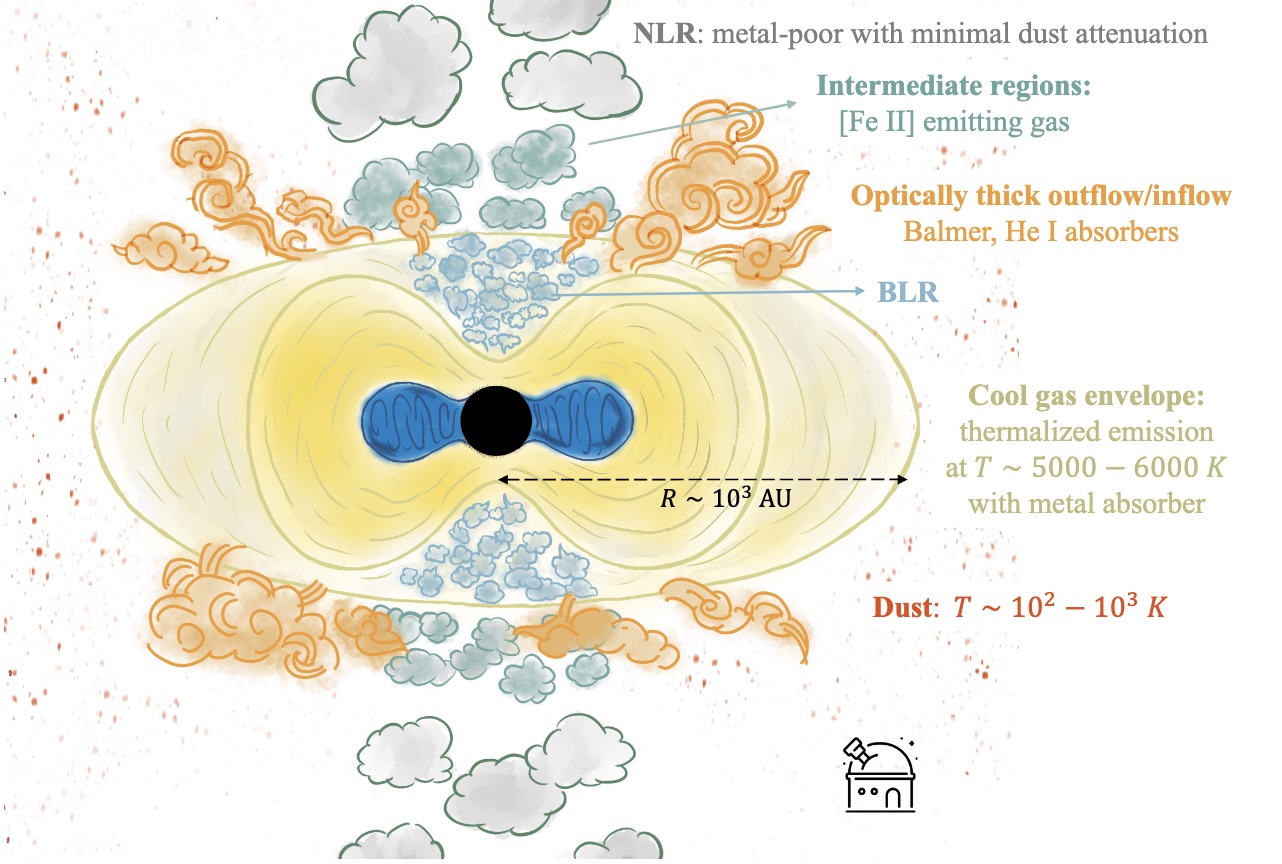
The authors find numerous broadened emission lines, signaling the presence of an active black hole. They also detect several intriguing absorption lines. These are most striking in one source, J1025+1402, nicknamed “The Egg.” In this object, there are clear absorption features from sodium, potassium, iron, and calcium. These elements appear in the observed states only under specific physical conditions. The authors interpret these findings as implying the presence of an envelope of cool gas surrounding the central black hole (see Figure 1). Such a scenario closely resembles the gas-cocooned AGN model proposed to explain distant LRDs!
Figure 1: A schematic showing the authors’ interpretation of the nature of LRDs. This scenario is built up based on spectroscopic observations from several ground-based telescopes. Although the local sources differ slightly from the ones in the early universe, this model is strikingly similar to the ones invoked to explain some of the most extreme LRDs. The fact that such objects exist in the nearby universe is intriguing and raises further questions as to how black holes enter such a phase. [Lin et al. 2026]
Original astrobite edited by Niloofar Sharei.
About the author, Ansh Gupta:
I’m an astronomy graduate student at the University of Texas at Austin working with Steven Finkelstein. I use data from JWST to study the formation and growth of the first galaxies and black holes in the universe. In my spare time, I enjoy playing piano, reading, and making YouTube videos.
The post A Black Hole Egg That Forgot to Hatch appeared first on AAS Nova.

![]()
Among the discoveries JWST has made since its 2021 launch, “little red dots” are one of the most perplexing. Named for their compact size and red color, the origins of these distant galaxies remain unknown. A recent article explores some little red dots’ spectral energy distributions and local environments to better understand what may be lighting up these tiny torches.
Along with their size and color, little red dots exhibit “V”-shaped spectral energy distributions (how they emit light across wavelengths), broad hydrogen emission lines, and no observed X-ray emission. These properties land them in an untapped parameter space with some similarities to both active galactic nuclei (AGNs) and stellar populations. Some previous investigations have suggested that little red dots contain AGNs, reddened by a dusty accretion disk scattering or blocking AGN light. Other studies have found that models for stellar populations can also fit certain little red dot spectra well.
Adding to the ambiguity, observations and theory predict AGNs to show broad spectral lines, which are present in little red dots — but if little red dots are AGNs, this implies a much higher density of AGNs in the early universe than previously predicted by ground-based surveys. Furthermore, AGNs are expected to emit in the X-ray and show photometric variability, but neither property has been detected definitively thus far for a little red dot. With a clear dilemma arising for the origins of little red dots, astronomers are still prodding at these curious sources.
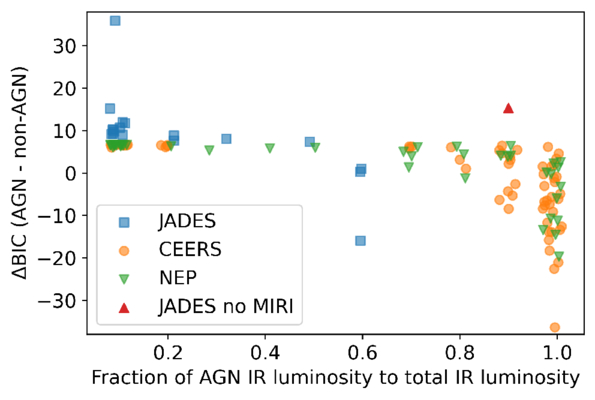
Comparison of AGN versus non-AGN fits using the Bayesian information criterion (BIC). Positive values of ΔBIC favor a non-AGN fit, and ~70% of little red dots have positive ΔBIC. Click to enlarge. [Carranza-Escudero et al 2025]
Using a robust statistical analysis, the authors found that AGN models tend to “overfit” the data — with more free parameters, an AGN model can be tweaked in a way that may not actually be physical (e.g., fitting for extremely high dust extinction that would not be possible). Instead, models without AGN components appear to be more appropriate for about 70% of the little red dots in their sample, suggesting that these peculiar objects may have a significant star-forming component powering their emission.
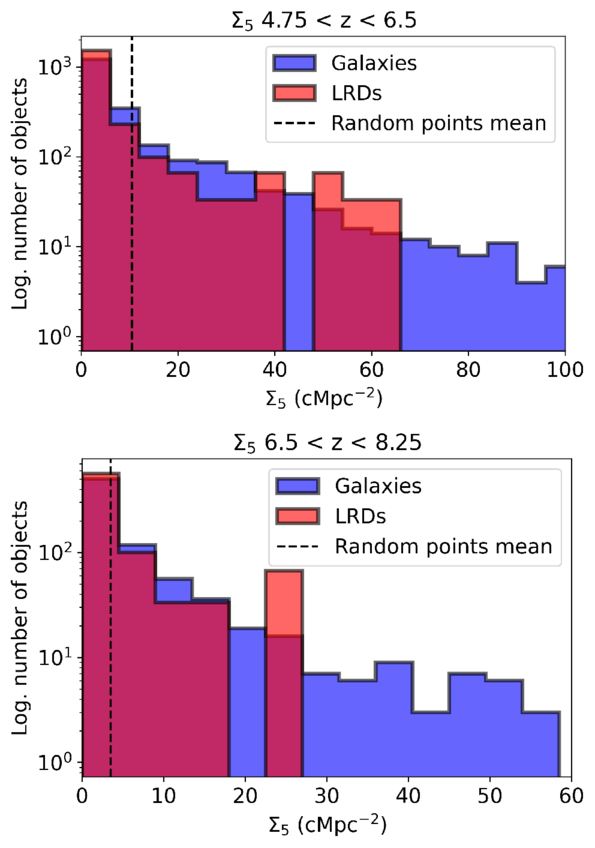
Histograms for two redshift windows showing that little red dots (red) tend to be found in less dense environments than other galaxies (blue) in the same redshift window. Click to enlarge. [Carranza-Escudero et al 2025]
In addition to characterizing little red dots’ emission, the authors analyzed the local environments to compare to other galaxies at similar redshifts. From their analysis, they found that little red dots tend to be found in sparser environments, generally isolated from other galaxies. One explanation for this could be that little red dots in higher-density environments evolve past this peculiar stage faster, which is supported by observations of high-density environments accelerating the evolution of other galaxy types at similar redshifts. However, further investigation is required to better understand the connection between the local environment and little red dot properties.
More little red dots are yet to be discovered, and continued analysis of their emission and environments will uncover more intriguing characteristics. For now, it seems as though little red dots are still a mystery.
“Lonely Little Red Dots: Challenges to the Active Galactic Nucleus Nature of Little Red Dots through Their Clustering and Spectral Energy Distributions,” María Carranza-Escudero et al 2025 ApJL 989 L50. doi:10.3847/2041-8213/adf73d
The post All Alone With No AGN to Call Home? New Results for Little Red Dots appeared first on AAS Nova.
![]()
Astronomers have confirmed the discovery of a little red dot galaxy from when the universe was roughly half a billion years old. The galaxy, CAPERS-LRD-z9, is the most distant object to show the tell-tale broad emission lines of gas spiraling around a black hole, opening a new window onto black hole growth in the early universe.
Images of six “little red dot” galaxies from JWST. [NASA/ESA/CSA/I. Labbe]
But what are little red dots? Are they growing supermassive black holes busily amassing gas? Compact collections of old stars? Shredded stars spoon-feeding baby black holes? As reported today in the Astrophysical Journal Letters, new JWST data provide answers for one particularly distant dot.
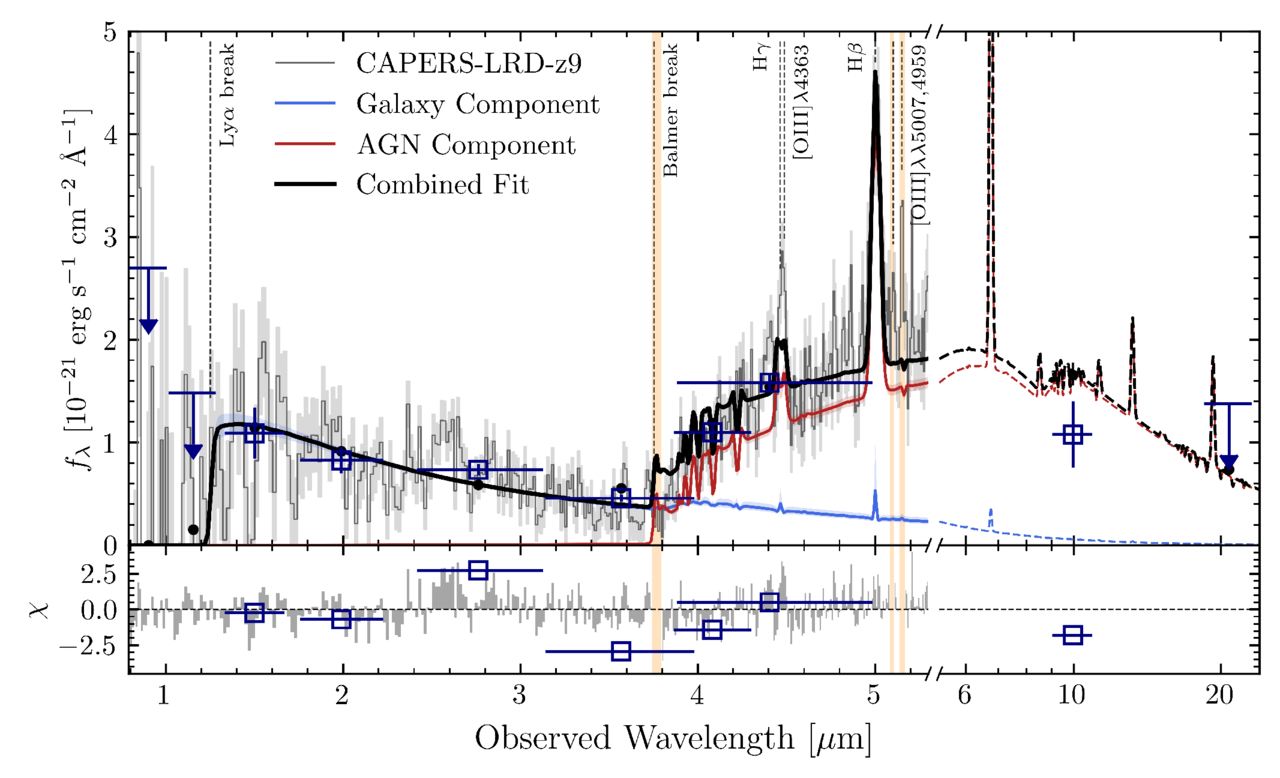
CAPERS-LRD-z9 was first identified as a possible high-redshift little red dot when it was observed by the Public Release IMaging for Extragalactic Research (PRIMER) survey with JWST’s Near-Infrared Camera (NIRCam). Anthony Taylor (The University of Texas at Austin) and collaborators followed up on the discovery with JWST Near-Infrared Spectrograph (NIRSpec) observations from the CANDELS-Area Prism Epoch of Reionization Survey (CAPERS). This spectrum pinned the object’s redshift at z = 9.288, corresponding to when the universe was only about half a billion years old.
With CAPERS-LRD-z9 placed along the cosmic timeline, Taylor and coauthors turned to the question of its identity. The JWST spectra revealed a broad emission line from hydrogen gas moving at thousands of kilometers per second — evidence that CAPERS-LRD-z9 harbors an accreting supermassive black hole (an active galactic nucleus or AGN) that is spinning gas into a frenzy around it. CAPERS-LRD-z9 is the most distant object known to show this characteristic signature of a growing black hole.
JWST NIRSpec spectrum of CAPERS-LRD-z9 with the fit from the AGN (red) plus stars (blue) model. Click to enlarge. [Taylor et al. 2025]
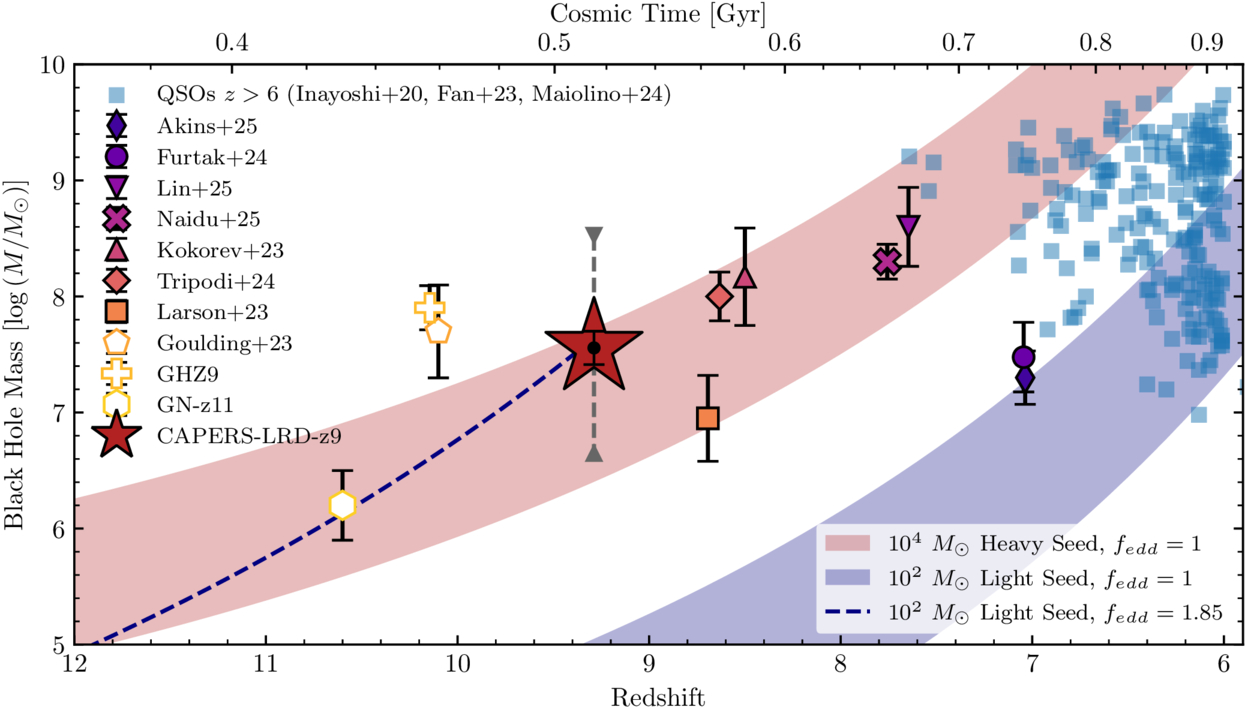
Observed black hole masses and redshifts of several sources, including CAPERS-LRD-z9 (large red star), quasars at redshifts of z > 6 (blue squares), massive spectroscopically confirmed AGN with broad emission lines (filled symbols), and the highest-redshift AGN detected to date via X-ray or ultraviolet emission. The shaded areas show the black hole masses achievable through accretion at the Eddington rate onto a massive (red) or stellar-mass (purple) seed. Click to enlarge. [Taylor et al. 2025]
This finding raises the question of how a black hole can grow to millions of solar masses in just 500 million years. The authors showed that this is possible in two scenarios: either the black hole began as a >10,000-solar-mass “seed” that grew at the Eddington rate — the hypothetical limit at which a black hole can accrete matter — or it started out as a smaller, ~100-solar-mass seed that grew at a super-Eddington rate. The observations rule out the possibility that the black hole grew from a ~100-solar-mass seed accreting at or below the Eddington rate.
In addition to setting the record for most distant broad-line AGN known, CAPERS-LRD-z9 gives new intel on the lives of black holes in the early universe. This won’t be the last we hear about this little red dot!
“CAPERS-LRD-z9: A Gas Enshrouded Little Red Dot Hosting a Broad-Line AGN at z = 9.288,” Anthony J. Taylor et al 2025 ApJL 989 L7. doi:10.3847/2041-8213/ade789
The post Distant Little Red Dot Hosts a Huge (and Growing) Black Hole appeared first on AAS Nova.
![]()
When JWST peered back into the early universe, its keen eyes revealed an unexpected population of galaxies nicknamed “little red dots” for their compact size and bright red hue. A new research article proposes that tidal disruption events could be responsible for the surprising appearance of these galaxies.
Six “little red dot” galaxies seen by JWST. [NASA, ESA, CSA, STScI, Dale Kocevski (Colby College)]
A successful theory of little red dot identity must account for several observed properties: “V”-shaped spectra, broad H-alpha lines, and little or no emission at X-ray wavelengths. In a recent research article, Jillian Bellovary (Queensborough Community College; CUNY Graduate Center; American Museum of Natural History) has theorized that little red dots get their curious characteristics from stars being torn apart by a young and growing black hole.
In this scenario, little red dots arise in the extremely dense star clusters created in the early universe. Because of their extraordinary density, these star clusters are vulnerable to gravitational collapse, causing the packed-together stars to crash into one another. The colliding stars combine to form a supermassive star that collapses, leaving behind an intermediate-mass black hole — a seed that could someday grow into a supermassive black hole.
Situated at the center of a dense star cluster, an intermediate-mass black hole would be poised to ensnare stars in its gravitational web, pulling the stars apart with its powerful tidal forces and stealing their mass. These star-shredding events are known as tidal disruption events.
Predicted number density of intermediate-mass black holes (blue and orange lines). The symbols show the observed number densities of little red dots as a function of redshift. [Bellovary 2025]
Because tidal disruption events tend to remain bright for about a year, this implies that a tidal disruption event rate of one per 10,000 years is necessary for tidal disruption events to explain little red dots.
Modeled tidal disruption event (TDE) rates for two different models and various values of velocity dispersion, σ, and stellar density, nstar. [Adapted from Bellovary 2025]
As Bellovary notes, little red dots could have multiple causes. Some might be due to tidal disruption events, while others could contain active black holes, ancient populations of red stars, or dusty starburst galaxies, as others have suggested.
To verify the tidal disruption event hypothesis, astronomers would need to find evidence for time variability at rest-frame ultraviolet wavelengths, as well as a characteristic decrease in brightness over time. These changes are expected to unfold over the course of years or decades, meaning that while observations may settle this question in due time, there will be plenty of time to ponder the mysteries of little red dots while we wait.
“Little Red Dots Are Tidal Disruption Events in Runaway-Collapsing Clusters,” Jillian Bellovary 2025 ApJL 984 L55. doi:10.3847/2041-8213/adce6c
The post A New Theory for Little Red Dots: Shredded Stars Feeding Growing Black Holes appeared first on AAS Nova.