❌

Normal view

Un pirate affirme avoir aspiré des centaines de milliers de messages sur la messagerie sécurisée de l’État

Tchap, c’est la messagerie ultra-sécurisée et souveraine du gouvernement. Elle était censée assurer une protection maximale, mais un pirate affirme avoir exfiltré plus de 643 000 messages et les données de 73 000 agents publics. Les faits restent à confirmer, mais l'incident soulève une question...

Ancient Romans Were Obsessed With This Remarkable Herb – Then It Vanished Forever

Julius Caesar Augustus StatueSilphium was an extinct Libyan plant renowned for contraception, medicine, and trade. Its disappearance remains a historical mystery, and scientists continue searching for surviving descendants. Roman leader Julius Caesar is said to have kept a stock of it in the treasury. Ancient writer Pliny the Elder says Rome’s Emperor Nero owned the last stalk of [...]

I Survived a Type Ia Supernova, and All I Got Was This Kick Velocity

17 March 2026 at 16:00

G272.2-3.2

Editor’s Note: Astrobites is a graduate-student-run organization that digests astrophysical literature for undergraduate students. As part of the partnership between the AAS and astrobites, we occasionally repost astrobites content here at AAS Nova. We hope you enjoy this post from astrobites; the original can be viewed at astrobites.org.

Title: Supernova Ia Remnants with M-Dwarf Surviving Companions
Authors: Kuo-Chuan Pan (潘國全), Pilar Ruiz-Lapuente, and Jonay I. González Hernández
First Author’s Institution: National Tsing Hua University
Status: Published in ApJ

Type Ia supernovae are important tools astronomers use to measure distances in space. Despite their important role as “standardizable candles,” their origins remain hotly debated. It’s long been theorized that a Type Ia supernova can develop from one of two pathways: the single-degenerate channel or the double-degenerate channel. In the single-degenerate channel, a white dwarf and a non-degenerate star (such as a red giant or main-sequence star like our Sun) orbit each other in a close binary system. The white dwarf accretes material from the outer surface of the non-degenerate star until it reaches a critical mass and explodes. The double-degenerate channel begins instead with two white dwarfs orbiting each other. Most explosion mechanisms from this channel result in the complete obliteration of the secondary, less-massive white dwarf. However, one theoretical explosion mechanism, called the dynamically driven double-degenerate double-detonation (D6) channel, might allow the secondary companion star to survive an explosion from a double-degenerate Type Ia supernova.

Generally, due to the immense energy from a supernova explosion, we expect these surviving companion stars to be “kicked” away from the blasts at high velocities. Fortunately, astronomers have found evidence of these surviving companion stars. As covered in a previous Astrobite, three hypervelocity white dwarfs have been found in Gaia data and traced back to the locations of double-degenerate Type Ia supernovae. Given the prevalence of Type Ia supernovae, however, astronomers are led to question why we haven’t seen many more of these candidates. It’s additionally important to wonder what similar “runaway” companions might look like for the single-degenerate channel.

Recent observations by the Gaia spacecraft near the supernova remnant G272.2-3.2 show an M-dwarf star, MV-G272, with an unusually high velocity around 240 km/s and a trajectory tracing back to the center of the supernova remnant. Is it possible for this M dwarf to be the runaway companion to the remnant’s original supernova? The authors of today’s article look at simulations of potential companion stars from single-degenerate Type Ia supernovae and compare their results to this observed potential companion candidate.

Because this work focuses on the potential for M-dwarf companions, the authors explored a range of simulated companion-star masses and radii characteristic of M dwarfs: 0.5, 0.6, and 0.7 solar mass and 0.396, 0.454, and 0.483 solar radius, respectively. To make these models, they used the stellar evolution code Modules for Experiments in Stellar Astrophysics (MESA) to construct and evolve a number of simulated stars with these specifications.

After setting up the models in MESA, they used the magnetohydrodynamics code FLASH to perform 2D and 3D simulations of the supernova explosion and the subsequent impact of the exploding star’s ejecta (or hot material) on its M-dwarf companion. After the explosion and impact were modeled, the companion star’s evolution was further followed in MESA.

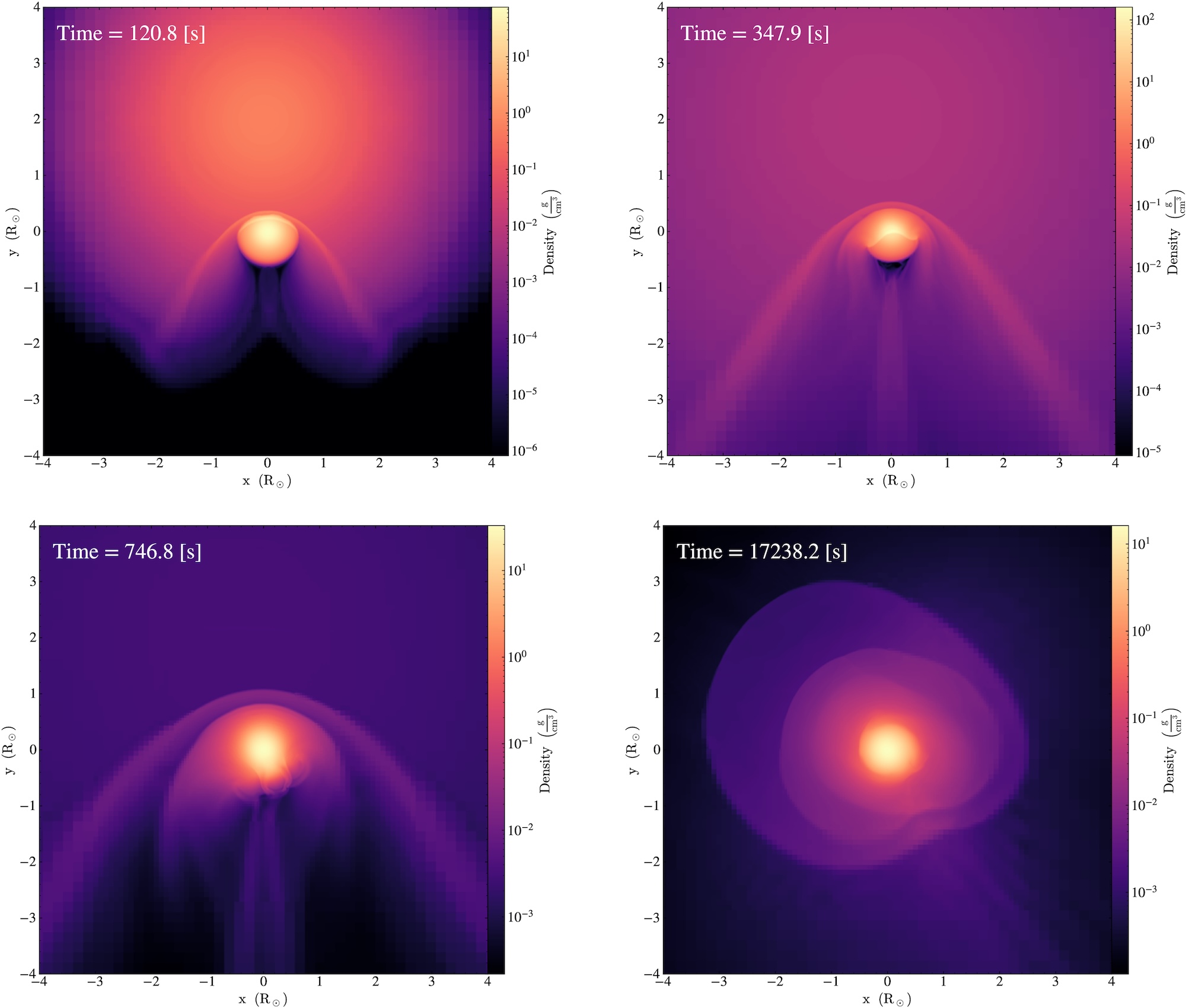
Figure 1 shows the density of the supernova’s ejecta, or exploding material, as it impacts the companion star. (You can think of this figure as if you were looking at the companion star out in space.) After roughly 100 seconds, you can see a bow shock develop around the top of the companion (or the “front” of the star) as it wraps around the companion. This impact causes significant compression of the companion star and rips away upwards of 50% the companion’s mass. The impact of this shock is what gives the companion star its “kick,” sending it hurtling through space.

simulations of supernova ejecta colliding with a star

Figure 1: Visual of the density of the companion star (center of each plot) and the supernova ejecta over time. In the top row of plots and the bottom-left plot, you can see the higher-density bow shock bent around the top (or front) of the companion star. In the bottom-right plot, you can see some of the supernova ejecta and unbound mass from the companion star settling around the companion star. [Pan et al. 2025]

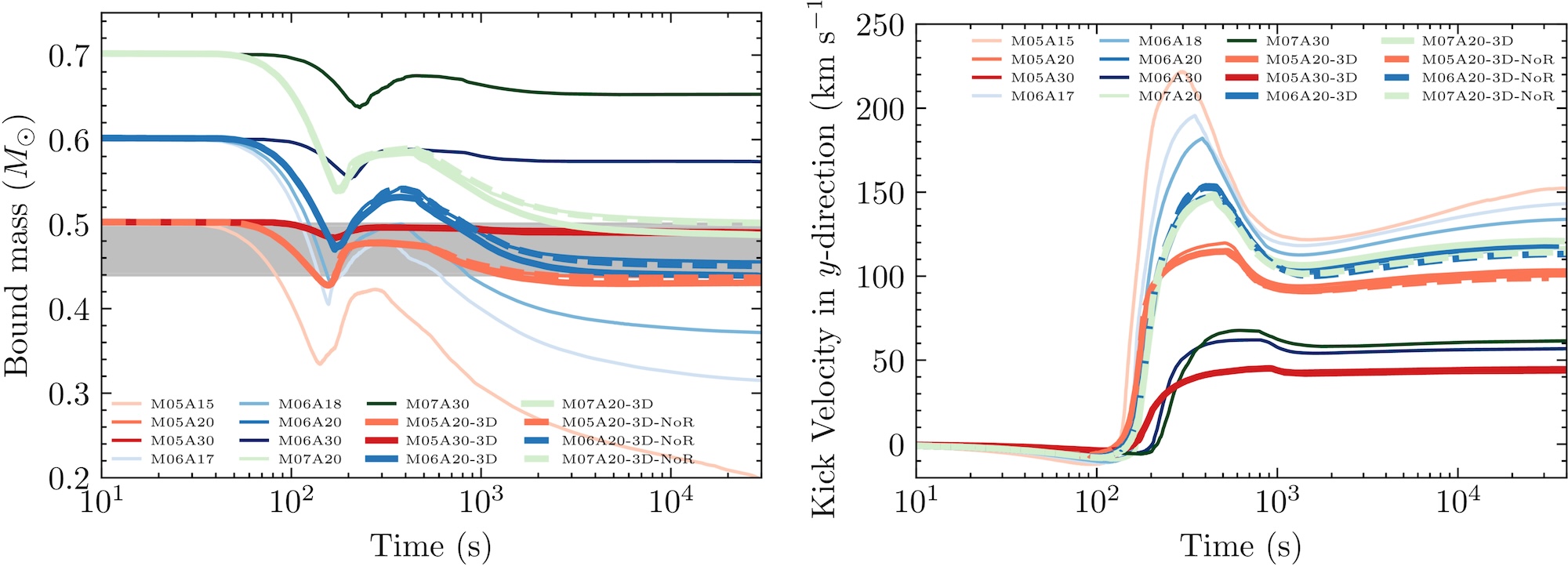
Because the authors explored a range of initial companion masses and distances between the primary and companion star, their results show some range. Figure 2 shows two important results: the evolution of the companion’s mass before and after the explosion (left plot), and the evolution of the companion’s kick velocity (right plot). The dip in mass around 100 seconds (102 s) indicates the impact of the bow shock. Even though the simulations model companions with a relatively narrow mass range (0.3–0.7 solar mass), there is considerable variation in the final masses after explosion. For example, the initial 0.5-solar-mass model ends up with anywhere between 0.07 solar mass (just 14% of its initial mass) and almost its full initial mass of 0.5 solar mass, depending on the distance between the companion and its exploding star.
plots of bound mass and kick velocity as a function of time

Figure 2: The different models shown in both plots indicate different initial masses and separation distances between the companion and the exploding star. Left: how the companion’s gravitationally bound mass evolves over time. The plot can be read left to right. The dip around 102 seconds indicates the impact of the supernova shock, which unbinds layers of the companion’s mass. Some of that mass becomes bound again to the companion after the shock passes. Right: how the companion star’s kick velocity changes based on initial mass and separation distance between companion and exploding star. The peak in values between 102 and 103 seconds indicates the impact, or “kick,” from the supernova. [Pan et al. 2025]

The results from this work generally show, predictably, that a companion closer to its primary star gets a bigger kick in velocity. These “kicks” range from about 50 km/s to 150 km/s. When added to the system’s initial velocity in space, it brings the total velocity of these companions into the 150–200 km/s range. This result is generally well aligned with the observed velocity of MV-G272, which was roughly 240 km/s.

Notably, runaway companion stars of these Type Ia supernovae seem to retain information from the initial explosion. Given the final velocities of these companions, astronomers might be able to figure out the companion’s initial mass and trace back its trajectory to the system it originated from. Overall, the fact that MV-G272 has a trajectory that tracks back to the center of a supernova remnant makes it a good companion candidate. These results support the feasibility of M-dwarf runaway companions from single-degenerate Type Ia supernova systems. Now that we know what these companions might look like — and how fast they can be going — astronomers can hopefully better search for these high-velocity stars in the future.

Original astrobite edited by Catherine Slaughter.

About the author, Mckenzie Ferrari:

I’m currently a PhD student in the geophysical sciences program at the University of Chicago. While I now study the atmosphere and oceans of Earth, most of my previous research focused on simulations of Type Ia supernovae and galaxy formation and evolution. In my free time, I foster cats for a local organization, enjoy cooking, and can often be found running along Lake Michigan.

The post I Survived a Type Ia Supernova, and All I Got Was This Kick Velocity appeared first on AAS Nova.

Featured Image: Hubble Revisits the Crab Nebula

9 February 2026 at 17:00

Hubble Space Telescope image of the Crab Nebula

In 1999–2000, the Hubble Space Telescope captured what was then the most detailed image ever taken of the Crab Nebula. In the quarter-century since the release of that image, the nebula — the remnant of a star observed to explode as a supernova in July 1054 — has been slowly unfurling and changing as the ejected stellar material expands into space. Now, as reported in a research article by William Blair (Johns Hopkins University) and collaborators, astronomers have turned Hubble’s inquisitive eye toward the Crab Nebula once again. One of the new images is shown above (click for the full view!). By comparing the new and old Hubble images, Blair’s team uncovered dramatic changes in the nebula’s intricate filamentary structure. These changes are due to the nebula’s three-dimensional expansion as well as evolution in the density of its knots and filaments. To learn more about the new Hubble portrait of the Crab Nebula, be sure to check out the full article linked below.

Citation

“The Crab Nebula Revisited Using HST/WFC3,” William P. Blair et al 2026 ApJ 997 81. doi:10.3847/1538-4357/ae2adc

The post Featured Image: Hubble Revisits the Crab Nebula appeared first on AAS Nova.

Hubble on the Hunt: A Spectroscopic Search for Betelbuddy

24 November 2025 at 17:00

constellation Orion

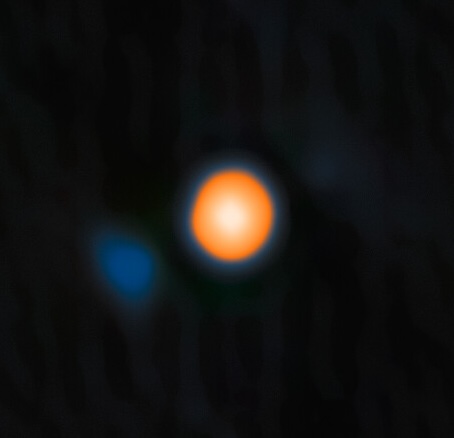
Multiple research teams have turned to the famous red supergiant Betelgeuse in search of a possible companion star hiding in its glare. A carefully designed spectroscopic search has placed new constraints on the identity of Betelgeuse’s stellar buddy.

Betelgeuse and its companion star

An image of Betelgeuse and its probable companion star from the ‘Alopeke instrument on the Gemini North telescope. [International Gemini Observatory/NOIRLab/NSF/AURA; Image Processing: M. Zamani (NSF NOIRLab); CC BY 4.0]

Betelgeuse and Its Buddy

Betelgeuse, a nearby red supergiant, is a variable star with a 400-day primary pulsation period and a 2,100-day secondary variation period. Recent studies have speculated that this secondary period is due to the presence of an 0.5–2.0-solar-mass companion star (often nicknamed “Betelbuddy”), and researchers using a speckle imaging technique likely spotted this companion earlier this year.

As is often the case when there’s an intriguing astronomical possibility, multiple research teams have sought out Betelgeuse’s purported stellar companion in different ways. One avenue recently described in a published paper was spectroscopic, searching for signs of ultraviolet emission lines from a growing young star.

Spectroscopic Search

In just 10 million years, Betelgeuse has sped through its main-sequence lifetime and taken on a new starring role as a red supergiant. In contrast, a 0.5–2.0-solar-mass companion star would not have even reached the main sequence in the same span of time. How is it possible to spot a tiny young stellar object next to a much brighter supergiant?

Hubble's observing pattern of Betelgeuse

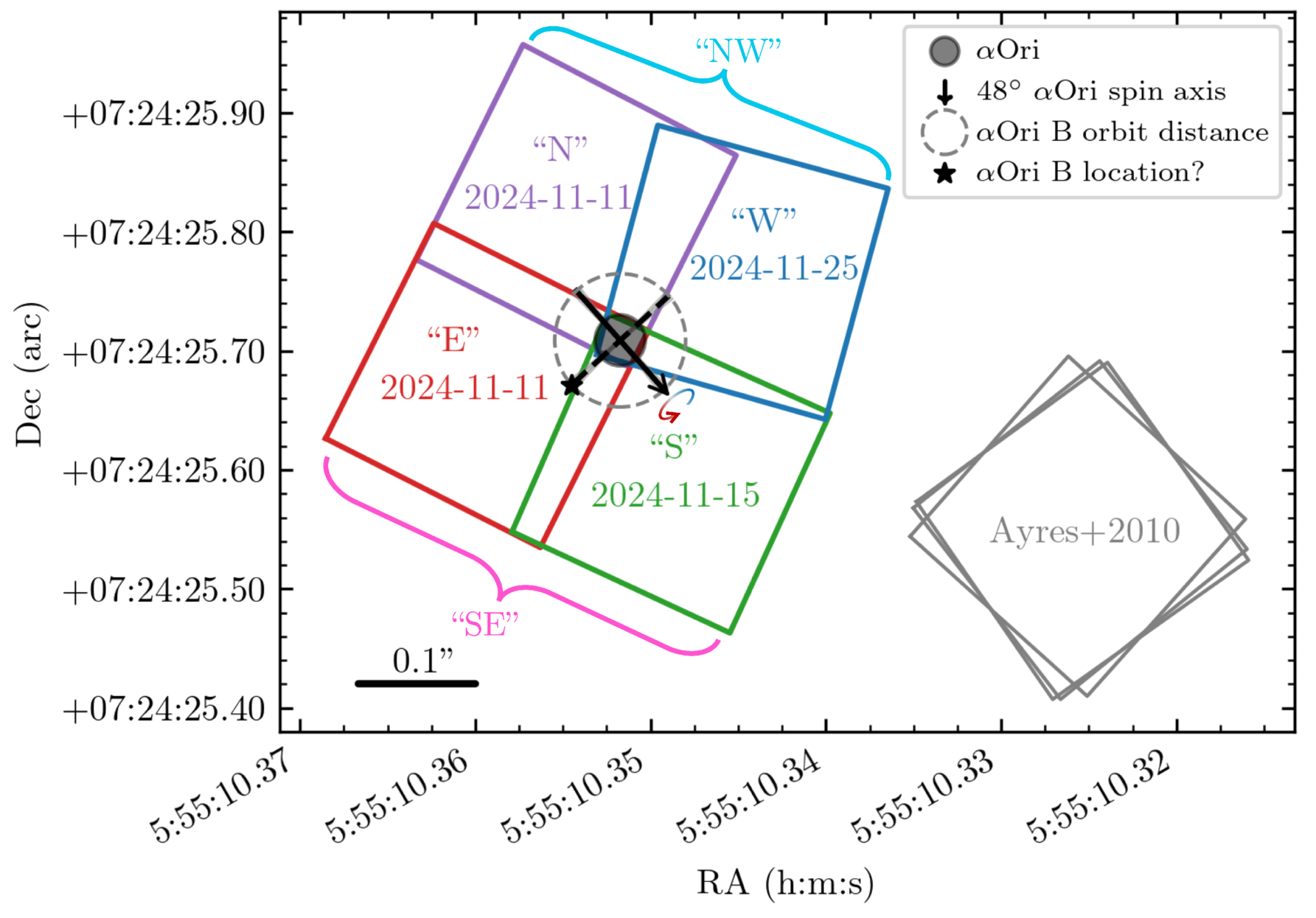
Hubble observing pattern, showing how the quadrants are arrayed around Betelgeuse. Click to enlarge. [Goldberg et al. 2025]

A team led by Jared Goldberg (Flatiron Institute) found a possible way forward in the far-ultraviolet, where young stellar objects and red supergiants both display prominent emission lines. Though Betelgeuse would greatly outshine its stellar buddy, the companion’s orbital motion should shift its emission lines relative to those of Betelgeuse, bringing them into view. To guide their search, the team consulted spectra of known young stellar objects, finding a dozen ultraviolet spectral lines that either rival the strength of those from Betelgeuse or aren’t present in Betelgeuse’s spectrum at all.

The search is on: Goldberg and collaborators observed Betelgeuse with the Hubble Space Telescope in November 2024, timed to when the companion star’s emission lines would be shifted relative to Betelgeuse. The observations split Betelgeuse’s disk into quadrants, only one or two of which should contain the companion, helping the team tease out the signal from the smaller star, if present. Ultimately, though, no statistically significant signals were found.

spectra of Betelgeuse

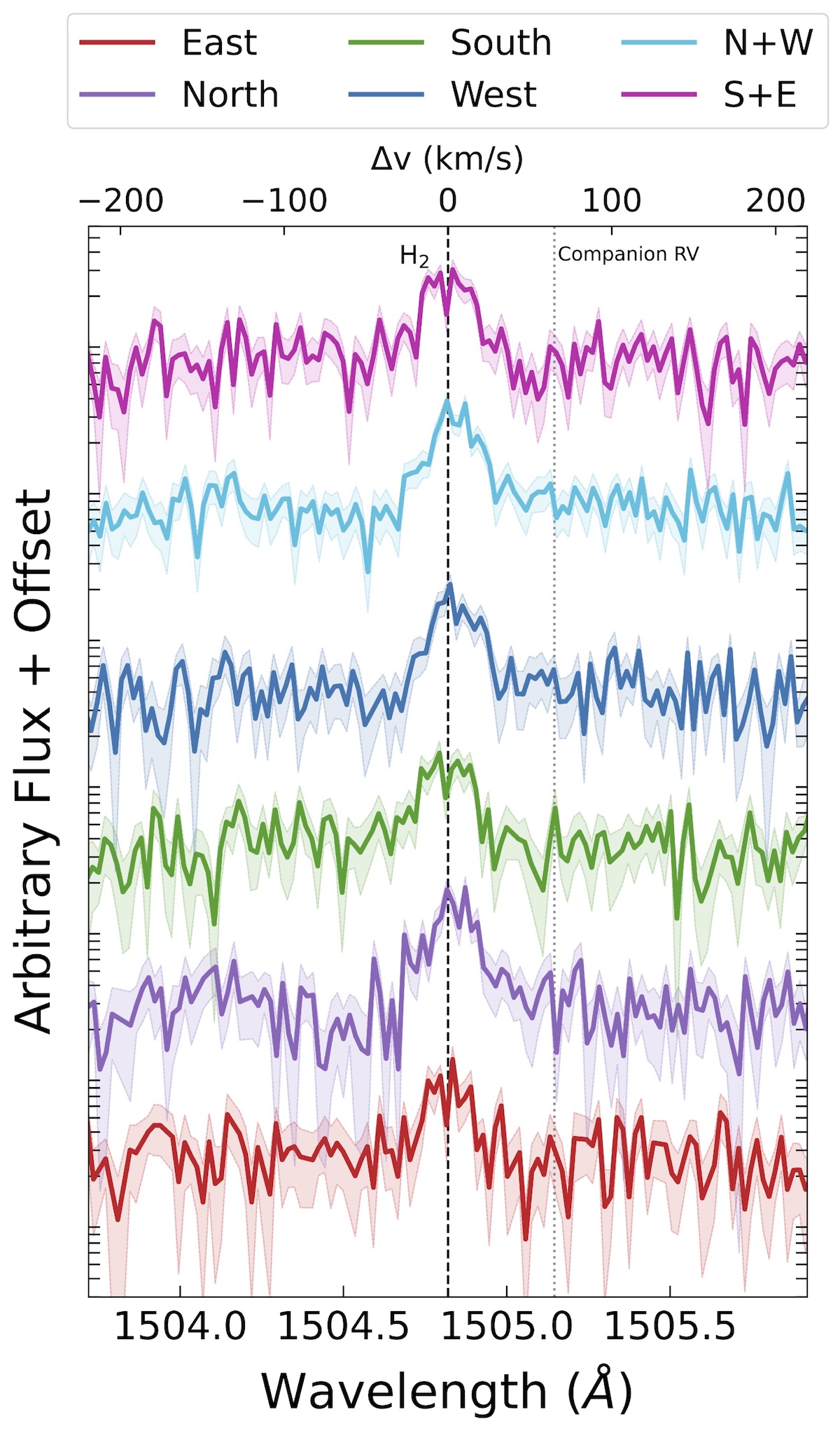
Emission around Betelgeuse’s 1504.82 Angstrom H2 line from each of the four observed quadrants as well as combinations of two quadrants. No significant signals were detected at the expected radial velocity of the companion star. [Goldberg et al. 2025]

When Finding Nothing Tells You Something

A lack of a significant detection doesn’t mean that the companion isn’t there, but it does place constraints on its identity. The data confidently rule out a companion star twice as massive as the Sun, marginally permit a star in the 1.1–1.5-solar-mass range, and favor a star lower than 1.1 solar masses.

Researchers assigned a likely mass of about 1.5 solar masses to the probable companion star imaged earlier this year. Though this is at the limit of what’s permitted by the ultraviolet observations, Goldberg and coauthors note that the companion star’s ultraviolet output could be suppressed due to tidal coupling with Betelgeuse or other processes. If the star’s ultraviolet emission is lower than expected, a 1.5-solar-mass companion remains consistent with Hubble’s non-detection of the star.

This is a fantastic example of how multiple lines of inquiry can converge on similar solutions. With the companion star expected to swing around to a favorable observing position again in 2027, this is certainly not the last chapter in the tale of Betelgeuse and Betelbuddy.

Citation

“Betelgeuse, Betelgeuse, Betelgeuse, Betel-buddy? Constraints on the Dynamical Companion to α Orionis from HST,” Jared A. Goldberg et al 2025 ApJ 994 101. doi:10.3847/1538-4357/ae0c0c

The post Hubble on the Hunt: A Spectroscopic Search for Betelbuddy appeared first on AAS Nova.

Chandra Spies a Supernova Shock Front Speeding Along

7 November 2025 at 17:00

Supernova remnant N132D

Beautiful bubbles of hot ionized gas, supernova remnants trace the dying days of massive stars. A recent study uses the Chandra X-ray Observatory to detail the motion and understand the origins of one supernova remnant.

Retracing Supernova Remnants

Massive stars, about 8 solar masses or larger, will end their short lives in violent core-collapse supernovae. These explosions barrel into any surrounding interstellar medium, carving out low-density cavities and blowing material outward. Appearing as a bubble or shell of hot gas, a supernova remnant carries the signatures of the type of star that produced it and the ways that star shaped its environment throughout its life. 

Nearby, in the Large Magellanic Cloud, is the 2,500-year-old supernova remnant N132D — the most X-ray luminous supernova remnant within the Local Group. Though N132D’s size, likely progenitor mass, and chemical composition are well constrained, astronomers have yet to nail down the velocity of the X-ray shock front — the outer edge of the supernova remnant that rams into the interstellar medium. This measurement is critical to understanding the local conditions the supernova first encountered and how its expansion will continue to impact the interstellar medium over time.

Chandra Observations of N132D

Determining the shock front velocity requires astronomers to focus on the thin outer edge of the soaring supernova remnant — how do we measure the motion of such a narrow strip of gas? X-ray spectroscopy of N132D yields a measurement from a single epoch of observations, but it cannot isolate the narrow shock front, making a reliable velocity measurement difficult to attain.

supernova remnant velocity

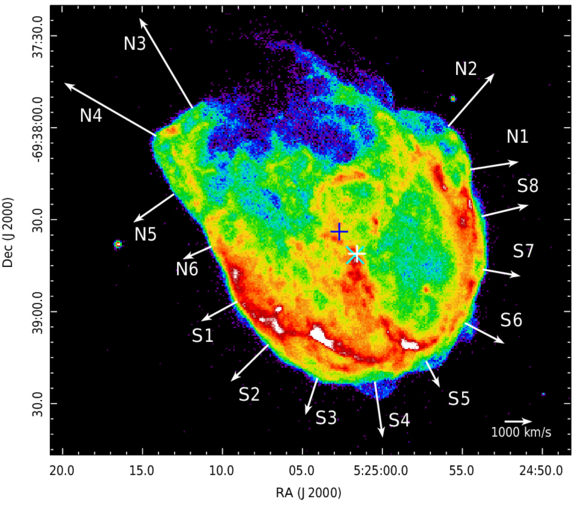
The expansion of supernova remnant N132D around the rim for each of the regions analyzed in this study. The arrow lengths are proportional to their estimated expansion velocities. Click to enlarge. [Long et al 2025]

Circumventing the challenges of spectral analyses, Xi Long (University of Hong Kong) and collaborators used two sets of X-ray observations of N132D from the Chandra X-ray Observatory taken about 14.5 years apart to measure the motion of the shock front across the sky over time. This measurement, known as proper motion, compares the location of the foreground supernova remnant to stationary background stars to estimate its angular speed. 

The authors focus on small regions on the very edge of the supernova shock front, six northern and eight southern, to carefully measure the motion of the shock between the two sets of observations. In separating the shock front into smaller regions, the authors can determine any variations in speed along the shock front. The southern edge of N132D moves with the same expansion rate of 1,620 km/s. The northern edge has an average expansion rate of 3,820 km/s, but its speed is more varied, which isn’t unexpected given its blown-out appearance.

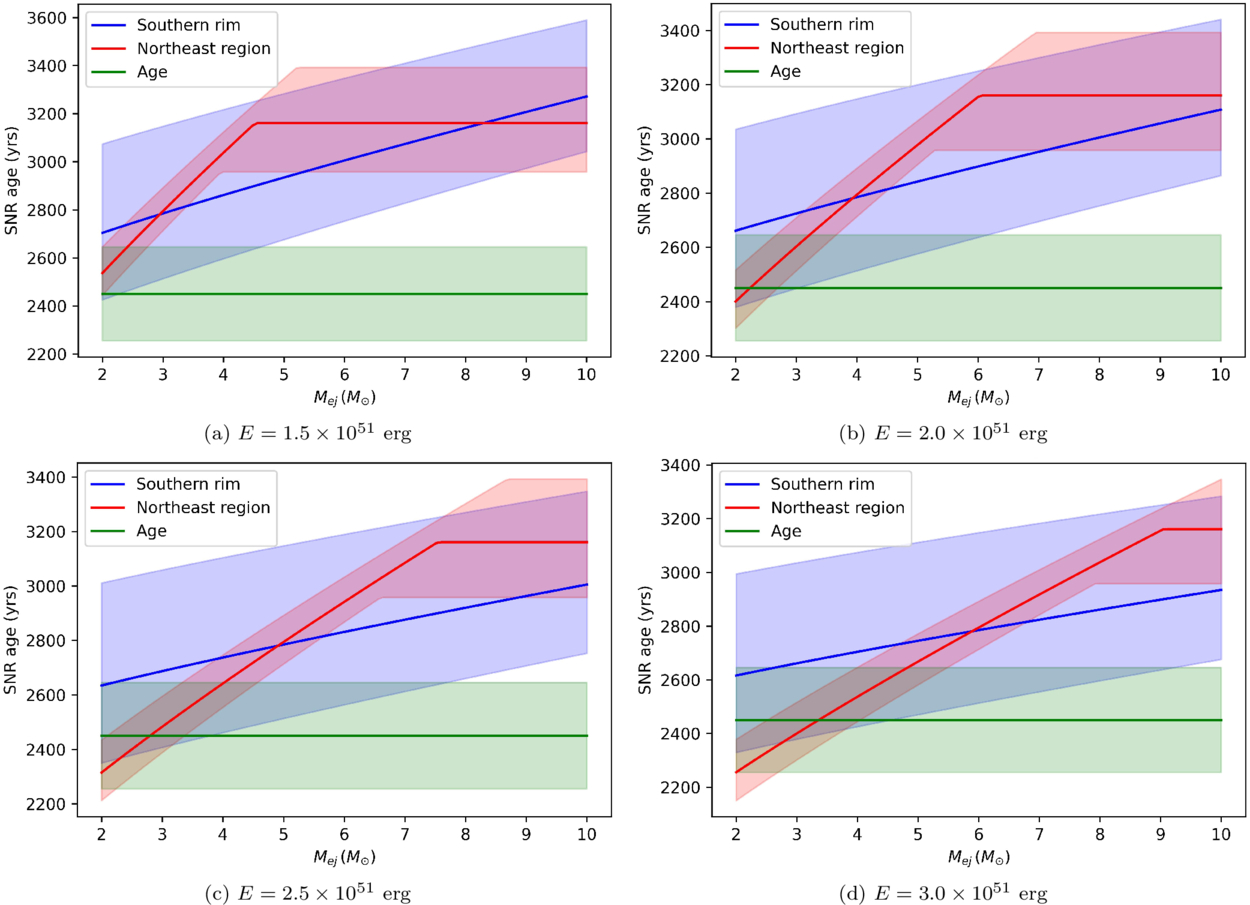
Modeling results showing the supernova age versus ejecta mass for the northern (red) and southern (blue) regions compared to the age estimate from an optical study of N132D. For the explosion energies and estimated ejecta masses between 2 and 6 solar masses, the models are consistent for all three. Click to enlarge. [Long et al 2025]

Comparing to Prior Studies

In addition to determining the velocity of the forward shock, the authors model the evolution of the supernova remnant to estimate the initial conditions of N132D including progenitor star mass, explosion energy, and ejecta mass. Their results agree with other studies that suggested N132D originated from a roughly 15-solar-mass star that exploded 2,500 years ago into a low-density cavity. 

This study showcases the unique ability of Chandra’s high-resolution instruments to carefully measure the evolution of supernova remnants, and further studies will continue to determine the detailed characteristics of supernova remnants across the Local Group.

Citation

“Chandra Large Project Observations of the Supernova Remnant N132D: Measuring the Expansion of the Forward Shock,” Xi Long et al 2025 ApJ 993 136. doi:10.3847/1538-4357/ae07c7

The post Chandra Spies a Supernova Shock Front Speeding Along appeared first on AAS Nova.

Featured Image: JWST Expands the Search for Extragalactic Supernova Remnants

29 September 2025 at 17:00

Out to what distance can we resolve the structure of a supernova remnant in the infrared? Until recently, it was only possible to do so for remnants in the Milky Way and the Magellanic Clouds, but JWST has now extended that capability to other nearby galaxies. In a recent research article, Sumit Sarbadhicary (The Ohio State University) and collaborators used JWST to study supernova remnants in the Triangulum Galaxy (Messier 33), a small spiral galaxy that is 2.7 million light-years away. The study area contained 40 supernova remnants that were previously identified at other wavelengths. The image above shows a portion of the galaxy’s southern spiral arm, where each white circle indicates a known supernova remnant. Infrared observations of supernova remnants are critical for understanding the physics of the interstellar medium and the composition, formation, and destruction of dust. To learn more about how JWST has pushed the limits of our search for extragalactic supernova remnants, and for details on each of the remnants detected by JWST in the Triangulum Galaxy, be sure to check out the full research article linked below.

Citation

“A First Look at Spatially Resolved Infrared Supernova Remnants in M33 with JWST,” Sumit K. Sarbadhicary et al 2025 ApJ 989 138. doi:10.3847/1538-4357/adec7a

The post Featured Image: JWST Expands the Search for Extragalactic Supernova Remnants appeared first on AAS Nova.

Featured Image: Hunting for Missing Supernova Remnants with EMU and POSSUM

15 September 2025 at 17:00

Researchers estimate that there are at least 1,000 supernova remnants in our galaxy that should be visible at radio wavelengths today — but so far, only a few hundred have been confirmed. Embarking on a search for the missing supernova remnants, Brianna Ball (University of Alberta) and collaborators used radio observations from the Evolutionary Map of the Universe (EMU) and Polarization Sky Survey of the Universe’s Magnetism (POSSUM) surveys. The image above presents a portion of that search, overlaying the positions of various objects of interest atop a background of radio continuum emission from EMU. Several types of objects are indicated: previously known supernova remnants (red), previously identified candidate remnants (orange), new candidates (white), known H II regions (cyan), and young pulsars (green stars). So far, the team has newly confirmed 14 supernova remnants, six of which were identified for the first time thanks to EMU and POSSUM, and 37 new candidate remnants. As the EMU and POSSUM surveys continue, the authors expect that as many as 400 candidate supernova remnants may be spotted. If these candidates are confirmed, it would nearly close the gap between expected and observed numbers of supernova remnants in the regions covered by these surveys. To learn more about this search for supernova remnants, be sure to check out the full research article linked below.

Citation

“A Catalog of Galactic Supernova Remnants and Supernova Remnant Candidates from the EMU/POSSUM Radio Sky Surveys. I.,” B. D. Ball et al 2025 ApJ 988 75. doi:10.3847/1538-4357/addc63

The post Featured Image: Hunting for Missing Supernova Remnants with EMU and POSSUM appeared first on AAS Nova.

Supermassive Black Holes and Stripped Subgiants: Significant Signals for Future Gravitational Wave Detectors

8 August 2025 at 17:00

Current gravitational wave detectors are primarily sensitive to powerful sources like black hole–black hole mergers — what types of events may next-generation gravitational wave detectors reveal? A recent study explores stripped subgiant stars around supermassive black holes and how their gravitational waves may be detected in next-generation missions. 

Inspiraling Stars and Gravitational Waves

The immense gravity of supermassive black holes at the centers of galaxies drives complicated dynamics that could generate so far undetected gravitational wave signals. One predicted source of gravitational waves is a rare event known as an extreme-mass-ratio inspiral (EMRI) — a prolonged inspiraling of a stellar-mass object around a supermassive black hole, driven inward by gravitational waves. EMRIs are thought to arise when a stellar-mass object is captured into a close-in nearly circular orbit around a supermassive black hole, emitting gravitational waves due to the object’s proximity to the black hole. 

To date, most studies have explored EMRIs involving compact objects like black holes, but an EMRI with an inspiraling star is possible, though not yet well explored nor understood. In addition to generating gravitational waves, a stellar EMRI will also emit light as the supermassive black hole rips up siphoned material from the star. These events may explain recent observations of peculiar X-ray transients, but their gravitational wave counterparts remain undetected as EMRIs’ predicted signals fall outside the sensitivity range of current ground-based gravitational wave detectors. However, the Laser Interferometer Space Antenna (LISA), a space-based gravitational wave detector expected to launch in the mid-2030s, will be sensitive to the gravitational waves of EMRIs. In order to properly identify them, we must better understand what to expect.

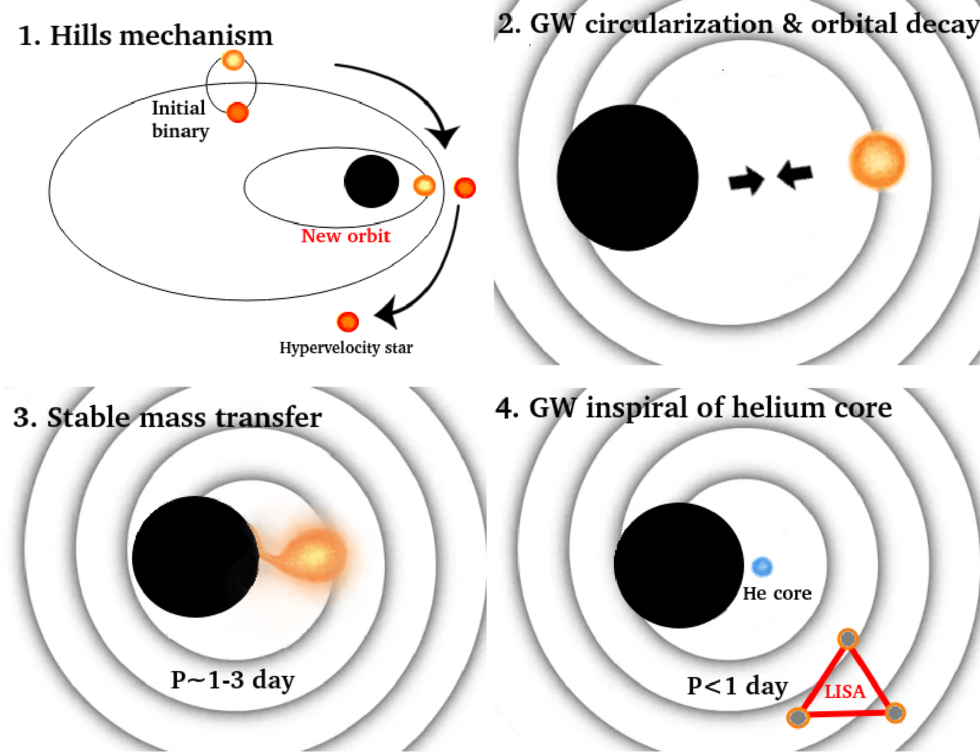
Diagram showing the evolutionary steps of a supermassive black hole capturing a subgiant star that subsequently undergoes mass transfer and gravitational wave-driven inspiral. Click to enlarge. [Olejak et al 2025]

Modeling a Subgiant Inspiral

Seeking to better predict what the gravitational waves of stellar EMRIs may look like and what LISA may detect, Aleksandra Olejak (Max Planck Institute for Astrophysics) and collaborators used stellar evolution code to simulate the evolution of a subgiant star as it transfers mass to a supermassive black hole and gravitational waves draw in its orbit. In their models, the supermassive black hole captures the star through scattering between stars or tidal interactions with a stellar binary in which the black hole catches one star and ejects the other.

Once the star is captured, its orbit becomes circularized around the black hole, pulled in closer over time until mass transfer of the star’s outer envelope begins. During this stage, the gravitational wave signal remains too weak to be detected. However, as the star is stripped down to just a helium core, it contracts and experiences an extended gravitational wave–driven orbital decay.

Possible Detections with LISA

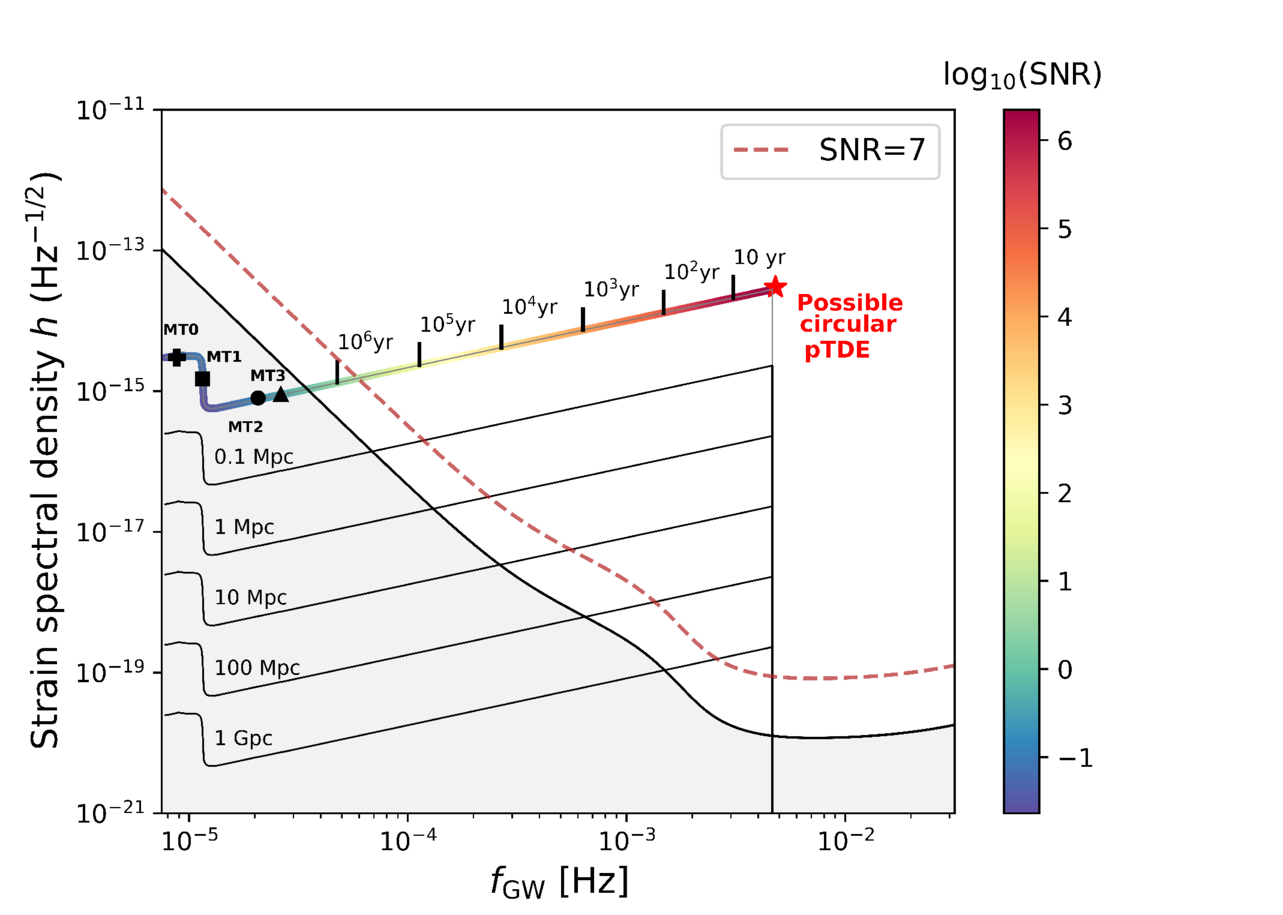
The strain spectral density as a function of the detected frequency of the gravitational wave. The colorful line indicates the signal from a stripped subgiant at the Milky Way’s center, and the gray lines are what would be observed at greater distances. LISA’s sensitivity to gravitational wave signals is shown with the black and red lines with detectable sources falling to the right of or above the line. Click to enlarge. [Olejak et al 2025]

With a better understanding of this process, the authors explored how such a signal compares to LISA’s sensitivity at various distances away from Earth. They found that as a star spirals inward, the gravitational wave signal grows stronger and enters LISA’s detectable frequency range. Stellar EMRIs occurring closer to Earth will result in higher signal-to-noise detections, and the gravitational waves from those occurring within the Milky Way would remain detectable for hundreds of thousands of years. The authors’ analysis revealed that, given their simulations, LISA could detect such an event out to ~3 billion light-years away. They estimate that a few systems involving similarly stripped subgiant stars could be detectable by LISA during a four-year mission, with a 1% chance of our galactic center hosting one.    

This study provides exciting potential for what is possible with LISA, and future detections of gravitational waves will shine further light onto the complicated dynamics of galactic centers and the evolution of stars around supermassive black holes.

Citation

“Supermassive Black Holes Stripping a Subgiant Star Down to Its Helium Core: A New Type of Multimessenger Source for LISA,” Aleksandra Olejak et al 2025 ApJL 987 L11. doi:10.3847/2041-8213/ade432

The post Supermassive Black Holes and Stripped Subgiants: Significant Signals for Future Gravitational Wave Detectors appeared first on AAS Nova.

Get a Kick Out of This: Researchers Waited 15 Years to Measure a Neutron Star’s Journey

1 August 2025 at 17:00

Crab Nebula

With a measurement 15 years in the making, astronomers have pinned down the path of a neutron star launched by a collapsing star. This finding helps to explain how neutron stars are “kicked” into space by supernovae.

Just for Kicks

Crab Nebula pulsar

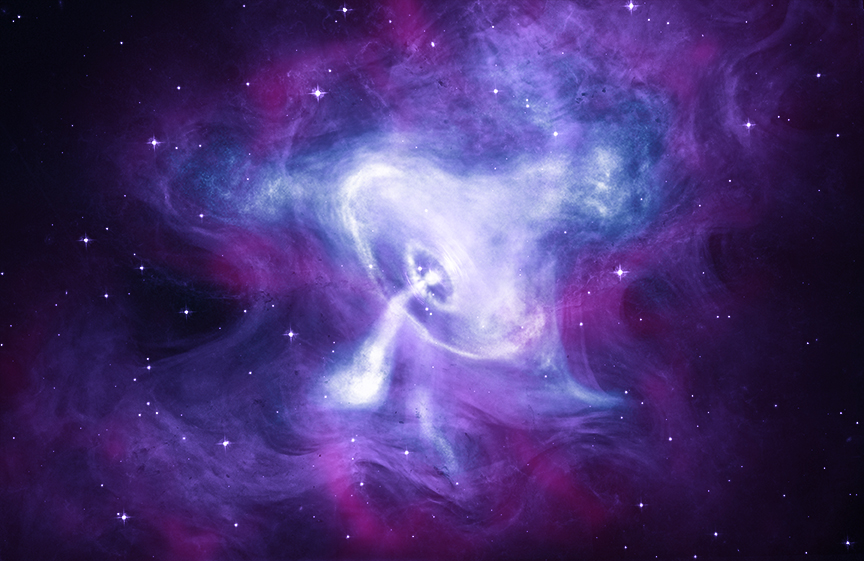
This multiwavelength image shows the pulsar — a type of neutron star — at the center of the Crab Nebula supernova remnant. [X-ray: NASA/CXC/SAO; Optical: NASA/STScI; Infrared: NASA-JPL-Caltech]

When massive stars reach the end of their lives, they expire in a final, fantastic cosmic display: a core-collapse supernova. These events can leave behind remnants called neutron stars, which are composed of highly compressed neutrons arranged in a sphere roughly as wide as the island of Manhattan is long.

Many neutron stars have been observed to zip through space at hundreds of kilometers per second, which suggests that these stars get a “kick” when they’re born in a supernova. However, the details of this kick are not yet clear. Are neutron stars launched into space in the opposite direction from the material ejected in the explosion, as some studies suggest? Or is the neutron star’s motion determined by the burst of neutrinos that carries off most of the supernova’s energy, as other studies hint?

Worth the Wait

To answer these questions, astronomers must compare the velocities of young neutron stars to the movement of their associated supernova remnants. In a recent research article, Tyler Holland-Ashford (NASA Goddard Space Flight Center) and collaborators measured the motion of the neutron star affiliated with the G18.9–1.1 supernova remnant, using Chandra observations made 15 years apart in September 2009 and July 2024.

Chandra images of the field containing the neutron star

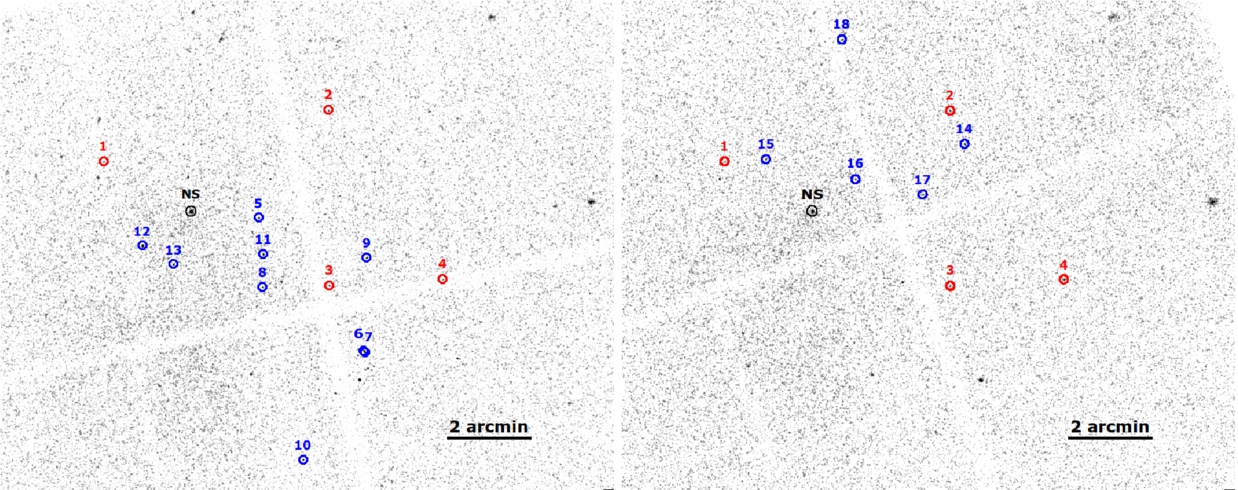
Chandra images from 2009 (left) and 2024 (right; this image is the merged product of two observations). The neutron star is shown in black. Blue and red sources were used for astrometric correction. The red sources were present in both observations. Click to enlarge. [Holland-Ashford et al. 2025]

Making this measurement is trickier than it sounds, requiring more finesse than simply charting the location of the neutron star at different times. Holland-Ashford’s team used measurements from the ultra-precise star-mapping Gaia spacecraft to account for the proper motions of other sources in the images and to put the observations from the two time periods into the same frame of reference. After these adjustments, they measured the proper motion of the neutron star to be 24.7 milliarcseconds per year.

Because the distance to the supernova remnant is uncertain, this proper motion could correspond to a range of transverse velocities. For distance estimates of 6,800 and 12,400 light-years, this puts the neutron star’s transverse velocity at 264 or 474 km/s, respectively.

A Distinct Offset

supernova remnant and neutron star location

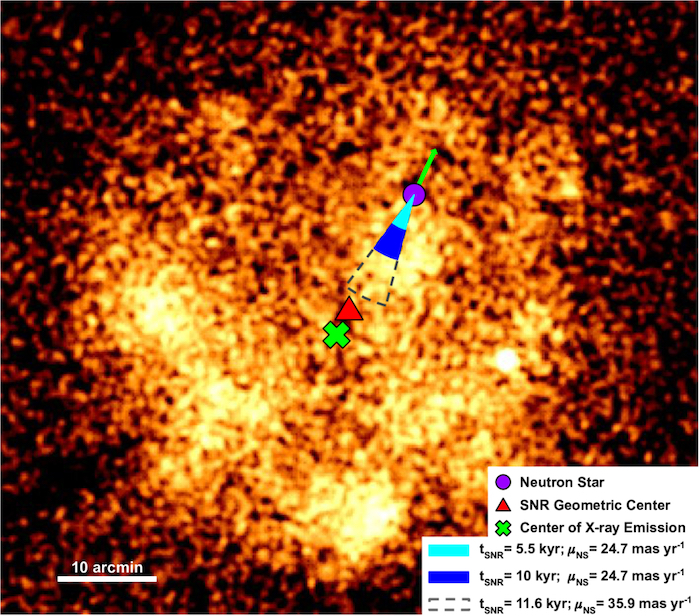
Current location of the neutron star (purple) compared to the geometric center of the supernova remnant (red) and the center of its X-ray emission (green). Even assuming the oldest reasonable age for the supernova remnant, there is a distinct offset between the neutron star’s birthplace and the center of the remnant. Click to enlarge. [Holland-Ashford et al. 2025]

What does this velocity tell us about the kick this neutron star received at birth? To probe the origin of the kick, the team first used the neutron star’s measured velocity and the likely age of the supernova remnant to trace the neutron star’s trajectory back to its birth site. This showed that the neutron star’s birthplace is offset from the center of the supernova remnant by several arcseconds, though both locations fall along the trajectory set by the neutron star’s motion. This suggests that the ejected stellar material and the newborn material were kicked in opposite directions by the supernova, most likely by a theorized “conservation-of-momentum-like” process.

Currently, Chandra is the only X-ray observatory with fine enough resolution to make the kind of measurement needed in this study. Luckily, Chandra’s observations of neutron stars stretch back to 1999, and combining this wealth of data with sensitive measurements from future high-resolution X-ray instruments should provide the long time baselines needed to trace the trajectories of more neutron stars and further explore the origins of neutron star kicks.

Citation

“Proper Motion of the Neutron Star in the Supernova Remnant G18.9–1.1,” Tyler Holland-Ashford et al 2025 ApJ 988 218. doi:10.3847/1538-4357/adeb7e

The post Get a Kick Out of This: Researchers Waited 15 Years to Measure a Neutron Star’s Journey appeared first on AAS Nova.

Betelgeuse’s Companion Star May Have Been Seen at Last

23 July 2025 at 17:00

Betelgeuse and its companion star

Astronomers may have directly imaged a companion star to the famous red supergiant Betelgeuse at last. Though the tentative detection only loosely constrains the star’s physical properties, it appears to be a 1.6-solar-mass pre-main-sequence star. The discoverers suggest the name Siwarha, Arabic for “Her Bracelet,” given that the star circles Betelgeuse, “Hand of the Giant.”

Betelgeuse in the Spotlight

constellation Orion

A photograph of the constellation Orion. Betelgeuse is the bright yellow star located left of center. [E. Slawik/NOIRLab/NSF/AURA/M. Zamani; CC BY 4.0]

Situated at the shoulder of the constellation Orion, the red supergiant Betelgeuse is one of the most recognizable stars in the night sky. It’s also the subject of countless scientific studies and amateur observations that stretch back for centuries.

Betelgeuse is a variable star. On top of its well-constrained 400-day pulsation period, the star has exhibited two behaviors that have drawn interest in recent years: a deep, prolonged dimming episode in 2019–2022 that is thought to be due to an immense ejection of mass from the star’s surface, and a 6-year variation in the star’s photometry, astrometry, and radial velocity.

Multiple studies have attributed the 6-year variability to one or more companion stars. In general, these studies predict that the companion star circles Betelgeuse on a tight, 6-year, nearly edge-on orbit. As reported in a new article published in the Astrophysical Journal Letters, observations have likely proved these predictions correct.

Speckle Detection

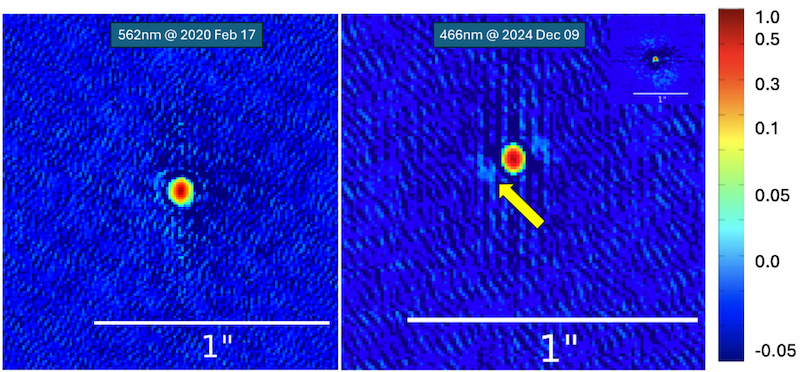
Steve Howell (NASA Ames Research Center) and collaborators searched for Betelgeuse’s predicted companion star using the 8.1-meter Gemini North telescope. The team used the ‘Alopeke instrument in speckle imaging mode, which involves taking thousands of milliseconds-long snapshots to avoid smearing due to atmospheric fluctuations.

Betelgeuse and its companion star in observations

Observations of Betelgeuse from 2020 (left) and 2024 (right). An arrow points to the companion. Note that the image processing introduces a 180º ambiguity in the location of the companion, which is resolved by analyzing phase information. [Howell et al. 2025]

The team imaged Betelgeuse in 2020 and 2024. The 2020 observations coincided with when the companion star was predicted to lie behind Betelgeuse from our vantage point, and no companion appears in these images. The 2024 observations were taken just a few days after the companion’s predicted greatest angular separation from the star — and show evidence for a star just beside Betelgeuse.

More to Learn

Howell and coauthors performed additional analyses to rule out interference from hot pixels, cosmic rays, or atmospheric diffraction. They also considered that the star could lie in the background or foreground, but they found both possibilities unlikely. After further calculations, the team estimated that the companion is six magnitudes fainter than Betelgeuse and separated by just 52 milliarcseconds at an angle of 115º. These quantities agree well with predictions for the companion’s position.

location of Betelgeuse in 2020 and 2024

The on-sky proper motion of Betelgeuse from 2020 to 20204. The companion is shown as the small black circle. This shows that if the companion star were actually a background star, it would have been plainly visible in the 2020 observations. [Howell et al. 2025]

Given the tentative detection — at the level of 1.5σ — it’s difficult to pin down the properties of the companion star. The team placed the star’s mass between 1.4 and 2.0 solar masses, with the likeliest value being 1.6 solar masses. If the companion has the same age as Betelgeuse, this star would be on the cusp of joining the main sequence. However, it may never reach that stage of life; Betelgeuse’s demise in a core-collapse supernova is imminent, in the astronomical sense, and the companion may spiral in to merge with Betelgeuse even before then. (It currently orbits at just 4 au — closer than the distance between the Sun and Jupiter.)

The team closed with a call to the community to turn their instruments toward Betelgeuse on 26 November 2027, when the companion will once again be at its greatest angular separation. Our exploration of this long-sought-after star has just begun!

Citation

“Probable Direct Imaging Discovery of the Stellar Companion to Betelgeuse,” Steve B. Howell et al 2025 ApJL 988 L47. doi:10.3847/2041-8213/adeaaf

The post Betelgeuse’s Companion Star May Have Been Seen at Last appeared first on AAS Nova.

Researchers Solve the Mystery Behind a Billion-Dollar Dental Implant Disease

4 June 2026 at 16:58
Dental Tooth ImplantResearchers have uncovered why a common and costly dental implant infection often resists antibiotics. Dental implants have helped tens of millions of people regain a full set of stable, functional teeth, something traditional dentures cannot provide. However, between 10% and 20% of implant recipients eventually develop peri-implantitis, a serious infection that damages the jawbone around [...]

Urban Light Pollution Might Be Worsening Allergies

4 June 2026 at 21:12
Light pollution prompts plants to shed pollen longer and stronger, according to new research.

© Amir Hamja for The New York Times

A study found that trees in cities with brighter lights start producing pollen earlier in the spring and finish later in the fall, adding up to 130 days per year to the allergy season.

Beans use an immune receptor to call in airstrikes on caterpillars

3 June 2026 at 12:15

For decades, scientists have understood that plants can release volatile organic compounds—essentially airborne chemical signals—to attract the natural enemies of the things that eat them, like caterpillars. What we didn’t know was exactly how a plant translates the physical act of being eaten into a specific, predator-summoning distress signal.

“[One] thing we didn’t know is how the plant detects the caterpillar in the first place,” says Adam Steinbrenner, a biologist at the University of Washington. Now, after years of experimenting with common bean plants in the lab and in the agricultural fields of Oaxaca, Mexico, Steinbrenner’s team pinpointed a single immune receptor that orchestrates its anti-caterpillar defense system.

Drooling caterpillars

When an herbivorous insect like a caterpillar feeds on a plant, it introduces its saliva straight into the plant's damaged tissues. This saliva contains biological clues called HAMPs: herbivore-associated molecular patterns. One of the HAMPs molecules is a peptide called inceptin, and there’s an 11-amino acid fragment of inceptin named In11, as well. Both of them turn out to be a fragment of the ATP synthase found in chloroplasts—basically a piece of one of the plant’s own proteins. As the caterpillar ingests the leaf, its gut enzymes chop up the plant's cellular engines and their pieces, including In11, are regurgitated back onto the leaf’s surface, albeit at extremely small concentrations.

Read full article

Comments

© mikroman6

Testing their mettle: How bacteria in deep-sea vents deal with toxic metal environments

29 January 2023 at 10:46

Researchers from Okinawa Institute of Science and Technology and Japan Agency for Marine-Earth Science and Technology have identified how bacteria can adapt to toxic metals released from hydrothermal vents. The study focused on Nitratiruptor sp. SB155-2, a species of bacteria isolated from vents in the Okinawa Trough. The researchers found that bacteria use transporter proteins […]

The post Testing their mettle: How bacteria in deep-sea vents deal with toxic metal environments appeared first on Science Bulletin.

❌