Using the James Webb Space Telescope, and with a little help from Einstein, astronomers have "weighed" a sleeping giant, a dormant supermassive black hole located a staggering 10 billion light-years away.
Brendan Carr, the chairman of the Federal Communications Commission, has greenlighted regulatory requests for the company’s Starlink satellite internet service and lavished praise on its chief executive.
After a 50-year search, astronomers have uncovered evidence that Sagittarius A* -- the 4.3-million-solar-mass black hole that resides at the center of our Milky Way Galaxy -- is blowing a hot cosmic wind into its surroundings, carving out a giant cavity near the Galaxy’s heart.
Giovanni Cassini was born in Perinaldo, in what is now Italy, on June 8, 1625. Early work on Jupiter and Mars’ rotational periods and the positions of Jupiter’s satellites led to an invitation to Paris and the Academie des Sciences by King Louis XIV; he became director of the Observatorie de Paris in 1671, andContinue reading "June 8, 1625: The birth of Giovanni Cassini"
Magnetic fields may be the hidden force bringing both newborn stars and giant black holes together. New computer simulations suggest that magnetic fields play a crucial role in helping pairs of young stars form. The findings could explain why binary star systems are so common throughout the Milky Way and may even offer clues about [...]
The Magellanic Clouds are a pair of dwarf galaxies passing the Milky Way probably for the first time, but as they move they have been interacting with each other for billions of years.
By taking general relativity into higher dimensions, a trio of physicists has proven that a mathematical pattern of ripples in space-time geometry could give rise to naked singularities and microscopic black holes.
NASA launched the Extreme Ultraviolet Explorer satellite, or EUVE, on June 7, 1992, to conduct an all-sky survey at wavelengths inaccessible from the ground. The first satellite designed to operate in the short-wave ultraviolet range, its “objectives included discovering and studying UV sources radiating in this spectral region, and analyzing effects of the interstellar mediumContinue reading "June 7, 1992: The Extreme Ultraviolet Explorer launches"
A meteorite discovered in Africa could be evidence of a lost protoplanet that once orbited our Sun, according to researchers at the University of Colorado at Boulder.
In a recent paper published in Earth and Planetary Science Letters, the team revealed evidence of an ancient protoplanet that may have been as large as Mars based on simulations of how the meteorite sample may have formed.
The four-and-a-half-billion-year-old world carried an unexpected geological makeup, which the researchers say casts doubt on common assumptions regarding planetary evolution.
Protoplanetary Demise
According to the UC Boulder team, the massive protoplanetary body collided with another object four and a half billion years ago, shattering it completely. This is the first definitive evidence of a lost protoplanet in our solar system, based on analysis of the angrite meteorite NWA 12774, a shard of that planetary embryo recovered from the Sahara Desert.
“It’s incredible to think there was once a world this large,” said lead author Aaron Bell, an assistant research professor in the Department of Earth Science at CU Boulder. “We only know it existed because a few fragments of it happened to land on Earth. These meteorites preserved evidence of a completely different pathway through which early planets developed.”
A Rare Meteorite Sample
Angrites, a rare type of volcanic rock, serve as a record of our solar system’s distant past. These rocks began forming only a few million years after the solar system’s birth, making them valuable evidence of this early era. However, they are extremely rare and difficult to find.
NWA 12774 is one of only 68 angrite samples identified among more than 80,000 meteorites cataloged by scientists. Given its rarity, the discovery could potentially reshape how researchers understand these ancient rocks.
Until now, scientists had assumed that angrites originated from relatively small asteroids less than 124 miles (200 kilometers) wide, based largely on their chemical composition. Large rocky planets such as Earth and Mars contain significant amounts of silicon dioxide, while angrites contain very little of the compound.
Unexpected Meteorite Discovery
Researchers began to reconsider those assumptions when they identified clinopyroxene in the meteorite sample. This mineral, commonly found in Earth’s crust and mantle, appeared unusually rich in aluminum, suggesting that it formed under significant pressure deep within a planetary body.
To investigate this unusual characteristic of NWA 12774, the University of Colorado Boulder team recreated the conditions under which the sample could have formed. Their analysis revealed that pressures of at least 17.5 kilobars were required to produce the aluminum-rich clinopyroxene found in the meteorite. For comparison, one kilobar is roughly equivalent to the pressure at the deepest part of Earth’s oceans, near the bottom of the Mariana Trench.
Rethinking Meteorite Origins
The researchers’ discovery proved that at least this particular angrite sample could not have formed inside a small meteorite, as a body with a radius of at least 621 miles would be required to generate the pressure needed to produce the crystals.
Additional evidence suggested the parent body may have been even larger. The crystals’ sharp edges and delicate internal structures indicate they likely formed at relatively shallow depths beneath the surface. Reconciling both the high-pressure conditions and the shallow formation depth suggests that the parent body may have ranged in size from the Moon to Mars.
“There are many meteorites sitting in drawers that haven’t been thoroughly studied, so there were likely more of these protoplanets we don’t know about,” Bell said.
Exactly what happened to this ancient world remains uncertain, but researchers believe it was likely destroyed in a massive collision early in the solar system’s history. Fragments of that lost protoplanet may have later contributed material to other bodies, potentially including Earth itself.
“The materials that formed the angrite parent body are fundamentally different from the ingredients of Earth and Mars,” Bell concluded. “It points to a distinct and separate evolutionary path in planetary formation in the early history of our solar system.”
Ryan Whalen covers science and technology for The Debrief. He holds an MA in History and a Master of Library and Information Science with a certificate in Data Science. He can be contacted at ryan@thedebrief.org, and follow him on Twitter @mdntwvlf.
A rare meteorite found in the Sahara Desert may be evidence of a long-lost "protoplanet" that formed in the early solar system before being destroyed in a colossal collision, a new study suggests
Where do the mysterious cosmic messengers called neutrinos come from? Researchers search for a connection between neutrinos and accretion flares from black holes.
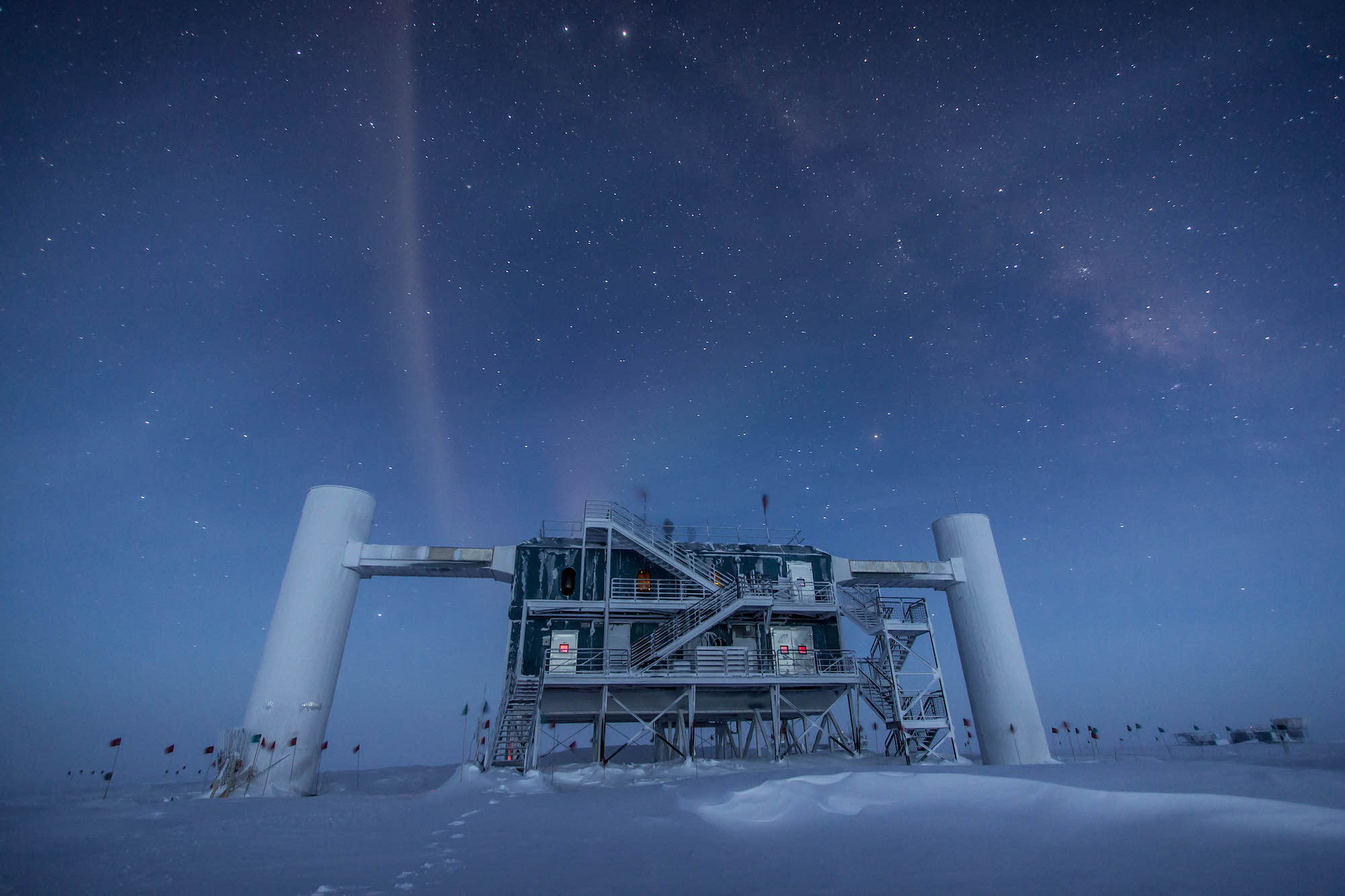
Neutrinos — neutral, nearly massless elementary particles — are generated by natural particle accelerators across the universe. Facilities like the IceCube Neutrino Observatory, which employs detectors buried a mile deep in Antarctic ice, spot neutrinos from distant astrophysical sources, but matching these neutrinos to their sources is no easy task.
Thus far, researchers have discovered a compelling connection between neutrinos and distant active galactic nuclei, which are powered by the accretion of gas onto supermassive black holes. The active galactic nucleus phase of a black hole tends to be long lived, with activity lasting hundreds of thousands of years or more, making these nuclei lasting sources of neutrinos.
Sampling Flares
Recently, researchers have found tentative evidence for coincident neutrinos from short-lived accretion events like tidal disruption events, in which a star is torn apart and accreted by a black hole. These studies have uncovered a potential connection between neutrinos and tidal disruption events with mid-infrared echoes, signaling the presence of obscuring dust.
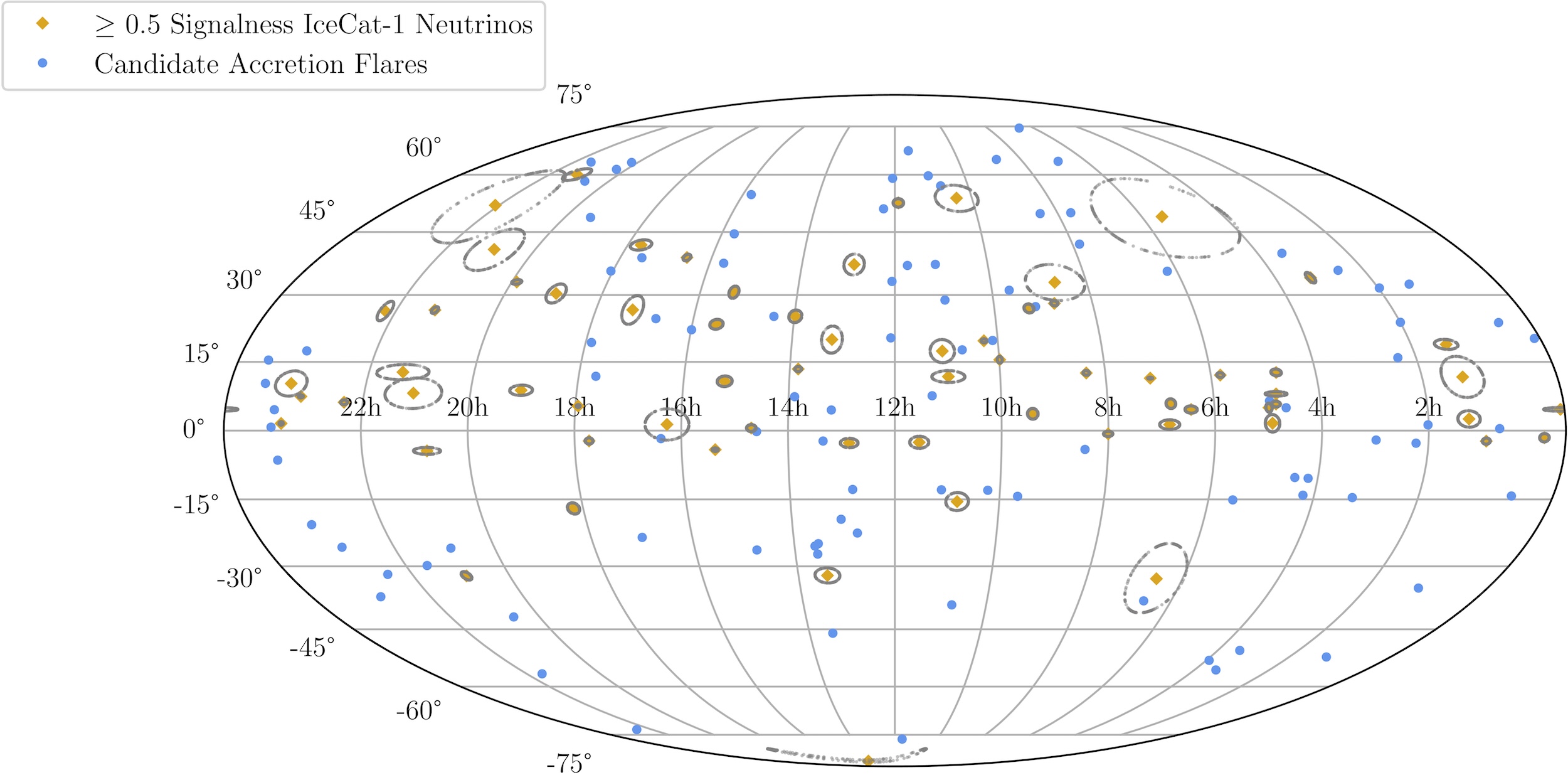
A map of the locations of the neutrinos (yellow diamonds) and black hole flares (blue circles) on the sky. Click to enlarge. [Wang et al. 2026]
To investigate whether there is any connection between neutrinos and short-lived accretion events, Megan Wang (Massachusetts Institute of Technology) and collaborators first compiled a sample of 99 black hole flares observed by NEOWISE. These flares were selected for their strong mid-infrared emission, location in the nuclei of galaxies, and a fast rise and slow decline. The team applied additional selection criteria to remove other bright transients, such as supernovae, and retain only tidal disruption events and active galactic nucleus accretion flares.
For the neutrino side of the equation, Wang’s team turned to IceCube’s most recent catalog of neutrino events from astrophysical sources. In total, they compiled a sample of 68 events for which the odds of the source being astrophysical was greater than 50%, and for which the directional uncertainty was below 50.
No Coincidences
For a flare and a neutrino to be considered spatially and temporally coincident, the neutrino must arrive within one year of the flare, and the flare must fall within the 90% certainty contours of the neutrino. Ultimately, Wang’s team found no neutrinos that fulfilled both criteria and only one that was spatially but not temporally coincident with a black hole flare.
This result appears to be at odds with previous studies that found several neutrinos that were coincident with tidal disruption events. Wang and collaborators noted that while this work finds no association between neutrinos and black hole flares, it’s possible that the team is studying a different population of accretion events.
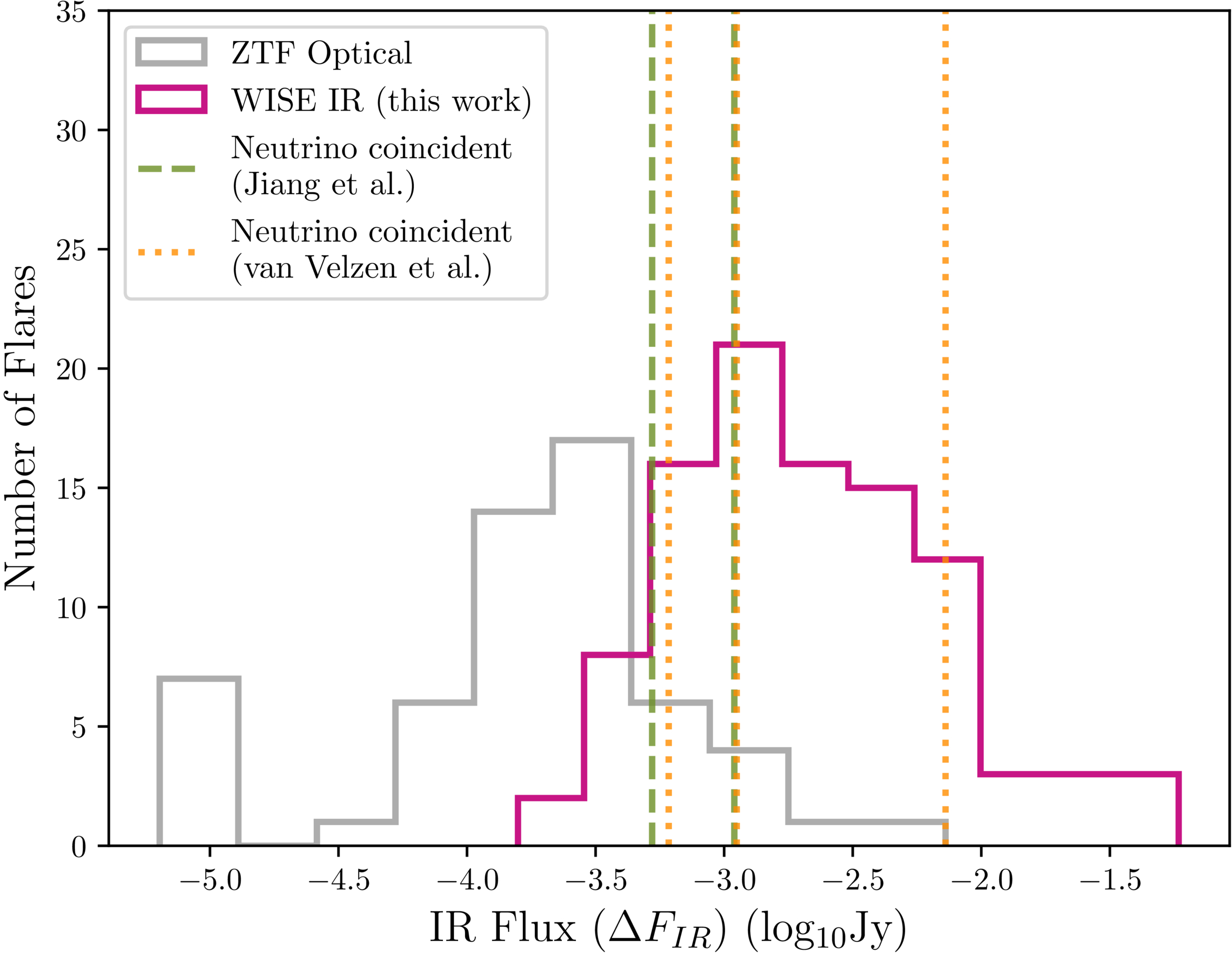
Infrared fluxes of the flares sampled in this study (magenta), optically identified flares (gray), and the tidal disruption events thought to have coincided with neutrino detections (green and gold dashed lines). [Wang et al. 2026]
For example, while the previous neutrino-associated flares were flagged for having strong mid-infrared emission, they differ from the current sample in that they were detected at optical wavelengths. The flares sampled in this work were detected in the mid-infrared and have little to no optical emission, potentially highlighting intrinsic differences compared to previous samples.
Future work, including studies that leverage upcoming datasets from the Vera C. Rubin Observatory, the Roman Space Telescope, and the NEO Surveyor, can address this question further and search for connections with specific populations of black hole flares.
Citation
“Testing the Association of Supermassive Black Hole Infrared Flares and High-Energy Neutrinos,” Megan Wang et al 2026 ApJL998 L29. doi:10.3847/2041-8213/ae3f90
Astronomers from around the world were fascinated last year when 3I/ATLAS, the third interstellar object ever observed passing through our Solar System, was discovered.
The SETI Institute was one of the many organizations that examined the unusual interstellar object, conducting a comprehensive search for any signs that it might be producing technological signals.
Using the Allen Telescope Array (ATA) at the Hat Creek Radio Observatory in Northern California, SETI researchers scanned a broad range of radio frequencies in search of potential evidence of extraterrestrial technology associated with 3I/ATLAS. The data that came back was clear: no signs of artificial signals. As most astronomers expected, 3I/ATLAS is most likely a natural comet.
“We searched for narrowband signals across a broad range of spectrum: 1–10 GHz. We can do this efficiently due to the ATA’s ability to record and search billions of channels at a time,” says Dr. Sofia Sheik, lead author of a new paper describing the SETI Institute’s work, in an email to The Debrief.
The interstellar comet 3I/ATLAS (Image Credit: International Gemini Observatory/NOIRLab/NSF/AURA/Shadow the Scientist)
Observations of interstellar objects have become more common in recent years, due to advances in telescopic technologies available to astronomers. Discovered last July, 3I/ATLAS is only the third confirmed interstellar visitor to enter our Solar System, preceded by 1I/ʻOumuamua in 2017, and 2I/Borisov in 2019.
These rare discoveries help astronomers understand the materials in our cosmic backyard. By analyzing the composition of these objects, scientists can gain a deeper understanding of how planetary systems develop and evolve throughout the galaxy.
The Research
The majority of recent astronomical observations indicate that 3I/ATLAS is a natural object, albeit one that exhibited some unusual qualities. However, the possibility remains that we may one day find a technological artifact from an intelligent civilization; it is equally possible that at some point, aliens may also discover a spacecraft of Earthly origin.
“Eventually, our own Voyager spacecraft will be extraterrestrial artifacts in other stellar systems,” Sheik told The Debrief. “Given that, it is important that we understand the natural distribution of interstellar objects so that we will be able to identify any anomalies that could one day be signs of an artificial interstellar object.”
The SETI research team studied 3I/ATLAS for over seven hours using the ATA, searching radio frequencies from 1 to 9 gigahertz. This range is especially important because it can detect narrowband radio signals, which are rarely produced by natural space phenomena and are often considered possible signs of technological activity.
Researchers found 74 million narrowband signals, but after filtering out human interference and motion-matched sources, only about 200 remained. These were later confirmed to come entirely from Earth-based technology or satellites.
“To be clear, we did not detect any radio signals from 3I/ATLAS. We ruled out the presence of signals down to power levels comparable with everyday appliances: for example, we definitely would have picked up a cell tower or a radio station equivalent had it been on the surface of 3I/ATLAS,” Sheik said.
In other words, no technosignatures were detected. The SETI observation ruled out signals stronger than approximately 10 to 110 watts across the observed frequencies (comparable to the power consumption of a household appliance).
NASA diagram showing the trajectory of the interstellar object 3I/ATLAS (Image Credit: NASA).
The Origins of 3I/ATLAS
For a time, there was a considerable amount of speculation over whether 3I/ATLAS could represent something more than just a natural object. Among the proponents of such ideas, theoretical physicist Avi Loeb emerged as one of the most visible supporters of the possibility that the interstellar object displayed anomalous qualities that could point to technological origins.
Last July, shortly after the object’s discovery, Loeb predicted on his Medium page that 3I/ATLAS may be one of two things: a comet possessing a smaller core with a radius less than 400 meters, or “an object that favored a radial orbit into the inner solar system,” meaning that it may also be a larger object compared to its predecessors. Indeed, further observations of the object eventually suggested that 3I/ATLAS appears to be significantly larger than ‘Oumuamua or Borisov was.
Loeb also suggested in a podcast interview that 3I/ATLAS might not be following a random trajectory, but rather that its current motion could be understood as “directed” toward the inner solar system.
“That obviously opens the door for it being technological, because who would target the inner solar system?” said Loeb during an interview.
In an email to The Debrief, Loeb shared his thoughts on the recent SETI findings.
“Radio communication is an old technology, which was recently accompanied by optical laser communication in NASA’s Artemis II mission to the Moon,” Loeb said. “Lasers might replace radio communication in our future space missions, and there is no guarantee that they would operate at the frequencies scanned in this study.”
“To save power, a technological transmitter might beam its signal in the direction of the receiver (rather than Earth) and might only transmit sporadically,” Loeb added.
“Interestingly, the anomalous ‘Wow! Signal’ detected on August 15, 1977, came from a direction which is separated by only 9 degrees from the arrival direction of 3I/ATLAS into the inner Solar System, but a similar signal was never detected again,” Loeb told The Debrief.
The Search for Interstellar Objects
For Sheik and the team, while 3I/ATLAS did not display any obvious signatures that could be associated with technosignatures, it still provided a significant learning opportunity.
“The results from 3I/ATLAS show how realistic it is to detect a signal with the technology we have today,” said co-author Valeria Garcia Lopez. “That is why it is important to keep searching for technosignatures, even from objects we might not expect to have signals.”
Additionally, this project highlighted the ATA’s ability to respond quickly to new discoveries. Observations began less than 24 hours after the discovery of 3I/ATLAS was announced, showcasing the telescope’s flexibility and preparedness.
“One of the ATA’s advantages is being able to get quickly on-source to follow up on new and exciting discoveries, which was showcased in the 3I/ATLAS observations,” Sheik told The Debrief. “3I/ATLAS was announced on July 1st, and the ATA began observations on July 3rd.”
With ongoing advancements in technology, future observations of similar interstellar objects should become more frequent.
“For sources that might be changing quickly, this kind of rapid follow-up is essential to get early data and context for later observations with other observatories,” Sheik added.
Chrissy Newton is a PR professional and the founder of VOCAB Communications. She currently appears on The Discovery Channel and Max and hosts the Rebelliously Curious podcast, which can be found on YouTube and on all audio podcast streaming platforms. Follow her on X: @ChrissyNewton, Instagram: @BeingChrissyNewton, and chrissynewton.com. To contact Chrissy with a story, please email chrissy @ thedebrief.org.
A distant quasar has revealed one of the most extreme ultraviolet outflows ever observed, providing new clues about the powerful interactions between supermassive black holes and their host galaxies. A supermassive black hole more than a billion times the mass of the Sun is blasting gas through space at such extraordinary speeds that astronomers are [...]
“Extraterrestrial Cause for the Cretaceous-Tertiary Extinction,” by physicist Luis Alvarez, geologist Walter Alvarez, Frank Asaro, and Helen Michel, was published in Science June 6, 1980. In it, the authors propose that an asteroid crashing to Earth was responsible for the death of the dinosaurs 65 million years ago. (The timeline was later amended to 66Continue reading "June 6, 1980: The asteroid impact theory"
An interstellar comet just revealed hidden methane and chemical clues from another star system. NASA’s James Webb Space Telescope has achieved another milestone by capturing the first mid-infrared chemical fingerprint of an interstellar object. The observations focused on comet 3I/ATLAS, a rare visitor from beyond our solar system, and the findings have been published in [...]
The giant planet’s bow shock isn’t just deflecting the solar wind, it’s acting as a powerful particle accelerator, firing electrons to relativistic energies of at least 1 MeV, according to a new analysis of data from NASA’s Juno spacecraft.
After searching for 50 years, astronomers have finally discovered powerful winds blowing from Sagittarius A*, the supermassive black hole at the heart of our galaxy.

 Login