"If a major meteor shower outburst or storm is forecast during a mission or crew activity, the mission would be delayed or the crew kept inside until the outburst or storm is over."
NASA’s X-59 Aircraft Flies Supersonic for First Time
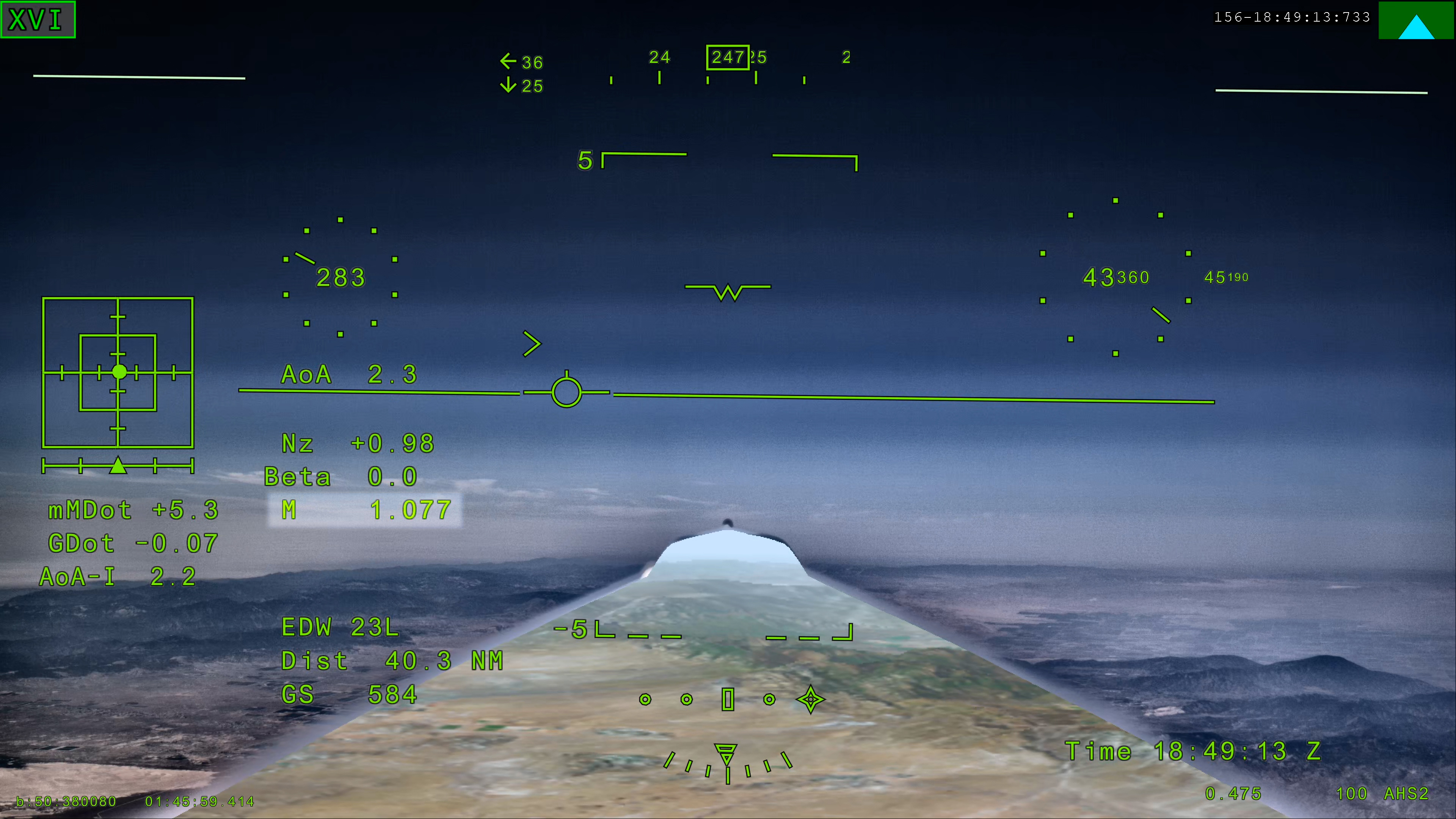
NASA’s X 59 eXternal Vision System shows Mach 1.077 on Friday, June 5, 2026, marking the aircraft’s first time reaching supersonic speed in support of NASA’s Quesst mission. The moment represents a milestone for the aircraft as it transitions to include test flights faster than the speed of sound.
NASA
NASA’s experimentalX-59 aircraft marked a major milestone Friday, June 5, when it flew faster than the speed of sound for the first time, setting the stage for demonstrating its quiet supersonic capabilities later this year.
NASA test pilot Jim “Clue” Less took off and landed at Edwards Air Force Base in California, reaching a top speed of approximately Mach 1.1 (713 mph) and altitude of 43,400 feet. The X-59’s flight began at 11:08 a.m. PDT and lasted 81 minutes, with the team focusing on flying qualities at both subsonic and then supersonic speeds.
In the coming days, we expect to take the next step and push to Mach 1.4
jared isaacman
NASA Administrator
”X-59 is getting ready for its quiet supersonic debut. Since the aircraft’s first flight on Oct. 28, 2025, the team has made tremendous progress, flying 16 times in the last 90 days and getting into a steady test rhythm. In the coming days, we expect to take the next step and push to Mach 1.4,” said NASA Administrator Jared Isaacman “I’m grateful to the NASA team and Lockheed Martin Skunk Works for their help getting us to this point, and I hope this is the first of many collaborations as we rebuild NASA’s X-plane portfolio.”
The X-59 is designed to fly at supersonic speeds while creating only a quiet thump instead of a loud sonic boom. For this flight, a NASA F‑15 chase plane flew nearby to monitor the X‑59. The loud sonic booms from the F-15 obscured any sound made by the X-59.
“The X-59’s first supersonic flight is a testament to America’s enduring leadership in science, engineering, and aerospace innovation,” said Michael Kratsios, Assistant to the President for Science and Technology and Director of the Office of Science and Technology Policy. “This achievement comes as the Trump Administration continues work to unleash supersonic flight and enable American ingenuity.”
This first supersonic flight is a significant milestone, but an event even more critical to the mission is upcoming. In just days, the aircraft is expected to make its first “mission conditions” flight, reaching a cruising speed of Mach 1.4 (925 mph) and altitude of approximately 55,000 feet. The X-59 also will be accompanied by a chase plane for this flight.
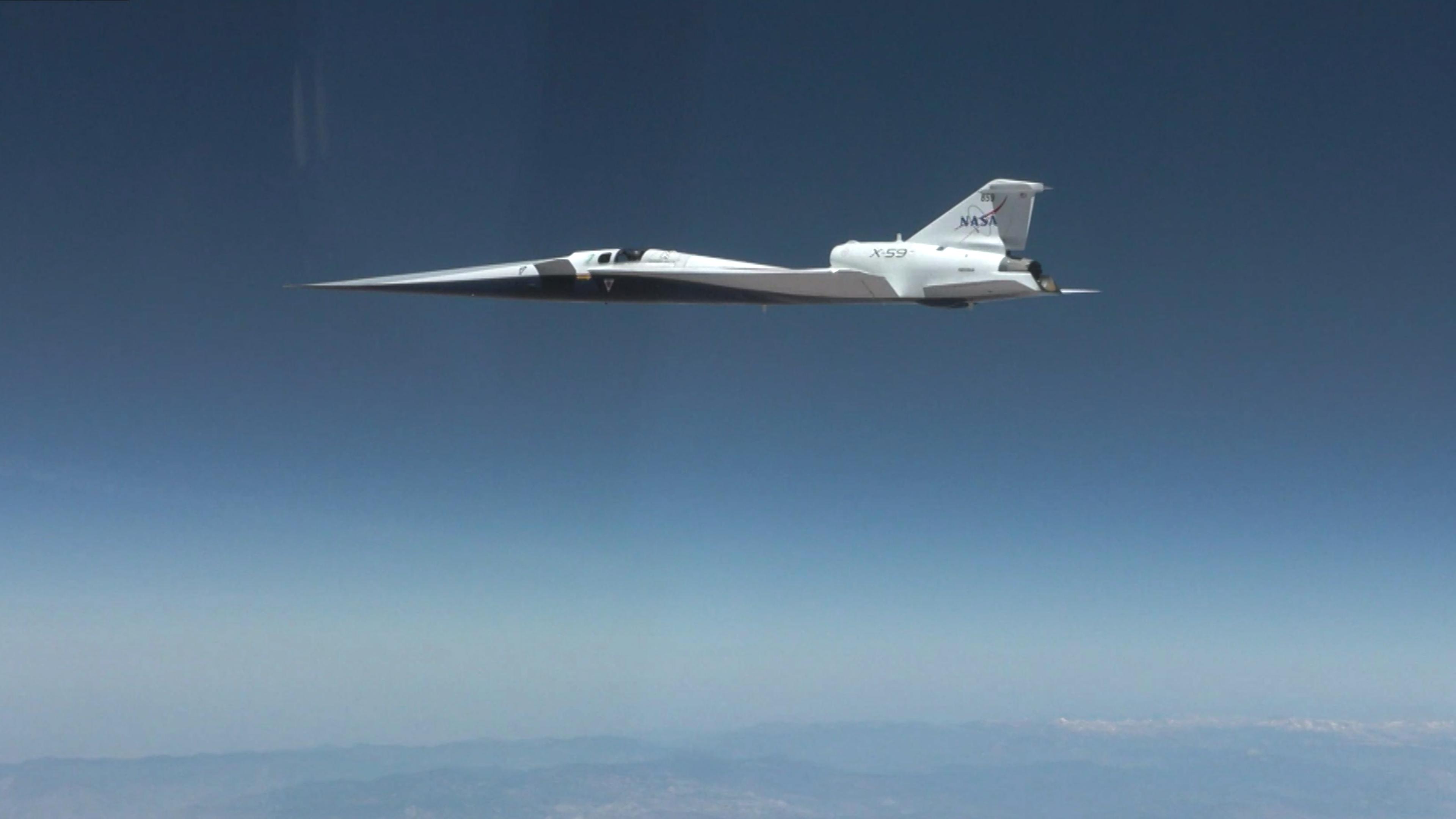
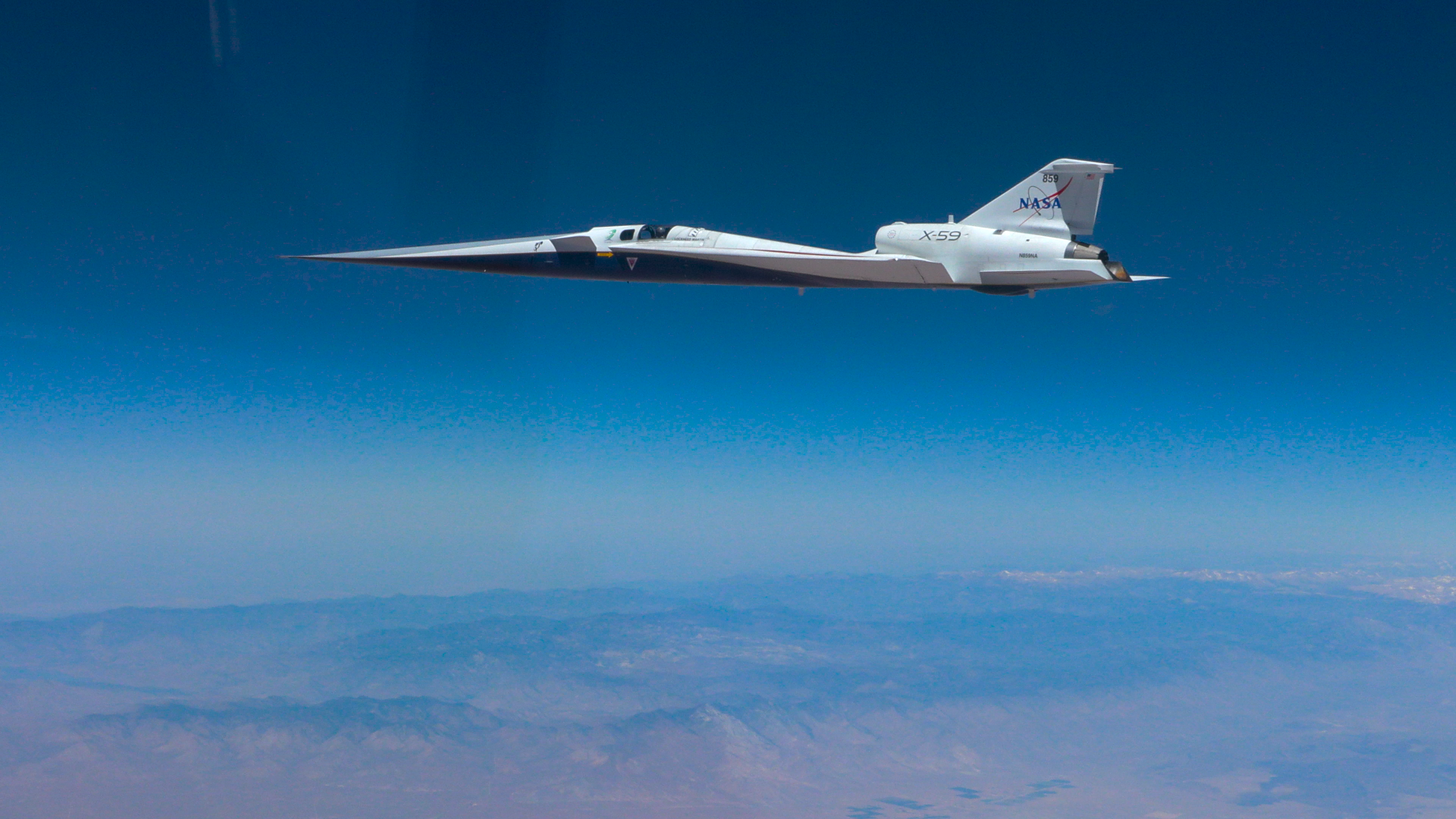
NASA’s X-59 quiet supersonic research aircraft completed its first supersonic flight Friday, June 5, 2026, marking the first time the aircraft exceeded the speed of sound in support of NASA’s Quesst mission. The milestone represents a major step in flight testing as the aircraft expands into the supersonic portion of its flight envelope.
NASA / Lori Losey
This speed and altitude are the base conditions for the X-59 when it will eventually fly over several U.S. communities enabling NASA to gather data about how people may perceive its quiet thump. NASA will share this data with U.S. and international regulators to help establish new data-driven noise standards to enable a future viable market for supersonic commercial flight over land.
For the last several months, the X-59 has been participating in an ongoing series of flights where the plane has been flying at a wide range of speeds and altitudes – a process known as envelope expansion. These tests are the first phase of the X-59’s flight testing. They are focused on performance and involve chase plane monitoring. When the aircraft completes this phase it will enter another, focused on its sound profile in order to verify its quiet thump capability.
The X-59 is the centerpiece of NASA’s Quesst mission, which aims to demonstrate quiet supersonic flight and help enable commercial supersonic flight over land worldwide. These advancements will help travelers reach their preferred destinations faster, spending less time in the air.
Through Quesst’s development of the X-59, NASA also will deliver design tools and technology for quiet supersonic airliners that will achieve the high speeds desired by commercial operators without disturbing people on the ground. NASA will validate design tools through ground and flight testing, providing U.S. aircraft manufacturers the ability to explore new quiet supersonic concepts, and provide them with confidence that their resulting designs will meet quiet flight requirements.
Preparations for Next Moonwalk Simulations Underway (and Underwater)
NASA’s X-59 eXternal Vision System shows Mach 1.077 on Friday, June 5, 2026, marking the aircraft’s first time reaching supersonic speed in support of NASA’s Quesst mission. The moment represents a milestone for the aircraft as it transitions to include test flights faster than the speed of sound.
NASA
NASA’s experimentalX-59 aircraft marked a major milestone Friday, June 5, when it flew faster than the speed of sound for the first time, setting the stage for demonstrating its quiet supersonic capabilities later this year.
NASA test pilot Jim “Clue” Less took off and landed at Edwards Air Force Base in California, reaching a top speed of approximately Mach 1.1 (713 mph) and altitude of 43,400 feet. The X-59’s flight began at 11:08 a.m. PDT and lasted 81 minutes, with the team focusing on flying qualities at both subsonic and then supersonic speeds.
In the coming days, we expect to take the next step and push to Mach 1.4
jared isaacman
NASA Administrator
”X-59 is getting ready for its quiet supersonic debut. Since the aircraft’s first flight on Oct. 28, 2025, the team has made tremendous progress, flying 16 times in the last 90 days and getting into a steady test rhythm. In the coming days, we expect to take the next step and push to Mach 1.4,” said NASA Administrator Jared Isaacman “I’m grateful to the NASA team and Lockheed Martin Skunk Works for their help getting us to this point, and I hope this is the first of many collaborations as we rebuild NASA’s X-plane portfolio.”
The X-59 is designed to fly at supersonic speeds while creating only a quiet thump instead of a loud sonic boom. For this flight, a NASA F‑15 chase plane flew nearby to monitor the X‑59. The loud sonic booms from the F-15 obscured any sound made by the X-59.
“The X-59’s first supersonic flight is a testament to America’s enduring leadership in science, engineering, and aerospace innovation,” said Michael Kratsios, Assistant to the President for Science and Technology and Director of the Office of Science and Technology Policy. “This achievement comes as the Trump Administration continues work to unleash supersonic flight and enable American ingenuity.”
This first supersonic flight is a significant milestone, but an event even more critical to the mission is upcoming. In just days, the aircraft is expected to make its first “mission conditions” flight, reaching a cruising speed of Mach 1.4 (925 mph) and altitude of approximately 55,000 feet. The X-59 also will be accompanied by a chase plane for this flight.
NASA’s X-59 quiet supersonic research aircraft completed its first supersonic flight Friday, June 5, 2026, marking the first time the aircraft exceeded the speed of sound in support of NASA’s Quesst mission. The milestone represents a major step in flight testing as the aircraft expands into the supersonic portion of its flight envelope.
NASA / Lori Losey
This speed and altitude are the base conditions for the X-59 when it will eventually fly over several U.S. communities enabling NASA to gather data about how people may perceive its quiet thump. NASA will share this data with U.S. and international regulators to help establish new data-driven noise standards to enable a future viable market for supersonic commercial flight over land.
For the last several months, the X-59 has been participating in an ongoing series of flights where the plane has been flying at a wide range of speeds and altitudes – a process known as envelope expansion. These tests are the first phase of the X-59’s flight testing. They are focused on performance and involve chase plane monitoring. When the aircraft completes this phase it will enter another, focused on its sound profile in order to verify its quiet thump capability.
The X-59 is the centerpiece of NASA’s Quesst mission, which aims to demonstrate quiet supersonic flight and help enable commercial supersonic flight over land worldwide. These advancements will help travelers reach their preferred destinations faster, spending less time in the air.
Through Quesst’s development of the X-59, NASA also will deliver design tools and technology for quiet supersonic airliners that will achieve the high speeds desired by commercial operators without disturbing people on the ground. NASA will validate design tools through ground and flight testing, providing U.S. aircraft manufacturers the ability to explore new quiet supersonic concepts, and provide them with confidence that their resulting designs will meet quiet flight requirements.
NASA’s X-59 quiet supersonic research aircraft completed its first supersonic flight Friday, June 5, 2026, marking the first time the aircraft exceeded the s...
NASA has told crew aboard the International Space Station (ISS) to resume normal operations, ending a roughly two-hour period in which five astronauts sheltered inside a docked SpaceX capsule. The shelter order came Friday morning as a precautionary measure to protect crew while Russian cosmonauts attempted a fix on the Zvezda service module’s transfer tunnelContinue reading "ISS crew back to normal after emergency shelter order"
NASA announced new contracts for the rovers and landers that will lay the groundwork for the agency’s proposed $30-billion Moon Base — some of which they plan to launch as soon as this fall — during a May 26 press conference. The announcement offered the most detailed look yet into the Moon Base plan NASAContinue reading "How NASA plans to build a Moon Base"
Days after successfully flying its Quarterhorse unmanned aircraft at supersonic speeds, an industry-first defense aviation company, Hermeus, has received the largest-ever contract awarded by the Defense Innovation Unit (DIU) to demonstrate high-Mach flight combined with high-Mach payload release.
The new $ 159 million award, which increases the original contract to a total of $219 million, will allow Hermeus’ engineers to expand on previous high-Mach test flight milestones in direct partnership with the U.S. Air Force and the U.S. Navy, with the goal of providing the American warfighter with the most advanced arsenal capable of delivering munitions and payloads around the world at record-setting speeds.
“By delivering flight-ready aircraft and demonstrating payload release at speed, we will prove this technology can create a decisive military advantage on a timeline that matters,” explained Hermeus CEO and co-founder, AJ Piplica. “Our focus is on providing the Air Force and Navy with the validated data they need to transition these platforms into the future force.”
High Mach Payload Release: “A Game Changing Warfighting Capability”
When announcing the new DIU award, Hermeus executives noted that the program will include a series of “intensive flight tests.” The first is expected later this year, while the final flights are expected sometime in 2027.
Although few specifics were provided, the company said the flights will “prove the aircraft can maintain high speeds and expand its performance limits” while also demonstrating the successful carry and release of payloads at high velocity. The company also noted that all flight data gathered during the development and testing phases “will directly inform service experimentation and future acquisition decisions.”
In May, Hermeus’ Quarterhorse Mk 2.1 unmanned aircraft successfully completed its first supersonic flight, reaching a top speed of Mach 1.21. Image Credit: Hermeus.
Although the U.S. Military has several aircraft capable of exceeding the speed of sound, and several more hypersonic (exceeding five times the speed of sound) aircraft and missile prototypes, delivering payloads from high-Mach aircraft has remained a challenge. However, some military experts argue that the U.S. would benefit greatly from the capability.
When discussing the need for high-speed payload release, DIU Military Deputy Major General Joe “Solo” Kunkel said that the largest problems the military is facing in the future are “generally around time and distance,” and the associated challenges with getting to distant locations “in a timeframe that matters.”
“I care about the warfighting capability, providing advantage to our partners and us in the fight, and making sure that we can walk into every fight with swagger,” General Kunkel said, adding that mass producing the technology developed by Hermeus could move it from a test platform to a “game-changing warfighting capability.”
“I think we found a significant number of use cases where it can be used as a weapon,” the General added.
Moving High-Mach Capability Out of the Lab
When discussing the company’s approach that convinced the DIU to offer its largest award in the organization’s history, including what they describe as “reclaiming the lost art of rapid iterative prototyping to build the fastest aircraft in the world today,” Hermeus noted that directly partnering with the USAF and USN allows their engineers to align tests with future mission needs and shorten the path from testing to deployment.
“By prioritizing relentless hardware iteration, we deliver high-speed systems at the pace of the modern battlefield,” the company’s statement explained. “We work with the Department of War to provide the high-speed capabilities our nation and its allies need to maintain a durable, asymmetric advantage.”
Image Credit: Hermeus.
When discussing the significance of the upcoming tests and the overall need for high-Mach flight payload deployment, including the benefit of the performance data, the company CEO heralded the DIU’s award, noting that the financing will help them move their successful demonstrations into real-world high-Mach platforms.
“This program is about moving high-Mach capability out of the lab and into an operationally relevant environment,” Piplica said.
Christopher Plain is a Science Fiction and Fantasy novelist and Head Science Writer at The Debrief. Follow and connect with him on X, learn about his books at plainfiction.com, or email him directly at christopher@thedebrief.org.
Elon Musk’s rocket company, on the cusp of the largest initial public offering ever, will soon end up in index funds after rule changes by Nasdaq and other index providers.
Gwynne Shotwell, the president and chief operating officer, is the adult-in-the-room foil to Mr. Musk as SpaceX prepares for a blockbuster initial public offering.
Gwynne Shotwell, the president and chief operating officer, is the adult-in-the-room foil to Mr. Musk as SpaceX prepares for a blockbuster initial public offering.
The $135 share price means Elon Musk’s rocket maker is poised to exceed the 2019 initial public offering of Saudi Aramco in both valuation and money raised.
A new MIT-designed lidar chip uses specially engineered antennas to reduce interference and widen the sensor’s field of view. From self-driving cars navigating busy streets to drones surveying disaster zones, lidar has become one of the most important technologies for helping machines perceive the world in three dimensions. By sending out rapid pulses of infrared [...]
In June 1983, Sally Ride became the first American woman to fly to space. Nearly three decades later, we learned that she had also been an LGBTQ trailblazer.
The big bang has causality issues, particularly the "horizon problem." I critique suggested solutions like cosmic inflation and negentropy, arguing that they require unproven concepts. The Creator, as described in the Bible, provides a coherent explanation without causality violations, in contrast with those scientific storytelling fairy tales for adults.
When we look out into space, even with the most powerful telescopes, are we seeing the universe in real time? Are we observing events as they happen, that is, at the time measured on our local clocks?
Stimulated Transfer redshift, a newly discovered phenomenon predicted by quantum electrodynamics, results in electron heating and a redshift of light from distant galaxies. The mechanism not only explains the extreme heating of the solar corona, but also provides an alternative explanation for astronomical redshifts without invoking an expanding universe.
The video clip of orbs circling a passenger plane prompts speculation about its origins, including faked footage, extraterrestrial craft, or military technology. After analysis, I dismiss the latter two due to physical impossibilities, instead propose that these are interdimensional craft linked to the spiritual realm.
The presentation presented here explores how light from distant galaxies could reach Earth in a universe less than 8,000 years old. This is from a biblical creationist perspective based on the scriptures and science.

 Login