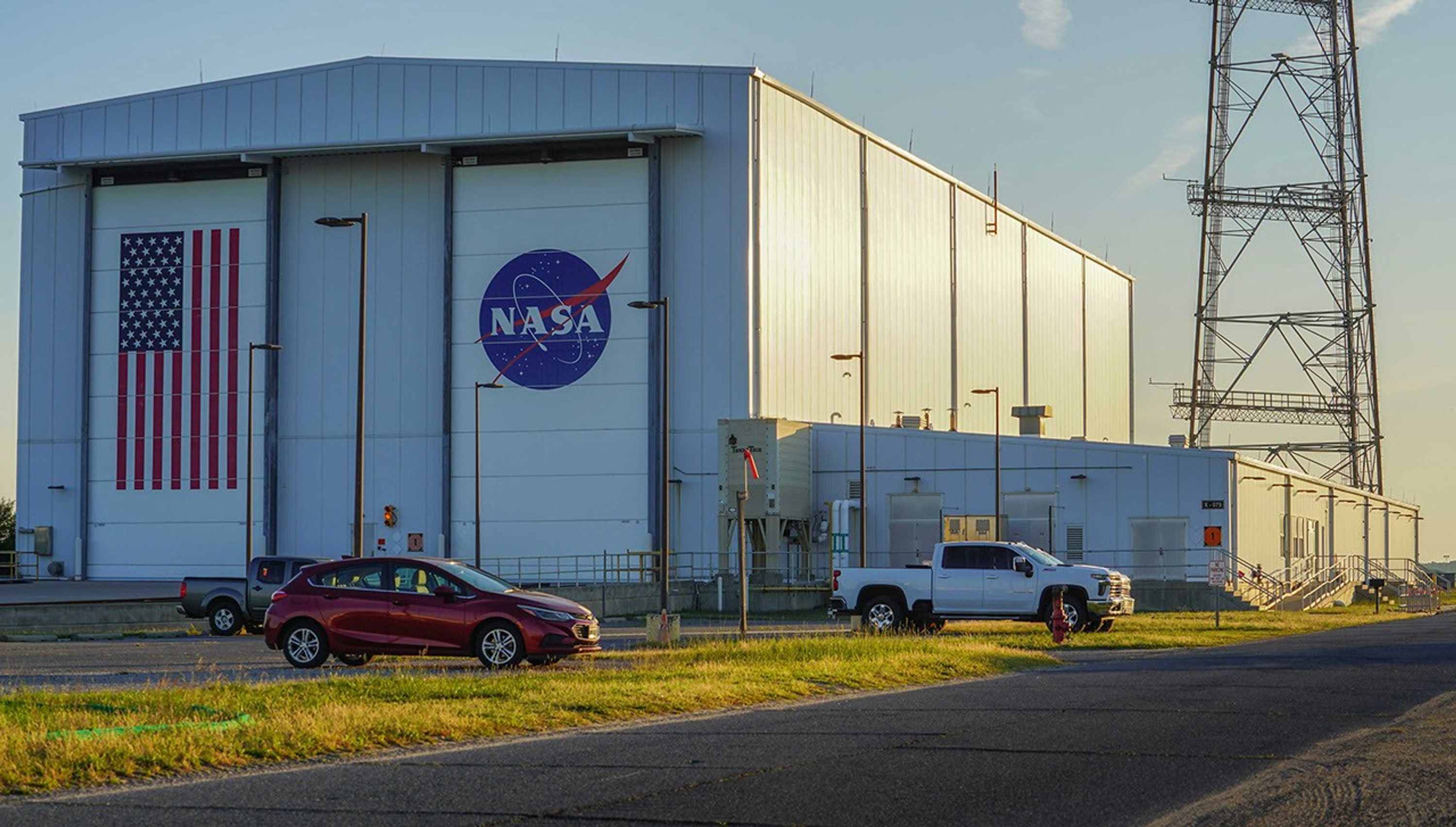
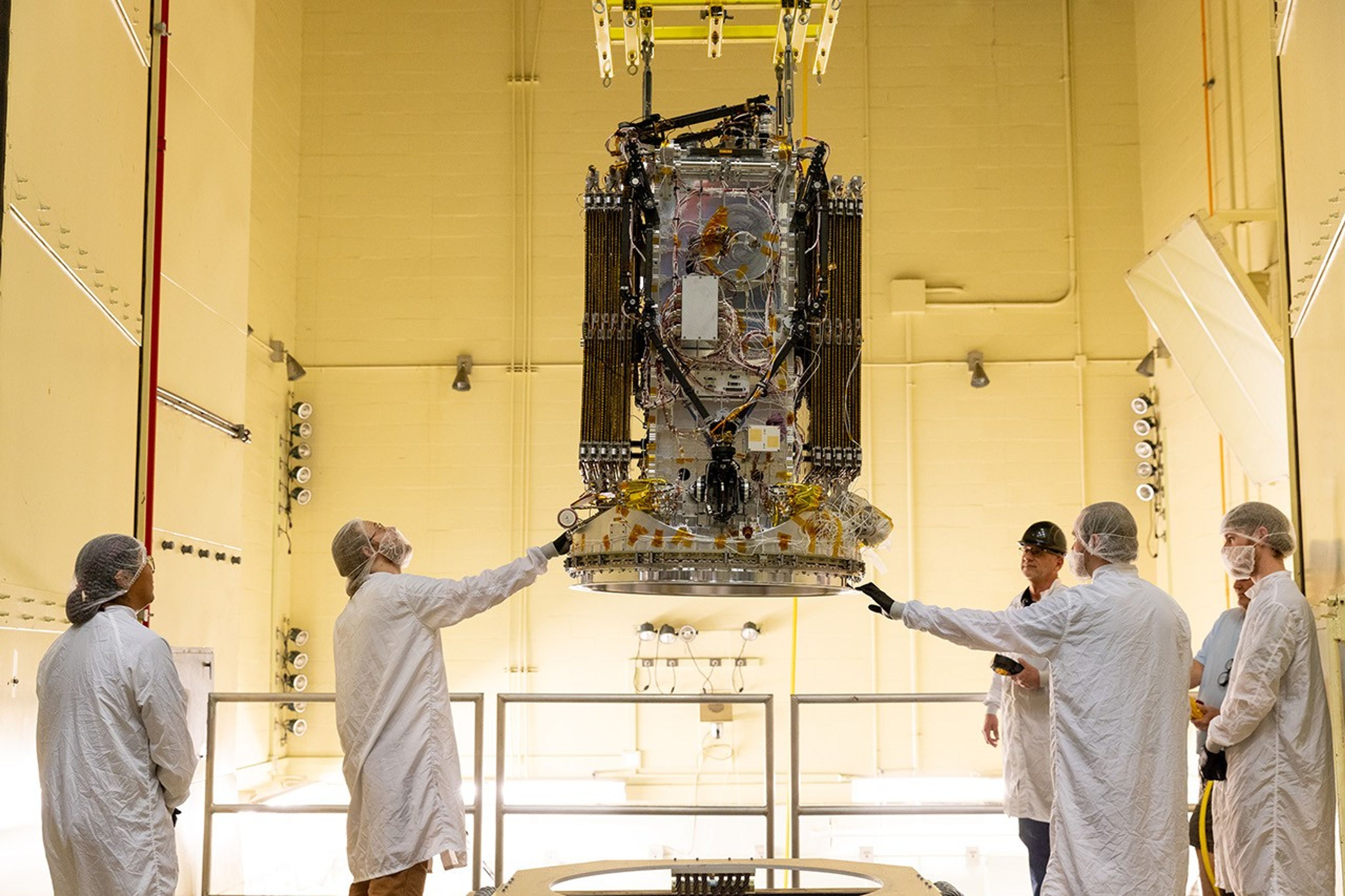
Northrop Grumman will load the LINK robotic servicing spacecraft from Katalyst Space into a Pegasus XL rocket at the Horizontal Integration Facility at NASA’s Wallops Flight Facility in Virginia, shown here. LINK arrived at Wallops on June 5, 2026, to begin integration.
NASA/Ron Beard
The LINK robotic servicing spacecraft, built by Katalyst Space and designed to capture and boost NASA’s Neil Gehrels Swift Observatory arrived at the agency’s Wallops Flight Facility in Virginia on Friday, June 5.
Inside NASA Wallops’ Horizontal Integration Facility, Northrop Grumman engineers will install the satellite into one of the company’s Pegasus XL rockets ahead of launch.
All spacecraft in low Earth orbit experience drag caused by our planet’s atmosphere. As a result, satellites without propulsion systems to counteract this effect gradually lose altitude and fall toward Earth.
Recent increased solar activity magnified the impact of atmospheric drag on Swift, causing it to sink faster than anticipated.
NASA contracted Katalyst to boost the 21-year-old observatory back to a higher altitude, pioneering a new servicing capability for the nation’s spacecraft fleet and allowing Swift to resume science observations.
After loading LINK into the Pegasus XL, Northrop Grumman will attach the rocket to the bottom of Stargazer, the company’s modified L-1011 aircraft.
Stargazer will deploy Pegasus XL from above Kwajalein Atoll, part of the Republic of the Marshall Islands in the South Pacific Ocean, later this month. The rocket will deliver the LINK spacecraft to an orbit where it can reach Swift.
As activities on the ground have raced to get LINK to Swift, the observatory team has been continuously making Swift’s orientation more aerodynamic to preserve altitude.
After more than two decades, the orbit of NASA’s Neil Gehrels Swift Observatory has entered a phase of rapid decay. While NASA could allow the observatory to re-enter Earth’s atmosphere, as many missions do at the ends of their lifetimes, this situation has presented an opportunity to advance American spacecraft servicing technology while also extending the life of a productive science mission. To accomplish this, NASA awarded the U.S. company Katalyst Space a contract in September 2025 to attempt to raise Swift’s orbit.
Engineers from Katalyst Space Technologies in Flagstaff, Ariz., stabilize their LINK robotic servicing spacecraft as it moves into a vibration chamber at NASA’s Goddard Space Flight Center in Greenbelt, Md., on April 15, 2026. The vibration chamber simulated the intense shaking LINK will experience during launch.
NASA/Scott Wiessinger
NASA studies how the Sun impacts the space environment, including objects in low Earth orbit, and recent increased solar activity has accelerated Swift’s decay. This has put NASA in a race against the clock before Swift re-enters Earth’s atmosphere in fall 2026. Katalyst’s robotic servicing spacecraft, LINK, will launch on its mission to boost Swift in June 2026 on Northrop Grumman’s Pegasus XL rocket.
Pegasus XL is an air-launched rocket that will be integrated with LINK at NASA’s Wallops Flight Facility in Virginia and then ferried underneath Northrop’s L-1011 carrier aircraft to the Reagan Test Range located on Kwajalein Atoll in the South Pacific for launch. By launching from Reagan Test Range, Pegasus will be able to deliver LINK directly into Swift’s orbit, where LINK will attempt to rendezvous with Swift and raise it to a higher altitude.
Northrop Grumman’s Stargazer, a modified L-1011 aircraft, soars upward after takeoff from Vandenberg Air Force Base in California. One of the company’s Pegasus XL rockets, carried beneath the aircraft as shown here, will launch Katalyst’s LINK spacecraft.
NASA/Randy Beaudoin
If this daring servicing mission is successful, it will be the first time a commercial robotic mission has captured a NASA spacecraft that is uncrewed and not originally designed to be serviced in space.
Swift studies gamma-ray bursts, the most powerful explosions in the universe, and other cosmic objects and events. In the more than two decades since its launch, Swift has become a key part of NASA’s strategy for studying fleeting and unpredictable changes in the sky from a variety of sources. With its versatility and rapid follow-up capabilities, Swift has enabled the discovery and localization of previously unknown cosmic targets. NASA then follows up these discoveries using different space telescopes, along with ground-based facilities from other agencies, to help us better understand how the universe works. By boosting Swift’s orbit, NASA will retain the observatory’s unique capabilities at a fraction of the cost of designing and building a new mission.
In anticipation of the boost, NASA temporarily suspended Swift science and modified its operations in a way that had never been done in the mission’s lifetime. This enabled controllers to keep the spacecraft in an orientation that minimizes drag effects and extends Swift’s time in orbit. To maximize the boost’s chances of success, Swift’s average altitude needs to be above about 185 miles (about 300 kilometers).
Mission Goals
Demonstrate NASA’s rapid-response capability and foster agile technology development to benefit current and future missions.
Advance U.S. private spacecraft servicing to demonstrate a key commercial capability for the future of space exploration and expand NASA’s use of servicing to a new and broader class of spacecraft.
Retain Swift’s unique capability to lead NASA’s fleet of space telescopes in studying changes in the high-energy universe using a cost-effective approach.
An artist’s concept of NASA’s Neil Gehrels Swift Observatory.
NASA’s Goddard Space Flight Center/Chris Smith (KBRwyle)
Swift boost facts
Contractor
Katalyst Space in Flagstaff, Arizona
Launch vehicle
Northrop Grumman’s Pegasus XL rocket
Launch location
Kwajalein Atoll, Marshall Islands
Launch date
June 2026
Servicing vehicle
Katalyst’s LINK spacecraft
A 880 pound (400 kilogram) small satellite
Uses three robotic arms to dock with Swift
Controlled rendezvous validated with a full-scale Swift model in a robotic testbed
Precision guidance, navigation, and control
Katalyst Space’s LINK spacecraft will take several months to complete the Swift orbit boost, as outlined in this timeline. In the artist’s concept, LINK is the smaller of the two spacecraft.
Katalyst Space and NASA’s Goddard Space Flight Center
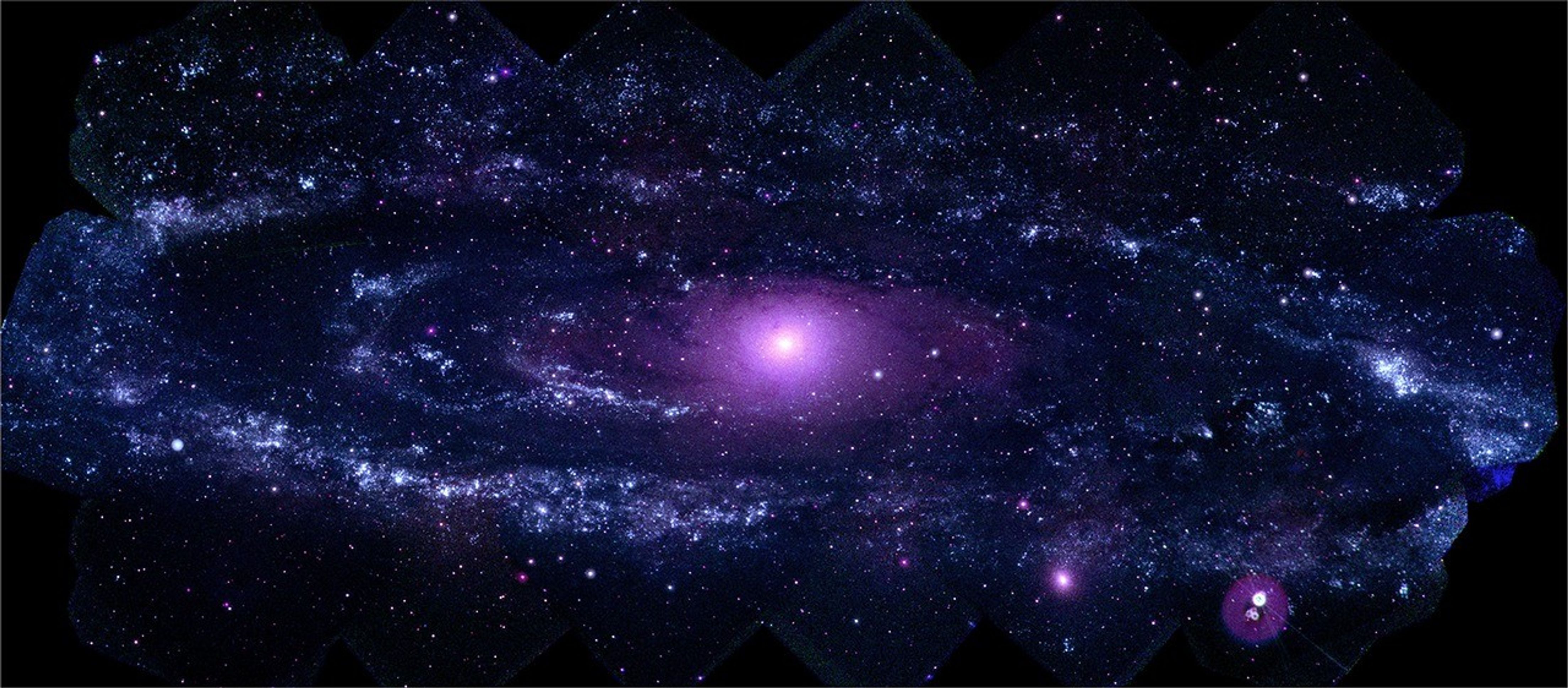
This mosaic of M31 merges 330 individual images taken by the Ultraviolet/Optical Telescope aboard NASA’s Swift spacecraft. It is the highest-resolution image of the galaxy ever recorded in the ultraviolet. The image shows a region 200,000 light-years wide and 100,000 light-years high.
NASA/Swift/Stefan Immler (GSFC) and Erin Grand (UMCP)
Pennsylvania State University, Mullard Space Science Laboratory, University of Leicester, Brera Observatory, ASI Data Center, Los Alamos National Laboratory
Mission Management
Goddard Space Flight Center, Greenbelt, Maryland
Program Management
NASA’s Space Science Mission Operations
Mission Operations
Penn State Eberly College of Science, State College, Pennsylvania
In July 2004, technicians in Hangar AE at what is now Cape Canaveral Space Force Station, Fla., removed the final pieces of protective covering from the Swift spacecraft in preparation for its November 2004 launch.
NASA-Funded Study Shows Wildfire Smoke’s Hidden Ozone Toll
Canadian wildfire smoke carried carbon monoxide — a building block of ground-level ozone — thousands of miles downwind in June 2023.
Credits: NASA’s Goddard Space Flight Center
Wildfire smoke is stoking a new challenge for cleaner air. A NASA-supported study published Thursday found that, over the last decade, wildfires have worsened ground-level ozone pollution across much of the contiguous United States, creating unhealthy air far from active flames.
Wildfires have become an increasingly important contributor to ground-level ozone, or smog, across much of the United States, researchers report June 4 in the journal Science. Nationally, fires offset nearly four years’ worth of ozone-control gains, with larger setbacks in the West and Midwest.
Smoke often is associated with the soot, ash, and other fine particles that make the air look hazy. But wildfires also emit gases such as carbon monoxide, which can help form surface ozone in sunlight when other pollutants are present. Surface ozone is an invisible pollutant harmful to human health, plants, and crops. As smoke plumes travel and mix with other pollution, those reactions can drive ozone increases hundreds or even thousands of miles from active fires.
“NASA Earth observations, along with ground monitoring networks, help reveal air quality risks from wildfires that can cross state lines, giving air quality managers better decision-making information as wildfire smoke affects more communities,” said John Haynes, manager of NASA Earth Action’s Health and Air Quality program at the agency’s Headquarters in Washington. “This is a strong example of NASA science serving communities here in the U.S.”
Building a clearer ozone picture
High in the atmosphere, ozone shields Earth from harmful ultraviolet radiation. Near the ground, however, ozone can irritate lungs, worsen asthma and other respiratory diseases, and increase health risks for children, older adults, outdoor workers, and people with existing health conditions.
To track surface ozone changes, researchers turned to deep learning, a form of artificial intelligence that finds patterns across large datasets. They used it to build a first-of-its-kind dataset estimating daily surface ozone from 2003 to 2024 on a kilometer-by-kilometer grid — about 0.6 miles on each side — across the contiguous U.S. The work received support from NASA’s Health and Air Quality program and other NASA grants.
The scientists combined data from about 1,000 ground-based air quality stations with atmospheric model data, weather information, wildfire pollution data, and satellite-derived information, including products from the Visible Infrared Imaging Radiometer Suite (VIIRS) and the Moderate Resolution Imaging Spectroradiometer (MODIS) instruments.
Smoke from Canada’s 2023 wildfires spread across North America. Tan to deep red colors show smoke intensity, estimated from black carbon in NASA’s GEOS-FP model.
NASA’s Scientific Visualization Studio (SVS) and NASA’s Global Modeling Assimilation Office (GMAO)
Their analysis revealed two distinct periods. From 2003 to 2015, U.S. ground-level ozone generally declined as emissions of ozone-forming pollutants decreased. After 2015, however, those gains slowed or reversed in many places. By comparing estimated ozone levels with scenarios that removed wildfire influence, the researchers found that pollution from wildfires was a main factor in that shift.
Without the wildfire contribution, ground-level ozone in the Midwest, for example, would likely have continued to decline. Instead, wildfires erased about 5.3 years’ worth of ozone-control progress since 2015.
“People in the Midwest may think fires burning far away will not affect them,” said the study’s corresponding author Jun Wang, an atmospheric scientist at the University of Iowa in Iowa City. “But once wildfire pollution is in the air, it can move across regions. Pollution from one place can affect air quality in another.”
Measuring the health toll
The study also found that wildfire-driven ozone increased exposure to unhealthy air and likely contributed to premature deaths. Premature deaths associated with long-term wildfire-related ozone exposure in the U.S. increased by an estimated 318 deaths per year after 2013, with the post-2013 average 46% higher than in the previous decade. The researchers calculated premature deaths using average lifespan, ozone exposure estimates, and population density.
The 2023 Canadian wildfires showed how widely those risks can spread, with smoke-driven ozone increases stretching across the Midwest and into parts of the Northeast and South. Overall, from 2022 to 2024, wildfires exposed an additional 43 million people in the U.S. to conditions that did not meet current federal air quality standards for ozone, the researchers estimated.
Capturing that national picture is difficult from ground monitors alone. Ground monitors remain the backbone of U.S. air quality tracking, but they do not cover every community. NASA’s scientifically validated satellite observations and models help researchers and agencies see air quality patterns across states, regions, and fire seasons.
That broader air quality work includes newer missions such as TEMPO (Tropospheric Emissions: Monitoring of Pollution). Launched in 2023, TEMPO is NASA’s first mission to use a space-based spectrometer to provide hourly daytime measurements of air quality over North America. Its view is sharp enough to distinguish pollution patterns, including surface ozone, across areas only a few square miles wide, a major improvement over earlier satellites.
Together, these capabilities help researchers and agencies see smoke-related ozone patterns that might otherwise be harder to detect, especially in rural and remote areas.
The work also points toward a practical use of NASA science during fire season. Wang’s team has used NASA support to develop FireAQ, a decision-support system that brings satellite observations, model forecasts, and fire and aerosol products into weekly briefings with state and local air quality officials. The goal is to help officials see where smoke-related pollution may move next and give communities better information.
NASA’s Roman Telescope could reveal 100,000 hidden worlds and rewrite what we know about planets across the Milky Way. NASA’s Nancy Grace Roman Space Telescope is expected to dramatically expand humanity’s catalog of worlds beyond our solar system. Known as exoplanets, these distant planets number nearly 6,300 discoveries so far through NASA missions and other [...]
NASA’s Fermi telescope may have finally uncovered the magnetic powerhouse behind the universe’s brightest supernovae. An international team of astronomers analyzing observations from NASA’s Fermi Gamma-ray Space Telescope has found what appears to be the first convincing detection of gamma rays from a rare type of extraordinarily bright stellar explosion known as a superluminous supernova. [...]

 Login