❌

Normal view

James Webb telescope pinpoints the most distant 'fast radio burst' ever seen

8 October 2026 at 19:00

Astronomers have detected the most distant burst of radio signals ever seen: an explosion that's emitting waves of energy from more than 10 billion light-years away.

The event, named FRB 20240304B, is known as a fast radio burst (FRB). Astronomers have detected thousands of FRBs before this. But because these events last only milliseconds, they are extremely difficult to study and their origin stories remain unclear.

In this case, however, astronomers managed to use a radio telescope array and the James Webb Space Telescope (JWST) to chart the event, with JWST narrowing down the precise host galaxy that FRB 20240304B came from. The study, published Thursday (Oct. 8) in the journal Science , sheds more light on a time when the universe was only about 3 billion years old, showing that FRBs arose early in our cosmos' history. The detection more than doubles the previous distance record for FRBs.

The JWST played an instrumental role in the discovery, study co-author Themiya Nanayakkara, a senior lecturer at the Sydney Institute for Astronomy, told Live Science in an email. The email was written in collaboration with study first author Manisha Caleb, a senior lecturer in astrophysics at the same university.

For example, JWST's observations showed that the host galaxy was smaller than expected, was "metal-poor" (had few elements besides hydrogen and helium), and was forming a lot of stars. These characteristics could offer new clues about the environments in which FRBs arise, giving more information about the mysterious events. Researchers suggest that this FRB may have been linked to a magnetar, a highly magnetic star core left after a supernova.

Zooming in with the James Webb telescope

The ancient FRB was initially detected with MeerKAT, an array of 64 radio telescopes in South Africa. Nanayakkara said MeerKAT revealed "both the detection of the fast radio burst and, importantly, a very precise position on the sky."

The researchers knew the FRB was far away because of the large dispersion of the radio signal, but initial searches with powerful ground-based telescopes, "saw essentially nothing; it looked like empty sky," the researchers told Live Science. "The most likely explanation was that the galaxy was simply too faint to be detected in those observations. That is where JWST became transformative."

An illustration of a series of colorful hexagons in front of a pink background

An illustration of a fast radio burst (FRB) being detected by the MeerKAT radio telescope array. (Image credit: Carl Knox - OzGrav, Swinburne University of Technology Background Image Credit: NASA, ESA, CSA, STScI, Themiya Nanayakkara (USYD) Background Image Processing Credit: Joseph DePasquale (STScI))

The science team successfully got time on JWST with a program called Director’s Discretionary Time, which is aimed at time-sensitive observations. The researchers started by using JWST's Near Infrared Camera to trace the radio signal and take a very deep image of the target region.

"Suddenly, there it was: a very faint galaxy almost exactly where we expected the host of the FRB to be," Nanayakkara said. The researchers then used JWST's Near Infrared Spectrograph to obtain a spectrum (wavelengths of light broken into different chemical signatures), which showed hydrogen and oxygen.

"These spectral features act like fingerprints: because we know the wavelengths at which they are produced in the laboratory, we can measure how much they have been shifted by the expansion of the universe," Nanayakkara explained. "That gave us a very precise redshift of about 2.15. We are therefore seeing this galaxy as it was when the universe was only around three billion years old, so roughly one-fifth of its current age."

Because the host galaxy is fairly young, it supports the idea that at least some FRBs are generated by magnetars, which are more likely to appear in spry galaxies where intense star formation is occurring, the team said.

The team plans to continue hunting for FRBs with JWST.

"We do not know what the sources will be yet," Nanayakkara said, as that depends on what pops up in the sky and is spotted by ground-based radio telescopes. "Once our radio telescopes find and localize a suitable new source, we can trigger the JWST observations. So it is quite exciting, because we really have no idea what we will find when we combine the power of these two types of telescopes."

Strange 'centaur' object between Saturn and Uranus has mysterious, changing rings, James Webb telescope study hints

15 September 2026 at 22:01

The rings around a strange small body orbiting between Saturn and Uranus look mysteriously different from previous views, new observations from the James Webb Space Telescope (JWST) suggest.

The rings encircle Chariklo, which is a centaur, a strange type of object that shows characteristics of both asteroids and comets. Chariklo is only about 400 miles (250 kilometers) in diameter and is part of a large group of tiny objects in the distant solar system.

Scientists first discovered Chariklo's rings in 2013 β€” making it the first small solar system body found to have rings β€” and studied them with ground-based telescopes again in 2014 and 2017. When JWST took another look at Chariklo in 2022, a decade had brought a lot of difference, according to a study published Sept. 9 in the journal Science Advances.

"By comparing JWST observations with those obtained … over the last decade, we discovered opposite changes in the two rings: while the inner ring shows significantly higher opacity, the outer ring shows lower opacity, " Pablo Santos-Sanz, a researcher at the Institute of Astrophysics of Andalusia and first author of the study, said in a statement.

Researchers don't know exactly how the changes took place, but the study authors offered three suggestions. The first is that JWST, which has a fine resolution, was able to see both denser and sparser zones of the rings than previous observations showed. The second is that there were changes in the rings' material or in the grains themselves. Finally, a third possibility is that JWST could see "grains with wavelength-dependent optical properties," meaning the telescope saw effects in composition and grain size that explain the variability.

Santos-Sanz said the research suggests that small bodies with rings β€” even those orbiting far away from the gravitational influences of planets β€” may have more changes in their systems than scientists previously thought. "Our results force us to rethink how they form, how they evolve, and what mechanisms maintain their stability," he said.

A theoretical follow-up observation, taken the next time Chariklo passes in front of a star, would help to confirm the new JWST results, the researchers added β€” especially the apparent decreased opacity of one of the rings and the increased opacity of the other.

"These observations would help disentangle temporal evolution from wavelength-dependent scattering effects, and clarify the physical processes shaping Chariklo’s rings," the researchers stated in the study.

A JWST milestone

The new observations of Chariklo also mark the first time that scientists have planned a JWST viewing campaign specifically around a stellar occultation β€” that is, the researchers timed the viewing precisely to when Chariklo passed in front of a distant star from the telescope's point of view.

All observations of Chariklo's rings, on the ground and in space, have used stellar occultations. That's because the rings are too faint to be imaged directly, so astronomers must instead learn more about the rings by measuring the dips and increases in brightness as Chariklo passes in front of the background star. Scientists use a similar method to study the atmospheres of alien planets with JWST's infrared instruments.

Chariklo's speed relative to JWST was low, at 1.5 miles per second (2.5 kilometers per second), allowing for fine imaging of the rings. To time the occultation, the researchers used info from the European Space Agency's Gaia mission, which precisely charts the locations and movements of more than 2 billion stars, as well as calculated the orbit of JWST at a location roughly 930,000 miles (1.5 million km) from Earth in the opposite direction of the sun. According to the researchers, the planning and execution of the mission required "extreme precision."

Microscopic alien technology may be hidden in moon dust, scientists say

15 September 2026 at 19:00

Could we find alien technology embedded in moon dust?

The bold idea, not yet peer-reviewed, suggests checking out the lunar surface for "microscopic technosignatures." The SETI Institute β€” or the Search for Extraterrestrial Intelligence Institute β€” describes these technosignatures as "tiny engineered particles" that may have come from interstellar space before settling on the moon.

The institute recently highlighted a paper on the topic, published on arxiv in August, and added the research is undergoing peer review for consideration in the International Journal of Astrobiology. The study is led by SETI Institute Affiliate Scientist Lewis Pinault.

"The moon has been quietly accumulating material from space for billions of years, much of it likely billions of years older than the moon itself," said Pinault in a statement. "We're asking whether that ancient collection might contain microscopic traces of technologies that existed long before humans ever looked up at the sky."

Even if no aliens turn out to be there, the search could help advance models of how dust goes through interstellar space, as well as effects on lunar geology or impact science, the institute added.

"The study reports no evidence of extraterrestrial technology," the institute added in the statement. "Instead, it demonstrates that searching for these microscopic technosignatures is now scientifically testable."

That's in large part because the NASA-led Artemis program, which will ultimately bring astronauts to the moon, as well as China's Chang'e robotic series, would provide opportunities to return samples, the institute said. (China is also eyeing bringing its taikonauts to the moon by 2030.)

SETI is best known for looking for artificial radio signatures in space that may have come from extraterrestrials. This new study, the institute added, is focusing more on past alien communities that may have preserved their knowledge in "durable particles," even if the communities are no longer in existence.

The study examines how these particles could (in theory) move from star to star, stay viable over long distances and periods, embed themselves in the lunar surface and then β€” if humans could find them β€” use AI-assisted imaging, materials analysis and microscopy to take a closer look, among other techniques.

Helping in that search is the environment of the moon itself, which β€” compared with Earth, at least β€” has slow-moving geology. As the institute points out, the surface has no flowing water or substantial atmosphere like our planet does. What's more, the moon has picked up dust in its environment for about four billion years (from not long after the solar system was formed 4.5 billion years ago), presenting a potential archive of dust in the solar system and interstellar space.

"The researchers argue that if advanced civilizations produce durable microscopic debris β€” whether intentionally or as a byproduct of space exploration or large-scale engineering β€” a tiny fraction of those particles could eventually become embedded in the lunar regolith," the institute stated.

The goal is to start these studies with about 35 cubic feet (one cubic meter) of lunar regolith, which is maybe the equivalent size of a fridge. Researchers would try out a series of careful investigations using multiple tools to "begin placing meaningful limits on the amount of durable artificial material produced by technological civilizations over the history of the Milky Way."

And as mentioned, even if this small sample doesn't turn up technosignatures, the researchers say the work is still important. It's another way to search for "extraterrestrial artifacts," to look at various aspects of solar system science, and to try out newer tools for examining moon samples that weren't available in the Apollo years.

"This is a novel addition to the search methodologies applied to seeking evidence of technology as a proxy for life and intelligence beyond our solar system and we are excited at the prospect of bringing this to fruition," stated Bill Diamond, SETI Institute president and CEO.

NASA astronaut Jessica Meir shares zero-G curly hair tips from the ISS (video)

13 September 2026 at 15:00

NASA astronaut Jessica Meir just shared some tips for controlling curls in the tough environment of microgravity β€” and it was a big deal for curly-haired people like me.

Meir's hair-care advice came Wednesday (Sept. 9) in a 5.5-minute video she posted to X from the International Space Station (ISS), where everything floats and "where curls are even more free to be what they want to be," the Expedition 75 astronaut wrote.

And if you think all this talk about hair care sounds frivolous, take it from a fellow curly: the representation matters. More on that in a moment, but first, let's see how Meir takes care of her curly hair in microgravity.

a woman wearing a black tank top and black shorts holds a water bottle on board a space station

In a video she posted to X on Sept. 9, 2026, NASA astronaut Jessica Meir provided tips for caring for curly hair in space. (Image credit: Jessica Meir/NASA)

According to Meir, washing in orbit requires no-rinse shampoo, especially focusing on the scalp, where sweat and salt build up. She has less access to hair products than we do here on Earth, as you would imagine, so she keeps it simple: a careful squeeze of her pouch of water, then working the expelled water along her hair roots, and also rubbing it on the scalp. Meir then uses a "dedicated T-shirt" to dry her hair, which she described as thick as well as curly.

In between treatments, Meir avoids brushes (for pretty obvious reasons of frizz) and uses her hands and fingers instead to "work" her hair. Luckily, humidity is not much of an issue on the ISS, but she does use leave-in conditioner: "My Earthly 3a curls become more like 3c," she said. Meir has been on the ISS since February, and she said she's looking forward to having an actual shower when she gets back home to Earth.

OK, so about that representation. My editor asked me to talk not only about Meir's video but also my own connections to her words, which brings up some teenage angst. In the 1990s, I was (then, as now) a curly-haired person who was just (bitterly) old enough to remember all the curly rock stars of my childhood in the '80s. But dare to wear curls in my school in like, 1994? As if! Lame!

All the young women around me were rocking the flat-haired "Rachel from 'Friends'" look that would take thick-haired curlies like me forever to achieve. I couldn't be bothered β€” I like sleep! Which apparently was enough for my classmates (of any gender) to deliver unprintable and sometimes racist insults, or to hide their faces from me because I was "ugly," or to spread rumors that I carried hair lice, and so forth. I couldn't believe it; other kids were sporting awesome and stand-out 'dos like mullets and mushroom cuts, so what was wrong with curls?

To be clear, as a 40-something I now have perspective: I later learned that some of my classmates had complex (even tragic) issues of their own contributing to the bullying, and I have no idea how other kids in my classes fared with their hairdos. The real lesson learned is that representation matters, inclusivity is possible and inclusivity matters across multiple dimensions. While looks may not sound important, at first glance, they really are: curly hair is a dimension of diversity. (I know I am just one female voice, with white U.K. ancestry; other people with curly hair will have different perspectives.)

So, back to the curly-hair-space-care routine: as a fellow curly, can I confirm that it stands up? Yes it does. While I'm no astronaut like Meir, I can offer you an analog: the two weeks I spent in 2014 at the Mars Society's Mars Desert Research Station in rural Utah, during which my crew was able to shower every two days, if we were lucky.

On that simulated Red Planet mission, I also used no-rinse shampoo to save on water, only combed (never brushed) my hair when it was wet, and mostly wore it bun-style to protect the curls in the meantime. While it took me two showers to feel normal when I at last reached a hotel room with running water, my hair bounced β€” so to speak β€” back quickly. That shows my curls are resilient, and since my 20s I've felt lucky to have them; my hair takes me a minimum of work or styling besides a quick wash and comb, and β€” as long as I don't touch my hair after it's wet β€” it's happy.

And to all those kids teasing me back in the day, allow me a moment of moon joy: NASA's Christina Koch sported curly hair during NASA's Artemis II lunar mission earlier this year. Koch herself, by the way, later spoke about her moon-mission braids at an event in my literal city in Canada (as, speaking of representation, I'm Canadian). Yes, of course there was more to this historic mission than hair: I covered Artemis II's science and activities at numerous in-person events for three-plus years, and some of its crew members for 17 years. But to see curls on a person looping around the moon? Bonus.

Every curly-haired person's experience is different, however, so I'd like to hear from you. There's a comment section with this article to chat about microgravity (or analog) curly-hair care, other curly-haired astronauts, or similar topics. Let us know your thoughts.

Mercury may have shrunk much more than we thought, new study hints

10 September 2026 at 14:00

Mercury, which is about one-third the size of Earth, may have shrunk more in its evolution than scientists originally thought.

A new study suggests that the tiny planet may have contracted 10% to 30% more than previous models suggested β€” meaning the planet’s total diameter shrunk almost 12 miles (19 km) since Mercury was formed. (Mercury’s diameter today is roughly 3,032 miles (4,880 km).

Previous missions overlooked the extent of the shrinkage because impact-crater debris on Mercury's surface hid the evidence, according to a study published Thursday (Sept. 10) in the journal Geophysical Research Letters. That size difference is important when researchers consider the planet's history, said Gaku Nishiyama, a planetary scientist at the German Aerospace Center Institute of Space Research and an author of the study.

"Because Mercury's evolution is driven by its cooling, the amount of contraction β€” an indicator of the extent of cooling β€” is one of the most important observables that can be compared to models for estimating its evolution scenario," Nishiyama told Live Science in an email.

There could also be implications for the planet's composition. For example, more shrinkage at Mercury could mean the planet would have a larger metal core and fewer light elements, such as silicon, inside that core, according to an American Geophysical Union statement.

"The interior of Mercury would reflect its formation," Nishiyama said, and possibly hint at the innermost part of our solar system. "Therefore, to understand how our solar system has evolved up to now, information that can be extracted from this estimation β€” such as core composition and initial temperature condition β€” is critical."

A violent history

A series of images of the surface of Mercury from space.

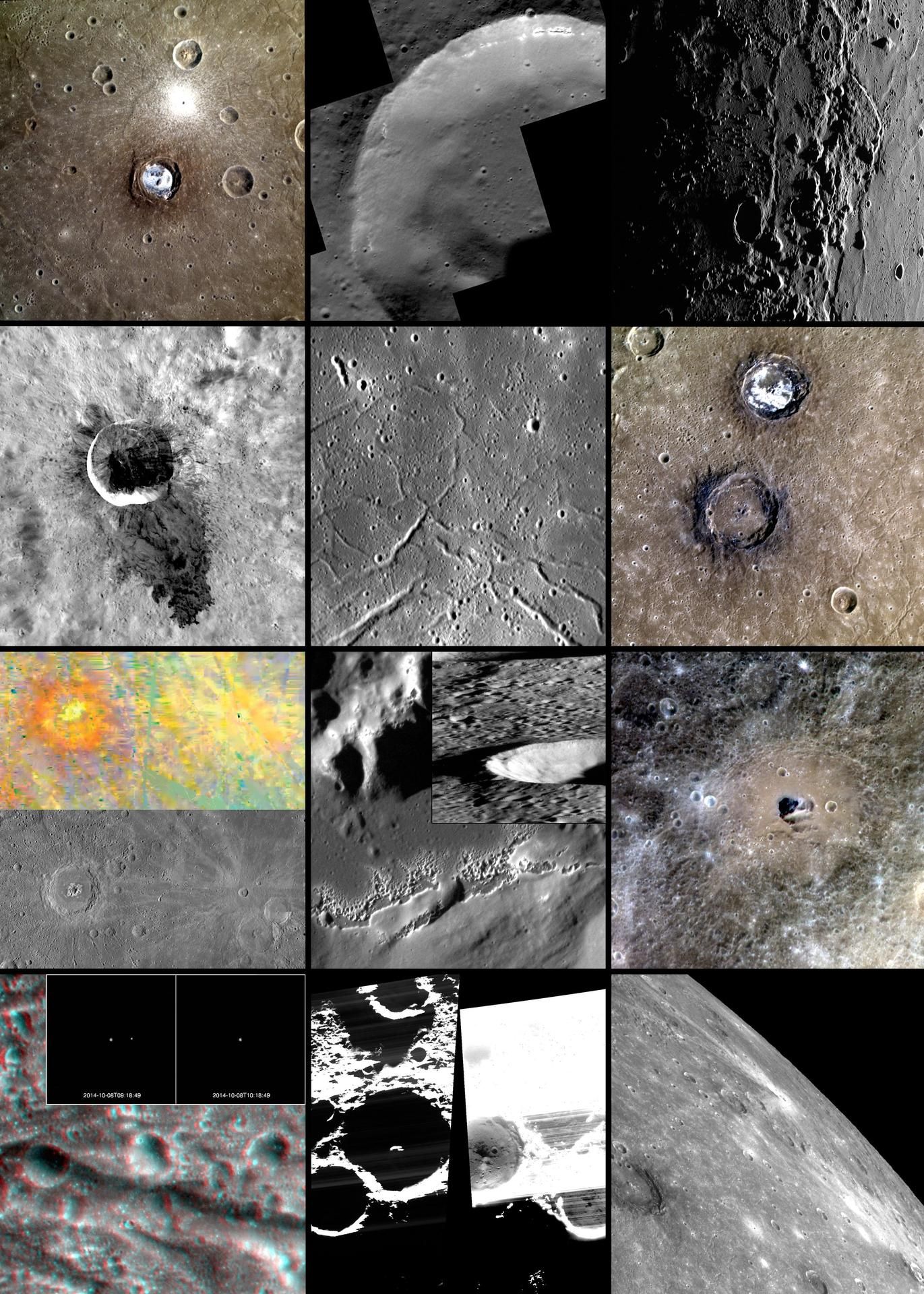
Observations from NASA's MESSENGER spacecraft (examples shown here) helped the team build new maps of the planet's shrinkage. (Image credit: NASA/Johns Hopkins University Applied Physics Laboratory/Carnegie Institution of Washington)

Mercury and the rest of the solar system planets formed due to the gradual collisions and aggregations of rock and gas upon asteroids and comets. Some of those impacts that created the planets also released a lot of heat. Mercury has been slowly cooling from those ancient impacts, and its interior has been shrinking along the way.

While this kind of cooling affects the entire planet's landscape, impact craters can mask the effects because each crash into the surface generates its own surface changes, including debris and new divots. The craters build up over time, making it difficult to spot more ancient geology underneath.

Nishiyama's team compared two sets of maps from Mercury, using data from NASA's MESSENGER mission, which orbited Mercury between 2011 and 2015. One set of maps charted geological features showing contraction, and the other set estimated the roughness of the planet's surface. Their work covered the entire surface and demonstrated that the most rugged spots on the planet have fewer wrinkles from shrinking. In other words, according to Nishiyama, the debris from more recent impacts is covering up the evidence of shrinking.

Nishiyama said more information will help to confirm the estimate. Such data could come from the European Space Agency's BepiColombo spacecraft, which began its arrival sequence at Mercury earlier this month after nearly eight years of space travel. Once the mission settles in, the spacecraft will take higher-resolution imagery of the surface than MESSENGER did. Nishiyama's team expects BepiColombo to pick up smaller impact craters, as well as scarps and ridges, that could further refine the measurements.

"Stay tuned for future topography measurements by BepiColombo," Nishiyama said. "Future data from laser altimetry on BepiColombo will collect more information on planetary contraction by measuring topography more precisely."

What comes after the moon? Artemis II commander and pilot shift to 'emeritus' status at NASA

10 September 2026 at 13:00

Three of NASA's Artemis II astronauts are starting off the school year with new assignments.

Artemis II commander Reid Wiseman and pilot Victor Glover, both NASA astronauts, will transition into "emeritus status" in September, the space agency announced on Wednesday (Sept. 9). Meanwhile, Canadian mission specialist Jeremy Hansen shared a video on X on Tuesday (Sept. 8) concerning his already-announced transfer from active duty to reserve status in the Canadian military.

The fourth Artemis II astronaut, NASA mission specialist Christina Koch, appears to still be on active duty, as no announcements have been made saying otherwise.

The Artemis II quartet flew around the moon in April, becoming the first people to go beyond low Earth orbit since 1972. The historic journey was widely expected to be the last step in active astronaut duty for at least some of the mission's four astronauts, especially Hansen, who had waited for a flight assignment for 17 years in part due to how Canadian Space Agency funding is allocated. (Robotics provided by the CSA form a minority share of international space partnerships with NASA, and astronaut flight rates are tied to funding.)

The Artemis II astronauts made a series of public appearances together this summer, culminating on Aug. 28 when President Trump awarded them the Congressional Space Medal of Honor. Hansen was only the second non-American to receive the award, which had previously been given to just 30 astronauts total.

While NASA's Wednesday announcement about Glover and Wiseman did not explicitly state that the duo are exiting active astronaut duty, their new role is described as allowing the astronauts to assist NASA as consultants and "individuals with a high degree of technical and professional knowledge," while allowing them to do other things.

The two astronauts are expected to help NASA plan future Artemis program missions. "I'm grateful they will continue sharing what they learned with our astronauts, flight controllers and engineers as we prepare for Artemis III in 2027 and the missions that follow," NASA administrator Jared Isaacman said in the statement.

three men and one woman hug inside a space capsule

From left: The Artemis II crew β€” NASA astronaut Christina Koch, Canadian Space Agency astronaut Jeremy Hansen, and NASA astronauts Reid Wiseman and Victor Glover β€” take time out for a group hug inside the Orion spacecraft on April 6, 2026. (Image credit: NASA)

Glover, who also retired from the U.S. Navy recently, will now assume a full-time role at his alma mater, California Polytechnic State University in San Luis Obispo, which has aerospace and space programs. The news was announced by the university on Wednesday, but the position took effect on Sept. 1. Glover will be an administrative leader providing advice to senior leadership on education, research and workforce strategies, according to Cal Poly.

"The most meaningful moments of my NASA career were supporting astronauts and their families through missions, and mentoring interns and new hires as they began their own journeys in technical and public service," Glover wrote Wednesday in a post on X about the career change.

Wiseman did not share any specific updates about his career plans on social media. The astronaut also exited active astronaut duty temporarily between 2020 and 2022 when he was chief of the astronaut office for NASA, a role that precludes flying in space as the chief is involved in flight assignments. Wiseman left that role and resumed active astronaut duty before being assigned to Artemis 2, which occurred shortly before the public announcement of the mission's crew in April 2023.

"NASA gave me tremendous responsibility, supported me through two space missions β€” and my time as chief astronaut β€” and was always there for my family when we needed it most," Wiseman said in the NASA statement about his career change. "I'm thrilled to continue serving future missions and programs through the emeritus program."

The mission continues! pic.twitter.com/2R6Dwb63bSSeptember 8, 2026

Hansen's Artemis 2 duties officially concluded on Sept. 2, according to his X account, and the astronaut β€” who has been based out of Houston since 2009 β€” posted a new video of himself Wednesday walking in the woods in Canada. Hansen said he has retired as a colonel with the Royal Canadian Air Force and is now a reservist working with 3 Canadian Space Division, which is essentially Canada's Space Force.

"The intention of that is to continue to serve Canada and government β€” the Canadian Space Agency β€” when it makes sense, to help us take advantage of some of the extraordinary opportunities that are before us right now," Hansen said in the video, adding that he will divulge more details about that work shortly.

Hansen also said he accepted a role as honorary national president with the Canadian military's Air Cadet League of Canada, which the astronaut has often said helped equip him with both flying and leadership skills when Hansen was growing up.

Additionally, Hansen pledged to "continue to share the moon joy" both as an individual and with his crew. For example, he recently joined a Canadian keynote-speakers bureau in which he plans to speak about how to accomplish personal "moonshots." In October, Hansen will also co-release "Earthrise: A Canadian Astronaut's Journey Into Deep Space" (HarperCollins Publishers, 2026) β€” a book that discusses his career and Artemis 2 β€” which he co-wrote with Canadian author John Larsen.

See the highest-resolution footage of a black hole jet ever taken, thanks to AI and 27 years of observations

9 September 2026 at 18:34

Astronomers just dropped a video 27 years in the making: the highest-definition animation of a gargantuan black hole jet blasting out of a distant galaxy and twisting off into space.

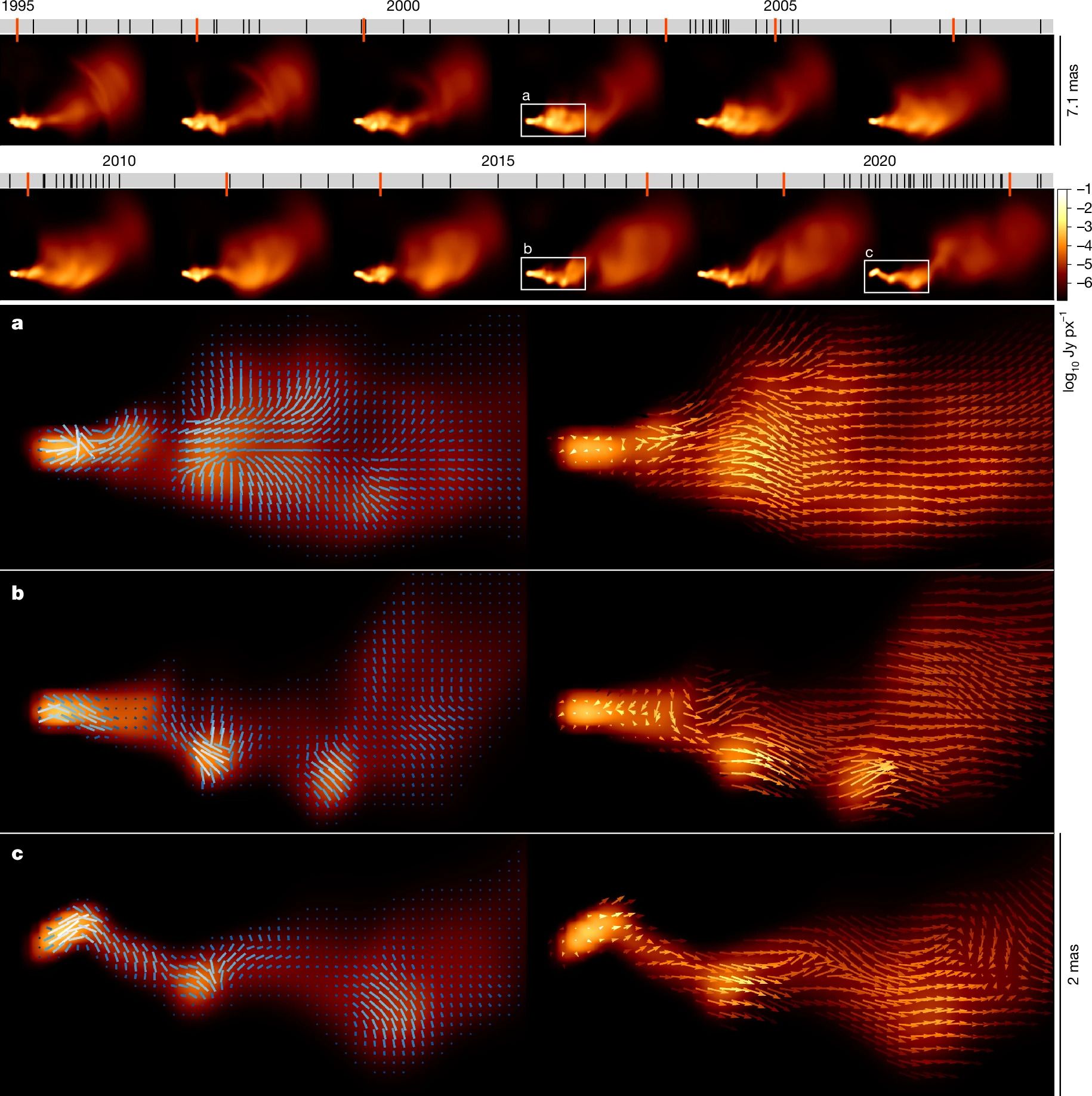
The video, made from 116 images taken between 1995 and 2022, captured a blazar known as 3C 345, in the constellation Hercules. A blazar is a sort of quasar β€” a bright, feeding supermassive black hole embedded in the center of a faraway galaxy β€” that emits huge jets of gas into its environment. The jets blaze at nearly the speed of light and are charged with highly concentrated X-rays and gamma rays.

As described in an Aug. 26 study in the journal Nature, scientists gathered the images of 3C 345 using decades of observations by the Very Long Baseline Array (VLBA), a network of 10 telescopes spread across the U.S. (VLBA had two programs that caught views of the jet, called BEAM-ME and MOJAVE, which collectively followed hundreds of blazar sources.)

To turn those hundred-or-so images into an animated movie, the team used an AI neural network named Kine, achieving a resolution four times higher than that of any individual image. By doing so, the researchers mapped the speed of the black hole jet to the highest precision yet. (Several study co-authors had previous experience boosting the resolution of distant black hole images while working at the Event Horizon Telescope Collaboration, the team behind the first image of a black hole.)

"The higher quality of our video reconstruction enabled a detailed measurement of the plasma velocity in the jet," study first author Marianna Foschi, a postdoctoral researcher at Caltech, told Live Science in an email.

A big, bright surprise

The researchers were surprised to see that the mighty jet's brightest components were flying at 10 to 13 times the speed of light while the gas surrounding it was zooming at about nine to 12 times the speed of light.

A series of orange plumes against a dark background

Still images of the black hole jet taken over 27 years. The bottom images (a-c) show the direction of polarization in the plasma jet. (Image credit: Foschi et al / Nature)

"This is unexpected because the general consensus is that these bright components are shock perturbations moving through the plasma, and as such they should have a higher velocity compared to the surrounding fluid," Foschi said. "Our work does not invalidate the shock model in general, but it puts it into question, at least in the case of this specific source."

VLBA uses radio antennae across the continental U.S. to map the sky, providing a wide view of the universe. But while VLBA has a comprehensive view of the sky, it lacks very fine details. The array is designed to generate a two-dimensional image with elements based on a measurement between two of the array's telescopes. Because the array has only 10 telescopes to do those measurements, however, its pixel resolution is limited.

That's where the Kine AI model makes a difference. The goal of Kine's work, Foschi said, is to develop an imaging algorithm that can create videos of observations at different times, focused on astronomical sources with variable brightness.

Kine is a neural network β€” a type of machine learning model that uses layers of "neurons" (computing nodes) to learn from a dataset, similar to the way a human brain learns. Kine can "process observations at different times, while learning and leveraging the spatio-temporal correlations present in the data," the research team wrote in the paper, referring to time and the three dimensions of space.

Foschi said the team is eager to apply Kine to other astronomical observations. "We believe this method will drastically change the way jet dynamics is studied from observations," she said. "In fact, our method enables a precise measurement of the projected velocity at any point in the jet."

See how much you know about black holes with our black hole quiz!

NASA expands Deep Space Network with giant new dish in California desert

6 September 2026 at 11:00

NASA's long-distance spacecraft-calling network just got a boost.

The Deep Space Network (DSN), best known for communicating with distant spacecraft such as Voyager 1, Voyager 2 and New Horizons, added a 114-foot (34-meter) radio-frequency antenna in California, boosting capacity on the increasingly crowded network.

More than 40 spacecraft exploring the solar system and interstellar space use DSN, which has struggled to keep pace with growing demand. Communications with the uncrewed Artemis 1 mission in 2022 and the crewed Artemis 2 mission in 2026 took priority as they traveled around the moon, substantially reducing the network's capacity to support other missions.

At least as early as 2021, managers were warning that despite ongoing efforts to add new antennas to DSN, the agency cannot reach all deep-space missions at once.

"We're trying to add capacity and more antennas, but we can't keep up with the demand that's currently out there, so missions should expect to be getting less availability," Brad Arnold, DSN manager at NASA's Jet Propulsion Laboratory (JPL), said during a presentation attended by Space News. Arnold also warned that the Artemis moon program would be "the gorilla in the room," because the astronauts by default have to be prioritized over robotic spacecraft: "That ultimately will affect our ability to service the rest of the missions."

That's because the DSN is designed to serve both human and robotic deep-space spacecraft. While JPL (then under contract to the U.S. Army) had three spacecraft radio-tracking stations in Nigeria, Singapore, and California ready for the early space program in 1958, the DSN with more powerful dishes was established in December 1963 as "the de facto network for missions into deep space," state JPL materials from the 50th anniversary celebration in 2013.

a large dish points towards the sky.

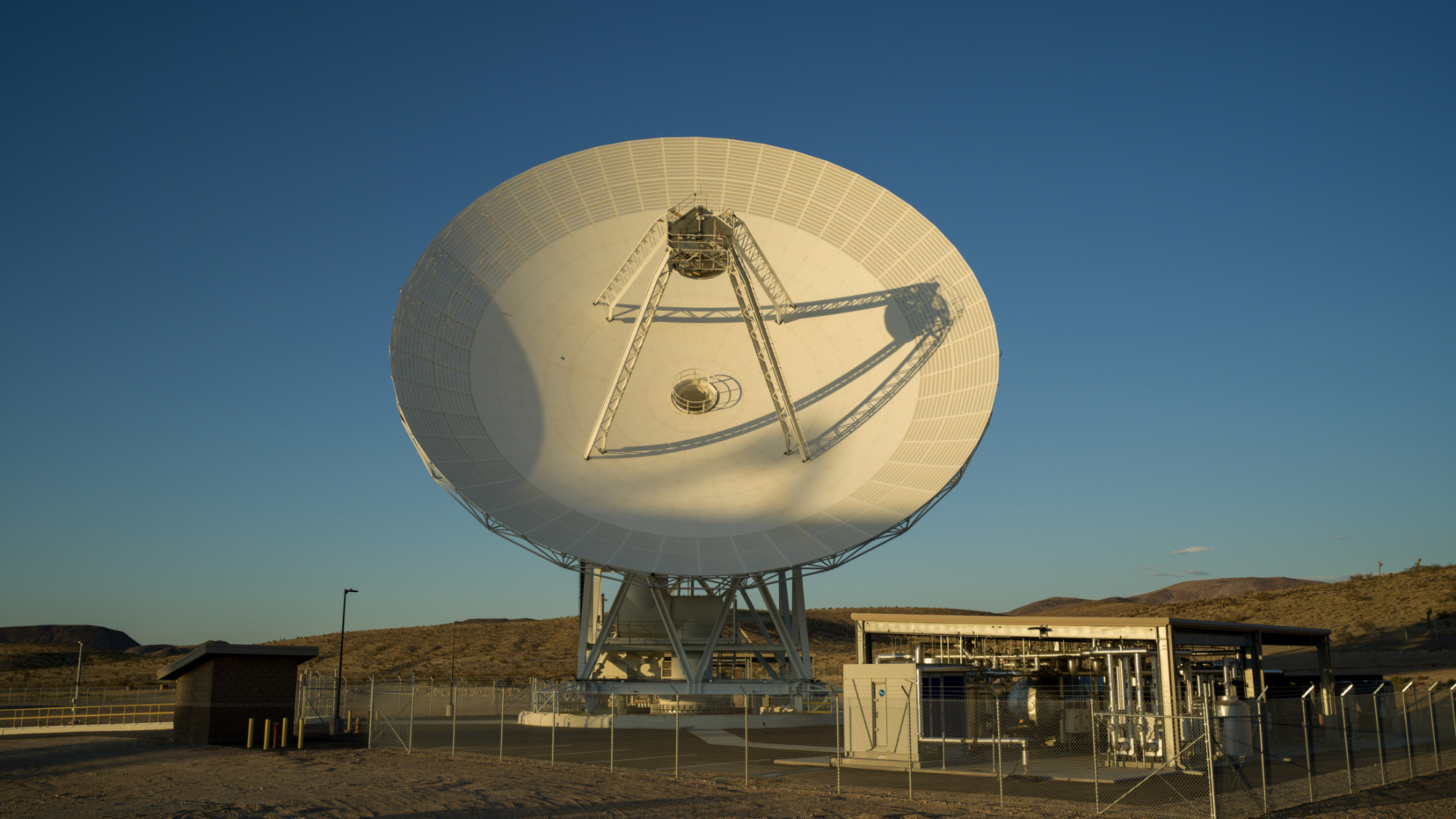
The recently completed Deep Space Station 23 at the Deep Space Network's Goldstone complex near Barstow, California. (Image credit: NASA/JPL-Caltech)

The DSN helped relay communications from Apollo 11's historic moonwalk by NASA astronaut Neil Armstrong's on July 20, 1969, and has since supported countless milestones. This includes images from Mars rovers starting in the 1990s and data showing that both Voyager 1 and Voyager 2 crossed into interstellar space in the 2010s.

These days, Artemis isn't the only extra demand on DSN; other space agencies also use the network for their own spacecraft, to a much greater degree than 50 years ago as space exploration has matured. NASA is also planning a permanent Moon Base near the lunar south pole as soon as the 2030s, although the agency does promise the base will, in its third phase, include "a coordinated lunar network supporting communications across Moon Base assets."

The DSN operates three complexes β€” at Goldstone in California, near Madrid in Spain and Canberra in Australia β€” each of which includes a large 230-ft (70m) antenna alongside several smaller dishes. The new antenna is about half that size and is co-located at Goldstone. It came online on Aug. 3, tracking NASA's Chandra X-ray Observatory.

DSS-23 is the fifth of six new 34-meter antennas planned under the DSN's Aperture Enhancement Project, which began in 2009. The project is expected to be completed when the sixth antenna, DSS-33, comes online at the Canberra complex in 2029.

The expansion has also taken longer and cost more than originally planned. A 2015 NASA Office of Inspector General report estimated the project at $362.4 million, but by the start of fiscal year 2023, expected costs had risen by 68% to $706 million and the project was nearly five years behind schedule. NASA now expects the final enhancement antenna to come online in 2029.

This NASA-funded 'Slingshot' spacecraft idea could map minerals on planets and moons across our solar system

5 September 2026 at 11:00

Nearby Earth, an iconic series of orbiting U.S. government satellites called Landsat have collectively been charting minerals and climate change for more than 50 years.

What if we can do the same thing in space? A new NASA early-stage project, whimsically named "Interworld Slingshot Resource Surveys", aims to bring "Landsat-style mineral intelligence" to other worlds, including the moon. NASA is aiming to put a moon base on the lunar surface in the 2030s that would be staffed by astronauts, as the U.S. tries to secure access to helium-3 and other minerals on the surface ahead of China. Being able to scout for minerals ahead of landing and setting up a base would be a huge boon for the United States' lunar ambitions.

The newly funded concept β€” which doesn't appear to have an official nickname or acronym, so we will call it "Slingshot" for short β€” isn't meant to address that big task all at once, but to be a Phase 1 study for a far-future Discovery-class (large) mission. The spacecraft could fly from world to world, scanning destinations such as the moon, an asteroid near Earth, or a target like the Mars moon Phobos, said principal investigator Pablo Sobron, a research scientist at the SETI (Search for Extraterrestrial Intelligence) Institute, in a statement.

"The thing most likely to stop space mining may be that we cannot afford to prove there is anything worth mining," Sobron said. "Land in the wrong place and you can lose an entire exploration program or a company, and nobody has enough money to keep sending spacecraft and hoping for the best."

The overall aim is to not only prove a spacecraft could make it that far, but also to see if Raman spectroscopy β€” which is commonly used close up to look for minerals or water by NASA's Perseverance mission on Mars, for example β€” could work from orbit or a flyby. The technique uses reflected light from a laser popped at a target to see the molecular structure of a mineral, which in turn reveals the mineral's composition.

"The main challenge for Interworld Slingshot Resource Surveys is the distance involved," SETI stated. "Raman scattering is very faint and hard to detect. The project team says that only about one photon in 10 trillion is Raman-scattered. Sobron's earlier long-distance Raman tests reached about 120 meters [393 feet]. This study is looking at whether useful measurements can be made from much farther away, around 30 to 50 kilometers [19 to 31 miles]."

a map showing earth, the moon, mars and its moon phobos with a long s-shaped path drawn between them on which a T-shaped spacecraft flies

The NASA-funded Interworld Slingshot Resource Surveys study is exploring whether a small spacecraft could survey the moon, a near-Earth asteroid and Phobos during a single mission using a single remote-sensing instrument. (Image credit: Pablo Sobron)

Slingshot received a Phase 1 grant from the NASA Innovative Advanced Concepts (NIAC) program, which aims to prove out conceptual ideas into something that could be nudged into further development.

NIAC has funded dozens of grants over the years, but illustrating the difficulty of and long development cycles to bring things into space, not much has made it out of the atmosphere yet. A notable NIAC success story was SNAPPY, the Solar Neutrino Astro-Particle Physics CubeSat, which reached space earlier this year aboard SpaceX.

Slingshot will use the Phase 1 funding to study photons (particles of light) to be used and detected by the spectrometer, along with lasers, pointing, and spacecraft propulsion and orbits. The concept received up to $175,000 over nine months and next in line would be trying to receive more lucrative Phase 2 NIAC funding over two years.

Hubble confirms mysterious, 10-sided cloud is growing over Saturn's south pole

3 September 2026 at 22:27

New Hubble observations have revealed a dramatic, 10-sided jet surrounding Saturn's south pole, and it appears to be evolving before our eyes.

The Hubble Space Telescope recently snapped a high-resolution view of the striking "atmospheric wave," which appears to have begun forming in 2023, archival Hubble images show. Scientists are curious about how this "decagon" popped up so quickly, given that Saturn's other famous multisided wave β€” a hexagon at the north pole β€” has been observed on the planet for 40-plus years.

"The question is, why did it suddenly form now when we haven't seen one before?" Amy Simon, a senior scientist at NASA's Goddard Space Flight Center and co-author of a new study describing the observations, said in a statement.

"The northern hexagon has been there every time we've looked for more than 40 years," Simon added. "This feature is different β€” it appears to be strengthening, giving us the rare opportunity to watch a giant atmospheric pattern develop."

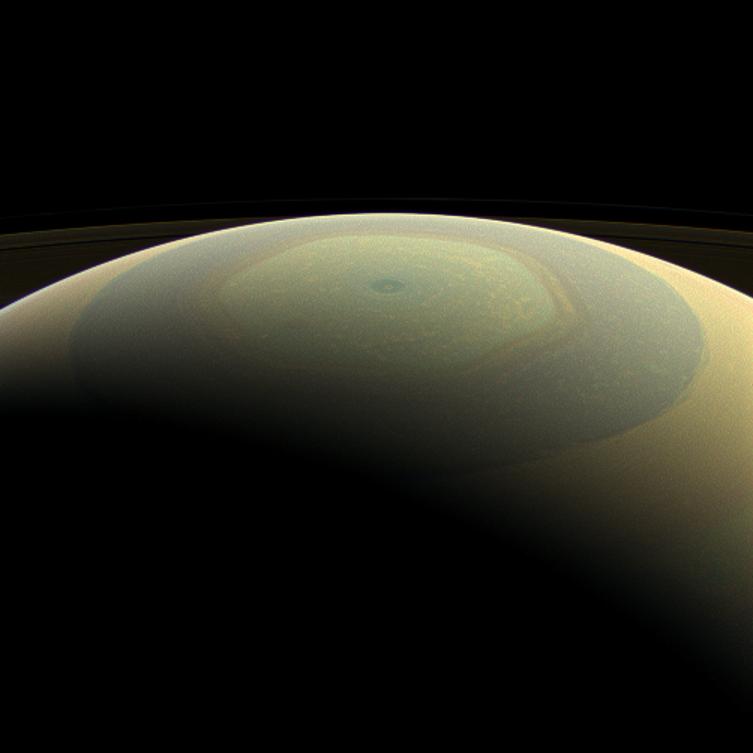
The globe of Saturn, seen here in natural color, is reminiscent of a holiday ornament in this wide-angle view from NASA's Cassini spacecraft.

The famous hexagon at Saturn’s north pole. (Image credit: NASA/JPL-Caltech/Space Science Institute)

Scientists can see the wave persisting through several atmospheric layers, which means it extends beyond the cloud tops. The wave is also found in a large jet stream at Saturn. More observations with Hubble and the James Webb Space Telescope (JWST) will be required to see how the wave is generated and what the decagon illustrates about atmospheres in large gas giants like Saturn.

The images were obtained as part of Hubble's Outer Planet Atmospheres Legacy program, which uses some of the telescope's time to image the solar system's outer planets β€” Jupiter, Saturn, Uranus and Neptune β€” once a year. The goal is to obtain long-term observations of these worlds, to supplement spacecraft orbiting or flying by.

From Earth's perspective, Saturn is slowly orbiting in its roughly 29-year journey of the sun so that its south pole is visible from our planet, allowing for a good view of the changing decagon. Hubble, in fact, was not the first to see signs of this decagonal shape; it was ground-based observatories that spotted a mysterious undulating band around Saturn’s south pole in 2024.

AgustΓ­n SΓ‘nchez-Lavega, first author of the study and a researcher in the Department of Applied Physics at the University of the Basque Country, and amateur astronomers Trevor Barry and Jean-Paul Oger first spotted the forming wave. The trio used the university's Planetary Virtual Observatory Laboratory, which brings in observations from around the world, to make the Saturnian discovery.

While more images in 2025 showed the wave starting to move into a decagon structure, Hubble was able to obtain high-resolution images without Earth's atmosphere in the way.

The Cassini spacecraft, which orbited Saturn between 2004 and 2017, didn't see the feature, hinting that it hadn’t started forming yet, according to NASA. "Given Saturn's symmetry in its north-south jet stream system, we have been searching for a counterpart to Saturn's northern hexagon on the south pole in Hubble images since 1990," SΓ‘nchez-Lavega said.

Both Hubble and JWST are expected to provide more opportunities to look at the ringed planet's developing decagon in the near future. In the meantime, Saturn isn’t the only solar system planet with perplexing polar features; 2017 images from NASA’s Juno spacecraft showed that Jupiter’s south pole is studded with gigantic, oval-shaped cyclones that echo the chaos of the planet’s famous Great Red Spot.

❌