❌

Normal view

Does written language speed up or slow down cultural change?

The written word is one of humanity's most important information technologies. Without it, mathematical and scientific discoveries would be lost to history. But it can also lock ideas in place long after they've stopped making sense.

So does writing speed up cultural change or slow it down?

Russell Gray, a professor in the Department of Linguistic and Cultural Evolution at the Max Planck Institute for Evolutionary Anthropology in Germany, heads a research project investigating how writing affects the way languages change. His team uses methods borrowed from evolutionary biology to trace languages through family trees β€” similar to the way biologists trace species.

Language is one element of culture that researchers can measure to determine whether writing speeds up or slows down cultural change.

"The obvious answer," Gray said, is that writing slows culture down because writing "is all codified and specified and people get trained in it." Gray doesn’t think the obvious answer is necessarily the right one. But other researchers agree that writing can lock in ways of thinking.

"Writing can lead to what learning psychologists sometimes call 'canalization,'" Charles Perreault, an associate professor in the School of Human Evolution and Social Change at Arizona State University, told Live Science in an email. "It can narrow the range of ways people think about a problem. When a rule, method, or story is written down, people may come to see it as the correct version … and may not even consider that a better or different way could exist."

Religious texts and legal codes are good examples. In both cases, the interpretation of rules written hundreds β€ͺ—‬ or even thousands β€ͺ—‬ of years ago shapes the way things are done, long after the circumstances that produced them have changed.

An old illustration of a monk holding a book sitting on a chair.

Eadwine the Scribe, from a 12th Century psalter written at Christ Church, Canterbury by Eadwine. For much of the Middle Ages and before the invention of the printing press, transcriptions written by monks were the primary cultural bridge preserving early Christian writings, and classic Greek and Latin texts, for posterity. (Image credit: UniversalImagesGroup via Getty Images)

This idea shows up in artistic expression, too: A 2017 analysis by ethnomusicologist Patrick Savage looked at more than 4,000 British-American ballads from the 16th through 20th centuries and found that written melodies changed less than those shared through oral tradition.

But there are also ways that writing may speed up cultural change.

"Before writing, much cultural knowledge had to be stored in people's brains," Perreault said. "That has obvious limits."

People forget things they don't study routinely, and when people die, their knowledge often dies with them. Because writing moves information storage beyond the human brain, it can reduce those losses, Perreault said.

"If writing prevents knowledge from being lost, and if it also helps information spread through a society, as with the printing press, then it could accelerate the ratchet effect of cumulative cultural evolution," Perreault said. "But this remains, to some extent, a hypothesis."

By the book

One reason the question of whether written language speeds or slows cultural evolution is that writing is hard to separate from everything that comes with it.

Writing has been separately invented only around four times in human history β€” although "some people argue there's a fifth in India," Gray said β€” which means nearly every writing system on Earth descends from that handful. Those systems spread through contact; trade, war, religion and the other ways humans intermingle had their own effects on cultural change that are hard to untangle from the effects of writing.

Also, "mass literacy is quite recent," Gray said. "If you've got these written varieties that are just used by, often, religious elites, that's potentially going to have much less impact."

So which force wins? Both experts think writing speeds up cultural change, though neither can prove it yet.

"I would say that writing probably speeds up cultural change overall," Perreault said. Gray agreed, though he acknowledged that most people would guess the opposite.

Still, Perreault cautioned, "these are empirical questions that have yet to be answered empirically."

Could we ever create artificial gravity on a spaceship?

Among the many risks astronauts face during long-haul spaceflight, an extended stay in microgravity is one of the most consequential for long-term health, with effects on vision, bones, muscles and many other aspects of the body.

One solution might be artificial gravity —‬ some way to create forces similar to Earth's gravity on a spaceship, akin to the giant rotating ring from Stanley Kubrick's 1968 film "2001: A Space Odyssey."

But is that technology ever coming, or will it remain science fiction?

"There's really no reason it couldn't happen," Torin Clark, an associate professor of aerospace engineering at the University of Colorado Boulder, told Live Science. "From a technical perspective, this is something that could happen in the very near future."

In fact, artificial gravity has almost made its way to space before. The Centrifuge Accommodation Module was a planned 8.2-foot-wide (2.5 meters) centrifuge for the International Space Station (ISS), but the project was canceled in 2005 for budgetary reasons.

"[Artificial gravity] is one of those things β€ͺ—‬ like all of a sudden, it's super popular, and then all of the scientists at NASA and everybody … have a lot of funding to understand how to actually implement this, and then it just dies," Ana Diaz Artiles, an associate professor of aerospace engineering at Texas A&M University, told Live Science. "And then it comes back, and dies, and comes back. I've been going through a couple of these cycles in the time that I've been doing this."

Besides budgetary concerns, there are questions about how such a solution would be implemented.

"Everybody agrees it's a good thing to do. The problem is that we don't know how to implement it," Diaz Artiles said. "How much gravity do you need? How big does [the device] have to be? How long do you need it to be? And how long do you have to use this? Should we use continuous gravity or a short-radius centrifuge, something where you go in and out?"

Researchers have three main approaches for creating artificial gravity. One is the classic sci-fi idea: a giant ring that rotates passengers' entire living quarters so they live and work under forces similar to Earth's gravity.

"You have a relatively long radius, which means you don't have to spin very fast to create gravity," Diaz Artiles said. "But this is massive. You can't get all the parts up there in the same spacecraft β€” you need multiple spacecraft and to assemble everything. So, of course, you can see what a big endeavor this is."

A short-radius centrifuge is a more feasible option. It's essentially a tube with a radius of 6 to 10 feet (1.8 to 3 m) that spins to simulate gravity. A passenger sits or stands inside, with their head closest to the center of rotation, so the spin generates the strongest pull down toward their feet.

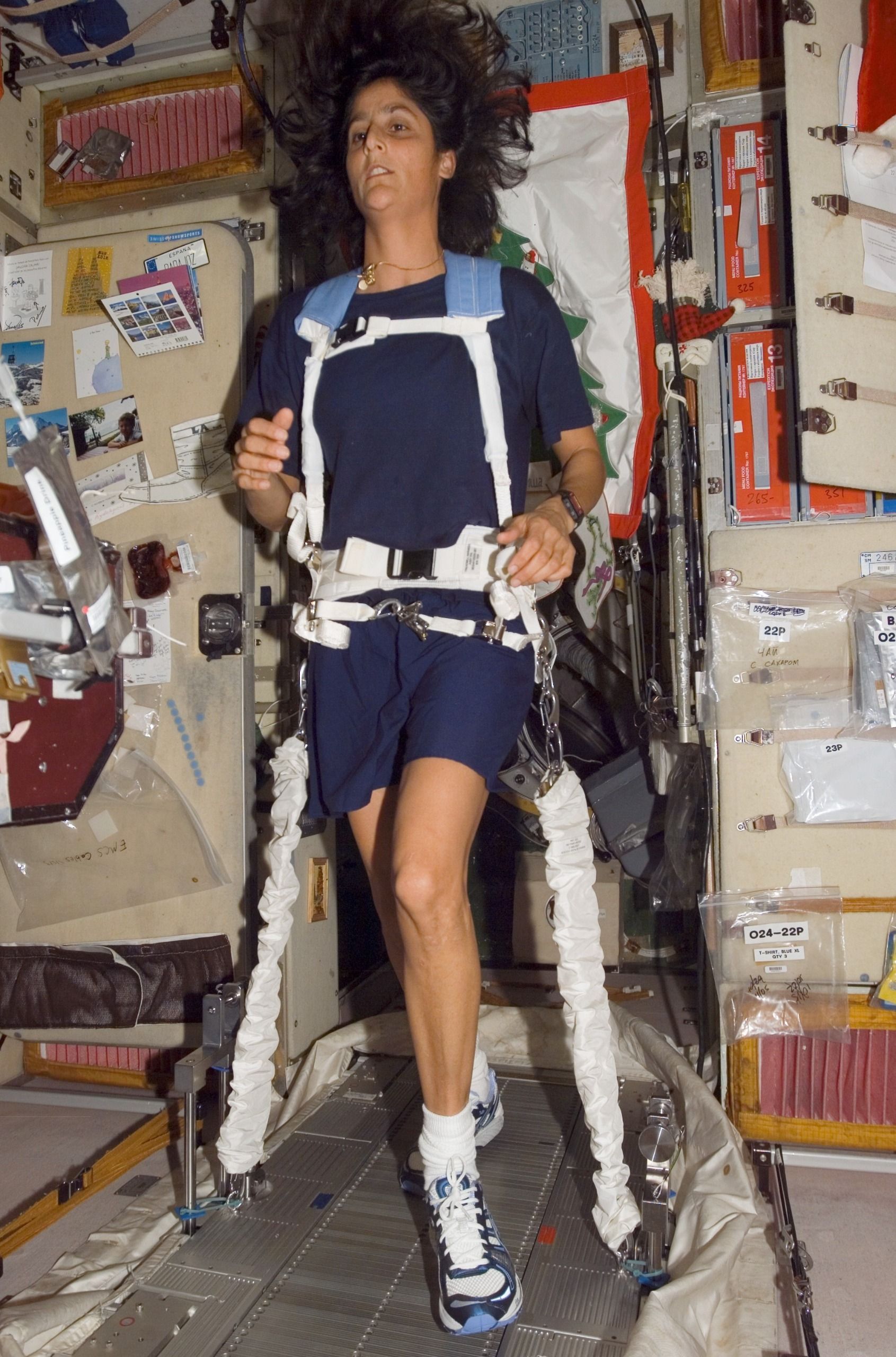
A woman walks on a treadmill in space.

Astronaut Sunita Williams, equipped with a bungee harness, exercises on the Treadmill Vibration Isolation System (TVIS) in the Zvezda Service Module of the International Space Station in 2006. (Image credit: NASA/Crew of Expedition 14, Public domain, via Wikimedia Commons)

Instead of allowing passengers to live in artificial gravity, this smaller device would be used in short daily sessions. "It's kind of like an exercise device," Diaz Artiles said. "In the ISS, you have a treadmill, you have this resistive exercise machine, so you go there for 30 minutes to do your exercise, and then you get out."

The final option is for spacecraft to create gravity via linear acceleration. This works in the same way that an accelerating car pushes passengers back into their seats, except the spacecraft would be oriented to push an astronaut's feet into the floor. To slow down, the spacecraft would turn around, firing its thrusters in the opposite direction to decelerate smoothly while maintaining a roughly similar gravity for its occupants.

"But then you need something like an engine that is able to accelerate all the time," Diaz Artiles said. "And propulsion-wise, I think we're not there yet."

Although a short-radius centrifuge is the most feasible approach in terms of both cost and engineering, it does have some drawbacks. For one, its fast spin can induce the Coriolis cross-coupled illusion β€ͺ—‬ a sensation of tilting or tumbling that happens when you tilt your head off-axis while rotating.

This is the effect that causes motion sickness, Clark said.

However, Clark and his team have found that people can build a tolerance to the sensation with training, simply by being in a slowly spinning centrifuge and gradually increasing the speed when they no longer feel the sensation.

"If you very slowly, incrementally increase the spin rate … and do that not just over one session but over multiple sessions across multiple days, as far as we could tell, anyone can be made to incrementally acclimate to the rotating environment [of] up to 20 to 30 rotations per minute," Clark said.

Would artificial gravity prevent harmful effects on the body?

But researchers still don't know how fast the centrifuge would need to rotate, or how long someone needs to spend inside it, to benefit. Long periods in microgravity can lead to bone and muscle loss, loss of aerobic fitness, blood clots, and visual issues from fluid shifts in the eyes. The hope is that artificial gravity could prevent those effects, but exactly how much gravity is necessary remains an open question.

Studies of people on head-down tilt bed rest β€ͺ—‬ the standard research method for simulating spaceflight deconditioning β€ͺ—‬ have found that 30 minutes a day in a centrifuge did prevent some loss of muscle function.

"Thirty minutes a day … maybe is not enough," Clark said. "Maybe an hour or even two hours a day, and maybe at higher G levels, would be beneficial."

But these studies are expensive and time-consuming. "It's very difficult," Diaz Artiles said. "I think people are interested in this concept, but we just don't have a good answer."

In the end, it's not a technological challenge that's keeping artificial gravity from being used in space; it's knowing the best way to employ it and securing the budget for it.

"We know how to do this. As humans, we have done more difficult things," Diaz Artiles said. "We need the money, but we also need to better understand the need."

See how much you know about human exploration into space with our spaceflight quiz!

How small can a transistor get?

For decades, engineers have been working to create smaller and smaller transistors to fit ever-larger numbers of them onto computer chips, all in the name of greater processing power. Now, in the age of artificial intelligence (AI), that effort has turned into an all-out race.

So how small can a transistor actually get? And is smaller even still the goal?

To understand the answer, first you need to know what a transistor is.

"If you take a computer or your mobile phone and you were to pry it open, you will see that there is a printed circuit board," Suman Datta, a professor of electrical and computer engineering at Georgia Tech, told Live Science.

On that circuit board are small, rectangular objects called chips, and inside each chip is a tiny piece of silicon. "And in that silicon, if you zoom in like a million times … maybe, if you're lucky, you will start seeing these tiny switches or transistors sitting etched into that piece of silicon," Datta said.

Sign up for our newsletter

Life's Little Mysteries logo with a question mark in a magnifying glass

(Image credit: Marilyn Perkins / Future)

Sign up for our weekly Life's Little Mysteries newsletter to get the latest mysteries before they appear online.

Each transistor is effectively a switch that turns on and off in response to jolts of electricity pulsing 4 billion times per second. Modern devices contain billions of transistors, and each one turning on and off in a precise orchestration to move and store 1s and 0s powers everything from Google searches and AI data centers to the device you're using to read these words.

The smaller the transistors are, the more can fit on each chip and the greater the chip's speed and functionality. So how small have they gotten so far?

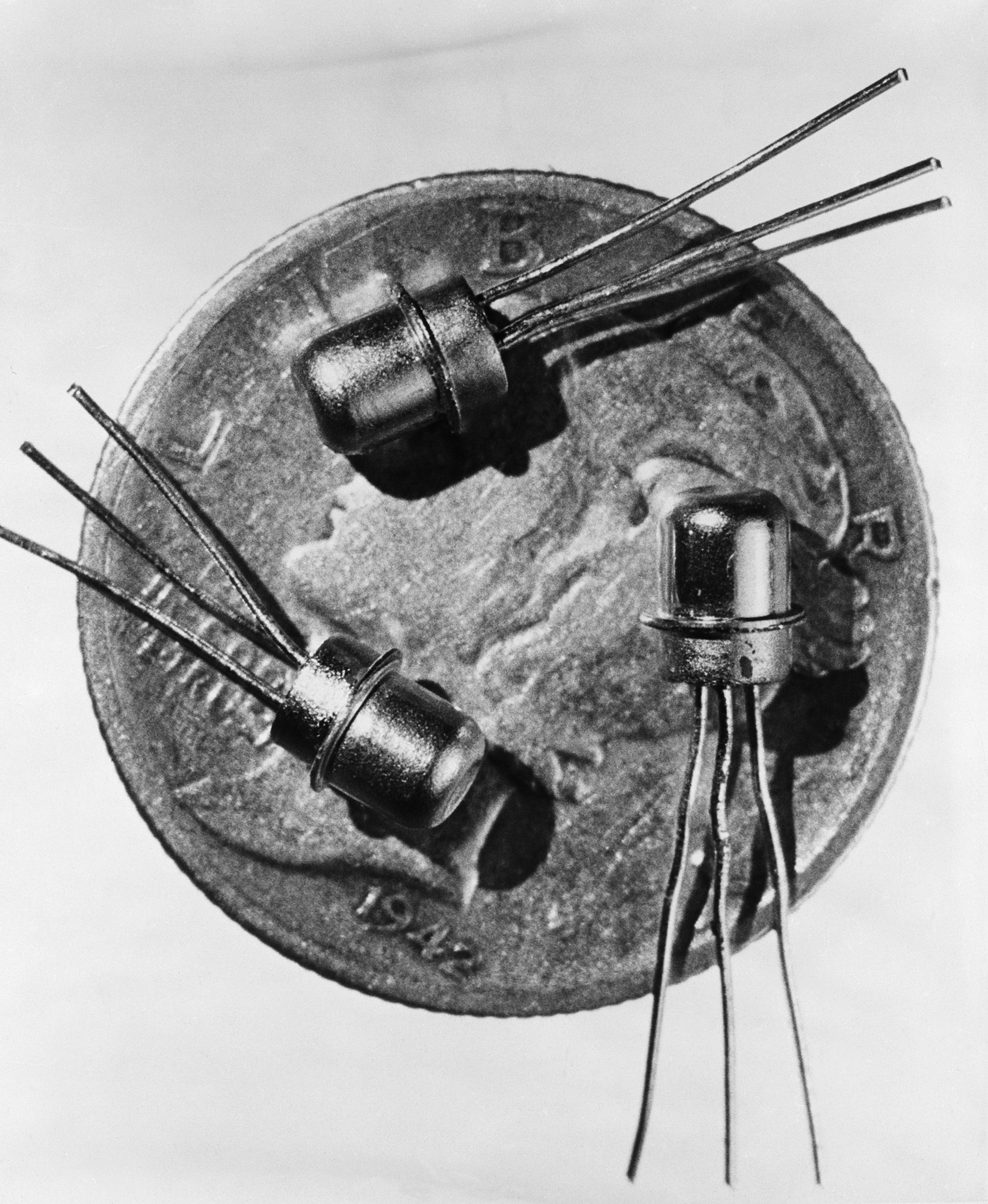
Three metal tubes with spikes coming off of them sit on a coin in a black and white photo

Transistors were once visible to to the naked eye, but have now been made orders of magnitude smaller than the width of a human hair. (Image credit: Bettmann via Getty Images)

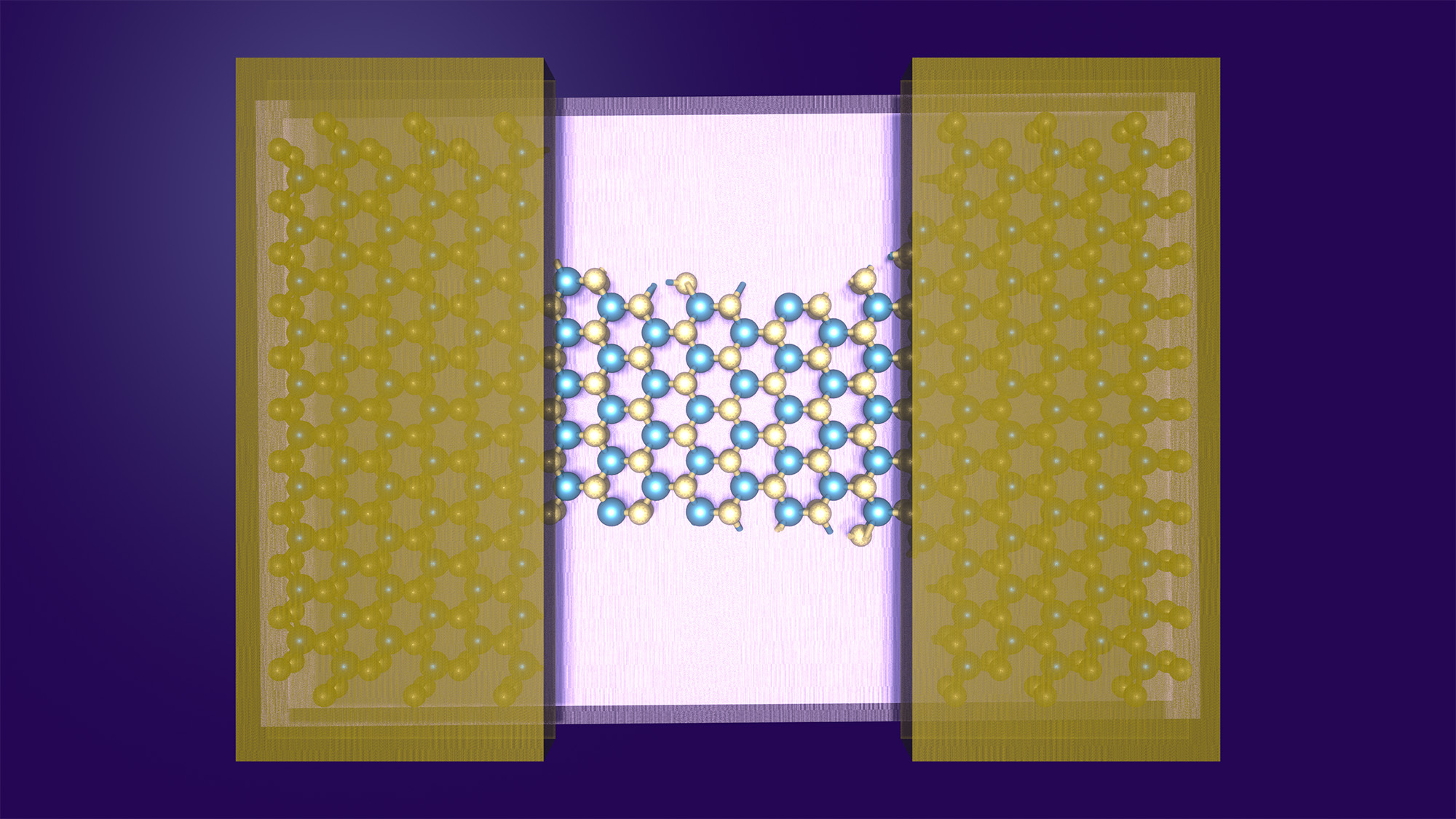
"Researchers have built proof-of-concept devices in which a single atom controls the flow of electrons, although the rest of the device is still much larger," Anton Persson, an assistant professor at Chalmers University of Technology in Sweden, and Tara PeΓ±a, an incoming assistant professor at UCLA, told Live Science via a jointly written email. That means the switching part of a transistor has been made at the smallest scale physically possible, even though a complete device that small doesn't exist yet. New materials and approaches could make these devices even smaller. In a study published in June in the journal Nature Nanotechnology, Persson, PeΓ±a and colleagues used two-dimensional semiconductors made of tungsten disulfide, among other materials, to shrink nanoribbon transistors down to a channel width of 25 nanometers β€ͺ—‬ about 0.00025 the width of a human hair.

An illustration of two golden boxes connected by a pink box with molecules in between.

An illustration showing the small transistor made by Persson, PeΓ±a and their colleagues. (Image credit: PeΓ±a et al (2026). )

Two-dimensional semiconductors are electrically active materials that are only one or a few atoms thick, and because electrical current can be controlled more precisely in such a thin layer, they allow for smaller transistors than traditional silicon does.

Over the next decade, they still expect silicon transistors to shrink, but more slowly than they did in the past, they said. "To go considerably smaller, we may eventually need to move beyond silicon to atomically thin materials, such as the two-dimensional semiconductors we study."

A host of considerations

Size isn't the only consideration; cost is important, too. It's enormously expensive up front to design and build a new chip. "We are as R&D-intensive as drug companies that spend billions of dollars developing one drug," Datta said. "It's a very similar business model."

There are also manufacturing factors to consider. "The often much harder step is producing billions of those transistors reliably, at scale and at a price that makes sense commercially," Persson and PeΓ±a said. "Something that works once in a laboratory does not necessarily work in a factory."

Another consideration is energy efficiency. "If I'm adding more and more transistors onto that little piece of silicon, and at the individual transistor level, they don't become more energy efficient … then when I go from, let's say, 10 transistors to 20 transistors, my power budget has to be doubled, all things being equal," Datta said.

For example, the latest Nvidia data center GPUs consume 1.4 kilowatts of electricity, and Nvidia's upcoming release is estimated to consume nearly a kilowatt more than that. Half of that is given up as waste heat, Datta said.

"So it's not just smaller, faster, cheaper, but also more energy efficient," Datta said. "You have to work on all the four vectors."

Is smaller still the goal in the age of AI?

Still, there is a limit to the physical space available for additional transistors, which is why engineers are turning to 3D designs β€” think taller instead of smaller.

"Instead of only making each transistor smaller, the idea is increasingly to stack transistors on top of one another so that more of them fit within the same chip area," Persson and PeΓ±a said. "That way, we can still make our electronics considerably more powerful, even if each transistor shrinks only modestly."

The quest for faster, more efficient chips is only getting more urgent with the explosive growth of AI. But smaller transistors and more powerful chips aren't just important for AI data centers; they also mean smaller, potentially cheaper consumer electronics.

"People certainly notice the consequences of smaller transistors," Persson and PeΓ±a said. "They can use less power and allow more computing power to fit on the same chip. That can mean faster electronics, longer battery life and lower costs. Historically, that combination has enabled today's smartphones to outperform room-sized supercomputers from decades ago."

So how small can transistors get? "We will do everything to make it as small as possible as long as we can control the physics," Datta said. "And as long as we can, we will find a way to make the economics work."

Was Einstein wrong about anything?

Albert Einstein gave us the theory of relativity, explained the photoelectric effect and predicted the existence of gravitational waves. He revolutionized our understanding of space, time and gravity.

In fact, he is so famous for his brilliance that "Einstein" is synonymous with "genius." But being a genius doesn't mean you're infallible. So was Einstein wrong about anything?

"For sure, he was wrong about tons of things," NicolΓ‘s Yunes, a theoretical physicist at the University of Illinois Urbana-Champaign, told Live Science. "We remember him for the things he was right about, for the most part, because the things he was right about shocked the scientific world and eventually those ripples affected everyone on Earth."

Sign up for our newsletter

Life's Little Mysteries logo with a question mark in a magnifying glass

(Image credit: Marilyn Perkins / Future)

Sign up for our weekly Life's Little Mysteries newsletter to get the latest mysteries before they appear online.

For example, one of his most famous predictions was marred by a mathematical mistake. In 1916, Einstein correctly realized that the acceleration of matter could produce ripples in space-time that we now call gravitational waves. But when he and the physicist Nathan Rosen described these waves using mathematics, they ran into a problem: Any solution to the equations of general relativity that would allow for gravitational waves "blew up," Yunes said. "They had these singularities … these divergences. And solutions that diverge and explode like that, they can't be physical representations of reality."

As a result, Einstein changed his mind and decided that gravitational waves couldn't exist. He wrote up his results and submitted them to the journal Physical Review, which had recently begun sending papers to outside experts for peer review. An anonymous reviewer caught an error in Einstein's math, and when Einstein learned about it, he was so furious that he withdrew the paper and submitted it to a different journal.

But the reviewer had spotted a real error: Einstein's mathematical infinities were a coordinate artifact. Much like Earth's lines of longitude seem to converge to a "singularity" at the North Pole even though nothing unusual is happening there on the ground, Einstein's math could have been fixed by using a different set of coordinates.

Without Einstein's knowledge, the reviewer befriended and demonstrated the error to Einstein's assistant, who explained it to Einstein. Einstein corrected the error and republished the paper with the opposite conclusion, showing that gravitational waves do, in fact, exist.

An illustration of two dark spheres circling each other against a blue, grid-like surface.

Einstein originally thought that gravitational waves existed, then changed his mind when the math didn't work out. However, an anonymous peer reviewer named Howard Percy Robertson managed to secretly help Einstein fix his mathematical errors. (Image credit: MARK GARLICK/SCIENCE PHOTO LIBRARY via Getty Images)

Calculating "impossible infinities"

Remarkably, Einstein stumbled on the same error twice β€” at least, it seemed that way. When examining the mathematics around black holes, he once again calculated impossible infinities β€ͺ—‬ this time, at the edge of a black hole. And once again, he concluded that this must mean the object couldn't exist.

"Einstein remained skeptical of the existence of black holes," John D. Norton, a professor in the Department of History and Philosophy of Science at the University of Pittsburgh, told Live Science in an email. "He was resolute in his judgment that there would be a singularity in space-time already at the event horizon of a black hole, which is now merely regarded as marking the point of no return for those falling into a black hole."

But this time, Einstein was not convinced that he made a mistake. Norton argues this wasn't just stubbornness; it reflected a philosophical belief in how Einstein thought mathematics and physics should relate to each other.

"He was unmoved by alternative analyses that found his mathematical infinities to be merely artifacts of the particular mathematical methods he preferred," Norton said.

An illustration of a black sphere surrounded by glowing white gas in space

Einstein was skeptical of the existence of black holes (pictured here in a 3D render) because his math showed a breakdown in space-time at a black hole's edge. (Image credit: Cavan Images / Luca Pierro via Getty Images)

Einstein and quantum mechanics

Einstein's resistance to quantum mechanics is probably his most famous wrong turn. His central objection was to a phenomenon called quantum entanglement: the idea that two particles can be linked in such a way that measuring one instantly affects the other, no matter the distance between them. In a 1947 letter to his colleague Max Born, he wrote, "I cannot seriously believe in it because the theory cannot be reconciled with the idea that physics should represent a reality in time and space, free from spooky actions at a distance."

Einstein thought this instantaneous phenomenon seemed to violate special relativity, which says that nothing can travel faster than light. As a result, he believed quantum mechanics must be incomplete and that there was some deeper, unknown description of reality that would restore order.

"He died not liking quantum mechanics," Yunes said. It wasn't until 1964, almost a decade after Einstein's death, that John Bell proved entanglement was real.

"Today, a lot of the technology that we have relies on quantum mechanics, and so we know it's correct," Yunes said. "But it's still incompatible with general relativity, with [Einstein's] classical theory."

"It's possible that general relativity is wrong," Yunes said. "It's also possible that quantum mechanics is not the right description when you're talking about systems that are very strongly gravitating and you're looking at Planck-scale-type dynamics," which are incredibly small scales at which quantum effects dominate. For instance, the center of a black hole, which is both compressed to the quantum scale but also sits inside the most intense gravitational field in the universe, is a place where general relativity predicts a singularity that quantum mechanics has no way to describe.

But many of Einstein's mistakes still moved science forward. "General relativity is a good example," Norton said. "Einstein based it on the idea that he was generalizing the principle of relativity to acceleration and on what he soon called Mach's principle. Neither proved compatible with his final general theory of relativity."

Einstein's mistakes might come as a surprise to others, but they didn't to him. Once, when writing a book with his collaborator Leopold Infeld, Infeld told him he was taking special care with it because Einstein's name would appear on it. Einstein laughed and said, "There are incorrect papers under my name, too."

See how much you know about Albert Einstein with our Einstein quiz!

❌