❌

Normal view

Proton–oxygen collisions put cosmic-ray models to the test

21 September 2026 at 08:15

Physicists at CERN have recreated the collisions that trigger cosmic-ray air showers in Earth’s atmosphere. Results from the ATLAS experiment on the Large Hadron Collider (LHC) show that none of the computer models used to simulate showers gets every detail right. Their measurements of particle production in proton–oxygen collisions are more than ten times more precise than the differences between the models – which could be improved by these latest results. This will be a step toward understanding the most energetic particles in the universe.

Cosmic rays are energetic particles (mostly protons) from outer space. They strike Earth’s atmosphere at nearly the speed of light, setting off cascades of secondary particles.

“Cosmic-ray air showers are sprays of particles raining down from high in the sky,” explains Jesse Liu of New York University, the lead author of a paper that describes the study. He adds that cosmic rays come from “extreme corners of our universe,” with exploding stars and supermassive black holes in distant galaxies as likely sources.

Still, the origin of the most energetic cosmic rays remains “one of the biggest mysteries in astrophysics,” says Karl-Heinz Kampert of the University of Wuppertal in Germany, who was not involved in the study. Such particles carry a hundred billion-billion electron volts or more – compared to the million-million electron volts achieved by the LHC. At the highest energies, only about one such particle hits each square kilometer of Earth’s surface per century. “The only way to measure them in sufficient numbers is to detect the extensive air showers they produce,” he says.

Difficult calculations

Interpreting these showers relies on computer simulations. But, the role of the strong nuclear force, which governs the underlying collisions, is notoriously difficult to calculate. The simulations therefore use models informed by accelerator data, yet “existing models widely disagree with one another on how these showers form,” says Liu.

The most energetic cosmic rays collide at energies far beyond the reach of the LHC, so “we must extrapolate the known properties of particle interactions at man-made accelerators to those occurring in the upper atmosphere,” Kampert explains. Moreover, the LHC’s beams had previously consisted only of protons or heavy nuclei such as lead, rather than the light nitrogen and oxygen nuclei found in air. “For more than a decade, the cosmic-ray community has been working to convince the CERN and particle physics communities of the importance of such measurements,” he says.

That changed in July 2025, when the LHC was reconfigured “to make protons acting as cosmic rays collide with oxygen nuclei playing the role of Earth’s atmosphere,” says Liu. The ATLAS detector recorded the charged particles these collisions produced.

Key parameter

ATLAS physicists studied “how many particles are created during collisions of protons and oxygen nuclei, alongside what energies and angles these particles fly out at,” Liu explains. They also determined the cross section, which “tells us how often these collisions occur,” he adds. Kampert calls it “a key parameter,” because it determines the average depth at which cosmic rays first interact in the atmosphere. This depth affects “essentially all air-shower measurements that are needed to infer the mass” of the incoming particle.

The measured cross section lies at the low end of model predictions, agreeing with only two of the seven models tested. The team also used it to infer the cross section for protons colliding with air, a quantity previously measured at such high energies only by cosmic-ray observatories. The result agrees with earlier air-shower measurements at similar energies.

“Our measurements are more than ten times more precise than the differences between the existing computer models,” says Liu. “Our data show that no model correctly describes the number of particles created in these collisions.” Some models misjudge the frequency of rare, particle-rich collisions by a factor of ten. A model called Angantyr best reproduces the particles’ energies and directions, but no model describes all the results consistently.

Blind spots and next steps

Kampert points out that the measurement has a blind spot because multipurpose detectors like CERN’s ATLAS and CMS are optimized to track particles flying out at relatively large angles to the beam. He explains, “most of the collision energy remains unseen by ATLAS and CMS and escapes close to the beam pipe, at very small angles. This unseen region most strongly influences the features of the air showers.” Specialized experiments, such as LHCf at CERN, are designed to fill this gap.

The next step, says Liu, is “to apply our data to improve the computer models of cosmic-ray showers.” Physicists will then check whether this eases the “muon puzzle” — facilities such as the Pierre Auger Observatory in Argentina see more muons, heavier cousins of electrons, in air showers than simulations predict. “Our proton–oxygen data are an important step toward resolving these puzzles and help decipher cosmic mysteries, namely what high-energy cosmic rays are made of and where they come from,” Liu adds.

“Model builders have been eagerly awaiting this data and have started improving their models based on it and earlier accelerator data,” says Kampert. Because Auger results suggest that the most energetic cosmic rays are mostly heavier nuclei such as carbon, nitrogen, oxygen and silicon, he calls data from oxygen–oxygen or nitrogen–nitrogen collisions “another important step forward.”

Earlier this year, he and colleagues outlined in Nature Reviews Physics how such data could feed into a common tuning of the models, an undertaking he calls “a great community effort involving researchers from different fields of science.”

“I hope [our work] strengthens the cross-disciplinary connections between particle physics and high-energy astrophysics, with much to learn from each other,” says Liu.

The research is described in Physical Review Letters.

The post Proton–oxygen collisions put cosmic-ray models to the test appeared first on Physics World.

Scientists recreate the universe's first moments and find something they didn't expect

Physicists smashed gold nuclei together at nearly the speed of light and found an unexpected pattern in the particles these collisions sprayed out. If confirmed, that pattern could help reveal how the hot soup of quarks and gluons that filled the universe in the first few microseconds after the Big Bang cooled and condensed into the protons and neutrons that make up ordinary matter today.

In every collision, particles are flung out sideways; how hard they are flung, on average, varies slightly from one collision to the next. Physicists expected the size of these variations to change smoothly as they adjusted the collision energy. Instead, the variations dipped, shrinking and then growing again. This dip could be a sign of a long-sought "critical point," a special set of conditions at which nuclear matter changes the way it transforms from one form to another.

The signal, detected by the STAR experiment at the Relativistic Heavy Ion Collider (RHIC) at Brookhaven National Laboratory in New York, is strong enough that it is very unlikely to be a statistical accident. However, the researchers cautioned that the dip is a tantalizing hint, not proof of the long-sought transition. They published their findings Sept. 22 in the journal Physical Review Letters.

A rulebook for extreme matter

Protons and neutrons are made of smaller particles called quarks, which are held together by the "strong force" carried by particles called gluons. When heated or squeezed enough, protons and neutrons melt into a hot soup of free quarks and gluons known as a quark-gluon plasma. It's thought that this primordial soup of particles filled the universe in the first milliseconds after the Big Bang.

Physicists want to pin down how this soup-ification happened, by measuring the so-called equation of state of nuclear matter. "For water, it tells you how pressure, temperature and density are linked, and therefore when it freezes, boils or expands," study co-author Rutik Manikandhan, a postdoctoral physics scholar at The Ohio State University, told Live Science in an email. For nuclear matter, "it is the basic rulebook for matter under the most extreme conditions in nature, such as the cores of neutron stars," Manikandhan added.

The "critical point" is a key landmark in that rulebook "For water, it is the point where the boundary between liquid and steam disappears," Manikandhan said, and theorists have long suspected that nuclear matter has a similar point. At extremely high temperatures, matter melts smoothly and gradually into quark-gluon plasma, but at higher densities, the change may become abrupt.

The critical point would mark where one kind of transition turns into the other. Some recent calculations place this point within reach of RHIC's lower-energy collisions. "But all of this is still conjectured and there is nothing concrete yet, either from the experimentalists or theorists," Manikandhan said.

The work also matters for cosmology. "Because the matter we create in these collisions resembles the matter that filled the universe a few microseconds after the Big Bang, mapping how it behaves helps us understand how the universe evolved from a hot soup of quarks and gluons into the protons and neutrons that make up everything today," Manikandhan said.

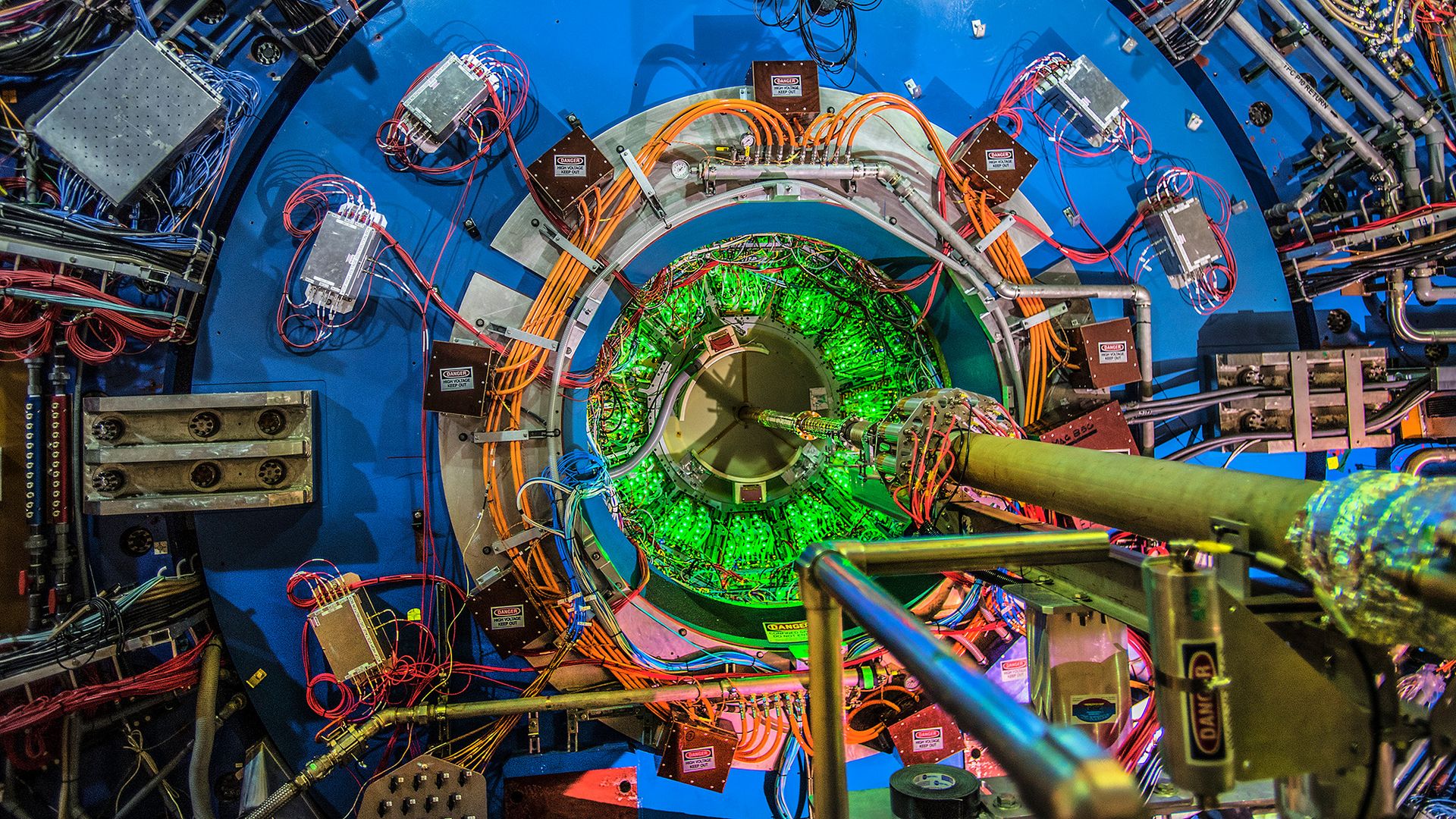
A close up of a circular collider with wires and pipes leading into it.

The central part of the three-story STAR detector at the Relativistic Heavy Ion Collider (RHIC). Scientists recently used the detector to study the conditions of the early universe, just milliseconds after the Big Bang. (Image credit: Brookhaven National Laboratory)

A dip where a smooth trend was expected

To explore this territory, the researchers ran RHIC at a range of collision energies. The lower the energy, the more tightly the colliding matter was squeezed. For its lowest-energy runs, STAR used a "fixed-target" setup, in which a beam of gold nuclei strikes "a thin gold foil placed inside the detector," Manikandhan said, instead of a second, oncoming beam. This produces the densest matter RHIC can make.

Collision energies are measured in electron volts (the energy an electron gains when accelerated across 1 volt). That is a minuscule amount, so particle physicists usually work in billions of electron volts, or giga electron volts (GeV). One GeV is roughly the energy locked up in the mass of a single proton, according to Einstein's famous equation E = mc2. The team analyzed roughly 1 billion collisions at energies between 3 and 7.7 GeV per pair of colliding protons or neutrons. That is the bottom of RHIC's range, which reaches 200 GeV.

In each collision, the team measured how hard charged particles were flung sideways out of the fireball ‪—‬ a quantity known as transverse momentum. The researchers then looked for correlations between the particles. A correlation measures whether two things tend to change together. Here, the team checked whether pairs of particles from the same collision tended to both be flung harder than average, or both more gently. That reveals something about the fireball as a whole. If a fireball is slightly hotter, or expands more forcefully, all of its particles get an extra sideways kick together.

"Those correlations reflect how much the temperature and the flow of the fireball fluctuate," Manikandhan said.

Close to a critical point, the matter's heat capacity — the amount of energy needed to raise its temperature — is expected to shoot up. That makes the fireball's temperature harder to budge, so the correlations should weaken. "If the matter approaches a critical point or a phase change, we would expect to see those correlations change in an unusual, non-smooth way as we vary the collision energy," Manikandhan said.

That is what the team saw in the most head-on collisions. "Instead of changing smoothly with energy, the correlations show a dip," Manikandhan said. The researchers compared the data with a smooth trend anchored by earlier STAR measurements at higher energies. The dip departs from that trend with a statistical significance of 5 sigma, the standard physicists usually demand before treating a signal as real. It means that if the true trend were smooth, random scatter in the data would produce such a pronounced dip only about once in 3.5 million tries.

"A smooth trend is what you'd expect from ordinary nuclear matter, so a dip suggests something more interesting is happening at those conditions," Manikandhan said.

By contrast, a widely used computer simulation of the collisions, which contains no critical point, reproduced the overall trend but not the dip. Off-center collisions showed only a faint hint of the same feature, which is too weak to count as evidence on its own.

Not the final word yet

"The result is suggestive, not proof of a critical point," Manikandhan said. Effects unrelated to a critical point can also shape these fluctuations, and how much of the dip they could explain remains unclear, the researchers noted.

Still, the dip "does point to a set of conditions where the behavior of nuclear matter changes, and it gives theorists a new, precise measurement to test their calculations against," Manikandhan said.

Next, the team plans to use the correlations to "extract the specific heat of the hot matter," Manikandhan said. They will then compare it with supercomputer simulations that calculate the behavior of quarks and gluons from first principles.

The researchers also plan to test the dip against more theoretical models and combine it with other measurements, such as fluctuations in the number of protons produced in the collisions. "Only when different measurements agree can we say confidently whether a critical point exists," Manikandhan said.

Missing decay at BESIII points to long-sought glueball

8 September 2026 at 14:41

Physicists at China’s BESIII experiment in Beijing have found the strongest evidence yet for the existence of glueballs – subatomic particles made of gluons alone. The glueball-like particle is called X(2370) and it was first spotted at BESIII 15 years ago.

Gluons carry the strong nuclear force that binds quarks into protons and neutrons. Gluons also pull on each other as hard as they pull on quarks, which means they ought to be able to clump into particles called glueballs.

“So far, all ordinary matter that we know of is composed of quarks and leptons,” says Colin Morningstar of Carnegie Mellon University, whose 1990s supercomputer simulations helped predict what glueballs should look like. “A glueball is a totally new form of matter made up entirely of gluons – no quarks, no leptons,” explains US-based Morningstar, who is not a member of the BESIII team.

For four decades, detecting glueballs have been an important goal of BESIII and its predecessor – according to Shan Jin of China’s Nanjing University. BESIII is on the BEPCII accelerator, where electrons collide with positrons to create large numbers of J/ψ particles. A J/ψ can sometimes decay by shedding a flash of light and dumping the rest of its energy into gluons. The gluons could then bunch together to create a glueball.

Lightest glueball

In 2011, Yanping Huang was Jin’s PhD student and observed the production of the short-lived X(2370) particle at BESIII. “The most important next step was to determine its spin-parity quantum numbers, and it turned out to be one of the most difficult steps for us due to large background processes,” says Huang, now at China’s Institute of High Energy Physics in Beijing. Those numbers describe how a particle behaves when turned around and seen in a mirror – a kind of fingerprint. Only in 2024, with an exceptionally clean chain of decays and all 10 billion J/ψ particles, could the team read it, and it matched the prediction for the lightest glueball.

Now, Huang, Jin and the rest of the BESIII team have gone further and searched in vain for a specific X(2370) decay channel. They argue its absence suggests that X(2370) contains no quarks and the lightest glueball is its dominant constituent.

Quarks come in several types, or flavours, and a glueball contains none, so it cannot favour one flavour over another. That even-handedness forbids the X(2370) from breaking up into a particular pair of kaons, which are lightweight particles carrying a strange quark. BESIII looked for that break-up and found that the decay occurs at a rate that is at most 8% of the rate of a much more common X(2370) decay channel.

Huang explains that an ordinary quark-based particle should undergo the kaon-pair decay far more often. “The lightest glueball is essential for a natural and complete explanation of all these properties, while all other interpretations can hardly explain them simultaneously”.

Like a duck

Francesco Giacosa at Jan Kochanowski University in Poland is enthusiastic about the BESIII research, which he was not involved with. “We have an object, X(2370), that walks like a duck, quacks like a duck and, in addition, does not do something that the duck we are searching for should not do.”

Jin says that the BESIII result has important implications. “This is the direct proof of self-coupling among gluons predicted by QCD about 50 years ago,” where QCD is quantum chromodynamics, the theory of the strong force. It also illuminates the origin of mass, “since the gluon mass is zero and the glueball mass is totally from the strong interaction”. Glueballs, he says, are “a unique kind of matter made of pure force”.

Morningstar observes, “The results are the strongest evidence yet that particles dominated by a glueball component can exist in nature. This work is certainly an experimental triumph.”

Not everyone is ready to call the 50-year search over. “In my opinion, an independent experimental confirmation would be extremely important,” says Giacosa. A glueball can also blend with ordinary quark particles, he notes, so “even if X(2370) is predominantly a glueball, we do not know precisely how large its non-glueball component is”.

Upgrade needed

Gentler collisions elsewhere could shed further light on this, says Jin, “but it seems difficult for them to collect 10 billion J/ψ events to perform systematic studies as BESIII in a short time, unless we upgrade BEPCII itself again”.

That upgrade is on the collaboration’s wish list. Huang plans further measurements of the particle’s properties, which “will also certainly help us to identify more glueballs”. Reaching them may take ten times more data.

Morningstar also looks forward to further discoveries, “Our theoretical computations have suggested other glueballs that might exist, so with this successful study, I believe the search for other glueballs will intensify”.

Giacosa thinks the prize is worth it. “Glueballs are, in my view, among the most fascinating composite objects predicted within the Standard Model,” he says, meaning physicists’ theory of the fundamental particles and forces. “Establishing one experimentally would be much more than adding one more particle to the list – it would confirm one of the most remarkable predictions of the theory of the strong interaction.”

The results were presented in August at the International Conference on High Energy Physics and are described in a preprint on arXiv.

The post Missing decay at BESIII points to long-sought glueball appeared first on Physics World.
'There is no conflict between quantum physics and gravity': Physicists prove Einstein's 'happiest thought' holds true at quantum scales

For the first time, physicists have measured the tiny quantum shift an object acquires by falling through Earth's gravity — an effect of Einstein's relativity that was predicted almost a century ago but never observed.

Researchers placed ultracold rubidium atoms into a superposition, a quantum state in which a single particle takes two paths at once. In this experiment, one path put the atom in free fall while the other kept it motionless. Recombining the atoms revealed an almost imperceptible difference between the two paths.

The measurement, published Sept. 2 in the journal Science Advances, shows that Einstein's equivalence principle — the idea at the heart of general relativity — still holds when it is pushed into the quantum world, creating a small but tantalizing link between relativity and quantum mechanics.

"The principle says that acceleration and gravity cannot be distinguished locally," Vlatko Vedral, a physicist at the University of Oxford and a co-author of the new study, told Live Science via email.

Einstein's happiest thought

The classic illustration of the equivalence principle is a thought experiment known as Einstein's elevator. A person sealed in a windowless elevator cannot tell whether the floor is pressing against their feet because the elevator is parked motionless on Earth or because it is being accelerated through empty space. Einstein called that realization the "happiest thought" of his life and built general relativity around it.

For heavy, everyday objects, the equivalence principle has been tested to extraordinary precision. Quantum objects are a different matter. They behave like waves, and each wave carries a quantity called phase — essentially, where its crests and troughs sit. Phase cannot be seen directly, but when two versions of the same particle are recombined, any mismatch between their phases shows up as an interference pattern. The two waves reinforce each other in some places and cancel each other out in others, thereby changing the odds of where the particle turns up.

Theory says that a wave in free fall should build up phase relative to an identical wave held still and that this phase should grow with the cube of the falling time. Therefore, doubling the fall time multiplies the effect eightfold. Charles Galton Darwin, a grandson of the famous naturalist, and Earle Kennard both documented this prediction in 1927 ‪—‬ but no one had measured it until now.

An atom that falls and stays still at once

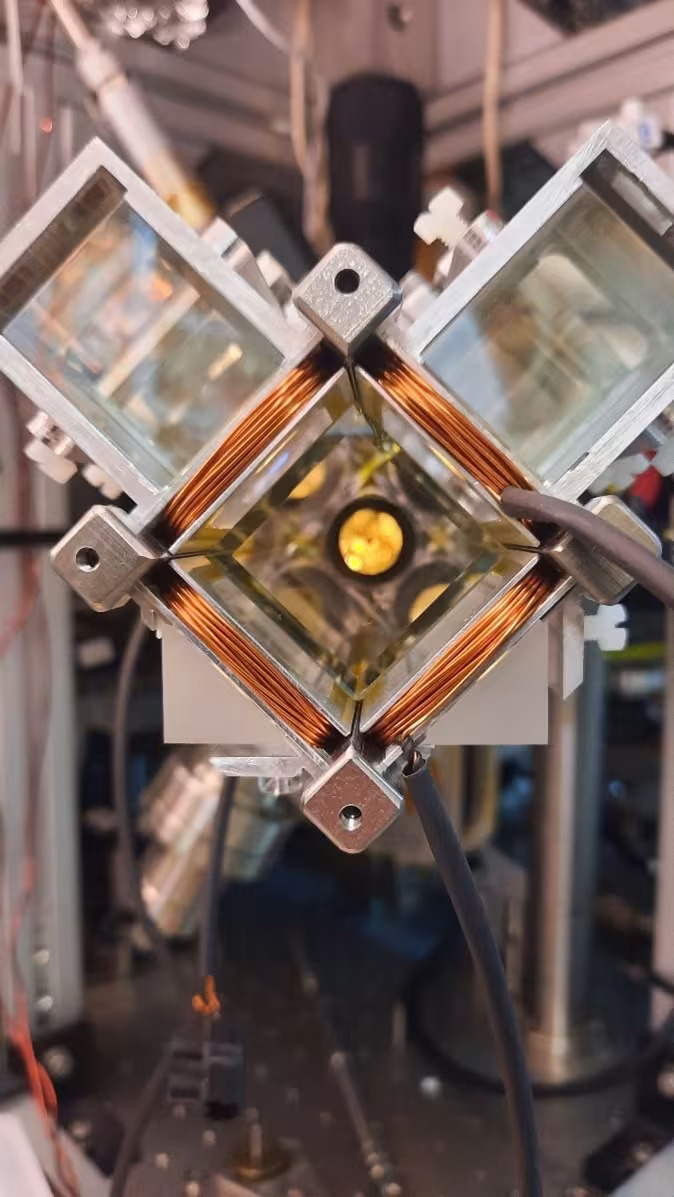
A square of copper coil held up by a series of metal bolts.

This apparatus, called 2D MOT, feeds the science chamber with cold atoms. (Image credit: Or Dobkowski)

Catching the effect required an instrument with one arm genuinely at rest with respect to Earth and the other in genuine free fall ‪—‬ something no previous experiment could supply. Matter-wave experiments going back to the neutron interferometry of the 1970s had measured gravity in other ways, but never with that pair of trajectories.

The team behind the new study, led by physicist Ron Folman at Ben-Gurion University of the Negev in Israel, chilled roughly 20,000 rubidium atoms into an exotic state of matter called a Bose-Einstein condensate, released them from their magnetic trap and ran the interferometer about 113 micrometers beneath an "atom chip" patterned with gold wires only 2 micrometers thick.

Radio and microwave pulses put each atom into a superposition of two magnetic states. A magnetic kick launched one of them upward, and a fraction of a millisecond later, a second pulse made that half insensitive to magnetic fields so that it rose and fell under gravity alone. The other half remained magnetically sensitive and felt a force tuned to cancel gravity exactly, leaving it suspended in place.

At the top of the arc, the two halves of a single atom stood about 7.5 micrometers apart ‪—‬ about seven times the width of the atomic wave itself — before the sequence was reversed to bring them back together. The team named the device the quantum Galileo interferometer, after the scientist who first argued that all objects fall at the same rate.

"Two different accelerations can be superposed, zero [acceleration] and the Earth's gravitational acceleration, and the resulting quantum interference measured," Vedral said.

A phase predicted almost 100 years ago

The researchers tracked the interference signal as they stretched the free-fall time to about 2.4 milliseconds. Across 633 runs over 5.3 hours, they recorded 13 complete oscillations, each one a full cycle of phase built up between the two halves of the atom. The growth followed the cube of the falling time, matching the theoretical model to within about 2.5%.

"The phase between the two elements of the superposition, which grows as the cube of the duration of the experiment and which was predicted a long time ago, in 1927, has now finally been observed for the first time," Vedral said.

The result matters because the same phase can be derived in two completely different ways: One treats gravity as a force acting on a quantum wave; the other moves into the falling frame, where gravity vanishes, and invokes the equivalence principle. Both give the same answer, and that agreement is what allows quantum mechanics and general relativity to coexist.

"They tell us that, at this level of accuracy, there is no conflict between quantum physics and gravity," Vedral said. "In other words, the equivalence principle is perfectly compliant with quantum mechanics."

The difficulty of bringing the two halves back together

The hardest part of the experiment was the recombination. Because the two halves of the atom end up moving at very different speeds, returning them to overlap in both position and motion is extremely demanding. Physicists Marlan Scully, Berthold-Georg Englert and Julian Schwinger named the problem the "Humpty-Dumpty effect." The magnetic fields also curve across the atom cloud, distorting the two halves in different ways.

The contrast of the interference fringes started at 80% for short runs and faded to 20% for the longest run, setting a practical ceiling on how long the experiment can run. The authors also cautioned that their measurement does not rule out every theory in which the equivalence principle breaks down, because some of those theories predict the same phase.

What comes next

The team now wants to test the equivalence principle under more general conditions, such as the "same experiment in a rotating frame," Vedral said. "Even more interestingly, performing an experiment in which two such systems are superposed and can gravitationally affect one another" would further test the results, he added.

That last idea points toward one of the field's central open questions. Scaling up the technique from atoms to far heavier objects, such as nanodiamonds, would let physicists ask whether gravity itself follows quantum rules and would open a route to testing the conjecture — championed by study co-author and Nobel laureate Roger Penrose — that gravity is what destroys quantum superpositions in the first place.

See how much you know about Albert Einstein with our Albert Einstein quiz!

Artificially rotating system reflects radiation like a black hole

10 August 2026 at 08:30

A radio signal has been amplified by scattering it from a stationary coin-sized electronic circuit that behaves as though it is rotating at an enormous rate. Conceived by a team at the City University of New York, the experiment is said to provide the first observation of rotational super-radiance involving electromagnetic waves. This wave-amplification effect is inspired by rotating black holes and was predicted more than half a century ago. Andrea Alù and colleagues found that only radio waves carrying a particular kind of twist were boosted, by as much as a factor of six in power.

In 1969 Roger Penrose pointed out that a rotating black hole holds a vast reservoir of energy that, in principle, can be tapped. “An object entering the region around the black hole can split into two parts, one falls into the black hole while the other escapes with more energy than the original object had, effectively taking some rotational energy from the black hole,” Alù, explains.

Two years later the Soviet physicist Yakov Zel’dovich realized that the same thing should happen to waves. “If a wave carrying angular momentum reflects from a rapidly rotating absorbing cylinder, the reflected wave could be amplified and come back stronger than it arrived,” says Alù. That amplification is called rotational super-radiance, which Alù describes as, “a process in which a wave becomes stronger by extracting energy from a system that rotates very rapidly”.

The catch has always been the word “rapidly”. For the effect to occur, the rotation must outrun the wave itself, and for light or radio waves that means rotational rates no mechanical object could survive. The effect has been coaxed out of water waves swirling around a vortex and out of sound waves bouncing off a spinning absorber, but electromagnetic waves had been out of reach. “While the idea is fascinating, no experimental demonstration was reported for electromagnetic waves, due to the required very fast speeds,” Alù says.

Clever solution

The CUNY team has found a clever way around the speed restriction. “Instead of physically spinning an object, we created an artificial rotation by periodically changing the properties of a network of resonators in space and time in a way that mimics rotation,” says Alù. The new device is disarmingly simple, comprising three small electrical circuits wired into a loop roughly two centimetres across, each one tuneable like a radio dial. The tuning of all three is wobbled up and down, with each kept slightly out of step with its neighbours, so the pattern sweeps around the loop like a wave passing through a stadium crowd.

“Although no physical object is rotating, this travelling modulation pattern acts like a rotating system,” Alù explains. And because the apparent speed is set purely by how quickly the electronics are driven, it can be pushed as high as one likes. “In fact, this speed can be faster than the velocity of light without violating any physical law.” Nothing material moves, so nothing outruns light.

The researchers fed a 100 MHz radio signal into the loop. This light was in a specific twisted state (possessing orbital angular momentum). They then swept the rotational rate from 5 MHz up to 195 MHz. Below 100 MHz the reflected light weakened steadily, as expected. Above 100 MHz, however, the synthetic rotation overtook the wave and the behaviour flipped. The reflected signals reappeared at the same frequencies as before — 60, 70 and 80 MHz — but were twisted the opposite way, and were stronger rather than weaker. That reversal, Alù notes, is “a key signature of entering the regime associated with super-radiance”. The gain arises in special windows the team calls angular-momentum bandgaps, which open once the synthetic rotation is fast enough and through which “energy can be transferred from the synthetic rotation to the wave”.

Fussy amplfier

The amplification was fussy about its input. “Our observed amplification was selective to the angular momentum of the input wave, only waves with particular angular-momentum properties experienced gain,” says Alù. Stranger still, the effect feeds on waste. In an ordinary amplifier, energy leaking out of the device is the enemy. Here a leakier circuit gave more gain, exactly as the thermodynamic reasoning behind super-radiance demands.

Alù is careful about what the experiment does and does not deliver. “The experiment does not study actual black holes or quantum gravity. Instead, it creates a laboratory system that reproduces some of the same physical principles involved in rotational energy extraction.” What it offers, he says, is “a controllable analogue platform where researchers can test and explore concepts that are otherwise difficult or impossible to study experimentally in astrophysical black holes”.

Three circuits in the loop allow only three distinct twists, so the immediate goal is bigger loops supporting a wider range. Beyond that lies the jump from radio waves to visible light, and a quantum version in which synthetic rotation might conjure photons out of empty space. Practical spin-offs may arrive sooner. Amplifying only one twist at a time is a natural fit for encoding information, and, Alù suggests, “new forms of lasers, with selective emission of angular momentum, can be envisioned”.

The research is described in Nature.

The post Artificially rotating system reflects radiation like a black hole appeared first on Physics World.
Nuclear fusion persists at ultralow energies inside metal foils

3 August 2026 at 16:34

Deuterium nuclei fired into thin foils of palladium and titanium keep fusing when the nuclei’s incident energies are reduced to the level where the process should be all but extinguished. Instead, physicists in the US have found that as the incident energy is reduced, the fusion rate plateaus – even at the lowest energies probed. Indeed, the low-energy fusion rate exceeds predictions for isolated nuclei by more than 1018. While significant, the enhanced fusion rates remain far too small for energy generation.

The results suggest that a metal’s electrons and internal defects can influence how fusion occurs, according to the researchers at the University of California, Davis and Lawrence Berkeley National Laboratory

Nuclear fusion powers the stars, but here on Earth it has so far been impossible to create a practical fusion reactor that delivers usable energy to the electricity grid

“Fusion is hard in the laboratory because positive nuclei repel each other,” explains team member Thomas Schenkel at Berkeley. Quantum mechanics offers a loophole – nuclei can tunnel through the repulsive barrier without having enough kinetic energy to overcome it. However, the tunnelling probability is very small at low energies.

Not fade away

Physicists measure these nuclear collision energies in kiloelectronvolts (keV). Today’s fusion reactors tend to operate plasmas at temperatures that correspond to collision energies of about 10 keV. Below that, reactions fade away, and earlier experiments showed that fusion pretty well stopped  near 5 keV.

Yet a solid is a very different environment to a plasma. “Metal lattices contain electrons, defects, and locally concentrated deuterium, all of which can combine to create reaction environments that do not exist in a conventional plasma,” says Jeremy Munday who along with Micah Karahadian is based at UC Davis . The metal’s electron cloud partly shields the repulsion between nuclei, letting them approach more closely. This “screening” effect has been studied since the 1990s and is still not fully understood. The field also carries the scars of the 1989 cold-fusion debacle, during which experiments reporting enhanced fusion rates in solids at room temperature could not be reproduced.

Schenkel and Munday came to this field in the 2010s as participants in a Google-funded effort that revisited the 1989 claims. The programme found no evidence for room-temperature fusion, but it seeded their current collaboration.

Membrane reactor

The team’s apparatus places a metal foil, a quarter of a millimetre thick, between two very different environments. “At the heart of our experimental setup is a type of membrane reactor that combines an electrochemical cell with a deuterium ion beam,” says Schenkel. On one side, an electrochemical process – “similar in principle to charging a battery,” says Munday – pushes deuterium into the metal from a liquid. On the other side, in vacuum, a beam of deuterium ions strikes the same foil, burying itself just a few millionths of a millimetre below the surface.

Each fusion event spits out a fast proton or neutron, caught by two independent detectors. “Detecting these products independently, along with extensive background and control measurements, gave us confidence that the signals came from fusion,” Munday says.

As the team reduced the incident energy, they were surprised. “We observed the well-known exponential rate drop, but then the rates did not drop anymore but rather plateaued as we further decreased the ion energy,” says Schenkel. The plateau appeared below about 2 keV in both metals, and loading extra deuterium electrochemically roughly doubled the yield.

“This is an enormous relative enhancement, although the absolute fusion rate remains far too small for energy production,” Munday stresses. “The immediate significance of our work is therefore the discovery of a new physical regime in which the material actively influences the nuclear reaction, rather than the demonstration of a practical energy source.”

Welcome corroboration

Konrad Czerski, professor of nuclear and medical physics at the University of Szczecin, Poland, sees the result as welcome corroboration. “The Berkeley study represents an independent confirmation of the effect found by our research group over two years ago within Europe’s CleanHME project,” he says. His team saw a similar plateau in zirconium, palladium and titanium with a different technique. The palladium results of the two groups agree well, he notes, but the titanium data differ.

Czerski is not persuaded by the American team’s explanation, which attributes the plateau to unusually strong screening in the foil’s damaged surface layer. His group’s measurements, he argues, “demonstrate unambiguously that the yield plateau arises from fusion of deuterium at ordinary thermal energies, and the screening energy doesn’t change.”

The disagreement underlines how much remains open in the field. “The most important next step is to identify the microscopic origin of the low-energy plateau,” says Munday. This would involve untangling the roles of screening, surface damage and the way deuterium moves and gets trapped in the metal. The US team also wants to test whether light or crystal vibrations can affect the reaction rate. Near-term applications, he suggests, might include compact neutron sources rather than reactors.

Czerski has a bolder vision for the future. “The experimental setups and the results obtained can launch a new research field focused on materials and enhancing the electron screening effect in nuclear reactions,” he says – one that “can finally lead to commercial applications, and even possibly to construction of a new energy source.”

The research is described in Nature Communications.

The post Nuclear fusion persists at ultralow energies inside metal foils appeared first on Physics World.

'Smaller than the tiniest scale in nature': Physicists made a black hole out of light and used it to test Stephen Hawking's elusive radiation theory

Physicists have coaxed a black hole's most famous glow out of a strand of optical fiber and, for the first time, watched that light react back on the simulated black hole that produced it.

The result gives researchers a rare, hands-on look at Hawking radiation ‪—‬ the faint thermal emission that Stephen Hawking predicted should leak out of black holes ‪—‬ and offers a first clue about the tiny push that could, in principle, make a real black hole slowly evaporate, the research team said in a new study.

Working with a tabletop experiment in optical fibers, the international team detected both the radiation and its long-sought "back reaction" — the way the radiation feeds energy back and reshapes the object that created it.

According to the new study, published July 1 in the journal Nature, the light behaved exactly as Hawking predicted it should: like the glow of a warm object, with a definite temperature and a spectrum that fades away steadily toward higher frequencies. It did so even in a regime where the usual textbook description of a black hole should break down.

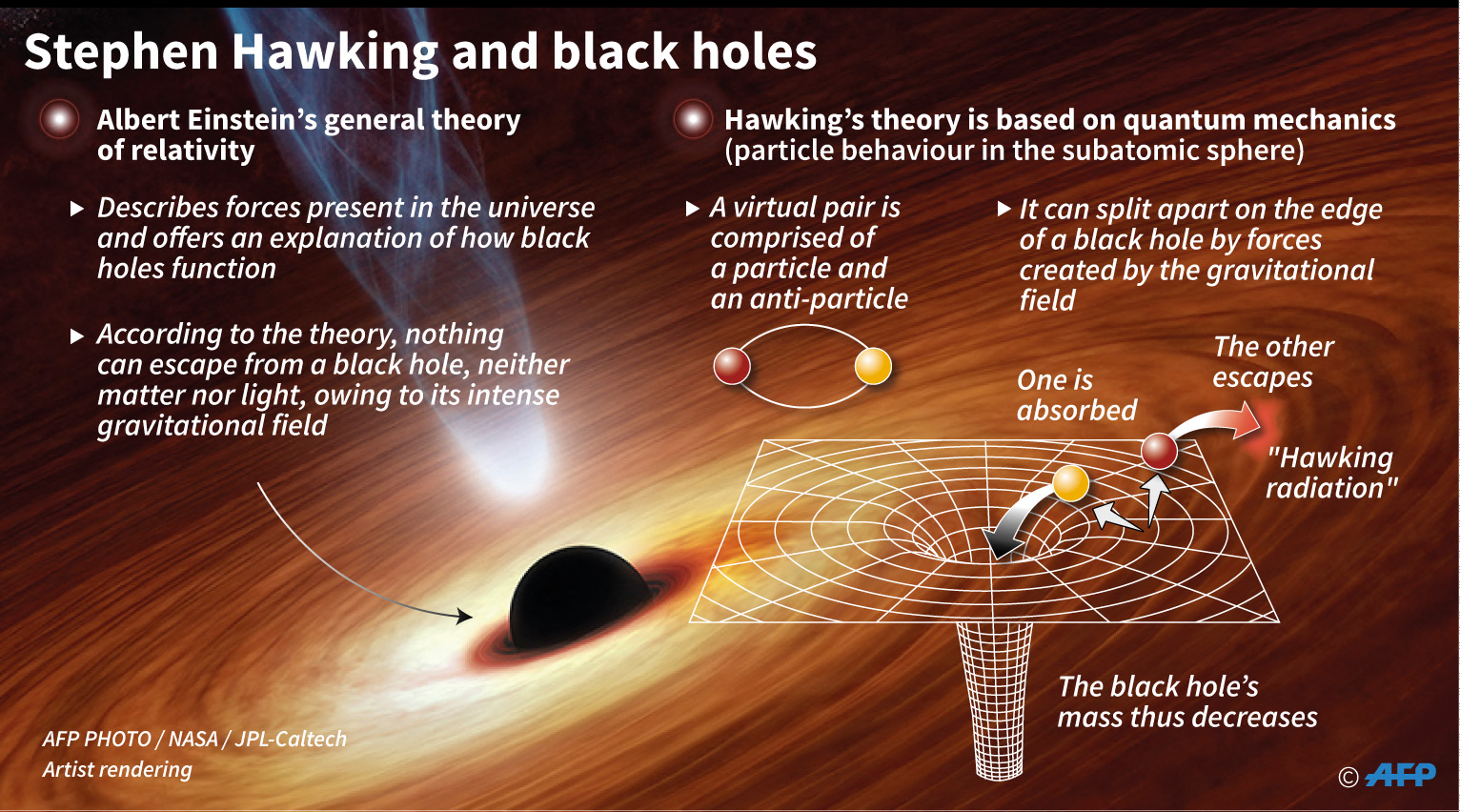
Illustration of two theories by Einstein and Hawking regarding black holes (Graphic by AFP)

An infographic explaining how Hawking radiation works, contrary to the predictions of general relativity. (Image credit: ALAIN BOMMENEL,VALENTINA BRESCHI,WILLIAM ICKES via Getty Images)

Where three great theories collide

Hawking radiation is famous because it sits at the crossroads of physics' biggest ideas.

"Jacob Bekenstein predicted that black holes have an entropy and a temperature, and Hawking calculated the thermal radiation of the black hole," study co-author Ulf Leonhardt, a physicist at the Weizmann Institute of Science in Israel, told Live Science via email. "In Hawking-Bekenstein radiation, quantum physics, general relativity and thermodynamics come together — subjects that are normally in conflict with each other."

The conflict runs deep: General relativity pictures space and time as smooth and continuous, while quantum mechanics describes a world of discrete, unpredictable jumps ‪—‬ and no one has managed to fully reconcile the two.

That combination is exactly what makes Hawking radiation so hard to study. Astronomers have never seen Hawking radiation from a real black hole and probably never will; the glow is far too faint to pick out across the cosmos. So physicists have turned to laboratory stand-ins that obey the same equations, building black hole analogues out of flowing water, ultracold atoms and, as in this study, light.

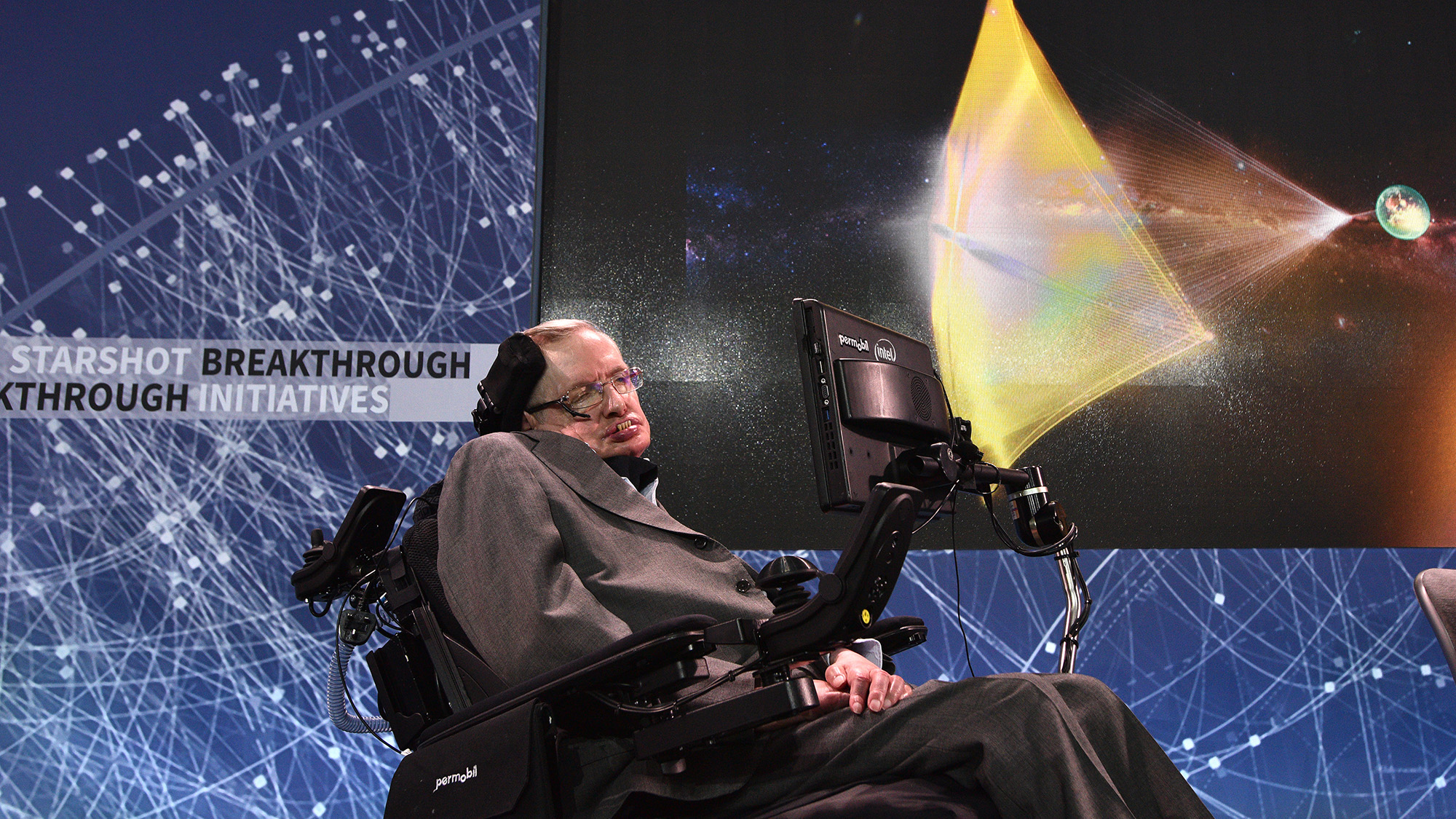
A man in an electronic wheelchair stands in front of a projector screen with various space images on it

Physicist Stephen Hawking that black holes should be able to lose information through an elusive type of radiation. New research zooms in on the mechanism that makes it possible. (Image credit: Bryan Bedder / Stringer via Getty Images)

Building a black hole from light

The trick behind every black hole analogue is a moving medium. "Imagine a swimmer in the sea with a current faster than he can swim," Leonhardt explained. "He is swept away. This is what happens beyond the [event] horizon, and this is why normally nothing can escape the black hole."

A black hole's event horizon is the boundary where that current — space itself, in real life — starts moving faster than anything can travel. To recreate it, the team needed a material that appears to rush along at the speed of light. Their solution was elegant: use light to make the "material."

"In optics we need a material that appears to move at the speed of light," Leonhardt said. "For this we use light itself — in nonlinear optics, light acts like a material."

In practice, the researchers fired an intense, ultrashort "pump" pulse into a thin photonic-crystal fiber — a strand of glass threaded with a pattern of tiny air channels running along its length, which lets researchers fine-tune how light moves through it. As it traveled, the pulse slightly changed how the glass bent light, creating a moving speed bump that raced along with it. A second, much weaker "probe" pulse then ran into this moving front. Where the probe could no longer keep up, an artificial horizon formed — and the black hole analogue was born.

Catching the glow and its pushback

The payoff came in the ultraviolet. According to theory, Hawking radiation is created in pairs: One partner escapes, while the other, carrying "negative" energy, is the mirror image that would fall into a real black hole. In the fiber, that partner showed up as ultraviolet light.

"We counted photons in the ultraviolet that correspond to the Hawking partners beyond the horizon," Leonhardt explained. "They have a wavelength around 233 nanometers. This was our signal."

Just as important as seeing the glow was understanding how it was made. For years, researchers assumed the fiber built up its Hawking radiation through a cascade — a chain of separate steps in which the light is converted first into one intermediate form, and then another, each feeding the next before the radiation finally emerges. The team found that, instead, a single, direct interaction does the job, with the pump and probe light producing the Hawking pair in one clean step. It is a much simpler picture that the researchers said may carry over to other analogues and perhaps even to real black holes.

Because energy has to come from somewhere, making Hawking radiation should nudge the source that created it. For a real black hole, that nudge is how it loses mass and, over unimaginable timescales, evaporates entirely — the process Hawking described in his landmark 1974 paper. No experiment had ever captured that recoil.

Here, the team saw it. Producing the radiation shifted a small fraction of the pump pulse's own light to a slightly different color, leaving a telltale lopsided pattern in the spectrum. That asymmetry, absent in earlier experiments, is the fingerprint of the back reaction, or recoil — the black hole analogue quietly paying the energetic price for its own glow.

The road to a quantum experiment

The result also speaks to one of the thorniest puzzles in black hole physics: the trans-Planckian problem. Trace Hawking's radiation back to where it was born and the calculation runs into territory no physicist can vouch for — the Planck scale, the vanishingly small size at which space and time are thought to lose their familiar meaning and all known physics gives out. Hawking's prediction, in other words, appears to rest on a foundation that may not exist.

"Any light getting away from the horizon is stretched out enormously," Leonhardt said. "So it must come from waves smaller than the tiniest scale in nature, where the physics is unknown. Would that still give Hawking radiation? That was the question, and we have answered it in our experiment." Remarkably, the glow stayed perfectly thermal even in this extreme regime.

The team's next step is concrete. So far, they have used ordinary laser light, which reproduces the spectrum of Hawking radiation but not its deepest quantum weirdness. Next, the team plans to "go quantum," Leonhardt said. "We will explore how to get into the quantum regime and observe quantum features such as entanglement" — the ghostly link that should tie each escaping Hawking particle to its lost partner.

See how much you know about black holes with our black hole quiz!

'A new way to study the edge of a black hole': Physicists just got the closest-ever look at a black hole's event horizon

Scientists have found evidence that gravitational waves from a spectacular black hole collision carry signals from the very edge of the newly formed black hole. If confirmed by future observations, the discovery could provide an entirely new way to investigate what happens in the immediate vicinity of a black hole without ever observing it directly.

In a new study, the researchers analyzed an exceptionally strong gravitational wave event known as GW250114. They identified a "direct wave," a subtle feature of the total gravitational wave signal predicted by theory but never previously detected in real data. The signal appears to contain information from extremely close to the black hole's event horizon, the boundary beyond which nothing, not even light, can escape.

The findings, published June 24 in the journal Nature, suggest that gravitational wave observatories may eventually allow astronomers to probe regions that have remained inaccessible since black holes were first predicted by Albert Einstein's theory of general relativity.

Listening to the edge of a black hole

Although astronomers have photographed the glowing material surrounding some supermassive black holes and have detected dozens of black hole mergers through gravitational waves, the event horizon itself has remained frustratingly difficult to study.

Unlike ordinary light, gravitational waves are tiny ripples in space-time produced when massive objects accelerate. They pass almost undisturbed through the universe, carrying information about violent cosmic events that would otherwise remain hidden.

According to study co-author Sizheng Ma, a postdoctoral researcher at the Perimeter Institute for Theoretical Physics in Canada, the newly identified signal offers a rare glimpse of what happens immediately after two black holes collide.

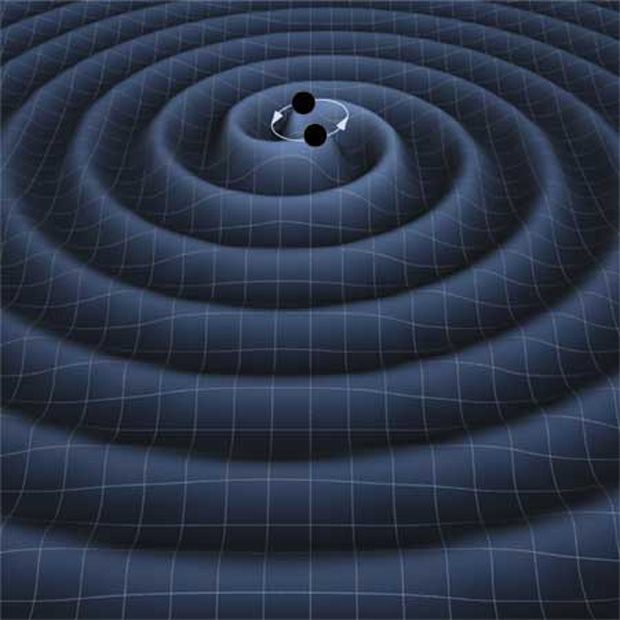
Two Black Holes Circling

When two black holes merge, they release gravitational waves — ripples in the fabric of space time — throughout the universe. Studying these waves can provide information about the newly formed black hole. (Image credit: K. Thorne (Caltech) and T. Carnahan (NASA GSFC))

"When two black holes merge, they violently shake space-time itself," Ma told Live Science. "For a brief moment, the region very close to the newly formed black hole's horizon is swept into a fast, fading swirl."

Ma explained that the direct wave is the portion of the gravitational wave signal produced near the horizon and carries the imprint of that motion outward through space.

"That is why it is so interesting," he said. "It may let us 'listen' to what happens near the horizon, a region we cannot see directly with light."

A remarkable black hole collision

The team focused on GW250114, a black hole merger detected on Jan. 14, 2025, by the two Laser Interferometer Gravitational-Wave Observatory (LIGO) detectors in Hanford, Washington, and Livingston, Louisiana.

"Our earlier theoretical work predicted that black hole mergers should produce a direct-wave signal from the near-horizon region," Ma said. "The big question was whether this effect could actually be seen in real data."

GW250114 turned out to provide exactly the conditions needed to test that prediction.

"It was strong enough, clean enough, and close enough to the theoretical situation where this signal should be visible," he said.

To search for the elusive feature, the researchers first removed the best-understood part of the gravitational wave signal, which comes from the newly formed black hole settling down after the merger. Then, they examined the remaining data to determine whether it consisted only of detector noise or contained another physical signal.

"What we found was striking," Ma said. "The remaining signal followed the expected rhythm and fading pattern of a wave shaped by the region very close to the final black hole's horizon."

The team concluded that the leftover signal matches the behavior expected for a direct wave predicted by previous theoretical studies.

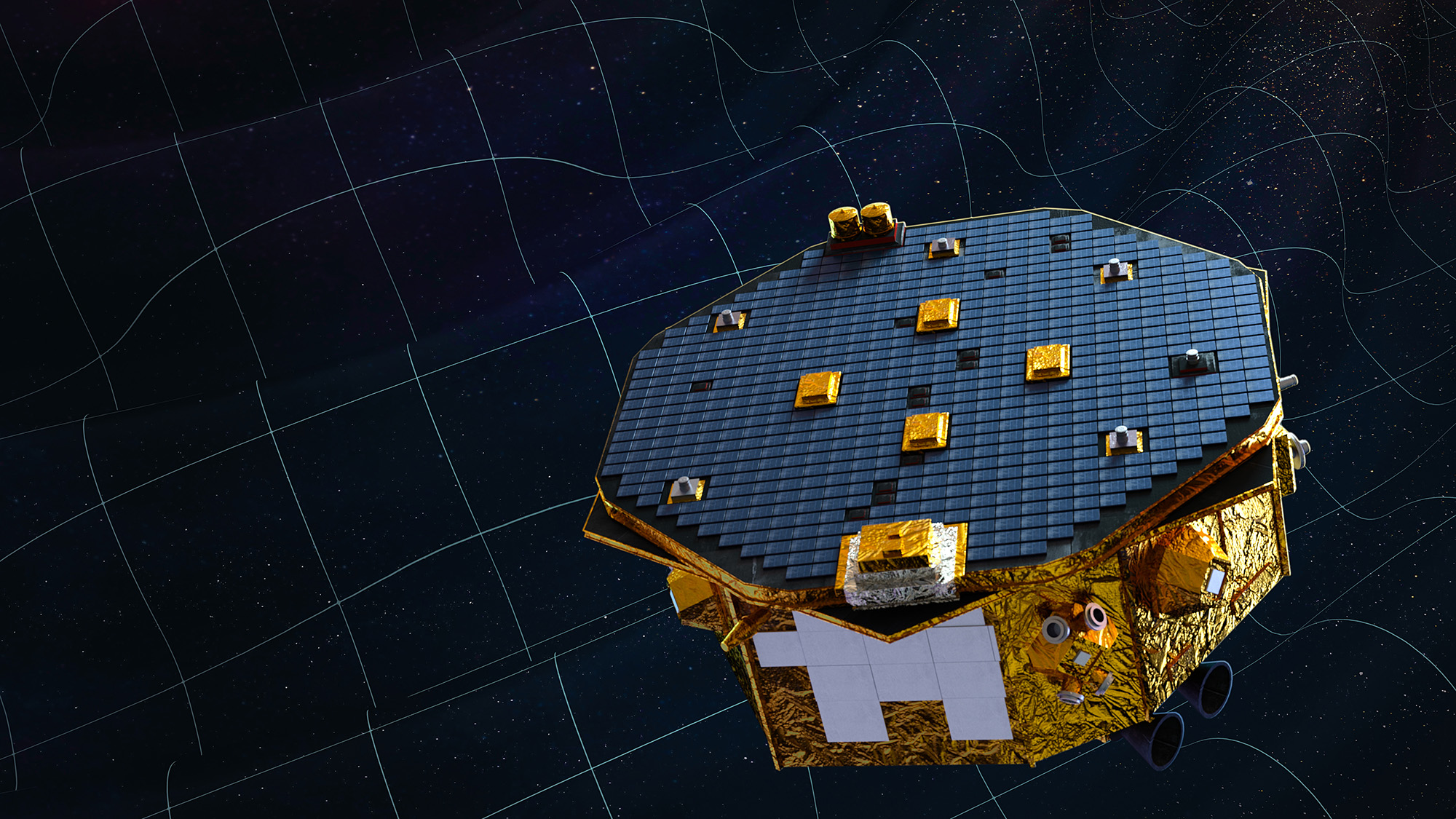
An illustration of a gold space probe with a flat top full of solar panels in front of wavy grid marks

ESA's upcoming LISA mission will detect gravitational waves from space, offering even more insights into the mysterious ripples than Earth-based detectors currently can. (Image credit: All About Space/Getty Images)

A new way to explore extreme gravity

The researchers stressed that their findings do not reveal what lies inside a black hole. Instead, they're providing a new observational tool for investigating the region immediately outside the event horizon.

"The gravitational wave data appear to carry an imprint from very close to the newly formed black hole's horizon — the famous point of no return," Ma said.

He explained that the measurements are consistent with space-time near the horizon being rapidly dragged around by the spinning black hole while the signal fades because of the intense gravitational field.

"For us, the exciting message is that gravitational waves may be giving us a new way to study the edge of a black hole using real observational data," Ma said.

Ma believes the method could eventually become useful for exploring ideas such as quantum gravity — which seeks to unite Einstein's theory of gravity with quantum mechanics — or the black hole information paradox, the longstanding puzzle of whether information that falls into a black hole is truly lost. However, it cannot test those questions directly yet.

"If quantum effects, or any deviations from the standard black-hole picture, leave a measurable imprint there, then direct waves could, in principle, help us search for them in the future," he said.

More observations will be needed

The researchers cautioned that the discovery is based on a single gravitational wave event. While GW250114 provided exceptionally favorable conditions, much stronger evidence will come only if similar signals are found in many additional black hole mergers.

"There are two main directions," Ma said. "The first is theory."

Current models capture the essential physics but remain simplified, and more realistic descriptions of black hole mergers will be needed.

"The second is observation," he added. "This result comes from one exceptionally loud and clean event, so the strongest confirmation would come from seeing the same kind of pattern in other black hole mergers."

As gravitational wave observatories continue to improve and detect increasing numbers of mergers, researchers hope to determine whether direct waves are a universal feature of black hole collisions.

"If the pattern appears repeatedly in the way general relativity predicts," Ma said, "direct waves could become a new way to study black hole horizons or the regions very close to them, and to test Einstein's theory in one of the most extreme environments in the universe."

If future observations confirm the team's results, scientists may have gained something they have sought for decades: a direct observational window into the very edge of a black hole.

See how much you know about black holes with our black hole quiz!

❌