❌

Normal view

Fast Radio Bursts Are Starting to Map the Universe’s Missing Gas

15 September 2026 at 16:00

A new Nature Astronomy study uses 114 fast radio bursts to trace cosmic gas and test how stellar and black-hole feedback reshapes matter around galaxies.

The post Fast Radio Bursts Are Starting to Map the Universe’s Missing Gas appeared first on Curiosmos.

Hints for Massive Galaxy Evolution from Dusty Star-Forming Galaxies

15 May 2026 at 17:00

NGC 972

How do massive galaxies form and evolve? A recent study traces the stellar and dust distributions across evolutionary phases of massive galaxies to better understand how massive dusty star-forming galaxies fit into the picture.

Dusty Massive Galaxies

Massive galaxies, like the Milky Way or even larger, undergo phases of active star formation and quiescent phases of inactivity, but exactly how these galaxies evolve through these stages is not yet fully understood. Dusty star-forming galaxies, which are undergoing a period of intense star formation and shrouded in dust, might be the missing evolutionary step between star-forming and quiescent phases of massive galaxy evolution.Β 

Currently, the leading explanation for massive galaxy formation and evolution is inside-out growth β€” star formation and quenching start in the inner regions of a galaxy and progress outward. However, it’s not clear whether dusty star-forming galaxies also follow the favored inside-out pathway, or if they instead proceed outside-in, first growing their disks and then assembling a central bulge.

JWST NIRCam images

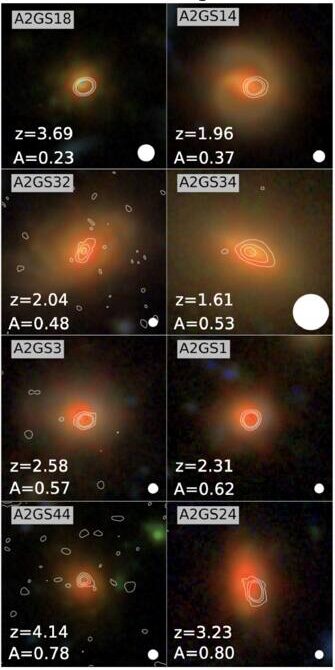
Example of JWST NIRCam images with ALMA contour lines overlaid for select dusty star-forming galaxies in the sample. [Modified from Bodansky et al 2026]

The spatial distribution (or morphology) of the stars and dust within dusty massive galaxies can help us trace their evolution. Thanks to high-resolution observations from JWST and the Atacama Large Millimeter/submillimeter Array (ALMA), researchers can now directly compare the morphologies of distant star-forming, quiescent, and dusty galaxies during the height of our universe’s star formation. Filling this gap will reveal how dusty star-forming galaxies may connect star-forming and quiescent galaxies in massive galaxy evolution.

Multiwavelength Morphological Comparisons

To directly compare the star and dust morphologies across massive galaxies, Sarah Bodansky (University of Massachusetts, Amherst) and collaborators selected a sample of 33 dusty star-forming galaxies from the GOODS-ALMA 2.0 survey that searched the sky for 1.1-mm dust emission as well as star-forming and quiescent comparison samples drawn from JWST observations. Combining the ALMA survey data with JWST imaging, the authors studied the rest-frame optical (stars) and rest-frame near-infrared (dust) morphologies of dusty, star-forming, and quiescent galaxies at redshifts around cosmic noon (a few billion years after the Big Bang).

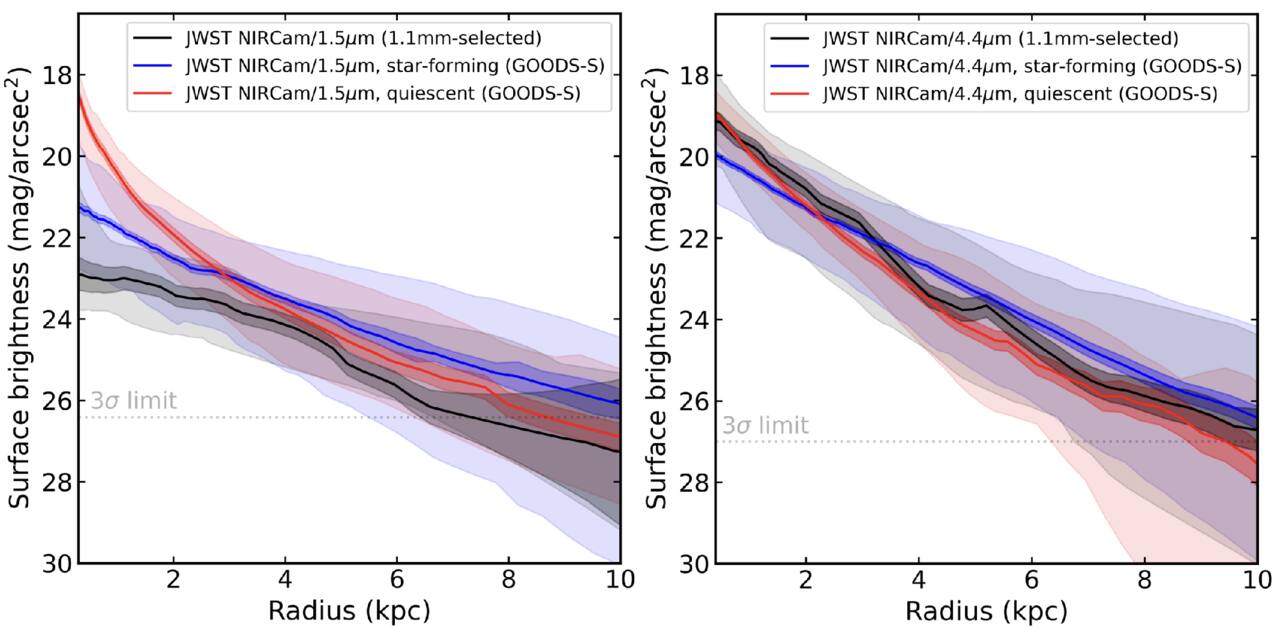
When comparing optical morphologies, the authors found that dusty star-forming galaxies and typical star-forming galaxies had similar distributions, but their near-infrared morphologies showed clear differences. Dusty galaxies tended to show more compact near-infrared emission, with dust tracing their stellar populations and more concentrated in the galaxies’ central regions. Though clearly different from star-forming galaxies, the authors noted striking similarities between the near-infrared morphologies of the dusty star-forming and quiescent galaxies, especially within their centers.

Surface brightness profiles

Average surface brightness profiles for the rest-optical (left) and rest-near-infrared (right) for the dusty (black), star-forming (blue), and quiescent (red) galaxies. In the near-infrared, the dusty star-forming galaxy profile appears very similar to the quiescent galaxy profile. [Bodansky et al 2026]

All of these properties suggest that dusty star-forming galaxies have built up stellar mass and dust in their cores, potentially forming a central bulge first and supporting an inside-out model of massive galaxy growth. This points to dusty star-forming galaxies as possible direct progenitors of early massive quiescent galaxies, hanging onto their last bit of star formation before becoming quiet as well. While this study morphologically distinguishes dusty galaxies from their star-forming and quiescent counterparts, future spectroscopic studies comparing the kinematics of these populations and investigations of molecular gas distributions are necessary to better pin down the evolutionary connection between star-forming, dusty, and quiescent massive galaxies.

Citation

β€œJWST+ALMA Reveal the Buildup of Stellar Mass in the Cores of Dusty Star-forming Galaxies at Cosmic Noon,” Sarah Bodansky et al 2026Β ApJΒ 1001Β 235. doi:10.3847/1538-4357/ae4f64

The post Hints for Massive Galaxy Evolution from Dusty Star-Forming Galaxies appeared first on AAS Nova.

Featured Image: Rare Giant Galaxies

23 February 2026 at 17:00

low-surface-brightness galaxies

Giant low-surface-brightness galaxies are rare and unusual members of the galactic menagerie. They host the largest galactic disks currently known, have baryonic masses of order 100 billion solar masses, and sport narrow, tightly wound spiral structures. The origins of these vast galaxies β€” they can be up to 10 times larger than the Milky Way β€” are unknown, though various theories involving mergers, accretion, and strange dark matter halos exist. Research also suggests that there may be a connection between these galaxies and compact ellipticals, which are small, dense, and contain old stars. In a recent article, a team led by Anna Saburova (Sternberg Astronomical Institute) investigated two giant low-surface-brightness galaxies with compact elliptical companions. In the image above, the colored circles represent the oxygen abundance at each location in AGC 192040 (left) and UGC 1382 (right). The red arrows point to the compact elliptical companions. Using the chemical abundance information to investigate possible formation mechanisms, Saburova and collaborators found that the two galaxies likely formed in different ways. UGC 1382 appears to be the result of multiple mergers, while AGC 192040 may have accreted gas from its halo or a galactic filament before undergoing a merger of its own. To learn more about this study of two rare galaxies, be sure to check out the full research article linked below!

Citation

β€œMUSE Study of Two Giant Low-Surface-Brightness Galaxies with Compact Satellites,” Anna S. Saburova et al 2026 ApJ 998 19. doi:10.3847/1538-4357/ae3139

The post Featured Image: Rare Giant Galaxies appeared first on AAS Nova.

Supermassive Black Hole in a Super Tiny Galaxy Found with JWST

26 September 2025 at 17:00

ultracompact dwarf galaxy

With very small stellar masses and tiny radii, ultracompact dwarf galaxies raise questions about the dividing line between the highest-mass star clusters and the lowest-mass galaxies. A recently published article leverages JWST’s high resolution to target one tiny galaxy and investigate its origins.

UCD 736

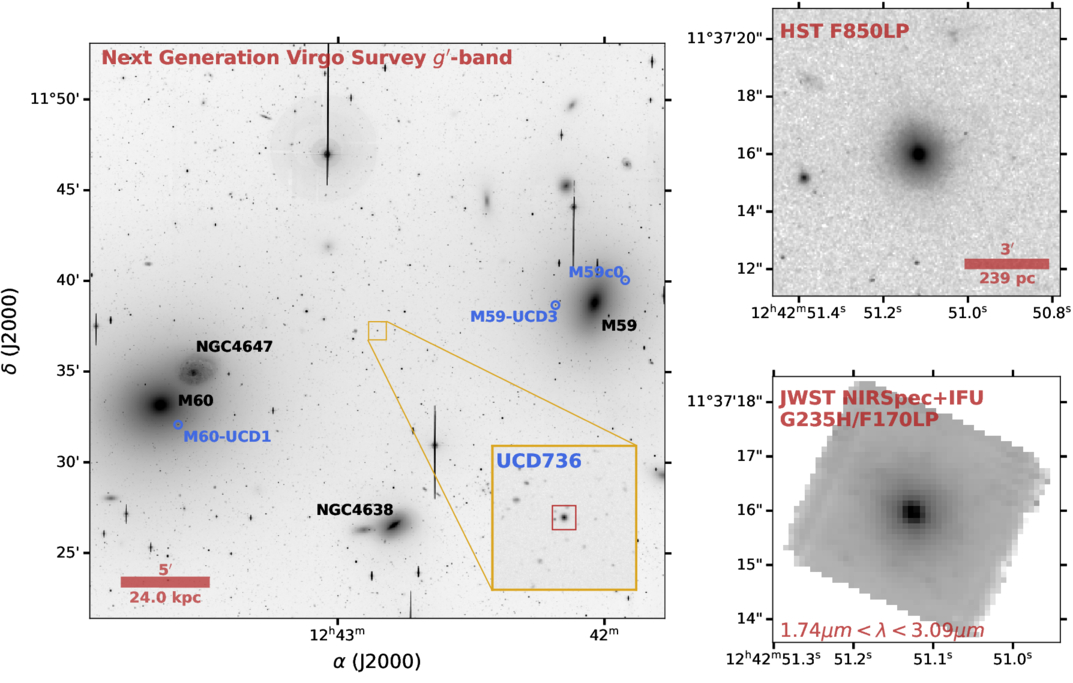
Location of UCD 736 in the Virgo Cluster with the other ultracompact dwarf galaxies with supermassive black hole detections labeled. Click to enlarge. [Taylor et al 2025]

Origins of Ultracompact Dwarf Galaxies

How tiny can a galaxy get? Discovered 20 years ago among the dense environments of the Virgo and Fornax clusters, ultracompact dwarf galaxies walk the line between the largest globular clusters and the smallest galaxies. Determining if these dwarfs are stellar in nature or actually of galactic origin is complex, but one sure way to get at this question is to determine if an ultracompact dwarf galaxy houses a supermassive central black hole.Β 

While astronomers have identified hundreds of these tiny dense galaxies, supermassive black holes have been detected in only five. Hoping to extend this sample, Matthew Taylor (University of Calgary) and collaborators targeted UCD 736, an ultracompact dwarf galaxy located in the Virgo galaxy cluster. If a massive black hole is found in this galaxy, it will be the smallest and least luminous ultracompact dwarf to have such a detection. Exploring galaxies at such small sizes will allow researchers to determine what fraction of ultracompact dwarfs have galactic or star cluster origins, which can provide insights into massive black hole seeding mechanisms in the early universe.

Modeling Black Hole Mass

Model results

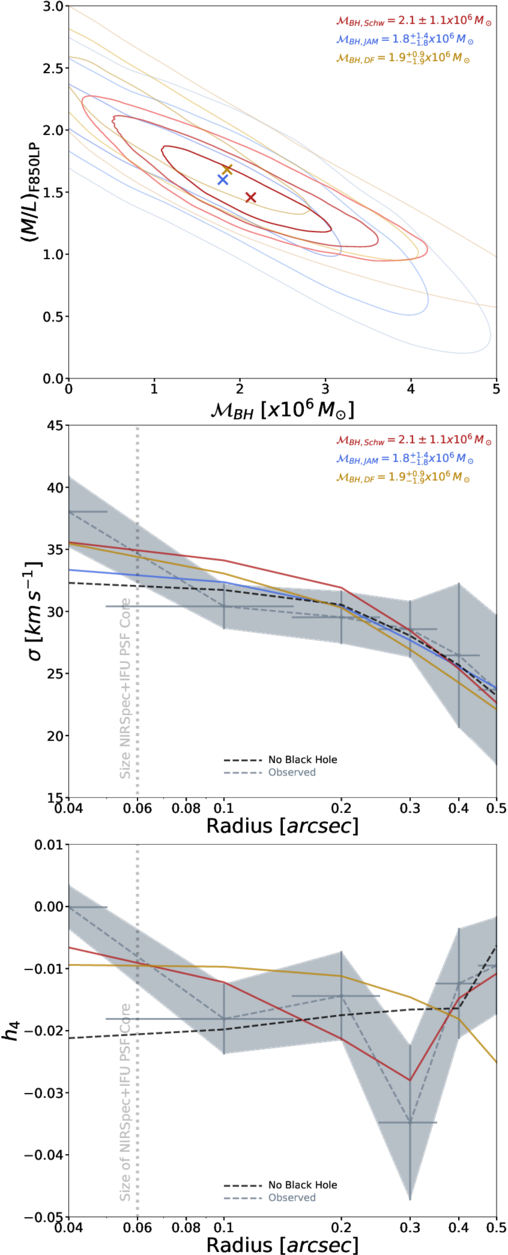
Summary of results for the three black hole modeling methods for UCD 736, indicating the quality of the models and how the observed velocity dispersion and spatial distribution of the galaxy fit with the models. Click to enlarge. [Taylor et al 2025]

In order to search for a central black hole in UCD 736, Taylor and team obtained high-resolution spectroscopy from JWST and supplemental imaging from the Hubble Space Telescope. The authors used the stellar kinematics and light profile of the galaxy to estimate the mass of its central black hole with three independent modeling methods. Based on the expected impacts of a massive black hole on galaxy dynamics and the estimated stellar population of the galaxy, the authors found that UCD 736 likely hosts a central supermassive black hole with mass ~2.1 million times the mass of the Sun.Β 

However, the authors noted that the three models do not provide equivalent confidence levels in this estimate β€” while one model confidently rules out the possibility of no central black hole at 3Οƒ significance, the other two models were less constraining, ruling out the possibility of there not being a black hole to only 1Οƒ. Despite these differences, all three models agree on the central black hole mass within the first confidence interval, indicating a positive detection of a black hole in UCD 736.

Progenitor of UCD 736

From their observations and modeling, the authors presented the fifth positive detection of an ultracompact dwarf galaxy with a central supermassive black hole within the Virgo Cluster. Given the presence of this black hole, UCD 736 likely originated as a more massive galaxy that was tidally stripped as it interacted with other nearby cluster galaxies. Interestingly, though, other ultracompact dwarf galaxies with black hole detections in the Virgo Cluster are much closer to the massive galaxy that likely stripped them. UCD 736 sits about 160,000 light-years outside of the nearest giant galaxy Messier 59’s tidal radius, which does not rule out interactions but could indicate that Messier 59 is particularly good at stripping material from smaller galaxies.Β 

Continued searches for black holes in ultracompact dwarfs will further probe the differences between the highest-mass globular clusters and the lowest-mass galaxies. Revealing more within this parameter space will allow astronomers to test black hole seeding and galaxy formation theories.

Citation

β€œA Supermassive Black Hole in a Diminutive Ultracompact Dwarf Galaxy Discovered with JWST/NIRSpec+IFU,” Matthew A. Taylor et al 2025 ApJ 991 L24. doi:10.3847/2041-8213/ae028e

The post Supermassive Black Hole in a Super Tiny Galaxy Found with JWST appeared first on AAS Nova.

Why are Astronomers Stunned by Abundant Oxygen in Earliest Known Galaxy?

15 April 2025 at 23:14
Astronomers have discovered a galaxy, allegedly dating from just 300 million years after the big bang, with unexpectedly high oxygen levels. This is in contradiction to existing cosmological models with galaxy formation taking much longer. The findings refute the validity of the big bang story itself.

❌