❌

Normal view

The moon is shrinking. Astronomers finally know how fast.

14 October 2026 at 20:55

It’s true, the moon is shrinking. And astronomers now know how fast it’s contracting. While only satellite observations and the most delicate instruments can detect these shifts, the consequences of this shrinkage means moonquakes can occur anywhere on the lunar surface at a moment’s notice.

A team led by Smithsonian National Air and Space Museum planetary geologist Thomas Watters detailed their findings in a study recently published in The Planetary Science Journal. Researchers used data from NASA’s Lunar Reconnaissance Orbiter Camera (LROC), which has spent over 17 years generating millions of images of the moon’s surface. A shriveling lunar landscape may sound dramatic, but it’s occurring at a glacial pace. Based on these new calculations, the moon’s overall radius has decreased nearly 148 feet over the last 400–800 million years as it continues to cool. That’s about 2.4 to 4.3 inches per million years, or just 0.1 micrometer annually.

Although slow, the incremental activity’s effects are visible everywhere. On Earth, about 90 percent of all seismic activity occurs near the boundaries between lithospheric plates. But unlike its host planet, our moon is encased by a single, shell-like plate. This means interior cooling can generate slips and faults anywhere at any given time. After reviewing images taken by the LROC, the study’s authors tallied over 10,000 visible lunar faults.

“The number of these young faults revealed in LROC images is much greater than I ever imagined,” said Watters. “As the interior of the moon continues to cool and contract, it is expected that the growth of existing faults and formation of new faults continues today.”

While the faults can happen anywhere, some lunar regions are more likely than others to feature them. Areas with the thickest crust have fewer faults, which indicates they may be more stable than other, thinner sections. In addition to better understanding lunar history, the distribution and frequency of moonquakes may also help NASA better plan for a long-term human presence on the moon.

The post The moon is shrinking. Astronomers finally know how fast. appeared first on Popular Science.

NASA’s Perseverance Mars rover sets distance record

13 October 2026 at 17:01

NASA’s Perseverance Mars rover has officially traveled 28.10 miles—farther across another planet’s surface than any other vehicle in history. Not only that, but the six-wheeled science lab accomplished this impressive feat almost entirely autonomously and in barely a third the time it took the previous recordholder.

“The original mission called for no more than 12.4 miles of driving. We’ve blown well past that,” Steven Lee, Perseverance and Curiosity project manager at NASA’s Jet Propulsion Laboratory, said in a statement.

Perseverance began operations on Mars on February 18, 2021, after landing in an ancient river delta selected for potential past microbial life called Jezero Crater. Since then, the rover has slowly but steadily made its way across the region, while conducting multiple sediment drilling surveys. These samples are then chemically analyzed using onboard laboratory equipment before the results are sent back to mission specialists at NASA.

Perseverance surpassed the previous travel record of 28.06 miles set by NASA’s Opportunity rover, before its communications with NASA ended on June 10, 2018. However, it took Opportunity nearly 15 years to accrue its distance while Perseverance exceeded the same mileage in less than six years, and on the 2,006th Martian day (sol) of its mission. Perseverance is currently traveling towards an area named Idubi through an expanse nicknamed “Lac de Charmes.” The region near Jezero Crater’s western rim hosts what may be the oldest landscape ever investigated in the solar system. Mars does not feature tectonic plates like Earth, which means its terrain is never eroded and subsumed into the planet’s substrates.

Mission engineers have not spent the last six years remotely steering Perseverance, either. The rover arrived on Mars equipped with a self-piloting system called AutoNav, which constructs 3D maps of the immediate surroundings to flag any potential hazards. AutoNav then charts a route between specific waypoints chosen by NASA specialists back home. Perseverance has completed 90 percent of its total excursion with AutoNav. Opportunity and its sibling rover, Spirit, only relied on a first version of the piloting system about five percent of the time.

Perseverance has a long road ahead of it, if all goes according to plan. In October, NASA approved the first mission extension that will continue the rover’s operations through about the end of 2028.

“With all mobility systems fully operational and favorable extended-ground-life test results, we expect Perseverance to keep adding to this record for many years to come,” added Lee.

The post NASA’s Perseverance Mars rover sets distance record appeared first on Popular Science.

NASA shares Artemis II astronauts’ handwritten mission notes

8 October 2026 at 19:40

Successfully sending Artemis II astronauts on their historic lunar flyby earlier this year required some of the latest and most precise technologies, but not everything in this mission needed the same intense equipment. As crewmates gazed through Orion’s capsule window at the moon’s eclipse of the sun on April 6, 2026, three of the travelers needed a way to easily sketch some of their preliminary observations. They took turns writing their notes on a shared tablet PC—and NASA has recently highlighted their work with a screenshot of their efforts.

Astronauts Reid Wiseman, Victor Glover, Christina Koch, and Jeremy Hansen had a lengthy list of tasks during their 10-day, 700,000-mile roundtrip. One of the most visually dramatic jobs involved carefully assessing lunar activity while passing across the moon’s dark side from a distance of about 46,000 miles away. The roughly hour-long observation period provided astronauts with an unprecedented opportunity to record meteorite activity.

A visualization of a dark Moon eclipsing the Sun is marked with handwritten notes in this April 6, 2026, screenshot from an Artemis II crew member’s tablet. Credit: NASA

The tablet screenshot includes notes taken by Wisemen (in blue), Hansen (in red), and Glover (in green) during the moon’s eclipse of the sun. The crew collectively spotted at least five faint flashes of light caused by impacts. According to Wiseman, the first three impacts occurred within about 10 minutes into their observations, while another two happened later during the flyby. Impacts two and four were likely also corroborated by Hansen and Glover.

Since the moon does not have an atmosphere like Earth’s, the lunar surface is regularly bombarded by space rocks. Most of them are comparatively small, but they will still pose a problem for future crewed trips to the surface,especially those stationed in a planned permanent lunar base. The data gathered by Artemis II on April 6 will help NASA better understand these dynamics, and plan for the safest environments possible for their astronauts.

Artemis II’s astronauts safely returned to Earth during a splashdown off the coast of San Diego at 8:07 p.m. EDT on April 11. If all goes as planned, Artemis III’s crew will launch on their mission no earlier than June 2027.

The post NASA shares Artemis II astronauts’ handwritten mission notes appeared first on Popular Science.

The search for habitable worlds

15 October 2026 at 12:00

The NASA Exoplanet Exploration Program (ExEP) has a curated list of 164 nearest Sun-like stars that are easily visible from Earth. This list represents the first targets for a proposed large space telescope specially designed to find life in the universe, currently known as the Habitable Worlds Observatory (HWO). 

After the HWO is completed, likely sometime in the 2040s, scientists will use the specialized telescope to directly image planets in those star systems. The telescope will search around Sun-like stars for planets in a region known as the habitable zone, where temperatures allow liquid water to exist. Scientists hope to find Earth-like planets with liquid water in the habitable zones of other stars.

While the 164 stars on ExEP’s list have qualities that make them good candidates for study, it remains unknown how many actually have terrestrial planets within their habitable zones. A team of scientists at Arizona State University used simulated data for ExEP’s 164 stars and their hypothetical planetary systems to assess which are most likely to have habitable worlds. Their results would help the HWO prioritize which star systems to observe.

The team started with a subset of 134 stars on ExEP’s list with no known exoplanets, giving researchers the freedom to simulate potential worlds around them. They used a software model called the DYNAmical Multi-planet Injection TEster (DYNAMITE) to predict the possibility that an unseen planet exists around each star by generating 100,000 simulated planetary systems around it. The simulations use mathematical formulas based on observations of real exoplanets to determine the sizes and orbital characteristics of hypothetical gas giants and rocky exoplanets. DYNAMITE then determines whether these planetary systems would be stable and include a terrestrial exoplanet in the star’s habitable zone.

The other 30 stars in the ExEP’s list have known exoplanets, but none of them are rocky planets in habitable zones. To predict whether these stars have unseen terrestrial planets in their habitable zones, the team used the same DYNAMITE process as before with the additional requirement that each star must have an exoplanet matching the one already found.

The space around a Sun-like star can be divided into three regions. The region closest to the star is too hot for liquid water to persist on an exoplanet’s surface, while the region farthest from the star is so cold that any water on an exoplanet would be frozen solid. Between these lies the habitable zone, where temperatures would allow liquid water to exist. However, it’s also possible that a combination of light and gravity could create habitable temperatures on large enough moons orbiting gas giants even beyond a star’s main habitable zone. Illustration by <a href="https://www.linkedin.com/in/andrew-bizal-ab14401ab/">Andrew Bizal</a>.

The space around a Sun-like star can be divided into three regions. The region closest to the star is too hot for liquid water to persist on an exoplanet’s surface, while the region farthest from the star is so cold that any water on an exoplanet would be frozen solid. Between these lies the habitable zone, where temperatures would allow liquid water to exist. However, it’s also possible that a combination of light and gravity could create habitable temperatures on large enough moons orbiting gas giants even beyond a star’s main habitable zone. Illustration by Andrew Bizal.

To increase the chances of finding a terrestrial planet in a habitable zone, the team also investigated potentially habitable moons orbiting gas giants in these systems. For each simulation that included a gas giant, the team inserted between 2 and 23 moons, with masses between 10% of Earth’s Moon and 50% of Earth. Then they simulated the surface temperatures of these moons based on how much starlight they receive and how strongly their host planet pulls on them. They deemed the moons potentially habitable if they were large enough to retain an atmosphere and had a temperature ideal for liquid water, even if they were not technically in their stars’ habitable zones.

For each star, the team calculated a metric based on the probabilities that the star had a terrestrial planet in its habitable zone, that the planet would remain in a stable habitable zone for at least 2 billion years, and that the star had a potentially habitable moon. They called this probability statistic a ranking metric and used it to compare star systems. 

Based on the ranking metric, the team found that the dimmer and cooler stars on their list generally had better chances of hosting a habitable-zone terrestrial planet than the brighter, hotter stars. They also found that stars without known exoplanets ranked more favorably. Around 70% of the stars with known exoplanets had less than a 1% probability of hosting a terrestrial planet in their respective habitable zones. Additionally, fewer than 0.1% of their simulated moons were habitable.

Overall, the researchers concluded that the HWO should prioritize observing cooler, Sun-like stars with no known exoplanets. They claimed that the exoplanets with known characteristics in their sample set were of sizes and in positions that made it unlikely for other exoplanets to be in their systems’ habitable zones. Even with expanded habitability criteria for moons, it would be very unlikely for HWO to find another Earth orbiting a gas-giant exoplanet. They ranked 47 stars in the highest-priority category (A Tier), 51 stars in the middle category (B Tier), and 66 stars in the lowest category (C Tier) to observe with HWO. 

At the end of their study, the team remarked that the proposed HWO represents a potential next step in the search for other Earths, but scientists still need to identify the best targets for this future telescope. The HWO telescope should be able to image rocky exoplanets directly, so thorough research to prepare a list of high-priority targets will help avoid overlooking other Earths.

The post The search for habitable worlds appeared first on Sciworthy.

Are Martian organics remnants of ancient life?

8 October 2026 at 12:00

Since the 1976 Viking missions, when NASA first successfully placed uncrewed landers on Mars, scientists who study life in the universe, known as astrobiologists, have been gathering evidence to determine whether microorganisms ever lived on the red planet. It has been a challenging determination to make. Until a Mars sample return mission occurs, all necessary analyses must take place on Mars, using instruments designed as much to withstand the stresses of space travel as to collect data, which limits how thoroughly scientists can study Martian rocks. As a result, the search for evidence of microbial life on Mars is inherently incremental. 

Recently, scientists added another piece of exciting, yet inconclusive, evidence to their search. In the summer of 2024, the Mars 2020 Perseverance Rover science team was searching for signs of ancient microbial life in a 3,700-million-year-old lake bed on Mars, known as Jezero Crater. In the process, they detected complex, carbon-containing organic molecules in mudstones within a river channel that once brought water to the now-dry lake bed. 

This is not the first time complex organic molecules have been detected in Martian mudstones. However, there are 2 reasons that astrobiologists are particularly interested in this new discovery. First, these organic molecules are widely dispersed across all 4 river channel mudstones they analyzed. Second, some of the organic molecules they found are associated with minerals that are known to support microbial life on Earth. 

Widely dispersed organic molecules associated with minerals that can support microbial life are exactly what astrobiologists would expect to see if microorganisms once lived in Jezero Crater. However, organic molecules can also form through geological processes, like when gases and minerals react at high temperatures and pressures at deep-sea vents on Earth. Therefore, astrobiologists must carefully assess organic molecules to determine their origin. 

In July of 2026, more than 60 Perseverance science team members took a first step towards determining whether ancient microorganisms could have made the organic molecules found in Jezero Crater. They compared the organic molecule detections in Martian mudstones to similar detections of organic molecules in samples of known origin, including fossilized Earth life, meteorites, and minerals. 

NASA scientists detected the organic molecules in Jezero Crater with a rover instrument called Scanning Habitable Environments with Raman and Luminescence for Organics and Chemicals (SHERLOC). SHERLOC uses a 248.6 nanometer (nm) wavelength laser to excite molecules in unknown materials. When molecules are excited, they absorb and scatter the laser light, causing characteristic shifts in the wavelength of the scattered light. 

Instruments like this, known as Raman spectrometers, detect the shifted light and display the detections as lines called spectra, which scientists use to identify the unknown molecules. The Raman spectra from the 4 mudstones in Jezero crater showed shifts of about 1600 nm, which is characteristic of complex carbon molecules. These shifts appear as bands in the spectra that are often called G-bands.

Raman spectrometers are common laboratory instruments, but most use lasers with wavelengths of 485 nm or higher, so the spectra they produce can be slightly different from SHERLOC spectra even when the laser excites the same kind of molecule. To get around this issue, the scientists compared the Mars spectra with spectra of complex carbon molecules from fossilized Earth microorganisms, coal, graphite, meteorites, and synthetic samples collected by Raman instruments using the same wavelength laser that SHERLOC uses. They found that the spectra collected on Mars overlap with at least one example from every sample type except graphite. 

These results don’t rule out the possibility that organic molecules in Jezero Crater were produced by ancient microbial life, but they can’t tell us exactly how they formed either. That determination will have to wait until the samples are brought to Earth so they can be studied with laboratory instruments.

The Perseverance team has made a small but critical contribution towards determining whether microbial life ever inhabited our closest planetary neighbor, Mars. Their efforts exemplify how the science of astrobiology and the search for possible extraterrestrial life slowly and carefully move forward. If we keep at it, humans may one day have a definitive answer to one of our most consequential questions: Are we alone?

The post Are Martian organics remnants of ancient life? appeared first on Sciworthy.

Le immagini ad alta risoluzione della sonda Lunar Reconnaissance Orbiter de…

17 September 2026 at 21:45
Le immagini ad alta risoluzione della sonda Lunar Reconnaissance Orbiter della NASA hanno rivelato un recente impatto sulla faccia nascosta della Luna. Un asteroide o frammento cometario ha scavato una cavità di oltre 200 metri di diametro, sollevando detriti incandescenti e dimostrando la continua vulnerabilità del suolo lunare al bombardamento cosmico.

Passion Meets Precision at NASA’s Flight Research Lab

16 September 2026 at 22:06

4 min read

Passion Meets Precision at NASA’s Flight Research Lab

One man communicates with a hand-held radio, as two other men wait to the side for the go-ahead command to fly an experiment on a drone.
Derek Abramson, Dale Reed Subscale Flight Research Laboratory chief engineer, left, communicates with the Edwards Air Force Base air traffic control tower for approval to fly the Alta-X drone near NASA’s Armstrong Flight Research Center in Edwards, California, on Thursday, Aug. 27, 2026. Justin Link, small uncrewed aircraft pilot, second from left, and laboratory chief pilot Justin Hall await flight clearance. Researchers at NASA’s Johnson Space Center in Houston developed the advanced guidance and navigation system known as the Safe and Precise Landing – Integrated Capabilities Evolution (SPLICE) experiment, which is installed on the Alta-X. SPLICE will help spacecraft land precisely and detect and avoid potential hazards, which is critical for NASA missions to the Moon and to Mars.
NASA/Ryan Kline

Long before they helped shape NASA’s future aerospace breakthroughs, Derek Abramson, Justin Hall, and Justin Link were in their garages and homes building radio‑controlled aircraft, testing new ideas, and flying their creations at hobby events. That early passion now fuels the work of NASA’s Dale Reed Subscale Flight Research Laboratory at the agency’s Armstrong Flight Research Center in Edwards, California.

At NASA Armstrong’s subscale flight lab, the team turns that lifelong enthusiasm into mission-focused innovation. The laboratory supports research that ranges from advanced navigation systems for future landings on the Moon and Mars to emerging aeronautics concepts that need quick, low-cost evaluation. NASA’s small, remotely piloted and autonomous aircraft allow engineers to explore ideas that could be difficult, risky or expensive to test at full scale.

Skilled team

Abramson, Hall, and Link play key roles in that work. Abramson serves as the laboratory’s chief engineer. Hall is the chief pilot. Link is a drone pilot. Together, they integrate emerging aerospace technologies with the lab’s subscale aircraft fleet and, when needed, design and build aircraft or flight experiments to evaluate new concepts.

A boy holds a large radio-controlled black-and-yellow helicopter.
Derek Abramson, chief engineer at the Dale Reed Subscale Flight Research Laboratory at NASA’s Armstrong Flight Research Center in Edwards, California, is shown with his Kalt Cyclone radio-controlled helicopter in the mid-1980s. Abramson loved flying this aircraft as a child, and he has been an aviation enthusiast for as long as he can remember.
Derek Abramson

Abramson’s expertise, built through service in the U.S. Navy and the aerospace industry, centers on technical oversight, management, and system design. Hall is known for creative approaches to problem solving and uses practical methods to address technical challenges and maintain flight safety. Link specializes in designing and fabricating research vehicles and draws on extensive hands-on experience to understand what works, and what does not, in flight. 

On weekends, the team often tinkers in their garages or hangars building radio-control aircraft, researching hobby trends, or exploring new technologies. You might see them flying their creations at hobby events or attending trade shows. Their passion for flight brought Abramson, Hall, and Link together years before they one-by-one joined NASA more than a decade ago, though each discovered that spark in a different way.

Early influences

Abramson’s interest began as a child with rubber-band powered stick and tissue aircraft and radio-controlled models. His early aviation pursuits led to his first solo flight while in high school and a pilot’s license. In the Navy, he worked on multiple aircraft, including EA-6B and the F-18, as an avionics technician. As an engineer, he supported the B-1 and CV-22 Osprey aircraft flight tests. As an intern at NASA Armstrong, he used his operational and engineering experience on remotely piloted and autonomous aircraft.

Hall’s interest grew after seeing historic aircraft including the Mach 3 SR-71 fly over his elementary school playground and watching Space Shuttle Challenger land from above his dad’s shoulders. He has built and flown model and remotely piloted aircraft for as long as he can remember. His reputation flying radio-controlled hobby aircraft at fly-ins and trade events led to an offer to fly subscale aircraft at NASA.

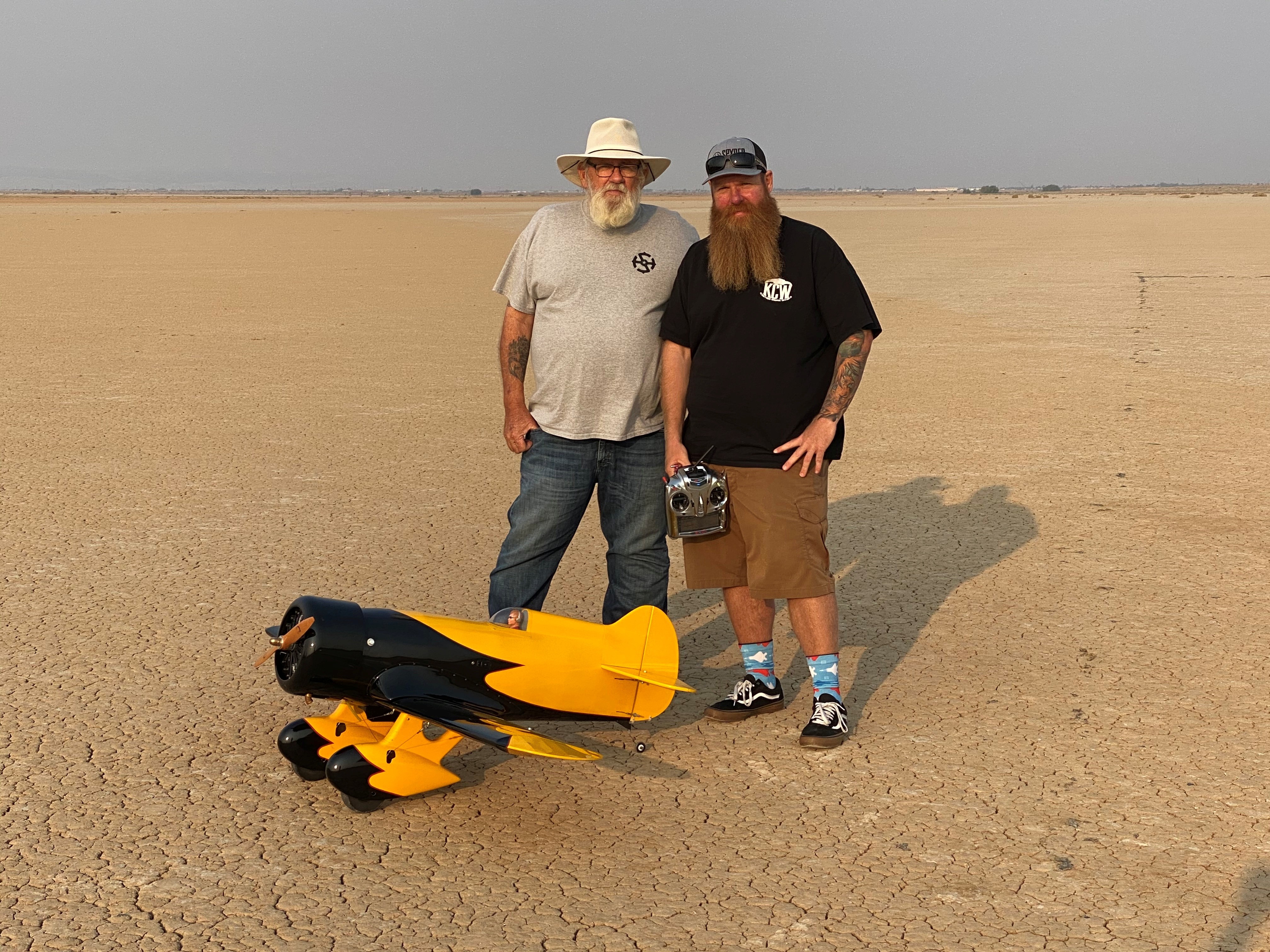
Two men stand by a yellow and black radio-controlled aircraft.
Justin Hall, chief pilot at the Dale Reed Subscale Flight Research Laboratory at NASA’s Armstrong Flight Research Center in Edwards, California, stands in front of a radio-controlled aircraft with his dad, David Hall, in August 2020. David Hall built the Gee Bee aircraft years earlier but was unable to fly it due to his health. He asked his son to fly the aircraft so he could see it in the air, which Justin did the day of this photo. Shortly afterward, David Hall passed away.
Justin Hall
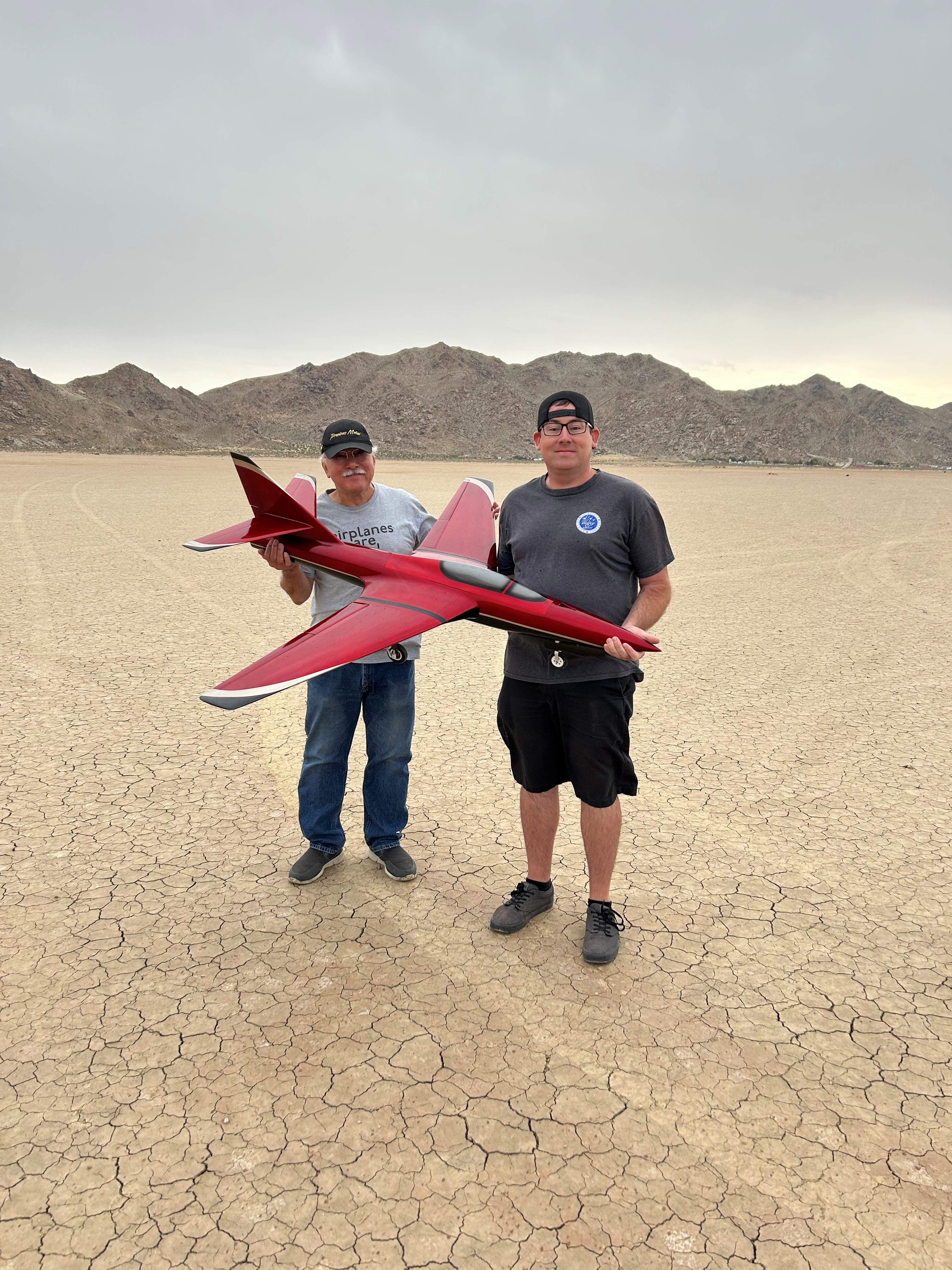
Two men hold a large radio-controlled aircraft. The aircraft is red with white and black stripes.
Justin link, drone pilot at the Dale Reed Subscale Flight Research Laboratory at NASA’s Armstrong Flight Research Center in Edwards, California, and his dad, Don Link, hold a Firebird radio-controlled aircraft on the day of its first flight in September 2023. It was a project they worked on together. Don Link reduced the dimensions of the original larger-scale model aircraft and drew the plans, while Justin Link manufactured composite molds and built the aircraft from scratch.
Justin Link

Link was five years old when he built balsa-wood aircraft with his dad and flew them in a field near their home. As he grew older, his hobby expanded to include radio-controlled cars, boats, helicopters, and aircraft. Aviation runs deep in Link’s family. His great grandfather served in the U.S. Army Air Corps, his grandfathers served in the U.S. Air Force, and his dad was an Air Force avionics technician. Link raced sailplanes, competed with scaled warbird aircraft, and was encouraged by family and friends to pursue an aviation profession. He has worked with large drones for more than 11 years, focusing on research and development, composite materials, and specialized fabrication methods.

Together, the team applies its experience and knowledge in rapid design, fabrication, integration and flight testing to bring new ideas to flight. Their work continues to support NASA’s missions across aeronautics, science, and exploration.

The post Passion Meets Precision at NASA’s Flight Research Lab appeared first on NASA Science.

Passion Meets Precision at NASA’s Flight Research Lab

16 September 2026 at 22:06

4 min read

Preparations for Next Moonwalk Simulations Underway (and Underwater)

One man communicates with a hand-held radio, as two other men wait to the side for the go-ahead command to fly an experiment on a drone.
Derek Abramson, Dale Reed Subscale Flight Research Laboratory chief engineer, left, communicates with the Edwards Air Force Base air traffic control tower for approval to fly the Alta-X drone near NASA’s Armstrong Flight Research Center in Edwards, California, on Thursday, Aug. 27, 2026. Justin Link, small uncrewed aircraft pilot, second from left, and laboratory chief pilot Justin Hall await flight clearance. Researchers at NASA’s Johnson Space Center in Houston developed the advanced guidance and navigation system known as the Safe and Precise Landing – Integrated Capabilities Evolution (SPLICE) experiment, which is installed on the Alta-X. SPLICE will help spacecraft land precisely and detect and avoid potential hazards, which is critical for NASA missions to the Moon and to Mars.
NASA/Ryan Kline

Long before they helped shape NASA’s future aerospace breakthroughs, Derek Abramson, Justin Hall, and Justin Link were in their garages and homes building radio‑controlled aircraft, testing new ideas, and flying their creations at hobby events. That early passion now fuels the work of NASA’s Dale Reed Subscale Flight Research Laboratory at the agency’s Armstrong Flight Research Center in Edwards, California.

At NASA Armstrong’s subscale flight lab, the team turns that lifelong enthusiasm into mission-focused innovation. The laboratory supports research that ranges from advanced navigation systems for future landings on the Moon and Mars to emerging aeronautics concepts that need quick, low-cost evaluation. NASA’s small, remotely piloted and autonomous aircraft allow engineers to explore ideas that could be difficult, risky or expensive to test at full scale.

Skilled team

Abramson, Hall, and Link play key roles in that work. Abramson serves as the laboratory’s chief engineer. Hall is the chief pilot. Link is a drone pilot. Together, they integrate emerging aerospace technologies with the lab’s subscale aircraft fleet and, when needed, design and build aircraft or flight experiments to evaluate new concepts.

A boy holds a large radio-controlled black-and-yellow helicopter.
Derek Abramson, chief engineer at the Dale Reed Subscale Flight Research Laboratory at NASA’s Armstrong Flight Research Center in Edwards, California, is shown with his Kalt Cyclone radio-controlled helicopter in the mid-1980s. Abramson loved flying this aircraft as a child, and he has been an aviation enthusiast for as long as he can remember.
Derek Abramson

Abramson’s expertise, built through service in the U.S. Navy and the aerospace industry, centers on technical oversight, management, and system design. Hall is known for creative approaches to problem solving and uses practical methods to address technical challenges and maintain flight safety. Link specializes in designing and fabricating research vehicles and draws on extensive hands-on experience to understand what works, and what does not, in flight. 

On weekends, the team often tinkers in their garages or hangars building radio-control aircraft, researching hobby trends, or exploring new technologies. You might see them flying their creations at hobby events or attending trade shows. Their passion for flight brought Abramson, Hall, and Link together years before they one-by-one joined NASA more than a decade ago, though each discovered that spark in a different way.

Early influences

Abramson’s interest began as a child with rubber-band powered stick and tissue aircraft and radio-controlled models. His early aviation pursuits led to his first solo flight while in high school and a pilot’s license. In the Navy, he worked on multiple aircraft, including EA-6B and the F-18, as an avionics technician. As an engineer, he supported the B-1 and CV-22 Osprey aircraft flight tests. As an intern at NASA Armstrong, he used his operational and engineering experience on remotely piloted and autonomous aircraft.

Hall’s interest grew after seeing historic aircraft including the Mach 3 SR-71 fly over his elementary school playground and watching Space Shuttle Challenger land from above his dad’s shoulders. He has built and flown model and remotely piloted aircraft for as long as he can remember. His reputation flying radio-controlled hobby aircraft at fly-ins and trade events led to an offer to fly subscale aircraft at NASA.

Two men stand by a yellow and black radio-controlled aircraft.
Justin Hall, chief pilot at the Dale Reed Subscale Flight Research Laboratory at NASA’s Armstrong Flight Research Center in Edwards, California, stands in front of a radio-controlled aircraft with his dad, David Hall, in August 2020. David Hall built the Gee Bee aircraft years earlier but was unable to fly it due to his health. He asked his son to fly the aircraft so he could see it in the air, which Justin did the day of this photo. Shortly afterward, David Hall passed away.
Justin Hall
Two men hold a large radio-controlled aircraft. The aircraft is red with white and black stripes.
Justin link, drone pilot at the Dale Reed Subscale Flight Research Laboratory at NASA’s Armstrong Flight Research Center in Edwards, California, and his dad, Don Link, hold a Firebird radio-controlled aircraft on the day of its first flight in September 2023. It was a project they worked on together. Don Link reduced the dimensions of the original larger-scale model aircraft and drew the plans, while Justin Link manufactured composite molds and built the aircraft from scratch.
Justin Link

Link was five years old when he built balsa-wood aircraft with his dad and flew them in a field near their home. As he grew older, his hobby expanded to include radio-controlled cars, boats, helicopters, and aircraft. Aviation runs deep in Link’s family. His great grandfather served in the U.S. Army Air Corps, his grandfathers served in the U.S. Air Force, and his dad was an Air Force avionics technician. Link raced sailplanes, competed with scaled warbird aircraft, and was encouraged by family and friends to pursue an aviation profession. He has worked with large drones for more than 11 years, focusing on research and development, composite materials, and specialized fabrication methods.

Together, the team applies its experience and knowledge in rapid design, fabrication, integration and flight testing to bring new ideas to flight. Their work continues to support NASA’s missions across aeronautics, science, and exploration.

80 años llevando aviones al límite: las pruebas de la NASA que transformaron la aviación moderna

16 September 2026 at 20:00
El hielo en vuelo, el estampido sónico o un enlace de comunicación intercontinental: el Glenn Research Center de la NASA lleva 80 años realizando experimentos para optimizar la navegación aérea.

Why we need in-orbit refueling to return to the Moon

16 September 2026 at 18:54

When the Artemis 2 crew splashed down in the Pacific Ocean on April 10, the excitement was palpable — Reid Wiseman, Victor Glover, Christina Koch, and Jeremy Hansen had swung around the Moon, broken a human spaceflight distance record, and come home safely. But for the Artemis program, it was just the beginning. Between April’sContinue reading "Why we need in-orbit refueling to return to the Moon"

The post Why we need in-orbit refueling to return to the Moon appeared first on Astronomy Magazine.

Estrelas que não conseguiram nascer ou planetas com origem diferente? James Webb procura a resposta

16 September 2026 at 17:16

A 1.000 anos-luz da Terra, o telescópio James Webb encontrou algo que parece desafiar a própria fronteira entre estrela e planeta: anãs castanhas com apenas duas vezes a massa de Júpiter. E há uma investigadora portuguesa entre os responsáveis pela descoberta.

The post Estrelas que não conseguiram nascer ou planetas com origem diferente? James Webb procura a resposta appeared first on Tek Notícias.

NASA’s Pandora Mission Begins Separating Planet Light From Star Light

16 September 2026 at 11:30

NASA’s Pandora satellite has started science observations of at least 20 exoplanets, measuring their host stars so Webb’s atmospheric results can be read more reliably.

The post NASA’s Pandora Mission Begins Separating Planet Light From Star Light appeared first on Curiosmos.

NASA’s Roman Space Telescope Now Has Fuel for at Least 22 Years

By: Alius
16 September 2026 at 10:30
Roman Telescope’s 22-Year Fuel Supply NASA fitted the Nancy Grace Roman Space Telescope with a grapple fixture and

💾

Auf YouTube findest du die angesagtesten Videos und Tracks. Außerdem kannst du eigene Inhalte hochladen und mit Freunden oder gleich der ganzen Welt teilen.

The Roman telescope has enough gas for 22 years, double NASA's expectations

15 September 2026 at 23:26

NASA's Nancy Grace Roman Space Telescope is gliding toward its distant observation post on a pinpoint trajectory so precise that engineers estimate the spacecraft's fuel load will last twice as long as their initial expectations, the space agency confirmed Monday.

The $4.3 billion observatory's designers originally planned to load enough propellant into Roman's four fuel tanks for a minimum lifetime of five years, plus a potential five-year mission extension. That was a conservative estimate. NASA officials knew an on-target launch and perfect execution of the observatory's first post-launch course correction maneuver would leave Roman with a hearty fuel reserve.

"As a result of exquisite planning by our orbital dynamics team, brilliant execution by the operations team, and a precise launch from SpaceX, Roman has fuel for at least 22 years of potential science operations," Jamie Dunn, center director at NASA's Goddard Space Flight Center, said in a press release.

Read full article

Comments

© SpaceX

❌