A new phase of solid superionic ice has been created for the first time in the laboratory. By heating a tiny sample of ultrapure water while compressing it to extreme pressures, physicists at the French Alternative Energies and Atomic Energy Commission (CEA) succeeded in forming an ice phase that features a hexagonal close-packed (hcp) structure and liquid-like hydrogen diffusing through a solid lattice of oxygen atoms. This demonstration could help us better understand the structure of ice giant planets such as Uranus and Neptune, which may harbour this form of ice deep within their interiors.
Unlike water’s familiar liquid, vapour and ice phases, superionic ice can only exist when water is subjected to tens or even hundreds of GPa of pressure at temperatures above 1000-2000 K. Under these conditions, theory predicts that hydrogen ions (protons) diffuse so readily through empty sites in water’s oxygen lattice that the material’s ionic conductivity may exceed 100 Siemens per centimetre, making it almost as conductive as metals. The melting temperature of this form of ice is also extremely high, reaching several thousand kelvin as new ice structures develop that feature a close-packed oxygen lattice.
Diamond anvil cells and X-ray diffraction spectra
To create super-high pressures in the laboratory, researchers typically use diamond anvil cells, which are tiny cavities in which samples are tightly compressed between the tips of two opposing diamond surfaces. In the new work, a CEA team led by physicists Alexis Forestier and Gunnar Weck added two high-thermal-conductivity cup-shaped discs made of boron-doped diamond to the diamond anvil surfaces. This set-up enabled them to apply pressure while heating their 12 micron-sized sample uniformly with lasers, thereby avoiding the large temperature gradients that complicate measurements in conventional diamond anvil cells.
Forestier, Weck and colleagues heated their sample of ultrapure water from 300 to 2630 K while applying pressures between 80 and 229 GPa. Thanks to the Extremely Brilliant Source’s sub-micron beam – part of the ID27 beamline at the European Synchrotron Research Facility in Grenoble – they were able to obtain high-quality X-ray diffraction spectra despite the small size of their sample. According to the CEA researchers, these spectra clearly showed a new hexagonal close-packed (hcp) phase of superionic ice emerging alongside a previously observed face-centred cubic (fcc) phase across a pressure range of 130-200 GPa and temperatures above 1800 K.
A link to Uranus and Neptune
The discovery brings the total number of superionic phases of water to three, with the other being the body-centred cubic phase first observed in 2016. But that’s not all. Forestier, Weck and colleagues say that their results, which they report in Physical Review Letters, could also help explain the magnetic fields of Uranus and Neptune.
Unlike the Earth’s magnetic field, these fields are skewed and off-centre with respect to the planets’ axis of rotation. These properties have led scientists to hypothesize that instead of being generated by the motion of molten iron in the planet’s core (as on Earth), the magnetic fields of Uranus and Neptune could arise from conductive superionic warm dense ice (composed of water, ammonia and methane) in the planets’ outer third.
“The experimental observation of this new hcp superionic phase now provides a rationale for incorporating its mechanical properties and ionic conductivity into these models of planetary interiors,” Forestier says. “Indeed, this phase can coexist with the fcc superionic phase and become more stable at higher pressures (above 150–200 GPa), and so probably exist deeper within the inner shell of these ice giants.”
The researchers’ next step will be to precisely define regions of the phase diagram where pressure and temperature are stable; map out the transition lines between the different phases (molecular and superionic); and understand how the new hcp phase behaves as it melts. This will help confirm whether these phases are stable and present within Uranus and Neptune, Forestier tells Physics World.
“We also want to obtain more direct experimental signatures of superionic behaviour, beyond the thermal expansion we observed,” Weck adds. “Brillouin spectroscopy measurements, for example, could reveal anomalies in the speed of sound, strengthening the evidence for proton diffusion.”
In the 1980s, scientists measured quantized jumps in the energy of ions for the first time. In the 2000s, it was photons’ turn. Now, thanks to a tour de force of device engineering and nanofabrication, researchers at Stanford University in the US are reporting that phonons – mechanical vibrations like those that carry sound – also display this quantum behaviour.
“We could see it by eye [in the data], which was very satisfying,” team leader Amir Safavi-Naeini tells Physics World. “I’ve been fascinated with the interface between the quantum world and the classical world and trying to move that interface closer to daily experience…and now we have mechanical objects.”
Laying the groundwork
The Stanford team’s recipe for observing quantum jumps in phonons begins with thin films of lithium niobate (LiNbO3). Although bulk samples of this material had been available since the 1950s, the commercialization of thin-film LiNbO3 a decade ago was a game changer for Safavi-Naeini and his colleagues once they worked out how to process the material.
Because LiNbO3 is piezoelectric, placing it under stress – from a vibration, say – produces a voltage. This voltage allows vibrational quanta to couple to superconducting qubits, after which the qubit states can be “read out” to determine whether a phonon was present or not.
The problem was that initially, the phonons had lifetimes of only 800 nanoseconds – well short of the millisecond the team needed to observe them falling from an excited state to the ground state. Extending these phonon coherence times “took a lot of work by a number of graduate students in my group,” Safavi-Naeini says.
After probing various sources of dissipation, including material properties that cause quantum excitations to lose coherence, the researchers realized that surface defects were key offenders. They therefore switched from polymer processing, which left a residue, to shadow masks that superimpose one chip over the other and evaporate metal through it. “There were probably three generations of students that worked on getting that four to five orders of magnitude increase in the performance of the devices,” Safavi-Naeini says.
The voltage profile of the nanomechanical resonator in motion. In the crystal used for the mechanical resonator, mechanical motion and electrical potentials are inherently coupled, so the motion profile has an accompanying electric potential profile. (Courtesy: Erik Szakiel)
Once they’d extended their phonon lifetimes, the researchers had to find a way of combining their “very clean, long-lived” mechanical and superconducting systems without destroying either. For this, Safavi-Naeini credits past and present students Takuma Makihara and Erik Szakiel, who spent most of their PhDs tackling issues with the mechanical oscillators before finding a way to couple them to the superconducting systems. “That was the last piece,” Safavi-Naeini recalls. “Once we had that, we could do these experiments.”
Spot the missing phonon
Because the superconducting qubits detect whether an even or odd number of phonons is present in the LiNbO3 (which at very low energies amounts to determining whether a phonon is there at all), they are effectively performing a parity measurement. That could make the Stanford team’s system useful for quantum error correction, where the goal is to find out whether an error has crept in without actually measuring the quantum states, since doing so would destroy their useful quantum characteristics.
One of the most common sources of error in superconducting qubits is the loss of an excitation, such as when a phonon decays. However, if data is encoded into phonons in pairs and the system detects an odd number of them, this loss becomes apparent without measuring all the states. This so-called “binomial” code has already been implemented for microwave photons, and Safavi-Naeini explains that it works best for long-lived particles – a further benefit of the team’s long-lived phonons.
Protein and gravity measurements
The Stanford researchers are now collaborating with Michael Roukes and colleagues at the California Institute of Technology (Caltech) to explore possible applications in high-precision measurements of single protein masses. They are also interested in fundamental science questions such as whether it’s possible to generate entanglement between mechanical systems through gravitational fields.
However, Safavi-Naeini cautions that their phonon lifetimes would need to be much longer – a factor of 10 for error correction and mass spectrometry, and for gravity perhaps as much as six orders of magnitude, with further modifications to the experimental set-up also required – before they can achieve these goals. “The hope is that by figuring out the fundamental sources of loss in these materials we can build our way up to those experiments in the coming decade,” he says. “Every time you improve, you hit some new source of noise, you understand it, then you can deal with it, and then you go to the next one. It’s a fun physics problem.”
Researchers in the Netherlands have shown that they can turn off the dipole moment of molecules that are normally polar, drastically altering the molecules’ behaviour in low-energy collisions. The discovery – which was only possible after the team cleared a major experimental hurdle – has implications for ultracold chemistry and could also lead to a better understanding of polarity, with benefits for quantum simulation and computation.
Chemical reactions are full of complexity and chaos, making them hard to study at the atomic and molecular level. Before attempting to do so, scientists typically cool the reactants to just above absolute zero, which restricts their movement and vibrations. Despite these restrictions, however, interactions between ultracold molecules remain poorly understood, especially when the molecules have an electric dipole moment.
In 2023 experimental physicist Bas van de Meerakker and theorist colleagues at the Radboud University Nijmegen in the Netherlands shone a ray of light on this murky area by studying the collision cross-section (that is, the likelihood that collisions will take place) between molecules of ammonia (NH3) at low energies. Their simulations showed that this cross-section falls off sharply as the energy decreases. This contradicts the classical picture of polarity, which suggests that the cross-section should continuously increase.
A big turn off
The Radboud team explained this discrepancy by noting that in the classical picture, polar molecules such as ammonia have a permanently asymmetric charge distribution – a dipole moment – due to the arrangement of the bonds between their constituent atoms. The quantum mechanical picture, in contrast, depicts an isolated molecule in a specific quantum state as having a definite parity, or symmetry. Because of this symmetry, the molecule’s net dipole moment in the lab frame is exactly zero.
According to this quantum picture, collisions between polar molecules at high speeds (high energies) cause these opposite parity states to mix via interactions between the molecules’ electrostatic fields. In the process, they essentially “turn on” each other’s dipole moments, causing them to attract each other and increasing the collision cross-section. At low speeds, however, the molecules cannot get close enough to trigger this mutual mixing. As a result, their dipole moments effectively switch off, and their collision rates drop drastically.
On a collision course
The Radboud team’s next step was to prove experimentally that this is indeed what happens. However, colliding cold molecules generally requires using electric fields to merge two molecular beams. When molecules in the two beams have very similar dipole moments, this is very difficult, because using an electric field to steer one beam automatically affects the path of the other. The risk is that the beams never overlap at all.
To overcome this obstacle, van de Meerakker and colleagues combined a 2.6 m Stark decelerator, a curved hexapole guide and a merged quadrupole/hexapole trap into a device that can overlap the beams at just the right position, with minimal angle between them. In this way, they achieved sufficient overlap to observe low-energy collisions. They then experimentally verified the predicted energy-dependent changes in cross-section for NH3-NH3 collisions, while also showing that this dependence is different when they replace hydrogen atoms with deuterium (NH3-ND3 or ND3-ND3 collisions).
Under control
According to van de Meerakker, the fact that cross sections drop at low energies could make it hard to perform experiments that require scattering to take place in crossed or merged beams. On the other hand, experiments in which dipolar molecules are stored in traps could benefit, as lower inelastic cross-sections mean fewer molecules are lost from the trap.
As for future work, van de Meerakker says the team plans to add a controlled electric field to the beam overlap region. The mechanism they discovered is expected to respond extremely sensitively to this field, with even small electric fields changing cross sections by orders of magnitude and thereby providing a “knob” with which to control collision outcomes. “It was exactly this type of control that sparked our interest in cold and ultracold molecules two decades ago, and it is very exciting that this is now within reach in our scattering experiments,” van de Meerakker tells Physics World.
Tim Langen, a physicist at Austria’s Vienna University of Technology who was not involved in this research, describes it as important because it provides experimental evidence for a phenomenon that had mainly been discussed theoretically. In his view, the results support the idea that effective dipolar interactions become strongly suppressed at low collision energies. He also finds the experimental approach “impressive” as it enables measurements in a regime that was previously difficult to access. “Overall, I find the work convincing and expect it to be of broad interest to researchers working on cold and ultracold molecules,” Langen concludes.
In the mid-1970s a graduate student wrestling with a deceptively simple quantum problem uncovered one of the most haunting images in modern physics. The pattern seemed almost impossibly intricate: delicate wings assembled from infinitely nested bands and gaps, a self-similar pattern born from the motion of electrons in a crystal under a magnetic field. First published in 1976 (Phys. Rev. B14 2239), it came to be known as Hofstadter’s butterfly, after its discoverer Douglas Hofstadter.
Half a century later, the butterfly has not faded into scientific nostalgia. If anything, it has become even more important – reappearing in new materials, new experiments and in places no-one imagined when it was first plotted. Recent research by Kazuki Ikeda from the University of Massachusetts and Yaron Oz at Stony Brook University suggests that related patterns may even surface in the physics of black holes (J. High Energy Phys.2026 38).
Each new realization adds another chapter to a story that is not really about a single graph, or even a single discovery, but about the unity of patterns across the physical world. A structure first seen in a simple model has become a symbol of how richness can emerge from basic rules, how beauty can arise from constraint, and how the quantum world still harbours forms strange enough to surprise us.
How the butterfly got its wings
What makes Hofstadter’s butterfly so compelling is the remarkable story of its birth and, more importantly, how far it has travelled from its original birthplace. Like many scientific breakthroughs, its discovery was fairly obscure initially and owed a great deal to luck. In 1974 Hofstadter – son of the 1961 Nobel-prize-winning nuclear physicist Robert Hofstadter – had just dropped out of graduate school at Stanford University in the US and was “in despair” according to friend and physicist Francisco Claro.
Having just completed a PhD with the renowned solid-state physicist Gregory Wannier at the University of Oregon, Claro suggested that Hofstadter should approach Wannier as well. As it happened, Wannier had been struggling with a problem that had puzzled him for years: he could not obtain an analytical solution to Harper’s equation, which describes the motion of electrons on a 2D crystal lattice subjected to a perpendicular magnetic field.
Named after P G Harper, who was a graduate student of Rudolf Peierls at the University of Birmingham, UK, this classic “magnetic problem” displayed a mysterious sensitivity to whether the magnetic flux was a rational or irrational number. It was a feature that immediately captured Hofstadter’s imagination and, with the rational–irrational dichotomy echoing in his mind, Hofstadter began his PhD studies at Oregon by immersing himself in solving the problem.
But he soon found himself equally stuck. Frustrated by the analytical approaches often discussed at the time, he pursued a different path: numerical computation. Using a programmable Hewlett Packard desktop calculator that by today’s standards looks laughably primitive, he displayed the numerical solutions graphically as the energy of electrons versus magnetic flux Φ per unit cell of the lattice. At that moment, he became convinced that he had uncovered the true structure of the problem. “All at once my eyes were opened,” Hofstadter recalls.
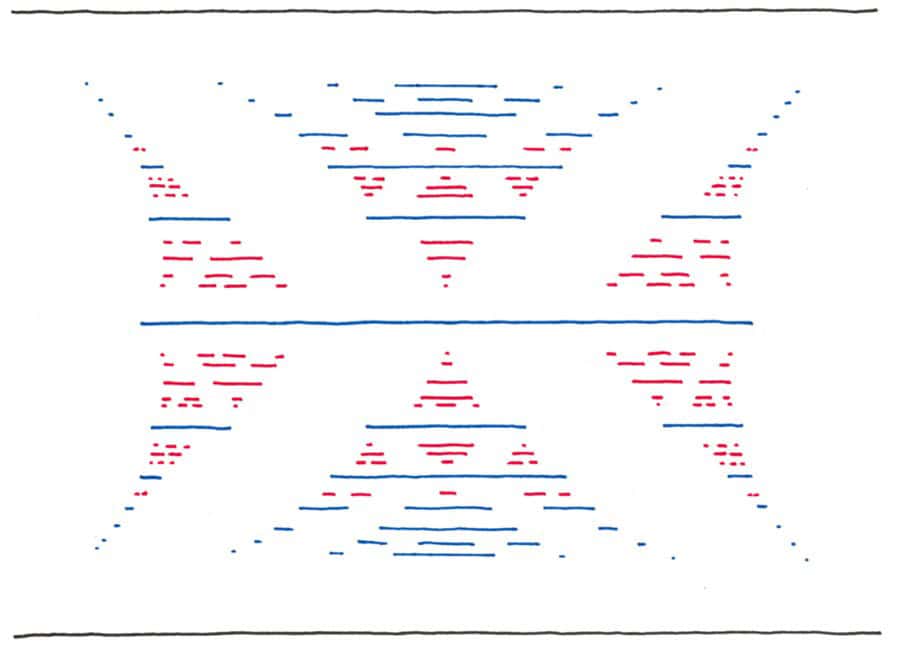
Beautiful beginning Hofstadter’s butterfly dates back to November 1974 when Douglas Hofstadter, who was then a PhD student at the University of Oregon, was trying to describe the motion of electrons in a 2D crystal lattice under an applied magnetic field. His work led him to produce a primitive, hand-drawn diagram – dubbed “Gplot” – that looked like a butterfly. The original diagram has been lost so Hofstadter created this reconstruction in 2016. (Courtesy: Indu Satija. Permission granted by Douglas Hofstadter)
What he found was a complex recursive shape (or fractal in today’s terminology) hidden within the energy spectrum of electrons in a magnetic field. Resembling a butterfly, Hofstadter brought his hand-plotted diagram, which he codenamed “Gplot”, to Wannier, who was not impressed. According to Hofstadter, Wannier dismissed the result as “numerology” and even threatened to withdraw the PhD student’s funding.
But after nearly a year, Wannier came to recognize the validity and significance of Hofstadter’s work, ultimately awarding Hofstadter his PhD and accepting the butterfly as a legitimate description of the energy spectrum of electrons moving on a 2D lattice in a magnetic field. Wannier even added to the butterfly’s story with a paper titled “A result not dependent on rationality for Bloch electrons in a magnetic field (Phys. Status Solidib88 757). This work, along with further studies with Claro, introduced a set of integers uniquely labelling every gap in the graph, providing a simplified description of the spectrum (Phys. Rev. B 19 6068).
Douglas Hofstadter: in his own words
Ruby celebration Douglas Hofstadter (right) pictured in 2016 with colleagues Indu Satija (centre) and Francisco Claro (left) all wearing T-shirts emblazoned with Hofstadter’s butterfly to celebrate its 40th anniversary. (Courtesy: Indu Satija)
Born in 1945, Douglas Hofstadter discovered his eponymous butterfly while a PhD student at the University of Oregon in 1975, using computational modelling to make his breakthrough (see main text). Four years later Hofstadter published his Pulitzer-prize-winning popular-science book Gödel, Escher, Bach, which tackles cognition, mathematics and symmetry.
Currently a professor of cognitive science and comparative literature at Indiana University in Bloomington, US, Hofstadter is still active as a researcher and wrote a follow-up book I Am a Strange Loop in 2007. On the golden jubilee of the now-famous butterfly named after him, Hofstadter provided the following comment to Physics World.
“This graph was first computed using a programmable desktop calculator and was first plotted by hand using coloured felt-tip pens. I was just extremely relieved that by showing that my ‘Gplot’ graph was made of distorted copies of itself, I would at last be able to get a PhD thesis. I had no idea that Gplot would go on to become well known as the Hofstadter butterfly, and that variations on the theme would proliferate like wildfire over the coming decades.”
“As the years have gone by,” he continues, “articles about Hofstadter’s butterfly have grown more and more numerous and harder and harder for me to follow. For better or for worse, these theories are all way beyond me, but remembering the first wingbeats of the butterfly’s flight cheers me up.”
Statements about states
Hofstadter’s butterfly is more than a beautiful graph. It is a map of what happens when quantum particles are caught between two competing kinds of order: the regular periodicity of a crystal lattice and the circular orbits of a magnetic field. When these two scales contend with one another, the energy spectrum does something extraordinary. Instead of varying smoothly, it fragments into a hierarchy of allowed and forbidden energies, referred to as bands and gaps, respectively.
Zoom in on one region and new structures emerge. Zoom in again and the pattern repeats, endlessly varied yet ruled by strict mathematical order. It is one of the rare instances in which fractal geometry appears not only in abstract mathematics or artistic imagination, but in the measurable behaviour of matter itself.
The deep connection between this theoretical pattern and real-world matter became clear through an exotic quantum phenomenon known as the integer quantum Hall effect. It was discovered experimentally by Klaus von Klitzing at the Max Planck Institute for Solid-State Physics in 1980 – a breakthrough that earned him the Nobel Prize in Physics five years later.
The classical Hall effect is what happens when a voltage is produced in a bulk conductor at right angles to an applied magnetic field. Similarly, the quantum Hall effect is the appearance of a voltage across opposite faces of a thin 2D semiconductor when a current is passed along the plane of the material and a magnetic field applied perpendicularly it. But there is one big difference in the quantum version.
If you slowly increase the power of the magnet, the transverse electrical conductance does not grow steadily. Instead, it jumps up sharply, with plateaus in between like steps on a staircase. In other words, it assumes quantized values given by integer multiples of the fundamental constant e2/h, where h is Planck’s constant and e is the charge on an electron.
In 1982 the British physicist David Thouless and his collaborators at the University of Washington, Seattle, made another remarkable discovery: the effect, they found, is topological. Topology is the study of the global properties of objects and topological invariants are those properties that do not change regardless of how much you try to deform a given object.
Thouless and colleagues found that the integers underlying the quantum Hall effect are topological invariants arising from the global topology of the electronic wave functions. This seminal work, which was published in 1982 (Phys. Rev. Lett.49 405), significantly contributed to Thouless earning the 2016 Nobel Prize in Physics, which he shared with Duncan Haldane and Michael Kosterlitz for their work on “topological phase transitions and topological phases of matter”.
1 Butterfly behaviour
(Courtesy: Indu Satija; CC BY 3.0 New J. Phys.18 103023; J. Stat. Phys. 156 417. Reused with permission from Springer Nature)
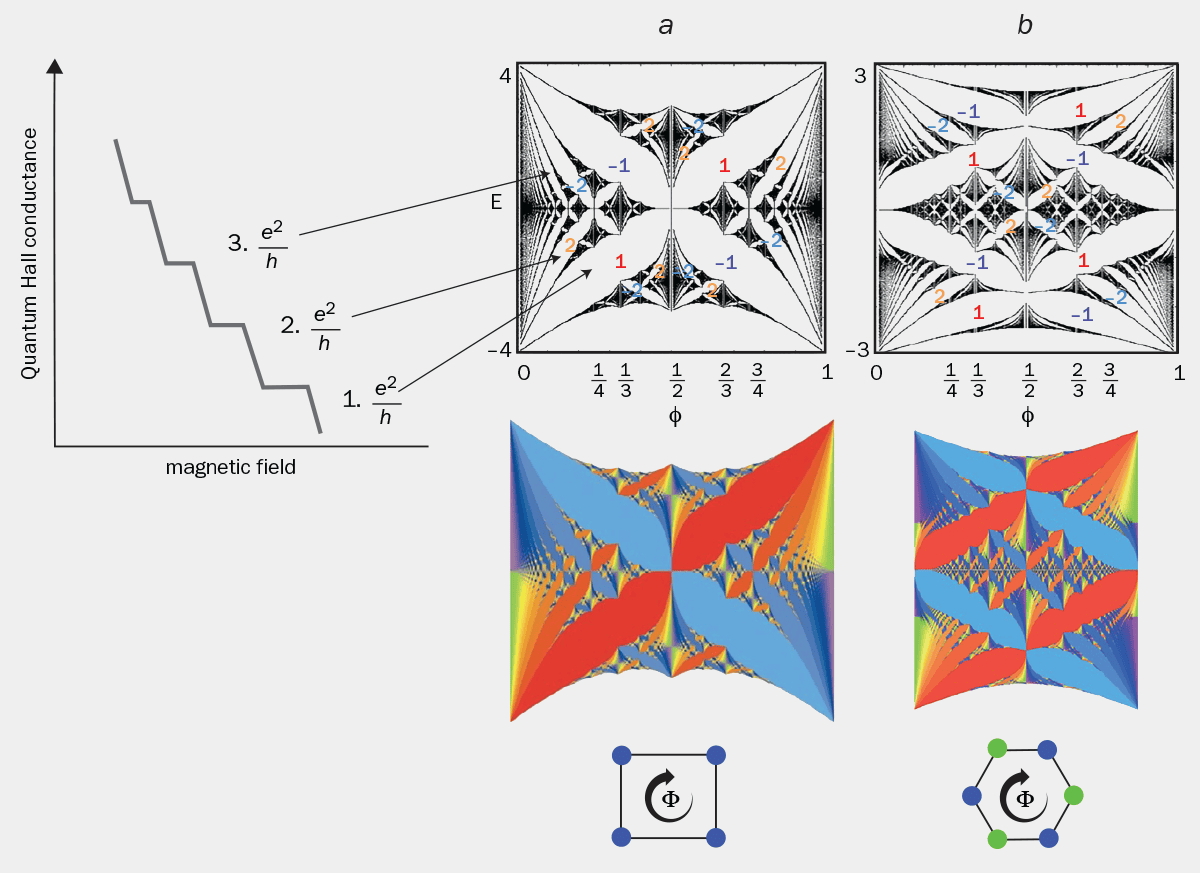
Hofstadter’s butterfly, in its original form, refers to the behaviour of electrons in 2D lattices subject to an applied magnetic field. (a and b) Shown here (top row) are graphs of the electrons’ energy (E) plotted against the magnetic flux (Φ) per unit cell for square and honeycomb lattices (bottom row). The relation between the quantum Hall effect (displayed in the staircase-like graph, left) and Hofstadter’s butterfly is shown via the arrows. The colours on the “butterfly graphs” (middle row) correspond to the quantum numbers of the Hall conductivity. Some of these integer labels are shown (colour coded) in the top row.
How all of this relates to Hofstadter’s butterfly is simple: the butterfly model describes all integer quantum Hall states, where the integers of Hall conductivity label the gaps in Hofstadter’s butterfly – the exact same integers that Wannier and Claro introduced in the butterfly spectrum (figure 1). In other words, the butterfly is not merely a chart of recursively split energy levels; it is also a coded map of topology in quantum matter under a magnetic field.
A pattern repeating across physics
That connection places it squarely within one of the central themes of modern condensed-matter physics, namely the realization that certain physical properties are protected not by local details, but by global features of the quantum state. But what is fascinating is that in the 50 years since Hofstadter’s butterfly was discovered, physicists have found that the same spectral architecture in it can also arise in a remarkable range of settings. It has appeared, for example, in other lattice geometries, in engineered semiconductor devices and in so-called moiré materials.
The butterfly’s migration into moiré systems has been especially fruitful. Such materials are created by stacking two atomically thin materials onto each other with a slight twist, creating a moiré pattern with different properties from the individual layers. Utilizing moiré materials, in research that began in 2013 led by Philip Kim of Columbia University (Nature497 598) and continues apace with a team led by Ali Yazdani of Princeton University (Nature639 60), the butterfly structure can now be tuned, probed and in some cases directly imaged on modern quantum platforms.
Over the last 50 years, the butterfly itself has also evolved into other forms. For instance, in some systems, the butterfly emerges without an external magnetic field. As a team of researchers led by Xu-Tao Wan from East China Normal University showed in 2025 (Phys. Rev. Lett.136 033401), the fractal pattern can be controlled by twist angle – that is, by geometry alone.
Each time physicists add a new layer of realism – spin, interactions, periodic driving or lattice complexity – the butterfly adapts, and re-emerges in new forms, so long as it is not overwhelmed by strong interactions, disorder or thermal effects
In other realistic systems, electron spin – the particle’s intrinsic magnetic orientation, absent from the original simplified model – becomes an essential part of the physics. Even when a magnetic field splits the system into spin-up and spin-down states via Zeeman splitting, the butterfly spectrum survives. More striking still, the butterfly can emerge independently for each spin state, as Xiaomeng Liu and Zhida Liu of Cornell University discovered in 2025 (Nature Phys.21 1873).
This persistence of the fractal structure, despite the added complexity introduced by spin, highlights the extraordinary robustness and universality of the underlying quantum phenomenon. More generally, what these new iterations of Hofstadter’s butterfly reveal is that what once looked like a specialized theoretical curiosity now seems more like a recurring motif in quantum matter.
Indeed, this is part of its enduring fascination: each time physicists add a new layer of realism – spin, interactions, periodic driving or lattice complexity – the butterfly adapts, and re-emerges in new forms, so long as it is not overwhelmed by strong interactions, disorder or thermal effects. This durability prompted a friend to once joke that whenever he undergoes an MRI scan, he cannot help wondering what kind of butterfly his body might be producing.
Beauty from simplicity
As my friend’s joke reveals, there is something unmistakably human about the butterfly’s appeal. Physicists are drawn to it not only for its usefulness, but for its beauty. It belongs to that rare class of scientific objects whose visual grace seems to gesture toward deeper truths. And yet its deepest charm may lie in the fact that its immense complexity grows from remarkable simplicity.
2 Baby butterflies
(Courtesy: Indu Satija)
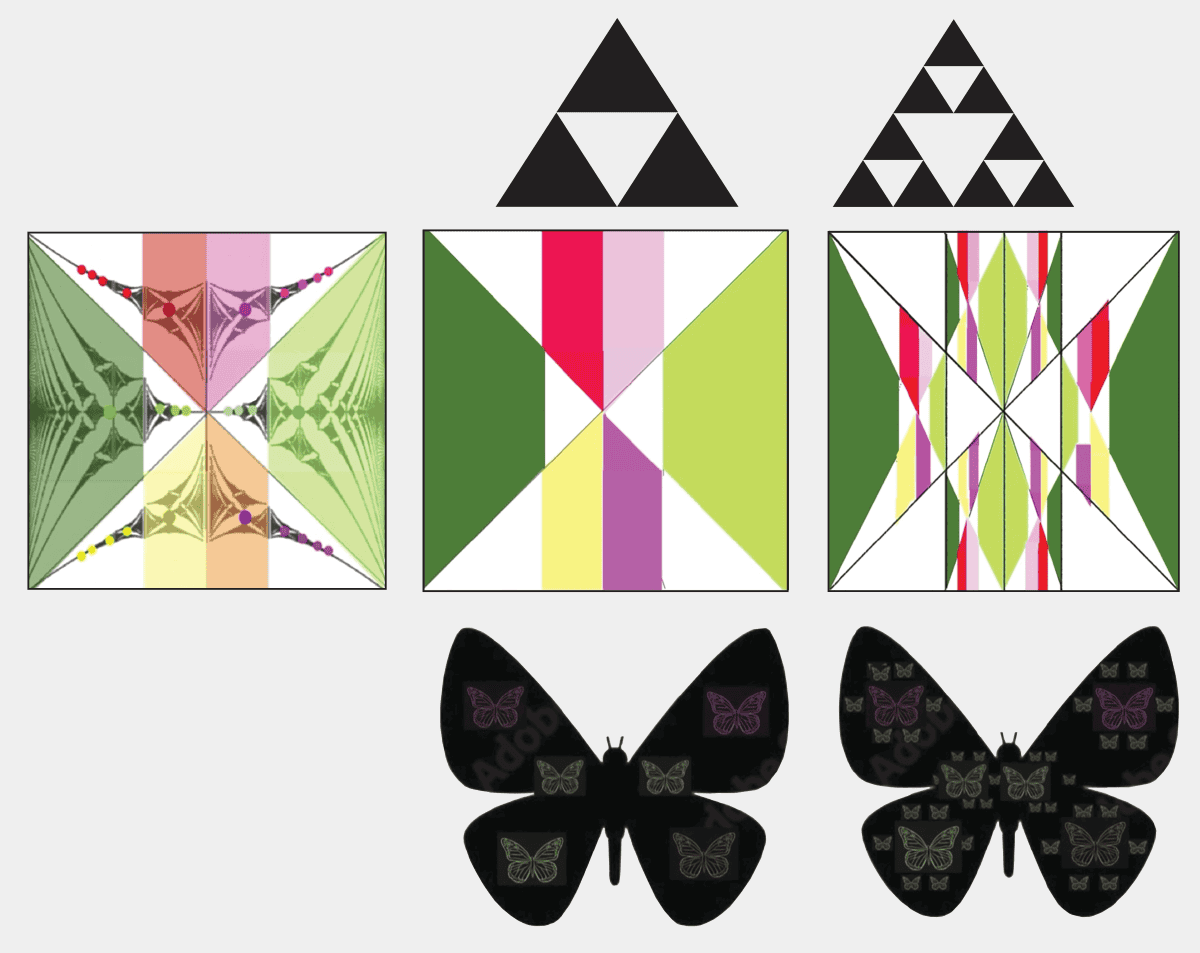
A simplified representation of Hofstadter’s butterfly, commonly known as the butterfly skeleton, interpreted as a 2D tessellation of trapezoids and triangles. It is shown in parallel with the “Sierpiński gasket” (top), which is made entirely from triangles. The iterative construction underlying this fractal consists of a parent butterfly generating six “baby” butterflies, represented by the six colour-coded trapezoids. Each baby butterfly is accompanied by a tail – an infinite chain of progressively smaller butterflies, indicated schematically by dots in the corresponding colour. The two butterflies at the bottom provide a schematic illustration of the hierarchical organization of the structure.
Beneath the intricate pattern are integers, recursion relations and number-theoretic structures that connect it to fairly simple geometric patterns, including the Farey tree, the tree of Pythagorean triplets and fractal packings such as the Apollonian gasket. In fact, this complicated quantum fractal admits a surprisingly simple geometric description: the butterfly landscape can be organized as a hierarchical lattice of trapezoids, bringing it into close parallel with geometric fractals such as the Sierpiński gasket (figure 2). It is extraordinary to think that this geometric harmony underlies such a complex and beautiful graph.
Fifty years on, Hofstadter’s butterfly remains exactly what great scientific ideas are supposed to be: elegant, prolific and unfinished. That interplay of beauty, mathematics and physical reality is what keeps the butterfly alive. Its evolution under interactions, spin effects and new forms of engineered geometry continues to reveal unexpected physics. And with each turn, the butterfly reminds us of something rare and precious in science: that the universe can hide immense complexity within simple forms, and that sometimes, if we are lucky, those forms are beautiful enough to be unforgettable.
Multiferroics are materials that simultaneously exhibit two or more ferroic orders—stable arrangements of physical properties that can be switched using an external stimulus. These materials could be highly advantageous for the development of various technologies, including non-volatile, low-power memory devices, spintronic devices, miniaturized electronics, neuromorphic hardware, sensors and magnetoelectric devices.
When a material heats up, its electrical resistance often rises. The harder question is what, exactly, is getting in the way. The electrons carrying the current may be scattered by vibrations of the material's atomic lattice, known as phonons. They may also collide with one another. Frustratingly, a conventional temperature test warms the electrons and the lattice together, so the effects arrive tangled in the same resistance measurement.
When a material heats up, its electrical resistance often rises. The harder question is what, exactly, is getting in the way. The electrons carrying the current may be scattered by vibrations of the material's atomic lattice, known as phonons. They may also collide with one another. Frustratingly, a conventional temperature test warms the electrons and the lattice together, so the effects arrive tangled in the same resistance measurement.
Soft materials such as colloidal suspensions, emulsions, foams and gels often display complex and unusual behaviors compared with ordinary solids or liquids. From a mechanical point of view, for instance, they can resist deformation like solids, but they can also start to flow like liquids when a sufficiently strong external drive is applied. This transition from solid-like to liquid-like behavior, known as "yielding," is central to the physics of soft amorphous materials and to many industrial and biological processes.
Soft materials such as colloidal suspensions, emulsions, foams and gels often display complex and unusual behaviors compared with ordinary solids or liquids. From a mechanical point of view, for instance, they can resist deformation like solids, but they can also start to flow like liquids when a sufficiently strong external drive is applied. This transition from solid-like to liquid-like behavior, known as "yielding," is central to the physics of soft amorphous materials and to many industrial and biological processes.
Beneath every step we take, soils hold one of the planet’s largest reservoirs of carbon, a vast, slow-moving bank of organic matter that quietly regulates how much of the world’s carbon stays locked away and how much escapes into the atmosphere as greenhouse gas. Now a sweeping new review warns that climate-driven extremes, droughts, floods, and wildfires, are rewriting the rules of that subterranean economy in ways that conventional models and land-management practices have not yet caught up with. The analysis, led by environmental scientist Nanthi Bolan of the University of Western Australia and colleagues, including a corresponding authorship by Bolan himself, synthesizes a substantial body of global evidence on how extreme weather reshapes carbon inputs to soil, microbial processing, erosion, and the sequestration of carbon that underpins soil health, water retention, nutrient cycling, and agricultural productivity.
The work, published in the journal Carbon Research, is notable for the scale of its underlying evidence base. On 14 January 2026, the authors searched Google Scholar, PubMed, and Web of Science using terms spanning climate change, extreme weather, soil carbon, microbial activity, decomposition, erosion, dissolved organic matter, and leaching. The initial sweep returned 14,218 records; after removing duplicates and screening for eligibility, 3,754 articles remained for bibliometric and qualitative analysis. From those, 187 publications were selected for detailed synthesis based on relevance, methodological rigor, and the substantive quality of their findings. Keyword co-occurrence patterns were mapped with VOSviewer, a bibliometric tool that reveals the intellectual architecture of a research field. The result is a critical review grounded in structured literature screening rather than new experimental data, but its synthesis offers one of the most comprehensive maps yet of how extremes rearrange the soil carbon cycle.
The review’s central finding is that no two extremes act alike. Drought, the most widespread disturbance, operates largely through the plant side of the equation. When rainfall fails, photosynthesis slows, plant biomass production falls, and the total flux of carbon entering soils through roots, residues, and litter declines. There is a nuance here: under moderate water stress, plants may temporarily shift a greater proportion of their fixed carbon belowground, investing in roots to chase moisture. But prolonged drought overwhelms that compensatory response. Microbial biomass shrinks, litter decomposition stalls, and the living engine of the soil carbon cycle idles. Then comes the deceptive twist: when rain finally returns, rewetting triggers a rapid pulse of carbon dioxide as starved soil microbes seize upon the accumulated substrates left behind by months of suspended activity. That post-drought CO₂ flush, the review emphasizes, can erase much of the apparent “savings” that accumulated during the dry period. Across the assembled evidence, repeated and multi-year drought was consistently associated with declining soil organic carbon, with grasslands and arable croplands showing particularly pronounced losses, ecosystems that happen to anchor much of the world’s food production.
Flooding tells the opposite story, but it ends in many of the same places. Water saturation chokes off oxygen diffusion through soil pores, forcing microbial metabolism into anaerobic pathways. That shift changes everything downstream. Prolonged waterlogging can drive the chemical reduction of iron oxyhydroxides, minerals that in oxygenated conditions act as microscopic glues binding organic carbon to soil particles. When those minerals dissolve, the carbon they held is released as dissolved organic carbon, which can then be stripped away by erosion and leaching and exported to rivers, lakes, and ultimately the ocean. The review stresses, however, that flooding is not unambiguously a carbon loss story. Wetlands and other periodically inundated ecosystems can accumulate and retain enormous carbon stocks precisely because water constrains decomposition. Whether a flood event releases carbon or banks it depends on the interplay between plant inputs, oxygen availability, and hydrological transport, a delicate balance that shifting rainfall regimes are actively destabilizing.
Wildfire is the most dramatic and immediately visible of the three forces, and its effects cascade on multiple timescales. Combustion directly strips vegetation, litter, and soil organic matter, transferring carbon to the atmosphere in hours. But fire also rearranges the physical and biological landscape of the soil in subtler ways: it can increase erosion by removing protective ground cover, alter soil wettability in ways that change hydrological behavior, restructure microbial communities, and expose previously protected carbon, once shielded inside aggregates or mineral associations, to fresh decomposition. There is a paradoxical bright spot. Pyrogenic carbon, the charcoal-like residue of incomplete combustion, is chemically recalcitrant and can persist in soils for centuries or millennia, functioning as a long-term carbon sink. Whether a fire leaves a landscape as a net carbon source or stabilizes some of its carbon in pyrogenic form depends on fire severity, soil moisture, fuel load, ecosystem type, and the trajectory of post-fire recovery. The review is clear that this balance cannot be predicted from fire alone; it is contingent, site by site, on conditions that vary widely across the globe.
Perhaps the most consequential theme running through the synthesis is that carbon responses cannot be inferred from the type of extreme event alone. Land use, soil mineralogy, hydrology, salinity, vegetation composition, microbial community makeup, and the timing of events within a season all determine whether carbon ends up stored, mobilized, or released. Iron and aluminum oxyhydroxides and clay minerals, for instance, provide mineral protection that can shield organic matter even under stress, while sandy or low-clay soils offer little such refuge. Managed croplands respond differently from native grasslands; saline coastal soils behave differently from acidic forest soils. And compound events, drought followed by wildfire, or alternating drought and flooding in rapid succession, may produce effects that are qualitatively different from those of isolated disturbances, as when a dried landscape burns more intensely, or when post-fire soils, stripped of vegetation, wash away in the first heavy rain. The review argues that the climate science and soil science communities have largely studied these disturbances one at a time, while the real world increasingly delivers them in combination.
The implications for climate mitigation and adaptation are substantial. Soil organic carbon is frequently invoked in national climate pledges and voluntary carbon markets as a bankable sink, yet the review suggests that the security of that bank depends heavily on how often and how severely extremes strike. If multi-year droughts steadily drain carbon from grasslands and croplands, or if fires repeatedly reset accumulation cycles, the effective permanence of soil carbon storage becomes far more fragile than many accounting frameworks assume. Conversely, protecting and rebuilding soil carbon delivers benefits well beyond climate: it improves water retention in drought-prone regions, supports nutrient cycling, stabilizes soil structure against erosion, and sustains the microbial diversity on which fertility depends. Carbon stewardship, in other words, is not separable from food security or ecosystem resilience; it is the same problem viewed from different angles.
The authors are candid about the limits of the current evidence base. The article does not report newly generated datasets and does not present a dedicated limitations section, and its conclusions rest on a qualitative synthesis of selected publications. Consequently, they call for improved and more consistent evidence across soil types, land uses, and both terrestrial and aquatic environments, and across multiple temporal scales, from the instantaneous CO₂ pulse after rewetting to the multi-decadal trajectory of carbon storage. Standardizing measurements of carbon pools, microbial functions, and event intensity, they argue, would make results comparable across ecosystems and enable more confident generalization, something the field currently struggles to achieve given heterogeneous methods and site-specific reporting.
Looking forward, the review sketches a research agenda that is as technologically ambitious as it is mechanistically focused. The authors recommend integrating high-resolution remote sensing with ground observations, advanced spectroscopy, molecular analyses, and integrated modeling to track carbon as it moves through soils and into waterways. They single out several priorities: characterizing microbial genomic and functional diversity as it responds to stress, quantifying carbon stoichiometry, probing the interactions between organic matter and iron and aluminum oxyhydroxides, understanding clay-mineral protection mechanisms, tracking long-term storage outcomes, and systematically studying the sequencing of compound extreme events. Each of these threads addresses a gap in the mechanistic chain that links a weather event in the atmosphere to a molecule of carbon, stabilized or released, in the soil.
What emerges from the review is a picture of the soil carbon cycle not as a stable background process but as a dynamic, contested system whose behavior under climate extremes is far less predictable than once assumed. The same storm that floods a rice paddy and exports carbon to a river delta may, a few hundred kilometers away, end a drought and briefly green a grassland, with opposite consequences for the atmosphere. As extremes grow more frequent and more compound, the review makes the case that understanding, and safeguarding, the carbon held beneath our feet will require science that is as interconnected and as restless as the weather itself.
Subject of Research: Impacts of climate change-induced extreme weather events (drought, flooding, wildfire) on carbon dynamics in soil
Article Title: Impacts of climate change-induced extreme weather events on carbon dynamics in soil
Article References: Bolan, N., Messiga, A. J., Sharma, S., Mukherjee, S., Bolan, S., Salehin, S. M. U., Rupngam, T., Rajan, N., Zhang, T., Yang, Y., Jagadesh, M., & Siddique, K. H. M. (2026). Impacts of climate change-induced extreme weather events on carbon dynamics in soil. Carbon Research, 5(1), Article 58. https://doi.org/10.1007/s44246-026-00300-5
Keywords: adaptation of land management practices to climate extremes, challenges to conventional soil carbon models, Climate change impacts on soil carbon storage, effects of droughts and floods on soil microbial activity, global evidence on soil carbon dynamics, implications for greenhouse gas emissions, influence of extreme weather on nutrient cycling and water retention, resilience of soil carbon reservoirs to climate, review of climate-driven soil carbon processes, soil erosion and carbon loss due to extreme weather, soil health and agricultural productivity under climate stress, wildfire influence on soil organic matter
Could radioactive atoms in a Bose–Einstein condensate (BEC) form a “superradiant neutrino laser”? According to a paper published last year by Benjamin Jones of the University of Manchester and Joseph Formaggio of the Massachusetts Institute of Technology the answer is “yes”. We were intrigued by this proposal and commissioned the freelance physics writer Tim Wogan to write an article for us.
As part of his reporting, Wogan sought the opinion of a BEC expert – James Thompson of NIST, JILA and the University of Colorado in Boulder. Thompson told us that he was sceptical of the viability of such a device – in particular, he pointed out that the de Broglie wavelength of the emitted neutrinos is much too short for superradiance to occur.
Now, another physicist (Wolfgang Ketterle, who shared a Nobel prize for his pioneering work on BECs) has published two papers that cast doubt on Jones and Formaggio’s proposal. All three papers are published in a very prestigious journal, so this is a scientific debate of note.
So what is superradiance, and how could it be used to create a source of coherent neutrinos?
Coherent burst
Superradiance was originally envisioned in an ensemble of excited atoms, each of which can decay by emitting a photon. Normally, the rate at which photons are emitted from such an ensemble is simply proportional to the number of atoms present. Double the number of atoms, and the rate of emission will double. However, if the ensemble is dense enough that the wavelength of the emitted photons is much longer than the separation between neighbouring atoms, the emission of a single photon will involve all of the atoms. What is more, the superradiant emission rate is proportional to square of the number of atoms. The result is short, intense burst of coherent radiation. It is this coherence that has caused some to refer to superradiant lasers – although the physics of lasers is different.
Jones and Formaggio’s proposal involves radioactive atoms that decay with the emission of a neutrino, rather than a photon. Their idea is to cool an ensemble of these atoms to near absolute zero so that it forms a BEC. This is a unique form of matter that can be described as a macroscopic quantum state. Under this condition, the duo argued that neutrinos would be emitted rapidly from a superradiant state.
Now, Ketterle, Yu-Kun Lu and Hanzhen Lin at the Massachusetts Institute of Technology argue in two papers that such a superradiant neutrino laser is an impossibility. As well as backing up Thompson’s concerns about the short wavelength of the neutrinos, they point out that the atoms produced by the neutrino decays are fermions, and this precludes superradiance. They also showed that the recoil of atoms after neutrino emission would not allow the coherent emission of neutrinos to occur.
I think this is a fascinating subject and I hope that Jones and Formaggio can revive their proposal, because a BEC-based neutrino laser would be very cool!
You can read more about the debate in an article in Physics by Thompson and colleagues.
Nickel disulfide, NiS₂, is an unusual material. Its interior behaves as an electrical insulator, blocking the flow of current, while certain parts of its surface conduct electricity freely. This contradiction has puzzled physicists for decades, and a recent study offers a detailed explanation. The conduction, it turns out, is confined to tiny one-dimensional steps on the surface, and these narrow conducting channels are a direct consequence of how electrons are arranged inside the crystal.
Mott insulator
NiS₂ shares its crystal structure with pyrite, the mineral sometimes called fool’s gold. At ordinary conditions, its electrons do not move freely through the lattice: the strong electrical repulsion between them opens an energy gap that keeps the bulk of the material insulating. This behaviour defines what physicists call a Mott, or charge-transfer, insulator, a category of materials that simple band theory cannot explain. Band theory predicts that any material with a partially filled outer electron shell should conduct electricity, yet compounds like nickel oxide obstinately insulate instead. In 1949, the physicist Nevill Mott showed why: if two electrons crowding the same atomic site cost more energy than is available, the electrons stay locked in place and no current flows, regardless of what band theory predicts. NiS₂ behaves in much the same way.
Yet electrical-transport measurements had repeatedly found that crystals of NiS₂ conduct through their surfaces. Earlier scanning-tunnelling experiments helped explain part of the puzzle: the broad, flat surface remains insulating, but the electronic gap narrows sharply near atomic-scale steps, tiny cliffs just one or two atoms high where the surface abruptly changes level. A new study 1 confirms this picture and examines the steps with much higher spatial resolution than before.
A not that smooth surface
A scanning tunnelling microscope (STM) works by bringing an extremely sharp needle close enough to a surface that electrons can leak across the gap between tip and sample. Measuring that leakage at different energies reveals both the surface’s shape and how easily electrons can enter or leave it. In NiS₂, these measurements uncovered electronic states concentrated tightly along the step edges: the states extend for a long distance parallel to a step but stay confined to roughly one to two nanometres across it. In other words, the electrons are effectively free to move in one direction while remaining trapped in the other two, forming genuine one-dimensional conduction channels.
Surface spectra of the terminations observed in STM. Source: M. Iraola, H. Guo et al (2026) Nature Communications doi: 10.1038/s41467-026-76126-x
Two distinct kinds of surface step were observed, depending on whether the outermost atomic layer exposes nickel or sulfur atoms. Both carry electronic states associated with their steps, but they are not equally important. The nickel-terminated steps host states that sit right at the energy where electrical conduction happens, making them the most likely explanation for the surface conductivity that transport experiments had measured for years. The sulfur-terminated steps also host states inside the insulating gap, but their energy is positioned further away, making them less directly responsible for carrying current.
The study also tested what happens when a magnetic field is applied perpendicular to the surface. The step-edge states survived fields as strong as 10 tesla, a field far stronger than any produced by a laboratory magnet used for everyday purposes. Their intensity weakened somewhat, particularly on the sulfur-terminated steps, but the states were never destroyed. This robustness matters because NiS₂ already displays complicated magnetic behaviour of its own, which might easily have disrupted a more fragile conducting state.
The deeper explanation lies in how electrons are distributed inside the crystal. In an ordinary insulator, the occupied electronic states can usually be pictured as clouds centred on the atoms themselves. NiS₂ is different: calculations show that part of its electron density is naturally centred at special positions between atoms, specifically near the midpoints of pairs of sulfur atoms, where no atom actually sits. Physicists call these obstructed charge centres, and materials built around them belong to a class known as obstructed atomic insulators, a concept that grew out of a broader effort over the past decade to classify materials by the geometry, and not just the energy, of their electron states.
The concept of obstructed atomic insulator. In an OAI, the valence bands are induced from Wannier functions localized at obstructed Wannier charge centers (OWCCs)—symmetric positions in the crystal not occupied by any ion. Wannier functions are the localized molecular orbitals of crystalline systems. Source: M. Iraola, H. Guo et al (2026) Nature Communications doi: 10.1038/s41467-026-76126-x
Not ordinary metallic defects
This arrangement is not a chemical accident; it is protected by the symmetry of the crystal. When the crystal is cut to form a surface, though, the special positions that hosted this electron density can no longer fit together the way they did in the bulk. At a step edge, this mismatch creates what is known as a filling anomaly: an imbalance in how the available electronic states can be occupied, which leaves behind a state inside the insulating gap, localized right at the edge. Calculations of artificial step structures reproduce the main features seen under the microscope, including this localization, supporting the idea that the conducting channels are not ordinary metallic defects caused by broken chemical bonds, but a direct consequence of the crystal’s underlying electronic geometry.
The study also settles a long-standing question about NiS₂’s magnetism at low temperature. Below about 39 kelvin, the nickel magnetic moments arrange themselves into a non-collinear antiferromagnetic pattern, with neighbouring moments pointing in different directions that largely cancel out. Below about 30 kelvin, they rearrange again into a state that produces a small but measurable net magnetization. New neutron-diffraction measurements support a revised model of this low-temperature arrangement, resolving a debate about the material’s magnetic ground state that had lasted for roughly fifty years.
Taken together, the results give NiS₂ a significance well beyond its peculiar conducting surface. The material shows that strong repulsion between electrons, magnetism, and the geometry of electronic states can coexist within a single crystal. Such geometric protection is normally associated with topological materials, in which certain electronic states are shielded from disorder or defects by the crystal’s symmetry. The new results suggest that this protection can survive even when strong interactions push a material into being an insulator, making NiS₂ a rare setting for studying how the quantum-mechanical arrangement of electrons decides where electricity is allowed to flow within an otherwise insulating crystal.
Author: César Tomé López is a science writer and the editor of Mapping Ignorance
Disclaimer: Parts of this article may have been copied verbatim or almost verbatim from the referenced research paper/s.
References
Mikel Iraola, Haojie Guo, Fabio Orlandi, Sebastian Klemenz, Martina O. Soldini, Sandra Sajan, Pascal Manuel, Jeroen van den Brink, Titus Neupert, Miguel M. Ugeda, Leslie M. Schoop & Maia G. Vergniory (2026) One-dimensional conduction channels in the correlated Mott NiS2 arising from obstructed Wannier charges Nature Communications doi: 10.1038/s41467-026-76126-x↩
Topological quantum materials combine unusual electronic states with properties such as magnetism or superconductivity, offering possibilities for future electronics and quantum technologies. Researchers at Tohoku University have now shown that changing the number of layers in a crystal can provide a systematic way to design topological magnets. The work is published in the Journal of the American Chemical Society.
Topological quantum materials combine unusual electronic states with properties such as magnetism or superconductivity, offering possibilities for future electronics and quantum technologies. Researchers at Tohoku University have now shown that changing the number of layers in a crystal can provide a systematic way to design topological magnets. The work is published in the Journal of the American Chemical Society.
Material properties such as sound insulation, resistance to extreme heat and thermal expansion originate from how the zillions of microscopic building blocks (nuclei and electrons) interact at equilibrium and respond to perturbations. Atoms are typically about one ten-billionth of a meter across, so there can be a lot of parts to keep track of—a task that is complicated at the quantum-mechanical level, where particles are neither here nor there until observed.
Material properties such as sound insulation, resistance to extreme heat and thermal expansion originate from how the zillions of microscopic building blocks (nuclei and electrons) interact at equilibrium and respond to perturbations. Atoms are typically about one ten-billionth of a meter across, so there can be a lot of parts to keep track of—a task that is complicated at the quantum-mechanical level, where particles are neither here nor there until observed.
Physicists around the world remain deeply divided on key mysteries of the universe, from dark matter to quantum gravity. The standard cosmological model failed to gain majority support, and no leading theory dominated the survey results. The largest survey ever conducted among physicists worldwide reveals surprisingly little agreement on some of the field’s biggest mysteries, [...]
In a promising advancement in the search for dark matter, scientists have transformed a tiny magnet into a detector that can sense some of nature’s faintest forces—with a little help from levitation.
The research could help researchers detect some of the heaviest particles that are believed to have ever inhabited the universe, according to physicists.
Led by Rice University physicist Christopher Tunnell, the achievement was made using a tiny permanent magnet—one around the size of a grain of sand—which they levitated over a superconductor that was chilled to freezing cold temperatures just above absolute zero.
Since the magnet floats without encountering any surfaces, this dramatically reduces friction, allowing the Rice team to carefully monitor its movements, some of which are as small as around one-hundredth of a single atom. Such subtleties of its motion offer a novel possibility: that the magnet’s faint movements could serve as an effective signal if a massive dark matter particle passed through the detector.
The tiny magnet used by the Rice University research team (Image Credit: Christopher Tunnell/Rice University).
Unusual Candidates for Dark Matter Particles
“Dark matter could be hiding at masses that our traditional experiments were never built to reach,” Tunnell said in a recent statement, noting that by leveraging the team’s novel detector, “we can begin searching a part of the dark matter landscape that has largely been out of experimental reach despite being the focus of extensive theoretical study by my Rice cosmology colleague Andrew Long.”
Among the most mysterious phenomena in the universe, dark matter is believed to comprise most of the matter that populates the cosmos and exerts gravitational effects that influence the formation and behavior of galaxies. Despite this, scientists have remained unsuccessful in detecting it or even determining what it is comprised of.
There are several experiments that hunt for hypothetical dark matter particles, which scientists believe have masses that are similar to those of atoms or subatomic particles. Still, there are some theoretical models which suggest much heavier particles could also qualify—some approaching sizes as large as a human cell.
A Novel Means of Detecting Dark Matter
Detecting something so large would require a very different kind of dark matter detector. To search for the kinds of interactions that smaller particles would be expected to generate, the Rice researchers instead looked for an impulse—one more likely to result from such an “ultraheavy” dark matter particle as it interacted with the detector.
“Instead of looking for a steady signal, we are waiting for very small knocks,” explained Rice postdoctoral researcher Juehang Qin.
The Rice research unit, led by associate professor Christopher Tunnel (left).
Over the course of one month, the team collected observations that focused mainly on quiet overnight periods when vibrations and other environmental disturbances were minimized. Unfortunately, no promising detections were made during this time.
Still, important results can also be derived from a lack of any definitive discoveries, especially when it comes to a field like particle physics. In this case, that’s because the absence of a signal allowed the researchers to place a few constraints on the combinations of dark matter masses and interaction strengths that should have been expected to produce detectable effects.
Altogether, the team’s experiment looked at nine orders of magnitude in its search for possible dark matter particle passes, which included searches for particles as much as 10 million times heavier than those investigated in past similar experiments.
Next Steps
Going forward, the next step would be to increase the experiment’s sensitivity by cooling the magnet even further, observing for longer periods, and eventually successfully levitating several magnets simultaneously. Multiple detectors could also help scientists determine whether real interactions involving dark matter are occurring, as opposed to false positives that might arise from vibrations or other kinds of interference.
Although the Rice team’s work is only a first step, their experiments with a tiny levitating magnet mark a promising pathway toward future potential detections, which may finally unlock new clues to the universe’s mysterious dark matter landscape.
The team’s research was detailed at the 2026 International Conference on Particle Physics and Cosmology, and additional details can be found here.
Micah Hanks is the Editor-in-Chief and Co-Founder of The Debrief. A longtime reporter on science, defense, and technology with a focus on space and astronomy, he can be reached atmicah@thedebrief.org. Follow him on X @MicahHanks, and at micahhanks.com.
Researchers at Nagoya University have built a graphene nanoribbon that can switch which way it twists using a natural solvent. Graphene nanoribbons are thin ribbon-shaped structures made of fused carbon rings. Twisted or helical versions of these ribbons show promise for advanced light and electronic devices. However, no graphene nanoribbon could switch that twist on demand, until now.
A 3D illustration of the [4]helicene nanoribbon shows the long chain of fused rings that gives the molecule its twisted structure. Source: Tomoyuki Ikai / Nagoya UniversityScientists have worked out how to switch between a right-handed and left-handed twist (chirality) by changing the solvent around it. The discovery 1 opens opportunities for new optical switches, chemical sensors, and spintronic components that adapt to changing environments.
Tomoyuki Ikai, lead author and professor at Nagoya University’s Graduate School of Engineering, is a polymer chemist inspired by natural helical structures such as DNA and proteins. Polymers are large molecules built from many small, repeating units linked together in a chain. Ikai had been working on ladder polymers, where each repeating unit is locked into place and cannot freely rotate around the bond connecting to its neighbor (unlike a typical flexible linear polymer).
“We used the same fusion approach already used to make predictable helical ladder polymers. But instead of a stable building block, such as [6]helicene, we used [4]helicene, a 4-ring unit written off as too unstable to be useful,” Ikai said.
Soak, twist, repeat
These units are difficult to control on their own because they switch their chirality too fast to hold one handedness. The team’s method fuses these small, restless units into one long chain. Once joined, they found that a neighbor effect took hold: each unit’s twist began to match its neighbors, and long stretches of the ribbon settled into a single, shared spiral.
To lock it in one overall direction, the researchers dissolved the ribbon in a natural chiral liquid, a liquid made of molecules that come in two mirror-image versions. They tested six candidates before they found the right one: beta-pinene, a compound found in pine trees and citrus peel.
Because beta-pinene molecules can be arranged in left- and right-hand mirror-images, these two versions each push the ribbon toward the opposite spiral. This also changed the twist direction of light the ribbon gave off, a property called circularly polarized luminescence, and is the first graphene nanoribbon shown to switch its light this way.
The switching induced a remarkably high degree of helical bias, with almost all of the helicene units aligning in the same direction. The switching effect is strongest at –90°C and grows weaker as the temperature rises toward room temperature.
“For a long time, people saw [4]helicene as unsuitable for chiral materials, because it could not be controlled,” Ikai said. “In this paper, we show that once you link enough of these units together, the instability itself becomes the useful part.”
A chiral solvent’s nudge toward one handedness is usually very weak on its own. Here, the ribbon’s own structure, with each unit mechanically linked to its neighbors, amplifies that weak nudge into a strong, nearly one-handed result.
An adaptive material
The researchers point to several possible future uses: The switchable light could serve optical devices. The ribbon’s chemical sensitivity to beta-pinene suggests it may work as a chiral sensor, and a similar design could one day help detect hazardous or unstable chemicals. Because graphene conducts electricity well, the ribbon may also suit electronic sensors.
The molecule’s twisted shape connects to spintronics, a field that uses the spin of electrons rather than just their charge. Ikai noted that a right-handed or left-handed structure can, in principle, let electrons of one spin pass through more easily than the other, a property helical structures are known for in physics literature.
The current design only holds its twist while it stays in the chiral liquid. If the solvent is removed, the ribbon drifts back to a mixed, unstable state. Ikai’s next goal is a form of “chiral memory,” a way for the ribbon to lock in its twist even after the solvent is gone. This next step builds on memory techniques the researchers have explored in other helical systems and is now applied to graphene for the first time.
References
Ikai, T., Inagaki, H., Oki, K. et al. (2026) Dynamic helical poly[4]helicene nanoribbon. Nat Commun doi: 10.1038/s41467-026-76724-9↩
Dark matter, the invisible substance thought to make up around 85 percent of all mass in the universe, forms an essential part of the standard cosmological model, providing the gravitational glue that holds together entire galaxies. What it actually is, though — and even if it truly exists — remains one of the great mysteries of science.
Now, a bizarre event that occurred nearly a mile underground at the world’s largest dark matter detector in South Dakota, the LZ detector, could be the first direct evidence of the substance. Or it could be something else entirely. Either way, it has scientists mystified and excited.
In a new paper published Tuesday and has been submitted to the journal Physical Review Letters, physicists running the LZ Dark Matter Experiment say that their detector recorded a stunning subatomic interaction that doesn’t fit anything else ever documented in physics.
Again, it’s not necessarily a dark matter discovery — but it’s so unusual that it warranted sharing.
“How do you even make sense of one event?” Tom Shutt, a particle astrophysicist at SLAC National Accelerator Laboratory and cofounder of the LZ project, told Science magazine. “We just decided we should publish and think really, really, really hard about what that event could be.”
Dark matter is a sort of ghost haunting the cosmos. We can’t see it because it doesn’t emit, absorb, or reflect light, or otherwise interact with any ordinary matter — except through gravity.
We see the fingerprints of its gravitational pull all around the universe, in fact. Galaxies aren’t massive enough to hold themselves together with their own gravity, so without the invisible presence of something with incredible mass, the very realms that define the universe, and which we call home, would fly apart.
There are countless candidates for what dark matter is, but the prevailing theory is that it’s made up of weakly interacting massive particles, or WIMPs. As their feeble acronym suggests, WIMPs are thought to be a hundred times as massive as a proton, but have such a weak nuclear force that they don’t interact with ordinary particles.
Because of their mass, they move much slower than ordinary particles, too, allowing them to clump together and form giant “halos” that provide the gravitational pull for galaxies to form in. There is no single agreed-upon definition of a WIMP, though, and it’s possible that WIMPs could be a whole family of particles, rather than just one.
If these theories are correct, then every once in a while, errant WIMPs can bump into the nucleus of an unsuspecting atom and create a trace amount of energy.
This is what the LZ detector is built to find. It’s essentially a tank filled with seven tons of liquid xenon, placed 1,480 meters underground in a former gold mine. At such a depth, the preponderance of xenon is shielded from the space radiation that our planet is routinely bombarded with (though there is a still a background level of other interactions that scientists can’t control, but can account for.) Anything that causes a a big enough stir in this controlled, quiet environment would be significant.
After spending years poring over the data the detector has collected so far, the physicists found a striking interaction that took place in 2023. Something, we don’t know what, smashed into a xenon particle, and produced a flash of light. If it was dark matter, it produced more energy than traditional WIMP models predict.
The scientists say that the detection has about a one in 400 chance of being a fluke. Scientific discoveries, though, need to meet at least a five sigma threshold, meaning that there should be only as roughly one in 3.5 million that it’s a fluke.
Still, physicists are absolutely thrilled. Even if this event isn’t a smoking gun by itself, there are other, larger dark matter detectors coming online, such as China’s PandaX experiment and Italy’s XENONnT, that should be able to hunt for the same high energy type of event.
“We can perform this study independently with a blind analysis to validate or invalidate LZ’s claim,” Elena Aprile, a physicist at Columbia University and spokesperson for the XENON experiment, told Science.

 Login