❌

Normal view

Ailanthone suppresses HSV-1 and eases keratitis in mice

21 October 2026 at 23:20

A plant-derived compound called ailanthone reduced HSV-1 replication in several cell models and eased corneal disease in a mouse model of herpes simplex keratitis, according to the study. The researchers found that ailanthone acted mainly after the virus entered cells and linked much of this effect to reduced expression of integrin beta 2, or ITGB2, a host protein that supports viral replication. The results identify ailanthone as a potential drug candidate, but the experiments do not establish that it is safe or effective in people.

The team began by screening natural compounds and testing ailanthone in African green monkey kidney Vero cells infected with HSV-1. Concentrations of 100 to 3,000 nanomolar reduced transcription of the viral immediate-early genes ICP0 and ICP4 and the late gene gD in a dose-dependent manner. The compound also reduced plaque formation and the concentration of progeny virus released into culture. Ailanthone had a half-maximal cytotoxic concentration above 10,000 nanomolar in these cells, while its half-maximal effective concentration against viral replication was 197.4 nanomolar, giving a selectivity index greater than 50. It also suppressed HSV-1-induced increases in the inflammatory cytokine genes IL-1B and TNF-α.

Antiviral activity was subsequently observed in human corneal epithelial cells, a model more directly relevant to the tissue affected by keratitis. Ailanthone concentrations of 100 to 500 nanomolar markedly reduced the cytopathic effects of HSV-1F, lowered expression of ICP0, ICP4 and gD, and reduced the viral induction of IL-1B and TNF-α. Its effective concentration in these cells was 50.16 nanomolar, with a cytotoxicity concentration above 10,000 nanomolar and a selectivity index greater than 100. The researchers also tested the compound in human retinal pigment epithelial ARPE-19 cells, where it reduced viral gene expression, plaque formation and progeny-virus titers while showing low cytotoxicity.

Activity was not restricted to the laboratory HSV-1F strain. In ARPE-19 cells, ailanthone concentration-dependently inhibited the late gD gene in the clinical acyclovir-resistant strain HSV-1/153, whereas 1,000 nanomolar acyclovir had little effect. The compound’s effective concentration was 35.05 nanomolar against HSV-1F and 227.4 nanomolar against HSV-1/153, with selectivity indices above 100 for both strains. A time-of-addition experiment indicated that ailanthone did not prevent attachment of HSV-1 to cells. It reduced entry under one experimental schedule and had its strongest effect on post-entry replication, where it lowered gD expression.

To investigate how the compound might work, the researchers combined computational target prediction with protein-interaction network analysis. They identified 36 targets shared by ailanthone and herpes simplex keratitis, then selected ITGB2 as a highly connected hub in the resulting network and as a top candidate in molecular docking. The predicted docking score for ailanthone and ITGB2 was −8.6 kcal per mole. Computational predictions alone cannot establish direct binding, so the team also performed a drug affinity responsive target stability assay in THP-1 cell lysates. Ailanthone protected ITGB2 from digestion by the protease pronase E in a dose-dependent manner, while acyclovir did not, providing biochemical evidence consistent with a direct interaction.

Functional experiments then tested whether ITGB2 was necessary for the antiviral effect. Three independent small interfering RNAs reduced ITGB2 messenger RNA and protein in THP-1 cells. Following HSV-1 infection, this knockdown lowered gD messenger RNA and protein and reduced the number of plaques produced when culture supernatants were transferred to fresh Vero cells. The converse pattern appeared when ITGB2 was overexpressed: elevated ITGB2 increased gD expression in infected cells, and it partially counteracted the reduction in gD protein caused by ailanthone in 293T and ARPE-19 cells. Together, these loss- and gain-of-function results support the conclusion that ailanthone’s antiviral activity is mediated at least partly by lowering ITGB2.

The researchers next tested ailanthone in an acute mouse model of HSV-1 keratitis. Six-week-old male BALB/c mice received a corneal scratch followed by application of HSV-1F, then received intraperitoneal ailanthone at 1 or 5 milligrams per kilogram or acyclovir at 5 milligrams per kilogram on days 1, 3 and 5 after infection. The methods section states that six animals were assigned to each group, although the discussion says five mice per group were used in the animal experiment. The 5-milligram-per-kilogram ailanthone treatment significantly reduced clinical disease scores, improved the appearance of the cornea under normal and cobalt-blue illumination, and lowered fluorescein staining scores on days 3 and 5. Hematoxylin and eosin staining at day 6 also indicated reduced corneal inflammation, and viral titers in ocular swabs were significantly lower than in infected mice given vehicle.

Analysis of mouse corneal tissue was consistent with the proposed mechanism. ITGB2 was upregulated in the corneas of infected animals, and ailanthone reduced its fluorescence intensity in a dose-dependent manner. Acyclovir did not significantly alter corneal ITGB2 levels. The investigators interpreted this as evidence that ailanthone differs from a direct viral DNA-replication inhibitor: the data are consistent with modulation of a host dependency factor rather than action solely through a viral enzyme. However, the study did not determine precisely how binding to ITGB2 leads to lower protein abundance. The authors note that transcriptional regulation, changes in messenger-RNA stability, or enhanced protein degradation could all be involved, and dedicated experiments would be required to distinguish among them.

Several limitations constrain how far the findings can be generalized. The cell experiments used established lines, including corneal epithelial and retinal pigment epithelial cells, rather than primary human corneal cells or an intact human immune system. The animal experiment examined acute primary infection in young male mice, whereas recurrent reactivation and the inflammation associated with repeated episodes are important features of human herpes simplex keratitis. Ailanthone was administered by intraperitoneal injection, but no topical ophthalmic formulation, corneal penetration, intraocular distribution, or optimized dosing regimen was evaluated. Long-term ocular toxicity and safety under repeated exposure also remain unknown. The natural compound may additionally affect multiple targets, and compensation among integrins could limit or alter its effects. The evidence therefore supports further preclinical investigation of ailanthone and ITGB2 as a host-directed antiviral strategy, not a clinical recommendation or a claim of human therapeutic benefit.

Subject of Research: Preclinical evaluation of ailanthone as a host-directed inhibitor of HSV-1 replication and herpes simplex keratitis.

Article Title: Natural compound ailanthone alleviates herpes simplex keratitis in mice by inhibiting HSV-1 replication

Article References: Chen, L., Yang, E., Zhang, X., Zhang, L., Wu, L., Chen, S., Jin, W., Qin, Q., Chen, R., Wu, J., & Chen, D. (2026). Natural compound ailanthone alleviates herpes simplex keratitis in mice by inhibiting HSV-1 replication. Frontiers in Pharmacology, 17, Article 1937590. https://doi.org/10.3389/fphar.2026.1937590

Image Credits: AI Generated

DOI: 10.3389/fphar.2026.1937590

Keywords: HSV-1, herpes simplex keratitis, ailanthone, ITGB2, host-directed antivirals, viral replication, corneal infection, mouse model, integrin beta 2, drug resistance, Natural, compound

Puncture-site closure linked to early wound events after vertebroplasty

21 October 2026 at 23:11

A retrospective study of 1,307 patients undergoing elective percutaneous vertebroplasty for osteoporotic vertebral compression fractures found that 136, or 10.4%, had a puncture-site wound event within two weeks of surgery. The composite outcome included erythema or swelling, bleeding or exudate, subcutaneous hematoma, and infection. After adjustment for patient and procedural factors, suture closure was associated with more than twice the risk of the composite outcome, while diabetes, mildly elevated international normalized ratio, and multilevel treatment were also associated with higher risk.

The findings come from consecutive patients treated at Ningde Municipal Hospital in China between January 2022 and June 2026. Patients were excluded if they underwent surgery for a new fracture, had uncontrolled coagulation disorders, received concomitant open spinal surgery, required an intraoperative incision at the puncture site, had malignant tumors or abnormal immune status, or lacked key clinical or follow-up information. The analysis therefore describes elective vertebroplasty performed within one hospital system, rather than all fracture patients or all puncture wounds treated after other forms of spine surgery.

Researchers extracted information from electronic medical records, operative and anesthesia records, laboratory reports, dressing-change notes, wound-clinic assessments, and documented telephone follow-up. All puncture sites were covered with waterproof dressings and assessed within two weeks through inpatient observation, clinical review, or telephone follow-up. A wound event was counted only when explicitly documented in the records. Erythema, swelling, bleeding, exudate, hematoma, and infection were combined into one patient-level outcome, counted once even if a patient experienced several types of event, while individual components were also summarized separately.

Closure was not assigned through a randomized comparison. The operating physician selected nonsuture or suture closure according to intraoperative bleeding, exudation, skin condition, wound tension, and routine practice. Sutured wounds were typically closed with one 3-0 Vicryl Rapide stitch. Among the 1,307 patients, 774 received nonsuture closure and 533 received sutures. An early event was recorded in 53 nonsuture cases, or 6.8%, and in 83 sutured cases, or 15.6%. The crude risk ratio for any event was 2.27, with a 95% confidence interval of 1.64 to 3.15 and a P value below 0.001.

After the researchers adjusted for closure method, diabetes, INR above 1.2, age, sex, body mass index, and multilevel treatment, the association with suturing remained. The adjusted risk ratio was 2.24, with a 95% confidence interval of 1.59 to 3.16 and P below 0.001. Diabetes was associated with an adjusted risk ratio of 1.57, with a 95% confidence interval of 1.11 to 2.21 and P equal to 0.010. An INR above 1.2, defined using the hospital laboratory’s upper reference limit, was associated with an adjusted risk ratio of 1.66, with a 95% confidence interval of 1.08 to 2.57 and P equal to 0.022. Multilevel treatment had an adjusted risk ratio of 1.73, with a 95% confidence interval of 1.03 to 2.89 and P equal to 0.038.

The component findings were concentrated in relatively common superficial manifestations rather than infection. Erythema or swelling occurred in 4.1% of patients with nonsuture closure and 10.9% of those with sutures, producing a crude risk ratio of 2.63, with a 95% confidence interval of 1.73 to 3.99. Bleeding or exudate occurred in 2.7% and 5.8% of the respective groups, with a crude risk ratio of 2.14 and a 95% confidence interval of 1.25 to 3.69. Subcutaneous hematoma was uncommon, affecting two nonsuture cases and three sutured cases, and its wide confidence interval included no difference. Infection was documented in one nonsuture case and no sutured cases, too few events to model infection separately.

Age, sex, and body mass index were not independently associated with the composite outcome in the primary adjusted model. Each additional decade of age had an adjusted risk ratio of 1.15, with a 95% confidence interval of 0.94 to 1.41 and P equal to 0.186. Female sex had an adjusted risk ratio of 0.96, with a 95% confidence interval of 0.66 to 1.39 and P equal to 0.829, while each 1 kg/m² increase in body mass index had an adjusted risk ratio of 1.07, with a 95% confidence interval of 0.99 to 1.17 and P equal to 0.091. These estimates mean that the study did not find clear independent associations for those demographic and anthropometric measures, not that they have no relationship to wound events in every clinical setting.

The suture result is particularly notable because the design cannot establish that suturing caused the additional events. The authors excluded several conditions that could make closure decisions unusual, including uncontrolled coagulation disorders, concomitant open surgery, and wounds requiring an intraoperative incision. Even so, surgeons may have selected sutures for locally difficult wounds, bleeding, exudation, poor skin condition, or excessive tension. Those unrecorded features could confound the comparison, while the fact that sutured patients may have had more wound checks or suture-removal visits could also increase the likelihood that mild redness or exudate was noticed and recorded. The finding should therefore be interpreted as an adjusted observational association rather than proof that sutures themselves produce wound inflammation or other complications.

Several other constraints limit what the study can establish. Follow-up was retrospective and varied among inpatient observation, wound-clinic examination, and telephone reporting, so assessment intensity and recording thresholds were not standardized. Very mild redness or transient bleeding may have been missed, and the records did not consistently capture event duration, patient discomfort, additional care, revisits, or hospitalization. The composite endpoint improved capture of local findings but combined conditions with different causes and severities. Only one infection occurred within two weeks, preventing meaningful analysis of surgical-site infection or later infections. The single-center design and the selected elective population also limit generalizability to open spine surgery, malignant disease, immunosuppression, or puncture sites requiring remedial closure.

Overall, the study identifies four factors associated with the short-term local wound status after elective vertebroplasty: suture closure, diabetes, elevated INR, and multilevel treatment. Its practical signal is that early observation may be especially relevant for patients with these characteristics, although the findings do not establish a clinical rule or a preferred closure technique. Because closure was clinician-selected, follow-up was not standardized, and the endpoint combined mild events with rare infection, the results point to priorities for further prospective research rather than definitive guidance. Within those limits, the observed 15.6% event rate after suturing compared with 6.8% after nonsuture closure provides the clearest signal in the cohort, while the observational design makes the mechanism unresolved.

Subject of Research: Factors associated with early puncture-site wound events after percutaneous vertebroplasty for osteoporotic vertebral compression fractures

Article Title: Factors associated with early puncture-site wound events after percutaneous vertebroplasty for osteoporotic vertebral compression fractures: a retrospective cohort study

Article References: He, X., Huang, C., Zheng, B., Wu, X., Huang, C., Lu, S., Huang, Y., Chen, J., Huang, J., & Li, B. (2026). Factors associated with early puncture-site wound events after percutaneous vertebroplasty for osteoporotic vertebral compression fractures: a retrospective cohort study. Frontiers in Medicine, 13, Article 1988843. https://doi.org/10.3389/fmed.2026.1988843

Image Credits: AI Generated

DOI: 10.3389/fmed.2026.1988843

Keywords: Percutaneous vertebroplasty, Osteoporotic fractures, Puncture-site wounds, Suture closure, Diabetes, Coagulation, Multilevel treatment, Retrospective cohort, Postoperative care, Factors, associated, early

Lake sediments trace 16,000 years of Western Balkan summers

21 October 2026 at 22:55

Sediments from a small mountain lake in Bosnia and Herzegovina preserve an approximately 16,000-year record of summer temperature change in the Western Balkans, revealing abrupt climatic shifts whose effects varied across Europe. Researchers at Eötvös Loránd University reconstructed past mean July temperatures from chironomid remains and other lake-sediment indicators, then used pollen, sediment particles, organic matter and geochemical elements to track associated changes in vegetation, erosion and lake conditions. Two peer-reviewed studies published in 2026 examine different periods in the same sequence, together covering the Late Glacial, the Holocene and more recent centuries.

The reconstructed record shows that a large cooling event associated with the Younger Dryas lowered estimated mean July temperatures at Lake Prokoško by approximately 2.3°C, a change intermediate between estimates from Alpine lakes and those farther east. The lake, which covers 4.8 hectares at an elevation of 1,670 metres in the Vranica Mountains of the Dinaric Alps, also records a later Middle Holocene interval in which estimated summer temperatures may have exceeded present-day levels. These findings emerge from a paleoclimate reconstruction based on biological, chemical and physical evidence preserved in lake sediments, rather than from direct instrumental measurements.

Lake Prokoško occupies a climatically significant position between Western, Central and Eastern Europe. Over thousands of years, remains from the surrounding landscape and the lake’s own ecosystem accumulated in bottom sediments, providing material for reconstructing regional environmental and climatic history. One study, published in Palaeogeography, Palaeoclimatology, Palaeoecology, focused on rapid changes between approximately 16,000 and 10,000 years ago during the Late Glacial and beginning of the Holocene. A separate study in Quaternary Science Reviews traced conditions through the Holocene to the present, extending the interpretation of the sediment sequence across the full period represented by the two investigations.

Chironomids, a group of aquatic insects also known as non-biting midges, supplied the principal temperature indicator. Their larvae occupy lake sediments and differ in their preferences for water temperature, oxygen levels and nutrient conditions. After moulting, larvae leave chitinous head capsules that sink to the lake bed, where they can be preserved for tens of thousands of years. The researchers identified the species represented in different sediment layers and compared the fossil assemblages with faunal and climate data from hundreds of modern European lakes. This comparison supported estimates of mean July temperature, while the accompanying pollen, sediment, organic-matter and chemical records provided evidence about forests, soil erosion, lake productivity and other environmental changes.

The oldest layers examined reflect cold conditions near the end of the last glacial period. At around 14,600 years ago, reconstructed mean July temperatures around Lake Prokoško were below 8°C. They subsequently rose by approximately 2.6°C within a comparatively short interval, reaching around 10.2°C. The reconstruction associates this warming with increased biological activity in the lake, spreading vegetation and more stable conditions in the catchment. The youngest sediments in the study cover the most recent millennium, where the chironomid community reflected not only temperature changes but also centuries of alpine grazing, greater nutrient input and the later expansion of nutrient-rich conditions.

The early warming ended abruptly when the Younger Dryas began around 12,900 years ago, the last major cooling episode at the close of the last glacial period. Estimated mean July temperatures at Lake Prokoško fell by approximately 2.3°C to about 7.9°C. Cold-water chironomid species became more abundant, while increased erosion transported more clastic material into the lake. Comparisons with reconstructions elsewhere in Europe revealed a marked spatial contrast: summer cooling of 3–4°C has been reconstructed at many Alpine lakes, whereas decreases in the Eastern and Southern Carpathians were generally less than 1°C. The Lake Prokoško estimate falls between those geographic extremes.

The researchers connect this west-to-east gradient, which becomes weaker toward the east, to oceanic and atmospheric changes in the North Atlantic region. For the Carpathian Basin, the contrast illustrates that the same large-scale climatic event can produce different responses in Western, Central and Eastern Europe. Lake Prokoško consequently provides a regional reference point for examining how the magnitude of a shared climate signal varied geographically. The researchers also emphasize that alpine lakes respond sensitively to relatively small temperature changes: variations in ice-cover duration, water stratification, oxygen content and biological activity can accompany those changes, making small mountain lakes useful environmental archives.

Warming resumed at the end of the Younger Dryas. Between approximately 11,800 and 11,400 years ago, reconstructed mean July temperatures increased by around 2.9°C. By about 10,500 years ago, they may have reached approximately 12.6°C. The lake became more productive, its ice-free season lengthened, and closed-canopy forests developed in the catchment, reducing erosion. Temperatures did not remain constant throughout the Holocene. Around 6,800 years ago, reconstructed mean July temperatures may have reached approximately 14°C, meaning that some summers around Lake Prokoško were warmer than those experienced today. The researchers distinguish this Middle Holocene warmth from present-day warming: the earlier conditions were mainly seasonal and driven by gradual changes in Earth’s orbital parameters that increased Northern Hemisphere summer insolation, whereas current warming is global, year-round, more rapid and primarily associated with human-caused greenhouse gas emissions.

A cooling trend began around 6,000 to 5,500 years ago during the Neoglacial transition toward a cooler Late Holocene. Reconstructed mean July temperatures fell from approximately 14°C to around 12.8°C, then to 11.8°C by about 5,670 years ago. Pollen evidence indicates that people were altering the landscape around the lake by the end of the Neolithic, approximately 6,000 years ago. Plants associated with grazing and open habitats became more common, followed later by more intensive forest use and the expansion of open areas. The same sediment archive therefore records both reconstructed climatic variability and the growing influence of human land use, although it does not by itself establish that human activity caused the temperature changes documented in the sequence.

Later Holocene temperatures continued to vary. Around 3,000 years ago, another significant cooling began, with mean summer temperatures falling from approximately 14.7°C to 12°C. Around 2,000 years ago, reconstructed temperatures rose during the Roman Warm Period, reaching approximately 13.3°C. Over the past millennium, centuries of alpine grazing opened the surrounding landscape and increased the nutrient load entering Lake Prokoško. The chironomid community changed significantly around 700 years ago, and species preferring more nutrient-rich waters became increasingly common over the following 500 years. Together, the two studies show that the lake’s fossil and sediment record captures environmental responses shaped by both regional climate change and local human transformation, while also demonstrating that estimates for individual periods remain reconstructions derived from sediment proxies and modern comparative data.

Subject of Research: Paleoclimate reconstruction of summer temperature variability in the Western Balkans

Article Title: Where three climate zones meet

Article References: Where three climate zones meet. Original publication (Bibliographic details unavailable.)

Image Credits: AI Generated

DOI: Not provided

Keywords: Lake Prokoško, Western Balkans, summer temperatures, paleoclimate, chironomid fossils, Younger Dryas, Holocene, climate reconstruction, land use, alpine lake, three, climate

Does opting out of smart TV tracking work? Research finds “suspicious” traffic.

21 October 2026 at 19:00

Smart TVs running operating systems from Samsung, Vizio, and Roku continue sending data to automatic content recognition (ACR) endpoints after users opt out of tracking in the devices’ settings, according to research published on Monday. The paper from Northeastern University researchers points to potential privacy violations from some of the biggest TV brands.

ACR captures video screenshots or audio clips from smart TVs and sends the data to remote servers, where it's used for things like measuring content viewership and serving targeted ads.

The paper, "Watching the Watchers: Privacy Analysis of US Smart TV Automatic Content Recognition," examined eight smart TV OSes across 12 smart TVs from 10 manufacturers (Amazon, Hisense, LG, Roku, Samsung, Sony, Supersonic, TCL, Vizio, and Westinghouse) to examine when smart TVs use ACR and how effective opting out of user tracking is.

Read full article

Comments

© https://www.gettyimages.com/detail/photo/modern-living-room-with-smart-tv-and-remote-control-royalty-free-image/2226225055

4TB Samsung 990 Pro M.2 SSD falls 27%, hits 20 cents per gigabyte

21 October 2026 at 17:07

At one point in time, it was the fastest PCIe Gen 4 drive you could buy. Now, the next generation of PCIe 5.0 drives is available, but the 4TB Samsung 990 Pro still offers extremely fast performance and whopping amounts of capacity in a single-sided M.2 2280 form factor. The main issue at the moment is price. Thanks to the AI boom driving up the prices of memory and storage, SSDs have reached insane highs, so to be able to take advantage of a large 27% discount in these times is nothing to be sniffed at. The 4TB Samsung 990 Pro has fallen from $1,099 to this new price of $799.90, a saving of over $300. This works out as roughly 20 cents per Gigabyte of storage capacity.

● Grab this SSD deal at Amazon

Having reviewed the Samsung 990 Pro 4TB when it was released, we found it to be one of the best 4TB SSDs on the market and among the best SSDs overall. The 990 Pro boasts maximum sequential reads of 7,450 MB/s and sequential writes of 6,900 MB/s, with random reads/writes coming in at 1.6 million and 1.55 million IOPS, respectively, while endurance is rated for 2,400 TBW.

990 Pro 4TB SSD: was $1099.99 now $799.90
The Samsung 990 Pro 4TB is among the fastest Gen 4 SSDs available thanks to read and write speeds of up to 7450/6900 MB/s, almost maxing out the Gen 4 bandwidth. This M.2 NVMe drive comes in the 2280 form factor and holds enough capacity to store a large selection of your favorite games or files.

Random reads/writes come in at 1.6 million and 1.55 million IOPS, respectively, while endurance is rated for a respectable 2,400 TBW.View Deal

Samsung uses 236-layer TLC V-NAND to achieve its 4TB capacity, while also using a single-sided design, making the 990 Pro ideal for use in computers where space is a finite resource. When we tested the Samsung 990 Pro 4TB, we found it scored above the competition on almost every test. On 3DMark's storage test, it had the lowest latency result, a big plus for responsive load times in gaming.

Samsung 990 Pro 4TB 3DMark Storage Test

(Image credit: Tom's Hardware)

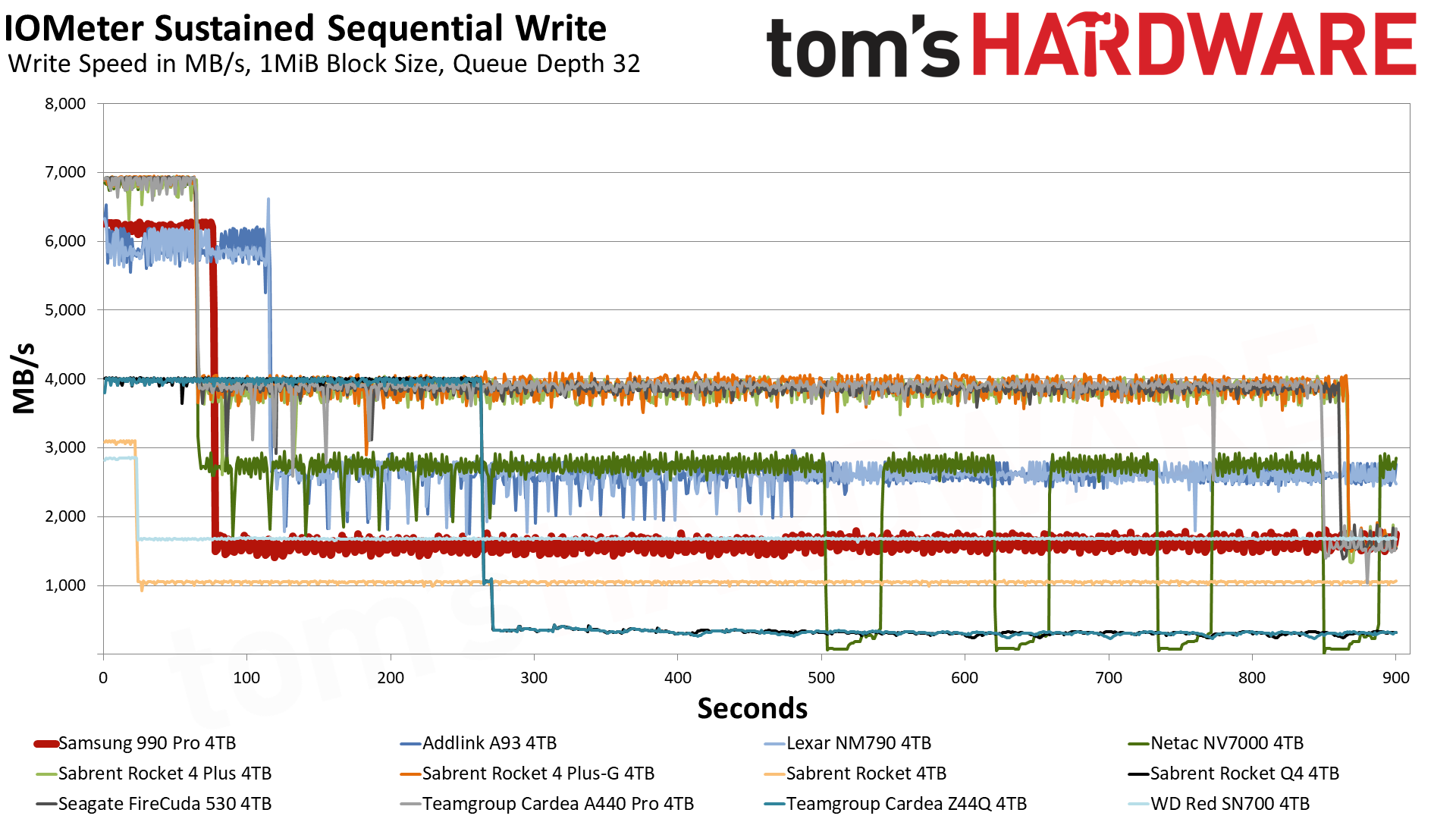
The Samsung 990 Pro is also excellent at sustaining strong write performance. In our IOMeter sustained sequential write tests, the 4TB 990 Pro was able to maintain a speed of 6.2 GB/s for 75 seconds thanks to its generous 10GB of pSLC cache. Once the data spills over into the TLC, it operates at 1.6 GB/s. The Samsung 990 Pro is also a leader in power efficiency, delivering 421.1 MB/s per watt. That number puts it ahead of all competitors but the Addlink A93 4TB and Lexar NM790 4TB.

Samsung 990 Pro 4TB sustained write speeds

(Image credit: Tom's Hardware)

The Samsung 990 Pro is certainly nowhere near the all-time low prices of years gone by, and I'm not sure at the moment when, if at all, we'll ever see those low prices again on storage, certainly not for some considerable time. If you want 4TB of storage now, then the Samsung 990 Pro is a formidable choice; just try to grab it when there's as much of a discount as possible.

Votre eau citronnée du matin fait-elle vraiment maigrir ?

21 October 2026 at 15:00
Détox, perte de poids, métabolisme relancé, pH rééquilibré : l'eau citronnée du matin porte une quantité de promesses dont aucune ne résiste à l'examen. Il reste quelques bénéfices réels, mais modestes. Et un risque bien documenté, systématiquement passé sous silence : l'érosion de l'émail...

16 Go de RAM, SSD et écran de 15,6 pouces : ce PC portable Ninkear à moins de 500 € affole les internautes

21 October 2026 at 15:00
Ninkear n'est pas le fabricant de PC le plus connu, mais il a de sérieux arguments à faire valoir. En promotion sur AliExpress, le Ninkear A15 se présente de 15,6 pouces pensé pour la bureautique, les études, les usages multimédias courants et même un peu de jeu. Son écran IPS Full HD, son...

How to export your iPhone passwords to a CSV file in iOS 27 Safari settings

21 October 2026 at 14:19

Apple’s iPhone User Guide for iOS 27 explains how to export your passwords for websites and accounts to a CSV file, which you can then import into another password manager. The option sits in the Settings app under Apps, then Safari, and Apple warns that the exported file is not encrypted. That makes the export […]

The post How to export your iPhone passwords to a CSV file in iOS 27 Safari settings appeared first on The Mac Observer.

Cet air fryer WELLENT de 12 litres à moins de 80 € assomme la concurrence sur Amazon

21 October 2026 at 14:00
Avec ses deux compartiments de cuisson, sa puissance de 2 950 W et ses fonctions de synchronisation, le WELLENT XXL 12L se présente comme une solution polyvalente pour préparer plusieurs aliments en même temps et pour plusieurs convives. Sa conception modulable permet aussi de réunir les deux...

FADU puts the filesystem inside the SSD's flash to bypass host CPUs

21 October 2026 at 13:30

SSD controller designer FADU’s new File-Semantic SSD (FS-SSD) was announced at the 2026 OCP Global Summit. The new device promises to move the file system into the SSD itself. As detailed in a white paper, this enables GPUs, DPUs, and NICs to open and read files with “no host filesystem, no block layer, and no storage-server CPU in the path.” FADU told Tom’s Hardware Premium it expects partner samples by Q3 2027.

FADU is a Seoul, South Korea-based fabless SSD controller designer. Its FS-SSD technology is designed to handle and improve the control path, as the data path side moved to accelerators years ago. FADU’s measurements show that the file system, plus block layers, can consume about 30% of CPU cycles in a GPUDirect Storage (GDS) random-read workload. It notes that bypass options give up the files, and the company claims its solution promises the best of both worlds.

In FADU’s own preliminary Network File System (NFS) over NVMe test, on a drive built on its FC6161 Gen6 controller in a PCIe 5.0 host, remote file throughput held steady as the server downshifted from what FADU labels 16 cores to just one, maintaining about 460,000 ops/s.

The NFSv3 operations are carried inside standard NVMe commands, and the drive handles path lookup, access control, and file-to-flash mapping. FS-SSD’s performance is remarkable when compared to Linux NFS-over-RDMA, which achieved a third of the ops/s with 16 cores and only 40K ops/s with one core. The technology remains “under active development,” and FADU told Tom’s Hardware Premium it expects Gen6-host results by Q1 2027, with partner samples in Q3 2027.

FADU chart of Filebench fileserver results: FS-SSD holds about 460,000 ops/s from 16 server cores down to one, while NFS over RDMA falls from about 150,000 to 40,000 ops/s

FS-SSD holds about 460,000 ops/s from 16 server cores down to one, while NFS over RDMA falls from approximately 150,000 to 40,000 ops/s (Image credit: FADU)

FADU chooses to use NFSv3 because it’s “small (21 operations), OS- and filesystem-agnostic, and stateless” with low firmware overhead. FS-SSD supports PCIe today, with NVMe-oF over RDMA and TCP working without any new transport needed. Reusing an existing protocol is a smart move, in our view. Under the hood, the file system and flash translation layer are merged with a file layer derived from F2FS. Node and data blocks are aligned with the natural flash pages, sections at corresponding erase units, so that the F2FS node table becomes a “File Map” pointing the node IDs at physical flash addresses.

One big advantage is that the DRAM mapping metadata overhead is considerably smaller: it uses the same amount of DRAM as a standard SSD, ~0.1% of NAND capacity (about 1 GB per TB), which a standard SSD fills almost entirely with its mapping table. Here, most of that DRAM, ~95%, can act as a hot-path node cache.

One garbage collector also replaces two, avoiding what FADU calls the “double GC” of host F2FS, where file-system cleanup and the drive’s own garbage collection amplify each other. Write amplification is also 63% lower versus a host F2FS solution on a mixed sequential and random workload with FADU’s research prototype, the company said. FADU told Tom's Hardware Premium that the prototype runs synthetic fio workloads on NVMeVirt, an open-source software SSD emulator from Seoul National University, so it is not a hardware result.

Most importantly for this method, it ensures host-free access. The GPU builds NFS-over-NVMe commands in queues in its own memory, which could include HBM. Alternatively, a remote SmartNIC or DPU with NVMe-oF target offload can drop commands in the drive’s submission queue. The data goes from SSD to NIC via PCIe peer-to-peer DMA, coming out as RDMA writes. FADU’s explicitly named use cases for this include GPU file reads and checkpoints, DPU-served HTTP content delivery, and a JBoF (just a bunch of flash) file server.

FADU’s numbers for its internal test come from a client and server Intel Core i5-13600K, a CPU with 20 threads that clocks up to 5.1 GHz with 128GB of DDR5, and a Mellanox ConnectX-6 100 Gbps NIC. Synthetic testing is compared using fio with the baseline F2FS and Ext4 on block firmware versus the FS-SSD via a kernel client and an SPDK user-space client. The sequential test is 1 thread, queue depth (QD) 128, with 128KB blocks, while random is at 4 threads, the same QD128, but with 4KB blocks.

These block sizes are typical for client workloads in our experience, so they are a fair measure, with detailed preliminary results in the table below. Against SPDK on the raw drive, figures FADU provided to us, FS-SSD’s SPDK client keeps about 93% on 4K random read and 53% on 4K random write, via fio, with around a 7% and 47% cost for the in-drive file layer. Though the raw drive’s 13,240 MB/s random write is above the ~12 GB/s FADU gives as the NAND’s program bandwidth, those runs likely weren’t at steady state. The Filebench result is particularly interesting, as the SPDK random gains apply to a plain block device too.

This should be the workload most favorable for the technology, as the Filebench file server is metadata-heavy with relatively high host overhead: FADU says it uses 10,000 files in a multi-level tree, mean directory width 20, and a mean file size of 128KB with 50 client threads.

FADU’s preliminary fio results: Gen6 controller in a PCIe 5.0 host, direct I/O

Setup

Sequential read (MB/s)

Sequential write (MB/s)

4KB random read (MB/s)

4KB random write (MB/s)

F2FS

14,120

4,510

7,850

3,980

Ext4

14,130

7,050

9,120

4,560

FS-SSD (kernel client)

14,140

11,940

8,070

4,320

FS-SSD (SPDK client)

Not reported

Not reported

13,000

7,030

Raw block (SPDK)

Not reported

Not reported

13,990

13,240

One important thing to recall is that although this test is on a Gen6 drive, the test results are on a PCIe 5.0 host. Therefore, every sequential read config tops out at around 14.1 GB/s, which is roughly the link limit. The testbed also uses a consumer-class desktop CPU, while the one-core NFS server is a showcase example. The kernel client ends up 11.5% behind Ext4 on random read and 5.3% behind on random write, again by our math.

One example of a tough question more generally is: how do concurrent GPU, DPU, and host writers coordinate? How does a kernel mount’s page cache stay coherent with GPU access? NFSv3 storage devices, by the pNFS Flexible File Layout spec (RFC 8435), are “always treated as loosely coupled,” which means “Mandatory byte-range locking cannot be supported.”

Credentials riding in the NVMe command may also face security issues, as loosely coupled devices get only “a level of security equivalent to AUTH_SYS,” NFS’s basic scheme, in which the server trusts whatever user and group IDs the client sends. FADU’s published material also does not describe features such as snapshots, encryption handling, quotas, ACLs, crash handling, and so forth, related to this. Statelessness is what makes it work, but it doesn’t solve all problems, so the trust factor moves elsewhere.

In reply to our questioning, FADU said that there is no cross-host locking, as NFS’s lock manager isn’t implemented. The drive applies each write whole, in order. If two writes hit the same spot, the second one wins; this is “last-writer-wins.” Coordination depends on the clients: kernel-mounted ones get the usual advisory locks among themselves, GPU and SPDK clients coordinate in the application, and at scale a pNFS metadata server handles the coordination. Caching is also handled like ordinary NFS, with kernel clients, or is not done at all, for GPU and SPDK clients. This is stock NFSv3 behavior.

The drive has to check user/group IDs against the file permissions itself. Because those IDs ride inside the command, a client could fake them, but FADU says it closes that issue with capability-based authentication. Each command carries a capability issued by an outside authentication server, plus a code computed with a key shared only between that server and the drive. This is not detailed in its published material. FADU adds that support for the Kerberos authentication protocol is planned. For networked drives, the standard NVMe-oF protections are used, with only pre-approved hosts admitted. A drive trusts a single host’s kernel like any NVMe drive.

However, as FADU described to us, ACLs and other features are missing in the current release, aside from encryption, which in this case is handled by the FC6161’s standard TCG Opal self-encrypting drive support. Power loss is also typically handled with capacitors flushing metadata, the write buffer, and a log of in-flight operations. On restart, the drive replays the unfinished operations, and every write is durable if the drive acknowledges it.

FADU’s longer sights are on producing a JBoF storage solution with no server in front: FS-SSDs, a PCIe switch, and a DPU or NIC for handling NVMe-oF in hardware. FADU’s model puts this at about 42% lower power, about 57% lower cost per 16-drive server, and higher rack density with significantly lower five-year total cost of ownership. The drives would slot in behind existing pNFS metadata servers and could scale. FADU’s controllers already ship with drives such as the SN861, which Western Digital launched and SanDisk now sells, but this would expand the options and solutions it can provide.

FADU’s FS-SSD roadmap

Milestone

Timing (per FADU)

Details

Gen6-host results

By Q1 2027

FS-SSD tested in a PCIe 6.0 host; hardware write-amplification figures to come with them

Partner samples

Q3 2027

OEM/ODM talks are at an early stage; active collaboration expected once samples ship

Hostless JBoF

By end of 2027

Reference design built on Xsight Labs E1 DPUs, delivered to OEM/ODM partners

GPU access

Now, via GPUDirect Storage

Works with GDS through the kernel client; FADU intends to join the Accelerated IO SIG (xio-sig), where Nvidia open-sourced cuFile; no direct engagement with Nvidia

Standards

Nothing submitted yet

FADU plans to start a file-semantic command set discussion at NVM Express and OCP Storage; samples and client code come first

Next year should bring real numbers and samples, with the JBoF reference design also expected. There may be an NVM Express or OCP Storage proposal down the line for a file-semantic command set to further cement and mature the approach. FADU has a good idea, is building it on an existing framework, and has a testbed with results and a hardware path forward on its Gen6 controller, with a trust model in mind. A Gen6-host run is now needed to support the company’s claims.

Canapés, tapis, sièges auto : cette shampouineuse portative à petit prix s'adapte à tout !

21 October 2026 at 13:00
Les taches sur les tapis, canapés et sièges de voiture ont du souci à se faire ! Avec son petit prix chez VEVOR, cette shampouineuse portative de 11,5 kPa sort les muscles pour redonner un coup de propre à vos textiles sans malmener votre portefeuille.

Créer un site avec l’IA dès 1 € par mois : que vaut vraiment l’offre IONOS ?

21 October 2026 at 12:30
Avec son hébergement dès 1 € HT/mois pendant un an, IONOS entend simplifier la création d’un site WordPress grâce à l’intelligence artificielle et à des services inclus.

4 cheap headphones and earbuds we've tested to avoid 'headphone dodger' fines — they're all cheaper than the £100 you'll pay if you're caught

  • UK government cracks down on people who annoy others with phone music
  • Fines of up to £100 for those people
  • It's cheaper to just buy these headphones

People who play music, TikTok videos or out-loud video calls on public transport probably aren't self-aware enough to know how annoying it is, but apparently the UK government does, because it's finally cracking down on so-called "headphone dodgers".

From next Monday, transport authorities will be allowed to fine rule-breakers by up to £100 if they're causing a nuisance. Prime Minister Andy Burnham is fronting the campaign, after previous governments toyed with the idea.

It's a good idea, but the success is dependent on enforcement, as transport safety officers and not drivers are expected to hand out the fines. Given how minimally-staffed most public transport services are, some (me) are dubious that the rules will make a difference.

However if you've been a 'headphone dodger' and you want to turn a new leaf (good on you), it'd make sense to buy a pair of headphones that cost much less than the £100 penalty fare.

And naturally, we've tested a few that we can recommend…

Sennheiser CX 80U

Sennheiser CX 80U earbuds on block

(Image credit: Future)

Starting with something nice and cheap, we've got some wired earbuds, which you can easily plug into the USB-C port on a phone and keep bundled up in your pocket the rest of the time. No Bluetooth dropouts, no losing a bud as you board the bus, no apps, none of that.

The Sennheiser CX 80U sound great, block surrounding noise quite well, and offer a nice simple design. We gave them 4.5 stars out of 5 in our review, only knocking them for some missing features of pricier buds.

Best of all, though, they're really cheap. They launched for $39.95 / £34.99 in January this year, but you can find them even a little cheaper than that on Amazon.

Sony WH-CH530 (or even the Sony WH-CH730N)

Sony WH-CH530N headphones in different colors, arranged in a circle to form a flower shape, on a gray floor

(Image credit: Sony)

If you want great-value headphones, you can't go wrong with a pair from Sony, and its recently-released Sony WH-CH530N are really affordable at $69 / £50.

We haven't yet finished testing these on-ears, they're that new, but their predecessors the WH-CH520 got 4.5 stars in our review. We praised the balanced sound and long-lasting battery, and the newer pair will likely bring improvements.

As you can see in the picture, they come in a wide range of colors, and also have noise cancellation, which isn't something you can say about all options at this price point.

Prefer over-ears? Go for the just-reviewed, all-new Sony WH-CH730N: a solid four stars and they're just under that £99 (or equivalent, in your country of residence) fine line, if you'll pardon the pun…

JLab JBuds Mini ANC

JLab JBuds Mini ANC earbud outside the case

(Image credit: Future)

Last, but not least, let's look at some standard wireless noise-cancelling earbuds, which we got to try earlier this year.

The JLab JBuds Mini ANC are tiny — you can even clip the case onto your keyring — so you've got no excuse for not having buds on the bus. At $49.99 / £49.99 they won't break the bank either.

We enjoyed the non-ANC JLab JBuds Mini too, when they came out three years ago, and they're ideal for people who want lightweight buds.

Have further thoughts? Drop us a comment — or better yet, fill out the poll below this text and then add your comment!

Le cardio grimpe, le prix dégringole : Amazon lâche 46 % sur ce vélo d'appartement 5 en 1

21 October 2026 at 11:00
Le vélo d’appartement pliable 5-en-1 TOPUTURE fait pédaler les sportifs, mais c’est surtout son prix qui dégringole chez Amazon ! Avec 46 % de remise, voilà une belle occasion de travailler son cardio à la maison sans faire transpirer son portefeuille.

Et si l’avenir de l’aviation légère passait par cet ULM électrique ?

21 October 2026 at 09:31
Rêver de toucher le ciel et d’atteindre l’espace n’a rien d’impossible, surtout en embrassant des études qui permettent d’y parvenir. L’IPSA, école d’aéronautique post-bac, œuvre dans cette direction en formant les ingénieurs de demain et en les aidant à concrétiser leurs idées.Rencontre avec...

Ce PC portable gamer MSI avec RTX 4050 voit son prix se faire démolir : -250 € à saisir d'urgence !

21 October 2026 at 09:00
Le MSI Cyborg 15 sort l’artillerie lourde, mais c’est surtout son prix qui prend une claque chez Cdiscount ! Avec 250 € de remise grâce à un code promo, ce PC portable gamer équipé d’une RTX 4050 a de quoi faire tourner les jeux sans mettre votre budget K.-O.

❌