Jase Parnell-Brookes has reviewed a huge range of skywatching optics, including the best telescopes, binoculars and image-stabilized binoculars. As our trusted authority and expert tester, when they recommend a product and you're in the market for it, their opinions and recommendations are worth paying attention to.
In their Nikon Stabilized 12x25 binoculars review, Jase reckoned they were without doubt the best compact image-stabilized (IS) binoculars they had ever tested. Right now they have $73 off and are at the best price we've seen since Black Friday 2025.
Jase awarded them with a perfect 5-star rating, which was mostly thanks to their excellent stabilization, their unobtrusive controls and incredibly small form factor. They also earned a place on our best binoculars guide as the best compact IS binoculars. This Best Buy deal is worthy of your attention if you're in the market for an incredibly versatile pair of binoculars that deliver still views in a compact body.
Save $73 on these pocket-sized image-stabilized (IS) binoculars from Nikon. They offer a strong 12x magnification and are portable enough to just slip into your pocket. In our review, we noted that the compact size and amazing IS system delivered amazing stargazing performance and earned them a perfect five-star review.
The Nikon Stabilized 12x25 S binoculars are incredibly compact and are a handy pair to take wherever you go. Kimberley LaneThe smaller objective lenses mean that the image looks a stop darker than viewing with the naked eye. Kimberley LaneThe eyecups rotate freely to adjust the amount of eye relief. Kimberley LaneThe binoculars are incredibly lightweight, considering their onboard image-stabilization system. Kimberley Lane
These image-stabilized (IS) binoculars punch well above their weight. Tipping the scales at a feathery 13.9 oz (395 g), they pack effortlessly into any bag, giving you rock-steady views wherever you roam. While the compact objective lenses yield a slightly dimmer view than the naked eye, they still deliver fantastic, crisp performance for casual stargazing.
In their testing, Jase managed to see the Andromeda galaxy (M31) with averted vision and the Orion nebula (M42), so these are worth taking out with you at night for a better look at the stars and some of the brighter deep sky objects.
They are also relatively cheap in the image-stabilized world where models can easily go for $1000 and up, depending on the model. Jase was happy to recommend these over another compact IS model, the Canon 8x20 IS binoculars, and they are actually lighter and smaller too. With their silky smooth steadying and clear views, they highly recommended them for anyone looking to get image-stabilized binoculars but doesn't want to spend big bucks.
Key features: 12x magnification, 25mm objective lens diameter, 4.5-degree angular field of view, 12.3mm eye relief, 13.9 oz (395 g) weight.
Product launched: November 2024
Price history: The Nikon Stabilized 12x25 binoculars usually retail for $699.95 on Amazon. This deal from Best Buy beats the Amazon price easily and, at just $626.95, is the best price we've seen since Black Friday 2025.
✅ Buy it if: You are looking for an affordable way into image-stabilized binoculars and need a pair that you can slip into your pocket.
❌ Don't buy it if: You need really high magnification or bigger objective lenses. For more powerful image-stabilized binoculars, try the Canon IS 15x50 binoculars.
NASA's Chandra X-ray Observatory has found a brand new type of an otherwise familiar object – compact binary systems that steal gas from other stars, but which do so while emitting very low-energy X-rays but copious amounts of ultraviolet.
Chandra spotted 84 suspicious object emitting very low-energy X-rays in six galaxies – four evolved ellipticals and two spirals, namely our near-neighbor the Andromeda Galaxy (M31) and the Pinwheel Galaxy (M101).
"We've never encountered a group of objects that act like this," said Mustafa Muhibullah of the University of Alabama in a statement.
Compact objects, in the form of black holes, neutron stars and white dwarfs, are the remains of stars that have died. Their small size and powerful gravity means that they're adept at getting close to orbiting companion stars and ripping the stars' outer layers of gas away. The gas swirls around the compact object, falling onto its surface, and this accretionary process usually produces torrents of high-energy X-rays because the stolen gas becomes superheated by the compact object's gravitational vice-like grip.
Because of their weak X-rays, Muhibullah's team refer to them as 'hypersoft X-ray sources'. Since low-energy X-rays and ultraviolet light are next to each other on the electromagnetic spectrum, Muhibullah and his team suspect that the low-energy X-rays are spillover from objects emitting prodigious amounts of ultraviolet. Moreover, they think that these objects are lower-level compact binaries.
They're hard to find though, because the interstellar medium of hydrogen and helium gas between the stars absorbs ultraviolet light. This could be why we have yet to find any hypersoft X-ray sources in our own galaxy, because we have to look through the interstellar medium through the plane of the Milky Way.
Consequently, there could be a large population of hypersoft X-ray sources that remain undiscovered and they could have an important effect on the universe around them.
"These clandestine X-ray sources are actually among the most energetic objects in galaxies, and they could be solving two cosmic mysteries at once," said Muhibullah.
The interstellar medium is filled with ionized gas where atoms have been shorn of electrons. Hot, massive stars do output a lot of high-energy ultraviolet light, but there are not enough of these stars to account for all the ionization. If hypersoft X-ray sources are dumping torrents of ultraviolet into space, they could explain the ionization instead. For stars to form, gas has to be cold and not ionized, so hypersoft X-ray sources could be gently regulating star formation within galaxies.
The second mystery is the puzzle over how exactly type Ia supernova explosions detonate. We know that they are fueled by white dwarfs accreting matter from a close companion star and, once the accumulated matter raises the white dwarf's mass beyond 1.44 times the mass of our sun – known as the Chandrasekhar limit – it explodes, but the details of what on the white dwarf actually ignites and how are fuzzy.
Studying a new breed of compact binary might finally reveal the answers and offer more clues about when white dwarfs become ready to explode.
"If we could find a way to spot these type Ia supernova explosions before they go off, that would be really important," said Jimmy Irwin of the University of Alabama, who is a member of Muhibullah's team. "Right now, we study them after they've exploded and astronomers have struggled to understand what is actually ignited."
Since type Ia supernova explosions are used as markers on the cosmic distance ladder, used for measuring the strength of dark energy and the expansion of the Universe, the benefits from understanding them better are clear to see in our efforts to understand how the Universe is evolving.
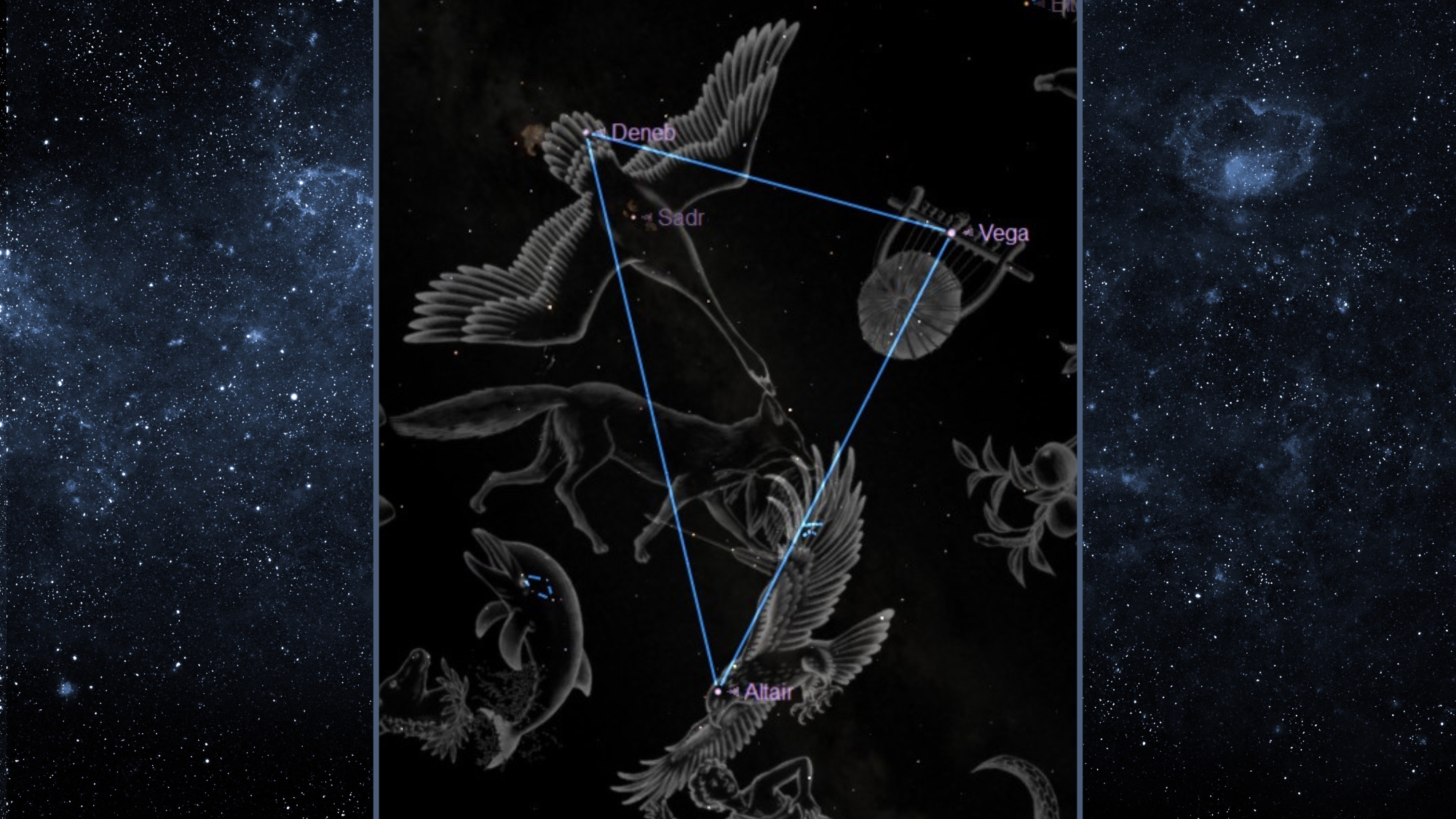
On clear September evenings, I often find myself looking up just after dusk, expecting the sky to feel a little less like summer. Yet there, still commanding the overhead darkness, are Vega,Altair, and Deneb — the three brilliant stars of the famous Summer Triangle.
Their familiar pattern can make the season feel as though it is lingering above us, even as cooler nights and earlier sunsets suggest otherwise. In fact, even as late as mid-November, the Triangle is still nearly overhead soon after sunset at dusk. That contrast raises a simple but intriguing question: if this bright celestial landmark remains so prominent well into autumn, why do we still call it the Summer Triangle?
Why not simply call it the Autumn Triangle?
Why it belongs to summer
The answer lies not in the calendar, but in how the Triangle moves across the sky over the course of a summer night. The chief reason is that, at this time of year, the Triangle does not remain visible all night. By dawn, it has begun to drop beyond the west-northwest horizon. During summer, by contrast, it remains with us from dusk until dawn: already evident in the east-northeast at nightfall, near overhead around the middle of the night, and descending in the west-northwest as daybreak approaches.
A matter of distance and brightness
The stars that compose the Triangle — Vega, Altair, and Deneb — lie at very unequal distances from us, so their apparent brightness can give a misleading impression of their true luminosity.
The closest of the three is Altair, 16.7 light-years away, followed by Vega at 25 light-years. Deneb, however, is vastly farther off, at roughly 1,600 light-years, though various sources place it between 1,400 and 2,600 light-years. Even though we see Deneb by light that may have begun its journey during the last days of the Roman Empire, it still shines at first magnitude (+1.3, to be exact) because it is a brilliant blue supergiant, at least 55,000 times brighter than the sun.
But their apparent superiority is largely a consequence of distance: Vega and Altair are only a few dozen light-years away, while Deneb lies well over a thousand light-years from Earth. Compared with the stellar lighthouse of Deneb, Vega and Altair are, comparatively speaking, penlight flashlights.
How to say "Vega"
Before continuing with this discussion about the Summer Triangle, it is worth pausing briefly on the pronunciation of Vega, a point that became especially noticeable after the 1997 science fiction drama Contact. Based on Carl Sagan's 1985 novel, the film follows astronomer Dr. Ellie Arroway, played by actress Jodie Foster, as she discovers a radio signal from Vega containing a sequence of prime numbers.
Throughout the film, the star is pronounced "Vey-gah," perhaps echoing Chevrolet's Vega, the subcompact automobile sold in the 1970s. Astronomers, however, generally use a different pronunciation.
The traditional astronomical pronunciationis Vē-ga, with the stress on the first syllable. In professional astronomical usage, Dr. Arroway and her colleagues would almost certainly have said "Vee-ga," not "Vey-gah." George Lovi (1939—1993), who was widely respected for his knowledge of star nomenclature, often reminded audiences that "Vee-ga is a star and Vey-gah is a car."
Who named the Summer Triangle?
The Summer Triangle and the allegorical figures (Cygnus, Lyra and Aquila) attributed to the three constellations it belongs to, at around 9 p.m. in mid-September. (Image credit: Starry Night Pro 8.0, background added in Canva Pro.)
There has long been debate over who first christened the bright stellar trio of Vega, Deneb, and Altair as the Summer Triangle. Some credit the legendary British astronomer Sir Patrick Moore (1923—2012), who wrote, "During a 1958 television broadcast on the BBC, I introduced the nickname of the Summer Triangle, and everyone now seems to use the term, even though it is completely unofficial." Yet several years earlier, in his 1952 sky guide, The Stars — A New Way to See Them, H.A. Rey (1898—1977) referred to the three stars as a "right triangle," and in his 1954 children's book, Find the Constellations, Rey used the Summer Triangle moniker.
Still others believe the term was popularized through U.S. navigator training manuals during World War II. Interestingly, astronomer Oswald Thomas (1882—1963) described Vega, Altair, and Deneb as "Grosses Dreieck" ("Great Triangle") in the late 1920s and as "Sommerliches Dreieck" ("Summerly Triangle") in 1934.
On Sept. 10, 2011, NASA's GRAIL spacecraft launched on a mission to the moon!
GRAIL, which stands for Gravity Recovery and Interior Laboratory, was sent to the moon to map its gravitational fields. Scientists could study the moon's interior structure by looking at maps of the moon's gravity.
Asteroid impacts from billions of years ago left dense pockets of material under the lunar surface, which can exert extra gravitational pull on spacecraft orbiting the moon. So by measuring that gravitational pull, the GRAIL mission could reveal information about what lies beneath the surface.
The mission actually consisted of two twin spacecraft named Ebb and Flow, which would fly in tandem around the moon to map variations in its gravitation field. Both lifted off on the same Delta II rocket from Cape Canaveral, Florida and arrived in lunar orbit almost four months later.
They mapped the moon for about nine months before NASA decided it was finished with the mission, and the two orbiters crashed into the moon.
A Delta II rocket launches NASA's twin Gravity Recovery and Interior Laboratory (GRAIL) mission to the moon from Cape Canaveral Air Force Station in Florida on Sept. 10, 2011. (Image credit: NASA/Kenny Allen)
Why it mattered
The moon is a weird place. It may look like a cold, gray ball of solid rock, but its density varies from location to location due to odd "mass concentrations" (or mascons for short) buried under the lunar surface. That leads to a strange, lumpy gravity that's not uniform across the lunar surface.
That's where GRAIL's Ebb and Flow probes came in. Each of the twin spacecraft carried three instruments to map the interior of the moon. Those included a Lunar Gravity Ranging System, a Radio Science Beacon and a camera called MoonKam Lunar-Imaging system.
Together, the instruments mapped the mascons on the moon in extreme detail to monitor where lunar gravity increased from the norm. Astronomers had long suspected that mascons on the moon and other planets formed during violent asteroid impacts.
Artist's concept of NASA's Grail mission. Grail's twin spacecraft are flying in tandem orbits around the moon to measure its gravity field in unprecedented detail. NASA/JPL A visualization created using data from NASA's GRAIL spacecraft shows differences in the moon's gravity field.NASA/JPL-Caltech/MIT/GSFC
"GRAIL data confirm that lunar mascons were generated when large asteroids or comets impacted the ancient Moon when its interior was much hotter than it is now," Jay Melosh, a GRAIL co-investigator at Purdue University, said in a NASA overview.
The MoonKam tool was actually a student experiment (MoonKam is short for Moon Knowledge Acquired by Middle School Students). It was built by undergradutate students at the University of California, San Diego in partnership with the Sally Ride Science foundation to encourage younger students to study science and space. (The names Ebb and Flow as GRAIL probe names were also suggested by 4th grade students at Emily Dickinson Elementary School in Bozeman, Montana, as part of a national competition.)
The $496 million GRAIL probes orbited the moon in an extremely low orbit, coming within 30 miles (50 km) of the lunar surface at their closest approach. They were separated from each other at distances that ranged from 109 miles to 140 miles (175 km to 225 km).
NASA crashed the GRAIL probes into the moon on Dec. 17, 2012 once its fuel reserves reached the point that it could not maintain its low lunar orbit. They crashed into a crater rim near the moon's north pole to prevent them from randomly crashing uncontrolled into someplace like an historic Apollo moon landing site.
LINK, the satellite sent to boost the orbit of NASA's Swift Observatory, may have had to give up on its mission, but LINK's manufacturer and operator Katalyst Space hasn't completely abandoned the spacecraft to its cosmic demise.
NASA called off LINK's mission to rendezvous with its Neil Gehrels Swift Observatory when the specialized probe encountered a thruster control issue. LINK was delivered to orbit on July 3, aboard an air-launched Northrop Grumman Pegasus XL rocket, but began to spin uncontrollably about three weeks after reaching space. Swift's orbit began decaying faster than expected last year, due to increased solar activity, and LINK was designed to rendezvous with Swift, grapple it, and then raise the observatory to a more stable altitude.
LINK's Swift Boost mission was considered a "Hail Mary" attempt from its onset. NASA's discovery of Swift's swiftly decaying orbit meant the Arizona-based Katalyst had less than a year to design, manufacture and test LINK before needing to launch. Now, with both of their missions on the short-track for destruction, NASA and Katalyst are left both trying to get the most out of their spacecraft with the time each has left.
LINK's failure means Swift is destined to burn up in Earth's atmosphere before the end of the year, and LINK itself is expected to fall to the same fate within just the next few weeks. But the probe's inability to save Swift hasn't stopped Katalyst from getting as much data from LINK as it can. Though a closer rendezvous is no longer in the cards, the spacecraft managed to successfully fire all three of its electric propulsion thrusters and adjust its orbit to fly within 7.5 to 9 miles (12 to 15 kilometers) of Swift. Katalyst was also able to deploy all three of LINK's robotic arms, which would have been used to grapple Swift for its orbital adjustment.
Swift launched in November 2004, and has been studying high-energy phenomena like gamma-ray bursts, supernovas, black-hole ejections and fast radio bursts across the universe for more than 20 years. Despite its impending demise, two of Swift's three science instruments — its X-ray Telescope (XRT) and Ultraviolet/Optical Telescope (UVOT) — were turned back on in late August after being shut down in February to minimize atmospheric drag on the spacecraft in anticipation of LINK's now defunct orbital boost efforts.
With the option for LINK to raise Swift's orbit now off the table, Katalyst and NASA are working to perform whatever technology demonstrations are possible aboard the spacecraft, in the hopes the technology can be used to service other satellites on missions in the future.
A catalog of almost 3,000 white dwarfs that exploded as type Ia supernovas after overfeeding on companion stars indicates that dark energy, the mysterious force accelerating the expansion of the universe, is changing over time.
The discovery, in conjunction with data from the Dark Energy Survey (DES), backs results revealed from the Dark Energy Spectroscopic Instrument (DESI) published in 2024 that suggested dark energy's influence is weakening.
That means that the team's research doesn't just involve the most comprehensive catalog of type Ia supernovas; it presents the clearest picture yet of the evolution of the universe and the influence of dark energy.
"We've rebuilt 3 decades of astronomical observations into a single, consistent framework," team member Ryan Camilleri of the University of Queensland said in a statement."We combined our data with other cosmic measurements, including relic light from the Big Bang and maps of how galaxies are distributed through space.
"Instead of confirming the standard model of cosmology, which assumes dark energy is fixed and unchanging, we have more evidence that dark energy may change over time."
How do exploding white dwarfs tell us about dark energy?
White dwarfs are the smoldering stellar remnants that are left over when stars with around the mass of the sun exhaust the fuel for nuclear fusion in their cores. This ends the outward pressure that supports a star against its own gravity, meaning the star's core collapses as the outer layers are shed. The core becomes a white dwarf, and for single stars, that is the end. But around 50% of sun-sized stars have a binary companion, and this can lead to renewed activity and a change in the star's fate.
If the white dwarf and its companion are close enough together, the dead star begins stripping away the outer layers of its companion. As this material builds on the white dwarf, it pushes the stellar remnant's mass over the so-called Chandrasekhar limit, allowing it to go supernova.
These cosmic explosions are called type Ia supernovas, and their light output is so uniform that these events are referred to as standard candles. They are of vital importance because measuring how their light has been redshifted as it travels means type Ia supernovas can be used to measure cosmic distances.
"Over the years we've learned a lot more about how supernovae behave so we've been able to go back and apply that improved understanding to older data," Camilleri said. "Extensive work has been done to link observations from different telescopes with different capacities and take into account issues such as cosmic dust and galaxy mass which can affect the light coming from a supernova.
"We also incorporated more subtle effects such as gravitational lensing, which is the bending and magnification of light around large objects as it travels from a supernova to Earth."
Two "fans" representing DESI observations above and below the plane of the Milky Way (Image credit: DESI Collaboration/DOE/KPNO/NOIRLab/NSF/AURA/R. Proctor/ Robert Lea (created with Canva))
Combined with the 2024 results from DESI, this research could change our idea of what dark energy actually is.
"Our supernova data from DES in 2024 first showed hints that dark energy may be time-varying, and this new compilation also sees a deviation from the standard model, although in a slightly different direction," Davis said. "Similarly, results from DESI found hints of variations in dark energy in its surveys of relic sound waves from the early universe.
"So, two completely independent measurements have found hints of time variation in dark energy, challenging the standard model that dark energy doesn't change."
Davis added that, as well as revealing what dark energy actually is, this research may also hold the clue to explaining how gravity and quantum physics fit together. While quantum physics (the best theory we have of how the universe operates at subatomic scales) and Einstein's theory of general relativity (our best picture of gravity) have been highly successful in their own rights, scientists have so far been unable to unite them. In other words, there is no theory of quantum gravity.
“We know these two theories are each immensely successful in their own realms, so if we can figure out how to put them together, that would be a huge step in theoretical physics," Davis continued.
This effort will receive a boost when data is added to the team's already comprehensive type Ia supernova catalog. This will include observations from the Dark Energy Bedrock All-Sky Supernova program (DEBASS), which is detecting hundreds more local supernovas than even the DES survey.
The team's results are available on the repository site arXiv.
During the recent press rounds for Apple TV's Ryan Reynolds/Kenneth Branagh vehicle "Mayday", writer/director duo Jonathan Goldstein and John Francis Daley talked about their plans for the next "Star Trek" movie. As well as confirming their story will feature an all-new crew, they mentioned that the in-development project will be inspired by a pair of hit films from the '90s and '00s, both of which — coincidentally — feature Denzel Washington operating at very different ends of the moral spectrum.
"Training Day" is a gritty police drama, where Ethan Hawke's rookie finds himself under the ethically dubious wing of the Oscar-winning Washington's corrupt cop Alonzo Harris. "Crimson Tide", meanwhile, is a tense submarine thriller in which Washington's executive officer argues with Gene Hackman's captain about whether to launch some nuclear weapons. The stakes? Only kicking off the Third World War.
The latter feels particularly suited to a Starfleet bridge. The greatest "Star Trek" movie of all, "The Wrath of Khan", also borrowed heavily from submarine movies, with the USS Enterprise given a naval makeover and space battles that played out like games of underwater cat-and-mouse. And while "Crimson Tide" doesn't necessarily fit with Gene Roddenberry's vision of a conflict-free professional environment, it's easy to picture a seasoned starship captain locking horns with an idealistic first officer about the right course of action.
In fact, if Paramount executives are having doubts about the premise, they should check out the latest episode of "Strange New Worlds", which has just given the premise a dry run. Because to all intents and purposes, "Orders of Magnitude" is "'Crimson Tide' in space" — and it's every bit as thrilling as that sounds.
MAJOR SPOILERS AHEAD! ANYONE YET TO WATCH "ORDERS OF MAGNITUDE" SHOULD PROCEED WITH CAUTION TO AVOID VIOLATING TEMPORAL PRIME DIRECTIVES.
(Image credit: Paramount)
The chances of Captain Christopher Pike and first officer Una "Number One" Chin-Riley coming to blows on the bridge are slim, especially as Michael Burnham's mutiny on the USS Shenzhou (in the opening episode of "Star Trek: Discovery") will still be fresh in Starfleet minds. Writer Alan B McElroy instead makes the smart move of marooning Pike and Chin-Riley on an alien planet, forcibly detained by a group of Andorian mercenaries.
So when self-proclaimed "wily old war dog" Admiral Simon Reeger (guest star Joe Morton) comes on board to commandeer the Enterprise for the top-secret pursuit of a cloaked enemy vessel, it's ranking officer James T Kirk — making one of his implausibly frequent visits to his future home — who steps up to become the ship's temporary number one.
(Image credit: Paramount)
Reeger initially seems like the ideal commanding officer, friendly and considerate enough to learn his subordinates' names before he arrives. But — as happened with Captain Ramsey and Lt Commander Hunter in "Crimson Tide" — it quickly becomes clear that this working relationship with Kirk is going to be a fraught one.
He scolds his new first officer for questioning his decision to leave Pike and the away team behind, and not being on the bridge quickly enough when red alert is sounded. This is a man who doesn't appreciate being undermined in public, for whom — as Dr M'Benga, who served under Reeger on the USS Constitution, puts it — the "mission is everything".
(Image credit: Paramount)
The story also hinges on a very "Crimson Tide"-like dilemma. In director Tony Scott's movie, the USS Alabama receives incomplete firing orders — Captain Ramsey believes this means they should launch nuclear weapons at the proposed target, but Hunter advises caution, insisting they should pause until the orders are verified.
In "Orders of Magnitude", meanwhile, Reeger surmises that the ship the Enterprise is pursuing — believed to be responsible for the deaths of five million people in the Vaardan Massacre — is hiding on the surface of Argus II. Concerned the cloaked vessel might escape, he orders the destruction of everything on the planet's surface — but with thousands of innocent lives on the line, it's an order that Kirk cannot, in good conscience, execute.
What follows is right out of the "Crimson Tide" playbook, as chains of command are stretched past breaking point, the "math of command" is questioned, and the bridge crew throw increasingly awkward glances between themselves. Kirk risks putting himself on the fast track to a court-martial, receiving radiation burns to sabotage the phasers, and drugging Reeger so M'Benga can declare him unfit for duty — an act M'Benga ultimately takes the rap for.
(Image credit: Paramount)
It also puts Kirk at odds with La'an (who's resolutely sticking to the admiral's orders), and forces him to ask big, potentially career-ending favors of big brother Sam.
"Orders of Magnitude" also makes things personal in a way "Crimson Tide" never did. Reeger lost his family on Vaardan and is out for revenge, but — perhaps more pivotally — he served with the Kirks' dad, George, on the Constitution.
Reeger became a hero after taking out several Klingon cruisers at the Battle of Zeta Reticuli, but he was actually incapacitated at the time and took the credit for George's heroic actions, stalling Kirk Sr's career in the process.
(Image credit: Paramount)
In the episode's climactic bridge showdown, the tone shifts to another '90s classic, as Jim Kirk goads Reeger into a confession about the Constitution scandal. The admiral's "You're damn right!" is pretty much a direct lift of Jack Nicholson's "You're goddamn right I did!" in the famous final act of timeless legal drama "A Few Good Men". And yes, Kirk can handle the truth — even if he doesn't want to.
It's unclear whether "Strange New Worlds" showrunners had any idea a "Star Trek" movie inspired by "Crimson Tide" was on the cards — or if Goldstein and Daley knew this brilliant episode was on the way. But if their movie does become "Trek"'s first big-screen outing since 2016's "Star Trek Beyond", they could do worse than taking a few notes from "Orders of Magnitude".
New episodes of "Star Trek: Strange New Worlds" debut on Paramount+ on Thursdays.
Wrinkles on the surface of Mercury have revealed that the closest planet to the sun is shrinking faster than scientists thought.
New research suggests that Mercury is shrinking between 10% and 30% faster than had been previously estimated. The team behind this research calculated that the planet has lost nearly 12 miles (19 kilometers) of its total diameter since it formed.
The researchers think that the extremity of this shrinking has gone unnoticed previously because bombardment from space rocks over time has created craters that obscured the evidence of this process.
Scientists say determining the extent of the shrinking of Mercury is key to investigating the composition of the planet's interior.
"More shrinking means Mercury could have a larger metal core, less light elements like silicon mixed into the metal core, or a higher starting temperature," team leader Gaku Nishiyama, of the German Aerospace Center (DLR) Institute of Space Research said in a statement.
Mercury's rocky past
Like all rocky planets in the solar system, Mercury was formed 4.5 billion years ago during a violent and turbulent time in the solar system's history, as rocks and asteroids collided with each other and were bound together.
These impacts generated heat, which Mercury has been losing ever since. As the interior of Mercury cooled, it also shrank. This caused geological wrinkles in the form of scarps and ridges to develop in the rocky outer layers of Mercury.
This cooling should result in Mercury shrinking in a roughly uniform way, and that would make these shortening structures common across the planet. However, asteroid impacts throughout its history have not only created craters that obscure signs of its geological history, but have also spread debris across the surface of Mercury. This makes wrinkles tougher to spot among the accumulation of billions of years' worth of geological features.
NASA's Messenger spacecraft spots an apparently fresh crater on Mercury during its early orbits on March 29, 2011. (Image credit: NASA/JHUAPL/CIW)
The team combined previous maps of Mercury's geology with new observations of the entire planet's surface roughness. They found the roughest terrain of Mercury featured the fewest wrinkles.
"It made us think that there's a process obscuring shortening structures," said Nishiyama, who thinks that impact debris in the roughest regions of Mercury is covering shrinking wrinkles.
The team then used the ridges and scarps in regions less affected by the dispersal of debris to estimate the amount of contraction. This indicated that missing features in rough areas could amount to 10% to 30% extra shrinkage over the 4.5 billion-year lifetime of Mercury. That amounts to a total change in diameter of up to 14.5 miles (23 kilometers) rather than the currently estimated 2.5 to 10 miles (4 to 16 kilometers).
"30% is a little bit surprising, but the corrected amount of contraction actually makes sense to me," Nishiyama said.
An illustration of NASA's MESSENGER probe over the surface of Mercury (Image credit: NASA/JHU-APL)
There may be more surprises in store. Nishiyama believes that the updated figures could still be an underestimate. This estimate is based on data collected by NASA's MESSENGER probe, which ended in 2015. MESSENGER could only distinguish features larger than around 3 miles (5 kilometers) across.
In November 2026, the BepiColombo mission will start conducting scans of Mercury's surface in much higher resolution than this, and that could reveal even more shrinkage features.
This new satellite image shows Vasquez Rocks in southern California, where Captain Kirk once faced off against the Gorn. (Image credit: NASA Earth Observatory/Michala Garrison/CBS via Getty Images)
Decades ago, Captain Kirk faced off against the Gorn on the uncharted desert planet Metron. But as we can see in new satellite imagery from NASA, that mysterious rocky world can actually be found right here on Earth in California.
What is it?
In this new image captured by the Operational Land Imager (OLI) on NASA's Landsat 9 satellite, you can see the wide variety of rock and vegetation in the area around Vasquez Rocks Natural Area County Park in southern California.
The 25-million-year-old Vasquez Rocks is a magnificent natural area with an incredible range of unique, large rocks jutting out of the ground. In this false-color image, you can see the area in shortwave-infrared and near-infrared wavelengths that show the differences in vegetation across the landscape.
And this location hides some amazing history. Not only is Vasquez Rocks home to incredible rock formations and desert vegetation, it is also where Captain Kirk fought the Gorn in Star Trek the Original Series. It's not a surprise the series chose this location for its infamous fight scene (among many other Trek scenes), as the massive, sun-bleached boulders pointing to the sky and barren landscape give it a distinctly alien feel.
A satellite view of the are around Vasquez Rocks. (Image credit: NASA Earth Observatory/Michala Garrison)
Why is it incredible?
While the rocky landscape of Vasquez Rocks is firmly fixed here on Earth, it has consistently made history as the backdrop to a whole host of iconic science fiction moments.
Indeed, Star Trek is one as Vasquez Rocks has been used for filming in a whole host of Trek episodes. It was even Spock's home world of Vulcan in the films Star Trek IV: The Voyage Home and Star Trek (2009).
But beyond Star Trek, the site has been used for filming sci-fi classics like Galaxy Quest, Battlestar Galactica and Planet of the Apes in addition to a whole host of cowboy movies and more.
It turns out that right here on Earth, we can find perfectly good alien worlds.
Three of NASA's Artemis II astronauts are starting off the school year with new assignments.
Artemis II commander Reid Wiseman and pilot Victor Glover, both NASA astronauts, will transition into "emeritus status" in September, the space agency announced on Wednesday (Sept. 9). Meanwhile, Canadian mission specialist Jeremy Hansen shared a video on X on Tuesday (Sept. 8) concerning his already-announced transfer from active duty to reserve status in the Canadian military.
The fourth Artemis II astronaut, NASA mission specialist Christina Koch, appears to still be on active duty, as no announcements have been made saying otherwise.
The Artemis II quartet flew around the moon in April, becoming the first people to go beyond low Earth orbit since 1972. The historic journey was widely expected to be the last step in active astronaut duty for at least some of the mission's four astronauts, especially Hansen, who had waited for a flight assignment for 17 years in part due to how Canadian Space Agency funding is allocated. (Robotics provided by the CSA form a minority share of international space partnerships with NASA, and astronaut flight rates are tied to funding.)
The Artemis II astronauts made a series of public appearances together this summer, culminating on Aug. 28 when President Trump awarded them the Congressional Space Medal of Honor. Hansen was only the second non-American to receive the award, which had previously been given to just 30 astronauts total.
While NASA's Wednesday announcement about Glover and Wiseman did not explicitly state that the duo are exiting active astronaut duty, their new role is described as allowing the astronauts to assist NASA as consultants and "individuals with a high degree of technical and professional knowledge," while allowing them to do other things.
The two astronauts are expected to help NASA plan future Artemis program missions. "I'm grateful they will continue sharing what they learned with our astronauts, flight controllers and engineers as we prepare for Artemis III in 2027 and the missions that follow," NASA administrator Jared Isaacman said in the statement.
From left: The Artemis II crew — NASA astronaut Christina Koch, Canadian Space Agency astronaut Jeremy Hansen, and NASA astronauts Reid Wiseman and Victor Glover — take time out for a group hug inside the Orion spacecraft on April 6, 2026. (Image credit: NASA)
Glover, who also retired from the U.S. Navy recently, will now assume a full-time role at his alma mater, California Polytechnic State University in San Luis Obispo, which has aerospace and space programs. The news was announced by the university on Wednesday, but the position took effect on Sept. 1. Glover will be an administrative leader providing advice to senior leadership on education, research and workforce strategies, according to Cal Poly.
"The most meaningful moments of my NASA career were supporting astronauts and their families through missions, and mentoring interns and new hires as they began their own journeys in technical and public service," Glover wrote Wednesday in a post on X about the career change.
Wiseman did not share any specific updates about his career plans on social media. The astronaut also exited active astronaut duty temporarily between 2020 and 2022 when he was chief of the astronaut office for NASA, a role that precludes flying in space as the chief is involved in flight assignments. Wiseman left that role and resumed active astronaut duty before being assigned to Artemis 2, which occurred shortly before the public announcement of the mission's crew in April 2023.
"NASA gave me tremendous responsibility, supported me through two space missions — and my time as chief astronaut — and was always there for my family when we needed it most," Wiseman said in the NASA statement about his career change. "I'm thrilled to continue serving future missions and programs through the emeritus program."
Hansen's Artemis 2 duties officially concluded on Sept. 2, according to his X account, and the astronaut — who has been based out of Houston since 2009 — posted a new video of himself Wednesday walking in the woods in Canada. Hansen said he has retired as a colonel with the Royal Canadian Air Force and is now a reservist working with 3 Canadian Space Division, which is essentially Canada's Space Force.
"The intention of that is to continue to serve Canada and government — the Canadian Space Agency — when it makes sense, to help us take advantage of some of the extraordinary opportunities that are before us right now," Hansen said in the video, adding that he will divulge more details about that work shortly.
Hansen also said he accepted a role as honorary national president with the Canadian military's Air Cadet League of Canada, which the astronaut has often said helped equip him with both flying and leadership skills when Hansen was growing up.
Additionally, Hansen pledged to "continue to share the moon joy" both as an individual and with his crew. For example, he recently joined a Canadian keynote-speakers bureau in which he plans to speak about how to accomplish personal "moonshots." In October, Hansen will also co-release "Earthrise: A Canadian Astronaut's Journey Into Deep Space" (HarperCollins Publishers, 2026) — a book that discusses his career and Artemis 2 — which he co-wrote with Canadian author John Larsen.
Though their origins may be shrouded in mystery, fast radio bursts (FRBs) could be used to probe some of the universe's biggest puzzles. This includes probing the nature of dark matter, the invisible sort of matter that somehow dominates the universe, and dark energy, the mysterious force causing the expansion of our universe to accelerate. They could even shed light on the mysteries of neutrinos, or "ghost particles." Let's dive into how.
FRBs are brief but intense blasts of radio waves currently thought to erupt from rapidly rotating dead stars with the universe's strongest magnetic fields, called magnetars. As FRBs travel billions of light-years to reach Earth, they pass through dense clouds of gas and dust in galaxies. This "cosmic fog" changes the original FRB signal. What this means is these blasts of radio waves carry the fingerprints of how matter in the universe is distributed.
Mapping the distribution and "clumpiness" of ordinary matter in galaxies can then help trace the distribution of dark matter, the effect of dark energy and the mass of neutrinos.
"We've established that FRBs are a leading probe of the distribution of matter in the universe," team leader Kritti Sharma, a graduate student working with Vikram Ravi, a professor of astronomy at the California Institute of Technology (Caltech) and also part of the team, said in a statement. "These FRB data can be used to enhance cosmology experiments that are trying to answer questions about dark matter, dark energy, and the mass of neutrinos."
For this research, Ravi and Sharma analyzed a sample of about 100 FRBs. This represents the first time scientists have used FRBs to directly measure the impact of so-called "feedback" from galaxies on the clumpiness of matter in the large-scale regions between galaxies.
Cosmic ghosts and the dark universe
Ordinary matter, composed of atoms made up of electrons, protons and neutrons, accounts for just around 5% of the universe's energy/matter budget despite comprising stars, planets, moons, our bodies, next door's cat and everything we see around us on a day-to-day basis.
Of this budget, the other 95% is composed of dark energy (68%) and dark matter (27%). It's little wonder that scientists are very keen to better understand these two aspects of the cosmos, sometimes collectively referred to as the "dark universe."
Things get even more murky when considering how, of that 5%, the second most abundant particles in the universe, aside from particles of light or photons, are neutrinos. These get their nickname of "ghost particles" because they interact with other matter particles so infrequently that approximately 100 trillion neutrinos pass through your body every second without leaving any trace. This is possible because neutrinos are virtually massless, and scientists are keen to accurately measure the mass of these cosmic ghosts.
These three mysterious elements of the cosmos have played a vital role in the evolution of large-scale cosmic structures like galaxies and galaxy clusters. That means, in turn, that measuring the clustering of matter can reveal details about the aspects of the universe that influenced that clustering.
An illustration of a supermassive black hole pumping energy into its surroundings, a type of cosmic feedback that can smooth out clumpy cosmic matter. (Image credit: Robert Lea (created with Canva))
However, to do that, scientists also have to understand how other factors smooth out cosmic clumpiness. That includes the energy pumped out from the hearts of galaxies by feeding supermassive black holes, a type of cosmic feedback that smooths out clumpy cosmic matter lying outside galaxies.
"The feedback process thins the gas around the galaxies, redistributing matter across vast distances. It smooths out clumps of matter in a way that looks astonishingly similar to what massive neutrinos do, or what dark energy or dark matter theories predict," Ravi said. "Unless scientists can independently measure this contribution from feedback, they can't tell these effects apart."
That's where FRBs come in.
An animation shows the random appearance of fast radio bursts (FRBs) across the sky. Astronomers have discovered about 85 since 2007. (Image credit: NRAO Outreach/T. Jarrett (IPAC/Caltech); B. Saxton, NRAO/AUI/NSF))
The researchers found that, while galactic feedback does indeed smooth surrounding material, making it less clumpy, the effect is weaker than has previously been measured.
"Our analysis of FRBs reveals how gas ejected by astrophysical feedback suppresses cosmic structure," team member Elisabeth Krause of the University of Arizona said in the statement. "This is amazing considering we only had about 100 FRBs in our sample. It's only the beginning."
The investigation of the universe with FRBs could get a major boost in 2029 when Caltech's Deep Synoptic Array (DSA) begins operating in Nevada. This powerful radio telescope is expected to find tens of thousands of FRBs, a major boon for cosmology.
The team's research was published on Tuesday (Sept. 8) in the journal Nature Astronomy.
SpaceX launched a secret mission for the U.S. Space Force today (Sept. 10) from California's central coast.
A Falcon 9 rocket lifted off from Vandenberg Space Force Base today at 11:42 a.m. EDT (1542 GMT; 8:42 a.m. local time), kicking off a mission called USSF-153.
The rocket's first stage came back to Earth about 8.5 minutes later, landing in the Pacific Ocean atop the SpaceX drone ship "Of Course I Still Love You." It was the 27th flight for this particular booster, which is designated B1801. The record for a SpaceX rocket is 37, set last month during a launch of the company's Starlink internet satellites.
The first stage of a SpaceX Falcon 9 rocket rests on the deck of a drone ship after launching the USSF-153 mission from Vandenberg Space Force Base in California on Sept. 10, 2026. (Image credit: SpaceX)
USSF-153 is a classified mission, so little is known about its payloads — what they are or where exactly they're headed. We didn't get much clarity from the webcast, which ended shortly after the Falcon 9's first stage landed.
However, the location of that touchdown provided some potentially useful information about USSF-153, according to NextSpaceflight.com.
The mission might be carrying "a batch of classified LEO [low Earth orbit] satellites for a U.S. government entity based on SpaceX's Starshield satellite bus, based on locations of rocket stage drop zones being exact fits with previous Starlink Group 15 launches," the outlet wrote.
"Starshield leverages SpaceX's Starlink technology and launch capability to support national security efforts," SpaceX wrote in a description of the Starshield program.
Today's launch was the 104th Falcon 9 mission of 2026. Eighty of the rocket's flights this year have been dedicated to building out the Starlink megaconstellation, which currently consists of more than 11,000 active spacecraft.
Editor's note: This story was updated at 11:55 a.m. ET on Sept. 10 with news of successful launch and rocket landing.
A "forbidden" merger between two massive black holes may not have been quite as impossible as previously thought. That's according to new research that suggests the black holes involved were smaller than expected.
On Nov. 23, 2023, the gravitational wave detector LIGO (Laser Interferometer Gravitational-Wave Observatory) detected tiny ripples in spacetime caused by the merger of two black holes. What was incredible about this signal, designated GW231123, was that it seemed to be the result of a black hole with 140 times the mass of the sun colliding with another that holds 100 solar masses.
This raised eyebrows among researchers because usual models of stellar evolution struggle to account for such massive black holes, especially ones that seemed to be spinning as fast as these two. While scientists have been attempting to explain how such an odd black hole binary could form. The team behind this new research suggests it doesn't need to be explained at all. They think that the masses of these black holes were an illusion.
The key to this illusion is a phenomenon called gravitational lensing, first predicted by Albert Einstein's 1915 theory of gravity, general relativity, which also first predicted the existence of gravitational waves. This theory says objects with mass cause the curvature of space and time, united as a four-dimensional entity called "spacetime." The more mass an object possesses, the greater the curvature, and because gravity arises from this curvature, the greater the gravitational influence.
Gravitational lensing occurs when light from a background object passes a massive foreground object. The foreground object can warp the fabric of spacetime in such a way that the light's path is curved. This means light from the same background source can reach Earth at different times, depending on how much that light was diverted.
This difference in travel time can magnify a background source, and it has been used to great effect to observe distant and ancient galaxies ordinarily too faint to be seen.
This research team thinks the effect also applies to gravitational waves, suggesting the signal GW231123 is an example of gravitationally lensed ripples in spacetime that made the black holes appear larger than they actually are.
"Like light, gravitational waves can also be deflected, magnified and split into multiple signals by massive objects," team member Miguel Zumalacárregui, group leader in the Astrophysical and Cosmological Relativity Department at the Albert Einstein Institute (AEI), said in a statement. "For gravitational waves, diffraction and interference effects give us an additional way to identify and study lensed signals."
A diagram (not to scale) of how gravitational lensing works. (Image credit: NASA, ESA & L. Calçada)
To investigate this possibility, the team developed a mathematical model of gravitational lensing and created software powerful and fast enough to analyze it.
"If we assume that GW231123 was deflected and distorted by a compact object of about 190 to 850 solar masses — or by an extended structure such as a globular cluster — we can understand the observed high masses," said team member Srashti Goyal, who was based at the AEI when conducting the research. "Moreover, the lensing interpretation does not require unusually high spins."
When the team modeled the event with that consideration factored in, they found the merger involved a system with a mass of 140 solar masses, rather than the 240-solar-mass system initially theorized.
A simulation of a black hole merger. (Image credit: NASA's Goddard Space Flight Center)
The team doesn't quite know what massive object is responsible for lensing the gravitational wave signal GW231123. But no matter what it is, if the team is correct, the lens could be something quite special.
"The nature of the lens remains a major mystery in our analysis, as individual compact lenses with 100 to 1,000 solar masses should be exceedingly rare," Zumalacárregui said. "Future work will need to establish whether such lenses can form, or whether an ensemble of lighter objects, including stars, can explain this event."
The team can't yet conclusively say if GW231123 is the first gravitationally lensed gravitational wave signal. Finding future signals of the sort will require upgrades to the sensitivity of detectors like LIGO.
Though even before that happens, the research does point to the utility of gravitational wave astronomy to study some of the universe's most violent events.
Celebrations of Star Trek's 60th anniversary made it all the way to the final frontier.
Among the science and supplies delivered to the International Space Station (ISS) for European Space Agency (ESA) astronaut Sophie Adenot's mission on orbit was a small piece of memorabilia to honor one of the most influential pop culture phenomena that has continually called for humanity to turn its gaze to the stars. Adenot carried a small Starfleet badge from one of Star Trek's newest series, Strange New Worlds, which she wore during a video posted by ESA and Star Trek.
"It's a small object, but it carries something bigger: sixty years of a story that taught us to dream about exploring together," ESA said in a separate post picturing the golden badge floating in front of the station's large Cupola windows. "From the crew of the USS Enterprise to the crews on the International Space Station, the mission hasn't really changed. Explore. Discover. Do it together," the post says.
Adenot launched to the ISS aboard a SpaceXDragon capsule on NASA's Crew-12 mission to the orbital lab on Feb. 13, and is serving as flight engineer for ISS Expedition 75. It's her first launch to space, and is set to wrap up soon, pending the launch and arrival of SpaceX's next Dragon spacecraft carrying the astronauts of NASA's Crew-13 mission, expected within just a few weeks.
In Adenot's video, she is seen donning the Starfleet badge on her ESA-issue ISS shirt, floating in ESA's Columbus laboratory module. "For me, exploration and science are about curiosity and cooperation, daring to go a little farther together, learning from what we discover and build, and turning that knowledge into a better future for everyone," she said.
Star Trek, too, has resonated with similar themes. Since its premiere on Sept. 8, 1966, the show has told stories that place social issues and cultural conflicts front and center in a way that 'demonstrates the best traits of humanity. It depicts, in its creator Gene Roddenberry's view, an idyllic version of humanity he believed was truly achievable through the act of simply accepting one another.
"The whole show was an attempt to say that humanity will reach maturity and wisdom on the day that it begins not just to tolerate, but to take a special delight in differences in ideas and differences in life forms," Roddenberry said in the 1976 album The Star Trek Philosophy. "If we cannot learn to actually enjoy those small differences — take a positive delight in those small differences between our own kind — here on this planet, then we do not deserve to go out into space and meet the diversity that is almost certainly out there."
ESA celebrated that philosophy, and the potential it holds for humanity. "Science fiction imagines the future. We build it," ESA's post said. "From the crew of the USS Enterprise to the crews on the International Space Station, the mission hasn't really changed. Explore. Discover. Do it together."
Using the ALMA (Atacama Large Millimeter/submillimeter Array) radio telescope, astronomers have watched as two stars come together to form a massive stellar binary. The observations revealed that these stars didn't form from the same collapsing cloud of gas and dust, as most binary stars are assumed to form, but instead came together later in their infancy.
Here on Earth, we are slightly prejudiced by our single sun to view stars as somewhat solitary bodies. However, around half of sun-sized stars in the Milky Way have a companion star. This percentage of stellar partnership rises to around 90% of massive stars. Eventually, these massive stars go supernova and shape their cosmic surroundings. Thus, understanding these binary systems is vital to our understanding of stars and of galaxies in general.
The team behind this research initially observed the still-growing massive stars, or protostars, in the binary system IRAS 07299−1651, located around 5,300 light-years away in 2019. At first, the researchers didn't see anything that suggested these stars didn't form from the same disk-shaped cloud of gas and dust that later fragmented. However, one thing really stood out: the disks of material surrounding and feeding these protostars are oddly misaligned.
Over the course of eight years, the team mapped subtle shifts in the position of the stars using ALMA in addition to the Very Large Array (VLA), as well as infrared images from the James Webb Space Telescope (JWST) and the Very Large Telescope (VLT).
"For the first time, we were able to watch two massive stars move around one another while they were still being born," team leader Yichen Zhang of Shanghai Jiao Tong University, China, said in a statement.
The team was able to reconstruct the full 3-dimensional structure of IRAS 07299−1651 for the first time, obtaining details about how the stars orbit each other, the way their disks are aligned, and the angle at which they blast jets into space.
"Each telescope revealed a different piece of the puzzle," team member Rubén Fedriani, of the Instituto de Astrofísica de Andalucía (IAA) in Granada, Spain, said. "The combination of radio and infrared observations provides the most exquisite detail on the formation of this massive protobinary system."
Unexpected chaos
The team's observations took them by surprise. They were expecting these stars to orbit each other in neat, near-circular orbits. Instead, the orbits were found to be highly flattened or "eccentric," almost parabolic.
If the stars had formed from the same disk of material, then even after it fragmented, the individual disks surrounding the stars would be aligned. However, that wasn't the case; the disks are tilted at a sharp angle to each other and to the orbits of the stars.
"It felt like solving a three-dimensional puzzle," team member Yao Wang of Shanghai Jiao Tong University said. "Each new observation added another piece, and eventually the orbit, disks, and jets all came together into a single, coherent picture."
An artist’s impression of the formation of a close massive binary system, showing misaligned disks around two young stars. (Image credit: Y. Zhang)
The chaotic structure of IRAS 07299−1651, as observed by the team, is difficult to explain if the two stars emerged from the same disk of material.
Instead, the researchers theorize that the two stars were born in individual clouds of gas and dust, before a chance encounter brought the two infant stars and their respective natal cocoons together.
Tracing back the orbits of the stars, the researchers found that this encounter likely occurred around 60 years ago. Considering stars live for billions of years, that is an instant on a cosmic timescale. The disk-shaped pockets of material around the stars have thus far survived the encounter, retaining their well-defined structures.
"This study demonstrates that the early lives of stars can be quite chaotic, with a chance encounter leading to this gravitational dance and stellar coupling," team member Jonathan C. Tan of the University of Technology and the University of Virginia said.
A binary star system, is IRAS 07299−1651 destined to settle to form such a system? (Image credit: NASA)
What the team can't yet establish is whether these stars are destined to stick together or if they will eventually move apart. Indeed, this fate may not have been sealed yet; interactions with the surrounding gas could determine what shape this system takes in the future.
The team hopes that further observations of IRAS 07299−1651 will help to better understand what the future holds for these stars.
In the meantime, the long-term monitoring approach adopted by the researchers could provide scientists with a powerful new way of investigating other young massive binary systems. This could reveal how common encounters like this are and if more binary systems are composed of stars brought together by chance encounters.
The team's research was published on Tuesday (Sept. 8) in the journal Nature Astronomy.
A brand new observatory began its tenure on Aug. 30 — it's called the Nancy Grace Roman Space Telescope, and it's equipped with a high-tech tool that can directly photograph planets beyond our solar system.
The tool is called a coronagraph; in simple terms, a coronagraph is a device that can be affixed to a telescope and block out the light of a star the telescope is looking at to study features around that star. Without such a device, starlight can be so overpowering that it outshines details nearby. You can think of a coronagraph as a way to recreate a total solar eclipse, except instead of the moon blocking out the sun it's a humanmade mask of sorts that does that trick.
But while coronagraphs have been used many times before, the one that just launched toward the stars is unprecedented. "The Roman Space Telescope is carrying the most advanced coronagraph that humanity has ever put into space," Dominic Benford, the telescope's program scientist, told Space.com.
If you can remember the striking "Pale Blue Dot" image of Earth that NASA's Voyager 1 spacecraft captured while floating about 3.7 billion miles (6 billion kilometers) from the sun, this is the kind of thing scientists expect to see with Roman's coronagraph. A menagerie of Pale Brown Dots should soon make us feel the weight of our existence.
"I love the feeling of smallness that comes from understanding you're not alone in the universe," Vanessa Bailey, Roman's coronagraph instrument scientist, told Space.com.
Earth as a "pale blue dot" seen by Voyager 1 in 1990. (Image credit: NASA/JPL-Caltech)
How does it work?
Coronagraphs aren't really a new thing. Often, they're even used to study our own sun.
For example, NASA's PUNCH mission — which stands for Polarimeter to Unify the Corona and Heliosphere — launched in 2025 and consists of four spacecraft, one of which holds a coronagraph. This coronagraph blocks out the light of our sun in order to reveal the wispy tendrils of the sun's outer atmosphere, or corona.
"In fact, more than 100 years ago, astronomers used coronagraphs to create an artificial eclipse to study the sun's corona," Bailey said during a press briefing on Aug. 29, a day before Roman launched to space. "That's the reason for the name."
But when it comes to other stars, coronagraphs hold another purpose. They can block out a star's light in such a way that planets actually orbiting that star come into view.
"We can block that starlight until we have only a few parts per billion of the light of the star remaining," Benford said of Roman's coronagraph. As a result, he explained, "we can directly see the light bouncing off something like a Jupiter around another star, which we've never been able to do before."
NASA's Solar and Heliospheric Observatory, or SOHO, constantly observes the outer regions of the sun's corona using a coronagraph, which blocks the bright solar disk. (Image credit: ESA/NASA/SOHO)
This process will surely give us our Pale Brown Dots — but to take things a step further, scientists will also be able to dissect the light bouncing off the theoretical Jupiter to reveal what the atmosphere of the world is like, too.
To be clear, Roman isn't the only astronomy tool we have that utilizes a coronagraph while looking beyond our solar system. Even the James Webb Space Telescope and Hubble Space Telescope have their own, for that matter. However, Roman's is far more complex.
For one, the Roman's coronagraph doesn't exactly "block" out starlight like a standard coronagraph does. For the "moon" in its artificial eclipses, it uses a combination of patterned disks and special filters to create destructive interference with the light of a target star. Destructive interference means competing waves of light cancel one another out, leading to a zeroed amplitude. In effect, this blocks out the starlight as necessary and only allows light reflected off the planets of interest to pull through and reflect off the coronagraph's mirrors.
A diagram showing what the disk's pattern might look like. (Image credit: NASA's Goddard Space Flight Center)
The first active coronagraph
Which brings us to the next special part about Roman's coronagraph: It's the first "active" coronagraph to fly in space.
What this means is it can adjust those mirrors in real-time to make sure its exoplanet observations are as clear as possible. This is important because as light reflects off the coronagraph's mirrors, it can create small distortions that mess up the delicate destructive interference dance. You'd need to adjust to bring the balance back, and these adjustments are possible because Roman's coronagraph has hundreds of tiny pistons built into its mirrors. This makes them deformable so they can change shape to account for distortions.
If it all works out, this coronagraph should be capable of detecting exoplanets that are about 100 million times fainter than their stars.
"These deformable mirrors are a real engineering feat," Bailey said during the press briefing. "They can be commanded with the precision approaching the size of an atom, and this is what really allows us to make this transformative performance."
The Roman Space Telescope's coronagraph as scientists were working on it. (Image credit: NASA/JPL-Caltech)
As for what the specific hope is for Roman's coronagraph, Bailey explained there are a few nearby star systems the team is particularly interested in peering into because we have hints of Jupiter-like planets orbiting in those systems that still haven't been imaged. "Or," she said, "there may be really interesting remnants of dust and debris from the process of planet formation." Perhaps that dust could exist in the habitable zones of the stars Roman looks toward, and perhaps this could tell us more about the birth of planet Earth.
"That is interesting in its own regard but also interesting as a precursor to the Habitable Worlds Observatory," Bailey said, in reference to NASA's next great project that will be equipped with a more advanced version of Roman's coronagraph. "We can study how dusty these nearby systems are and understand whether any of them might have too much dust for us to be able to observe an Earth-like planet in the future."
An animation shows what Roman looks like deploying in space. (Image credit: NASA’s Goddard Space Flight Center Conceptual Image Lab)
While Roman will pretty much be focusing on Jupiter-like worlds because they're big enough to be detected with its current capabilities, HWO could certainly find another Earth someday.
From 6,000 exoplanets to 100,000
And before we wrap up, we must briefly mention this newly christened exoplanet hunter's partner tool, the majorly impressive Wide Field Instrument (WFI) that can survey huge swaths of sky in one go. It is because of the partnership between the WFI and its coronagraph that Roman will immensely expand our exoplanet gallery, says associate administrator for NASA's Science Mission Directorate Nicky Fox. The coronagraph won't be finding new exoplanets alone, but rather will be diving deeper into exoplanets the WFI finds first.
The Roman Space Telescope's WFI. (Image credit: NASA/Chris Gunn)
WFI will use two different techniques to contribute to our gallery. The first one is called the transit technique, and it's the same method big names like Kepler and TESS tapped into. It involves noticing dips in starlight that happen when a possible planet transits the face of a star from the telescope's vantage point. "If you see that happen multiple times," Fox said, "you can infer that it's a planet, and you can get the radius and the size of the planet from that observation."
The second technique has to do with gravitational lensing, which refers to how objects with mass in space (and therefore gravitational influence) can warp the very fabric of spacetime and alter the path of light traveling through the affected region. What comes to mind might be a mighty galaxy cluster twisting spacetime like a sheet of satin, but little things like stars and planets can do it, too. The so-called "microlensing" effect of smaller objects warping spacetime leads to the brightening of background objects.
Fox sums up WFI's two techniques in a nutshell: "If you see a little dip, that can suggest there's a transiting planet. You see a little brightening, that can suggest there's a microlensing planet."
For WFI, the microlensing technique will be sensitive to Earth-size planets in the habitable zones of their stars, while the transiting technique will be more sensitive to planets closer to their stars. And as Bailey reminds us, there are absolute heaps of planets to test Roman out on: "When you look up at the night sky, most of those stars have planets."
Right now, we only know of about 6,000 of those worlds. Fox believes this new space telescope could unveil 100,000 more.
Global warming will soon cross a critical threshold, surpassing a dangerous limit set years ago, the United Nations Environment Programme (UNEP) has found. But experts say it's still possible to cool things back down, emphasizing that the stakes are too high to stop trying.
In 2015, 196 nations and territories signed the Paris Agreement, pledging to restrict the average rise of global temperatures to below 2 degrees Celsius (3.6 degrees Fahrenheit) above pre-industrial levels. Ideally, the rise was meant to be kept to 1.5 degrees C (2.7 degrees F) above those levels. However, according to a new report detailed by the UNEP, we are on track to cross that 1.5 C line — and soon.
"This summer's scorching heat, raging wildfires and deadly floods are a warning of what lies ahead. We must make the overshoot above 1.5 degrees as small and short as possible. That demands an overshoot of ambition," U.N. Secretary-General Antőnio Guterres said in a statement.
According to the new report, experts have found that if we as a planet continue with business as usual, not only will we pass 1.5 C, but it will happen within just a few years. The report, however, maintained a positive tone. Rather than simply predicting a doomsday plot, the main purpose of this release is to outline a pathway with the necessary steps to set things on the right track.
"As global temperature rise gets set to cross 1.5°C, pushing climate risks and impacts to dangerous new heights, the world must strive to return to below 1.5°C as soon as possible and simultaneously reduce the vulnerability of societies, communities and economies to climate impacts," the report, titled "Limiting Overshoot: Navigating exceedance of 1.5°C and pathways towards return," states in its abstract.
Climate change is primarily caused and driven by human activities like transportation, industrial manufacturing, agriculture and more. According to the report, the two main aspects of this work need to be: reducing emissions and enabling adaptations to protect people impacted by the effects of climate change.
The U.N. states in the report the necessity of both an immediate and sustained reduction in the emissions of greenhouse gases like methane and carbon dioxide. Not only do we need to find a way to cut emissions fairly immediately, but we also need to find a way to sustain that effort over time. The U.N. further states it is important to not only work toward removing carbon from the atmosphere, eventually reaching net-negative emissions where more emissions are removed by humans from the atmosphere than added to the atmosphere.
This sort of carbon capture technology is still fairly early in its development, but according to the U.N., it is essential we find ways to rapidly move toward a future where we can capture and store carbon from the air and therefore reduce the quantity of greenhouse gases around our planet.
In addition to these long-term emission reduction actions, in this report the U.N. has also asserted that this process will need to include "adaptation actions," or ways to support the many people and communities already affected by climate change.
Even if all of the world's nations start working immediately to drastically reduce emissions, we are already seeing the sometimes fatal and irreversible effects of climate change. From increasing the intensity of wildfire seasons to worsening natural disasters, climate change is far from a distant future. It's our reality, especially for those living in high-risk areas like coastlines. So, while the nations of the world need to work together to reduce emissions, it is also important that adaptations are found to reduce the existing and future impacts of climate change on our communities.
"There are no good outcomes if we remain above 1.5°C. Across the globe, extreme heatwaves are already proving that climate impacts will strike faster, hit harder, and last longer — costing more lives and causing deeper disruption," Inger Andersen, the Executive Director of UNEP, said in the same statement. "Now is the time we must double down on climate action. We can — and must — get on the right path. By cutting greenhouse gas emissions, strengthening resilience and adaptation, and ensuring exceedance of 1.5°C is as small and short as possible."
United States Space Command just held its first-ever "Apollo Maneuvers" exercise, which saw spacecraft maneuvering through simulated contested environments.
U.S. Space Command combines assets and personnel from each U.S. military branch (including the U.S. Space Force) to project American military power into and from orbit. It's unclear which or how many satellites or spacecraft took place in Space Command's recent Apollo Maneuvers 2026, but the exercise involved international partners, according to a command statement. What is known is that the exercise aimed to demonstrate "dynamic on-orbit operations, validate contested logistics and advance collective space maneuver doctrine."
To put it in plain English, this means that Space Command practiced maneuvering satellites and other spacecraft in proximity to one another in a simulated conflict environment, in order to continue refining the "orbital dogfighting" that the U.S. military has been hinting at for some years.
In military terms, dogfighting refers to the close aerial combat that fighter jets engage in, pitting two or more pilots against one another in contests of flying ability and firepower.
In terms of space, this involves "objects in space maneuvering in and out and around each other in synchronicity, and in control," according to Space Force's Vice Chief of Space Operations Gen. Michael A. Guetlein.
“That's what we call dogfighting in space," Guetlein told attendees at a conference in 2025, according to Air & Space Forces, while speaking about Chinese satellite operations observed in 2024.
From statements that U.S. Space Command leadership gave about its recent exercise, it sounds like Apollo Maneuvers practiced just that, but in space.
"We will take some of our existing satellites and work with partners to demonstrate what are some of the requirements and capabilities to be able to maneuver for advantage, not just maneuver when you have to change your orbital position," Space Force Gen. Stephen N. Whiting, commander of U.S. Space Command, told reporters last month during a briefing at Redstone Arsenal in Alabama, according to Air & Space Forces.
"The side that can maneuver persistently and at scale will set the operational rhythm in orbit."
Space Force Gen. Stephen N. Whiting, commander of U.S. Space Command, delivers a keynote address at the Space Foundation's 40th annual Space Symposium in Colorado Springs, Colorado on April 8, 2025. (Image credit: Space Foundation)
When it comes to space and what appears to be the inevitability of a conflict extending to Earth orbit, we're still not quite sure what that will look like. But several nations have been developing capabilities and concepts for maneuvering satellites in close proximity to other satellites with the intent to destroy or disable them, or to deny or degrade their communications or intelligence-gathering capabilities.
But Space Force and U.S. Space Command still appear to lack many of the technologies they say they need to wage such warfare. Speaking at the Space Foundation's Space Symposium in 2025, Whiting stated that that the United States needs "orbital interceptors" to fight in space.
"And what do we call these?" Whiting rhetorically asked attendees. "We call these weapons, and we need them to deter a space conflict and to be successful if we end up in such a fight."
But U.S. Space Force has ordered and executed recent missions that have demonstrated capabilities and technologies along the lines of what Whiting described.
In June 2026, for example, a Rocket Lab Electron rocket sent one of the company's Puma satellites to orbit, where it rendezvoused with a True Anomaly Jackal spacecraft that launched a month earlier. Once both spacecraft were in orbit, they maneuvered close to one another to simulate "dynamic engagements."
The mission showed Space Force's "readiness to lean on our commercial partners to deny, disrupt and counter any adversarial advantage — no matter where they try to operate in space," according to a Space Force statement.
On Sept. 9, 1982, the first private rocket launched from a Texas cattle ranch.
The Conestoga 1 rocket was designed by Space Services Inc. of America (SSIA) and built from spare parts of other rockets. It was named after a type of covered wagon that used to transport American settlers westward to the new frontier during the 19th century.
The 36-foot rocket lifted off from a private launch facility on Matagorda Island, Texas and flew for 10-and-a-half minutes. It reached an altitude of 195 miles and became the first privately funded rocket to reach space.
The only payload on board was 40 gallons of water, which didn't serve much scientific purpose, but it was ejected from the spacecraft at peak altitude to serve as a visual marker so ground crews could watch.
The private Conestoga 1 rocket sits atop its launchpad at Matagorda Island, Texas ahead of its historic Sept. 9, 1982 launch. It was the first privately developed rocket to fly. (Image credit: Space Services Inc.)
Why it mattered
Private rocket launches may seem routine today (SpaceX alone launches hundreds each year), spaceflight in 1982 was primarily the purview of government agencies like NASA, the U.S. military and other national agencies.
That changed with the launch of Conestoga 1 by SSIA. The company, led at the time by legendary Mercury 7 and Apollo-Soyuz astronaut Deke Slayton, and entreneurs Charles Chafer and David Hannah, Jr., was based in Houston and raised $6 million from 57 supporters to develop their rocket, according to Wired. The company initially tried to launch a different type of rocket, called Percheron, in 1981, but it exploded on the pad, according to an account by Inc. magazine.
SSIA found success three years later with Conestoga 1, a solid-fueled rocket based on an old Minuteman missile second stage (which Wired said SSIA bought from NASA for $365,000). It launched on its suborbital mission from Matagordo Island, Texas, which is about 170 miles (274 km) north of what is now Starbase, Texas, home to SpaceX's Starship megarocket launches.
SSIA would go on to launch another suborbital sounding rocket carrying science experiments in 1989. The company attempted to launch a larger Conestoga rocket (Conestoga 1620), which included additional strap-on boosters, in October 1995 from NASA's Wallops Flight Facility on Wallops Island, Virginia, but it failed 46 seconds after liftoff, according to NASA.
Today, SSIA's subsidiary Celestis, a space funeral company, now offers memorial flights by arranging to fly human cremains into space on commercial spaceflights. (SpaceX's Falcon 9 rockets have carried some such payloads. Another branch offers informal star naming services.
But the legacy of Conestega 1 lives on today in a robust commercial space launch industry that has seen a number of private companies enter the space marketplace. SpaceX, Blue Origin, Virgin Galactic and Scaled Composites have even built and flown private astronauts on suborbital (and orbital in SpaceX's case) missions. SpaceX, meanwhile, has built and launched the largest private rocket on Earth, the Starship and Super Heavy booster. It stands over 400 feet tall, is more powerful than NASA's mighty Saturn V moon rocket, and is designed to be fully reusable to allow missions to Earth orbit, the moon and Mars.
The Anak Krakatau volcano began erupting on Sept. 4, 2026, as seen here on Sept. 5 by the Landsat 8 satellite jointly operated between NASA and the U.S. Geological Survey (USGS) (Image credit: NASA Earth Observatory/Michala Garrison)
A volcano on an Indonesian archipelago began erupting on Sept. 4, and satellites in orbit have been watching closely.
What is it?
The volcano Anak Krakatau started spitting out ash and lava on Sept. 4. On an archipelago between Sumatra and Java, the island volcano's sudden eruption grounded flights, closed schools and even stopped fishing in the area.
The volcano launched ash into the air and into the city of Jakarta and the Lampung province during a 25-hour-long eruption. But even following this eruption, Anak Krakatau remained active throughout the weekend. In fact, the volcano is still so active that it could erupt again soon.
But it wasn't just people on Earth watching the volcano erupt this past weekend. The Landsat 8 satellite, operated by NASA and the U.S. Geological Survey (USGS), spotted a white plume of volcanic gas billowing into the atmosphere all the way from space. The white plumes of gas are thought to mainly contain water vapor, carbon dioxide and sulfur dioxide, while ash and debris make up the brown clouds surrounding the plumes.
Why is it incredible?
While Anak Krakatau simmers after this most recent eruption, this event isn't a major shock, as the volcano sits in what is known as the "Ring of Fire." This "ring" (a loose term, as it's not exactly a ring) snakes about 25,000 miles (40,000 kilometers) around the Pacific Ocean and includes over 750 volcanoes, some dormant and some active.
In fact, in Indonesia alone there are 500 volcanoes, and 127 of them are active, including Anak Krakatau. And this volcano has a particularly interesting story: It emerged from the sea in 1927, rising from the caldera formed by the 1883 eruption of Krakatau (also known as Krakotoa), which was one of the most famous and destructive volcanic events in history. (Anak Krakatau means "child of Krakatau" in the Indonesian language.)
While not all geologists agree on the exact margins of the Ring of Fire, it rests on a string of tectonic plates and has existed for over 35 million years. And not only is this ring home to hundreds of volcanoes, it's also a hot spot for earthquakes.

 Login