❌

Normal view

Space weather caused a 16-minute train delay in 1848: 'Our research has a hint of a detective story'

16 September 2026 at 23:00

Detective work by a team of space-weather experts has discovered the truth about a historical event that had been thought to be the first-ever case of technological disruption by geomagnetic activity from the sun, but has now been shown to have taken place seven years later.

From it being too hot or too wet to leaves on the track or cows on the line, there's a fine tradition of what the British public consider to be flimsy excuses for delays on the trains. Yet an 1871 edition of the journal Nature describes a very different event that caused a train departing Exeter, in Devon on the south-west coast of the U.K., to be delayed by 16 minutes: a solar storm that flooded the railway signals' electrical telegraph network with current.

"The Exeter train delay is a fascinating story because it sits right at the point where emerging technologies first began to encounter the realities of the space environment," said Jim Wild, who is a professor of space physics at Lancaster University and also the President of the Royal Astronomical Society, in a statement.

The event has frequently been cited as the first example of a solar storm disrupting technology on Earth, but when a team led by Wild went back through historical records to investigate further, they found that things didn't add up.

The original report in Nature stated that the electrical disturbance occurred at 10:05pm local time on Oct. 18, 1841. However, Wild's team found that particular train line didn't open until 1846.

So, they delved deeper into the history books to figure out the truth.

"Our research has a hint of a detective story β€” piecing together a wide range of archived records to better understand a historically severe space-weather event," said team-member Mike Hapgood, a space weather expert at RAL Space, which is the UK's National Space Laboratory, in Oxfordshire.

Combining data from railway timetables, old newspapers, plus historic reports of solar observations and the northern lights and digitized geomagnetic data, Wild and Hapgood's team were able to conclude that the most likely date for the train delay was Oct. 18, 1848, which coincided with a strong solar storm that hit Earth.

This revised date knocks it off top spot in the chronological list of such events. The first recorded disruption to electrical technologies is now a disturbance on the Midland railway network, which had lines covering much of the U.K., in March 1847.

"Although this means it is not the earliest recorded space weather impact, it remains one of the first clear examples of solar activity disrupting critical infrastructure," Wild said. "It also demonstrates the value of combining scientific records with contemporary newspaper reports and archival documents when reconstructing historic space weather events."

A view of a yellow sphere with some flares coming off of it.

Solar storms have been playing havoc with electrical technology on Earth since the 1840s. (Image credit: NASA/SDO)

The case reminds us that space weather has been a hazard to technology and modern systems for a long time, and isn't just a recent problem.

"Society has been experiencing the effects of space weather on technology for almost as long as electrical technologies have existed," said Wild.

The most dramatic example is the aforementioned Carrington event of 1859, representing the most significant solar storm on record as it caused telegraph poles to spark and battery power supplies to be disrupted. By this point, telegraph operators had grown used to electrical disturbances associated with auroral activity, but even the Carrington storm shocked them β€” quite literally in some cases, as extra current ran down the telegraph lines β€” with its ferocity. Should a similar event occur today, it would cause huge black outs, knock out power grids, disrupt communications and fry satellites.

"While today's space weather [monitoring] capabilities are far more advanced than anything available in the 1800s, the modern technologies we depend on are also much more vulnerable to solar storms," said Hapgood.

The current solar cycle 25 peaked in Oct. 2024 and we are just beginning to come out of an extended period of maximum activity. However, it remains to be seen how the rest of this cycle will play out before reaching solar minimum in about 2030. We've already seen severe geomagnetic storms caused by space weather in May 2024 β€” will we experience another powerful storm before the decade is out?

The battlefield now extends all the way to the moon, U.S. military's highest-ranking officer says

16 September 2026 at 22:00

The U.S. military must be ready to engage the enemy farther from home than ever before, according to its highest-ranking officer.

"Today's modern battlefield operates from the seabed to cislunar space," Gen. Dan Caine, the chairman of the Joint Chiefs of Staff, said Wednesday (Sept. 16) during a keynote address at the Air & Space Forces Association's Air, Space & Cyber Conference in National Harbor, Maryland.

Cislunar space extends from Earth all the way out to the orbit of the moon and includes the lunar surface. For several years now, military officials have been stressing the strategic importance of this huge region, which could get quite a bit busier in the next decade or so.

a military man in a blue uniform speaks at a silver lectern

Gen. Dan Caine, chairman of the Joint Chiefs of Staff, speaks at the Air & Space Forces Association’s Air, Space & Cyber Conference in National Harbor, Maryland, on Sept. 16, 2026. (Image credit: Craig Hudson, for Air & Space Forces Association)

For example, both the United States and China plan to build bases near the moon's south pole, which is thought to harbor large amounts of water ice. Winning this new moon race is critical, U.S. officials have stressed, because whoever does so will be able to establish norms of behavior on and around Earth's nearest neighbor.

China has already demonstrated impressive capabilities in the lunar sphere. In 2019, the nation's robotic Chang'e 4 mission pulled off the first-ever soft landing on the moon's mysterious far side. In 2024, Chang'e 6 returned far-side samples to Earth β€” another first.

Caine didn't cite such missions or even mention China by name. And he provided no details about what conflict on the cislunar battlefield might look like (though presumably it would be entirely robotic, with satellites seeking to take out adversary craft via jamming or blinding).

But he invoked the cislunar battlefield twice and noted that U.S. military branches cannot assume continued dominance of their various domains.

"Future conflicts will demand that we operate without the assumptions of uncontested access, secure rare areas or uninterrupted or uncontested sustainment," Caine said. "Our task, my friends, is to adapt right now, so the joint force is prepared to fight, endure and win in global contested environments, from the seabed to cislunar space."

The United States' long-held advantage in the final frontier will be key to securing such victories, he added.

"We must continue to ensure that the United States of America can strike anywhere on the globe at the time and place of our choosing, and sustain that force," Caine said. "Our United States Space Force must provide unrivaled space superiority and sustain the associated networks, domain awareness [and] data advantage that the joint force needs to win in space, both now and in the future."

We now know that part of the Space Force's strategy for maintaining that crucial superiority is the operation of weapons in Earth orbit. The branch's chief, Gen. Douglas Schiess, admitted as much during an address at the same conference on Tuesday (Sept. 15).

"Let me be crystal clear: Today, guardians operate on-orbit weapons that can defend the joint force against space-enabled attacks,” Schiess said during his speech. ("Guardian" is the official name for a member of the Space Force, just as members of the U.S. Navy are called sailors and members of the Army are soldiers.)

Schiess provided few details about these weapons but, later in the speech, implied that they are electromagnetic rather than kinetic in nature. That is, they're probably designed to knock out key systems of adversary satellites rather than destroy the entire spacecraft (which would create a cloud of potentially troublesome debris).

It's no surprise the U.S. possesses and employs such technology; the newsworthy bit is that a top official said it so openly. The nation's chief rivals in the space domain, China and Russia, possess advanced counterspace technologies as well. For example, both have destroyed defunct satellites with missiles and conducted close approaches of spacecraft with "inspector" vehicles.

SpaceX Falcon 9 rocket-landing team gets 1st-ever Neil Armstrong Space Prize

16 September 2026 at 21:00

The winners of the first-ever Neil Armstrong Space Prize just got their hardware.

Those awardees β€” the people who developed and mastered the famous landing capability of SpaceX's Falcon 9 rocket β€” were announced in April. But they didn't actually receive the prize until Tuesday night (Sept. 15), when it was bestowed during a ceremony at the Cosmos Club in Washington, D.C.

And it was richly deserved, according to Purdue University, which created the international award and named it after perhaps its most famous alumnus. (Purdue is known as the "cradle of astronauts," because 30 of its graduates have flown in space or been selected as NASA astronaut candidates.)

"Neil Armstrong's achievement rested on extraordinary engineering, teamwork and the courage to attempt what had never been done before," Mark Lundstrom, the John A. Edwardson Dean of the College of Engineering at Purdue, said in a statement on Tuesday.

"The Falcon 9 Booster Landing Team carries that spirit forward," he added. "By making rocket reuse practical at unprecedented scale, they changed the economics of spaceflight and opened new possibilities for science, exploration and commerce. It is especially fitting that they are the first recipients of the Neil Armstrong Space Prize."

Purdue wants the annual prize to become a sort of Nobel for space science and exploration. The inaugural honorees are five SpaceX employees, who represent the much larger Falcon 9 landing team:

  • Lars Blackmore, senior principal Mars landing engineer
  • Shana Diez, senior director of Starship reliability
  • Jon Edwards, senior vice president of Falcon & Dragon projects
  • Yoshiaki Kuwata, principal guidance, navigation and control engineer
  • Eduardo Velazquez, director of Crew Starship engineering

The two-stage Falcon 9 debuted in June 2010. The rocket was always envisioned to have a reusable first stage, though making that happen took a while.

"On a simple hand calc, I thought, 'Oh, this would work,'" said Kuwata, who joined SpaceX in 2012.

"But then the difficult part is going from this hand calculation to the reality, and there are a lot of nuances that we learned on the way," he told Space.com. "And on paper, I think it would have been done in like six months. But it took like three, four years to actually get it to work."

The milestone moment occurred on Dec. 21, 2015, on the 20th Falcon 9 flight to date: The rocket's first stage came back to Earth for its first-ever vertical touchdown, landing at Florida's Cape Canaveral Air Force Station (now known as Cape Canaveral Space Force Station) after sending 11 satellites to orbit for the company Orbcomm.

The Falcon 9 ticked another big box on April 8, 2016, acing a touchdown on a SpaceX "drone ship" stationed in the Atlantic Ocean.

These eye-popping sights have now become commonplace; to date, SpaceX has landed boosters more than 650 times during orbital missions. And these rockets don't stay on the ground for long. Six different Falcon 9 first stages now have more than 30 launches and landings under their belt, led by Booster 1067, which has flown a whopping 37 times.

Such extensive reuse has helped make the Falcon 9 the dominant rocket flying today. In 2025, the vehicle flew 165 missions β€” about half of the global total β€” and all of them were successful.

This success has inspired copycats. For example, two different Chinese rockets have landed successfully in the past few months, one of which employs foldable landing legs just like a Falcon 9 first stage.

But the imitation doesn't bother Velazquez.

"I think this is great," he told Space.com. "I mean, we didn't start from scratch, right? If you look at a cross section of our engines and the engines from the '60s, they're all very similar. So we're all kind of cribbing from the same place. But the fact that we are able to advance the bar so that everybody else is landing first stages is just great. I think we all move forward together, and we need more entrants in the field to really have a big kind of spacefaring economy and civilization."

a large silver rocket comes in for a landing on its launch pad near the sea

Composite photo showing the Super Heavy booster of SpaceX's Starship megarocket coming in for a landing on the launch mount on Oct. 13, 2024. (Image credit: SpaceX via X)

SpaceX is planning to sunset the Falcon 9 in the relatively near future in favor of Starship, the fully reusable megarocket it's developing to help humanity settle the moon and Mars, among other exploration tasks.

Starship has flown 13 test flights to date, all of them suborbital. SpaceX has already successfully recovered the giant vehicle's Super Heavy first stage on three occasions, catching the booster with the "chopstick" arms of the launch tower at its Starbase site in South Texas.

Such success follows quite naturally from the experience the company built up with the Falcon 9 (and its cousin the Falcon Heavy). But landing and reflying Starship's upper stage, known as Ship, is a different animal. (Falcon upper stages are expendable.)

"The bigger step change for Starship is the stage two β€” Ship upper stage β€” reusability," Kuwata said.

"In Monte Carlo simulations, [Ship landings] work well," he added. "And then we kind of demonstrated that pinpoint landing, precision landing, on the ocean many times. But I feel we will find out more things along the way by trying many times."

"Yeah, the 'trying many times' I think is kind of key," Velazquez said. "And I think we're getting pretty close to to catching a Ship."

Roman Space Telescope starts waking up as NASA powers on instruments for the 1st time

16 September 2026 at 19:00

As the newest heavy hitter in orbital observatories continues the journey to its final destination, NASA has begun the process of switching the spacecraft on.

The Nancy Grace Roman Space Telescope launched on Aug. 30, and is on a three-month long trek to Lagrange point two (L2). L2 is a relatively idle orbital sweet spot almost a million miles from Earth that will allow Roman to remain on the planet's night side and keep the bright sun to its back. It's an optimal location for the telescope to operate its two primary instruments, the Wide Field Instrument (WFI) and its Coronagraph Instrument.

Neither are ready to begin collecting science, and will undergo another month or so of calibrations and tests before Roman can begin its mission, but initial downlinks from the telescope indicate nominal readings on its components as NASA teams continue its commissioning. "This is a huge milestone for the team at Goddard, our industry teams at BAE Systems, Inc. and Teledyne, and our science centers," said Josh Schlieder, the Wide Field Instrument scientist at NASA's Goddard Space Flight Center, in a statement.

The WFI is a 300-megapixel infrared camera designed to survey enormous swaths of the sky. Scientists plan to use the imager to take fast snapshots of the cosmos, study dark energy, and map the distribution of matter throughout the universe. It uses 18 infrared detectors that NASA says combine for a sensing area about the size of a laptop; by comparison, a typical digital camera imaging sensor covers about the size of a postage stamp.

Before engineers could switch on the WFI, they spent about 10 days allowing the instrument to dry out and shed contaminants that may have accumulated prior to launch. The WFI was kept at a relatively warm (for space) -85 degrees Fahrenheit (-65 Celsius). On Friday (Sept. 11), Roman teams turned off the instrument's heater to allow it to cool to around -225 Fahrenheit (-143 Celsius), at which point it was cold enough to activate its infrared detectors. The detectors continued cooling afterward toward their eventual operating temperature of about -300 F (-183 C).

Following the successful activation of its infrared sensors, engineers moved on to calibrate the WFI's element wheel, which filters individual wavelengths for detection using a system of prisms and other optic mechanisms. And, on the morning of Sept. 13, Roman teams confirmed the focus components were functioning nominally.

Roman's coronagraph also completed its first major steps toward operation. The instrument is controlled by the Coronagraph Commanding Center at Caltech/IPAC in Pasadena, California, where operators were able to verify that they could remotely operate the instrument’s electronic and mechanical systems. The coronagraph functions using a series of mirrors, masks and sensors to block the light of a distant star in order to detect the much fainter light of planets in that star’s orbit.

Tests on the coronagraph also included warming the device to 72 degrees Fahrenheit (22 Celsius) β€” nominal for operating conditions in controlled environments on Earth, but quite warm compared to the WFI’s -300 F (-183 C) operating temperature. The extra heat allows the Coronagraph to maintain conditions similar to those inside NASA test chambers so engineers can more easily simulate tests on Roman's deformable mirrors.

"Now that this test is complete, we've been decontaminating: sitting idle with our detectors warm so anything that’s stuck to the surface, such as water or trace chemicals, will tend to leave it,” said Eric Cady, an optical engineer leading commissioning efforts for the Roman Coronagraph at NASA's Jet Propulsion Laboratory.

Decontamination procedures on Roman's coronagraph will continue for 30 days, along with periodic checks and other minor calibrations. That will occupy a portion of the observatory's remaining journey to L2, which is expected to last about 12 more weeks. NASA says Roman remains on track to release its first science images in early 2027. And, thanks to the precision of Roman's SpaceX Falcon Heavy launch vehicle and fuel savings during Roman's early trajectory corrections, the telescope is expected to have enough propellant to operate for the next 22 years.

The universe's most extreme dead stars can form from vampire white dwarfs β€” and scientists finally know how

16 September 2026 at 17:00

When stars the size of our sun die, they leave behind powerful stellar remnants called white dwarfs β€” and these white dwarfs can transform into even more extreme objects called neutron stars, composed of the densest material in the universe. However, scientists have found that conditions must be "just right" for the major makeover to occur. You can think of it like a cosmic "Goldilocks" situation.

As it turns out, the white dwarf has to be feeding on a companion star like some kind of cosmic vampire.

Neutron stars and white dwarfs are both born when stars run out of the fuel supplies needed for nuclear fusion happening in their cores, but the difference between the two lies with their masses.

Stars with masses similar to that of the sun end their lives when they run out of hydrogen in their cores. This halts the nuclear fusion process β€” which involves converting that hydrogen to helium β€” leading to the stars collapsing and shedding their outer layers to become a white dwarf with around the mass of the sun crammed into the width of Earth.

When stars with masses around eight times that of the sun collapse after running out of hydrogen in their cores, they generate enough pressure and heat in these cores to fuse the produced helium into even heavier elements. This process only ends when the star attains a core of iron. The final collapse results in a supernova explosion and creates a neutron star with a mass between one and two times that of the sun. That's the usual way neutron stars form.

However, what if there's a bridge between the white dwarf scenario and neutron star scenario? Scientists have long suspected there is indeed a pathway for a white dwarf to become a neutron star. This new work maps out that pathway, calling it accretion-induced collapse (AIC).

"In AIC, the progenitor is already a stellar remnant, and the trigger is not its own evolution but material handed to it by a companion," team leader Laurenz ThΓΌmmler of ETH Zurich told Space.com.

The researcher added that an AIC begins with a stellar remnant in the form of a white dwarf, while the traditional route to birthing a neutron star begins with a massive "living" star. Yet, in the AIC, the collapse of an overfeeding white dwarf continues in a broadly similar way to the collapse of a massive star that creates a neutron star.

As ThΓΌmmler explains, in both cases, the neutron star creation process involves the massive star's core imploding and zippy particles called "neutrinos" carrying away energy from the event. However, an important difference is in the "standard" massive star collapse scenario, the subsequent core-collapse supernova and neutron star birth happens inside a thick envelope of material that has been ejected during the massive star's death throes. In AICs, however, this thick envelope of matter is absent.

"AIC is expected to be faint and fast, and why so little matter is ejected compared with an ordinary supernova. Not all white dwarfs could undergo an AIC, and that is the essential point."

Though AICs have been theorized about for years, ThΓΌmmler and team wanted to know what characteristics a white dwarf would need in order to undergo this transformation. They set about investigating this using 3-dimesional simulations.

It's what is inside that counts

Most white dwarfs consist of carbon and oxygen. However, some stars collapse to form a white dwarf composed of oxygen, neon and magnesium. That only happens for a narrow range of stellar masses, meaning this composition represents a minority population of white dwarfs.

When carbon and oxygen white dwarfs overfeed on stellar material from a companion or donor star, they eventually reach the so-called Chandrasekhar limit, usually around 1.4 stellar masses. Above this limit, they can go supernova. They don't become neutron stars as a result of these "Type 1a" supernovas, however, but are rather completely destroyed. Oxygen, neon and magnesium white dwarfs can avoid that destruction thanks to their high densities.

"They are typically born more massive and denser than carbon-oxygen white dwarfs and therefore require less additional mass to approach the Chandrasekhar limit," ThΓΌmmler said.

However, ThΓΌmmler and colleagues discovered this isn't the only condition needed to provoke an AIC. The white dwarf can't be too greedy either.

A large orange sphere next to a smaller silver sphere, a trail of orange smoke connects them

An illustration shows a "vampire" neutron star feeding on a close companion star. (Image credit: Robert Lea (created with Canva))

The team found that the accretion rate, or rate at which material from the donor star falls onto the white dwarf, has to fall within a fairly narrow window to allow an AIC to occur.

"If it is too low, nova eruptions can expel much of the accumulated material again; if it is too high, winds, envelope expansion, or binary interaction can prevent the white dwarf from reaching the conditions required for collapse," ThΓΌmmler said. "The accretion has to be fast enough, and steady enough, to get it there without triggering explosive burning along the way.

"When those conditions hold, electrons are captured onto neon and magnesium nuclei. This removes the pressure supporting the star, and the collapse follows."

All this means that AICs are expected to be rare events, although the rate at which they occur remains highly uncertain.

A glowing blue sphere surrounded by magnetic field lines

An illustration of a highly magnetic neutron star. (Image credit: ESO/L. CalΓ§ada)

The team also found the environment around AICs is somewhat surprising.

"We expected the most neutron-rich material, which produces the heaviest elements, to emerge along the rotation axis, since that is where the magnetically driven outflow is strongest," ThΓΌmmler said. "It does not."

Instead, the team's models revealed neutron-rich material emerging at the mid-latitudes of white dwarfs as they transform into neutron stars. This is region where the outflows of matter driven by intense magnetic fields collide with winds heated by energy-carrying neutrinos.

ThΓΌmmler explained that this is significant because it means that these events would appear different based upon the angle at which they are observed.

How to spot white dwarf transformations

Laurenz said these AICs could be identified by Vera C. Rubin Observatory and other telescopes as a bright ultraviolet and optical event lasting two to three days, potentially accompanied by X-ray emissions and longer-lasting radio emissions.

However, the neutron stars created by such events may be difficult to distinguish from stellar remnants birthed in the traditional way.

"They are expected to populate the lower end of the neutron-star mass distribution because the collapsing white dwarf has a mass close to the Chandrasekhar limit and ejects relatively little material," ThΓΌmmler said. "However, ordinary stellar-collapse channels, particularly those involving low-mass progenitors, can also produce neutron stars with masses of approximately 1.1 to 1.4 solar masses, so a low mass alone would not uniquely indicate an AIC origin."

thick band of stars across the top of the image this is the milky way, below in the foreground to the right is a large dome structure this is the vera c rubin observatory.

The Vera C. Rubin observatory gazes out at the Milky Way (Image credit: RubinObs/NOIRLab/SLAC/NSF/DOE/AURA/B. Quint)

The team isn't done investigating AICs, with ThΓΌmmler explaining there are two main approaches to take next.

"The first is to make the predicted light curves more reliable by following both the radioactive heating and energy injection in substantially greater detail," ThΓΌmmler said. "This requires distinguishing energy carried by gamma rays, which can escape relatively early from the low-mass ejecta, from that deposited more efficiently by charged particles, while also modelling how the neutron star wind heats and accelerates the heavy-element-rich material."

The team's simulations can then be used to follow the expansion of the ejecta from the AIC and calculate how the observed light curve and spectra depend on viewing angle.

"This work is currently underway," ThΓΌmmler said. "The second direction is to test the robustness of the explosion geometry, since our present models begin with a relatively simple magnetic-field configuration and more complex or tilted fields may produce different angular ejecta patterns."

The team's research is available to view as a pre-print on the paper repository site arXiv.

On this day in space! Sept. 16, 1949: A US launch of a V-2 rocket explodes, killing its monkey passenger Albert III

16 September 2026 at 16:00

On Sept. 16, 1949, the U.S. launched a V-2 rocket with a monkey named Albert III on board.

Albert III was the third monkey the U.S. attempted to launch to space. He was also the third one to be killed on the job. The U.S. precursor to NASA began launching monkeys into space in the 1940s to try to see what might happen to humans in space.

This testing started more than a decade before any humans were launched up there. The monkeys were all given anesthetics and covered with sensors and probes that monitored their vitals. While the other five Alberts that were launched on V-2 rockets were all rhesus monkeys, Albert III was actually a long-tailed macaque. Sadly, Albert III died when his rocket exploded 10 seconds after launch.

The two Alberts who came before him died differently, first by suffocation and then by a parachute that failed to deploy before landing. It wasn't until the Albert VI flew in 1961 that a test monkey survived a test launch. NASA stopped using monkeys for launch testing in the 1980s.

A title card with a small monkey who launched on a failed test flight in 1949

A small macaque monkey named Albert III was lost during a failed V-2 rocket launch test from White Sands Missile Range in New Mexico on Sept. 16, 1949. (Image credit: Future/NASA)

Why it mattered

In the late 1940s, the United States was just beginning to gain experience with large rocket and ballistic missile launches using a cache of V-2 rockets (and the German rocket scientists like Werhner von Braun that designed them). And while the U.S. military sought to develop rocket and missile weapons, animal launches like the failed flight of Albert III were aimed studying how the upper atmosphere and cosmic rays could affect living things (like future astronauts).

To do that, the U.S. Air Force formed Project Blossom, a series of V-2 rocket launches out of White Sands Missile Range in New Mexico that included five "biological flights" overseen by the Aero-Medical Laboratory at Wright-Patterson Air Force Base, according to a history by the White Sands Missile Range Museum.

Albert III's launch failed 24.7 seconds after liftoff, with the V-2 rocket flying at a slower speed than expected after liftoff, the museum account states. The rocket suffered an explosion in its tail section 10.7 seconds into the flight, then another one 14 seconds later (likely due to leaks in its alchol fuel system). It reached a maximum altitude of just 3 miles before the failure.

Despite the failure, military scientists took what they learned from Albert III's launch to make design improvements in future tests. There were still failures (the next monkey launch of Albert IV did not succeed), and three of the seven Project Blossom launch tests failed in all.

The first successful monkey launch carried Albert VI (and 11 mice) to suborbital space and back on a new Aerobee rocket on Sept. 20, 1951, NASA has said.

Want more space history? Check out our full On This Day In Space Story archive and watch our On This Day In Space videos on YouTube.

'Lost in Space': Celebrity astrophysicist Neil deGrasse Tyson on his lavish new encyclopedia of the cosmos (interview)

16 September 2026 at 15:00

Superstar astrophysicist, bestselling author, podcaster and ravenous consumer of pop culture Neil deGrasse Tyson has never been shy when it comes to sharing his candid thoughts, esoteric humor and vast depth of knowledge with the entire world.

His latest book, "Lost in Space: 5,000 Facts For Navigating The Universe," is a spectacular 400-page whirlwind odyssey around the heavens that's wonderfully composed using hundreds of bold illustrations, charts, maps, galactic images, planetary profiles, astronomical wonders and historical photos that will keep curious readers engaged for a millennium or more.

Released on Sept. 15, 2026 from National Geographic and written by Tyson and StarTalk colleague Lindsey Nyx Walker, "Lost in Space" is an encyclopedic space glossary and guidebook that includes information on everything from telescopes to UFOs to exoplanets. Think of it as a colorful, eye-catching candy store of cosmic proportions.

the cover of a space science and astronomy book

(Image credit: National Geographic)

"First you’ll notice how beautiful it is," Tyson told Space.com. "That’s National Geographic, and this is the fourth collaboration between them and our podcast. They made it into a beautiful object that, even if you didn't read it, you just want to look at it. From the cover to the layout and the pages and images, it's sheer beauty. It's a coffee table book, but it's also a really fun read. The idea was that there's so much interesting information in the universe that it's not just metrically interesting, it's analogically interesting.

"Like in our podcast, where we merge science, pop culture and humor when you can. The facts of this book were constructed to rise up above the base value of a fact and turn it into something that’s memorable to you as a reader β€” which means you can open to any page and pick out any fact and find something you might have never thought about. The entire universe. It's got each planet, the night sky, moons, and a section on the Periodic Table of Elements. I’m proud of it."

a space book page of planets and moons

(Image credit: National Geographic)

Longtime producer and science journalist Lindsey Nyx Walker, the book's co-author and Tyson's StarTalk co-host, helped him come up with the lion’s share of the fascinating facts and factoids, with a small writing team flushing out the last 2,000 or so details.

"It's all in the spirit of, 'Is it an interesting or tasty fact, and does it make you smile?'" Tyson said. "Because then you'll come back for more. And ideally, does it tap into something that you cared about walking into the room? So there's a lot of referencing to movies. What would happen if The Hulk went from human size to The Hulk size? If you didn’t add matter to him, he’d have the density of a beach ball and a gust of wind would bounce him down the street. He must somehow gain mass, and they don’t really address that. When we're talking about mass and density, there are ways you can reach pop culture and have that highlight other ways you might be thinking about that very same subject. I was a geeky kid, and if I saw this book on a table I'd never put it down."

a page from a space science and astronomy book

A dynamic page from "Lost in Space: 5,000 Facts For Navigating The Universe." (Image credit: National Geographic)

"Lost In Space" is coming out just two weeks after a big astronomy event β€” the launch of NASA's Nancy Grace Roman Space Telescope on Aug. 30, 2026. Tyson offered up his thoughts and enthusiasms on this remarkable investigatory tool.

"I'm privileged to be a participant in a field where the simple launch of a telescope makes headlines," he said. "We’re not making science for another six months. What a joy it is to have the public celebrate our technological steps along with us. And I just think that’s a beautiful fact. It’s the next step in trying to understand dark matter, dark energy, and exoplanets β€” very different things from each other. But the telescope has different detectors that can rotate in and out of the focal plane so it can serve multiple sub-communities within the world’s astrophysicists. We’re all looking forward to this."

"Lost in Space: 5,000 Facts For Navigating The Universe" is available now.

Colossal cosmic cloud revealed in insane new image from the James Webb Space Telescope | Space photo of the day for Sept. 16, 2026

16 September 2026 at 15:00

A yellow and orange gaseous star forming region against the black of space filled with stars.

The star-forming region IC 348, as imaged by the James Webb Space Telescope. (Image credit: ESA/Webb, NASA, CSA, K. Luhman, C. Alves De Oliveira, M. Zamani (ESA/Webb))

An ethereal and magnificent display of gas and dust stretches across the cosmos in a spectacular new image captured by NASA's James Webb Space Telescope.

What is it?

Glowing wisps of translucent gas and dust paint a striking image of the star-forming region IC 348 in this new JWST snapshot. In the image, you can see IC 348, a region found about 1,000 light-years away.

In this vast expanse of gas and dust, cold molecular hydrogen gas collapses to create new stars. And this image has no shortage of suns, with twinkling stars speckling the entire cosmic landscape, diffraction spikes and all.

But while this is a star-forming region, objects are found here as well. This image was captured as part of a scientific search for brown dwarfs, which are objects that form like stars but aren't massive enough to kickstart hydrogen fusion in their cores.

Why is it incredible?

Brown dwarfs are one of the great mysteries of our universe. Not as massive as the least massive stars, but more massive than the biggest planets, brown dwarfs are strange objects stuck in the middle.

Brown dwarfs do emit some light and heat, which helps scientists to find them, though doing so can be tricky, as they're much cooler than stars and not that bright (at least in visible light). However, despite being dim, they give off infrared radiation, allowing them to be spotted by infrared instruments aboard space telescopes like JWST.

This incredible new image is part of an observing program that aims to use JWST to find and study the smallest brown dwarfs. In 2022, researchers looking at IC 348 found brown dwarfs just a few times more massive than Jupiter, so they were on the very small end. Researchers hope to find even smaller brown dwarfs to help them better understand how these strange objects form and vary across space.

Steven Spielberg's alien conspiracy movie 'Disclosure Day' finally hits a streaming service in October

16 September 2026 at 14:00

We all love Steven Spielberg and his innumerable contributions to the art of cinema over the decades. His latest entry into the genre, "Disclosure Day", wasn't quite as warmly received by audiences, but it's nevertheless an entertaining sci-fi flick that's worth checking out. And good news on that front, because "Disclosure Day" will be streaming on Peacock from Oct. 9, 2026.

Produced by Universal Pictures and Amblin Entertainment for a cost of roughly $200 million (including marketing), "Disclosure Day" first touched down in cinemas on June 12, 2026. It had some of that old Spielberg magic, but ultimately felt a decade late to the UAP party; a story linked to another era where folks got all their news from local television stations.

Critics were tepid toward the alien conspiracy movie, with our own "Disclosure Day" review calling it a "close encounter with Spielberg's brilliance that doesn't quite make contact". Despite it not living up to the highs of "Close Encounters" or "E.T.", it's still a compelling thriller.

Word of mouth wasn't exactly overly enthusiastic either, and it ended its theatrical run collecting $241 million worldwide. By Hollywood's math, a movie needs to return 2.5 times its initial budget to break even, which means that "Disclosure Day" wasn't really the lucrative summer firecracker that the studio had hoped for.

"Disclosure Day" stars Emily Blunt, Josh O'Connor, Colin Firth, Eve Hewson and Colman Domingo in an often engaging but sometimes confusing cover-up plot about a Kansas City meteorologist and a tech whistleblower chased by a sinister group trying to sequester evidence that alien beings have been living amongst us on Earth.

Directed by Steven Spielberg from a screenplay by longtime collaborator David Koepp ("Jurassic Park," "The Lost World: Jurassic Park"), "Disclosure Day" will begin streaming exclusively on Peacock starting Oct. 9, 2026.

Watch Disclosure Day on Peacock:

Premium (Ads): $10.99/month or $109.99/year
Premium Plus (No Ads): $16.99/month or $169.99/year
Apple TV & Premium (Ads): $14.99/month
Apple TV & Premium Plus (No Ads): $19.99/month View Deal

Where will the US Space Academy be based? NASA wants class to start by 2028

16 September 2026 at 13:00

The hunt is on for a state to host the U.S. Space Academy.

NASA released a request for information on Sept. 9, following a meeting that NASA Administrator Jared Isaacman held in Washington for the occasion. The space agency has set a quick timeline for the project: States are encouraged to submit a proposal by Oct. 26, 2026.

"Now, with the RFI underway, states across the country have an opportunity to help us shape a legacy institution built for America's future in space," Isaacman said in a NASA statement on Sept. 10.

The U.S. Space Academy won't be a purely military institution in the mold of the Naval Academy or West Point. It will be led by NASA, and one of its core functions will be educating future scientists, engineers and astronauts, as well as warfighters.

If all goes to plan, the academy will welcome its first class of 300 students for instruction starting in 2028. Because that doesn't leave much time for planning and building, the RFI states that the academy may start before it has a permanent campus.

While the academy may rely on "one or more partner institutions" for facilities to start out, the RFI outlines plans for a big campus once everything is up and running.

A permanent campus will include buildings for teaching, research, administration, student residences, sports venues and gyms, dining halls and related facilities.

The purpose of the new space academy is to "encourage and guide the next generation of Americans to pursue cutting-edge, technical fields that currently do not have a sufficient amount of programs and graduates needed to ensure America maintains superiority in space," a White House fact sheet about the planned academy states.

The request calls for a groundbreaking by 2027, as well as a temporary campus for the first class of 300 students in 2028. The timeline in the RFI has the academy's permanent location in operation by 2031.

"The location of the U.S. Space Academy is foundational to its success," NASA Deputy Administrator Matt Anderson said in the Sept. 10 statement.

"We're asking states to bring their strongest vision β€” the infrastructure, the partnerships and the community that can compete with the elite options this caliber of student will have and match the boundless ambition of our future space leaders," he added.

Russia launches Progress 96 with 3 tons of cargo to the space station (video)

16 September 2026 at 11:00

Russia launched a cargo mission toward the International Space Station today (Sept. 16), delivering the freighter spacecraft to orbit for a three-day rendezvous journey.

The robotic Progress 96 spacecraft lifted off atop a Soyuz rocket from the Russian-run Baikonur Cosmodrome in Kazakhstan today at 9:33 a.m. EDT (1333 GMT).

From engine ignition through solar array deployment on the spacecraft, the Progress 96 launch was completely nominal. It was "a flawless launch," said NASA's Rob Navias during the mission's livestream this morning, with "an excellent climb to orbit by the Soyuz booster."

A soyuz rocket launches from the Baikanour Cosmodrome.

Roscosmos' Progress 96 cargo spacecraft launches from the Baikanour Cosmodrome on a Soyuz rocket on Sept. 16, 2026. (Image credit: NASA)

Progress 96 is loaded with about 3 tons of food, propellant and other supplies for the astronauts aboard the International Space Station (ISS). The freighter will deliver this cargo three days after launch, if all goes according to plan. You'll be able to watch rendezvous and docking activities when the time comes.

The freighter will remain docked to the orbiting lab for about five months. It will then be loaded up with trash and sent down to a fiery death in Earth's atmosphere over the Pacific Ocean.

The Progress 94 spacecraft met this fate on Sept. 7, departing from ISS' Poisk module to make room for Progress 96.

A soyuz rocket launches from the Baikanour Cosmodrome.

(Image credit: NASA)

Progress is one of four spacecraft that fly operational cargo missions to the ISS these days, along with Japan's HTV-X, SpaceX's Dragon capsule and Northrop Grumman's Cygnus. All but Dragon are expendable, burning up in our air when their time in orbit is up.

There are currently seven people living aboard the ISS β€” NASA astronauts Jack Hathaway, Jessica Meir and Anil Menon; the European Space Agency's Sophie Adenot, who last month became the first French woman ever to perform a spacewalk; and Pyotr Dubrov, Andrey Fedyaev and Anna Kikina of the Russian space agency Roscosmos.

Editor's note: This story was updated at 10 a.m. ET on Sept. 16 with news of successful launch.

22 years of science! NASA's Roman Space Telescope doubles its lifetime with super-precise engine burn

15 September 2026 at 22:24

NASA's newly launched Nancy Grace Roman Space Telescope is set to extend its lifespan and double its exciting potential for discovery thanks to an efficient use of fuel on its way to its final orbit.

"As a result of exquisite planning by our orbital dynamics team, brilliant execution by the operations team, and a precise launch from SpaceX, Roman has fuel for at least 22 years of potential science operations," said Jamie Dunn, the center director at NASA's Goddard Space Flight Center, in a statement.

The space telescope, which launched from Cape Canaveral on Aug. 30 on a mission to measure dark energy and search for exoplanets, is headed to the L2 Lagrange point. There, it will join the likes of the James Webb Space Telescope on the opposite side of Earth to the sun. Its primary mission will last five years, and scientists were hoping for an additional five years if funding allowed.. Now, however, that potential extended mission could go on for a lot longer β€” and it's all thanks to the spacecraft coming in less massive than the original design had projected.

A diagram showing the Lagrange points.

The Lagrange points depicted in a diagram. (Image credit: NASA Goddard Space Flight Center Scientific Visualization Studio)

At the beginning of Roman's design process, the fuel capacity was chosen to permit a maximum mass of 21,605 pounds (9,800 kilograms), yet the finished spacecraft came in lighter at 17,760 pounds (8,065 kilograms). And because it was lighter, there was a surplus of available mass that could be used for more fuel.

"A spacecraft's mass changes throughout the design and build process, so we base the propellant on a set maximum value so we won't come up short," Alison Rao, who leads Roman's propulsion systems at NASA Goddard, said in the statement. "We track the propellant needed based on actual mass throughout integration and testing as well, to make sure we have wiggle room. Since Roman's [mass] was lower than we budgeted for, we were able to fill the propellant tanks to their capacity rather than only filling them as much as we needed to for the 10-year requirement."

The extra fuel loaded onto the telescope before launch meant it had enough for at least a 14-year mission. Then, within a day of launching, the space telescope had to fire its engine for three minutes to push it onto a trajectory to take it to L2. This engine burn was more precise and hence more efficient than anyone could have hoped for, sending Roman on its way to L2 with 99% accuracy. In doing so, it used only 40 pounds (18 kilograms) of fuel, which is less than 10% of the 441 pounds (200 kilograms) of fuel that had been budgeted for the maneuver. This is thought to have bought Roman an additional four years of life, bringing the tally to 18 years.

Then there's the added bonus. The precision with which the Aug. 31 engine burn was conducted means that the second course correction, required to take Roman into its orbit at L2 in early December, will also now require much less fuel. This will add yet another four years to Roman's operational lifetime, so long as nothing goes wrong with the telescope. Once in orbit at L2, only minor burns once every 28 days are needed for station keeping β€” a negligible amount of fuel.

In total, this observatory could be probing the final frontier and making incredible discoveries for at least the next 22 years, taking it up to 2048 at minimum. For the next two or three decades, we're going to be hearing a lot about the Nancy Grace Roman Space Telescope.

New 'StarCraft' game announced, but it's a grim open-world shooter and it's not coming until 2030

15 September 2026 at 21:00

BlizzCon 2026 delivered big gaming news over the weekend, including Diablo 5 and a new Warcraft 3 expansion announcement, but sci-fi lovers were the ones with the most cause to celebrate, as we learned that StarCraft will return in 2030. It's not coming back as a sci-fi strategy game this time, though.

16 years after StarCraft 2's initial launch and after months of rumors, Blizzard Entertainment has unveiled StarCraft, the next chapter in the franchise. Provisional title or not ('Dominion' is just the trailer's moniker), we know that it's set roughly 70 years after the events of the SC2 trilogy and that it's been envisioned as a "narrative-driven open world shooter" without seasonal or live-service elements, at least at the time of writing.

Creative director Dan Hay's (known for his work on the modern Far Cry games) teased a game that's quite different from what's shown in the first CG trailer above. Humans are still fighting against the Zerg, a ruthless hive-like species infesting the stars, and we get to see thousands (if not millions) of marines being thrown into the meat grinder... literally.

We've seen this story before, but the trailer's condensed tale of an eager young man getting turned into ground meat during his first encounter with the Zerg is chilling. It's all well and good when you're floating above the carnage, but the average StarCraft battle looks way more brutal from a boots-on-the-ground point of view.

From the cinematic, you'd think StarCraft is more of a Helldivers-like game, but it seems the focus will be on single-player gameplay with a strong story. I wouldn't rule out some form of co-op or multiplayer, though.

Screenshot from the reveal trailer for the untitled Starcraft open-world shooter coming in 2030.

(Image credit: Blizzard Entertainment)

Other hot bits of info straight from BlizzCon confirm it's a third-person shooter, meaning players can customize and see the character and their equipment in action as battles rage on. A fantastic choice given how iconic the StarCraft marine armor is.

It's hard to imagine how the full thing will come together without any gameplay footage to look at β€” and a lot can change between now and the tentative 2030 release window β€” but we must admit it's a rather attractive pitch, especially after Warhammer 40K: Space Marine 2 did something similar (but with linear levels).

Let's just hope the powers that be haven't completely forgotten about making a third mainline StarCraft game too.

US Space Force says it operates weapons in orbit: 'Our aim is deterrence'

15 September 2026 at 20:54

The U.S. Space Force is opening up about its operation of orbital weapons, but not much beyond admitting that they exist.

During a "State of the Space Force" address at the Air & Space Forces Association’s Air, Space & Cyber Conference in National Harbor, Maryland, on Tuesday (Sept. 15), Chief of Space Operations Gen. Douglas Schiess stated unequivocally that the Space Force uses active space-based weaponry to support United States national defense.

β€œLet me be crystal clear: Today, Guardians operate on-orbit weapons that can defend the joint force against space-enabled attacks,” Schiess said, referring to the official name for Space Force personnel.

Space is central to national security infrastructure and warfighting efforts, and serves a critical role in how the military communicates, navigates, conducts operations and tracks threats globally. It’s become an increasingly contested domain, with adversaries developing technologies designed to disrupt or destroy satellites in orbit as well as hypersonic weapons that challenge ground-based-only defenses.

Schiess didn’t specify what kind of weapons the U.S. operates in orbit, how many there are, or what exactly they do. But the revelation that the Space Force is operating those kinds of assets is by itself a pretty hefty admission. The news expands the known scope of U.S. military activity in the final frontier, which already included the use of satellites for GPS, communications, missile warnings and other targeting and intelligence operations.

β€œSpace is both a battlefield and the backbone of our joint force,” Schiess said. β€œWe face determined and credible adversaries who are building counter-space systems at incredible speeds to target directly the United States’ space advantage.”

The chief adversaries are China and Russia, experts have said. Both nations have developed a range of counterspace capabilities intended to threaten or interfere with other satellites, including through electronic warfare and anti-satellite (ASAT) systems. Russia demonstrated as much in 2021, when it destroyed one of its own spacecraft with an ASAT missile, which created a cloud of more than 1,500 pieces of orbital debris.

The U.S. has been rapidly expanding its own military presence in orbit over the past decade or so, and is ramping up those efforts even more with plans for the implementation of President Trump’s Golden Dome missile interception system. In the last year alone, the Space Force has awarded more than $12 billion in major contracts to companies like SpaceX, Rocket Lab, L3Harris and Boeing for a wide range of services, including national security launches, space-based tracking satellites and other defense technologies.

Schiess pointed to the Victus Haze mission as an example of how the Space Force is getting ready to react to orbital threats on short notice. Rocket Lab carried out Victus Haze in June, launching an Electron rocket and interceptor spacecraft within just 17 hours of receiving notice from the Space Force, setting a launch turnaround record.

a constellation of satellites shoots beams to each other and down to Earth.

Illustration of part of a Golden Dome satellite constellation. (Image credit: L3Harris)

Schiess also highlighted the Space Force’s critical role in Operation Epic Fury and the ongoing engagement of U.S. military forces in Iran. β€œGuardians are not supporting from the sidelines as a nice-to-have, but we are delivering space power directly into the fight as a need-to-have,” he said. Schiess even gave an anecdotal example of the actions of one Guardian, β€œSpecialist Gray,” in the heat of battle.

β€œEven as alarm red sirens were blaring and incoming missiles targeted her site, she courageously held the line, protecting forces, denying adversary capability, and delivering space effects until her commander had to literally pull her from the console to safety,” Schiess said.

Schiess described her operations before she was pulled from that console, giving some clue as to what exactly is meant by β€œon-orbit weapons.”

He said the Guardian in question needed to β€œreconfigure her weapon system and execute critical non-kinetic fires,” and went on to add, β€œShe locked onto the target, optimized her weapon system and waged electromagnetic warfare against a determined adversary.”

Those descriptions offer at least some clues about the technologies involved. Phrases like β€œelectromagnetic warfare” and β€œnon-kinetic” could point to signal jamming technology or other non-physical means of disrupting a target.

Schiess said the Space Force intends to continue expanding its combat power with more robust architectures and the ability to respond with increasing speed to evolving threats. That proliferation on behalf of Golden Dome and other national security programs stands to deliver substantially more military hardware into orbit in the coming years, but Schiess framed the buildup around the prevention of conflict, rather than its provocation.

β€œOur aim is deterrence,” he said.

SpaceX's next Starship launch will lift off on Sept. 22 and aim to reach orbit for 1st time

15 September 2026 at 19:33

We now have a launch date for Starship's most ambitious mission to date.

SpaceX announced today (Sept. 15) that it's targeting Sept. 22 for the first orbital flight of Starship, the fully reusable megarocket that the company is developing to help humanity settle the moon, Mars and more.

Liftoff, from SpaceX's Starbase site in South Texas, will occur during a 75-minute window that opens at 8:15 a.m. EDT (1215 GMT and 7:15 a.m. local Texas time). You can watch it live here at Space.com when the time comes.

SpaceX's Starship megarocket launches on its 12th test flight, on May 22, 2026.

SpaceX is targeting Sept. 22 for Starship's first-ever orbital launch, a landmark flight that will deploy 26 Starlink satellites and last about 10 hours. (Image credit: SpaceX)

Starship Die Cast Rocket Model Was $47.99 Now $39.99 on Amazon.

Even if you can't see SpaceX's Starship in person, you can score a model of your own. Standing at 13.77 inches (35 cm), this is a 1:375 ratio of SpaceX's Starship as a desktop model. The materials here are alloy steel and it weighs just 225g.View Deal

The upcoming flight will be the 14th overall for Starship, which debuted in April 2023 and has flown twice so far in 2026. But the 408-foot-tall (124-meter-tall) vehicle's first 13 jaunts were all suborbital, so Flight 14 will be a landmark.

"By going to orbit, the next phase of developing Starship to be fully and rapidly reusable can begin," SpaceX wrote in a Flight 14 mission description.

"This will also mark the first time we plan to deploy Starlink V3 satellites into the constellation, delivering a payload that will dramatically expand connectivity speeds and reliability around the world," the company added.

Starlink, SpaceX's network of broadband satellites in low Earth orbit, currently consists of more than 11,000 active spacecraft. None of those are the larger, more capable V3 version, which are designed to launch on Starship.

Flight 14 will carry up 26 of these next-gen craft β€” the first of many, if all goes to plan. SpaceX founder and CEO Elon Musk has said the company wants the Starlink megaconstellation to eventually consist of 100,000 V3 satellites.

Three of the Starlink craft launching on Flight 14 have been outfitted with cameras and will photograph the heat shield on Starship's upper stage, known as Ship, after deployment. SpaceX will use this imagery to study and potentially improve the heat shield, which protects Ship during its return trip through Earth's atmosphere.

If all goes according to plan on Sept. 22, the 171-foot-tall (52-m-tall) Ship will complete six orbits of Earth at an altitude of about 171 miles (275 kilometers). The vehicle will then maneuver its way to a splashdown in the Pacific Ocean west of Chile about 10 hours after launch, SpaceX wrote in the mission description.

That's a very different plan than previous Starship flights. On those suborbital missions, Ship stayed aloft for just 65 minutes or so, did not complete an orbit of Earth and came down in the Indian Ocean, off the coast of Western Australia.

But Flight 14 will be more of the same for Starship's first-stage booster, known as Super Heavy. If all goes to plan, the giant rocket will splash down in the Gulf of Mexico about seven minutes after liftoff, as it has done on a number of previous flights.

So there will be no catch β€” of either Ship or Super Heavy β€” by the "chopstick" arms of Starbase's launch tower on Flight 14. SpaceX has pulled off tower catches of Super Heavy on three occasions to date but has never done so with Ship. This recovery method will eventually be the norm on Starship flights, leading to faster and more efficient reuse of the vehicle, Musk has said.

So, while Flight 14 aims to check a very big box β€” reaching orbit β€” other milestones will be reserved for future flights. A Ship tower catch will be among the most anticipated, along with refueling the vehicle in orbit, something that will be required for missions to the moon, Mars and beyond.

Microscopic alien technology may be hidden in moon dust, scientists say

15 September 2026 at 19:00

Could we find alien technology embedded in moon dust?

The bold idea, not yet peer-reviewed, suggests checking out the lunar surface for "microscopic technosignatures." The SETI Institute β€” or the Search for Extraterrestrial Intelligence Institute β€” describes these technosignatures as "tiny engineered particles" that may have come from interstellar space before settling on the moon.

The institute recently highlighted a paper on the topic, published on arxiv in August, and added the research is undergoing peer review for consideration in the International Journal of Astrobiology. The study is led by SETI Institute Affiliate Scientist Lewis Pinault.

"The moon has been quietly accumulating material from space for billions of years, much of it likely billions of years older than the moon itself," said Pinault in a statement. "We're asking whether that ancient collection might contain microscopic traces of technologies that existed long before humans ever looked up at the sky."

Even if no aliens turn out to be there, the search could help advance models of how dust goes through interstellar space, as well as effects on lunar geology or impact science, the institute added.

"The study reports no evidence of extraterrestrial technology," the institute added in the statement. "Instead, it demonstrates that searching for these microscopic technosignatures is now scientifically testable."

That's in large part because the NASA-led Artemis program, which will ultimately bring astronauts to the moon, as well as China's Chang'e robotic series, would provide opportunities to return samples, the institute said. (China is also eyeing bringing its taikonauts to the moon by 2030.)

SETI is best known for looking for artificial radio signatures in space that may have come from extraterrestrials. This new study, the institute added, is focusing more on past alien communities that may have preserved their knowledge in "durable particles," even if the communities are no longer in existence.

The study examines how these particles could (in theory) move from star to star, stay viable over long distances and periods, embed themselves in the lunar surface and then β€” if humans could find them β€” use AI-assisted imaging, materials analysis and microscopy to take a closer look, among other techniques.

Helping in that search is the environment of the moon itself, which β€” compared with Earth, at least β€” has slow-moving geology. As the institute points out, the surface has no flowing water or substantial atmosphere like our planet does. What's more, the moon has picked up dust in its environment for about four billion years (from not long after the solar system was formed 4.5 billion years ago), presenting a potential archive of dust in the solar system and interstellar space.

"The researchers argue that if advanced civilizations produce durable microscopic debris β€” whether intentionally or as a byproduct of space exploration or large-scale engineering β€” a tiny fraction of those particles could eventually become embedded in the lunar regolith," the institute stated.

The goal is to start these studies with about 35 cubic feet (one cubic meter) of lunar regolith, which is maybe the equivalent size of a fridge. Researchers would try out a series of careful investigations using multiple tools to "begin placing meaningful limits on the amount of durable artificial material produced by technological civilizations over the history of the Milky Way."

And as mentioned, even if this small sample doesn't turn up technosignatures, the researchers say the work is still important. It's another way to search for "extraterrestrial artifacts," to look at various aspects of solar system science, and to try out newer tools for examining moon samples that weren't available in the Apollo years.

"This is a novel addition to the search methodologies applied to seeking evidence of technology as a proxy for life and intelligence beyond our solar system and we are excited at the prospect of bringing this to fruition," stated Bill Diamond, SETI Institute president and CEO.

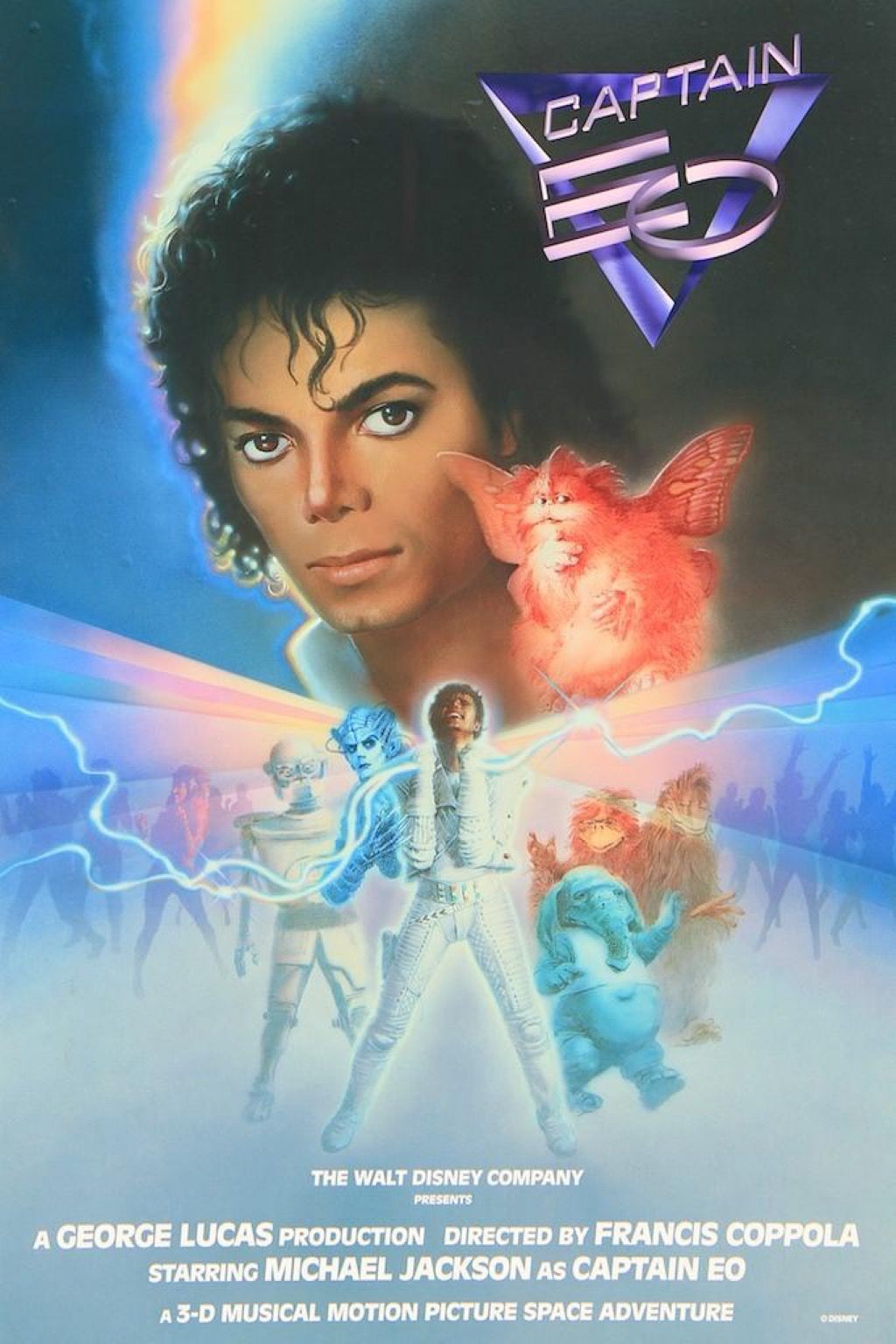
'Captain EO' at 40: Michael Jackson's wild sci-fi movie that you could only watch at Disney theme parks

15 September 2026 at 18:00

40 years ago on Sept. 12, 1986, musical icon Michael Jackson debuted in "Captain EO," a 17-minute long 3D sci-fi fantasy film. The catch? You could only see it at Walt Disney World's EPCOT Center in Florida, or β€” six days later β€” at Disneyland’s Magic Eye Theater over in Tomorrowland.

Jackson had already been anointed the King of Pop in the β€˜80s with the stellar multi-platinum album "Thriller" when the creative cosmic tumblers aligned, joining the immense talents of Jackson, George Lucas, Francis Ford Coppola and the wizards of Disney's Imagineering to create one of the most unique sci-fi entertainment offerings ever conceived.

With impressive special effects, catchy songs, dynamic dance numbers and co-starring Academy Award-winning actress Anjelica Huston as the witch queen known as the Supreme Leader, "Captain EO" was a huge attraction seen by millions of Disney guests.

It told the story of a rag-tag crew of space misfits led by Jackson's charismatic Captain EO (in a sweet white leather uniform) on a mission to a sinister industrial planet to deliver a mysterious gift to its despotic ruler. Plenty of hijinks ensue with EO's oddball companions: Major Domo, Hooter, Idy & Ody, and a winged kitten creature named Fuzzball.

After crash landing on the dark world directly onto the homing beacon, EO and his crazy crew are apprehended by a gang of warrior henchmen and hauled into the throne room to face the wicked alien ruler who is imprisoned in anger and hate.

Huston is electrifying in her Giger-esque makeup, supported by a tangle of banded black cables and sporting long fingernails that were deliciously thrust into audiences’ eyes using the magic of 3D and the special red-and-blue-lensed glasses handed out when arriving for each screening.

When EO's crew manifests into a musical band to offer a song to the Supreme Leader, Hooter trips over the power cord to ruin the performance. The commotion tries the queen’s patience and she dispatches her cruel Whip Warriors to capture EO and send him to her deepest, darkest dungeon.

But EO fights back with an illuminating t-shirt (hey, it was the '80s!), some fancy dance moves and a surge of musical energy to unlock her beauty. This transforms Huston into a colorful enchantress with her grim lair now becoming a lush Greek-like temple. Darkness turns to light and everyone leaves as peaceful galactic friends.

It's an honest plot with heart and humor filled with cool tunes and a sprinkling of in-your-face 3D moments for the whole family, and really, what else would you expect from a Jackson/Disney collaboration in the decade of excess?

a scene from a sci-fi musical

Michael Jackson in heroic form as the titular "Captain EO" (Image credit: Disney)

The two prominent songs β€” the original "We Are Here to the Change the World," and "Another Part of Me" β€” are used to great effect throughout the simple narrative. I can fondly remember leaving the Magic Eye Theater the first time I saw it in the 1990s with an uplifted attitude and the renewed vigor needed to brave the epic summertime Disneyland crowds. Over the years I’d revisited the film a dozen times and it's remained a fun time capsule of unbridled spirit perfect for its age and even more relevant today.

Production began on "Captain EO" in the summer of 1985 with "Star Wars"' creator George Lucas serving as producer and legendary Francis Ford Coppola of The Godfather fame in the director's chair. James Horner, who’d later go on to compose the music for "Titanic," was enlisted to pen the original score. Essentially an expanded music video similar in format to 1983’s horror short, "Thriller," "Captain EO" was filmed entirely in Los Angeles with Lucas's ILM unit called in for a VFX polish.

Costing nearly $30 million to produce, "Captain EO" was, at the time, the most expensive short ever filmed on a per-minute basis. It was also a pioneering attraction that used in-theater 4D techniques that delivered floodlights, fog, smoke, starfields, meteors and LED laser effects out into the audience in conjunction with the added visual component of its 70MM 3D filming process.

sci-fi characters in a theme park

"Captain EO's" Major Domo, Idy & Ody and Hooter at Disneyland (Image credit: Disney)

"For all those who share Walt Disney's dream and delight in the promise of the future, we cut this ribbon signifying the opening of the 3-D musical motion picture space adventure, 'Captain EO!,'" proclaimed Coppola at its 1986 Disneyland premiere.

The attraction ran continuously at Disney World’s EPCOT Center until 1994 and lasted three years longer at Disneyland's Magic Kingdom before it was closed in 1997.

Upon Jackson’s untimely death in 2009 it returned for an encore tribute run between 2010 and 2015, including re-releases at Tokyo Disneyland and Disneyland Paris before vanishing completely to be locked up forever in the Disney Vault. It was also broadcast once though on MTV for a 1995 Michael Jackson tribute.

a poster for a sci-fi musical film

"Captain EO" rocked the cosmos in Disney theme parks 40 years ago (Image credit: Disney)

While an official Disney streaming option is nowhere to be found, there are YouTube channels that have uploaded enhanced and/or upscaled copies of "Captain EO" if you've got a hankering for some heart-warming sci-fi.

With so many dire warnings, dystopian fare and AI doomsdays prophesied everywhere you turn, maybe we all need a little bit of Captain EO's hopeful β€œThe planets are linin' up, we're bringin' brighter days” message.

Making rocket fuel out of Mars' thin air: New breakthrough could make it happen

15 September 2026 at 17:00

Astronauts could travel back to Earth from Mars using rocket fuel converted directly from the carbon dioxide in the Red Planet's atmosphere, using a technique known as electrochemical reduction, a recent study reports.

It's an old method involving electrolysis, which is the application of an electrical current to drive a chemical reaction, but the new trick produces methane pure enough to be used as liquid propellant. (A number of rocket engines these days burn liquid oxygen and liquid methane β€” including the Raptors that power Starship, the rocket SpaceX is developing to help humanity get to Mars.)

"The work we're doing is basically taking CO2 and using electricity to convert it into carbon-containing fuels and chemicals," said Carter Racine in a statement. Racine is a Ph.D. student in mechanical engineering at Texas A&M University and a member of the study team, which was led by University of Mississippi chemical engineer Ahmed Badreldin.

"You can't bring up everything you need [on Mars] from Earth, because every additional kilogram adds enormous cost and complexity to launch and escape Earth's gravity," added Badreldin. "So the question becomes, How do we make the fuels and chemicals needed for space exploration from the resources already available at the destination?"

One answer is electrochemical reduction, which takes place in an electrolyzer, with electrons flowing from the negatively charged anode to the positively charged cathode. Water at the anode is oxidized, meaning it loses an electron, which is transferred to the carbon dioxide at the cathode, where one of its atoms gains an electron and becomes what chemists refer to as "reduced" (meaning its oxidation state is lowered). It can then react with the hydrogen and oxygen atoms that have split from the oxidized water molecules.

The anode contains a catalyst, and the choice of material for the catalyst dictates what carbon-based compounds are produced when the reduced carbon reacts with the hydrogen and oxygen. For example, a gold catalyst leads to the production of carbon monoxide (CO), while copper produces more complex compounds including alcohols, ethanol and methane (CH4).

What makes the work of Badreldin's team stand apart from previous experiments is that they have developed a nanometer-scale copper catalyst doped in nitrogen that is able to produce nearly pure methane.

Electrochemical reduction of carbon dioxide has been used to produce methane before, in applications on Earth. The problem is, those methods have produced a lot of byproducts alongside methane. On Earth we have complex equipment that separates the methane from the other unwanted compounds, but astronauts are not going to be able to take such unwieldy devices to Mars when every kilogram counts. That's a problem, because for methane to be used as a liquid propellant in rocket fuel it needs to be pure.

artist's illustration of a small human outpost on mars

NASA wants to send astronauts to Mars in the late 2030s or early 2040s. (Image credit: NASA)

However, the specific copper catalyst used by Badreldin's team is able to preferentially produce methane over other compounds, thereby creating it pure without having to refine it. And there's plenty of carbon dioxide available on Mars to use: While Mars' atmosphere is thin, it is nonetheless composed of 96% carbon dioxide.

Even if astronauts never go to Mars, the usefulness of this technique on Earth is clear. Rather than drilling for this natural gas, we can create methane from the carbon dioxide already in our atmosphere.

"We want to do that because right now many of these carbon-based products ultimately come from virgin fossil resources," said Racine. "If we can make them using captured CO2 and renewable electricity, it could reduce reliance on virgin fossil carbon and help close the carbon cycle."

Consequently, electrochemical reduction has also been suggested for use on Earth as a carbon sequestration technique, drawing carbon dioxide out of our atmosphere where it acts as an unwanted greenhouse gas.

The problem with that is, converting carbon dioxide into methane to be burned as a fuel simply releases that carbon dioxide straight back into the atmosphere in a net-zero cycle. Ideally, we want to lock that carbon dioxide away from the atmosphere for a long period of time, but Badreldin doesn't think the technology is ready yet.

"What we are ultimately interested in is seeing whether we can move beyond simply recycling CO2 and toward pathways that are net-negative," he said. "That means using CO2 as a carbon source while converting it into products where the carbon is stored or used long enough that it is not immediately released back into the atmosphere."

It should be noted that the best way to alleviate climate change is to cease burning all fossil fuels, including methane. However, using methane created from electrochemical carbon dioxide reduction in a net-zero process rather than drilling for it could help during the transition from fossil fuels to renewable resources.

The study reporting this research was published in April in the journal ACS Catalysis.

'The violence leaves a mark': How satellites are helping the world monitor war and atrocities

For decades, researchers have been monitoring armed conflict around the world by analyzing news reports and collecting oral testimonies. This approach, while valuable, has its limitations. A new study suggests that a satellite's view from above might fill the gaps in our understanding of the grim realities of war.

In 2017, the Myanmar Army murdered several hundred Muslim Rohingya civilians in the village of Chut Pyin near the country's western coast. Reports of the massacre in the settlement of about 2,000 reached the world through the testimonies of survivors who fled to neighboring Bangladesh. The massacre was part of a years-long campaign of brutality against the Muslim minority conducted by the Buddhist-run state. Satellite data later showed that houses in the predominantly Rohingya neighborhood were burned down by the Myanmar military during the atrocity, providing undeniable proof that the ethnic minority was targeted.

The incident is one of many demonstrating the advantage of adding views from space into conflict research, study lead author Valerie Sticher, a political science researcher at the University of Zurich in Switzerland, told Space.com.

"We have huge data sets about wars around the world going back 40 years," Sticher said. "But those datasets are based mostly on media reports. And these reports are not always available and not always reliable. Media can have biases and often focus only on certain types of violence."

For example, human reporters are more likely to focus on the numbers of people killed rather than the number of houses destroyed, she said. Satellites, on the other hand, provide a broad sweep over vast areas of land and, crucially, revisit the same location repeatedly. They can reveal patterns in conflicts and trends that could otherwise go undetected, while providing an overview of areas controlled by authoritarian regimes.

The researchers are now developing a methodology to integrate satellite observations into conflict research and create automated image analysis pipelines that would generate early warnings and alert the world to what's happening on the ground.

"Automated satellite data analysis would allow us to respond faster," said Sticher. "For example, in Myanmar, the area affected by ethnic cleansing was closed to independent journalists and investigators. Satellite data was the earliest reliable information to reach the outside world."

satellite photo of a circular, blue launch pad in the desert with black smoke rising from it

A SkySat Earth-observation satellite operated by the California company Planet spotted the wreckage of a failed launch out of Iran's Imam Khomeini Space Center on Aug. 29, 2019. (Image credit: Planet Labs, Inc.)

Hannes Mueller, a conflict researcher at the Spanish National Research Council, said that totalitarian governments can be very good at preventing information about atrocities from reaching the world. However, they can hardly fool satellites.

"In Myanmar, for example, when the military clears villages, they frequently kill everybody in those villages," he said. "Then you don't have any eyewitnesses for you to find out what's going on. But they usually also destroy the entire village, and so the violence leaves a mark from space."

Mueller was not involved in the new study but has used satellites in his work since the conflict in Syria in the early 2010s. He lauds the new paper for trying to "plot the road" for a more systematic integration of satellite data into conflict-monitoring data sets.

"Imagine we could generate a data stack of the entire world of all housing destruction since 2020 without any gaps in it," he said. "That would be a complete breakthrough!"

But satellites, too, have their limitations, he said. Currently, spacecraft must be tasked to take images and beam them to Earth. Because of the limited download availability, they can't image every spot they fly over, meaning they usually only reveal the aftermath of catastrophic incidents. For example, the Syrian city of Homs only became the focus of satellite imaging campaigns after the Syrian military attacked it with heavy artillery to suppress pro-democracy protests.

"There are no images of Homs before it got attacked," said Mueller. "There is no archival data of the city from before. Then, after the attack, you suddenly get lots."

In the future, onboard AI image processing β€” which some of the commercial satellite Earth-observation companies have already rolled out β€” might solve the problem. Machine learning algorithms running on computers on board the satellites will be able to detect incidents of potential interest and autonomously select significant images to send to the ground.

But there are other concerns. Just as authoritarian regimes can deny access to warzones to independent journalists, governments can order Earth-observation companies to restrict access to images of specific areas. In fact, the U.S. government did just that earlier this year when it ordered American commercial Earth-observation providers like Planet Labs to stop releasing high-resolution images of the Gulf of Oman and the Strait of Hormuz amid the escalating conflict in the region. The U.S also asked Europe to delay releasing images of that region captured by the European Sentinel satellites by 24 hours.

"With that, we are back to the same biases that we have with the news reporting," Mueller said. "We need to think about infrastructure that would provide us with transparency. That would really be a revolution in conflict research."

The new study was published in the journal Nature on Sept. 9.

On this day in space! Sept. 15, 1968: Russian tortoises (& other critters) launch around the moon on Zond 5 spacecraft in wild first circumlunar flight

15 September 2026 at 15:00

On Sept. 15, 1968, the Soviet Union launched the Zond 5 spacecraft on a mission to loop around the moon and return to Earth. There were no cosmonauts aboard, but there were several smaller vertebrates β€” including the first two tortoises to ever go to space!

Other passengers included wine flies, mealworms, plants and seeds. These were the first animals in deep space and the first to travel around the moon.

The Soviet Zond 5 rentry capsule in the ocean (left), Soviet scientists measure Zond 5 tortoises after their circumlunar flight in September 1968.

The Soviet Zond 5 rentry capsule in the ocean (left), Soviet scientists measure Zond 5 tortoises after their circumlunar flight in September 1968. (Image credit: RSC Energia)

After looping around the moon, the Zond 5 spacecraft turned around and came back to Earth. It was supposed to land in Kazakhstan on Sept. 22, but the spacecraft's guidance system failed, and it splashed down in the Indian Ocean instead.

The Soviets did recover the capsule and found that the tortoises and other critters were still alive, although they had lost some weight since the start of the mission.

At left: The Soviet Union's Zond 5 mission launches on the first circumlunar flight on Sept. 15, 1968 from Baikonur, Cosmodrome. At right: A view of the Earth from deep space from Zond 5.

At left: The Soviet Union's Zond 5 mission launches on the first circumlunar flight on Sept. 15, 1968 from Baikonur, Cosmodrome. At right: A view of the Earth from deep space from Zond 5. (Image credit: RSC Energia)

Why it mattered

In September of 1968, the Space Race to the moon was in full swing. NASA was just three months away from the historic Apollo 8 mission, which sent the first astronauts around the moon in daring first-of-its-kind mission.

But with Zond 5, the Soviet Union scored an early win for the first circumlunar flight that launched from the Earth to the moon, then returned for a landing (or splashdown, in this case). In fact, the flight may have spurred NASA to launch Apollo 8.

The Soviet Zond 5 rentry capsule (left) and a declassified U.S. reconnaissance photo of an N-1 moon rocket on the launch pad in September 1968.

The Soviet Zond 5 rentry capsule (left) and a declassified U.S. reconnaissance photo of an N-1 moon rocket on the launch pad in September 1968. (Image credit: NASA/RSC Energia/NRO)

"The flight of Zond 5 caused concern in the U.S. that the Soviets would place cosmonauts aboard the next Zond and complete the first crewed circumlunar mission. At about this time, a U.S. Corona reconnaissance satellite photographed an N-1 rocket on its pad at Baikonur," NASA wrote in a report, adding that NASA's then-chief James Webb likely saw those intelligence reports.

"The apparently successful Zond 5 mission coupled with the photos of the Soviet lunar booster on the launch pad may have contributed to the decision to send Apollo 8 on its circumlunar mission in December 1968, bringing the moon landing one step closer."

Zond 5 launched from Baikonur Cosmodrome atop a Proton rocket and took three days to reach the moon. The two tortoises on board were, appropriately, Russian steppes tortoises, NASA has said. After looping around the moon, the critters spent a few more days in transit for the trip home.

It was a guidance system error that led the Zond 5 capsule to splash down in the Indian Ocean instead of landing on land as planned. But the landing on Sept. 21 wasn't the end of the road for the Zond 5 tortoises and other animals.

The Soviet recovery ship Vasily Golovnin plucked the Zond 5 capsule from the ocean and returned to port in what is now Mumbai, India on Oct. 3, weeks later! They wer ethen flown to Moscow on an Antonov-12 cargo plane before the capsule was finally opened to find the tortoises alive and in good health. You can still view the Zond 5 capsule at the RSC Energia museum in Korolev.

Cassini's Grand Finale death dive at Saturn in 2017

Artist's illustration of NASA's Cassini spacecraft plummeting through Saturn's atmosphere on Sept. 15, 2017.

Artist's illustration of NASA's Cassini spacecraft plummeting through Saturn's atmosphere on Sept. 15, 2017. (Image credit: NASA)

A bunch of space traveling tortoises and other animals aren't the only notable space event that happened today in history.

On Sept. 15, 2017, NASA's Cassini spacecraft died in a blaze of glory as it crashed into Saturn after 13 years orbiting the ringed planet. NASA ended the mission in a fiery plunge because Cassini was running out of fuel and the space agency wanted to ensure it wouldn't crash into one of Saturn's icy moons, like Enceladus, and contaminate them. They called it Cassini's Grand Finale.

Launched in 1997, the $3.26 billion Cassini mission entered orbit around Saturn in 2004 and dropped a European Huygens probe onto the cloudy moon Titan in early 2005. The mission was expected to last until 2008, but was extended twice, ultimately stretching through to September 2017.

During its mission life, Cassini discovered a trove if new Saturn moons, found a strange hexagon at the planet's north pole and tracked mesmerizing details of the planet's many rings.

"Congratulations to you all," Earl Maize, the Cassini program manager, said to the mission team after the spacecraft signal was lost."This has been an incredible mission, an incredible spacecraft, and you're all an incredible team. I'm going to call this the end of mission."

Want more space history? Check out our full On This Day In Space Story archive and watch our On This Day In Space videos on YouTube.

❌