Archaeologists have discovered an iron cannonball fired by Texans at the Battle of the Alamo in 1836. This is the second intact cannonball they have discovered from the famous conflict. The first one, a bronze cannonball, was found earlier this year and was likely fired by the Mexican army.
"It's a huge deal," Tiffany Lindley, director of archaeology at the Alamo, said in a video statement from Alamo Trust. "We all thought, 'There's no way we can top it,'" she said, referring to the bronze cannonball discovered March 5, just a day before the 190th anniversary of the conflict that killed Davy Crockett, "and then we found another one."
Both cannonballs were recovered from the northeast corner of the church at the Alamo, which was originally built in 1718 as a Spanish mission and fortress in what is now San Antonio. But the Alamo is better known as the location of an 1836 battle during the Texas Revolution, in which Anglo-American settlers and Hispanic Texans known as Tejanos seceded from the Republic of Mexico.
In a 13-day siege culminating in a deadly assault on March 6, 1836, Mexican troops, commanded by Gen. Antonio López de Santa Anna, surrounded the Alamo and killed the 180 Texan rebels defending the structure, including Davy Crockett. The cry "Remember the Alamo!" was used in later skirmishes in the Texas Revolution as soldiers fought Mexican troops for independence.
The newly excavated iron cannonball was found June 2, according to a statement from Alamo Trust.
Of the two cannonballs, "the newest one is slightly larger" and was likely fired from a cannon that shot 6-pound [2.7 kilogram] cannonballs, Kolby Lanham, a senior researcher and historian at the Alamo, said in the statement. "The likelihood is that the bronze one belonged to the Mexican Army and the iron one belonged to the Texans."
Over the years, archaeologists have found numerous pieces of ammunition and shrapnel at the Alamo, Lindley said, but these cannonballs are the first examples of solid shots — spherical projectiles fired from a gun or cannon — they have ever found.
"It's just a huge kind of once-in-a-lifetime deal," Lanham said. "But obviously, it's happened twice."
The size and weight of the cannonball suggests it was fired by a cannon that shot 6-pound cannonballs. (Image credit: Alamo Trust)
The Mexican and Texan cannonballs were found near each other, so they are likely the historic remains of the two sides shooting at each other in the fateful siege nearly two centuries ago.
"Whenever they were dropped the very first time — possibly in 1836, probably — they haven't been touched since, and that's what makes them extra special," Lindley said. "I don't think you can undersell it."
The Alamo remains an active archaeological site, where experts have discovered artifacts that span its centuries of history, from Indigenous stone tools that predate the Spanish mission through the late 19th century, when the structure was converted into a general store and warehouse.
Physicists recently wondered what would happen if you tried to split a photon — and they found some unexpected behavior that may transform the way we think about particles.
The experiment, in which researchers simulated a photon being sliced by a shutter under various conditions, showed that a severed photon can lead to a complex mixture of zero to infinitely-many photons — raising some big questions about the nature of particle interactions.
Photons are elementary packets of light, which means they are not made up of anything else. So what does it even mean to try splitting a photon? It may be possible thanks to wave-particle duality — a core principle of quantum mechanics, the bizarre physics of the very small.
According to wave-particle duality, a photon is not only a particle but also a wave. Using theoretical calculations, the researchers investigated what would happen if you sent this photon through a shutter and closed it while the photon was passing through, effectively cutting off the tail end of the photon wave.
"I think that most physicists would expect there to be a certain probability that you have zero photons and a certain probability that you have a single photon left after you have done this," Johannes Skaar, co-author of the new study and a professor of theoretical physics at the University of Oslo, told Live Science. "And that is approximately true, but it is not exactly true."
What are the chances?
This brings up another strange aspect of quantum mechanics: its probabilistic nature. Particles exist as a cloud of probabilities stretching to infinity. Until a particle is observed, its properties, such as its position or energy, are in a superposition of possible values; all we can know are the chances of finding it in a certain state.
Through their calculations, Skaar and his colleagues determined how cutting a photon affects these probabilities. In their study, recently accepted in the journal Physical Review Letters, they found that it would create a complex mixture of photon states, including one with an infinite number of photons.
Each of these states has a probability that depends on how quickly the shutter cuts the photon. The expected number of photons becomes infinite only if the shutter is closed infinitely quickly. For realistic shutter speeds, even a thousand photons would be extremely unlikely.
This may sound very strange, but the quantum physicists were unfazed. In fact, what surprised Skaar and his colleagues was what happens if you make measurements of the cut photon from different perspectives.
A photo of an optical table with laser and beam-splitting cube, often used in photonics research. (Image credit: EschCollection via Getty Images)
"When you measure from one side of the shutter, then it will look like a single photon state," Skaar said. "Then, on the other side, it will look like a vacuum state — that means no photons. And that is very strange because the actual state globally is this mixture from zero to infinity."
Changing how we think about particles
The fact that these complex mixtures can be treated locally as very simple states raises fundamental questions about the nature of particles. Skaar said they are still reckoning with the full extent of these implications and they are now considering how this process could play out for other quantum particles, such as electrons.
They hope that by following this theoretical thread through, they may be able to develop a neater way of describing particle interactions. Currently, particles' infinite stretching means they have been interacting for an infinite amount of time. This then poses a problem for causality — the order of cause and effect — in particle interactions, the team said.
These new theoretical photons with a cutoff tail would not have this problem, meaning the causal link in an interaction would be clear, Skaar said. He admitted that there is much more work to be done to develop the theoretical description of this interaction. However, the new result is an important step toward describing particle interactions with a clear causal relationship, which Skaar described as the team's "ultimate goal."
Hunter-gatherers in Siberia fell victim to lethal plague outbreaks around 5,500 years ago, marking the oldest known evidence of plague to date, a new study finds.
A research team investigating the Stone Age remains identified ancient DNA ion over a dozen individuals that came from previously unknown strains of Yersinia pestis, a bacterium that causes pneumonic, bubonic and septicemic plague.
The disease that infected these hunter-gatherers, most likely pneumonic plague, probably spilled over from wild marmots, and ravaged through family groups living around Lake Baikal, according to the study, published Wednesday (June 17) in the journal Nature.
Ancient DNA from the two newfound plague strains revealed a unique gene that codes for proteins that trigger massive immune responses, perhaps explaining why children were the most likely to die from the disease, the authors wrote in the study.
The discovery of two deadly plague outbreaks in prehistoric hunter-gatherers challenges the long-standing assumption that epidemics first occurred after the rise of agriculture, study first author Ruairidh Macleod, a researcher of ancient genomics at the University of Oxford, told Live Science.
"We got the really striking result that we found lots and lots of plague here far earlier than we expected," Macleod said. This is "the closest we'll probably ever get to a direct smoking gun demonstrating the virulence [the ability of germs to cause disease] of these early plagues."
Understanding how the disease has evolved over time is essential for gaining insight into how Y. pestis may change in the future, study co-author Eske Willerslev, an evolutionary geneticist at the University of Copenhagen, said at a news conference Tuesday (June 16), ahead of the study's publication.
Prehistoric plague outbreaks
Research suggests that plague outbreaks devastated communities long before the Black Death, the catastrophic epidemic that swept through 14th-century Europe and killed around 25 million people, or between 25% and 33% of Western Europe's population at the time.
Now, a close inspection of the ancient DNA of hunter-gatherers buried in four cemeteries along the banks of the Angara River, which flows out of Lake Baikal, has provided "the best kind of evidence that we could probably hope for" that prehistoric plague strains were lethal and resulted in mass death, Macleod said.
Lake Baikal is in southeast Siberia. (Image credit: Ralph White via Getty images)
During previous excavations of these cemeteries, researchers noticed that an unusually high number of children had been buried over a short period. There were no signs of violence or other injuries, Macleod said at the news conference, leaving the archaeologists stumped as to why so many children died.
Macleod and his team stepped in to see if ancient DNA could shed light on this mystery.
The researchers extracted ancient DNA from the teeth of 46 individuals at the four cemeteries. They checked whether any were related while also scanning for ancient DNA from known germs.
To their surprise, they identified large amounts of Y. pestis in 18 individuals. These cases spanned two distinct disease outbreaks: one lasting from around 5,596 to 5,341 years ago, and another most likely spanning 5,126 to 4,926 years ago.
Some graves contained the remains of multiple infected individuals who were buried at the same time, suggesting they died during the same outbreak. One grave belonged to three closely related young girls, while another held a nephew and aunt.
"There must have been survivors who knew these people when they were alive and what their identities were and what their biological relationships were to bury the dead and bury them in shared graves," Macleod said.
It is currently not possible to identify plague-specific antibodies that would identify which individuals survived the outbreaks, he added.
The findings help to support the idea that prehistoric populations were impacted by plague, Aida Andrades Valtueña, a researcher who specializes in ancient pathogens at the Max Planck Institute for Evolutionary Anthropology in Germany but was not involved in the study, told Live Science in an email.
However, more complete sequencing of the plague DNA is needed to confirm that the various cases were from the same outbreak, rather than from separate infections, she noted.
What do you know about the Paleolithic, Mesolithic and Neolithic eras? Find out with our Stone Age quiz.
A Chinese spacecraft has arrived at one of Earth's temporary "quasi-moons" and will soon attempt to land on the space rock to scoop up samples that will be returned to our planet next year. The ambitious mission could help researchers uncover secrets about Earth's main moon and provide clues that may benefit space exploration and planetary defense, experts say.
The mission's primary target is 469219 Kamo'oalewa — also known as 2016 HO3 or simply Kamo'oalewa — a near-Earth asteroid discovered in 2016 by astronomers at Hawaii's Haleakala Observatory. It likely spans somewhere between 130 and 330 feet (40 to 100 meters) across and is a "quasi-satellite" of our planet, meaning it's orbiting the sun right alongside Earth in a temporary partnership. (Kamo'oalewa means "oscillating celestial fragment" in Hawaiian.)
Tianwen-2 is predicted to have arrived at Kamo'oalewa on June 7 and inserted itself into an orbit alongside the asteroid, according to an unverified timeline shared by freelance journalist Andrew Jones, a leading expert on China's space program. Around a month later, on July 4, the probe is expected to descend upon the space rock to collect samples from its surface, potentially employing a never-before-seen drilling technique to do so. (The CNSA has not released an official timeline for the mission or shared any recent updates about its progress.)
If successful, the samples are expected to be returned to Earth on Nov. 29, 2027, according to the same timeline. At this point, Tianwen-2 will then slingshot around our planet and head farther out into the solar system for its secondary mission: to rendezvous with and study 311P/PanSTARRS — a peculiar object beyond Mars, which displays characteristics of both comets and asteroids — in 2035.
This photo of one of Tianwen-2's decagonal solar panels, captured in orbit, was the first image of the probe released by the CNSA. (Image credit: CNSA)
Samples from Kamo'oalewa could help answer many interesting questions, including the true origin of the object, which some experts believe may have broken off from the moon.
"What makes [this mission] extraordinary is that we don't yet know [the object's] composition or origin," Li Chunlai, a researcher with the Chinese Academy of Sciences' National Astronomical Observatories and chief commander of Tianwen-2's ground application system, said in a state-sanctioned video translated to English. "We'll only obtain definitive answers after completing our exploration."
What is Kamo'oalewa?
There are currently eight known quasi-moons orbiting the sun alongside Earth, following the most recent quasi-moon discovery in September 2025. Unlike the similarly named "minimoons," which are asteroids that are briefly captured by Earth's gravity for a few months or years at a time, quasi-moons are temporary satellites that slowly circle our planet but are never gravitationally bound to it.
This relationship can last decades, or even centuries. For example, experts think Kamo'oalewa has been accompanying our planet for at least 100 years and could remain alongside it for another 300 years before it starts to fall out of sync with our solar orbit.
On June 7, when Tianwen-2 was expected to arrive at Kamo'oalewa, the space rock was around 24.2 million miles (39.1 million km) from Earth. (Image credit: NASA/JPL/Small-Body Database Lookup)
"The way Kamo'oalewa moves with Earth is kind of like a dog that might tag along with you for a while on a long walk through the woods, but it's not your dog," Richard Binzel, a planetary scientist and asteroid expert at MIT, told Live Science in an email.
The Ferris-wheel-size space rock is one of the closest quasi-moons to us, with a minimum distance of around 2.9 million miles (4.6 million kilometers) from Earth, or around 12 times farther away than our actual moon. It is also one of the fastest-spinning quasi-moons, rotating around its axis every 30 minutes. But unlike other quasi-moons, which likely originate from the solar system's main asteroid belt, between Mars and Jupiter, our current best guess is that Kamo'oalewa is actually a piece of the moon.
This hypothesis is based on observations from 2021 that showed Kamo'oalewa absorbs and reflects light similarly to the moon, hinting that the space rock may be a chunk of lunar material ejected by a long-ago meteor strike. More recently, in 2024, researchers narrowed down the most likely impact crater from which the asteroid originated: the 13.6-mile-wide (22 km) Giordano Bruno crater, located on the far side of the moon. However, there is still a chance that Kamo'oalewa is a main-belt asteroid that just happens to look an awful lot like lunar material.
Kamo'oalewa (a.k.a. 2016 HO3) circles Earth but does not orbit our planet. This simulation shows its predicted movements relative to Earth over the next few centuries. (Image credit: NASA/Pheonix7777/Wikimedia)
"I am curious to find out the answer about its origin, since the debate on its [potential] lunar origin is still very open," Marco Fenucci, a mathematician at the European Space Agency's Near-Earth Objects Coordination Centre who has co-authored multiple studies on Kamo'oalewa, told Live Science. This mission should "definitely give us an answer to this matter," he added.
Scientists are also unsure whether Kamo'oalewa is a "solid monolithic rock," like the $100,000 quadrillion asteroid Psyche (the target of NASA's ongoing Psyche mission), or a "rubble-pile-like asteroid," such as Bennu or Ryugu, both of which have been explored by sample-return missions in recent years, Fenucci said.
Scooping up samples
Having arrived at Kamo'oalewa, Tianwen-2 will spend the next few weeks mapping the asteroid's surface at altitudes between 1,000 feet and 12.5 miles (300 m to 20 km) above its surface, according to limited mission details revealed by Chinese scientists in a January study. The resulting map will allow researchers to estimate the asteroid's density and work out the best landing spot.
On July 4, the probe is expected to swoop down and scoop up around 3.5 ounces (100 grams) of surface material, or regolith, from the asteroid, which is slightly less than what NASA's OSIRIS-REx mission managed to grab from Bennu. However, there are multiple ways this sampling process could play out.
If the asteroid is a pile of rubble, the probe will utilize a touch-and-go approach, which involves hovering just above the surface and using a robotic arm to reach out and grab the sample. This method was also used by OSIRIS-REx for Bennu and by Japan's Hayabusa2 mission, which scooped up samples from Ryugu.
But if Kamo'oalewa has a more solid surface, Tianwen-2 will attempt to land directly on the space rock and anchor itself in place before drilling into the asteroid. This has never been attempted before and could allow for longer contact time and "more controlled sampling," according to The Planetary Society.
Tianwen-2 will circle Kamo'oalewa at various altitudes in order to scan the space rock and figure out its best possible landing spot. (Image credit: Zhang et al. 2026)
After collecting samples, the probe will remain alongside the asteroid and conduct further analysis of its size, shape and trajectory.
In late April 2027, Tianwen-2 will depart Kamo'oalewa and begin the six-month journey back to Earth, where it will dump its samples in a return capsule that will fall to our planet's surface as the probe begins its long journey to rendezvous with 311P/PanSTARRS.
The return capsule will reenter Earth's atmosphere at around 27,000 mph (43,500 km/h), researchers wrote in the January study. That's slightly faster than the Orion capsule carrying the Artemis II astronauts traveled as it fell back to Earth in April.
What could we learn from Tianwen-2?
In addition to ending the debate over Kamo'oalewa's origin, samples from Tianwen-2 could reveal more about the solar system and our place within it.
For example, previously returned asteroid samples have helped to "tell us where Earth's water came from, how complex organic molecules were distributed in the early solar system, and how surface processes like space weathering alter asteroid properties over time," Fenucci said. These samples can also be used to "establish a link to known meteorites found on Earth" and help us learn more about these space rocks, he added.
Tianwen-2 launched into space May 28 on board one of China's Long March 3B rockets. (Image credit: VCG/VCG via Getty Images)
The proximity of quasi-moons and minimoons to Earth also makes them valuable assets for future space exploration missions. Some researchers have proposed using them as temporary bases or refueling stations that could serve as stops on the way to Mars or other faraway destinations. These objects "could become literal stepping stones for human missions to practice what it is like to leave the Earth-moon cradle," Binzel said.
One particular idea that scientists want to explore is whether water can be extracted from these objects. And if Kamo'oalewa is a piece of the moon, that could have implications for NASA's planned moon base. "Someday, it might be possible to extract that water to provide resources for thirsty astronauts or even generate usable rocket fuel from the hydrogen," Binzel said.
"Over the time scale of centuries, these kinds of objects have a chance of striking the Earth," said Binzel, who invented the Torino scale used to measure the impact potential of near-Earth objects. Therefore, a better understanding of space rocks like Kamo'oalewa "can prepare us in how to deal with a threatening object if one were ever discovered," he added.
A giant blob of abnormally cold water in the North Atlantic Ocean is shifting the Indian summer monsoon, threatening the livelihoods of more than 1 billion people, new research suggests.
The link between these two systems highlights a previously unrecognized connection that could inform weather forecasts in South Asia and shed light on climatic events elsewhere, scientists say.
The Indian summer monsoon is a rainfall pattern that lasts from June to September and is driven by temperature differences between the warm northern Indian Ocean and cooler seawater below the equator. Historically, the monsoon triggered heavy rainfall along the west coast of India and a huge region of northern India called the Indo-Gangetic Plain. But since 1999, this pattern has changed dramatically, the researchers reported in a new study.
Northwest India now receives about 25% more rain during the monsoon season than it did before 1999, while the Indo-Gangetic Plain gets roughly 4% less, the team found. This is disastrous for farmers, in particular, because their soils and crops are adapted to the old rainfall pattern, said study first author Mahendra Nimmakanti, a climate scientist at the Indian Institute of Science's Centre for Atmospheric and Oceanic Sciences.
"India is largely dependent on agriculture," Nimmakanti told Live Science in a joint interview with study co-author Matthew Huber, a professor in the Department of Earth, Atmospheric, and Planetary Sciences at Purdue University in Indiana. Higher-than-normal precipitation in northwest India is causing flash floods and crop losses, because agriculture in this region is adapted to dry conditions. Meanwhile, the Indo-Gangetic Plain has seen periods of drought that also caused crop declines and impacted farmers' livelihoods, Nimmakanti said.
Previous studies have linked shifts in the Indian summer monsoon to changes in the Atlantic Meridional Overturning Circulation (AMOC), a giant web of ocean currents in the Atlantic that regulates the global climate and carries heat to the Northern Hemisphere. Data suggests the AMOC is slowing due to climate change and releasing less heat in the North Atlantic Ocean than it did before. This may be causing a southward shift of the Intertropical Convergence Zone, a band of low-pressure atmospheric conditions around the equator that drives tropical monsoons, including the Indian summer monsoon.
But these studies didn't specify how the Indian monsoon might shift or explain the underlying mechanism in detail, Nimmakanti said. "They generally explain that if there is a weakening of AMOC, that suppresses the Indian summer monsoon," he said.
One part of the problem is that current climate models do not show the changes in the Indian monsoon that have happened in real life, possibly because they also don't fully capture shifts in North Atlantic sea surface temperatures. This is especially true for a region southeast of Greenland known as the "cold blob," where the water was colder between 1901 and 2021 than it was in the late 1800s, even as the ocean around it heated up.
To pinpoint how and why the Indian monsoon has changed, the researchers fed precipitation data, sea surface temperature records and other real-life observations into dozens of climate models. This reproduced the shifts observed over the past 27 years. However, the results only implied a correlation between shifts in the North Atlantic and changes in the monsoon, not that the former directly caused the latter.
Northwest India now gets 25% more rain during the monsoon season than it did before 1999, and this shift has also increased flooding risk in Pakistan. (Image credit: Sabir Mazhar/Anadolu via Getty Images)
To figure out if North Atlantic sea surface temperatures caused the Indian monsoon to behave strangely, the team added and removed the cold blob in a simulation. The results showed that the cold blob has shifted the Indian monsoon by creating a strong temperature gradient over the North Atlantic, which, in turn, affects jet stream winds and pressure systems in the atmosphere above Eurasia.
Specifically, the jet stream above the North Atlantic has intensified, and a "blocking" system over the Ural Mountains in western Russia has strengthened, Huber said. As a result, weather systems in India have changed, sucking moist air toward the country's northwest and away from other regions.
"It's a shifting of the high- and low-pressure systems," Huber said. "Realizing that these two systems were directly linked through this wave train coming off the North Atlantic, that was novel."
More than 1 billion people in India and other parts of South Asia depend on the monsoon for food security and economic stability. The new results, published April 27 in the journal AGU Advances, could help forecasters predict extreme rainfall and drought events in India and neighboring countries like Pakistan during the monsoon season.
Some researchers think the Indian monsoon is a key tipping point within the global climate, and the findings suggest the system crossed a threshold in 1999. Since then, the cold blob has caused a "persistent jet stream reorganization," leading to abrupt shifts in the monsoon, according to the study.
It's unclear how the Indian monsoon will evolve under intensifying climate change, because climate models produce different predictions of what will happen in the North Atlantic, and other drivers may come into play as the world changes, Huber said.
"What we do now know is that this is one of the key building blocks of formulating a theory for what will happen in the future," he said.
These discoveries have raised a provocative question: How deep do the roots of mathematical thinking go? While modern humans are the only known species to develop formal mathematics, studies of crows, monkeys and other animals suggest that the cognitive building blocks of math may have evolved hundreds of millions of years before people began doing calculations.
Few researchers have done more to uncover these abilities than Andreas Nieder, a professor of animal physiology and the director of the Institute of Neurobiology at the University of Tübingen in Germany. By examining the neural activity of both monkeys and crows, Nieder has found evidence that very different animal brains can process numerical information in surprisingly similar ways. Live Science spoke with Nieder about how these findings may reveal that the origins of mathematics are far older than our species.
Kenna Hughes-Castleberry: How did you get into researching crows and primates?
Andreas Nieder: After studying the auditory and visual systems for several years as a student, I realized that I wanted to focus on the neuronal foundations of intelligence and cognitive control functions. How does the brain give rise to abstract concepts, working memory, or the ability to follow complex rules deliberately? Of course, to study intelligence, you need intelligence specialists. I therefore began working with primates — more specifically, rhesus monkeys, arguably among the most intelligent mammals. They are closely related to humans, possess relatively similar brains, and share many cognitive abilities with us.
However, as a trained biologist, I was always interested in a broader evolutionary question: Are sophisticated cognitive abilities unique to mammals, or can they emerge in very different brains? Crows provided an ideal comparative species. Birds diverged from mammals more than 360 million years ago — roughly six times longer ago than the extinction of the dinosaurs. Yet despite this immense evolutionary distance, corvids display remarkably flexible behavior; in many ways, they are the feathered primates of the air.
Some are reliable, highly motivated workers that perform consistently day after day. Others are sensitive divas who seem to require special treatment before they are willing to cooperate.
Andreas Nieder
KHC: Are crows difficult to study? Are they fun? Do they have personalities?
AN: Both primates and crows are demanding to study. Because they are highly intelligent, they require special housing and care. Since we investigate cognitive abilities under tightly controlled experimental conditions, they also require extensive behavioral training by skilled personnel. And, of course, the regulations governing research with these species are particularly strict.
At the same time, they are fascinating research subjects. Individual monkeys and crows differ noticeably in temperament and behavior. Some are curious and adventurous, others are cautious and reserved, and some learn new tasks much faster than others.
Their qualities can be quite striking. Some are reliable, highly motivated workers that perform consistently day after day. Others are sensitive divas who seem to require special treatment before they are willing to cooperate. Researchers generally avoid anthropomorphizing, but there is little doubt that individual animals exhibit stable behavioral traits that we would reasonably describe as distinct characters.
KHC: You've found that crows understand the concept of zero. How do we know this?
AN: We trained crows to recognize different numbers — sets containing one, two, three, four objects, and so forth. We then included trials in which no items appeared at all. The remarkable finding was that the birds treated an empty set as a quantity and as part of the numerical continuum. They behaved as though the empty set belonged before "one." Their error patterns were particularly revealing: They confused zero more often with one than with larger numbers, exactly as one would expect if zero were mentally represented as a numerical quantity next to one. In addition, recordings from neurons in the crow brain showed cells that responded selectively to empty sets. This suggests that zero is not merely a behavioral trick but is represented neurally as a meaningful numerical category.
KHC: To play devil's advocate, is the ability to recognize the difference between something and the lack of something really that surprising? Is it akin to the human concept of zero?
AN: That's an important question. Simply recognizing that nothing is present or absent is not surprising. Many animals can distinguish between the presence and absence of objects. The key issue is whether they treat "nothing" as a quantity that can be compared to other quantities.
Our experiments suggest that crows do more than detect absence. They position empty sets within an ordered numerical sequence, at the low end of the number line, and show distance effects similar to those observed with other numbers. For example, they find it easier to distinguish zero from two than zero from one.
That said, we should not claim that crows possess the full human mathematical concept of zero. Humans use symbolic zero in arithmetic, algebra, calculus and formal mathematics. What we have demonstrated is a foundational precursor: a nonsymbolic numerical representation of zero. This may represent an evolutionary building block from which more sophisticated human concepts eventually developed.
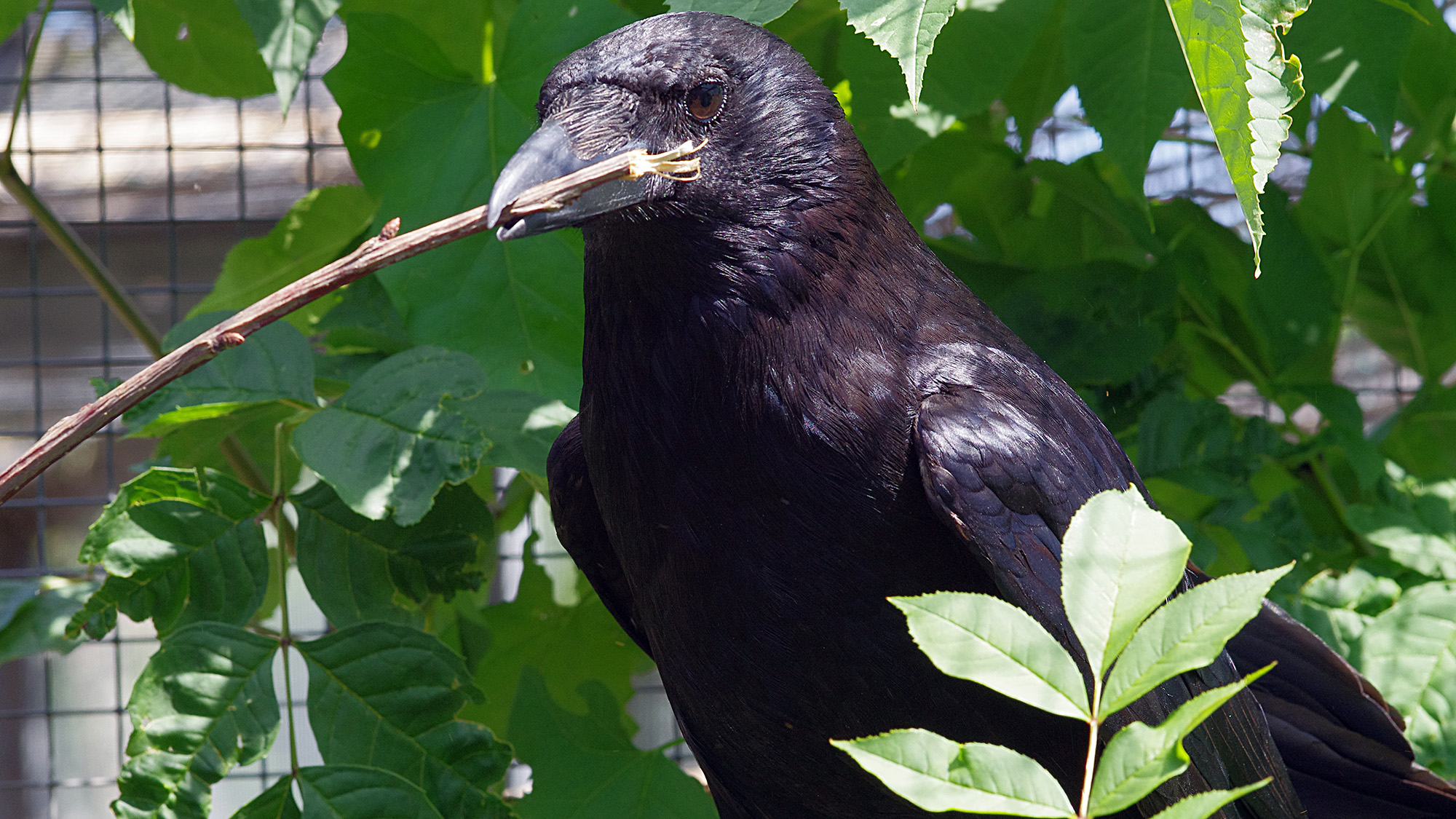
Crows use tools like tree branches to pick out bugs from hard-to-reach areas. (Image credit: Andreas Nieder)
KHC: You've also found that crows can perform statistical analysis. Tell me more about these findings and what you showed.
AN: We trained carrion crows [Corvus corone] to associate a series of arbitrary visual signs, colored geometric images displayed on a touch screen, with different reward probabilities. One sign might yield a food reward 90% of the time, another 70%, another 50%, and so on down to 10%. Importantly, the signs themselves carried no inherent meaning; the birds had to learn these probabilities through experience.
Once the birds had learned these sign-probability associations, we presented them with pairs of signs and asked them to choose one. To maximize their rewards, they should select the sign associated with the higher reward probability. The crows did exactly that. Even when confronted with many novel pairings, they reliably chose the statistically more favorable option.
This does not mean that crows perform formal statistics in the human sense. They are not calculating percentages or solving probability equations. However, the results show that they can extract probabilistic regularities from experience, store this information in memory, and use it flexibly to make reward-maximizing decisions under uncertainty. These are fundamental ingredients of statistical reasoning and are highly valuable in natural environments, where animals constantly have to make decisions based on incomplete information.
KHC: Have researchers tried similar tests on babies or young humans, and if so, how do we stack up?
AN: Yes. Developmental psychologists have conducted many related studies with infants and young children. Even before learning language, infants show sensitivity to quantities, numerical differences and simple probabilistic information. By around 4 years of age, children also display an intuitive understanding of empty sets.
What is striking is that the behavioral signatures observed in crows resemble those seen in preverbal human infants and nonhuman primates. Of course, human children eventually develop symbolic mathematics through language, education and culture, which takes them far beyond the abilities observed in animals.
KHC: Can these findings tell us anything about how the human understanding of math evolved?
AN: They suggest that some foundations of mathematics may predate humans by a very long evolutionary timescale. Humans did not invent numerical intuition from scratch. Rather, we appear to have inherited ancient cognitive systems that allow brains to estimate quantities, compare numbers, and represent concepts such as zero approximately.
The fact that crows and primates — two distantly related groups — show similar numerical abilities suggests that these capacities may emerge whenever evolution favors flexible intelligence. Human mathematics likely built upon these ancient cognitive foundations and then expanded dramatically through language, symbols and culture.
What is striking is that the behavioral signatures observed in crows resemble those seen in preverbal human infants and nonhuman primates.
Andreas Nieder
KHC: What's something a general audience might be surprised to learn about crows?
Many people are surprised to learn that crows are songbirds. Most people associate songbirds with melodic singers such as nightingales or blackbirds, not with the harsh cawing of a crow. Yet crows do learn a significant part of their vocal repertoire and are even known as apt imitators, even of human speech sounds — the internet is full of funny videos in which crows imitate human speech.
What makes this particularly interesting is that their vocalizations are not merely reflexive calls. In our experiments, we found that crows can exert volitional control over their vocal behavior. They can learn to produce vocalizations in response to arbitrary cues and withhold them when required, demonstrating a level of cognitive control over vocal output that is considered an important prerequisite for complex communication and, ultimately, language.
More recently, we showed that crows can even use their vocalizations to count. In a recent study published in [the journal] Science, we trained crows to produce a specific number of calls — between one and four — in response to visual or auditory cues. Remarkably, they not only generated the correct number of vocalizations but also appeared to prepare the intended number before they started calling. This suggests that they can represent numerical information and use it to guide a self-generated sequence of vocal actions.
Taken together, these findings show that crow vocalizations are far more sophisticated than most people assume. Their characteristic "caw" is not just a simple call — it can be brought under deliberate cognitive control and even used to express numerical information. For a bird, that is a remarkably advanced ability.
This interview has been edited for length and clarity.
Taming Nature: Inside China's efforts to control the region's water
China is facing water scarcity that affects millions of people, so the country is embarking on water projects on a scale the planet has never seen. This three-part series investigates three elements of this effort: the world's biggest dam, a doomed effort to create a "river in the sky," and a colossal water transfer project.
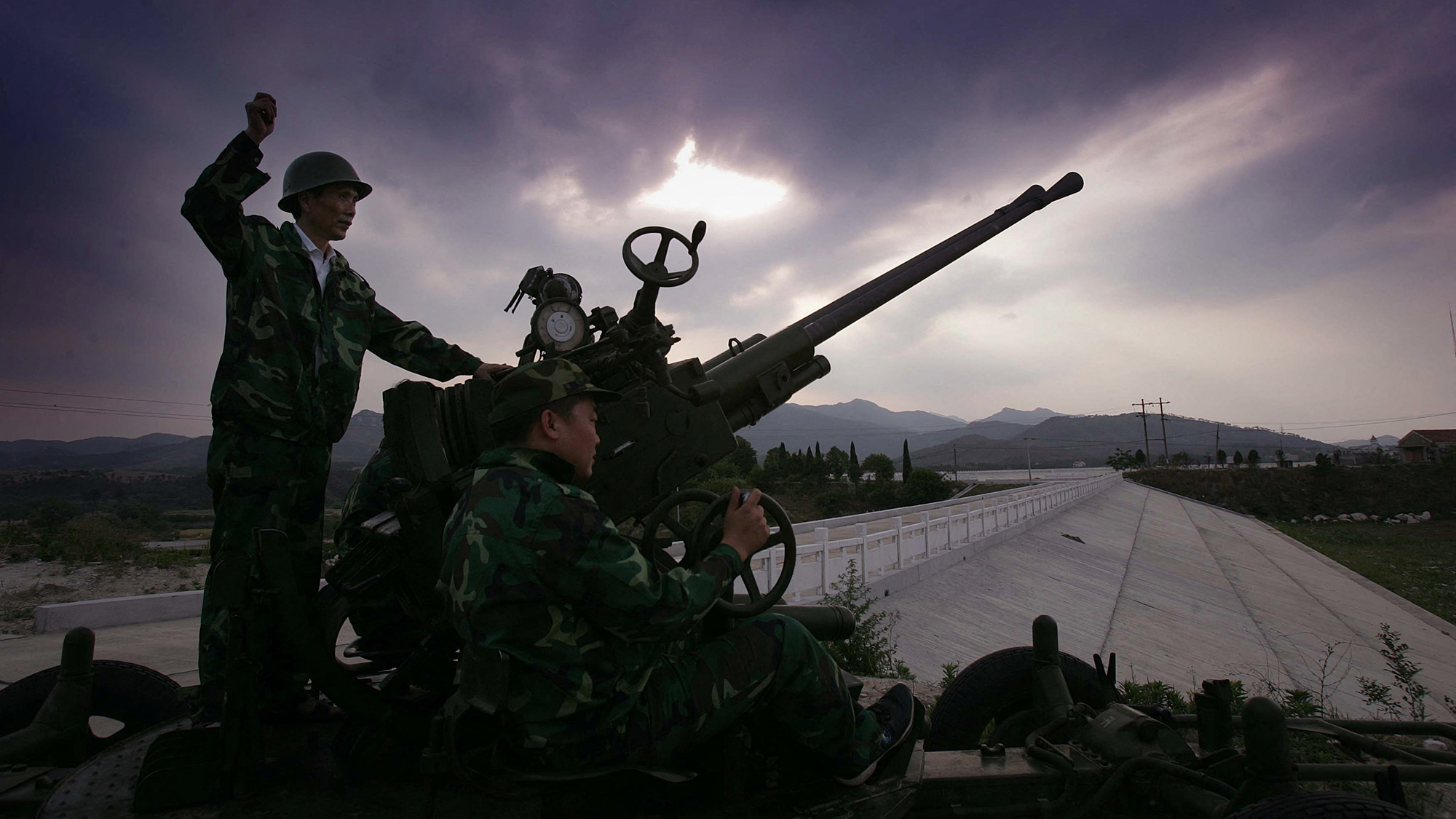
In southwest China, Chinese soldiers load and fire rockets toward the sky as aircraft and drones circle overhead, dropping their toxic cargo into the air. The weapons are not trained on an enemy, and the planes aren't dropping bombs. Instead, they are targeting the clouds hovering in the sky.
This footage is just a tiny snapshot of the massive, countrywide effort to seed the clouds with rain at an unprecedented scale.
More than 50 countries around the world use cloud seeding to modify the weather at small scales, including the United States.
China has been using and expanding cloud seeding for decades. This images from 2011 shows cloud-seeding shells being fired into the sky in Hubei Province, central China. (Image credit: Getty Images)
But China is the world leader, employing around 50,000 people; using thousands of rocket launchers and dozens of planes; and investing the equivalent of billions of dollars in these initiatives, experts told Live Science.
In 2018, China embarked on its most ambitious cloud seeding plan. The Tianhe ("Sky River") project aimed to create a permanent airborne water "corridor" from one river basin to another on the Tibetan Plateau. The project was intended to be part of the country's much bigger South-North Water Transfer project — a massive effort to transfer water to China's highly populated and water-scarce North and East.
From the start, the Sky River faced scathing criticism from scientists who said the project was unworkable. Yet China forged ahead.
China's pursuit of such a scientifically questionable geoengineering technology shows just how far Chinese authorities are prepared to go to achieve the country's water and climate goals. It also reveals how the Chinese government views the natural world, experts have said.
"There is an impetus to control and to view the environment as a machine or an infrastructure that can be controlled," Emily Yeh, a professor of geography at the University of Colorado Boulder, told Live Science.
The science of cloud seeding
China uses cloud seeding to produce precipitation to build up snowpack, help alleviate droughts, reduce the impact of hailstorms, and create skies clear of clouds and pollution for official events — as it did most famously during the 2008 Beijing Olympics, experts told Live science.
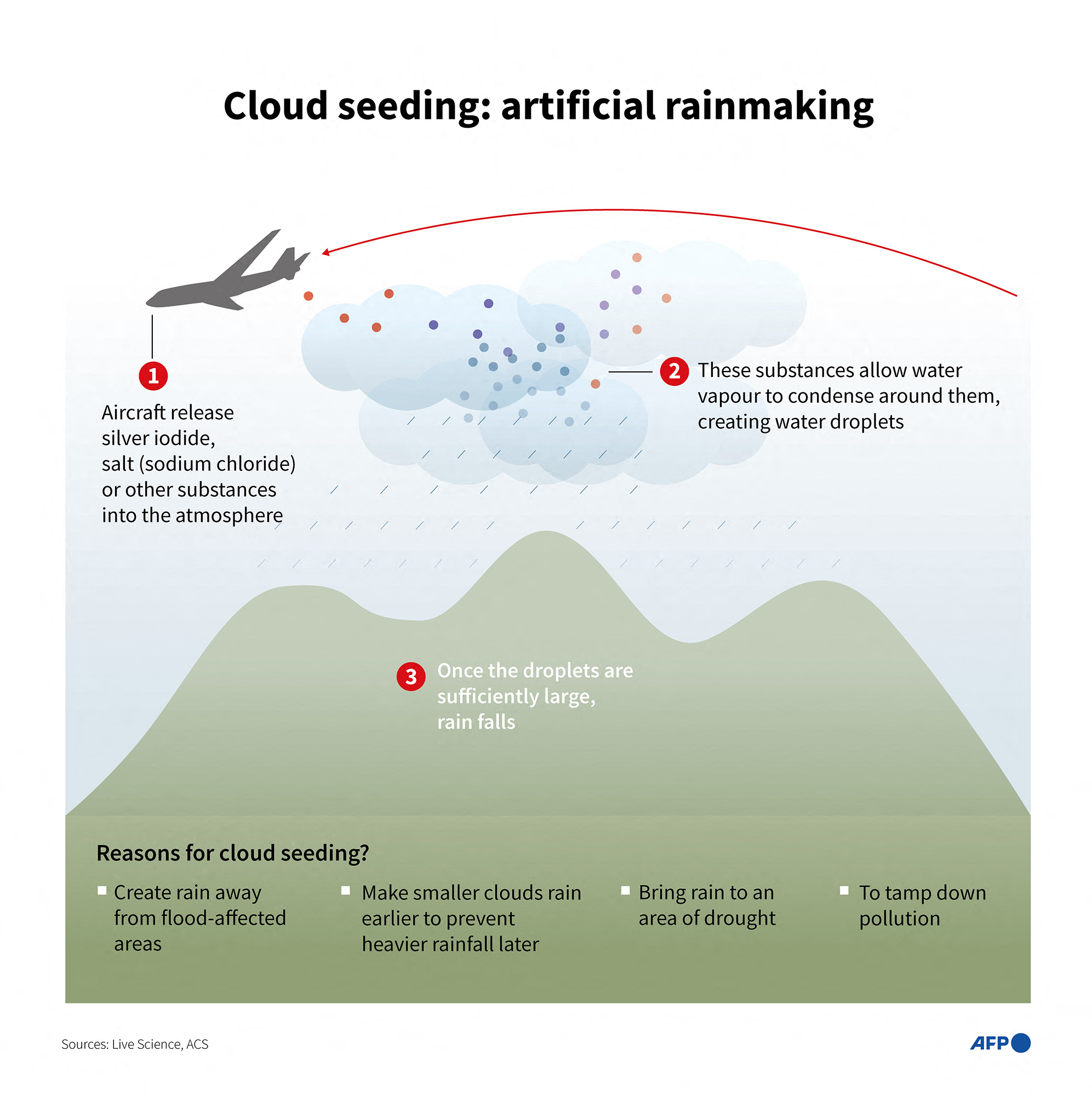
But cloud seeding can't create rain from an empty sky. Instead, it causes existing clouds to generate precipitation more efficiently by injecting particles into a cloud. Water droplets then coalesce around these particles, and the water eventually falls as rain or snow.
"Every single drop in any cloud you have ever seen — there's a particle in it," Rob Rauber, an atmospheric scientist at the University of Illinois Urbana-Champaign, told Live Science. Cloud seeding speeds up the raindrop-forming process by introducing more particles, he explained.
This illustration shows, in simple terms, how cloud seeding works. (Image credit: LAURENCE CHU via Getty Images)
There are two main ways to do this, depending on whether the temperature of the clouds is above or below 32 degrees Fahrenheit (0 degrees Celsius). Warm-cloud seeding is known as hygroscopic seeding, while cold-cloud seeding is called glaciogenic seeding.
"They have the same general goals or approach," Jeff French, head of atmospheric science at the University of Wyoming, told Live Science. "And that is to introduce something into the cloud that would increase the efficiency in which cloud droplets or ice crystals are able to grow to precipitation-size particles and fall out of cloud either as rain or as snow."
A salt such as sodium chloride is typically used for hygroscopic seeding to attract water droplets, French said. Glaciogenic seeding, by contrast, takes advantage of cold clouds' supercooled water — water that is liquid even when temperatures are below freezing — by introducing silver iodide. This substance has a similar structure to ice and collides with supercooled water in a cloud, causing it to freeze and eventually fall from the cloud, French said.
Scientists insert seeding particles into clouds in a number of ways, including by dropping them from planes and drones, firing shells or rockets into the clouds from the ground, or burning materials in chambers that release the combustion byproducts into the air.
Scientists are still learning exactly when and how to use these techniques most effectively. Rauber and French both noted that it's difficult to quantify cloud seeding's impact.
"It becomes kind of a quagmire when you ask that question: 'Does cloud seeding work?'," French said. For his research, he used airplanes, ground sensors and radar across the U.S. Mountain West to measure the effects of seeding from aircraft on the initiation and growth of crystals and eventual snowfall. "From a physical standpoint, I can say very confidently that cloud seeding works," French said.
However, that experiment was in cold, mountainous conditions, and the impact of cloud seeding depends on many conditions, so tracking whether cloud seeding increases precipitation over a longer period and in different conditions can be challenging.
Science Spotlight
(Image credit: Marilyn Perkins / Future)
Science Spotlight takes a deeper look at emerging science and gives you, our readers, the perspective you need on these advances. Our stories highlight trends in different fields, how new research is changing old ideas, and how the picture of the world we live in is being transformed thanks to science.
"Not all clouds are created equal," French said. Some are colder or warmer, and the seeding material won't work as well; in others, the size or distribution of droplets makes precipitation less likely. Even within a small region, the snowfall varies tremendously from one point to another. And beyond a small region, all bets are off.
"If you have a very successful cloud seeding program, that is producing, maybe 7% or 9% or even 10% more precipitation over a mountain range, downstream of that mountain range, the impact may be 1%," French said. "But it is a really difficult number to get our arms around."
French added that scientists should be careful to not overpromise what cloud seeding can accomplish.
"If the promise is that cloud seeding is going to eliminate droughts even on a local level, the answer is no, it can't live up to that. There's no scientific evidence," French said. But if targeted properly, it can moderately increase natural precipitation, he said.
Cloud seeding on the Tibetan Plateau
Despite cloud seeding's limitations, China has established weather modification bureaus across the country.
"They have a whole campus of people who are working in the weather modification field," Rauber said. "They have a fleet of aircraft — they're on a whole different scale than anything that goes on anywhere else in the world."
Chinese researchers claim that the country has made huge strides in its weather modification. Reports from state-owned media suggested that weather modification efforts increased precipitation by 168 billion tons between 2020 and 2025, and that in experiments, just one cup of cloud seeding material generated 30 Olympic-size pools' worth of precipitation over an area the size of Yellowstone National Park in the arid Xinjiang region.
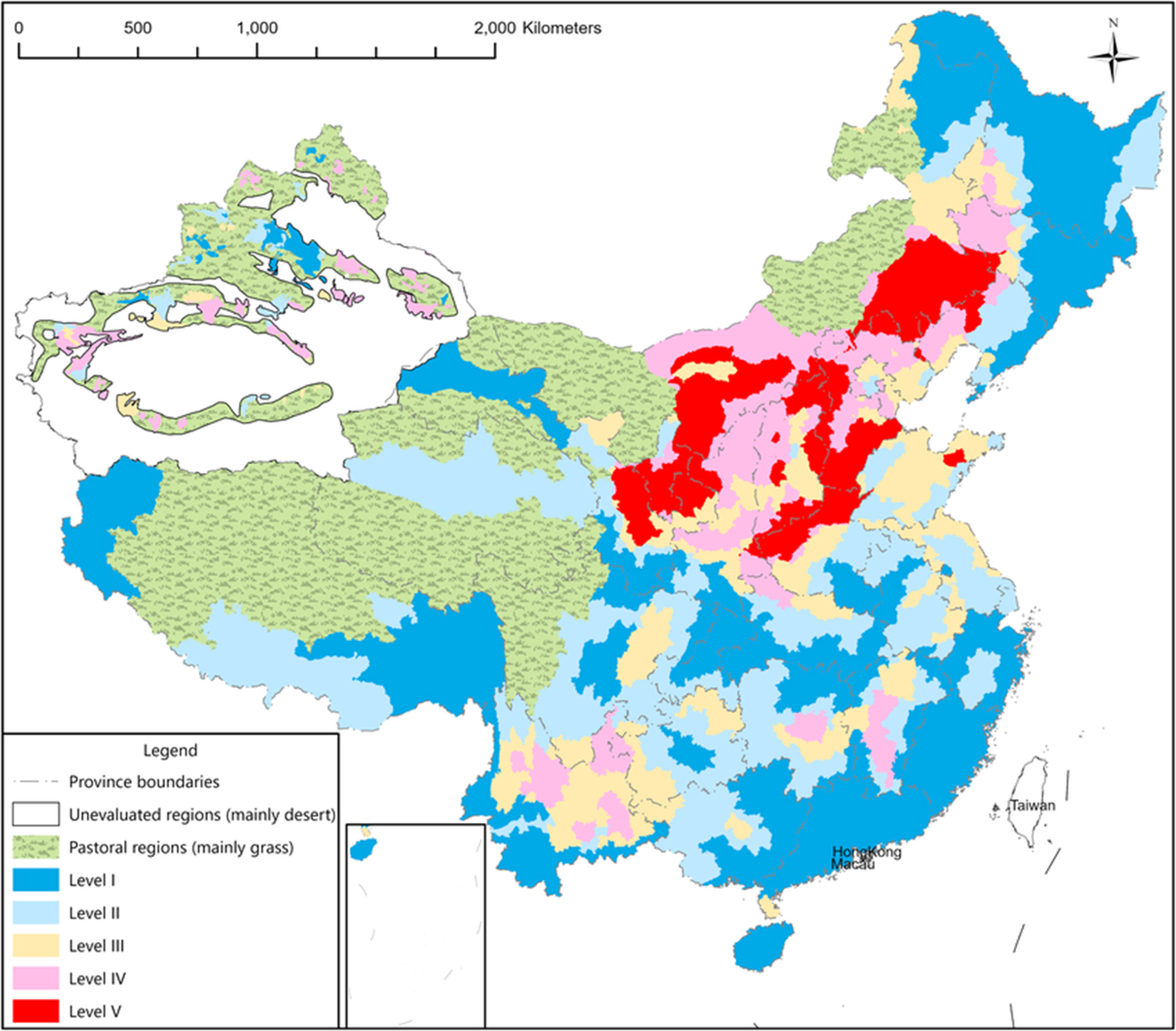
A map showing water scarcity in various regions of China. (Image credit: Kong et al. (2021), CC BY-NC-ND 4.0)
These weather modifications have also been conducted on the Tibetan Plateau. The vitally important region, nicknamed Asia's Water Tower, is the source of multiple major rivers that supply water to nearly 2 billion people across Asia. But the plateau is facing increasing desertification and glacier loss due to human-caused climate change and other human activities such as overgrazing animals.
China's cloud-seeding ambitions for the plateau reached a whole new level in 2018, when authorities announced the Sky River project. The controversial project aimed to use cloud seeding to create precipitation across a 620,000-square-mile (1.6 million square kilometers) area in the Tibetan Plateau — about the size of Alaska — to divert Indian monsoon rains above the Yangtze River basin and channel the water to the Yellow River basin. From the Tibetan Plateau, the Yellow River flows north and east into the parched northern regions of China, while the Yangtze flows south and east into less-water-scarce areas. The initial plan claimed the project would transfer up to 7% of the country's total annual water consumption, reports noted.
The atmospheric channel was intended to be part of the country's colossal South-North Water Transfer Project, circumventing the region's challenging terrain by moving the water in the sky instead.
The plan, due to be completed in 2025, called for seeding this atmospheric river using tens of thousands of silver iodide-burning chambers on the ground, linked to a series of meteorological satellites that would analyze the weather conditions. Information from these satellites would automatically trigger the burners when the conditions were suitable for cloud seeding.
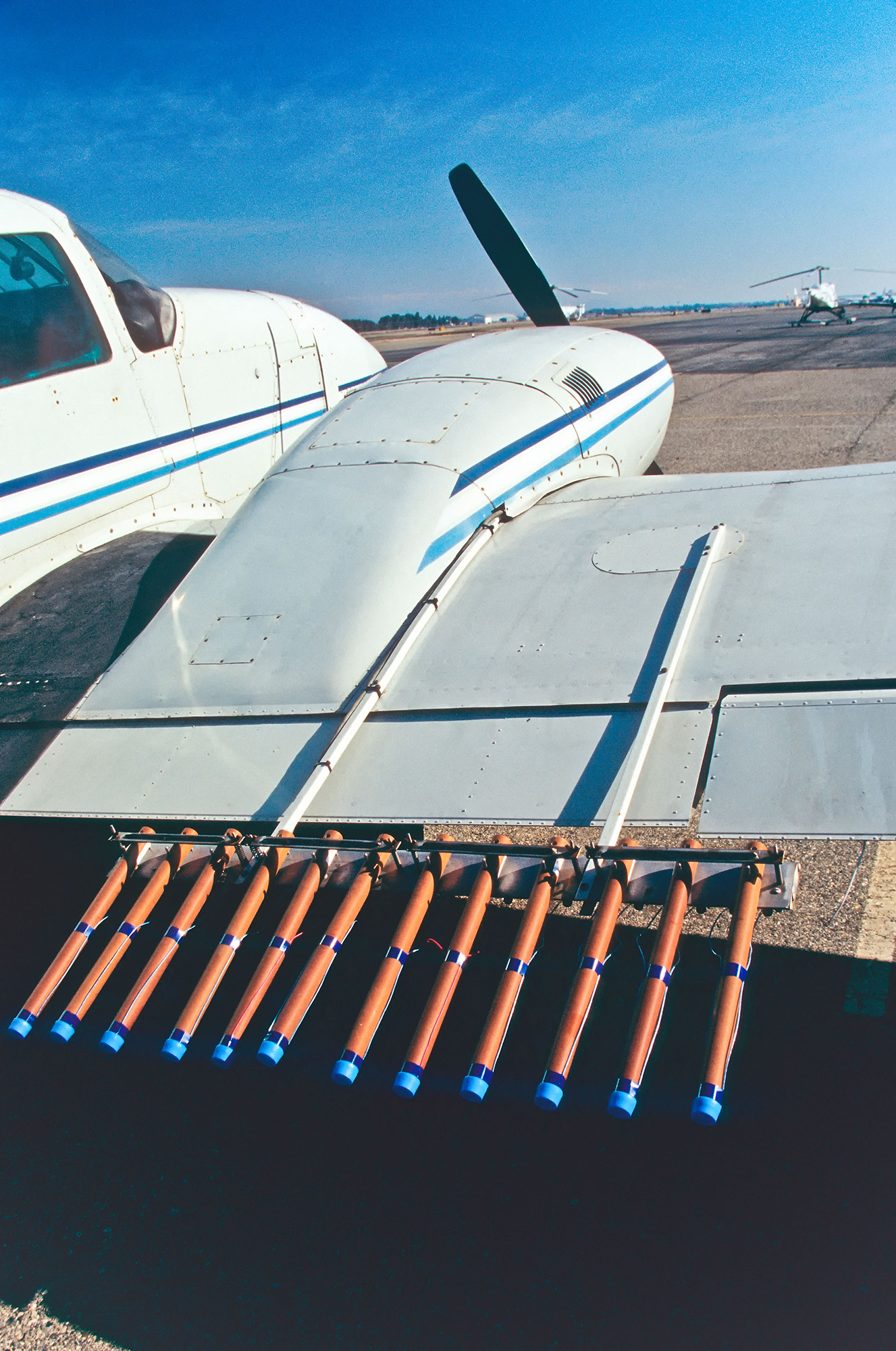
Cloud seeding takes place in more than 50 countries, including in the U.S. Here, a plane in California is about to take off with pyrotechnic silver iodide flares. (Image credit: inga spence via Alamy)
However, the plan was immediately met with a barrage of criticism from scientists in China. In a translated statement, Hancheng Lu, a professor at the National University of Defense Technology's School of Meteorology and Oceanography, called the project "an absurd and fantastical project with neither scientific basis nor technological feasibility."
The project was unworkable because it is not possible to convert all atmospheric moisture to rain, or to channel moisture in this way, Yeh said.
As of 2022, researchers were working on a significantly scaled-back version of the project. However, China's official channels have gone dark on the topic.
China's newly announced five-year plan, which sets out the policy direction of the country from 2026 to 2030, references weather modification enhancements but doesn't mention this specific project, according to reports from Chinese media.
This has led experts to speculate that the project was quietly canceled.
"When one goes to China and asks atmospheric scientists not involved in it about it, they just sort of laugh, and it's like this embarrassing incident," Yeh said. "It was never possible."
To see whether the project was still going forward, Live Science reached out to several researchers involved in the project, but they did not reply by the time of publication.
The fears of cloud seeding
The pursuit of the Sky River project — despite the low likelihood that it would ever work —— has caused significant alarm in neighboring countries. India relies on the monsoon rains and rivers such as the Brahmaputra, which starts in the Tibetan Plateau before flowing through India and Bangladesh on a 1,800-mile-long (2,900 km) route to the sea. There are also suspicions about cloud seeding being used to cause flooding across borders.
Many of these fears are overblown, experts told Live Science. Rauber noted that cloud seeding can't influence weather enough to reduce water in a wider weather system.
"This is always a question of, 'Are you robbing Peter to pay Paul?'" Rauber said. But the amount of water in storm clouds "is way greater than anything cloud seeding is going to extract."
Climate geoengineering
China's all-in pursuit of technologies like cloud seeding — even on the internationally important and politically sensitive Tibetan Plateau — has raised concerns that China is prepared to go to extreme lengths to engineer its way out of its problems — even when it involves scientifically dubious geoengineering projects with massive risks.
This may even involve attempts to change how much sunlight reaches the planet's surface, experts have speculated.
"Given similarities, weather modification could serve as a means to incrementally build legitimacy for solar radiation management, in China and beyond, which may ultimately make it possible to deploy it," researchers argued in a 2019 study.
However, there's no evidence that China is currently pursuing such climate modifications, and it's unlikely they'd do so without some cooperation or buy-in from other countries, researchers wrote in 2023.
"It is currently unlikely that China would deploy SRM unilaterally. But its weather modification programme does demonstrate the country's willingness and capability to undertake large-scale atmospheric intervention projects," the study authors wrote.
Solar radiation modification aims to release particles such as sulfur high into the atmosphere to reflect sunlight back into space in an effort to limit global heating. It is being increasingly investigated by researchers and governments. The controversial concept has never been demonstrated on a large scale, and studies suggest it has many potential risks, such as the potential to shut down monsoon rains.
Scientists have already seen some of the negative impacts of natural solar radiation modification, for instance in the aftermath of large volcanic eruptions, such as Tambora in 1815. "It led to the suppression of the monsoon, because the monsoon is driven by heating from the sun, Rauber said. "And that cuts back on rain in tropical areas, and that causes droughts, which causes all sorts of diseases and can lead to mass starvation," he added.
"The evidence from nature is don't mess with Mother Nature," he said.
The symptoms: In March 2020, the woman developed a high fever, chest tightness, shortness of breath and diarrhea, and she lost her sense of smell and taste. She also experienced coughing fits so intense that they caused her to faint. Based on these symptoms, her primary care provider diagnosed her with COVID-19, although she was not formally tested for the illness due to the lack of diagnostic testing available at the time.
After her diagnosis, she did not seek further medical care due to concerns about out-of-pocket costs, according to a report of the case.
What happened next: Three weeks after her symptoms started, the patient felt well enough to work from home. However, four weeks after that, many of her symptoms returned. She also noticed new feelings of disorientation and felt that "something was off with faces." Her primary care doctor suggested she go to an emergency room, where a CT scan was taken of her brain. The scan didn't show any active bleeding, the report notes, and she was discharged.
In June 2020, the patient spent time with family for the first time since catching COVID-19 and found she could not recognize her father or visually distinguish him from her uncle. She still recognized people by their voices, though.
The patient worked part time as a portrait artist; she used to be able to check her reference photos every 15 to 30 minutes but found she now struggled to hold the details in her mind. She told doctors that "faces are like water in my head," according to the case report.
The patient also had trouble doing everyday tasks, such as navigating her local grocery store or finding her way back to her car in a parking lot. In November 2020, she also started having balance issues and frequent migraines.
The diagnosis: Based on her wide-ranging and relapsing symptoms and her suspected history of COVID-19, doctors diagnosed the patient with post-acute sequelae of COVID-19 (PASC), now known as long COVID. They diagnosed her difficulties with recognizing faces as "face blindness," or prosopagnosia.
Roughly 2.5% of the general population is thought to be born with some degree of face blindness, while others can acquire the condition later in life. The exact number of people with acquired prosopagnosia is unclear, but some estimates suggest roughly 1 in 30,000 people in the U.S. are affected.
Many people with acquired prosopagnosia also have issues navigating familiar spaces. That was also the case with this patient, likely due to the "proximity of brain regions critical for scene and face processing," the case report authors noted.
SARS-CoV-2, the virus behind COVID-19, can trigger a wide range of neurological effects. (Image credit: loops7 via Getty Images)
To assess the extent of the patient's prosopagnosia, doctors had her complete several tests of facial memory, which asked her either to memorize strangers' faces or recognize celebrities' faces. The patient performed markedly worse on these tests than 10 women of similar age who were used as a comparison group.
However, she performed as well as the comparison group on other types of cognitive tests, suggesting her deficits were fairly specific to faces. She also got normal scores on tests of facial perception — the ability to recognize that a face is a face — so her face blindness seemed tied more to memory deficits for faces, the report authors said.
The treatment: The case report does not detail a specific course of treatment, and in general, few treatments exist for face blindness. If there's a clear cause for the deficit — such as a tumor in a key part of the brain for facial processing — addressing that underlying issue can help reverse acquired face blindness.
If the condition ends up being permanent, there are various strategies that can help patients cope. For instance, "perceptual training" can improve patients' ability to identify and remember the features of a person's face. Additional strategies include training people to use other cues, like voices and social context, to identify people.
The 28-year-old woman, by contrast, wasn't thought to have suffered a stroke, and it's unclear exactly how COVID-19 led to her facial processing issues.
The case report authors surveyed more than 50 other people with long COVID, to see if they also had signs of face blindness. While many showed general declines in visual recognition and navigational abilities, the group didn't have a specific problem with faces. So while long COVID is known to cause a range of neurological issues, it appears that face blindness is a rare consequence.

 Login