❌

Normal view

'We're not a competitor to fusion. We are fusion': Inside the race to harness unlimited solar power in space

The year is 2050, and as the sun sets, the night's first constellations emerge in perfect rows. But these amber-glowing arrays aren't stars at all; they're satellite clusters, harvesting the day's last rays before beaming their power back to Earth.

If it reads like science fiction, that's because it started that way. Called space-based solar power (SBSP), the concept featured prominently in the techno-utopian imaginations of 20th-century visionaries and writers. But for decades, it was dismissed β€” a pie in the sky proposal.

Now, as a new space race heats up, governments and private companies in China, the U.S., the U.K. and Japan are developing several projects to reassess the idea's feasibility. These include China's ZhuRi ("Chase the Sun") program, Japan's OHISAMA project, the U.K.'s Space Solar, and power-beaming experiments by Caltech and the Air Force Research Laboratory in the U.S., all of which are targeting test launches in the next five years.

Proponents say the technology has the potential to meet Earth's energy needs many times over while causing minimal harm to the environment. But first it needs to get off the ground: In the eyes of critics, space-based solar power is exorbitantly expensive, riddled with untested assumptions, and far too complex to be deployed in time for an urgent green-energy transition.

The challenges include getting the massive solar-panel-covered satellites into space; assembling them; getting those solar panels to constantly face our star; and then finding ways to convert, concentrate and transmit their collected power back to Earth.

Despite these hurdles, researchers keep returning to the idea. Perhaps because the most crucial step β€” generating energy in the first place β€” is already being done by the sun. Every second, our star fuses hydrogen atoms to expel the same energy as nine trillion atomic bombs. All that's left to do is catch it.

"We're not a competitor to fusion. We are fusion," Peter Garretson, the U.S. Air Force's former chief of future technology and an SBSP expert, told Live Science.

From science fiction to NASA proposal

The first glimmers of SBSP as a concept came from the Russian rocket scientist and astronautics pioneer Konstantin Tsiolkovsky, who, in 1923, suggested deploying space-based mirrors that could concentrate sunlight to Earth with enough intensity to boil 10 cups of coffee.

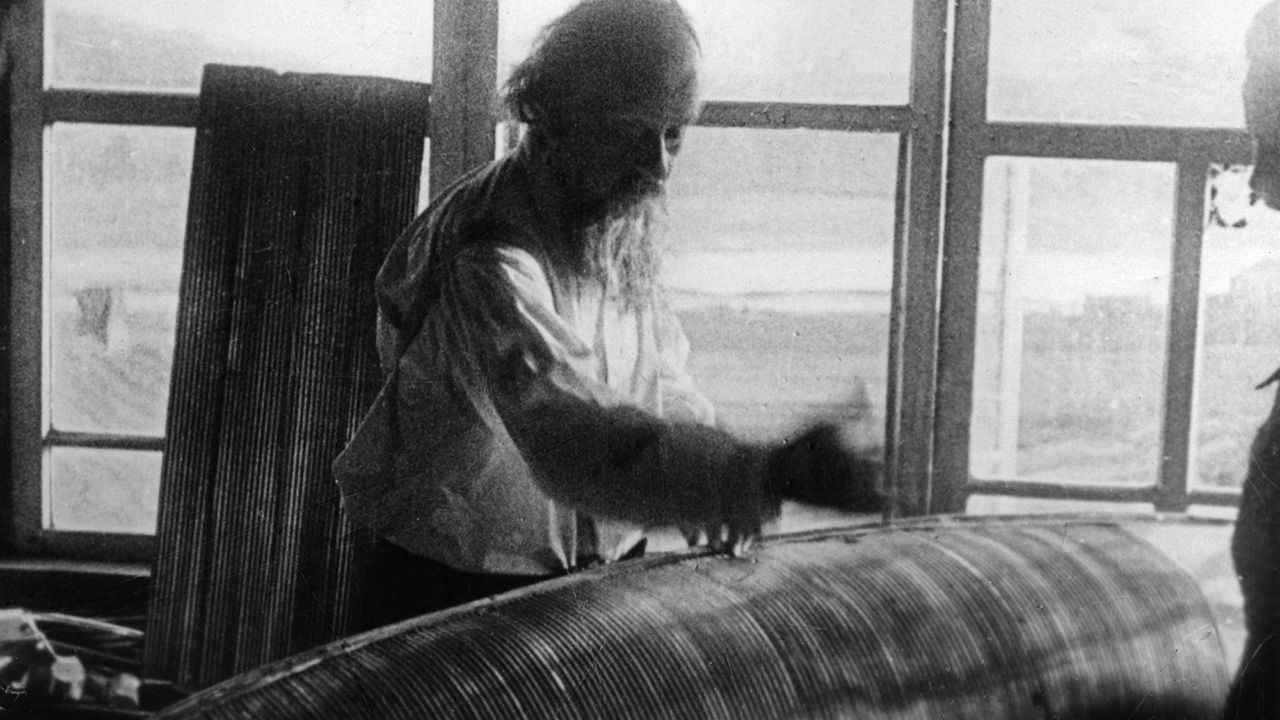
A black and white photo of a man standing over a circular metal object

Konstantin Tsiolkovsky inside his workshop in Kaluga, Russia. Long before he became globally celebrated for his pioneering formulas on rocket design and space travel, Tsiolkovsky spent decades obsessively working on designs for a steerable, all-metal cargo airship. (Image credit: Sovfoto/Universal Images Group via Getty Images )

Tsiolkovsky's fanciful proposal soon entered science fiction, appearing in the British writer Olaf Stapledon's 1937 novel "Star Maker" as a "gauze of light traps" that an advanced alien civilization used to focus "the escaping solar energy for intelligent use" β€” an idea later formalized by theoretical physicist Freeman Dyson as a Dyson sphere.

Then, in 1941, Isaac Asimov made the clearest, most famous early sketch of SBSP in his short story "Reason," in which a robot colony toils aboard a power station that collects solar energy and fires it back to Earth in the form of microwaves. Asimov provided few details on the fictional station's engineering, instead focusing on the robots' religious worship of the vessel.

But the transformation from science fiction to a concrete proposal didn't take long. In 1968, aerospace engineer Peter Glaser, a consultant and project manager for the Apollo 11 mission's distance-measuring laser reflectors, drew up an engineering design for a "solar power satellite" consisting of three key elements: a ray-collecting device, a converter and a transmitter.

Glaser's collector was a disk of photovoltaic panels that would be lifted some 22,400 miles (36,000 kilometers) off the ground. Locked in a geostationary orbit above Earth and bathed in near-constant sunlight, the satellite would harvest solar rays before converting them into microwaves to be beamed, largely unimpeded through the atmosphere, to receiving antennae on the ground. Once there, the microwaves would be converted into electricity and distributed across the grid.

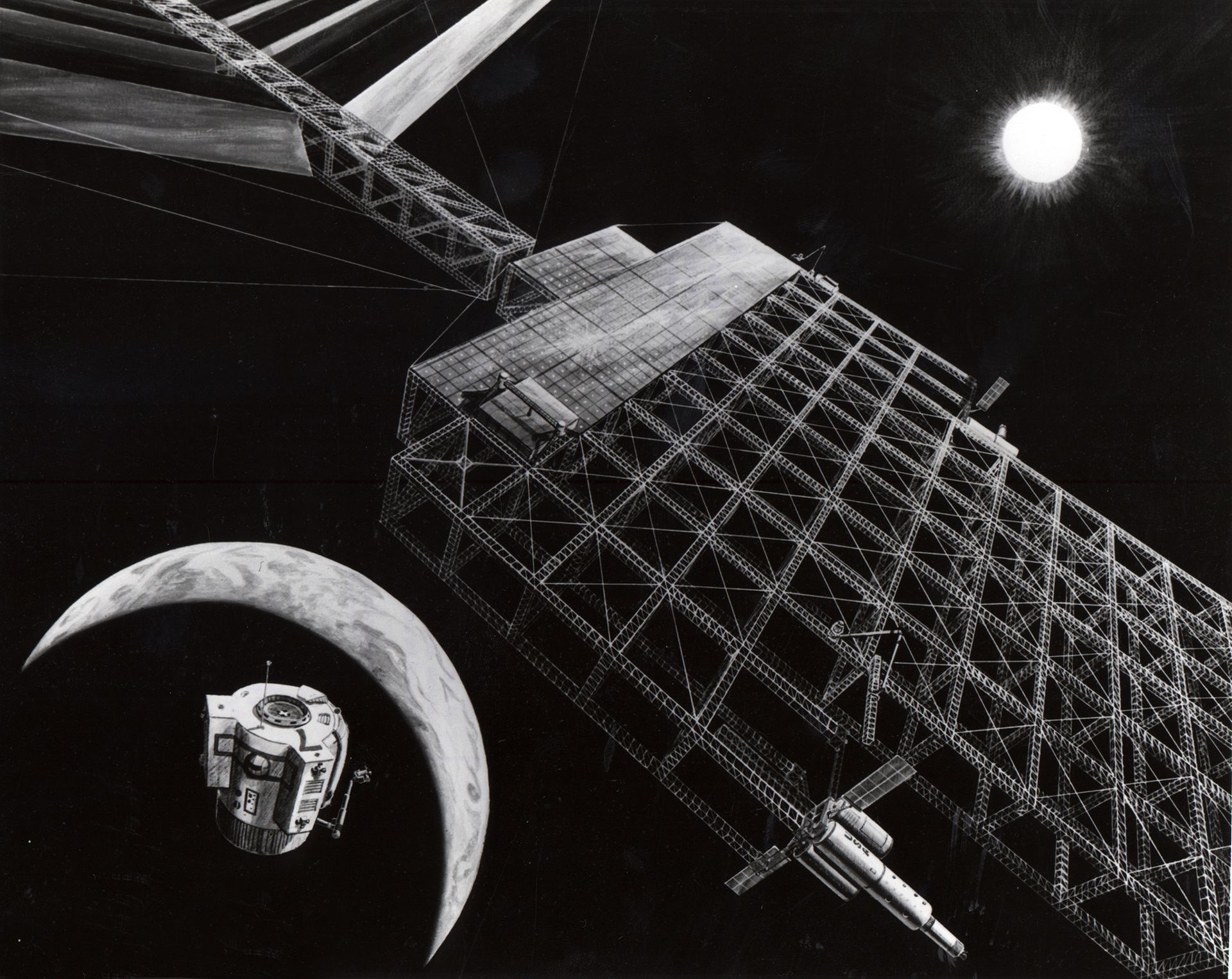
A black and white photo showing a satellite in space with the sun in the background

A 1976 artist's illustration of a solar power satellite based upon Peter Glaser's original design.The image shows the assembly of the satellite's microwave transmission antenna. (Image credit: Heritage Space/Heritage Images via Getty Images. )

NASA awarded Glaser a contract to study the concept further, with both domestic and international energy crises (such as the 1973 oil crisis and the 1979 Three-Mile Island nuclear accident) adding wind to his solar sails.

But Glaser's design hit technical and financial roadblocks, the most forbidding being the project's sheer size. By 1981, when the U.S. Department of Energy's four-year study of space-based solar power was released, it estimated that a "meaningful" contribution of 300 gigawatts (sufficient to power hundreds of millions of homes) would require 60 satellites, each spanning 21 square miles (55 square kilometers) and weighing 50,000 tons (45,000 metric tons). The plan was deemed unaffordable.

Later reassessments, such as a 1997 report by NASA physicist John Mankins, pointed to advances such as improved solar cells that made the concept more realistic. Yet the overall consensus remained hostile. A 2015 report released by the Strategic Studies Institute (SSI) of the U.S. Army War College stated that while SBSP systems are "technically feasible," there was "no compelling evidence that such systems will be economically competitive" with terrestrial power systems. It concluded that "the reality is that such systems always seem to be seen as just 10 years away by their advocates."

Aiming high

But a lot can change in a decade, including the cost of firing rockets. Since the SSI report, SpaceX's reusable Falcon 9 rocket has sent launch costs plummeting to around 30 times less than those of NASA's Space Shuttle, with satellites also getting cheaper due to mass production and advances to the clean rooms where they're made. And SpaceX's even bigger Starship rocket promises to more than quintuple Falcon's payload capacity, lowering prices further.

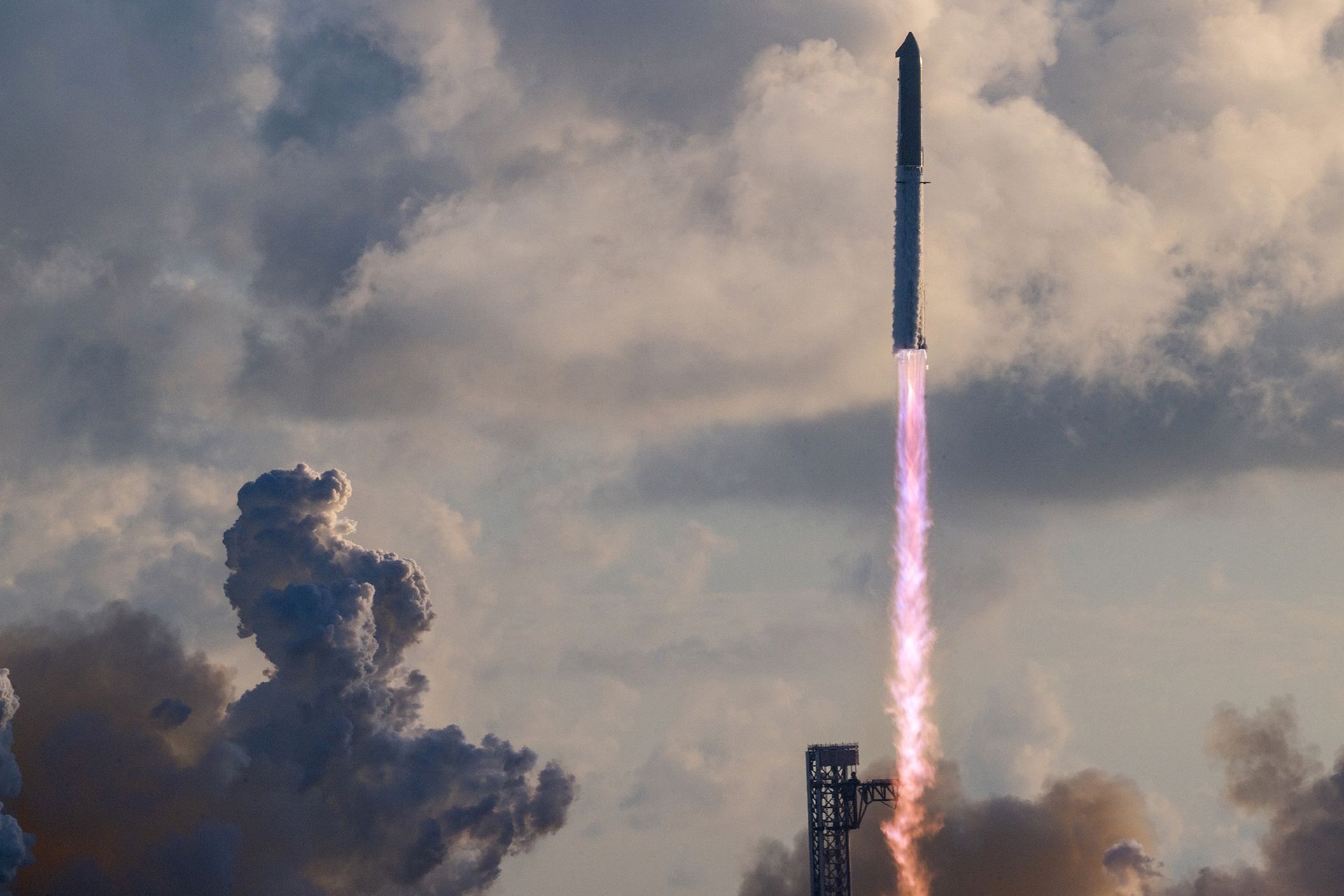
A rocket with purple flame blasts off of a launch pad

SpaceX's Starship Flight 14 launches from Boca Chica Beach, Texas on September 28 as part of its first orbital test flight. (Image credit: Brandon Bell via Getty Images)

"What you have is a cadre of people in the space community that have grown up before Starlink and SpaceX," Garretson said. "They literally could not believe that, as your launch rate goes up and you amortize your costs, [the launch cost] approaches the cost of fuel." Some took notice. A 2021 assessment commissioned by the U.K. government estimated that a 2-gigawatt, mile-wide space-based solar power array would cost 17.3 billion British pounds ($23.4 billion) and generate energy at 50 British pounds ($68) per megawatt hour over its century lifetime.

That's the equivalent output of a large power station in the U.K., with the initial costs being 39% to 49% cheaper than biomass, nuclear or the most efficient gas energy sources, according to the assessment. And while it's still 14% to 52% more expensive than current terrestrial wind and solar energy, the technology could be beamed anywhere, even to remote locations.

Based on these findings, in 2023, the U.K. government awarded 4.3 million British pounds ($5.8 million) in seed funding to a handful of companies and universities to develop SBSP further.

The U.K. report chose one satellite design as its reference architecture: CASSIOPeiA. Belonging to the U.K. SBSP company Space Solar, the satellite's design is an attempt to crack a significant challenge faced by early solar satellite blueprints: how to keep solar panels constantly aligned with the sun to maximize radiation collection.

Unlike other satellite designs, such as China's Multi-Rotary Joint Solar Power Satellite or Mankins' SPS-ALPHA, which rotate the panels or use a system of mirrors to constantly redirect sunlight onto them, CASSIOPeiA is shaped like a gigantic DNA strand.

This design, alongside a sun-synchronous orbit and a slow spin, enables CASSIOPeiA to constantly receive and transmit solar energy without any heavy or failure-prone moving parts. Space Solar claims that a single CASSIOPeiA satellite, which would be about 1 mile (1.6 km) in diameter, could microwave-beam as much as 2 gigawatts of constant power to a fixed point on the ground β€” enough to supply a city of 2 million people.

Space Solar says that once the satellite is in space, it will be far more efficient and economical than gathering sunlight on the ground could ever be. That's because the light hitting the space-based power station isn't deflected or attenuated by the atmosphere.

"You use a lot less materials compared with terrestrial solar, and you utilize them more," Sam Adlen, co-founder and co-CEO of Space Solar, one of the funding recipients, told Live Science. "So it's 100% utilized in space rather than 10% if you're on the ground β€” and you've got 13 times more instant energy, so you're getting much more out of the materials."

Beaming down

However, the next step β€” beaming gigawatts of energy down and across tens of miles of atmosphere and through potential cloud cover β€” remains a major technical hurdle.

Proposed power-beaming methods are currently split between two types: lasers and microwaves. California-based startup Aetherflux, which has plans to beam power from satellites in low Earth orbit, has developed an infrared laser transmission system that it will test using a demonstration satellite launched on October 1. The microwave energy will be transmitted at around one kilowatt (enough to supply the basic electrical demands of a household).

Meanwhile, Caltech and Overview Energy, another U.S. startup, have both demonstrated respective microwave and laser-power beaming from orbit and from a plane, respectively, albeit in negligible amounts ( less than a kilowatt).

Despite their efficiency and proven ability to travel vast distances, optical beams in the infrared and near-infrared ranges are easily scattered by water droplets in the atmosphere, preventing power from being transferred on cloudy days. Persisting efficiency issues with optical power transmission also worsen at gigawatt power levels, meaning lasers are less feasible for use at the utility scale.

Microwaves, on the other hand, can be beamed at frequencies with much higher power and suffer relatively little atmospheric attenuation. That's why Space Solar, Japan's OHISAMA project and China's ZhuRi program all plan to use microwave-beaming systems. Nonetheless, microwaves have comparatively longer wavelengths, so their beams diffract more widely across longer distances. This means that even if beams are sent by transmitters hundreds of meters wide, they would need Earth-based receivers spanning dozens of square miles.

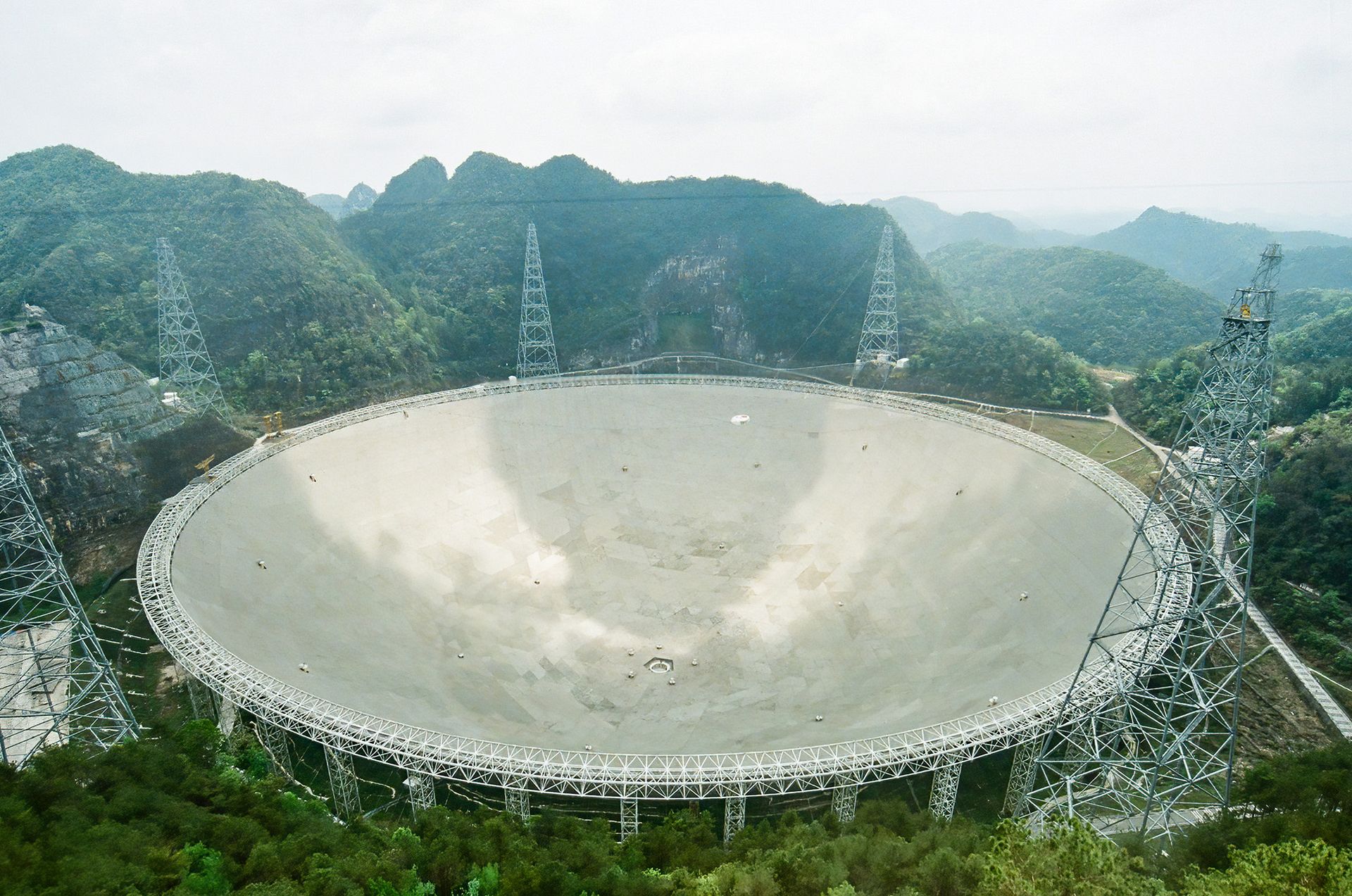
A large circular disk is seen in the middle of a forrested region.

An aerial view of China's Five hundred meter Aperture Spherical Telescope, the world's largest single dish. With current technology, transmitters of this scale would need to be constructed in space in order to successfully beam microwaves to magnitudes bigger receivers. (Image credit: Qu Honglun/China News Service/VCG via Getty Images.)

These limitations mean that "it's going to take many years" before gigawatt-scale power beaming is achieved, Remo Proietti Zaccaria, head of the DELTA Lab at the Italian Institute of Technology, told Live Science.

Improvements in power-beaming efficiency will bring their own challenges. Even battery-powered laser pointers can blind or burn, so prototypes by laser-beaming SBSP companies like Aetherflux must be designed with that possibility in mind. They promise safety mechanisms that switch off their lasers if anything flies between the transmitter and the receiver.

"Definitely for the weapon side, this technology now can be used efficiently," Proietti Zaccaria said.

If you're imagining an orbital weapon devised by a Bond villain, you may be disappointed β€” even fully developed power-beaming lasers and microwaves would take a while to cook an egg, or boil Tsiolkovsky's coffees. But beaming technology could still have potent military use: Scrambling communications systems on Earth to create havoc with relatively little effort.

"If you throw even that amount of intensity of power to our antennas, you're going to freeze the electronics; that's for sure," Proietti Zaccaria said. "It's not necessary to destroy them. As long as you freeze the electronics, you've done the job."

The challenges associated with power beaming have pushed some engineers to simpler concepts. One (going full circle back to Tsiolkovsky's original proposal) envisions the deployment of space-based mirrors that reflect sunlight back to Earth after sunset, with a single reflector extending the daylight delivered onto solar panels by around 20 minutes.

This may not seem like much on its own, "but then you can increase this with multiple reflectors," Onur Celik, a researcher in space technology at the University of Glasgow, told Live Science. "If you have 10 or more of them, you can arrange them in space in such a way that you can extend this to up to two hours or so at that altitude."

"The sunlight that you deliver, if it all turns into electricity, could power thousands of homes," he concluded.

The light of day

The trillion-dollar question is whether that power will be cheaper and more efficient than that generated on the ground. The median cost of the electricity generated by SBSP as estimated by the U.K. government is 50 British pounds per megawatt hour ($68), putting it roughly in line with the costs of offshore wind and terrestrial solar power.

However, this estimate is orders of magnitude too sunny for the 2024 NASA cost report, with its projections suggesting SBSP's baseline electricity costs fall between $610 and $1,590 per megawatt hour, depending on the array design. NASA concluded that the U.K.'s median estimate was achievable only after drastic future reductions in launch and manufacturing costs.

Independent studies are also divided over feasibility. One assessment suggests that SBSP could reduce Europe's need for land-based renewable energy by up to 80%, while another counters that the costs could be 12 to 80 times more expensive than those for terrestrial alternatives. This variability exists within the studies themselves, with research published in the journal Acta Astronautica estimating that SBSP could contribute to meeting anywhere from 3% to 31% of global electricity demand, depending on possible constraints in how many satellites can safely fit into an orbit, the receiver size, and where power is beamed to.

"For the numbers we found, I don't believe that this technology could actually be employed to generate energy for Earth," said Proietti Zaccaria, a co-author of the Acta Astronautica study. If humanity had used up all available space for solar panels on Earth, "then I will tell you it would make sense, because at that point, 3%, 5%, 10% could make a difference."

Proietti Zaccaria does see use cases for SBSP schemes for future moon or Mars missions, but otherwise, "the cost for building technology of this kind is really very, very high," he said. "Vice versa, the cost nowadays of buying and installing a solar panel on the roof of any building has become extremely cheap."

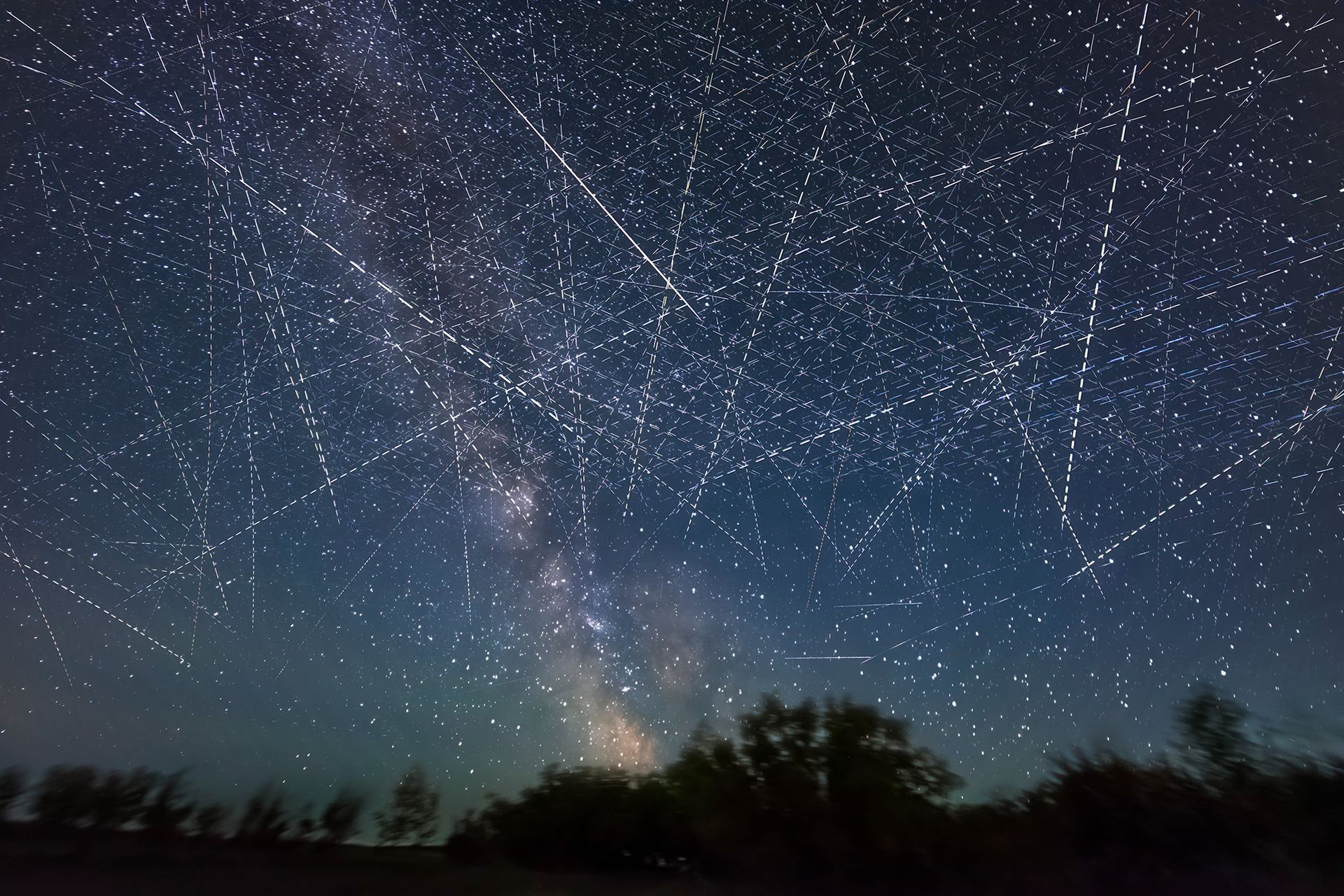
Among the challenges would be ferrying the raw materials for the systems into space and then assembling them. Such a feat would make the construction of the International Space Station β€” currently the most complex structure built in orbit β€” seem like child's play. Maintaining arrays and preventing them from crashing into other satellites in Earth's increasingly crowded orbits would also take significant international coordination.

A series of white streaks of satellites in the night sky.

Exposures taken over just 30 minutes on a night in June 2024 show the growing crowdedness of Earth's skies.There are now roughly 20,000 active and inoperational artificial satellites in Earth's orbit, with the number expected to reach around 60,000 by 2030. (Image credit: Alan Dyer/VWPics/Universal Images Group via Getty Images )

Then there are the unweighed environmental costs. All modern rockets use methane, a potent greenhouse gas, to propel them into space, and they release much of it into Earth's upper atmosphere, where its effects are the strongest.

"And so clearly, there is a question there on how launching 100,000 of these superheavy vehicles into the atmosphere will actually impact the atmosphere itself, as opposed to the benefit that we get in the next 20 years or so from having solar power from space," Matteo Ceriotti, a senior lecturer in space systems engineering at the University of Glasgow, told Live Science. "It's not entirely clear."

Ceriotti said the likeliest route for overcoming all of these difficulties come from smaller companies running, and then streamlining, proof-of-concept tests in space.

"Obviously, it's not something that we have ever done," he said. "So clearly, we need to start somewhere, and we need to start small."

The hopes of SBSP proponents remain unclouded by gloomy estimates. They cite several technologies, from personal computers to reusable rockets, that were once thought to be impossibly expensive, even fictitious, that are now ubiquitous and cheap. Their eyes remain fixed on demonstration missions to be launched over the next four years by the likes of Space Solar, Reflect Orbital, Aetherflux and Virtus Solis. If these missions succeed, another once-impossible idea could appear much brighter.

"The private sector is good at this, because it has to be," Sanjay Vijendran, an SBSP consultant who led the European Space Agency's now-shuttered SOLARIS project to test the feasibility of SBSP, told Live Science. "It can break the problem down to quite a small level and start to do things with today's technology and today's way of doing things, and start to show that this can be valuable."

Help us improve Live Science Pro: We're always trying to make our content better. Leave us feedback about Pro here.

Science news this week: Gold tongues discovered in tombs, sugar found in space, a new monkey identified in the Congolian rainforest, and ancient impact crater 'geoguessed' by an amateur astronomer

This week's science news reminds us how the past still speaks if we listen closely, with news of the discovery of 18 ancient Egyptian tombs filled with dozens of gold tongues topping the bill.

The ancient Egyptians believed that gold was the flesh of the gods, meaning that bestowing gold tongues upon the deceased could help them speak in the afterlife. But it's not entirely certain whether all of the newly found gold objects were tongues (one may actually depict a wheat ear, a symbol of fertility), and the mystery of a possible false door inside the tomb is also stirring up debate.

It's not the only ancient Egyptian discovery causing disagreement among archaeologists this week; an analysis of the nearly 4,000-year-old skeletal remains of ancient Egyptian princesses reveals they may have hunted or trained with the military β€” though not all experts agree.

Elsewhere, archaeologists discovered a curious ancient chariot among the remains of a mysterious society that burned down its own buildings before disappearing. We also learned that an ancient Bronze Age shaman thought to be a man was actually a woman, and researchers revealed the origins of more than 150 liberated Africans who had been left to die by the British Navy on the island of St. Helena.

We anticipate further ancient discoveries after a new study revealed that DNA can last for up to 50,000 years in Africa. Meanwhile, we published an excerpt describing how experimental archaeologists used ancient techniques to mummify a modern-day person β€” part of our coverage of author Sam Kean's book "Dinner with King Tut: How Rogue Archaeologists Are Re-creating the Sights, Sounds, Smells, and Tastes of Lost Civilizations."

Sugar found in space

Sweet! Sugar found in raspberries was discovered near the Milky Way's center, hinting that life's ingredients are common in space

A view of white glowing gas swirling among white and blue stars in deep space.

A Hubble image of the Milky Way’s center, in the constellation Sagittarius. Researchers have discovered a sugar found in raspberries buried in a cloud in this region. (Image credit: NASA, ESA, and G. Brammer)

Astrochemists delivered a sweet surprise this week, with news that they had detected a type of sugar called erythrulose in interstellar space, near the center of our Milky Way galaxy.

Erythrulose, consisting of four carbon atoms, is found in raspberries back on Earth. But its presence in space is a mouthwatering sign that the essential ingredients for life are highly abundant across our galaxy. That could make life much more prevalent than we thought, and could mean that aliens may also have a sweet tooth.

Discover more space news

β€”'Smaller than the tiniest scale in nature': Physicists made a black hole out of light and used it to test Stephen Hawking's elusive radiation theory

β€”'The moon looked wrong': Artemis II mission controller Chris White on taking historic lunar flyby photos from 250,000 miles away

β€”James Webb telescope captures never-before-seen glimpse of 'Centaur' galaxy's battle wounds β€” Space photo of the week

Life's Little Mysteries

What is the roundest animal?

A close up of a black shiny pill bug all rolled up.

A pill bug curls into a round ball for protection. (Image credit: lophius via Alamy)

Animals come in all shapes and sizes, but are any a satisfyingly perfect sphere? It turns out that this deceptively simple question holds some evolutionarily profound implications.

β€”If you enjoyed this, sign up for our Life's Little Mysteries newsletter

Amateur astronomer 'geoguesses' an ancient crater

'This was one of the most arduous expeditions I've ever done': Scientists confirm that 15-mile-wide pit found on Google Maps is ancient meteor crater

Image shows a satellite picture from Google Earth showing a recently discovered meteor impact crater.

The large pit, discovered on Google Maps in 2024, is actually a 390 million-year-old meteor impact crater. (Image credit: Gordon Osinski via Google Earth)

Geoguessing emerged in the last decade as a geography game (and later a popular esport) in which players deduce locations from Google Maps imagery. But what about geoguessing something completely undocumented, and one that only trained scientists should be able to recognize?

In that circumstance, amateur astronomer JoΓ«l Lapointe should be crowned this year's champion. Using Google Maps to plan a hiking trip in Quebec's CΓ΄te-Nord region, Lapointe stumbled upon an indentation that has now been confirmed by scientists to be a 390 million-year-old scar from a gigantic asteroid collision.

"I get lots of messages from the public thinking they have found a crater and 99/100 turn out not to be the case," Gordon Osinski, a professor of planetary geology at Western University in Canada who confirmed the find, told Live Science in an email. "This is one of those rare examples that shows this is possible."

Discover more planet Earth news

β€”Tropical forests stop absorbing carbon dioxide during El NiΓ±o events. This year could be the worst.

β€”Venezuela's devastating 'earthquake doublet' holds a warning for California's San Andreas Fault

β€”'These are striking forecasts': Super El NiΓ±o keeps getting even more likely, and it could bring a humanitarian crisis

Also in science news this week

β€”5 'extremely rare' iron shackles discovered in France highlight Celtic slave trade 2,300 years ago

β€”Nobel Prize-winning physicist and team use Claude AI to solve decades-old math puzzle

β€”New 3D silicon chip stacks circuits on top of each other to boost computing power

β€”Robot dog can climb stairs, navigate a forest and bound over logs thanks to new, rapid AI training technique

β€”Scientists are deep-freezing koala eggs and sperm to protect the species from extinction

β€”Heaven Lake: China's deepest lake sits atop a colossal volcano and belongs mostly to North Korea

Something for the weekend

If you're looking for things to keep you busy over the weekend, here's a selection from our best opinion pieces, interviews, diagnostic dilemmas and crosswords that we published this week.

β€”Tobacco companies are pushing nicotine pouches on teens β€” and we need to act now to stop them [Opinion]

β€”'It affects your daily life suddenly': Sea level researcher explains why once-in-a-century floods could become the new normal [Interview]

β€”Diagnostic dilemma: Junk-food diet caused a teen's permanent blindness [Diagnostic Dilemma]

β€”Live Science crossword puzzle #52: The moon's other name β€” 2 down [Crossword]

Science photo of the week

Orange-lipped monkey that roars and snorts deep in Congo rainforest is new species to science

Two orange-lipped black monkeys sit in a large leafy tree looking at the camera

The newly described monkey has orange lips and a patch of white fur around the anus. (Image credit: Β Daniel Rosengren, Frankfurt Zoological Society Β )

Hello! A new monkey just dropped!

Named Colobus congoensis after the remote region of the Democratic Republic of the Congo where it was found, this striking newfound species has orange lips and makes unique roars and snorts.

The monkey's discovery is remarkable, most of all because finding new primates is extremely rare β€” with only five new ones being identified in Africa over the past 75 years β€” and also because of its relatively large size. Pinning down the species took years of careful tracking and documentation, alongside work with people from eight local villages who had knowledge of it.

Besides being a cool find in its own right, the discovery points to there being potentially many more undiscovered mammals, fish, reptiles and plants hidden inside the Congolian rainforest.

Follow Live Science on social media

Want more science news? Follow our Live Science WhatsApp Channel for the latest discoveries as they happen. It's the best way to get our expert reporting on the go, but if you don't use WhatsApp we're also on Facebook, X (formerly Twitter), Flipboard, Instagram, TikTok, Bluesky and LinkedIn.

Science news this week: Time emerges inside a mini-universe, scientists thicken Arctic ice, and one of the oldest graves of a free Black person in the US found

This week's science news was filled with big discoveries from the world of the small, led by a physicist's creation of a mini-universe, which was designed so we can watch time emerge from within an isolated quantum system.

The experiment was performed using a Bose-Einstein condensate β€” a strange state of matter that consists of thousands of atoms blended into a single quantum object at near absolute zero (minus 273.15 degrees Celsius, or minus 459.67 degrees Fahrenheit). The system showed time speeding up, slowing down and even stopping, depending on what the system was doing.

Those weren't the only highbrow high jinks using a Bose-Einstein condensate we reported on this week. We also covered NASA's upgrade to its mini-fridge-sized laboratory on the International Space Station that will use the bizarre state of matter to probe the quantum world. Back on Earth, physicists also found that complex numbers aren't necessary for quantum mechanics to work and used quantum computers to create a rare material critical to nuclear fusion. And to stick with news from the small (and weird) things of the world, we also reported that scientists have created little diving suits to transform cockroaches into search-and-rescue cyborgs.

Arctic ice thickening shows promise

First experiment to thicken Arctic ice with seawater shows promise β€” but there's a big catch

A person walking through snow toward an air defence radar station in Cambridge Bay, Nunavut.

Researchers conducted the first real-life sea ice thickening experiments in Cambridge Bay, Nunavut. (Image credit: Arctic-Images/Getty Images)

The Arctic is the world's fastest-warming region, where sea ice is rapidly disappearing at a rate of 12.2% per decade.

The ice is crucial for maintaining stable sea levels and marine nutrient flows, and for reflecting solar radiation away from our planet, so its precipitous decline is deeply concerning. That's why one team of researchers turned to a surprisingly simple method to stem the ice loss: flooding ice sheets with seawater to thicken them.

The results, despite some major caveats, showed a lot of promise.

Discover more planet Earth news

β€”Extreme heat waves are making our cities buckle. Investing in urban nature is no longer optional.

β€”Colorful 'painting-like' ripples cover an ancient seafloor structure in the Bahamas β€” Earth from space

β€”'Uncharted territory': Record-high ocean temperatures confirmed for June as El NiΓ±o strengthens its grip

Life's Little Mysteries

Does fast charging damage your battery more than regular charging?

A close up of a phone showing 90% with a

Some types of batteries charge faster than others. (Image credit: Tfilm via Getty Images)

If you're as shamefully attached to your devices as I am, you may have wondered about the wildly differing times it can take for them to charge. So what's the science behind fast charging, and does it damage a device's battery more than regular charging does?

β€”If you enjoyed this, sign up for our Life's Little Mysteries newsletter

One of the oldest gravestones of a free Black person in the U.S. found

'One of the oldest gravestones of a free Black person in America' discovered in Boston

a grey gravestone in a barren landscape with a death's head decoration and inscription

The gravestone of "Boston," a formerly enslaved man who died in the 18th century in Boston, Massachusetts. (Image credit: Boston Parks and Recreation Department)

It was found amid photos of headstones during a restoration project at Boston's Granary Burying Ground β€” a gravestone with only one name, "Boston."

That's how a team of conservationists chanced upon the tombstone of Sebastian, a formerly enslaved man who died free in 1729 and chose the city's name as his own.

A search through the historical archives has produced a wealth of information about Boston's past, including his reputation as a hardworking handyman throughout the city, and his emancipation following the death of the man who held him in slavery.

"It's been there all along. We just had to go look and share the story," Michelle Wu, the mayor of Boston, said in a July 4 speech.

Discover more archaeology news

β€”100,000 years ago, one of the earliest Homo sapiens outside Africa was stabbed in the face, analysis finds

β€”6,000-year-old broken ribs discovered in Syria may be one of the oldest known cases of child abuse in the world

β€”Neanderthals and modern humans may have shared culture 59,000 years ago in Turkey, study finds

Also in science news this week

β€”New sodium metal battery design charges in just 4 minutes and retains its capacity for years

β€”Dirty 'button' unearthed by metal detectorist turns out to be a rare 900-year-old coin from Norway's last Viking king, Magnus Barefoot

β€”'Astronomers have to revise estimates': The Milky Way may be larger, heavier and more lopsided than we realized

β€”2,500-year-old tomb of a 'warrior prince' with chariot and helmet discovered on Italy's Adriatic coast

β€”Malaria had nearly been eliminated around a giant dam in the Amazon β€” but then it came roaring back. Experts just discovered why.

Science interview

'800 seconds for a sick visit': Some factors driving antibiotic resistance have nothing to do with biology, says medical sociologist Julia Szymczak

A person puts a stethoscope on a stuffed toy

Decisions around antibiotic prescribing aren't driven only by medical knowledge β€” emotions also play a role, a medical sociologist explains. (Image credit: Angel Santana via Getty Images)

Antibiotic resistance continues to pose a growing danger across the U.S., with more than 2.8 million antimicrobial-resistant infections occurring in the country each year. Last week, we brought you a report from Live Science health editor Nicoletta Lanese, who visited Japan to investigate how that country is curbing its overuse of antibiotics.

Now, in the second part of a feature series into the fight against this "silent pandemic," Nicoletta interviewed medical sociologist Julia Szymczak to dig into the social and emotional drivers of antibiotic overprescription.

Something for the weekend

If you're looking for things to keep you busy over the weekend, here's a selection from our best opinion pieces, interviews, diagnostic dilemmas and crosswords that we published this week.

β€”Superintelligent AI in space could explain the Fermi paradox [Opinion]

β€”'It's more than a hope; it's a guarantee': The Vera C. Rubin Observatory's 10-year movie of the universe is about to 'blow our minds,' chief scientist Tony Tyson says [Interview]

β€”Diagnostic dilemma: A woman heard voices for years β€” but not because of psychosis [Diagnostic Dilemma]

β€”Live Science crossword puzzle #51: Largest rodent on Earth β€” 4 down [Crossword]

Science photo of the week

Secretive Chinese probe snaps first photo of Earth's mysterious 'quasi-moon' β€” and it may pose a big problem

A blurry photo of a grey asteroid in the vacuum of space with Chinse logos superimposed on top

China's Tianwen-2 spacecraft captured this photo of the quasi-moon Kamo'oalewa (a.k.a. 2016 HO3) at a distance of around 12.5 miles (20 kilometers) from the near-Earth asteroid. (Image credit: CNSA)

It doesn't look like much, but this blurry, gray image is the first-ever close-up photo of one of Earth's temporary "quasi-moons" β€” a fast-spinning asteroid temporarily orbiting the sun in sync with our planet.

Of equal intrigue is the spacecraft that took the image: a secretive Chinese probe that is likely gearing up to land on the space rock and snag a sample β€ͺ—‬ although an unexpected hiccup will make that more difficult.

Follow Live Science on social media

Want more science news? Follow our Live Science WhatsApp Channel for the latest discoveries as they happen. It's the best way to get our expert reporting on the go, but if you don't use WhatsApp we're also on Facebook, X (formerly Twitter), Flipboard, Instagram, TikTok, Bluesky and LinkedIn.

Science news this week: James Webb telescope finds a never-before-seen substance, China's 'Great Green Wall' grows faster than natural trees, and a Medici murder mystery is solved

This week's science news was all about goings on in space, with reports that the James Webb Space Telescope (JWST) picked up a signal from a mysterious, never-before-seen substance on Pluto and Titan.

The space telescope detected a specific absorption line in the spectra of these worlds' atmospheres, revealing the characteristic trace of a unique and unknown molecule. It's unclear exactly what the molecule could be, and the mystery is made even more compelling by the fact that the environments of Pluto and Titan are very distinct.

Farther afield, the JWST's predecessor, the Hubble Space Telescope, spotted "impossible" light from a galaxy we shouldn't even be able to see. And in the busy skies surrounding our own planet, scientists are dreaming up a scheme to drop a giant "airbag" that could protect us from solar storms, sending spacecraft into orbit to save doomed telescopes, and also giving answers to why metal sticks together in space.

And just in time for Independence Day weekend, the sun has launched a string of eruptions to Earth that will likely paint the night skies with colorful auroras.

China's 'Great Green Wall' grows faster than natural forests

66 billion trees have been planted in China's Great Green Wall β€” and they appear to be growing faster than natural forests

An aerial view of a forest next to a barren landscape

The San Jacinto and southern San Andreas faults have reached their highest levels of tectonic stress in 1,000 years. (Image credit: PEDRO PARDO via Getty Images)

China is no stranger to engineering projects designed to bring its environment to heel; we've recently covered the Asian powerhouse's attempts to tame nature through the creation of atmospheric rivers, the world's biggest dam and water transfers. But these are hardly China's only forays into sculpting its natural environment, with the country having planted more than 66 billion trees along its northern borders to halt the advance of the Gobi and Taklamakan deserts.

Now, new research has revealed a startling detail about the trees in this "Great Green Wall": they're growing significantly faster than natural forests. Exactly why remains a mystery, but, as Live Science contributor Brian Owens reveals, it could be due to a stronger response from the trees to rising atmospheric carbon dioxide.

Discover more planet Earth news

β€”'It sounds so impossible': Student studying fungus that makes users hallucinate tiny people may be on the verge of a scientific breakthrough

β€”'Uncharted territory': Record high ocean temperatures confirmed for June as El NiΓ±o strengthens its grip

β€”Study suggests life on Earth has around 1.8 billion years left β€” but the biosphere might evolve to survive even longer

Life's Little Mysteries

Are CAPTCHAs obsolete in the age of AI?

A close up of a computer screen showing the captcha

AI is getting better at solving CAPTCHAs. Does that mean CAPTCHAs are obsolete? (Image credit: Cosminxp Cosmin via Getty Images)

Are you a robot? It used to be a question that only humans could answer β€” by clicking on traffic lights or strings of warped and grainy characters, or Completely Automated Public Turing tests to tell Computers and Humans Apart (CAPTCHAs). But what happens now that autonomous artificial intelligence (AI) agents can ace some of these trials without detection? Have they made CAPTCHAs obsolete?

β€”If you enjoyed this, sign up for our Life's Little Mysteries newsletter

Medici murder mystery solved

Ancient-DNA analysis solves 500-year-old mystery of what killed 2 Medici brothers

researchers in green scrubs study a human skeleton on a table

Researchers analyzed the remains of brothers Giovanni and Francesco de' Medici for evidence of malaria. (Image credit: Courtesy the University of Pisa)

The Medici family ruled Renaissance Tuscany with an iron fist, fulfilling their ruthless ambitions with methods so underhand that the name of their most famous advisor, NiccolΓ² Machiavelli, became a synonym for skulduggery.

So, when two brothers from the infamous family died under mysterious circumstances, it was believed for 500 years that they were murdered, possibly by arsenic poisoning. Now, science has revealed the true culprit behind the medieval cold case, and it's not what we expected.

Discover more archaeology news

β€”Ancient ring discovered underground in Scotland could be a Stonehenge-like monument

β€”500-year-old freeze-dried potato snacks discovered in Inca storage room in Peru

β€”2,000-year-old scrolls buried by Mount Vesuvius eruption finally deciphered with help from AI

Also in science news this week

β€”Chinese supercomputer leapfrogs best US machines to be ranked world's fastest

β€”The hantavirus outbreak is over, WHO declares

β€”Rise in cancer in younger adults may be explained by faster 'biological aging,' early study hints

β€”Dead-end bitcoin mining wastes as much energy as Switzerland's entire hydropower generation capacity

β€”CERN shuts down Large Hadron Collider until 2030, upgrading the atom smasher to its most powerful form yet

β€”Scientists figured out how to shrink huge ultrafast lasers so they fit on a tiny chip β€ͺβ€ͺ—‬ the 'holy grail' of the field

Science Spotlight

Japan's bold experiment to curb antibiotic misuse has been a huge success. Could it work in the US?

Three images side by side with a yellow, blue and purple filter. The left images shows a stack of coins, the middle shows a child being taken care of by a woman in a mask and the right shows a Japanese city.

Japan has rolled out a creative strategy to rein in antibiotic resistance. Should the U.S. follow suit? (Image credit: Nicoletta Lanese (left and right panels); Getty Images (central panel); edited by Live Science)

Antibiotic resistance is a growing threat in the U.S., with more than 2.8 million Americans developing antimicrobial-resistant infections each year. The solutions to this worrying trend can be very complexβ€” such as moving agricultural systems away from their overreliance on antibiotics, or preventing the rapid spread of superbugs through international travel.

But stopping doctors from overprescribing antibiotics is one of the easiest strategies in the battle against this "silent pandemic." And it turns out that Japan has already fought it with some success, driving down antibiotic overuse with an innovative new policy. To investigate further and ask what notes the U.S. should be taking, Live Science's health editor Nicoletta Lanese visited Japan and reported back on their investigation.

Something for the weekend

If you're looking for things to keep you busy over the weekend, here are a smattering of our best expert opinion pieces, alongside a crossword, an interview and a quiz, that we published this week.

β€” Computer scientists are rushing to tame AI's voracious appetite for energy [Opinion]

β€”'It's more than a hope, it's a guarantee': The Vera C. Rubin Observatory's 10-year movie of the universe is about to 'blow our minds,' chief scientist Tony Tyson says [Interview]

β€”Live Science crossword puzzle #50: Longest-serving president in US history β€” 1 across [Crossword]

β€”Ancient empires quiz: Can you match these lands to the historical powers that ruled them? [Quiz]

Science photo of the week

Bull's-eye! Enormous 'bow and arrow' galaxy is unlike anything radio astronomers have ever seen

A red blob of gas is seen against a deep space background

The 'bow and arrow' galaxy shows its highly unusual shape in radio wavelengths. (Image credit: Hota, Dabhade and Ghosh et al and the RAD@home Collaboratory)

If you ask me, it looks more like a rusty anchor, or a blurry deep-sea fish. But whichever way you see it, the newly discovered "bow and arrow" galaxy β€” or, more formally, the RAD-Bow-And-Arrow Radio Galaxy (RAD-BAARG) β€” is an oddball unlike any other recorded.

The galaxy's unique structure is likely the result of gravity, which is warping RAD-BAARG into a funhouse mirror version of its former self as it falls into a nearby galaxy cluster. A shock front from this plunge surrounds the galaxy as it moves through hot gas.

Follow Live Science on social media

Want more science news? Follow our Live Science WhatsApp Channel for the latest discoveries as they happen. It's the best way to get our expert reporting on the go, but if you don't use WhatsApp we're also on Facebook, X (formerly Twitter), Flipboard, Instagram, TikTok, Bluesky and LinkedIn.

'Machine-gun sun' could bring auroras to more than a dozen states this Independence Day weekend

Fourth of July celebrations across the United States this weekend could be accompanied by light shows in the night skies, as a string of powerful solar eruptions appear set to strike Earth.

The sun has been especially hyperactive over the past few days β€” firing off 10 M-class solar flares over 24 hours that have been accompanied by multiple coronal mass ejections (CMEs), which are set to slam into Earth on July 3 and July 5.

CMEs are large, fast-moving clouds of magnetized plasma and solar radiation that occasionally get flung into space with solar flares when kinks in the sun's magnetic field snap. If CMEs smash into Earth, they cause disturbances in Earth's magnetic field, called geomagnetic storms, that can trigger partial radio blackouts and produce vibrant aurora displays farther away from Earth's magnetic poles than usual.

"Machine-Gun Sun! More than 5 storms on their way to Earth and 3 of them offer good chances for aurora views," Tamitha Skov, a space weather physicist at Millersville University of Pennsylvania, wrote in a July 2 post on the social platform X. "NOAA and NASA model predictions do not show all the storms yet (it's hard to keep up with the rapid-fire storm launches!) but the first should hit before noon July 3 UTC."

The CMEs are expected to give a glancing blow to our planet, creating conditions for a moderate (G2) geomagnetic storm, according to the National Oceanic and Atmospheric Administration's (NOAA) Space Weather Prediction Center. It's also possible that these storms will strengthen to become strong (G3), depending on how they interact with Earth's magnetic field.

Auroras resulting from G3-class geomagnetic storms are often visible in northern parts of Washington, Idaho, Montana, Wyoming, North Dakota, South Dakota, Minnesota, Wisconsin, Michigan, New York and Maine, according to NOAA. Skywatchers farther south in Oregon, Nebraska, Iowa, Illinois, Indiana, Ohio, Pennsylvania, Massachusetts, Connecticut, Rhode Island, Vermont and New Hampshire will also have a chance of catching the light show. In any case, skywatchers interested in seeing or photographing the auroras will need to get as far from artificial light sources as possible.

The weekend storms might not be the last activity we see from the sun in the coming days, as two gigantic sunspots currently pimpling its face are displaying "beta-gamma-delta" magnetic fields β€” the most tangled and unstable type. This means these sunspots harbor the potential to launch powerful X-class flares, according to spaceweather.com.

The last few years have seen a record number of powerful X-class flares explode from the sun's surface, hitting Earth with several major solar storms, including 2024's Mother's Day storm. This record comes partly from improvements to scientists' solar monitoring technologies, but also due to the sun reaching its 11-year peak in sunspot production, or solar maximum, in 2024.

Following this peak, the sun has now entered a period known as the "battle zone," a relatively understudied solar phase where instabilities across our star's newly flipped magnetic field ramp up the production of solar holes, gigantic, highly-tangled sunspots and subsequent geomagnetic storms.

The worst-case scenario for a solar storm is a superstorm like the 1859 Carrington Event, which released roughly the same energy as 10 billion 1-megaton atomic bombs. After slamming into Earth, the powerful stream of solar particles set telegraph systems around the world on fire and caused auroras brighter than the light of the full moon to appear as far south as the Caribbean.

The Carrington Event unleashed a roughly X45 magnitude solar flare that remains a record, yet it's likely far from the worst the sun can muster β€” with ancient tree rings harboring evidence of even more powerful blasts that occurred long before humans existed.

The hantavirus outbreak is over, WHO declares

The hantavirus outbreak that struck a cruise ship in April, killing three people and sparking fears of further spread, is over, the World Health Organization (WHO) has announced.

"Today, the final contact of a person exposed to hantavirus on the cruise ship MV Hondius completed their quarantine period, tested negative and returned home. No further cases have been reported since the 25th of May," Tedros Adhanom Ghebreyesus, the WHO's director-general, said in his opening remarks at a news conference Thursday (July 2). "We are therefore very pleased to say that WHO considers the outbreak of hantavirus over."

The total number of cases linked to the outbreak was 13. All those affected were either passengers or crew on the ship.

The outbreak began aboard the Dutch-flagged cruise ship MV Hondius after it departed southern Argentina on April 1. It involved the Andes virus, the only known hantavirus that can spread between people.

Hantaviruses are rodent-borne viruses that are found in the Americas, Europe and Asia and spread to humans relatively rarely, usually via contact with the urine, droppings or saliva of infected rodents. The Andes virus, however, has sparked short chains of human-to-human transmission in the past.

Before public health authorities were informed of the cases on MV Hondius, several dozen people disembarked the vessel on the island of St. Helena. To find them, authorities launched an international contact-tracing operation, tracking down more than 650 contacts in total who were then followed by health authorities in 33 countries and territories, according to the WHO.

Additionally, health authorities coordinated the monitoring, care and transport of the remaining passengers and crew aboard MV Hondius.

Of these contacts, those considered at the highest risk of infection were then quarantined and monitored for up to 42 days, because sometimes, hantavirus symptoms don't show up until weeks after exposure to the virus. Depending on their jurisdiction and degree of exposure, some contacts quarantined at home while others stayed in specialized facilities.

The initial unchecked travel of some contacts, alongside the virus's long incubation period, prompted concern from the public that the cluster of cases could explode into an enormous outbreak, or even a global pandemic. Many infectious-disease experts emphasized that the Andes virus does not spread easily between people and that the containment effort was going well, so the risk of a large outbreak was low. Still, some experts raised concerns that the international travel of contacts could trigger pockets of the deadly disease, and some argued that the Andes virus does have "pandemic potential."

Now, with the final contact having completed their quarantine period and no further cases reported, the WHO has declared the outbreak over. All of the contacts who were repatriated to the U.S. completed their quarantine period by June 21.

"WHO will continue working with governments and partners to advance our understanding of this outbreak and of hantavirus more generally," Tedros said. "We are also coordinating a study involving 21 countries to understand how the disease develops, which will support the development of diagnostics, therapeutics and vaccines for future outbreaks."

Besides rigorous contact tracing, the WHO credited the coordinated actions of national public health bodies as being vital to preventing the further spread of the disease. These measures included the response of the Spanish government, which created a safe zone on the island of Tenerife for the ship's remaining passengers to disembark before they were repatriated under quarantine.

As the hantavirus outbreak concludes, there's an ongoing Ebola outbreak in the Democratic Republic of the Congo and an outbreak of the Marburg virus in Uganda. These and future outbreaks will require similarly robust international cooperation, the WHO emphasized.

"The outbreaks of hantavirus, Ebola and Marburg all show why there is no alternative to international cooperation in the face of international threats," Tedros said. "No country alone can fight."

This article is for informational purposes only and is not meant to offer medical advice.

Science news this week: Goblin shark filmed for first time, California close to a major quake, physicists split photon, and inside China's plans to 'tame nature'

This week's science news was filled with things missing and found, with the revelation of the first-ever deep-sea footage of the elusive goblin shark making waves in the press.

Goblin sharks (Mitsukurina owstoni) are mysterious, deepwater creatures that have not changed much since they first appeared on Earth 125 million years ago β€” making them "living fossils." But capturing a recording of the sharks in their deep habitats is exceptionally difficult, and they have previously been seen alive only after being hooked to the surface on fishing lines. Scientists recently filmed not one, but two goblin sharks: The first near Jarvis Island in the South Central Pacific, and the second 6,550 feet (1,997 meters) deep in the Tonga Trench.

If you like your elusive animals on the wilier (and certainly much cuter) side, we also reported on the first ever photographs of the dwarf fox, a species that was believed to be extinct but has been found near a highway in Cozumel, Mexico.

Elsewhere, archaeologists found a second cannonball from the 1836 Battle of the Alamo, meaning they now have one from each side of the conflict. And separate teams of archaeologists discovered the remains of a prehistoric man in Germany who may have been a human sacrifice and signs of a "prototype" Stonehenge close near the famous Stone Age monument.

If you got this far wondering if the "missing" news items were, well, missing, we also covered how a "cold blob" of absent heat in the Atlantic Ocean is shifting Indian summer monsoons, threatening over one billion people; the Texas-size chunk of ice missing from Antarctica; how an ancient chunk of the moon found in Africa hints at a calamitous lunar collision; and a bizarre viral infection that left a woman unable to recognize her own father.

California is scarily close to a major quake

'The system is critically stressed': San Andreas and San Jacinto faults scarily close to major earthquake, study finds

Aerial view of the San Andreas fault and map showing tectonic stress at the San Andreas fault in 2025.

The San Jacinto and southern San Andreas faults have reached their highest levels of tectonic stress in 1,000 years. (Image credit: Left: Cavan Images / Peter Essick / Getty Images; Right: Burkhard et al., 2026 (CC BY 4.0))

The next major Californian earthquake could be closer than we thought, according to an alarming new study.

The research, based on historical modeling of earthquake activity, found that Southern California's San Andreas and San Jacinto fault systems are at their highest levels of tectonic stress in more than 1,000 years; while also being connected by a "gate" system that could make them rupture together.

The exact odds of each event happening and the timing of a possible future rupture are unknown. But the scientists stress that understanding how much strain is building up inside the system could help to prepare for whatever comes next.

Life's Little Mysteries

Why does it take our eyes so long to adjust to the dark?

A close up of a person's brown eye behind the lens of the glasses.

Why does it always take up to an hour for our eyes to adjust to our surroundings if we're out in nature on a dark night? (Image credit: Jackal Pan via Getty Images)

Our eyes are remarkably adaptable, switching from navigating under bright lights to the near pitch-black of a moonless night. But anyone who's stubbed a toe during this acclimation window β€” and that definitely includes me β€” may have once or twice asked themselves why it takes our eyes so long to adjust to the dark. Live Science shed a bit of light on the question.

β€”If you enjoyed this, sign up for our Life's Little Mysteries newsletter

Physicists split a photon

'A mixture from zero to infinity': Physicists split apart a photon β€” and ended up with an improbable swarm of particles

A lightbulb is shattered with various colors coming out of it against a black background

Physicists are studying what would happen if a single particle of light was sliced apart β€” unleashing a swarm of unpredictable outcomes. (Image credit: tiero via Getty Images)

What do you get if you split a photon? Anywhere from zero to an infinite number of more photons, physicists say.

That's the finding made by a new experiment that simulated a photon being sliced by a shutter under various circumstances, revealing the result was anywhere from zero to one to upwards of an infinite swarm of the tiny light particles. The probability of each of these states corresponded to how quickly the shutter cut the photon.

And the unexpected behavior has some truly profound implications for how we view fundamental particles.

Discover more physics news

β€”The world's first nuclear clock just ticked on β€” and it could help detect a fifth fundamental force of physics

β€”NASA's experimental X-59 jet breaks sound barrier twice, reaching Mach 1.4 in step toward 'quiet supersonic' technology

β€”Earth-based telescope shares image of Artemis II capsule near the moon β€” one of the farthest photos of humans ever taken

Also in science news this week

β€”'A completely different story': 300 million-year-old fossils reveal the first vertebrate land dwellers weren't what we thought, researchers claim

β€”Oldest known plague victims found in a 5,500-year-old burial ground in Siberia β€” and many of them were children

β€”Indonesia's near-identical, 'Twin Peaks' volcanoes form striking mirror image β€” Earth from space

β€”Lavish Roman villa discovered outside Rome's walls may have been frequented by Hadrian and Marcus Aurelius

β€”Neuroscientists are searching for the 'cellular substrate of loneliness'

Science Spotlight

'River in the Sky': China's doomed plan to create a 'cloud seeding corridor' tells us how far the country will go to solve its climate crisis

A rocket blasts off from a launch page next to a fence and forested hill.

A cloud-seeding rocket is launched into the sky in Hebei Province in an attempt to generate precipitation. (Image credit: VCG via Getty Images)

China's response to the climate crisis continues to astonish. Over the past two decades, the world's industrial powerhouse has presided over the largest and fastest clean energy buildout in modern history, while also working to bring its carbon emissions to a peak before 2030.

But an underdiscussed aspect of China's climate plans are its bold attempts to geoengineer the environment to be more resilient and better suit human needs. That's why, in his three-part "Taming Nature" series, Live Science's production editor James Price investigated the country's efforts to create a permanent atmospheric river and build the world's biggest dam in earthquake-prone Tibet.

Something for the weekend

If you're looking for things to keep you busy over the weekend, here are some of the best news analyses, crosswords, interviews, opinion pieces and quizzes published this week.

β€”A secretive Chinese probe has just arrived at one of Earth's 'quasi-moons' and will soon attempt a first-of-its-kind landing [News analysis]

β€”Dangerously hot and humid: Rising temperatures in the US make outdoor exercise hazardous [News analysis]

β€”'Is having two legs useful' in space?: Astronaut John McFall explains what life in orbit might be like for the first physically disabled person in space [Interview]

β€”'They reliably chose the statistically more favorable option': A crow researcher explains how these winged geniuses process numbers, and what it could reveal about human math smarts [Interview]

β€”Bow-Wow, Ding-Dong, Pooh-Pooh: Expert explains early theories of how human language evolved β€” and their silly names [Opinion]

β€”Rainforest quiz: Can you sort Earth's largest rainforests from biggest to smallest? [Quiz]

β€”Live Science crossword puzzle #48: Largest fish on Earth β€” 6 across [Crossword]

Science video of the week

Watch bison herd defend a newborn calf from wolf attack in a primeval Polish forest

Wolves attacking a herd of European bison in a forest. In the background we see the wolves biting a newborn bison calf.

Wolves are growing in number across Poland and Belarus, spelling trouble for the region's bison. (Image credit: Wijnands & Borowik, 2026. Ecology and Evolution (CC BY 4.0))

European bison (Bison bonasus) are typically considered to be a non-prey species β€” only being hunted by humans.

But rare and unexpected camera trap footage from Poland's Bialowieza Primeval Forest (the oldest and best-preserved temperate lowland forest in Europe) has called that into question.

In the video, a herd of bison is recorded rallying around a newborn calf to fend off an attack from five wolves (Canis lupus), successfully driving the predators away. It's a nerve wracking watch, and one that could become more common as wolf packs grow in size thanks to a late 1980s hunting ban across the region.

Follow Live Science on social media

Want more science news? Follow our Live Science WhatsApp Channel for the latest discoveries as they happen. It's the best way to get our expert reporting on the go, but if you don't use WhatsApp we're also on Facebook, X (formerly Twitter), Flipboard, Instagram, TikTok, Bluesky and LinkedIn.

❌