Preparations for Next Moonwalk Simulations Underway (and Underwater)
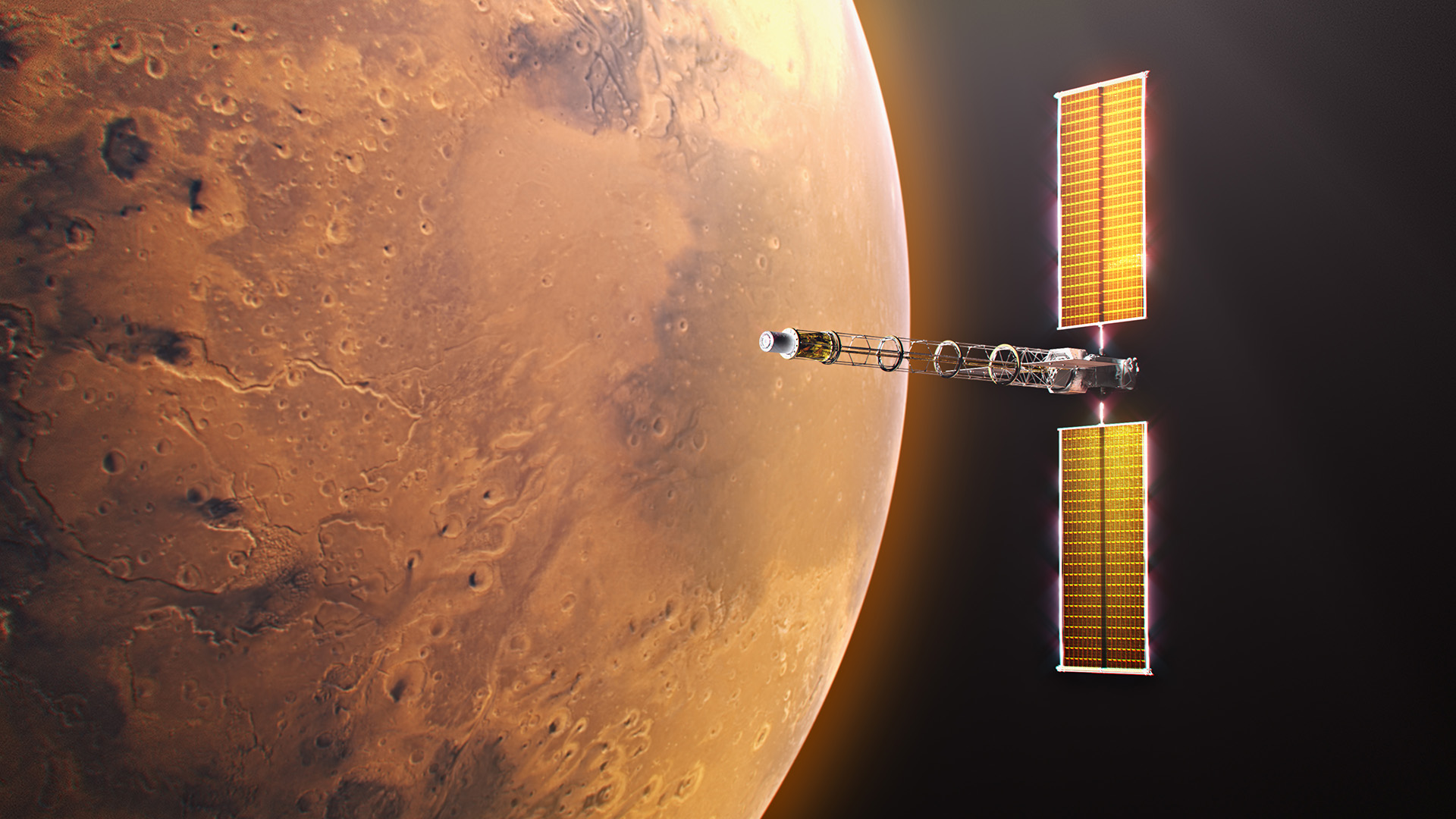
Space Reactor-1 Freedom will be the first spacecraft ever to demonstrate fission power beyond Earth’s orbit, traveling to Mars to deliver a science payload called SkyFall.
NASA/Alberto Bertolin
Destined for Mars and beyond, NASA’s Space Reactor-1 (SR-1) Freedom will be humanity’s first fission-powered spacecraft to travel outside Earth’s orbit. Announced during NASA’s “Ignition” event, this mission will demonstrate nuclear electric propulsion in deep space, and progress is underway on its key element: the nuclear power module. To expedite development of the spacecraft, NASA and its partners have mutually agreed to key contract actions that will advance the SR‑1 Freedom mission.
“These contract actions not only reduce technical risk and help us maintain momentum toward our 2028 launch, but they also strengthen collaboration across our partners,” said Steve Sinacore, SR-1 Freedom program director. “These actions keep SR‑1 Freedom on track and ensure we’re building the strongest possible foundation for NASA’s first fission‑powered voyage beyond Earth orbit while developing technology extensible to a vibrant space nuclear future.”
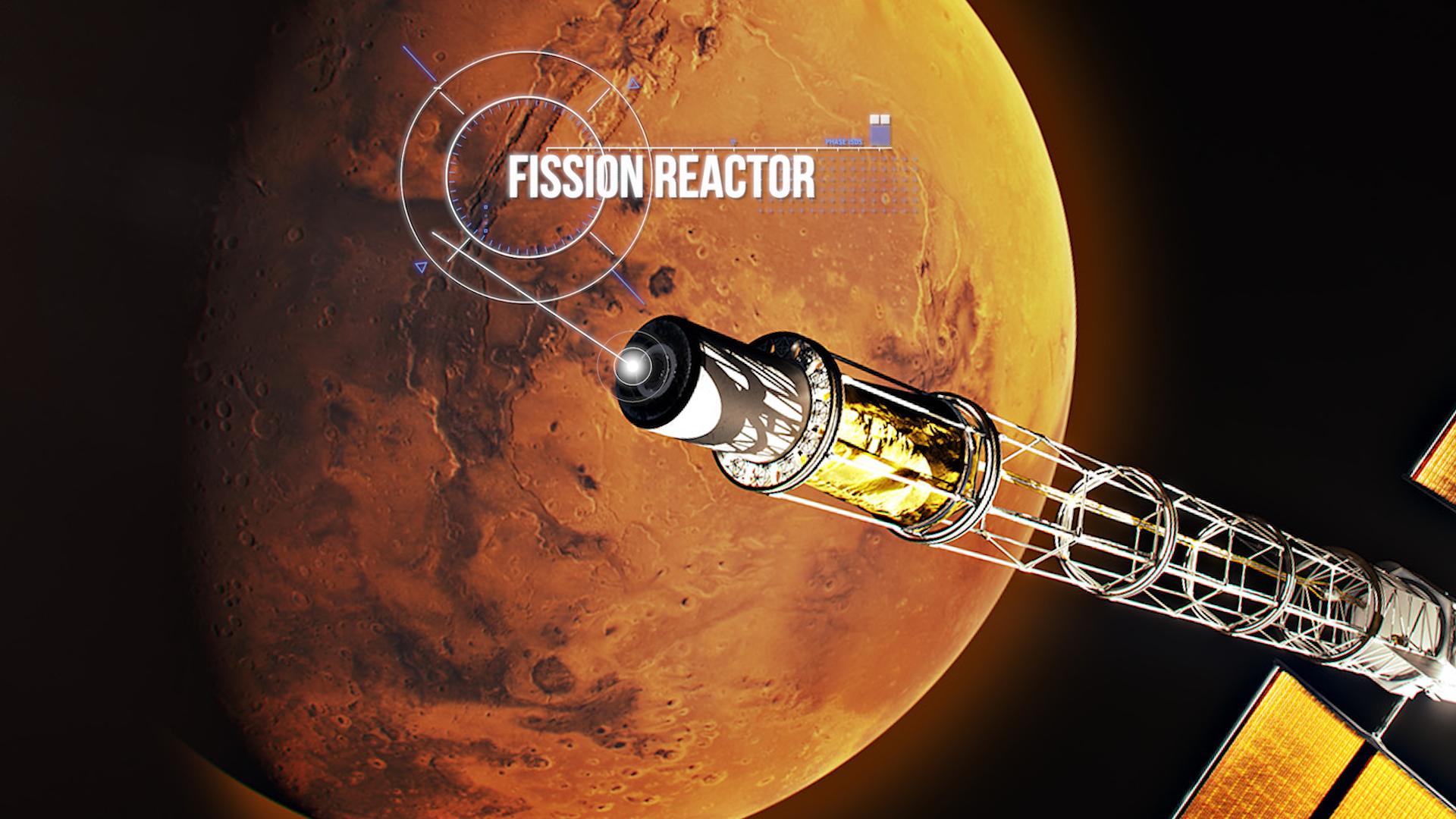
Space Reactor-1 Freedom’s nuclear power module, located at the end of the spacecraft’s boom, consists of a reactor that generates heat through nuclear fission and a power conversion system that converts that heat into electricity to power systems and electric propulsion.
NASA/Alberto Bertolin
Sierra Lobo Inc. will provide the nuclear power module’s closed Brayton cycle power conversion system, which converts thermal energy from its fission reactor into electrical power needed for SR-1 Freedom’s nuclear electric propulsion demonstration. The work will be conducted under the Space Flight Systems Development and Operations Contract III, awarded in 2024, to support spaceflight hardware design, development, testing, and operations at NASA’s Glenn Research Center in Cleveland.
The power conversion system will be integrated with the fission reactor, which is being designed and developed by the Department of Energy (DOE)’s Idaho National Laboratory to complete the nuclear power module. NASA and DOE incorporate thorough safety standards throughout the design and development of the SR-1 Freedom spacecraft, including interagency safety reviews, continuous oversight by a NASA chief safety officer, regulatory compliance, and a rigorous safety design process focusing on hazards, failure tolerance, and nuclear safety. In addition, the nuclear reactor portion of SR-1 Freedom will remain inactive until the spacecraft leaves Earth orbit.
Launching in late 2028, SR‑1 Freedom will deliver the SkyFall science mission, a team of three Mars helicopters evolved from the Ingenuity design, to collect scientific data, demonstrate exploration zones, and identify potential water sources. The mission will pave the way for deep space exploration and next‑generation fission-powered systems designed to keep NASA’s Moon Base operating through periods of darkness and in locations where solar power alone is not sufficient.
Experience the Launch of NASA’s Roman Space Telescope
Are you ready for a new view of the universe? The Nancy Grace Roman Space Telescope will reveal distant worlds, dark energy, and the structure of the cosmos, and we want you to be a part of it!
Digital creators and social media users are invited to register to our NASA Social for the Nancy Grace Roman Space Telescope launch. Roman is NASA’s next flagship astrophysics mission, designed to explore everything from our outer solar system to the edge of the observable universe. This mission is scheduled to launch on Aug. 30, 2026, aboard a SpaceX Falcon Heavy rocket from Launch Complex 39A at NASA’s Kennedy Space Center in Florida.
Are you passionate about social media and communications? Do you love to create content for an audience? Are you a fan of new, unique experiences? If you said yes, this NASA Social event is for you! This is your opportunity to be on the front lines of this historic mission.
The NASA Social event will take place over two days, including the day of launch. A maximum of 50 digital creators will be selected to attend this two-day event and will be given access similar to news media.
NASA Social participants will have the opportunity to:
Tour NASA’s Kennedy Space Center
Learn directly from astrophysics subject matter experts
Meet fellow digital creators and social media users
Spend time with members of NASA’s social media team
View the launch of the Nancy Grace Roman Space Telescope
NASA Social events are intended for members of the public. Current or former NASA civil servants, NASA contractors, NASA interns, and individuals or organizations currently under contract to provide products or services to NASA are not eligible to apply or participate in NASA Social events.
NASA Social registration for the Roman launch opens on this page on Monday, June 15 and the deadline to apply is at 11:59 p.m. EDT on Sunday, June 28. All applications will be considered on a case-by-case basis.
Do I need to have a social media account to register?
Yes. This event is designed for people who:
Actively use multiple social networking platforms and tools to disseminate information to a unique audience.
Regularly produce new content that features multimedia elements.
Have the potential to reach a large number of people using digital platforms.
Reach a unique audience, separate and distinctive from traditional news media and/or NASA audiences.
Must have an established history of posting content on social media platforms.
Have previous postings that are highly visible, respected, and widely recognized.
Users are encouraged to follow @NASARoman for Roman updates on X, Facebook, and @NASAGoddard and @NASAUniverse on Instagram. Updates and information about the event will be shared on X via @NASA_Events
How do I register?
Registration for this event opens Monday, June 15 and closes at 11:59 p.m. EDT on Sunday, June 28. Registration is for one person only (you) and is non-transferable. Each individual wishing to attend must register separately. Each application will be considered on a case-by-case basis.
Can I register if I am not a U.S. citizen?
Yes, this event is open for all to apply.
When will I know if I am selected?
After registrations have been received and processed, an email with confirmation information and additional instructions will be sent to those selected. We expect to send the first notifications on July 17 and waitlist notifications on July 22.
What are NASA Social credentials?
All NASA social applications will be considered on a case-by-case basis. Those chosen must prove through the registration process they meet specific engagement criteria.
If you do not make the registration list for this NASA Social, you still can attend the launch off site and participate in the conversation online. Find out about ways to experience a launch at https://www.nasa.gov/kennedy/see-a-launch-up-close/.
What are the registration requirements?
Registration indicates your intent to travel to NASA Kennedy and attend the two-day event in person. You are responsible for your own expenses for travel, accommodation, food, and other amenities.
The schedule of events and special guest appearances are subject to change without notice. NASA is not responsible for loss or damage incurred as a result of attending. NASA, moreover, is not responsible for loss or damage incurred if the event is canceled with limited or no notice. Please plan accordingly.
Kennedy is a government facility. Those who are selected may need to complete additional steps to receive clearance to enter the secure areas.
IMPORTANT: Those without proper identification cannot be admitted.
For United States Citizens:
You will be required to present a REAL ID compliant identification or valid U.S. passport PLUS one of the following:
Acceptable documents to accompany federal or state identification:
Unexpired Employment Authorization Document issued by DHS that contains a photograph (Form I-688B)
Driver’s license or ID card issued by a state or outlying possession of the United States provided it contains a photograph or information such as name, date of birth, gender, height, eye color, and address
ID card issued by federal, state, or local government agencies or entities, provided it contains a photograph or information such as name, date of birth, gender, height, eye color, and address
School ID card with a photograph
Voter’s Registration Card
Military Dependent’s ID Card
U.S. Military card or draft record
U.S. Coast Guard Merchant Mariner Card
Native American Tribal Document
U.S. Social Security Card issued by the Social Security Administration (other than a card stating it is not valid for employment)
Original or Certified copy of birth certificate issued by a state, county, municipal authority, or outlying possessions of the United States bearing an official seal
U.S. Citizen ID Card (Form I-197)
ID Card for use of Resident Citizens of the United States (Form I-179)
Unexpired employment authorization document issued by DHS (other than those listed previously)
For Foreign Nationals:
Same items required of U.S. Citizens (SSN only when applicable)
Unexpired foreign passport, with I-551 stamp or attached Form I-94 indicating unexpired employment authorization
Passport number and registration date
Citizenship
Driver’s license issued by a Canadian Government authority
For Legal Resident Aliens:
Same items required of U.S. Citizens, and:
Permanent Resident Card or Alien Registration Receipt Card with photograph (Form I-551)
Unexpired Temporary Resident Card (Form I-688)
Certification of Birth Abroad issued by the Department of State (Form FS-545 or Form DS-1350)
The REAL ID Act was passed by Congress in 2005 to establish minimum security standards for state-issued driver’s licenses and identification cards.
All registrants must be at least 18 years old.
What if the launch date changes?
Hundreds of different factors can cause a scheduled launch date to change multiple times. The launch date will not be official until after the Flight Readiness Review. If the launch date changes prior to the review, NASA may adjust the date of the NASA Social accordingly to coincide with the new target launch date, and will notify registrants of any changes via email.
If the launch is postponed, attendees will be invited to attend a later launch date. If the launch is postponed beyond 72 hours, the NASA Social event may be canceled.
NASA Social attendees are responsible for any additional costs they incur related to any launch delay. We strongly encourage participants to make travel arrangements that are refundable and/or flexible.
What if I cannot come to the Kennedy Space Center?
If you cannot come to NASA Kennedy and attend in person, you should not register for the NASA Social. Join the conversation by following @NASARoman on X and Facebook, and @NASAGoddard and @NASAUniverse on Instagram. You can watch the launch at nasa.gov/live. NASA will provide regular launch and mission updates on @NASA.
If you cannot make this NASA Social, don’t worry; NASA is planning many other NASA Social events in the near future at various locations! Check for updates on NASA Socials.

 Login