❌

Normal view

Think you can spot a ChatGPT image? Take my real-or-AI quiz and see how many fool you

17 September 2026 at 10:07

OpenAI launched ChatGPT Images 2.5 last week, bringing all sorts of impressive upgrades to the way it generates images. The company says the latest model will bring us “sharper details, faster generation, more precise editing, and better tools for creating and sharing.”

We’ve already identified the new features of ChatGPT Images 2.5 you’ll actually use, like Sketch for turning quick drawings into polished images, templates for things like posters and better editing tools.

But it’s not all good news. We’re still a little disappointed by the presence of telltale noise patterns in some of its creations. TechRadar writer Eric Hal Schwartz described the problem well: “Everything gets a gritty, sandy look, and nothing looks clean for some reason.”

What I’m most interested in isn’t necessarily how good ChatGPT’s new image capabilities are, but whether they can realistically pass as genuine photos.

Is this real or AI?

I’ve written before about how I love to comb through the r/isthisAI subreddit, where people post suspicious images and ask everyone else to help them work out whether they’re real.

It’s fascinating but also concerning when you see the number of scams, fake viral posts and completely fabricated people that are now floating around online.

So yes, ChatGPT Images has improved. But has it reached the point where AI images are becoming genuinely different to distinguish from real ones?

The jury’s still out. I think we’ll need a bit of time to experiment ourselves and for r/isthisAI to fill up with new images.

But in the meantime, I’ve been interested in the way Redditors have responded to the new image capabilities. Especially one thread about asking ChatGPT to make the most realistic human image possible.

The Redditor who started the thread shared the resulting image of a young woman. And, at least at first glance, there’s very little about her that screams AI to me.

Can you actually tell which photos are AI now?

I decided to experiment with ChatGPT Images myself, especially with prompts like the Reddit thread in which I tried to get the chatbot to make the most realistic-looking images.

To make the comparison feel as fair as possible, I went through photos from my own travels this summer and picked some I was happy to share. I then asked ChatGPT to create extremely realistic images with similar subjects, settings and compositions.

For some, that meant asking for a realistic photograph of a blonde woman. For others, I recreated the kinds of ordinary travel photos sitting in my camera roll, which was meals in restaurants, boats in harbors and scenes from walks.

Importantly, I wasn’t trying to make spectacular AI art, I really wanted the opposite. Images that were boringly believable.

Take the quiz below to see if you can guess which are the real photos of my travels this summer and which are ChatGPT-generated.

Is that gritty, sandy look still enough to give the AI ones away? Can you focus less on the faces and spot strange details in the backgrounds? Or have we reached the point where your first instinct simply isn’t reliable anymore?

Take the quiz and tell me how you get on in the comments below.

Metasurface optical device boosts nonlinear frequency conversion

17 September 2026 at 09:30

By combining a band-structure engineered multi-quantum-well heterostructure with a nanostructure known as a metasurface, physicists in Austria and the US have created a device that can efficiently transform light into different frequencies – including those at technologically important near-infrared wavelengths. Their technique, which boosts nonlinear frequency conversion, could help in the development of smaller and more efficient components for telecommunications, quantum information transfer and other photonics technologies.

Nonlinear frequency conversion is an optical process in which a material is used to generate light of a different frequency to that incident on the material. It is now routinely employed in a wide range of photonics devices that rely on frequency mixing, ultrafast signal processing, broadband and pulsed light sources, and high-speed light modulation. It is also used to generate entangled photon pairs for quantum communication. One common type of frequency conversion, and the one used in this new study, is second-harmonic generation. Here, two input photons are combined to produce one photon with twice the energy.

Efficient nonlinear devices require light with high electric field strengths and materials that respond to these intense electromagnetic fields by producing a light polarization that is not directly proportional to the applied field. “Only a handful of such nonlinear crystals exist and these have complicated structures with weak nonlinearities, which means they require high optical powers to make photons interact with each other,” says Marcus Ossiander from the Institute of Experimental Physics at TU Graz in Austria, one of the authors of the new study published in Nature Nanotechnology. “While, new such crystals emerge from time to time, their structure is fixed, which dictates which light wavelengths they work at and how efficiently.”

Asymmetrically coupled multi-quantum wells

Recently, a group of researchers at the University of Texas at Austin in the US, led by Seth Bank, also an author of this latest study, succeeded in creating an optical nonlinearity not via a new crystal structure but by growing a semiconductor metamaterial made from nanoscale layers of gallium arsenide and aluminium gallium arsenide. These layers contain multiple quantum wells that are asymmetrically coupled to each other.

The quantum wells confine electrons in one dimension while allowing them to move freely in the other two dimensions, something that has the effect of restricting their energy levels into discrete, quantum states. Since they are asymmetrically coupled, the electrons end up mainly moving in one direction when exposed to light. This so-called “one-way street leads to increased nonlinear electron oscillations, allowing light waves to interact with each other extremely efficiently and exceed naturally occurring nonlinearities.

Ossiander and his colleagues, including Federico Capasso at the Harvard John A. Paulson School of Engineering and Applied Sciences (SEAS), have now added a second, two-dimensional metamaterial atop the first one. This metasurface, which consists of titanium dioxide pillars, each several hundred nanometres in size, precisely creates the particular light polarization required to deflect incoming light so that it scatters along the one-way street. This enhances the interactions between light waves even further and so increases the intensity of light in the structure.

An extra lap

Researchers have known for a while now that metasurfaces are extremely good at resonantly trapping light and increasing the interaction of light with matter. Usually, the process is straightforward, explains first author Pernille Undrum Fathi, who works in Capasso’s group: you implement a resonant metasurface, and it enhances, for example, the nonlinear effects that you are aiming for.

“The new material sent us for an extra lap, however, because, during our experiments, we discovered that the designable second-order nonlinear susceptibility tensor element (the required incident polarization) is different to that of conventional materials,” she says. “Therefore, when we shone light at exactly normal incidence, the metasurface–material combination generated light waves whose polarizations cancelled each other out completely, so annihilating any enhanced optical nonlinearity.”

However, the researchers found that tilting the sample by just 0.3° broke this symmetry and solved this challenge. Indeed, they were able to increase the effective nonlinear conversion of the light to three orders of magnitude higher than that for a non-patterned heterostructure. The effect is also higher than previously reported values for comparable devices at near‑infrared wavelengths.

“Nonlinear optics are ubiquitous in modern science and technology, with examples including the generation of light at new frequencies (where lasers might be unavailable), all-optical signal processing and the generation of entangled photon pairs for quantum communication,” Ossiander tells Physics World. “Enhancing the fundamental processes enabling this technology will allow for much more efficient, compact devices and enable new measurements that would previously be impossible.”

Metasurfaces offer an excellent route to control and enhance the interaction of light with matter, and the team was intrigued to find out what could be made possible when combining these materials with nanostructures, adds Fathi.

“Working with new materials of course comes with additional uncertainty, and we spent a lot of time learning about and understanding the mechanisms of these new structures and how the particular nonlinear tensor elements of this material interact with the resonant modes introduced by the metasurface,” she says.

“The material we studied is very interesting but also complex,” adds Ossiander, noting that the reseachers believe they can learn how to make even better use of the designer nonlinearity in it by further investigating its fundamental properties. “Indeed, there is a new publication in Optica by Bank’s group on how to improve the multi-quantum-well material even more.”

The post Metasurface optical device boosts nonlinear frequency conversion appeared first on Physics World.

PC Portable HP OmniBook 3 : son prix chute et Cdiscount ajoute 10 % pour les nouveaux clients

17 September 2026 at 09:00
Le HP OmniBook 3 16-by0012nfx met son grand écran 16 pouces et son Ryzen 5 à prix plus léger chez Cdiscount. Une remise qui tombe à pic pour changer de PC portable sans mettre son budget sous pression.

Regardez bien cette fleur : elle ne sera plus la même dans quelques heures !

17 September 2026 at 08:20
En quelques heures seulement, cette fleur peut changer complètement de visage. Ses couleurs éclatantes apparaissent, disparaissent, puis se réinventent au rythme de la journée. Derrière cette étonnante métamorphose se cache un mécanisme fascinant qui montre à quel point les plantes sont capables...

Exotic pet trade poses rising zoonotic disease risks in India

17 September 2026 at 07:15
In India, the exotic pet trade is increasing the risk of zoonotic disease spillovers, as close contact with imported wild animals creates repeated opportunities for dangerous pathogens to jump to humans and vice versa, reports Mongabay India’s Arathi Menon. Dr. Rina Dev, an avian and exotic animal veterinarian in Mumbai who treats imported and seized wildlife, experienced the potential danger firsthand when she was hospitalized with a lung infection. “I hope it’s not something from the parrots I was treating,” Dev told Mongabay India after she was released from the hospital. Her concerns are warranted: diseases like avian chlamydiosis (psittacosis) are commonly contracted by people who handle birds, earning it the nickname “bird handler’s disease.” Dev noted that traded animals can carry a wide array of infections, including salmonellosis from reptiles, tuberculosis from primates, and avian influenza from birds. “Tuberculosis is increasingly being detected among primates, which is a big zoonotic concern,” she said. Uttara Mendiratta, a conservation researcher working on illegal wildlife hunting and trade, said disease transfer between humans and other primates is especially easy because we’re so closely related. Ebola and HIV can both pass from nonhuman primates to people, for example. Human diseases can also be deadly for wildlife. A global analysis revealed that traded mammals are 1.5 times more likely to share pathogens with humans than nontraded mammals. On average a traded species shares one additional pathogen with humans for every decade it’s traded. Additionally, a 2026 report by Humane World for Animals, a global…This article was originally published on Mongabay

Voici le nutriment essentiel au cerveau que vous ne consommez peut-être pas assez

17 September 2026 at 07:00
Encore trop peu connue, la choline est un nutriment essentiel au bon fonctionnement de l’organisme, et ce, dès la vie in utero. Indispensable au développement du cerveau, elle joue aussi un rôle clé dans la mémoire, l’humeur ou encore la santé du foie. Pourtant, la majorité de la population n’en...

Displaced by typhoons, Taiwan’s Bunun Indigenous people struggle to preserve heritage

17 September 2026 at 05:17
Wild grass now grows around the abandoned wooden houses of Tengjhih, a high-mountain hamlet in southern Taiwan, once a key settlement of the Bunun Indigenous people. Now, little remains except for the memories it holds. Around 150 Bunun Indigenous residents of Tengjhih were permanently resettled in lowland areas after the deadly Typhoon Morakot in 2009 destroyed the only access road to their village, contributor Aylin Ho reports for Mongabay. Typhoon Morakot killed 755 people across Taiwan, triggering catastrophic floods and landslides. While Indigenous peoples represented just 2.1% of Taiwan’s population at the time, approximately 70% of the land declared unsafe by authorities was located within Indigenous territories. Efforts to rebuild the road to Tengjhih in 2012, 2021 and 2023 faced setbacks due to climate change-amplified rainfall and landslides. More recently, a typhoon in 2025 also devastated one section of the mountain, Ho reports. The indefinite closure of the surrounding Tengjhih National Forest Recreation Area has wiped out the local ecotourism and agricultural economy. “When a major typhoon hits us, I have no income for the entire year,” said Bi’ Ismahasan, 70, a tea and coffee farmer who now relies on government assistance. “In 2026, I lost my entire harvest. Every year is worse than the previous one.” Displacement has severed connections to ancestral land, threatening the transmission of cultural practices and language to younger generations. “Today, when [young people] come back, there is no village and no work,” said Saminat Maliklan, 55, a Bunun cultural guide and one of five…This article was originally published on Mongabay

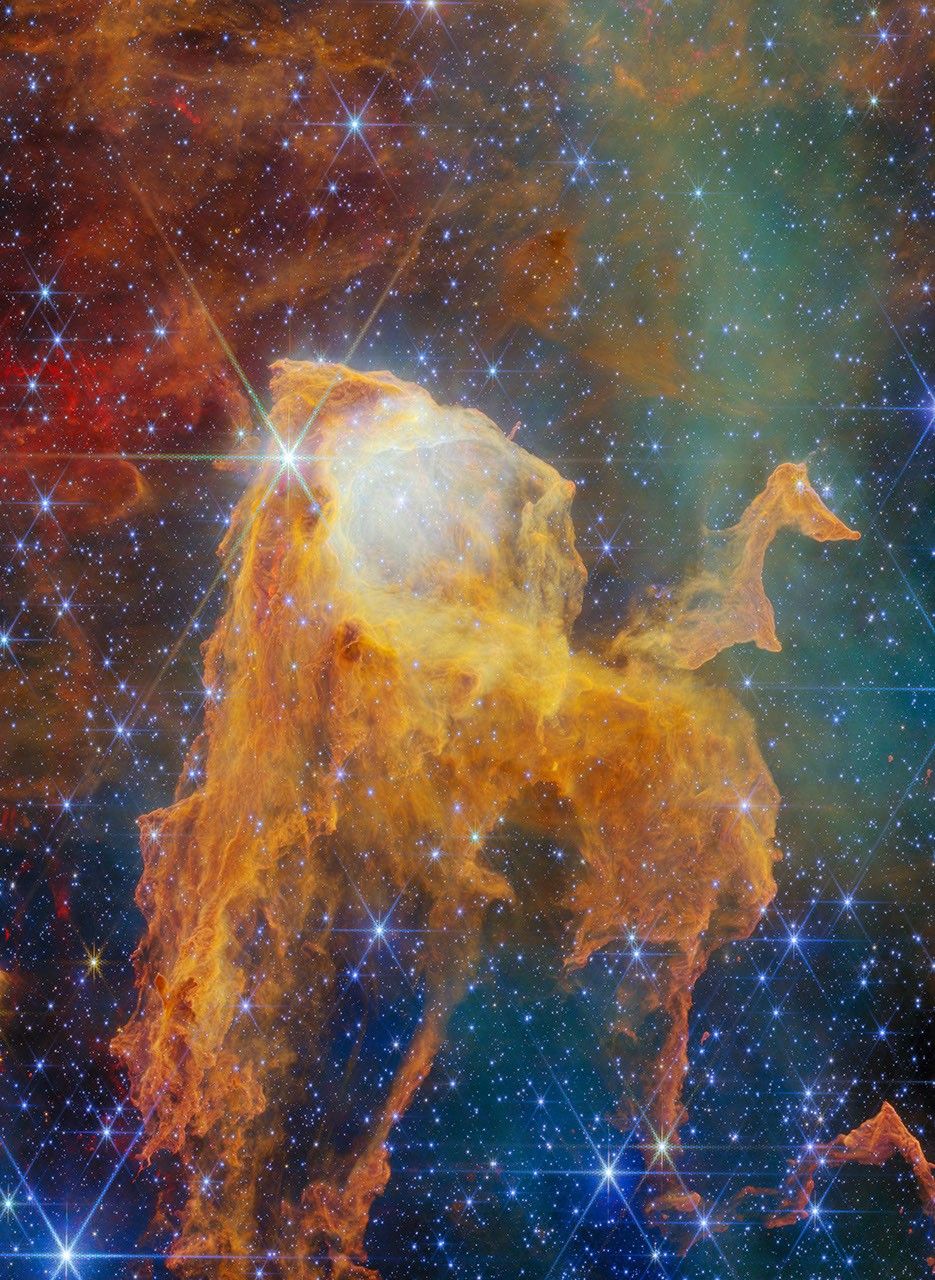
APOD: 2026 September 17 – A Treasure Chest in the Carina Nebula

17 September 2026 at 05:05

APOD

Astronomy Picture of the Day

Discover the cosmos! Each day a different image or photograph of our fascinating universe is featured, along with a brief explanation written by a professional astronomer.

A colorful nebula resembles an open treasure chest on a field of stars

A Treasure Chest in the Carina Nebula

Explanation: This treasure chest is full of stars. The featured image was obtained with NASA‘s James Webb Space Telescope and shows a dust pillar in the Carina Nebula inside our Galaxy, roughly 7500 light-years away. It is formed by interstellar gas and dust, and shaped by powerful stellar winds and radiation from neighboring stars like the nearby Eta Carinae stellar system which is more luminous than 5 million suns. The star formation inside the pillar is excavating its head, creating the open lid of the chest. Astronomers estimate that there are about 70 stars in a compact cluster inside the pillar. This cluster is now thought to be only around 1.3 million years old. Its bounty of young stars includes a massive star approximately 19 times as massive as the Sun. More massive stars are rarer, shine brighter and evolve faster than less massive stars. They are the shiniest jewels in the treasure chest.

APOD’s main NASA site is moving : From apod.nasa.gov to science.nasa.gov/apod
Tomorrow’s picture: what’s next?

Date September 17, 2026
Credit ESA/Webb, NASA & CSA, M. Reiter; Acknowledgement: M. H. Özsaraç
Authors & editors: Cecilia Chirenti, Robert Nemiroff, Jerry Bonnell, Keighley Rockcliffe
A service of: ASD at NASA / GSFC,
NASA Science Activation & Michigan Tech. U.

The post APOD: 2026 September 17 – A Treasure Chest in the Carina Nebula appeared first on NASA Science.

A single Bitcoin transaction carried an average water footprint of about 16,000 litres in 2021 once the electricity and cooling behind it were counted — roughly 6.2 million times the water behind one credit-card swipe, and the figure rises and falls with the price of Bitcoin itself

17 September 2026 at 03:00
Rows of cryptocurrency mining rigs and cables

In 2021, the average transaction recorded on the Bitcoin blockchain carried an estimated water footprint of roughly 16,000 litres, once the water used to generate the electricity behind the mining process and to cool the machines doing the work is added up. That figure, drawn from a peer-reviewed study published in the Cell Press journal Cell Reports Sustainability, works out to roughly 6.2 million times the water footprint of a single credit-card swipe, based on de Vries’ own estimate — discussed in a later interview with Greenpeace rather than the paper itself — that one card transaction carries a footprint of around 2.6 millilitres.

The research, titled “Bitcoin’s growing water footprint,” was published online in late November 2023 by Alex de Vries, a data scientist with a background in financial economics who tracks the industry’s resource use. De Vries built his estimate around two components. The larger of the two, accounting for roughly 80 to 90 percent of the total, is indirect water use: the water consumed at power plants to generate the electricity that miners buy, whether through evaporative cooling at thermoelectric plants, hydropower reservoir evaporation, or other generation methods. The paper calculates this by combining data on where Bitcoin’s computing power is located with regional water-intensity figures, expressed in litres of water per kilowatt-hour of electricity produced on that grid.

The remaining share, direct water use, covers cooling and humidification equipment on-site at mining facilities, measured using an industry metric called water usage effectiveness, or WUE. For large-scale US mining operations, the study estimated a weighted-average WUE of between 0.25 and 1.03 litres per kilowatt-hour, depending on climate and facility design. Location matters enormously to the total: the study estimated Kazakhstan accounted for 63 percent of Bitcoin’s 2021 water footprint while hosting only around 14 percent of its computing power. Average water intensity across Bitcoin’s power mix rose from 8.63 litres per kilowatt-hour in 2020 to 15.0 litres per kilowatt-hour in 2021, the paper found.

What the comparisons mean

News coverage of the study, including reporting by ScienceDaily and Fast Company, popularized the comparison that a single Bitcoin transaction’s water footprint is roughly equivalent to filling a backyard swimming pool. The 6.2-million-times-a-credit-card-swipe comparison, cited in de Vries’ own commentary and repeated across outlets covering the paper, follows from dividing the 16,000-plus-litre figure by that credit-card baseline, and it moves with Bitcoin’s price. When the market fell during the 2022 downturn, mining activity and its associated electricity and water use fell with it, only to climb back toward record levels as the price recovered in 2023. Because a higher Bitcoin price makes mining more profitable and draws more computing power onto the network, the water footprint tracks the price cycle instead of holding steady. De Vries projected the network’s total 2023 water footprint at roughly 2,237 gigaliters, an increase over 2021 despite the intervening price crash.

Extrapolated to the United States, which absorbed a large share of mining capacity after China’s ban, de Vries estimated domestic mining operations consume water at a scale comparable to roughly 300,000 US households, or a city on the order of Washington, DC, a comparison he discussed in an interview with Greenpeace.

Where the estimate is contested

The methodology has drawn pushback. Critics covered in a DL News investigation note that per-transaction water figures are largely independent of transaction count — a block can bundle thousands of individual payments, so dividing total resource use by the number of on-chain transactions can make the per-transaction number swing based on how the network happens to be used that day — a shift in usage patterns, not a genuine efficiency change.

Bitcoin advocate Daniel Batten has gone further, arguing in commentary covered by the same report that the swimming-pool framing overstates the case by counting indirect water use from power generation that would occur with or without Bitcoin mining, and that applying the same accounting method to other electricity-intensive industries — banking, AI, search engines, construction, or media — would produce similarly large-sounding numbers. Separately, a UN-affiliated water researcher, Kaveh Madani, flagged in the same report that “water footprint” and “water consumption” are technical terms with distinct meanings in hydrology, and that using them interchangeably in public communication risks overstating the case. The Register’s coverage of the dispute frames it as a live disagreement between the paper’s author and its critics — not a settled question.

Why it matters beyond the headline number

The debate sits inside a larger and less disputed trend: much of Bitcoin mining has moved into regions and grids with high water intensity, including coal-heavy and drought-prone areas, since China’s 2021 mining ban scattered the industry’s computing power across new jurisdictions. That shift, documented in mining-location data tracked separately by the University of Cambridge, means Bitcoin’s water footprint is now heavily influenced by decisions about where mining farms are sited and what power sources they draw on, in addition to how much Bitcoin is worth on any given day. For a network whose environmental accounting has focused almost entirely on carbon and electricity for over a decade, the 2023 paper marked one of the first attempts to put a number on the water side of the ledger as well.

The post A single Bitcoin transaction carried an average water footprint of about 16,000 litres in 2021 once the electricity and cooling behind it were counted — roughly 6.2 million times the water behind one credit-card swipe, and the figure rises and falls with the price of Bitcoin itself appeared first on Space Daily.

Scientists test underwater solar panels that work 10 meters beneath the waves —breakthrough perovskite tech could support self-powered marine drones

  • Scientists have developed solar panels that can work up to 10 meters underwater
  • The panels can capture up to 324 mWh of energy at that depth
  • Each device is expected to last up to five and a half years at a time

A lot of devices are deployed underwater for research and exploration purposes, but powering them all can prove to be difficult, especially if they’re under the waves for a considerable period of time. A new scientific paper, however, has shown that solar panels can be successfully used at depths of up to 10 meters, potentially presenting a new way to keep underwater tech powered up and ready for action.

The paper was published in the Joule periodical and accompanied by a press release explaining its advances. The research was conducted by a team of scientists from Yunnan University in China, who said that a series of solar cells placed 32 feet (10 meters) below the water’s surface in the South China Sea were able to collect enough energy to power up a set of lithium-ion batteries in two hours.

The cells were made from lead halide perovskite with a polymer called polyhexamethylene guanidine hydrochloride added into the mix. This additive helped to enhance the effectiveness of the panels.

According to Wen-Hua Zhang of Yunnan University, “Very few studies have been reported on underwater solar cells, and all of them are focused on very shallow water depths of only two meters or less, a scenario far from catering for requirements of practical application.”

An underwater solar panel being tested

A photo of the prototype solar cells being tested in the South China Sea. (Image credit: Joule)

“This work presents the first functional validation of submerged solar cells practically operating at a water depth of up to about 10 meters, greatly broadening their application scope,” Zhang added. The researchers stated that each cell could be deployed for around five and a half years at a time.

The panels captured 1,416 milliwatt-hours (mWh) of electricity at a depth of two meters. This decreased to 752 mWh at six meters and 324 mWh at ten meters. During separate lab testing, the solar panels had a power conversion efficiency of just under 35%.

Paving the way

Underwater datacenter

Solar panels could one day be used to power ‘self-sustained marine energy systems and autonomous underwater devices,’ researchers believe. (Image credit: datacenterdynamics)

The idea behind this research is that underwater solar panels could be used to power devices such as sensors, cameras, communications systems, and more.

Many of these objects are stationary for much of the time, so nearby solar cells could help keep them topped up and working without necessarily requiring extensive human intervention.

One question that remains unanswered is how exactly solar panels like this would interact with their environment. For example, it’s likely that they would accumulate biomatter that could hinder their operation, potentially requiring regular cleaning in order to remain fully functional. After all, the sunlight that will power these cells could also promote the growth of plants and animals — a process known as biofouling.

Still, the research seems to have potential. As the authors noted, “This work paves the way for the practical deployment of perovskite photovoltaics in underwater environments, offering a promising route toward self-sustained marine energy systems and autonomous underwater devices.”

Quote of the day by pioneer Douglas Engelbart: 'The digital revolution is even more significant than the invention of writing or printing' — an audacious claim about interactive computing

16 September 2026 at 23:00

It's hard to imagine how we'd interact with computers today without the work of engineer and inventor Douglas Engelbart, who pioneered many aspects of computer science and also invented the computer mouse. The breadth and depth of his work led him to believe that humanity's digital era could be the most significant in its history.

The digital revolution

Engelbart, then a researcher at the Stanford Research Institute where he led the development of interactive computing, was delivering a demonstration now considered by many as legendary.

Quote of the day

This article is part of TechRadar Pro's QOTD project to provide an insight into the minds of the brightest and most recognized figures in the technology industry today and in years gone by. Read the full series here.

This spoken presentation, known as 'The Mother of All Demos', involved a 90-minute showcase in which his team described their progress to a captivated audience.

Engelbart wasn't standing at a podium, but at a computer that was based 30 miles away in his research lab. The event cycled between spoken passages, live demos, and different members of the team using teleconferencing to speak about different technologies.

A new era

During this talk, he delivered his opinion that their work, which would lay the foundation for advancements in the years to come, was a more important contribution than both writing – and even printing.

This was an incredibly bold prediction, because he was comparing the digital revolution to core aspects of the human condition. Writing and printing fundamentally opened pathways for sustainable knowledge transfer, allowing humanity to pass on and build on progress over the course of millennia.

If anybody was poised to know the significance of the computing era, it was Eglebart. His work was at the heart of many of the technologies that we take for granted today, including the humble computer mouse. In 1964, he built a small, carved wooden block featuring a single button on top and two metal wheels beneath to track movement. He went on to demonstrate this for the first time at his 1968 demo.

❌