❌

Normal view

When will SpaceX and Blue Origin fly to the moon? NASA reveals lunar lander timelines (and an Artemis III update)

21 October 2026 at 14:00

NASA has revealed new details about its plans to return astronauts to the surface of the moon, outlining a series of upcoming milestones for SpaceX and Blue Origin as both companies race to ready their lunar landers for the agency's Artemis program.

During an Oct. 5 presentation at the Astronautical Congress (IAC) in Antalya, Türkiye, Steve Creech, acting manager of NASA's Human Landing System (HLS) Program, laid out development timelines for both spacecraft, with key demonstrations planned through early 2028 that include orbital refueling and uncrewed lunar landing tests to qualify the vehicles to fly astronauts to the surface of the moon.

A more pressing deadline, however, is NASA's Artemis III mission, which is targeted for the third quarter (Q3) of 2027. Artemis III will launch four astronauts aboard NASA's Orion spacecraft to low Earth orbit (LEO), where they will rendezvous and dock with test versions of both companies' landers for interoperability checkouts. Those demonstrations will help inform NASA's determination about which lander the agency will choose to carry astronauts to the moon's surface on Artemis IV, targeted for early 2028.

SpaceX and Blue Origin were both awarded NASA contracts to develop HLS vehicles — Starship and Blue Moon, respectively — and have spent the past several years refining their respective lunar lander designs and dealing with various delays along the way. In the face of those delays, and in an effort to better structure its mission progression for success, NASA overhauled its Artemis program architecture in February to maintain its goal of landing astronauts on the moon by the end of 2028 and establish a more regular cadence of uncrewed landings in the meantime.

As part of that shakeup, Artemis III, previously the program's first crewed lunar landing mission, was moved up a year and repurposed for the lunar lander vehicle tests the agency is preparing to fly to LEO next year. The program's first moon landing remains scheduled for 2028, but was shifted to the manifest for Artemis IV.

Between now and then, both SpaceX and Blue Origin have more than a dozen test demonstrations and vehicle milestones to achieve, including success during Artemis III and flights afterward. This will all lead up to a key decision NASA must make: Which vehicle will carry out the first crewed landing on the surface of the moon since the Apollo program ended in 1972?

Starship reached for the first time on its most recent test flight, which occurred on Sept. 28 from SpaceX's Starbase site in South Texas. NASA lists several other important goals for the vehicle to achieve in 2026, including (in the order listed during the IAC presentation) the first return and catch of the rocket's upgraded Version 3 (V3) booster at its launch pad; the first-ever return and catch of a Ship upper stage; the first Starship launch from one of SpaceX's launch pads still under construction on Florida's Space Coast; and, possibly, the first V3 booster reflight.

NASA also expects SpaceX to complete the initial build of the crew cabin for its lunar lander Starship variant. SpaceX released renders of Starship's interior last year, as well as images of the test elevator astronauts are using to train for Starship egress on the lunar surface, but little else has been made public about the progress the company has made on the cabin's design.

Artist's rendering of the cabin of SpaceX's Starship vehicle during an Artemis moon mission for NASA.

Artist's rendering of the cabin of SpaceX's Starship vehicle during an Artemis moon mission for NASA. (Image credit: SpaceX)

Should the cabin's initial build wrap up by the end of the year, as NASA's presentation suggested, SpaceX will use Q1 2027 to complete integration of the systems that Starship will need to communicate with Orion during Artemis III, and deliver a cabin simulator for astronauts to train on leading up to the mission. SpaceX plans to continue Starship test flights through Q2 of next year, complete a landing leg demonstration and begin crew cabin airlock tests.

Blue Origin's lunar lander mockup is ready for NASA Artemis astronaut training

For Artemis III, SpaceX plans to fly one of its existing V3 Starship upper stages, with some slight modifications. Starship and Orion will dock as part of Artemis III but the SpaceX vehicle won't be equipped with a crew cabin for the mission's astronauts to enter. Between the end of this year and the beginning of the next, SpaceX is expected to complete the addition of a docking system and nosecone cover to the Artemis III Starship vehicle, which, NASA documents suggest, has already completed its mechanical fit checks.

A giant chrome rocket and a small space capsule dock in low Earth orbit.

Render of SpaceX Starship and Orion docked in low Earth orbit. (Image credit: SpaceX)

Other notches on SpaceX's checklist leading up to Artemis III include the first propellant transfer demonstration with Starship in orbit. As the first-ever launch vehicle and spacecraft designed for full reusability, Starship's fuel constraints require that its tanks be topped off in order to fly beyond LEO. For a moon landing mission, this could mean up to a dozen launches of SpaceX's Starship "tanker" spacecraft to an orbiting fuel depot, which the moon-bound Starship will visit. To pull that off, though, SpaceX has to show it can successfully transfer those cryogenic fuels on orbit, and also store them effectively enough to prevent too much boil-off.

Starship won't require any refueling flights to complete its objectives for Artemis III, but SpaceX is expected to launch its first Starship tanker vehicle within a few months of that mission as it gears up for the Artemis IV moon landing mission. To that end, a launch of an uncrewed Starship lunar lander variant is targeted sometime toward the end of Q3/beginning of Q4, with an uncrewed lunar landing mission carried out before the end of 2027.

Blue Origin, meanwhile, has its own set of milestones to meet as it develops its Blue Moon Mark 2 (MK2) lander — a 52-foot-tall (16 meters) spacecraft powered by three BE-7 engines. Unlike the bare-bones V3 Starship that SpaceX will launch on Artemis III, Blue Origin plans to fly a completed test vehicle, incorporating the crew cabin, partial life-support, flight software and other systems needed to allow astronauts to enter the lander from Orion during their time docked in LEO. Astronauts will be able to enter Blue Moon from Orion to get a feel for the lander in zero-g and test some of its systems.

A lunar lander rendezvous with Orion in space.

Render of Blue Origin's Blue Moon lander and Orion prior to docking in low Earth orbit. (Image credit: Blue Moon)

NASA's timeline shows the company working to complete a series of manufacturing and testing milestones in the last few months of 2026, including continued BE-7 testing and qualification of Blue Moon's BT-7 maneuvering thrusters. The company also faces its Artemis III interim design review and a critical design review for an upcoming landing demonstration mission in 2028.

Blue Origin is also working to restore its pad at Cape Canaveral Space Force Station's Launch Complex-36 (LC-36) to operation and return its New Glenn rocket to flight, following an explosion of the rocket in May that caused extensive damage to the facility. NASA's presentation places that milestone in Q4 2026, a timeline the company has also been very vocal about maintaining. A recent Reuters report, however, suggests that may not happen until early 2027.

By early 2027, the company expects to complete the spacecraft's communications systems and finalize its flight software, with assembly, integration and testing continuing into Q2. Q1 2027 is also when Blue Origin's Blue Moon MK1 lander (a smaller, uncrewed version of its MK2 successor) will launch to the lunar surface as a part of NASA's Commercial Lunar Payload Services (CLPS) program of robotic moon missions.

During Q2 2027, as the Artemis III mission approaches, Blue Origin is expected to complete integration of its test lander with New Glenn and conclude qualification of its BE-7 engine. Throughout next year, the company plans to continue construction and refurbishments at its launch facilities and hopes to have a new launch pad ready to support the upgraded, more powerful New Glenn 9x4 rocket l by the end of Q3. The first flight of that rocket variant is scheduled for Q4 2027, alongside a second MK1 lunar mission and the launch of an uncrewed MK2 demonstration lander.

That spacecraft is expected to attempt its own uncrewed lunar landing in Q1 2028, around the same time Blue Origin has scheduled a third MK1 flight. Like SpaceX, Blue Origin will need to demonstrate that its lander can safely reach the moon's surface,operate there and return to lunar orbit before NASA clears it to carry astronauts on a future Artemis mission.

NASA's overall timeline remains the same as it has been since the February revamp, with Artemis III expected to launch in mid-2027, followed by a crewed lunar landing on Artemis IV in 2028, and possibly another on Artemis V that same year. There may be changes on the horizon, though. NASA will host a press conference on Friday (Oct. 23) with Administrator Jared Isaacman and Associate Administrator Amit Kshatriya, as well as Artemis program director Jeremy Parsons. During the event, which you'll be able to watch here at Space.com, they will discuss the status of the upcoming moon missions and an "Artemis acceleration."

SpaceX and Blue Origin still face tight schedules to complete their respective uncrewed landing demonstrations before Artemis IV. With SpaceX targeting Q4 2027 and Blue Origin Q1 2028, both are pushing the margins against NASA's hopes to return astronauts to the lunar surface that same year. Which company ultimately gets the green light for that first landing mission will depend on the progress each makes between now and then, and whether their landers can demonstrate the readiness that NASA requires to safely carry astronauts to the surface of the moon and back again.

Japan launches historic MMX sample-return mission to Mars' moon Phobos (video)

19 October 2026 at 20:53

Japan's groundbreaking mission to Mars is officially underway, headed to the Red Planet's mysterious moons Phobos and Deimos for a historic sample-return attempt.

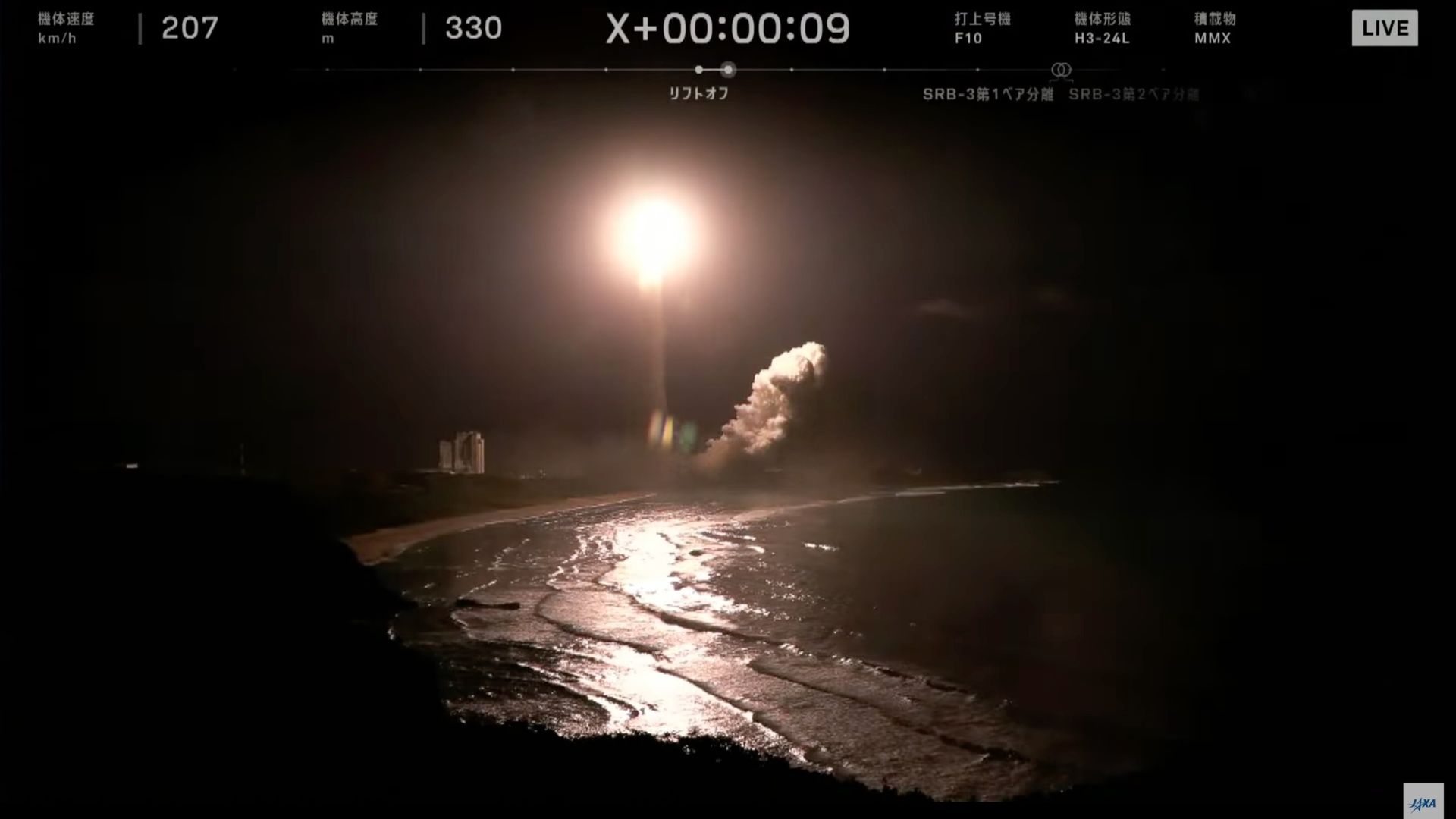
The Martian Moons eXploration (MMX) mission launched today (Oct. 19) from Tanegashima Space Center in Japan, riding an H3 rocket that lifted off from Pad-2 at Tanegashima's Yoshinobu Launch Complex at 3:41 p.m. EDT (1941 GMT; 4:41 a.m. local time in Japan on Oct. 20).

The JAXA (Japan Aerospace Exploration Agency)-led MMX mission is bound for Mars orbit, where it will study the planet's two moons, Phobos and Deimos. If everything goes according to plan, MMX will become the first spacecraft to land on and return samples from Phobos for study back on Earth, which scientists think could shed light on a decades-old mystery about the moons' origins and reveal clues about the formation of the early solar system.

Japan's MMX mission to Mars' moon Phobos launches from Tanegashima Space Center on Oct. 19, 2026.

a rocket launches into a night sky from a seaside pad (Image credit: JAXA)

It was the 10th liftoff of Japan's expendable, two-stage H3 rocket, which was jointly developed by JAXA and Mitsubishi Heavy Industries. After clearing its launch pad today, the 207-foot-tall (63 meters) launch vehicle flew a nominal trajectory through its ascent corridor over the Pacific Ocean, jettisoning its four solid boosters in pairs just before the flight clock reached two minutes. The rocket shed its payload fairings about one minute and 20 seconds later, exposing MMX to the vacuum of space for the first time.

H3's first stage, powered by two LE-9 rocket engines, channels a mixture of liquid hydrogen and liquid oxygen to produce a combined thrust of 331,000 pounds (1,471 kN), according to Mitsubishi Heavy Industries. As the mission clock approached T+5 minutes, H3 executed its main engine cutoff procedure and separated from the second stage, which ignited its engines for a 5.5-minute burn about 10 seconds later.

All continued to go to plan after that. The H3's upper stage ignited its engine for a second time for a trans-Mars injection burn about one hour and four minutes after liftoff, a maneuver that lasted roughly six minutes and 25 seconds and took MMX to a maximum velocity of about 24,145 mph (38,858 kph).

MMX was released from the rocket's upper stage right on schedule, about one minute after the completion of that burn and roughly 71 minutes after liftoff. The success elicited loud cheers in mission control, which viewers saw and heard on JAXA's launch webcast.

MMX is now under its own power, and on course for Mars. The interplanetary transit will last about 10 months, with the spacecraft scheduled to arrive at the Red Planet in August 2027. When it does, MMX's propulsion module will execute an orbital insertion burn to place itself in a quasi-satellite orbit (QSO) around Phobos, which places MMX within the space around the moon as both circle Mars.

MMX will spend about three years in the Martian system, devoting much of that time to studying the 14-mile-wide (22 km) Phobos with its science instruments. The spacecraft also carries the IDEFIX rover, a joint effort of the space agencies of France and Germany, which is scheduled to deploy to the surface of Phobos in late 2028 or early 2029.

After a mapping campaign to select suitable landing sites, MMX will perform two separate touchdowns on Phobos to collect and stow samples in the spacecraft's return capsule. Following its second landing and sample collection, MMX will briefly return to QSO with Phobos before transferring to a more elongated orbit around Mars that intersects with the planet's smaller moon, Deimos, which is just 8 miles (14 km) in diameter.

During the last several months of its time around Mars, MMX will perform a series of Deimos flybys before departing for Earth in November 2030. If all goes according to plan, the MMX sample-return capsule will land in Australia in 2031.

Scientists are counting on those samples, and other data collected during MMX's time around Mars, to answer a decades-old question surrounding the Martian moons' origins. Competing theories and conflicting evidence point to two possibilities for how Mars got its moons.

Their near-circular, equatorial orbits suggest a narrative similar to how Earth's moon is thought to have formed — as a result of a massive planetary impact between Mars and some other giant space rock, which broke off pieces of the planet that eventually coalesced to form the natural satellites that orbit there today.

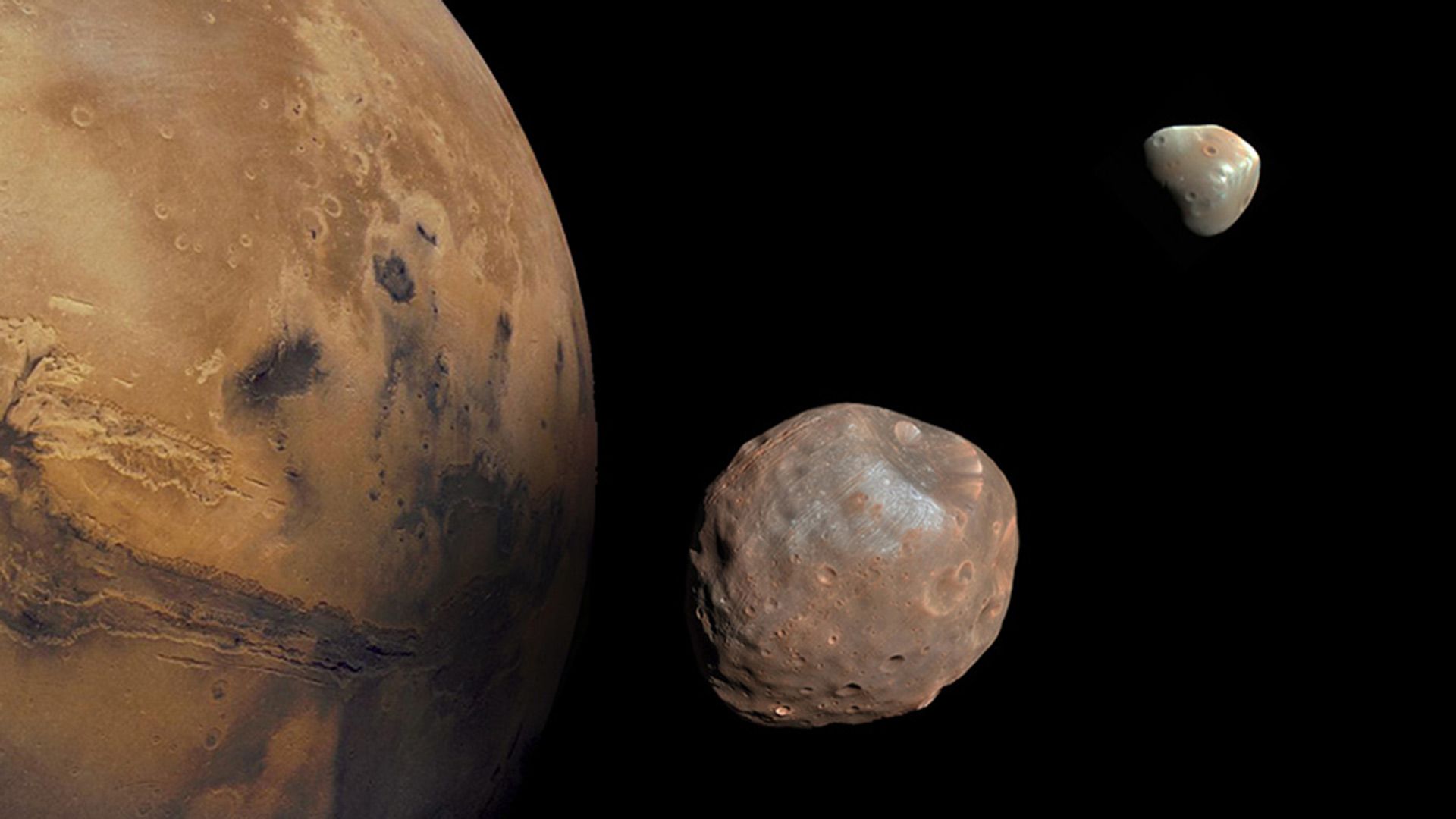
Mars and its two moons, Phobos and Deimos.

A composite image with Mars and its two moons, Phobos and Deimos. (Image credit: NASA/JPL/University of Arizona)

Neither Phobos nor Deimos is spherical, isntead; both are oblong and lumpy, like potatoes. That fact — along with their chemical composition, as far as we have been able to tell using telescopic spectroscopy — point to the possibility that Phobos and Deimos were asteroids from the early solar system that were captured by Mars' gravitational pull. Figuring out the moons' true origin story would provide key clues about Mars' geological past, the solar system's early history and the formation of the inner planets, mission team members have said.

Once the MMX samples are safely returned to Earth, scientists will study their composition and mineralogy, then compare such chemical fingerprints with those of Martian rocks and asteroid material. These analyses, combined with data collected by MMX during its mission, will help nail down the origin of Phobos — and by extension, Deimos. — by

While JAXA leads MMX, the mission is an international effort, with interagency partnerships between JAXA, NASA and the European Space Agency (ESA), as well as U.S. and European companies, which supplied a handful of the spacecraft's scientific hardware and communications equipment.

NASA's contributions to MMX include the Mars-moon Exploration with Gamma rays and Neutrons (MEGANE, pronounced "meh-gah-nay") device, which is a gamma-ray and neutron spectrometer built by the Johns Hopkins Applied Physics Laboratory (APL); a Honeybee Robotics-built pneumatic sampler; and communications support using the agency's Deep Space Network.

NASA has also invested approximately $87 million through the end of the mission, which includes funding for United States scientists and astromaterials experts on the MMX team. The agency is getting something concrete for such contributions: At least 15% of the planned 10-gram (0.35 ounces) returned Phobos sample will be reserved for NASA's study. Those materials will be transferred and maintained at the agency's Johnson Space Center in Houston for analysis and long-term preservation.

MMX is not the first Phobos sample-return project to take flight, by the way. That distinction goes to Russia's Phobos-Grunt ("Phobos-Soil") mission, which launched in November 2011 but failed to get out of Earth orbit due to a rocket glitch. The 14.5-ton spacecraft eventually crashed back to Earth over the Pacific Ocean in January 2012.

Editor's note: This story was updated at 5 p.m. ET on Oct. 19 with news of MMX's successful separation from the H3 rocket's upper stage.

Returning the first samples from a Martian moon: Inside the science of Japan's bold MMX mission to Mars

18 October 2026 at 20:20

Editor's note: Japan launched its bold MMX sample-return mission to the Mars moon Phobos on Oct. 19) at 3:41 p.m. EDT (1941 GMT).
Watch a replay of the liftoff and read our launch story here.

Japan's mission to Mars is one of the most ambitious in spaceflight history. It aims to become the first spacecraft to return to Earth from Mars orbit, carrying with it the first-ever samples from the Red Planet system.

The mission, known as Martian Moons eXploration (MMX), is a first-of-its-kind endeavor to study the origin of Mars' moons Phobos and Deimos. The robust undertaking includes a landing on Phobos to collect the samples — which will likely be the first from the Mars system to return to Earth — and a search for evidence that could shed light on events during the formation of the solar system billions of years ago.

MMX launched on an H3 rocket from Japan's Tanegashima Space Center on Monday (Oct. 19) at 3:41 p.m. EDT (1941 GMT; 4:41 a.m. local time in Japan, Oct. 20). After a 10-month journey to reach Mars, the spacecraft will spend about three years studying Phobos, deploying a rover and landing to collect its samples. The mission will then shift its focus to Deimos for a series of flybys before departing for Earth in November 2030. If all goes according to plan, the MMX sample-return capsule is scheduled to land in Australia in 2031.

The spacecraft

The MMX spacecraft is comprised of three main parts, as well as a small rover. After release from its H3 launch vehicle, a propulsion module will provide the boost to put MMX on course for Mars. MMX's main exploration module carries the microwave-size IDEFIX rover and most of the mission's scientific instruments, while the return module houses the sample-return capsule.

Japan's Mitsubishi Electric built MMX's three main modules, with the French space agency CNES (Centre National d'Études Spatiales) and Germany's DLR (Deutsches Zentrum für Luft-und Raumfahrt) jointly developing IDEFIX. The little rover is named for a dog in the 1960s French comic "Asterix," in a nod to the country's first satellite, Astérix, which launched in 1965.

IDEFIX carries a suite of cameras, as well as the Raman Spectrometer for MMX (RAX) and miniaturized radiometer (miniRAD) instruments to analyze Phobos' surface composition and temperature.

The Propulsion Module (left) and Exploration and Return Modules (right), which together make up Japan’s Martian Moons eXploration (MMX) spacecraft, are seen at the Tanegashima Space Center in Minamitane, Kagoshima prefecture on Aug. 13, 2026.

The Propulsion Module (left) and Exploration and Return Modules (right), which together make up Japan’s Martian Moons eXploration (MMX) spacecraft, are seen at the Tanegashima Space Center in Minamitane, Kagoshima prefecture on Aug. 13, 2026. (Image credit: Yuichi YAMAZAKI / AFP via Getty Images))

Most of MMX's scientific instruments are housed on the exploration module, like NASA's Mars-moon Exploration with Gamma rays and Neutrons (MEGANE, pronounced "meh-gah-nay") device, a gamma-ray and neutron spectrometer built by the Johns Hopkins Applied Physics Laboratory (APL), and France's MIRS (MMX InfraRed Spectrometer) instrument.

The exploration module also houses the Japanese-built TENGOO (TElescopic Nadir imager for GeOmOrphology) tight-zoom camera, wide-angle OROCHI (Optical RadiOmeter composed of CHromatic Imagers) multispectral camera, laser altimeter (LIDAR) and Mass Spectrum Analyzer (MSA). The return module, meanwhile, carries Japan's Circum-Martian Dust Monitor (CMDM) and Interplanetary Radiation Environment Monitor (IREM).

The mission

MMX will arrive in orbit around Mars in August 2027, at which point it will shed its propulsion module and transition into a quasi-satellite orbit (QSO) around Phobos that allows the probe to fly in a sort of formation with the small, asteroid-sized moon as they both circle the Red Planet.

The spacecraft will spend its first few months in the Martian system observing Phobos from different altitudes, using its TENGOO and OROCHI cameras, LIDAR and MSA to map the moon's surface, study its composition and select potential landing sites.

IDEFIX will be released in late 2028 or early 2029, during the first of two MMX landing rehearsals, at about 130 feet (40 meters) above Phobos. Due to the 14-mile-wide (22 kilometers) moon's extremely low gravity, the rover will be able free-fall to the surface damage-free (hopefully), right itself after a few bounces and begin exploring to gather data on the terrain and surface conditions.

a four-wheeled black cartoon rover stands on the surface of a planet hued in light browns. A starry night space scape is seen above with a satellite in the upper left.

An artists render of IDEFIX on the surface of Phobos. (Image credit: CNES/DLR/JAXA (ASTERIX® OBELIX® IDEFIX® © Année LES EDITIONS ALBERT RENE / GOSCINNY-UDERZO))

MMX sample collection could begin as early as December 2028, the acting director of NASA's Planetary Science Division, Lindsay Hays, said during a mission briefing on Oct. 15. The spacecraft will attempt two collection landings, with its exploration and return modules descending and returning to orbit as one vehicle.

On Phobos' surface, two different sampling mechanisms — the Corer Sampling Mechanism (C-sampler) and Pneumatic Sampling Mechanism (P-sampler) — will extract and collect at least 10 grams (0.35 ounces) of material for stowage inside the spacecraft's return capsule before MMX lifts off again for orbit. After its first touchdown and sample collection, MMX will return to QSO near Phobos before descending to a second landing site for a similar attempt and subsequent return to orbit.

An artist’s concept of JAXA’s MMX spacecraft during its Mars’ orbit insertion. The Martian moon Phobos, which MMX will explore and sample, is in the background.

An artist’s concept of JAXA’s MMX spacecraft during its Mars’ orbit insertion. (Image credit: JAXA)

MMX will end its observations of Phobos after about three years focused on the Martian moon, and will transition into a higher, resonant orbit around Mars in 2030. That course will repeatedly intersect Deimos' path for a series of flybys to collect and compare data with those from Phobos observations as scientists aim to investigate the moons' origins.

Near the end of 2030, the exploration module will separate, leaving the return module to fire its engine out of Mars' gravitational influence and begin an eight-month journey back to Earth with the collected samples. As MMX closes the last stretch of void during its approach to Earth in 2031, the sample-return capsule will separate and enter the atmosphere for a targeted parachute landing in Australia's Woomera region, where its contents will be recovered for laboratory analysis by Japan and its mission partners.

Phobos and Deimos

Those samples, and the data collected by MMX, could tell scientists a lot — about the moons' composition, geography and, perhaps most importantly, how they came to exist in the first place. There are two leading theories for Phobos and Deimos' origins, both of which point to very different versions of ancient Martian history.

"Phobos and Deimos are interesting, but not just in their own right. Their presence is a key piece of the larger story of the Mars system," said Tom Statler, MMX program executive and scientist in NASA's Planetary Science Division, during the Oct. 15 mission briefing. "By uncovering the moons' origin, we'll gain new insights into the history of both Mars and Earth, especially those events that shaped both planets billions of years ago and helped create the worlds we see today."

Both Phobos and Deimos are relatively small and irregularly shaped, and bear several resemblances and spectral characteristics to primitive D-type asteroids — ancient bodies thought to preserve material dating back to the solar system's formation about 4.6 billion years ago. Those similarities suggest Phobos and Deimos may have formed elsewhere in the solar system and were later captured by Mars' gravity.

Phobos is the larger of Mars' two small moons and bears the scars of millennia of small impacts.

Phobos is the larger of Mars' two small moons and bears the scars of millennia of small impacts. (Image credit: NASA/JPL-Caltech/University of Arizona)

Their near-circular, equatorially-aligned orbits around the Red Planet, however, somewhat complicate that theory. For example, a captured asteroid would be much more likely to have entered an elongated and tilted orbit akin to the direction and velocity of its original approach, scientists say. A competing hypothesis, therefore, offers a much more violent, but somewhat familiar, narrative for the moons' origins.

An enormous collision with ancient Mars could have blasted material into orbit to form a debris disk from which the two moons eventually coalesced. Such a process, which would be similar to the formation of Earth's moon, could explain their circular, equatorial orbits.

The contradicting geological and orbital observations for Phobos and Deimos collected to date have prevented scientists from definitively establishing one hypothesis over the other. MMX aims to provide an answer.

Images captured by NASA's Mars Reconnaissance Orbiter reveal that the surface of Deimos is mostly smooth, marred only by recent impact craters.

Images captured by NASA's Mars Reconnaissance Orbiter reveal that the surface of Deimos is mostly smooth, marred only by recent impact craters. (Image credit: NASA/JPL/University of Arizona)

"It's two totally different lines of evidence that point in two different directions. That's what makes it an interesting puzzle," Statler said. Several theories have also been presented for hybrid scenarios combining the two, he added.

"There's all kinds of different ways, all kinds of different combinations of those two basic scenarios," Statler explained. "But that's the puzzle from the start, the two seemingly contradictory lines of evidence that are pointing us to what … the real history was, but we don't know what it is yet."

The science

Each theory for where Mars' moons came from predicts different chemical characteristics for their surfaces. Presumably, captured asteroids would preserve chemical signatures of material originating elsewhere in the solar system, potentially rich in volatile elements like hydrogen. Moons formed through a planetary impact, however, would contain a mixture of Mars and impact material, altered by the intense heat of such a violent collision.

Determining which scenario is more likely could reveal whether Mars experienced a massive moon-forming collision or acquired its moons from elsewhere in the early solar system. Either answer could offer new insights into the planet's evolution and the events that shaped the terrestrial planets like Earth billions of years ago, mission team members say.

"At this point, we know nothing about the composition of Phobos," David Lawrence, MEGANE principal investigator at APL, said during the Oct. 15 briefing. "We have information about mineralogy, but no elemental composition. And so, elements are really a key way to get at some of these foundational questions."

MMX's scientific suite has been carefully calibrated to make those determinations. The cameras and sensors on the MMX exploration module's TENGOO, OROCHI and LIDAR instruments will map Phobos' terrain, geological features and variations in surface materials from orbit, to provide clues about the moon's formation and evolution. Complementing those measurements, MIRS is designed to detect and classify Phobos' surface minerals and search for organic compounds to further differentiate its possible origin as an asteroid or ancient chunk of Mars.

The RAX spectrometer and miniRAD instrument aboard IDEFIX will add localized context to those observations by examining surface mineralogy and their thermal properties up close.

Back in orbit, NASA's MEGANE instrument will measure Phobos' elemental composition through gamma-ray and neutron spectroscopy that can scan tens of centimeters beneath the moon's surface for signs of volatile elements. Higher abundances of hydrogen, chlorine, sodium and potassium, for instance, would favor the asteroid-capture hypothesis, while lower abundances of those compounds could point to the heat and chemical deterioration associated with a planetary impact.

"In Japanese, 'megane' means eyeglasses," Lawrence said. "So we like to think of MEGANE as being an instrument that will look at Phobos with gamma ray and neutron glasses."

a split image. a dark background looks at microscopic pieces of mars rock. on the right, a mars rock.

A martian meteorite under the microscope and hand specimen. (Image credit: Open University, CC BY-NC-SA)

When compared to the samples MMX will return to Earth, MEGANE's findings could help scientists determine if volatile depletion found on Phobos reflects the intense heat of a post-impact formation or billions of years of subsequent erosion from the natural effects of space exposure.

MSA, meanwhile, will measure charged particles around Phobos, searching for evidence of subsurface ice and investigating how solar wind exposure has altered the moon's surface. It will also study atmospheric particles escaping from Mars. CMDM will measure dust around Mars, including particles potentially ejected from its moons by impacts.

Comparative observations of Deimos after MMX's final departure from Phobos will help establish whether the moons share similar compositions and, potentially, a common origin.

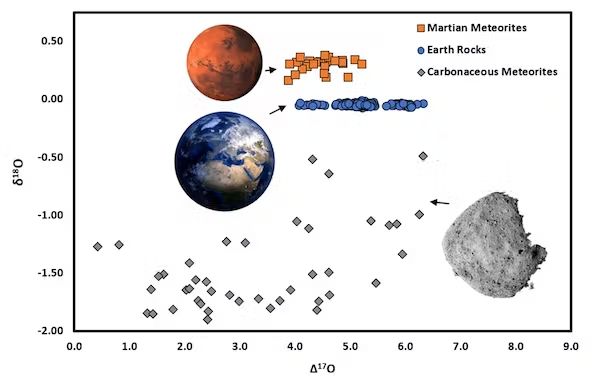
Once safely returned to Earth, laboratory analysis of the Phobos samples will allow scientists to examine chemical composition and mineralogy with a precision beyond that of MMX's onboard instruments. Tests like isotopic analyses — measuring subtle differences in the atomic makeup of elements — can help identify the samples' origins by comparing their chemical fingerprints with those of Martian rocks and asteroid material.

JAXA (Japan Aerospace Exploration Agency) scientists think some returned material could even originate from Mars itself, deposited on Phobos after ancient asteroid impacts blasted rocks off the Red Planet's surface, potentially holding evidence of its geological past.

a plot graph shows grey dots along the bottom with a grey asteroid on the bottom right. earth hangs middle left, with mars above. both planets have many dots, blue and orange, respectively, a crowded near the top right area of each planet.

Oxygen isotope plot showing the stark differences in oxygen between the Earth, Mars and asteroids. If Phobos does indeed represent an ancient fragment of Mars, it could comprise the most primitive of Martian material. (Image credit: Open University, CC BY-NC-SA)

International effort

The JAXA-led mission represents interagency partnerships with NASA and the European Space Agency (ESA), which are providing hardware and communications support through the Deep Space and Estrack networks.

NASA's contributions to MMX also include MEGANE, the Honeybee Robotics-built P-sampler, and an approximately $87 million investment through the end of the mission. NASA is funding the United States scientists on the MMX team, who will, alongside NASA's astromaterials experts, "be fully involved in the examination and scientific analysis of the Phobos samples when they are delivered to Earth," Hays said during the mission briefing. "We get all of the value and all of the scientific participation at a lower cost total [than funding the entire mission]."

For its role, NASA will receive at least 15% of the returned samples, with materials to be maintained at the agency's Johnson Space Center in Houston for analysis and long-term preservation. To that end, MMX's scientific impact could extend far beyond the mission's conclusion.

"The Phobos samples will be historic," Statler said, with the potential "for future research to answer the questions we don't even know yet how to ask."

'We are getting a lot of pressure from the administrator himself': How NASA is racing to obey Trump's 'Super Intelligence' order

16 October 2026 at 14:55

NASA has begun replacing references to artificial intelligence with "super intelligence" following an executive order from President Donald Trump, which directs government agencies not to acknowledge the terminology change in their external communications.

An internal NASA document obtained by Space.com lays out plans to update the agency's websites, publications, organizational titles and digital infrastructure with a four-phase "super intelligence" implementation schedule extending into December. And the changes go beyond NASA's public-facing communications, with at least one planned technical update described as "a breaking change" expected to disrupt existing software integrations.

The terminology shift arrives as NASA continues expanding its use of AI across missions and research programs, from autonomous Mars rover navigation to models capable of analyzing enormous amounts of scientific data. The technologies themselves aren't changing, but NASA's effort to implement the nomenclature introduces new obstacles for scientific communication and the agency's digital infrastructure.

Trump's executive order (EO), called "Inaugurating the Era of Super Intelligence," was signed on Sept. 29. It directs federal agencies to replace any mention of "artificial intelligence" and "AI" with "super intelligence" and "SI" in all official government communications. The White House argues that AI has advanced beyond simple automation or imitations of human intelligence, and that language befitting "a new era of Super Intelligence" is needed to better reflect the technology's emerging capabilities.

Despite introducing the new name, the order retains the federal government's existing definition of artificial intelligence, which broadly covers machine-based learning systems capable of making predictions, recommendations or decisions. That means technologies already classified as AI can now be designated "super intelligence" without demonstrating any additional capabilities.

To follow suit, NASA's Office of Communications (OCOMM) and Office of the Chief Information Officer (OCIO) distributed an internal implementation schedule that outlines the span of work that the agency's multiple comms teams now have ahead of them.

"Effective immediately, we must use "super intelligence" and "SI" in all in-scope content/publications," the document says, bolding the key terms.

It covers both internal and external communications and instructs NASA employees to use "super intelligence" and "SI" in all new "presentations, exhibits, printed materials, media interviews, or other collateral or content for external audiences."

Internally, the policy applies to all official employee communications, NASA style guides, intra-agency websites and IT systems referenced in public-facing communications or official materials. And NASA's instructions echo Trump's directive forgoing any kind of transitional language.

"NASA is … adopting the terminology ‘Super Intelligence’ as the agency continues to expand the use of these rapidly advancing technologies across its missions," agency officials told Space.com in an emailed statement. "NASA is already applying SI to advance mission planning, autonomous systems, scientific research, and the analysis of complex datasets."

Orders from the top

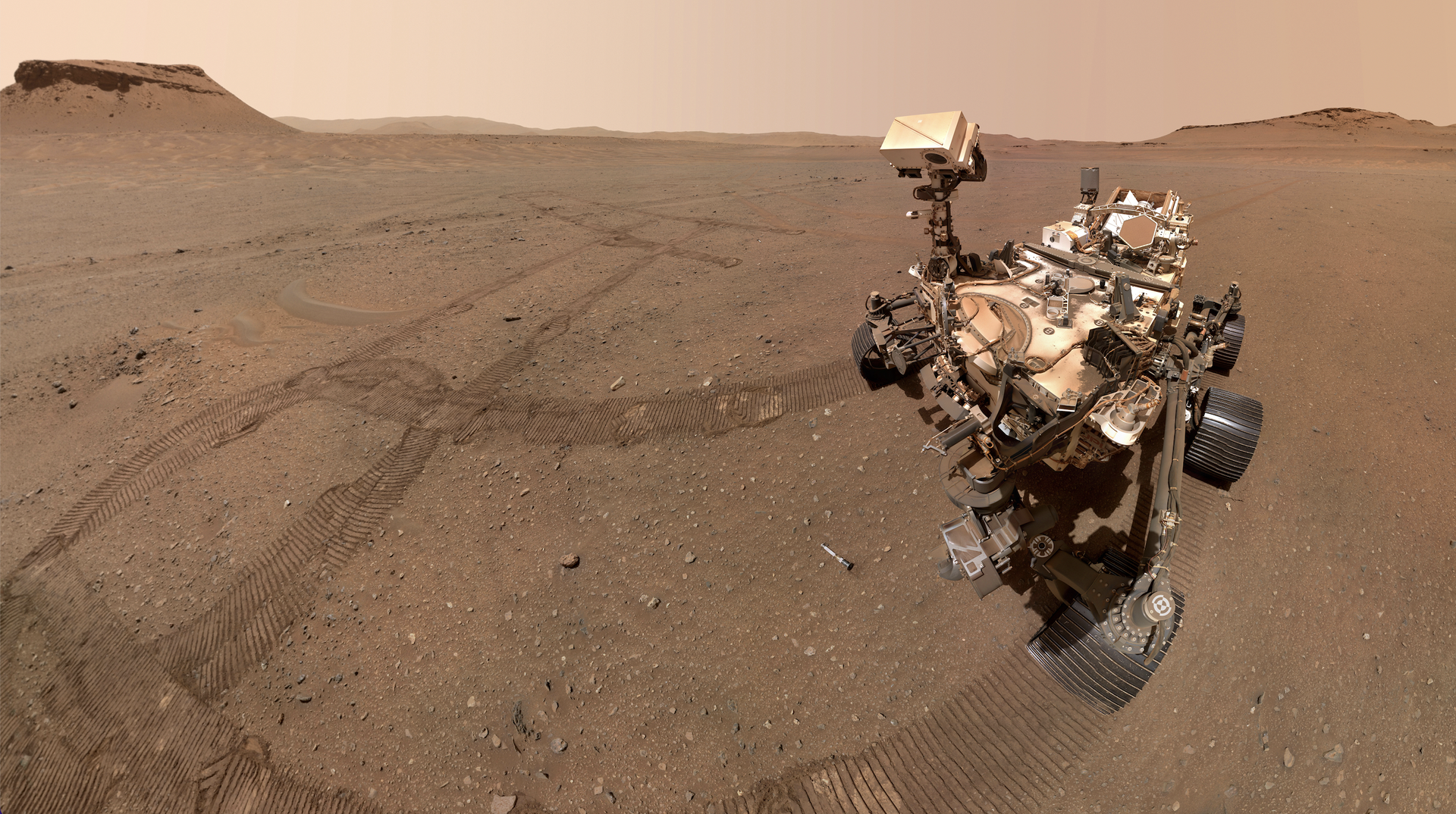
NASA's Perseverance Mars rover selfie.

NASA's Mars rover Perserverance team began using a vision-based artificial intelligence system to plan safe driving routes on Mars without a human controller in December 2025. (Image credit: NASA/JPL-Caltech/MSSS)

Agency leadership has generally been aligned with the current administration's agenda, adjusting NASA's priorities to meet the president's goals when needed. NASA Administrator Jared Isaacman has helped lead that charge since his appointment to the position in December 2025; he has been a champion of Trump's human spaceflight-heavy vision for the agency since his first day. That should come as no surprise; NASA is, after all, part of the executive branch, and the agency is obliged to abide by executive orders.

But Isaacman's relationship with Trump is, perhaps, more visible than that of past NASA chiefs. The duo have shared several jovial public interactions, including an unexpected phone call from Trump during a press conference celebrating the launch of NASA's Roman Space Telescope on Aug. 30. One month later, Isaacman attended a White House luncheon with more than a dozen AI tech executives, on the same day that Trump signed his super intelligence EO.

While he's not an AI company executive, Isaacman is a member of the tech-billionaire community. Before beginning his tenure at NASA, Isaacman founded and served as CEO for Shift4 Payments, a payment processing company. He used some of that fortune to charter a pair of private astronaut launches with SpaceX — Inspiration4 and Polaris Dawn, which were the first-ever all-civilian orbital spaceflight and the flight that featured the first-ever private spacewalk, respectively.

"I was honored to have an opportunity to join that luncheon," Isaacman said when asked his opinion of AI during a post-launch press conference for the SpaceX Crew-13 astronaut mission on Oct. 1. By that point, he had already added the SI nomenclature to his lexicon. "I made clear when it was my turn to speak … I am the space guy here [not an 'AI' guy]," he added as a caveat, before saying that the "potential super intelligence has … [can] change the course of civilizations."

Isaacman's embrace of the new lingo may be partially behind NASA's own accelerated efforts to bring the agency's comms in line with the administration's. One NASA employee told Space.com, "We are getting a lot of pressure from the administrator himself to act on this."

Internal difficulties

Beyond just substituting one term for the other, NASA personnel have been told not to acknowledge the previous nomenclature at all, including short-term phrases such as "SI, also/formerly known as AI."

The changes extend to related terms such as "generative AI" becoming "generative SI," with NASA's guidance directing agency messaging away from "automation." They'll now put an emphasis on how today's technologies "amplify human ingenuity and unlock new forms of creativity," the NASA document says, quoting Trump's order.

The use of the term "SI," and the direction not to use "AI," applies across all NASA's centers and mission directorates, including contractors and personnel at NASA's Jet Propulsion Laboratory (JPL) in Southern California, which is run by Caltech.

Specific technical citations, like "machine learning," "large language models" and "chatbot," remain acceptable, but the new terminology may run the risk of carrying different meanings in different contexts.

Technical exceptions aside, some at NASA responsible for implementing the changes think it may present more obstacles than expected. "There's concern that there's going to be a lot of confusion in the scientific community and in the general population," a NASA employee knowledgeable of the plan told Space.com, under the condition of anonymity.

a collage of nasa stuff

(Image credit: Space.com)

In recordings of an internal NASA communications meeting obtained by Space.com, employees echoed the same concerns to their direct management and voiced some frustration over their inability to relay to the public that the changes are being made in the first place.

"We're not even supposed to use AI as a term ... it's being talked about like Voldemort or Macbeth, with people calling it 'the technology that must not be named,'" the NASA employee said.

"Super intelligence and artificial intelligence — they have two different meanings. They both are already separate things," one meeting participant said. "As a science communicator … I feel like it's our responsibility to raise our hand and say, 'Hey, this is going to confuse people. This doesn't make sense.'"

To Isaacman's credit, those worries may have a chance of being heard by him and NASA's top brass, thanks to a management culture that seems to encourage concerns at any level being brought up the ladder without reprisal.

One meeting leader references "the idea box," an anonymous online system that allows employees to submit feedback directly to agency leadership, and reminded participants that "using the tools that we have at our disposal to make those concerns heard at the top level will not hurt."

In contrast, during the transition at the start of Trump's second term last year, before Isaacman was appointed to NASA's top seat, things at some NASA centers did not always feel as open when it came to voicing concerns to management. At the time, NASA was operating under interim leadership, first by former Kennedy Space Center Director Janet Petro, from January to July 2025, then by Transportation Secretary Sean Duffy from July to December.

In a statement to Space.com, NASA officials said the agency "is taking a coordinated approach to incorporating this direction across agency communications and digital resources while maintaining the functionality and accessibility of its systems and services."

"The agency will continue to communicate its research, findings, and technological advancements accurately and transparently,” the statement said.

NASA already ahead of the game

While artificial intelligence encompasses a broad range of technologies, super intelligence has traditionally referred to a far more advanced, and often hypothetical (and sometimes sci-fi-level), capability that surpasses the limits of human cognition.

Beyond NASA, AI has entered into the space industry's ongoing realm of conversation in recent years, with several companies exploring the possibility of data centers in low Earth orbit (LEO). SpaceX is already operating the world's largest satellite network — there are currently more than 11,000 of the company's Starlink satellites in LEO, providing internet connectivity around the globe — and has proposed a constellation of up to 1 million satellites functioning as "orbital compute" for CEO Elon Musk's AI endeavors.

NASA began integrating AI into a number of its missions, both current and upcoming, well before conversations about SI stepped into the picture. One of the first to try on that hat was the agency's Perseverance rover on Mars, which used machine learning to plan and complete its first drive on the Red Planet using routes mapped out by generative AI in December 2025.

four half-orbs, each in a different color, on a black background

The Surya model from NASA and IBM processes high-resolution images from NASA's Solar Dynamics Observatory.  (Image credit: NASA/SDO/IBM)

NASA has also put AI to work analyzing massive amounts of data. Surya, an AI-powered foundation model introduced by NASA and IBM last year, was trained on nine years of NASA heliophysics data to help improve space weather and solar activity forecasting. A more recent lunar collaboration between NASA and IBM was introduced last month to help researchers investigate the surface of the moon for potential deposits of water ice, and AI is central to NASA's plan for processing the massive amounts of data expected once Roman is operational.

"Foundation models" like Surya fall under the acceptable precise-language usage that NASA still considers best practice when communicating with scientific audiences, according to the agency's internal guidance. However, separate instructions for scientific publications and research documents are still being developed internally, leaving some uncertainty over how NASA researchers will reconcile the new terminology with established language used by universities, international space agencies and other scientific institutions that may not adhere to Trump's EO.

According to the agency's internal plan, a determination for scientific publications and research documents will be issued by NASA's Scientific and Technical Information, Science Mission Directorate and Chief Science Data Officer teams, along with separate guidance for official agency policy documents, both of which are listed on a page titled "Forthcoming Guidance."

Implementation

Retroactively, certain already published web pages, including applicable evergreen content in active use, will be marked for update or given an added disclaimer with an archival notice. Titles, descriptions and other metadata for older videos and podcasts may also be revised to reflect the new terminology, while the original recordings, transcripts and captions will remain unchanged. NASA's page for Perseverance's AI-guided trek across Mars' surface, for instance, is now titled, "Mapping Perseverance’s Route With SI," but "AI" is still present in the page's URL — for the time being, at least.

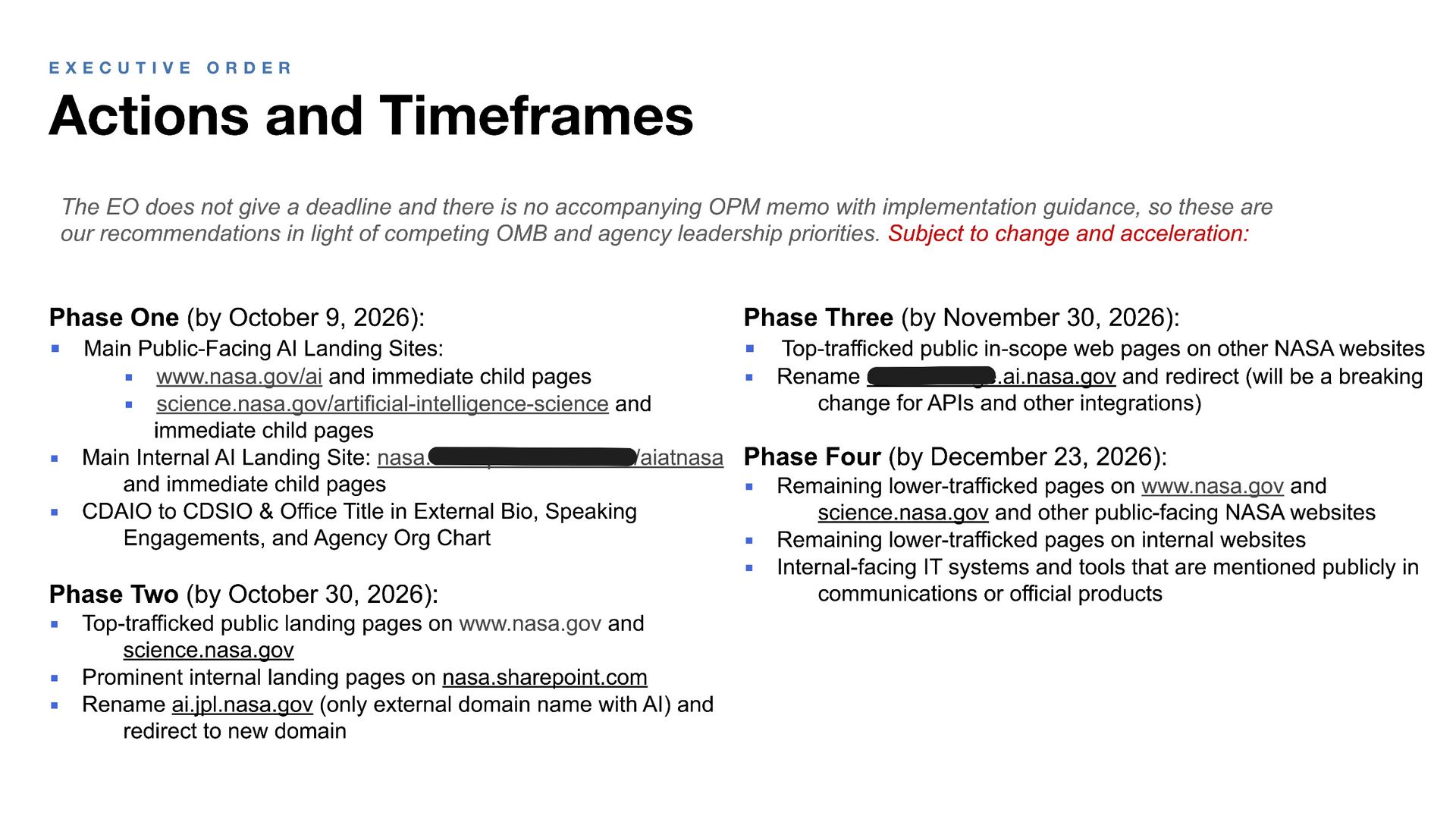
Soon, that URL will redirect to a new one, with "SI" in its place. NASA's internal plan divides its implementation into four phases, with proposed deadlines stretching from Oct. 9 through Dec. 23.

"Every agency is doing it at their own pace," one NASA employee told Space.com. "You'll see some places have not implemented the change yet, and others, like NASA, are pushing it forward sooner rather than later."

a presentation slide with phase text for implimentation of super intelligence.

Internal NASA slide for Super Intelligence implementation (image approximation). (Image credit: Space.com recreation of an internal NASA presentation)

Phase One, which went into effect Oct. 9, included NASA's primary AI-related websites and agency personnel titles, such as that of Kevin Murphy. He is now "acting chief data and super intelligence officer," not "acting chief data and artificial intelligence officer."

Phase Two will expand the overhaul to heavily visited pages on nasa.gov and science.nasa.gov, and rename the website for JPL's Artificial Intelligence Group, ai.jpl.nasa.gov, to redirect visitors to an address reflecting the new SI terminology. The second phase's completion was initially set for implementation by Oct. 30. Sources familiar with the agency's progress, however, said that timeline was accelerated and the changes made ready to go live starting today (Oct. 16), two weeks ahead of schedule, according to a NASA employee.

Phase Three is marked for implementation by Nov. 30. It includes additional high-traffic NASA websites and the renaming of its URL for Ask Sage, a generative AI platform used by federal agencies. NASA's internal plan describes the change as a "breaking change for APIs and other integrations," meaning existing software connections may need to be updated.

According to NASA officials, "any necessary technical changes will be evaluated and implemented through established agency processes."

Finally, Phase Four, targeted for Dec. 23, will scoop up NASA's remaining, lower-traffic websites, as well as internal IT systems and tools. NASA's guidance notes that Trump's EO doesn't designate a deadline for affected agencies, and that, without accompanying direction from the Office of Personnel Management, its framework ultimately represents the authors' recommendations "in light of competing OMB (Office of Management and Budget) and agency leadership priorities."

Editors note: This story was updated at 10:10 a.m. EDT (1410 GMT) on Oct. 16 to include Statments from NASA sent after publication.

Roman Space Telescope starts waking up as NASA powers on instruments for the 1st time

16 September 2026 at 19:00

As the newest heavy hitter in orbital observatories continues the journey to its final destination, NASA has begun the process of switching the spacecraft on.

The Nancy Grace Roman Space Telescope launched on Aug. 30, and is on a three-month long trek to Lagrange point two (L2). L2 is a relatively idle orbital sweet spot almost a million miles from Earth that will allow Roman to remain on the planet's night side and keep the bright sun to its back. It's an optimal location for the telescope to operate its two primary instruments, the Wide Field Instrument (WFI) and its Coronagraph Instrument.

Neither are ready to begin collecting science, and will undergo another month or so of calibrations and tests before Roman can begin its mission, but initial downlinks from the telescope indicate nominal readings on its components as NASA teams continue its commissioning. "This is a huge milestone for the team at Goddard, our industry teams at BAE Systems, Inc. and Teledyne, and our science centers," said Josh Schlieder, the Wide Field Instrument scientist at NASA's Goddard Space Flight Center, in a statement.

The WFI is a 300-megapixel infrared camera designed to survey enormous swaths of the sky. Scientists plan to use the imager to take fast snapshots of the cosmos, study dark energy, and map the distribution of matter throughout the universe. It uses 18 infrared detectors that NASA says combine for a sensing area about the size of a laptop; by comparison, a typical digital camera imaging sensor covers about the size of a postage stamp.

Before engineers could switch on the WFI, they spent about 10 days allowing the instrument to dry out and shed contaminants that may have accumulated prior to launch. The WFI was kept at a relatively warm (for space) -85 degrees Fahrenheit (-65 Celsius). On Friday (Sept. 11), Roman teams turned off the instrument's heater to allow it to cool to around -225 Fahrenheit (-143 Celsius), at which point it was cold enough to activate its infrared detectors. The detectors continued cooling afterward toward their eventual operating temperature of about -300 F (-183 C).

Following the successful activation of its infrared sensors, engineers moved on to calibrate the WFI's element wheel, which filters individual wavelengths for detection using a system of prisms and other optic mechanisms. And, on the morning of Sept. 13, Roman teams confirmed the focus components were functioning nominally.

Roman's coronagraph also completed its first major steps toward operation. The instrument is controlled by the Coronagraph Commanding Center at Caltech/IPAC in Pasadena, California, where operators were able to verify that they could remotely operate the instrument’s electronic and mechanical systems. The coronagraph functions using a series of mirrors, masks and sensors to block the light of a distant star in order to detect the much fainter light of planets in that star’s orbit.

Tests on the coronagraph also included warming the device to 72 degrees Fahrenheit (22 Celsius) — nominal for operating conditions in controlled environments on Earth, but quite warm compared to the WFI’s -300 F (-183 C) operating temperature. The extra heat allows the Coronagraph to maintain conditions similar to those inside NASA test chambers so engineers can more easily simulate tests on Roman's deformable mirrors.

"Now that this test is complete, we've been decontaminating: sitting idle with our detectors warm so anything that’s stuck to the surface, such as water or trace chemicals, will tend to leave it,” said Eric Cady, an optical engineer leading commissioning efforts for the Roman Coronagraph at NASA's Jet Propulsion Laboratory.

Decontamination procedures on Roman's coronagraph will continue for 30 days, along with periodic checks and other minor calibrations. That will occupy a portion of the observatory's remaining journey to L2, which is expected to last about 12 more weeks. NASA says Roman remains on track to release its first science images in early 2027. And, thanks to the precision of Roman's SpaceX Falcon Heavy launch vehicle and fuel savings during Roman's early trajectory corrections, the telescope is expected to have enough propellant to operate for the next 22 years.

US Space Force says it operates weapons in orbit: 'Our aim is deterrence'

15 September 2026 at 20:54

The U.S. Space Force is opening up about its operation of orbital weapons, but not much beyond admitting that they exist.

During a "State of the Space Force" address at the Air & Space Forces Association’s Air, Space & Cyber Conference in National Harbor, Maryland, on Tuesday (Sept. 15), Chief of Space Operations Gen. Douglas Schiess stated unequivocally that the Space Force uses active space-based weaponry to support United States national defense.

“Let me be crystal clear: Today, Guardians operate on-orbit weapons that can defend the joint force against space-enabled attacks,” Schiess said, referring to the official name for Space Force personnel.

Space is central to national security infrastructure and warfighting efforts, and serves a critical role in how the military communicates, navigates, conducts operations and tracks threats globally. It’s become an increasingly contested domain, with adversaries developing technologies designed to disrupt or destroy satellites in orbit as well as hypersonic weapons that challenge ground-based-only defenses.

Schiess didn’t specify what kind of weapons the U.S. operates in orbit, how many there are, or what exactly they do. But the revelation that the Space Force is operating those kinds of assets is by itself a pretty hefty admission. The news expands the known scope of U.S. military activity in the final frontier, which already included the use of satellites for GPS, communications, missile warnings and other targeting and intelligence operations.

“Space is both a battlefield and the backbone of our joint force,” Schiess said. “We face determined and credible adversaries who are building counter-space systems at incredible speeds to target directly the United States’ space advantage.”

The chief adversaries are China and Russia, experts have said. Both nations have developed a range of counterspace capabilities intended to threaten or interfere with other satellites, including through electronic warfare and anti-satellite (ASAT) systems. Russia demonstrated as much in 2021, when it destroyed one of its own spacecraft with an ASAT missile, which created a cloud of more than 1,500 pieces of orbital debris.

The U.S. has been rapidly expanding its own military presence in orbit over the past decade or so, and is ramping up those efforts even more with plans for the implementation of President Trump’s Golden Dome missile interception system. In the last year alone, the Space Force has awarded more than $12 billion in major contracts to companies like SpaceX, Rocket Lab, L3Harris and Boeing for a wide range of services, including national security launches, space-based tracking satellites and other defense technologies.

Schiess pointed to the Victus Haze mission as an example of how the Space Force is getting ready to react to orbital threats on short notice. Rocket Lab carried out Victus Haze in June, launching an Electron rocket and interceptor spacecraft within just 17 hours of receiving notice from the Space Force, setting a launch turnaround record.

a constellation of satellites shoots beams to each other and down to Earth.

Illustration of part of a Golden Dome satellite constellation. (Image credit: L3Harris)

Schiess also highlighted the Space Force’s critical role in Operation Epic Fury and the ongoing engagement of U.S. military forces in Iran. “Guardians are not supporting from the sidelines as a nice-to-have, but we are delivering space power directly into the fight as a need-to-have,” he said. Schiess even gave an anecdotal example of the actions of one Guardian, “Specialist Gray,” in the heat of battle.

“Even as alarm red sirens were blaring and incoming missiles targeted her site, she courageously held the line, protecting forces, denying adversary capability, and delivering space effects until her commander had to literally pull her from the console to safety,” Schiess said.

Schiess described her operations before she was pulled from that console, giving some clue as to what exactly is meant by “on-orbit weapons.”

He said the Guardian in question needed to “reconfigure her weapon system and execute critical non-kinetic fires,” and went on to add, “She locked onto the target, optimized her weapon system and waged electromagnetic warfare against a determined adversary.”

Those descriptions offer at least some clues about the technologies involved. Phrases like “electromagnetic warfare” and “non-kinetic” could point to signal jamming technology or other non-physical means of disrupting a target.

Schiess said the Space Force intends to continue expanding its combat power with more robust architectures and the ability to respond with increasing speed to evolving threats. That proliferation on behalf of Golden Dome and other national security programs stands to deliver substantially more military hardware into orbit in the coming years, but Schiess framed the buildup around the prevention of conflict, rather than its provocation.

“Our aim is deterrence,” he said.

'If I wanted to go to space, I would have stayed at NASA': What's next for Artemis II astronaut Victor Glover after his mission to the moon

15 September 2026 at 11:00

NASA astronaut Victor Glover is now "astronaut emeritus." He's hanging up his spacesuit for a position he hopes can guide the future engineering and science leaders of tomorrow.

Glover, who served as pilot on NASA's Artemis II mission that flew around the moon in April, officially began his new role as executive advisor to Jeff Armstrong, president of the California Polytechnic State University (Cal Poly),on Sept. 1, and is stepping away from the majority of his duties at the space agency.

NASA announced on Sept. 9 that Glover, as well as Artemis II commander Reid Wiseman, are transitioning to emeritus status beginning this month, but are not retiring from the agency outright. Even astronauts who do fully retire from NASA are still retained "in the system," Glover told Space.com, "but I actually get to have a badge that is a little bit different. I can come back. I have a NASA email address. I still work closely with the agency. I'm considered a special government employee."

"It allows me to have just a slightly more robust and meaningful relationship with NASA," Glover said — but "more robust" won't necessarily equate to the same daily commitment. His role at Cal Poly will be full-time, according to the university, but he's not exactly going to be putting in typical work hours there either.

"We're still figuring it out," he said. "It's not going to be nine to five. I'm not a faculty member. I don't have a class I have to teach or a board that I oversee. It'll be where the school needs me the most and where I can highlight what great work they're already doing."

Glover's connection to Cal Poly runs deep. He's a Cal Poly alum who graduated with an engineering degree in 1999. A two-sport athlete, he wrestled for the university and played on its football team. And it's where he met his wife, Dionna, who also graduated from Cal Poly. The two have since raised four daughters, all of whom have either graduated or are currently attending their parents' alma mater. With Glover's multifaceted connection to the university, Cal Poly sees his potential contributions as equally diverse.

The university says that Glover, in his position as executive advisor, will work with the gamut of university leadership, including the president, provost and college deans. He will help "identify, develop and accelerate strategic initiatives, partnerships and philanthropy aimed at expanding the university's leadership in engineering, applied computing, aerospace, aviation, maritime, artificial intelligence, cybersecurity, autonomous systems and national defense," according to Cal Poly's statement.

A man in a blue jumpsuit stands in front of giant letters that read

Victor Glover officially began his role at Cal Poly on Sept. 1. (Image credit: Cal Poly)

How that will manifest into Glover's actual contributions is still being figured out. "There's just so much potential," he said, adding that he wants to serve in an additive role for Cal Poly where he can "get in and help, and do the most good."

Cal Poly has been undergoing a period of significant change and expansion over the past several years. This fall, for the first time ever, the university transitioned from a quarter system to a semester-based one. It also recently completed its integration with the former California State University Maritime Academy, whose Vallejo campus is now Cal Poly's Solano Campus and home to the Cal Poly Maritime Academy.

"They're hitting on all cylinders in so many areas," Glover said. "There's so many areas where Cal Poly is doing amazing things, and each of those things by themselves have been a big deal."

The university operates on a "Learn by Doing" philosophy, which emphasizes hands-on, real-world experience alongside classroom instruction. Glover credits his professional successes to this system, and his experiences over a decade at NASA have reinforced his belief in that kind of educational approach.

"Putting energy and time into building trust is just as important, or more important, as building technology, and so I think there's a lot of areas where my NASA experience will also feed back into Learn by Doing," Glover said. "I think everything I did at NASA has a place here."

"At NASA we do some pretty challenging things, pretty risky things, but we have a really strong scientific and technical understanding of what we're doing," Glover said. "That kind of risk-informed decision making is an important part of what we do here [at Cal Poly], whether it's professional development or helping these students to become the next generation of leaders."

Glover cited Charles Lindbergh's book "We," and its perspective on learning to fly a plane, as an example for Learn by Doing's effectiveness. "You teach yourself to fly," Glover said. "An instructor is really there to keep you from having ultimate mistakes. But you teach yourself to fly. It's something that you have to work out yourself. And I think that this school really understands that … We want to make sure that these students can critically think and analyze, but we also want to make sure that they can do the work with their hands."

Flying is something with which Glover has an extensive familiarity. Before he joined NASA in 2013, he was a U.S. Navy aviator and test pilot with 4,000 flight hours in more than 40 aircraft who flew 24 combat missions, though he is now best known for piloting NASA's Orion spacecraft around the moon on Artemis II.

A man in a blue jumpsuit sits in an open jet

Victor Glover lands a T-38 jet at NASA's Kennedy Space Center in Florida on March 27, 2026, ahead of the launch of the Artemis II mission. (Image credit: Space.com / Josh Dinner)

Glover launched aboard Orion on NASA's Space Launch System (SLS) rocket on April 1 with three crewmates — Wiseman, NASA astronaut Christina Koch and Canadian Space Agency astronaut Jeremy Hansen. The quartet spent approximately 10 days aboard the Orion capsule and flew a course around the moon's far side. Their mission was the first to fly a crew to lunar space since Apollo 17 in 1972, and it captured the attention of millions across the world as the astronauts sent back views of the moon unlike any humanity had ever seen.

Artemis II was the first crewed mission in NASA's Artemis program, which has the ultimate goal of establishing a permanent base on the lunar surface. The next time Orion launches, on Artemis III, the spacecraft's crew will be tasked with testing out docking hardware with the program's lunar lander vehicles in Earth orbit. NASA is targeting mid-2027 for that mission. If it's successful, Artemis IV will follow in 2028 as the program's first lunar landing attempt, with subsequent missions with more crew and cargo to incrementally assemble an outpost on the surface of the moon in the 2030s.

A man in a blue jumpsuit stands in front of giant a trio of NASA jets.

Victor Glover arrives at NASA's Kennedy Space Center in Florida on March 27, 2026, ahead of the launch of the Artemis II mission. (Image credit: Space.com / Josh Dinner)

As the only people to fly aboard Orion in space so far, the Artemis II crew's experience and insight into the spacecraft, and how future Artremis astronauts can best train to fly it, are invaluable to NASA — hence Glover and Wiseman's emeritus status.

Hansen, who trained at NASA's Johnson Space Center (JSC) and lived in Houston since his induction as a CSA astronaut in 2009, announced in July that he's stepping back from active astronaut duty beginning this month and moving back to Canada. On Sept. 8, the day before NASA made the announcement about Glover and Wiseman, Hansen posted a video on X stating that his Artemis II duties officially concluded on Sept. 2.

The mission continues! pic.twitter.com/2R6Dwb63bSSeptember 8, 2026

That leaves Koch as the only Artemis II crew member on an active astronaut roster, but Glover and Wiseman, as emeritus flyers, aren't out of the agency entirely. "With our experience flying Orion in space, the agency knows that we can still make a meaningful contribution to Artemis and human spaceflight in general, without having to be there full time," Glover said. "We can still support our colleagues and their families and the mission while we go off and pursue other other opportunities."

Supporting other astronauts on NASA's roster, and the teams that run the missions, are the parts of the job that Glover enjoyed the most. "[The emeritus status] allows us to still support our colleagues, which is the best part of being an astronaut. It's not flying in space," Glover said.

"I told [NASA leadership], ‘Nothing has really changed,'" Glover said. "If they call me and say, ‘Hey, we need this,' they can count on me to be there because they are so fantastic. I will always be there to carry the water for them when they need it."

Four humans in blue jumpsuits stand outside on a raised platform. A big orange rocket and launcher tower can be seen in the background.

From left: Canadian Space Agency astronaut Jeremy Hansen, and NASA astronauts Christina Koch, Victor Glover and Reid Wiseman at NASA's Kennedy Space Center during the Artemis II SLS rollout on Jan. 17, 2026. (Image credit: Space.com / Josh Dinner)

Though he'll still be helping astronauts prepare for future missions every now and then, Glover said his own spaceflight days are behind him. Glover had flown to space once before, prior to Artemis II, as pilot of SpaceX's Crew-1 mission to the International Space Station (ISS). Glover spent 168 days in orbit on that stint, serving as flight engineer for Expeditions 64 and 65, and completed four spacewalks.

"I didn't make this move planning to go back to space," Glover said. "I was pretty satisfied after my first space mission, so I don't have this hole in my heart that needs to be filled by going to space again."

A few NASA astronauts who've left and moved on to the private sector have ended up going back to space, like Peggy Whitson, who retired from NASA in 2018 before joining Axiom Space and later commanding the company's Ax-2 and Ax-4 private astronaut missions to the ISS. But Glover doesn't see a move like that in his future.

A man in a blue jumpsuit stands against a blue sky with a big orange rocket behind him on the left.

Victor Glover stands at NASA's Kennedy Space Center during the rollout of the Artemis II Space Launch System rocket on Jan. 17, 2026. (Image credit: Space.com / Josh Dinner)

"If I wanted to go to space, I would have stayed at NASA. It's the gold standard," Glover said. "I love our corporate partners and what they're doing. There's some really amazing things, including what Jared Isaacman himself has done … But I would have stayed at NASA full time as an active astronaut if I was trying to go back to space."

Isaacman was sworn in as NASA administrator in December 2025. His spaceflight experience came before that: In September 2021, he commanded SpaceX's Inspiration4 mission, the first all-civilian orbital spaceflight, and later performed the first commercial spacewalk during the private Polaris Dawn mission in September 2024.

In fact, Glover said it was harder walking away from his career flying fighter jets than it was to walk away from the opportunity to maybe one day fly in space again. Harder still might be leaving behind the place he's called home for more than a decade, but ultimately he said it was an easy choice. He's lived in Houston and worked at JSC since his selection into NASA's astronaut class in 2013, but expects he and his family will make the permanent move to the West Coast, to be closer to Cal Poly.

"One of the reasons why this was just such an easy decision to make is that both NASA and Cal Poly … and everybody understands that we need time to get used to this new reality, and they're all giving us a lot of grace and space as we just kind of figure out what the right rhythm, what the right ops tempo is," Glover said. He thinks he and the family will make the move sometime after the New Year.

In the meantime, though you may not see him quite as much on NASA's social media channels, he has made a few appearances in posts on his daughter Maya's TikTok profile. In posts celebrating his return from the moon and recent career shift, Glover can be seen performing dance routines with his family — but don't bother refreshing your feed to load more any time soon.

"Don't expect to see a whole lot more of that, because I would do anything for my kids, but you know, well, I guess almost anything for my kids," Glover said jokingly. When asked which was harder to train for, between piloting Orion and the dance moves, he said, "Oh, clearly the dance moves."

LINK spacecraft gets close to NASA's Swift Observatory, but not close enough to save it

10 September 2026 at 19:00

LINK, the satellite sent to boost the orbit of NASA's Swift Observatory, may have had to give up on its mission, but LINK's manufacturer and operator Katalyst Space hasn't completely abandoned the spacecraft to its cosmic demise.

NASA called off LINK's mission to rendezvous with its Neil Gehrels Swift Observatory when the specialized probe encountered a thruster control issue. LINK was delivered to orbit on July 3, aboard an air-launched Northrop Grumman Pegasus XL rocket, but began to spin uncontrollably about three weeks after reaching space. Swift's orbit began decaying faster than expected last year, due to increased solar activity, and LINK was designed to rendezvous with Swift, grapple it, and then raise the observatory to a more stable altitude.

LINK's Swift Boost mission was considered a "Hail Mary" attempt from its onset. NASA's discovery of Swift's swiftly decaying orbit meant the Arizona-based Katalyst had less than a year to design, manufacture and test LINK before needing to launch. Now, with both of their missions on the short-track for destruction, NASA and Katalyst are left both trying to get the most out of their spacecraft with the time each has left.

LINK's failure means Swift is destined to burn up in Earth's atmosphere before the end of the year, and LINK itself is expected to fall to the same fate within just the next few weeks. But the probe's inability to save Swift hasn't stopped Katalyst from getting as much data from LINK as it can. Though a closer rendezvous is no longer in the cards, the spacecraft managed to successfully fire all three of its electric propulsion thrusters and adjust its orbit to fly within 7.5 to 9 miles (12 to 15 kilometers) of Swift. Katalyst was also able to deploy all three of LINK's robotic arms, which would have been used to grapple Swift for its orbital adjustment.

Swift launched in November 2004, and has been studying high-energy phenomena like gamma-ray bursts, supernovas, black-hole ejections and fast radio bursts across the universe for more than 20 years. Despite its impending demise, two of Swift's three science instruments — its X-ray Telescope (XRT) and Ultraviolet/Optical Telescope (UVOT) — were turned back on in late August after being shut down in February to minimize atmospheric drag on the spacecraft in anticipation of LINK's now defunct orbital boost efforts.

With the option for LINK to raise Swift's orbit now off the table, Katalyst and NASA are working to perform whatever technology demonstrations are possible aboard the spacecraft, in the hopes the technology can be used to service other satellites on missions in the future.

International Space Station astronaut gives out of this world tribute to honor Star Trek’s 60th anniversary

9 September 2026 at 21:00

Celebrations of Star Trek's 60th anniversary made it all the way to the final frontier.

Among the science and supplies delivered to the International Space Station (ISS) for European Space Agency (ESA) astronaut Sophie Adenot's mission on orbit was a small piece of memorabilia to honor one of the most influential pop culture phenomena that has continually called for humanity to turn its gaze to the stars. Adenot carried a small Starfleet badge from one of Star Trek's newest series, Strange New Worlds, which she wore during a video posted by ESA and Star Trek.

"It's a small object, but it carries something bigger: sixty years of a story that taught us to dream about exploring together," ESA said in a separate post picturing the golden badge floating in front of the station's large Cupola windows. "From the crew of the USS Enterprise to the crews on the International Space Station, the mission hasn't really changed. Explore. Discover. Do it together," the post says.

Adenot launched to the ISS aboard a SpaceX Dragon capsule on NASA's Crew-12 mission to the orbital lab on Feb. 13, and is serving as flight engineer for ISS Expedition 75. It's her first launch to space, and is set to wrap up soon, pending the launch and arrival of SpaceX's next Dragon spacecraft carrying the astronauts of NASA's Crew-13 mission, expected within just a few weeks.

In Adenot's video, she is seen donning the Starfleet badge on her ESA-issue ISS shirt, floating in ESA's Columbus laboratory module. "For me, exploration and science are about curiosity and cooperation, daring to go a little farther together, learning from what we discover and build, and turning that knowledge into a better future for everyone," she said.

Star Trek, too, has resonated with similar themes. Since its premiere on Sept. 8, 1966, the show has told stories that place social issues and cultural conflicts front and center in a way that 'demonstrates the best traits of humanity. It depicts, in its creator Gene Roddenberry's view, an idyllic version of humanity he believed was truly achievable through the act of simply accepting one another.

"The whole show was an attempt to say that humanity will reach maturity and wisdom on the day that it begins not just to tolerate, but to take a special delight in differences in ideas and differences in life forms," Roddenberry said in the 1976 album The Star Trek Philosophy. "If we cannot learn to actually enjoy those small differences — take a positive delight in those small differences between our own kind — here on this planet, then we do not deserve to go out into space and meet the diversity that is almost certainly out there."

ESA celebrated that philosophy, and the potential it holds for humanity. "Science fiction imagines the future. We build it," ESA's post said. "From the crew of the USS Enterprise to the crews on the International Space Station, the mission hasn't really changed. Explore. Discover. Do it together."

Watch Star Trek Strange New Worlds on Paramount+:
Essential (ads): $8.99/mo or $89.99/yr
Premium (no ads): $13.99/mo or $139.99/yr

Stoke Space raises $1 billion for fully reusable rockets, targets 'early 2027' for 1st-ever launch

8 September 2026 at 20:23

Stoke Space has amassed a substantial sum during its latest round of financing and is revealing exactly where it plans to invest its new stack of cash.

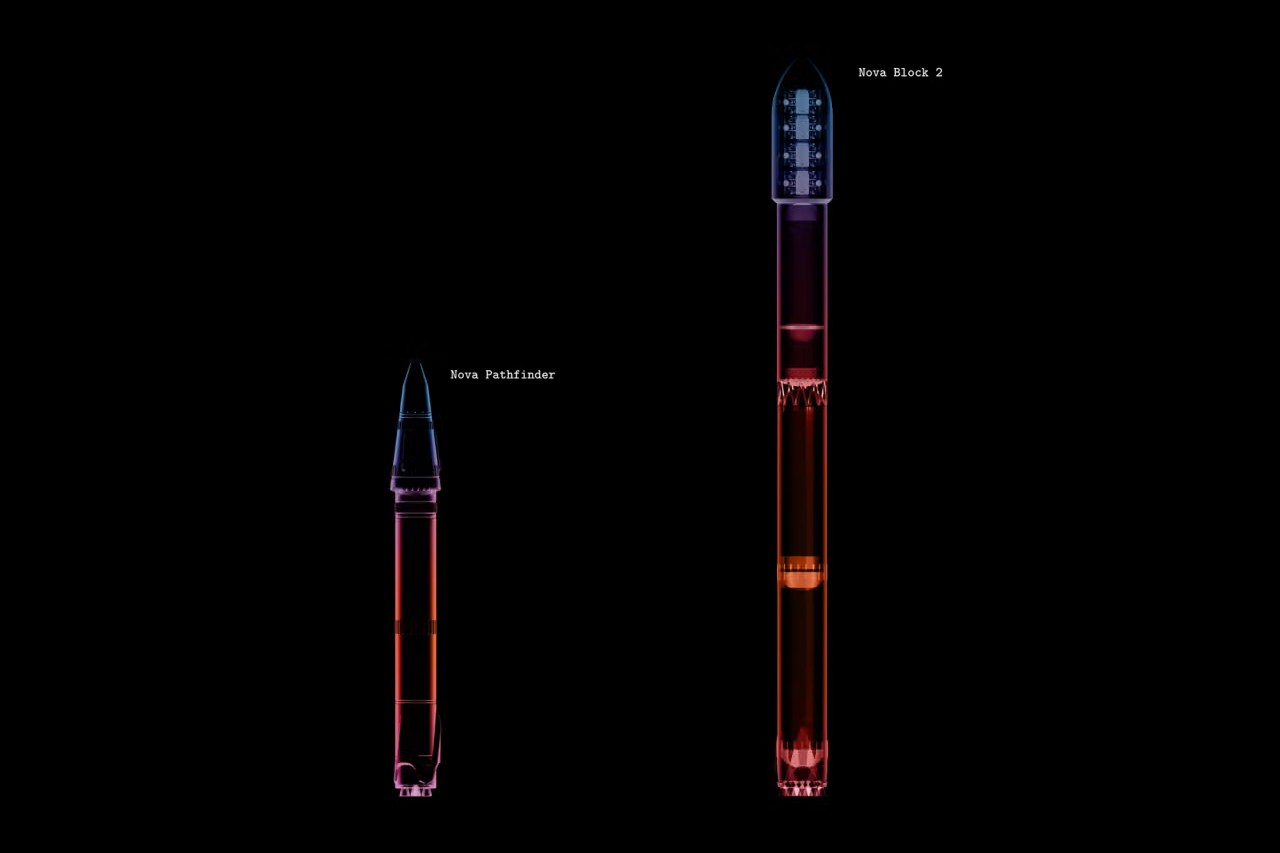
The Kent, Washington-based company just raised $1 billion via its"Series E" capital campaign, bringing Stoke’s total investor haul to $2.3 billion. The Sept. 8 announcement provided a development update for Stoke’s fully reusable Nova Pathfinder launch vehicle and included plans for its never-before-seen Nova Block 2 rocket, a more powerful system designed to be able to deliver up to 15 tons to low Earth orbit (LEO).

“We are humbled by the trust our investors and customers have placed in us in pursuit of this critical generational challenge,” said Andy Lapsa, Stoke CEO and co-founder. “This investment enables us to scale toward delivering the capability and cadence our customers require.”

Nova Pathfinder is Stoke’s first orbital launch vehicle (the largest first rocket ever undertaken by a U.S. launch company, according to Stoke), and is based on the same technologies the company is building into its Block 2 design. Both two-stage vehicles are being manufactured with full and rapid reusability in mind, with Pathfinder serving as the proving ground for that architecture.

Pathfinder's first stage is powered by seven Stoke-designed full-flow, staged-combustion (FFSC) Zenith rocket engines, fueled by liquid oxygen and liquefied natural gas (LNG). The first stage on Nova Block 2 will be equipped with 14 Zeniths. Stoke calls FFSC “perhaps the most difficult rocket engine cycle to develop,” but highlights its advantages; the tech leaves fewer residuals like soot around the engines and reduces the amount of maintenance needed between flights, according to the company.

The upper stage of both rockets is the more atypical approach to spacecraft design, compared to other vehicles of the same launch class. The aft end of Nova’s second stage is designed with a heat shield to protect the vehicle during reentry through Earth’s atmosphere. Instead of the ceramic tiles historically used on the heat shields of previous spacecraft, the dome-like structure at the base of Nova’s upper stage is made of metal, which is actively cooled by the liquid hydrogen that fuels the stage’s Andromeda propulsion system.

Rather than a single large, vacuum-optimized engine bell at its center, Nova’s upper stage features 12 small dual-thrust chambers integrated into a circle around the outer edges of the vehicle’s heat shield. Stoke successfully completed a “hopper” test flight of Pathfinder’s upper stage engine system in 2023, flying the vehicle about 30 feet (10 meters) into the air before it safely touched down.

Small holes outline the peremiter of a metal dome.

Andromeda upper stage engine and integral re-entry heat shield. (Image credit: Stoke Space)

Scaling up to Block 2, Stoke plans to equip the upper-stage system with independent systems for each of the 12 engines, potentially increasing thrust by over a factor of five, according to the company. Block 2’s upper stage also drops Pathfinder’s tapered design in favor of cylindrical tanks, increasing propellant and payload volume to accommodate a 5-meter-wide (16.4 feet) fairing.

Stoke says the larger Block 2 configuration has been in the works alongside Pathfinder for several years. The company is developing the more powerful rocket to support large commercial and national security satellite constellations, of which there soon may be a high demand.

Nova Block 2’s closest competitors are SpaceX’s Falcon 9 rocket and Rocket Lab’s upcoming Neutron launch vehicle, which is still under development. And Falcon 9 is already being sundowned by SpaceX as the company gets closer to operational flights with its next-generation Starship rocket. While certain Falcon 9 flights for NASA, like crew launches to the International Space Station, are expected to continue until at least 2030, SpaceX CEO Elon Musk has said that Starship’s ultimate success “means winding down Falcon.” The timing should line up with when Stoke hopes to step in with Nova Block 2. Block 2’s first launch is targeted for 2029, with production and flight cadence expected to increase from there.

Colorful outlines of two different rockets stand side by side. The right one is taller.

Nova Pathfinder next to Nova Block 2. (Image credit: Stoke Space)

As Stoke ramps up development for its upgraded launch vehicle, the company’s fresh round of funding will also go toward construction of the physical infrastructure Stoke needs to build, test and eventually operate both vehicles. The company is planning a 475-acre (192 hectares) expansion to its 75-acre (30 hectares) Moses Lake Test Site in Washington to support propulsion and vehicle testing as Pathfinder nears its first launch and Block 2 hardware begins coming online.

Stoke is also expanding its operations at Cape Canaveral Space Force Station (CCSFS) in Florida. The company was selected by the U.S. Space Force in 2023 to manage CCSFS’s Space Launch Complex-14, where it’s now building a new payload processing facility sized to accommodate both vehicles. And to complete its full reusability system, the company is also developing an offshore recovery platform.

Pathfinder has a much shorter timeline to the launch pad. Stoke is targeting early 2027 for Pathfinder’s debut launch, which the company plans to send to orbit with a customer payload. If that’s successful, Stoke hopes to fly multiple Pathfinder missions throughout 2027 and 2028 while Block 2 development and testing continue in parallel.

Once Block 2 does reach the launch pad, Stoke plans to keep Pathfinder in service. “We see value in having more than one way to serve the market, since some missions are particularly well suited to the Pathfinder configuration,” the company said.

'A new mission starting today': 8 years after launch, BepiColombo begins Mercury arrival

3 September 2026 at 17:25

After nearly eight years traveling through the inner solar system, the trailblazing BepiColombo spacecraft has finally begun its arrival at Mercury.

The joint European Space Agency (ESA)-Japanese Aerospace Exploration Agency (JAXA) mission reached a major milestone today (Sep. 3), entering its arrival phase at one of our sun's least-studied planets. BepiColombo's Mercury Transfer Module (MTM), the main power and propulsion system that has ferried a dual stack of planetary probes through space for nearly eight years, released its payload to kick off a sequence of operations that will ultimately place the two spacecraft in Mercury's orbit.

The separation left ESA's Mercury Planetary Orbiter (MPO) and JAXA's Mercury Magnetospheric Orbiter, known as Mio, together for their final approach, which will take about six more months. "It will basically be a new mission starting today," said Bruno Sousa, ESA's head of operations definition and engineering, during today's mission livestream.

BepiColombo launched aboard an Ariane 5 rocket from Europe's Spaceport at the Guiana Space Center in Kourou, French Guiana, on Oct. 19, 2018, beginning a journey that was expected to take about seven years. To assist its plunge sunward, the spacecraft's trajectory has included one flyby of Earth, two of Venus and six of Mercury, as it has shed more and more gravitational energy during to slow its approach to the system's innermost planet.

"It's one of the most complicated missions we have ever flown," Sousa said. The mission was made even more complicated in April 2024, when a solar panel issue reduced the available power for MTM's electric thrusters. Engineers devised a lower-thrust trajectory that saved BepiColombo's mission but delayed its Mercury arrival from December 2025 to November 2026.

Today's maneuver doesn't place BepiColombo in orbit around Mercury quite yet. MPO and Mio will spend the next several weeks navigating toward the planet ahead of orbital insertion on Nov. 21. "Arriving to Mercury is not as simple as other missions that do a big maneuver and they are there," said Elsa Montagnon, BepiColombo's operations manager. "In our case, it's going to be six months of continuous activities."

The Nov. 21 arrival will begin a sequence of 16 maneuvers to progressively lower and reshape BepiColombo's orbit. Mio is scheduled to separate from MPO around Dec. 9 and settle into a highly elliptical polar orbit. MPO will jettison Mio's MOSIF sunshield (Magnetospheric Orbiter Sunshield and Interface Structure) on Dec. 16, then continue lowering its own altitude before reaching its own polar orbit on March 10, 2027.

A spacecraft separation illlutration showing different stages of flight.

BepiColombo's arrival at Mercury will take about six months. (Image credit: European Space Agency)

BepiColombo is scheduled to begin science operations on April 6, 2027, with MPO and Mio studying Mercury simultaneously from complementary orbits. MPO will focus on Mercury's surface composition, geology and planetary interior, while Mio will investigate the planet's magnetic field and its interaction with the solar wind.

Today's separation took place at 8:00 a.m. EDT (1200 GMT), but confirmation of that event didn't come for more than an hour following its scheduled execution. Acquisition of signal from BepiColombo came just before 10 a.m. EDT (1400 GMT), followed by a positive telemetry reading indicating the spacecraft was where it was supposed to be.

"I'm again extremely relieved," Montagnon said. "That the telemetry comes exactly at the moment we expect it, and that we see in the telemetry that the configuration of the spacecraft is the correct one," she said, "this is the best case scenario."

Chinese rocket explodes less than 90 seconds after liftoff (photos)

10 August 2026 at 17:03

China's latest rocket launch ended in failure this morning, lighting up the skies with some unwanted fireworks.

The state-owned China Aerospace Science and Technology Corporation (CASC) launched a Long March 7A rocket today (Aug. 10) from the Wenchang Space Launch Site, in the country's Hainan province, just after 8:00 a.m. EDT (1200 GMT; 8:02 p.m. local time). Around 85 seconds into the launch, the rocket exploded, generating a massive fireball and a cloud of smoke and debris while still soaring through Earth's atmosphere.

CASC had not yet released a statement about the incident by the time of this story's publication, but video reposted to social media captured the shock of onlookers the moment that the rocket burst into flames. Based on such views, the mission will almost certainly be deemed a complete failure, with total loss of vehicle and payload.

Today's launch was the 18th Long March 7A mission since the rocket's debut in 2020, which, subsequently, also ended with the vehicle's explosion. China traced that mishap to an engine malfunction that occurred shortly after first-stage separation. This morning's launch, however, didn't get that far.

The Long March 7A's four side boosters and core stage detach as a full cluster during first stage separation, which typically occurs just under three minutes after liftoff. As today's incident occurred just 85 seconds into flight, the rocket was still engaged in the main stage's initial engine burn to escape Earth's atmosphere.

The 7A — a variant of China's Long March 7 rocket family — stands just over 197 feet (60 meters) tall and combines the first two Long March 7 stages with a hydrolox (liquid hydrogen and liquid oxygen)-powered third stage capable of launching up to 7 tons to geostationary transfer orbit (GTO).

long-distance photo of a rocket launching at night

A Long March 7A rocket carrying the ChinaSat 4B satellite launches from the Wenchang Spacecraft Launch Site on Aug. 10, 2026. The launch was not successful. (Image credit: Meng Zhongde/VCG via Getty Images)

According to China National Radio, today's launch carried China's Zhongxing-4B spacecraft,, a communications satellite presumably bound for GTO. China's Zhongxing satellites provide telecommunications and broadband internet services and are also thought to provide services for China's military.

It is unclear what repercussions today's explosion may have on upcoming launches, including a Chinese Zhuque-3 rocket liftoff scheduled for Monday evening. That mission is scheduled to fly from China's Jiuquan Satellite Launch Center, more than 1,500 miles (2,415 kilometers) from Wenchang, at 7:45 p.m. EDT (2345 GMT; 7:45 a.m. local time), and is expected to feature a first-stage landing attempt.

CASC uses the standard Long March 7 rocket, which shares its core stage with the 7A, as its launch vehicle for delivering cargo to the Tiangong space station in low Earth orbit about every eight months. The most recent of those missions launched in May, putting the next resupply launch sometime around January 2027. Depending on the cause of this morning's explosion, that mission and others could face delays as China investigates the incident.

Editor's note: This story was updated at 4:20 p.m. ET on Aug. 10 with new photos of the launch.

Vulcan Centaur swapped out again: NASA goes with SpaceX Falcon Heavy rocket for launch of space weather mission

23 July 2026 at 22:00

NASA is shaking things up for its next mission to research the sun.

The six satellites of NASA's Sun Radio Interferometer Space Experiment (SunRISE) mission are poised to launch to Earth orbit soon, to serve as an early warning system for incoming solar storms. They were originally slated to lift off on a United Launch Alliance (ULA) Vulcan Centaur rocket but have now been assigned a SpaceX Falcon Heavy, according to a NASA mission update.

SunRISE will fly to space as part of a rideshare mission sponsored by the U.S. Space Force's (USSF's) Space Systems Command (SSC). Though it's not stated specifically in the NASA release, that may be a hint as to why the mission's rocket was changed. On its most recent launch, USSF-87, Vulcan experienced an anomaly in one of its solid rocket boosters — the second such incident to occur during the rocket's four launches to date.

Vulcan succeeded in delivering the USSF-87 payload to its designated orbit on that launch, but the recurrence of the booster issue during ascent prompted the Space Force to pause national security launches on Vulcan until it could be addressed. Which mission SunRISE will be manifested on has not yet been released, but SSC has already shifted other launches between Vulcan and SpaceX's Falcon 9, so NASA's change in rockets for SunRISE could indicate either that the mission has been remanifested on a different SSC rideshare, or that another SSC mission has been shifted from Vulcan entirely.

SunRISE is a heliophysics study under the NASA Science Mission Directorate's "missions of opportunity" umbrella and is part of the Explorers Program run by Goddard Space Flight Center in Greenbelt, Maryland. It consists of six small satellites, each about the size of a mailbox. The mini-constellation's mission is led by scientists at the University of Michigan and will be managed out of NASA's Jet Propulsion Laboratory in Southern California.

The half-dozen smallsats will be delivered to an orbit about 22,000 miles (35,000 kilometers) above Earth — just above a geostationary parking altitude — and fly in a giant 10-mile (16-km) "X" formation, each extending its roughly 10-foot (2.5-meter) antenna booms to act as a single large radio telescope to track solar radio bursts. These kinds of bursts travel faster than the energetic particles from a solar storm, and precede their arrival when shot towards Earth.

Powerful solar storms, like the one that hit Earth in January, are capable of disrupting or disabling satellites by interfering with onboard electronics, sensitive instruments and communications systems. If a storm is severe enough, it can pose a radiation threat to astronauts in orbit and even airborne passengers flying near Earth's poles, where the planet's magnetic field is weaker.

a split image: on the left, six small satellites on a table. on the right, those satellites fly in space in formation within an illustrated circle.

The SunRISE satellites, seen at left, will fly in formation, illustrated on the right, working as one large radio telescope in Earth orbit. (Image credit: NASA/JPL-Caltech)

SunRISE will help researchers better understand the behavior of incoming solar radio bursts, but the mission won't serve as an alert system by itself. Instead, scientists will use data collected by the spacecraft to improve prediction models for impending space weather, which in turn could lead to mitigation plans to better thwart the effects of such solar events on orbital infrastructure.

Falcon Heavy is SpaceX's heavy-lift launch vehicle, capable of launching up to 58,860 pounds (26,700 kg) to geostationary transfer orbit. It's a triple-booster rocket that consists of three modified Falcon 9 first stages, and has launched 12 times since it debuted in 2018. Four of those have delivered national security payloads to orbit, with the most recent of those, USSF-52, launching in December 2023. Falcon Heavy's most recent flight overall occurred this past April, when it sent the Viasat-3 F3 telecom satellite to orbit.

Falcon Heavy's next mission will lift off with NASA's Nancy Roman Space Telescope, currently set for no earlier than Aug. 30. SunRISE is scheduled to launch later this year, but a more specific launch window has not yet been announced.

Should Artemis IV astronauts actually land near the moon's south pole? Artemis II pilot says the lunar equator might be better

23 July 2026 at 13:00

The moon's south pole has long been the target of NASA's Artemis lunar landing missions, but one Artemis astronaut is questioning if that's still the best plan.

NASA's Victor Glover, who piloted the Artemis II mission around the moon this past April, proposed a different approach while speaking at the NASA Exploration Science Forum at the agency's Ames Research Center in California on July 21, according to a report published on Space News. "I think we need to be realistic and work our way to the south pole, and maybe not try to go there first," Glover said.

Instead, Glover suggested aiming closer to the moon's equator, where missions can land in areas not at risk of falling out of daylight, and in regions reachable by orbits that allow for quick transfers back to Earth in case of an emergency, according to Space News. That argument aligns with other recent Artemis program changes that NASA has introduced to gradually expand successive mission goals, but whether space agency officials will take his advice depends on what the top priority for Artemis moon landings is deemed to be.

a male astronaut wearing a blue flight suit stands with his arms crossed against a dark background

NASA astronaut Victor Glover, the pilot of the Artemis II moon mission. (Image credit: NASA)

NASA has long targeted the lunar south pole due to its abundance of water ice. Permanently shadowed areas inside craters in this region are believed to harbor large ice deposits, which scientists believe can be used as a resource in the production of several space-travel essentials, like potable water, radiation shielding and rocket fuel. That goes a long way toward achieving the Artemis program's ultimate goal of creating a sustainable, long-term base on the surface of the moon, and using the lessons learned in building that outpost to enable the eventual occupation of Mars.

There is, however, a secondary motivation behind NASA's ramped-up urgency to see its Artemis missions succeed in a timely manner. China has also set its sights on the lunar surface, stoking fears in some U.S. officials about the implications of Chinese astronauts staking some sort of claim at the moon's south pole before American astronauts are able to get there.

During a Senate Commerce Committee hearing last year, several space industry experts, including former NASA Administrator Jim Bridenstine, urged lawmakers not to let that happen. Mike Gold, president of civil and international space at Redwire, told senators that China beating the U.S. back to the moon would mean "a global realignment that will impact our economy, our tax base, our ability to innovate and our national security."

If not just getting back to the moon first, but being the first with boots on the ground at the south pole, is the priority, Glover's suggested approach may not get NASA there in time. China is making fast progress with its lunar program; it has already demonstrated robotic landings and sample returns on both the moon's near and far side and begun developing hardware for a crewed landing by 2030.

NASA's next Artemis mission, Artemis III, is scheduled for next year. It will launch four astronauts aboard the Orion space capsule for rendezvous and docking tests with the program's two commercial lunar lander vehicles, SpaceX's Starship and Blue Origin's Blue Moon. If all goes according to plan on that mission, NASA is targeting late 2028 for the program's first moon landing on Artemis IV. To pull that off, one of the two landers has to be up to the task, and both have faced significant delays that have raised questions about their readiness on NASA's timeline.

To facilitate south pole landings, NASA previously laid out a lunar near-rectilinear halo orbit (NRHO) — a high-altitude, elliptical polar orbit — where Orion would dock with the lunar Gateway space station, and then crews would transfer to and undock aboard one of the Artemis landers to descend to the surface. Gateway is no longer part of the picture, however; the agency has sidelined that outpost to push ahead with a surface base.

But NRHO on its own also introduces some complications that SpaceX and Blue Origin have raised while developing their lunar landers, as well as safety concerns for astronauts facing a potential emergency situation on the moon's surface. Because of its highly elliptical shape and long orbital period, opportunities to launch from the moon's south pole to rendezvous with Orion in NRHO open up just once a week.

To highlight the potential risks imposed by relying on an NRHO, Glover brought up a hypothetical situation — an astronaut health issue that requires a medical evacuation just after landing at a lunar south pole moon base.

"You’re stuck for a week," Glover said. "That’s a big deal to me, and I don’t like that plan … The equator gives me opportunity to save that person."

If the point of Artemis' returning astronauts to the moon as soon as possible is landing there at all, then there's no need for the first of those missions to aim for the south pole, Glover argued. "If you want to go fast, go familiar … If we want to land soon, familiar, daylight, equator."

"I think we need to be realistic and work our way to the south pole, and maybe not try to go there first," he added.

SpaceX is also eyeing an equatorial orbit when Starship flies on the Artemis IV mission, and NASA may already be quietly shifting the mission's landing site to a higher latitude. During a June 9 event that revealed the Artemis III, SpaceX Customer Operations and Integration Vice President Jessica Jensen outlined an Artemis IV mission plan with Starship that didn't involve NRHO.

"We have an updated plan with NASA that includes docking Starship with Orion in Earth orbit instead of NRHO, and then we use Starship to actually do the translunar injection with Orion attached," Jensen said, stressing the same benefits that Glover expressed during the July 21 forum.

"The crew can also abort off the lunar surface nearly any time, versus waiting up to days from NRHO," she said. "In addition to improving crew safety, these new Artemis IV orbits also significantly lower the amount of propellant Starship needs to aggregate in space, since we now just have a more direct route to the moon, and this lower schedule risk overall."

Space Force orders 36 more Golden Dome missile-tracking satellites, for $1.75 billion

21 July 2026 at 20:00

The U.S. Space Force is adding three dozen spacecraft to its growing constellation designed to detect and track incoming missiles from orbit. The Space Development Agency (SDA) announced the agreements, worth a combined $1.75 billion, on July 14, naming L3Harris Technologies and Sierra Space as the recipients.

Each company will provide 18 Accelerated Missile Defense Tranche 3 (AMDT3) spacecraft, for a total of 36 satellites that will grow the SDA Proliferated Warfighter Space Architecture's Tranche 3 Tracking Layer constellation, part of the Trump Administration's Golden Dome initiative. All 36 are expected to be ready for launch by the end of 2028, according to an SDA statement.

SDA's contracts with each company differ slightly. One calls for "18 missile warning and missile tracking variant space vehicles" from Sierra Space, while the other requests "18 missile defense variant space vehicles" from L3Harris, all equipped with infrared sensors to add to the constellation's global network.

L3Harris will receive up to $955 million for its 18 satellites, which the Space Force describes as "Hypersonic and Ballistic Tracking Space Sensor-like" (HBTSS) spacecraft. Sierra Space's agreement has the potential to reach $798 million for its 18-satellite contribution. Altogether, the 36 spacecraft will be distributed across four orbital planes as part of a hybrid missile-defense architecture designed to provide "global stereo coverage" of next-generation missile threats.

The Tracking Layer uses infrared imaging in low Earth orbit to detect and track missiles, and it transfers that data in real time through a low-latency communications network to military forces on the ground. According to the agency, the new satellites will increase the constellation's coverage and integrate into the spacecraft of SDA's first three Tranches.

“AMDT3 expands upon SDA’s previous and current Tracking Layer generations — Tranches 1, 2 and 3," said SDA Director G.P. Sandhoo, "marking another milestone in delivering a resilient, global missile warning, missile tracking, and missile defense capability.”

Sierra Space will base its satellites on the Horizon vehicle, from the company's Eclipse satellite series, which it also used in the design of the spacecraft it provided for the Tranche 2 Tracking Layer program, according to a Sierra Space release.

a stack of rectangular satellites is stacked in a dimly lit room

Stack of Satellites from Sierra Space. (Image credit: Sierra Space)

L3Harris plans to build on the success of the HBTSS satellites the company developed for the Military Defense Agency, according to an L3Harris release. The company "has more than 70 missile tracking and defense satellites on order, including five on orbit, between MDA’s HBTSS program and SDA’s Tracking Layer across Tranche 0, 1, 2 and 3," the company said.

The 36 satellites from L3Harris and Sierra Space are in addition to the 72 Tranche 3 Tracking Layer spacecraft SDA ordered in December 2025, via contracts worth $3.5 billion. L3Harris was included in those agreements as well, along with Lockheed Martin, Rocket Lab and Northrop Grumman. In total, the two rounds of awards bring the Tranche 3 constellation to a planned 108 satellites, worth about $5.25 billion. If all goes to plan, all of them will be available to launch by the end of 2029.

The newly contracted satellites from L3Harris and Sierra Space could begin heading to space sooner than that, however. SDA describes the new contracts as "accelerated," though a launch timeline has not been established to the overall group. Once in orbit, the Space Force will assume responsibility for the satellites' operation and integration "in support of joint force operations and delivering warfighting capabilities," the SDA statement said.

Artemis III astronauts will beam 4k video from Orion to Earth using SpaceX Starlink lasers

21 July 2026 at 18:00

Orion is getting an upgrade on Artemis III, and the astronauts aboard are getting WiFi (sort of).

NASA is partnering with SpaceX to equip the Orion spacecraft for Artemis III with a pair of Starlink mini laser terminals, designed to operate on SpaceX's existing Starlink network. The two panels will be installed on Orion's exterior, and will augment the spacecraft's existing communications systems.

The added capability is expected to provide a greater data capacity from Orion to NASA's mission control in Houston, which may include high-definition live video from orbit. The mission is currently scheduled for the second half of 2027, and will also include another sizable contribution from SpaceX: a Starship rocket.

SpaceX currently operates more than 10,000 Starlink spacecraft in LEO, which provide satellite internet coverage across nearly the entire globe to commercially-available wireless terminals about the size of a laptop. Combined, those more than 10,000 and counting satellites are equipped with over 25,000 lasers currently in operation in LEO to maintain the network's interconnectedness, according to a NASA update.

The company previously demonstrated the Starlink constellation's use as a communication relay network during the privately funded Fram2 mission that launched the first human into a polar orbit around Earth in 2025. SpaceX frequently utilizes its high-data capabilities to stream high-definition live views of its Falcon 9 and Starship rocket launches from orbit.

Artemis III is the third in a program of NASA missions with the goal of returning astronauts to the moon and establishing a permanent base on its surface. Artemis III is designed as a practice run for NASA's Orion capsule to rendezvous and dock with the program's commercial lunar lander vehicles, Starship, and Blue Origin's Blue Moon spacecraft, in low Earth orbit (LEO). That's a lot closer to home compared to the Artemis II mission that NASA launched in April of this year.

Artemis II was Orion's first flight with astronauts onboard, and flew a 10-day mission around the far side of the moon. NASA used laser communications during Artemis II as well, using terminals on Orion and ground stations at NASA's Jet Propulsion Lab in California and White Sands Complex in New Mexico to transmit data loads too big for the agency's Near Space and Deep Space radio networks. With flight sticking to LEO during Artemis III, communication limitations become a lot easier to surmount.

If all goes according to plan during Artemis III, NASA has scheduled the first Artemis moon landing on the following mission, Artemis IV. NASA is targeting 2028 to launch Artemis IV, and has selected Starship as the lunar lander that will return astronauts to the lunar surface.

Another reusable rocket? Japan launches, lands RV-X prototype (video)

18 July 2026 at 15:00

Japan has succeeded in the first-ever flight test of its RV-X experimental reusable rocket prototype.

The launch — or hop, considering its duration and distance — took place at the Japan Aerospace Exploration Agency's (JAXA) Noshiro test facility on July 11 and lasted about 40 seconds. The 24-foot-tall (7.3 meters) test vehicle, powered by a single engine, rose just over 33 feet (10 m) in the air and traveled a horizontal distance of approximately 50 feet (15 m) across the site's concrete pad before touching down softly on the side opposite its liftoff point.

The short test flight went exactly as planned and puts JAXA and its partners one step closer to the development of a technological spaceflight achievement only ever accomplished by a small handful of orbital rockets — SpaceX's Falcon 9, Falcon Heavy and Starship, Blue Origin's New Glenn and, most recently, China's Long March 10B.

a conical silver rocket hovers about 15 feet above the ground in a cloudy sky

Japan's RV-X reusable rocket prototype takes its first hop, on July 11, 2026. (Image credit: JAXA)

JAXA's RV-X is being developed and operated in conjunction with Japan's Mitsubishi Heavy Industries and is a precursor vehicle to a single-stage reusable flight experiment project called CALLISTO. CALLISTO is a joint venture involving JAXA, France's space agency CNES and the German Aerospace Center (DLR) to design and build a single-stage rocket capable of vertical launch, landing, refurbishment and reuse. That vehicle will itself be a pathfinder rocket as JAXA seeks its own entry into the cost-saving playing field of reusable launch services.

Japan's most advanced rocket in operation, the H3, was introduced in 2023 but wasn't designed for reusability. The H3 is more efficient and cost-effective than its H-2A predecessor, which was retired last year. But two of the new rocket's eight launches have not been fully successful, and it falls short in its cost-effectiveness compared to more advanced reusable rocket stages. So JAXA is hard at work on the H3's future replacement.

"Reusable rockets require consideration of operational feasibility," JAXA's website says. "By repeatedly verifying maintenance, operation, vehicle movement and launch pad setup using an actual experimental vehicle in preparation for flight tests, we were able to establish operational procedures that will contribute to the repeated operation of future rockets."

The test, and the RV-X vehicle itself, slightly resemble a similar flight article from SpaceX's early Starship development days. The "Starhopper" Starship prototype was compared to a water tower during its first "hopper" test in 2019. The first time the stumpy, three-legged, steel Starhopper jumped off the ground at SpaceX's Starbase facility in South Texas, it flew about 65 feet (20 m) straight up and back down.

Starhopper's success paved the way for higher jumps for longer durations as SpaceX honed Starship's early design, and the same is planned for RV-X. Now that JAXA's test rocket has completed its first 33-foot (10 m) hop, Japan's space agency is looking higher, too. RV-X's next launch is expected to fly as high as 330 feet (100 m), with another lateral crossover and hover included in its flight before landing.

SpaceX stacks massive Starship rocket ahead of July 20's Flight 13 test launch (video)

16 July 2026 at 18:07

Starship is about to take to the skies on a bold new test flight of the world's most powerful rocket.

After several days of testing, SpaceX has stacked and readied its massive Starship rocket for its 13th test flight. The company tried to launch on Thursday, but that attempt was aborted at the last second. SpaceX is now targeting Monday (July 20), during a 90-minute launch window that opens at 6:45 p.m. EDT (2245 GMT), from pad 2 at SpaceX's facility in Starbase, Texas.

Both stages had been in their respective Starbase hangars for final checkouts following successful engine tests. Booster 40, the Super Heavy first stage launching on Starship Flight 13, was returned to the pad on Wednesday (July 15). Ship 40, the mission's upper-stage spacecraft, was rolled from the hangar beginning on Wednesday evening. The rocket was stacked overnight, according to a SpaceX post on X, and now awaits prelaunch procedures ahead of the beginning of Flight 13's launch countdown.

A giant steel rocket stands next to a launch tower lit by spotlights in the dark of night.

Starship is stacked at Starbase, Texas, ahead of its planned 13th test launch on July 16, 2026. That attempt was aborted; SapceX is now targeting July 20. (Image credit: SpaceX)

Flight 13 will launch the second "Version 3" (V3) Starship, a new iteration featuring extensive design upgrades to help mature the rocket toward clearing the vehicle for official operation. Compared to its Version 2 predecessor, V3 is taller, carries more propellant, and has lost significant mass around its engine section due to upgraded avionics systems. V3 is also equipped with 33 of SpaceX's upgraded Raptor 3 engines on Super Heavy, and another six (three sea-level, three vacuum-optimized) Raptor 3s on Ship.

Starship is designed for full reusability, with both Super Heavy and Ship capable of returning to their launch site for landing and refurbishment, which means making sure there's enough fuel in the tank to make the journey back. One critical upgrade for Starship V3 involves the propellant transfer docking ports that have been added to Ship's dorsal side (opposite the heat-shield tiles on its belly, or ventral side). Ship uses the majority of its fuel getting to space and will therefore require propellant transfers from various refueling flights in order to fly beyond low Earth orbit.

NASA is eyeing the development progress of Starship very closely, with a vested interest in the spacecraft's yet-unproven ability to transfer and maintain the types of cryogenic fuels that power its Raptor 3s. NASA has contracted SpaceX to design a lunar lander version of Starship to return astronauts to the moon as a part of the agency's Artemis program, and effectively managing its onboard propellants is one of the requirements on NASA's checklist to certify the vehicle to fly with crews.

Starship Die Cast Rocket Model Was $47.99 Now $39.99 on Amazon.

Even if you can't see SpaceX's Starship in person, you can score a model of your own. Standing at 13.77 inches (35 cm), this is a 1:375 ratio of SpaceX's Starship as a desktop model. The materials here are alloy steel and it weighs just 225g.View Deal

SpaceX plans to complete such a demonstration later this year in preparation for Artemis III, targeted for mid-to-late 2027, which will fly a crew of four aboard NASA's Orion spacecraft to dock with Ship in Earth orbit ahead of the program's first moon landing mission on Artemis IV in 2028. NASA contracted Blue Origin's Blue Moon spacecraft as an additional Artemis lander, which will also launch to Earth orbit for docking operations with Orion during Artemis III.

Starship's readiness to fly those future missions will largely be determined by the rocket's performance on Flight 13, and its subsequent test launches in the coming months. The launch aims to smooth over a few rough patches that the vehicle ran into during V3's debut on the mostly successful Flight 12, which occurred on May 22. Those hiccups included Super Heavy failing to steer itself back to Earth for a controlled splashdown and Ship not relighting one of its Raptor engines in space as planned.

Stacking Starship for Flight 13 pic.twitter.com/L4XN6gqgRtJuly 16, 2026

If all goes according to plan on Flight 13, Super Heavy will perform a boostback burn and soft splashdown in the Gulf of Mexico. Ship will carry on with a suborbital trajectory, and is expected to release 20 Starlink V3 satellites — the first of the upgraded Starlinks to fly to space. Six of those spacecraft are equipped with cameras to inspect Ship's heat-shield tiles during flight. The satellites, though, will be on the same suborbital trajectory as Ship, and are expected to burn up during reentry through Earth's atmosphere. Ship is scheduled to perform a landing burn and soft splashdown of its own a little more than an hour after liftoff, and will meet a watery demise in the Indian Ocean.

Live coverage of Starship Flight 13 will begin about 30 minutes prior to liftoff, and can be streamed here on Space.com or directly on SpaceX's website and social media channels.

Editor's note: This story was updated at 1:15 p.m. ET on July 17 with the new target launch date of July 20.

'Full steam ahead': NASA ramps up prep for Artemis III astronaut launch in 2027

15 July 2026 at 23:00

NASA is picking up the pace on its Artemis III mission preparations, pressing forward on multiple fronts to assemble launch vehicle hardware and beginning routine simulations inside Artemis mission control.

The agency is "full steam ahead," according to a July 13 NASA update. Across Kennedy Space Center (KSC) in Florida, components of Artemis III's Space Launch System (SLS) rocket are coming together, undergoing tests and awaiting transportation for final integration ahead of next year's launch. NASA is targeting mid-to-late 2027 for Artemis III, which will launch four astronauts into low Earth orbit (LEO) aboard the Orion spacecraft. It will be the second crewed mission of NASA's Artemis program, which aims to establish a permanent human presence on the moon.

Artemis III will be a critical stepping stone in NASA's lunar landing architecture, despite the mission not actually flying to the moon. Instead, SLS will launch Orion and its four-person crew into LEO for rendezvous and docking operations with the program's two commercial lunar lander vehicles: SpaceX's Starship and Blue Origin's Blue Moon spacecraft.

With the completion of the massively successful Artemis II mission that flew astronauts around the moon in April and the second half of 2026 beginning to count down, NASA has shifted into full gear to complete assembly and testing of the hardware that will launch Artemis III.

Several components for the mission's SLS rocket have arrived in the Vehicle Assembly Building (VAB) at KSC. The SLS core stage was delivered at the end of April, and it was connected with the rocket's engine block section in May. The first two of the core stage's four RS-25 engines arrived in June and will be installed on the SLS engine block once the remaining two are delivered, after which NASA plans to begin integration with the mobile launch platform (MLP) and launch operations tests. A temporary weather cap was also delivered in June, which will protect the stage when NASA transports it to the launch pad for tests before the full vehicle is stacked.

The bottom segments of both SLS solid rocket boosters (SRBs) were delivered over the last week, and they have been mounted on the MLP, according to NASA's update. The upper SRB segments arrived at KSC via train in June and will undergo inspection and testing before the twin boosters are fully stacked.

Artemis launch director Charlie Blackwell-Thompson participates in the launch countdown simulation on July 2, 2026, in Firing Room 1 of the Launch Control Center.
Per NASA: Artemis launch director Charlie Blackwell-Thompson participates in the launch countdown simulation on July 2, 2026, in Firing Room 1 of the Launch Control Center.NASA/Chad Siwik
Employees pose for a photograph following work inside the VAB to secure the left-hand aft assembly solid rocket booster segment to the mobile launcher at the VAB on July 9, 2026.
Per NASA: Employees pose for a photograph following work inside the VAB to secure the left-hand aft assembly solid rocket booster segment to the mobile launcher at the VAB on July 9, 2026.NASA/Ben Smegelsky
The left-hand and right-hand aft assembly solid rocket booster segments for NASA’s Artemis III SLS (Space Launch System) rocket are secured to the mobile launcher at the agency’s Vehicle Assembly Building at NASA’s Kennedy Space Center in Florida on July 11, 2026.
Per NASA: The left-hand and right-hand aft assembly solid rocket booster segments for NASA’s Artemis III SLS (Space Launch System) rocket are secured to the mobile launcher at the agency’s Vehicle Assembly Building at NASA’s Kennedy Space Center in Florida on July 11, 2026. NASA/Frank Michaux
Artemis III astronauts Randy Bresnik and Andre Douglas visit the Multi-Payload Processing Facility at NASA's Kennedy Space Center on July 10, 2026.
Per NASA: Artemis III astronauts Randy Bresnik and Andre Douglas visit the Multi-Payload Processing Facility at NASA's Kennedy Space Center on July 10, 2026.NASA/Cory Huston

Inside KSC's Neil Armstrong Operations and Checkout Building, the Artemis III Orion is making significant progress — engineers have now finished installation of the spacecraft's heat shield.

Artemis III will be the first Orion mission to use an upgraded heat shield, featuring design improvements gleaned from analysis of unexpected wear on the heat shield flown on Artemis I. Orion's service module is also currently inside the Operations and Checkout Building and recently completed acoustic testing. Both the service module and Orion capsule are now being prepared for joining and eventual transportation to the VAB for stacking.

The pieces for Artemis III are coming together at @NASAKennedy.The twin solid rocket boosters? They’re getting stacked.The launch team? They’re simulating the countdown.The heat shield? It’s now attached to the Orion spacecraft.Full steam ahead for Artemis III. pic.twitter.com/2f92kv6HEiJuly 13, 2026

On the personnel side of things, Artemis III team members at KSC have begun monthly launch simulation tests to hone procedures for SLS propellant loading, terminal count operations (the final 10 minutes prior to liftoff) and launch day operations. Those tests will continue regularly leading up to Artemis III's launch next year, according to NASA.

As teams across NASA are busy readying all the pieces for Artemis III, others are looking ahead to the program's first lunar landing, planned for Artemis IV. That mission, scheduled for late 2028, will deliver a crew of astronauts to the surface of the moon for the first time since 1972. The SLS that will get them there is also coming together piece by piece.

The liquid oxygen (LOX) tank for the Artemis IV SLS core stage was recently relocated within NASA's Michoud Assembly Facility in New Orleans, positioning the tank for testing as it enters its next phase of production.

Watch Archimedes burn! Rocket Lab fires up engine for its powerful next-gen Neutron launcher (video)

15 July 2026 at 21:00

Rocket Lab has completed a major qualification test for its formidable Archimedes engine, which will power the company's next-gen Neutron launch vehicle.

As Rocket Lab continues with regular launches of its workhorse small-lift Electron rocket, development of Neutron has carried on in the background, progressing toward a possible debut later this year. The company recently completed a full-duration burn of a second-stage Archimedes, paving the way for integration with Neutron in the coming months.

The burn took place at Rocket Lab's Archimedes Test Complex, housed at NASA’s Stennis Space Center in Mississippi. The full-duration test aimed to simulate flight-like requirements and lasted just under 5.5 minutes. "What a thing of beauty," the company said in a July 13 social media post announcing the success, calling it a "critical preparation for Neutron's first flight."

A rocket engine on a test stand blasts blue and orange flame.

Rocket Lab performs a test burn of its Archimedes engine at NASA's Stennis Space Center in Mississippi. (Image credit: Rocket Lab)

Neutron is equipped with eight Archimedes engines on its first stage, which together provide nearly 1.5 million pounds of thrust at liftoff. The output of each is comparable to that of each Merlin 1D engine, which powers the first stage of SpaceX's Falcon 9 rocket. Like the Falcon 9, Neutron is also designed for partial reusability: Its first stage will be capable of returning for landing back at its launch site or on droneship vehicles stationed at sea.

The vehicle's second stage, however, is unique compared to other rockets. Conventional launch vehicles secure their payloads inside protective fairings that fall away from the rocket completely once damaging aerodynamic forces disappear in the vacuum of space. But Neutron's fairing halves separate like a clam shell. Rocket Lab has dubbed the system the "Hungry Hippo," after the popular children's game.

Neutron's fairings are also unique in the way they house the rocket's second stage, which emerges from the open fairing jaws to provide its payload a final push into orbit. A single vacuum-optimized Archimedes (AVac) powers Neutron's second stage. It features an engine bell that stretches about eight feet (2.5 meters) taller than the rocket's first-stage engines and produces 1.2 times the thrust of its first-stage counterparts in a vacuum.

Archimedes second stage engine full duration burn - complete ✅ (and what a thing of beauty). The AVac (Archimedes Vacuum) engine produces 1.2x lbf of its Stage 1 variant and stands ~2.5m taller thanks to its extended nozzle optimized for the vacuum conditions of space.Recent… pic.twitter.com/zFb6cKNy1gJuly 14, 2026

For the recent engine test, Rocket Lab installed a shorter sea-level variant skirt on the AVac to compensate for its grounded altitude, which can expose the full-length nozzle to "flow separation and instability," the company's post said. "Stub skirts are used to anchor our engineers' analysis for how the engine will perform with the full nozzle in vacuum conditions."

Rocket Lab had targeted late 2025 for Neutron's debut but pushed that date to the first half of 2026 as last calendar year was approaching its end with the rocket far from being ready for launch. Neutron's timeline suffered another blow in January, when the main stage tank ruptured during a pressure test taking place at the company's Wallops, Virginia, launch facility.

Setbacks aside, Rocket Lab founder and CEO Peter Beck has repeatedly voiced his stance that the Neutron team is focused on reaching orbit when the vehicle is ready, not meeting an arbitrary target date.

❌