Reading view

Soaring solar and a surge in hydro push more coal off the US grid

Last year, the first few months of data from the US grid suggested that fears of a data-center-driven surge in demand were becoming a reality. Demand had risen by about 3 percent, triggering a surge in coal, interrupting what had been a long downward trend. But over the course of the year, both trends slowed considerably.

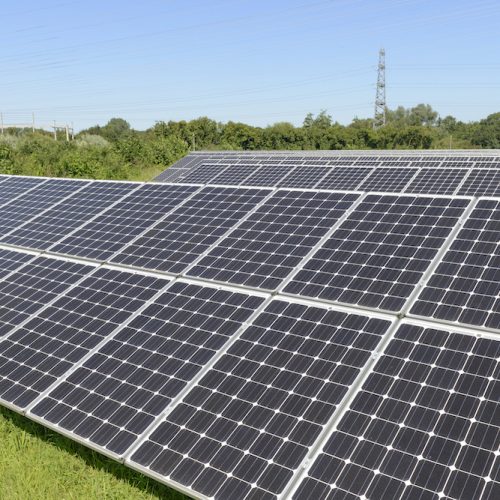
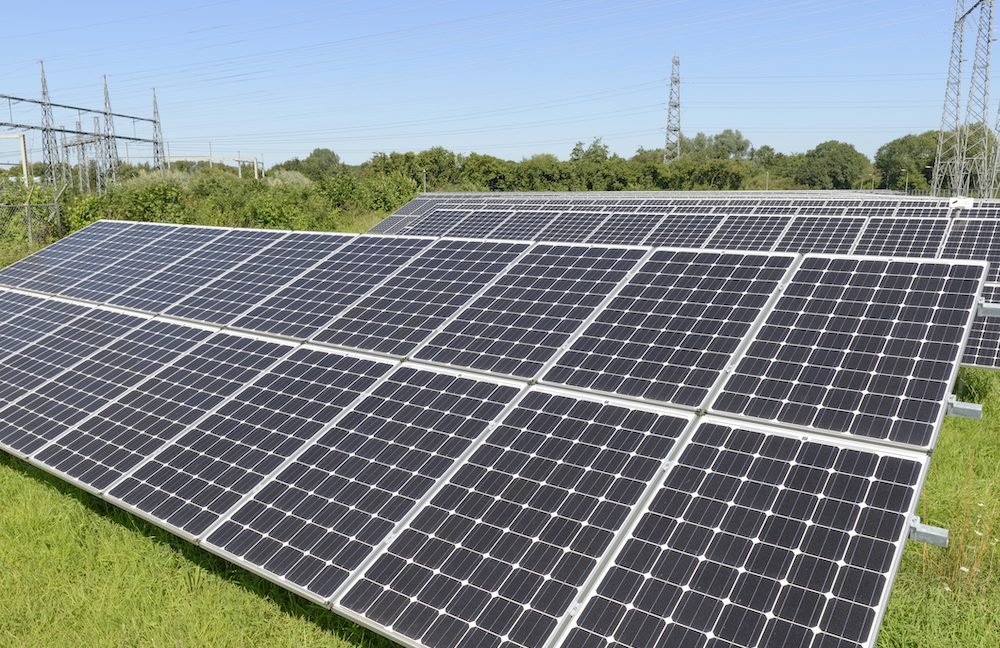
A year later, all of that seems to be in the past, as the US has returned to its normal pattern: slow growth, with renewables pushing coal off the grid. The one oddity is that hydroelectric production has surged without a corresponding increase in capacity, likely due to unusually warm weather in the western US causing the snowpack to melt early. That may have consequences later in the year.

Pushing fossil fuels out

Overall demand in the US grew by only 1.5 percent in the first quarter of 2026 compared to the same period the year before. Often, changes in demand during this part of the year are driven by weather-related heating demand. But the US had an unusual combination set of weather conditions to start 2026, with the western half baking in unseasonal warm temperatures, while the eastern half suffered a deep freeze. So we'll probably need data from more of the year before we read too much into the small rise in demand we've seen so far.

Read full article

Comments

© Getty Images

  •  

Tiny droplets of primordial soup appear in oxygen collisions

Colliding oxygen nuclei could briefly recreate one of the most extreme states of matter in the universe – according to evidence gathered by physicists working on the CMS Collaboration at the Large Hadron Collider at CERN. Their analysis suggests that when smashed together, even relatively small atomic nuclei can produce a tiny droplet of quark–gluon plasma (QGP). This is a superhot “soup” of elementary particles that is believed to have filled the universe just after the Big Bang.

Under normal conditions, quarks the particles that make up protons and neutrons are tightly bound together by gluons, which carry the strong nuclear force. But at extremely high temperatures, matter changes into a radically different form in which quarks and gluons move freely in a dense fluid-like state called a QGP.

Scientists believe the entire universe existed in this form for a tiny fraction of a second after the Big Bang. To recreate it here on Earth, physicists smash atomic nuclei together at nearly the speed of light.

One of the main ways researchers study this strange state of matter is by observing the fast-moving particle sprays created during the collision. In the absence of a QGP these energetic particles would travel outward freely. But if they pass through QGP, they lose energy, somewhat like a bullet slowing down in water. Physicists call this effect jet quenching.

“Jet quenching is one of the main tools we use to study the QGP,” explains Jiangyong Jia of Stony Brook University in the US, who was not involved in the CMS study. “When a high-energy collision produces a QGP droplet, energetic quarks and gluons created in the same collision have to travel through it, and they lose energy along the way.”

For many years, this energy-loss effect had only been clearly observed in collisions involving very heavy nuclei such as lead or gold. Lower mass systems, including collisions between protons and heavier nuclei, showed hints of unusual behaviour but no convincing evidence that particle jets were being slowed down.

A clear signal

The new CMS study examined collisions between oxygen nuclei, which are much smaller than lead nuclei. Oxygen contains just 16 protons and neutrons, compared with 208 in lead. This allowed researchers to investigate how small a droplet of QGP can become while still affecting energetic particles passing through it.

The collisions were performed in 2025 at an energy of about 5 TeV the highest energy ever for oxygen ions. The CMS Collaboration measured how many high-energy particles emerged from the collisions. This was compared to simpler proton–proton collisions, which are not expected to result in jet quenching.

The physicists found a clear reduction in the number of energetic particles produced. At some energies, the suppression reached about 30%, far beyond what could be explained by random statistical fluctuations. The pattern looked remarkably similar to what researchers had previously observed in much larger leadion collisions, although the effect was weaker overall.

“Oxygen-16 has only 16 nucleons compared to 208 in lead, but it appears to produce a medium that absorbs jet energy in a qualitatively similar way to much heavier systems,” Jia explains. “The shape of the suppression curve in oxygenoxygen collisions resembles what is seen in leadlead, which suggests the underlying physics is the same.”

Understanding fireballs

The team compared its measurements with several theoretical models. Models that included energy loss caused by QGP generally matched the data better than models without it. Still, some uncertainty remains. Part of the observed effect may come not from a QGP itself, but from differences in how quarks and gluons are distributed inside oxygen nuclei before the collision even occurs.

“The main limitation right now is the nuclear parton distribution functions,” Jia says. These describe how quarks and gluons are arranged inside atomic nuclei. According to Jia, uncertainties in these distributions “can account for roughly half of the observed suppression on their own”.

Future experiments involving proton–oxygen collisions are expected to help clarify the picture. The findings may also reshape how physicists think about the minimum size needed to create QGP.

“It shows that QGP formation is not limited to heavy nuclei,” Jia says. “It can occur in collisions of nuclei as light as oxygen.”

Researchers now hope to compare oxygen with other light nuclei such as neon to understand how the properties of QGP change as the colliding systems become larger or smaller. The work could eventually help physicists build a more complete picture of how ordinary matter behaved in the universe’s earliest moments and how the strong nuclear force operates under the most extreme conditions known in nature.

The research is described in Physical Review Letters.

The post Tiny droplets of primordial soup appear in oxygen collisions appeared first on Physics World.

  •  

Soaring solar and a surge in hydro push more coal off the US grid

Last year, the first few months of data from the US grid suggested that fears of a data-center-driven surge in demand were becoming a reality. Demand had risen by about 3 percent, triggering a surge in coal, interrupting what had been a long downward trend. But over the course of the year, both trends slowed considerably.

A year later, all of that seems to be in the past, as the US has returned to its normal pattern: slow growth, with renewables pushing coal off the grid. The one oddity is that hydroelectric production has surged without a corresponding increase in capacity, likely due to unusually warm weather in the western US causing the snowpack to melt early. That may have consequences later in the year.

Pushing fossil fuels out

Overall demand in the US grew by only 1.5 percent in the first quarter of 2026 compared to the same period the year before. Often, changes in demand during this part of the year are driven by weather-related heating demand. But the US had an unusual combination set of weather conditions to start 2026, with the western half baking in unseasonal warm temperatures, while the eastern half suffered a deep freeze. So we'll probably need data from more of the year before we read too much into the small rise in demand we've seen so far.

Read full article

Comments

© Getty Images

  •  

Word wave puzzle no.4

Here’s how the game works:

    1. Enter a word guess – in this game the word has six letters.
    2. After submitting your guess, each letter in the guessed word is coloured to provide feedback:
      • Green: The letter is correct and is in the correct position in the target word.
      • Yellow: The letter is correct but is in the wrong position in the target word.
      • Grey: The letter is not in the target word at all.
    3. Using this colour feedback, refine your next guess.
    4. Continue guessing until you correctly identify the hidden word(s) or run out of attempts.

If you need any hints, read the article here.

Fancy some more? Check out our puzzles page.

The post Word wave puzzle no.4 appeared first on Physics World.

  •  

Officials hail ‘major milestone’ for US Deep Underground Neutrino Experiment

A vast complex of steel beams for a next-generation neutrino detector has begun its descent underground in what officials have called a “pivotal phase” towards construction of the $3.3bn Deep Underground Neutrino Experiment-Long-Baseline Neutrino Facility (DUNE-LBNF).

An event was held yesterday – attended by senior officials including CERN director-general Mark Thomson and Dario Gil, undersecretary for science at the US Department of Energy (DOE) – to commemorate the start of moving 4.5 million kilograms of steel beams underground that will be used to hold DUNE’s detectors in place.

In February 2024, excavation work finished on two huge underground spaces for DUNE. Located 1.6 km underground at the Sanford Underground Research Facility in South Dakota and are some 150 m long and seven storeys tall, the spaces will be used to house DUNE’s four neutrino detector tanks that are each filled with 17,000 tonnes of liquid argon and cooled to 88 K.

When complete in 2031, DUNE-LBNF will study the properties of neutrinos in unprecedented detail, as well as the differences in behaviour between neutrinos and antineutrinos.

DUNE will measure the neutrinos that are generated by Fermilab’s accelerator complex, which lies around 1300 km away just outside Chicago.

The cryostat materials, which have been contributed by the CERN, are now scheduled to be moved underground and installed in the next few months.

“Today represents the start of a pivotal phase for DUNE, the development of the far detector structures in South Dakota,” noted Fermilab director Norbert Holtkamp. “Our focus remains on safety, quality and schedule — in that order — to ensure we successfully deliver on behalf of the US Department of Energy, our nation and the world.”

The post Officials hail ‘major milestone’ for US Deep Underground Neutrino Experiment appeared first on Physics World.

  •  

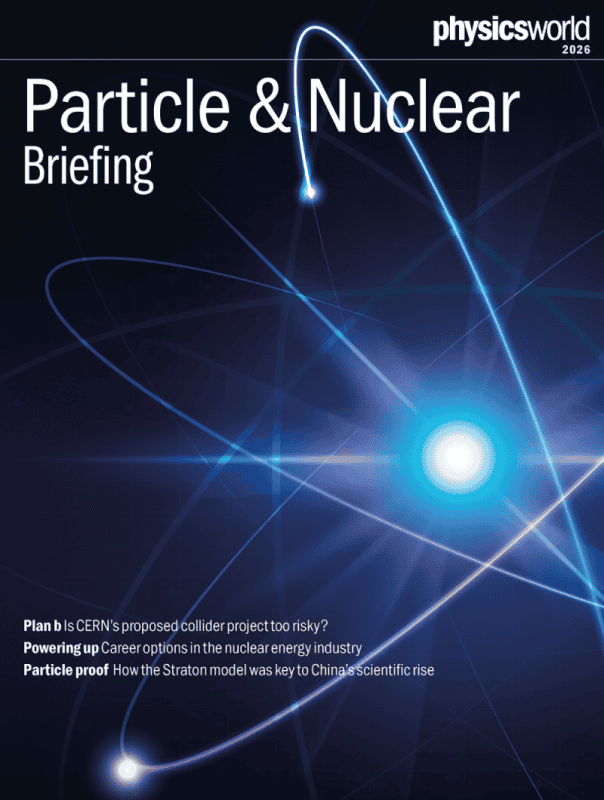
The Physics World 2026 Particle and Nuclear Briefing is out now

Since taking up the role of CERN director-general earlier this year, Mark Thomson has already had to contemplate the consequences of funding changes within the UK’s research councils.

Late last year, UK Research and Innovation, the umbrella organization for the UK’s research councils, did not commit any further contributions towards a major £150m upgrade to the LHCb detector – one of the four large experiments at the Large Hadron Collider that continues to do pioneering science.

As we report in the Physics World 2026 Particle & Nuclear Briefing, unless the decision is overturned or other avenues of funding are found, the experiment will now finish operations in 2033 and not take advantage of the High-Luminosity LHC (HL-LHC) that is currently being installed at CERN.

Another item in Thomson’s in-tray will be setting the course for the next flagship collider at CERN after the HL-LHC finishes operations in the 2040s.

In the ongoing process to update the European Strategy for Particle Physics, the Future Circular Collider (FCC) is the preferred option. Constructed near the LHC, this huge 91 km circumference electron–positron collider will come with a significant cost of $18bn. Thomson could find it a hard sell with some of the funding needing to come from outside CERN’s 24 member states.

Front cover of the 2026 particle and nuclear breifing
(courtesy: IOP Publishing)

As physicist and historian Michael Riordan points out in the briefing, the eye-watering cost of the FCC together with the worsening geopolitics of a fragmenting world order could make funding and building such colliders risky.

There are still many open questions over building the FCC, and indeed the future of particle physics, and some of those issues are set to be discussed at the 17th International Particle Accelerator Conference, which will be held in Deauville, France, from 17-22 May.

Elsewhere in the briefing, we talk to six physicists working across the nuclear energy industry, highlighting how a background in physics can open many doors in this expanding sector, and take a look at an obscure theory of elementary particles that proved to be key to China’s re-emergence as a scientific nation after the Cultural Revolution had stalled its development.

  • The free-to-read Physics World 2026 Particle & Nuclear Briefing is available here.

The post The Physics World 2026 Particle and Nuclear Briefing is out now appeared first on Physics World.

  •  

Shock as CERN antiproton lorry vanishes in staff car park

WE HOPE YOU ENJOYED OUR APRIL FOOL’S JOKE FOR 2026. KEN HEARTLY-WRIGHT WILL BE BACK AGAIN NEXT YEAR.

Researchers at the CERN particle-physics lab near Geneva have been left stunned after a lorry containing a vial of antiprotons went missing. The lorry had been used by the Baryon-Antibaryon Symmetry Experiment (BASE) to successfully transport 92 antiprotons around the CERN site last month.

Following their work, BASE researchers had left the lorry in the main CERN car park but found it had vanished the following morning. The antiprotons were contained in a cryogentically-cooled Penning trap composed of gold-plated cylindrical electrode stacks made from oxygen-free copper surrounded by a superconducting magnet bore.

Initial suspicion was that the lorry might have been stolen by visiting US researchers from Fermilab, but a review of CCTV footage by CERN scientist Vittoria Vetra suggests it had been left overnight with the handbrake off.

I should have paid more attention. But I was just reaching into my bag to get my baguette lunch.

CERN lorry driver Herwig Chopper

Vetra discovered that following the test run, the driver – Herwig Chopper – had hit a pine marten dashing across the car park. “I should have paid more attention,” admitted Chopper. “But I was just reaching into my bag to get my baguette lunch”.

The driver swiftly went to get help for the stricken marten, with the suspicion being that in the rush he accidently left the truck’s handbrake off.

Footage taken later in the day revealed that the antiproton lorry began moving slowly forwards towards an identical vehicle containing protons, which had been used in 2024 to successfully transport protons across the lab’s campus.

Moments later, the two trucks collided and annihilated in a brilliant flash of light that dazzled the CCTV camera.

The light was so intense that it was even picked up at CERN’s Antiproton Proton RecoIL-1 (APRIL-1) experiment, which lies just a few hundred metres away.

Initial analysis by experiment head Silvano Bentivoglio suggests that the significant centre-of-mass energy of the collision could have produced two new particles, which the team have dubbed an “angelon” and a “demon”.

This new discovery opens up a new branch of particle physics to probe the full collision spectrum of trucks containing matter and antimatter.

TV physicist Brian Cox

“This new discovery opens up a new branch of particle physics to probe the full collision spectrum of trucks containing matter and antimatter,” says TV particle physicist Brian Cox. “Who knows what we might find and it could also be possible to collide other methods of transportation to search for new forces.”

There are now calls for CERN to build the 91 km Future Truck Collider in an underground tunnel with the Vatican and other private sponsors already coming forward with significant funding.

The post Shock as CERN antiproton lorry vanishes in staff car park appeared first on Physics World.

  •  
❌