
Reading view

Webb Spots Supermassive Black Hole Older Than Its Home Galaxy
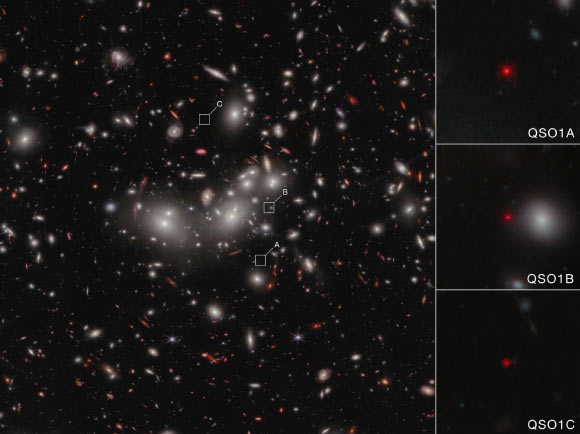
This Webb/NIRCam image shows the little red dot Abell2744-QSO1, magnified and triply imaged by galaxy cluster Abell 2744. Image credit: NASA / ESA / CSA / Lukas Furtak, Ben-Gurion University / Alyssa Pagan, STScI.

Astronomers using the NASA/ESA/CSA James Webb Space Telescope have found an enormous black hole in the early Universe that appears to predate its own host galaxy, raising fresh questions about how the cosmos’ first supermassive monsters were born.

The post Webb Spots Supermassive Black Hole Older Than Its Home Galaxy appeared first on Sci.News: Breaking Science News.

  •  

Is Dark Energy Unnecessary? Mathematicians Challenge Standard Cosmological Model of Universe

This artist’s impression shows the evolution of the Universe beginning with the Big Bang on the left followed by the appearance of the Cosmic Microwave Background. The formation of the first stars ends the cosmic dark ages, followed by the formation of galaxies. Image credit: M. Weiss / Harvard-Smithsonian Center for Astrophysics.

Mathematicians from University College London and the University of California, Davis, have published a mathematical proof that the Universe’s accelerating expansion can be explained without dark energy, dealing a serious blow to the Lambda-cold dark matter model.

The post Is Dark Energy Unnecessary? Mathematicians Challenge Standard Cosmological Model of Universe appeared first on Sci.News: Breaking Science News.

  •  

Open, Flat & Closed Universes: Curvature Explained

Standard cosmological models are classified by spatial curvature into three broad types: open, flat, and closed universes. These correspond to negative, zero, and positive spatial curvature respectively, and each case has distinct implications for the geometry and global volume of space. Open, Flat, and Closed Universes In the simplest Robertson–Walker models the three cases can...
  •  
❌