
Reading view

“They Would Be Able to ‘See,’ ‘Hear,’ and ‘Think’”: Laser-Powered Ceramic Engines Could Drive Futuristic Intelligent 6G Networks


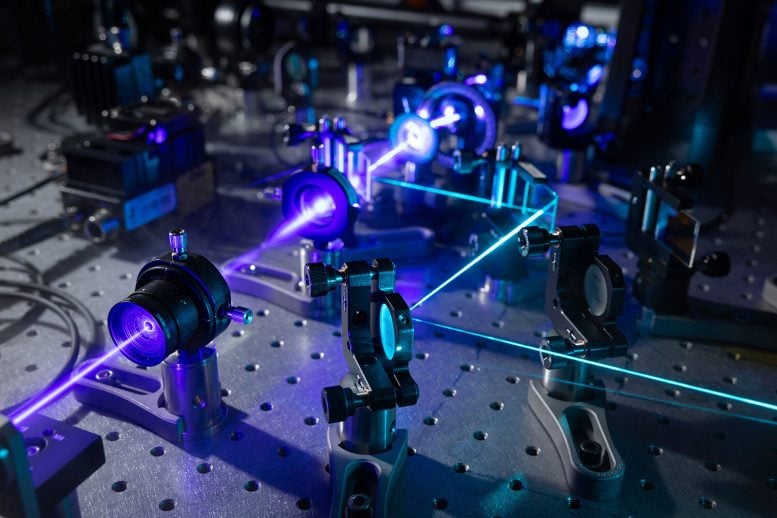
Chinese scientists say they have set a new visible-light transmission standard by demonstrating a laser-driven communication engine that uses a light-based, easy-to-use ceramic material capable of transmitting information over distances exceeding 1.2 kilometers.

“This is really a record with attractive performance beyond the traditional technology,” says Zhiguo Xia of South China University of Technology in Guangzhou, China.

The research team behind the potentially historic achievment said exceeding current LED-based light-based transmission distances, which are typically confined to a few meters could usher in ‘intelligent’ 6G communication networks, including streetlamps, smartphones, and other devices that “would be able to ‘see,’ ‘hear,’ and ‘think,’” by detecting people and objects and integrating that information into network-wide active processing.

Laser-Powered Engines & the Elusive Future of AI-Driven Intelligent 6G Networks

According to a statement announcing the laser-powered engine breakthrough, conventional LED-based visible light communication (VLC) systems typically operate at short distances ranging from a few inches to “a few meters.” This has limited their applications to mostly laboratory demonstrations. Still, the technology is considered an integral part of planned intelligent, AI-enabled 6G networks that would replace current 5G standards.

Unlike current 5G networks, 6G networks would enable significantly more information and enable systems to act in concert to improve performance and add previously unavailable features. According to the study authors, 6G networks built into future smartphones and other electrically wired objects such as streetlamps and stoplights would not allow information to move through networks an order of magnitude faster. They note that this added capacity would fundamentally change these systems, turning them from single-use systems into connected components of a larger, intelligent network.

“They would be able to ‘see,’ ‘hear,’ and ‘think,’ detecting people and objects and their subtle movements,” the researchers explained.

Still, several technological barriers have limited the emergence of 6G, including what the research team described as “challenges in combining high-performance lighting materials and high-speed photodetectors into compact devices that can be mass-produced at low cost.”

“A Paradigm Shift from Connection to Intelligent Connection”

To extend the range of data transmission, Xia’s team explored ceramics capable of emitting light and withstanding high temperatures. The final process involved mixing calcium ions with a powder of chemical compounds typically used in glass formation.

According to the study authors, this simple formula “eliminates the need for high-pressure manufacturing,” typically associated with electronic ceramic production. The ceramic used in the process also transfers heat 20 times more efficiently than silicon, the favored material in laser-driven transmission technologies. This durability dramatically increases the amount of laser energy the material can withstand compared to other VLC options.

After experimenting with several prototypes, the team said that tests showed light coherence and data consistency up to 1.2 kilometers, offering “direct experimental evidence” for 6G technology.

Xia conceded that dreams of intelligent AI-enabled networks with this level of data transmission capability have so far existed “largely at the visionary level.” However, the team’s result could make “a paradigm shift from connection to intelligent connection possible.”

Team Eyeing Future Improvements to Increase Speed and Reliability

Although the initial experiments were encouraging, Xia’s team said their current version has some limitations. For example, it mainly emits light in the yellow region, ranging between 500 and 650 nanometers. This lack of red-light components would limit its use to what the team described as “applications requiring a very high color rendering index,” a measure of an object’s true color relative to a natural sunlight standard.

The new laser-powered engine also operates at what the team termed “far below” fiber-optic speeds, limiting its usefulness in intelligent network applications.

To address these and other limitations, Xia’s team said they plan to investigate light-emitting materials beyond ceramics. These include exploring materials with shorter fluorescence lifetimes and tunable emission bandwidths, which the team notes “can further speed up (transmission) rates.”

Another possible future improvement is to integrate the laser-driven engine with an RF (radio-frequency) system to ensure continued data transmission in bad weather, which can degrade VLC performance. Because future intelligent 6G networks will include satellites, the team said, adding that their technology could enable high-speed coverage in “tough-to-reach” regions of the planet, such as deserts, oceans, and mountains.

“AI‑driven link adaptation can dynamically adjust data rate and optical power, ultimately supporting a future 6G network that is space‑air‑ground integrated, fully covered, and highly reliable,” Xia explained, adding that their work “also provides compelling experimental support for the application of laser lighting in scenarios such as drone logistics and low‑altitude air travel.”

The study “Tailoring quasi-transparent ceramic as a laser-driven photonic engine for kilometer-level white light communication” was published in the journal Matter.

 Christopher Plain is a Science Fiction and Fantasy novelist and Head Science Writer at The Debrief. Follow and connect with him on X, learn about his books at plainfiction.com, or email him directly at christopher@thedebrief.org.
  •  

Stanford’s Revolutionary New Microscope Reveals Living Cells in Stunning Detail

Interferometric Microscopy Laser ArrayStanford researchers have developed a microscope that can show how nanostructures interact inside living cells at the highest resolution achieved so far. The view into living cells just got better. Stanford researchers have merged two microscopy methods to build a unique instrument that can capture cell structures interacting in real time at an unprecedented resolution [...]
  •  

Building a better laser on the Moon

There are craters on the Moon where the Sun never shines – and researchers in the US and Germany have shown that these shady locations would be ideal for housing lasers that are more stable than similar devices operated on Earth.

Writing in the Proceedings of the National Academy of Science, Jun Ye at NIST and the University of Colorado and colleagues explain the benefits of installing a silicon optical cavity in a permanently shaded crater. Such a cavity is a block of silicon with internally facing mirrors at opposing ends. Light from a commercial laser is shone into the cavity where it bounces back and forth, growing in intensity and coherence. The length of the cavity defines the frequency of the trapped light. So if the cavity is machined to a very high precision, then the cavity light has a very narrow frequency range.

Some of this light is extracted from the cavity, creating a source of high-quality laser light. To ensure the stability of the laser, the cavity can be cooled to cryogenic temperatures to minimize thermal fluctuations. Now, Ye and colleagues have shown that this stability can be improved significantly if a cavity is operated in a shady nook on the Moon.

Cold vacuum

There are more than 300 regions of the Moon that are in permanent shadow. As well as being enveloped in darkness, these regions tend to maintain a steady temperature of about 50 K. While the Moon has no real atmosphere, it is not surrounded by a perfect vacuum. Radioactive decay and bombardment by meteorites, the solar wind and sunlight liberates molecules from the surface and these will linger briefly before escaping into space. Because dark craters are not subject to bombardment, there should be fewer gas molecules in these regions – and therefore a better vacuum than on the surface. Indeed, the team calculates that pressures of less than 10−10 Pa should exist in these craters, which is well within the ultrahigh vacuum regime.

As a result, dark craters should be a perfect environment for operating a silicon optical cavity. There it would experience a small number of collisions with gas molecules, boosting its stability. What is more, by radiating heat out of the crater and into space, Ye and colleagues reckon that an optical cavity could be further cooled to a chilly 16 K. At this temperature, silicon will neither expand nor contract in response to tiny temperature fluctuations – further stabilizing the output of the cavity.

According to the researchers’ modelling, such a cavity would have a very low thermal noise-limited stability of 10−18 and a coherence time exceeding 1 min. This performance, they say, is ten times better than that achieved by the best cavities operated on Earth.

Testing Einstein

The team proposes several different uses for light emitted by the cavity. Because it would have a very stable frequency, it could be used as a very precise lunar time signal. This would be very useful for the navigation on, or near to, the Moon as well as for scientific experiments – including those that test Einstein’s general theory of relatively.

Ultrastable lasers would also allow scientists to create long-baseline interferometers for astronomical observations, including the detection of gravitational waves. Furthermore, the cavities themselves could also be used as detectors. Gravitational waves at certain frequencies would affect the output of a cavity – as could hypothetical interactions between silicon atoms and dark matter.

Using a high-powered relay laser, the cavity signal could be transmitted to lunar satellites that contain atomic clocks – creating a timing network similar to Earth’s global navigation satellite systems such as GPS. Furthermore, light from the cavity could be used to create a quantum network that stretches from the Moon to the Earth.

Team member Yiqi Ni works for the US-based company Lunetronic, which is developing technologies for use in permanently shadowed craters. Ni says that a silicon optical cavity could be operated in low-Earth orbit within two years – and be installed on the Moon within three to five years.

The team also includes researchers from the US National Institute for Standards and Technology (NIST) and PTB, which is Germany’s national metrology and standards institute.

The post Building a better laser on the Moon appeared first on Physics World.

  •  

‘Einstein’s flying mirror’ technique opens a path towards extreme light intensities

Tests of fundamental physics that were previously impossible could become a reality thanks to a new way of producing extremely intense beams of light. Using a state-of-the-art high-power laser, researchers at the University of Oxford, UK demonstrated that they could dramatically increase the efficiency of a nonlinear optical technique called relativistic harmonic generation. According to the team, this increase could herald a paradigm shift, making it possible to achieve hitherto unheard-of electromagnetic field intensities in the laboratory.

The theory of quantum electrodynamics (QED) predicts that at very high intensities, light can interact with the vacuum, converting light energy directly into matter. “If we can achieve such intensities, we could test theories about the fundamental nature of the universe,” says Robin Timmis, who led the new study. “However, doing so requires a laser system a million times more intense than those currently available.”

Relativistic harmonic generation

In the new work, Timmis and her colleagues in Peter Norreys’ group at Oxford used the Gemini laser at the UK Science and Technology Facilities Council’s Central Laser Facility (CLF) to generate coherent extreme ultraviolet (XUV) and X-ray photons via relativistic harmonic generation. They began by firing high-frequency, ultrashort, sub-picosecond (10-12 s) laser pulses onto a solid glass target. This creates a plasma that acts like an oscillating mirror, and Timmis likens the next step to shining a flashlight at this mirror while it is rushing towards you at near-light speed – a concept known as “Einstein’s flying mirror”. The result is that the light reflected from the plasma becomes compressed, and gains intensity.

Working with researchers from Brendan Dromey‘s group at Queen’s University Belfast in Northern Ireland, the team used a process called coherent harmonic focus to concentrate this light into a region as small as a few nanometres across. This step may have boosted the light beam’s intensities as high as 1023 W cm−2, although Timmis acknowledges that this is an estimate based on previous theoretical simulations, as the team was unable to measure it directly.

“If confirmed with further experiments at Gemini, or indeed even larger facilities, we may have made the most intense source of coherent light ever,” says Timmis, who received this year’s Institute of Physics Culham Thesis Prize in part thanks to this work, which is described in Nature. “The energy in our XUV beam was over three orders of magnitude brighter than previous measurements,” she adds. “By resolving a long-standing gap between theoretical expectations and experimental results, we confirmed the required energies to support a coherent harmonic focus and therefore offer a substantial boost in intensity above that of the original laser pulse.”

Towards the next generation of extreme electromagnetic field studies

According to the researchers, these results demonstrate that there is a realistic experimental pathway to next-generation laboratory studies of extreme electromagnetic fields. In particular, they say that the quantum critical field for QED tests, which is known as the Schwinger limit and has a value of >1016 V cm−1 or >1029 W cm−2, is now open, paving the way towards all-optical studies of the quantum vacuum. As well as fundamental physics, Timmis says that more efficient harmonic generation could also have applications in ultrafast imaging of physical and biological systems, photolithography and fusion science.

The Oxford team is now analysing data from a follow-on experiment at the CLF that will guide their next steps. “We will be shortly publishing results about a new harmonic beam that we have discovered on that run,” reveals Timmis, “and future studies will focus on actively controlling the coherent harmonic focus and directly measuring its intensity.”

The post ‘Einstein’s flying mirror’ technique opens a path towards extreme light intensities appeared first on Physics World.

  •  
❌