 Login
Login
Rocket launches are turning the upper atmosphere into an accidental climate experiment
 A new study finds pollution from satellite megaconstellations could account for 42% of the space sector’s climate impact by 2029.
  A new study finds pollution from satellite megaconstellations could account for 42% of the space sector’s climate impact by 2029.
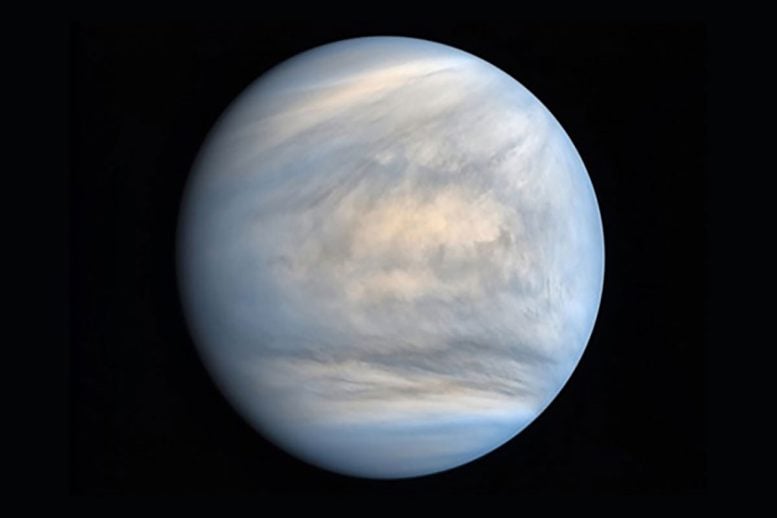 Models suggest that impact-ejected material from Earth could reach Venus’ clouds and potentially survive there briefly. Panspermia is the idea that life, or the ingredients needed for life, can move through space on asteroids, comets, and other objects. If life’s building blocks appear on one planet, a powerful impact could blast material from its surface [...]

Using spectral data from the Near-Infrared Spectrograph (NIRSpec) onboard the NASA/ESA/CSA James Webb Space Telescope, astronomers analyzed the atmosphere of TOI-199b, a distant Saturn-mass world that is neither frozen nor scorching hot.
The post Webb Detects Methane in Atmosphere of Exo-Saturn TOI-199b appeared first on Sci.News: Breaking Science News.
The continent of Africa is splitting into 2 tectonic plates in the middle of Ethiopia. In the recent past, geophysicists have improved their understanding of how tectonic plates like these separate. They’ve shown that continents begin to split apart as the crust and upper mantle, known as the lithosphere, crack and shift. Later, magma from deep within the Earth travels upward through these cracks to Earth’s surface, forming volcanoes. Therefore, scientists know that volcanoes form in areas of continental rifting, but not how quickly they form, which complicates efforts to assess volcanic hazards in rift zones.
Researchers led by Kevin Wong sought to answer this question by examining a mineral formed when magma cools, called olivine. They focused on 72 olivine crystals ranging in size from 1 to 4 millimeters (0.04 to 0.16 inches) from rocks collected at the Boku and Ziway volcanic fields in the Main Ethiopian Rift (MER) zone in Africa. They explained that the lithosphere in this area is still about 35 to 40 kilometers (21 to 25 miles) thick. This thick lithosphere suggests that the MER represents an intermediate stage of continental separation and offers a rare opportunity to study how tectonic stretching transitions into magmatic rifting in the process.
Wong and his team analyzed olivine because it’s one of the first minerals to crystallize from magma, and it continues to grow as the magma rises and cools. As magma rises, its composition changes, producing sharp chemical “zones” within the growing crystals, analogous to growth rings in trees. Changing temperatures and magma compositions cause different elements, like magnesium and iron, to diffuse into and out of the crystals at various rates during the magma’s ascent. So scientists can model these chemical zones and their boundaries in olivine crystals to determine how quickly the magma ascended from the upper mantle to erupt in the rift.
Wong and colleagues examined the olivine crystals from the MER volcanic fields using high-magnification imaging and chemical analyses, with an instrument known as an electron microprobe. Within each crystal, the team mapped 10 to 15 points spaced approximately 5 to 15 microns apart (about 10% of the thickness of a human hair) along a transect from the inner core to the outer rim, spanning its growth zones.
They found 2 different populations of olivine crystals. The first consisted of normal-zoned crystals with magnesium-rich inner cores, and the second consisted of reverse-zoned crystals with lower magnesium cores. They explained that recently-formed magmas in the deep Earth contain higher amounts of the element magnesium relative to iron. The magnesium-rich zone has a sharp boundary with the magnesium-poor zone, but this boundary can get blurred when elements diffuse across it. Diffusion progressively smooths these crystal boundaries over time at known rates, so researchers can use their “blurryness” to extract information on how quickly the crystals equilibrated with the surrounding magma.
The researchers used numerical models to estimate how quickly magnesium and iron would diffuse across these chemical boundaries at different temperatures and surrounding magma chemistries. They compared thousands of simulated diffusion profiles to their measured olivine diffusion profiles. They used this iterative process to estimate that the crystals diffused, on average, for 40 and 17 days in the surrounding magma while ascending from the deep Earth to erupt at Boku and Ziway, respectively. They further tested these estimates using a growth-diffusion model that better represented natural crystal behavior. That model produced ascent times of about 27 days on average and better reproduced the crystal zoning patterns they observed.
Based on these models, the researchers concluded that intermediate-stage rifting events happen on unexpectedly short timescales. Magmas travel up to 40 kilometers (25 miles) from the deep Earth to the surface within, on average, a single calendar month, which is closer to human timescales than geologic timescales. They suggested that this rapid ascent is likely due to highly developed magmatic plumbing systems in the lithosphere that form before much lithospheric thinning. However, they noted that their results still suggest a wider range in ascension timescales than optimal for disaster mitigation and prediction.
The post Magma rapidly rises to Earth’s surface as Africa splits in two appeared first on Sciworthy.
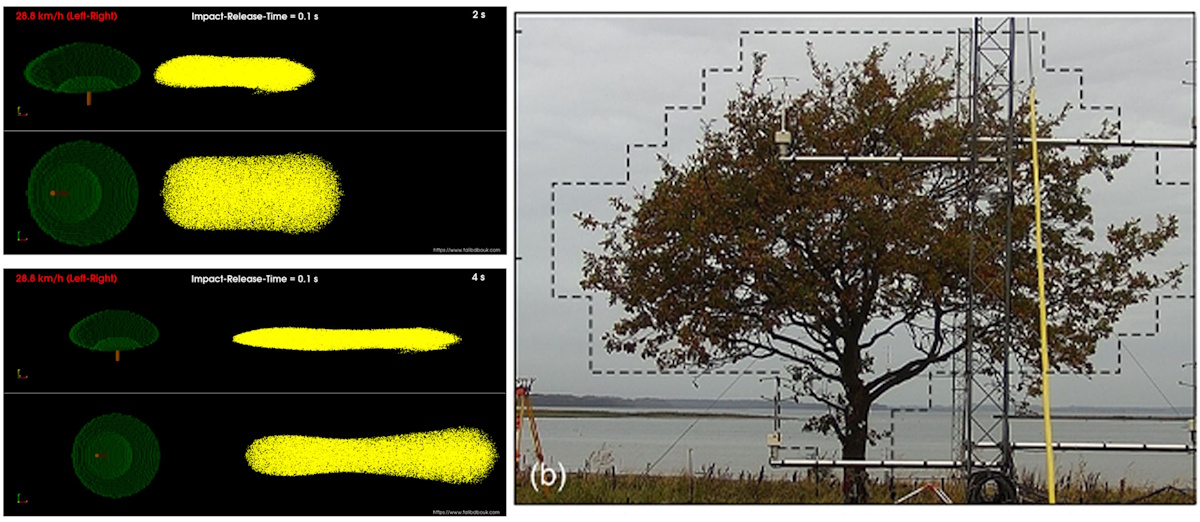
Researchers in France have developed a novel method to investigate how pollen is dispersed from trees when the wind blows – paving the way for new approaches to urban planning that could help alleviate the symptoms of seasonal hay fever.
A project team headed up at the University of Rouen Normandy has discovered for the first time that different trees can exhibit different local dynamics for the transport of pollen grains – for example, when pollen is dispersed by wind – and that that this behaviour depends on the local detachment force of pollen grains occurring at the scale of each flower inside the tree.
As part of the project, outlined in the paper Flow and plants: On the dispersion of wind-induced tree pollen, published in Physics in Fluids, the researchers developed an innovative direct-forcing porous immersed boundary method (DF-PIBM) to explore the wind-driven pollen dispersion and transport phenomena from green trees.
“The research investigates, through advanced physics-based modelling and simulations, the impact of tree types and their interaction with wind on the local dispersion of pollen grains in the surrounding environment,” says lead author Talib Dbouk, a researcher in the CORIA Lab, CNRS, at the University of Rouen Normandy.
As Dbouk explains, the team’s approach involved the use of a range of advanced computational fluid dynamics (CFD) modelling and simulation techniques to solve the local air flow around and within the trees, taking into account the interaction between the air flow and the pollen grains in and/or on the tree flowers.
“The DF-PIBM is an advanced numerical technique developed in order to accurately solve the local resistance of a tree to wind by assuming the tree leaves lead to the fact that a tree can [act] as a porous medium, where the local porosity inside the tree will depend on its leaf area density,” he adds.
According to Dbouk, this method was “derived, implemented and validated in an in-house CFD code”, first by testing different flow configurations around and within porous spherical particles – and then by extending and applying it to different types and structures of trees.
In Dbouk’s view, the key advantage of using DF-PIBM compared with other approaches is that it allows researchers to accurately solve the local air flow velocity and the local pressure inside the tree.
“DF-PIBM has a number of current and potential applications – including prediction of the behaviour of airborne pollen grains and support for future applications involving vegetation–flow interactions in urban settings,” he says. “The currently developed DF-PIBM allows us to accurately predict all the phenomena of the detachment, dispersion, resuspension and local transport of airborne pollen grains when emitted from a green space – for example, trees and grass – and thus any vegetation zones inside urban environments under different weather conditions.”
Meanwhile, co-author Julien Reveillon confirms that the next steps for the research team will involve the integration of all its physics-based models into a new advanced digital twin of the Rouen-Normandy Metropolitan region in Normandy, France.
“This is with the intention of developing a new advanced multi-risk assessment digital platform that can help our local public authorities in their future territorial management and planning strategies – for example, to better anticipate and fight climate change phenomena, especially those related to local heat islands and aero-allergens like pollen, in addition to environmental pollution of air, water and soil,” he says.
“Moreover, huge efforts are also [being] made in order to develop and integrate advanced models related to predicting and simulating airborne pollutant particle dispersion in our region, for example those related to emissions from both natural fires and industrial accident fires,” co-author Béatrice Patte-Rouland tells Physics World.
The post Pollen dispersion study offers hope for hay fever sufferers appeared first on Physics World.
