 Login
Login
NASA’s Psychedelic Crop Map Shows Plants Have a Hidden Signature — and Radar Can Read It
 Who said science can't be pretty?
  Who said science can't be pretty?
 A new study finds pollution from satellite megaconstellations could account for 42% of the space sector’s climate impact by 2029.
Sam Altman, the chief executive of OpenAI, took to the Internet a few years ago to propose that homo sapiens would be the first species “to design our own descendants”. In his best case scenario, the “merge” between humans and artificial intelligence occurs at some point over the next 50 years. The alternative, where we remain simply human and the machines follow their own path, is more ominous. “If two different species both want the same thing and only one can have it – in this case, to be the dominant species on the planet and beyond – they are going to have conflict,” he wrote.
More recently, Elon Musk, the world’s richest man, who at one point last year was granted the power to reconfigure the US federal government, argued on his social media platform, X, that “it increasingly appears that humanity is a biological bootloader for digital superintelligence” – our role in the history of the cosmos reduced to that of the low level code that boots up a computer before you can run sophisticated programs on it.
And Musk is on the tame side of the evolutionary proposition. According to Silicon Valley lore, he once pushed back against Google co-founder Larry Page’s claim that our next manifestation, to follow in the steps of the meat-and-bone humans you see walking about today, would necessarily have digital form in order to spread throughout the galaxy. (In fact, he recently testified in court that it was those concerns that prompted him to found OpenAI with Altman.) Meat and bones do not make for efficient interstellar travelers.
t would be a mistake to understand these weird worldviews as an ultimately harmless take by techies who grew up on a diet of dystopian science fiction. The notion that we are approaching the end of the homo sapiens, as defined since Darwin’s day, is coalescing into a durable body of belief among the elites at the helm of our technological future.
Their dreams are not all perfectly aligned. But like the folk stories and superstitions that have for ever revolved around more established religious traditions, the collection of far-fetched scenarios valley oligarchs are writing into our future exhibits the hallmarks of a religion in the making, a body of belief to confer a sense of cosmic transcendence and inevitability to their hi-tech project.
In their minds, they are on their way to build the next phase of humanity, a “transhuman” future. In this future, they can satisfy their desire for immortality and assert power over the cosmos as transhumans multiply and expand across the galaxy. Their ultimate goal: to execute on a techno-mystical dream to distill the essence of what it is to be human, consciousness and all, into bits of information to be downloaded as binary code on to some non-biological substrate such as a silicon chip, or beamed through space as electromagnetic waves.
The mythopoeic infrastructure assembled in and around San Francisco carries risk for humanity as we know it. It justifies steering technology along a path that is, at best, indifferent to the needs, hopes and aspirations of everyday humans in a quest to deliver a future that only looks like utopia to these masters of the universe.
Who cares if artificial intelligence obliterates humdrum human labor when it offers us the opportunity to transcend our body and conquer the galaxy? The fantasy directs the technology: rather than building economically useful tools that can help humans expand their capabilities, the overlords of AI are sinking vast resources into a dream of building superhumans.
These beliefs have pushed to the fore over the last quarter century, accompanying the advance of information technologies that have delivered enormous wealth and power to a new IT elite, one committed to science-based progress and hungry for transcendent meaning, but indifferent or even hostile to the propositions and moral constraints of organized religion.
“Silicon Valley has been a militantly secular space,” a prominent thinker about technology whose employer would be unhappy if he went on record told me. “It created a God-shaped hole, which it filled in its image.” Having rejected standard religious sources of purpose, they found an alternative path to provide their lives with significance via sci-fi transhuman dreams. Or as Musk observed in a singsong post on X: “Atheism left an empty space. Secular religion took its place.”
While this newfangled cosmogony has been cobbled together at least since the early days of the Internet, it reached toward breathtaking new horizons on the shoulders of artificial intelligence, which opened up vast new possibilities for the transhuman dream. Douglas Rushkoff, a critic of the technological oligarchy and its ambitions, put it thus, referencing the 1980s-era satire featuring the first ever “computer-generated” TV host. “I guess AI makes the notion of having a Max Headroom existence plausible.”
Weird though the valley’s proposed utopia may appear, it fits a longer tradition of business titans with vast unrestrained wealth seeking to endow their endeavors with transcendent value. Henry Ford, as historian Kati Curts has written, also believed his calling was about more than transforming manufacturing to make cars; he believed he was on a mission to re-engineer the world to improve society.
Ford built Fordlândia, an attempt to create a harmonic social order supported by an industrial-scale rubber plantation in the Brazilian rainforest. Altman, Musk and the valley gang want to merge consciousness with AI and conquer the cosmos. The distance between these visions has mostly to do with the technological possibilities of their time. The proposition that they are engineering some utopian vision that humanity should be grateful for is not that dissimilar.
As Nobel prize winning economist Daron Acemoglu wrote: “The handful of people unleashing this technology on the world are guided by an ideology of control (over humanity) and by a conviction that machines are uniformly better than humans.”
The danger, for the rest of us, is how the technological oligarchy’s aspirations will reshape the economies and societies of our present, as they redirect resources – capital, energy, minerals, water – to turbocharge AI and bring about the transhuman dream at the expense of healthcare, education or poverty reduction in the here and now.
While Americans are starting to show some signs of discomfort over the unrestrained appetites of this crop of AI moguls, the Trump administration has shown few signs so far of wanting to put in place regulatory guardrails and constrain their efforts in any way.
There are a variety of views in the valley about what a future humanity should look like.
Altman and Page are perhaps the most committed to the goal of merging humans with superintelligent technology and abandoning the flesh. Altman was an early subscriber to Nectome, a valley startup that proposes to retrieve information present in the brain’s anatomical layout and molecular details in order to replicate consciousness in the future. “I assume my brain will be uploaded to the cloud,” Altman told the MIT Technology Review.
Musk wants something a bit different, also spacebound but committed to flesh, enhanced by computers via something like his own brain-to-computer interface company Neuralink. Peter Thiel, of PayPal and Palantir fame, frowns on “just a computer program that simulates me”, but is drawn to the techno-ideal of “this radical transformation where your human, natural body gets transformed into an immortal body”.
And yet, the visions converge. Page, for instance, has suggested that rather than giving money to charity he might just give it to Musk. As he once told Charlie Rose, Musk wants to go to Mars to provide a backup planet for humanity to expand and that is a worthy goal to contribute to.
There are shared sources that provide some sense of moral purpose to the various flavors of sci-fi ambition. One of the core starting points is rather earthbound: the movement for effective altruism (EA), which seduced the technological elite with its appeal to unflinching rationality. Philanthropy, the EAs argued, was largely wasted by funding, say, the local library. Donors had to be purposeful, carefully directing their money to where it would do the most good for the most people.
That is not an unreasonable proposition. It encouraged laudable efforts to, say, eradicate malaria in Africa, on the grounds that one could save a whole human life for a small fistfull of dollars. But it eventually departed from the needs of present earthlings.
First, it was the longtermists, who emerged from effective altruism to argue that improving the world of the future was worthier than spending on the present. From there it took but one small step to move the goalposts to the cosmos: how about focusing on the wellbeing of myriad future transhumans populating the vast reaches of the galaxy in the far future? Maybe they will be of the flesh. Maybe not.
It’s easy to get lost in the tangle of beliefs and aspirations – articulated and refined by academics like William MacAskill and Nick Bostrom, at university departments or thinktanks funded by the techno-oligarch’s mushrooming wealth. They draw from unorthodox ethics, and from idiosyncratic readings of the laws of physics. The goal: to justify the imperative to take humanity (or at least the most privileged part of it) where it has never gone before.
One of this crew’s goals is to advance up the Kardashev scale – a measure of the amount of energy a civilization consumes – to harness the energy and acquire the technological capabilities needed to transcend our biological confines. Present day humanity, at the bottom of the ladder, doesn’t even consume all of the energy of the Earth. Advanced civilizations, the thinking goes, are expected to consume all the energy of their star, at least, if not all that of the galaxy.
One of the earlier groups pushing for a transhuman future in the 1990s were the ultra-libertarian Extropians, which included leading intellectuals such as Eliezer Yudkowsky, Bostrom and economist Robin Hanson. Outlined in their core principles, they proposed “Boundless Expansion: Seeking more intelligence, wisdom, and effectiveness, an unlimited lifespan, and the removal of political, cultural, biological, and psychological limits to self-actualization and self-realization. Perpetually overcoming constraints on our progress and possibilities. Expanding into the universe and advancing without end.”
Another, more recent branch, are the effective accelerationists. They have tried to conscript physics to their cause, arguing – controversially – that maximizing intelligent life is an imperative, because life is good at extracting available energy from the environment and dissipating it – increasing what is known in physics as “entropy”.
As Beff Jezos – the online identity of Guillaume Verdon, one of the leading lights of the movement – puts it: “Effective accelerationism aims to follow the ‘will of the universe’: leaning into the thermodynamic bias towards futures with greater and smarter civilizations that are more effective at finding/extracting free energy from the universe and converting it to utility at grander and grander scales.”
In a philosophical twist that surely pleases Silicon Valley’s billionaires, effective accelerationists argue for rampant techno-capitalism, unhindered by regulation, government and other nuisances, because this would maximize the consumption of the universe’s resources, “capture civilizational utility”, and dissipate the residue into the disorganized void.
The details of the dream don’t actually make much of a difference. Because they all take us roughly to the same place. What matters now is whether the masters of the universe – invested in harnessing the energy of the stars, tempted by a moral calculus that posits that the wellbeing of the people of the present is of inferior value to the vastly more numerous humanoids of the future – will have the patience to care for the rest of us.
The signs are not great. Silicon Valley venture capitalist Marc Andreessen, for instance, wants to “ensure the techno-capital upward spiral continues forever”. His list of enemies encompasses pretty much any person or idea that might stand against technological endeavor. That includes “sustainability”, “social responsibility” and “tech ethics”.
Thiel is unusual in this crowd in that he is fiercely committed to an idiosyncratic variant of Christianity in which anybody standing in the way of technology, or governments that try to tax him, show up as the antichrist. But though he claims little affinity with Andreesen, he seems to have similar tastes. A diehard libertarian, he is contemptuous of government redistribution. His philanthropy is about for-profit investments in projects to further technological progress. Charity, as commonly understood, amounts to wasting resources that technologists will need to transcend our present. Musk has called empathy “the fundamental weakness of western civilization”.
Regardless of the specific features of their transhuman dreams, the narrative crafted by Silicon Valley billionaires justifies their vast accumulation of power. As computer science pioneer and tech visionary Jaron Lanier told me: “If you create God but you own God you become the dictator.” And these dictators don’t seem to believe earthbound humans – most of us, at least – are particularly valuable. Questioned in February about the vast amounts of energy sucked up by AI, Altman noted, somewhat disparagingly, that “it also takes a lot of energy to train a human.”
The flat-out indifference toward the rest of us is evident in their frequent assessments about what AI could bring down upon us – ending human work, building weapons of mass destruction, even bringing about human extinction in the service of making paperclips. Palantir’s manifesto notes that “one age of deterrence, the atomic age, is ending, and a new era of deterrence built on A.I. is set to begin.” Or as Musk once put it, before he changed his mind, launched xAI and merged it with SpaceX, “with AI we are summoning the demon.”
Yet they admittedly have no idea what they are doing. “People outside the field are often surprised and alarmed to learn that we do not understand how our own AI creations work,” Anthropic co-founder Dario Amodei wrote last year. “They are right to be concerned: this lack of understanding is essentially unprecedented in the history of technology.” Amodei has deep ties to effective altruism; his sister Daniela, Anthropic’s president, is married to a founder of the movement. Recently, though, they’ve both distanced themselves from it.
What’s particularly distressing is how unconstrained these moguls are, as they pursue the futuristic utopia they plan to build with their machines. Tech billionaires are plowing hundreds of millions into political campaigns, to fend off attempts at regulation and evade accountability lest their endeavors go awry. They want to make sure nobody butts in as they work to reshape society. And they are largely succeeding – for now, no one with the power to stop them is butting in.
How should society intervene? Does our political system provide the tools to help steer the process in a pro-social direction? Beyond the uncertain impact of technology on our future economic and social landscape, how should we address the narrow concentration of the fruits of these endeavors to build transhuman cyborgs with silicon brains?
The Trump administration has shown little interest so far in resisting the tech oligarch’s fantasy. But that doesn’t necessarily mean that the valley oligarchs’ project of techno-domination is inevitable. Misgivings are emerging among the Maga base: The folks in rural Virginia who push back against datacenters hogging power and water supplies, evangelicals wary of a cosmopolitan elite claiming recourse to a tech-inflected higher authority.
Other signs of trouble are brewing for the AI project – from college graduates booing commencement speakers who extol AI, to Trump’s brief moment of concern over the potential criminal capabilities of Anthropic’s new Mythos model before deciding not to regulate the thing after all. In the latest Times-Siena poll from earlier in May, more than twice as many registered voters said AI is mostly bad, compared with those saying it was mostly good.
Perhaps the most forceful, pro-human position has come from the Holy Father himself. On Monday, Pope Leo published the encyclical Magnifica Humanitas, pushing back against the unfettered development of AI at the expense of jobs and social equity. “This creates a paradox of material progress and anthropological regression that undermines the foundations of a just and stable social peace,” he added.
One might also take comfort in the fact that the oligarchs’ dreamscape is so far-fetched. Ford and his civilizatory dream again come to mind. Fordlândia today lies in ruins. A pointless water tower pokes into the sky from the banks of the Amazon, large decrepit houses in the American suburban aesthetic surround a lifeless playground and a long-empty swimming pool.
There are the ruins of nurseries, where as Federico Guzmán Rubio writes in his book There is Such a Place, Ford’s aversion to cows meant the children of workers were introduced to soy milk, shipped in from miles away. There are the ruins of schools where kids were taught about Henry Wadsworth Longfellow. What’s left is testament to the incongruous dreams of an oligarchy that overvalued its power and confused its appetites with the greater good.
The AI-fueled cosmic fantasy is no less nuts. Forget the part where human consciousness is rendered in digital form, merged with AI and beamed across the galaxy. The ostensibly more down-to-earth proposition that conscious AI is not just possible but around the corner is in fundamental tension with our tenuous grasp of what consciousness is. Even more mundane objectives, such as getting artificial intelligence to train itself, keep getting pushed forward into the event horizon.
Perhaps this time too the outlandish claims will fade into irrelevance; the Star-Trek vision of people being dematerialized and beamed up and down around the galaxy will decay into some rustbound heap. Maybe the transhuman project will give way to a more or less recognizably human future with some cool new AI plugins. Maybe it can even be achieved in a way that serves our long-forgotten dream of equitable prosperity.
So far, though, our technological visionaries are pushing for something else, a future marked by vast concentrations of wealth and power, indifferent to the humdrum aspirations of the unwashed many. In the unlikely event that it succeeds in taking the essence of Page, Musk and their ilk aboard a silicon body to “where no man has gone before”, here’s hoping that they don’t destroy the world we know in the process.

After two years of analysis, the KM3NeT collaboration published its findings in Nature on 12 February 2025. The muon’s energy was estimated at 120 petaelectronvolts. The neutrino that produced it, they concluded, carried approximately 220 petaelectronvolts. No neutrino of comparable energy had ever been recorded anywhere. The previous record, held by events in IceCube’s dataset, sat around 10 petaelectronvolts. The event, designated KM3-230213A, nearly an order of magnitude higher.
This is one detection, not a population. The questions it raises are real, but a single event cannot settle them.
Neutrinos interact so rarely with matter that trillions pass through a human body every second without leaving any trace. They carry no electric charge and have almost no mass. Those properties make them useful as astronomical messengers: unlike photons or charged particles, they travel from their source to the detector in a straight line, largely unaffected by the magnetic fields and radiation that fill intergalactic space. A neutrino arriving from a distant source carries information about that source in a relatively uncorrupted form.
Energy is a key piece of that information. At 220 PeV, KM3-230213A falls into a regime that the KM3NeT collaboration describes as the first confirmed detection of a neutrino in the hundreds-of-PeV range. The detector was not full at the time: only 21 of the planned 230 detection strings were in place, with 378 optical modules operating. That the instrument caught an event of this energy while still a fraction of its eventual size is, at minimum, an indication of what the completed detector may see.
The almost horizontal trajectory of the muon, combined with its energy, rules out the possibility that the particle arrived from the atmosphere above, which is where the vast majority of muons at KM3NeT’s depth originate. The track’s geometry and energy together point to a neutrino that entered the Earth from above, interacted with rock or seawater near the detector, and produced the muon that ARCA recorded. In the collaboration’s analysis, the probability of this being an atmospheric background event is negligibly small.
The neutrino’s reconstructed direction points to celestial coordinates of right ascension 94.3 degrees and declination minus 7.8 degrees. The KM3NeT collaboration searched that region for potential sources. They found nothing significant. No known Galactic object has been proposed as a plausible source for a neutrino at this energy. The direction is also inconsistent with any nearby extragalactic source that would straightforwardly explain the observation.
Several candidate categories have been proposed in the literature since the paper’s publication. Active galactic nuclei, particularly blazars, are among them: blazars are a class of active galaxy in which a relativistic jet points toward Earth, and they have already been associated with lower-energy neutrino detections by IceCube. One analysis, published in early 2025, examined blazar candidates within the angular uncertainty of KM3-230213A and found no convincing match. A separate paper considered gamma-ray bursts as the source, including a search for associations with documented GRB events accounting for possible Lorentz invariance violations that might have delayed the neutrino’s arrival relative to the gamma-ray signal. Those searches also found no definitive association.
A third category is the cosmogenic neutrino: a particle produced not at an astrophysical source but in transit, when an ultra-high-energy cosmic ray collides with a photon from the cosmic microwave background that fills the Universe. This process, known as the GZK mechanism after the physicists who described it, is expected to produce neutrinos at very high energies, and 220 PeV sits within a plausible range. The KM3NeT collaboration’s own companion paper on the cosmogenic scenario found it consistent with the observation but not conclusive. A more exotic proposal, published in Physical Review Letters in 2026, suggested the event could have been produced by the final evaporation of a primordial black hole, an event that would generate a short burst of high-energy particles including neutrinos. That hypothesis remains speculative and is not supported by independent evidence.
None of these scenarios has been confirmed. The source of KM3-230213A is, at present, unknown.
The more awkward question about KM3-230213A is not where the neutrino came from, but why IceCube has not seen anything like it.
IceCube is the larger instrument. It operates in the ice beneath the South Pole with an instrumented volume of one cubic kilometre and has been collecting data since 2010. Its exposure, the product of effective detection area and operating time, substantially exceeds KM3NeT’s at the energy of KM3-230213A. On purely statistical grounds, IceCube should have been the first detector to observe a neutrino at this energy, and it should have observed more than one by now. It has not. IceCube’s published upper limits on the neutrino flux at these energies are, in fact, below the rate implied by a single KM3NeT event observed over the period KM3NeT was running.
Several papers have attempted to quantify this tension. Estimates vary between roughly two and three-and-a-half sigma, depending on assumptions about the neutrino’s source spectrum and the angular region of sky considered. That range sits below the conventional threshold for claiming a significant discrepancy, but it is not negligible, and it has generated a substantial volume of follow-up work.
One natural explanation is statistical: a single-event detection at an energy where event rates are expected to be very low will inevitably produce some tension with non-detection elsewhere, and the significance of that tension is sensitive to the model used to estimate expected rates. It is possible that KM3NeT was simply fortunate to catch an unusually rare event, and that IceCube’s non-detection is consistent with that rate at the two-sigma level.
A more theoretically ambitious explanation was put forward by Vedran Brdar and Dibya S. Chattopadhyay in a paper published in Physical Review Letters in February 2026. Their argument centres on a geometrical fact. The neutrino detected by KM3NeT travelled through approximately 147 kilometres of rock and seawater before reaching the detector. A neutrino arriving at IceCube from the same direction in the sky would have passed through only about 14 kilometres of ice. That difference in path length through matter, they suggest, could explain the discrepancy if the particle was originally a sterile neutrino, a hypothetical particle that does not interact via the standard weak force, which oscillated into a detectable active neutrino over the longer path to KM3NeT. The shorter path to IceCube would have been insufficient for that conversion to occur at the required rate.
The paper presents two mechanisms by which such oscillations could arise, both involving physics beyond the Standard Model. The authors are explicit that this is a proposal, not a confirmed result: the paper identifies a possible resolution, not a demonstrated one.
KM3NeT/ARCA at the time of the detection was operating with 21 detection strings out of a planned 230. The full detector will instrument approximately one cubic kilometre of deep Mediterranean water, with roughly 200,000 photomultiplier tubes distributed across the string array. At the time of writing, the collaboration has continued deploying detection units through annual marine campaigns, and an online alert system is being developed to distribute direction and timing information for interesting events shortly after detection, enabling rapid follow-up from other instruments.
The collaboration also notes that an upgrade to the detector’s positioning system will improve directional reconstruction for future events from the current angular uncertainty of approximately 1.5 degrees down to the target of around 0.1 degrees. That improvement will apply retroactively to KM3-230213A as well, potentially tightening the source region enough to either implicate or exclude specific candidate objects that currently fall within the uncertainty cone.
A parallel development worth watching is the collaboration between KM3NeT and IceCube. Both teams have indicated interest in joint analysis of the ultra-high-energy neutrino sky, combining IceCube’s larger exposure with KM3NeT’s different viewing geometry and detection medium. That comparison may eventually resolve whether the apparent tension between the two instruments reflects astrophysics, instrument response, or something more fundamental. At the moment, it remains unresolved.
KM3-230213A is a real detection. The analysis behind it is careful and the publication in Nature was peer-reviewed. The energy estimate of 220 PeV carries a 90 per cent confidence interval running from 72 PeV to 2.6 exaelectronvolts, which is wide, but even the lower bound of that range comfortably exceeds any previous neutrino detection. The event is what the KM3NeT collaboration says it is.
What it is not is a resolved scientific story. The source is unknown. The IceCube tension is real but not yet statistically decisive. The proposals for exotic physics, sterile neutrino oscillations, primordial black hole evaporation, remain speculative. The collaboration itself is measured about what can be concluded from a single event, and the papers published since the Nature article reflect the genuine uncertainty that still surrounds it.
The more useful frame, for now, is that KM3-230213A establishes that neutrinos at these energies exist and can be detected with instruments of this kind. The completed KM3NeT will see more of them. Whether the next one resolves the questions the first has raised, or adds new ones, is the part that remains to be seen.
The post A particle just passed through the Mediterranean carrying 220 petaelectronvolts of energy — roughly twenty times more than any neutrino ever recorded before it, and scientists still aren’t sure where it came from appeared first on Space Daily.
The paper draws on Two-Line Element data from the Space-Track database, the standard orbital-mechanics format used to track every object in Earth orbit. Ashruf’s team began with a set of 95 candidate debris objects from the 1960s, then filtered for objects in low Earth orbit below 800 km, with stable near-circular orbits and continuous data across the full period. Seventeen survived that filtering.
The list includes TIROS weather satellites, Thor rocket debris, Delta stage fragments, and two Soviet-era Cosmos objects. They orbit at inclinations ranging from roughly 48 to 99 degrees, and altitudes between about 600 and 800 km, completing a full loop of the planet every 90 to 120 minutes. Their masses range from under 20 kg to over 1,400 kg.
What they share is longevity and passivity. None have performed any orbital adjustment in over sixty years. That makes their altitude history a clean signal: whatever happened to their orbit happened because of the atmosphere, not because of anything onboard.
Solar activity is most commonly tracked through sunspot numbers, a count that correlates with the Sun’s emission of extreme ultraviolet radiation. The Sun’s eleven-year cycle moves between quiet periods, when sunspot numbers are low and the thermosphere cools and contracts, and active periods when numbers climb and the upper atmosphere heats and expands. More atmosphere at orbital altitude means more drag on any object passing through it.
Earlier research had established this general connection. What it had not established was where within a solar cycle the drag effect becomes meaningfully stronger. Ashruf’s team fitted a Gaussian curve to the sunspot record for each of the three cycles studied, then identified the point in each cycle where the 17 debris objects showed a transition from slow, gradual decay to markedly steeper decay. That point, consistent across three cycles and across the full range of objects, fell between approximately 67 and 75 per cent of the cycle’s peak sunspot number.
The authors describe this as a threshold beyond which thermospheric density increases sufficiently to drive a clear acceleration in orbital decay. Below the threshold, descent is slow and fairly uniform. Above it, the curve steepens. The threshold appears on the way up through each cycle and again on the way back down.
Cross-checking with direct measurements of extreme ultraviolet flux from the Solar and Heliospheric Observatory confirms the pattern. Within the rapid-decay windows identified by the debris data, EUV flux in the 0.1 to 50 nanometre band ran roughly 50 to 130 per cent above levels seen outside those windows. The debris records and the solar measurements point to the same mechanism: heightened EUV output heats the thermosphere, which expands upward, and the increased air density at orbital altitude increases drag.
The three cycles in the dataset were not equal in strength. Solar cycle 22, which peaked around 1989 to 1991, was the most active of the three. Cycle 23, peaking around 2000 to 2002, was moderately active. Cycle 24, peaking around 2014, was historically weak by modern standards.
The debris records reflect that hierarchy directly. Peak decay rates during cycle 22 averaged 0.59 metres per hour across the 17 objects. Cycle 23 produced a mean of 0.54 metres per hour. Cycle 24 came in at 0.25 metres per hour, roughly half of cycle 22’s pace. The staircase is clean: each successive cycle, as solar activity weakened, drove proportionally less orbital decay.
The paper also compared the correlation between decay rates and several different solar and geomagnetic indices. Solar proxies performed strongly: the F10.7 radio flux index explained about 75 per cent of the variance in decay rate across the 17 objects; sunspot numbers accounted for about 67 per cent. Geomagnetic indices fared poorly. The AE index, which tracks auroral electrojet activity driven by particle precipitation and magnetic disturbances, explained less than 2 per cent of the long-term variance. The Dst index, which measures the ring current, explained around 22 per cent. The paper’s interpretation is that geomagnetic storms matter for short-term orbital perturbations, but for sustained, long-term decay the dominant driver is solar EUV forcing of the thermosphere, not geomagnetic disturbance.
The team used ballistic coefficients derived from the cycle 22 and cycle 23 data to model what cycle 24 orbital decay should have looked like, then compared those predictions to what the TLE data actually showed. For 15 of the 17 objects, the model reproduced the observed decay profiles reasonably well, though it required a scaling factor ranging from 0.55 to 0.79 to match observed behaviour. The need for that scaling reflects known limitations in empirical atmospheric density models, particularly around the transition between solar minimum and solar maximum conditions.
Two objects did not fit at all. SAT 733, a Thor Agena D rocket body, and SAT 734, a satellite called OPS 3367A, showed persistent large discrepancies between modelled and observed decay that no scaling factor could close. Both travel near-polar orbits, at inclinations close to 99 degrees. The other 15 objects orbit between roughly 48 and 67 degrees of inclination.
The paper’s interpretation is cautious but direct: the NRLMSIS 2.0 atmospheric model, which is the standard empirical model used for this kind of orbital prediction, likely underestimates atmospheric density variability at high latitudes. The thermosphere at polar regions is influenced by geomagnetic activity in ways that are not fully captured by models built primarily around lower-latitude data. The gap matters because polar and sun-synchronous orbits are common choices for Earth-observation missions, and their reentry predictions may carry larger errors than the model currently reflects.
The practical value of a threshold is that it gives satellite operators a more specific warning indicator than a general solar forecast. Rather than tracking the entire solar cycle, operators can watch sunspot numbers relative to the expected cycle peak. When that ratio climbs past roughly two-thirds of peak, conditions enter the regime where drag-driven decay accelerates. Fuel reserves for orbit maintenance need to be adequate for that period, not just for quiet-Sun operations.
The February 2022 Starlink event sits in the background here. A moderate geomagnetic storm shortly after launch pushed 38 satellites into orbits lower than planned, and atmospheric drag was sufficient to prevent them from reaching their target altitude. Most reentered within weeks. The Starlink case involved a geomagnetic disturbance rather than sustained solar maximum conditions, so the mechanisms are not identical, but the broader point stands: drag at low Earth orbit is not a fixed baseline to plan against, and the Sun’s eleven-year cycle is the primary long-term variable.
The paper notes that missions launched near a solar maximum may consume propellant faster than mission planners expect, particularly if planning tools use average solar conditions rather than the cycle-phase-specific drag rates the new threshold identifies.
The 17 objects all orbit within the 600 to 800 km altitude range. The paper does not claim the same threshold applies at lower altitudes, where atmospheric density is higher and the relationship between solar activity and drag may behave differently. Most of the large satellite constellations being deployed now operate below 600 km, and the paper’s findings do not directly translate to that regime without further work.
The three solar cycles in the dataset were also all relatively moderate by historical standards. The most active cycles on record, including cycle 19 in the late 1950s, produced solar maxima substantially stronger than cycle 22. Whether the 67 to 75 per cent threshold holds under more extreme solar conditions is not something this data can answer.
The polar orbit modelling gap remains open. Ashruf’s team notes it explicitly as a direction for future work, and it is a real limitation for anyone predicting the reentry timing of debris in high-inclination orbits.
Better empirical models for high-latitude atmospheric density are needed, and the debris records in this study now provide one benchmark for testing them.
The paper is published as “Characterizing solar cycle influence on long-term orbital deterioration of low-earth orbiting space debris”, authored by Ayisha M. Ashruf, Ankush Bhaskar, C. Vineeth, and Tarun Kumar Pant, in Frontiers in Astronomy and Space Sciences, volume 13, published 6 May 2026. It is open access.
The post Rocket debris that has been drifting in low Earth orbit since the 1960s just helped scientists find something they had missed for decades — a specific threshold in solar activity past which space junk starts falling toward Earth measurably faster appeared first on Space Daily.
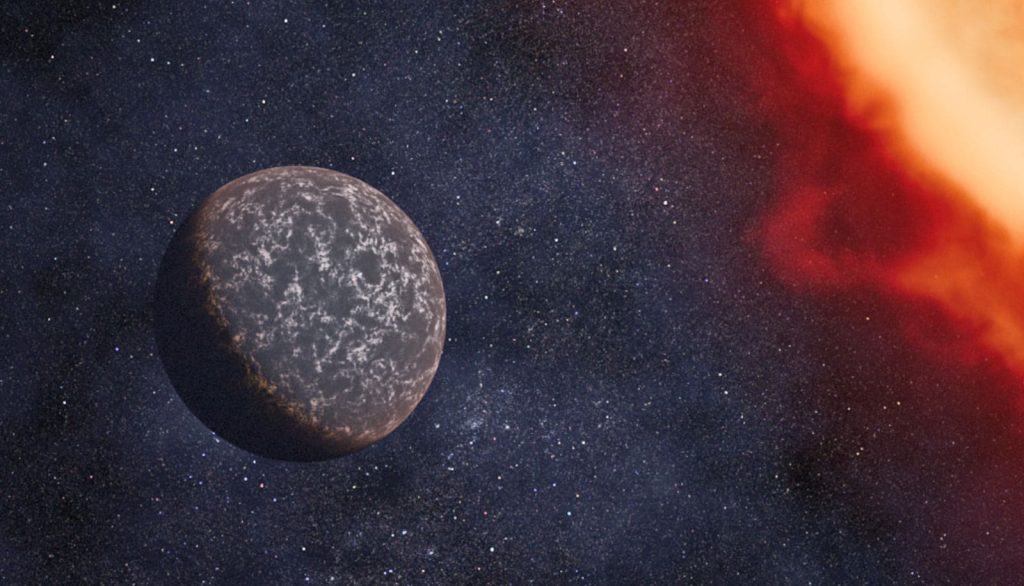
Astronomers have found thousands of worlds in faraway star systems, but one of the questions that’s been hardest to answer is the one that immediately jumps to any human mind: What does the planet look like? By analyzing subtle changes in light, researchers found the planet Kua’kua—which orbits a small star in the constellation Indus—has […]
The post Scientists get their best-ever look at distant planet’s surface appeared first on Knowridge Science Report.
Earth has many unique features for a planet, such as a magnetic field, a large moon, and plate tectonics. It’s also the only planet we know of that harbors life. These facts form the basis of the Rare Earth hypothesis, which posits that we haven’t found aliens because other planets in the Galaxy probably don’t have all the right conditions for life.
Another characteristic of Earth is that about 30% of its surface is land and about 70% is ocean. Recently, Columbia University Assistant Professor David Kipping investigated whether the proportion of Earth’s surface covered by dry land versus ocean, or its land fraction, is another reason Earth is habitable not only for simple single-celled organisms, but also for intelligent species like humans.
To test this hypothesis, Kipping created 4 statistical models of planets with different land fractions that intelligent aliens could potentially evolve on. First, he created an equation to describe the likelihood that a planet in its star’s habitable zone has a particular land fraction, known as a probability distribution. Kipping weighted this probability distribution toward the extreme ends, making it more likely that a planet would be covered by a single huge landmass or a single vast ocean than by a mix of both, as on Earth.
Kipping then incorporated this land fraction probability distribution into his statistical models to calculate the probability that a random planet will have that land fraction and host intelligent life. The 4 scenarios Kipping tested were: 1) that intelligent life is more likely to emerge on land-dominated planets, 2) that it’s more likely to emerge on ocean-dominated planets, 3) that it’s more likely to emerge on planets with roughly equal amounts of land and ocean, and 4) that its emergence is independent of a planet’s land fraction.
As a first step in determining the kinds of planets intelligent aliens would tend to emerge on, Kipping used each model to predict the probability that intelligent life would emerge on a planet with the same land fraction as Earth. He then compared these probabilities by calculating the ratios between each value. Because Earth is the only known planet with intelligent life, a model that predicted a greater probability for humanity’s existence on Earth would be more likely to reflect reality.
Kipping considered it strong evidence that a given model was more realistic than another if the ratio between 2 of them was greater than 10, meaning one model was 10 times more likely to predict the existence of Earth and humanity. Kipping found that no comparison of any 2 models passed this threshold. However, the models assuming that intelligent life prefers ocean-dominated planets or planets with a land-ocean balance were 2.5 and 3 times more likely to predict the existence of humanity than the model assuming that intelligent life prefers land-dominated planets. Additionally, the model assuming that intelligent life prefers a land-ocean balance was always more likely to predict humanity than any other model, though marginally.
Kipping also addressed whether finding more planets with intelligent life would affect which model was deemed most realistic, for example, if scientists discovered conclusive evidence of life on Mars in its distant past. Here, Kipping identified 2 complications. First, it’s uncertain how much of Mars’s surface was once covered by water – some estimate it had a land fraction as high as 81%, while others estimate it was as low as 25%. Second, proving that Mars once had life would not prove it once had intelligent life.
Regardless, Kipping reran the models assuming that ancient Mars had a land fraction comparable to Earth’s. Adding this second data point produced ratios similar to those in the earlier Earth-only calculations, meaning it still didn’t make any single model 10 times more likely to predict the existence of humans and Martians, respectively.
Kipping then took the 10-times threshold and reversed the calculations to find what conditions would exceed it. In doing so, he calculated that astronomers would need to find 14 other planets with intelligent life and known land fractions to robustly determine whether intelligent life is more likely to occur on desert planets, ocean planets, balanced planets, or without bias.
Kipping concluded that he can’t yet definitively state whether there is something special about Earth’s land fraction when it comes to producing intelligent species. However, Earth’s existence would suggest that intelligent life is unlikely to favor extreme desert planets, so the Milky Way probably isn’t filled with Tatooines and Jakkus. And while his analysis doesn’t debunk the Rare Earth hypothesis, it does undermine the argument that Earth’s ocean size explains why Earth is rare.
The post Is Earth’s water why intelligent life evolved here? appeared first on Sciworthy.

China capped a busy month of launches by sending four new satellite internet test satellites into orbit with a workhorse hypergolic rocket.
The post China launches test direct-to-device satellites for multiple projects appeared first on SpaceNews.
São quase 6 dezenas os investigadores, académicos e profissionais da indústria que já integram a RE², uma rede de partilha e debate para os exploradores espaciais portugueses.
The post RE²: esta rede quer por em contacto os exploradores espaciais portugueses appeared first on Tek Notícias.
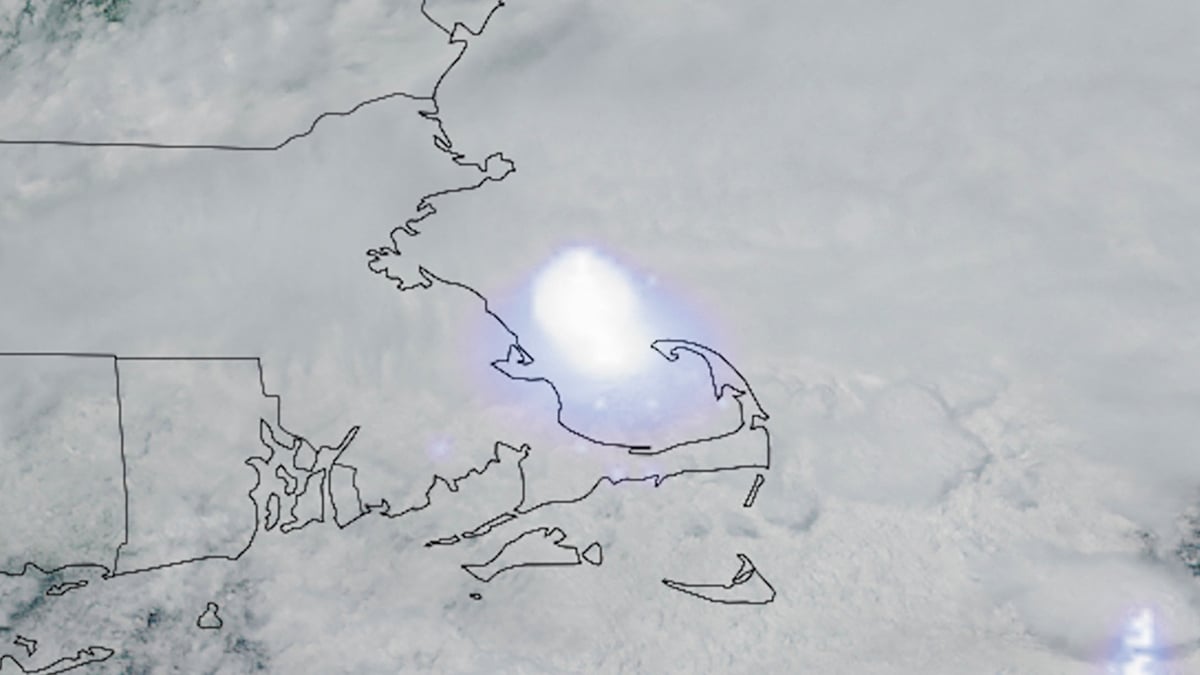 The meteor was traveling at 75,000 mph when it broke apart, NASA says.
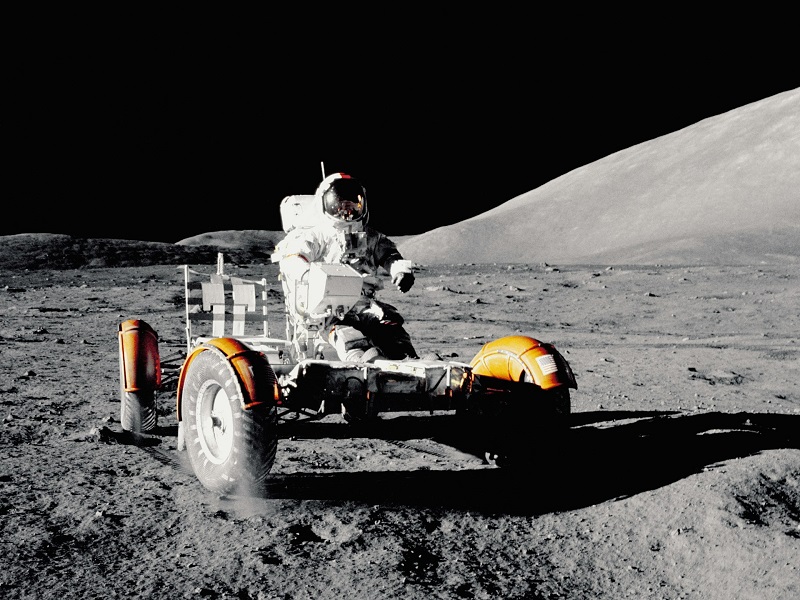
A new race to the moon is emerging between the United States and China. Unlike fifty years ago, the goal is no longer just about landing and leaving, but establishing a base that allows for a sustainable presence and extended stays on the surface of our natural satellite. The objective is now to use the […]
The post Is extracting oxygen from lunar soil the future of space exploration appeared first on Knowridge Science Report.
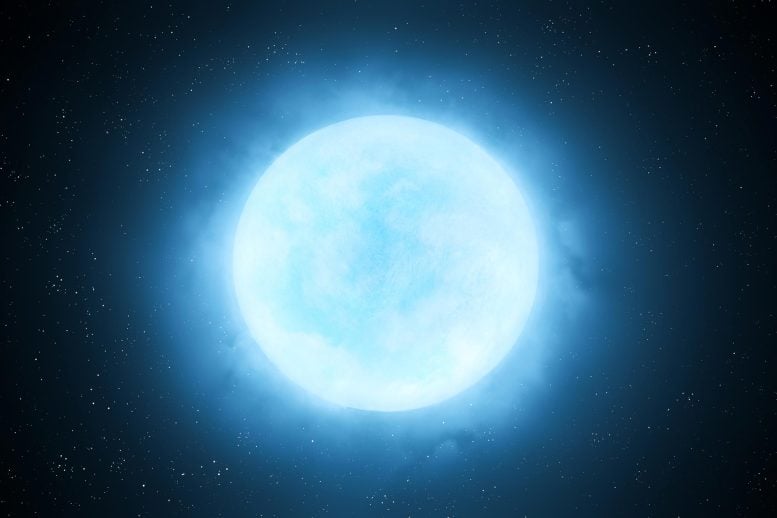 Researchers say the isolated white dwarfs Gandalf and Moon-Sized define a new class of stellar remnant because they share five traits, including X-ray emission. Across the immense scale of the Universe, a single unusual object can prompt astronomers to look for others like it, sometimes leading to the recognition of an entirely new class of [...]
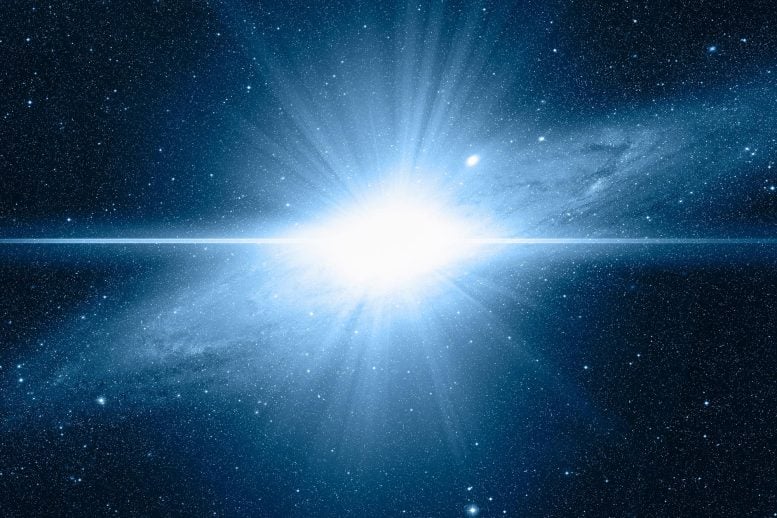 A new method could improve cosmology research by analyzing supernovae together with the galaxies that host them. An international collaboration led by scientists at the Institute of Cosmos Sciences of the University of Barcelona (ICCUB) has created a new approach that may sharpen what researchers can learn about how the Universe expands and what dark [...]
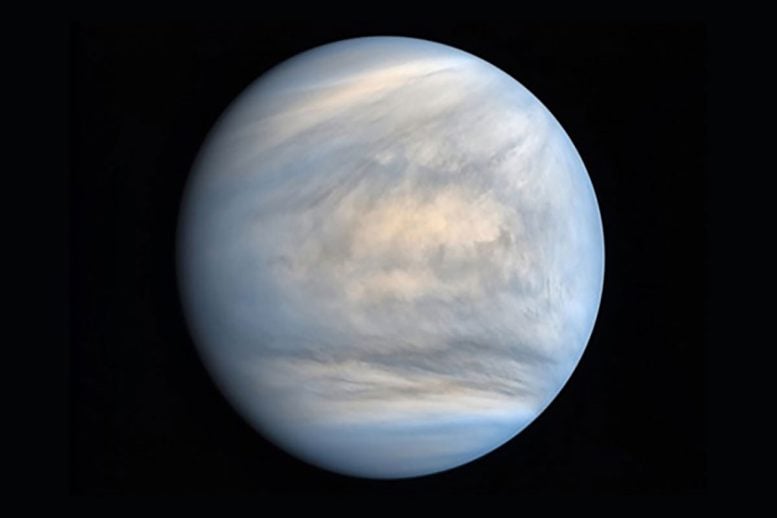 Models suggest that impact-ejected material from Earth could reach Venus’ clouds and potentially survive there briefly. Panspermia is the idea that life, or the ingredients needed for life, can move through space on asteroids, comets, and other objects. If life’s building blocks appear on one planet, a powerful impact could blast material from its surface [...]
| June 9: | Conjunction of Jupiter and Venus |
| June 21: | Summer Solstice |
| June 29: | Full Strawberry Moon |
| June 30 | Asteroid Day |
Summer arrives this month and with it come long, sweltering days along with all-too-brief nights. But if you can dodge the fireflies and stock up on mosquito repellent, there’s still stargazing to be done! This month’s highlight is a conjunction between our solar system’s two biggest show-offs. There’s also the summer equinox to consider—along with a very tasty-sounding full moon.
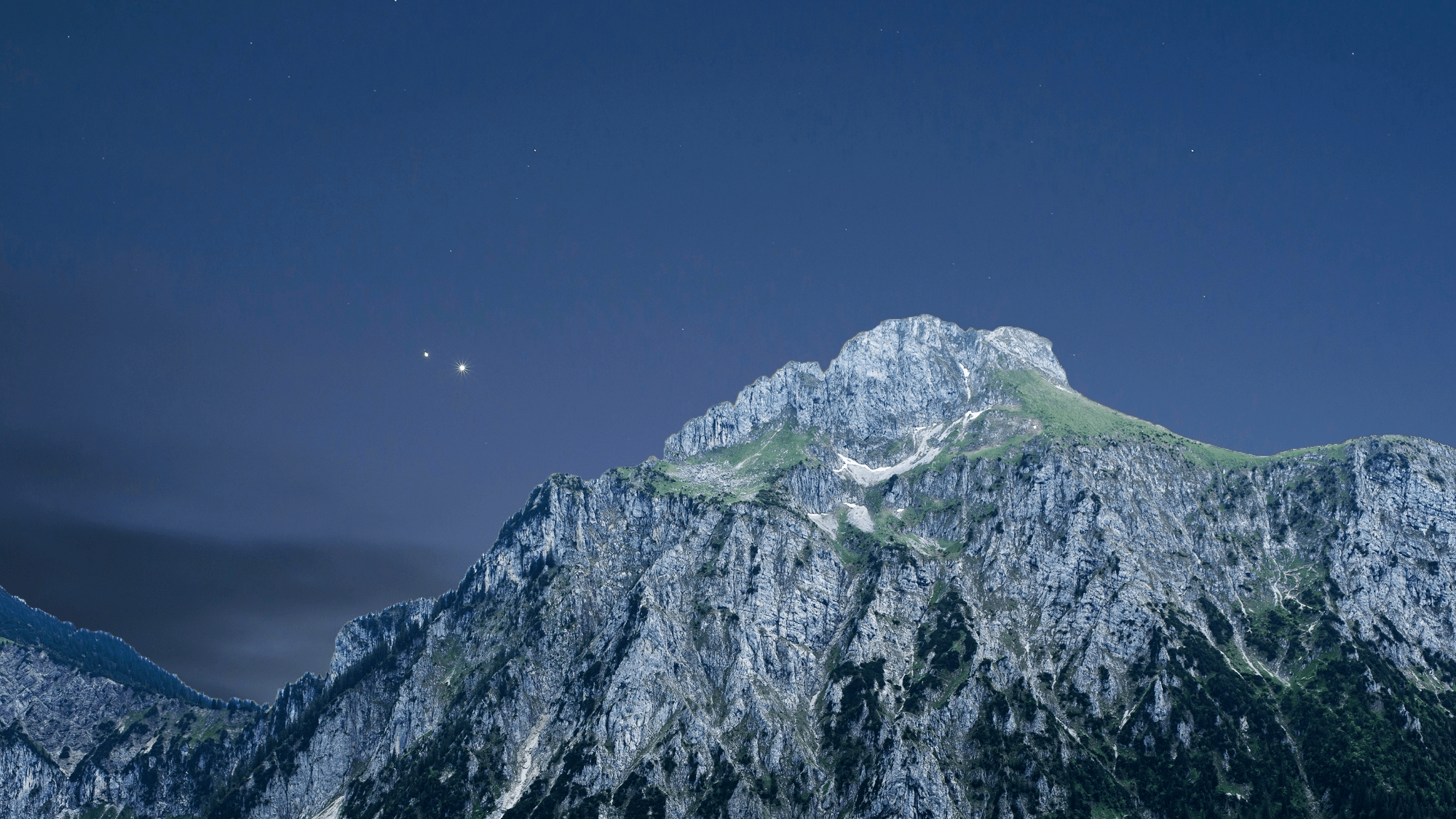
Fellow fans of the solar system’s large adult son may have noticed that Jupiter has been rather quiet of late. But fear not! Our big rambunctious lad is back in the spotlight this month, galumphing his way across the sky toward the beckoning goddess of love. The gas giant will reach his destination early this month, and the result for us earthbound folk will be the chance to witness a Jupiter-Venus conjunction.
The two planets will be at their closest on June 9, when they’ll be spotted lounging happily together above the northwestern horizon just after sunset. There’ll also be a couple of peeping Toms in the vicinity. The twin stars Castor and Pollux will be peeking out in space just to the right of the two planets. Spotting these two malcontents might require binoculars, but Jupiter and Venus should absolutely be visible to the naked eye.
There’s an argument to be made that the longest day of the year is always the Wednesday of the current week. But in a technical sense, the longest day of 2026 arrives on June 21. That’s right—get ready for the summer solstice!
We tend to think of the solstice as the start of summer, but that’s not technically what the term denotes. Instead, it has to do with the Earth’s orbital axis.
The orbital axis is the imaginary line through the north and south poles around which our planet spins. Like many planets, Earth’s orbital axis isn’t perfectly perpendicular to its orbital plane. It’s tilted at approximately 23.44° and the tilt remains constant in relation to the orbital plane. This means that as the Earth moves around the sun, the angle at which it leans toward the sun changes. This is the reason behind our seasons!
The solstice is the day when this tilt toward the sun is most pronounced as shown below.
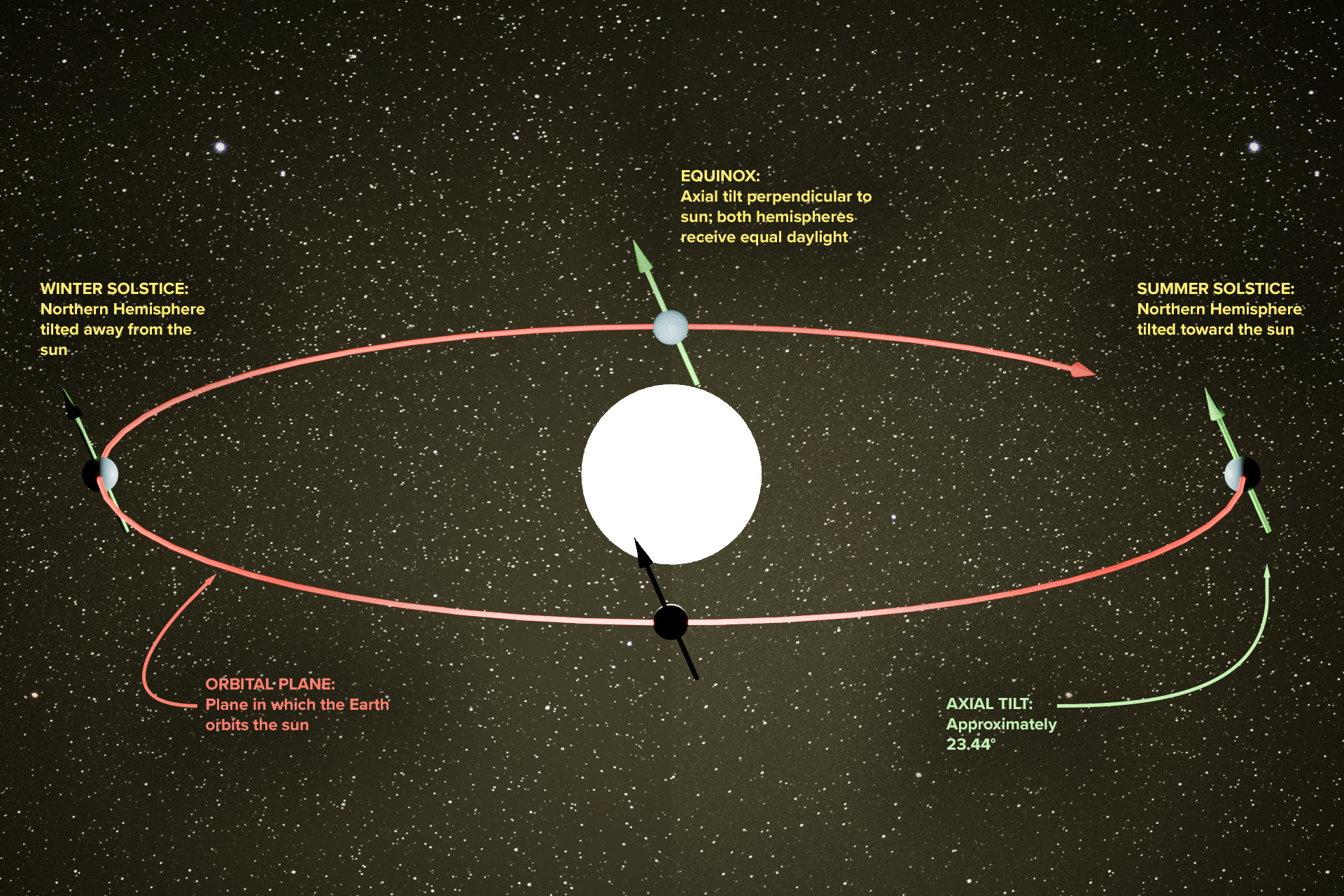
On the left, we see the Northern Hemisphere’s winter solstice, while the Southern Hemisphere is tilted sharply toward the sun. Halfway around, the Earth’s axis is perpendicular to the sun, so neither hemisphere is leaning inward. This is the equinox, and there are two of these every year. On the right, it’s the Northern Hemisphere leaning toward the sun, marking the northern summer solstice—which arrives this year at 10:22 p.m. EDT .
For the last couple of months, we’ve had early full moons. But thanks to May’s Blue Moon, our satellite will wait until almost the very end of the month to emerge in its full sunlit glory. As per the Farmer’s Almanac, the Strawberry Moon’s moniker comes from similar names given to June’s full moon by multiple Native American nations, including the Algonquian, Ojibwe, Dakota, and Lakota peoples. It’s a beautiful and rather poetic name, and a perfect fit for the moon that will rise at the end of this month’s long, hazy summer twilights.
June 30 is Asteroid Day, a day to celebrate the fact that Earth has not been hit by a decent sized asteroid in well over a century. The date was chosen to commemorate the 1908 Tunguska event, the last time the Earth experienced a significant impact. Fortunately for humans, that collision took place in a remote part of Siberia, where it flattened 500,000 acres of forest and caused a shock wave that was felt as far away as Indonesia.
In 2014, the United Nations declared June 30 as a “sanctioned day of public awareness of the risks of asteroid impacts.” So be aware! One of the people behind the idea was Brian May. Yes, the same Brian May who plays lead guitar in Queen. May moonlights as an astrophysicist when he’s not tearing up the fretboard of the guitar he and his father built together in the early 1960s.
When the sun finally does go down, remember that you’ll get the best experience gazing at the cosmos if you get away from any sources of light pollution, give your eyeballs some time to adjust to the darkness, and review our stargazing tips before setting out into the night.
Until next time!
The post June skygazing: A visit to Venus, longest day of the year, sweet summer moon, and asteroids appeared first on Popular Science.

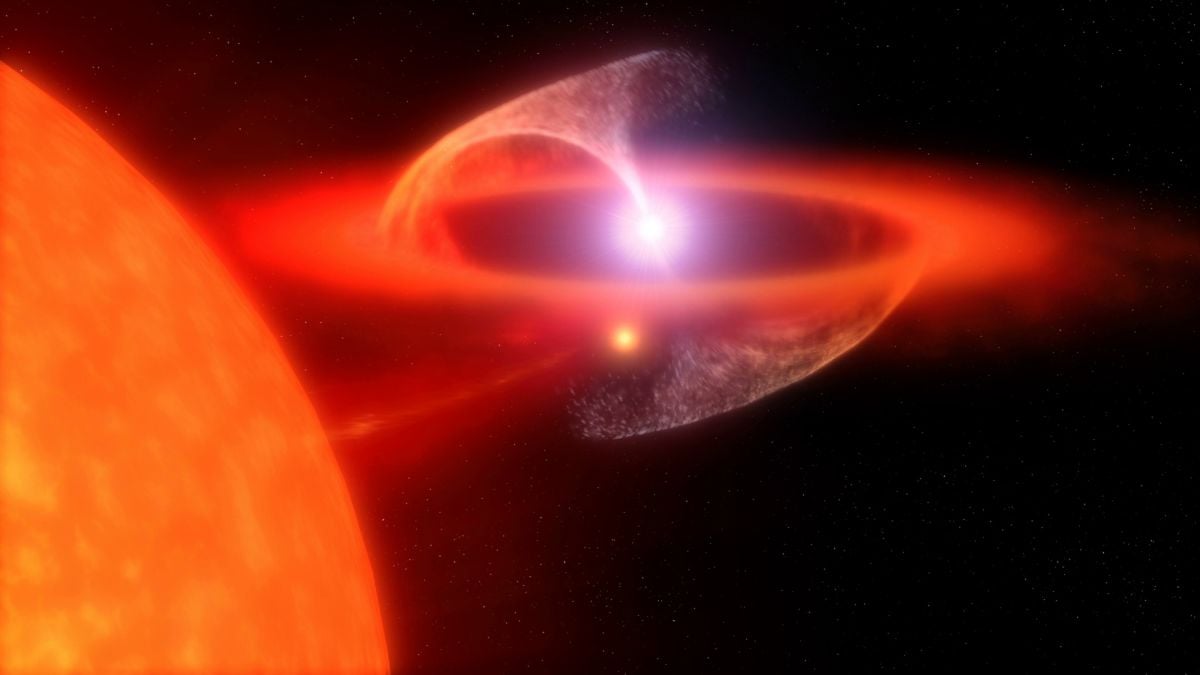 A tempestuous relationship.