Reading view

Earth May Be Seeding Venus With Life, According to New Research

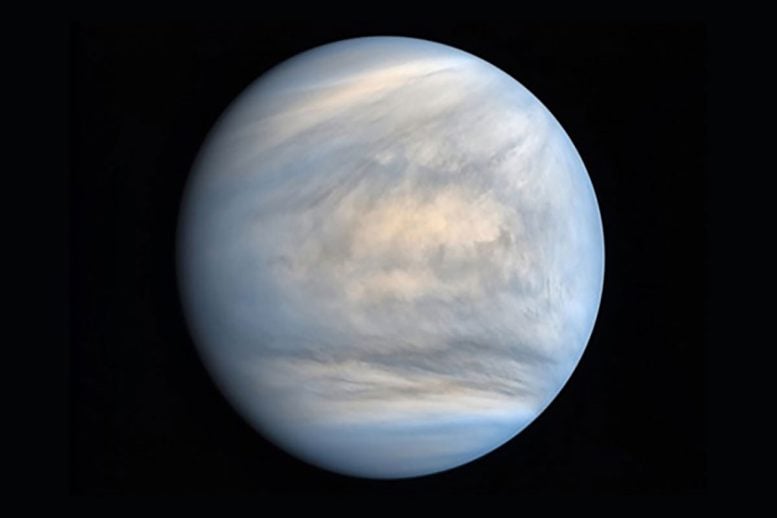
Venus Cloud Layers in UltravioletModels suggest that impact-ejected material from Earth could reach Venus’ clouds and potentially survive there briefly. Panspermia is the idea that life, or the ingredients needed for life, can move through space on asteroids, comets, and other objects. If life’s building blocks appear on one planet, a powerful impact could blast material from its surface [...]
  •  

Characterizing galaxies at “cosmic noon”

The universe is around 14 billion years old, but scientists theorize that no stars formed for the first several hundred million years, during an era known as the cosmic dark ages. They refer to the first billion years or so after this, when stars formed, as the cosmic dawn. At that time, the very oldest galaxies first assembled from collections of gas and plasma. 

As these galaxies assembled and more material became available, the number of stars formed each year increased. Around 2 to 3 billion years after the Big Bang, galaxies grew faster than they ever would, producing stars at the highest rate in the universe’s history. This era is called cosmic noon.

Researchers from the Netherlands recently investigated 3 distant galaxies whose light began its journey to Earth during cosmic noon. They selected targets from a set of ancient star-forming galaxies identified in the ALMA – Archival Large Program to Advance Kinematic Analysis or ALMA-ALPAKA project. Of these, they chose to study 3 galaxies labeled ID1, ID3, and ID13.

They combined 2 different types of data to produce a detailed description of these galaxies. First, they collected data from an enormous telescope comprising 66 antennas in Chile, known as the Atacama Large Millimeter/submillimeter Array or ALMA. They used ALMA to detect radio-wave emissions from carbon monoxide and elemental carbon in these galaxies. The researchers stated that studying these chemicals in distant galaxies could reveal how their free-floating gas clouds move. They also used publicly available data from JWST’s Near Infrared Camera, or NIRCam, to determine how much light the galaxies’ stars emitted. By analyzing cosmic noon galaxies in multiple different ways, the team aimed to measure their masses and the relative contributions of regular matter and dark matter.

They used a computer program developed by other astronomers to interpret the JWST data as a series of maps showing the distribution of stars across each galaxy. They used this light-emission data to estimate the total mass of all the stars in these galaxies. Then they developed an original computer program to map the distribution of gas through each galaxy using the ALMA data. The team used these maps to create plots, known as rotation curves, which show how fast particles orbit each galaxy’s center as a function of their distance from it. 

The astronomers used these rotation curves to estimate the amount of dark matter in each galaxy. They explained that this method works because dark matter is totally invisible, but it still exerts a gravitational pull. Its gravitational pull causes visible material like stars and gas closer to the edges of these galaxies to move faster than they would in galaxies without dark matter. 

The team found that these galaxies had between 39 and 80 billion times the mass of our sun, or solar masses, in stars. They had between 4 billion and nearly 16 billion solar masses worth of free-floating gas. And they had from 1 trillion to 31 trillion solar masses of dark matter.

However, when the team compared the light-emission data with the rotation curves, they found a discrepancy. Typically, dark matter resides in a shell or halo surrounding a galaxy, meaning it should mostly affect material near the galaxy’s outer edge. Since astronomers don’t usually have to account for dark matter near a galaxy’s center, they can calculate the total mass of center material based on the amount of gas and stars they see there. But near the centers of these galaxies, the team found that the masses they derived from the light emissions were less than what they calculated from the rotation curves. 

They proposed multiple potential explanations for this discrepancy. First, they suggested that the halo shape might not be a good model for the dark matter distribution in all galaxies, meaning that cosmic noon galaxies could contain dark matter near their centers. Second, they suggested that stars could be packed tightly in the center of these galaxies, blocking each other’s light emissions. Third, they suggested that galaxy ID1 could have a supermassive black hole as big as 1.5% its total stellar mass at its center.

The team concluded that they now have a detailed picture of the mass distribution in these cosmic noon galaxies, but the reason for their center mass discrepancies remains elusive. They suggested that a complex relationship exists between the dark matter halos and the rest of the material within these galaxies. They indicated that future astronomers could adapt their methods to study the distribution of material in other distant galaxies studied by ALMA-ALPAKA and forthcoming galactic surveys.

The post Characterizing galaxies at “cosmic noon” appeared first on Sciworthy.

  •  

Searching for planets in a galaxy far away

The Star Wars series depicted alien heroes fighting against evildoers and their planet-destroying superweapons “a long time ago in a galaxy far, far away.” But what do scientists really know about alien planets in distant galaxies beyond our own? These worlds, known as extragalactic exoplanets, are expected to exist, assuming the Milky Way is no different from other galaxies. However, we have yet to find them since other galaxies are still too far, far away for modern exoplanet-observing techniques.

Recently, a team of astronomers analyzed a stream of over 700,000 stars that the Milky Way likely absorbed from the dissolving Sagittarius dwarf galaxy. These stars are very distant, so the team investigated whether any of them host large, close-orbiting exoplanets called hot Jupiters, which are relatively easy to find.  

They established a set of 3 criteria to narrow down their list of stars. First, each star should appear bright enough when observed by the Transiting Exoplanet Survey Satellite, or TESS, to ensure high-precision results from the team’s data processing software. Second, each star must have more than a 50% likelihood that it originated from the Sagittarius dwarf galaxy, based on motion and position measurements from the Gaia mission. Finally, each star should have a radius of less than twice the Sun’s, as it’s easier to find planets around smaller stars. They used these criteria to limit their candidate list to around 20,000 stars.

After selecting their candidate stars, the team analyzed publicly available TESS catalog data using the software packages eleanor and TESS-Gaia Light Curve, or TGLC. These tools allowed them to plot each star’s brightness over time, in graphs called light curves. Then, the astronomers looked for periodic brightness dips in these light curves as evidence that an exoplanet passed in front of the star. From this, they excluded several thousand additional stars with too much light interference from their surroundings, reducing their final sample size to just over 15,000 stars.

To find hot Jupiters, the team looked for brightness dips at intervals of 14 hours to 10 days, which is the typical orbital period range for hot Jupiters. Then, they used geometry to derive each exoplanet’s radius from the fraction of the starlight it blocked. They excluded candidates with dips corresponding to objects with radii at least twice that of Jupiter’s, as these are likely caused by orbiting companion stars rather than exoplanets.

Among all the stars they surveyed, the team’s strongest candidate to host a hot Jupiter was a star labeled TIC 92223525. They calculated that this star could host an exoplanet with a radius 1.76 times the size of Jupiter’s and an orbital period of 7.2 days. However, when they reviewed this star’s light curve, they found that it was likely contaminated by its neighbor, TIC 92223526. The regular brightness dips from this system of orbiting stars mimicked that of an exoplanet, creating a false positive for TIC 92223525 that was difficult to detect during initial screening. As a result, the team ultimately excluded this candidate, leaving them with no confirmed exoplanets.

The researchers drew several conclusions from their inability to find hot Jupiters in their sample of stars from the Sagittarius dwarf stream. They estimated that if more than 1% of these stars hosted hot Jupiters, it would have been highly unlikely not to detect one in a sample of over 15,000 stars. This places an upper limit of about 1% on the occurrence rate of hot Jupiters. If this estimate is accurate, then even an ideal exoplanet search team would need to examine over 11,000 stars to find an extragalactic hot Jupiter. Accounting for more realistic levels of scientific uncertainty, a future team would likely need to study at least 80,000 stars to find one. 

Although this survey of the Sagittarius dwarf stream yielded null results, the team suggested that future researchers continue searching it and other star streams from different galaxies. Scientists have identified over 20 such streams in the Milky Way. Researchers studying these streams could find the first extragalactic exoplanet or provide evidence that other galaxies produce fewer hot Jupiters than our own. But let’s hope none of them find the first extragalactic Death Star!

The post Searching for planets in a galaxy far away appeared first on Sciworthy.

  •  

What makes ‘chemically peculiar stars’ peculiar?

Stars are mostly made of 2 elements: hydrogen and helium. While this has always been the case, those 2 elements and lithium were the only elements in existence when the Big Bang occurred around 14 billion years ago. When the first stars exploded, they released those primordial elements, as well as heavier elements produced by nuclear fusion inside them. 

Astronomers call all elements heavier than hydrogen and helium metals, a term chemists use quite differently. Subsequent generations of stars, including the Sun, formed in clouds of gas and dust enriched with these metals, such as carbon, oxygen, magnesium, and silicon. Scientists estimate that modern stars are 1% to 5% metal by mass.

Astronomers claim there is no solid evidence that stars contain exceptionally high amounts of metals, but some, called chemically peculiar stars, appear to. Astronomers study stars by looking at the patterns of light they emit, called spectra. Each element produces a unique light pattern, so astronomers can compare the light patterns in a star’s spectra to determine how much of each element is present, especially in the outer layers of the star. Researchers theorize that chemically peculiar stars don’t actually have more metals than average stars. Instead, they think that metals from their interiors diffuse to their outer layers more than in most stars.

A team of researchers from the American Association of Variable Star Observers and Masaryk University in Czechia recently observed 85 chemically peculiar stars to understand their behavior and better classify them. For their study, they first used the General Catalog of CP Stars, published in 2009 in Astronomy & Astrophysics, to identify targets across the 4 classes of these stars, labeled CP1 through CP4. CP1 stars have strong spectral patterns for iron and other heavy elements, CP2 stars have strong patterns for silicon, chromium, strontium, and europium, CP3 stars have strong patterns for mercury and manganese, and CP4 stars have either unusually weak or usually strong helium patterns. 

The team compiled a list of 85 stars to observe, then used the BRIght Target Explorer (BRITE) Constellation to monitor changes in their brightness. The BRITE Constellation is a set of 5 satellites equipped with telescopes and cameras for either red or blue light. Using the BRITE Constellation, the team monitored each star for several days. 

They found that 74 of these 85 chemically peculiar stars varied in brightness during their survey. They attributed this to the varied abundance of metals on their surfaces, which would form dark patches that go in and out of view from Earth’s perspective as the stars rotate. The team observed that 6 of these 74 stars appeared to change in brightness over multiple periods. They were surprised by this result because a star’s brightness wouldn’t vary over multiple periods if the changes were due to rotation. They compared their findings to data other scientists had collected from these stars with the Transiting Exoplanet Survey Satellite, or TESS, and found that all 6 stars had been misclassified as chemically peculiar stars.

The other 11 chemically peculiar stars appeared to show no periodic changes in their brightness, suggesting that they’re stationary. The team claimed that some CP1 and CP3 stars don’t rotate, but they identified cases in which CP2 and CP4 stars that ought to rotate appeared to be stationary. They suggested 2 potential reasons for this. One is that these CP2 and CP4 stars are misclassified, requiring more thorough analysis of their spectra to confirm their classifications. The other is that the stars rotate slowly, with rotational periods of 50 days or longer, which would be difficult to distinguish from those of totally stationary stars.

The team concluded that more astronomers should revisit the historical classifications of stars, especially as technology advances and more space-based telescopes become available. This strategy would allow future researchers to draw better data from research archives and catalogs. Additionally, they claimed that their method of pairing long-term monitoring via small satellites with TESS data is well-suited for refining classifications, identifying misclassified objects, and further exploring the structure and mechanics of chemically peculiar stars.

The post What makes ‘chemically peculiar stars’ peculiar? appeared first on Sciworthy.

  •  
❌