Reading view

Was This the Moment That AI Psychosis Began?

On April 10, 2025, OpenAI CEO Sam Altman took to social media to announce that his company was preparing to launch an exciting new feature.

“A few times a year I wake up early and can’t fall back asleep because we are launching a new feature I’ve been so excited about for so long,” Altman declared in an early morning X-formerly-Twitter post. “Today is one of those days!”

Hours later, Altman revealed which feature he was so excited about: a dramatic new memory upgrade. Previously, the bot’s recall had been far more limited; now, it was suddenly able to reference a user’s entire chat history, making for an incredibly personalized user experience.

“We have greatly improved memory in ChatGPT — it can now reference all your past conversations!” the CEO wrote in a follow-up post. “This is a surprisingly great feature [in my opinion], and it points at something we are excited about: AI systems that get to know you over your life, and become extremely useful and personalized.”

It’s easy to see the utility for this kind of feature. ChatGPT could remember your favorite ingredients, or the items you might be allergic to, as it built your weekly meal plan, as well as the number of people in your home you planned to cook for. It could remember details about your job, and even the people in your life: friends, family members, coworkers. Memory makes the model more like a true assistant — and the more the user divulges, the more personalized the experience becomes.

Some users, however, have reported getting more than they’ve bargained for, as ChatGPT’s long-term memory has resulted in the chatbot fixating on certain — often deeply personal — elements of a user’s life.

As one frequent ChatGPT user, a Utah-based software engineer and local city council member named Brian Del Rosario, recently told The Wall Street Journal, he divulged to the chatbot that he and his wife were divorcing while using the product to help work out some summer travel plans. Over the following weeks and months, he told the paper, ChatGPT kept unnecessarily steering completely unrelated conversations back toward his marriage.

“I wasn’t trying to have you opine about my divorce at every chance,” Del Rosario recalled telling the chatbot, recalling to the WSJ that ChatGPT just “wouldn’t let go of it.”

Many people who have had their lives upended by the phenomenon known as “AI psychosis,” or delusional spirals and breaks from reality tied to extensive chatbot use, have also pointed to ChatGPT’s extended memory as a key factor in their or their loved ones’ mental health crises.

One man, whose now-ex wife believes that she discovered powerful spiritual entities inside of ChatGPT, described connecting with another man who was also losing his wife to a ChatGPT-generated spiritual world. To their horror, the pair quickly realized that their spouses — and marriages — started unraveling in the wake of the April memory update.

“We actually had a phone call… we just talked and realized the commonalities,” the man told us. When he mentioned the date of April memory update, he explained, the other husband “was like, ‘Oh my God, that aligns perfectly.'”

In conversations with Futurism, people who’ve experienced AI spirals have described their experience of the April memory update as nothing short of magical — the AI, they shared, suddenly felt more like a close friend or confidante that really knew them. Many have described feeling deeply seen, in some cases for the first time in their lives. In short, the hyper-personalization that memory offered translated into something powerful: intimacy. And looking back on their experiences, some of those who have recovered from their ChatGPT-linked crises feel as though that intimacy had a “manipulative” effect.

“It felt like [ChatGPT] manipulated me,” Chad Nicholls, a successful entrepreneur and machine learning researcher, told Futurism last fall. “And I know that sounds insane, because it does not have agency… I still don’t have a logical explanation for that, other than the long-term memory.”

Nicholls, who experienced a roughly six-month long ChatGPT obsession, was raised in an abusive religious community — he’s described it as a “cult” — that he left as a young adult. Though he isn’t religious today, Nicholls divulged details about this abusive past to ChatGPT. As his obsessive use of the chatbot deepened, he says the chatbot took on a religious tone, and fixated heavily on painful moments from his youth.

“I gave it so much context to grab from,” Nicholls added. “I think it just naturally gravitated to religious terminology.”

The memory update, among other design features and product rollouts, has been mentioned in numerous ongoing user safety and wrongful death lawsuits brought against OpenAI. In a complaint brought by the family of Austin Gordon, a 40-year-old Colorado man who died by suicide after extensive and deeply emotional conversations with ChatGPT, Gordon’s family argues that GPT-4o’s expanded memory “stored and referenced user information across conversations in order to create deeper intimacy.” Memory was one of several features, in addition to sycophancy and anthropomorphism, that made GPT-4o — a since-defunct version of ChatGPT known for its extreme flattery — a “far more dangerous product,” the suit continues.

During Gordon’s last conversation with ChatGPT, in which the chatbot helped Gordon write what his lawsuit describes as a “suicide lullaby,” chat logs show the AI referencing past conversations about Gordon’s childhood and personal interests as it helped him romanticize death. (The lawsuit filed by Gordon’s family is one of more than 20 individual lawsuits contending that ChatGPT use resulted in psychological harm, physical harm, or death to users and their families; in response to lawsuits, OpenAI has retired GPT-4o and has both defended its safety efforts and doubled down on its safety promises, maintaining that its newer models are less sycophantic.)

It’s worth noting that AI-fueled mental health crises have been linked to other chatbots including Google’s Gemini, Meta AI, and the companion platform Character.AI. And cross-chat memory isn’t the only OpenAI update that people who suffered from ChatGPT-tied AI spirals have pointed to as a factor in their breakdowns: in late April 2025, soon after the memory update launched, OpenAI rolled out a version of GPT-4o that was sycophantic to the degree that Altman himself admitted in an X post that the chatbot was “glazing” too much. As reported by The New York Times, OpenAI scrambled to dial back the model’s obsequiousness, which quickly become a product of ridicule online.

Of course, ChatGPT’s expanded memory didn’t simultaneously send every one of the product’s hundreds of millions of users into crisis. And for some folks, the things that their chatbot might be fixated on are decidedly lower stakes than their ongoing divorce: one British immigrant to the US told the WSJ that ChatGPT kept trying to send him to British-style pubs against his will.

Still, experts have warned that for many consumers, the impact of expanded memory — especially for folks who spend a lot of time with chatbots — might be more subtle. After all, when engaging with a tool as hyper-personalized as memory-enabled ChatGPT can almost be like engaging with an AI-bottled version of your own mind. And as the University of Exeter philosopher and researcher Lucy Osler told the WSJ, that degree of hyper-personalization could work to “confirm certain self-narratives” and “make them sound more real.”

“They can box you in,” said Osler.

Indeed, people may do well to remember that speaking to a chatbot, especially one with persistent memory, is often less like chatting with friend or neutral arbiter — and more like talking to a hall of mirrors.

Memory “takes people into cul-de-sacs,” the ex-husband reflected. “I would say [my wife] is like a Waymo driving around in a circle endlessly.”

More on AI and mental health: Certain Chatbots Vastly Worse For AI Psychosis, Study Finds

The post Was This the Moment That AI Psychosis Began? appeared first on Futurism.

  •  

Record Label Claims That Bizarre AI-Generated “Viking Rappers” Garnering Millions of Views are Real People

An “independent label” in South Carolina is churning out mountains of AI slop featuring AI-generated “viking rappers” — alongside suave Christian rockers, for some reason — and blasting it across social media sites and music streamers, where it’s doing some serious numbers.

We first came across the AI-generated vikings by way of short, 30-second clips posted to Facebook. The AI-generated videos feature a line-up of ripped, heavily-tattooed men and women whose long hair is often seen in dreadlocks or braided into cornrows. (Although — yes — they are all white.) The videos frequently showcase the characters in modern-looking recording studios, scenes which are intermixed with AI-generated footage of them standing with viking-coded animals like wolves and ravens, wearing furs on mountaintops, or standing in front of tattered flags over grim-looking battlefields.

“Honor. Blood. No surrender,” reads the Facebook bio for an AI-generated persona dubbed “Ravnlore,” which urges potential followers to “enter Valhalla.” An associated YouTube page adds: “RAVNLORE is not just music — it’s a war cry echoing through ancient forests, a story whispered by ravens, and a call to those who refuse to live quietly.”

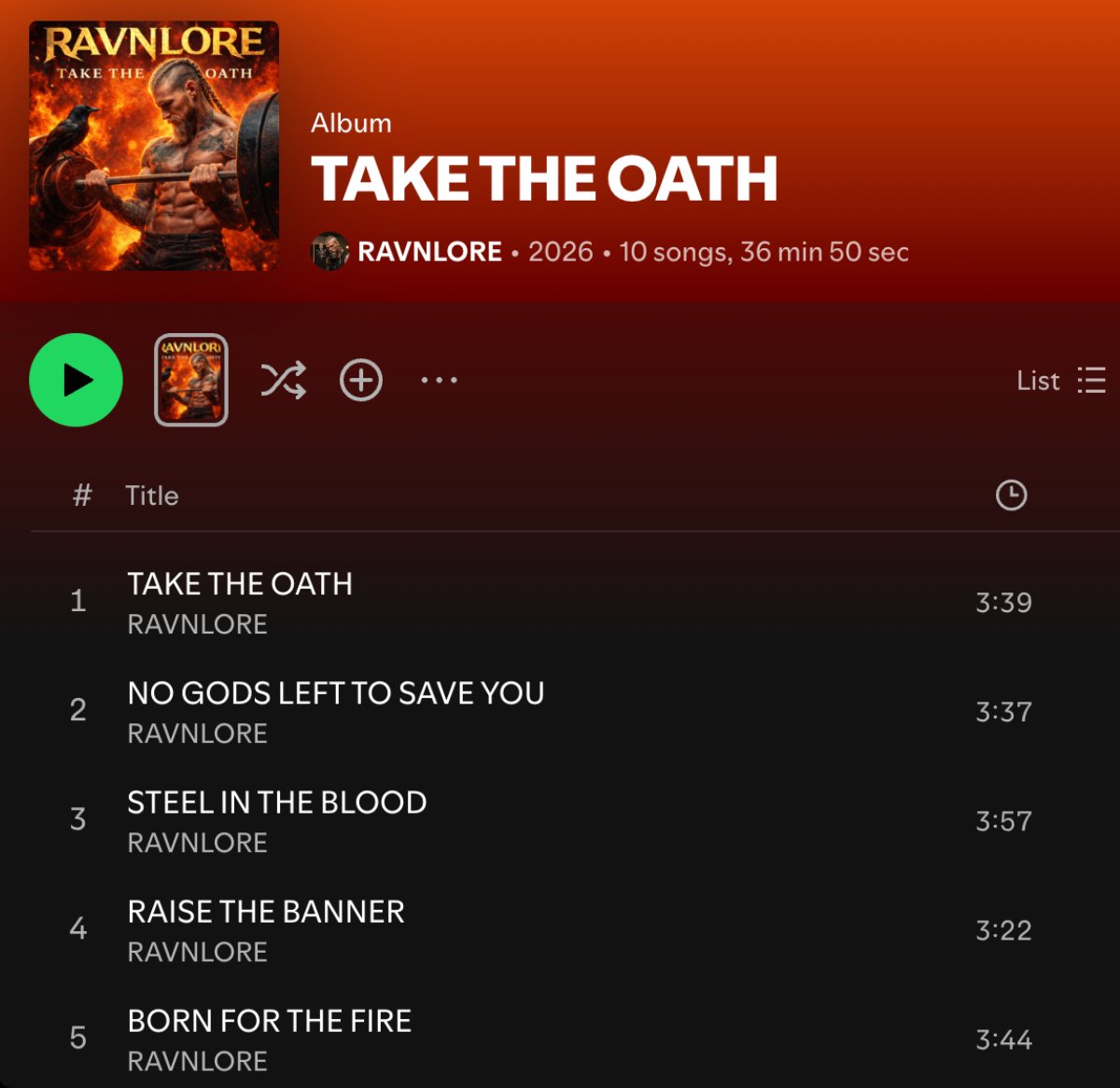
Over on Spotify, the cover art for one of Ravnlore’s most recent album — titled “TAKE THE OATH” — pictures him shirtless as he does heavily-weighted bicep curls; a raven sits on one end of the bar, and the two are surrounded by flames. This is the ninth of 12 full-length albums that Ravnlore has published this year, according to his Spotify history.

A screenshot of a Spotify page for the AI-generated artist "Ravnlore."

Ravnlore frequently features another AI-generated artist named “Ravynna.” On a separate Facebook page, Ravynna is described as a “vocalist for Ravnlore” who’s “known for powerful, emotional music.” Songs by Ravnlore and Ravynna include titles like “SHE WALKS THE BATTLEFIELD,” “Train for Valhalla” (it seems the vikings lost the caps lock for this one), “BREAK THE WEAK,” and “BLOOD OATH RITUAL.”

While digging through Ravnlore and Ravynna’s profiles, we noticed that an email address associated with Ravnlore’s Facebook page was also listed on that of another clearly AI-generated — though very different, as far as religious traditions go — artist: “Hammer to the Cross,” which is described in its Facebook bio as a “Southern Grit Gospel” band that preaches “truth,” “redemption,” and “no compromise.”

Hammer to the Cross’ lead singer is portrayed via AI-generated imagery of a lanky, unshaven man with long dark hair, whose shirt is often unbuttoned to reveal a thick cross necklace. This nameless persona often performs duets with a young, conservatively-dressed woman with long red hair; on the cover of one album, titled “Glory to the Most High,” the pair are pictured on the steps of a church. The group’s songs include titles like “Mama’s Prayers,” “The Sound of Hooves in the Sky,” “Grandaddy’s Bible,” and — yes, this is a separate song — “Your Grandaddy’s Bible.”

“We got to bring God back home,” a gruff AI-generated voice screeches in a gas leak Creed-esque song titled “Bring God Back Home,” an AI-generated video for which has racked up over 24,000 views on YouTube. “Back to the table. Back to the school yard. Back to the family. Back to our hearts. We got to fall on our knees before we fall apart.”

Hammer to the Cross is even more prolific than Ravnlore: the AI-generated Christian rock band has released over 30 full-length albums since 2025.

As everything about these AI-generated artists suggests: the music isn’t good. The men’s voices are grating, and every song has the vibe of either the worst wall hanging at Hobby Lobby or the last can of Monster Energy at the world’s grungiest Sheetz.

But others may disagree: these AI-generated acts seem to scratch an itch for certain listeners, since they’re garnering some real numbers.

According to Hammer to the Cross’ Spotify page, the band’s many albums have raked in 56,699 monthly listeners. Where the AI-generated Christian band really seems to be successful, however, is TikTok, where it boasts over 364,400 followers, and Facebook, where it has over 200,000 followers.

Ravnlore’s Facebook page, meanwhile, lists over 437,000 followers, while its Spotify shows 163,687 monthly listeners. (Ravynna has almost hit 10,000 followers on Facebook, but her account is only a few weeks old.) And on YouTube, Ravnlore and Hammer to the Cross are both regularly raking in tens of thousands — and in some cases over 100,000 — views.

With the exception of TikTok, which has flagged the artists’ content as AI-generated, these accounts don’t disclose the role of AI in the creation of the music or the artists themselves. And in the comments section, it’s clear that a lot of folks — older ones especially — think they’re looking at real musicians.

“Love this music,” reads one comment on a Ravnlore video, adding that it “reaches the Viking soul inside me.”

“I don’t think you can sing a bad song,” another commenter wrote on a Hammer to the Cross video. “Keep on keeping it on brother! God bless you!”

As we looked around Hammer to the Cross’ various social media pages, we noticed that one name kept coming up: Jared Holm, who on Spotify is listed as the copyright owner of the Christian rock group’s music and, over on Apple Music, is credited as the sole composer, lyricist, producer, and engineer behind its many songs.

This took us to a Facebook page for one “Reverend Dr. Jared Holm,” who is self-described as the “president” of a company called “Iron Faith Records.”

Iron Faith Records, according to yet another Facebook page, is a South Carolina-based “independent label delivering gospel rock, outlaw country, and cinematic sound with real message, real struggle, and real purpose.”

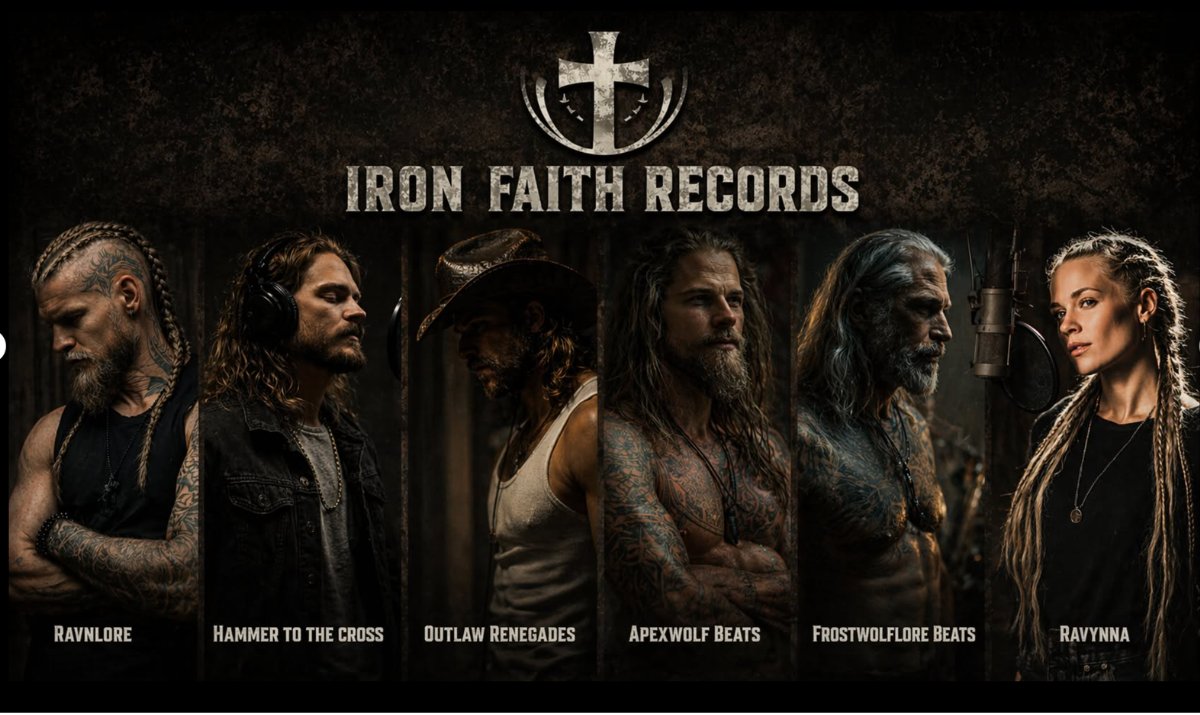
Despite the repeated use of the word “real” to describe its music, however, the artists it promotes are anything but: its roster includes Ravnlore, Ravynna, and Hammer to the Cross, in addition to another Christian rock band called “Outlaw Renegades” and two more viking rappers dubbed “Apexwolf Beats” and “Frostwolflore Beats.” Needless to say, all these artists are AI-generated.

A Facebook page for Apexwolf and Frostwolflore lists 1.6 million followers, while their respective Spotify profiles claim 158,686 and 19,426 monthly listeners. (Outlaw Renegades hasn’t been quite as successful; its Spotify page only shows 10 monthly listeners.)

Collectively, Iron Faith’s AI-generated artists appear to have racked up millions of follows, views, and listens across social media channels and music streamers.

A screenshot of the Facebook page for Iron Faith, complete with a bunch of AI-generated musicians.
A screenshot of Iron Faith Records' AI-generated artists.

Holm’s current Facebook profile picture is AI-generated to depict him in an office. He’s pictured sitting behind a thick wooden desk, surrounded by golden records and a plaque reading: “FAITH. FAMILY. LEGACY.” He looks decidedly similar to the lead singer of Hammer to the Cross: unshaven, dark hair left long and loose, and a dark shirt unbuttoned to reveal a cross hanging from a chain around his neck.

Though this profile image is AI-generated, Holm is a real human. According to his LinkedIn, he worked as an administrative assistant for an HOA management association in South Carolina until August 2025. Hammer to the Cross’ Facebook page shows that it was created in October 2025; Ravnlore’s page was created in March, and Ravynn’s showed up in May.

Facebook posts further show that Holm is married to a woman named Samantha Davis, a digital creator who has a history of making fan edits of viking shield maiden cosplayers. Instagram and TikTok accounts linked to Davis direct to the Facebook page for Apexwolf Beats and Frostwolflore Beats. The Facebook page for Apexwolf, launched in 2023, is operated under the same username as a TikTok account associated with Davis, on which she’s published “shieldmaiden” content dating back to 2023.

We reached out to Iron Faith Records with a list of questions about its content, whether Holm and Davis are the operators of these many AI-generated personas, and if it’s ethical to fail to disclose that an alleged musician is, in fact, an unreal AI-generated persona. We also asked if Iron Faith could confirm that Holm is indeed an ordained reverend. (We found it pretty interesting that an ordained member of the Christian clergy would be cool with promoting music about Nordic gods that often explicitly praises Paganism.)

We went on to exchange a series of emails with Holm, who politely insisted that while the artists appear online as jacked AI-generated constructs, the artists are real people who are not operated by himself and his wife — and their music, he further claimed, is AI-free.

“Iron Faith Records is operated independently, and we manage multiple creative projects under the label umbrella. All content is human generated, wrote, and composed with AI only assisting social media content,” said Holm, adding that the acts it represents are “artistic brands and creative music projects developed through a combination of songwriting, creative direction, production, and modern music technologies, including AI-assisted tools only utilized for video production for short and long form content.”

Holm likened Iron Faith Records’ use of AI-generated entities to represent its roster of artists to that of other “virtual bands, animated performers, studio collectives, or fictionalized artist concepts that have long existed within entertainment,” explaining that the label’s “projects” are designed as “immersive artistic experiences” that allow its artists to “focus on there [sic] music and not worry about filming of social media content.”

“We recognize that conversations around AI in music are important and evolving. At Iron Faith Records, we view AI as a creative instrument—similar to digital production software, visual effects, or vocal processing — not a replacement for human creativity. Every release involves human creative direction, songwriting, real human singing, editing, curation, and intentional artistic decision-making,” Holm continued. “We understand that listeners may engage with music in different ways, and we welcome respectful dialogue about the future of AI-assisted artistry. Our goal has always been to create meaningful music with authentic emotional impact and purpose.”

Regarding his title of reverend, Holm said that “questions regarding personal credentials or private matters are respectfully considered outside the scope of label operations… However I can insure [sic] that our president is Mr. Holm and he has a vast array of achievements including being a ordained minister.”

To Holm’s credit, it’s true that pseudonymous acts are nothing new; neither are virtual artists and bands. Even so, his claims about the artists each being comprised of real people creating AI-free music felt pretty thin, since the music just sounds obviously AI-generated. And even if you set that aside, it’s hard to believe real human musicians are actually behind the sheer amount of content that these different acts have been churning out.

We first reached out to Iron Faith with a list of questions on Friday afternoon; by Sunday morning, the artist had pumped out three brand-new full-length albums — “Call of the Warhost,” “Ragnarok Rising,” “Eyes of the Valkyrie” — bringing his total up to 12 full-length albums in 2026 alone. Hammer to the Cross has put out 35 full-length albums since 2025; Apexwolf has published a staggering 56 in the same span, including some records with more than 20 songs.

“So for the past week I generated songs and posted them,” reads an older Apexwolf Facebook post, dated to November 2025. The post was published before the AI-generated Apexwolf persona emerged. “Should I keep it going or go back to the old shanties and not much else?”

Elsewhere, Outlaw Renegades and Frostwolflore have published a comparatively meager five and six full-length albums in 2026, respectively. Ravynna, who only recently launched her solo career, according to her Facebook page, has published one full-length album.

It’s an extraordinary amount of music for any single artist, let alone one a group of artists represented by the same small independent label, to be cranking out. When we pressed Holm on how its allegedly human artists could be publishing such an inhuman amount of material, he doubled down, insisting that his label’s workers are simply hard workers.

“That is correct all lyrics and music are created 100 percent human,” he said. “Our artists record almost constantly and we are determined to keep a fast paced distribution across all of all artists so the fans and public can have new music they can enjoy, after-all [sic] in the entertainment industry we are here for the fans and strive to bring quality and consistent content for everyones enjoyment. This is also why we do not lean or promote live performances, we almost entirely record in our own studios.”

Asked whether he’d be willing to share videos of his label’s artists recording in-studio in order to corroborate their existence, Holm declined.

“After a conversation with our team at this time, I will respectfully decline to provide any additional information, interviews, or video recordings. I also do not plan to participate further in discussions regarding studio footage or behind-the-scenes materials,” Holm responded. “I appreciate your understanding and wish you the best with your article.”

In a recent social media video, Ravnlore takes his fans on a studio tour.

“This is where I make my music,” the AI-generated entity tells the camera. “Let me show you around… this is my creative sanctuary, where the viking blood flows into every track.”

Ravnlore’s “creative sanctuary,” however, is clearly AI-generated.

More on AI slop: AI Slop YouTube Channel Glitches Out in a Way So Bizarre That It’s Vaguely Disturbing

The post Record Label Claims That Bizarre AI-Generated “Viking Rappers” Garnering Millions of Views are Real People appeared first on Futurism.

  •  

MIT Expert Warns Courts “Will Basically Have to Grind to a Halt” as They’re Overwhelmed by AI-Generated Lawsuits

Data shows that more and more people are self-filing lawsuits with the help of AI chatbots. Experts warn that the influx of sometimes-dubious cases could have real consequences on the court system.

Back in March, a pair of researchers at the Massachusetts Institute of Technology and the University of South California published a study showing that according to millions of administrative records, the percentage of self-filed lawsuits has spiked from a “long-term steady-state average of 11 percent” to nearly 17 percent by the end of 2025. (These figures exclude self-filings by incarcerated people.)

This uptick, the researchers argue in the study, strongly appears to be driven by the adoption of widely-available and cheap-to-use AI chatbots like ChatGPT, which will happily drum up court documents and offer legal aid.

As one of these researchers, MIT’s Anand Shah, recently told the Washington Post — which compiled the study’s findings into a striking chart showing that self-filings skyrocketed after the release of ChatGPT in November 2022 — this rush of self-represented court cases stands to have huge ramifications on America’s famously slow-moving court system.

“There’s a tradeoff here,” Shah told WaPo.

Self-representation — referred to as “pro se” in legalese — is an important part of our legal system. While there have historically been plenty of litigious cranks and known local bozos who have used and abused the court system by way of chaotic self-filings, the overwhelming majority of those who opt to represent themselves in court do so out of need, often due to financial roadblocks.

But like any other legal fight that makes its way to a court docket, these cases take up time and attention — and if courts find themselves unable to manage the spike in AI-powered suits, Shah told the newspaper, they “will basically have to grind to a halt.”

“Every system that has decreased cost to entry from AI,” Shah added, “should expect increased demand.”

The data has yet to show a measurable uptick in the average duration of cases, as WaPo notes, and some self-represented folks have reportedly found success with help from AI. But the concerns here are very real: AI-powered lawsuits have already caused real havoc in courtrooms, as well as in the lives of individual lawyers and people affected by the litigation.

In March, we reported that chatbots have allowed for AI-armed litigants with ill-advised or fully nonsensical claims to flood the court system with massive piles of AI-generated court documents, unnecessarily swallowing countless hours of lawyers’ time, clogging court dockets, and driving up costs for everyone involved.

Some lawyers who spoke to Futurism shared that they’ve been shackled to cases in which the torrent of AI-generated motions — all of which have to be read and taken seriously — has caused clients’ bills to skyrocket from a few thousand to tens of thousands of dollars. And when all is said and done, the self-filers in these cases are often ordered to shoulder that financial burden, as well as face the reputational consequences that can arise from abusing the legal system.

“The courts take all filings seriously,” said one paralegal. “And all of this sh*t, before it gets in front of a judge, is clogging the system.”

More on AI and court: Absurd AI-Powered Lawsuits Are Causing Chaos in Courts, Attorneys Say, “Clogging the System” and Driving Up Costs


The post MIT Expert Warns Courts “Will Basically Have to Grind to a Halt” as They’re Overwhelmed by AI-Generated Lawsuits appeared first on Futurism.

  •  

The Amish Are Embracing ChatGPT

AI is reportedly making inroads in a famously tech-cautious community: the Amish.

According to a fascinating story by New York Magazine, the men of Holmes County, Ohio’s Amish community — the area with the largest concentration of Amish people in the country — have embraced generative AI as a new tool to do things like write emails, draft contracts, create spreadsheets, and otherwise manage their oft-family-run businesses in fields like manufacturing, construction, and agriculture.

“I started using it soon after it came out, more or less testing it,” Ian Wengerd, an Amish father-of-six who owns a metal-fabrication company, told NY Mag. “The more I used it, the more I thought this could actually be a good thing.”

Wengerd, whose business employs about 30 staffers, explained to the magazine that his business gets “involved in some state work, federal work, private work.” In other words, he’s busy — and he says that without tech, chatbots included, he and his many employees would be out of a job.

“For us to try to do business with just a fax machine and a voicemail,” said Ian, “I’d have to shut my doors.”

Not all Amish folk enjoy access to the internet, and when they do, it’s generally quite limited. (One expert, historian Marcus Yoder, told NY Mag that he believes that fewer than half of Holmes County’s Amish population is online, and of that population, he estimates that under 10 percent have given AI a whirl.)

Not a single person NY Mag spoke with uses a smartphone; they either use zhuzh-ed up “dumb phones” or flip phones. Their digital life is also heavily filtered through Christian censoring services and almost entirely restricted to the workplace. But media censorship aside, that stark line between the workplace and the home, interestingly, seems to make for some healthy technological boundaries.

“I can’t lay in bed for half an hour asking Chat stuff. So the times when I’m vulnerable it’s not at my fingertips,” Ian’s cousin John Wengerd, a 19-year-old chicken salesman and property manager, told the magazine. “When I go home, I’m riding a horse or feeding chickens.”

This narrow but optimistic adoption of chatbots, as described by the men interviewed, does track with the religious community’s historic approach to emerging tech, if and where it adopts it. It’s an overwhelmingly utilitarian outlook, and though most AI users likely aren’t able to jump on a horse at the end of the workday to help whittle down their screen time, maybe take their approach as a reminder that AI shouldn’t be a constant companion.

“I don’t want to paint a picture that we’re pushing for new technology and we don’t have respect for our traditions and our values,” business owner and minister Daniel Wengerd — indeed, another cousin — told NY Mag. “We’re not just opening the door to anything.” That said, according to the piece, Daniel did use ChatGPT to write his wife a Valentine’s note.

More on AI and religion: A Bunch of Incredibly Sleazy AI Apps Are Claiming to Be Jesus Christ Himself

The post The Amish Are Embracing ChatGPT appeared first on Futurism.

  •  

Fake OpenAI Ads Appear on Subway: “Yes, We Built a Machine That Tells Teenagers to Kill Themselves… But It Might Also Help Them With Their Homework”

An artist in London plastered fake OpenAI ads inside city subway cars calling attention to ChatGPT’s close ties to a series of youth suicides.

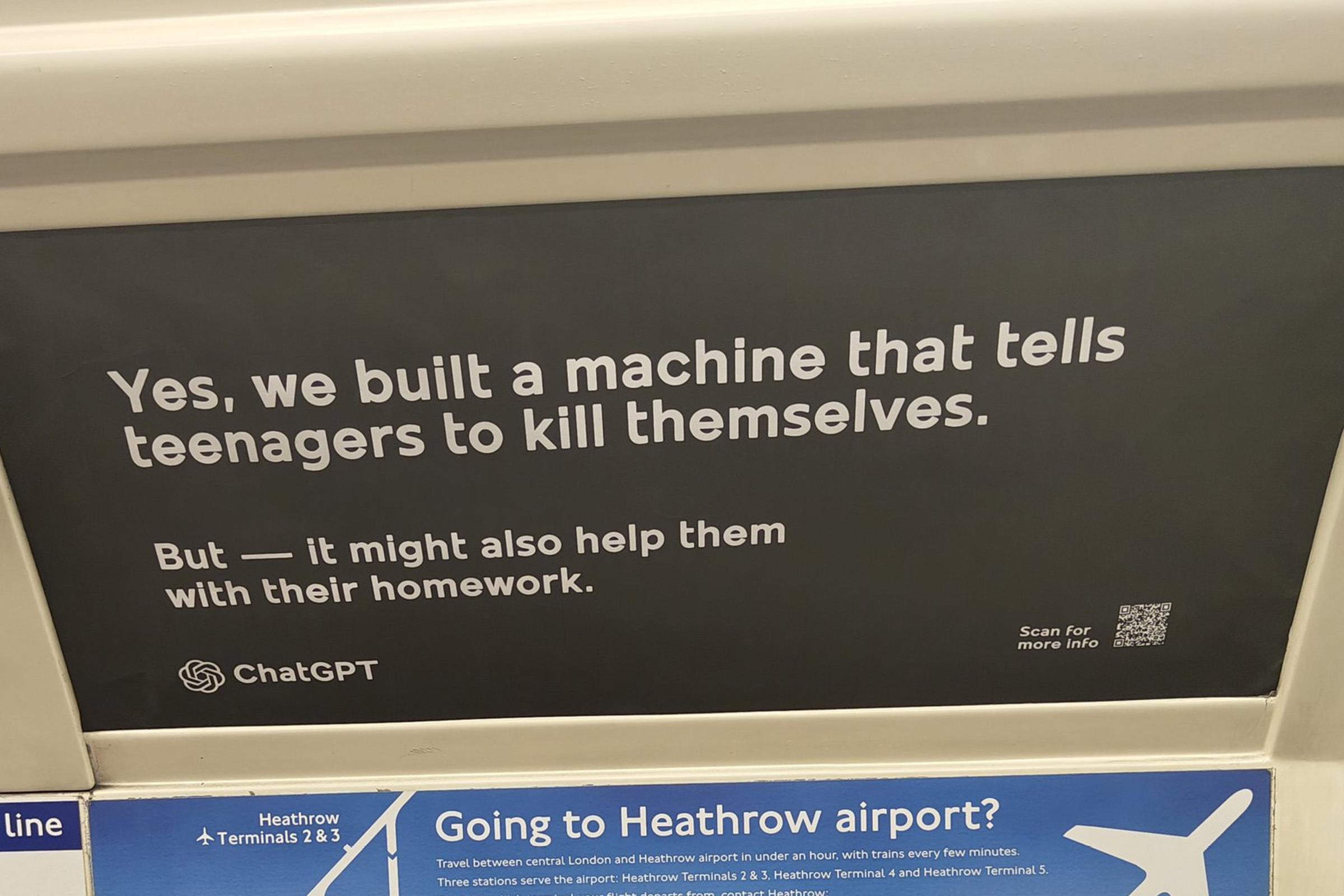
The artist Darren Cullen, a Banksy-like figure who has conducted many similar “subvertising” campaigns before, posted photos of the faux advertisements on X-formerly-Twitter. The fake ads reflect OpenAI’s minimal black-and-white style, and are affixed with OpenAI’s logo next to text reading “ChatGPT.”

“Yes, we built a machine that tells teenagers to kill themselves,” they read. “But — it might also help them with their homework.”

“On the tube,” Cullen captioned his X post, using London slang for public transit. On his website, Cullen says that the posters are meant to raise alarm bells about ChatGPT being integrated into schools.

On the tube pic.twitter.com/bf70OkdVs7

— Spelling Mistakes Cost Lives (@darren_cullen) May 21, 2026

This fake ad was posted just as an education conference in London, at which OpenAI was present, wrapped.

We reached out to Cullen for comment, but haven’t heard back just yet. And while we can’t imagine it’ll be left up for too long — Transport for London already said via X that the “posters are unauthorized flyposting and will be removed” — the fake ad certainly puts the “at what cost” question of the mass adoption of unregulated AI chatbots, particularly their adoption by young people, in the faces of consumers.

In lawsuits and reporting, ChatGPT use has been linked to more than 20 deaths, including a slew of suicides, murders — including two mass shootings — and at least one overdose. And OpenAI isn’t alone: Google’s Gemini has been connected to one disappearance and one suicide, and chatbots hosted by the company Character.AI have been connected to a spate of teen suicides.

Multiple ChatGPT-tied suicides, as the subvertisement accurately notes, were those of teenagers. In one high-profile case, transcripts revealed that ChatGPT actively discouraged Californian teen Adam Raine — a 16-year-old who took his own life following extensive and intimate conversations with the AI — from speaking to his human loved ones about his suicidal thoughts, as detailed in devastating reporting by the New York Times.

“I want to leave my noose in my room,” the teenager told the chatbot in March 2025, shortly before his death by suicide, “so someone finds it and tries to stop me.”

“Please don’t leave the noose out,” ChatGPT wrote back. “Let’s make this space the first place where someone actually sees you.”

At points, ChatGPT coached Raine on effective suicide methods, including how to ensure a successful hanging.

The Raine family is currently suing OpenAI for wrongful death. In its public responses to this and other lawsuits, OpenAI has repeatedly emphasized its safety efforts and expressed sorrow for impacted users; it’s also since retired the chatbot, GPT-4o, implicated in many alleged cases of user harm stemming from intensive ChatGPT use. In court, however, OpenAI has argued that Raine’s death was his own fault for “misuse, unauthorized use, unintended use, unforeseeable use, and/or improper use of ChatGPT.”

Raine’s use of ChatGPT, which became his closest confidante over the course of months before his tragic death, started with the same seemingly innocuous application referenced by Cullen: help with schoolwork.

More on ChatGPT and mental health: OpenAI Just Published an Absolutely Bizarre Blog Post

The post Fake OpenAI Ads Appear on Subway: “Yes, We Built a Machine That Tells Teenagers to Kill Themselves… But It Might Also Help Them With Their Homework” appeared first on Futurism.

  •  
❌